
CHAPTER 22

Republican 1864 presidential campaign poster featuring a portrait of Abraham Lincoln.
In the fall of 1864, as Grant continued to hold Lee in his defensive lines around Richmond and Petersburg, the opposing armies in the west headed off in opposite directions. Confederate General John Bell Hood, having failed to keep Sherman out of Atlanta, marched northward, hoping to draw the Yankees out of Georgia. Sherman followed him for a week, but then let him go and returned to Atlanta. As Hood continued first westward, then northward into Tennessee, Sherman prepared for his famous march to the sea.
Even as readers digested this important military news, most eyes turned by late autumn to an altogether different kind of American battleground: that of presidential politics. With Atlanta fairly won and Sherman advancing inexorably through Georgia, Lincoln’s re-election fortunes seemed to be on the rise. But neither Confederates nor Democrats were ready to surrender without a fight.
Readers of the antiwar New York World, for example, were treated to relentless, racially tinged attacks on the administration, not limited to the pages of the daily paper. The World also masterminded an elaborate “dirty trick”meant to convince voters that Republicans secretly planned to move beyond emancipation and introduce full racial integration. The newspaper covertly issued an incendiary book titled Miscegenation — a new word derived from both Greek and Latin to mean “race mixing”— which trumpeted, in a concealed tongue-in-cheek style, a future society in which blacks could intermarry with whites. Then the publishers audaciously sent a copy to the President himself, seeking the era’s equivalent of a blurb. Lincoln proved too clever to take the book seriously; sniffing out the hoax, he simply filed it away.
The World would not rest, however, and also financed a series of demagogic campaign lithographs charging, among other things, that the Union commander-in-chief had callously requested a comic song while touring an Antietam battlefield littered with dead soldiers. Lincoln was so infuriated by this particular calumny that he drafted an indignant reply, though in the end, as was often the case, he decided not to send it. Finally came a caricature called (like the book) Miscegenation, showing the President bowing to greet a mixed-race couple in a scene in which minstrel-like blacks assumed the superior position to whites. The race-baiting worked at least on one level: the World’s nasty campaign managed to embroil most of the town’s leading Republican dailies in an ugly internecine fight — with each accusing the other of being too soft on amalgamation of the races.
Regaining the offense by October, Republican newspapers countered with a string of pro-Lincoln, anti-McClellan editorials, none as vociferous as those in The Times. Its editor, Henry Raymond, was continuing his open second career as chairman of Lincoln’s re-election campaign — a role that today would be regarded as an intolerable conflict of interest. In mid-century America, it seemed no more unnatural than the defiantly outspoken, undisguised partisan biases of the newspapers themselves.
Events helped Lincoln as much as Raymond did. In mid-October, the Union turned defeat into triumph at the Battle of Cedar Creek, capped by one of those instances of personal heroism that assumes the proportion of legend. General Philip B. Sheridan was returning to the Virginia front from a visit to Washington when he learned the news of an unexpected, nearly disastrous predawn attack on his distant army. He quickly began a dramatic gallop to the front at Winchester, rallying despondent troops all along his path. “On he rode,” an eyewitness recalled admiringly, “his famous war-horse covered with foam and dirt, cheered at every stop by men in whom new courage was now kindled.” The Heroism of “Little Phil” not only aroused his troops, it also inspired a famous poem and an equally renowned painting. Sheridan won the official thanks of Congress and a promotion to major general in the regular army, and the Union declared victory in the crucial Shenandoah Valley Campaign.
Around the same time, on October 11, early statewide elections in Ohio, Indiana, and Pennsylvania showed significant strength for the rebounding Republicans — a clear indicator of a comfortable victory in the national polling the following month. Just three days later, one of the most influential and enduring of Lincoln’s Democratic critics died. Chief Justice Roger Brooke Taney, who had led the tribunal for nearly three decades, authored the infamous Dred Scott decision, and futilely attempted to block Lincoln’s assumption of executive authority early in the war, finally expired at the age of 87. By the end of the year, after taking his time to fill the vacancy, Lincoln nominated another longtime nemesis, his former Treasury Secretary Salmon P. Chase, to be Taney’s successor. In one deft move, Lincoln shrewdly silenced a long-irritable rival, while elevating a proven antislavery man to a court almost certain soon to hear vital test cases on emancipation.
Election Day proved a triumph for Abraham Lincoln. On November 8, the President easily won his once-hopeless campaign for a second term with nearly 56 percent of the popular vote and an overwhelming 212 electoral votes to George B. McClellan’s mere 21 — with only Delaware, Kentucky, and New Jersey falling to the Democrats. In the separately tallied soldiers’ vote, which the Republicans had worked assiduously to count, Lincoln won 116,887 to McClellan’s 33,748 — as much an overwhelming vote of confidence in the war effort as a stinging rebuke of the general and his party’s so-called peace platform. Two days later, McClellan officially resigned from the army and confided: “For my country’s sake, I deplore the result.”
Not surprisingly, Lincoln saw the mandate differently. Appearing at the White House to acknowledge a victory serenade the same day as McClellan shared his lament, he characteristically celebrated not his own victory, but the mere fact that the people had successfully carried off a free election. “It has long been a grave question whether any government, not too strong for the liberties of its people, can be strong enough to maintain its own existence, in great emergencies,” he told the crowd. As he explained: “We can not have free government without elections; and if the rebellion could force us to forego, or postpone, a national election, it might fairly claim to have already conquered and ruined us.”
For weeks, during the run-up to Election Day, rumors had abounded in New York that Confederate agents were about to strike against the city in order to disrupt the polling and throw Lincoln’s expected victory into turmoil. Many dismissed these stories, arguing that local voters were disposed to vote against the President (which they did), and any attack would actually help the Republicans by curtailing turnout in the overwhelmingly Democratic metropolis. Election Day came and went without incident, but New York was not to be spared. Less than three weeks later, agents who today would be called “terrorists” tried to burn down hotels, theaters, and other public buildings in New York. The plot fizzled, but not without attracting headlines, analyses, editorials, letters, and a collective sigh of relief that the damage was so minimal.
Having won a ringing vote of confidence, Lincoln received yet another gift before year’s end. After more than eight weeks of marching through Georgia — with only a scattering of reliable reports reaching a North collectively holding its breath — William T. Sherman’s army reached the coast and occupied one of the great old cities of the South. In a dispatch to his commander-in-chief, Sherman grandly “presented” conquered and occupied Savannah, Georgia, to Lincoln as a Christmas gift.
“When you were about leaving Atlanta for the Atlantic coast, I was anxious, if not fearful,” the President admitted in response to his triumphant general, “but feeling that you were the better judge, and remembering that ‘nothing risked, nothing gained’ I did not interfere. Now, the undertaking being a success, the honor is all yours...a great success.”
And then, ever-impatient that the long war now might soon be drawn to a close, Lincoln added: “But what next?”
THE PRESIDENT AND GENERAL MCCLELLAN.
OCTOBER 10
The Copperhead press has been making a great deal of capital out of an alleged offer made by F. P. BLAIR, Esq.,1 to Gen. McCLELLAN. It has said that Mr. BLAIR had told the General that the President would give him a command in the field, provided he would decline being a candidate for the Presidency at the Chicago Convention. It was assumed and charged that in doing this Mr. BLAIR had acted for the President, and that the latter was therefore responsible for the offer.
In another column we publish a letter from Mr. BLAIR on this subject. He states, in the first place, that Mr. LINCOLN not only did not authorize him to make any such proposition to Gen. MCCLELLAN, but that he did not know of his intention to see him on that or any other subject, or of his purpose to visit New-York at all. He says, in the next place, that he never made any such offer to Gen. MCCLELLAN, or anything which could be construed into an offer of a command in the field on that or any other condition. And, in the third place, he states what he did say to Gen. MCCLELLAN on that and other subjects. He advised him not to be a candidate for the Presidency, because he was certain to be defeated, and under such circumstances that he could never hope to rise again. He also advised him to apply to the President for a command in the field, because his military knowledge enabled him to be of service to the country in that capacity, and it was due to his friends, who believed he had talent, to evince a willingness to use it.
Now, in all this, we must say Mr. BLAIR showed his usual good sense. His advice was good, and the reasons which he gave for it were good also. Gen. MCCLELLAN will see the day when he will regret that he did not follow it. But Mr. BLAIR’s positive and explicit statement, that the President had nothing to do with this conversation, that he knew nothing of it or of his interview with Gen. MCCLELLAN, ought to put a quietus on the story. There is little reason, however, to suppose that it will. The Opposition party and press are too short of material for carrying on the war against President LINCOLN, to afford to throw away so telling a fiction. And when we see the National Intelligencer willing to sacrifice its hitherto carefully-nursed reputation for candor and fair-dealing, and laboring through three columns of sophistry to fasten this imputation on the President in the face of Mr. BLAIR’s distinct disavowal of all authority, there is not much reason to hope that the less scrupulous organs of that party will take a different course....

A cartoon comparing the 1864 presidential campaign platforms of the Democratic and Republican parties.
1. Francis Preston Blair (1791–1876) of Maryland was the father of a Union general and senator (Francis Jr., 1821–1875) and Lincoln’s postmaster general (Montgomery, 1813–1883), and an influential political force since the Jacksonian era. The elder Blair later wrote a letter to The Times admitting he had met McClellan and openly predicted both his nomination and defeat at the polls, but adamantly insisted he had not been sent or authorized by President Lincoln.
THE OCTOBER ELECTIONS.
OCTOBER 10
Elections occur to-morrow in PENNSYLVANIA, OHIO and INDIANA. They are watched with intense interest by men of all parties throughout the country. In themselves the results in these States are of comparatively little consequence; but the indications which those results will afford of the probable issue of the Presidential contest in November are of the utmost interest and importance.
In OHIO the contest has not been waged with any great degree of vigor or determination on the part of the so-called Democratic party. The canvass has been animated, but nothing more. The Copperheads do not seem to have had any great hope of success under any circumstances, and they have not, therefore, put forth any very strenuous exertions. There is very little doubt that the vote of Ohio will be cast for the Union ticket by a very handsome majority — we hope not less than 50,000.
In PENNSYLVANIA and INDIANA the contest has been more severe, and the result is consequently somewhat more doubtful. There is probably no loyal State in which sympathy with secession is more open and decided than in Indiana. Not content with endeavoring to overthrow the Administration, the Copperheads there have been hard at work in endeavoring to array the State openly and actively on the side of the rebels. The organization of the Sons of Liberty was intended to commence operations in that State. Secret importations of arms have been going on for months past, for the purpose of enabling the Copperheads of Indiana to take the field at home in armed opposition to the Government; and it was the action of that Government, in seizing these arms, that aroused the eloquent indignation of Gov. SEYMOUR in the Chicago Convention.
That party have been making the most desperate and determined efforts to defeat Gov. MORTON and throw the State into the ranks of the opposition. It has been thoroughly organized, abundantly supplied with money, and sustained by aid, in lavish profusion, from this City and other outside sources. Everything that desperate exertions can do to carry the State will be done to-morrow. Rebels expelled from Kentucky have been brought by thousands across the Ohio to give their votes against the Government. The whole power of the party will be put forth to carry the State. The soldiers in the field are not allowed to vote, and not less than 40,000 votes will thus be lost to the Union cause. Nevertheless, we have strong hopes of success. Gov. MORTON believes we shall succeed. The Chairman of the Union State Committee and other gentlemen of position actively engaged in the canvass, write that the chances are decidedly in our favor. COLFAX’s reelection is reasonably certain, in spite of the most desperate efforts to defeat him; and we hope the Union State ticket will succeed by not less than from 5,000 to 7,500 majority.
PENNSYLVANIA is the battle-field. The Democrats have evidently made up their minds that unless they can carry that State now, it will be useless to hope for success in the November fight. They have accordingly put forth every possible effort to secure a show of victory. Their leading politicians from this State, Gov. SEYMOUR, JOHN VAN BUREN, DEAN RICHMOND, AUGUST BELMONT and others, have been giving Pennsylvania their special attention for some weeks past. Hundreds of thousands of dollars have been sent there within the last ten days. The Union men, meantime, have not been idle. They have been actively and carefully canvassing the State, holding large public meetings, discussing the issues involved, and striving to arouse and enlighten the public sentiment of the State in every possible way. Unless all the signs of the day prove deceptive, they will carry the State. No State ticket is in the field, and the election is only for members of Congress; — but it is confidently expected that we shall gain at least four members, and Gen. CAMERON, Chairman of the State Committee, thinks we may gain seven. With very many obstacles to contend against, peculiar to the present struggle, we believe the State will vote for the Union cause.
There is good reason, therefore, to expect substantial Union victories in each of these three great States. If all of them are thus carried, the Presidential contest will be substantially decided. If one or even two of them should vote against us, they will compel a sharper struggle and more strenuous efforts on our part; but even in that case they will not seriously jeopardize the result.
THE ELECTIONS — VICTORY!
OCTOBER 12
The great States of PENNSYLVANIA, OHIO and INDIANA, yesterday, gave their popular verdict in favor of the Union, the prosecution of the war against rebellion to its successful conclusion, and in favor of the present administration of the Government.
The verdict in all these States, as will be seen from our returns, is emphatic, even on the home vote in Pennsylvania, to which thousands, if not tens of thousands, will be added by the gallant soldiers of the proud old Commonwealth now in the field.
In Ohio the soldier’s vote will not be needed to swell her triumphant majority to fifty or sixty thousand, though it may serve to sweep the last vestige of Peace Democracy from her Congressional Delegation. The city of Cincinnati, the home of GEORGE H. PENDLETON, the Peace colleague of Gen. MCCLELLAN on the Democratic ticket, has done nobly.
In the gallant Volunteer State of Indiana, where a Democratic Legislature has not permitted her soldiers to vote, the great civil victory of yesterday is truly astounding; at once inspiring to the Union hearts of the North, where, we confess, some doubt was felt of the reelection of Gov. MORTON, and crushing to the last hope of the Peace Democracy in the Northwest.
HOW THE SOLDIERS VOTE.
OCTOBER 13
To the Editor of the New-York Times:
Happening to notice an article in a New-York paper under date of Oct. 1, referring to the soldiers’ politics of the One Hundred and Eighty-sixth Regiment N.Y.S.V., and to the manifestations by that regiment while passing through the City, we, the undersigned, would cheerfully say by the way of refutation, that the regiment from the time they took up their line of march at Battery Barracks until the time of their arrival at the foot of Canal-street, did not halt or in any manner stop, but did, while passing through Broadway upon coming up to the Lincoln and Johnson banner cheer roundly for the same, and that said cheering was cheerfully taken up by fully seven eighths of said regiment in favor of LINCOLN and JOHNSON; and further, that seven-eighths of the men in said One Hundred and Eighty-sixth Regiment are in favor of LINCOLN and JOHNSON, and if they were allowed to vote on the question to-day would so vote. That on the morning the regiment left Battery Barracks a vote was taken in said regiment, and that the vote showed the above statement to be true.
(SIGNED.) H.J. WELCH, CAPTAIN CO. A. 186
REGIMENT; JAMES W. WAYNE, CAPTAIN CO. B;
EDWIN SWAN, CAPTAIN CO. C; LANSING SNELL,
CAPTAIN CO. E; DAN’L B. ROOD, CAPTAIN CO.
H; CHAS. D. SQUIRE, CAPTAIN CO. F; CHARLES
S. MANNGS, CAPTAIN CO. G. HEADQUARTERS
186TH REGIMENT, N.Y.S.V., CITY POINT, VA.,
OCT. 9
DEATH OF CHIEF JUSTICE TANEY.
OCTOBER 14
ROGER BROOK TANEY, Chief Justice of the Supreme Court of the United States, died in Washington, at 11 o’clock Wednesday night, in the seventy-eighth year1 of his age....
Mr. TANEY took his seat on the Supreme Bench in January, 1837. His name will be chiefly associated with the famous decision in the case of “DRED SCOTT,”which has gained special prominence from its bearings on some of the most important political issues of the age. The decision itself was in accordance with the opinion of the majority of the court, and was merely to the effect that the Circuit Court of the United States for Missouri had no jurisdiction in the suit brought by the plaintiff in error, but the Chief Justice went out of his way to indulge in a long and entirely irrelevant dissertation about the estimate which he claimed our ancestors placed upon the negro, and the rights to which he was entitled. In the course of his remarks the Chief Justice took occasion to assert, that for more than a century previous to the adoption of the Declaration of Independence, negroes, whether slave or free, had been regarded as “beings of an interior order, and altogether unfit to associate with the white race, either in social or political relations; and so far inferior that they had no rights which the white man was bound to respect;” that consequently such persons were not included “people”in the general words of that instrument, and could not in any respect be considered as citizens; that the inhibition of slavery in the territories of the United States lying north of the line of 30 degrees and 30 minutes, known as the Missouri Compromise, was unconstitutional; and that DRED SCOTT, the negro slave, who was removed by his master from Missouri to Illinois, lost whatever freedom he might have thus acquired by being subsequently removed into the territory of Wisconsin, and by his return to the State of Missouri. For the last two or three years Chief-Justice TANEY, on account of falling health, took very little part in public affairs; and he was by many suspected of leaning strongly in his sympathies toward the Southern side of the great issues which divide the nation.

Roger B. Taney, late chief justice of the Supreme Court.
1. Taney was in fact 87.
THE DEATH OF ROGER B. TANEY.
OCTOBER 14
The demise of Chief-Justice TANEY comes almost like some strange visitation. For one full generation he has occupied the highest judicial position in the United States, and it almost seems identified with his name. The disturbance of old associations is all the greater, because it happens at the very height of the civil conflict which is linked indissolubly with the most important act of his judicial life. Judge TANEY was a man of pure moral character, and of great legal learning and acumen. Had it not been for his unfortunate Dred Scott decision, all would admit that he had, through all those years, nobly sustained his high office. That decision itself, wrong as it was, did not spring from a corrupt or malignant heart. It came, we have the charity to believe, from a sincere desire to compose, rather than exacerbate, sectional discord. But yet it was none the less an act of supreme folly, and its shadow will ever rest on his memory.
The original mistake was in gratuitously attempting to settle great party questions by judicial decision. The attempt was gratuitous, for the very decision of Judge TANEY, that the court had no jurisdiction in the case over the court below, was in itself sufficient reason for not undertaking a decision of all the constitutional questions incidentally connected with its merits. What Justice CURTIS declared in his very able opinion, that “on so grave a subject as this, such an exertion of judicial power transcends the limits of the authority of the court, as described by its repeated decisions,” will unquestionably be the judgment of history.
The Supreme Court never from its first organization took faith which so much impaired the public action in its impartiality and wisdom. In view of the sides taken by the respective Judges, it was impossible for the body of the people not to believe that the court was influenced by party and sectional feeling. The court should have foreseen this invidious position, and have avoided it, by taking no further cognizance of the case than necessity absolutely demanded. It was useless for them to attempt to settle great political questions. Such attempts before made, even in the palmiest days of the court, and on questions of immeasurably less importance, had failed. The court is no oracle. It does not pronounce its decisions with a categorical Yea or Nay. It must, like a legislative body, stand on its rendered reasons; and these reasons must stand the test of criticism before they can be accepted as conclusive, and as authoritative law. If the reasoning of the court is no more cogent and luminous than the reasoning of the legislature, it is worth no more. No candid man who has read the decision of Judge TANEY will say that that opinion evinced more ability, more clearness of perception and strength of reasoning, than had been displayed by Mr. WEBSTER and Mr. CLAY in the Senate, in their maintenance of opposite opinions. Nor will any candid man who has read the dissenting opinions of Judges CURTIS and MCLEAN claim that their views were not as cogently put as those of the Chief Justice. It was a natural necessity that the final solution of these great civil questions could come only from continued public discussion, and the condition in which the public mind eventually reposes.
The Dred Scott decision was made public the very month that President BUCHANAN acceded to power, and it formed the basis of his whole policy in respect to Slavery through his entire administration. It shipwrecked both him and his party. It contributed, more than all other things combined, to the election of President LINCOLN. The people would not abide this attempt of the majority of the Supreme Court to foist upon the Constitution the extremest dogmas of JOHN C. CALHOUN. They would not tolerate the doctrine that the Constitution, by its own force, established Slavery in all the Territories of the United States, making Slavery a national instead of a local institution. That the Dred Scott decision was a complete yielding to the full desires and demands of Slavery, is made strikingly manifest by the fact that the Montgomery Constitution, which was shaped by slaveholders without the slightest let or hindrance, does not contain a syllable in the interest of Slavery which is not found precisely in this Dred Scott Decision of Chief-Justice TANEY. There is no shadow of a new guaranty for this institution except the section that in all newly acquired territory “Slavery shall be recognized and protected by Congress and by the territorial government, and the inhabitants of the several States shall have the right to take to such territory any slaves lawfully held by them;”and another section securing the right of “transit and sojourn in any State with slaves and other property.” Those are just the points on which would have been secured for Slavery under the Federal Constitution, had Judge TANEY’s interpretation become established law.
His removal by death will make an epoch in the history of the Supreme Court. Unquestionably his place will be filled by some jurist who is in perfect accord with all the great Union principles and Anti-Slavery sentiments which will henceforth control the executive and legislative branches of the Government. It is true that the old Democratic Judges WAYNE, CATRON, NELSON, GRIER, and CLIFFORD will still constitute half of the court but even were they disposed to make another political decision in the interest of Slavery, their combined opinions would have no effect against the other half of the court, headed by the Chief-Justice. Whatever great questions may be forced upon the court in connection with the rehabilitation of the States whose people have been in rebellion we may now be confident, will be adjudicated in accordance with the fundamental principles of our Government, as recognized by its founders, and in harmony, too, with the great policies imposed upon the country by the necessity of destroying the present rebellion and every possibility of its recurrence in the future.
THE SOLDIERS AND GEN. MCCLELLAN.
OCTOBER 15
What a rebuke of Major-Gen. McCLELLAN is contained in the soldiers’ votes now sweeping in! If there be one soldierly fibre in his bosom, how it must tingle with shame. His friends have always claimed that he had a peculiar power of inspiring his troops with personal devotion. All his addresses to them show that he made this a special object. Grant that he succeeded. Admit to the fullest extent all that his home admirers claim about his personal popularity with the soldiers. It makes their present rejection of him all the more dishonoring.
Soldiers naturally have a pride in their service. They believe in military men. Their very esprit du corps puts them in sympathy with their leaders. And yet here is one who led them longer than any other, and who, it is claimed, had a peculiar hold upon their trust, repudiated almost unanimously in favor of a mere civilian — and that civilian too one whom the home supporters of MCCLELLAN have flouted at with every possible expression of contempt.
Surely it is a most extraordinary rebuff. How comes it? What has filled these hundreds of thousands of clear-headed American soldiers with all this distrust and aversion? Mainly, it is the consenting to be used for unsoldierly and unpatriotic purposes. The Major-General stands for office on a platform of concession to the rebels these patriot soldiers are fighting to subdue — and that is why they scorn him. His position, to their eyes, is a false one. He has drawn away from what they deem the line of duty. He is, as they consider, unfaithful to the flag. If there be any other reason more creditable to him that can account for this discarding by the soldiers, we should like to see it named.
It is a sad, shameful spectacle. He who was once the selected champion of the flag now leagued with those who would lower it to the dust He who prided himself in being at the head of our patriot armies, now hand in hand with their worst enemies — with the party leaders who have from the beginning done everything to hinder their reinforcement, who have decried their successes, have pronounced their war a failure, have given unceasing comfort and encouragement to their foes in the field, have used all conceivable means to render futile their heroism, have even denied that heroism and stigmatized them as “minions”and “hirelings.”We don’t wonder that the living soldiers are indignant at such a defection of him who once led them. It is enough to stir the bones of the dead.

An 1864 cartoon questioning the military competence (and personal courage) of Democratic presidential candidate George McClellan.
THE LATE ELECTIONS.
OCTOBER 15
Tuesday last1 was an eventful day in the history of this continent. A battle was fought then whose results shall reach further than those of any engagement fought during this war. The simple farmer who, in the valleys of Pennsylvania and Ohio, or on the prairies of Indiana, deposited a vote that day, did his part in deciding a contest whose effects shall influence all future history. When we look down through the vista of coming time, and think what we so narrowly escaped and what we probably gained on that day, the mind is amazed at the immense results dependent on rival human actions.
Through the farmer’s Union vote, so quietly given on that Tuesday, we behold the principles of Constitutional government reinstated over this continent; the right of the majority to rule, asserted for all coming time; the power of a base aristocracy, supported on oppression, broken for ever, and liberty made a possession of all classes and races in this Union. We see happy communities, millions after millions, from one age to another, growing up in such happiness, prosperity and enjoyment of equal rights on the rich fields of this virgin continent, as the world has never before witnessed; we behold the chains of slavery broken wherever the Union banner floats, and every corner of this land opened to the oppressed of Europe and to the free and intelligent laboring population. We can see freedom scattering its blessings where now slavery curses the soil and the people, and peace reigning where now is havoc and war. All this we can picture to ourselves as the certain result through coming centuries, of that simple act of patriotism and duty, done by our farming population on Tuesday last.
Then, when we remember what we probably escaped on that eventful day; when we look down the future and imagine what would be the results of a Peace Democracy ruling at Washington and recognizing the Confederacy; when we fancy this proud Union broken into four or five jarring and hostile Confederations, all unity of administration and free intercourse on this broad continent barred up, the Border States become a “land of blood”for centuries, the chains riveted anew on the unhappy negroes, and fearful insurrections following, which should destroy both races and waste the soil to a desert, the growth of liberty, civilization, and even Christianity permanently checked on this Northern Hemisphere — our glorious Republic become a mockery and a by-word to all nations — we can see how tremendous a destiny may hang on the depositing of a single vote.
It is true that the success of the Peace Democracy in the State elections might not have defeated the Union candidates in the Presidential election. It is also true that MCCLELLAN and PENDLETON, even if elected, might not be able to bring about the armistice and peace which their party claims. The good genius of the Republic might preserve it, even under a Copperhead President. Still, the chances are, that if these State elections had gone against us, the Union party would have been discouraged, the rebels elated, and, possibly, our Presidential candidate defeated. With PENDLETON, VALLANDIGHAM and SEYMOUR as the advisers of the new Administration, there cannot be a doubt that vacillation of counsel, negotiation, then an armistice, and then peace, would have followed; and the only possible result of peace is the independence of the Confederacy, and the probable disintegration of our Union.
But, thank Providence! we have escaped all these dangers. Tuesday’s silent battle of votes has decided the destiny of the Republic. Henceforth, “Union and Liberty”for all classes and races, are to reign over this continent forever.

A cartoon satirizing the 1864 presidential campaigns.
1. Statewide elections in key Northern strongholds, including Pennsylvania and Indiana.
THE REBELS IN VERMONT.
OCTOBER 20
The rebels are making Canada their base of operations for both land and naval raids. It is only a few weeks since a body of Confederates, from the British side, made their rush upon our vessels in Lake Erie, and captured a couple of small steamboats, which they burned; and this morning we are startled with a telegraphic account of an invasion and raid upon St. Albans, Vermont, yesterday, by a band of a score or more of armed rebel desperadoes from Canada. These Confederated ruffians shot several citizens of the town, wounding two seriously, and it is feared fatally — assailed three banks, and plundered them of a very large sum of money — supplied themselves with horses, and threatened to burn the town, — after which they left in the direction of Canada. A body of citizens quickly started in pursuit; but as St. Albans is only about ten miles from the Canada line, there is little doubt that the rebel ruffians escaped.
This is a very serious matter, and demands immediate and decisive action on the part of the British authorities in Canada — action of a very different kind from that which they have lately taken in cases of violation of neutrality. If they look with unconcern on such attempts, or act in a feeble manner, and permit the Provinces to become not only a general rendezvous for rebels, but the region from which armed Confederates can most conveniently make forays upon our commerce and into our territory, it will assuredly lead to painful and most undesirable results. It will be impossible, after such affairs as that of yesterday, to prevent the outraged people from pursuing their enemies across the lines.
We have had occasion heretofore in two instances to compliment Lord MONCK for the promptitude with which he gave our Government information of the designs of rebels in Canada upon our territory. He has now something else to do. He must take measures to catch and punish these assassins, thieves and banditti. They violated British law as well as American rights, and it behooves the British authorities to see that there is no humbug about this matter. We see additional ground of hope for this in the reported seizure, by the British authorities at Bermuda, of Lieut. BRAINE, the rebel pirate who captured and destroyed the American steamship Roanoke. This BRAINE, it will be remembered, is the ruffian who seized the steamer Chesapeake on this coast, and who was permitted to go scot-free by the British courts at St. Johns.
We are earnestly anxious for peace and amity with Great Britain and her Provinces, and it becomes the authorities, both Provincial and Imperial, to see that no such outrages as that of yesterday are permitted to disturb that peace and amity.
VICTORY!
ANOTHER GREAT BATTLE IN THE VALLEY.
LONGSTREET WHIPPED BY SHERIDAN.
VICTORY WRESTED FROM DEFEAT.
OCTOBER 21
WAR DEPARTMENT, THURSDAY, OCT. 20 —
10.45 A.M.
A great battle was fought, and a splendid victory won by SHERIDAN over LONGSTREET, yesterday, at Cedar Creek.
Forty-three pieces of artillery were captured and many prisoners, among them the rebel General RAMSUER.1
On our side Gens. WRIGHT and RICK-ETTS were wounded, and Gen. BIDWELL killed.2
Particulars, so far as received, will be forwarded as fast as the operator can transmit them.
EDWIN M. STANTON, SECRETARY OF WAR.
SECOND DISPATCH. [OFFICIAL.] WAR DEPARTMENT, WASHINGTON, THURSDAY, OCT. 20 — 10:45 A.M.
Maj.-Gen. Dix:
Another great battle was fought yesterday at Cedar Creek, threatening at first a great disaster, but finally resulting in a victory for the Union forces under Gen. SHERIDAN, more splendid than any heretofore achieved. The Department was advised yesterday evening of the commencement of the battle by the following telegrams:
RECTERTOWN, VA., WEDNESDAY, OCT. 19 — 4 P.M.
Maj.-Gen. H.W. Halleck, Chief of Staff:
Heavy cannonading has recommenced in the valley, and is now going on.
(SIGNED,) C.C. AUGUR, MAJOR-GENERAL.
HARPER’s FERRY, VA, — 6:40 P.M., WEDNESDAY, OCT, 19
Hon. E.M. Stanton, Secretary of War:
Firing at the front has been continuous during the day. The direction seemed at intervals to be to the left of Winchester, as if at Berry’s Ferry.
No news from the front.
(SIGNED,) JOHN D. STEVENSON, BRIGADIER-GENERAL.
HARPER’s FERRY, VA, — 8:45 P.M., WEDNESDAY, OCT. 19
Hon. Edwin M. Stanton, Secretary of War:
The enemy attacked our army with great impetuosity this morning at daylight.
The attack was made on the left of the Eighth Corps, and was at first successful, they capturing some guns, prisoners and wagons.
Our line was reformed and heavy fighting continued through the day.
SHERIDAN was reported at Winchester this morning, and went out to the front.
The particulars received are not official, and are not favorable, though no serious disaster could have occurred without direct news from SHERIDAN.
RESPECTFULLY, JOHN D. STEVENSON, BRIGADIER-GENERAL.
...A few minutes later the following official report of his victory was received from Maj. Gen. SHERIDAN:
CEDAR CREEK, WEDNESDAY, OCT. 19, 10 P.M.
To Lieut. Gen. Grant, City Point:
I have the honor to report that my army at Cedar Creek was attacked this morning before daylight and my left was turned and driven in confusion.
In fact most of the line was driven in confusion, with the loss of twenty pieces of artillery.
I hastened from Winchester, where I was, on my return from Washington, and found the armies between Middletown and Newtown, having been driven back about four miles.
I here took the affair in hand, and quickly united the corps, formed a compact line of battle just in time to repulse an attack of the enemy, which was handsomely done at about 1 P.M.
At 3 P.M., after some changes of the cavalry from the left to the right flank, I attacked with great rigor, driving and routing the enemy, capturing, according to the last report, forty-three pieces of artillery and very many prisoners.
I do not know yet the number of my casualties or the losses of the enemy.
Wagons, trains, ambulances and caissons in large numbers are in our possession.
They also burned some of their trains.
Gen. RAMSEUR is a prisoner in our hands, severely, and perhaps mortally wounded.
I have to regret the loss of Gen. BIDWELL killed, and Gens. WRIGHT, GROVER and RICKETTS wounded.
WRIGHT is slightly wounded.
Affairs, at times, looked badly, but by the gallantry of our brave officers and men disaster has been converted into a splendid victory.
Darkness again intervened to shut off greater results.
I now occupy Strasburgh.
As soon as obtained, I will send you further particulars.
(SIGNED,) P.A. SHERIDAN, MAJ. GEN.

A Kurz and Allison lithograph of the Battle of Cedar Creek.
1. Stephen D. Ramseur (1837–1864) died a day after falling, with a bullet to the lungs, at Cedar Creek.
2. Horatio G. Wright (1830–1899), James B. Ricketts (1817–1887) survived the battle; Daniel D. Bidwell (1819–1864) was mortally wounded by a shell.
THE RESULT OF THE ELECTION — ITS CAUSE — THE DUTY OF THE DEFEATED.
NOVEMBER 10
ABRAHAM LINCOLN has two hundred and thirteen electoral votes against twenty-one for GEORGE B. McCLELLAN.1 He has carried twenty-one States against three for GEORGE B. McCLELLAN. He has a popular majority of nearly, if not quite, 400,000, in round numbers.
This is the voice of the original loyal States, excluding the partially reclaimed States of Tennessee, Louisiana, and Arkansas, whose votes, so far as a Presidential vote was taken in them, was undoubtedly given Mr. LINCOLN, but on account of the still disorganized condition of these States, their vote will probably not be counted in the electoral college.
Such a preponderance of popular sentiment is unexampled since the reelection of JAMES MONROE, forty-four years ago, by an electoral vote of two hundred and twenty-eight votes to one. We accept it without surprise. It simply is a verification of what we have steadily declared from the outset, that the American people would stand by the Government as long as the Government stands by the flag. On that broad assumption we have rested our faith as on adamant. The man has been but a poor student of the Anglo-Saxon nature. Who has not learned that the national spirit is the strongest element in its blood. It is that quality of our race which has made England the foremost nation of Europe. War, instead of weakening it only intensifies it. Every new year of the twenty years’ war against NAPOLEON, though bringing new burdens and new outpourings of blood, only set Saxon muscle all the firmer. Not one solitary instance can be found, either in English history or in American history, in which a party ever acquired power by working against a war in which the nation was once fairly embarked. It has been tried over and over again from the first existence of parties, but has uniformly failed. If this has been the uniform result where nothing but the pride or the material interest of the nation was concerned, the natural impulse must operate with vastly greater force when the life of the nation is at stake. It was downright infatuation in the leaders at Chicago to imagine that the American people would consent to give up the war as a failure, and trust to an “ultimate convention”to decide upon the national fate. It was a great weakness in Gen. McCLELLAN to fancy that he could stand on that Chicago platform and yet satisfy the national sentiment of the people by a few glittering generalities. Gen. McCLELLAN’s strongest support has come from our adopted citizens — the very portion of our people who have none of that inborn sentiment. They cast a great multitude of votes, and in ordinary times hold the balance of power. But in a struggle like this they could accomplish nothing. When the life of the nation is concerned, the sovereign power is sure to he exercised by them who have sprung from the soil of the nation — and exercised, too, with the same resistless sweep we have just seen.
It is true that the native-born Americans of the Southern States have been deficient in this national sentiment. This is because the present generation of them have been vitiated by being bred in the false doctrines of the Calhoun school of State Rights. But that was rendered possible only by peculiar circumstances connected with a peculiar institution. That institution will soon disappear, and we shall then see the old national feeling again assert itself among the masses of the Southern people; and the recoil will dash forever from public life every Southern politician who has set it at naught.
ABRAHAM LINCOLN having been reelected President by this immense majority, through this national sentiment, the practical question for the supporters of Gen. McCLELLAN now is, in what spirit they will accept it. Their orators and their newspapers have done their utmost to destroy the confidence of the people in Mr. LINCOLN and the policy of his administration. They have exhausted argument, entreaty, denunciation, ridicule and defamation. They have subjected each and every official act to the most unfavorable criticism, and the worst misrepresentation, within their power. They have poured forth a ceaseless stream of abuse against all the more important members of his Cabinet. Whatever odium they could generate against him per se, or whatever by association, they have turned to account. Whatever political capital they could make for themselves by singleness of speech, and by doubleness of speech, they have realized. Whatever power there was in glittering promises to allure, or in dark warnings to intimidate, or in sordid appeals to corrupt, or in fierce tirades to inflame, or in big boasts to bamboozle, has been plied in this Presidential canvass to the uttermost limit. It has all miserably failed. Again we ask, what will these people do about it?
What they ought to do is plain enough. They should lay to heart the lesson that no public policy, in these times especially, has any chance, which is not thoroughly pervaded with an intense national spirit. They should understand that this spirit is utterly incompatible with faction in any form or measure; and that opposition to President LINCOLN’s Administration on system, without a practical end is faction, pure and simple. By the sovereign decree of the people, Mr. LINCOLN will be again President of the United States for four years from the fourth of March next. It is now impossible to put another man in his place. He has in charge the most arduous work ever intrusted to mortal hands. He has a right to the sympathetic encouragement, the generous criticism, and the effective material and moral support of all the people, without distinction of party. We are not without the hope that the present opposition will recognize this and will now, for a time at least drop its character as an opposition; and, with a national spirit, will work with all national men in carrying this war through to its legitimate end, which, as the people have decided, alone can secure the true national destiny.
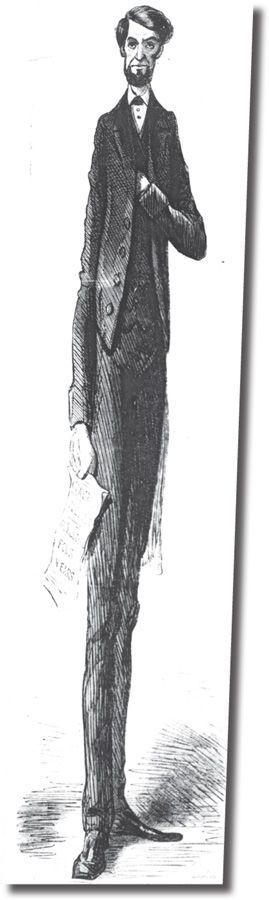
A Harper’s Weekly cartoon celebrating Abraham Lincoln’s election: “Long Abraham Lincoln A Little Longer.”
1. Lincoln’s final electoral vote count was 212.
THE VICTORY, AND HOW TO IMPROVE IT.
NOVEMBER 10
We doubt if in any one of President LINCOLN’s memorable utterances, there is anything more indicative of a mind entirely great, than in that brief speech addressed by him, yesterday morning, to an appreciative, but most unseasonable, audience at the White House. It seems that the ardor of some of his Washington supporters called him from his room at 2 in the morning, to tell him in set phrase, what we have no doubt he knew very well before, that he had been reelected President of the United States.
In his own inimitable way, Mr. LINCOLN replied to his friends, thanking them genially for the particular mark of devotion they had shown by calling on him, but adding, at the same time, that “he always regretted to triumph over anybody.”
We are satisfied that in this simple expression of feeling, uttered with no premeditation, may be found to lie the essence of that peculiar philosophy which the loyal people of America discovered in Mr. LINCOLN’s character when they determined to intrust him anew with their suffrages. The vast intelligent body of electors who recorded their votes for Mr. LINCOLN on Tuesday, think precisely as Mr. LINCOLN thinks, that, unless this election is a triumph of principle, of right, of loyal honor, and not a mere triumph of party, it is no victory at all. Nay, it is the opening of a reign of faction, which will parallel in its dangers and disasters the terrible experience which sectionalism and secession have brought upon the revolted States. The victory of Tuesday derives its prime significance and its sole merits from the fact that it does not involve the supremacy of one party over another, but that it marks the triumph of the loyal opinion of the nation over a faction. The returns already received show that, apart from extemporized votes dragged out of the most ignorant and debased class of the foreign population, McCLELLAN’s strength in 1864 — as far as the North was concerned — lay mainly where the strength of JOHN C. BRECKINRIDGE lay in 1861. To the support of both candidates many sincere and good citizens may have come from life-long party association. But even these, the best find purest of McCLELLAN’s voters, must not complain if they are ranked for the time as sectionalists, unless their formal declaration of party faith was a carefully prepared lie.
Mr. LINCOLN’s refusal to regard the contest as a struggle for mere party supremacy, we take, it, presents an open highway for many who have been deluded into supporting the sectional and disunion candidate to return to their allegiance — not to their allegiance to particular party leaders — but to that sense of obligation which in this fearful crisis they owe to the country. It cannot have been a pleasing association for the good and sound men of the Democratic party to find themselves, even for these few weeks of hot conflict, in the company of men who regarded, and regard now, every national victory won by our armies as a calamity, and who were prone to heap obloquy upon the illustrious dead of the national army, by proclaiming their labors a crime, and their sufferings and death a sacrifice in the cause of injustice, oppression, and wrong. No one will cast it up to the true Union-loving Democrat, that he found his party ties such as to temporarily estrange him from the path of political wisdom. The first to forget such estrangements, as Mr. Lincoln’s timely words assure us, will be the President-Elect. When the very life of the nation is at stake, it can be no hour far prolonging party-fights among honest citizens, beyond the boundary which marks the issue of the contest. If victory tests with the supporters of the Administration, that victory can be made most perfect by disclaiming every disposition to turn it into any sectional channel, and by heartily, frankly, and in good faith, inviting the cooperation of loyal men of all classes in securing the victory which has yet to be won over armed treason, before the country is once more restored to Union and to peace.
HOOD AND SHERMAN — THE WESTERN CAMPAIGN.
NOVEMBER 16
We do not think that, in the whole course of the war, the rebels have ever made a military mistake as great as in the diversion of HOOD’s army toward Tennessee. The soldiers of that army were publicly promised by their leaders a month ago that their feet would soon press the soil of that State, and JEFF. DAVIS himself, in his Columbia speech, spoke of their going as high northward as the Ohio River.
Now, when we reflect on the past course and present aspect of military affairs in the Southwest, the madness of such a project must be apparent. The war in that section was begun on the Ohio River, pushed up the Cumberland to Donelson, across Kentucky to Bowling Green and Mill Springs, down to Nashville and Memphis, onward to Corinth and Chattanooga, and still forward and southward till our army stood triumphant in Atlanta. As it marched, it destroyed or drove before it the armies of the rebels, defeating them in not less than twenty pitched battles of magnitude. The country we left behind us in our advance was very effectually conquered and subdued. The whole belligerent and able-bodied population was in the rebel armies that we whipped; and all the main strategic or otherwise important points we captured, fortified and garrisoned. In striking for Tennessee, HOOD struck for a region where the successful prosecution of offensive military operations was next to impossible. It was easy enough for FORREST and his horsemen to dash around and capture little towns or assault outposts. But when it came to the movement of a large army, the matter was altogether different. On every hand there were great fortresses; all around, there were minor but powerful works; the rivers were patrolled by gunboats; the railroads guarded by block-houses; the cities garrisoned; and beside all this, there was a large movable army (leaving SHERMAN altogether out of the count) ready at any point and at any moment to meet the rebels in front, to assail them in flank, to fall upon their rear, or to cut their communications and destroy their supplies. The rebels could not have selected a more hopeless region in which to campaign, with the prospect of any valuable or durable results, than the State of Tennessee. East, Centre and West, North and South, it is ours, and everywhere it is a field prepared for battle. Under these circumstances and conditions, what could HOOD possibly hope to effect? Sweep swiftly across Tennessee? — it might be done. Across Western Kentucky? — it were not altogether impossible. Up to the Ohio, and across the Ohio? — well, what then? Has he gained anything? — does he hold anything? — can he stay there? Has he got Chattanooga, or Murfreesboro, or Nashville? — has he got Knoxville or Memphis? Does he command the Cumberland, the Tennessee, or the Mississippi? Has he got the State of Tennessee? What has he done to forward the triumph or secure the independence of the Southern Confederacy? Well might the grim SHERMAN give vent to the most inexpressible contempt in regard to the northward movement of HOOD; well might he exclaim: “Let him go North, d--n him! If he will go to the Ohio River, I will give him rations.”
Where HOOD’s main body is stationed at this moment, is not given out; but the appearances are that he has not as yet pressed Tennessee; that he has not even yet got beyond North Alabama.
In the meantime, while HOOD’s army, according to the programme set forth by himself and by JEFF. DAVIS, was to be moving into and through Tennessee, what was SHERMAN, at Atlanta, to be about? — what were the opportunities that this mad rebel movement afforded him? SHERMAN followed HOOD a considerable distance, but getting disgusted with the pursuit, and being determined, as he remarked, that the rebels should not plan his campaigns or mark out his course for him, he turned back toward Atlanta, and prepared for the prosecution of a new campaign in rebeldom, upon his own plan. HOOD had not only gone where he himself could effect nothing; he had not only failed in drawing SHERMAN upon a wild-goose chase after him; but he had uncovered the whole of the important country between the Savannah and Alabama Rivers, and from the mountains to the sea. So that, whether SHERMAN desired to strike for Savannah, for Mobile, or for Lynchburgh, his work was simplified, and his path rendered comparatively clear, by the fact that HOOD was struggling deviously and wretchedly among the bristling strongholds of Tennessee.
The real purpose and direction of the new campaign which Gen. SHERMAN has embraced the opportunity of HOOD’s absence to undertake, is still unknown. It has been a topic of the greatest public interest for the past week; but no man or journal is able, apparently, to give anything definite about it. Speculation runs over a thousand miles, from Lynchburgh to Mobile; but fortunately for SHERMAN, it can fix itself certainly nowhere. The rebels seem to be even more excited about the matter than we are; but they also fail to give us reliable news.
SHERMAN’S MARCH.
THE ARMY REPORTED TO HAVE LEFT ATLANTA ON THE 12TH
NOVEMBER 18
A dispatch was published in a Cincinnati paper of yesterday, giving some details of the departure of Gen. SHERMAN’s columns from Atlanta, on the 9th or 12th, and their probable concentration at Augusta, which the War Department deems contraband, and we therefore refrain from publishing the report. —
ED. TIMES.
INTELLIGENCE FROM REBEL SOURCES.
SPECIAL DISPATCH TO THE NEW-YORK TIMES.
WASHINGTON, T>HURSDAY, NOV. 17
Richmond papers of Tuesday received here, furnish intelligence from Georgia up to the 14th inst. They state that SHERMAN left Atlanta on the 12th, moving northward, though they doubtless mean by that eastward on a northerly line.
REPORT FROM WASHINGTON.
WASHINGTON, THURSDAY, NOV. 17
No official intelligence has been received from Gen. SHERMAN for a week past.
Hood’s Movements, Strength and Position....
SHERMAN’S MOVEMENT.
The Indianapolis Journal, of Tuesday last, says:
“We had a conversation yesterday with a gentleman who had just arrived in this city direct from Atlanta, having left there on Friday, Nov. 6.
Every arrangement had been made for a gigantic movement in some direction. One corps had already moved out of the city, and others were to follow, but had not done so up to the hour of his departure, in consequence of the illness of Gen. SHERMAN.
SHERMAN expresses the utmost indifference as to HOOD’s movements, and says ‘THOMAS has sufficient troops to attend to him and prevent his returning South.’
The officers and men of SHERMAN’s army were never in better spirits or more confident of success. They regard this as the great movement of the war.
Most of our prisoners, heretofore confined at Anderson Ville, have been removed to Augusta, and as that place is directly in the line, SHERMAN will probably take it. They stand a good chance for a speedy release.
No private property in Atlanta had been burned or destroyed, nor was it expected that it would be. From Atlanta to Augusta is 171 miles; from Augusta to Charleston 121 miles; to Savannah 130 miles. But, as our cotemporary remarks, ‘the country is not difficult; no mountain ranges lie in the way to make transportation laborious, such as ROSECRANS met in Tennessee in his campaign against Chattanooga; no passes or defiles present easily defensible positions to an opposing force; the whole region both to the south and east is rich in food, and has been untouched by the war.’
The Chicago Journal says: “A furloughed officer of SHERMAN’s Staff states that he has been ordered, when his leave expires, to rejoin his command at Savannah. HOOD is said to be on the line of the Chattanooga and Atlanta Railroad. FORREST has not joined him, but is again moving toward Kentucky.”

Sherman’s March to the Sea, a rendition by artist F.O.C. Darley.
GEN. SHERMAN’S MOVEMENT.
NOVEMBER 19
SPECIAL DISPATCH TO THE NEW-YORK TIMES.
WASHINGTON, D.C., FRIDAY, NOV. 18
The direction of Gen. SHERMAN’S grand counter-move in Georgia is not yet sufficiently indicated to authorize a determinate opinion as to his ultimate aim. Until we learn definitely the actual direction he has given his columns from Atlanta, we shall be left in doubt as to his real objective.
The rebels are equally mystified; for the two latest reports we have had from the Richmond papers make him march in diametrically opposite directions. Those of Tuesday state that SHERMAN left Atlanta on the 14th, moving northward — by which they mean eastward on a northerly line — and anticipate his striking Augusta, on route for Savannah. On the other hand, those of Wednesday, received here this morning, expressly report him as advancing on Selma and Montgomery, Ala., with, of course, Mobile as his goal; and they support this view by the announcement from Mobile of a large increase of the fleet, and especially of the transportation in the bay of Mobile.
There are almost equally good reasons for believing that he aims at the one point as at the other. It is almost equally probable that he will perform the military marvel of emerging on the Gulf of Mexico, or debouching his columns on the coast of the Atlantic. The results of every kind, military, material and moral, to be accomplished by either enterprise, are almost equally splendid; the damage to be inflicted on the enemy equally prodigious. It is a choice between two moves akin in their audacity, in difficulty of execution, and in the promise of their achievements.
SOUTHERN NEWS.
SHERMAN’S ARMY.
NOVEMBER 23
There no longer remains any doubt that SHERMAN has torn up the Atlanta and Chattanooga Railroad, boldly cut himself off from all connection with his base, and plunged headlong into the heart of Georgia, depending entirely upon the force he has with him, and the weakness of the country through which he designs to pass. His aim is, beyond all question, to secure a position upon the seaboard, where he may receive reinforcements and supplies at leisure, and having there established his base, to prosecute further operations next Spring or during the Winter. It is not known for what point his course is directed — whether he has selected Savannah or Charleston as his base, or whether he aims first at Selma and afterward at Mobile.
We are rather inclined to think that he will prefer the latter, being induced thereto, no doubt, by the refusal of the Alabama Legislature, when summoned by Gov. WATTS, to make any provision for the public defence: a refusal which the Yankee journals have not been slow to interpret into a desire on the part of that State to return to the “bosom of ABRAHAM,” If we may be excused for adopting, for once, the profane expression of Secretary SEWARD, Such a movement on his part would, moreover, correspond with the design The NEW-YORK TIMES gave him credit for entertaining last Summer, when he made his famous march from Vicksburgh.
It may be, however, that he thinks it would redound more to his advantage to seize Augusta, the Importance of which has been grossly over-estimated, and thence match against Charleston, which, with the advantage of a water base, would allow free communication with all the ports of the United States. From Charleston he can lend a hand to GRANT. who he hopes will, by that time, be in possession of Richwood, in operations against Wilmington the result of which, he supposes, will entirely shut us out from the sea. The Yankee papers, several weeks ago, announced the determination to transfer the Winter campaign to the cotton States, and this, we presume, is the preliminary movement.
Whichever of the two movements SHERMAN has in view, it is evident that he calculates largely upon the weakness of the country through which he designs to march, or on its disloyalty to the Confederacy. In both calculations we are inclined to believe that he will be greatly mistaken. It will be the fault of the people it. habiting those countries if his army be not utterly destroyed long before it shall have reached either Mobile or Savannah.
The marches SHERMAN will be compelled to make in order to reach the several stages of his journey are great, considering that he must carry the greater part of his supplies with him. From Atlanta to Macon, the first stage, is somewhat more than one hundred miles, and here there is understood to be a strong garrison, defending powerful works. From Macon to Augusta, one hundred and seventy miles further, there is a railroad, the destruction of which will, of course, be attempted by our forces, and will be effected, at least, to the extent of retarding his progress until the portion broken down can be restored.
From Augusta to Savannah the distance is about twenty-five miles, and -at Savannah, whatever calculations he may now make, he will be pretty certain to meet with a stubborn resistance. Here, then. is a march before him of three hundred miles, through a country sparsely settled, and a cotton-growing country, where he will not find the necessaries of life so abundant that he can afford to dispense with magazines, or that he can replenish these so often as to be able at all times to have them close in his rear.
When he shall have reached Savannah, subdued the garrison and taken possession, he may think of Charleston, 100 miles further north. If SHERMAN can do all this with the force he has at command, which we are disposed to think does not exceed 40,000 men, then he is a much greater Commander than we take him to be, and the Georgians are much tamer people than they have credit for being. For our own part, we cannot see how the contemplated campaign is to advance the design of subjugation, let it terminate as it may.
It may serve us as an additional annoyance to the people, but it must be as destitute of results as the arrow is destitute of the power to wound the air through which it passes. It leaves absolutely open the entire country in the rear, from Chattanooga to the Gulf, wherever the Yankee army is not for the time encamped.
SHERMAN’S MARCH.
NOVEMBER 26
Gen. SHERMAN’s army is making rapid progress in its great march through Georgia. Our advices are as late as Sunday last, at which time it was in the geographical centre of the State. The news of this morning will be found both important and exciting — though the excitement in the North can by no means approach the tremendous commotion it is producing in Georgia, and throughout the length and breadth of the whole Southern Confederacy.
From the various items of intelligence that have reached us within the week and up to this hour, mainly through rebel mediums, we are enabled to fix definitely two or three points which were for some time in doubt, to deduce some general results, and to draw some few inferences.
1. In the first place, as to the direction of SHERMAN’s march. When the fact of a movement was originally announced to the public, it was a subject of distracting dispute, whither it was to tend. Speculators and journalists differed as widely and as variously as possible. The whole Confederacy lay before them where to choose their place of rest, with no guide but their own fancy. SHERMAN was marching upon Lynchburgh, in Virginia, to cooperate with GRANT on the James; he was marching upon Mobile, on the Gulf of Mexico; he was retreating into Tennessee; was moving upon HOOD’s rear; was advancing into South or North Carolina; was striking for Pensacola. But the actual fact has turned out to be as foreshadowed in The Times of the 10th instant, that SHERMAN is marching through the State of Georgia to a base on the Atlantic coast.
2. SHERMAN is marching in two great columns, each of them two corps in strength, with cavalry — one column (HOWARD) striking southward for Macon, and the other (SLOCUM) eastward for Augusta — the whole of the four corps, it is supposed, to form a junction at Augusta, and thence advance to the sea.
3. By Sunday last, HOWARD’s column had got as far as or beyond Macon, though it is not fixed that the place itself was taken. His advance had reached Gordon, sixty miles east of Macon, on the Savannah Railroad, and at the junction of the railroad to Milledgeville. This point is one hundred and forty-one miles from Savannah, and ninety miles from Augusta. The main body was reported only twenty-three miles from Milledgeville, and the Legislature of Georgia had adjourned and left with precipitation. The other column (SLOCUM) had made about an equal distance along the railroad from Atlanta to Augusta. In other words, both columns had got about half way on their march to Augusta in six days, (14th to 20th.) SHERMAN’s “Orders for the March”requires each of the columns to start habitually at 7 o’clock in the morning, and to make about fifteen miles per day. We judge that the six days’ march to Macon was almost precisely up to orders.
4. In this hundred miles’ march through the most densely populated section of Georgia, SHERMAN met with no serious obstruction from the rebels. COBB and his militia have popped up once or twice in the rebel newspapers, and it is not impossible that they took refuge in Macon, which is strongly fortified, and made such a show of defence, as to stop our forces, if not to cause them to pass by the place. Macon itself, indeed, may not have been, taken in HOWARD’s line of March, as his troops passed to the northeast of it in the movement toward Milledgeville. Deserters from LEE’s army, however, who came into our lines at City Point yesterday, report its occupation by our troops.
5. The march of our army seems to have been spread over a wide extent of country. According to the rebel reports, which are doubtless authentic, SHERMAN’s two columns have already traversed eighteen of the most populous and wealthy counties in Central Georgia, viz.: Clay, Fayette, Fulton, De Kalb, Walton, Newton, Jasper, Morgan, Putnam, Jones, Butts, Henry, Spalding, Pike, Bibb, Twiggs and Baldwin; and either his infantry or cavalry have visited the following towns: Decatur, Jackson, Griffin, Forsyth, Monticello, Hillsboro, Covington, McDonough, Social Circle, and others. At a dozen different points he has touched both railroads, and the width of the strip of country over which his army moves is not less than seventy five miles covering both the railroad to Augusta and that to Savannah.
Thus far, then, the march, in whatever aspect viewed, has been a success. The compact columns have marched to time, and resistlessly. The rebels seem to be in despair of stopping our army. BEAUREGARD has issued a highfalutin proclamation, announcing that he is flying to Georgia’s relief; but more sober rebels than he are calling on the elements, the negroes, and all possible and impossible powers and weaknesses, to aid them. The whole Confederacy is evidently in a panic; and there is no doubt that JEFF. DAVIS will do all that is possible to thwart or overthrow SHERMAN during the last half of his extraordinary march. That they have not succeeded in doing anything from last Sunday until now, is evident enough from the fact that they have not informed us of it.
THE REBEL PLOT.
ATTEMPT TO BURN THE CITY.
NOVEMBER 26
The city was startled last evening by the loud and simultaneous clanging of fire-bells in every direction, and the alarming report soon spread from street to street that a pre-concerted attempt was being made by rebel emissaries, in accordance with the fiendish programme recently set forth by the Richmond papers, to burn New-York and other Northern cities, in retaliation for the devastation of rebel territory by Union armies. The facts gathered by our reporters appear to confirm the truth of these reports.
The plan adopted by the incendiaries was to set fire at once, or nearly at once, to the principal hotels and other public buildings in the city. At seventeen minutes of nine the St. James Hotel was discovered to be on fire in one of the rooms. On examination it was discovered that the bed and several other articles of furniture had been saturated with phosphorous and set on fire. A few minutes afterward Barnum’s Museum was discovered to be on fire; but the flames were soon extinguished, and the building sustained very little damage. At five minutes of nine fire was discovered in rooms No. 138, 139, 140, and 174 of the St. Nicholas Hotel. The fire was got under without much difficulty by the fire department of the hotel, but not until the furniture and the rooms had been damaged to the amount of about $2,500. The beds in this case, also, were found to be saturated with inflammatory materials. At twenty minutes past nine the inmates of the Lafarge House were alarmed by the cry of fire; but the flames were extinguished without much difficulty, and the damage received was comparatively slight. Shortly after 10 o’clock the Metropolitan Hotel was discovered to be on fire; but by this time the police had given warning at all the hotels of the designs of the incendiaries, and the watchmen being on their guard, discovered the fire in time to put it out before it had done much damage. The Brandreth House, Frenche’s Hotel, the Belmont House, Wallack’s Theatre, and several other buildings were fired during the course of the evening, but none of them were seriously damaged.
About ten o’clock the Detective Police arrested a woman at the Metropolitan Hotel, under circumstances that involve her in serious suspicion. She hails from Baltimore, and was noticed going from one hotel to another, leaving each hotel just previous to the breaking out of the fire. She strongly protests her entire innocence of the crime charged upon her; but the fact that the fires followed closely in her wake, as she passed from house to house, is a very suspicious circumstance, and justifies her arrest and detention.
The Police also made several other arrests; but in accordance with a request from Police Headquarters, we refrain from mentioning the names of the parties taken into custody.
The scenes at the various hotels, where the usual quiet of the evening was broken by the alarm of fire, and by startling rumors of extensive conflagrations throughout the city, were very exciting. At several of the hotels, the inmates of the rooms were requested to vacate their quarters and permit them to be carefully searched for incendiary materials. In several instances, beds in vacant rooms were found saturated with phosphorus and filled with matches. A box filled with inflammatory material was taken from the Metropolitan to the Police Headquarters, and after being exposed to the air for a short time, burst into flames.
To guard against the threatened conflagration, watchmen were put on at all the hotels, and a dozen pails of water were set on every floor, ready for instant use. Fire-Marshal BAKER is busy investigating the origin of the fires, and the Police are said to be on the track of several suspected persons.
THE INCENDIARIES — FIRST FOREWARNINGS.
NOVEMBER 27
Regular and organized warfare outside of LEE’s lines at Richmond, has become an absolute impossibility for the Confederacy, and we must be prepared to hear at intervals, for many months to come, that our larger cities are infested with incendiaries in numbers heretofore altogether unknown to our experience of crime.
We must be prepared to find that our native thieves, burglars, forgers and murderers, who have only the purpose of individual plunder to serve, are prepared to cooperate with the refugee class to the full measure of their vicious ability. The detective force of the city, therefore, should be doubled at once. We cannot afford to run any risk. Every respectable, law-abiding citizen should constitute himself, as far as his time and means will possibly admit, a volunteer watchman. Our hotels, such of them at least as have been known to be the resort of Southern skulkers, so aptly described by the Daily News, should be thoroughly scoured by judicious officers of the police force and by detectives of well-established character. With only reasonable precaution, we can at once provide an effectual guarantee that this incendiary business shall not spread, and we can take most effectual steps to see that the city is shortly purged of the presence of hundreds and thousands of so-called Southerners.
THE NEW APPOINTMENT TO THE CHIEF-JUSTICESHIP — HOW RECEIVED.
DECEMBER 8
The appointment of SALMON P. CHASE to the Chief-Justiceship of the Supreme Court gives very general satisfaction. Even his political opponents — those of course excepted whose judgment is palsied by old prejudice — cheerfully concede that the President could have made no better selection. We can recall no Instance of one transferred from the political arena to the Supreme Bench with so little animadversion. It is a remarkable contrast to the storm of wrath raised by Gen. JACKSON’s appointment of his immediate predecessor.
We consider this fact very significant. It is one of the most notable tokens we have had that the Republic has indeed entered upon a new era. There is no public man in the country whose anti-slavery record has been longer, or more consistent, or more decided than that of SALMON P. CHESE [sic]. Twenty-eight years ago, he was seen in the Ohio courts pleading with great power in behalf of fugitive slaves. He took the most determined ground against the entire system of fugitive slave surrenders. The same intense anti-slavery spirit which always controlled him professionally attended his political life from the very first. One of the founders of the “Liberty party”in Ohio in 1841; an active member of the Buffalo Liberty Convention in 1843; again an active member of the second Liberty National Convention in 1847; elected to the United States Senate by the Democratic Legislature of Ohio in 1849, on distinctly avowed anti-slavery grounds; a most earnest opponent of Mr. CLAY’s compromise measures of 1850; repudiating the Democratic party because it indorsed these measures in its Presidential platform of 1852; one of the foremost advocates of the Kansas-Nebraska bill of 1854, adhering to his anti-slavery principles with the same tenacity as when Governor of Ohio in the slavery period of BUCHANAN’s Administration; still uncompromising and unflinching as member of the Peace Convention which assembled in Washington on the eve of the great rebellion; known as the head of the radical wine of the radical wing of president LINCOLN’s Cabinet and the special favorite of the so-called radical portion of the Union party or the next Presidency, he yet is now made Chief Justice of the Supreme Court of the United States, with the almost universal approval of both of the great parties. There are but one or two living public men in the country upon whom, in time past, the Democratic party has poured out contumely so bitter and so incessant, and yet now all this is either hushed into soft silence, or else positively converted into honeyed commendation.
This new leaning toward Mr. CHASE on the part of his old political opponents,cannot be imputed to a satisfaction that he has quitted the political arena forever. Everybody knows that in his judicial capacity he will be required to pronounce upon many momentous questions affecting the interests of slaveholders, and intimately connected with old party issues. There is no danger that he will step out of his proper judicial province to do this, in imitation of the conduct of his predecessor in the Dred Scott case; but he cannot avoid these questions if he would. In conjunction with his brethren on the bench, he will have to settle most important points of constitutional law, growing out of the Emancipation Proclamation, the confiscation acts of Congress, and other enactments that have been passed, and are yet to be passed, for the suppression of the rebellion, and the reestablishment of constitutional rule. Yet for all that, almost every body trusts him.
The simple truth is, that the terrible discipline of this war has wrought a complete change in the temper and sentiment of even the Democratic party, in respect to the South. This change has gone on in spite of even the fierce excitement of the late Presidential canvass. It asserted itself in the cheerful acquiescence, we may almost say the positive satisfaction, with which the reelection of President LINCOLN was received by the great body of the party. It again asserts itself in this easy concurrence in the eminent fitness of the appointment of SALMON P. CHASE to be Chief-Justice. The Democratic party, in spite of all of its old habits, cannot help recognizing that the old order of things is at an end, and that the nation is passing into a new stage of being. It is more and more realizing the necessity of conforming to this transition; and submits, with a grace never felt before, not only to the transition itself, but to those public agents who guide it, however obnoxious these may have been in other days. This happy adaptation bespeaks an end of faction, and is a most propitious augury.
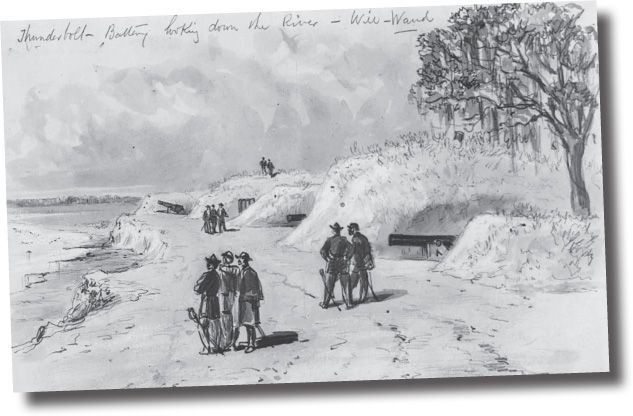
Alfred Waud’s sketch of federal troops and fortifications for the Battle of Savannah.
SAVANNAH OURS.
SHERMAN’S CHRISTMAS PRESENT.
DECEMBER 26
WAR DEPARTMENT, WASHINGTON, DEC. 25
— 8 P.M.
To Maj.-Gen, Dix, New-York:
A dispatch has been received this evening by the President from Gen. SHERMAN. It is dated at Savannah, on Thursday, the 22d inst., and announces his occupation of the city of Savannah and the capture of one hundred and fifty guns, plenty of ammunition, and about 25,000 bales of cotton. No other particulars are given.
An official dispatch from Gen. FOSTER to Gen. GRANT, dated on the 22d instant, at 7 P.M., states that the city of Savannah was occupied by Gen. SHERMAN on the morning of the 21st, and that on the preceding afternoon and night, HARDEE escaped with the main body of his infantry and light, artillery, blowing up the iron-clads and the Navy-yard. He enumerates as captured 800 prisoners, 150 guns, 13 locomotives, in good order, 190 cars, a large lot of ammunition and materials of war, three steamers and 33,000 bales of cotton. No mention is made of the present position of HARDEE’s force, which had been estimated at about 15,000.
The dispatches of Gen. SHERMAN and Gen. FOSTER are as follows:
SAVANNAH, Ga., Dec. 22
To His Excellency, President Lincoln:
I beg to present you as a Christmas gift, the city of Savannah, with one hundred and fifty heavy guns and plenty of ammunition, and also about twenty-five thousand bales of cotton.
(SIGNED,)
W.T. SHERMAN,
MAJOR-GENERAL.
TWO MONTHS OF WAR AND THEIR SIGNIFICANCE.
DECEMBER 26
The past two months’ campaigning has taught the rebels a hard lesson. Each isolated event has an important lesson of its own, but taken together they open up startling revelations. It must be sufficiently distasteful to the rebels that an army of fifty thousand men can cut itself off from its base at Atlanta and at leisure establish another three hundred miles distant, on the Atlantic coast. This fact alone proves the helplessness of the Confederacy outside of its intrenched strongholds. The rebels may agree with DAVIS that Richmond, or any other fortified point, may be forced from them without their suffering vital loss, but this will not make them relish being pummeled everywhere else. Then, again, HOOD’s defeat, taken by itself alone, conveys a scathing comment on DAVIS’ policy of waging war. The same may be said of PRICE’s defeat in Missouri, or of EARLY’s in the Shenandoah. But in the summary, and considering the total result, there is conveyed to the minds of the rebels a still more disagreeable suggestion than is involved in simple defeat or indiscretion, and that is, that as their relative strength is diminished, the proportion of the waste attendant upon the war on their part is greatly increased.
During the last two months the rebels have lost forty thousand men, three fourths of whom have been taken prisoners on the battle field. Twenty-five officers of the rank of General have been placed hors du combat. More than three hundred and fifty pieces of artillery have been captured, (including those at Savannah,) and it is scarcely possible to estimate the number of small arms taken. These large captures of men and of guns appear almost incredible, when we consider that with the exception of Fort McAllister and Savannah, no fortress is included in the estimate; the captures were made on the battle field. Then look at the destruction of railroads, stores, and factories. Probably no country was ever more thoroughly devastated than the Shenandoah was by SHERIDAN after the battle of Winchester. SHERMAN, in his march through Georgia, entirely destroyed two hundred miles of railroad, besides large quantities of stores essential to the Confederate armies. All the great arsenals of the South outside of Richmond are within his grasp. CANBY’s expeditions from Vicksburgh and Baton Rouge destroyed millions worth of stores which had been accumulating for HOOD, and long lines of railway. According to rebel reports STONEMAN and BURBRIDGE did equally efficient work in BRECKINRIDGE’s rear on the Virginia and East Tennessee Railroad. WARREN’s raid on the Weldon Railroad in the short space of three days destroyed twenty miles of the road — ties, rails and all — as effectually as if it had never been built.
In the meantime the rebels have so managed the Winter campaign that our losses during the last two month have been but trifling. HOOD’s campaign in Tennessee has shortened this war by many months, not so much because he has been beaten by THOMAS, as because by taking himself away from SHERMAN’s front, he has enabled the latter in one short month to accomplish results which, in the ordinary course of military events would have required long delays. How different the Winter campaign would have looked now if HOOD had contented himself with simply resisting SHERMAN’s further advance. Thousands of lives would have been lost, where, as the case now stands, SHERMAN has only had disabled about fifteen hundred men — a little more than LEE lost during the same thirty days by the shots of our pickets. Delay, too, would have been a great advantage to the rebels, as it would have given them several weeks of leisure in which to recuperate their armies. But that opportunity, thanks to rebel recklessness, is gone, and can never be recovered.
Never, we think, has it happened in any war that two months have been so decisive of grand results as the two which have just closed. It is only necessary that the people should hurry to the front every available soldier, in order to make the next few months completely decisive of this unhappy conflict.

Harper’s Weekly illustration showing Sherman marching into Savannah.
THE CLOSE OF SHERMAN’S GREAT CAMPAIGN — SAVANNAH OURS.
DECEMBER 26
SHERMAN’S resplendent campaign has had a logical termination, in the capture of Savannah, the chief city and seaport of the State of Georgia. This campaign, so unique and striking, is thus rounded and made complete. The military mystery, which for so long a time amazed and puzzled the country, is revealed, and is seen to be a thing whose character and object were fixed, definite and grand. The army, about which the rebels told so many falsehoods, from the hour of its “retreat” from Northern Georgia to the day they “ruined” it near Atlanta — from the time they had it “floundering through the bogs of Georgia” to the moment they brought it up in blank despair before the fortifications of Savannah — through all the defeats it suffered without knowing of them, and amid all the failures it enjoyed to read about — has marched onward to its destination with triumphant tread, has reaped fruits of victory as it went, and has grasped the prize when it reached the goal.
SHERMAN offers the President, as the head of the Republic and the representative of the people, the City of Savannah as a “Christmas gift.”
The military and other spoils of the city are mentioned as one hundred and fifty cannon, much materiel of war, over two hundred cars and locomotives, twenty-five thousand (or according to FOSTER, thirty-three thousand) bales of cotton, and several steamers. The bulk of HARDEE’s army escaped from the city on Tuesday last, the day before our army moved into it, and the prisoners are estimated at less than a thousand, but twenty thousand people were found in the city, “quiet and well-disposed.”The rebel iron-clads have been destroyed and the navy-yard demolished, and FOSTER and DAHLGREN have opened up communications with the city through the Savannah River.
It would undoubtedly have been very gratifying to have taken captive all of HARDEE’s army of fifteen thousand men. There was a break, however, in the line of SHERMAN’s investment of the city. That break was on the eastern side of the place, and consisted in the space from the mouth of the Savannah River to a short distance above the city — a space of about seven miles. Had DAHLGREN’s iron-clads been able to run up and cover this short line, HARDEE would have had no possible route of escape. We do not doubt that FARRAGUT, with wooden vessels would have accomplished this work. HARDEE may find some difficulty yet in getting his army on to the railroad or into Charleston; but the chances of success are in his favor.
The time covered by SHERMAN’s campaign, from the day he left Rome until he planted his army within the defences of Savannah, was just about forty days. The campaign will stand as one of the most striking feats in military history, and will prove one of the heaviest blows at the vitality of the great Southern rebellion.