
CHAPTER EIGHT
Evening – Tuesday 19 September 1944
Without any good news from Nijmegen Lieutenant Generals Horrocks and Browning met at their co-located headquarters at Malden. Just outside the city, General Horrocks recorded how:
‘Suddenly the door opened and in came a tall, good-looking American General, who like Maxwell Taylor commander of the 101st Airborne Division, was as unlike the popular [British] cartoon conception of the loud-voiced, boastful, cigar-chewing American as it would be possible to imagine. They were both quiet, sensitive-looking men with an almost British passion for understatement. Yet, both of these two commanders, under their deceptively gentle exteriors, were very tough characters indeed.
We pointed out to Jim Gavin that attacks on the road and railway bridges in the town were making very slow progress and that it was absolutely vital that both should, if possible, be captured intact – though we could see that they were heavily defended and had been prepared for demolition.’
Horrocks to Gavin: ‘Jim, never try to fight a Corps off a single road’.
General Gavin has recorded his response to the situation and his orders:
‘It seemed to me that the hour was becoming desperate. Urquhart [1st Airborne Division] had now been cut off for three days, and I still did not have the big Nijmegen bridge. If I did nothing more than pour infantry and British armour into the battle at our end of the bridge, we could be fighting there for days and Urquhart would be lost. I decided therefore that I somehow had to get across the river with our infantry and attack the northern end of the bridge and cut the Germans off at the southern end.... I asked General Horrocks about boats, and he said he thought they had some boats well down the road in the train somewhere. The discussion on this point quickly spread amongst the staff. They finally agreed that they should have about twenty-eight folding canvas boats in trucks somewhere farther to the rear. American boats, with which I was familiar, were plywood, but at that moment boats were boats and I had to have them.’
There were in fact thirty-two British assault boats available in the Guards Armoured Division’s Engineer Field Park Squadron, however, this number was reduced to twenty-six when a truck carrying six boats was destroyed on Hell’s Highway.
Wednesday 20 September 1944
General Gavin had a lot to think about as he drove the short distance up the hill to his CP. His divisional staff certainly had another sleepless night ahead of them, as they fleshed out the plan and issued orders.
‘Back at Divisional Headquarters, we poured over the maps. [3/504PIR were to carry out an assault crossing]... In the meantime, every artillery piece, every tank gun, and every weapon we had would pour fire into the German positions on the far side. This would include as much smoke as we could get our hands on to cover the crossing. It was a risky tactic, but something had to be done. I could not conceive of sitting on the southern bank with a regiment of infantry and the Guards Armoured Division while Urquhart was destroyed eleven miles away.’
The second, and equally important part of the plan, was the renewed attack on the southern end of the bridges. If the Guards and 2/505 PIR were not equally successful, then the 504th would be destroyed in detail on the Island. This was a risk that General Gavin was prepared to take. Following the failure of the previous day’s armoured and infantry charges towards the bridges, General Allan Adair planned a systematic clearance of Nijmegen that, in the words of the Guards’ divisional history:
‘would start at dawn the following morning [Wednesday 20 September], preparatory to a major attack on the bridges fully supported by artillery later in the day; the risk of the Germans blowing them up in the meantime was fully appreciated, but there was no alternative.... 5th Guards Brigade therefore assumed responsibility, with one American battalion [2/505 PIR] still under command, for clearing Nijmegen prior to seizing the bridges. This freed the 504th US Parachute Regiment to undertake the assault crossing, supported by two squadrons of 2nd Bn Irish Guards.’
While the Allies were completing the planning of their attacks on the Waal crossings, shortly after dawn, 20 September, enemy pressure began mounting on the 82nd from the south. As has been explained the 82nd occupied thinly held positions on the Groesbeek Heights, covering what was, in effect, the Division’s rear. Further back down Hell’s Highway, 107th Panzer Brigade had renewed its attack on the bridge at Son, which was held by 101 Airborne Division, and closed it to Allied traffic. As the climax of the Nijmegen battle was approaching, the overall MARKET GARDEN situation was extremely unfavourable for the Allies.

Grenadiers of 1st (Motorized) Battalion, Grenadier Guards, prepare for battle in the western part of Nijmegen.
The Capture of the Railway Bridge’s Southern End – Afternoon, Wednesday 20 September 1944
The action on 20 September can best be viewed by going back under the railway bridge, and parking in Joris Ivensplein (not a part of town for the faint hearted to dally – it’s a red light district) and walking to Kronenburger Park. The houses along the Kronenburger Single were where the Americans fought on the upper floor supported by British tanks on the road below.
As planned, the clearance of Nijmegen began at 08.30 hours on 20 September, under the Grenadiers’ CO, Lieutenant Colonel Gouldburn. Their aim was:
‘to clear enough of the town to have room to manoeuvre for the final attack on the bridge itself, and also to make sure that the attack would not be molested by Germans advancing from the west.
‘The attack went surprisingly well’ with company / squadron groups of Grenadier Guards infantry or American paratroopers, supported by Grenadier tanks. Each was given a sector of the city to clear. The clearance was methodical, with a company of infantry clearing a block with a second company waiting behind them ready to clear the next block once the first had broken any resistance. Initially, the Germans, were content to inflict any delay they could on the advancing Allies and then fell back towards the main positions, occupying an area about three hundred metres deep and about 1,000 metres long covering the bridges.’
The force heading for the railway bridge closed in quickly on the enemy’s main defences around the embankment leading up to the bridge. They had taken a route to the east; the opposite side of the railway line to their previous attempt. However, Company D, 2/505 and Grenadier tanks became bogged down as they attempted to cross the open fields of fire in the Kronenburger Park. Kampfgruppe Henke with a stiffening of SS troops was standing firm and the advance slowed as buildings surrounding the park had to be cleared room by room. During the course of the battle General Gavin went forward into Nijmegen to see for himself how 2/505 and their Grenadier Guards tanks were getting-on in the west of the city:
‘... but there was little to be seen, since most of the fighting was taking place in the buildings and on the rooftops. Later the veteran troopers told me about the experience. What they wanted to do, they said, was ... fire down into the gun positions of the 88s and the foxholes of the Germans. This they eventually did. It was a new experience for the troopers, but they soon discovered that the best technique was to fight from rooftop to rooftop; thus, they were always on high ground. Where necessary, they blew holes in the upper floors of adjoining buildings so as to make their way forward and still be on top of the Germans.’
Fitters from the Royal Electrical and Mechanical Engineers work on a Grenadiers’ tank damaged during the street fighting in Nijmegen.

A Grenadier Guards officer later described the action of 2/505 PIR to General Gavin as ‘A jolly sight to see those paratroopers hopping from rooftop to rooftop’.
Meanwhile, on the other side of the river, SS-Sturmbannfuhrer Reinhold, the Nijmegen garrison commander, was visited by his divisional commander and briefed on the progress of the battle. He was told about the increasing Allied resources being concentrated on Nijmegen, despite the seven battalion attack on Mook and Groesbeek mounted by General Eugen Meindl’s II Fallschirmjäger Corps. These German attacks had been designed to divert the Allies from the bridges to the still thinly held positions on the Groesbeek Heights. In this, they were unsuccessful but they were diverting the Allies reserves away from Nijmegen. This lack of reserves in Nijmegen was to have an important impact on the outcome of MARKET GARDEN.
The Assault River Crossing – 15.00 Hours Wednesday 20 September 1944
Return to your car. It is not normally possible to reach the riverbank where 3/504 crossed from or where the fire support group took up position, as the location is an industrial area. An excellent view of the crossing site, from the German viewpoint is included later in the tour. For those who wish to visit the general area, go back through the underpass and follow Voorstadslaan from the area of the railway bridge and turn right onto Weurtse Weg. Follow this road for a mile and turn right onto the Winselingsweg. This area is still occupied by a modern power station and factories. This is the area where the troops assembled and the attack was launched.
Early on the morning of 20 September 1944, Lieutenant John Holabird, 307 Engineers, of 504 PIR was amongst the first to view the river that the Allied generals’ had decided, in some desperation, that they were to cross:
‘C Company, 307th Engineers had moved closer to the river. Captain “Spike” Harris called me and together we walked up the power station on the Waal River with other C Company officers and platoon sergeants. I had no idea why we were going. We met with Colonel Tucker [CO 504th Parachute Infantry Regiment], Major Cook and other field grade officers. I was sure something BIG was going on because ordinarily we wouldn’t have been party to all those upper ranks of officers. We walked upstairs in the empty power station and looked out over the river, it was broad.... About then I began to understand what was up. We were going to cross it and the Engineers in the U.S. Army were the customary boatmen. Ergo, we were there to plot a night crossing. “Where were the boats?” we asked. “Coming,” they replied. “What kind of boats?” “Press out, British canvas assault boats.” “How soon?” “Afternoon.” And then I began to understand that they were really serious about a daylight crossing. Wow! “Who’s going to protect us? That is one wide river.” – “We’ll lay in British armour to hit the other side and to lay down a smoke barrage so no one will be able to see.” It began to dawn on me that this was one rash daredevil idea and we engineers were going to be a big part of it. We went back to the company and we moved up in enfilade to the east of the power station on the down [inland] side of the levee or embankment.’

Major Cook of 504 Parachute Infantry Regiment.
Colonel Ruben Tucker’s 504 PIR had been relieved by the Welsh Guards, who took over defence of the Grave area. The plan was for 3/504 PIR to conduct the assault across the river, followed by the 1st Battalion. The 2nd Battalion was to clear the area surrounding the power station and provide fire support. 504 PIR had moved towards the western suburbs of Nijmegen in time for an H Hour of 08.00 hours but this was delayed to 11.00, then to 13.30 and eventually to 15.00 hours. General Horrocks describes the frustration:
‘... owing to the difficulty of getting lorries containing the boats up the one long narrow road which constituted our lines of communication and which, in spite of all our efforts, was from time to time completely blocked by burnt-out vehicles. The delay in getting these precious boats forward was infuriating, and it was the only time that I saw Gavin really angry. Having flown in he did not understand the chaotic situation at ground level in the rear, and as Zero Hour for the crossing had to be constantly postponed, he turned to me and said, “For God’s sake try! It’s the least you can do”.’
Meanwhile, Captain Moffatt Burriss, commander of Company I 3/504 PIR, sheltering behind the river embankment, said:
‘We were not shown the river before the crossing. We waited the other side of the levee most of the day. If we had seen what we were expected to cross in daylight, we probably wouldn’t have done it! I still wonder how any of us survived the crossing.’
Lieutenant Thomas Pitt recalls how his battalion:
‘was selected to be the guinea pigs. So the first thing that was to occur prior to the actual crossing was that we were to get some air cover. British Spitfires [Typhoons] that had long range capability were operating out of France. Finally after some delay, two spitfires [sic] came over and started to strafe the opposite banks and on the opposite dike where the Krauts were dug-in. About the second pass, the Germans got one of the Spitfires and the other one went home. So that was the end of the air cover.

Lieutenant Thomas Pitt.
The British had these large tanks; I forget the name of it [Shermans]. They were going to give us some artillery fire but first laid down some smoke. There were about some eight or ten of them [tanks] that dug in up closer to the bridge from us. They opened fire and they put a lot of iron down in a short period, but in a couple of minutes the [German] counter battery came.’
In fact, Lieutenant Pitt has seen only a part of the direct fire support available. The Irish Guards’ history describes their part in the successful crossing:
‘Colonel Giles [Vandeleur] took Major DRS FitzGerald and the troop commanders forward on foot to choose fire positions for the tanks. The timings had to be calculated exactly as the whole area was more or less under German observation and was already under spasmodic shell fire.... At half-past two the tanks moved slowly up to the river, reaching their positions just before three. No. 2 Squadron lined the embankment near the Power House and No. 3 Squadron hid behind rubble heaps on the waste land round the factory. No. 2 Squadron had by far the better field of fire, but was itself completely exposed to the Germans on the far bank....Fortunately [most of] the German 88mm and 20mm guns had been sited for anti-aircraft work and so, not being able to depress their barrels low enough to fire into the river, concentrating on the Irish Guards’ tanks.’
In addition to the tanks the combined artillery of the 82nd and Guards Armoured Divisions, totalling approximately one hundred field guns, fired in support. They had been in action through out the day in support of the Grenadiers and 2/505 in Nijmegen as they closed in on the enemy’s main defences around the bridges. Only one supply convoy had reached the Guards Armoured and the 82nd’s artillery supply arrangements had failed. Therefore, ammunition was strictly limited but most guns had approximately fifty rounds each, plus, in some cases, a few extras dumped on the gun positions. It was very different from the experience of Normandy, when artillery ammunition was virtually always available, and fired, in seemingly limitless quantities. Nonetheless, the desperate need to get across the Waal and on to the Rhine led to a decision to risk running artillery ammunition down to dangerously low levels. Even so the artillery had only enough ammunition to engage immediate targets. The lack of artillery ammunition was to have a greatly underestimated effect on XXX Corps’ conduct of the remainder of MARKET GARDEN and artillery ammunition was not restored to normal until final clearing of Hell’s Highway on 26 September 1944.

The fire-plan began shortly before 15.00 hours with a heavy smoke screen, as 3/504 PIR dashed over the river embankment. The main armament and machine-guns of the Irish Guards supplemented the artillery and mortar fire. Using vital tank ammunition to cover 3/504 PIR’s crossing, severely limited the options open to General Adair, later that day.
The assault route taken by the (US) 3/504 over the river Waal 20 September.


The crossing of the Waal by the Paratroopers of the 3/504 on the afternoon of 20 September 1944, as depicted at the Groesbeek Museum.
Lieutenant Pitt continues his infantryman’s eye view of the crossing:
‘The boat was like a canvas material with a wood frame to it and it held about twelve men in a boat. We had to paddle to get it across. We took the boats and came from behind the factory (I don’t think the Krauts knew we were there). We started down across the sandy shore which was maybe 50 yards long till we got to the water. We were running with these boats and our weapons and what not. In addition to all that crap the old man [the CO, Major Cook] said you lay a telephone line across the river so we can talk back to them, if we need support fire or something. We weren’t sure that the radios would work that distance with the one’s we had. So I had a kid from the communications section join us with a roll of wire on a spindle-like thing.
‘We got into the damn boats and thought it at first it looked like rain in the water. Then we realized it was lead coming from the Krauts on the other side and away we went. I’ll tell you we were paddling like mad to get across. Quite a few of the boats overturned; guys in a lot of them were killed in getting across the river. I don’t know how many boats we had lost in the river. It was a hell of a wide river [175 yards].’
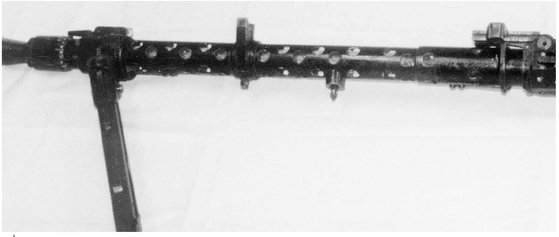
MG 34 German machine-gun, was obsolecent by 1944 but still used in large numbers by ad hoc and rear echelon units of the German army.
Engineer Lieutenant John Holabird, also recalls the crossing and how after the command ‘Go’:
‘We sprang into action. After all, we were the so-called “river crossing experts.” We hauled the boats down one by one. Did we figure out to press them out, or did some Brit show us? Who knows? Anyhow, we got one opened up. Was there a command to move out? I can’t remember. I just knew we were supposed to crack this boat down the embankment across the sandy shore and across the river. How did I feel? I was numb and frozen. But I figured that if Spike and the big shots thought we could make it, why not?
I rallied my squad; grabbed the boat and headed down the embankment about 15 feet. I think the canvas boat was heavier than it looked – then across sandy mud to the river’s edge and into the water. We pushed the boat out to where we could all step in. All hell was breaking loose. Tanks firing smoke and lots of small arms fire. I had experience with canoes and rowboats, plus a period on a freshman crew at Harvard. So I took the stern and shouted, “stroke!” – “stroke!” – “stroke!” as we wallowed across the Waal.’
Captain Moffatt Burris was waiting with his company in the dead ground behind the dyke listening to the fire support reach a crescendo.
‘As we came out into the open, the weight of our boat seemed imponderable; our feet sank deep into the mud. We must have caught the krauts by surprise, because for the first 100 yards there wasn’t a round fired from the enemy side of the river. Then suddenly all hell broke loose. We had run halfway across the flat topped plateau prior to reaching the drop, when Jerry opened up with everything he had – LMGs, Mortars, 20mm guns, artillery and rifles. As if in a rage at our trying anything so dangerous, he was throwing everything he owned at us.

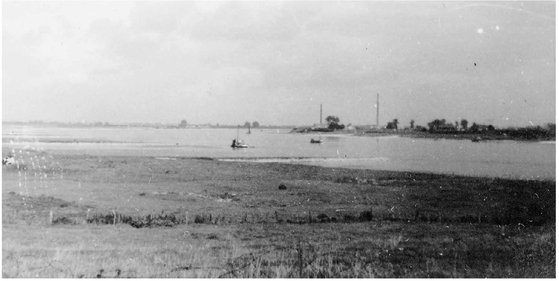
The Waal in 1944.
At last we reached the drop. We let our boats slide down to the beach and we ourselves slid alongside them. We pulled our boat quickly across the short beach, and everyone piled in. By this time, the situation was horrible. The automatic fire had increased and the artillery was deadly. Men were falling to the right and left of me. Our ears were filled with the constant roar of bursting artillery shells, the dull wham of a 20-mm round or the disconcerting ping of rifle bullets.
Men grabbed paddles and started frantically to work. Most of the men had not paddled before; and had it not been for the gruesomeness of the situation, the sight might have been ludicrous. With all our strength, we would lunge forward only to miss the water completely. Gradually our boat got moving in the right direction. We lunged forward at different times.
.... Occasionally I lifted my head to give directions to the engineer steering our boat and to cast a cursory glance at the other 25 boats. By now the Waal was covered with our small canvas craft, all crammed with frantically paddling men. ... Large numbers of men were being hit in all boats, and the bottoms of these craft were littered with the wounded and the dead. Here and there on the surface of the water there floated a paddle dropped by some poor casualty before the man taking his place could retrieve it from lifeless fingers.
The water all around the boats was churned up by the hail of bullets, and we were soaked to the skin. Out of the corner of my eye, I saw a boat hit in the middle by a 20-mm shell and sink. Somewhere on my left, I caught a glimpse of a figure topple overboard, only to be grabbed and pulled back on board by some hardy soul.
We were soaked, gasping for breath, dead tired, and constantly expecting to feel that searing sensation as the bullet tore through you. I wanted to vomit. Many did. Somehow or other we were three-fourths of the way across. Everyone was yelling to keep it up but there was little strength left in anyone. ... But at last we reached the other side.
We climbed over the wounded and the dead in the bottom of the boat and – up to our knees in water – waded to shore.’
General Gavin was now at the division’s rear near Mook, dealing with a crisis there. However, it seemed that any one of any importance was observing 504 PIR’s crossing from the power station roof. The reaction of the watching senior British officers was of incredulity -’Unbelievable!’Typical comments were, ‘My God, what a courageous sight it was.’ by Lieutenant Colonel J.O.E Vandeleur and ‘I have never seen a more gallant action’ was the crisp comment from General Browning.
Across the river the Germans had been caught by surprise, Heinz Harmel, commander of Kampfgruppe Frundsberg said ‘Crossing one of Europe’s widest and fast flowing rivers in daylight was inconceivable and dismissed as suicidal.’ Consequently, he had only deployed outposts along the dyke road, about six hundred yards from the riverbank. However, fire trenches dug into the dyke dominated the flat and open land that the Americans had to cross and against even a lightly held screen, the attack was to be costly. Allied fire was concentrated on the dyke; particularly the Irish Guards’ tank machine guns.
Having reached the narrow river beach 3/504 charged over the flat flood plain towards the dyke. Captain Moffat Burriss recalls how ‘I was angry and we charged across the open flood land without stopping’. This was achieved with the support of concentrated covering fire and smoke. The smoke was not entirely effective and a 20mm anti-aircraft gun on the railway bridge’s northern embankment was soon in action but it was unable to stop the madly charging paratroopers. Infantryman Lieutenant Thomas Pitt recalls:
‘We were coming across another beach-like area 600 yards wide before the final dike. They were dug-in some on the beach and then back in the dike. We were running by them and they were just shooting. The only thing to do was to head for the dike because there wasn’t a Goddamed bit of cover anywhere else or anything. So we finally got about half way back to the dike and this kid who is peeling off this wire and he says “I ran out of wire should I set the phone up here?” I said “hell with it kid just take it easy now and get to the dike. We will talk to them some other day.” So we finally got over to the dike. The Krauts on the other side. The dike must have been maybe ten yards or so wide at the top and they were on the backside. We spent a little time tossing grenades from one side or the other – that was fun and games. They were there with their potato mashers and we had fragmentation grenades. My job was to hold the left flank so as we moved down towards the bridge the Krauts wouldn’t turn and come behind us. So, we proceeded to hold it [the dike]. The Krauts tried to come across a couple times.’
Following the initial assault, 1/504 PIR was crossing the fire swept river in a steadily reducing number of boats. Ahead of them, at 16.45 hours, HQ 504 PIR reported to divisional headquarters that they were ‘...across the river and 3/504 were advancing against the enemy’ bridges to their east. Lieutenant John Holabird and his engineers mission was to accompany the infantry and destroy as many German demolition circuits as he could on the two bridges. He recalls that:
‘We scampered out of the boats and up the beach to higher ground and took off gradually east where we knew the highway bridge to be. We were eight young men, who had just won a new life and we dashed like a cavalry squadron. Nothing could stop us now and we didn’t wait for the 504th. There was a pillbox in front of us. Who knows if there were any defenders? We tossed in grenades and shot ahead. There were two houses. I think uninhabited but we tossed grenades there too and romped on. At some point I bethought me of duties as an officer, wrote a brief, and sent it back by one of my engineers.
We spread out. From here on I get hazy. I was down to six and we were hooping and hollering all over the place. Like a bad officer, I got ahead of the group. I remember running through a large pasture; was surprised by the whistling of bullets going by; wondering if someone was really trying to shoot at me, me, the victorious crosser of the Waal. Finally, after an hour and a half, my euphoria began to wane. I took off my helmet and looked around. It must have been 5 or 5:30 by this time. Bullets still whistling around – but presumably not at me (I hoped) – I wondered what in the world I should be doing? No men, no mission, not really an infantryman. Two of my men arrived and we took council and wondered whether to proceed or get back to the beachhead.
At this point, we discovered Major Cook and elements of the 3rd Battalion coming towards us in a ditch. I reported in to Major Cook, told him that everything was OK this far and since I had only two of my squad left, I probably should see what I could do at the landing.’
Back at the crossing point, which was still under fire, 504 PIR was still being paddled across the Waal to expand the bridgehead to the north and north-west. At the same time, the British 615 Field Squadron Royal Engineers, under heavy artillery and mortar fire, were ferrying American equipment, such as anti-tank guns and mortars, across the river. These heavy weapons were essential if 504 PIR was to repel the inevitable German counter-attacks.
Hof van Holland – Afternoon – Wednesday 20 September 1944
Five hundred metres to the west of the railway bridge lay a 17th Century fortification, of high earthen banks surrounded by a wide, water-filled, moat, called Fort Lent or Hof van Holland. The Allied tactical planning map prepared on 11 September 1944, showed at least one 88 mm and the presence of a section of 81mm mortars. From the cover of the fort, the mortars could provide fire support to any part of the Germans defences in Nijmegen. However, nine days later the fort had been reinforced by SS infantry, with their usual high proportion of Spandaus. Colonel Tucker, commander 504 PIR, recalls how, having watched the crossing from the power station, he:
‘... came down and jumped into one of the boats with my G-3 [operations staff officer] and went across the river to arrive just as grenades and fire were brought down on Fort Lent.’
Colonel Tucker

Communications were working well back to the fire support group on the southern bank of the Waal, despite the mixing of troops and confusion inherent in battle. Indirect fire had stunned the defenders. Colonel Tucker arrived just as fire from Allied mortars and artillery lifted and, in the words of the historian of the Irish Guards the fort received
‘... particular attention – even armour piercing shot to keep the defenders’ heads down’.
The American paratroopers closed in for yet another spectacular kill. Colonel Tucker continued:
‘What happened – there was grenade and mortar fire into the fort area, then a running dive into the moat. The bridge into the fort was kept clear by riflemen who fired at anything that moved. I went into the fort behind the initial troops.’
A deadly blend of clinical military efficiency and raw courage had overcome a strong position, covering approaches to the railway bridge. So it was, that small groups of determined Americans reached the northern end of the railway bridges, driven on by the ‘intoxication of the crossing’. In the words of XXX Corps’ historian:
‘By six o’clock the American flag was seen to be flying on the northern end of the railway bridge. This magnificent assault is probably one of the most amazing achievements of the war, and it could have been carried out only by a very fine division.’
The Capture of the Railway Bridge – Late Afternoon 20 September 1944
Captain Neville and a part of his mixed group of Grenadiers and paratroopers penetrated the enemy positions on the railway bridge’s southern embankment, while the remainder of his force was held up by the SS at the Kronenburger Park. Guardsman Howe, who had been so pleased to ride into Nijmegen in one of his battalion’s Bren Gun Carriers on 19 September, recalls the fighting:
‘After our battle the day before, we were a bit short of ammunition but I had a satchel of grenades that I used clearing the enemy out of the houses he had occupied between our positions and the railway bridge. The day seemed to go on forever. Grenades through windows or door. The crack of the detonation and in we went with a burst from the Bren and the bayonet. The strange thing is that throughout the whole battle I never saw a live German until I reached the bridge and they were running away across it.’
However, elsewhere, as the Grenadiers reported,
‘The SS and young troops fought savagely, but the old men ran away or surrendered when the SS soldiers’ backs were turned’.
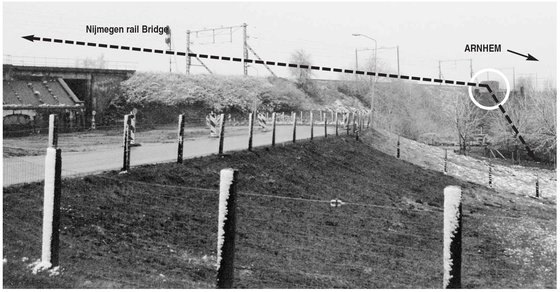
The original underpass on the Ousterhout Dyke road. Note the pill box which had excellent fields of fire.
By early afternoon, the Allies’ hold on the southern end of the railway bridge was still tenuous, with fighting in the surrounding streets and houses. Captain Neville was unable to report his Company Squadron group’s success to the Grenadiers’ Headquarters, as his radio was suffering the same problems of screening, as those experienced by the 1st Airborne Division in the streets of Arnhem. If he had been able to report, perhaps the Grenadiers’ main effort could have been switched to the railway bridge and the success exploited far more quickly. All German accounts are definite in that they lost control of the southern end of the bridge mid-afternoon but most Allied accounts based on divisional level war diaries paint a far less clear picture. However what is clear is that elements of 3/504 PIR were established at the northern end of the railway bridge by early evening. Private Albert Tarbel, company radio operator, recorded in his diary:
‘After fighting with different groups from our H Company, I was trying to rejoin Captain Kappel. I finally met with him at the railroad bridge. We also had quite a fight there. At one point, we were passing Gammon grenades to Captain Kappel, who was throwing them at the German soldiers through an opening in the northern bridge tower entrance. Needles to say, we neither offered nor gave any quarter to the Germans on the railroad bridge.’
The railway bridge was badly damaged by German frogmen on September 1944 and was rebuilt after the war. The modern concrete stands on the original stone piers.

Lieutenant Keep, of Company I, writing shortly after the event, describes how, once the railway bridge was secure how they:
‘...organized defences, knowing the Krauts would counterattack to get it back. We heard rumours that German tanks were coming from one direction, infantry from another. However, we did face fanatics who constantly crept towards us from the middle of the great bridge, coming as close as they dared, then throwing potato mashers [stick grenades]. It was suicide, but such individuals are ever prevalent among the present-day representatives of the Herrenvolk [master race].
Then at dusk, a strange thing happened. Out of the darkness loomed a tremendous mass of German soldiers walking from the middle of the bridge and approaching our end. There must have been 200 – 300 of them. We all thought our goose was cooked and were prepared to open up with what small firepower we had left when one of the Krauts called in German that they wanted to surrender.... Had they realized what a paltry group we were, I fear all thoughts of surrender would have vanished and they would have turned bellicose.’
Sadly, word that the railway bridge was taken did not strike home in the minds of the divisional staffs, as British and American attention was focused on the fight for the Road Bridge.
The Attack on the Road Bridge – Afternoon and Early Evening Wednesday 20 September 1944
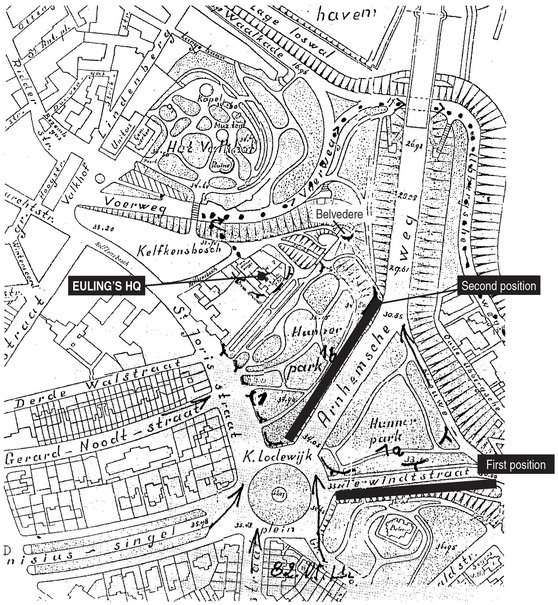
Return via the railway bridge and Keizer Karel Plein, on to the Oranje Single. Follow the road, on to the open Keizer Traianus Plein (formerly known as Kaiser Lodwijk Plein). The road system is complicated but follow signs to ‘Centrum and Parking’. Turn on to St Joris Straat and look for a parking space. On most days of the week, the best thing to do is to park in the underground car park that has its entrance as the square opens out. The modern museum dominating the Kelfkensbosch square does not contain material relating to 1944 but stands on the site of buildings that contained SS-Hauptsturmführer Euling’s battalion headquarters (see page 169). From the car park, a short walk around the Valkhof Gardens and Hunner Park will take the visitor to the scene of the action on 20 September 1944.
Starting at 08.00 hours, Lieutenant Prescott, commanding a troop of Shermans from No.2 Squadron 2/Grenadier Guards, was to clear the main road from Keizer Karel Plein to the bridge:
‘Initially I was placed under command of 4 Company of the 1st Battalion and our task was to clear the main street from the “ring road”[Oranje Single] up to the Valkhof Gardens overlooking the bridge. I married up with the infantry company south of the ring road and we soon set off across this road. I recall seeing American parachutists dug in along the road in verge between the two carriageways. One could not but get the impression that they were very tired. We made reasonably good progress down the street with the infantry clearing the houses, while the tank troops, of necessity on a one-tank front, gave fire support up at the windows. I recall coming under small arms fire at one time and having to close down, and shortly afterwards having mortar fire directed onto my tank and closing down once more. My troop corporal was shot through the arm while in the cupola of his tank, but was able to continue in command. We reached the open square Kelfkenbosch in front of Valkhof Gardens and stopped to take stock.’
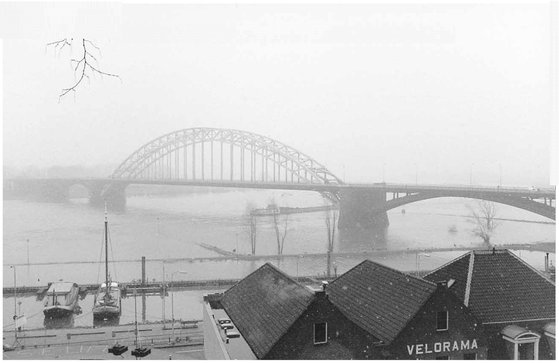
The view of the bridge from the German pill box on the Valkhof.
This phase of the operation took about five hours. The American paratroopers, along with the Grenadiers’ tanks and infantry steadily closed in on the bridge, clearing houses as they went. SS-Hauptsturmfuhrer Schwappacher recorded in his after action report:
‘Whenever the enemy was ready to advance on the bridge we hit him with the full impact of an artillery barrage, which immediately halted the attacks, whereupon our infantry, reinforced, were able to maintain their positions.’
Despite the considerable strength of the Frundsberg’s artillery, the mounting Allied pressure and losses eventually forced the SS soldiers to start pulling back from the southern edge of Hunner Park to positions on the western side of the Arnhemsche Weg. However, the road to the bridge that the Allies sought so desperately was covered by enemy fire. The burning hulks of Shermans that had previously fought their way onto the approach to the bridge, were a testimony to the effectiveness of the Panzerfaust in the hands of determined soldiers.
Having reached the Kelfkensbosch Square on the southern edge of Hunner Park and the Valkhof Gardens, the Allies were forced to pause to regroup and re-supply for the final assault on the main enemy positions guarding the road bridge. The plan that Lieutenant Colonels Goulburn and Vandervoort agreed was that the Grenadier infantry would assault Hunner Park and the Valkhof, while Vandervoort’s 2/505 PIR would attack enemy positions on the northern edge of the Kaizer Lodewijk roundabout. H Hour for all three attacks was set at 15.30 hours, half an hour after 3/504 PIR eventually started their much delayed assault river crossing.
1/Grenadiers were to assault the Valkhof Gardens from the area of the Police Station, to the west, with King’s Company, reinforced by Lieutenant Dawson’s Platoon from No. 2 Company. No. 4 Company was to cross the open Kelfkenbosch/St Joris Straat square and clear the Hunner Park and capture the Belvedere. No. 2 and No. 3 Companies were to cover the flanks of the assaulting companies and provide reserves if necessary. The tanks of 2/Grenadiers would remain divided up in support of the British infantry and the American paratroopers. The attack was delivered with only the sketchiest orders to platoon commanders. However, this was of little consequence as one company commander explained:
‘From the first five minutes, the fighting did not conform in any way to my original plan, but once we got our teeth into the enemy the men’s spirit was so terrific – even laughing and joking that nothing could have stopped us.’

A view from the open Kelfkensbosch through St Joris Straat to the Kaiser Lodewik Plein.

SS-Hauptsturmführer Karl-Heinz Euling.

Facing a dangerous enemy, such as soldiers of the Waffen SS, this light-hearted reaction to the likelihood of sudden, violent death was familiar to the seasoned commanders.
The Germans’ main positions around the bridge were still held by soldiers of SS-Hauptsturmführer Euling’s battalion, along with those from the outposts, who had fallen back to join their comrades. In addition, two weak companies of SS engineers under SS-Untersturmführer Wener Baumgaertel held strong points in the centre of the Valkhof Gardens, and in the Belvedere which provided the German position some depth to its defences. The whole area was festooned with barbed wire entanglements and a complex of shallow crawl trenches dug over the preceeding days as reinforcements had arrived. At this time, four of the Frundsberg’s assault guns were still operational, with more covering the bridge’s northern ramp.
A rare surviving Resistance document prepared in Nijmegen by Jan Van Hoof. He passed such information to the SOE in London March 1944. The shaded areas depict fortified buildings, which with the trench system, made the Valkhof an extremely strong position. The numbered triangles symbolise German pill boxes.


The Kelfkensbosch and the ornamental bridge into the Valkhof Gardens. Tanks of 2/Grenadiers were knocked out attempting to cross the square.
The King’s Company got off to a good start as the enemy were clearly not expecting a flank attack, with their main positions facing the open area of the Kelfkensbosch. This meant that the Guards were able to cut their way through the barbed wire entanglements and climb up a steep rubble slope to the western edge of the Valkhof Gardens. If the German had properly covered this obstacle with fire, the Guardsmen would have been unlikely to have broken into the main enemy position. However, even so casualties were high and King’s Company lost its commander in this first phase of the battle. Lieutenant Dawson, who had arrived to join the attack, just as the advance began, took over command of King’s Company in the absence of other officers. Lance Sergeant Simpson recalls:
‘We reached the top of the slope and the platoons in the ruins of the police station behind us were firing away over our heads. We paused to gain our breath and charge our magazines. We then dashed forward a short distance to a German trench. It wasn’t very deep and led to positions to our right. Still it was good cover which was very welcome and I found that I had had close shave, with a round having shot through my water bottle on my hip.’
Looking down Lindenberg towards the Waal. King’s Company 2/Grenadiers attacked from the Police station (now replaced) across the road and up the rubble covered slope into the Valkhof on the right.

Having gained a toehold on the edge of the Valkhof with his two leading platoons, Lieutenant Dawson attempted to expand his lodgement by sending a reserve platoon around to the right under covering fire. Unfortunately this platoon lost heavily, as it ran into an SS position and had to withdraw. Lieutenant Dawson’s second flanking attempt, this time on the left, was more successful. The platoon made its way under cover of the embankment to within fifty yards of the bridge but they were unable to reach it due to heavy Allied and German fire that was sweeping the area. Having retraced their route slightly, they were able to fight their way up into the Gardens behind the Germans. From this position, the platoon was able to the dominate the Valkhof area and bring fire down onto Hunner Park and the southern approaches to the bridge. This fire support was of considerable assistance to No.4 Company and Companies E and F of 2/505 PIR. Providing fire support to other attacks was easy but winkling determined SS defenders out of the Valkhof, was to be a protracted and nasty business.
No. 4 Company attacked Hunner Park across the Kelfkensbosch, as the enemy had anticipated. They attacked on a two-platoon frontage but this time each platoon was supported by a Sherman tank. As the Grenadiers’ regimental history describes, the attack did not get off to a good start:
‘Lieutenant Fazackerly led off, fanning across the open ground. They had not advanced more than a hundred yards before the Germans opened up with the most withering fire from the area of the bridge. Lieutenant Fazackerly was shot through the stomach, Lieutenant Prescott’s tank was hit by an enormous shell and blew up, Lance Sergeant Heawood and his section were mown down and pinned down by fire, and casualties started to mount all round at a most alarming rate.’
The route around the northern edge of the Valkhof Gardens (see Resistance map on previous page) taken by a platoon from King’s Company.


Voreweg with the Belvedere in the distance. It formed a deep trench between the Valkhof Gardens and Hunner Park.
The Chapel in the Valkhof Gardens was repaired after the war but its massive walls stood up to shot and shell remarkably well.

The pill box built into the walls of the Valkhof. From here machine guns covered one of the approaches to the bridge.
Major Stanley decided to move his company further to the right, as it was clearly impossible to cross the Kelfkensbosch. However, with the buildings along the southern side burning, re-deploying was not easy and very slow. Having reached the Americans on the St Joris Straat, No. 4 Company found the paratroopers similarly pinned down by Spandau fire from the Belvedere area and Keiser-Lodewijk Plein. St Joris Straat was much narrower at this point and the buildings across the fire swept road were obviously fortified but until these buildings were cleared, no progress towards the bridge could be made. The risk had to be taken.
Under covering fire from paratroopers and fellow Guardsmen, with mortars and tanks firing smoke the leading Allied platoons crossed the road and made their way through the gardens bordering the Hunner Park, towards the Belvedere. The regimental history describes how the leading platoon reached about thirty yards from:
‘the fort. Lieutenant Greenall and his ten strong “platoon” immediately charged at it and succeeded in driving away the whole force of Germans, killing many of them and taking about thirty prisoners.’
This was a well-developed position, strongly held by SS engineers but news that the Americans had crossed the river behind them must have undermined their morale and contributed to the Guards’ and Paratroopers’ ascendancy. The Grenadiers’ historian describes the action in the buildings between St Joris Straat and Valkhof:
‘At the same time, Lieutenant Slob’s Platoon surrounded a large house near by, covered the exits with machine-guns and threw in phosphorous grenades which roasted alive about 150 Germans who were inside. At this point all serious German resistance seemed to crack. They were overwhelmed by fire ... Soon a patrol from No. 4 Company moved down on to the bridge and, apart from a considerable quantity of shell-shocked prisoners, found it clear.’
The Belvedere occupied by 10 SS Engineers and captured by 2/502 PIR. This view is from the Valkhof Gardens across Voerweg to the bridge’s southern ramp.

The ‘large house’ was Haus Robert Jannssen, which SS-Hauptsturmfuhrer Euling used as his HQ and strong point. Euling escaped the fire and carnage in his headquarters as the Guardsmen and flames advanced on him. Leading sixty survivors of his battalion, he escaped down the steep bank into the Voerweg and to safety under the road bridge. (See dotted line on map).
A copy of SS-Hauptsturmführer Karl-Heinz Euling’s map, showing his defence of the Nijmegen bridge.

Hunner Park after the battle. A dead Guardsman surrounded by German equipment testifies to the severity of the fighting.
Meanwhile, Companies E and F, 2/505 had, with the addition of the Guards, assembled sufficient combat power for them to clear the Kaiser Lodewijk Plein Roundabout and the eastern portion of Hunner Park. The removal of the enemy from the Belvedere helped their advance considerably. The Grenadiers’ tanks, with the advantage of numbers, won a deadly fight with the German assault guns. Even so, a tank advancing any distance into uncleared territory towards the bridge risked being knocked out by Panzerfausts.
In the gathering dusk, the bloody business of clearing enemy positions in detail began. This went on late into the night. So determined was the resistance by pockets of SS defenders, that it shaped the following day’s battle. However, as daylight failed, the Allies had vital footholds on the southern approaches to both bridges. At divisional headquarters, realization that their troops had reached their objectives, coincided with a garbled radio message that the Americans of 504 PIR had ‘reached the northern end of the Bridge’. The Grenadiers could see nothing through thick smoke screens but the message galvanized 2/Grenadiers into taking a desperate risk. They were to launch another attempt to get tanks across the area littered with the burning hulks and bodies of those who had earlier led the way onto the Kaiser Lodewijk Plein and the road bridge beyond. However, the garbled message had referred to the rail bridge where the Stars and Stripes could indeed be seen not the road bridge. This mistake, of a type only too common in war, caused orders to be issued.
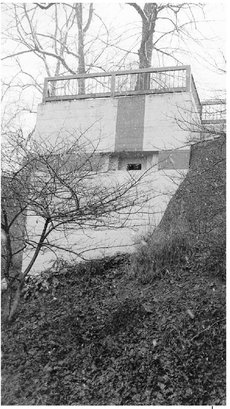
Return to your car and head for the Keizer Traianus Plein (formerly Kaiser Lodewijk Plein) and follow signs for Arnhem. This will take the visitor across the vital bridge. There is no stopping on the bridge and the driver should concentrate on the road rather than the view, as traffic moves quickly. Take the first slip road off the bridge’s northern ramp signposted towards Lent West. Turn left along the dike road and after a hundred metres park in the first pull off. Just in front is the large concrete bunker from which SS Brigadefuhrer Heinz Harmel watched the final assault on the bridge.
The Grenadiers Rush the Bridge – 1900 Hours Wednesday 20 September 1944
The tanks of No. 1 Squadron 2/Grenadiers were the only uncommitted reserve in Nijmegen. The squadron commander, Major Trotter, himself having been briefed by Lieutenant Colonel Goldburn, called his second in command Captain Lord Peter Carrington, and troop commander, Sergeant Peter Robinson, for orders outside the Nijmegen Hotel. Of the two reporting for orders, the former was a peer of the realm and wartime soldier, while the later was a hard bitten Regular Army Guardsman and one of the battalion’s few non-officer troop commanders. Lord Carrington eventually became British Secretary of State for Defence and head of NATO. In one of his typically clear pieces of military thinking, Lord Carrington summed up the orders he and Sergeant Robinson had been given,
‘We thought that someone must be round the bend, to order an assault on the bridges. They were certain to be mined, and would probably be blown up under us as we crossed. The orders were for Sergeant Robinson “to take the bridge at all costs” to enable us to link up with the American paratroops who had previously crossed the Waal approximately one mile west, and were believed to be clearing north of the bridge’.
Nijmegen citizens look on as a Sherman belonging to 2/Grenadiers await orders to move towards the road bridge.


A Sherman belonging to 2/Grenadiers, prior to the assault on Nijmegen road bridge.

Sergeant Peter Robinson DCM.
Lieutenant Jones of 1 Troop, 14 Field Squadron, Royal Engineers, following in a light armoured car, was to start defusing the demolition charges that were known to litter the bridge’s structure. Lord Carrington was to follow in his squadron headquarters tank. The orders group ended with Major Trotter formally shaking hands with Sergeant Robinson and reassuringly saying ‘Don’t worry, I’ll let your wife know, if you don’t come back.’ Having seen the fate of the two troops who had earlier attempted to move onto the Kaiser Lodewijk Plein, it seemed more than likely that Major Trotter would have to deliver this message.
According to Sergeant Robinson’s Army issue wristwatch, the first move forward started at 18.13 hours. Peter Carrington noted that ‘It was not quite dark, as we went over’. Nosing forward across the Kaiser Lodewijk Plein, Sergeant Robinson’s tank was engaged by an 88mm but the hasty shot ricocheted off the road and struck the Sherman a glancing blow, disabling the vital radio set. While his troop commander withdrew under smoke, Lance Sergeant Billingham became the 88mm’s target but the troop’s other two tanks were stationary and ready to give covering fire. Sergeant Pacey engaged the 88mm with HE and reduced the German gun to scrap before Sergeant Billingham was hit.
Back in cover, the troop reorganised, with Sergeant Robinson moving to a tank with a working radio. Under pressure from the Commanding Officer’s repeated orders to get going, the Shermans were moving forward again into the enemy’s killing area on the approaches to the bridge. The ramp was covered by three enemy anti-tank guns and numerous Panzerfausts. At about 19.00 hours, driven forward by admirable self-discipline and three hundred years of regimental tradition, Sergeant Robinson recalls how:
‘We had barely travelled fifty yards, when a Panzerfaust struck a nearby girder. It seemed that projectiles were coming from every angle, yet strangely we remained intact. Not only was the bridge defended from both flank and front, but we suffered repeated attacks from the air in the form of men hanging from girders dropping grenades, while snipers endeavoured to keep us running blind [by keeping the Sergeant closed down in his turret].’
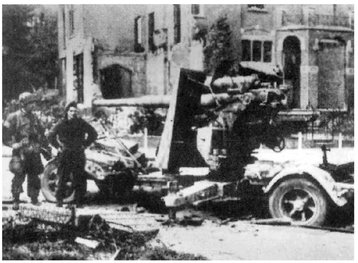
A Guardsman and a paratrooper inspect a knocked out German 88 on the edge of the Kaiser Lodewijk Plein.
The tanks commanded by Sergeant Robinson and Lance Sergeant Pacey charged over the bridge, engines roaring, with their Browning machine-guns firing. As they crossed the vast structure, Germans shot in the bridge’s girders plummeted to the roadway below or hung grotesquely from safety straps as their lifeblood ebbed away. These were not suicide snipers but mainly SS engineers working on the Bridge checking and repairing the demolition circuits. There has been much discussion about whether or not resistance fighter Jan Van Hoof had cut the demolition circuits but the greatest sin a military engineer can commit is to have his demolition charges fail. They constantly check their multiple electronic circuits and promptly repair any breaks. However, engineers on the bridge, as SS soldiers, were expected to fight determinedly to the last. Some one hundred and eighty German dead were subsequently recovered from the bridge and its structure. Many more would have fallen into the river below. From his forward observation post on the riverbank, to the east of the bridge, SS-Brigadeführer Harmel, in the twilight, only had glimpses of the smoke shrouded bridge. He recalls how:
‘Model had told Bittrich that the Nijmegen Waal bridges were not to be destroyed but the bridges were still prepared for demolition. As the crisis came, I watched from the bunker on the riverbank. When I lost radio to Euling, I knew that the bridge was going to be taken. Everything seemed to pass through my mind all at once. What must be done first? What was the most important action to take? It all came down to the bridges. They must be destroyed. If Bittrich had been in my shoes, he would have blown the main bridge. In my view, Model’s order was now cancelled because the situation had changed. I had no intention of being arrested and shot by Berlin for letting the Bridges fall into enemy hands – no matter how Model felt about it.
I waited, watching and then saw one tank on the centre of the bridge, then another following behind and to a side. I ordered the pioneer with the firing mechanism to “Get ready” and when two more tanks reached the centre, I gave the order, on my own responsibility “Let it blow!” Nothing happened. “Again” I shouted to the pioneer. I waited to see the bridge collapse with the tanks into the river. It failed to go up – probably because the initiation cable had been cut by artillery fire. Instead, the tanks kept moving forward getting bigger and closer. “My God, they’ll be here in two minutes”, I told my radio operator.’
The bunker where Heinz Harmel watched the Grenadier tanks cross the bridge. From here he gave the order to blow the demolition charges.

The leading tanks raced on across the long exposed bridge, under fire all the way and skidded sideways, at speed, through a concrete chicane roadblock at the northern end. Against all the odds, they were across! Almost immediately Guardsman Lesley Johnson, Sergeant Robinson’s gunner, spotted the first of a pair of anti-tank guns on the bridge’s ramp fifty metres away and knocked it out with his third round of HE. The tank charged on brushing aside the second enemy gun and grinding the bodies of the crew under the tracks as it passed. Such was Johnson’s surprise at surviving the ‘running of the gauntlet of fire’ that he declared that: ‘I swear to this day that Jesus Christ rode on the front of our tank’.
The concrete chicane road block on the Lent end of the Bridge and flak tower.

Immediately behind Sergeant Robinson’s troop, was Lieutenant Jones of the Royal Engineers in his scout car with orders to make the bridge’s demolition charges safe. He recalls:
‘I tried, with binoculars, to see if there were any demolition charges, but there were none visible. I left the house and went up behind the forwarCompany D to see how close they had got to the bridge. They had just lost their company commander in addition to a lot of men and were in no condition to push on much further, so I decided to go back. When I got back to my car at about 18.00 hours, I found an urgent order from OC 14 Field Squadron to report to the roundabout near the bridge at once. I arrived at 18.20 hours and found a troop of 2/Grenadier Guards tanks lined up ready to rush the bridge at once...
On the bridge, the first thing I saw was about half a dozen wires on the footway at the side of the bridge. These I cut. I walked up to the roadblock and saw about ten Tellermine in a slit trench nearby. These were obviously designed to close the block. ... I removed the igniters and threw them in the river.’

Lieutenant Tony Jones.
Lieutenant Jones with his scout car covering him made his way back towards Nijmegen checking as he went. He found no more obviously dangerous cables or charges, as the Germans had camouflaged them by building them into the bridges structure. He did, however, collect prisoners and returning to the Nijmegen end of the bridge he,
‘handed the seven men over to the CO and reported that, in my opinion, the bridge was safe and all that was now necessary was a detailed search.’
Lieutenant Jones led his troop onto the bridge along with a German POW who agreed to help his captors:
‘He led us to the next pier, [at the northern end of the second span]... There was an elaborate system of staging and the charges were made of TNT packed in green painted boxes, each charge with a serial number corresponding to a serial number painted on the girder. The charges were to be fired electrically, and the detonators were in and connected to one of the wires, which I had previously cut on the deck. We removed these and decided to check the rest of the bridge, though our prisoner had said there were no more charges.’
It would seem that the bridge was not comprehensively prepared for demolition and that the charges found by Lieutenant Jones were placed, in the time available, with the aim of blowing a single span. However, by following on behind the Grenadier’s tanks and quickly cutting the cables, Lieutenant Jones thwarted SS-Brigadeführer Harmel’s self-appointed mission to blow the bridge. Luck, on this occasion, had been on the side of the Allies. Without capturing the Road Bridge intact, there would have been no chance of XXX Corps reaching the Rhine and in this case, the fate of the battle rested in one man’s hands – Lieutenant Tony Jones of the Royal Engineers.
British engineers, collect up wiring and explosives that were intended to blow the bridge. Note the numbered demolition charges.

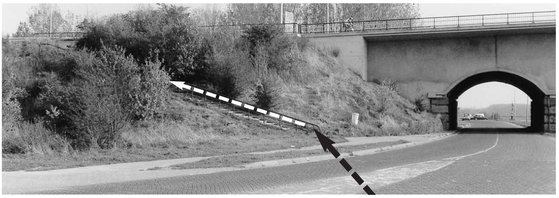
Turn around, drive back and pass under the Bridge. Park opposite the steps up the embankment to the main Arnhem road.
On the northern bank, after their assault crossing and maddened charge against the German positions on the dyke, 504 PIR’s paratroopers fanned out in small groups, as during the assault their ranks had been greatly thinned. Leading a group of no more than fifteen men towards the bridges was Captain Moffatt Burriss, commander of Company I, who recalls:
‘At sundown, we found ourselves under the massive Nijmegen Bridge, which rose nearly twenty stories. The dyke road ran under the north end of the bridge, which was supported by huge concrete columns. An eerie silence had fallen at the north end, and we didn’t see any enemy troops. Across the river, the city of Nijmegen was ablaze, and there was a great deal of firing around the bridge’s south end.
As I stood beneath the north end, I saw a set of concrete steps that went from the lower road to the main highway at that end. ... Then I turned to La Riviere and pointed up the concrete stairway. “Let’s go up!” As I reached the top of the steps, I saw a lone Kraut standing at the end of the bridge. He was so surprised to see us that he dropped his rifle, held up his arms, and immediately surrendered.
The northern end of the Nijmegen bridge and the steps that Moffatt Buriss climbed to meet Sergeant Robinson and Captain the Lord Carrington.
La Riviere and an enlisted man were standing with me at the end of the bridge. I had just told La Riviere to take some men, start across the bridge, and cut wires, when a German hiding high in the girders shot and killed the enlisted man standing between us. La Riviere immediately wheeled around and shot the Kraut. As the man fell, one of his straps caught in the girders, and he was caught in the steel structure. When we left two days later, he was still hanging there.
It was beginning to get dark. As we looked at the south end of the bridge, we saw silhouettes of tanks heading across in our direction. We couldn’t tell if they were German or British, but I think most of us believed that they were Kraut reinforcements. “Let’s get off the bridge and over the embankment,” I said, “until we can tell whose they are.”
As we waited with Gammon grenades in our hands, two tanks passed within a few feet of us. They were British. When the third one arrived, we swarmed all over it and shouted, “Hey, we’re Americans!” The tank commander stuck out his head. I grabbed him around the neck. “You guys are the most beautiful sight I have seen in months”.’
Captain Lord Carrington remembers this meeting. However, as they were exchanging relieved greetings, the sound of battle could be heard ahead in Lent, on the road to Arnhem.
Two dead SS engineers lying dead on the Nijmegen bridge. Some one hundred and eighty Germans were killed in an attempt to hold it.


Vehicles of Guards Armoured Division cross the road bridge over the Waal at Nijmegen.
The question of who captured the bridges has understandably exercised members of the two divisions and many commentators. However, almost sixty years after the event, it can be said that the capture of the bridge was a joint operation and a joint success. As General Gavin estimated, it would almost certainly have taken the Allies much longer to fight their way to the bridges without the truly heroic Waal crossing by 3/504 PIR. It should also be born in mind, that capturing just one end of the equally large bridge at Arnhem hardly constituted securing a viable crossing. On this basis, honours at Nijmegen are shared equally between the Guards and the 82nd Airborne. On meeting General Gavin for the first time, several days after the bridges’ capture, General Dempsey did say,
‘I am proud to meet the commanding general of the finest division in the world today.’
In General Gavin’s words:
‘... I accepted it with reservations, believing that he was being too kind. However, an alert staff officer overheard the comment, and it became part of the division’s history.’
If the question of who captured the bridge is easily settled, the issue of the lack of immediate exploitation of the success can not be so easily settled and is a source of enduring controversary.