
CHAPTER NINE
Night Wednesday 20 / Thursday 21 September 1944
Do not take the ramp up to the main Arnhem road but follow the local road (Griftdijk Sud) at the foot of the embankment, towards Elst, that runs parallel to the highway. Follow the road through Lent until the railway underpass is reached.
Five tanks had set out across the bridge. Sergeants Robinson and Pacey, with the benefit of surprise, got across and continued on into Lent. Guardsman Johnson recalls how Robinson was shouting into his radio’s microphone:
Aerial photograph of the two bridges taken 10 September 1944.

‘He had a voice like a bull and that, I think, annoyed me more than anything. It was coming through my earphones like claps of thunder’.
The Troop’s other two tanks were hit by a hail of solid, armour piercing shot and Panzerfausts, on the northern ramp and one had caught fire. Sergeant ‘Rockey’ Knight’s tank collided with the vehicle in front of him that had been hit by the SS infantry who were still in the area in considerable numbers. He recalls:
‘We were fired at. Everybody jumped from the tank and I hit the slope of the causeway beside the tank. After a while a German kicked me and apparently fancied me dead. On closer inspection of our tank, it was actually the cam nets and luggage that had been set afire on the backside of our tank on top of the motor compartment. I re-entered the tank – nobody inside – and managed to drive it in the direction the others had gone. I didn’t see any of my crew members. Afterwards I learned they had been made POW.’
One of those taken prisoner, Ernie Wheateley, recalls:
‘I jumped into a Jerry foxhole out of the way. Hearing somebody walking about overhead about ten minutes later, I took a look and there was an awful looking Jerry peering down at me, to say, “Come out Tommy”, which I promptly did, having no Sten or other gun with which to defend myself. He says, “Where are your mates?” and before I could say anything, out they came.’
Word went out that Sergeant Knight’s vital tank needed a crew. Forward stepped some intrepid paratroopers, who in previous service, had crewed Shermans. For the remainder of the night one of the Grenadiers’ tanks, was crewed by British and American soldiers.
Meanwhile, Sergeant Robinson’s two leading Shermans, exposed on the roadway surrounded by the buildings of Lent, had run a gauntlet of Panzerfaust fire. As they headed north, they had a brush with another group of Americans. Captain Burriss recounts how:
‘We later learned that the tank commanded by British Sergeant Robinson encountered some troops in a ditch just ahead of him. Thinking they were Germans, he fired on them. One tossed a Gammon grenade back at him. They both realized their mistake and, because no one had been hurt, they held a brief celebration.’
Having driven off the bridge’s ramp towards Lent the next problem encountered was an enemy Sturmguschutz. Lying in wait, it got off the first shot but missed. While the German gunners were reloading, Guardsman Lesley Johnson laid the sight of his 75-mm gun on the bulk of the enemy vehicle and fired.
‘“Target!” I shouted, as I saw the flash of steel striking steel but we wanted to make sure and pumped several more rounds into the hulk.’
A little further on, in the centre of Lent, the church was ‘swarming with Germans’ who were surprised by the unexpected arrival of British tanks. The enemy infantry were driven into the building by the Shermans’ coaxial machine-gun fire. Sergeant Robinson ordered Johnson to engage with main armament. The armour piercing round already in the breach crashed through the church walls followed by high explosive rounds, which they kept firing until the church was ablaze. The surprised SS infantry broke under the hail of the Grenadiers’ fire and as they ran, illuminated by the fiercely burning church, the two tanks fired down the village street. Guardsman Johnson wryly pointed out that Sergeant Robinson’s motto had been ‘If it moves shoot it!’ and they did a lot of shooting at moving targets in Lent.
Sergeant Robinson’s two tanks continued in the dark, on through Lent to where the railway bridge crosses the wide tree lined concrete road from the northern end of the bridge. Reaching the railway bridge, the Grenadiers’ Shermans cautiously went under it and on towards Arnhem. Guardsman Johnson, who admits to having been ‘gripped with the cold hand of battle’ at the time, wrote:
The railway bridge at the northern end of Lent. Two of the Grenadiers’ tanks went under the bridge just after dark on 20 September 1944.
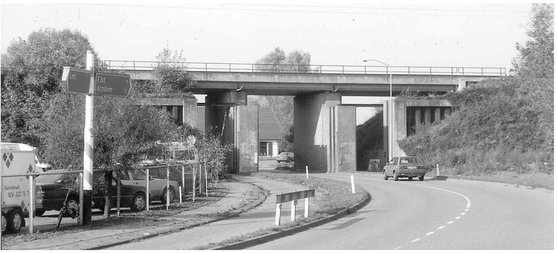
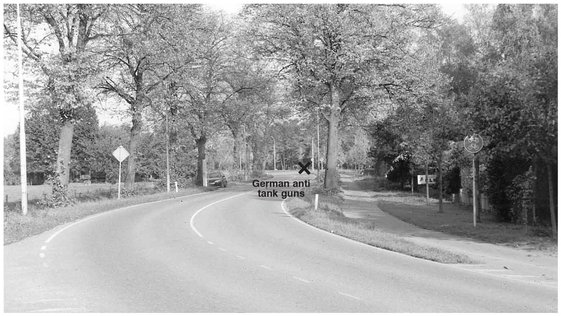
Coming under the rail bridge and swinging around this bend, Sergent Robinson came under fire from a German anti-tank gun.
‘We went round at 15 M.P.H., machine-gunning as we went. Suddenly there were two terrific explosions right in front of the tank. The blast from them came down the periscope and into my eyes and I thought for a minute that I had been blinded.’
The Guardsmens’ luck had run out. They had met a roadblock created by two mutually supporting German anti-tank guns. In the now complete darkness, it was impossible to tell exactly where they were and unable to deploy off the road and without infantry they could make no further progress. Withdrawing the two tanks back behind the railway line Sergeant Robinson saw:
‘One American paratrooper who I beckoned over, and then from nowhere there suddenly appeared thirty of his comrades, who gave me a most royal welcome, climbing all over my tank. It was the first time I had ever seen a tank kissed, whilst frankly, I felt like kissing them.’
Both paratroopers and armour were pleased to have the mutual support of one another but there was no serious discussion about continuing the advance. The Americans were very low on ammunition and even if the two tanks had got past the anti-tank guns that were blocking the road ahead, the gauntlet of Panzerfausts would certainly have claimed them long before they reached Arnhem. The real factor was, however, human. Both the British and American soldiers had been through, by any military measure, traumatic events in the preceding hours and had understandably run out of drive and the ‘pot of courage’ was drying rapidly.
Captain Lord Carrington had crossed the bridge sometime after Sergeant Robinson’s troop and, as we have seen, met up with Captain Moffatt Burriss who had arrived at the northern end of the bridge. The cordiality of the initial meeting was quickly lost, when the three tanks who had gone forward to Lent returned to the area of the northern end of the Bridge’s ramp. Captain Burriss recalls:
‘That’s when the British tank crews brought out their teapots. I was furious. I charged to the front of the tank line, where I found the British commander Captain Peter Carrington of the Grenadier Guards. “Why are you stopping.” I asked him. “I can’t proceed,” he said crisply. “That gun will knock out my tanks.” “We will go with you. We can knock out that gun.” After crossing the river in those flimsy boats, taking out the machine-guns, knocking out the Germans’ 20-mm gun, and capturing the bridge, I had no doubt that we could handle the German 88. “I can’t go on without orders.” He was a British captain and I was an American captain. He wasn’t about to recognize my authority. “No,” he said, “I have to have orders from my British commander.” I could not believe what I was hearing. “You mean to tell me you’re going to sit here on your ass while your own British paratroopers are being cut to shreds – and all because of only one gun?” He shook his head. “I can’t go without orders.” I looked him straight in the eye. “You yellow son of a bitch. I’ve just sacrificed half of my company in the face of dozens of guns, and you won’t move because of one gun.” Then I cocked my Tommy gun, put it up to his head, and said “You get this tank moving, or I’ll blow your damn head off.” With that he ducked into his tank and locked the hatch. I couldn’t get to him.
About half an hour later, Major Cook [commanding 3/504 PIR] had a similar argument with him but to no avail. And an hour or so after that, Colonel Tucker [commanding 504 PIR] had the same argument. He told Carrington, “Your boys are hurting up there at Arnhem. You’d better go. Its only eleven miles.” Still no movement.... In retrospect, we were probably too hard on Carrington. He had little option but to wait for orders; however, we took out our anger on him because the man responsible was nowhere in sight.’
Lieutenant Pitt whose platoon remained in close defence of the recalls how:
‘By the time we got there, Cook, who was the Battalion Commander was there. And then, the first British tanks came roaring across the bridge. Most of H Company and G Company came shortly afterwards. I don’t know how many of them. Then came a couple of jeeps and [General] Gavin and his radioman. By then, it was practically dark, along came a staff car, and out got the British commander. He was, I guess, the corps commander. I’m not sure who he was. Gavin said “We will put some men up on the tanks and in front of the tanks and lets head for Arnhem.” I think it was some ten miles or so – it wasn’t far. This British commander said “We don’t move our tanks at night.” Gavin said “You don’t move them at night? Well if we wait till daylight then they [the Germans] will move some stuff in.” The Brit said “Well, we can’t move tanks at night.” Gavin said “If they were my men in Arnhem we would move tanks at night. We would move anything at night to get there.” This guy said “We are not. We will move them in the morning.”’
Captain Burriss’s ‘man responsible’ had many factors to consider on the night of 20/21 September 1944 and the situation was far from straightforward. Firstly, during the course of 20 September ten miles of the 82nd Airborne’s rear south-east perimeter from Beek to Molenhoek was under heavy attack and had sucked in all available reserves. The 82nd’s divisional reserve, the Coldstream Guards Group, had been deployed to Molenhoek in the afternoon to blunt an attack that threatened the vital Heumen Bridge. Secondly, for much of the day, Hell’s Highway had been cut in the area of Son by 107th Panzer Brigade. This very badly delayed the delivery of combat supplies, the lifeblood of an armoured division, as well as further combat troops. Thirdly, following the expenditure of virtually all their ammunition in covering the 3/504’s crossing of the Waal, XXX Corps’ artillery and the Irish Guards ammunition was so low that they were in no position to continue the attack. Fourthly, the battle in Nijmegen was still going on, with determined SS soldiers adding considerable confusion to attempts to consolidate and reorganize. Finally, at 19.30 hours information, as recorded in both 504 PIR’s and 82nd Airborne’s signal log records,
‘South east of Arnhem: three Tiger tanks, two companies of infantry and a heavy gun are on their way to Lent/Nijmegen.’
Surely, this information shaped the decision made that evening not to commit the few Shermans available. These practical difficulties created significant problems for the Allied commanders and prevented them from mounting an immediate advance to Arnhem.
To put XXX Corps difficulties in a wider context, two other views complete the debate. Firstly, Major Geoffrey Powell, who was defending a sector of 1st Airborne Division’s perimeter at Oosterbeek, commented about the Guards’ failure to advance on the night of the 20/21 September 1944:
‘And so the Grenadiers did, as the Irish had done during the breakout from the Meuse-Escaut Canal [stop over night]. However, to some of the airborne officers, both British and American, who watched the Guards at work, they did give the impression of being deliberate and unflappable, as Guardsmen are expected to be, but possibly rather too much so at times.’
The implication of this is that the prospect of an early end to the war was effecting the British ground troops performance in battle; much as it effected the 1st Airborne Division’s desire to get into battle in the ‘final days of the war’. Secondly, General Gavin’s airborne view:
‘I cannot tell you the anger and bitterness of my men. I found Tucker at dawn so irate that he was almost unable to speak. There is no soldier in the world that I admire more than the British, but British infantry leaders somehow did not understand the camaraderie of the airborne troops. To our men there was only one objective: to save their brother paratroopers in Arnhem.’
Or as Captain Moffatt Burriss said in a more direct and soldierly manner over fifty years after the event:
‘I am not a profane man but we busted our arses to get across that river so they could get to our airborne brothers. Why didn’t they move?’
German PAK 75mm anti-tank gun.

However, Lieutenant General Horrocks’s case is compelling in its simple military analysis. He summed up the situation as follows:
‘The forward troops always think that those in the rear are leading a life of ease and should be doing more, but even Jim Gavin, the divisional commander, could have had no idea of the utter confusion which reigned in Nijmegen at the time with sporadic battles going on all over the place, and particularly on our one road to the rear where chaos reigned. [Ahead] was infantry country, and realizing this, I had ordered up the 43rd Wessex Division to move through Nijmegen and launch a divisional attack towards Arnhem. I did not realize at this time that they also were badly blocked on that one “blasted” road which was constantly under fire and so often cut.... As regards the troops immediately available, the Irish Guards Infantry were reduced to five platoons [probably more].
‘I now began to feel as though I was in a boxing ring, fighting a tough opponent with one arm tied behind my back. I was in fact, trying to fight three battles at the same time. The first was to keep open my tenuous supply line, which stretched back along one road for over fifty miles to Eindhoven and beyond; much of which was being frequently cut by an increasing number of German forces operating on both sides of this single road link. The second battle was to prevent the Germans closing in on Nijmegen itself, especially from the wooded country to the east of the town. Finally, I was desperately trying to force a way through to the north bank of the Neder Rhijn to join up with the embattled parachute troops.’
At the time, those fighting at Nijmegen did not know that 2/Para’s tenuous hold on the Arnhem Bridge’s northern ramp was finally lost during the afternoon of Wednesday 20 September, some three hours before the Nijmegen Bridges were seized. They had heroically held their positions with a battalion strength group for sixty-eight hours, which was twenty hours longer than Montgomery had required, but fell short of the seventy-two hours promised by General Urquhart. If all of 1st Parachute Brigade had been able to reach the Arnhem Bridge, let alone the rest of the division, may be the hopelessly over optimistic timings facing XXX Corps and the US airborne divisions would not have mattered. This is, of course, only one of the campaign’s major ‘what if’ questions.

German emergency ferry at Pannerden.
In response to the changed situation, SS-Brigadeführer Harmel demanded greater efforts from his SS engineers. The vital panzer sub units were crossing the Pannerden Ferry by last light on 20 September and heading towards Lent. Harmel recalled that:
‘Ferrying across the Pannerdensh Canal was very slow for the first days. When we started, we could transport only men and light vehicles and then my Division’s remaining Sturmgeschütz. It took my engineers more than two days [PM 20 September] to build a raft to take the panzers that were then arriving from the factories in the Reich. I myself had crossed the ferry with my tactical headquarters and set up at Doorenburg.’
Even if the Allies had the combat power to drive on towards Arnhem on the night of 20/21 September, they would have been unable to deploy off the road. In addition, as Sergeant Robinson found, they would have been under fire from the uncleared flanks, such as the fortified enemy position at Oosterhout. In addition, Harmel had directed that all available units were,
‘to block the road between Elst and Lent with every available anti-tank gun and artillery piece because if we don’t they’ll roll straight through to Arnhem’.
Nijmegen bridge from the Nijmegen side in Spring 1945.

If the Guards had been able to advance, the resulting encounter battle would have brought the advance to a halt with heavy tank losses. The opportunity to complete the MARKET GARDEN plan had long since passed with the failure to seize the Nijmegen Bridges at the beginning of the battle.
Final Thoughts
Let the words of Captain Moffatt Burriss sum up the climax of the battle for the Nijmegen Bridges at the tactical level:
‘The 3rd Battalion, 504, had accomplished the impossible. We had crossed the Waal. We had attacked across two miles of heavily defended open terrain. We had seized the two vital Nijmegen Bridges. We had opened the lifeline to Arnhem. And it had cost the Krauts plenty.’
However, that lifeline was too late coming for 2/PARA at the Arnhem Bridge. The victor of the MARKET GARDEN campaign, SS-Brigadeführer Harmel, has the final word. After nearly fifty years of reflection, he said:
‘What is seldom understood is that the Arnhem battle was in reality won at Nijmegen. If the Allies had taken the [Nijmegen] Bridge on the first day, it would have been all over for us. Even if we had lost it on the second day, we would have had difficulty stopping them. By the time the English tanks arrived, the matter was already decided.’
Allied transport crossing Nijmegen bridge after the battle.
