CHAPTER TEN
Thursday 21 September 1944
Take the turning to the left just after the railway underpass (Zaligestraat). This road takes the visitor back to the Waal. Just before the junction is the Hof van Holland fort surrounded by trees and a moat. Hof van Holland is now private holiday homes but it is possible to park and have a good look at the moat and bridge that 3/504 PIR attacked across.
Driving on a short distance the Oosterhout Dijk road is reached. Cross under the railway bridge, with its pillbox still upon the embankment, and continue on to 3/504 PIR’s crossing site. Park by the 82nd’s memorial on the bend.
The earning of the 82nd Airborne Division’s only Congressional Medal of Honor awarded during the Second World War, took place on the Island on the afternoon of 21 September 1944. 1/504 PIR were holding the left flank of the Waal bridgehead facing Oosterhout. Company C had been keeping groups of German infantry, who had been attempting to advance on them, at bay with well-aimed rifle fire, which accounted for around twenty enemy soldiers. This situation did not last for long. Sergeant Ross S Carter recorded:
‘War with a stubborn and resourceful enemy, however, never offers a one-way advantage for long. Our successful rifle fire invited retaliation which came at first as a heavy artillery barrage and, second, in the form of preparations for an attackwith armour. Five Mark VI [Tiger] tanks, supported by numerous infantrymen, moved into the little town and then towards us. Behind the opposite bank of the road, we heard them roaring and clanking. Then we saw five great shapes lined up in assault formation. The long gleaming guns stuck up like vicious snouts of prehistoric monsters almost to the top of the road. Only the high bank prevented them from lowering the muzzles enough to hit us. The Kraut infantry, full of respect for our unerring marksmanship stayed out of sight in the ditches. They were waiting for the kill like jackals.’
82nd Airborne Division’s monument, wth a tablet listing all those killed during the action in the Nijmegen area. Included is Private Towle’s name along with Congressional Medal of Honor.

These Tigers were a part of Major Knaust’s reinforced Kampfgruppe that had forced its way through the wreckage on the Arnhem Bridge, south onto the road to Nijmegen. Sergeant Carter continues:
‘Since the field behind us was perfectly level and clear back to the river, if the tanks once got over the road we were lost. Now it was only a matter of minutes until they would come, perhaps until most or all of us would be dead. We were conjecturing whether the Krauts would wipe us all out or give us a chance to surrender when slim, youthful Towle, followed by James K carrying some shells, came hurrying up with his bazooka. Towle who had joined us in Italy, was a quiet, self possessed, dark-haired boy whose fate and luck it was to be the only bazooka man in the company with any ammunition.
He climbed up the bank, took a quick peep at the tanks, then slid down and got his bazooka. He said ironically “I see I am going to get the Congressional today.” He crawled back up and set to work. He would fire his metal pipe, slide down to reload, then crawl back up to a new point. The Krauts swivelled their 88s and tank machine-guns to cover the different portions of the embankment; wherever he stuck his weapon over, they sniped at him point blank range. Towle was facing five tanks weighing sixty tons each. Three hundred tons of mobile forts were being opposed by one man and one bazooka! Finally the stout-hearted trooper forced the tanks to withdraw to the town. His bravery saved our company and the left bank of the Rhine.
In a few minutes a mortar shell dropped on Towle and killed him. Towle got his Congressional posthumously.’
Born in Cleveland Ohio, the death of Private John R Towle was described in a citation published in a General Order on 15 March 1945:
‘Hurriedly replenishing his supply of ammunition, Pvt. Towle, motivated only by his high conception of duty which called for the destruction of the enemy at any cost, then rushed approximately 125 yards through grazing enemy fire to an exposed position from which he could engage the enemy half-track with his rocket launcher. While in a kneeling position preparatory to firing on the enemy vehicle, Pvt. Towle was mortally wounded by a mortar shell. By his heroic tenacity, at the price of his life, Pvt. Towle saved the lives of many of his comrades and was directly instrumental in breaking up the enemy counterattack’.
The Company C’s relief was not long lived as the tanks were seen forming up for another attack: Staff Sergeant Carter continues:
‘Word came down the line that the Captain had requested British tank support. We looked down the road towards the bridge, hoping doubtfully that the British would come in time, as it was four o’clock. They never passed up teatime to our knowledge. We listened to the tanks growling in the little town and for the sound of the British tanks.
Watched by American paratroopers, Cromwells of the Welsh Guards cross the Nijmegen Bridge.
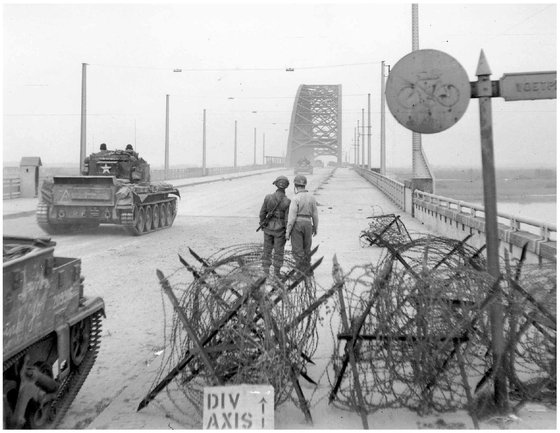
At last we heard the enemy tanks start moving. Our hearts plummeted to our boots. Then far down the road we heard a vast roaring. The British were coming. Soon six Cromwell tanks, followed by British infantry came into sight. We hit the bottom of our holes knowing that the enemy would redouble his shellfire. The British tanks came up and set to work in a most matter-of-fact way. They knocked out three Mark VIs almost instantly and machine-gunned everything in sight.
A machine-gun in a big house across the road fired on them. Immediately a tank shot an armour-piercing shell through the house, followed by a white phosphorus shell, which exploded inside. A hullabaloo started within, succeeded in short order by a mass exodus in a mad rush. Next, they blew a mortar position to hell. These helpful actions plus the tac-tac of their machine guns beat the music of gratitude deep into our hearts. They had achieved a Lone Ranger rescue in grand style. Their job done, the gallant tank cavaliers rumbled off the way they had come. Since, however, the hour was well past teatime, they pulled into a nearby wood to have their spot.’
The delayed arrival of the Cromwell tanks of the 2/Welsh Guards at the front near Oosterhout had not been the result ‘tea stops’. Sitting in his Sherman’s turret, Major Fisher of No. 1 Squadron jotted down his impressions, while stuck behind a battlegroup ahead that had been stopped in its tracks on the road to Arnhem:
‘1.0 p.m. My tank is just crossing the Waal.
1.15 p.m. We are stationary on the bridge ... it is slightly uncomfortable as we are a perfect, silhouetted target for German bombers, if any.
2 p.m. This bridge is not attractive ... There is a certain amount of small-arms fire from time to time, but I can’t make out quite where from.
2.15 p.m. When I was out of my tank just now a bullet whistled past my nose – literally. Soon after we had a mortar concentration all round us ... now there are lots of enemy planes over us. One man has been slightly wounded in the squadron. What a bloody place to be sitting!
2.45 p.m. More planes over us quite low. This is an unpleasant situation I shall not forget this bridge for a long time.
3.15 p.m. More shelling and mortaring. Brigade, Division and Corps Commanders have all gone forward in succession to make a plan to deal with the opposition. Meanwhile we stay on this dammed bridge.
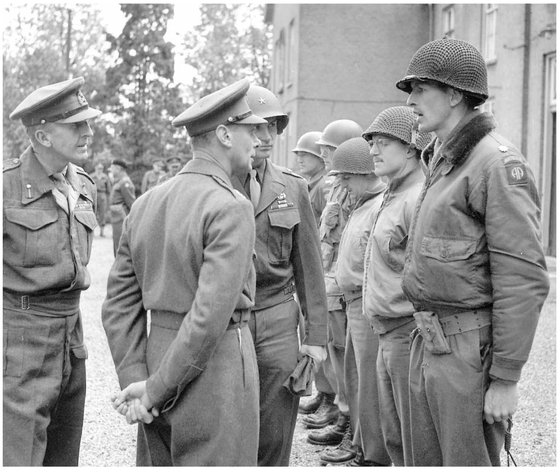
The King with Generals Horrocks and Gavin meeting members of the 82nd Airborne after the battle.
4.30 p.m. Mortaring every now and again to keep us worried but nothing as close as before ... I hope we shall not have to stay on this bridge all night.’
However, just after 17.00 hours (well after teatime) they were able to move forward and on to the road around to the left flank of the bridgehead, via Oosterhout. Riding on the tanks were infantrymen of 1/Welsh Guards. Lieutenant MC Devas was commanding the leading troop who ‘nosed their way carefully along the winding lane’. In the gathering darkness, they engaged the enemy Tigers with their 17-pounder guns, mounted in the Challenger variants of the standard Cromwell and knocked three of them out, thus more than earning their keep. The Squadron was ordered to pull back, as the Guards Armoured Division’s attempt to beak out to Arnhem was halted on the main route north. However, the Welshmen remained in the wood, in support of 1/504 PIR, prepared to counter the threat of the Tigers against this thinly held sector of the still vulnerable bridgehead.
Despite renewed attempts by 43rd Wessex Division’s infantry and tanks of 8 Armoured Brigade on the direct and flanking routes to the banks of the Rhine, XXX Corps were too late to reach the Arnhem bridge. The beleaguered men of 2/PARA were overwhelmed and the remainder of 1st Airborne Division, failing to reach them, were driven back into a defensive perimeter, of no tactical significance, several miles west of the vital bridge. On the night of 25/26 September the British Airborne troops were evacuated. Ever since then, airborne, armoured and infantry commanders and soldiers have wondered if they could have done more to reach 1st Airborne Division. However, others say that the entire MARKET GARDEN concept was ‘vainglorious’ and that the air, and hence the airborne, plan was fatally flawed. The debate will go on and this acount will be continued in another Battleground Europe volume; The Island.
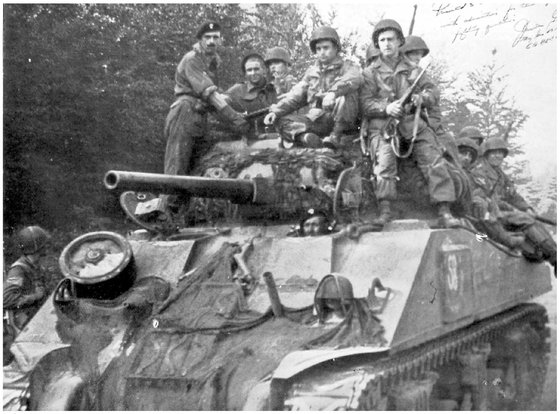
Grenadier Guards give American paratroopers of 82nd Airborne a lift to the fighting in Nijmegen.