

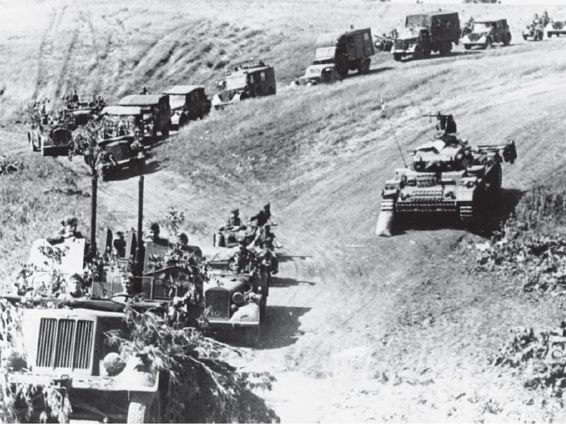
Half-tracks, Sturmgeschütze, and other vehicles of the LVI Panzer Corps in the open terrain characteristic of Barbarossa’s early weeks. Once past the Velikaya River von Manstein’s lightning advances fell foul of more difficult terrain. (NARA)
German Plans
A bittersweet soldiers’ one-liner, equal parts cleverness and accuracy, holds that there are two types of military plans: those that won’t work and those that might work. Except in over-determined hindsight, it is difficult to decide into which category Barbarossafalls. Flushed with victory after crushing France, Hitler had wanted to invade the USSR in autumn 1940 – an ambition vigorously opposed by his generals. This disagreement, and logistical weakness and delays, convinced Hitler to postpone the assault until the following spring. The dominating role of logistics was underlined on July 21, 1940 when the army commander-in-chief, Field Marshal Walther von Brauchitsch, told Hitler that only 80–100 divisions would be required to subdue the Soviet troops – a number in fact largely dictated by what the Reichsbahn (the German national railroad network) could move and sustain, rather than a realistic estimate of fighting forces needed.
According to international common opinion, shared by Hitler and the Wehrmacht, a war against the USSR would be quick and easy. The German leadership had nearly 11 months to plan Barbarossa, much longer than for their earlier campaigns. However, their hard-marching army did not have the capacity simultaneously to penetrate the Soviet lines and to conduct huge encirclements much beyond the frontier – indeed, it is questionable if even a fully-motorized force, like the US Army in 1944–45, could have done what the Wehrmacht expected of the Ostheer in Barbarossa. In addition, the Nazi “philosophy” of racial and martial superiority which exaggerated Germany’s prowess while minimizing that of its enemies, combined with insufficient resources and poor staff work, would ensure a difficult campaign.
Barbarossa’s planning suffered from curious effects harkening back to the German experiences in the east during the Great War. Then, as later, a single division could successfully take on two or three Russian divisions. Still, war in the East had been no easy proposition; in 1915, when the Central Powers made their greatest advance in that theater, losses were 1.25 times greater than those in the West. Although Ludendorff’s defensive line ultimately stretched from Finland to the Crimea, the German forces and their Habsburg allies had ample experience with Russian weather and terrain. They knew their own manicured forests were nothing like the common eastern wildernesses (referred to as the Urwald). German and Austrian soldiers lived with Russian filth, vermin, disease, and poverty. Ironically, terrible roads and poor communications had been a major cause of Russian failure in 1914–17. Evidently these lessons were lost on Wehrmacht leaders a generation later.9
As indications of his confidence in his own military abilities and the importance of the ideological struggle against Communism, Hitler put his mark on Barbarossa’s operational details like no previous campaign. Taking into account the Army’s and Luftwaffe’s short striking ranges, the plan eschewed deep operations and settled on a line formed by the Dvina and Dnepr rivers for its initial goal. As happened in Poland and the West, the Soviet commanders’ forward deployment played into the German forces’ hands. Writing after the war former Field Marshal Friedrich Paulus recreated the contemporary mood of the German leadership: “tremendous vigor of National Socialist policy, then at its zenith” and “complete confidence born of the victory in the Western campaign.” He went on to say that “experts declared [Hitler’s] previous victories impossible.” The Wehrmacht would again prove them wrong in 1941. While many of Hitler’s generals questioned Barbarossa as an indirect attack on Britain, they were enthusiastic about building a blockade-proof Reich.
As stated, Hitler began thinking of an Eastern campaign before France had even formally surrendered. Initial planning began with the rushed (four days), poorly researched assessment of the Red Army’s strength by Lieutenant Colonel Eberhardt Kinzel’s Fremde Heere Ost staff (FHO – Foreign Armies East). German intelligence knew very little about their future enemy despite ten years’ efforts. In addition, every Abwehr (counterintelligence) agent in the USSR had been turned. They underestimated the overall size of the Red Army while overestimating the number of units in the western military districts. All subsequent plans were based on the weak cornerstone of Kinzel’s inadequate and faulty analysis that the Wehrmacht would take to its grave. This junior officer and his small overworked staff also had responsibility for the armies of Scandinavia, the Balkans, China, Japan, and the United States (Kinzel subsequently committed suicide in 1945). The Gestapo, answerable for political intelligence, added another layer of inaccuracies by predicting the Soviet state’s collapse within weeks. Although just days into Barbarossa Hitler began to hedge his bets by saying that he might not have begun the campaign if he had known the real strength of the USSR, it is difficult to see an intelligence estimate (or anything else, for that matter) dissuading him from a campaign he had been anticipating for nearly 20 years.

A Red Army soldier crawls to surrender to a Panzer IV and attendant Landsers. The barn is well built and undamaged, a valuable refuge in the coming winter. (HITM)
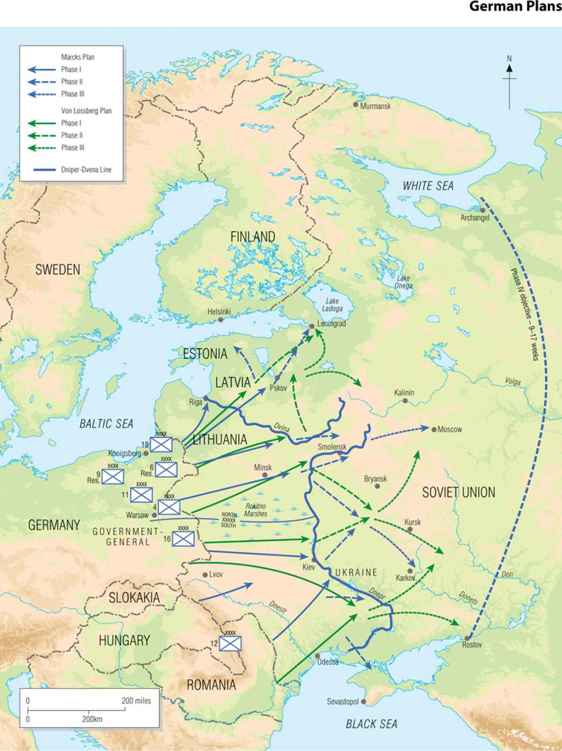
With the German military focused in the summer of 1940 on the Battle of Britain and Operation Sealion, on July 4, 1940 Army Chief of Staff Colonel General Franz Halder put generals Georg Küchler and Erich Marcks to work planning the Eighteenth Army’s defense of the East. Their planning turned offensive two weeks later when Hitler told Halder, “Stalin kokettiert mit England” (Stalin flirts with England). By the end of July, Marcks’ plans neared completion. Following Kinzel he assumed “… the Russians no longer possess the superiority of numbers they had in the World War…” On July 29, he flew to Halder’s headquarters in Fontainebleau where the army chief of staff succeeded in shifting Marcks’ emphasis from the Ukraine to Moscow. Marcks completed his Operationsentwurf Ost (Operational Draft East) on August 5, 1940. In general he divided the invading force into three army groups in two main bodies, north and south of the Rokitno Marshes with Moscow as the ultimate objective. Marcks’ plan had three phases: 1 – the initial three-week 250-mile push to the Dvina– Dnepr line; 2 – an intermediate phase between two and four weeks consisting of a logistical pause and possible advance up to 100 miles; and 3 – final drives lasting from three to six weeks on Leningrad, Moscow, and the deep Ukraine. Presumably the war would be won at that point, so phase 4 would be the last month of tidying up the front and establishing winter defenses along the Volga.
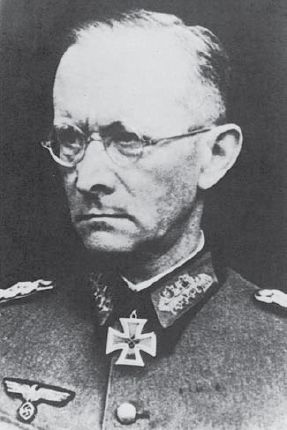
General Erich Marcks wrote OKH’s plan for Barbarossa then commanded the 101st Light Division. Shrapnel cost him his left leg on June 26, 1941. He died three years later commanding the LXXXIV Corps at St Lô. (NARA)
Hitler wanted the OKW involved so on July 29, he told Jodl to prepare a plan also. Another lieutenant colonel, Bernhard von Lossberg, wrote the OKW plan largely on his own initiative with some input from Jodl. He also required only one month to create his Aufbau Ost (Buildup East). He completed an additional Operationsstudie Ost (Operational Study East) on September 15, 1940. He included Rumania more fully in his plan and assumed a vigorous Soviet forward defense followed by an 1812-type fighting withdrawal. Both OKH and OKW assumed the bulk of the Red Army would be destroyed in phase 1 and envisioned the Schwerpunkt against Stalin’s capital. Since von Lossberg started his plan five weeks later than Marcks and as Jodl was closer than Halder to Hitler – both in thinking and proximity – we can assume the former plan was more in line with Hitler’s concept. Von Lossberg’s main contribution was to clarify Hitler’s thoughts with regard to Barbarossa’s later phases, specifically the turns north and south preparatory to the assault on Moscow and flexibility in subsequent operations that would prove the most controversial features of the campaign. The drafting of the plans for history’s greatest invasion had thus devolved on one major general – the lowest general rank in the Heer (Army) – and two lieutenant colonels. All had drafted their plans based on the same questionable information so independent analysis and checks and balances were nonexistent. Neither the Marcks/OKH nor the von Lossberg/OKW plans doubted the Wehrmacht’s ability to successfully overthrow the Soviet Union.
This is especially true considering the unreasonable six-, eight-, or ten-week assumptions about Barbarossa’s expected length. Also, the massive size of the eastern theater clearly had a significant effect and dramatically decreased German weapon densities. They could count on one panzer per 29 square miles in the West; in the East this fell to one panzer per 112 square miles. Above the battlefield the ratio plummeted from one aircraft per 2 square miles in 1940 to one in 95 during Barbarossa.
Realizing that Germany would not only seek to secure the Ukraine’s natural resources but also to put as much distance as possible between the Red Army and Rumanian oil, Stalin concluded the main effort would come in the south. Judging from his actions, Hitler as well as many German economic and military leaders, the Abwehr, and the army’s own Military Geography Department concurred. Planners in the OKH’s operations staff favored giving weight to Army Group South in order to counter the Soviet main effort there. In fact, increased Soviet activity in the Ukraine in the winter of 1940–41 caused the German leadership concern over operations in the south. However, Moscow beguiled many army leaders, most significantly Halder. Further, it seems that the German army chief of staff was especially susceptible to the arrogance that affected the entire Wehrmacht after the defeat of France.
Halder gave General Paulus, Oberquartiermeister I as of September 3, the tasks of de-conflicting the competing OKH and OKW courses of action and further developing the Marcks plan. Paulus finished this work in just two weeks, presenting his own “Foundations of the Russian Operation” at the end of October.10 After the war Paulus admitted that he had approached the problem “from the purely military point of view” – not a ringing endorsement of his own job performance and emblematic of poor-to-nonexistent German strategic thinking.
Between November 28 and December 7, 1940 he hosted Barbarossa wargames. Von Brauchitsch told participants to expect “a hefty border fight” lasting some four weeks, after which the remainder of the USSR would be occupied against only “weak resistance.” As a result of these simulations Paulus insisted on creating an 11-division OKH reserve. He also attached an infantry corps to each panzer group mainly to assist with breakthrough operations. Not surprisingly, the wargames confirmed the primacy of the Moscow axis and a three-week phase 1 was followed by a logistical pause of the same length. They centered on the Baltic States and Leningrad, and less on Moscow. Prophetically, the wargames indicated that clearing the Baltic States would take much time and impact Army Group Center operations. Even at this early planning stage von Rundstedt asked for units from Army Group Center to attack southward into the rear of Soviet forces attempting to escape from Kiev.
Simulating Barbarossa
Prussian-German commanders and staffs had been wargaming since the 17th century. The simulations’ main goals were to exercise plans, bring likely problems to light, identify friction points, rectify potential mistakes, and allow senior commanders to meet and work with their subordinates. Wargames either had no instructions or else very loose rules, so as to intentionally avoid “even the slightest semblance of regimentation” and allow for full intellectual freedom. The OKH carried out strategic simulations from November 29 to December 3, 1940 as well as on December 7.
Army Group South conducted Planspiel Otto over four days between January 20 and February 5, 1941 at its headquarters in a luxury hotel in St Germain en Laye, downstream from Paris (in a Planspiel commanders brainstorm the plan). Participants were mainly colonels and lieutenant colonels under the supervision of Army Group Chief of Staff Lieutenant General Georg von Sodenstern. Field Marshall von Rundstedt was present throughout while General Halder attended the last day only. The plan assumed a larger army group than historically present since the Balkan invasion lay in the future; forces in Rumania included two German armies and a panzer corps.
This arrangement gave Army Group South the double-envelopment capability found in Army Group Center, the highly coveted Zangenangriff (literally “fang attack,” encirclement battle) against Soviet forces in Galicia and Bessarabia. In the Otto wargame the attackers were roughly handled by Soviet defenses but did close a Kessel (cauldron, or pocket) near Proskurov. In his concluding remarks von Sodenstern enumerated some special issues: questions of surprise, creating the Schwerpunkt, cooperation between Army and Luftwaffe units, and the daring of the leadership disposed far in the enemy’s depth and maneuvering without fear of threatened flanks. He sided decisively with the acting panzer group commander, especially concerning the latter’s freedom of action.
Operation Marita against Greece and Yugoslavia plus the backward Rumanian infrastructure that limited the size of German units stationed there changed the situation. With forces halved and panzer units removed altogether the Proskurov encirclement was off. However, Otto did accurately anticipate the furious counterattacks launched by Soviet mechanized corps and the disrupting influence of the 5th Army in and around the Rokitno Marshes.
The Second Army carried out a Kriegsspiel at the Park Hotel in Munich from March 10 to 13 under the eye of commander Colonel General von Weichs. As a Kriegsspiel it had a more familiar format, alternating Red (German) and Blue (Soviet) sides. Another interesting point is the simulation’s start date: May 20. Since it took place well before German operations in the Balkans it shows that Barbarossatag was a moving target.
Significantly Leningrad is never mentioned in the wargame. Army Group North weighted its attacks to the right flank and was much more oriented on Moscow and supporting von Bock. This backfired on the German troops as “the Soviets” (played by Wehrmacht officers) took advantage of the relative paucity of von Leeb’s forces on the left and recaptured Riga in a surprise counteroffensive. After taking Dvina River bridgeheads the German troops stalled for nearly two weeks. German units took heavy losses and even requested three days’ rest barely a fortnight into the campaign. Barbarossa in the north was going so poorly that the German leaders even considered employing chemical weapons (Geländevergiftungen).
In his closing remarks von Witzleben warned against micromanaging subordinates in a way that stifled their initiative. But the Second Army’s wargame must have disappointed all concerned. Army Group North had lost Riga, was stalemated along the middle Dvina, and was stalled around Minsk. Army Group North took many remedial measures which paid dividends during Barbarossa. Once across the Dvina the panzers no longer wheeled southeast toward Minsk but made for Leningrad. Gone were conservative German movement rates: instead of infantry marching 60 miles in six days it advanced 150 miles in ten days; instead of panzers going 90 miles in six days they covered over 200 miles in less than 100 hours. But the fact that von Leeb and members of his staff chose not to attend the simulation can only be seen as a lost opportunity.
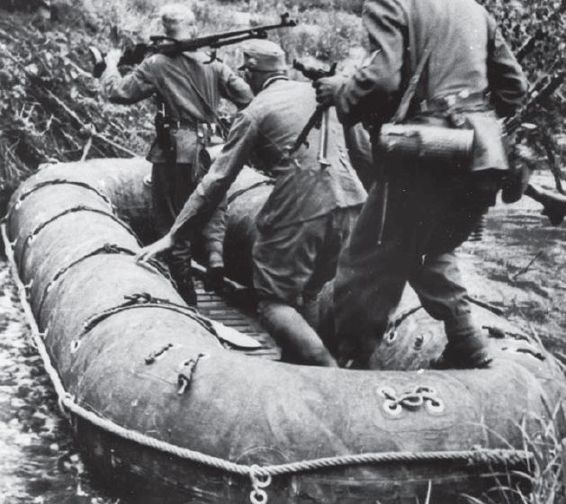
A rubber raft, in this case a “Grosser Flossack,” used to cross the Ukraine’s many rivers. The troops appear to be Gebirgsjäger with the soldier in front carrying a Panzerbüchse 39, the infantry’s standard antitank weapon. Its 7.92mm round proved ineffective against most Soviet tanks. (NARA)
Army Commander Field Marshal Walther von Brauchitsch and Halder briefed Hitler on the wargames’ outcome on December 3. The Führer approved the basic plan. Significantly, however, he added a prophetic comment, declaring Moscow “not so very important.” For the next nine months Hitler continually emphasized destruction of the Red Army in the field over capturing Moscow.
Von Lossberg wrote the first draft of Führer Directive 21 on December 12, the Luftwaffe added its details on the 16th; it went to Hitler the next day and became official on the 18th. Although it mentioned numerous geographic objectives, Moscow among them, it clearly identified Barbarossa’s main goal as the destruction of the Soviet military. All preparations for Barbarossa were to be completed by mid-May. A series of logistical wargames were held from December 17 to 20, after Hitler signed the Directive! The Wehrmacht believed its logistics nearly failed in France because the Western theater was so large and therefore required serious reworking for Barbarossa. These wargames confirmed the requirement for a logistics pause at the Dvina–Dnepr rivers. Finally, these simulations proved that if the Soviet military was not destroyed west of that line, the abysmal infrastructure further east meant the German forces probably would not succeed against even weak resistance.
OKH published its operation order, Aufmarschanweisung Ost (Deployment Directive East), on January 31, 1941.11 While Führer Directive 21 can be considered a strategic overview of Barbarossa, Aufmarschanweisung Ost represented the campaign’s actual operational nuts and bolts. The directive’s introduction mentioned Moscow as an objective of von Bock’s men only after resistance in northern “Russia” had been broken. Specific instructions for Army Group Center did not mention the Soviet capital. Six or seven months later many German generals feigned surprise and righteous indignation when Hitler held them to this prioritization of Barbarossa’s objectives.
One threat identified by FHO on February 12 consisted of Red Army forces that could retreat to relative safety east of the Rokitno Marshes, only to later attack the flanks of German thrusts making for Moscow or Rostov. This draft study anticipated perfectly the July and August controversies. Fearing dilution of his pet effort against Moscow, Halder deleted these references from the final version presented to Hitler on January 21, demonstrating how far his subterfuge would go to subvert the German staff system.
Operational staffs created detailed directives and operation orders during the following winter and spring. However, the German leaders’ traditional emphasis on operations hamstrung the planning for personnel, military intelligence, and logistics, especially given the unrealistic assumptions about Barbarossa’s expected length – of between six and ten weeks only.
Further, the German leadership expended a lot of energy planning for Barbarossa’s logistical requirements although these efforts bore little fruit. Hermann Göring correctly predicted in February 1941 that logistics would “endanger the entire operation.” The staff assumed that the roads and railroads west of the Dvina and Dnepr rivers would be superior to those east of that line; but this was true only in a very relative sense, and movement capability became a limiting factor as soon as the German troops crossed the border. Logistics were also one main reason for locating Barbarossa’s Schwerpunkt in the center: German rail connections from the Reich to East Prussia and occupied Poland – which also offered better staging areas for a potential attack on the Moscow axis – were superior to those farther south in Hungary and Rumania.
The German Air Force completed its plans for Barbarossa on February 20. The Luftwaffe possessed the same concepts of Vernichtungskrieg, Auftragstaktik, and Schwerpunkt as the army.12 It also shared the army’s weakness of having very junior officers plan such a massive undertaking as Barbarossa: this task fell on Major Rudolf Loytved-Hardegg and three subordinate officers. These men provided sealed orders to Luftwaffe crews that were to be opened only eight hours prior to H-Hour!
Consistent with the Luftwaffe’s main war-fighting doctrine, Regulation 16, Luftkriegsführung (1935), air superiority was its first priority. The Luftwaffe sought first to destroy the Red Army Air Force (especially its most modern equipment) and its supporting ground operations. Assisted by Lufthansa pilots gathering data during civilian flights over the USSR, the German leaders had very good intelligence on Soviet dispositions. They named their Barbarossatag assault the Grosses Wecken (Great Reveille). However, owing to range and payload limitations, the Luftwaffe could not attack the Soviet aviation industry effectively. After gaining air superiority the Luftwaffe would shift to flying CAS missions for the army – its primary mission.
On the last day of April, Hitler officially set Operation Barbarossa’s start date for June 22. Some historians falsely believe Germany’s Balkan invasion fatally delayed the launching of the campaign. Von Lossberg wrote that Hitler always planned to conquer Greece prior to Barbarossa. Indeed, invading the Balkans was discussed at the Führer conference of December 5. The main causes for deferring Barbarossa’s start date from May 15 to June 22 were incomplete logistical arrangements and an unusually wet winter that kept Central European rivers at full flood until late spring. Besides, to have started much earlier would have only meant that Barbarossa began during the infamous rasputitsa (spring and autumn rainy season, “time without roads”).
Differences between Hitler and his generals and between OKH and OKW were discounted by the German High Command’s expectation that their Russian campaign would be short. With near-unanimity they assumed Barbarossa would begin with the quick elimination of the Red Army followed by a series of marches and then a brutal occupation. The planned final assault on Moscow was predicated on the two northern army groups cooperating to capture Leningrad and Kronshtadt before wheeling southeast. However, the planned one-two punch never occurred.
Barbarossa suffered from a liability common to other Wehrmacht operations, namely the absence of a unifying strategic objective. The entire plan appears to be a combination of operational-level solutions to a war with the USSR; strategy was relegated to the realm of wishful thinking. Traditionally directed at enemy forces rather than geographic objectives, the German forces therefore chased a moving target with mission accomplishment accordingly hard to judge. This “strategy,” undermined by weaknesses in the vaunted German general staff system, lop-sided emphasis on operations over personnel, intelligence, and logistical concerns, tweaking wargame results until they fit pre-conceived notions, and relegating bad news to the category of “inconvenient truths” met its match in the USSR.
Planners for Barbarossa have been variously described as suffering from “unbounded hubris” and “sublime inattention to logistical realities,” but the Führerprinzip then ascendant in Nazi Germany allowed no warnings, only optimism. It suspended reality, made the impossible feasible, and substituted faith and will power for numerical strength and technological superiority. In a system that had thrived on risk ever since Frederick’s most audacious oblique maneuvers in the 18th century and with men who believed the bigger the risk the more they liked it (witness the Schlieffen Plan), Barbarossa represented the ultimate risk. The German forces would have to get every break possible if they were to make good on Hitler’s boast to turn the Volga River into his Mississippi.13
Army Group North
Leningrad, unlike Moscow, was one of Barbarossa’s strategic objectives from the very first. Regarding Army Group North, Marcks wrote “north of the main group of forces [aiming for Moscow] a strong group advances through the Baltic States to Leningrad and takes the base of the Russian Fleet.” He anticipated the advance on the axis Dünaburg–Pskov–Leningrad. Von Lossberg likewise, planned to annihilate the Red Army west of the Dvina River, and called for German troops in Norway and the Finns to cut the Murmansk railroad and to cooperate with forces advancing from East Prussia to encircle Leningrad.
General Paulus’ wargames demonstrated that if Eighteenth Army was strengthened at the expense of the Sixteenth, the Army Group Center flank would be vulnerable to Soviet counterattacks. Threats to their common boundary did indeed cause constant friction between the two army groups. The wargames also established the need for intermediate objectives on the army group’s right shoulder, near Velikie Luki or Lake Il’men, preparatory to an assault on Leningrad. Propitiously they confirmed the requirement for the loan of some Army Group Center panzers if von Leeb hoped to conquer the city. At the December 5 meeting between Hitler, von Brauchitsch, and Halder, the Führer stressed, “We must strive to encircle the enemy forces in the Baltics. Therefore the Moscow Army Group must be so strong that it can turn significant portions to the north.” Ironically Hitler dashed Army Group North’s chances of success when he failed to heed his own advice.
The Aufmarschanweisung confirmed the primacy of encircling the Red Army west of the Dvina, leading with a strong right and the Schwerpunkt along the axis Dünaburg–Opochka–Leningrad. Field Marshal von Leeb’s main goals were: 1) destroy the Red Army holding the Baltic States; 2) neutralize Kronshtadt; 3) capture Leningrad; and 4) link up with the Finns.
Army Group North’s plan for reaching Leningrad, 500 miles away, went generally as follows: Hoepner’s Panzer Group would punch through the Soviet’s frontier defenses and make for the Dvina crossings near Dünaburg, from there aiming toward Opochka. Depending on Leningrad’s defenses, Hoepner would either advance due north or swing northeast. The Eighteenth Army would clear the Baltic region and be prepared to take the islands off Estonia’s coast. The Sixteenth Army had responsibility for securing the boundary with Army Group Center.

Motorized infantry run to catch up with an SdKfz 251 half-track on the way out of a Russian village. German mechanized and motorized infantry rode to battle, but fought dismounted. (HITM)
Ironically, Army Group North suffered the most severe impact from the Balkan operation; when Hitler dispatched the Twelfth Army against Yugoslavia and Greece in April 1941 he moved the Eleventh from OKH Reserve and sent it south to Rumania. Only five of 21 divisions (none mechanized) from the Eleventh ever reappeared on von Leeb’s order of battle, despite his desperate need for them.
Army Group Center
In a plan where the big money was on the panzer groups, Army Group Center had a distinct advantage by having two. In contrast to the other two army groups whose frontages expanded enormously from the campaign’s first day, von Bock’s axis of advance was anticipated to basically remain the same width from Poland to Moscow. Army Group Center even “benefited” from an unexpectedly weak opponent: Kinzel’s analysis of the Red Army overestimated Soviet infantry facing it by 40 percent while underestimating enemy armored and mechanized forces by 70–80 percent.
Army Group Center’s first mission was to destroy the Red Army forces in Belorussia. Panzer groups on the flanks represented von Bock’s main punch, with infantry armies marching in between. After creating an initial Kessel at Minsk, Army Group Center’s operational goals were Vitebsk and Orsha (the Dvina–Dnepr line), to be followed by a three-week logistical pause for the “railroad advance.” The outer wings would then swing wide and meet again to create another pocket at Smolensk. Victory was universally defined as destruction of the Red Army west of the Dvina and Dnepr.
Except in the mind of Franz Halder, a few other generals, and some postwar critics, Moscow represented merely an operational objective, not the strategic key to a total German victory. The overview portion of the OKH Aufmarschanweisung mentioned Moscow as von Bock’s objective only after resistance in the North had been broken, and specific instructions for his army group did not mention the Soviet capital. A major adjustment occurred on March 8, 1941 when Hitler directed that 1) an infantry corps be detailed for security duty on the army group’s right, bordering the Rokitno Marshes (to help maintain contact with Army Group South); and 2) Barbarossa’s entire strategic reserves would follow von Bock. These formations, generally under Second Army, quickly became a de facto part of Army Group Center, so that OKH ceased to have any reserves worthy of the name. The folly of such high-risk behavior, launching an invasion like Barbarossa without strategic reserves, cannot be overstated.
While acknowledging the benefits to the defense of numerous rivers, Colonel General Hermann Hoth’s own Aufmarschanweisung urged that his Third Panzer Group go “eastwards fast and without looking back,” to wreak havoc on enemy command and control, reinforcements, and logistics. Third Panzer Group would initially be under Ninth Army control. Colonel General Heinz Guderian hoped to reach Minsk with his Second Panzer Group in five or six days; this formation initially came under Fourth Army, which also had the missions of defending against a surprise Soviet invasion to the west, and helping close off any encirclements. After taking Smolensk, both strategic and operational leaders anticipated that Army Group Center would turn north toward Leningrad.
Army Group South
Führer Directive No. 21 gave von Rundstedt three to four weeks to reach Kiev and the Dnepr crossings. He would then turn south to trap enemy forces against the Black Sea with the Caucasus oil region his ultimate destination. At Barbarossa’s start, Army Group South massed in the cramped space between the Rokitno Marshes and the Carpathian Mountains. The impact of Red Army elements lurking in and east of the marshes on Army Group South’s northern flank remained a significant threat to its operations throughout Barbarossa’s first three months.
A busy scene, complete with a halted Panzer III and a convoy led by a quad 2cm Flakvierling cannon mounted on an SdKfz 7/1 half-track, followed by trucks, motorcycles, staff cars, and other vehicles. (HITM)
Von Rundstedt wanted to create a German–Hungarian force based on the Seventeenth Army, but Hitler distrusted Hungary and forbade any formal contact between the two militaries. However, the Aufmarschanweisung did add Rumania to von Rundstedt’s area of responsibility. The ensuing 200-mile wide Hungarian gap between Axis forces in occupied Poland and Rumania created numerous security, logistical and command and control problems.
Army Group South’s original plan envisioned a double envelopment during phase 1, employing First Panzer Group in the north and Twelfth Army coming out of Rumania. Hitler soon decided against this course of action, and besides, in April he ordered Twelfth Army to invade Yugoslavia and Greece. As discussed above Eleventh Army took over duties in Rumania but combined forces there would not be ready by June 22 so would attack later, giving Barbarossa its staggered start in the far south. Therefore von Rundstedt would initially fight mainly a frontal war, punctuated by occasional penetrations and relatively small encirclements.
These factors, along with relatively weaker friendly forces and stronger Soviet forces, and a larger area of operations, combined to create difficulties for Army Group South. Additionally, von Rundstedt contended with a subtle prejudice within the Wehrmacht dating back to World War I when primarily Austria, not Germany, fought in the Ukraine.
Soviet Plans
On August 23, 1939 Stalin created conditions to eliminate the Polish buffer and give the USSR a common border with Germany for the first time since 1918. At the same time he pursued an active foreign policy to replace Poland with an expanded Soviet Union that within a few months included eastern Poland, the Baltic States, and Bessarabia.14
For at least a dozen years prior to Barbarossa the USSR vacillated between defensive and offensive strategies. By the late 1930s it built fortified regions along the border behind which the Red Army would mobilize, fend off any attack, and then launch a general offensive (collectively the Germans called the Fortified Regions the Stalin Line). In the Soviet experience static fortifications had been quite effective when used against them by the Finns; they attributed the apparent failure of the Maginot Line to specifically French weaknesses.
The avalanche of murder known as the Great Purges began in May 1937 with the execution of Marshal M.N. Tukhachevsky, the Red Army’s brightest star in the early 1930s. Stalin used Soviet military leaders to expose traitors and saboteurs, not to improve the Red Army. Despite being severely weakened by these purges, thanks to its extensive and effective spy network the USSR learned of Barbarossa soon after Wehrmacht leaders did. With the advantage of this forewarning, initially, the Soviet military planned to defend critical axes of advance using the fortified regions. That plan ceased to be workable when the Soviet Union extended its borders west in 1939–40.
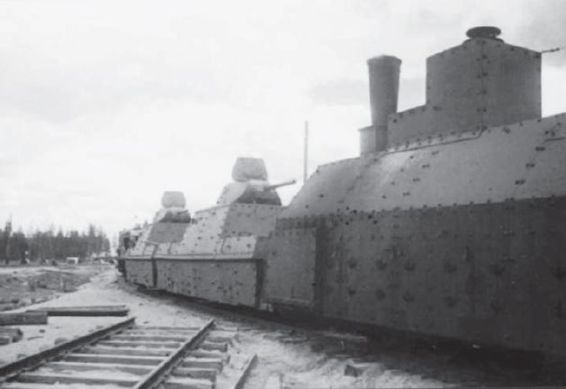
A favored weapon since the Russian Civil War, the armored train proved to be a useful tool given the huge distances and poor roads in the Soviet Union. This example mounts T-34/76 tank turrets. (Elukka)
The decision to deploy defending units so far forward also robbed the Red Army of room to maneuver, a traditional Russian strength, by placing them right under the Germans’ guns. As Red Army chief of staff and member of the Military Soviet from 1926–34, Tukhachevsky had focused on defending the Ukraine and the twin “capitals” of Moscow and Leningrad. By 1940, however, much had changed and the German blitzkrieg campaigns had turned the military world on its head. While Stalin acted the good neighbor to assuage Hitler, Soviet military thinkers put Tukhachevsky’s offensive doctrines on hold until they had found a way to halt the blitzkrieg. Red Army planning became more defensive – if only for the first few weeks of a future war.
The Soviet leadership had a long time to prepare for Barbarossa and was contemptuous of Poland, which had been surprised by Germany despite years of increasing tensions prior to 1939. Since then, from their vantage point on the war’s sidelines, the Soviet High Command had watched Hitler dismember Poland, France, and numerous smaller opponents, yet they developed no workable plan to counter the blitzkrieg. The Red Army began planning in earnest immediately following Hitler’s “secret” July 31, 1940 meeting. Sensing that an upcoming conflict would be a war of attrition, with resource-poor Germany aiming for the resource-rich Ukraine, on October 5, 1940 Stalin ordered the main Soviet defensive effort redirected south and away from the Moscow axis. This course of action ignored the fact that communications in occupied southern Poland and Rumania were too poor, and the Balkans too insecure, for that area ever to support the deployment Barbarossa’s Schwerpunkt forces.
The new southern orientation became Mobilization Plan 1941 (MP 41) on October 14 and was further refined over the next six months. This commitment to an inherently and, in fact excessively, offensive approach was not the USSR’s only error: in addition, although the Soviet leaders knew Hitler had ordered the number of panzer divisions doubled, they did not know that in order to achieve this the number of panzers per division had been halved. Further, the “1941 Plan for the Defense of State Borders” assumed Germany would need 10–15 days to finalize its invasion preparations. However, Stalin preferred to look the other way as the Wehrmacht made ready for 11 months. One observer called Hitler the only man Stalin ever trusted. Soviet military intelligence failures complimented the dictator’s wishful thinking. The Red Army over-estimated German strength at 260 divisions, 10,000 panzers, and 15,000 aircraft (real numbers: 150, 3,300, and 2,510 respectively). Unfortunately for them, 500,000 untrained recruits and reserve armies sent to the front in the weeks prior to Barbarossatag could not stave off disaster.
Soviet planning forged ahead when Stalin summoned the Politburo and military leaders to a ten-day conference in Moscow starting on December 23, 1940. Wargames followed immediately, with General G.K. Zhukov teamed with 21 other generals to simulate an attack on WSMD, against Pavlov and 28 other generals. From January 2 to 6, Zhukov led the “Germans” out of Prussia and Poland, and these maneuvers exposed the vulnerability of Pavlov’s four armies to encirclement. When roles were reversed, Zhukov easily parried Pavlov’s mechanized attack into Germany – causing the Soviet leadership to question the wisdom of its strategic “Red Folder” plans for a counteroffensive into Germany, but not with sufficient vigor.
In simulating the south, Kiev Special Military District commander Zhukov led the German troops and won as expected; after all the Soviet High Command had seriously neglected defensive doctrine. In the second simulation Zhukov successfully defended the Ukraine and even launched a limited attack into Hungary and Rumania. His successes and high-visibility roles confirmed the primacy of the south in Red Army calculations. Results of wargames in December and January of 1941 painted a gloomy picture. On January 13 Stalin asked “Who won here?” None of his generals answered satisfactorily. The next day, after the wargames’ conclusion, Stalin made Zhukov Red Army Chief of Staff, effective two weeks later. Stalin and Zhukov nevertheless delayed making substantive changes in Soviet deployments for weeks.
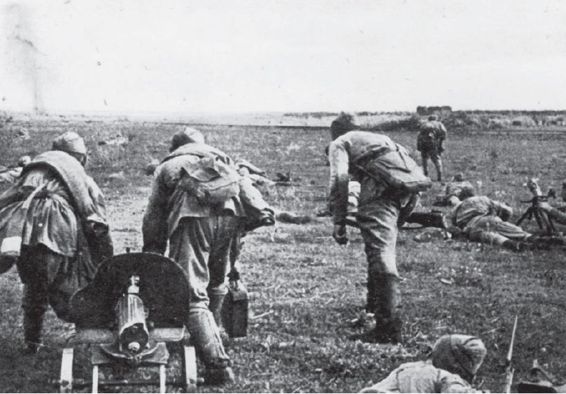
Red Army riflemen advance with the support of a Maxim M1910 machine gun (left) and 50mm M1940/1941 mortar (right). The defense of the USSR ultimately depended on men like these. (HITM)
When Zhukov took over as chief of staff he had less than five months to implement a realistic defensive strategy and minimize the offensive mindset. Through April he updated MP 41 during a series of high-level conferences. Under the new plan the USSR would create 344 divisions of 7.85 million men, 6.5 million of them facing Germany. They retained the need to hold the border, followed by an active defense followed in turn by a counteroffensive. This tactic consisted of allowing the panzers to slip east then destroying each spearhead individually. His “Plan for the Defense of the State Frontier” issued the month before Barbarossa advocated a defense followed by an attack into the Reich’s rear areas. Military Districts readied plans by April and distributed them to subordinate armies in May. Corps commanders were permitted to look through the plans, to familiarize themselves with their general outline, but not to keep copies.
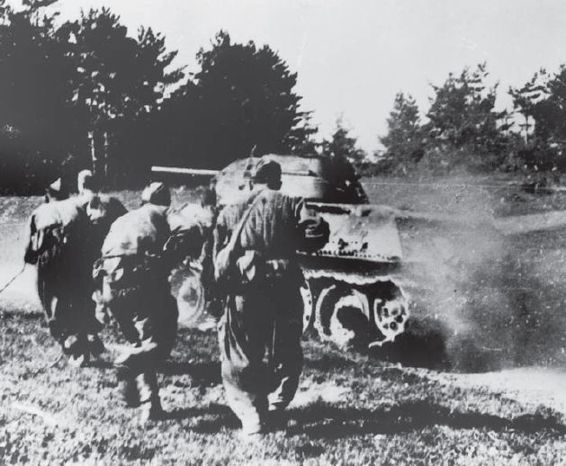
Soviet riflemen and T-34 tank in the attack. Losses suffered by poorly conceived and executed attacks conducted as part of the Soviet strategy of the active defense meant any mobile counterattack forces would not be available later in the campaign.
Even the USSR’s best general could not work defensive miracles in less than five months. His State Defensive Plan 41 (DP 41) stated “that the Red Army would begin military operations in response to an aggressive attack.” While remaining on the strategic defensive it would unleash operational offensives that might penetrate into the Reich; the Soviets were also aware of the potential panzer thrusts’ lack of mutual support and vulnerable flanks.
Fatefully, Zhukov’s plans also called for the forward deployment of 237 out of 303 divisions – a high number. However, the opening of the Barbarossa offensive on June 22 came too soon for the revised MP 41 and DP 41 to take effect. On that date the Red Army was deployed as follows: first echelon (6–30 miles deep) – 57 divisions; second echelon (30–60 miles) – 52 divisions; third echelon (60–240 miles) – 62 divisions. This positioning of so much of the Red Army in forward areas played into the German forces’ hands.
The Soviet Union was finally actively preparing for war. By spring Zhukov convinced Stalin to mobilize 500,000 reservists and send them directly to front-line units. At about the same time he and Defense Commissar Marshal S.K. Timoshenko learned of Barbarossa’s final plans.
The Baltic Special and Leningrad Military Districts
Initial Red Army planning in the north assumed that Leningrad would only be threatened from Finland and that German thrusts would aim for Moscow. By November 18, 1940 the Soviet High Command learned of the existence in German planning of a supporting attack heading for Leningrad. A defensive plan from that date identified an attack axis through Pskov and also anticipated the Finns advancing via Vyborg against Leningrad. Responsibility for defending the Pskov–Ostrov approaches to Bolshevism’s birthplace shifted to the Baltic Special Military District (BSMD) from the Leningrad Military District. Unfortunately for the Soviet forces, neither headquarters gave the issue its full attention.
Such plans as did exist identified two phases of defensive fighting: first at the frontier and along the Dvina River; second on the Riga–Pskov–Luga– Novgorod line. This took advantage of natural obstacles like the Velikaya and Luga rivers, as well as marshes and forests in the area. A later plan, dated May 15, 1941, maintained the Leningrad Military District’s responsibility for defending Leningrad and the Murmansk rail line. The same plan gave the BSMD the mission to halt the enemy between Riga and Vilnius and hold the Baltic Islands. The “Leningraders” would accomplish their assigned mission. Their comrades on the East Prussian border would not.
The Western Special Military District
The Soviet leaders’ sanguine assumptions about war with Germany, borne out by the outcome of their wargames, matched those of the German commanders about theirs. Red Army defenses were revealed to be only one echelon deep and lacking reserves, but these facts did not trouble the national leadership. Napoleon probably would have called Pavlov, the WSMD commander, “an unlucky general.” When Stalin shifted the Soviet emphasis from the Moscow axis to the Ukraine Pavlov lost the status and resources of the main defensive effort.
Significant forces still occupied the massive Bialystok salient, ripe for von Bock’s picking; WSMD occupied a 270-mile front, most of it along this treacherous bulge. According to John Erickson, Pavlov’s main contribution to his defensive capability during the months before Barbarossawas to tweak a few unit dispositions, in the process weakening the line and depriving his forces of reserves of their own. This was most noticeable on the very axis that Guderian would use, but it was approved by the Soviet High Command.
The WSMD issued its Order 008130 on March 26, 1941, ordering all units to achieve full strength by June 15, but resources fell far short of good intentions. It is very likely that in the minds of Stalin and Zhukov WSMD existed as a sacrifice to the blitzkrieg; by February 1941 they may already have been thinking that the Reserve Front might fight the main defensive battle along the pre-1939 frontier and the Stalin Line. Pavlov’s bad luck would continue.
The Kiev Special and Odessa Military Districts
The Soviet High Command knew the Germans’ Schwerpunkt stood north of the Rokitno Marshes, yet Stalin insisted their emphasis remain in the south. The latter theater played a prominent role in Soviet planning from a desire to ensure continued dominance of the Ukrainian people, retain the region’s resources and industry, and maintain a power base close to the Balkans. To that end, Zhukov dispatched the 19th Army from the Northern Caucasus to Tserkov (south of Kiev) and the 16th Army from Transbaikal to Shepetkovka in central-western Ukraine.
Despite Zhukov’s changes, no Red Army formations were fully prepared for the coming onslaught, the future Southwest and Southern Fronts included. Kirponos’ forces deployed too far forward in the first operational echelon, within 30 miles of the frontier. Bearing in mind its dearth of transport, the Soviet infantry would move slower than the panzers attempting to bypass them, inviting disaster. Divisions within the many mechanized corps in the Ukraine were often based 100 miles apart from one another. Stalin Line fortifications in the south, approximately the second operational echelon, generally ran between the pre-1939 frontier and the Dnepr. This massive river marked the boundary of Kirponos’ strategic echelon. Aware that German forces in Rumania were separated from any support by Hungary, the Red Army planned to attack Hitler’s ally once the initial assault had been blunted. Included in these offensive plans were naval aviation raids against the Ploesti oil fields and amphibious attacks on Rumanian islands in the Danube delta.
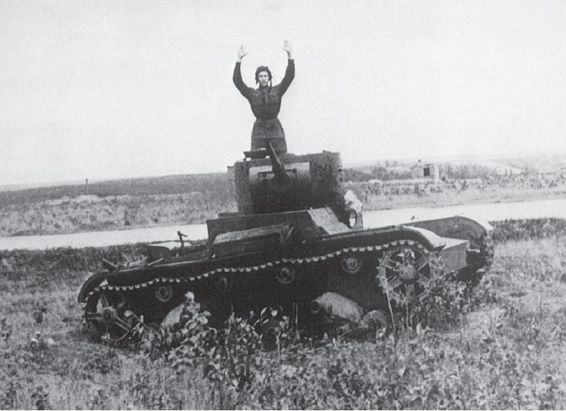
The commander of a T-26 light tank surrenders to the command “Hände hoch!”. (Podzun)
As a testimony of Kirponos’ good judgment, Soviet border guards fell under military command only in his KSMD. Further in accordance with prewar plans, he prepared a counteroffensive into the Reich, allocating two shock groups of three mechanized corps each, totaling 3,700 tanks for the purpose. The violence of von Rundstedt’s assault overwhelmed these plans, however. As a final indication of the Ukraine’s importance, on June 22 Stalin sent his best general, Zhukov, directly to the Southern Front’s headquarters to coordinate its defense.
9 Among others, the following senior German generals served in Russia during World War I: von Rundstedt, Kesselring, von Manstein, von Mackensen, and Halder.
10 Unfortunately for historians, OKH/OKW primary source documents from this critical autumn and winter timeframe seem not to be available.
11 In the German staff system a directive (Weisung) did not have the force of an order (Befehl).
12 Auftragstaktik refers to doctrine of giving subordinates broad “mission type” guidance rather than very specific orders; Schwerpunkt refers to the main, overriding objective – capture this or defend that at all costs; Vernichtungskrieg is the doctrine of victory by destroying an enemy’s forces in the field, as opposed to capturing its capital, a certain hilltop, etc.
13 Snyder, Bloodlands, p.160.
14 Bessarabia is a region in Eastern Europe between the former USSR and Rumania bounded by the Dniestr River in the east and the Prut River in the west.