

A scene repeated every day and in every sector throughout the summer and autumn battles: Red Army soldiers surrender, here to a PzKpfw II and motorcycle troops of a reconnaissance unit. So typical are German photos of such scenes that it is too easy to forget that many of these soldiers’ comrades fought to the death, often charging at the invaders with more hope of taking a German with them than of victory. In that, at least, they were often successful. (HITM)
Concerning Barbarossa’s main points, in the months leading up to June 22 Hitler had done his part but the German military had not done its. The Führer and his Directive 21 had specified the ends, for example capturing or neutralizing Leningrad, but the German Army general staff system had not worked out the means. One month after the invasion the German High Command hit the “what next” point and required a further month to develop and execute a plan that should have been decided upon six months earlier. In view of the strategic impasse at the very pinnacle of German leadership, how could the Wehrmacht destroy “the bulk of the Russian army in western Russia … in a rapid campaign” as called for the previous December? Decision making therefore devolved on operational leaders, a suboptimal solution. Since Hitler, the OKW, and OKH seemed unable to mold the Ostheer’s significant individual, operational victories such as closing in on Leningrad and executing the Smolensk and Kiev pockets into a coherent, strategic whole, their cumulative strategic effect was lessened.
In the north Reinhardt’s one panzer corps stood alone fewer than 100 miles from Leningrad; but it had no significant logistical or aerial support. Certainly even the arrogant and overconfident German High Command did not believe that 50,000 of their own troops could carry the huge metropolis of nearly 3 million. Therefore von Leeb had to wait, not only for von Manstein, marching Landsers from his two infantry armies plus all of his heavy siege equipment, but also for panzers and Stukas from Army Group Center.
Stalin sent Marshal Kuznetsov to light a fire under the defenders, but by temperament and training he was completely unqualified. That job fell on Vatutin, part of the new generation of Red Army generals, on the far-eastern extremity of the northern theater. His attacks in the wilds on either side of Lake Il’men distracted the German chain of command all the way up to Hitler.
Army Group Center had just come off a very successful month and two massive encirclement battles. However, Timoshenko would allow it no rest while German logisticians behind the front labored to bring forward much needed support. With panzer spearheads at Velikie Luki and Yelnia, von Bock also had to wait for his High Command to decide, “What next?” Along with the answer to that question came the loss of Guderian and Hoth’s panzer groups (although Hoth remained). As forewarned eight months earlier, the drive on Moscow would have to await satisfactory developments to the north and south. German infantry, often only now showing up to their first combat of the campaign, would bear the brunt of the Soviet troops’ revenge at places like Yelnia and along the boundary between Army Groups North and Center.
Until Uman dramatic victories eluded von Rundstedt and his men. Their one breakthrough only placed von Mackensen’s panzer corps at the gates of Kiev, which did about as much good as having Reinhardt’s in front of Leningrad. But Kirponos’ delay of Army Group South, effective in terms of time and space, was disastrous in terms of men and units, especially the now extinct mechanized corps. With the “armored heart” of their doctrine gone, tanks operated in brigade and division-sized formations only, so results were limited to the tactical level. In the south Red Army fortunes would hang on the Dnepr, which they hoped would prove a more of a significant barrier than the Dvina.
Closing in on Leningrad
Von Leeb’s panzers diverged like fingers on an open hand. To compound matters the results of the Finns’ attack across Karelia were the opposite of what the German leaders had anticipated. The High Command had too much hope on taking Leningrad by direct assault. They despaired of linking up on the Svir River and therefore did not place the justified emphasis on von Manstein’s right hook. Lacking mass, each panzer corps fought in near isolation over terrain that favored the defenders while the infantry armies were likewise dangerously dispersed.
Other factors impacted von Leeb’s plans. In the army group’s center, supply problems delayed the Sixteenth Army’s attack along the Luga five times between July 22 and August 6. Weather repeatedly grounded Luftwaffe air support, further postponing planned attacks across the front from Tallinn to Lake Il’men. On August 7, von Leeb’s meteorological staff told him the weather next day would be good.
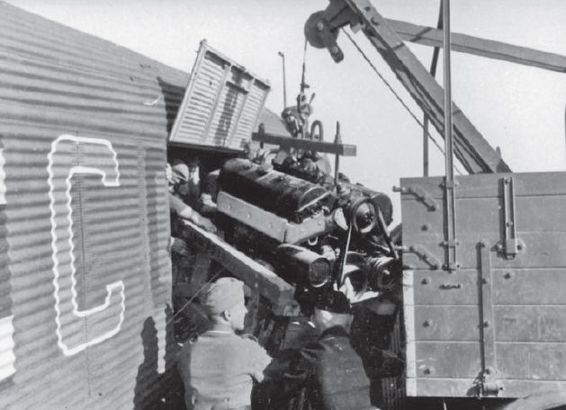
An engine for a panzer is unloaded from a Ju-52. Difficult terrain and weather, poor roads, and increasing partisan activity made aerial resupply essential for Hoepner’s panzer spearheads throughout Barbarossa. (NARA)
Finally at 0900hrs on August 8 the general offensive began along the Luga River. Advances were limited to 2–3 miles that day. Hoepner reinforced XLI Panzer Corps with the 8th Panzer and 36th Motorized Divisions and slowly Reinhardt avulsed the defenders out of positions under construction for six weeks. The panzers struggled to accomplish a breakthrough and it was only after Busch’s Landsers weighed in that the offensive began to go the German forces’ way. Von Manstein finally attacked at Luga town on the 10th, also making halting progress against the 41st Rifle Corps. Hoepner changed his Schwerpunkt back and forth between his two panzer corps in order to gain some advantage. In four days XLI Panzer suffered 1,600 casualties and LVI Panzer 900.
Reinhardt finally achieved a hard-won breakthrough on August 12–13. The next day 8th Panzer swung south in order to meet von Manstein’s men coming up from the town of Luga. But first, near Lake Il’men, Vatutin launched a counterattack to relieve pressure on Leningrad’s defenders. This attack and the German reaction had a significant impact on the final assault.
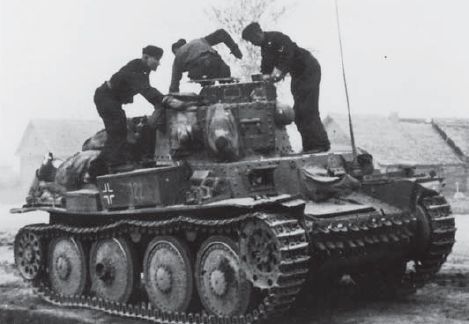
A Panzer 38(t) of the 8th Panzer Division near Leningrad. Of a total of 223 panzers, 118 were these near-obsolete Czech models, yet the 8th Panzer represented von Manstein’s main striking force. (HITM)
German Command Problems
With Barbarossa one month old, on July 21 Hitler, Keitel, two staff officers, some SS bodyguards, and propaganda photographers arrived by air at Army Group North headquarters. Hitler appeared “pale and nervous,” perhaps symptoms of his summer illnesses. His only visit to von Leeb during Barbarossa accomplished nothing substantial. None of the participants knew it then, but the German High Command was in the middle of its debilitating five-week debate over strategic decisions on the campaign’s future during the prime summer campaigning season.
Not satisfied with his own visit, Hitler next sent Paulus, considered an expert in mechanized warfare, to Army Group North headquarters on July 24 and 26. Instead of convincing Hoepner to continue attacking between Lakes Peipus and Il’men he returned to the Wolfsschanze reporting that the area was completely unsuited for panzers. Hitler sent Keitel back north on July 30 with the promises of assistance of VIII Fliegerkorps. Von Leeb told him the army group needed 35 divisions but had only 26, and that the Sixteenth Army could not adequately defend its 200-mile-plus front dangling loosely in the direction of Army Group Center.
As happened elsewhere along Barbarossa’s front during the German High Command’s tomfoolery, operational commanders took matters into their own hands. Intrigue at the strategic level did not equate to inactivity at the operational or tactical levels. With the LVI Panzer Corps bogged down on the road to Novgorod, on July 15 Hoepner decided Reinhardt would attack alone from his bridgeheads towards Leningrad. Von Leeb visited the panzer group command post the next day, approved this decision and returned I Army Corps to Hoepner to serve as his right flank protection. However by late July LXI Panzer still waited for von Manstein who spent weeks trying to negotiate the Luga Line. On July 30 a frustrated Reinhardt again wrote in his diary, “More delays. It’s terrible. The chance we opened up [to Leningrad] has been lost for good…” Defending the Sabsk bridgeheads cost many more casualties than capturing it.

A Stuka flies over the bombed-out ruins of Novgorod the day after a massive VIII Fliegerkorps attack. The walled Kremlin and Volkhov River (lower left) are clearly visible. (NARA)
Meanwhile the Kremlin was having its own command and control problems. Relying on leadership by fear, commissars “advised” with threats though most commanders did everything possible under the circumstances. The situation improved slightly under Voroshilov, but as the German forces approached Leningrad the old marshal’s principal response was to create the Military Soviet for the Defense of Leningrad, probably to spread the blame for anticipated failures. During the second half of August, Stalin dispatched a deputation from his own headquarters to rectify the situation. His men broke up the ad hoc Soviet and dismissed the entire leadership of the Northwest Front (Voroshilov received a temporary face-saving position as Leningrad Commander) until Zhukov arrived on September 9.
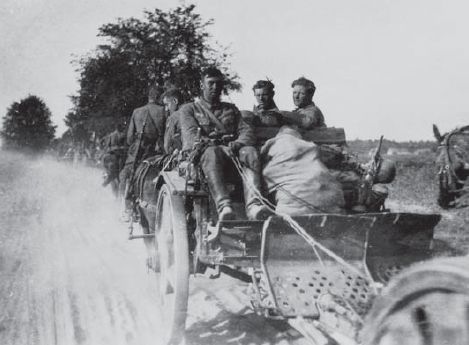
Artillerymen of the 212th Infantry Division ride on a caisson as they approach Utorgosh west of Lake Il’men. For them the war of movement would soon be over as they now had to fight through successive defensive lines guarding Leningrad. (NARA)
Sixteenth Army: Staraya Russa and Demyansk
Vatutin had been husbanding remnants of the 11th and 27th Armies plus the new 34th and 48th Armies to attack Army Group North’s extended eastern flank. He originally developed overoptimistic plans of striking Busch on both sides of Lake Il’men and advancing 10 miles per day. Stavka told him this was “clearly beyond the capacity” of the front and instructed him to settle on a more “limited mission.” Vatutin therefore decided to attack only south of the lake on August 3 or 4 and try for 2–3 miles per day. In the center of his assault, supported by the 11th Army, the robust new 34th Army represented the main effort, driving into the 30-mile gap between the Sixteenth Army’s X and II Corps. On the flanks, the 48th Army aimed for Novgorod while the 27th moved on Kholm. The attack was delayed until August 12, first by the writing of new orders and poor weather and then by the Germans’ Luga offensive.
German intelligence failed to spot Soviet preparations. To the south, the 27th Army did not make much progress against Kholm but closer to Lake Il’men the 34th advanced 24 miles in two days to cut the Dno–Staraya Russa railroad. Hansen’s three divisions fell back under the blows of Major General K.M. Kachalov’s 12. Soon the same miserable terrain with which Army Group North had to contend, plus poor command and control, conspired to slow the Soviet offensive. The town of Dno represented Busch’s headquarters and a logistics hub supporting much of the Leningrad offensive. The gap between the X and II Corps grew to almost 50 miles as Vatutin added four divisions to his order of battle. The German 30th Infantry Division abandoned Staraya Russa on August 16. A 30-mile retreat, following their earlier strenuous advance and difficult defensive battle, further exhausted the Landsers. Von Leeb, and to a lesser degree Hitler, overestimated the impact of the Red Army attack. Halder dismissively called them “irrelevant pinpricks.” Unsurprisingly, Hoepner did not want the Staraya Russa attacks to detract from his own assault and advocated keeping pressure on the lower Luga Line and even pulled LVI Panzer Corps out of the middle of Luga to reinforce Reinhardt for a final push on Leningrad.

Landsers (trans. “those of the land”) belonging to the 11th Infantry Division fighting near Dno in August. The steel helmet of the soldier to the left still bears the black-whitered national badge, in theory phased out before Barbarossa. (HITM)
However von Leeb refused to accept the risk of a threatened right, and transferred the 3rd Motorized and SS Totenkopf (plus I Fliegerkorps and VIII Fliegerkorps air support) from the Luga Line to Dno to prepare for a German counterattack. Under cover of the night von Manstein’s divisions made a 150-mile march to reinforce a situation that was already stabilizing. On August 19, first Totenkopf at 0300hrs and then 3rd Motorized Division struck the 34th Army unexpectedly like a hammer. Rain and Soviet resistance made the going rough, but by 23 August the German forces restored the Lovat River line, taking 18,000 POWs, 300 guns, 200 tanks, and the first Katyusha rocket launchers to fall into their hands. The bulk of four rifle divisions and one cavalry division were crushed.

 EVENTS
1. To the north the German drive on Leningrad causes Vatutin to plan attack on either side of Lake Il’men. Stavka downgrades to southern pincer only.
2. 12 AUGUST: newly created 34th Army attacks 50-mile gap between German X and II Corps. The 11th (against Staraya Russa) and 27th Armies (Kholm) attack in support.
3. 14 AUGUST: under cover of darkness von Leeb transfers SS “Totenkopf” to an area of 16th Army Headquarters. The next day he halts at LVI Panzer Corps Headquarters and 3rd Motorized Division (on road to join assault on Leningrad) also turns toward Dno.
4. 16 AUGUST: 245th Rifle and bulk of 163rd Motorized Rifle Divisions cut Staraya Russa–Dno railroad near Gorki. SS “Totenkopf” moves out against their left flank. 21st Rifle Corps elements enter Staraya Russa behind withdrawing 30th Infantry Division.
5. 19 AUGUST: Headquarters LVI Panzer Corps and 3rd Motorized Infantry Division begins counterattack; 30th Infantry Division transitions from defense to offense. II Corps attacks at Kholm.
6. 20 AUGUST: despite terrible weather, but with Luftwaffe close air support, SS “Totenkopf” and 3rd Motorized Divisions meet near Velikaya Selo and close trap on bulk of 163rd, 202nd, 245th, 262nd Rifle, and 25th Cavalry Divisions.
7. 23 AUGUST: the 16th Army restores Lovat River Line but drive on Leningrad has had to continue minus valuable armored and Luftwaffe elements.
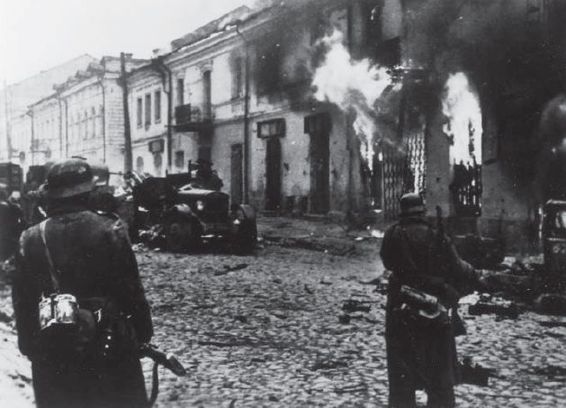
Landsers of the 290th Infantry Division fighting in Staraya Russa during the second half of August; the town changed hands three times that month. (HITM)
Ironically, about the same time as LVI Panzer Corps regained the line of the Lovat, General of Panzer Troops Adolf Kuntzen’s LVII Panzer Corps set out from Hoth’s panzer group; this was the long-anticipated but long-delayed support from Army Group Center to the Leningrad efforts. Soviet resistance around the Smolensk pocket took longer than expected to reduce, delaying their departure. To reach von Leeb, LVII Panzer began an attack at 0330hrs on August 23 toward Velikie Luki, following a bombardment by artillery, Nebelwerfer and Stukas. The nature of the terrain meant that the corps’ two panzer divisions operated almost independently. The battle for Velikie Luki ended on the 26th with another Kessel of 30,000 POWs. Although German losses were significant, Soviet dead lay in heaps. The bulk of the 22nd Army, 126th, 110th, 124th, 179th, 186th, 14th Rifle Divisions plus the 48th Tank Division, was destroyed. Kuntzen’s men struggled northward while Red Army defenders made effective use of mines, antitank ditches, and fortified houses. After its two-week trek the LVII Panzer Corps arrived at Kholm and linked up with Army Group North on September 9.

Soviet pioneers belonging to the 34th Army emplacing mines amongst antitank obstacles in August. At this point they were engaged in a seesaw battle against the Sixteenth Army south of Lake Il’men. (HITM)
Reunited after Staraya Russa the II and X Army Corps, plus the LVI and LVII Panzer Corps, headed east for Demyansk and the Valdai Hills beginning on September 12. The flat, swampy ground, mud 18 inches deep and undergrowth-clogged wilderness slowed the German troops. Moving at night for better concealment attracted partisans and cavalry. They reached Demyansk four days later in piecemeal fashion, but halted due to the desperate logistics situation. Ju-52 transport aircraft provided emergency resupply. By September 18, however, most of the mobile formations were loading onto trains for the Moscow front. It seems their exertions would have been more worthwhile if they had been spent reaching out toward the Finns on the Svir River. But with the panzers departing, the Sixteenth Army Landsers would henceforth be on their own.
Busch’s men closed another small Kessel near the Valdai Heights, encircling 35,000 more Soviet troops, 334 guns, and 117 tanks. Finally the Sixteenth eliminated the elusive 11th and 27th Armies and the newer 34th Army. The 12th Infantry Division reached the source of the Volga near Lake Ostashkov in the Valdai Heights, essentially marking the end of Sixteenth Army’s progress in Barbarossa. The entire Valdai sideshow had only won a tactical victory for the Germans.

A column of Stoewer light cross-country vehicles negotiate muddy roads and thick forests near Demyansk in September. As the German advance pressed further from the Soviet border, so the transport infrastructure became increasingly primitive. (HITM)
Combined losses for the 11th, 27th, and 34th Armies from August 10–31 were 128,550 men (30 percent) and 481 tanks (89 percent), but von Leeb forfeited operational success on the Leningrad axis or an even more fecund linkup with the Finns, all for tactical victories on a secondary front. Granted he secured the seam between the two army groups, but at a cost to the German forces in lost time and expended efforts that crippled drives on Leningrad or the Svir River. Halder stubbornly and willfully resisted reinforcing von Leeb with Hoth’s panzers for nearly a month only to relent by dispatching the XXXIX and LVII Panzer Corps northward when it was arguably too late for them to achieve more than limited success.
The Eighteenth Army and the Baltic Islands
Lacking a third panzer corps with which to build a Schwerpunkt, Hoepner had again to wait for infantry to march forward to fulfill that role. These forces came in the form of von Küchler’s XXVI and XXXVIII Army Corps, which finally arrived on the Neva River in the second half of August. They had three missions: 1) shield the panzer group’s left; 2) push the 8th Army north; and 3) destroy the 8th before it could add its strength to the defenses of Leningrad. But these operations, plus any final assault on the massive city, would have to wait until the dramas around Staraya Russa and Demyansk played themselves out. Relegated to secondary front status, the Eighteenth Army’s attention turned to the islands off the Estonian coast.

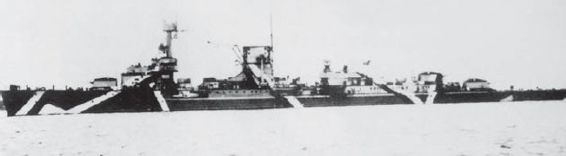
The 6,700 ton, 6in gun cruiser Leipzig participated in the German operations against the Baltic Islands. Diagonal stripes are often misidentified as “camouflage” but were in reality air-recognition markings for Kriegsmarine ships operating in the Baltic early in the war. (Podzun Verlag)
In October 1917, Imperial Germany had conducted Operation Albion, amphibious landings on the Baltic Islands. The Nordkorps landed on the seaward side, bagging 20,000 Russian POWs before moving on to Reval (later named Tallinn). A generation later von Leeb’s men began planning Operation Beowulf on April 29, originating instead on the Estonian mainland. Heavy fighting in the Eighteenth Army area, especially at Tallinn, plus the Kriegsmarine’s difficulty in assembling the required amphibious craft, repeatedly delayed Beowulf. Soviet nuisance air raids launched from Saaremaa against Berlin between August 7 and September 4 (possible responses to Luftwaffe raids on Moscow?) gave launching the assault added urgency.
Saaremaa and Hiiumaa were the largest of the numerous islands at approximately 1,000 and 500 square miles each. Smaller Muhu was connected to Saaremaa by a 2¼-mile-long causeway. All the islands were flat, sandy, and rocky, covered with heather and generally inhabited only by poor farmers and fishermen. Major General A.B. Elisseyev commanded 24,000 defenders (German intelligence estimated 15,000) who had used the preceding ten weeks poorly and were ill-prepared. Initially two battalions of the 79th Rifle Regiment guarded Muhu while the 3rd Independent Rifle Brigade held Saaremaa. One Soviet advantage was their ten coastal and 16 mobile artillery batteries stationed throughout the islands.

Pionier-Sturmboot 39 of the 61st Infantry Division crosses the sound between Estonia and Muhu Island on September 14. German amphibious capabilities were severely tested during this one-division operation. (NARA)

Red Army defenders of the Baltic Islands employing a 50mm M1940/1941 mortar. General Elisseyev and his men did not use the time between Barbarossatag and the German landings effectively and were essentially isolated from the remainder of the USSR. (HITM)
The German leaders wanted Elisseyev to think they were repeating their 1917 attack from the sea and thus on the night of September 13 the cruisers Leipzig, Köln, and Emden plus mine sweepers, sub-chasers, and torpedo boats conducted a feint to the west of the islands in Operation Südwind. In Operation Nordwind, the Finns did the same off the north shore of Hiiumaa with two monitors, two armed icebreakers and various smaller vessels. Unfortunately for them, their flagship, the 10-inch gun monitor Ilmarinen, struck two mines and sank within seven minutes with a loss of 271 sailors. However, these naval ruses worked as the Soviet forces rushed to defend the islands’ western coastline and therefore were not ready when the real assault came from the Estonian mainland.
Beowulf’s plan called for the 61st Infantry Division under General Siegfried Haenicke to assault on September 14, only 17 days after conquering Tallinn. The 151st, 162nd, and 176th Infantry Regiments would cross the 6-mile sound to Muhu in turn, starting at 0400hrs. Brandenburger commandos parachuted in against coastal guns at Kuebassare (seaborne elements failed to arrive) and the Luftwaffe planned robust air support. The first wave in four–six-man boats missed their intended beach by 1 mile as a result of strong winds and currents, as well as inexperienced crews. The second wave got so disoriented that it circled back to Estonia. Aufklärungs Abteilung (Reconnaissance Battalion) 161 landed on the north end of Muhu later in the day. By the first evening five infantry and one light mountain artillery battalions occupied a 4-mile wide beachhead.
151st Infantry Regiment crossed the causeway to Saaremaa against disorganized Soviet resistance on September 15; the defenders had not yet recovered from the deception plan. 151st and 162nd Infantry Regiments advanced down the southern side of Saaremaa while Aufklärungs Abteilung 161 and the 176th Regiment moved along the north coast. Resupply came in the form of huge Bf-321 Gigant transport gliders. The capital Kuresaare fell on the 21st.

61st Infantry Division soldiers in a rubber raft on Hiiumaa Island in October. Leading the group is an Unteroffizier (foreground) and a Leutnant behind him. Although the Baltic Islands were not large they had extensive areas of marshland. (HITM)
Soviet remnants numbering 15,000 retreated to the Sorve Peninsula for a final stand. Beginning on September 23, first the 162nd Infantry Regiment then the 151st assaulted the 1½-mile wide isthmus. Fighting ended there on October 5. Haenicke’s men captured 5,000 POWs while many escaped to Hiiumaa. Throughout the operation I/KG77 and II/ZG26 provided invaluable air support, coordinated by the air-control ship Karl Meyer steaming in the Baltic.
Preceded by another naval feint and supported by gunfire from Köln and other ships, the 176th Infantry Regiment landed on the east side of Hiiumaa at 0500hrs on October 12 in Operation Siegfried. Somehow surprise was complete once again against the poorly led Soviets. Aufklärungs Abteilung 161 and the 151st Regiment followed on the west and central axes. Severe terrain limited the effectiveness of motorized Kampfgruppe Sierigk. The battle for Hiiumaa lasted nine days against often stubborn resistance by 3,000–5,000 Soviet soldiers.
General Haenicke commanded another exemplary operation after receiving the Knight’s Cross for his 61st Infantry Division’s role in taking Tallinn just weeks earlier. Aided by naval units and Bf 110s as flying artillery, his men eliminated the threat of artillery interdiction of Riga Bay. At a cost of 2,850 casualties they captured 15,000 POWs and over 200 guns. Poor Red Army leadership, specifically weak command and control plus ineffective use of reserves, handed the Germans a satisfying tactical victory.

EVENTS
1. 10 SEPTEMBER: elements of 217th Infantry Division invade Vormsi and capture after one-day fight. Division artillery fire will close sound between Hiiumaa.
2. 14 SEPTEMBER: Brandenburg Special Command “Benesch” lands by glider near Soviet coastal battery in fort on Kuebassare Peninsula. Shipborne elements turned back by heavy seas.
3. 14 SEPTEMBER: Infantry Regiment 151 (in 180 boats) and Aüflarungs Abteilung 161 (90 boats) cross from mainland to Muhu and manage to hold against uncoordinated Soviet counterattacks.
4. MORNING OF 16 SEPTEMBER: first elements of Infantry Regiment 151 then Aüflarungs Abteilung 161 fight across two and a half mile-long causeway to Saaremaa against disorganized defense. Bridgehead secure by 1100 hours.
5. 22 SEPTEMBER: after easily overrunning most of Saaremaa Red Army remnants make last defense at one and a quarter milewide isthmus to Sorve Peninsula. Infantry Regiment 162 attacks on 23–27 September through heavily fortified defense.
6. EVENING OF 27 SEPTEMBER: Infantry Regiment 151, with the help of Luftwaffe close air support and naval gunfire, breeches Soviet defensive lines and captures Sorve Peninsula.
7. 5 OCTOBER: Soviets evacuate Sorve by sea; 1,500 soldiers escape to Hiiumaa.
8. MORNING OF 12 OCTOBER: Infantry Regiment 151 follows to Hiiumaa.
9. AFTERNOON OF 12 OCTOBER: IR 176 and AA161 conduct amphibious landing against south shore of Hiiumaa.
10. 21–22 OCTOBER: Soviets abandon Baltic Islands; 570 men manage to escape.
Resuming the Offensive Against Leningrad
Hitler saw St Petersburg, the seat of the Tsars, as a symbol of Russia’s status as a great power, its dominance of Europe, and its naval superiority in the Baltic Sea. His hatred of the renamed city of Leningrad as the cradle of Bolshevism was based on ideology and racism rather than strategy or geopolitics. Vatutin’s inconclusive Staraya Russa attack and the arrival of the XXXIX Panzer Corps from the Third Panzer Group sealed Leningrad’s fate; If not captured outright the city would at the very least be a hostage of the German forces.
It should come as no surprise that the closer von Leeb got to Leningrad the farther behind he left the blitzkrieg. Early in Barbarossa, as a morale-boosting measure the men of 3rd Motorized Division were told they could grow beards until Leningrad fell. By late August commanders bowed to the inevitable and ordered their men to shave again. Panzer thrusts, measured in hundreds of miles per month in June and July, now slowed to a crawl. German losses mounted; the 30th Infantry Division suffered 1,359 casualties during Barbarossa’s first month, but 2,947 during the second. The Northwest Front suffered a bloodletting as well with 25 of its 30 divisions whittled down to between 10 and 30 percent of assigned strength in July.
Von Leeb’s repeated immobilization of Hoepner’s panzers gave the Red Army time to strengthen its lines, even if only slightly. David Glantz has condemned the German leaders’ self-imposed surrender of the strategic initiative as Reinhardt stood practically unopposed on the Neva at Kingisepp. Von Leeb compounded this folly by his continued inaction while the Sixteenth Army eliminated a tactical threat at Lake Il’men far from Leningrad.
General Halder initially vigorously resisted reinforcing Army Group North with Hoth’s panzers. Only when it was too late, and then in a piecemeal manner, did the chief of staff relent. However, success was now less likely than weeks earlier. Even then the two army groups would not cooperate to liquidate a threat to their mutual flanks. By the time von Leeb had sufficient strength either to slaughter the Northwest Front or to link up with Mannerheim both opportunities had passed. One can only guess whether another Kiev-style Kessel in the north or a rendezvous on the Svir might have been possible if the German forces had committed themselves decisively and fully in that sector.
Von Leeb was optimistic about his army group’s chances against the Red Army forces facing them, but Hitler was not. Reinhardt’s panzer corps had been stalled within 100 miles of Leningrad since the first half of July. Now, nearly two months later, the Germans finally anticipated the penultimate assault on the city. On September 4 von Brauchitsch and Halder arrived at army group headquarters in Pskov. Keitel was already there and the three of them told von Leeb of his new mission, merely to surround Leningrad, not conquer it. The next day Hitler issued instructions giving von Leeb two missions, to encircle Leningrad by attacking toward Shlisselburg and also to drive on Volkhov in order to link up with the Finns on the Svir. On September 6 Hitler issued Führer Directive 35 dealing with the final attack on Moscow (Operation Typhoon). This established September 15 as the date when VIII Fliegerkorps and Hoepner’s remaining panzers would transfer to Army Group Center for the offensive two weeks later. In return von Leeb received the 7th Airborne Division flown in from Crete, the 250th Spanish Blue Division, plus the 212th and 227th Infantry Divisions arriving from France.

Traffic jam at a Luga River bridge in late August. The river is neither wide, with steep banks, nor fast flowing yet was obviously an obstacle. German pioneers have constructed a new bridge to the left. (HITM)
Von Leeb’s lack of focus on any single obtainable target would cost him his primary objective. All the while Mannerheim watched critically from Finland for any signs that Army Group North might falter as the United States and Soviet Union applied diplomatic pressure on his tiny nation to remain close to its 1939 borders.
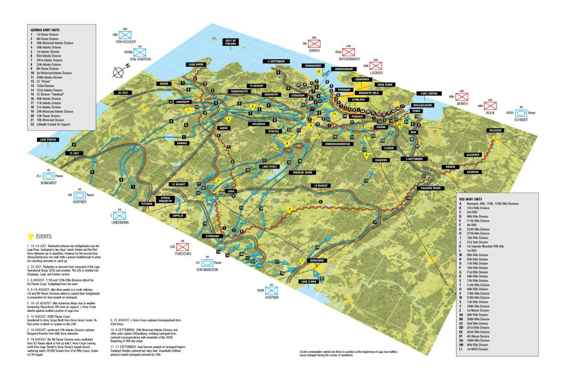
EVENTS
1. 13–14 JULY: Reinhardt achieves two bridgeheads over the Luga River. Leningrad is two days’ march distant and the Red Army defenses are in shambles. However for the second time during Barbarossa von Leeb halts a panzer breakthrough to allow his marching elements to catch up.
2. 23 JULY: Piadyshev is removed from command of the Luga Operational Group (LOG) and arrested. The LOG is divided into Kingisepp, Luga, and Eastern sectors.
3. 8 AUGUST: 111th and 125th Rifle divisions attack the XLI Panzer Corps’ bridgehead from the west.
4. 9–16 AUGUST: after three weeks in a costly defense, 1st and 6th Panzer Divisions attack to expand their bridgeheads in preparation for final assault on Leningrad.
5. 10–26 AUGUST: after numerous delays due to weather hampering Fliegerkorps VIII close air support, L Army Corps attacks against southern portion of Luga Line.
6. 15 AUGUST: XXXIX Panzer Corps transferred to Army Group North from Army Group Center. Its first action is attack on Lyuban on the 25th.
7. 16 AUGUST: reinforced 12th Infantry Division captures Novgorod Kremlin from 48th Army elements.
8. 19 AUGUST: the 8th Panzer Division veers southward from XLI Panzer attack to link up with L Army Corps coming north from Luga. Result is Army Group’s largest Kessel, capturing nearly 20,000 Soviets from 41st Rifle Corps; closes on 30 August.
9. 21 AUGUST: L Army Corps captures Kranogvardiesk from 42nd Army.
10. 8 SEPTEMBER: 20th Motorized Infantry Division and other units capture Shlisselburg, isolating Leningrad from overland communications with remainder of the USSR. Beginning of 900-day siege.
11. 11 SEPTEMBER: final German assault on Leningrad begins. Dudergof Heights captured two days later. Essentially furthest advance toward Leningrad achieved by 24th.

Generals Busch, von Richthofen, and Wiktorin (XXVIII Army Corps) plan an assault on the Luga River defenses. The entire nature of Barbarossa’s northern theater changed at this point, when the Soviet forces’ cobbled-together defenses, terrain, and weather conspired to halt the German troops only a few days’ march from Leningrad. (Podzun Verlag)
For a moment during mid-August as the LVI Panzer moved north from Luga and XLI Panzer swung counterclockwise to meet it, Hoepner came close to building a two-panzer corps Schwerpunkt for the first time during Barbarossa, but his superiors’ overreaction to the Staraya Russa counterattack shattered that vision.
However, Reinhardt had not been completely idle during the Staraya Russa battles of the second half of August and kept up the pressure. The rain fell hard and the Red Army had turned most villages into fortresses. Soviet antitank mines reduced the ratio of destroyed panzers to Soviet tanks to 1:2, a disastrous trend for the German forces. The panzer crews halted their advance periodically and assumed defensive Igel. So it continued for another week as 1st and 6th Panzer Divisions inched forward toward Krasnogvardeysk. On August 24, XLI Panzer Corps reached the end of its endurance still short of the town, switching to a defensive posture for another two weeks.
As von Leeb issued orders on September 6, forces for the final assault of Leningrad lined up as follows. The Schwerpunkt under Hoepner consisted of the XLI Panzer and XXXVIII and L Army Corps with the missions of attacking Krasnogvardeysk and cutting off the 8th Army from Leningrad. Hoepner also commanded the XXVIII Army Corps and elements of the 12th Panzer Division on the Izhora River, with Slutsk and Kolpino as their objectives. To the east stood Schmidt’s newly arrived XXXIX Panzer Corps (18th and 29th Motorized Divisions from Army Group Center), which was to chase away any Soviet relief efforts from the direction of Leningrad. Elements of the Sixteenth Army would secure the Lake Il’men and Lake Ladoga shoulder to the east. On the Soviet Leningrad Front were the 8th Army to the west, the 42nd Army (Lieutenant General F.S. Ivanov) near Krasnogvardeysk, and the 55th Army (Major General I.G. Lazarev) around Slutsk and Kolpino. The defenders numbered 452,000 men. Included in that number were 80,000 naval infantry in seven brigades. Popov believed that he had the flexibility to transfer forces from the 23rd Army in Karelia to more threatened sectors if necessary.

Soviet 122mm M1931 guns in action along the Luga line. The Germans took a massive toll on the now-immobile artillery branch, early in the campaign when many prime movers were transferred to the newly raised mechanized corps. (HITM)
Army Group North’s last effort to take Leningrad began on the eastern flank. Schmidt’s Panzer Corps battled the 55th Army on its right and the 54th on its left as it made straight for Lake Ladoga via Chudovo, which fell on August 25. The noose closed around Leningrad when Shlisselburg fell on September 8. The hero of the moment was Lieutenant Colonel Harry Hoppe, the same man who had captured Novgorod’s Kremlin the month before. Voroshilov was afraid to tell Stalin of the disaster so the latter learned the bad news via German radio.

Army Group North cut overland communications with Leningrad by taking Shlisselburg on Lake Ladoga, shown here on September 8. However, the 5-mile wide toe-hold was inadequate for completely isolating the city. (Topfoto)
As temperatures dropped Reinhardt felt strong enough to attack at 0930hrs on September 9. The 36th Motorized and 1st Panzer Divisions led the way through Krasnogvardeysk and the old Tsarist barracks at Dudergof, which fell on the 11th. But Hoepner had no reserve to exploit the success. A day later the 1st and 6th Panzer Divisions entered Leningrad’s inner defensive ring near Krasnoye Selo. Under orders from Stalin not to surrender, Red Army soldiers blew themselves up with hand grenades rather than show the white flag. In the close fighting Stukas from von Richthofen’s VIII Fliegerkorps dropped bombs 200–300 yards in front of the German troops. Meanwhile the XXVIII Corps and 55th Army fought to a draw near Slutsk.
Smelling another trap Hoepner released his new reserves, the 8th Panzer, to pass Reinhardt’s right and then to swing south. It would rendezvous with the new L Army Corps (269th Infantry and Polizei Divisions) coming up from the town of Luga, which had just fallen with the loss of another 16,000 Soviets. Together they encircled nine divisions of the LOG and 41st Rifle Corps near Vyritsa, capturing 25,000 Soviets. By mid-September the Luga defense line had ceased to exist, while the 48th Army could field only 6,235 men and 31 guns. Further German advances looked doubtful, however; the LOG had accomplished its mission.

Hans Ulrich Rudel sinks the battleship Marat at Kronshtadt, September 21, 1941. Flak explodes while the Stukas are still 10 miles out. Starting at 9,000 feet altitude the dive bombers tip over for the final run. They carry 2,000-pound bombs especially made for large warships (1). Pilots plunge at about 80° without using dive brakes in order to get through the bursting artillery. Lieutenant Hans Ulrich Rudel (T6+AD) (2) keeps his sights on the Marat (3). He pushes the bomb release then pulls back on the stick. He momentarily blacks out from the G-force until his radioman/gunner tells him “She is blowing up, sir!” However, Rudel and his comrades won an incomplete victory; the crippled Maratsettled into the shallow water of the bay, but her stern guns continued to bombard German soldiers on the mainland preparing their final assaults on Leningrad. (© Osprey Publishing, Howard Gerrard)
Hoepner and von Leeb labored under imminent High Command threats to pull Fourth Panzer Group out of the Leningrad fight and send it to Moscow. The field marshal suffered from a fatal resignation, stating “I’m fighting a poor-man’s war,” while the panzer commander wanted one last push. Command and control arrangements were far from satisfactory for Hoepner. He had limited authority over the XXXVIII Corps on the left (under the Eighteenth Army) and none over the XXXIX Panzer Corps on the far right. Throughout von Leeb appears to have exercised little decisive leadership. Accordingly German attacks were slow in getting started and poorly coordinated.
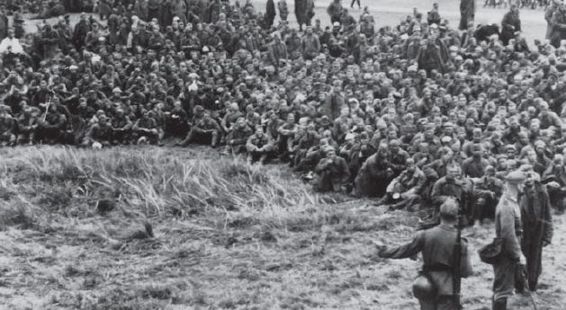
Soviet POWs await their fate near the lower Luga River sector. With a smaller panzer group, Army Group North failed to achieve the massive encirclements that characterized the battles in the Army Group Center and Army Group South sectors. (NARA)
On September 9, Zhukov arrived in embattled, encircled Leningrad and gave Voroshilov the following note from Stalin: “Hand over command of the Front to Zhukov and fly back to Moscow immediately…” Zhukov promptly countermanded his predecessor’s orders to make preparations to demolish the city and to scuttle the Red Banner Fleet. He issued his own “not one step back” instructions and provided the defense with shape by creating his own main effort near Uritsk, sending reinforcements there and ordering counterattacks.
On September 13, with the battle on a knife edge, Reinhardt committed the 1st Panzer, 36th Motorized, and 1st and 58th Infantry Divisions at Uritsk. A day later he ordered the 6th Panzer (by now down to 9,000 men) to Pushkin and sent 8th Panzer east to assist Schmidt. As often happened, these assaults preempted a countermove planned by Zhukov. Close to the center of the line, the 121st Infantry Division, with many elements at one-third strength, battled in the “haunted” forests. They could see the golden cupolas and towers of Leningrad a mere dozen miles away. Toward the end of the month both sides settled down to an active defense and began a propaganda war using loudspeakers.
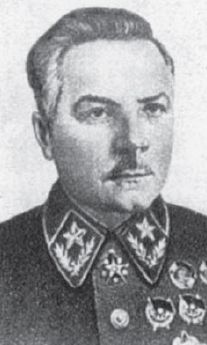
Marshal K.E. Voroshilov’s political closeness to Stalin did not equate to military skill. First Kuznetsov then Voroshilov made such a hash of defending Leningrad’s southern approaches as to almost guarantee German success. (David Glantz)
Hoepner’s men wondered if this was indeed the final assault. Their high-water mark came on September 18 as the XXVIII Corps took Slutsk while the 1st Panzer and Polizei Divisions took Pushkin, with 1st Panzer engaging new Soviet tanks fresh from the factory at Kolpino. That same day, however, the 6th Panzer received orders to pull out and make for Moscow, to be followed on the 20th by the remainder of XLI Panzer Corps.
To the west, on September 16 Reinhardt reached the Gulf of Finland at Strelnya, isolating Major General Cherbakov’s 8th Army from Leningrad. To the east, 54th Army counterattacks at Mga failed to dislodge the XXXIX Panzer Corps. The main defense in Leningrad’s suburbs began to gel around this time. The 1st Panzer halted at the high-water mark of White Russian forces during the Civil War and by September 25 the front lines had solidified.
With that, 900 days of darkness descended over Leningrad while the moon circled like a vulture; 1 million citizens starved in that first winter alone. Leningrad had been a frontline city during the Winter War but this would be different. The supplement to Führer Directive 33 advocated terror “to discourage any flicker of resistance” within the city. On September 16 Hitler stated “The venomous nest Petersburg out of which Asiatic poison so long gushed into the Baltic Sea would disappear from the face of the earth.” A directive of September 22, exactly three months after Barbarossatag, made his bombast official but no closer to realization. Many Landsers regretted they would not have the opportunity to capture Leningrad.25
Surrounding and starving Leningrad was only one option considered by Hitler; a half-hearted alternative had been to allow the still-neutral United States to either supply or evacuate the population. Toward the end of World War I General Erich Ludendorff wrote a study on the difficulties of taking Petrograd, but likely he considered the implications of feeding its 2 million people. Hitler felt unconstrained by similar humanitarian issues. On September 10 von Leeb asked what would be expected if women and children sought to escape starvation by trying to come through the German cordon. The Führer said, “They’d be shot.” Von Leeb replied, “That might happen once, but no more. German soldiers don’t shoot women and children … that would cause a severe crisis in discipline.” The field marshal was obviously naive about what German soldiers would or would not do during the Nazi–Soviet war. However his point was doubtless lost on Hitler. Even more naively some in the German High Command believed that Stalin would forfeit Leningrad.
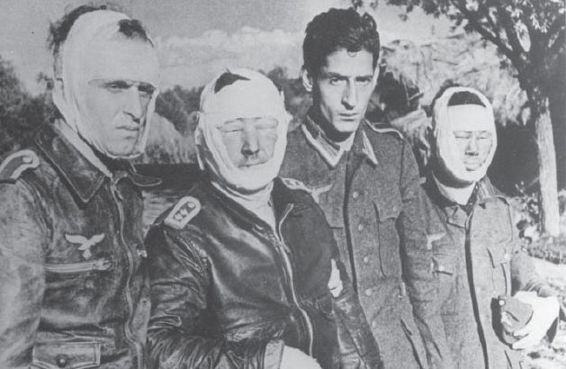
Barbarossa was hard on the Luftwaffe. Here the captured crewmen of a bomber are paraded through Leningrad, over which their aircraft was shot down. The Hauptfeldwebel in the leather jacket, probably the pilot, looks especially banged up. They await an uncertain fate. (Courtesy of the Central Museum of the Armed Forces, Moscow via Stavka)
In any event these issues never arose. For his part, on September 21 Stalin also issued draconian orders concerning Leningrad. The USSR would resupply the city and the population would manage as best it could. Because Hitler halted his forces so early and Finland refused to be drawn into a fight for the huge metropolis, Leningrad maintained a substantial hinterland of over 1,100 square miles. That space provided ample room for troop concentrations, airfields, depots, farms, and factories, all of which dissipated the siege’s effectiveness. In fact, industry continued to produce ammunition, weapons, and vehicles, and repaired much of the same, out of the range of German artillery. Finally, due to the city’s stout air defenses, the Luftwaffe’s September bombardment lasted barely two weeks. Throughout the theater by the end of September all four of the Luftwaffe’s top fighter aces were either dead, in the hospital, or removed from active flying duty for political reasons. Worst of all, the Luftwaffe was completely incapable of making up its losses, personnel or equipment.
The Soviet Counteroffensives
While the jaws of von Bock’s Panzer groups closed on the Smolensk pocket, Stavka struggled to regain the initiative. The German leaders already had a copy of the July 13 order instructing Timoshenko to attack. Three days later the marshal complained to Moscow that he had “insufficient strength to cover Yartsevo, Viazma, and Moscow. The main thing is no tanks.” Stavka (through Zhukov) reiterated its orders on the 20th, essentially telling the West Front to use four armies to encircle the German troops then attempting to surround Smolensk, and save the 16th, 19th, and 20th Armies inside the pocket. The same order demanded “operations by larger groups” than Timoshenko’s previous Berezina River attacks by just two or three divisions. Stavka instructed him to create five attack groups, each loosely based on a field army and named after its commander: 29th Army (Lieutenant General I.I. Maslinnikov), 30th Army (Major General V.A. Khomenko), 24th Army (Major General S.A. Kalinin), 28th Army (Lieutenant General V.I. Kachalov), all four NKVD generals, plus an ad hoc group under Major General K.K. Rokossovsky. Initially these forces were all supposed to attack on July 21.
Group Kachalov moved out first, on the 23rd. It was soon creating problems for Guderian, and by July 27 it looked as if the 10th Panzer Division and Grossdeutschland might become cut off. Guderian responded with a counterattack towards the important communications node at Roslavl. By July 31, XXIV Panzer Corps (3rd and 4th Panzer Divisions) and VII Army Corps (197th, 23rd, and 78th Infantry Divisions) were attacking eastward from Krichev into Kachalov’s rear. A day later IX Army Corps (263rd and 292nd Infantry Divisions) assaulted southward, sealing Group Kachalov’s fate. The fight against these apparently most serious threats to Army Group Center was over by August 7. Even though General Kachalov had died in battle in a Soviet tank, Commissar Lev Mekhlis had him branded as a traitor (only to be rehabilitated after the war).
Groups Kalinin and Khomenko attacked on July 24. VIII Fliegerkorps had not yet departed for Army Group North, so Bf-109s mauled the Soviet close support effort. Kalinin’s mission was to exploit Kachalov’s “success”: an eventuality that never presented itself. Both of these attacks achieved little and were soon turned back. The same day Colonel General O.I. Gorodovikov’s Cavalry Group (32nd, 43rd, and 47th Cavalry Divisions supported by 232nd Rifle Division) began causing trouble across Guderian’s and von Weich’s lines of communication southwest of Bobruisk. Group Maslinnikov (off the “Timoshenko Counteroffensive” map to the north) attacked on July 29, but also achieved little.
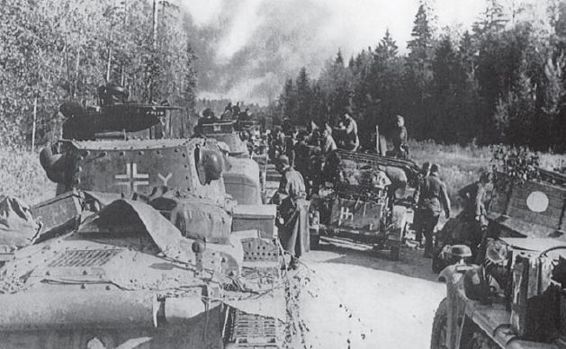
Terrain in the Third Panzer Group’s area was more thickly forested than farther south in the Second Panzer Group sector. These vehicles bear the “Hh” of Hoth’s formation, plus the yellow Y-rune of the famous 7th Panzer Division – one of several whose tank regiment was still equipped with the Czechoslovak-made PzKpfw 35(t) or 38(t). (Podzun)
Arguably the weakest group had the greatest impact. Rokossovsky had the mission of halting Hoth’s direct advance on Viazma and Moscow, but started with a force of only two rifle and four artillery regiments. He soon collected stragglers of 38th Rifle Division plus about 90 tanks. His assault first blunted then actually drove back the advance of 7th Panzer and 20th Motorized Divisions. Von Bock reinforced his hard-pressed units with 17th Panzer, yet still could neither displace Rokossovsky’s men nor close the Solovevo gap through which many Red Army soldiers were escaping from Smolensk.
Kachalov’s attacks, Rokossovsky’s stubbornness, the fact that von Kluge’s personal aircraft had been forced down and the field marshal was feared lost, and other factors conspired to cause the German commanders momentary consternation. All combined, the attacks hurt Hoth’s panzer group worse than the rest of Army Group Center. But von Bock, having foreknowledge of the Timoshenko offensive, dispatched the Luftwaffe to attack Soviet assembly areas and generally halted the uncoordinated and piecemeal operations. When the Smolensk Kessel slammed shut on about July 27–28, Stavka changed Timoshenko’s mission from relieving the trapped defenders in the pocket to escaping encirclement himself. In the marshal’s after-action report to Stalin he wrote that he “gave all the reinforcements that I could to Khomenko and Kalinin. But you know I had no guns, no aircraft, and very few personnel.”

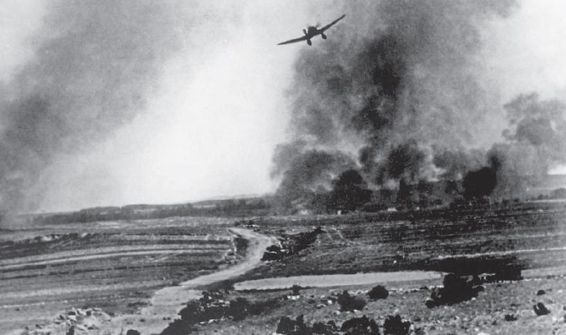
A Ju 87B Stuka pulls out of a dive after attacking a group of 80 Soviet tanks on August 1. Air–ground co-operation was essential for the success of blitzkrieg, and von Bock would miss von Richthofen’s VIII Fliegerkorps after August 3, when it was taken away from Army Group Center and shifted to the Leningrad Front. (NARA)
By the end of July personnel losses hurt both sides. As Hitler pointed out, Soviet casualties to that point equaled Russian losses in World War I. But Stalin was not Nicholas II and the USSR was not Imperial Russia. Germans killed and wounded by the same date were 42,000 for Army Group North, 74,500 for Center, and 63,000 in the South. Respectively, replacements amounted to only 14,000, 23,000, and 10,000.
Yelnia
Guderian’s XLVI Panzer Corps seized the Yelnia bridgehead over the Desna River on July 20. It was seen as a temporary halt. The town sat on the high ground over the river and housed a stop on the major east–west rail line. Most commanders there assumed that they would resume the advance on Moscow as soon as the infantry had tidied up the Smolensk and neighboring pockets. Yelnia would serve as the ideal jumping-off point for Barbarossa’s last big push. However, the second half of July coincided with the crisis of command at Rastenburg. German units at Yelnia had only had an early taste of what would turn out to be a ten-week defensive struggle. In view of its “temporary” nature, the salient had been chosen neither for its defensive qualities nor for its suitability for reinforcement and resupply.
While defensive doctrine did not receive the same emphasis as offensive in the interwar German Army it was not neglected. The Poles never severely tested German defenses and the Western Allies did so only once, at Arras on May 21, 1940. On the other hand Red Army Forces constantly badgered the invaders with their frequent counterattacks and constant attempts to break out of and in to the various Kessels. Less than two months into the Barbarossa campaign, and with the mass of von Bock’s armor fighting to the north and south, Zhukov now sought to make Yelnia a lightning rod for a series of deadly assaults. The end result was Germany’s first operational withdrawal in World War II.
Elements of 10th Panzer Division and SS Reich initially occupied Yelnia. It took Timoshenko only three days to assemble his initial attack forces and they began hitting the German positions for the next two weeks. Their larger (and unrealistic) mission was to relieve their trapped comrades inside the Smolensk encirclement by September 8. Guderian’s men often had to fend off a dozen attacks per day, while ammunition and reserves ran dangerously low. Close proximity to Smolensk became a German asset as that Kessel was reduced, freeing up infantry and the Luftwaffe’s I Flak Corps for duty around Yelnia.
With Lukin’s surrender at Smolensk the immediate need for the Soviet forces to carry the attack forward so vigorously diminished. By the middle of August most of von Bock’s panzers began to depart in the directions of Leningrad and Kiev, so the Fourth and Ninth Armies took over the sector’s defense. The bulk of Kesselring’s two Fliegerkorps also flew north and south. Simultaneously, while the German forces had advanced beyond the reach of their logistical tether the Soviet units retreated back along their lines of supply.
As Army Group Center abdicated the battlefield initiative during the logistics “pause,” Timoshenko seized it. Emboldened by strength, logistical, and morale factors by August 11 the Soviet divisions were assaulting all along von Bock’s front. Timoshenko’s subordinate 19th Army (reinforced by 101st Tank Division and 43rd Mixed Aviation Division) achieved a 6-mile penetration across the River Vop. As Timoshenko pounded German positions north of the salient, Zhukov, now commanding the Reserve Front, lavished his attention on Yelnia itself. His main asset would be Major General K.I. Rakutin’s 24th Army. Simultaneously, Major General L.M. Dovator led the 50th and 53rd Cavalry Divisions on a raid deep into the German rear which required three divisions to counter.

This Obergefreiter (left) and a private have dug in beside a destroyed T-34. Amongst the clutter of their fighting position can be seen Kar 98 carbines, an MG34, a bayonet, cooking equipment, and an M1938 gas mask canister. (NARA)
To the German soldier on the ground there seemed to be no shortage of Soviet infantry, Katyushas, or CAS. Assaults in battalion strength, parachute drops behind their lines, and night attacks became common. Here the unsuitability of the terrain surrounding the Yelnia defense positions became fatal for many a Landser; the wounded had to wait until dark for medical evacuation away from their exposed locations. They could not even count on help in the form of counterattacks by armor and motorized troops, since Guderian’s mobile forces were fighting back the Bryansk Front attacks, reducing the Roslavl threat and making preparations for the upcoming operation against Kiev.
The beginning of the end of the Yelnia salient came on August 30 when, following a three-hour artillery preparation, the Soviet forces stove in 23rd Infantry Division to a depth of 6 miles. On September 2, von Brauchitsch, Halder, and von Bock all agreed to abandon Yelnia and the order went out the next evening. The German commanders tried to put lipstick on a pig by calling the retreat a withdrawal. In the end Yelnia demonstrated the German leaders’ somewhat unjustified obsession with rivers and river crossings and represented a waste of scare resources. IX and XX Army Corps left Yelnia on the 5th, and the Soviet 100th, 103rd, 309th, and 120th Rifle Divisions reoccupied the town from the following day.

One reason that the Sturmgeschütz was so important to the Germans: their mainly horse-drawn artillery often lagged far to the rear of the fighting, making displacing to new positions a slow process. The standard German infantry division still included some 6,000 horses, for its artillery, supply train, and part of its reconnaissance element. (HITM)
The German Crisis of Command
Hitler was deathly superstitious about following Napoleon’s ill-fated footsteps to Moscow. As early as the end of June he was considering the second phase for Barbarossa, but was clear that this did not include Moscow. Hitler never fell under the spell of Stalin’s capital and his plan since the previous December had been to send Hoth and Guderian north and south after Smolensk. In diary entries of June 30 and July 8, Halder initially agreed with this thinking and halfheartedly conceded that infantry might be enough to take Moscow. Halder deviously worked to dissuade the Führer; enlisting von Brauchitsch, von Bock, and Jodl’s help behind the scenes while falsifying Red Army strength estimates to suit his arguments. However, there was no unanimity among the German leadership.
By the second half of July, initial German euphoria had cooled and Hitler could not sleep. He commented, “One cannot conquer Russia” (so one might ask, what was he doing there?). Soviet powers of resistance were hard to fathom. In view of the prodigious territory lost, estimated Soviet casualties of 3 million dead and wounded and another million captured, it was incomprehensible to Hitler that the enemy could sustain a credible defense much longer. On July 17 Hitler decided to send Hoth north and Guderian south. Two days later, with minimal staff assistance, he issued Führer Directive 33 followed by a supplement days later.26 Succinctly, these documents confirmed the southern strategy, united the First and Second Panzer Groups in a single operation against Kiev and, to Halder’s chagrin, left Moscow to von Bock’s infantry. By this time Halder had changed his mind again and he tried again to persuade Hitler to continue committing the armor to the central axis. He increased estimates of Soviet forces defending Moscow hoping Hitler would decide in favor of a massive encirclement victory there.
On July 20 Halder flew to von Rundstedt’s command post vainly hoping to hear that Army Group South could pull off the Kiev battle alone. Three days later he and von Brauchitsch went to Hitler’s headquarters to argue in person for the Moscow option. The Führer continued to insist that his main objective was the destruction of the enemy’s forces. Halder correctly presented Moscow as a place where much of the Red Army could be fixed and defeated, but the general’s arguments backfired when he told Hitler that owing to logistics problems Second and Ninth Armies could not advance on Moscow until August 10. The Führer replied that in that case neither could the panzers so he would send the tanks north and south as planned. On July 30 Hitler further postponed any decision on future operations until current ones, including closing the Uman pocket and creating Dnepr bridgeheads, were complete.
As regards the northern thrust, Directive 33 and its supplement essentially ordered Third Panzer Group north from the Moscow axis toward Leningrad. The supplement subordinated Third Panzer Group to von Leeb. It correctly implied that two panzer groups would give the final push on a Leningrad greater chance of success. Clearly Army Group North was not strong enough to accomplish its assigned missions alone. Hoth’s six divisions would assist Hoepner to encircle Red Army forces in the north and prevent Soviet reinforcement and resupply of the Leningrad area. In his directives Hitler reestablished capturing Leningrad as a prerequisite for turning on Moscow as discussed at his conference on December 5 the year before. However, this went against Halder’s fixation on Moscow.
Besides, Barbarossa had reached its long-anticipated logistical pause. For example, in the south only two rail lines served von Rundstedt’s entire army group when German doctrine called for a minimum of one per army. The Reichsbahn’s goal of 24 trains per day in September was achieved on only 12 days and many of those trains were only partially loaded. Therefore OKH ordered Army Group Center to transfer 5,000 tons of Grosstransportraum capacity to its southern neighbor.
General staff maneuverings came too late as Hitler issued Führer Directive 34 on July 30 (this was at least written with Jodl’s help). A Supplement on August 12 read: “the most important aim … is not the capture of Moscow but, rather, occupation of the Crimea, the industrial and coal-mining area of the Donets Basin, the cutting of Russian supply lines from the Caucasus oil fields…” Hitler recognized the importance of the Ukraine’s resources and knew that before Army Group Center could move on Moscow, Army Group South would have to advance and clear von Bock’s right flank.
In the north Hitler reasserted the primacy of Leningrad, specifically pushing von Leeb to swing wide right and link up with the Finns, but Directive 34 further delayed any assistance from Army Group Center and sent Hoth’s men only so far as the Valdai Heights. Hitler stressed encircling Leningrad by linking up with the Finnish Army but then denied von Leeb the necessary resources. The supplement spoke of the need to “relieve Army Group North of anxiety about its right flank.” Most significantly it stated that before attacking Moscow “operations against Leningrad must be concluded.” The Führer acceded to Army Group Center’s desire to retain most of Hoth’s Panzer Group; with disastrous effects on von Leeb’s subsequent fortunes.
These Führer Directives, especially No. 33, confused more than clarified Barbarossa’s objectives and its future. At each step the German leaders had to retool their thinking up and down the entire chain of command. Hitler departed on a tour of army group headquarters to speak directly to field commanders, especially those of the panzer groups. On August 4 the Führer, Halder, Keitel, Jodl, and OKW and OKH staff officers met leaders of Army Group Center (including future assassination conspirator Henning von Treschkow) at von Bock’s headquarters in Borisov. Under Halder’s stern gaze, the generals present toed the chief of staff’s line. In the end they could not discourage their Führer, however, now enthused about von Rundstedt’s chances following Uman. Hitler’s priorities remained, in order, Leningrad, the Ukraine, and then Moscow.
On August 7 Jodl and Halder met to discuss Moscow, as General Warlimont27 later wrote, for the “first time that anyone can remember.” On the 8th Jodl tried to sell Hitler on the idea that massive Red Army forces assembling in front of Moscow represented a valid target for another offensive. Two days later Halder’s and Jodl’s OKH and OKW headquarters issued a joint situation report recommending the Moscow option. Unfortunately for them the Soviet assault on Staraya Russa in the north which began on the 12th redirected everyone’s attention to potential dangers on Moscow’s flanks. The following week, on the 18th, OKH submitted a Denkschrift (study), supposedly only for von Brauchitsch’s eyes (but widely disseminated), claiming that the Ostheer had enough resources and, most importantly, time for one objective in what was left of 1941: Moscow. In reality Halder and Jodl decided not to decide between Moscow or Kiev but instead told Hitler the Wehrmacht could take both!
However, German military leadership could not present a united front to dissuade the Führer from the two flanking operations. A telling exchange occurred when Colonel Adolf Heusinger of the OKH told Jodl that if Germany wanted to destroy Communism it had to attack Moscow. Jodl replied that, “The Führer has a sixth sense…You must admit that the Führer’s reasons are well thought out.” Other generals were powerless to dissuade Hitler. They could not even successfully exploit Hitler’s illness: he was battling dysentery or had suffered a nervous breakdown around this time. By mid-August even Göring, as Director of Economy and Four-Year Plans and, since June 29, Economic Director of Occupied Eastern Territories, waded into the discussion in favor of the Ukraine option.
Too late Halder played his last ace by sending Guderian to the Wolfsschanze on August 23. The panzer general belonged to the Moscow “camp” (and was not yet disgraced) but knew nothing of the Halder–Jodl compromise. At one point Guderian told von Bock and Halder that he could not turn south and away from Moscow because of his troops’ exhaustion. Yet just one day later, when confronted by Hitler, he selfishly agreed with anything the Führer wanted so long as his Second Panzer Group maintained cohesion, thereby unwittingly torpedoing Halder’s scheme. When given the option of digging in or advancing south Guderian’s choice was obvious.
Hitler broke the intellectual logjam days earlier on August 21 with his own Denkschrift. He stated that sending the panzer groups north and south and not toward Moscow was
not a new proposition, but a fact that I have clearly and unequivocally stated since the beginning of the operation… The principal object that must yet be achieved before the onset of winter is not the capture of Moscow, but rather, in the south the occupation of the Crimea and the industrial and coal region of the Donets.

Barbarossa’s strain shows on this soldier’s face. Men like him bore the burden when the internal dissention beset the German High Command barely one month into the campaign. (NARA)
The document went on to accuse von Brauchitsch of caving in to the army group commanders. Ultimately, Hitler also authorized both the flank and Moscow options, but at least he had resolved the matter of sequencing; he would stick with German military thinking since Frederick as manifested in Barbarossa’s original plan and first destroy Red Army forces in the field. Accordingly OKH issued orders on August 30 for Army Groups Center and South to cooperate in the upcoming operation against Kirponos. Two days later von Rundstedt said “The Vernichtungsschlact(battle of annihilation) in the Ukraine is of decisive importance for the outcome of the entire Eastern campaign.”
Throughout most of this critical period Soviet reactions had a decisive effect on German thinking. The inability of Army Groups North and South to encircle and eliminate large numbers of Red Army troops had left both of von Bock’s flanks vulnerable. Von Leeb and von Rundstedt each had only one panzer group, so double envelopments were difficult, if not impossible. Soviet moves on the flanks often made German plans obsolete before they could be executed. The constant Red Army counterattacks also shook Hitler’s confidence; he no longer “walked with the assurance of a sleepwalker.”
Needless to say, Halder was disgusted with all four directives and supplements but by the end of August he held the losing hand and Hitler demanded that operations on the flanks begin as soon as possible. Von Manstein later wrote that “the open tug-of-war between Hitler and OKH over further operational goals [Moscow–Kiev–Leningrad] prevailed” over the need to cooperate in order to insure Barbarossa’s strategic success. Halder used Hitler’s illness, von Brauchitsch, Jodl, and even Guderian in his attempts to thwart the dictator. For his part, the army commander was too tired either to support Halder or fight Hitler. Von Lossberg commented that after the summer leadership crisis, “it was only a matter of time until von Brauchitsch was relieved.”
Kiev
A month into Barbarossa similar strategic dilemmas and problems with senior generals bedeviled Stalin as they did Hitler. Like most German soldiers, many Soviets assumed Moscow to be the Wehrmacht’s Schwerpunkt. Zhukov, however, believed Army Group Center’s losses sustained fighting for Smolensk instead indicated an attack toward Kiev, and he told his boss as much on July 29. The dictator remained unimpressed with the general’s arguments, calling them “nonsense.” Within a week Stalin replaced the marshal for again pointing out the Ukraine’s vulnerability. He was wary of “fighting withdrawals” since retreating from Berdichev and Vinnitsa had only resulted in the encirclement at Uman.
Three days later Kirponos confidently told Stalin that he could hold Kiev. German intelligence inaccurately credited the Southwest Front with considerable forces: 73 rifle, 16 tank, and five cavalry divisions (in reality respectively 30, six and two at full strength). By the second half of August the Red Army Air Force enjoyed a 2.2:1 superiority in fighters and a 1.5:1 advantage in bombers (by the end of the month the Luftwaffe had only 1,045 serviceable aircraft in all of the USSR). Zhukov, now a front commander but still a member of the Supreme Command Staff, sent a telegram on August 18 to reiterate his previous warnings.
Stavka further complicated command arrangements by naming Marshal Budenny to lead the Southwest Direction, supposedly coordinating the efforts of the Southwest and Southern Fronts. Soon after arriving Budenny thought he had convinced Stalin to give up the Dnepr’s west bank. A few days later, however, the dictator changed his mind and decided to hold Kiev. While German and Soviet High Commands were thus occupied, in accordance with outdated plans trains from Kharkov poured reinforcements into the trap and near-certain destruction. Most often they went straight into the city rather than on the salient’s flanks where they possibly could have halted von Kleist and Guderian.
Between the Marshes and Kiev
Kiev’s prewar population exceeded 850,000. The III Panzer Corps under von Mackensen presented the first direct threat to Kiev when it rushed the city on July 10. A surprise assault never materialized and soon Hitler redirected his valuable panzers away from the potentially bloody fight. With Khrushchev as commissar 160,000 civilians dug nearly 40 miles of defensive works, 20 miles of antitank ditches and 750 bunkers. The 1st, 2nd, 28th, 161st, and 193rd Militia Brigades supplemented the 147th, 175th, 206th, and 284th Rifle Divisions of Lieutenant General Kostenko’s 26th Army.

A Gefreiter holding two MP38s and another soldier stand watch over the Dnepr, the last major obstacle to Barbarossa. This photo gives a good idea of the river’s width.
When the Sixth Army arrived at Kiev the mission of taking this fortress behind the Irpen River fell to the XXIX Corps. The first assault came on July 30 but the defenders threw the attackers back. Leading from the front, Lieutenant General Kurt von der Chevallerie of the 99th Light Infantry Division was wounded in this action and soon received the Knight’s Cross. The German forces regrouped and tried again to no avail. The next onslaught began on August 8 supported by assault guns, Nebelwerfer and Stukas. The fighting reminded World War I veterans of the worst combat in Flanders. Stretcher-bearers went forward only at night and battalion doctors worked around the clock. In one day one artillery regiment lost 26 horses to exhaustion and another drowned in a mud hole. By the 12th the XXIX Corps had not broken through. Under the 26th Army’s intense artillery fire and counterattacks and to save German lives, XXIX Corps withdrew to its August 7 lines. The Soviet Union’s third city could not be taken frontally.
The 5th Army’s skillful defense to the north against von Reichenau was the other reason for the existence of the Kiev salient. Von Rundstedt concluded he could not accomplish his main mission, taking Kiev, until the Sixth Army front stabilized. He therefore reinforced von Reichenau with the LI and XVII Corps from OKH Reserve, the LV Corps from Army Group South Reserve and ultimately the 11th Panzer Division as well. The Sixth would have to do without Luftwaffe support, currently dedicated to the fighting at Uman.
At various times in mid- and late August Budenny, Kirponos, and Khrushchev appealed to Stavka for permission to withdraw Potapov to shorter lines and keep pace with the retreating Bryansk Front. The High Command consented on August 19 and the 5th Army crossed the Dnepr four days later. They failed to destroy the wooden bridge at Garnostoipal behind them, however. In Operation Biber (Beaver) the LI Corps and the 11th Panzer Division stormed the only bridge standing between Kiev and the marshes. Within 24 hours German assault parties reached the Desna River.
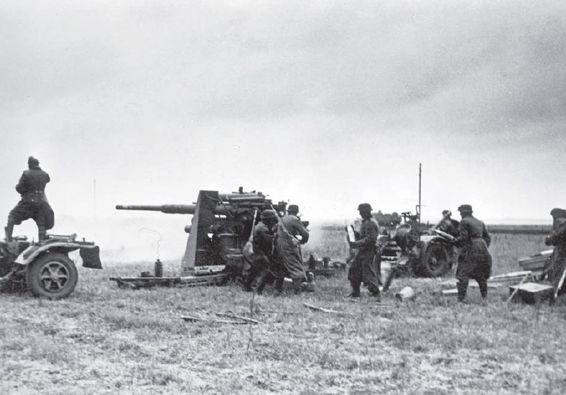
An 88mm heavy Flak gun in operation supporting an SS unit against Soviet tanks. This photograph gives a good idea of the gun’s large crew. (Topfoto)
Kirponos ordered all Red Army Air Force assets against the bridge and two Il-2 Sturmoviks managed to burn the bridge with incendiary bombs. This cut off the German forces in the sand dunes between the rivers. The Soviet troops attacked them from all directions, while German artillery and Dnepr Flotilla monitors dueled for control of the rivers. German engineers finally repaired the bridge on September 2, ending ten days of isolation. On the army’s right the XXXIV Corps closed on Kiev from the north on August 25. The next day the XVII Corps took Chernobyl. With its communications now secure Sixth Army units forced the Desna in numerous places. In view of the dangerous situation, on September 7 Kirponos demanded permission to retreat over the Desna. This Stalin granted two days later. Too late; on the 10th von Reichenau linked up with Second Army finally hemming in the 5th Army.
Guderian from the North
The Ostheer reorganized again on July 27, when von Kluge was removed from command of Fourth Panzer Army. The experiment had been a failure; at a high cost it paid no dividends. Either von Brauchitsch or von Bock had to continually prod von Kluge who proved to be equally poor both as a superior and as a subordinate, showing little aptitude for the blitzkrieg. Von Bock and his two panzer group leaders felt a sense of relief, but Hoth’s joy was short-lived: he had lost most of his armor to Army Group North and, as of August 5, he also commanded the Ninth Army in place of the ailing Strauss.
Guderian, however, raced on with his newly minted Army Group Guderian, and did not allow details such as reducing the Smolensk pocket or fighting a defensive battle at Yelnia to stop him. He moved south supported by KGs 3 and 53, ZG 210 and JG 51. His abrupt 90° turn south caused confusion in Stavka and Budenny immediately alerted Stalin to the danger in the 5th Army’s rear. The dictator did not take the threat seriously, however, since he considered Guderian’s move south merely a tactical adjustment prior to resuming the attack on Moscow to the northeast. Within a day the XXIV Panzer Corps broke Major General K.D. Golubev’s 13th Army and cut the Bryansk–Gomel rail line, endangering Bryansk Front’s rearward communications. Two days later Stavka created the 40th Army under Major General K.P. Podlas, specifically to block Guderian.
When attempts to capture the tactically prudent bridges at Orsha, Mogilev, and Rogatchev failed, Guderian crossed the Dnepr elsewhere, making those towns irrelevant. In typical blitzkrieg fashion he left Mogilev to the Second Army infantry and accepted the risk that the Soviet forces there were too weak and disorganized to present a threat. He ordered IX Army Corps to continue toward Roslavl all night on August 2–3 and marched at the head of the column to ensure his orders were carried out. On the 3rd, IX Corps linked up with General of Panzer Troops Leo Geyr von Schweppenburg’s XXIV Panzer Corps, thereby encircling more than 38,000 defenders and capturing 250 tanks and 713 guns.
Krichev was next on Guderian’s list. Here on August 14, 16,000 POWs of the resuscitated 13th Army were taken by XXIV Panzer plus VII and XIII Army Corps troops. Von Weichs, moving south on a parallel course between Guderian and the marshes, had the mission of taking Gomel, but by August 12 had not yet attacked owing to mud and shortage of ammunition. By the time his Second Army moved out, XXIV Panzer Corps had slipped behind the defenders and cut off any escape. On August 17 Loerzer’s II Fliegerkorps, operating from newly won bases as far south as Rogatchev, flew 180 Stukas and 40 Bf-110s in support of Guderian’s 17th Panzer Division. Remnants of the 21st Army evacuated the city on that same day and the German troops occupied it two days later, rounding up another 50,000 POWs.
Guderian continued to Starodub on August 18. Red Army soldiers there mistook the panzer forces as paratroopers and in any event they could not establish a new defense. After occupying the town the Germans sent bogus transmissions to Timoshenko’s headquarters saying, “Russians are holding Starodub. Do not bomb us!”
On August 20, Stalin ordered Yeremenko to destroy Guderian. Yeremenko employed the 13th (once again) and 50th Armies plus elements of the badly beaten 3rd and 21st, but failed to halt the panzers. His attacks had some effect against Lemelson’s XLVII Panzer Corps, but this was not decisive. The dictator told Yeremenko “Stavka is much displeased with your work. I await your report on the destruction of Guderian’s group.” but except for three divisions facing XXXV Army Corps in the Rokitno Marshes, the Central Front had ceased to exist. During the same time von Brauchitsch also voiced his frustration. At a conference of army chiefs of staff on August 25 he criticized von Bock for his failure to maintain mass, the misuse of his panzers and the inability to maintain a Schwerpunkt. Army Group Center chief of staff, Major General Hans von Greiffenburg, shot back, how could it do these things when higher headquarters was sending it north, east, and south?
In a daring action Model’s 3rd Panzer Division captured the Desna River bridge at Novgorod-Severskiy on August 24. Both sides threw forces into the fight. Stavka ordered the 21st Army to attack into the rear of Gyer von Schweppenburg’s XXIV Panzer, but this came to naught. Red Army Air Force reconnaissance saw the entire situation develop but the Soviet forces lacked combat power on the ground to counter it. The 21st Army pulled back without telling its neighbor to the east, 40th Army. Now completely unsupported, any assault into Guderian’s flank by Podlas was out of the question.
To make matters worse remnants of the 13th Army disobeyed Stalin’s orders and retreated away from the fight just as Model cut the Moscow–Kiev rail line at Shostka. Simultaneously the Second Army burst into action to the west of Guderian and smashed into the 21st Army, which drifted toward Kiev and eventual destruction.
The German forces’ road to the south now lay wide open. The Second Army continued down the Gomel–Chernigov highway in late August. XIII, XLIII, and XXXV Army Corps assaulted Chernigov on the lower Desna with air support; Red Army troops withdrew on the night of September 6–7 but not before putting the city to the torch.

Near Kiev a formation of Stukas flies over German lines toward the east and another bombing mission. (Topfoto)
Led by XXIV Panzer Corps, Guderian pushed southward. From September 2 Yeremenko’s Bryansk Front, a collection of decimated units with a near-impossible mission, attempted to slow them by counterattacking the 120-mile-long exposed east flank. On September 6 Kirponos in Kiev ordered the 21st Army (formally assigned to the Southwest Front that day) to drive into the rear of the 3rd and 4th Panzer Divisions – Geyr von Schweppenburg’s vanguard. Yeremenko’s efforts failed to slow the panzers, which crossed the Seim River the next day. A 20-mile gap now existed between the Bryansk and Southwest Fronts.
The 21st Army finally launched its assault against Guderian’s exposed left on September 9. Lacking coordination with the Bryansk Front it accomplished little. Later that day Stavka ordered the 5th and elements of the 37th Armies (a new headquarters controlling reinforcements arriving near Kiev) to turn east away from the Sixth Army and toward Second Panzer Group. This move was also too late. The Soviet leaders sensed a trap but could not react to the threat.
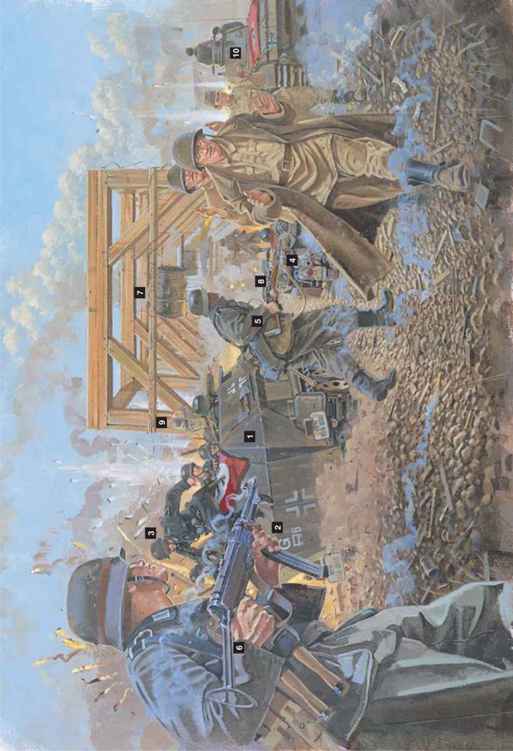
3rd Panzer Division storms the Desna River bridge, August 26, 1941. Model assembled a crack combat group; they faced mostly older, untrained Red Army troops. With covering fire from the regiment’s tanks, the Motorized Infantry moved forward in their SdKfz 251 half-tracks, shown here with an aerial recognition flag draped over the rear doors (1). It also bears the tactical markings of 6th Panzer Regiment and the white “G” of Guderian’s Second Panzer Group (2). A Gefreiter (3) vaults over the rear of the vehicle leading his squad into the attack. Motorcycle infantry on their Zundapp KS750s (4) led the way, taking heavy casualties. Red Army troops initially resisted fiercely, but they were soon streaming westwards to surrender to the attacking German troops, shown carrying the M1934 Karabiner 98k rifle (5) and the MP40 sub-machinegun (6). The bridge had been rigged for demolition with explosive charges in green rubber bags. Huge drums of fuel (7) hung from the wooden framework of the bridge and a 500lb aerial bomb (8) had even been placed in the middle of the roadbed. Fuse wires ran from the explosives across the bridge to the Soviet eastern bank. German pioneers (9) cut the wires and severed the ropes holding the fuel drums, which splashed harmlessly into the river below. Meanwhile, tanks on the west bank, such as the PzKpfw III (10) shown with an aerial recognition flag spread on its engine deck, fired their machine guns at Red Army demolition teams working their way along the wooden framework under the bridge. All attempts to destroy the bridge failed, however, and at approximately 0830hrs a signal flare arched into the sky signifying it had been secured intact. (© Osprey Publishing, Howard Gerrard)
By September 10 the gap between Kirponos in Kiev and Yeremenko outside grew to over 40 miles. When Model’s 3rd Panzer Division occupied Romny that day Stalin ordered the Southwest Front to direct 90 percent of all its air missions against Model (including many by the new Sturmoviks). With the 40th Army ingloriously pushed aside and the 27th Army’s three rifle divisions guarding 100 miles of front the Soviet forces’ north shoulder collapsed.

Infantry with 37mm Pak 36 and assault gun support making the final attack on Kiev. After the losses sustained at Kiev Hitler forbade any more attacks on large Soviet cities. Losses to mechanized formations over the next year prevented Stalingrad being encircled and necessitated an assault on the city itself, with disastrous consequences. (NARA)
The Southwest Front’s line exceeded 500 miles. Budenny saw the danger represented by the First and Second Panzer Groups and requested permission to withdraw from the Dnepr to the Psel River – a move of approximately 150 miles east that Stalin was unlikely to approve. On September 11 he argued with Chief of General Staff Shaposhnikov over this course of action. Finally Stalin stepped in and settled the matter; he fired Budenny and instructed Kirponos to hold out. As Zhukov had recommended three days earlier, the dictator named Marshal Timoshenko to command the soon-to-be-wrecked Southwest Direction.
Von Kleist from the South
After Uman von Kleist’s panzers closed in on the wide Dnepr. The 9th Panzer Division managed to get across at Zaporozhe on August 19 but could not hold its position against determined Soviet counterattacks. Further upstream the Seventeenth Army secured a major bridgehead the next day at Kremenchug. Then the motorized infantry of the 13th Panzer Division captured a 1,000-yard bridge at Dnepropetrovsk on August 25. The 60th Motorized Division joined in the next day and within a week the 198th Infantry Division and SS Viking solidified the bridgehead. Intense Red Army attacks pounded the German forces from three sides but were defeated with the help of the Luftwaffe (and the first appearance of the Italian 22nd Fighter Group). At Kremenchug 80 tanks attacked the LV Corps sector in one day, of which 60 were destroyed. Von Rundstedt created a decoy bridgehead at Cherkassy to help take pressure off those at Dnepropetrovsk and Kremenchug. Budenny took the bait and indeed launched counterattacks against Cherkassy.
At Kremenchug, in the panzers’ way, stood the new 38th Army. Stavka created this formation from headquarters, 8th Mechanized Corps, and five rifle and four cavalry divisions, mostly new arrivals to the front. Its 40,000 men defended a 120-mile front around the bridgehead. The main German blow hit the 297th Rifle Division, but most Soviet reserves were to the north resisting Guderian. Dogfighting aircraft swarmed in the skies above. The 38th Army’s counterattack planned for September 8 never materialized; with no armor and low ammunition it was “impossible to move in the open terrain due to aerial attacks.”

A weary Italian foot column with pack mules from the 3rd Cavalry Division, Duca d’Aosta. Soldiers on the near side of the road seem to be regular infantry. Those on the far side are the division’s Bersaglieri (light infantry) with distinctive black cockerel feathers on their helmets. (Library of Congress)
On September 4 von Rundstedt ordered Seventeenth Army north toward Lubny and Mirgorod and a rendezvous with Guderian while First Panzer would exploit due east toward the open country around the iconic historic Russian battlefield of Poltava. However, von Brauchitsch, Halder, and von Rundstedt plus their chiefs of staff and operations officers met at the Army Group South command post on the 8th. Among other things they discussed pulling Group Mackensen (III Panzer Corps and the CSIR) out of the heavily contested Dnepropetrovsk bridgehead. They ultimately decided against von Rundstedt’s offensive and reversed the earlier arrangement by sending von Kleist north and von Stülpnagel east. They further agreed to begin the southern leg of the Kiev offensive on the 11th. A day before the attack was to begin von Kleist sent XLVIII Panzer Corps into Seventeenth Army’s lodgment at Kremenchug. His group fielded only 331 Panzers, 53 percent of its June 22 strength. Heavy rains delayed the offensive 24 hours and the two armies attacked on September 12. V Fliegerkorps flew air support from its new bases at Kirovograd and Uman while the II Flak Corps provided air defense and antitank fire for the advancing panzers.
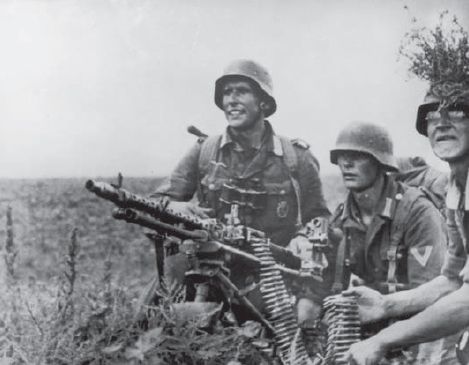
An MG34 crew provides the infantry anvil to the panzer hammer on the western edge of the Kiev pocket. The three-man section includes a section leader, a Feldwebel (left), who wears the Infantry Assault badge, and an Obergrefreiter first gunner (center) and assistant gunner. (NARA)
Hube’s 16th Panzer Division led the way with the 9th Panzer Division alongside pulling the corps behind them. Supported by Nebelwerfer (Stukas zu Fuss), the XLVIII surprised the Soviet forces and covered 43 miles in 12 hours. The II/2 Panzer Regiment overran the 38th Army headquarters building and the commander, now Major General Feklenko, evaded capture by jumping out of a window. With von Stülpnagel, pushing toward Poltava, covering its eastern flank First Panzer Group made for a rendezvous with Guderian.
Closing the Trap
Most Red Army units now had farther to go to escape eastward than the German forces did to close the trap. Sensing their impending doom, the defense stiffened on each tip of the closing jaws. Model’s men required two days to fight their way through Romny. On September 13 his 3rd Panzer Division raced the final 30 miles to the outskirts of Lokhvitsa, the planned link-up point with Army Group South.28 Coming up from Kremenchug, the 16th Panzer Division collided with fanatic NKVD defenders in Lubny. Hube personally led the fighting through the town. V Fliegerkorps contributed by isolating the pocket, keeping the skies free of Red Army Air Force aircraft and by preventing enemy escape. Hube crossed the remaining 25 miles to Lokhvitsa and Guderian’s men, officially sealing the Kessel at 1820hrs on September 14.


Scorched earth: a supply dump burns on the horizon as the Red Army abandons Kiev on September 20. The Dnepr River is in the foreground. (NARA)
That same day Marshal Shaposhnikov reminded Southwest Front “you must fulfill comrade Stalin’s order of September 11” to stand and fight. The dictator and Kirponos literally debated the issue over the tickertape as the trap closed. Even after Minsk, Smolensk, and Uman Stalin was still disrespectful or ignorant of the blitzkrieg’s speed. Around Lokhvitsa the panzer men at once turned and stood back-to-back anticipating both immediate breakout and relief attempts.
The Soviet Union’s senior leadership continued its now moot debate over abandoning Kiev. Just days into his command of the Southwest Direction Timoshenko began to show signs of the strain. He sent his chief of staff, General I.Kh. Bagramian, into the pocket to tempt Kirponos to initiate a mass escape. Knowing the realities of Stalinism, Kirponos demanded “documentary” proof from Stavka. That finally arrived from Shaposhnikov on September 17 at 2340hrs: “Supreme commander [Stalin] authorizes withdrawal from Kiev.” But it made no mention of actually escaping the trap nor where the Southwest Front was supposed to go.
Early the next morning Kirponos authorized his command to break out. He made the 37th Army his rearguard but Vlasov’s troops never made it out of Kiev. Eventually over 15,000 men avoided the Kessel. Kirponos was not among them. He attempted to evade capture with 1,000 men of his staff and the 289th Rifle Division. German soldiers ambushed the column and killed the general near Shumeikovo on September 20.

Booby-traps started fires throughout Kiev soon after the Soviets abandoned the city. This event drastically affected Hitler’s later thinking on taking Soviet cities. Here a German administrative building (note the swastika banner) goes up in flames. (Topfoto)
By that point the encirclement resembled a triangle with each side 30 miles long. Wehrmacht forces divided the battlefield into smaller pieces for easier digestion. The fight for the city proper began with the XXIX Corps’ assault on September 16. The 71st and 296th Infantry Divisions led the way over the same heavily defended terrain as before. They soon saw the churches and citadel of Kiev’s distinctive skyline. The 95th Infantry and III/StuG Regiment 77 contributed to the reduction of numerous bunkers and dug-in tanks. On the Soviet side, loudspeakers blared Stalin’s speeches in order to properly motivate the defenders.
Fighting died away by September 24. That day explosions set off by remote control started fires that raged through Kiev for five days, killed many Germans, and served as a lesson to Hitler about the dangers of combat in large cities. Rear security duty fell to Group von Roques, consisting of three German and one Slovak security divisions plus five Hungarian brigades. They herded two-thirds of a million Soviet POWs who survived three months of war only to succumb to beatings, execution, starvation, disease, and the elements. For civilians the cruelty of the Nazi–Soviet War entered a new phase; with Axis troops shooting from the rim of the Babi Yar ravine 33,771 Jewish dead lay in pools of maroon below.
After three months of seemingly only pushing the Southwest Front back von Rundstedt achieved a major encirclement. The OKW War Diary gave the following account of Soviet prisoners and material losses. This does not include Red Army killed and wounded:
KIEV LOSSES
|
POWs |
Tanks |
Artillery and Antitank Guns |
|
|
Army Group South |
|||
|
Pocket (Sept 11–26) |
440,074 |
166 |
1,727 |
|
Kremenchug (Aug 31–Sept 11) |
41,805 |
279 |
106 |
|
Gornostaypol (Sept 4–10) |
11,006 |
6 |
89 |
|
Army Group Centre |
|||
|
Since Gomel (Aug 20–Sept 10) |
132,985 |
301 |
1,241 |
|
Pocket (Sept 11–26) |
39,342 |
72 |
273 |
|
Total |
665,212 |
824 |
3,436 |

A 50mm Pak 38 in action at the Berislav bridgehead on September 9. Its tungsten-core projectile could penetrate a T-34’s armor and caused a redesign in the Soviet tank before the year was out. (NARA)

German He-111 bomber flies over the Soviet Black Sea port of Nikolaev. (Topfoto)
Black Sea Coast
Tyulenev’s defenses held firm opposite the Eleventh Army and Rumanian forces, but after Uman the Soviet evacuation of Bessarabia and the western Ukraine began in earnest. Von Schobert crossed the Dniestr on a wide front, taking Balta in early August. Tyulenev received permission to evacuate the Trans-Dniestr and leave a garrison in Odessa. Marshal Antonescu (King Michael I of Rumania promoted him on August 23) volunteered his military to clear the Black Sea coast and capture Odessa.
Von Rundstedt issued Order No.5 on August 10, which listed three goals: 1) destroy Soviet forces escaping from Uman; 2) occupy the Dnepr’s west bank; and 3) secure the Sixth Army’s north flank. Hitler directed that von Kleist take the resource-rich Dnepr bend by direct route, sparing Tyulenev another encirclement. Although reinforced by Hungarians and Italians (both far to the rear and short on supply), First Panzer was too weak, too spread out and too low on supplies to mount an effective pursuit of Tyulenev’s men. Von Kleist’s diverse post-Uman objectives were Kremenchug (III Panzer Corps), Krivoi Rog (XIV Panzer) and Nikolaev (XLVIII Panzer). Nikolaev fell on August 16. The LSSAH captured Kherson from Soviet marines on August 19 while the 22nd Infantry Division secured the 700-yard-long Dnepr bridge at Berislav for the Eleventh Army. While the battle for Kiev was going on Eleventh Army broke out of the Berislav bridgehead. Progress was slow at first but by September 17 German forces had cut off the Crimea from overland communications when they reached the Black Sea and Sea of Azov coasts.
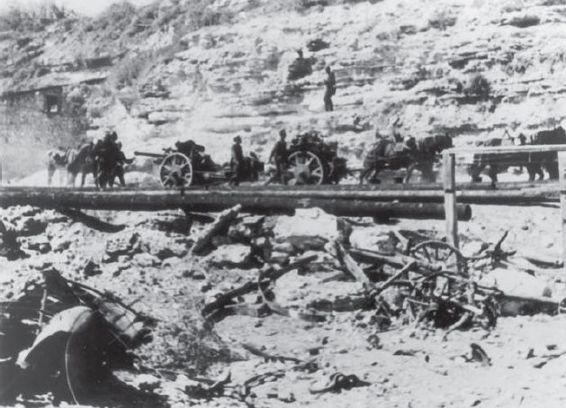
Horse-drawn artillery and limber at the XXX Corps’ bridgehead at Berislav. The 105mm M18 field howitzer was the standard German divisional gun. (NARA)
Rumanian General Headquarters issued Order No.31 for the assault on Odessa on August 8. The Fourth Army passed this mission primarily on to its 1st and 3rd Corps, with the 4th and 5th Corps initially supporting. Behind an impressive line of prepared defenses stood two rifle divisions and a cavalry brigade backed up by 249 guns under General G.P. Safronov. Support was also provided by 27 warships of the Black Sea Fleet. Rear Admiral G. V. Zhukov was in overall command of the garrison. The Rumanians outnumbered their Soviet counterparts 6:1 in infantry and 5:1 in artillery. Antonescu pushed his men hard and between August 16 and 24 the first defensive belt had been penetrated with heavy losses to each side. Each army counterattacked violently as advance and loss were measured in hundreds of yards. By September 4 General N. Ciuperca admitted to Antonescu that his infantry was decimated. The German leaders sent specialist battalion reinforcements but five days later Ciuperca was relieved. Subsequent Axis assaults under General I. Jacobici generally weakened until finally coming to a halt on September 22. So far the Rumanians had sustained 31,552 casualties.
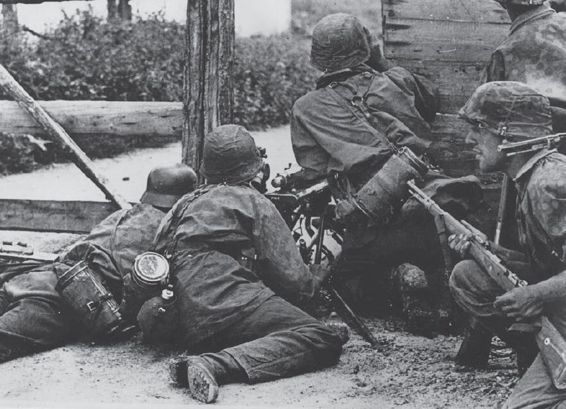
SS wearing camouflage tops in village fighting, August 1941. (Nick Cornish at www.Stavka.org.uk)
Renewed attacks began on October 2. By October 8 Rumanian units broke into the main defensive line. Rumanian losses were often two to three times those of the Red Army, another 39,301 men dead. The new offensive lasted ten days. While the Rumanians planned their final attack the Soviet forces abandoned the port. On September 29 Admiral Oktyabrsky suggested to Stalin that the Odessa’s defenders might be of more use reinforcing the defenses in the Crimea rather than merely dying in place. Surprisingly, given his frequent “no retreat” orders, the dictator agreed. For fear of being labeled “defeatist” no evacuation plans existed. But the Soviet leaders’ careful arrangements avoided a repetition of the earlier disastrous water evacuation of Tallinn on the Baltic.

Pioneers of the XXVIII Army Corps assault Red Army fortifications near Slutsk on September 15 with a combination of flame throwers and explosives (note the pouches worn by three of the four men at left). This effectively marked the high-water mark of Army Group North’s campaign. (HITM)
The new Coastal Army commander, General I.Y. Petrov (Safronov had suffered a heart attack), decided to abandon the port early, during the night of October 15/16. Approximately 86,000 men had been shipped out previously but on that last night 35,000 men, 1,000 trucks, and 400 guns left on 192 sailings. Only rearguards remained by 0200hrs. Engineers demolished port facilities and the last vessel cast off at 0510hrs. The Rumanians did not even realize the Soviet soldiers had escaped. During the siege the Rumanians suffered 96,000 casualties, almost equal to the Soviets’ 102,000 and more than the 89,000 total German losses thus far in the entire Eastern campaign. The cream of the prewar Rumanian Army had perished. The survivors took out their revenge on the city’s Jews, butchering 20,000 of them.
Summary
A generation earlier Ludendorff’s staff had anticipated the near-impossible task of conquering Petrograd. Somehow Reinhardt thought he could rush into Leningrad and take the city by coup de main, similar to a matching bookend of von Manstein’s earlier triumph against the smaller Dünaburg. By the time von Leeb was somewhat prepared for a serious attack, his staff could come up with nothing more imaginative than a frontal assault over the well-prepared Luga River defensive positions and the outlying towns to Leningrad’s southwest. Due to the delays, the German leaders were overcommitted to that option so could have hardly switched to the less dangerous, indirect approach represented by joining up with the Finns on the Svir River.

A Gefreiter chalks up another “kill” on the radio sponson of an early model Sturmgeschütz III. The assault gun commander, an Oberleutnant wearing the field-gray panzer jacket of the Sturmartillerie, leans out of his hatch. (NARA)
Meanwhile the region around and south of Lake Il’men was a constant distraction to the German leadership, bleeding off time and units plus the attention of commanders and staffs – all needed elsewhere. The key to the investment of Lenin’s city was the 5-mile wide toe-hold on the shores of Lake Ozero at Schlisselburg. By mid-August better-late-than-never reinforcements finally arrived from von Bock but were simply thrown into the meat grinder against Leningrad’s defenses, which dated back to late June when Potapov first consulted a map. Exhaustion, losses, overstretch, and reality all conspired to bring a halt to this obvious but unprofitable course of action. With panzers and Stukas streaming back to the Moscow front in mid-September, what mobile formations von Leeb had left considered a race to the east to make Leningrad’s entrapment less permeable.
The United States and Barbarossa
Prince Otto von Bismarck allegedly said that Americans speaking English was the supreme geopolitical fact of the modern era. Between Barbarossatag and Pearl Harbor President Franklin D. Roosevelt managed a significant redirection of US security policy, all the while being sensitive to the opinions of the American people and their elected officials in Congress plus outwardly trying to work within US neutrality laws. Early in his presidency Roosevelt was alert to the dangers of Imperial Japan and the Third Reich. Barely six months after taking office he opened back-channel negotiations with the USSR and the two proto-superpowers exchanged ambassadors before the end of 1933.
When Barbarossa was launched American diplomats in Moscow, military leaders, and rabidly anti-Communist career State Department officials at home gave the Soviet Union no chance to win. However, on June 23 Under Secretary of State Sumner Wells laid out two main pillars of American policy: common cause with any enemy of Hitler, and its “Europe first” strategy. A day later the president confirmed this view. Of course not all Americans supported this judgment, many believing that two murderous dictatorships slaughtering each other was in everyone’s best interests. But as German armies racked up their first victories public opinion in the US softened.
In late July Roosevelt sent personal envoy Harry Hopkins to Moscow (via London) to take the pulse of the USSR. Stalin’s honest but ultimately optimistic picture convinced the president’s confidante of the wisdom of supporting the Soviet government. On the heels of the Moscow visit Roosevelt and Churchill met aboard warships in Argentia Bay, Newfoundland. Allied promises of support were a bit short on specifics for Stalin’s taste but concrete aid to the USSR soon followed. Roosevelt had to first overcome bureaucratic inertia in Washington before Lend-Lease aid, the main conduit for US support, began to flow eastward. With this in mind Roosevelt sent another New Deal associate, W. Averell Harriman, to Moscow between the twin disasters of the Kiev and Viazma-Bryansk battles. Basically American, British, and Soviet parties signed “no strings attached” protocols concerning support. Fortunately the USSR had plenty of gold bullion and critical natural resources with which to buy US aid.
The United States had less success trying to influence Germany’s allies. Misjudging strength of the dysfunctional Pact of Steel, Roosevelt tried to keep Japan from attacking the Soviet Union’s far east. He need not have worried; it had already decided to move south into the Pacific. Regarding Finland, many Americans supported Finland’s attempts to recapture land lost during the Winter War. However, President Risto Ryti said his nation’s goals were “…the defeat of the Soviet Army and complete crushing of Bolshevism…” Strategically and operationally Finland knew better than to venture too far into the Soviet Union, but it ignored American admonitions about going too far. Britain declared war on Finland, the US never did. The Americans also sympathized with Rumanian desires to recapture Bessarabia, yet Antonescu continued well past both the Prut River and Odessa.
The second half of 1941 marked Roosevelt’s “undeclared, executive naval war against the Germans” that scared Hitler. This was the beginning of the Roosevelt–Churchill divide when the US decided to aid the Soviet Union directly and not through the British middle-man. It highlighted the shift of American strategy from continental/hemispheric security to global activism and leadership (the Washington–Berlin air distance was less than that of Washington–Rio de Janeiro).
After Smolensk maps of the Moscow axis usually reflect little change until Typhoon. This usually suggests the logistics pause which utterly failed to accomplish its intended purposes: losses were not made good, little maintenance was done. Any arrows on maps mainly show Soviet counterattacks, growing in number and boldness. Comparisons of German losses during periods of movement and combat consistently demonstrate the advantages of forward motion. It should come as no surprise therefore that the remnants of panzer spearheads at Yartseveo and Yelnia were magnets for Red Army assaults and very unhealthy for the Landsers holding them. Second Army and Second Panzer Group soldiers probably felt fortunate by comparison to be part of the Kiev operation.
In Hitler’s mind the plunges southward by von Weichs and Guderian were logical steppingstones toward Kiev. At the end of July, as Smolensk and its ancillary battles were being cleaned up, von Bock had tempting targets 200 miles east (Moscow) and 200 miles south (the Southwest Front), but the German senior command indulged in a time-wasting contest of wills, particularly between Hitler and Halder. German strategic thinking could not keep pace with the fast-moving panzer formations on the battlefield. But German High Command moves confirmed Soviet leadership thinking that proved to be just as mistaken. Second and Third Panzer Group drives north and south appeared to them as evidence of von Bock’s natural desire to firm up his flanks prior to the final frontal assault on their capital. To that end they made Yelnia a symbol at the door to Moscow.
While the German High Command’s dysfunction definitely hamstrung Barbarossa, of greater significance for the generals was Hitler’s deepening involvement in military decisions, the abrogation of traditional Prussian prerogatives over civilian authority, and their inability to pull together to achieve a common goal when threatened from the outside. The German leadership’s self-inflicted command paralysis of late July and much of August is arguably the most critical nonoperational factor in Barbarossa’s failure. Following a month of stunning initial victories Germany’s highest leadership figuratively shut down while Hitler worked through personal illness to impose his will on fractious and obstinate generals.
Von Rundstedt used the third period of the campaign to achieve a number of tasks essential for further prosecuting Barbarossa: 1) with the Second Army’s help von Reichenau isolated the pesky 5th Army; 2) his men closed on the lower Dnepr along most of its length and crossed it in many places; and 3) farthest south they cut off overland communications to the Crimea. Even with all that success, the capstone of the army group’s summer, if not all of Barbarossa, was the Kiev encirclement. Finally OKH coordinated the operations of two army groups into one massive battle. The Wehrmacht’s effort was immense. In just one example, between September 12 and 21 V Fliegerkorps alone flew 1,422 sorties and dropped 625 tons of bombs. Of course the German forces were aided immeasurably by Stalin’s intransigence. Their victory at Kiev attained many prerequisites for the Ostheer’s continued advance. The massive amounts of material captured at Kiev permitted the German units increased mobility, although mopping up took until October 4. It is hard to imagine Typhoon or any other autumn maneuver being nearly as successful with the Southwestern Front intact in the Ukraine.
For a fleeting moment the Ostheer outnumbered the Red Army in the field but 1.5 million new recruits joined the defenders’ ranks in October and November. Stalin put Timoshenko in charge too late to change the course of the battle. Regardless, his continual interference and imposition of so many controls from above contributed to the difficulties that plagued the Red Army. The dictator sacrificed Kiev in order to buy time to prepare Moscow’s defenses, to him a more valuable locale. Another relative Soviet bright spot to arise from the Kiev fiasco was that once Stavka realized what was happening to Kirponos it allowed Tyulenev to withdraw the latter’s Southern Front to the lower Dniepr, which it did in good order. Although historians will long debate the German leaders’ Kiev/Moscow decision one thing is clear; the generals may have won history’s greatest encirclement battle but they lost the battle for influence in Hitler’s headquarters.
25 They needed only to wait one year for Stalingrad to see what they were missing.
26 Ergänzung can also be translated as “completion.”
27 A day earlier Warlimont wrote a memorandum doubting the German forces’ ability to reach the Archangel–Astrakhan line.
28 Due to von Kleist’s delay moving out the OKH moved the rendezvous point 30 miles south to Lokhvitsa.