

Mounted reconnaissance elements of the 1st Infantry Division approaching Kronshtadt Bay in September. This maneuver isolated remnants of the Soviet 8th Army at Oranienbaum until 1944. (HITM)
September had been an eventful month for Barbarossa. The Kiev battle crowned the summer and would motivate the Ostheer through the autumn. Hitler could take comfort in the fact that in the Ukraine “his” operation had paid such handsome dividends. Now Halder and the generals who had been looking longingly at Moscow could execute “their” operation.
Army Group North had Leningrad cut off and in its sights, the Finns did not seem that far away to the northeast while to the southeast the boundary with von Bock finally looked solid after weeks of uncertainty. Von Leeb massed as many troops in the siege lines as he could muster while heavy weaponry moved into position to support them. He also prepared a separate force to attack through the Tikhvin and Volkhov resource areas and on to the Svir River. Few believed that Leningrad’s large civilian population, much less its modern military garrison, could hold out long if denied overland contact.
After Kiev, in the south von Rundstedt’s men saw only more open vistas before them. How could the Red Army possibly replace two-thirds of a million men and still create a viable defense of the eastern Ukraine? Many in Army Group South must have believed that fuel availability was their only limiting factor. But units detached for the Moscow attack and the weeks necessary to reduce and secure the Kessel were their first reality checks. When the army group moved out for the Crimea, the Don River and points beyond they discovered that their own logistics situation had grown only more tenuous east of the Dnepr and that Stavka had somehow managed to scratch together a force with which to defend the eastern Ukraine.
Von Bock now commanded the force he had always wanted and the mission other German generals had always hoped for. He had to cover the last 200 miles to Moscow in a campaign where others had gobbled up 200 miles in only a few days or a couple of weeks. The subordinate generals and the men under his command had proven themselves over and over during the past three months. In contrast, the prewar Red Army had ceased to exist after Barbarossa’s first weeks. Partially trained reserve forces supposed to back them up had perhaps survived another month at most. By the time they launched Typhoon, the German High Command reckoned that Soviet defenders now before Moscow would soon be outclassed, leaving the road open to their capital city.
However, three months into Barbarossa strategic overstretch was taking its toll on German operations; the Ostheer was on the defensive in many places just to create offensive forces at critical locations. German losses had also been horrendous and everyone knew it: generals at every echelon by looking at statistics and frontline soldiers by looking around them at shrinking numbers of men and vehicles present for duty each morning.
On the eve of Typhoon Soviet leaders had many problems themselves. Losses of men, weaponry, territory, industrial capacity, and natural resources had been staggering. No European nation had ever sustained such devastation and survived. Gone were the massive mechanized corps; henceforth counterattacks would be conducted by small tank brigades and untrained infantry masses. Gone also was any semblance of combined arms formations; for ease of command and control infantry and armor fought alone while combat-support elements such as antiaircraft artillery and engineers were removed and consolidated in standalone outfits.
But also gone, due to the harsh realities of modern combat, were legions of old and incompetent interwar leaders. In the USSR’s state of extreme emergency Stalin had few qualms about molding the country’s top leadership in his image. Germany and the Wehrmacht suffered from many self-limiting effects and these would greatly assist the USSR. But Stalin and Zhukov would team up in November to actively halt Barbarossa in its tracks.

Exhausted German soldiers relax in the shade of a building. Unusually, the men appear to wear SS-pattern camouflaged helmet covers and smocks over their regular army tunics. (HITM)
Tikhvin and Volkhov
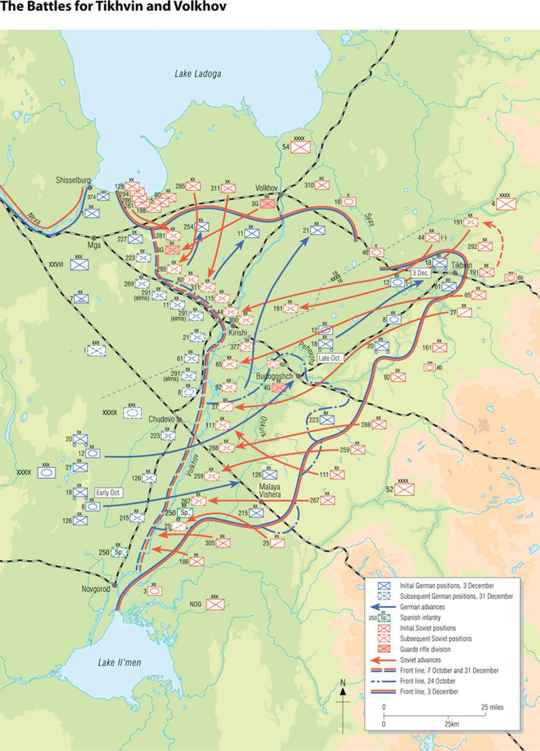
As the final assault on Leningrad played itself out, Stavka took seriously the threat that Army Group North might attempt to link up with the Finns. To reinforce the 7th Independent Army now holding the Svir River, it established the 54th, 52nd, and 4th Armies in or around Volkhov. It shifted one tank and eight rifle divisions to the sector. German reinforcements during the same period consisted of the 254th Infantry Division at Volkhov and the 61st at Tikhvin. However, Hitler remained unmoved. Although he only had the battered XXXIX Panzer Corps left for such a mission, he ordered an attack northward. Stalin also urged his commanders to attack to reopen communications with Leningrad. Accordingly, Marshal G.I. Kulik assembled 63,000 men in eight divisions supported by 475 guns and 59 new KV tanks to attack on October 20.
Typically, the German commanders moved more quickly than the Soviets and struck on the 16th. While General Schmidt departed to temporarily replace the ill commander of the Second Army, the XXXIX Panzer, presently under General of Panzer Troops Hans-Jurgen von Arnim, split the boundary between the 52nd and 4th Armies. Both sides fought hard for small villages to gain some shelter at night. Freezing weather caused a holocaust of horses, breaking the hearts of hardened Landsers over the suffering of their equine companions. With 12th Panzer and 18th and 20th Motorized Divisions leading the way, the Germans captured Mal Vishera within one week. The German advance stopped and started as the weather in turn thawed and froze the mud and ice amid terrain cluttered with forests, lakes, and swamps. By October 25 any advance was basically over. On the following day von Leeb flew to Führer Headquarters in a vain attempt to squeeze additional support from the dictator. Henceforth, the field marshal described successive attacking forces simply as “new victims.” Despite his negativity, he nevertheless managed to change Hitler’s mind and won support for continuing the attacks. Somehow the Germans crawled forward against the collapsing defense. Finally the German forces occupied Tikhvin on November 8. Approximately 20,000 POWs, 179 guns, and 96 tanks fell into their hands.
From then on the 126th Infantry, 20th Motorized, and 8th Panzer Divisions (all very weak) attempted to defend 60 miles of front in an exposed salient. Although Luftwaffekommando Tikhvin (KG 77 and II/JG 54) provided some air cover, despite miserable weather, the German forces reaped no benefit from their brief occupation of Tikhvin’s bauxite mines. To the northeast Group Boeckmann (I Army Corps, 11th and 21st Infantry Divisions, reinforced by the 254th) pushed to within 4 miles of Volkhov.

Tikhvin’s beaten defenders fled and threatened to rout into the rear of the 7th Army facing the Finns. Kulik relinquished command and was soon executed. Stalin put 7th Army commander General K.A. Meretskov (just released from NKVD prison) in charge of the shaky 4th Army as well, with instructions to get positive control of the situation.

The thick forests, wet marshes, and primitive infrastructure encountered during the latter part of Operation Barbarossa constituted ideal terrain for the Red Army’s cavalry. Their 25th and 27th Cavalry Divisions actively participated in the Staraya Russa and Tikhvin operations. (NARA)
Stalin resolved to take the offensive along the entire front. With the Wehrmacht’s main striking forces concentrated around Moscow, he would attack on the two flanks. Marshal Timoshenko would lead the assault in the south around Rostov. In the north the Germans’ vulnerable salient at Tikhvin looked like a target of opportunity. According to Stavka’s plan the 54th Army (Lieutenant General I.I. Fedyuninsky) would attack around Volkhov, the 4th under Meretskov would reduce the Tikhvin salient as the main effort, while the 52nd (Lieutenant General N.K. Klykov) plus the Novgorod Operational Group would advance in the south. Their overall goal was nothing less than reopening the Tikhvin–Leningrad railway and the destruction of all German forces east of the Volkhov River. At one point during the second half of October, Luftwaffe reconnaissance noted about 2,000 vehicles reinforcing the Volkhov Front.
The Red Army intentionally used staggered starts for its attacks. The 52nd Army began in the south on November 12, with Meretskov launching the primary assault on the 19th. The 52nd Army’s attack produced meager results but forced the German forces to react by committing precious reserves. In the center Meretskov caused von Leeb the most concern. As the latter noted in his diary on November 22, “Tikhvin is more or less encircled.” He knew he had to assemble a counterattack force and regain the town. The best he could do was rush in Haenicke’s much-traveled 61st Infantry Division.

German army logistics elements lagged far behind combat units, and were often relegated to the worst “roads” – with dire consequences, given the Wehrmacht’s heavy reliance on horse transport. It was not only the mud of the autumn and spring rainy seasons that imprisoned wagon wheels and wore down horses; the choking dust and deep, concrete-hard ruts of summer were also destructive. (HITM)
Some 28 German divisions faced 75 Soviet, many of the latter fresh. By December 3, XXXIX Panzer Corps reported it could no longer defend Tikhvin against the 4th Army. On the 6th Hitler still insisted the town be held, but the very next day von Leeb told the 61st Infantry to prepare to withdraw. That same night, December 7, he authorized the town’s evacuation, telling the Führer over the phone of his “very painful duty to report that Tikhvin, over which we’ve fought and occupied for weeks, must regrettably be given up.” Hitler approved the move post facto at 0200hrs the next morning.
Near Volkhov the Soviet 54th Army drove the I Army Corps south before it. A general withdrawal began as the Red Army hounded German rearguards. By mid-December Army Group North was back on the Volkhov River, where it had been two months earlier. Von Leeb tried to put a good face on his men’s accomplishments during Barbarossa in his Christmas Order of the Day: 438,950 POWs, 4,590 guns, and 3,847 tanks captured or destroyed in five months. However, it was clear to all that the invasion, begun with such high hopes in June, had culminated without Army Group North accomplishing its objectives.
Operation Typhoon
In September, Army Group North arrived in the suburbs of Leningrad and severed the city from land communications. At Kiev, Army Group South, with the help of Second Army and Second Panzer Group, won history’s greatest encirclement battle: two-thirds of a million men were trapped in a Kessel the size of Belgium and the Ostheer outnumbered the Red Army for the first and only time in World War II. The German forces had paid a price, but to most of the world it looked as if the campaign would continue to go their way; their victory at Moscow was assumed.
Planning for Typhoon
For once the German leadership anticipated events, and Hitler issued his order for the final assault on Moscow almost ten days before the trap around the Southwest Front slammed shut at Lokhvitsa. On September 6 his Directive No.35 stated that the successes of the flanking army groups had created the “prerequisites for conducting a decisive operation against Army Group Timoshenko, which is conducting unsuccessful offensive operations against Army Group Center’s front.” Hitler went on to instruct von Bock:

Landsers with mix of Kar-98 rifles and MP-38 machine pistols clear an intact village. (Topfoto)
launch an operation against Army Group Timoshenko as quickly as possible “so that we can go on the offensive in the General direction of Viazma and destroy the enemy in the region east of Smolensk by double envelopment… After destroying the main mass of Timoshenko’s group of forces in decisive encirclement and destruction operations, Army Group Center will begin pursuing enemy forces along the Moscow axis.
The OKH staff added its Directive for the Continuation of Operations four days later with Halder in the uncommon (but insincere) role of team player. Von Bock’s staff had shelved an earlier plan to attack Moscow because of the Kiev operation. On September 16 he issued his reworked Typhoon operations order for three panzer groups making three thrusts; in addition to the stalwart Hoth, Guderian would come back after concluding the Kiev operations, and from Army Group North he would later receive Hoepner’s Fourth Panzer Group (XXXXI and LVI Panzer Corps, totaling three panzer, two motorized, and two infantry divisions). As on Barbarossatag, von Bock paired the panzer groups with field armies to ensure better coordination at the breakthrough points. Typhoon’s mission was to destroy the West, Reserve, and Bryansk Fronts, and to prevent the enemy from retreating in good order to Moscow.
As usual, the German commanders could not complete their plan without debate. Von Bock wanted a deeper encirclement east of Viazma, while many favored a shallower one aimed at that city. For example Hoth argued against the deep option simply because he had so few panzers and trucks, so little fuel and Luftwaffe support. After closing the pockets Halder wanted to send the motorized units into Moscow, but Hitler wanted no part of urban combat, as he had made clear earlier at Kiev and Leningrad. Also, attempts to coordinate Typhoon with an attack by von Leeb toward Lake Il’men with Sixteenth Army, and with a movement by von Rundstedt on Kharkov with Sixth Army, met with mixed results.
For a month now Army Group Center had fought a relatively static battle, so it had accurate tactical intelligence on Soviet strength and dispositions; it identified 80 of the 83 Soviet rifle divisions to its front (typically, FHO identified only 54 of them.) Even in this static situation, German logistics were still unsatisfactory: despite large depots at Gomel, Roslavl, Smolensk, and Toropets they could only sustain a short burst towards Moscow. Panzer serviceability rates were also a problem: they stood at 50 percent for Guderian, 70–80 percent for Hoth, and 100 percent only for Hoepner. Prior to Typhoon 4th Panzer Division, for example, received as replacements only 30 PzKpfw IIIs and five PzKpfw IVs (creating a total of 110 operational tanks), and only enough fuel to travel 60 miles.
With von Brauchitsch, Halder, and Kesselring in attendance, von Bock hosted a conference on September 24 to wargame Typhoon with his six subordinate army and panzer group commanders. Fourth Army and Fourth Panzer Group in the center represented Typhoon’s Schwerpunkt. Typically, logistics were falsely assumed to be adequate. The vaunted logistics pause that was supposed to precede the final Moscow offensive did not have the desired results because of near-constant fighting. However, Hitler’s generals did convince him to release 60 PzKpfw38 (t)s, 150 PzKpfw IIIs, and 96 PzKpfw IVs panzers plus 3,500 wheeled vehicles from Führer reserve on September 15.
Most subordinate commands issued their orders on the 26th. For Typhoon, Army Group Center mustered 1,929,000 soldiers in 56 infantry, 14 armored, and eight motorized divisions; together they counted 14,000 indirect-fire weapons and 1,000 tanks, and the Luftwaffe contributed 1,390 aircraft. Not wanting to take any chances on the weather, Guderian obtained permission to begin his assault two days early.
Soviet Preparations
The Soviet leaders did not know it yet but they would soon regret expending so much energy and so many men assaulting von Bock in attacking during late summer. On September 10, four days after the issue of Führer Directive 35, Stavka ordered forces facing Army Group Center to halt their attacks and take up the defense. By then the average strength of many rifle divisions stood at only about 3,000 men. Since mid-July the Soviets had been building and improving works to defend their capital. The most important of these, Zhukov’s anchor, the Mozhaisk Line, was 40–50 percent complete by September 30, and the same could be said for the other three Fortified Regions: Volokolomsk, Maloyaroslavets, and Kaluga.
The Soviet High Command had expected the “final assault” on Moscow around late August, and had allowed themselves to be lulled into a false sense of security since then. They would use a new defensive technique in the autumn, concentrating on roads and settlements, knowing that the German troops would need exactly those. But on the other hand, they also assumed, given the imminent rasputitsa, that Hitler would not launch a major offensive following the Kiev battle. Further, they thought that the Germans still had most of their panzers near Leningrad and Kiev. Red Army intelligence missed the movement of much of Fourth Panzer Group from von Leeb, and the return of Second Panzer Group plus some of von Kleist’s First Panzer Group from von Rundstedt.

While Landsers in the foreground trudge past below a Panzer III, signal troops set up a radio with telescoping antenna. (HITM)
Stalin’s High Command knew that after Kiev there would be no more trading space for time before Moscow. However, with the correlation of forces all wrong it is no surprise that they also defended the wrong places. They expected the main thrust directly at Viazma along the Minsk highway. Von Bock’s strikes on either side of the main defenses, and Guderian’s thrust south of Bryansk, caught them completely off guard. As one blunt post-Soviet Russian history put it:
Stavka failed to divine the German intentions... it issued its warning of an impending attack too late, and when it did, it never ordered the Reserve Front to prepare its defenses.29
From north to south, Colonel General Konev commanded the West Front (22nd, 29th, 30th, 19th, 16th, and 20th Armies) along a line 210 miles long. Budenny’s Reserve Front (24th and 43rd Armies) guarded 60 miles of the front, while his 31st, 49th, 32nd, and 33rd Armies stood to the rear. On the southern flank, Yeremenko’s Bryansk Front (50th, 3rd, and 13th Armies plus Operational Group Ermakov) covered 180 miles. Many of these armies had been fighting since June 22, and their headquarters, units, and men had been encircled and/or escaped encirclement many times. Owing to losses incurred at Viazma–Bryansk (see below) many of the defending units would be militia divisions, although some of these had been fighting since Yelnia.
Logistics problems plagued the Red Army also. Ammunition, transport and repair capacity, fuel, and aviation gas had all been used up during the “Timoshenko Offensive.” Many frontoviki lacked winter clothing – it was not only the German forces who failed in this regard. However, while von Bock had literally no reserves for Typhoon, at least the “beaten” Red Army had husbanded some.
Fully 40 percent of the entire Red Army between Leningrad and the Black Sea defended Moscow: 1,250,000 men (including 193,000 new soldiers) manned 83 rifle, 2 mechanized, one tank, and nine cavalry divisions plus 13 tank brigades. Sixty-six rifle divisions occupied the first echelon, with 17 rifle divisions and seven tank brigades behind them, and 12 rifle divisions and six tank brigades stood in reserve. They were supported by 7,600 guns, 990 tanks, and 863 aircraft (perhaps two-thirds of them operational).
On September 26, Konev reported that the German troops were preparing to attack across his front on October 1. This news completely surprised Stalin, who issued another defensive directive the next day. By the end of September the Soviet leaders were confident that their system could respond, survive, and probably not collapse. On the other hand, so far the German forces had always succeeded. By the end of the Moscow battle only one of these two statements would still be true.
Viazma and Bryansk
“Fast Heinz” Guderian lived up to his nickname when he moved out on September 30, two days before the rest of Army Group Center. Outside the ancient Ukrainian capital of Glukhov he hit the unprepared Operational Group Ermakov and scattered its five divisions, soon creating a 13-mile gap between Ermakov and 13th Army. Nevertheless Yeremenko called the attack “only a diversion” and “not critical.” Ermakov rallied his forces to counterattack a day later, but he did not have much impact because of the usual failings: poor coordination, too few tanks, and no air support. However, by nightfall 3rd Panzer Division had its first experience with Katyusha rockets, dogs trained to run under tanks with explosives fixed to their backs, and almost undetectable wooden-cased, antitank mines.
Since the rest of the front seemed to be quiet, Yeremenko and the High Command considered Guderian’s assault a diversion – fog and rain limited Luftwaffe activity, further deceiving the defenders. Nevertheless, Stavka began moving reserves toward the point of rupture, probably in homage to Guderian’s reputation, but they were soon to find that the real danger lay to the north. To complicate matters they had no clear picture of events, since Luftwaffe raids soon cut Yeremenko’s communications.
On October 2 (Paul von Hindenburg’s birthday), Ninth and Fourth Armies created penetrations in the Soviet defenses in trench-fighting involving bayonets, hand grenades, sidearms, and spades; by the end of that day 260th Infantry Division alone had overcome 120 bunkers. The infantry often reoccupied the same Yelnia battlefields that they had given up a month earlier.


A horse sunk up to its shoulders: what were these wagon drivers thinking? The horse will be lucky to get free and not die of exhaustion or hypothermia. (Nik Cornish at Stavka.org.uk)
Hoth’s and Hoepner’s armor exploited through the gaps; it took the latter only two hours to overcome the River Desna defenses. The 7th Panzer Division’s artillery preparation amounted to 130 tubes per mile, while their 300 tanks spread across a 1½-mile front in two waves. On day one Third Panzer Group split 19th and 30th Armies apart, while the Fourth Panzer smashed 43rd Army in Budenny’s first echelon and hit the 33rd Army behind it. Over Hoth’s men flew four fighter and attack Geschwader (wings).
Konev ordered Boldin to counterattack against Hoth’s right flank with the 126th and 152nd Rifle and 101st Motorized Divisions plus the 126th and 128th Tank Brigades (total tank strength approximately 300). Hoth was already miles to the east and Boldin’s strike hit thin air. Yeremenko pleaded with Shaposhnikov to employ a mobile defense but the chief of staff ordered him instead to maintain a “stubborn defense of manned defensive lines.” Naturally this played right into von Bock’s hands. Since Stavka had already taken Guderian’s bait and sent its reserves south it had nothing with which to counter the real danger.

Lieutenant General K.K. Rokossovsky, in a still from a Soviet propaganda film, at his 16th Army headquarters northwest of Moscow. He managed to survive torture during the Red Army purges of the 1930s to be recalled for service following the Winter War debacle. (Topfoto)
Within 24 hours of launching Typhoon von Kluge began to interfere by ordering Hoepner, already 50 miles into the Soviet rear, to redirect XLVI Panzer Corps northward along the boundary of the Bryansk and Reserve Fronts in order to create a smaller encirclement west of Viazma. The field marshal tried to redirect XLVI Panzer Corps northward in order to create a smaller encirclement west of Viazma. This amounted to yet another dangerous dispersion of armor that was intended to be employed in mass. Kesselring, who had known Hoepner since the two had served together in World War I, considered the panzer general “shaken” and with “little confidence.”
The bulk of Fourth Panzer Group, including 5th Panzer Division (new to the theater and originally earmarked for Africa – so many of its vehicles still wore their desert paint scheme), raced up the road toward Yukhnov. Soviet fighter pilots reported this movement, but Marshal Shaposhnikov demanded repeated confirmation, and by the time he was satisfied, the town had already fallen. Unsurprisingly, a couple of days later the same man, referring to the developing Viazma–Bryansk battles, said they were “…no basis for disquiet.”
Logistics reared its ugly head when, after breaking into Konev’s second-echelon 32nd Army, Hoth literally ran out of fuel on October 4 and his spearhead required Luftwaffe resupply. He could not move again until the 5th while Konev used that small pause to request permission to retreat from the quickly developing trap. Konev reported the potential danger to Moscow, “Stalin listened to me, but made no decision.” He therefore ordered a relief assault toward Viazma against the German flanks, by Boldin from the north and Rokossovsky’s 16th Army from the south. That night Stavka allowed Konev to begin retreating out of the encirclement. (In unrelated events, Hoth had now left for Army Group South to command Seventeenth Army; Reinhardt took command of his Third Panzer Group while Model in turn moved up to XLI Panzer Corps.)
The following morning Konev told 16th and 19th Armies to exfiltrate eastward, an order repeated to the rest of the West Front on October 7. He ordered Rokossovsky – unrealistically – to hold Viazma as the rear guard. These measures were too late: on the morning of the 7th, Reinhardt’s 7th Panzer Division met Hoepner’s 10th Panzer at Viazma. On that same day, October 7, Zhukov made a tour of the various Front headquarters and he could not have liked what he saw. Therefore General Lukin, who had only escaped from Smolensk two months earlier, was now placed in charge of forces inside the Viazma pocket, with the mission of breaking out through the weak 11th Panzer Division cordon toward Gzhatsk during the night of October 10/11.
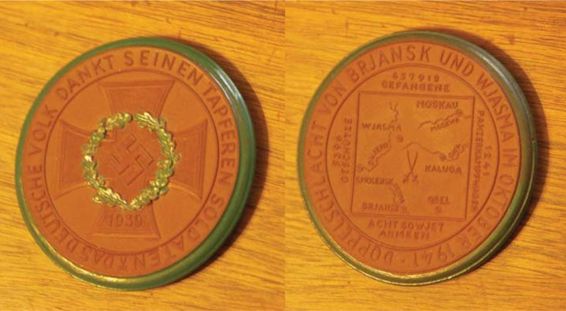
Meissen Porcelain struck this medallion to commemorate the Viazma–Bryansk Kessel: Left – An Iron Cross with an oak leaf wreath. The inscription reads: The German People Thank their Brave Soldiers. Right – A map of the battlefield framed by the count of captured booty: 657,918 prisoners, 1,214 tanks, eight Soviet armies, 4,396 guns. The inscription reads: Double Battle of Bryansk and Viazma in October 1941. (Author’s Collection)
Things did not go so well for the German troops in the south. The original mission of Second Army was to cover von Kluge’s right flank and let Guderian trap Yeremenko. But, as before at Minsk and Smolensk, Guderian cared less about closing off encirclements than driving on Moscow. He remained focused on the city, without worrying about his exposed flanks – believing that the Southwest Front to his right was too weak after Kiev to mount serious resistance. Von Weich’s slowness and Guderian’s neglect conspired to slow the Bryansk (southern) half of the triple envelopment. Eventually Second Army picked up its pace and Guderian finally sent his XLVII Panzer Corps (17th and 18th Panzer Divisions) around the east side of Bryansk. On October 5 the panzers cut the rail connection from Moscow, the front’s lifeline; the next day they almost captured the Bryansk Front headquarters (Yeremenko and his adjutant escaped). Two days later they linked up with Second Army north of the city. The second, incomplete Kessel had finally closed.
Reducing the huge encirclements bought the Soviet forces a breather and cost the Germans casualties and time. The outlines of the Kessels were often somewhat random and certainly not based on ideal defensive terrain. Breakout attempts were expected and violent: escapees climbed over mountains of their own dead. German soldiers stripped warm clothing off of Soviet dead and POWs. Conditions inside Barbarossa’s Kessels were horrendous. According to David Stahel those of Viazma–Bryansk were worst.
At Viazma and Bryansk the German forces destroyed seven of 15 Soviet armies, 64 of 95 divisions, 11 of 15 tank brigades, and 50 of 62 artillery regiments. They listed 6,000 guns and mortars and 830 tanks destroyed, killed approximately 332,000 Red Army soldiers – including three army commanders – and marched 668,000 into captivity. Soviet numbers do not significantly dispute these claims. However, the walls of the German trap were porous: approximately 85,000 men escaped from Viazma and another 23,000 from Bryansk. Although they had lost their heavy weapons, these men – plus another 100,000 escapees from 22nd, 29th, and 33rd Armies and Group Ermakov – lived to fight another day, and trickled east to occupy Moscow’s various defensive positions. The German commanders wondered how the Soviet forces were able to find new units to keep throwing into the front lines. Their own casualties at Viazma–Bryansk amounted to 48,000 men.
Until November
Von Bock issued his order for the continuation of operations on October 7.30 In the north, Ninth Army and Third Panzer Group would advance on Rzhev and Kalinin (in addition to moving toward Rybinsk and making contact with Army Group North); in the center Fourth Army would make for Maloyaroslavets and Kaluga, while Hoepner aimed for Mozhaisk; to the south, Guderian (his command now renamed Second Panzer Army) would drive on towards Tula with Second Army in support. However, all this had to wait until the two encirclements were cleared, a task requiring two-thirds of the army group and between one and two weeks. Additionally, Army Group Center’s logistic woes prevented it from continuing sustained operations. So, just when von Bock had rent a 300-mile hole in the Moscow defenses, behind which the Soviet forces could muster scant reserves, he had to slow down to await reduction of the two pockets and to reconsolidate his army group.

Two Germans supporting each other in October. According to the caption, they are suffering shell shock following bombardment by Katyusha rockets. It is clear from the looks on their faces that Barbarossa possessed little glory for them. (Nik Cornish at Stavka.org.uk)
Stage II of Typhoon also had to contend with worsening weather. Rain began to fall in the southern sector on October 6 and elsewhere a day later. Luftwaffe sorties dropped 90 percent from 1,400 on October 6–7 to 139 on the 9th. Supplies could not come forward and the wounded could not be evacuated. Nevertheless, that same day Halder was optimistic about the chances of encircling Moscow. For a few hours those odds lengthened dramatically, as Hitler toyed with the idea of sending Guderian and von Weichs south toward Kursk. Although he scrapped the idea within hours, this is further proof of the minimal importance the dictator placed on Moscow – even at this late date, and the corresponding value he attached to destroying the Red Army. After all, many German commanders assumed that they had eliminated Soviet forces defending Moscow at Viazma and Bryansk, and should therefore concentrate on the flanks.
Simultaneously in the Kremlin, Zhukov told Stavka that “the chief danger is that all routes to Moscow are open and the weak protection along the Mozhaisk line cannot guarantee against the surprise appearance of enemy armored forces before Moscow.” Having just arrived from Leningrad, he recommended massing all available forces along the Mozhaisk. The Soviet High Command therefore created the Moscow Reserve Front under Moscow Military District commander Lieutenant General P.A. Artemev, to hold the positions Zhukov suggested – now determined to be Moscow’s principal line of defense.

Destined to play a critical role in the defense along the Moscow axis, General Zhukov (second from left) and staff doing the work of all good field commanders – planning with a map. (Elukka)
On October 10, Third Panzer Group moved toward Kalinin with the Ninth Army covering its left. Their mission was to join up, lever the Northwest Front off the Moscow–Leningrad railway, then turn southeast against the capital itself. The defending 22nd and 29th Armies put up a good initial defense, but 1st Panzer Division entered Kalinin on October 14. As had happened often during Barbarossa’s later phases, the German forces soon discovered taking a city and holding it were quite different. Now that Kalinin had been captured, Reinhardt could turn right and either initiate a deep encirclement of Moscow or roll up the Mozhaisk line from the north.
It took Northwest Front Chief of Staff N.F. Vatutin one day to organize a counterattack force of two rifle and two cavalry divisions plus a tank brigade, but fighting around Kalinin lasted two full weeks as both sides poured units into the battle. By the end of October neither had the energy to go farther. VIII Fliegerkorps occupied recently abandoned airfields around Kalinin, only to see its aircraft blasted by Soviet artillery. Meanwhile Zhukov dispatched Konev to command the new Kalinin Front, which basically connected that city with Moscow along the Volga.
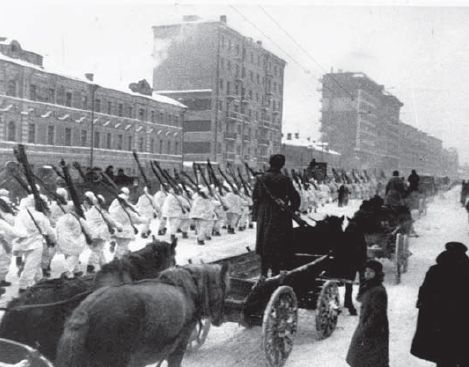
“Stalin is with us!” A ski battalion marches through Moscow to the fighting front, late in Barbarossa. After Viazma–Bryansk few Germans believed that the Soviets could continue to put fresh units in their path. (Topfoto)
On the old Napoleonic battlefield at Borodino two regiments of the newly arrived Siberian 32nd Rifle Division plus 18th and 19th Tank Brigades tried to halt 10th Panzer and SS Reich Divisions (supported by half a company of Brandenburgers). On one night the commander of a company from 98th Infantry Division requested permission to attack. The regiment asked, “Attack where?” The lieutenant answered, “It doesn’t matter where, we’re freezing and need quarters!”
Due west of Moscow, as part of Operation Schneesturm (Snowstorm), Army Group Center assaulted the new Moscow Reserve Front, specifically 16th Army at Volokolomsk, 5th Army at Mozhaisk, 43rd Army at Maloyaroslavets and 49th Army at Kaluga. By October 16 all four had been defeated. These setbacks could have meant the end of the Moscow defenses, but instead the Soviet resistance stiffened. In about ten days during mid-October the forces defending the critical Mozhaisk positions grew from six rifle divisions, a like number of tank brigades and ten artillery regiments, to 14 rifle divisions, 16 tank brigades, and over 40 artillery regiments. These defenses were not simply a single thin line but reached in depth all the way to Moscow. With the Luftwaffe expending little effort on interdiction since mid-October, the capital’s railway system provided an easy way to reinforce the Mozhaisk positions.
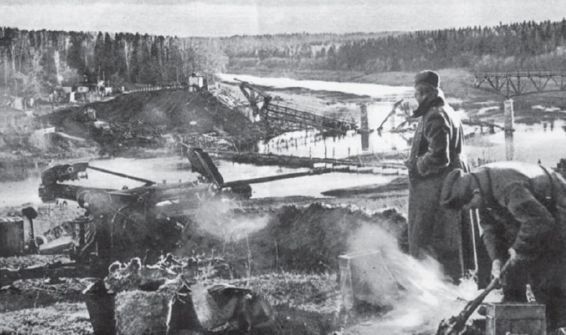
The crew of a 2cm Flak gun build a fire to keep warm while guarding a bridge near Mozhaisk. As often happened, retreating Soviets demolished the original bridge, only for German engineers to build another right next to it. (Author’s collection)
Part way through the battle Stavka merged Artemev’s command with the West Front. On the southern flank, Guderian’s progress slowed dramatically when XXIV Panzer Corps ran out of fuel and was then stopped completely at Mtsensk by the 1st Guards Rifle Corps. Earlier, in three days the Red Army Air Force airlifted 5,500 men to Orel under Stalin’s express orders. After Kiev, parts of the Second Army, especially its rear services, were still struggling north during mid-October, so could not contribute fully in this sector. Luftwaffe Ju-52 transports refueled Guderian by dropping supplies since they could not land in the mud. At the end of the month 60 men from Grossdeutschland shot their way into Tula, but were thrown out within hours, never to return. The southern edge of that city marked the temporary limit of Guderian’s advance.
As of October 14, von Bock still believed that there were no Soviet units defending Moscow. Inside the capital panic set in, despite directives signed by Stalin and Shaposhnikov on October 8 and 9. On the 12th the State Defense Committee put Moscow in a state of siege under NKVD control. Additional militia and “destroyer” units (local defense and security) were raised, and 440,000 workers were armed. Some government agencies evacuated the city for points east, and foreign embassies were advised to leave as well. However, on October 19 Stalin issued a directive meant to halt the panic once and for all. In mid-July Hitler had boasted that Moscow “must disappear from the face of the earth.” Three months later, Stalin resolved to stay put and defend his capital. The dictator’s determination heartened the frontoviki: “Stalin is with us!” Both dictators staked their all on the fate of the city.
Exhaustion set in on both sides, and the Mozhaisk line marked the end of Typhoon. After the encirclements at Viazma and Bryansk the Ostheer continued successfully to exert pressure on the Red Army defenses, but achieved no breakthroughs. A stalemate developed along the front, German morale rose a bit, and an unofficial truce between the two sides began, somewhat like in the trenches during Christmas, 1914. Hitler could not bring himself to assault Moscow frontally through its primary defenses, such as they were, and vainly sought a decision on the flanks.
In the north, although Third Panzer Group’s occupation of Kalinin caused the Soviet leaders consternation, the maneuver represented just another dilution of German efforts; the distances from Viazma to Kalinin and Viazma to Moscow were the same 120 miles, but the effects of going in two different directions were enormous. In the south, for the third time during Barbarossa, Guderian had put personal goals ahead of organizational ones – on this occasion by his sloppy completion of the Bryansk Kessel, and still he could not get appreciably closer to Moscow.
At the time and since German commentators have used the autumn weather as an excuse for Typhoon’s failure, as if the rasputitsa was unpredictable. In fact, rainfall in 1941 was slightly below average for October and less than half an inch above average for November. The temperature in 1941 was even 2˚(F) lower than the average for October, and only 3.5˚(F) colder than average for November. Conversely, the frost came a little early in 1941, an advantage for the German troops. This does not mean that the wet and cold did not affect operations; they absolutely eliminated the possibility of a fast advance on Moscow after Viazma and Bryansk. But solid German staff work would have prepared the Ostheer better for the entirely predictable weather.
With predictable results at Viazma and Bryansk Stalin for the third time was going to throw the dice; he had already lost twice at Minsk and Smolensk. At each turn along the Moscow axis he had underestimated the speed and violence of the blitzkrieg, while overestimating the benefits of standing fast in immobile defenses. Likewise, after four months of hard lessons the Red Army still could not mount effective countermeasures against German armored spearheads.
Soviet defenses toughened noticeably by the time the Red Army occupied the Mozhaisk positions. Zhukov knew that thanks to the entirely unsuprising weather he could concentrate along the few all-weather roads. Rumors were reaching the frontoviki about the treatment of earlier Red Army captives at the hands of the Wehrmacht, so surrender became completely unattractive. In mid-October (the exact date is unknown) Stalin heard from his master spy in Tokyo, Richard Sorge, that Japan would not help Germany against the USSR, but was heading south toward the Philippines and Indonesia instead. Soon one division from the Soviet Far East was arriving near Moscow by rail every two days; by the end of the month an additional 13 rifle divisions and five tank brigades were present. German intelligence failed completely to identify this build-up. Rastenburg, OKW, and OKH simply could not believe that after Kiev, Viazma and Bryansk, and all its other disasters the Red Army had anything left to put in their path before Moscow.
The Crimea and Eastern Ukraine
With the Kiev Kessel no longer in doubt, on September 21 von Rundstedt received orders for continuing Barbarossa southeast of the Dnepr. Next stops: the Donbas and Crimea. Von Kleist would make for Rostov, the Eleventh Army would capture the Crimea, the Seventeenth was to aim for Voroshilovgrad via Kharkov while von Reichenau would cover its left flank to Belgorod and the Don River beyond.
The Crimea
In mid-September, with the Sixth and Seventeenth Armies and First Panzer Group at the Kiev Kessel and the Rumanian Fourth Army besieging Odessa, von Rundstedt dispatched the Eleventh and Third Rumanian Armies toward the Crimea. Geologically, a massive alpine fold created the 10,000-square-mile peninsula and its 5,000-foot mountains. It has a tradition of cultural uniqueness and dominates the Black Sea. Hitler wanted to eliminate this “aircraft carrier” targeted on Ploesti (though the USSR lacked strategic air capability) and gain a stepping stone to the Caucasus. He also wanted to woo Turkey into joining the Axis cause.
Meanwhile Tyulenev tried to re-establish a coherent defense in the wake of Uman. He had 20 rifle, one tank, and several cavalry divisions to hold the Dnepr line from above Dnepropetrovsk to its mouth at Kherson. On August 19 Stavka gave him the job of containing German bridgeheads at Dnepropetrovsk, Berislav, and Kherson. One week later D.I. Rybyshev replaced the wounded Tyulenev as Southern Front commander.
To Perekop
The Eleventh Army had progressed slowly for the entire campaign. It suffered isolation from the remainder of the army group, devoted much effort to keeping the Rumanians out of trouble and provided flank cover for the Seventeenth Army. Von Schobert kept his corner of Barbarossaadvancing in as high morale as circumstances allowed. On September 9 von Rundstedt’s headquarters ordered the Eleventh Army to seize the Crimea and cover the army group’s flank along the Sea of Azov. The Eleventh had begun expanding its Berislav bridgehead days before.
Von Schobert, killed when his Fiesler Storch liaison aircraft landed in a Soviet minefield east of Berislav on September 12, never got a chance to carry out his new orders. That same day Rybyshev began pulling back to a shorter line running due south of Zaporozhe. The Reconnaissance Battalion of the LSSAH tried to capitalize on the confusion by dashing across the 50 miles to the Perekop Isthmus in a surprise move. It failed but in so doing discovered the Soviet defenses were much more sophisticated than expected.
Attending von Schobert’s funeral at Eleventh Army headquarters in Nikolaev on September 17 was its new commander, von Manstein, newly arrived from the Leningrad Front. While he might have to work to match his predecessor’s popularity he brought new energy to the Eleventh (and the Rumanian Third Army, under its operational control). Although it took weeks to implement, one of von Manstein’s first tasks was to convince his superiors the army couldn’t seize the Crimea and cover the army groups’ flank, and that taking the Crimea had precedence. Penetrating the defenses of the Perekop represented his most immediate concern.
The isthmus has two narrow, easily defended chokepoints, one 5 miles wide near the town of Perekop and another near Ishun that, while technically wider, is broken up by numerous bitter lakes. The Russians had created a massive moat 150 feet wide and up to 60 feet deep with an earthen bank behind it. This was known as the Tartar Ditch. Two other routes connected the peninsula with the mainland but were not militarily significant.
The Soviet 51st Independent Army commander was Lieutenant General F.I. Kuznetsov (formerly facing Army Group North). He had four rifle and two cavalry divisions in his frontline with two rifle and one cavalry division to the rear. Defense lines were between 5 and 7 miles deep and were augmented by bunkers, minefields, and over 100 tanks. Field artillery, naval gunfire, and air support were in abundance. With Luftflotte 4 occupied at Kiev and Odessa, the Black Sea Fleet easily re-supplied the defenders without interference. By contrast, von Manstein’s railhead was way back at Pervomaysk (near Uman) and more to the point, the German forces were considerably outnumbered.

46th Infantry Division assaults the Tartar Ditch, September 24, 1941. Pioneers advanced through barbed-wire entanglements and other obstacles with Bangalore torpedoes, improvised demolition charges (1), and wire cutters. Landsers advanced alongside the pioneers, providing covering fire but they took heavy casualties despite support from German artillery, Stukas (2), and assault guns. The squad shown here are equipped with a mixture of M1934 Karabiner 98k rifles (3), MP38 (4) and MP40 (5) sub-machine guns, and MG34 light machine guns (6). They are also supplied with the ubiquitous M1924 stick-grenade (7). Scaling the earthen rampart with assault ladders (8) the Pioneers got close enough to employ flamethrowers (9) and satchel charges against enemy bunkers and fighting positions (10) and defensive positions began to fall silent one by one. (© Osprey Publishing, Howard Gerrard)
East of the Dnepr the Ostheer entered the legendary steppe. According to von Manstein’s plan the XLIX Mountain and XXX Corps would chase the 18th and 9th Armies toward Melitopol while the LIV Corps was ordered to Perekop. In a move that presaged Operation Blau in 1942, General P. Dumitrescu’s Rumanians would cover the army’s extended left. After LIV Corps achieved its breakthrough, the Third Army would relieve the XLIX Mountain Corps, allowing the Gebirgsjäger to exploit into the Crimea’s interior.

Cossacks with horse artillery in the age of mechanization. Troopers wear the Kubanka caps and Cherkeska caftans. As Soviet vehicle losses continued to rise, various cavalry forces had to provide the Red Army with a mobile capability. (NARA)
Storming the narrows fell to the 46th and 73rd Infantry Divisions backed up by all the combat support von Manstein could assemble: one assault gun and 20 artillery battalions plus Nebelwerfer. The Landsers attacked on September 24. The watchwords were infiltrate and bypass Soviet strongpoints. Within a day the men of Hansen’s LIV Corps reached the Tartar Ditch. Punished by Stukas and counterbattery fire, Red Army artillery slackened. The German troops negotiated the moat and wall on September 26. It took two more days to break the first defensive belt.
Battle of the Sea of Azov
However, the final thrust into the Crimea would have to wait. In one of those coincidences of timing common in war, the Southern Front attacked against von Manstein’s left during the last week of September. Between 10 and 13 Rifle divisions created a 10-mile gap in the Rumanian Third Army’s lines, through which poured two tank brigades. Von Manstein moved his headquarters away from Perekop and north-eastward to reassure Dumitrescu. He also turned the XLIX Mountain Corps 180 degrees. Instead of punching into the Crimea it marched northeast to bolster the shaky Rumanian line.

Commander of the 1st Mountain Division, Major General Lanz, near Nikopol around the time of the Sea of Azov battle. The 1st Mountain performed masterfully on the flat steppe and consistently led the Seventeenth Army. (NARA)
Von Manstein personally intervened on numerous occasions as the situation became tense. Rain hampered the movement of German reserves. The Soviet attack soon stalled from a combination of poor coordination, limited objectives, and German resistance. Not actively involved at Kiev, von Mackensen’s III Panzer Corps watched these developments from its Dnepropetrovsk bridgehead. A great opportunity arose for a decisive German counterstroke. On September 25 von Rundstedt issued Order No.9 directing von Mackensen south along with the XIV Panzer Corps driving out of the CSIR’s Petrikovka salient to von Mackensen’s northwest. After crossing the Oryol and Sarmara rivers, the panzers’ objective was Berdyansk on the Sea of Azov.
They completely outmaneuvered the Soviet forces. Departing on October 1, XIV Panzer Corps on the right and III Panzer Corps swinging left cut Southwest Front’s communications. Under blue skies von Kleist’s men (he had lost XLVIII Panzer Corps to Guderian after Kiev) put the 18th and to a lesser degree the 9th Armies in grave danger. By October 3 both armies were retreating and the Eleventh took up the chase. Two days later III Panzer Corps occupied Melitopol, the First Panzer Group became First Panzer Army, and Y.T. Cherevichenko took over Southern Front. On October 7, XIV Panzer Corps and the LSSAH joined hands at Berdichev and sealed the trap. The 9th and 18th Armies were crushed with a loss of over 106,000 POWs captured plus 212 tanks and 766 guns of all descriptions put out of action. The Germans buried 18th Army commander Smirnov with full honors. Von Manstein redirected his attention back to the Perekop.

Conquest of the Crimea
Von Kleist took over responsibility for the Sea of Azov coast and von Manstein gave him XLIX Mountain Corps and the LSSAH as part of the deal. The Eleventh Army now had to conquer the Crimea with six infantry divisions and the promise of two more plus the small Rumanian Mountain Corps. His forces were half as strong as the 51st Army, now reinforced by the Odessa garrison (minus its heavy equipment left on the mainland). Von Rundstedt convinced Göring to provide three fighter and two Stuka Gruppenunder Colonel Werner Mölders, the first Luftwaffe ace to both surpass the Red Baron and reach 100 victories. Mölders would land his Storch a few hundred meters behind the fighting and act as the forward air controller.
Kuznetsov had improved his positions during the battles around Melitopol. Meanwhile the flat, barren terrain offered no cover to von Manstein’s men and any fighting positions they dug soon filled with salty water since the dry ground was barely above sea level. Hansen’s LIV Corps again led the assault. The wider Ishun line allowed him to attack with three divisions, albeit at reduced strength because of the Perekop and Melitopol fighting. The XXX Corps would act as the exploitation force.
Artillery and Nebelwerfer opened up at 0540hrs on October 18 and Stukas joined in at sunrise. Without the additional CAS, Soviet fire would have obliterated the German forces as they worked through the nine defensive lines (6 miles deep) securing gaps between the saltwater lakes. After a day’s progress on the east, that wing ground to a halt. Von Manstein therefore switched his Schwerpunkt to his right. About this time the weather turned wet, hindering German efforts to bring supplies forward while Odessa’s displaced veterans continued to arrive and reinforce the defenses. By October 25 Hansen claimed his corps was combat ineffective. Von Manstein would not hear of it, “There’s no such thing for a division to be finished.”
Red Army forces had suffered as well, notably from Mölders’ CAS. Kuznetsov’s men finally broke on October 26. They had no more prepared positions south of the isthmus and the retreat turned into a rout. On the 29th Soviet authorities declared a state of siege throughout the parts of the peninsula they still controlled. By the next day the front cut through the Crimea’s center. Kuznetsov lost coordination between his east and west. The 51st Army made for Kerch while the Coastal Army (formerly in Odessa) headed for Sevastopol. Since von Manstein now had no motorized units, surprise moves were out of the question. Accordingly his infantry kept marching until the Soviet forces decided to halt and face about. By early November the XXX and LIV Corps stood in the foothills northeast of Sevastopol, which was defended by three divisions and the remnants of four others. At the Parpach Isthmus the newly assigned LXII Corps faced portions of five divisions. The Rumanian Mountain Corps held the partisan-filled mountains and coastline in between.
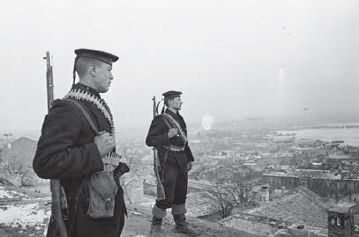
Soviet sailors near Kerch on the far eastern tip of the Crimea. Sailors and marines were in the thick of it whenever the fighting got close to a coastline, or especially, a naval base. (Corbis)
The 51st Army in the east simply could not organize effective resistance. By November 3 the XLII Corps had slipped around the defenders and captured the port of Feodosia. Denied that escape route, Kuznetsov tried to reach the larger port of Kerch at the far eastern tip of the Crimea. XLII Corps took the town despite heavy fighting on the 15th, preventing further Soviet escape. In eight weeks the Eleventh Army had captured over 100,000 POWs and 797 artillery pieces of every description. But with Sevastopol unbowed to the west von Manstein would not be crossing over to the Taman Peninsula to execute Halder’s grandiose expedition to the Caucasus.
Sevastopol
Similarly to what the British did at Singapore, during the interwar period the USSR prepared Sevastopol for an attack from the sea. But in late 1940 and especially during the siege of Odessa they prepared for a land assault as well. They built three concentric defensive lines, respectively 1–2, 3–5, and 10 miles from the harbor. Over 3,000 bunkers interspersed with nearly 140,000 mines, antitank ditches, and trenches linked massive forts mounting naval caliber guns. Over 100 Red Army Air Force aircraft and the Black Sea Fleet made the defense a truly joint operation.
Not only did von Manstein’s infantry lack any motorized units (except ad hoc formations created by consolidating vehicles from existing units), but steep mountains and deep ravines surrounding Sevastopol also slowed their advance. Attacker and defender prepared for the inevitable. It was vital that Eleventh Army utilize the available logistics as effectively as possible and von Manstein used economy of force elsewhere on the peninsula in order to concentrate against the fortress. LVI Corps represented the main effort coming from the north and northeast while the XXX Corps supported from the south.

Von Manstein planned to begin his assault at the end of November but terrible weather pushed the attack to 1942 – a date beyond the scope of this book. Von Manstein’s infantry was in a weakened state after five months of campaigning plus German logistics between the Dnepr and Sevastopol, 400 miles distant, were in a shambles. Eleventh Army could not attack the fortress and fight partisan bands that sprung up everywhere, especially in the Yalta Mountains. His Luftwaffe support departed to first Moscow and then the Mediterranean. The USSR regained air superiority while the Black Sea Fleet proved capable of both resupplying the beleaguered garrison and conducting amphibious operations along the Crimean coast.
Having been denied the military honors of von Rundstedt’s other armies the Eleventh finally had its chance to shine in September and October. Outnumbered on the ground it succeeded, with the help of von Kleist’s panzers in fending off an attack by two Soviet armies at Melitopol, with Luftwaffe assistance, in penetrating two well-prepared, narrow, and deep defensive positions at Perekop and, finally in clearing Red Army forces from the entire peninsula except for Sevastopol. If von Manstein had possessed even a single mechanized division with which to race into the fortress ahead of the marching Soviets, the battle for the Crimea might have been over much sooner.

Rear Admiral Oktyabrsky aboard the cruiser Krasny Krym (Red Crimea). The Black Sea Fleet commander was also in overall charge of the defense of the Crimea and Sevastopol and led numerous joint operations. (NARA)
Kharkov to Rostov
Processing and sending Kiev’s 660,000 POWs into captivity took weeks and delayed Sixth and Seventeenth Armies. Their next objectives were the industrial areas of Kharkov and Stalino. Believing the Soviet forces would continue to defend every yard of territory Hitler expected other encirclements near these two cities. First Panzer Army aimed for Rostov. The Third Reich was already short of oil and the German High Command felt it had a good chance of reaching the Caucasus in 1941.
Meanwhile Stavka sought to stabilize its southern flank. The Soviet Union also depended on the steady flow of Caucasus oil and Western supplies now coming through Iran. Stalin had been anxious to regain the strategic initiative since Barbarossatag. With much of the Ostheer tied down in November facing Moscow’s defenses he was keen to open offensives on either flank.
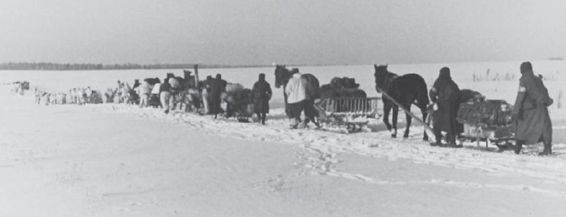
No way for a modern army to conquer the planet’s largest nation: a German column with commandeered local pony-sledges plods eastward during the coldest winter in many years. Despite ample experience in the East during the Great War, Germany’s curious neglect of logistic in favor of operational planning was a weakness that would be exposed on the first day of the campaign, and would haunt its every step thereafter. (HITM)
Sixth and Seventeenth Armies
Finally, on October 6 von Reichenau advanced with some difficulty through Achtyrka and Sumy while the Seventeenth Army moved south from Poltava with the Hungarian Fast Corps (now down to six battalions strength) as its mobile reserve. Shattered by the Kiev battles, the Soviet forces could not organize a coherent defense. Von Rundstedt fired von Stülpnagel, who in turn was replaced by Hermann Hoth. After some tough going near Krasnograd the new commander pushed the Seventeenth toward Lozovaya, which fell after two days’ fighting. Hoth then split his army between the twin objectives of Izyum on the left and Stalino on the right. Again the fast-marching Seventeenth tried mightily to compensate for the fact that Army Group South had only one panzer army with only two panzer corps. The Sixth Army headed for Kharkov as the Soviet defenders struggled to offer more than token resistance. Von Reichenau’s men likewise worked hard to maintain contact with Army Group Center on their left.
Late in the second week of October wet weather and poor logistics conspired to stop the Ostheer. Combat had destroyed all Dnepr bridges and now ice floes threatened pontoons erected by German engineers. European-gauge railroads would not reach far enough until the end of November. Hitler stepped in on October 14 and instructed both infantry armies to cooperate against Kharkov. While this might guarantee capture of Kharkov it simultaneously weakened the German effort in the Donbas and compromised Hoth’s protection of First Panzer’s lengthening northern flank. The Führer had lost confidence in von Reichenau, however, after the latter’s uncertain leadership during Barbarossa’s first months. It took three days of heated discussions before the generals convinced Hitler to allow the Seventeenth Army to continue toward the Don River undistracted and for the Sixth Army to capture Kharkov alone.

Von Kleist in an impromptu conference with Italian General Giovannelli, commander of the Pasubio Division. (Topfoto)
Stavka had no intention of allowing another massive encirclement at Kharkov and withdrew Red Army units. Improving weather in the third week of October meant increased mobility for the German troops. On October 19 German intelligence reported the enemy was “fighting without any enthusiasm and running away.” While the German Seventeenth Army battled the Soviet 38th Army southeast of Kharkov, von Reichenau curled around the north, defeating the nine Soviet divisions defending the city on the 24th. Hoth labored with his army going in three directions and the Hungarian Fast Corps as his only mobile reserve. Soon bad weather intervened again to halt the German advance.
The Seventeenth Army crept forward. Their “pursuit detachments” consisted of infantry on native panje wagons. The Donbas defenders were a true Workers and Peasants’ Red Army as 150,000 industrial and farm worker militia members joined regular army forces. Fighting was slow and costly in the heartland of prewar Soviet heavy industry. The German forces did manage to tap into the oil pipeline from Baku, acquiring many days of diesel fuel. Hoth eventually occupied most of the middle Don. The Sixth Army never made it much past Kharkov and Belgorod. For von Rundstedt’s infantry the invasion ended.

Panzer Advance to Rostov
With First Panzer Army almost ineffective due to losses and lack of supply von Rundstedt recommended halting and taking up winter quarters.31 No one in higher headquarters supported such a move. Von Kleist’s role in the battle of the Sea of Azov ideally placed his panzer army for continued operations toward Rostov. With von Manstein now exclusively concerned with the Crimea, First Panzer had sole responsibility for the army group’s right. After Kiev von Kleist reinforced Guderian’s Second Panzer Army with the XLVIII Panzer Corps and in compensation received the XLIX Mountain Corps and the LSSAH. He arrayed his forces from north to south thus: CSIR, XLIX Mountain Corps, XIV Panzer Corps, III Panzer Corps, and finally the SS along the Azov coast.
Even before completing the Melitopol operation von Kleist consolidated all available fuel and pushed his right across the Mius River. Likewise, to conserve aviation gas the Luftwaffe flew only single-engine aircraft such as Bf-109s and Stukas. On the 20th the 1st Mountain Division captured Stalino, thoroughly ruined consistent with the Soviet High Command’s scorched earth policy. Shortly afterwards the Italians took the Rykovo– Gorlovka area. On October 22 Army Group South issued its Directive No.10 for the final assault on Rostov.
The XIV Panzer Corps’ tracked elements represented von Kleist’s main effort. Von Wietersheim’s men crossed the Mius at Golodayevka in early November. Aided again by bad weather commencing on November 7, the Red Army dug in south of the Tuslov River. In view of the increased resistance, the Schwerpunkt switched to von Mackensen. North Caucasus Front activated the 56th Independent Army under Lieutenant General F.N. Remezov to defend Rostov and the lower Don. The 37th Army commanded by A.I. Lopatin soon came alongside to extend Timoshenko’s line northward.
Freezing weather returned on November 13, permitting resumed movement. Von Rundstedt planned to continue his advance four days later, but with Seventeenth Army incapable of covering the panzer army’s north, von Kleist’s advancing spearhead soon created an exposed 150-mile flank. Timoshenko saw this opportunity and planned to counterattack.
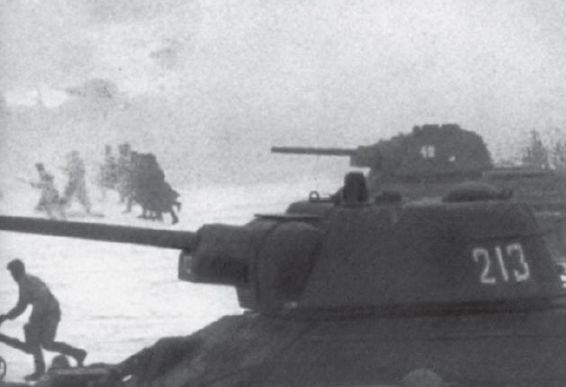
Gaining the upper hand: emboldened by flagging German fortunes, and motivated to defend their capital, the Soviets increased their offensive activity in November and December. Here T-34/76 tanks accompany advancing Red Army infantrymen. (Elukka)
Von Mackensen massed his armor to the north alongside that of von Wietersheim. Together they attacked south of the Tuslov to take an indirect route to Rostov in a clockwise sweep. Both panzer corps moved out at 0800hrs on November 17 and quickly pierced the Soviet lines. Both air forces were extremely active: the IV and V Fliegerkorps providing CAS while the Red Army Air Force interdicted German supply lines between Mariupol and Taganrog.
The 37th Army’s counterattack on the northern portion of the bulge presently attracted the attention of the XIV Panzer and XLIX Mountain Corps, leaving Rostov to III Panzer Corps. By November 19 von Mackensen’s panzers reached Nachichevan, 4 miles northeast of Rostov, and his motorized infantry occupied Aksaiskoye 2 miles from the Don River. The next day III Panzer Corps entered the city while the LSSAH even fought its way across the Don and established a small bridgehead on the south bank of the massive, frozen river. Communist Party members and civilians fled before the panzer troopers. The Ostheer’s furthest advance was reached on November 22 with the temporary occupation of Rostov. Von Kleist wanted to abandon the city after one day but von Rundstedt ordered him to stay.
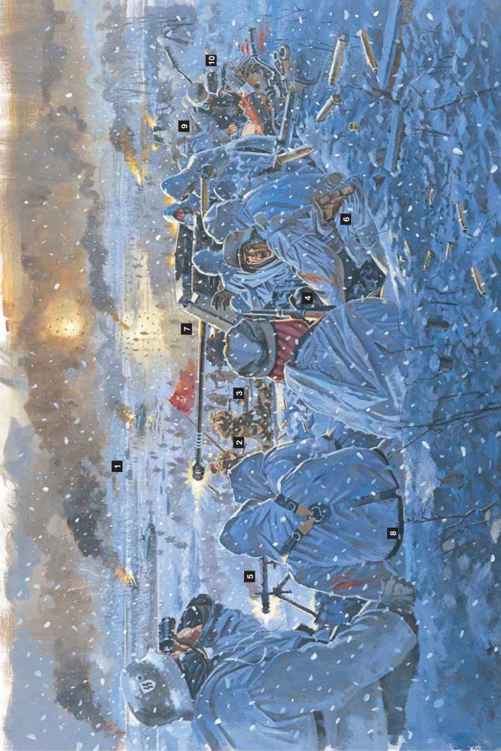
Final defense along the Don River by Leibstandarte SS Adolf Hitler, Rostov, November 25, 1941. On the south edge of Rostov overlooking the Don River the 300 men of LSSAH Motorized Division’s reconnaissance battalion under Sturmbannführer Kurt “Panzer” Meyer held a 5-mile front. Early on November 25 Timoshenko loosed his 56th Army against the III Panzer Corps’ defenses and at 0520hrs parts of three rifle and one cavalry divisions assaulted the German line. The mile-wide Don was frozen solid and supported all but the heaviest vehicles. T-34 tanks (1) provided support fire from the far bank. Soviet riflemen of the 343rd Rifle Division (2) attacked in battalion strength with bayonets fixed to their Moisin Model 1891 rifles (3). The German troops weaponry included the standard M1934 Karabiner 98k rifle (4) and MG34 light machine guns (5), with officers also carrying the Walther P38 sidearm (6), supported by a few Pak 38 50mm antitank guns (7). Some of the SS troops wore issued snow smocks (8), some improvised snow camouflage (9), while others had nothing but their standard wool uniforms (10). (© Osprey Publishing, Howard Gerrard)
Timoshenko’s Counteroffensive
On November 9 Timoshenko briefed Stalin on his plan to use the Southern Front, now under Cherevichenko, to attack von Kleist’s vulnerable left flank. With the bulk of the Red Army defending Moscow, Stavka could offer no additional help. The marshal assembled 12th (K.A. Korteev), 18th (V. Ya. Kolpatchy), 37th (Lopatin), and 9th (F.M. Kharitonov) Armies, in addition to Remezov’s 56th Independent Army holding Rostov. Lopatin’s 37th, assembling near Krasnodon, would be the main effort, with the confluence of the Tuslov and Krepkach rivers as its initial goal. The 9th and 18th Armies, hastily rebuilt following the Sea of Azov battle, covered his east and west flanks respectively.
Timoshenko’s ultimate objective was Taganrog. His force consisted of seven armies, including 40 rifle and 13 cavalry divisions plus seven tank brigades and an airborne corps. The attack’s size tested contemporary Soviet command and control, but drastic measures were required to secure Caucasus oil while keeping as many German units as possible distracted from Moscow.
Timoshenko launched his attack on November 17 and added over 100 tanks the next day. The Germans knew of the assault ahead of time but were too weak to offer much resistance along the lengthy flank. Lopatin struck portions of the Seventeenth Army, the CSIR, the XLIX Mountain Corps and, above all, the left flank of the XIV Panzer Corps. The boundary of these last two formations, held by the 1st Mountain and SS Viking Divisions, was breached. The T-34s overwhelmed von Wietersheim’s panzers and the Soviet forces employed Katyusha rockets against Army Group South for the first time. Von Kleist dispatched Stukas and his last reserves, the Slovakian Mobile Division (a brigade’s strength).
The threat to First Panzer Army’s flank and rear was real enough, but not sufficient to keep the German forces out of Rostov. Despite losing the important city, Stavka remained fixed on eliminating von Kleist. The panzer general asked von Rundstedt for reserves and advice on stabilizing the dangerous situation. Oblivious, OKH vainly pressured Army Group South to execute Directive No.11 – a drive on Maikop in the Caucasus.
The XIV Panzer withdrew to the Tsulov River. Panzer Army headquarters pulled 13th and 14th Panzer Divisions out of Rostov in order to create a counterattack force. Hitler’s personal promise for aerial resupply amounted to a mere 24 Ju-52s on November 24. Von Rundstedt’s staff already considered retreating to the Mius when Timoshenko lashed out again.
At 0520hrs on November 25, men of the LSSAH saw battalions of Soviet infantry coming out of the fog. With arms linked and screaming “Urrah!” they stormed over the frozen Don. Without cover they fell to the German guns in their hundreds. With attack and counterattack supported by armor of both sides, the battle raged for two days. But the main differences between this attack and that of a week earlier were von Kleist’s more exposed position and the absence of any support by the Seventeenth Army. By November 27 the Southern Front had assaulted the German defenses along its entire length. Luftwaffe CAS was out of the question due to the German Moscow offensive. Telephone lines hummed between army group headquarters and Rastenburg. On his own initiative von Kleist ordered III Panzer Corps out of Rostov during the night of November 28/29. His panzer divisions averaged 12–24 operational tanks and infantry companies numbered 50 men. Von Rundstedt approved moving to the Mius on the 30th. At 25 miles per day the retreat’s pace matched that of the advance during Barbarossa’s early days.

Rostov, November 1941. Soviet riflemen advance through the “Gateway to the Caucasus”. Rostov was the first Soviet city liberated, though the Germans recaptured it during Operation Blau the following summer. (NARA)
After hours of telephone calls between Hitler’s and von Rundstedt’s staffs (the field marshal refused to speak directly with higher headquarters), the Führer instructed First Panzer to halt east of the Mius along an intermediate line. With Luftflotte 4 flying overhead von Kleist’s men pulled back all the way to the Mius anyway. They maintained a small bridgehead at Taganrog, mostly for its advanced airfields, but otherwise abandoned the river’s east bank – a move sure to infuriate Hitler.
Von Rundstedt is Relieved of Command
At this juncture, with crucial battles taking place at Leningrad, Moscow, and Rostov, Hitler left his headquarters for head-of-state duties in Germany. Retreat to the Mius was practically an accomplished fact when he returned from the funerals of Luftwaffe aces Ernst Udet and Werner Mölders. Von Brauchitsch, who had suffered a severe heart attack on November 13, took the brunt of Hitler’s wrath. The Führer demanded last-man defenses and counterattacks. Von Rundstedt would hear nothing of it and offered to resign, which Hitler immediately accepted.
In a teletype early on December 1 Hitler appointed von Reichenau joint army group and Sixth Army commander (both headquarters were in Poltava) and instructed him to halt von Kleist’s withdrawal. Von Reichenau passed on the order to First Panzer headquarters and appealed to von Kleist’s sense of duty. But the panzer commander knew better the disastrous implications of throwing his army back at the Soviet forces, and he had the wellbeing of his weary troops in mind. Von Reichenau relented late that day and confirmed the retreat order.
To personally investigate, Hitler made the unprecedented move of flying to the front on December 2. With von Reichenau and Lohr’s chief of staff he flew to Mariupol to meet von Kleist and LSSAH commander Sepp Dietrich. Hitler could not ignore the two frontline leaders’ unanimity. Dietrich’s testimony of SS suffering and unstinted support of his Heer superiors impressed the Führer. Hitler left the next day, again flying via Poltava. There he met von Rundstedt, acknowledged the field marshal’s service, and promised to reinstate him after some rest.
This was as close as Hitler ever came to admitting a mistake to one of his generals. By late November the army group’s hopes rested on First Panzer Army. However, gravely weakened from five months of fighting, at the end of a feeble logistical tail and poorly supported by its northern flank units von Kleist could not hope to capture Rostov and hold it for longer than a week. Across the front the Soviet forces began to recover from Barbarossa’s initial shock, husband replacements, and develop operational skills of their own. Timoshenko’s counteroffensive would not be the last time the Red Army exploited an overextended German thrust. Army Group South was fortunate von Rundstedt and von Kleist were as skilled in defense as offense.
Assault on Moscow
During the second half of October the German leaders hoped to build upon the momentum of the Viazma–Bryansk begun during the first half. Their own weaknesses, the weather and Soviet resistance made this impossible. Red Army forces along the entire front and in reserves close behind would grow from 269 divisions and 65 brigades totaling 2.2 million men at the beginning of November to 343 divisions and 98 brigades with over 4 million men a month later – and most of these new troops manned the Moscow sectors. On November 1 von Bock’s forces fielded 136 divisions on paper, but with a real strength of 83, totaling 2.7 million men, and he would receive no reinforcements.
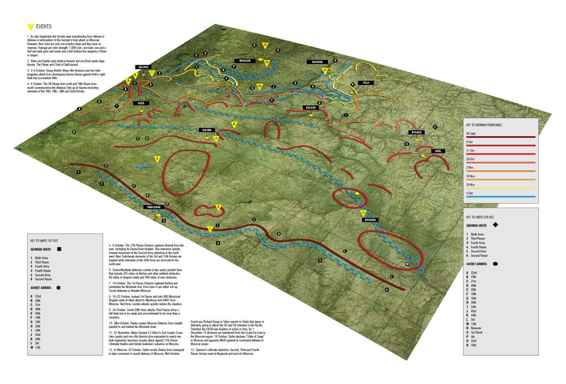
 EVENTS
1. By late September the Soviets were transitioning from offense to defense in anticipation of the German’s final attack on Moscow. However, their lines are only one echelon deep and they have no reserves. Average per mile strength: 1,000 men, one tank, one and a half anti-tank guns and seven and a half indirect fire weapons (76mm or larger).
2. Hitler and Halder want shallow Kessels but von Bock wants deep thrusts. The Führer and Chief of Staff prevail.
3. 3-4 October: Group Boldin (three rifle divisions and two tank brigades) attack from developing Viazma Kessel against Hoth’s right flank but accomplish little.
4. 6 October: The 7th Panzer from north and 10th Panzer from south (covering twice the distance) link-up at Viazma encircling elements of the 16th, 19th, 20th and 32nd Armies.
5. 6 October: The 17th Panzer Division captures Briansk from the east, including its Desna River bridges. This maneuver assists forward movement of the Second Army attacking to the north west. Near Trubchevsk elements of the 3rd and 13th Armies are trapped while elements of the 50th Army are encircled to the north east.
6. Soviet Mozhaisk defenses consist of two nearly parallel lines that include 225 miles of ditches and other antitank obstacles, 66 miles of dragon’s teeth and 380 miles of wire obstacles.
7. 14 October: The 1st Panzer Division captured Kalinin and penetrates the Mozhaisk line. From here it can either roll-up Soviet defenses or threaten Moscow.
8. 18–22 October: Instead 1st Panzer and Lehr 900 Motorized Brigade make ill-fated attack to Mjednoye and AWAY from Moscow. Red Army counter-attacks quickly restore the situation.
9. 24 October: Soviet 29th Army attacks Third Panzer Army’s left flank but is too weak and uncoordinated to be more than a nuisance.
10. Mid-October: Stavka creates Moscow Defense Zone roughly parallel to and behind the Mozhaisk lines.
11. 27 November: Major General I.V. Belov’s 2nd Cavalry Corps (two cavalry and one rifle division plus equivalent to nearly two tank regiments) launches counter attack against 17th Panzer. Liberates Kashira and blunts Guderian’s advance on Moscow.
12. In Moscow: 10 October: Stalin recalls Zhukov from Leningrad to take command of overall defense of Moscow; Mid-October: Soviet spy Richard Sorge in Tokyo reports to Stalin that Japan is definitely going to attack the US and UK interests in the Pacific. Therefore the USSR has freedom of action in Asia. By 1 December 70 divisions are transferred from the Soviet Far East to the Moscow region; 19 October: Stalin declares “State of Siege” in Moscow and appoints NKVD general to command defense of Moscow proper.
13. Typhoon’s ultimate objective: Second, Third and Fourth Panzer Armies meet at Nogisnsk and encircle Moscow.

Landsers jump from a Panzer III during the fighting near Klin in December. (Topfoto)
On the last day of the month OKH issued yet another “Continuation of Operations Directive.” It ordered Ninth Army to attack toward the Volga Reservoir while Third and Fourth Panzer Groups would slash toward Yaroslavl (nearly 200 miles northeast of the Volga) in the north. Second Panzer Army, with only 50 of its 600 tanks operational, was to aim for Gorky (over 200 miles distant), with Second Army covering its right while also making for Voronezh. Once again Fourth Army represented the army group’s Schwerpunkt, with Moscow as its objective. The attack would begin on November 15. The other army groups received equally unrealistic missions: North was to link up with the Finns, while South was to push on to Stalingrad and Maikop!
Could Army Group Center reach Moscow? Many German soldiers were keen on the idea and willing to make the effort. Would accepting a personnel and material victory at Viazma–Bryansk followed by retreating back to the relative security of the Dnepr and other rivers as well as the prepared positions they had occupied before Typhoon be a better course of action than advancing into the unknown of the Soviet capital? No, von Bock had wanted to seize Moscow from the start, and now he would have his way. Like most German officers of that time, he was almost terminally optimistic: his soldiers would win the final battle, he would follow Hitler’s orders, and he would capture the legendary city.

German troops attempting to push a Krupp L2H143 1½-ton light truck along an icy Russian road. Most German wheeled vehicles did not perform well under these severe conditions. (Nik Cornish at www.Stavka.org.uk)
Preliminaries
On November 6, marking the anniversary of the 1917 Revolution, Stalin told soldiers marching from Red Square directly to the battlefield, “If they want a war of extermination, they shall have one.” He feared the German forces could encircle Leningrad, Moscow, Rostov, and Stalingrad and perhaps even capture them. He therefore reinforced Zhukov’s West Front, supported by Konev’s Kalinin Front to the north and Timoshenko’s Southwest Front in the south.
Zhukov wanted control of the entire battle for Moscow, and Stalin gave it to him. The West Front took command of 50th Army (from the disbanded Bryansk Front) on November 10, and 13th Army at Kalinin a week later. With fresh lessons from the defense of Leningrad in mind, Stalin ordered Zhukov to launch a series of pre-emptive assaults against the German positions. The general argued against this plan, but ultimately followed orders.
On the left, 49th Army (Lieutenant General I.G. Zakharkin) attacked on November 14 against XII and XIII Army Corps near Serpukhov. The 2nd Cavalry Corps tried to exploit but failed to have much impact. Two days later, near Volokolomsk, Rokossovsky led his 16th Army into the gap between 14th Motorized and 7th Panzer Divisions, likewise achieving little success. New units from the Far East had little time to prepare, were unused to combat, and lost up to one-third of their personnel and 157 of 198 tanks in ill-advised assaults. The follow-on charge of Major General L.M. Dovator’s 3rd Cavalry Corps was essentially suicidal; his 44th Cavalry Division practically ceased to exist, and its sister 17th suffered 75 percent casualties. These attacks severely weakened Red Army forces that would soon desperately need all their available strength. However, merely taking the offensive bolstered Soviet confidence.
On the day before Zhukov’s first attacks, Halder met with most of the Ostheer’s army and army group chiefs of staff plus representatives of his own staff at Orsha. He had come to pass along Hitler’s admonition for even greater efforts to achieve Barbarossa’s grandiose objectives. He arrived unable to imagine that the Red Army had any means left to stop von Bock before Moscow. Had they not just obliterated all the enemy’s forces at Viazma– Bryansk? Unfortunately German intelligence was so poor they had no way to confirm or deny their assumptions. With Moscow now so close, the historic city was exerting an allure over many German leaders. Halder “hoped” for six more weeks of cool weather without much snow.
His hopes were dashed by the men who had just come from the fighting front. Representatives from Army Groups North and South wanted to stop where they stood. Von Bock’s chief of staff, von Greiffenberg, echoed his commander when he said that Moscow could only be taken frontally and that Halder’s pompous encirclement plans were out of the question. Halder conceded, and allowed the less ambitious army group plan to go forward. Kesselring spoke up to say that many of his Luftwaffe units had already left for the Mediterranean, and that his staff and “a substantial number of units” would depart on November 18. Von Richthofen’s very much weakened VIII Fliegerkorps would take over the air support mission.
As usual, logistics concerns were soon being voiced. The OKH quartermaster representative said that they could not supply the army group; for example, fuel deliveries were one-quarter of requirements. Halder’s response to this real problem was simply to announce that OKH was “not going to stand in von Bock’s way if he thinks he can succeed; you also need a little bit of luck in war.” Even though rail lines had operated to Gzhatsk by October 27 and to Borodino a few days later, von Bock’s logistics remained under stress. Supply woes caused the staggered start of his final push. Nevertheless, Army Group Center wanted to start as soon as possible and not wait for its supply situation to improve; only Moscow justified this level of effort and risk.
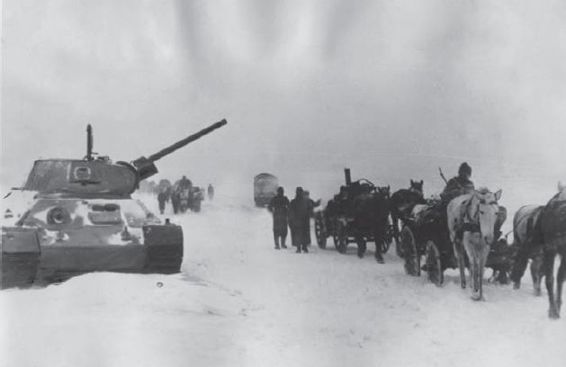
Weather not fit for man nor beast: a small German supply column, including a “goulash cannon” field kitchen, makes its way past a knocked-out T-34. During winter raids, Soviet troops often targeted these trailers; in 1939–40 they had learned the hard way from the Finns that the combat potential of an isolated unit without the means to provide hot food and drink would degrade overnight. (HITM)
There would be few modifications to the plan of attack. Owing to the dire situation of von Leeb’s Sixteenth Army to the north, Ninth Army’s mission was limited. Reinhardt’s Third Panzer Group would attack on November 15 and aim for the Volga–Moscow Canal. Three days later, Hoepner’s Fourth Panzer Group (still the most powerful panzer group in the Ostheer) and Guderian’s Second Panzer Army would move out toward Teryayevo and Kolomna respectively. Von Kluge, whose Fourth Army should have had major responsibilities, was left in limbo. The Second Army had to accomplish the impossible combination of covering the flanks of the Fourth and Second Panzer Armies, while maintaining contact with the Sixth Army of Army Group South, and also conducting its own attacks on Orel, Kursk, and Voronezh. The German High Command seemed completely divorced from reality.
Army Group Center received no reinforcements to make up its losses from combat and illness. Meanwhile, the Soviet forces around Moscow received 100,000 men, 300 tanks, and 2,000 guns during the first half of November alone. Among the new formations was an engineer army with three brigades of 19 pioneer battalions to help Zhukov dig in. Now, along the main front, 233,000 Germans, with 1,880 guns, 1,300 tanks, and approximately 800 aircraft were facing 240,000 Soviet soldiers, 1,254 guns, 502 tanks, and 1,238 aircraft. While Halder wrote on November 5 that “the Luftwaffe is slowly disintegrating” on its primitive frontline airstrips, most Red Army Air Force squadrons were operating from the well-equipped permanent airfields surrounding Moscow. In the meantime German troops had begun to talk openly about their fear of the enemy and the cold.
Von Bock Versus Zhukov: North
The time for waiting is over. We can attack again. The last Russian defense of Moscow is destroyed. We must still the heart of the Bolshevik resistance in order to end the campaign for the year. The Panzer Group has the good fortune of leading the decisive stroke. Therefore all strength, our entire fighting spirit, the hard will… is required. Take hold of the enemy and destroy him. Retain your spirit! Your goal, a … conclusion to the difficult fight and your well-earned rest. Lead with courage! The battle gives you good luck!
So wrote Erich Hoepner to his troops as they began their final assault on Moscow.
Hitler had less interest in the Fourth Army and Fourth Panzer Group attacks in the center or Guderian’s slow assault in the south; he cared most about the Third Panzer Group’s operations in the north. Operation Volga Reservoir began on November 15, with Ninth Army’s XXVII Army Corps joined by Third Panzer Group’s LVI Panzer Corps and Hoepner’s V and XLVI Army Corps a day later. (It took Strauss until the 20th to relieve Reinhardt’s XLI Panzer Corps, which was still defending Kalinin and so the latter unit could not participate in the attack.) They made good progress, all things considered, and reached both the reservoir and the canal to Moscow on the 18th. When VII and IX Army and XL Panzer Corps threw their weight into the battle Rokossovsky’s situation became desperate. Von Bock’s special command train moved to his army group’s northern flank in anticipation of continued progress.
The 16th Army commander requested permission from Zhukov to withdraw to the Istra River, but received a negative response. Rokossovsky then went over his front commander’s head and made the same request of chief of staff Shaposhnikov, who authorized the retreat. Zhukov sent the following stinging telegram to his willful subordinate:

The closer the Germans got to Moscow, the farther they were from their supply sources, and the closer the Soviets were to theirs. Here two M1937 45mm antitank guns are manned by their well-equipped crews. (Elukka)
I am the one who gives orders to troops at the front! I overrule the order allowing troops to retreat to the Istra Reservoir. I order them to defend themselves where they stand and not retreat one step.
Thereafter Zhukov ruled with iron discipline. (He had the commander and commissar of 133rd Rifle Division executed in front of their troops for allowing an unauthorized retreat.)
Remnants of Dovator’s cavalry corps managed to slow Hoepner, but Reinhardt made good progress against the boundary between 16th and 30th Armies. Third Panzer Group hit the right flank of 5th Army (now under General L.A. Govorov) near Zvenigorod on November 19–20. On the 21st, Zhukov sent Rokossovsky and the 16th Army deputy commander to personally shore up the situations at Solnechnogorsk and Klin respectively. Solnechnogorsk fell before Rokossovsky arrived, so both generals went to Klin, which likewise fell on the 22nd when the 30th Army retreated north rather than east.
Zhukov’s right threatened to become unhinged with the 30th Army’s swing north, creating a gap that Reinhardt soon exploited. Stalin dispatched all reserves, including all air assets, to the northern sector. The XLI and XLVI Panzer Corps crossed the frozen Istra Reservoir during the last days of November. Army Group Center’s farthest advance north of Moscow occurred on November 27, when Colonel Hasso von Manteuffel of 7th Panzer Division (now down to 36 operational tanks) captured a bridgehead over the Volga at Yakhroma.
The 1st Shock Army, which the Soviet leadership had been secretly building for another mission out of seven rifle brigades and 11 ski battalions, was thrown into the breach between 16th and 30th Armies against the Third Panzer Group bridgehead. With only one very weak and unsupported panzer corps able to make it this far, the Germans gave up their Yakhroma outpost on the 29th. Another German outfit made it even closer to the Soviet capital when 2nd Panzer Division captured Krasnaya Polyana, only 12 miles from the Kremlin. The combination of 1st Shock and 20th Armies (the latter commanded by the brilliant but traitorous A.A. Vlassov) halted this threat as well. On December 3, Hoepner called for a three-day halt; but before the German forces could get started again the Soviet general counteroffensive had begun.
Von Bock versus Zhukov: South
A less serious threat developed to the south of Moscow when Guderian’s Second Panzer Army attacked toward Tula on November 18. He initially made good progress, causing a 30-mile gap along the boundary of the West and Southwest Fronts, but his men soon came up against new Siberian divisions that Guderian described as “keen for battle and well trained.” By the 22nd he wanted to stop on account of extended flanks, terrible weather, high casualties, poor logistics, and many other problems. The deplorable conditions made life difficult and the morale of Guderian’s men, like that all along the Moscow fighting, constantly rose and fell. German field medical services, operating in the same ragged conditions, struggled against wounds, typhus, frostbite, fleas, and exposure. The following day von Bock flew to Guderian’s headquarters to prop up his flagging subordinate and urge the Second Panzer Army to continue at least as far as Kolomna. But when Guderian hit Tula, “little Moscow,” defended by a hodgepodge of workers’ brigades and NKVD units, he came to a halt. Fighting there raged around Leo Tolstoy’s old estate and German dead were buried right next to the great writer’s grave.
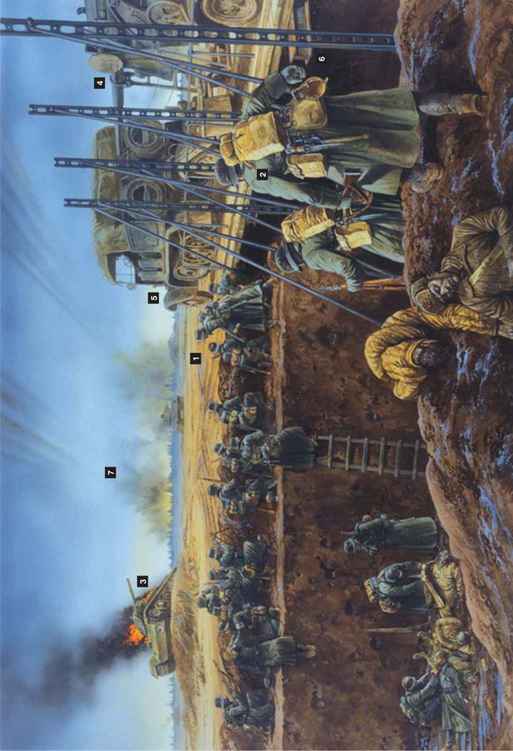
137th Infantry Division assault through the Moscow defenses near Voronino, November 17, 1941. This scene shows infantry (1) and engineers (2) of the 137th Infantry Division negotiating the defenses near Voronino almost due south of Moscow, between Maloyaroslavets and Serphukov. The infantry first fought their way across a steep-sided antitank ditch and then through the primitive earthen field works beyond, losing many men to mines and machine-gun fire. The Soviets quickly launched counterattacks, often supported by tanks (3). Early on November 17, Soviet tanks overran two howitzers; the divisional commander, General Bergmann, asked for reinforcements, in this case 8.8cm Flak 36 guns of Corps Flak Abteilung 707 (4), pulled by their SdKfz prime movers (5) over a tactical bridge erected by the engineers (6). Overhead, Nebelwerfer rockets pound the Soviet lines (7).
In accordance with the blitzkrieg mentality the men of Second Panzer Army sidestepped Tula to the east, and somehow staggered on to Venev by the 24th and actually reached Kashira. There 17th Panzer Division handled Boldin’s 50th Army roughly, drawing Zhukov’s attention, and one of his last reserves, the 2nd Cavalry Corps. This formation, which was renamed 1st Guards Cavalry Corps on the 26th, received substantial CAS, and arrived in Kashira just hours before 17th Panzer. A sharp engagement developed around the town on the Oka River, the last natural obstacle in Guderian’s way. But Belov’s cavalrymen overran that division’s scattered outposts – and then disappeared into Army Group Center’s rear areas, for a five-month rampage.

Unlike their relatively unprepared German counterparts, these warmly dressed and camouflaged Soviet troops – the two-man crew of one of the Red Army’s ubiquitous Maxim M1910 machine guns – are well equipped for fighting in the snow. (Elukka)
Tula proved to be a very hard nut to crack as Boldin’s men held on. On November 27–28 Guderian sent what remained of 3rd and 4th Panzer Divisions on a counterclockwise sweep north of the city. Their armor was consolidated into Kampfgruppe Eberbach, which numbered 110 tanks on the 17th but only 32 a week later. Guderian likewise ordered XLIII Army Corps to come clockwise from the south in an attempt to encircle this obstacle. Personally leading the advance, the panzer general experienced at first hand the difficulties faced by his men fighting in temperatures as low as -30˚ (F). The 340th Rifle and 112th Tank Divisions held open Tula’s last corridor to the outside despite Guderian’s efforts.
On November 27, Guderian added his voice to the growing chorus of Army Group Center generals frustrated at von Kluge’s inactivity. Here is the downside of the Auftragstaktik, revealed at the most inopportune moment; the system trusted the judgment of the commander on the ground to make sound decisions, yet all could see that in having von Kluge lead the Schwerpunkt against Moscow this trust was grossly misplaced. Guderian said that he could not continue assaulting “if the right wing of Fourth Army for its part does not assume the offensive without delay.” Von Bock told Guderian’s chief of staff that such an attack was “out of the question.” Meanwhile, on the army group’s extreme right, the Second Army (with Colonel General Rudolf Schmidt replacing the ailing von Weichs) shoved aside the Soviet 3rd and 13th Armies and made for Voronezh. On von Bock’s southern flank Guderian, aiming northward, and Schmidt, attacking to the east, could offer each other no mutual support. On top of that, the usual combination of terrible weather, weak logistics and Red Army resistance, plus poor coordination with the neighboring Sixth Army (Army Group South’s left flank) conspired to bring Schmidt’s men to a halt by the end of the month, well short of his objective.

A combination of ancient and modern: German supplies are offloaded from a Ju 52 trimotor transport aircraft and onto a horse-drawn panje sled. Distance, weather, terrain and partisan activity made aerial resupply essential on many occasions, but this was a task for which the Luftwaffe was inadequately equipped. Meanwhile, the Red Army was also using air transport: Stalin flew 5,500 men of 1st Guards Rifle Corps to Orel in just three days. (Podzun)

While railcars full of undelivered winter clothing and equipment sit idle in Germany, these Ostfront soldiers have to make do with bed sheets and tablecloths. (Topfoto)
Von Bock Versus Zhukov: Center
Supposedly the Schwerpunkt in the critical Mozhaisk sector, the Fourth Army fought a defensive battle while the armor attacked on its flanks. With the motto “Moscow is behind us!” Zhukov felt secure about this critical sector. He would concentrate on the wings while keeping a wary eye on the expected attack up the middle.
While Third and Fourth Panzer Groups advanced early in the offensive, von Kluge launched some preliminary attacks with his left on November 18–19. However, according to von Bock, the right wing of Fourth Army was “very serious and precarious.” Von Kluge paraded a series of excuses for his inaction, to the extreme annoyance of Halder. Von Bock discussed with the chief of staff the possibility of asking von Brauchitsch to give the balking Fourth Army commander a direct order to attack. For over a year the German Army had been anticipating the final assault against Stalin’s capital, and now that the moment had arrived the commander of the main effort would not move.
Von Kluge finally stirred himself and attacked in earnest on December 1 in the direction of Naro–Fominsk, with XX Army Corps under the Austrian General Robert Materna flanked by LVII Panzer (total tank strength: 70) and IX Army Corps. Initial success against the 43rd Army offered a slight glimmer of hope when it looked as if 258th Infantry Division might achieve a breakthrough, hitting the second-echelon 5th Army defending the Minsk–Moscow highway.

A Red Army artillery firing position in the winter. During Barbarossa, Soviet artillery did not yet play the decisive and dominating role that it later would. During the summer and autumn of 1941 Zhukov husbanded his artillery for the battle that he knew would develop around Moscow. (Elukka)
Von Kluge correctly aimed his attack against the Mozhaisk line, but Zhukov anticipated the blow and had a counter. On the assault’s second day 33rd Army (Lieutenant General M.G. Yefremov) attacked with the 5th and 11th Tank Brigades plus one tank and two ski battalions. T-34s and StuGs hunted each other through the villages, which Soviet aircraft bombed simply to deprive the invaders of any shelter. The German troops scattered in uncharacteristic panic and soon reoccupied their starting lines. Von Bock did not know what to think; on December 2 he told von Kluge, Hoepner, and Reinhardt that the Soviet forces were ready to break, but a day later he told Halder that he “doubted the success” of the Moscow operation.
Immediately following the battles for Viazma and Bryansk, Von Bock had had the defenders of Moscow reeling. When he did eventually resume offensive operations in mid-November, he could only do so in fits and starts. Having already given the Soviet divisions weeks to catch their balance, he now attacked sequentially over a period of weeks – which allowed Zhukov to parry in a corresponding fashion.
During the Ostheer’s last lunge toward Moscow, Third and Fourth Panzer groups advanced between 50 and 60 miles, finally arriving 12–20 miles from the Kremlin. Their pressure near Yakhroma made November 27 a real day of crisis for Zhukov, although neither side was fully aware of the fact at the time. The relatively under-resourced Second Panzer Army never got as close to Moscow and after Tula took no objective of even tactical value. Guderian, Hoepner, and Reinhardt all clamored to be designated as the assault’s Schwerpunkt (the Wehrmacht could only resource one at a time), while the man given that distinction, von Kluge, did not know what to do with it. The three panzer commanders all complained about von Kluge, who in turn complained about them. Von Bock could not manage his unruly subordinates. Before Moscow he alternated between making analogies with the Marne in 1914 (where the younger von Moltke failed to take Paris at the last moment due to lack of nerves) and Verdun in 1916 (comparing the Soviet capital to the meat-grinder battle into which both armies fed more and more men).

A miserable-looking German horse convoy braves a severe blizzard. (Corbis)
Only at the Orsha conference did Halder finally realize the desperate condition of the Wehrmacht in Russia. In a juxtaposition of points of view, the chief of staff then decided that German forces must only threaten Moscow, not capture it. Hitler overrode Halder, stating that they needed to conquer the city. But how? This was the bizarre relationship between Germany’s political leader and his generals. Hitler had his contradicting views; Halder had his cyclothymic moods. They made a study in despair that hamstrung Operation Typhoon.
By contrast, at the beginning of Typhoon the Red Army defense of Moscow suffered from apparent terminal disorganization. Six weeks later Zhukov had undisputed command of the entire theater and Stalin’s full confidence. Only when it was far too late, by November 29 to judge from Von Bock’s diary, did the German leaders acknowledge the USSR’s “huge reserves.” Stalin, Stavka, and the entire Soviet command structure had been waiting for Typhoon (and by extension, Barbarossa) to reach its culminating point so that they could begin their general winter counteroffensive. Between November 29 and 30, Zhukov briefed the dictator on the attack that would mark the end of both German advances and Moscow’s danger. The anemic Army Group Center, with its long, indefensible lines of supply and uncovered flanks, was ripe for the taking.

Soviet cavalry in winter clothing. The cavalry arm was well suited for operations in the winter and Marshal Timoshenko used this to good advantage during his counteroffensive at Rostov. (NARA)
Summary
It can be said that Barbarossa ended with a whimper rather than a bang; there was no deafening crescendo, just the dreaded Flucht nach Vorn (fleeing forward) because the two other options, stopping or retreating, were just too distasteful to the German commanders. Along the great mass of the front line in early November they dug in. At the northern and southern extremities, Tikhvin–Volkhov and Rostov, the Ostheer launched small, one-two corps sized attacks. Of course at Moscow they fought a huge offensive with six armies.
The campaign’s fourth phase, Operation Typhoon, began with great promise. In a way, the starting lines looked eerily like those on Barbarossatag over four months earlier, with both armies drawn up face-to-face along hundreds of miles of front. Forces were greatly reduced due to the incessant fighting, but their relative qualities were very similar: a veteran Ostheer complete with mobile elites versus a relatively inexperienced Red Army soldiery (about the fourth completely new iteration to face the German forces). The main difference was at the top: the constant string of crushing German victories in battle had only confirmed the leaders’ earlier hubris, while the equally constant string of crushing Soviet defeats had culled out their worst leaders. That left the Wehrmacht dreaming of objectives hundreds of miles east of Moscow on one side against hard-headed realists on the other.

Pairs of well-clothed Soviet soldiers overcome a stout barbed wire obstacle. Under Zhukov the Red Army had little trouble transitioning from defense to offense. (Corbis)
The undeniable success of Typhoon gave Barbarossa’s final stage a look of invincible inevitability. Within ten days another million Soviets, dead and captured, were wiped off the Red Army order of battle. Propaganda Minister Goebbels, himself no military man, gushed with comparisons of Köningsgrätz and Sedan. But these battles, like Typhoon, had been operational victories. Hitler needed strategic success if he hoped to bring down the USSR, but, even with Typhoon’s relatively shallow Kessels and the German infantry all up close to the starting line, reducing and securing the pockets consumed valuable time. Exhaustion, poor logistics, and the rasputitsa would put the final bullets into the German leaders’ plans to rush into an undefended Moscow.
Von Leeb, fighting his “poor man’s war” in the north, predictably accomplished the least during Barbarossa’s finale. His already-smallest army group was made even smaller by the detachment of Hoepner’s panzer group in mid-September. The northern theater’s geography, always bad thanks to nature, got worse as the German troops settled in to besiege Leningrad. Here, all their advantages of mobility were negated. The attacks to Volkhov and Tikhvin were begun too late in the year, with too few forces and as too much of an afterthought to have any decisive success. Earlier in the year, with Hoepner’s full panzer group and as a part of conscious and coherent plan, one can easily see the operation covering the last 40 miles to the Finns waiting along the Svir River.

Von Rundstedt also had to ante-up for Typhoon, although proportionally his losses were not as great as von Leeb’s. Again reducing and securing their great Kessels, in this case Kiev’s, took more time and resources that the German leaders would have liked. Formations not involved at Kiev, the Eleventh Army, or with the mobile flexibility to avoid Kessel cleanup duty such as First Panzer Group, pushed on to the southern Ukraine and Crimea. This was von Rundstedt’s first and most significant exploitation of the Soviet’s post-Kiev disorganization.
The Eleventh’s successes on the confined Perekop isthmus demonstrated the German Landser’s continued dominance over his Soviet counterpart. Meanwhile the Red Army had no meaningful counter to von Kleist’s thrust into the Donbas. With the Kiev area subdued and occupied by early October, Sixth and Seventeenth Armies did reap some benefits from the emaciated Soviet defenses east of Lokhvitsa. Stuck in the relative no-man’s-land between the more spectacular events of Typhoon and Rostov, these two infantry armies would have to be satisfied reaching Belgorod and Kharkov plus the middle Don River. The fleeting glory of Rostov turned out to be too exposed to be viable so von Kleist settled in along the more sensible Mius River.
During the awkward time between Typhoon and the penultimate assaults on Moscow, von Bock’s men jockeyed for position from which to begin the latter when the final word came. With difficulty Hoth took Kalinin while Guderian only brushed with Tula. Despite tremendous losses sustained during Barbarossa’s previous five months of fighting and marching, German commanders believed they could carry Moscow. Since the beginning of Typhoon the Red Army had suffered the loss of 2 million men, including 750,000 dead. Add to that the additional million casualties from the battles in the Ukraine in September and there was no way the German High Command figured the USSR could possibly make up a 3 million-man shortfall. However the organizational prowess of the Soviet state did just that, to the astonishment of the Wehrmacht and much of the world. Of course it should be noted that the failure of Japan to threaten the Soviet far east did Stalin an immense favor in this regard.
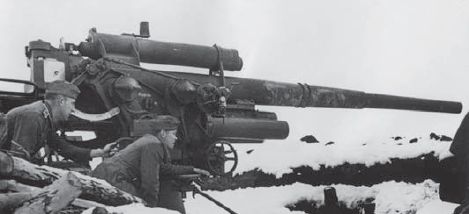
Adapt and overcome: the German 8.8cm Flak 18 gun changed roles and became famous throughout the European theater as the ultimate direct fire antitank weapon. (HITM)
Only Moscow was worth the all-or-nothing ultimate risk. Over a three-week period Army Group Center’s Schwerpunkt shifted from Reinhardt/Strauss in the north to Guderian/Schmidt in the south to Hoepner/von Kluge in the center. Only in the first case was Zhukov’s defense seriously tested. To the south Guderian’s luck ran out while Schmidt’s strength was dissipated on such improbable and widely separated objectives as Tula and Voronezh. In the center Hoepner practically went it alone against the teeth of Zhukov’s defensive main effort. His nominal superior and the man on whom the Ostheer’s forlorn hope rested, von Kluge, was nowhere to be seen. David Stahel believes that as reward for von Kluge’s support during the German leader’s July–August command meltdown, the Führer took it easy on the field marshal when it was clear that the latter had utterly failed at Moscow’s gates.
Reading Barbarossa
The literature of Barbarossa, and indeed the entire Nazi-Soviet War, has undergone many permutations since 1945. In the immediate post-war period mainly the Germans and Soviets themselves wrote about the Eastern Theater. Participants on both sides, mostly the generals, wrote their memoirs while the Soviets published voluminous official histories and campaign analyses. But the Eastern war’s complexities, paucity of English language sources and the fact that few Americans or British served in the theater meant it initially received very little coverage in western literature.
Dividing Europe into NATO and Warsaw Pact camps, the rearming of Germans in both zones and other factors meant the histories soon fell under the spell of the Cold War. Especially in the West there was a need to prove that the Soviets could be beaten and the West Germans were the ones to help do it. Therefore, books at the time usually portrayed the Red Army as an unskilled mass which managed to win only due to its size, its willingness to accept casualties, and the amateurish interference of Hitler. Meanwhile the Wehrmacht supposedly fought a chivalrous war sullied only by Nazi Party hacks in the SS. After all, the captains and colonels of the Ostfront were soon the generals of the Bundeswehr. German memoirs and histories by the likes of Paul Carell (himself a wartime Nazi propagandist) are examples of this genre. The US Army employed former Wehrmacht generals to write monographs about the East under the suspect supervision of Franz Halder. In 1960, the Soviets published the six volume, English version of their official History of the Great Patriotic War of the Soviet Union, 1941–1945. Today it seems dated and an ideological curiosity.
A third wave of “Russian Front” historians came along in the early 1960s. Using some official Soviet sources, British historians like John Erickson and Alan Clark helped redirect the Anglophone audience away from North Africa, Normandy, U-boats, strategic bombing, etc while beginning to correct the earlier, skewed impressions of the Nazi-Soviet War. Earl Ziemke added his two volume history, almost the official US Army version, ironically starting not with Barbarossa but with the war’s later phases. In the early 1980s another American, Lieutenant Colonel David Glantz, began what can only be described as a one-man mission to set straight the record of the Nazi-Soviet War. Around the same time academic, as opposed to popular, German historians started to make serious contributions to the historiography.
The fall of the Berlin Wall and the collapse of the USSR ushered in a fourth generation with new access to former Soviet documents, intellectual freedom for Russian speaking historians, reduction of Cold War prejudices and advantages of the information age. Glantz continued to lead the way to the point of endangering his personal health. Israeli Omer Bartov demolished the myth of the squeaky-clean, apolitical Wehrmacht while American Geoff Megargee did the same for the vaunted German general staff. An invaluable addition to the literature came in 1998 with the MGFA (Military History Research Office now called ZMBW) series “Germany and the Second World War,” which can be considered close to the Federal Republic’s official history of World War II. Works by MGFA and BA-MA (Federal Military Archive) historians Boog, Förster, Müller, and Ueberschär are practically guaranteed to be excellent. Most recently (early 2013) Australian David Stahel is half way through his very in-depth study of Barbarossa.
Of course the historiography of the Nazi–Soviet War includes countless excellent authors and books not mentioned here. However, there are also completely discredited works like Icebreaker by Viktor Suvarov and those of doubtful analytical value such as Russell Stolfi’s Hitler’s Panzers East. Perhaps even more than most history, books on the Nazi–Soviet War should be read critically. Memoirs, books by authors like Carell and Haupt, or divisional histories published by veteran groups can probably be trusted for objective facts, such as the date a certain regiment was in a specific location, but should be viewed skeptically when discussing subjective judgments.
With the above caveats in mind, I would recommend any of the books in the present bibliography. Gabriel Gorodetsky’s Grand Delusion gives an outstanding description of Stalin’s behavior leading up to Barbarossa. Despite its title, Stopped at Stalingrad by Joel Haywood has excellent coverage of the 1941 campaign. For a unique German perspective, see Klaus Reinhardt, Moscow, The Turning Point. The Wages of Destruction by Adam Tooze set the new standard for economic history of the Third Reich and has much to say about Barbarossa. The examination of the campaign in H.P. Willmott’s The Great Crusade, probably the best short, single-volume history of World War II, contains the excellent analysis of the fighting in 1941 we have come to expect from that prolific historian.
In any event, at no time during Barbarossa’s last month do we see firm German leadership of the Moscow offensive. Halder was dreaming about Gorky and Stalingrad. Von Bock could neither control his subordinates nor coordinate the three main attack axes. By December 1 he evidently sensed the inevitable and requested either major reinforcements or permission to fall back to defensible lines. But hours later he then turned around and told Jodl he wanted to keep going on to Moscow! It is hard to see the hand of Hitler, the bogeyman in the generals’ disingenuous postwar sniveling and excuse-making, in any of this nonsense.
29 Hayward, Before Stalingrad, p.138.
30 On the same day Hitler ordered that no Germans were to enter Leningrad, Moscow, or other major city, casting doubt on his desire to actually occupy Stalin’s capital.
31 “Winter quarters” is a queer, almost 18th-century concept, considering that during Barbarossa both armies had caused massive destruction (i.e., scorched earth) throughout the German rear areas and the entire tactic implies contracting to inhabited locales and then surrendering vast areas between them to a dynamic enemy.