
CHAPTER 4
′Forward on wings of flame to final victory’
Winston Churchill 23 March 1945
WITH THE WEATHER and state of the river all looking suitable for the assault crossing and airborne drop, ‘At 1530 hours on 23rd March, I [Montgomery] gave orders to launch the operation...’
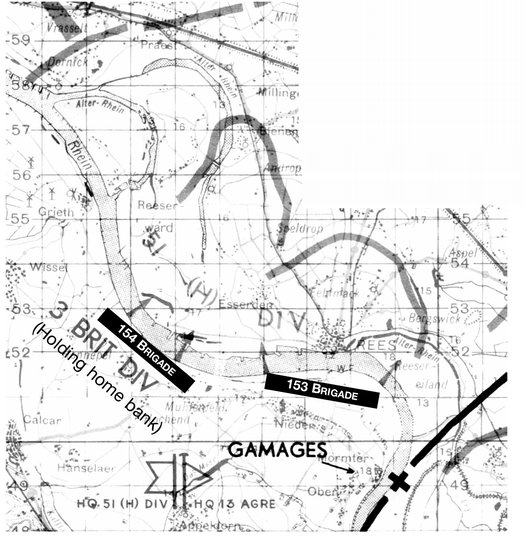
51st Highland Division was to lead XXX Corps’ assault across the Rhine at 2100 hours on D-1. With elements of 3rd Division holding the home bank in the Corps’s sector, the initial crossing was to be launched from the area from opposite the German-held town of Rees northwards. Two battalions each from 153 and 154 Brigades were to form the leading flight in what were to be the opening moves of Second British Army’s largest amphibious assault operation since D-Day.
XXX Corps’s orders for the initial phase were:
′...to capture Rees and Haldern and establish a bridgehead sufficiently deep to permit bridges to be built, preparatory to a further advance into Germany. 51 (H) Division, with under command 9 Canadian Brigade of 3 Canadian Division, was to assault and secure the initial bridgehead, 9 Canadian Brigade being committed on the LEFT flank. Immediately after, one infantry brigade and divisional headquarters of 43 (Wx) Division were to be passed across the river. 43 Division was to take 9 Canadian Brigade under command and relieve the LEFT brigade of 51 (H) Division.
At least a part of the purpose of 51st Highland Division’s preliminary assault crossing, five hours before the main effort by 15th Scottish Division, was to widen the frontage of the assault, in order to give a larger objective for the inevitable German counter-attack and to draw away German reserves from the Xanten – Wesel area. In other words, it was a classic Montgomery move designed to unbalance the enemy before the main blow fell.

XXX Corps (above) and 51st Highland Division.
Major General Rennie’s plan for 51st Highland Division was to assault with two brigades, 153 and 154. Their initial tasks were to secure the bank and objectives little more than a thousand yards inland. In the case of 153 Brigade, their second wave (1 Gordon) was to capture Rees, while that of 154 Brigade (1 Black Watch) was to expand the bridgehead by capturing the villages of Speldrop and Klein Esserden. 152 Brigade was to send a battalion (2nd Seaforth) over the river to support 153 Brigade in the capture of Rees before midnight on D-1. The remainder of 152 Brigade were to follow and further expand the bridgehead.
The area chosen for the Highland Division’s landing was bounded by one of the horseshoe lakes (meres) and marshy areas created when the Rhine abandoned its old course. This provided the 51st Highland Division with some protection, however, to expand northward the villages of Speldrop and Bienen had to be taken. Speldrop itself lies at the centre of the great horseshoe and Bienen at its northern end. The Germans had fully appreciated the tactical value of these places, and had prepared counter-attacks which they could launch promptly.
In the area that 153 Brigade were to assault, the cover from view and fire offered to the enemy by the small riverside town of Rees was exploited to the full and was known to be occupied by elements of 8th Fallschirmjäger Division. Positioned amongst the buildings on the river’s edge, the determined Fallschirmjäger were able to dominate potential crossing points astride the town and the flood plains, especially that immediately to the east. Artillery observers had good positions of observation from Rees Cathedral and mill tower across the whole area. As Lieutenant General Horrocks was to bemoan, XXX Corps’s ‘...bad luck that once more we should be faced by these diehard Nazis ... we heard stories, from US and our flanking corps, of German soldiers surrendering in their thousands ... while we had to fight hard right up to the end’.
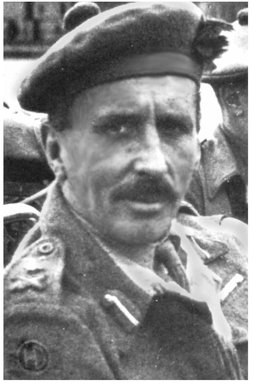
Major General Rennie.
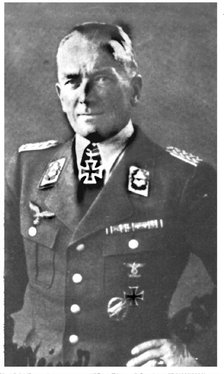
Generalmajor Miendel, commander II Fallschirmjäger Korps.
Final Preparations and the Bombardment
Assembly and thorough briefing of the force, was one of Montgomery’s prerequisites for success and the few troops who took part recall more comprehensive briefings since those during the run-up to D Day. As already recorded, the assault troops had moved into their forward assembly areas in the woods and valleys, three miles west of the Rhine, all being in position early on 23 March (D-1). Here they slept, waited and carried out their battle preparations; last letters were written, radios, other specialist equipment, weapons and ammunition were checked and cleaned and life jackets fitted. Company commanders read Montgomery’s message to their soldiers, while quartermaster sergeants brought up hot food, the last to be seen for some time and finally faces were blackened.

Sappers prepare the carpet that their LVT will use to create an exit from the river.
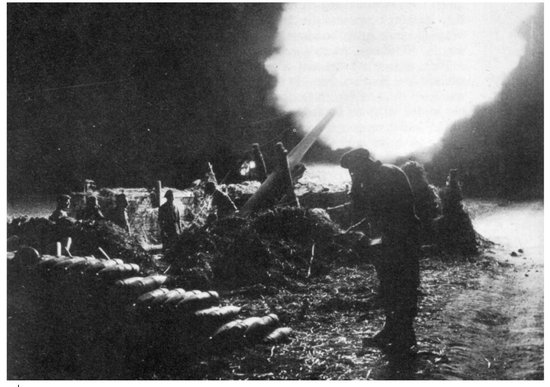
A British 5.5 inch medium gun in action at night.
The first troops to move down through the units holding the Rhine to the river bank were the Royal Engineers. As night fell, at 2000hrs 3rd Division’s Sappers started work on creating gaps through the dykes and ramps down into the river. Behind them, other sappers, including 50 GHQ Engineers, began to build roads, such as that which became known as Caledonian Road, across the flood plain to the gap in the bank. In maintaining and improving the gap the Royal Engineers ‘were subject to almost continuous, and at times heavy, enemy shell, mortar and machine gun fire throughout the night and some forty-five casualties were caused’. Despite the attentions of the enemy, several lengths of road up to 800 yards long were successfully laid during the night of 23/24 March.
Finally, in darkness, the time came and, around 2030 hours, as described in Second Army’s history, the
′... assault formations slipped out of their hides and turned their LVTs towards the east. Across the broad floodplain toward the dark swift-running waters of the great barrier of the R Rhine amphibians picked their careful paths, assisted by movement light. A tremendous artillery barrage roared encouragement. The curtain had risen on the opening phases of the last battle of the European war’.

As there was little chance of forming up on the riverbank without being detected by the enemy, the assault force were all mounted in LVTs and, with the DD tanks of the Staffordshire Yeomanry following, motored down to their crossing points on pre-recced routes. Covering the sound of movement and softening up the 8th Fallschirmjäger Division, who were dug-in on the far bank, was the bombardment that had begun at 1700 hours and by 2100 hours, it was being fired by all the available guns of 21st Army Group. This was the beginning of what was reckoned to be the greatest British artillery bombardment of the war being fired by some 5,500 guns. 112 Field Regiment, for example had to take part in firing two fireplans codenamed ‘Snifter’ and ‘Sherry’ and a ‘milk round’ of counter battery tasks all against identified enemy gun and mortar positions. Just before H Hour, other regiments engaged some of the areas on the opposite bank with the aim of detonating enemy landmines.
Major Martin Lindsay of 1 Gordons, recalled that:
′There was a continuous ripple of slams and bangs as all our guns, stretching across so many fields behind, were firing, and it went on for four hours ... meanwhile quite a lot of stuff was beginning to come back from the other side, mostly medium and light mortars. One mortar in particular was dropping its bombs all round this house. At 7.30 p.m., there was still one and a half hours to go. A tremendous rumble of guns behind us, their shells whistling overhead, and the nice sharp banging sound of our 25-pounders landing on the far bank.’
Lieutenant Beck, Gun Position Officer of B Troop, 341 Battery, 86th Field Regt RA (Herts Yeomanry) recorded in the battery command post log that not all went well for the gunners:
′The operation began with the roar of massed guns at zero hour and the firing continued all night. Bofors, mortars and rocket guns all joined in and the air was alive with tracer shells being pumped into the defences on the opposite bank. Soon after midnight, an unfortunate accident occurred on D Sub of A Troop. No one will ever know what happened but it would seem that in loading the gun in the dark the loader accidentally hit the shell fuse against the breech. Normally this would not cause an accident but the fuse must have been faulty. The shell exploded killing instantly the occupants of the compartment ... it was a grim reminder that the shells the gunners handled so easily were lethal. We had become so accustomed to them that we had almost ruled out the possibility of danger, the safety devices were known to be foolproof.
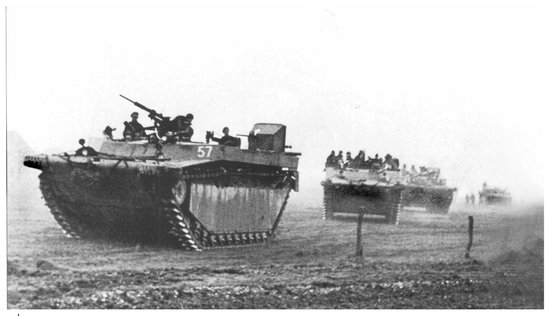
LVTs making their way down to the river in the fading light and smoke.
The Assault Crossing
Mounted in 150 amphibious Buffaloes, with one troop of four LVTs per infantry company and attached personnel, the leading four infantry battalions of 51st Highland Division reached the final holding area. The nucleus of the Bank Control Group was provided by the Royal Dragoons, dismounted from their tanks for the task. This unglamorous but absolutely vital job, according to Corps Commander, General Horrocks, ‘... was no easy task, as units had to be marshalled into their correct area and / or lanes in the dark, while all moves were coordinated with extreme accuracy’.
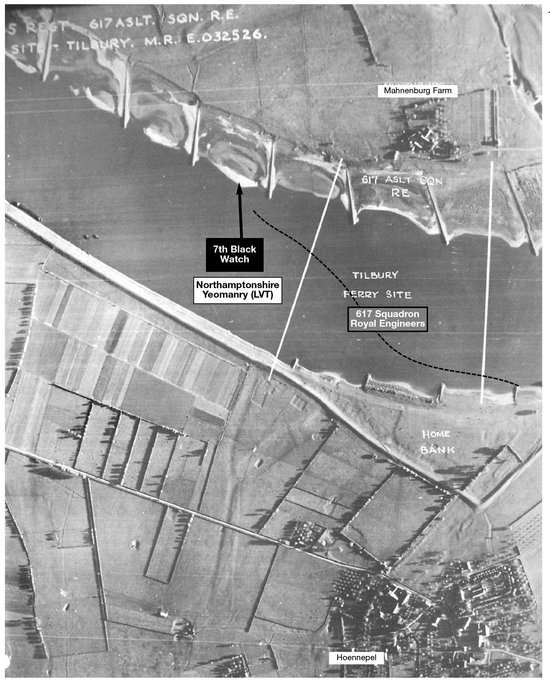
Captain Stafford of 617 Assault Squadron RE, who were to establish a ferry near Mahnenburg once the initial crossing had been made recalled:
The great night of 23 March arrived and I with my troop sergeant, loaded up the scout car with recce equipment and, at 1800 hours, we moved up to the forward assembly area of 1 BW, with whom we were to cross the river that night. We arranged to lie in hiding in Honnoppel until H Hour..., and then to proceed to the LVT loading point 400 yards behind the flood bank, where we were to get a lift across the river [as a part of the second wave].
The period between 1900 and 2100 hours was one which I’ll never forget. Every gun in the area was taking part in a most terrific barrage and at times I thought our machine guns might have done well to raise their fire a few feet higher, as the tracer seemed dangerously close. By 2100 hrs, the barrage reached its peak, and the assault wave left the home bank.
Through the gaps and into the water went the LVTs. Cpl James Campbell of 7 Argyle & Sutherland Highlanders recalled the four minute trip across the river in the Buffalo:
We got into our Buffaloes and ran down to the river, with the artificial moonlight going – that is searchlights shining on the cloud base and reflecting back down on the water – all you could hear was people shouting ″turn these so and so lights off″ because we felt that we were silhouetted on the river and if we could see two or three hundred yards up and down the river then so could the Germans see us sat out in the middle like ducks.
There was quite a bit of machine-gun fire from the German side of the River. Although we had a point 5 calibre machine gun on the Buffalo we were only too glad to be out of the river and across the other side.
Trooper Walter Fuller of 4 RTR recalled:
For this operation our Shermans had been replaced with American Buffalo amphibious tanks, supporting the 51st Highland Division. It was pitch black as we led our tanks into the water, we couldn’t see and had no idea what to expect, other than that being the first unit over the Rhine no doubt meant resistance would be heavy. It was an extremely nerve-wracking crossing, especially as we had only just changed over from the Shermans we were used to! After a while though we realised that in fact there was next to no resistance and our crossing was all but uncontested, which was a huge relief. When we reached the other side I remember one man, Colonel Alan Jolly [CO 4 RTR], planting the regimental flag on the eastern bank of the river. It was in fact the very same flag taken into battle by the unit in the First World War and was a proud moment for us all.
While for most things went well during the crossing of the first wave, but for Bill Robertson of 154 Brigade things looked difficult for a time.
My most vivid memory of WWII was crossing the Rhine ...1945, four days after my 19th birthday ... in amphibious vehicles called Buffaloes which were run by the Northamptonshire Yeomanry. We were half way across when our tracks locked and we went around in a circle and drifted. We all thought we were going to have to jump or swim for it, but at the last minute the tracks started up again.

8 Fallschirmjäger Division
General Horrocks, accompanied by his tactical HQ, with little else to do at this point in the battle, had climbed into an observation post on some high ground overlooking the Rhine. He recalled that ‘All around me were the usual noises of battle but I could see very little except the flicker of the guns’. Horrocks, however, did not have to wait long before, at 2117 hours, he received the message timed at 2104 ‘The Black Watch has landed safely on the far bank’.
154 Brigade
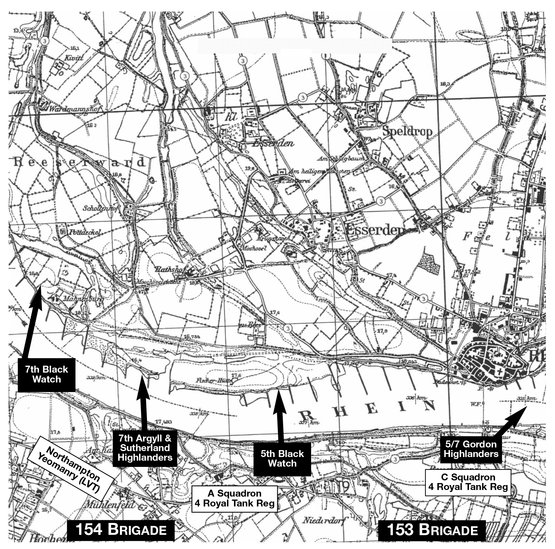
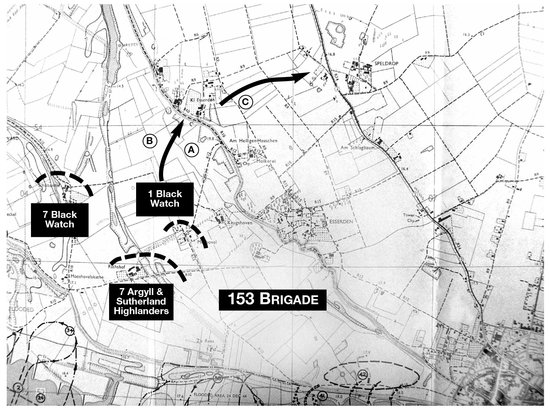
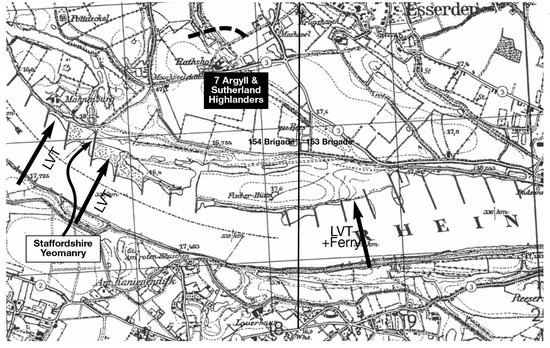
The task given to Brigadier James Oliver was to form a bridgehead a mile and a half deep, to the east of Rees, including the villages of Klein Esserden (not to be confused with Esserden which was in 153 Brigade’s area) and Speldrop. The assault was to be led by two battalions, 7 Black Watch and 7 Argyls, with the third battalion, 1 Black Watch, crossing into the bridgehead later.
7 Black Watch (first to report their landing and suffer casualties) and 7 Argylls and Sutherland Highlanders, crossing on the Division’s left, climbed up the steep banks, out of the river in their tracked amphibians with a little difficulty, astride Mahnenburg. One of the Northamptonshire Yeomanry’s LVT was knocked out by a Teller-mine, on the enemy bank. While 7 Black Watch were debussing from their Buffaloes, further casualties were sustained from anti-personnel Schumines that had been scattered thinly along the banks. Accompanying the infantry were engineers of 274 Field Company, whose task was to clear the bank of mines before the arrival of the subsequent waves, as well as helping construct exit ramps to ease their passage.
C Company 7 Black Watch secured their battalion’s bridgehead, while B Company advanced on Potdeckel. Once secure A Company set off to their objective of Scholtenhof, further inland. Lieutenant Colonel Cathcart’s Tactical HQ was established in Potdeckel with B Company. D Company then advanced between A and B to complete the battalion’s initial objectives and took the hamlet of Wardmannshof, with the assistance of two Wasp flame-throwers. C Company remained in reserve, securing the bank for subsequent waves. By dawn the ‘Black Jocks’ had coordinated their defensive positions and were digging-in, with detachments of medium machine gunners from 1/7 Middlesex, in time to beat off a Fallschirmjäger counter-attack that was launched under cover of the early morning mist.
Meanwhile, 7 Argyll and Sutherland Highlanders after an uneventful crossing in the Buffaloes of the Nottinghamshire Yeomanry, who had landed the battalion exactly as intended, set about executing their plan, which Captain Ian Cameron recalled:
The plan for the 7th Argylls was to attack with A Company forward on the right and B Company on their left, with D Company following up behind A company. A Company were to make for Ratshoff, which was a small village, and B Company were to make for a farm a bit to the left of this. D Company were then to go through A Company and make for a crossroads beyond Ratshoff.
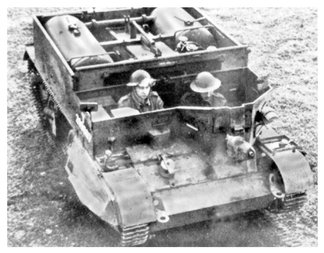
An early version of the Wasp flame-thrower conversion of the Bren gun carrier, issued to infantry battalions with two tanks holding a total of 100 gallons of flame fuel.
On reaching the enemy bank, ‘the cordite and smoke from the creeping barrage was hanging low over the area and the general atmosphere resembled a London fog’. It was only a matter of minutes before the companies found their bearings and set off towards their objectives around Ratshoff and the crossroads beyond. ‘The first phase went according to plan, and all companies captured their objectives quickly against light opposition, along with about 100 prisoners.’

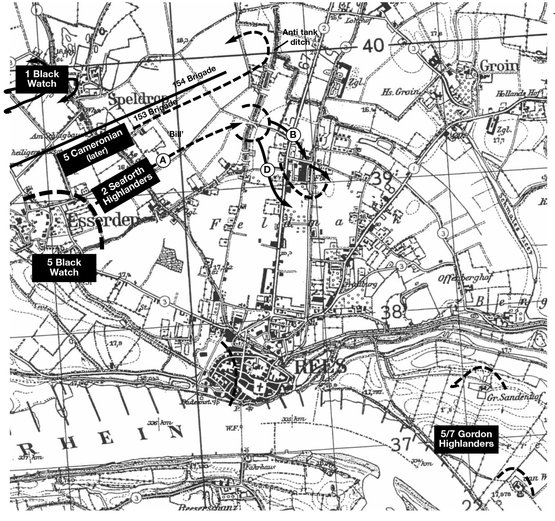
Phase One Operations of 154 Brigade 23/24 March 1945
Thus, the initial phase of 154 Brigade’s part in the operation had been completed remarkably smoothly, against Fallschirmjäger, who were thinly spread and still stunned by the tremendous bombardment. Well before dawn, the leading battalions were digging-in to form a firm bridgehead. The Brigade’s reserve battalion 1 Black Watch was crossing and moving up to expand the bridgehead in the Brigade’s second phase.
At 2100 hours Black Watch was forming up in the assembly area awaiting the return of the Buffaloes from the river. Crossing with the Black Watch was Captain Stafford and his RE recce party.
My troop sergeant and I left our scout car and walked off, loaded with a wireless set, mine detectors, prodders, tracing tape, numerous small hand lamps, etc, to the LVT loading point. After a short walk, we boarded a Buffalo, sat on top of a small armoured car, up went the ramp and off we went for our short ′swim’, I might add that up to this time enemy fire had been negligible, but the sky was lit up by a chandelier type of flare which, made me feel most conspicuous.
1 Black Watch touched down on the far bank just after 2300 hours and passing through 7 Argylls, made for the villages of Speldrop and Klein Esserden. They soon ran into trouble; and Major Richard Boyle was killed leading B Company on the approaches to Klein Esserden, which according to the Battalion’s post operational report ‘... was a strong position of houses and deep minefields, resolutely defended by parachutists’. To make matters worse and deny crucial fire support, the artillery observation officer’s carrier and his radio were destroyed by a mine. The battalion was now unable to contact the artillery back on the home bank and could not adjust fire, which would normally deliver a crushing blow to the enemy before the infantry’s final assault. With heavy enemy mortar fire directed at them, 1 Black Watch was suffering casualties. However, virtually unsupported, A Company took the Creamery on the outskirts of the village without much difficulty and B Company, with only one officer left unwounded, went on to occupy the main part of Klein Esserden. C Company advanced on Speldrop a thousand yards away. In reaching Speldrop they had succeeded in isolating Rees from the north west, thus protecting the left flank and 1 Gordons (153 Brigade) who would be attacking Rees from the west, from start lines behind the Black Watch. By 0600 hours, the Commanding Officer, Lieutenant Colonel Hopwood was reporting, from his Tac HQ, now established in the Klein Esserden creamery, back to Brigade HQ that he had moved forward from the river bank and that his companies had taken their objectives. The Black Watch had far more of a fight against Fallschirmjäger who had the opportunity to recover from the bombardment, as well as benefiting from the support of immediate reserves. To make matters worse there were soon disturbing reports that C Company in Speldrop were under mounting pressure from Fallschirmjäger counter-attacks.
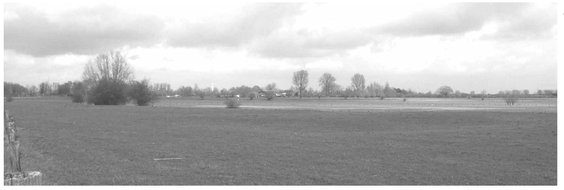
The view from the river dyke inland to Esserden over the country to be crossed by 5 Black Watch.
Under darkness and mist, a very heavy enemy counter-attack had infiltrated into Speldrop and C Company, who were fighting in the buildings, which they had not had time to prepare for defence were forced to give ground. In addition, their ‘bag of sixty German prisoners had already to be set free’. Such was the danger of the company being overwhelmed and Colonel Hopwood decided to withdraw them at 0800 hours and subsequently B Company were also forced back. Both companies were brought in behind A Company in the area of the Creamery. One platoon of C Company was, however, isolated and could not pull back with the rest of the company.
Lieutenant Robert Henderson, a nineteen-year-old subaltern, volunteered to go out with a fighting patrol to attempt to extricate the lost platoon. Advancing along a hedgerow his patrol came under intense Spandau fire. Virtually pinned down, Lieutenant Henderson ordered his men to remain in cover; along with a Jock armed with a Bren gun, he crawled along a shallow ditch at the foot of an embanked road. A machine-gunner, however, spotted and engaged Henderson, killing the Bren gunner and knocking Henderson’s Webbly revolver out of his hand. The officer seizing his shovel from the back of his pack, charged the Spandau-gunner and sliced his head open with a blow from his shovel. Waving the patrol forward, he led them into a house at the edge of the village, before himself going back some sixty yards under heavy Spandau fire to recover the dead gunner’s Bren gun. Lieutenant Henderson and his patrol were forced to abandon the building, which was on fire, as the Fallschirmjäger counter-attacked. They moved to another house, from which the enemy failed to move them. ‘There it [the patrol] held out all day, and was finally caught up by the advance in the evening.’ Lieutenant Henderson was awarded an immediate Distinguished Service Order for this determined action, which provides an insight into the nature and horror of close quarter battle.
The loose straggle village of Speldrop from Klein Esserden.
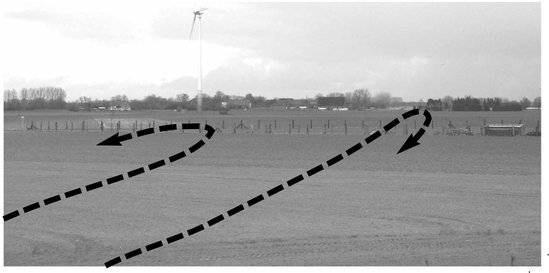
By 0800 hours, with a very active and determined defence being mounted by the fanatical soldiers of 8th Fallschirmjäger Division, 154 Brigade had a secure bridgehead but had failed to hold both Esserden and Speldrop. The loss of 1 Black Watch’s artillery forward observation officer, without a doubt contributed to this, but immediate and ferocious counter-attacks were always to be expected from the Germans and the Fallschirmjäger in particular.
153 Brigade
Also crossing at 2100 hrs, Brigadier Roddie Sinclair was allocated the divisional main effort, the capture of the town of Rees and forming the easterly or right hand sector of the Highland Division’s bridgehead. 5 Black Watch and 5/7 Gordon Highlanders, carried in 4 RTR’s Buffaloes, were to land astride Rees. Crossing with the Brigade and under command, were the 3.7-inch howitzers of Captain McNair’s 454 Mountain Battery RA. These were the only artillery guns that could be transported in the Buffaloes, as they could be dismantled and taken over obstacles, as generations of visitors to military tattoos knew (the Royal Navy gun team race is the only modern equivalent in current British Service). The role of the gunners, brought from training in the Inverness area, was to provide intimate support to 1 Gordons during the battle for Rees.
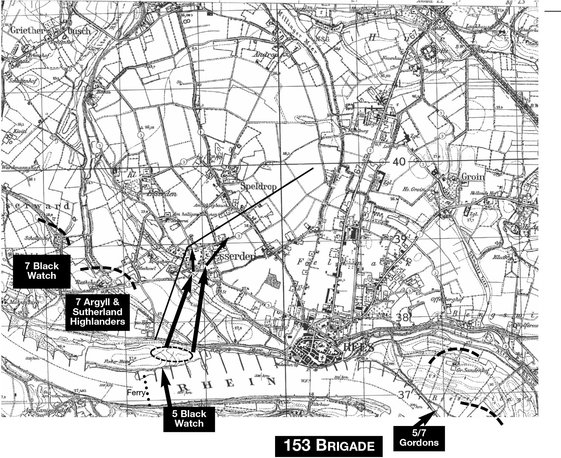
5 Black Watch had boarded their Buffaloes in some small woods south of the village of Appeldorn, three miles from the Rhine and had, as far as they were concerned, a good crossing. In fact 4 RTR had difficulty in climbing out of the river because of the stone clad enemy banks that damaged a high proportion of the LVT’s tracks. This event of ‘Clauswitzian friction’ was to have a significant impact on subsequent operations. Debussing on the enemy bank, 5 Black Watch benefited from some very good reporting of likely enemy minefields by 3rd Division, that was based on observations of the areas where the Germans had been moving about without restriction. The Black Watch also benefited from the British barrage, which:
... had been murderously heavy; it had included salvos of rockets fired from tanks; much of the kick had been taken out of the defence. The first companies passed over many positions whose garrisons were still dazed; as the succeeding companies reached them they were just coming to life.
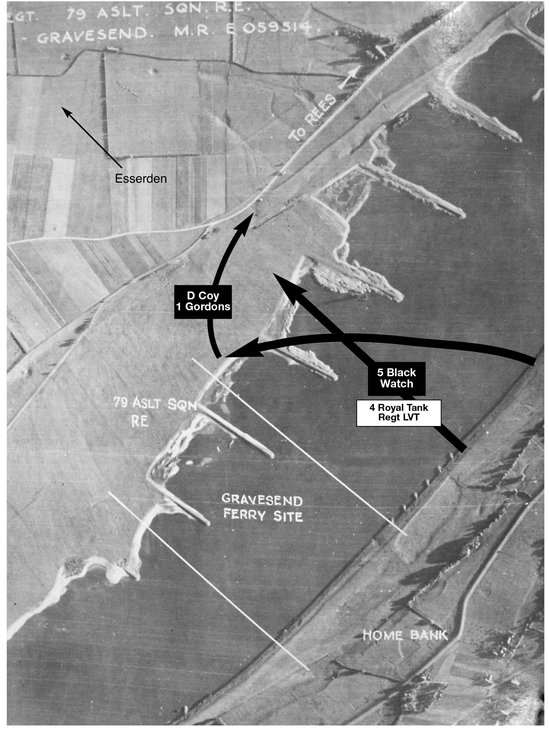
5 Black Watch’s leading pair of companies set off towards their first objective a farm on the Esserden – Rees road. The remaining two companies who were following took over the lead towards the straggling village of Esserden. In close quarter battle they fought from building to building clearing out the Fallschirmjäger as they went. By dawn, they had cleared the southern half of the village of enemy. The regimental historian recorded: ‘Here such few inhabitants as were left were weeping: they had been told by the parachutists that the British butchered all civilians. They went on weeping all night.’ During the course of the early morning, 5 Black Watch forced the Fallschirmjäger out of the northern section of Esserden, completing their tasks.
Landing with 5 Black Watch were D Company 1 Gordons, who had accompanied them to secure a group of farm buildings which were to be used as a concentration area for the Gordons’ attack on Rees from the west. They were to protect company recce groups and assault pioneers under Major Rae, who were to lift mines, lay out assembly lines and guide the companies forward as they landed. All did not, however, go to plan as the Germans set fire to the farm with incendiary bombs before D Company could secure the buildings, necessitating a change of position for the Forward Assembly Area (FAA) away from the blaze. Even so, D Company suffered casualties from mortar fire.
Carried across the Rhine by C Squadron 4 RTR, 5/7 Gordons landed on what was in effect an island to the east of Rees, bounded on its far side by a waterway, the Alter Rhine, which was the old course of the river. The battalion’s objective was to clear the farmhouses on the island and hold the ground in order to isolate Rees from the east.
The Alter Rhine Island was held by a company of infantry, probably from 19 Fallschirmjäger Regiment, supplemented by ersatz infantry. The defences were centred around the farms of van Willichshof in the centre, Steppenhof in the south and Gross Sandenhof in the north, with section posts at key points along the bank.
The Gordons’ regimental historian wrote:
B Company, on the right, secured one farm within forty minutes of landing, a number of Germans being killed and forty taken. C Company made for the Alter Rhine to cross it and clear the further bank; but they found that the only bridge had been blown. As they approached they received heavy fire from the enemy beyond the stream. This was the first check. Meanwhile, D Company had arrived and taken another farm without opposition, and still another was captured, with fifteen Germans, by a platoon led by 2nd-Lieutenant Stephen.
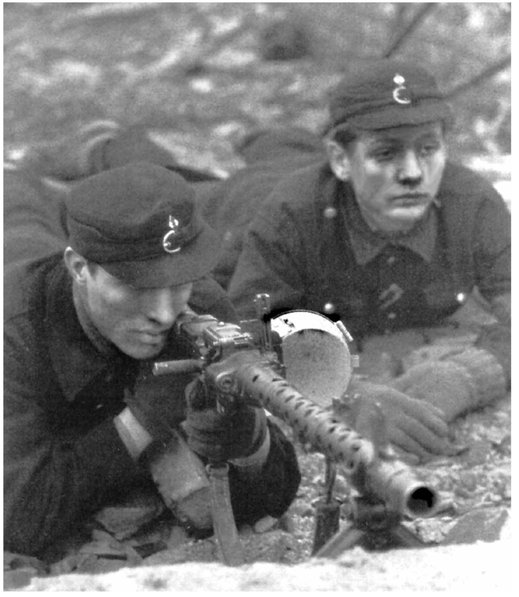
A young Volkssturm (Hitlerjugend) MG 34 crew.
When day broke on 24th March the Gordons were certainly in possession of the Island, but they spent an uneasy time upon it. From the higher ground beyond the Alter Rhine German snipers and machine gunners commanded the whole expanse of open land: all movement outside the various farm buildings drew fire.
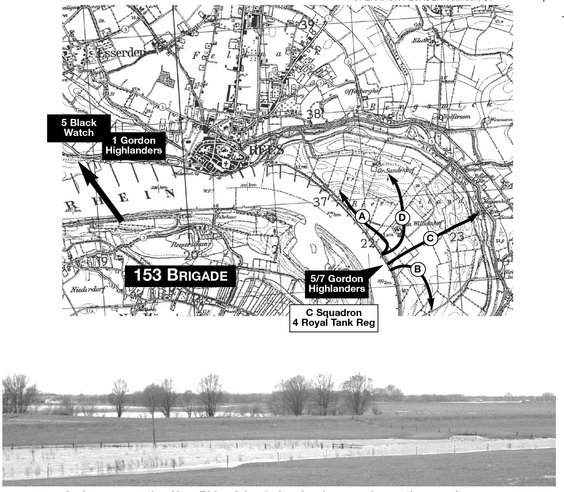
A view across the Alter Rhine Island showing how unpleasantly open it was for the 5/7 Gordons.
Landing with the infantry of 153 Brigade were soldiers of the Royal Signals who had dragged an armoured telephone cable across the river, behind their Buffalo, to ensure line communications were maintained. Initially this was to be with the bank control officer and eventually with various headquarters that were to be established astride the Rhine.
The Attack on Rees
The third battalion of 153 Brigade was 1 Gordons. They showered praise on ‘1 Royal Ulster Rifles, who held this sector of the near bank of the Rhine, for the Ulstermen not only dug slit trenches for the Gordons just behind the loading area but provided a special ″brew up″ so that every man received a mug of tea well laced with rum before embarking’. Major Martin Lindsay recalled that:
I shall always remember the scene in the loading area: the massive bulk of the Buffaloes; the long ghostly files of men marching up to them, their flickering shadows and those of a smashed farmhouse and the armoured car at the Royals’ post; a few busy figures darting here and there in the moonlight directing people into this and that Buffalo.
Then, as recorded by the regimental historian:
... came a delay. The first Buffaloes which returned from landing the Black Watch were not ready for the Gordons, for these craft found it difficult to get back out of the river on to the bank which was faced with stone. In attempting to land many of them damaged their tracks, and it was deemed quicker to bring along the Buffaloes which had already carried the 5th/7th Gordons across further up-stream. This check meant that the 1st Gordons could not start to attack Rees until 1 a.m. on 24th March and the respite must have been of value to the enemy.
Eventually, 1 Gordons successfully crossed the river without loss by 0050 hours and with a much delayed H Hour, B Company led the Battalion’s advance towards the north west corner of Rees followed by C Company. Crossing three hundred yards of open grassland, the two companies were soon held up by enemy fire from the south west corner of Rees. However, under the cover of an on-call artillery bombardment and a mortar smoke screen, they crossed the open flood plain and cleared the winter dyke at 0153 hours, ‘without further incident’. The winter bund was cleared with grenades and the Gordons pursued the enemy survivors who were falling back into their defensive perimeter in a housing estate.
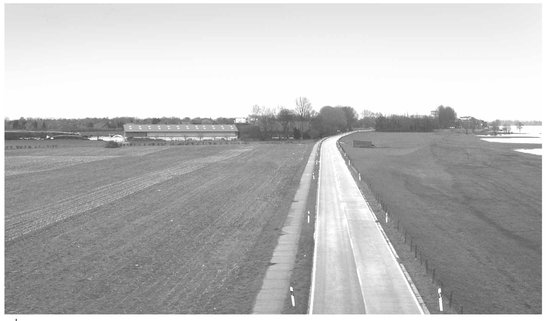
Looking due east towards Rees across the open ground that 1 Gordons had to cross.
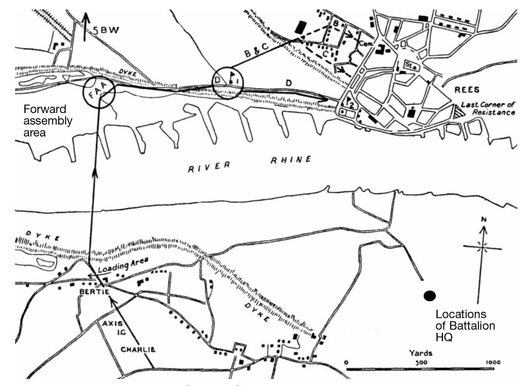
At 0215 hours, B Company who were on the left flank, managed to get in amongst the houses and gardens of the estate under cover of darkness. Enemy resistance was very determined. They were in company strength and split up into groups of four to six, with each group occupying individual houses. Due to the dispersed nature of the estate, the enemy did not withdraw but stood and fought hard for each house they occupied and only surrendered when they were overrun. B Company itself only a hundred and twenty strong at the beginning of the battle took seventy Fallschirmjäger prisoner. It is not hard to work out who should have been labelled as ‘elite’ in this fight.
Meanwhile, at about 0400 hours, Major Lumsden’s C Company had been able to follow a route parallel to the winter dyke south east into the centre of the town. They were, however, soon in trouble as their advance brought them under the fire of snipers and machine guns not easy to locate on the outskirts of the ruin and chaos that was Rees. At 0445 hours, a platoon of C Company had broken into the western outskirts of Rees and was meeting stiff opposition. The enemy were ‘using Panzerfausts at close range’, in an anti-personnel role. Typically, as a section of Gordons entered a house they would be fired on by Panzerfausts from adjoining rooms, through ‘mouseholes’ in the walls. When they rallied and counter-attacked, they would find the defenders had escaped through prepared tunnels in the cellars.
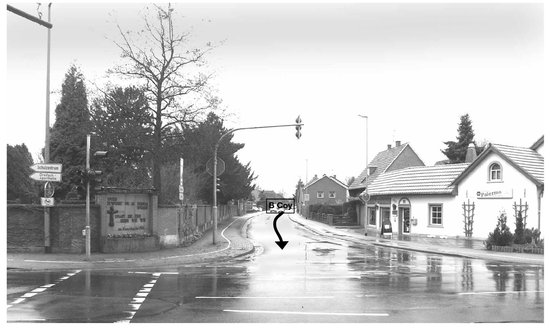
The area of the Cemetery (left) and the ‘housing estate’ (right) on the north western outskirts of Rees.
By 0500 hours, both B and elements of C Companies were still spread out in the housing estate and the ground, north of the bund between the estate and the outskirts of the town. Opposition was still resolute and Major Lumsden had an additional problem. His rear platoon had been hit by a salvo of shells as they bunched up whilst crossing the bund. The platoon commander, Lieutenant Titterton, was dead and there were a dozen other casualties. The platoon had split up and dispersed either side of the bund.
Major Lindsay was monitoring the progress of the battle on the Battalion’s radio net at Main HQ, which was still west of the river and recalled that:
The first intimation of trouble was Alec [Lumsden] asking the Colonel to send up his spare officer, who had been left on the far bank with the company greatcoats and some other kit which they had taken across and dumped. Then he was telling D Company in the farmhouse area to send up part of one of his platoons, which had not crossed the dyke with the remainder. It was not hard to guess that this meant that the company had been shelled on its way forward, and that a platoon commander had been hit and some of the platoon had in consequence got lost or gone to ground. Meanwhile B and C Companies were fighting in the housing estate and gardens on the far side of the dyke and meeting a good deal of resistance. A little later ...it became apparent that C Company was still fighting in the orchards short of Rees when they came under fire from the Boche holding some of the houses at the outskirts of the town and by this time they were able to see well enough to shoot.
Major Petrie, OC D Company, eventually gathered the remainder of C Company’s last platoon and pushed up over the bund. When asked how things were going he admitted it was ‘a bit sticky’ but as it would be daylight shortly things might change. At first light, 0537 hours, however, the advantage switched decisively to the enemy who were now able to bring down accurate sniper and spandau fire on both B and C Companies. The penalty of the Gordons’ delayed crossing was now being paid!
Fallschirmjäger artillery in action.

At 0600 hours, C Company’s position was being jeopardised by a group of Germans moving onto its left flank. B Company, who was still clearing the housing estate, had been unable to keep up with the C Company advance. Major Lindsay recalled:
The next thing I heard was an acrimonious conversation between Alec Lumsden (C Company) and George Morrison (B). Alec was telling George that he hadn’t put a platoon where he said he was going to, and that the enemy had in consequence been able to get round his flank [on the dyke]. He then spoke to the Colonel and said he was pinned down in the open with Huns on three sides of him and that he must withdraw on to B Company as he was getting casualties, could not get forward and his position was untenable. Having extracted a reluctant permission from the Colonel [Grant – Peterkin] to withdraw, he decided to hold on for a little longer, and then began to feel his way forward once more.
About 5 a.m. I heard him [Lumsden] report that he had reached the first row of houses in the town. Later on I heard B Company say they had passed through the cemetery and reached the edge of Rees, having taken about seventy prisoners. An hour or two after that Bowlby said he gathered that D Company had also reached the town, along the water’s edge.
It was at about this time that Major Morrison, was bursting into a house through the front door, ‘... when I was bowled over by a German who was coming out. He was a giant of a man, a Fallschirmjäger sergeant major, carrying a Schmeisser sub machine gun’. To everyone’s surprise, it was the wiry Scottish major who got up from the ensuing brief but brutal struggle. Soon afterwards, the resistance in the housing estate crumbled and the left flank of C Company was able to break into the edge of the town.

The face of a Fallschirmjäger soldier fighting the Fatherland’s invaders.
B Company reported at 0700 hours, that they had reached the Rees-Speldrop road and turning right, had positioned themselves in the Rees cemetery and were deployed to protect the flank of C Company who were to fight their way into the main part of the town. German resistance was, however, far from crushed and the capture of Rees was going to be a protracted affair.
DD Tanks
Meanwhile, the two squadrons of DD tanks belonging to Lieutenant-Colonel John Trotter’s Staffordshire Yeomanry, had started the process of crossing the river behind and between the two infantry brigades. Their entry point was near what was referred to as ‘Storm Boat House’. Troop Commander, Lieutenant Sadler, described the operation:
We sent a recce party over with the Buffaloes, to pick landing spots which were supposed to be lit with green lights, two green lights, one above the other.
The Staffordshire Yeomanry were responsible for making their own exits and the recce and preparatory work on the banks, the far bank took a considerable amount of time and in many cases, unaided, the tanks found the exit bank to be difficult. However, crossing in one of the Yeomanry’s six Buffaloes was an airborne bulldozer, which was light enough to cross the mud banks. Once ashore, it was able to reduce the bank to a slope and several carpets made of coir matting with scaffolding poles were laid to give rigidity. With the exits made, the tanks could cross. Lieutenant Sadler continued:
I was first tank into the River. We went down the slope, on the way we had quite a bit of gunfire and one or two of the tanks had their canvas screens holed so they couldn’t do the trip.
We got into the river, which was quite fast flowing. I seemed to have been there a long time and I didn’t see the two green lights, but suddenly I saw one green light. I thought, well, the other one might have gone out or something, so I started to land and I found out I was on a mud bank. Before I realised where I was (I thought I’d crossed the river), I let the canvas side down and of course my other two tanks, or three in actual fact, came over and one got stuck in the mud. There was a shellfire going on at that time. It was very uncomfortable and I had to get out of the tank, get the chains out and hook on to the other tank and pull it out. Of course, then I had the problem of whether to risk going from the mud bank to the actual true bank of the river. I probably didn’t have enough air anyway to inflate the screen again, so I took the chance and as it happened, the water didn’t come up above turret level so we were all right. The other three tanks followed.
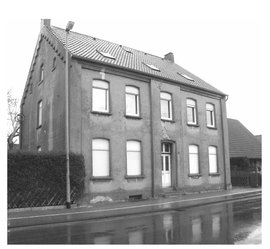
Strongly built houses on the edge of town made good strongpoints for the enemy.
The actual place I landed, of course, was wrong. The correct place was about two hundred yards downstream. I went down and was able to link up with them, by which time, the squadron leader had arrived.
The difficulty in locating the DD exit point was due to the fact that it was not directly or even obliquely across the river but almost a mile downstream. The 3 ½ knot current swept the ungainly and barely ‘seaworthy’ tanks downstream through the 154 Brigade LVT crossing loop.
When the first tank was eventually ashore, at the correct point, it was used to help tow other DDs across the soft river mud and onto the ramp over the Rhine dyke. By 0600 hours, two troops of the Staffordshire Yeomanry’s DD tanks were across and ready for action. With the laying of the coir carpets further out into the river and with daylight, the speed of crossing increased markedly and the first squadron was supporting the infantry at 0700 hours. The DD converted Shermans, despite the problems on the exit banks and the loss of three tanks, had been used to help solve the perennial problem of assault crossings of major waterways; being able to get tanks across in time for them to be available to help defeat enemy counter-attacks. The remaining two squadrons would not be able to cross until 13 Army Group Royal Engineers opened their Class 50/60 ferries which would not be before H Hour +12.
DD tanks moving up to the Rhine, showing the propellers and the flotation screen in the lowered position.
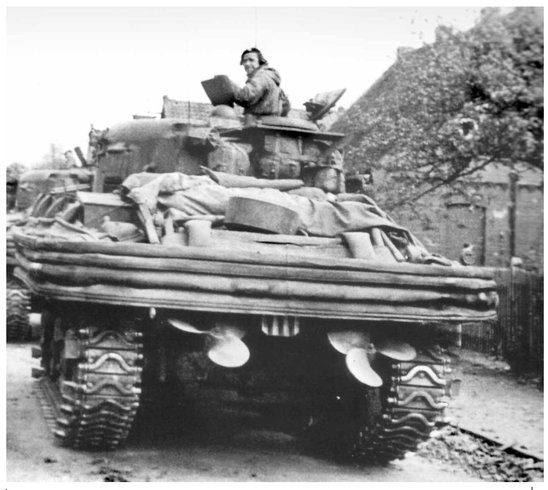
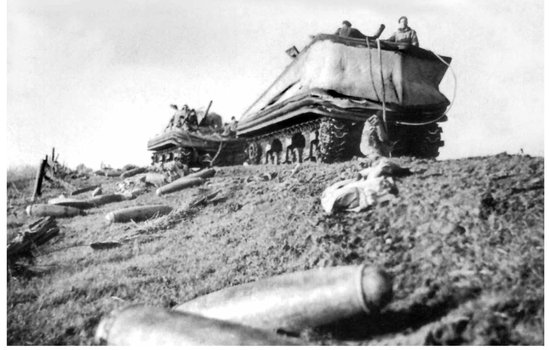
Staffordshire Yeomanry DD crews deflating their flotation screens following their crossing.
152 Brigade
Brigadier Cassels did, however, have an active role in the initial stages of the assault. He was, however, to provide a battalion (2 Seaforth) under command of 153 Brigade, to assist in the isolation of Rees and 5 Cameronian to 154 Brigade to further expand the bridgehead. With his remaining battalion (5 Seaforth), he was to maintain a divisional reserve and be prepared to lead the development of operations from the divisional bridgehead.
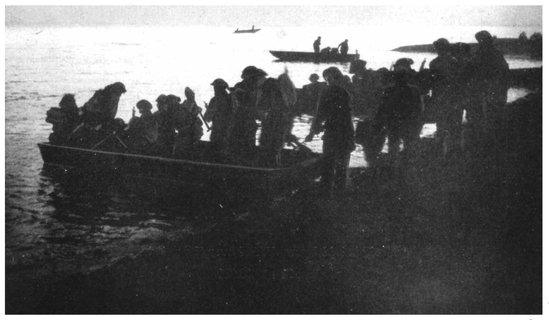
As the fourth battalions of the two assault brigades, the Seaforths and the Cameronians crossed the river in a ferry of storm boats operated by 70 Field Company RE. The ferry site was approximately on the inter-brigade boundary, which aided command and control in the dark. ‘Thirty-five boats and engines had been brought forward during the night before the assault, under cover of smoke, and dumped and camouflaged in the orchard behind the proposed launching site near Storm Boat House.’ According to the RE history:
About an hour after the assault waves of Buffaloes had crossed, the boats were carried over the dyke with the help of a company of pioneers and, by 2315 hours, twenty-two serviceable boats were in the water.
All boats were concentrated to run a continuous ferry service. Bank Control allotted the ferry to one battalion at a time, with the leading battalion of 152 Brigade moving up and commencing to cross at 0035 hours 24 March.
Highland troops were marshalled into boats as they became available and the loaded boats crossed one behind the other to the landing places on the far bank, ‘which had been marked upstream and downstream by carefully shaded coloured lights’. Only the most important light vehicles were ferried across in LVTs at this stage, which left the infantry battalions to man-pack their machine guns and mortars, along with their ammunition. With only light scales of ammunition, their own organic fire support was limited.
The boats continued to operate backwards and forwards. It was found that it took about 55 minutes to ferry a battalion across the river and, with some breaks in operating, the six battalions of 152 Brigade and 9 Canadian Brigade as well as some 500 other troops had been ferried across by the afternoon of 24 March. Prisoners and casualties were brought back on return journeys.
The ferrying operation was ‘peaceful while the first battalion was being taken over but the site was a very obvious one and soon became subjected to very accurate shelling which continued, off and on, well into 24 March’.
Captain Stafford, who was the far bank recce party for a heavy class 50 (tons) ferry, codenamed TILBURY, that was to be operated in the area of 152 Brigades assault the following day could testify that things did not remain ‘peaceful’ for long.
On touching down on the enemy bank, we immediately found that the initial wave of infantry had encountered a schumine field on the beach, and several men had been killed or wounded in it.... Owing to the minefields, I decided that our quickest and safest method of progress was to wade in the river, where it was unlikely that we would encounter any enemy obstructions. We soon found this easier said than done, mainly due to the weight and clumsiness of the equipment we were carrying. Mortar fire was becoming increasingly accurate and more than once I had to perform the divers act to protect myself. In doing this, I lost my 38 [radio] Set which had been strapped on my back. Every 150 yards or so, we encountered groins and, as we crossed the first one, I became aware that something was disclosing our exact position, as a sniper, hiding in a nearby crane, appeared to have our range very accurately. On investigation, I discovered the reason – every time I stooped down, a hand torch on the rear of my belt switched on, flashing out a vivid green light! Even so, we were increasingly troubled by accurate mortar fire.
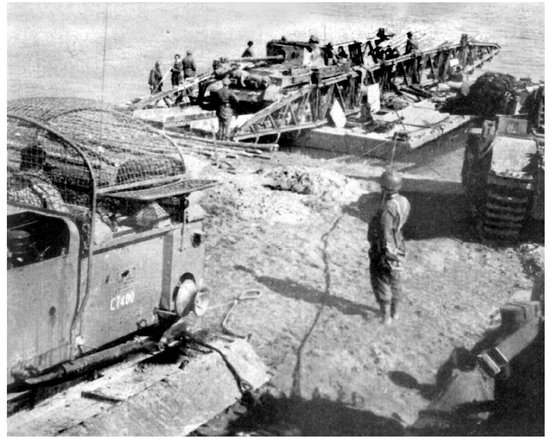
Medium and heavy ferries would not be open for many hours, making the DD tanks an important asset.
While 2 Seaforth were across the river quickly around the appointed hour of 0235 hours, 5 Camerons prepared to cross around 0300 hours and HQ 152 Brigade and 5 Seaforth (divisional reserve) not until dawn. This last battalion went across in dribs and drabs due to the losses to storm boats and the fifty casualties amongst the Sappers of 70 Field Company, which reduced the number ferrying to twelve. The Seaforth’s historian recorded that:
The Battalion crossed company by company and disembarked on the far bank under intermittent shell fire, a few casualties being suffered. As soon as the stragglers, from a wayward boat, had been collected, the Battalion moved up the axis of 5th Black Watch, to a forming-up area in Esserden. We had sent a party, under the Second-in-Command, with the rear elements of 5th Black Watch to reconnoitre and prepare a forming-up place, within the perimeter of 5th Black Watch’s area. C Company, our reinforcement Company, had been employed launching the boats, after which they provided guides for the assaulting waves down to the riverside.
See map on page 95
At 0245 hours, A Company 2 Seaforth set out to seal off the northern approaches to Rees via an unnamed crossroads that was nicknamed ‘Bill’ and a bridge over the anti-tank ditch, which was in fact an existing water course that had been improved for defence. Here A Company contacted small parties of Fallschirmjäger who were promptly dealt with. The Seaforth were, however, in an unenviably precarious position.
It was not thought that the mopping-up of Rees, by the remaining Battalions of 153 Brigade, would be completed by the time the Battalion set out on its mission, and we were prepared for an unprotected right flank on our move. It had been planned, however, that a Battalion of 154 Brigade on the left [1 Black Watch] would be holding Speldrop, by the time we were launched, thus protecting our left flank. As it turned out, Speldrop did not fall until nearly 36 hours later and we went into our task with two open flanks.
We were of course operating in the dark and were equipped and prepared to force our way to our objective, there to remain in hedgehog fashion, astride the main road, until the Battalions, fighting in Rees, could fight their way through to us, or we to them.
Battalion Headquarters and the remaining two Companies, D and B, were poised ready to pass through B Company and continue quickly to their objective, the factory north of Rees. The bridge over the anti-tank ditch was, however, found to be badly blown and the road cratered. This did not delay the infantry companies, although it meant a good deal of engineer work, before the battalion HQ vehicles could pass. Under fire, a platoon of sappers, under command, started work immediately. A Sapper officer was ‘having an exciting chase with a sniper, rounded off by measuring his length in the water at the bottom of the ditch’.
By dawn 2 Seaforth had moved a mile inland and were astride the old B67 (east of the modern road of that designation) and had overcome stiff resistance in the Pipe Factory.
D Company reached the main road and B Company their objective, the latter going through to capture intact the road bridge, over the [another] anti-tank ditch, North of the position. The objective was a big one – too big for two Companies to hold, so the Commanding Officer, Lieutenant Colonel GW Dunn, ordered up A Company (less a Platoon which remained to protect our axis) to another area east of the Factory. The Battalion thus disposed had only just consolidated when dawn broke. The enemy was clearly thrown out of gear by the arrival of the Battalion across their main line of retreat, and some 50-60 prisoners were taken within a short time, most of them walking blindly into the trap set for them. At dawn, it was seen that quite a large number of enemy were all round us, and our axis of advance, the previous night, was under constant small arms fire. Further, the two Battalions clearing Rees had their hands full in the town and seemed unlikely to reach us that day.
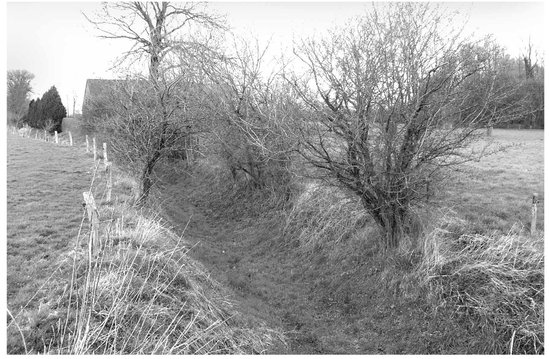
The ‘anti-tank ditch’ is today back in use as a drainage ditch.
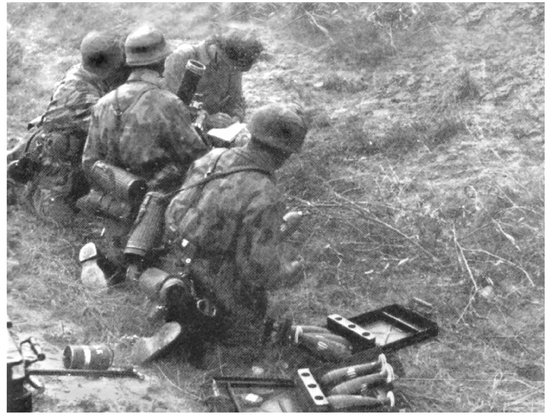
A Fallschirmjäger medium mortar crew preparing their ammunition.
Lieutenant Colonel Dunn’s aggressive tactics and local patrols cleared the whole of the Pipe Factory complex and the immediate surrounding area. This was a commendable result as it was a big task, and further prisoners were rounded up. The Seaforths requested a troop of tanks in order to extend their domination of the surrounding country but, none were yet available, so the battalion ‘had just to sit in their hedgehog’ defences, without transport of any description with them. To keep the enemy quiet, and take what local offensive action they could, patrols probed outwards. The enemy engaged the Seaforths with Spandau fire and casualties were suffered who could not be evacuated, leaving the Regimental Medical Officer with a growing number of men to treat with his scant man-packed resources.
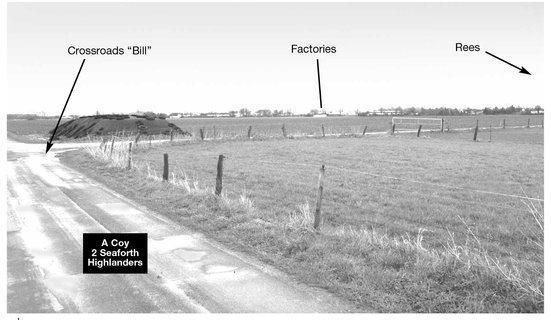
To the east a significant number of enemy troops were seen moving on the Groin road running north out of Rees throughout the day. Signal communication was reasonably good because both Seaforth’s Tactical HQ and the attached gunner observation party had carried the heavy sets forward from the blown bridge, either on man-packs, or on improvised trolleys. Using the radios, the withdrawing Germans were engaged by observed artillery fire.
By placing themselves across the B67, 2 Seaforth had started the isolation of Rees from the north, leaving a one mile gap to the north-east between them and 5/7 Gordons on the Island. A gap that was covered by fire from machine guns and artillery. 2 Seaforth, however, were isolated but it was expected that their situation would improve when 5 Cameronian seized the hamlet of Mittelburg to the north, which once in a state of defence, would offer a degree of mutual support.
5 Cameronian moving up behind 5 Black Watch in Esserden found that fighting was still going on in the area and that it was not possible to advance on Mittelburg as planned at first light (0530 hrs). However, the Staffordshire Yeomanry’s DD tanks were now arriving in the bridgehead and the first squadron was duly allocated to the Cameronians for their delayed attack which was now due to start at 0700 hours.
With the tanks moving by bounds, supporting the infantry, the 5 Cameronian battle group advanced on the village of Mittelburg. As they approached, four or five assault guns opened fire from positions amongst the houses at the edge of the village. These assault guns were almost certainly from 15 Panzer Grenadier Division. The battle group possessing superior firepower, in the form of the Shermans of B Squadron and, of course, the corps artillery, was able to continue the advance. However, on closing up to the anti-tank ditch three out of four Yeomanry tanks were knocked out and the attack over the open ground came to a halt. It is probable that the assault guns were either the self-same vehicles or were from the company that supported the counter-attack on Speldrop and Klein Esserden just a little later. With the situation at Speldrop to their left rear deteriorating and Spandaus sweeping the open terrain they would have to cover to reach Mittelburg, the decision was made to abandon further advances by 5 Cameronian. This of course left 2 Seaforth isolated in the Pipe Factory in what their CO described as a ‘sticky position’.
At about 0800 hours the Seaforth and Cameronians reverted to command of 152 Brigade, once Tactical Headquarters and 5 Seaforth had crossed the river after dawn, in penny packets due to the loss of so many storm boats.
9 Canadian Brigade
Meanwhile, the highland battalions of 9 Canadian Brigade, 3rd Canadian Division were crossing the Rhine behind 154 Brigade on the left flank of the assault. The Highland Light Infantry of Canada’s (HLI of C) advance party, consisting of nine other ranks commanded by Capt Donald Pearce, had gone ahead with elements of 154 Bde and were waiting on the east bank. Their task was to recce the ground in order to lead the battalion to its assembly area when it arrived on the far side. These men were the first Canadians to cross the Rhine.
At 0345 hours, the HLI of C received orders to move, and by 0425 hours the fighting men of the four rifle companies with ‘Mae West’ lifejackets slung round them and laden with 24-hour ration packs, were clambering into their Buffaloes in the marshalling area on the road north of Honnopel. Having driven four hundred yards over the flood plain they had crossed the Rhine under ‘sporadic shelling’. An hour later, once on the far bank, guides led the battalion into its assembly area to the south of Klein Esserden, a march that was enlivened for C Company capturing of 30 members of the Volkssturm. Here, fully assembled as dawn broke, the Highland Light Infantry of Canada came under command of 154 Brigade, at a crucial point in the battle; reports were coming in of 1 Black Watch’s difficulties at Speldrop. The original tasks allocated to the battalion in the expansion of the bridgehead, the capture of Bienen were now impractical and the battalion monitored the situation. Eventually, as we will see in Chapter 9, warning orders were issued and plans made to retake Speldrop.
The prime means of movement for both sides was marching.
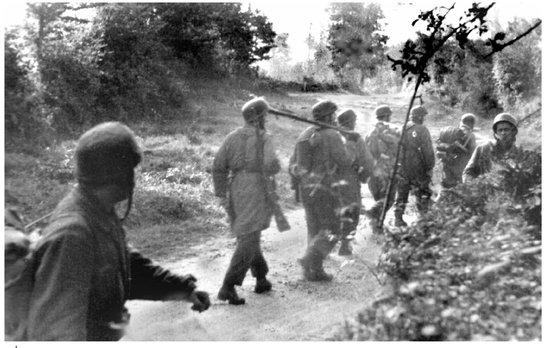
The remainder of 9 Canadian Brigade were scheduled to cross later in the day and to be complete by mid afternoon.
Summary
Enemy reaction to the 51st Highland Division’s crossing in the Rees sector had at first been slight, due to a combination of the numbing effect of the bombardment, tactical surprise and the isolation of the battlefield, the interdiction sorties flown by the Allied air forces. However, the German response by local reserves was increasingly significant and supported with mortar fire and by sniping from determined Fallschirmjäger soldiers. There were also signs that the inevitable armoured counter-attacks were developing.
By 0800 hours, however, 51st Highland Division had secured a bridgehead with the majority of its infantry, with mainly man-packable support weapons. However, they were well served by a mass of artillery whose radio nets in most cases were working well and some tank support. Other heavy weapons and vehicles, along with the ordinary gun tanks of the Northamptonshire Yeomanry would have to await the opening of ferries before they could cross to the east bank of the river. The nature of the country, with its boggy terrain and defended villages and woods, was such that the two squadrons of DD tanks were very much in a supporting role in case of counter-attack. The leading elements of 9 Canadian Brigade were also across and with 152 Brigade now operational, sufficient combat power was being assembled to hold anything 15th Panzergrenadiers and 8th Fallschirmjäger could throw at the Highland Division. Meanwhile, 1 Gordons were in the first phase of clearing the virtually isolated town of Rees, which it was now acknowledged would be a slow business.
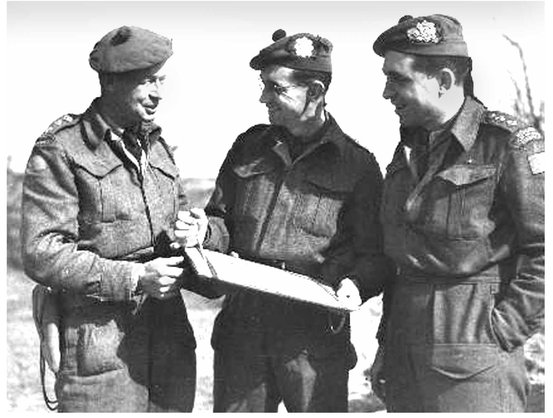
Officers of the Highland Light Infantry of Canada.
The Death of General Rennie
The 51st Highland Division had been subject to numerous changes of command. Major General Thomas Rennie was moved from 3rd Division and is widely credited with restoring the fame and fortune of the Division.
He was often to be found at the sharp end, encouraging his Jocks across the start line and visiting front line positions, leaving the infantry knowing that he shared their dangers and hardships.
At 0900 hours on the morning of 24 March, General Rennie had crossed the Rhine with his Jeep in an LVT and was on his way to visit Tac HQ of 154 Brigade. In the jeep along with the General were Lieutenant Tweedie, his ADC, and his radio operator, Lance-Corporal Craig. Still in the area of the riverbank, he wished ‘Good luck’ to the Adjutant of 7 Argylls, who was passing in a Bren gun carrier and as the divisional historian recalled:
A salvo of mortar bombs fell, and the jeep received a direct hit. General Rennie fell out on to the grass verge. Tweedie was unhurt, but Craig was wounded. ″Are you all right, sir?″ asked Tweedie. There was no reply. General Rennie was carried to 176 Field Ambulance, which was only some thirty yards away. He died almost immediately after admission.
General Horrocks wrote ‘I have always felt that Rennie had some foreboding about this battle ... I had never seen him so worried. He hated everything about it and I couldn’t understand why. Like so many highlanders I believe he was ″Fey″.’
The shocking loss of such a fearless, popular and effective divisional commander can be imagined. For instance, Colonel Bradford of 5 Black Watch, told his company commanders of the General’s death ‘but forbade them to pass it on to the Jocks until Rees should be taken’. Perhaps this passage will explain Colonel Bradford’s fears:
There was never anybody quite like Thomas Rennie. He was as staunch as Dumbarton Rock, determined to the point of obstinacy; he was a great Jock-lover, and they in turn adored him. He was the most accessible and least pretentious of generals, of whom every officer and man could boast as a friend. He had an impish sense of humour, and a cheerfulness, which was proof against every crisis or disaster. He had a great flair for doing things the right way, and complete confidence in his judgment, which was shared by all around him. He could sift the essential from the non-essential, and refused to bother himself at all or take the slightest interest in anything which was not. His courage was far beyond the ordinary, but there was nothing flamboyant about him. ... there wasn’t a Jock in the Division who did not know his duffle-coated figure. He never wore a red hat to the day of his death; a Red Hackle was good enough for him.

General Rennie was buried at the village of Appeldorn on the west bank, with four Black Watch soldiers acting as pallbearers, to the sound of the pipes. Attending were his divisional staff, General Horrocks, his Corps Commander, and the commanders of the 3rd British Division and 3rd Canadian Division. During the post war concentration of graves, his body was moved to the CWGC cemetery in the Reichswald.