
CHAPTER 2
On Saturday 10 June, 1944, Oradour-sur-Glane was unusually full. In the preceding years, refugees from Alsace-Lorraine and Franco’s Spain had sought sanctuary there. The visitors included people from Limoges who came in search of food, such as eggs, which was more easily obtainable in the country. A number of anglers had arrived with hopes of good sport in the River Glane. People from the neighbouring hamlets and farms had come to do their shopping and collect their tobacco ration which was distributed every ten days.
The most tragic aspect of the population was that the schoolchildren, nearly 200 in all, had not gone home that afternoon because there was to be a medical inspection and vaccination.
A light-hearted mood prevailed. The people chatted about the landings in Normandy, the news having been received on their radios from the BBC. The weather was fine, the food and wine in the hotels and restaurants were good and the diners speculated how long it might be before France was liberated. A few people spoke of troop movements in the locality but it was assumed they were on their way to the Normandy battlefront and would no longer harass the population of that area. They had been seen in Saint-Junien, about six miles away, but no convoys were expected to pass on the narrow roads around the village.

Entrance to the village in 1938. Note the size of the tree behind the car. Compare its growth with the earlier view in the same position.

Rue Emile Desourteaux in 1932. The entrance to the Champ de Foire is just beyond the first pole on the right.
It was the eve of a religious festival with a First Communion service.’The church was decorated with flowers and the little communicants had had their special costumes prepared by their mothers. In the homes the mid-day meal was late because the men had been working in the fields and had not long returned from a full morning’s work. At the Hôtel Milord, which still had a varied menu in spite of the shortages, the diners included a party of twenty. Some had arrived the previous day and were staying the weekend. There was a young pelota champion from Marseilles and a woman who had returned to Oradour to pick up some silver and other valuables from her home there. The guests at the Hôtel Avril included a woman with her three children and her little niece. She had come to Oradour from Paris where she feared there might be a bombardment.
The anti-Franco Spaniards who had feared reprisals when the dictator took over the government had found employment as farm labourers, mechanics and hotel staff.
A family named Lévignac who lived in Avignon, perturbed by the bombing, in that town had evacuated their sons Serge (16) and Charles (12) to Oradour where they felt sure they would be safe. The elder boy was billeted with a farmer just outside the village while the younger lived with an 80 year old woman and her daughter who was nearly 60.
M Lévignac, an insurance agent, arrived in Oradour on the 9th and stayed overnight at the Hôtel Avril. He spent some time with his sons on the morning of the 10th then took the tram to Limoges on business. He said he would be back in the early evening. He sent a postcard to his wife in which he wrote, ‘I feel I am giving our sons life itself.’

The Rue des Bordes with the Café de la Chêne in the background.

Taking it easy in the sunshine. A group outside a little café in the main street.
Also in the village that day were the two sons of Professor Forest, a teacher of philosophy who was a native of Oradour. He had moved with his family into a wing of the Château de Laplaud, rented to him by the Vicomtesse de Saint-Venant, a family friend.
With him were five of his six children. The professor had sought peace and quiet in Oradour when his university, in common with others, had been closed by the Germans in March 1944. The château was about two miles from the village and Michel Forest (20), who was studying law, and his brother Dominique (6), the family favourite, walked to Oradour early in the afternoon.
Michel was a poet and deeply religious. He kept a diary in which he wrote: ‘This place (Oradour) is pervaded by a classic tranquillity in which one can live as a human being should.’ Another entry read: ‘I shall die young. But does it matter?’
The two often went for walks together. Dominique, a gentle affectionate lad, was going to take his First Communion in Oradour church on 11 June. He had to look his best, so he was going to have his hair cut by a village barber and would also visit his grandfather.
Professor Forest went to Limoges by tram, accompanied by his other sons, Jacques, Bernard and François.
A brother and sister from Strasbourg, Emile and Odile Neumeyer, were staying with the parish priest, the Abbé Chapelle, aged 70. He was poor and humble and had to take care of himself when his aged housekeeper died.
The Abbé Chapelle had been obliged, since the war, to extend his ministry to Javerdat, about three miles west. Despite his age, he walked there every morning whatever the weather, to say Mass.
The Neumeyer family were for a time refugees living in a house near the presbytery. When most of them decided to return to Strasbourg, Odile, who was 33 in 1944, stayed behind to look after the priest. Her brother Emile was a pupil at a mission school at Cellule in the Auvergne. He had a brief holiday which started on 8 June. When he arrived at Oradour he found his sister was ill so he helped the priest to do the housework and to prepare for Sunday’s service. He also agreed to act as server at the Saturday Mass. Bernadette Cordeau’s father was doing forced labour in East Prussia. He had been relieved to learn that she and her mother had returned to Oradour, their former home, from Paris where the family had settled when he got a job there.
Bernadette, who was 16, was living with her mother at the home of her grandmother at Les Bordes, a hamlet a short distance to the north-east of Oradour. She went to Oradour to learn dressmaking while her mother worked as secretary to a doctor in Limoges. On 10 June, Madame Cordeau’s employer was on call so she had to stay in Limoges overnight. She told Bernadette it would be best in the circumstances if she went to work in Oradour that day. Of all the people in Oradour on the afternoon of 10 June none could have had any idea of the dreadful thing that was about to happen. None could have imagined they would nearly all be dead by sunset.
Yet those who had seen the SS activity in Saint-Junien may well have been apprehensve. One of them was Denise Bardet, a teacher at the girls’ school whose 24th birthday was on that fatal Saturday. She was engaged to a young Limoges man and her brother was at the teacher training college in the city. Denise had accompanied some of her pupils to Saint-Junien the day before and heard of the brutal behaviour of the SS from the townsfolk and of their atrocities in other parts of the region. Saint-Junien had been invaded by an SS unit after the blowing up of a railway viaduct near the town by the maquis.

Schoolchildren pictured about 1932. Many of them may have been among the victims of the massacre as adults.

The Champ de Foire before the destruction. The communal well confirms that there was no piped water.

Denise Bardet (24 that day) who died in the church with her pupils clinging to her.
Denise did not actually witness any brutality but she saw the armed soldiers, who imparted a sense of power and evil, and felt a sense of relief when she and her charges returned to Oradour on the bus with its charcoal burning stove at the rear which provided gas for the motor. The feeling of apprehension provoked by the nearness of the SS may still have been with her when she took her place before her pupils after lunch.
Then a strange sound was heard, increasing in volume as the source neared Oradour...
Oradour had not seen any military traffic before and it was therefore with some surprise that the people in the streets, particularly those at the lower end of the village, heard the rumble of heavy vehicles approaching from the direction of Limoges. The people in the hotels and restaurants were too absorbed in taking their coffee and liqueurs, with typical French animated conversation, to notice the sound. It was the same in the schools where the chattering children had not yet been called to order.
Two trainee teachers from the Limoges college had finished their lunch at the Hôtel Milord and walked to the edge of the village where one, who was working at one of the schools, turned back. The other waved and disappeared in the direction of a nearby hamlet. She was the last person to leave Oradour before the SS arrived.
It was exactly 2.15 p.m.when the SS arrived. As with the rest of the operations, everything was carried out to a time schedule. There were eight trucks, two heavy tracked vehicles and a motor-cycle. Five of the vehicles, three trucks and the tracked vehicles, went straight up the main street almost to the end. There, some of the vehicles turned round and went back down to the bridge over the Glane. Both ends of the main street were now blocked while other vehicles moved to seal the other exits.
The soldiers, who quickly jumped down and ran to their appointed posts, numbered between 150 and 200. They were young men of between 17 and 25 years of age, wearing camouflage tunics and steel helmets with camouflaged canvas covers. Orders were barked by NCOs and there was a rush to surround the entire village. They had orders to shoot anyone who attempted to leave. When the encirclement was complete a white flare was fired.
The people at first watched these manoeuvres with surprise and then with growing disquiet. What on earth was happening? Some thought it was part of the general retreat from the area by the occupation forces, to take part in the battle in the north. Others anticipated a checking of identity papers, nothing more.
Aimé Renaud, one of the few who escaped, said he felt uneasy from the very first and meeting a wine merchant named Denis advised him to go and hide somewhere. Denis said he was not afraid of the Germans. ‘They are ordinary men, like us,’ he said. ‘In any case, I’m old and no longer afraid of anything.’
Mme Clavaud, aged 65, of Champ-de-Bois, was entering Oradour to do some shopping when she was warned by a friend, Mme Puygrenier, that there were Germans in the village.When she saw some of them she thought that, although they looked ferocious, they would not eat her. She was quickly rounded up with the other people.
Marcel Brissaud (17) had just arrived in the village from his home at Les Bordes and, when he saw Germans, was afraid he might be picked up for deportation to Germany for forced labour. The mayor, Doctor Jean Desourteaux, an elderly man with a white beard, and a teacher, Léonard Rousseau, tried to reassure him. There was really no need to be afraid. It was same sort of military manoeuvre which would soon be over.
But Marcel was not convinced. He managed to evade the troops and got back to his home where he took shelter in the loft. He tried to convince his family of the danger if the Germans came their way. When the SS arrived he heard his mother say, ‘What on earth can they want us old folk for?’ His father had lost a leg in the 1914-18 war. After they had been taken away, he heard the sound of furniture being moved. The soldiers seemed to be emptying cupboards and chests of drawers and he caught a glimpse of them as they were leaving. Some of them were carrying sheets loaded, no doubt, with silver, jewellery and anything else worth looting. When they had gone, he ran to hide in the fields. He later saw his home go up in flames. He was the only survivor of the family.
A Jewish family named Pinède was among the guests at the Hôtel Avril. The parents told their children they knew they would be arrested whatever happened and advised them to hide somewhere. Two girls of 18 and 22 and a boy aged 9 hid themselves under an outside staircase leading to the garden of the hotel. They stayed there until the hotel started to burn.
The youngsters crossed three gardens and were suddenly confronted by an SS trooper who stared at them. The elder girl asked him simply, ‘What are we to do?’ The soldier, who was probably an Alsatian and understood French, told them to hurry off. They ran through empty houses and gardens and across fields and subsequently found shelter in a château.
A Jewish dentist named Levy, from Limoges, was dining with Mme Jeanne Leroy from Saint-Malo. His wife was in a concentration camp and he had no papers. He fled as soon as he saw Germans in the streets and managed to get out of the village to hide in the fields all day. Mme Leroy stayed, believing there would only be an identity check. She had been obliged to leave her flat in Saint- Malo in 1942 when the Todt Organisation, who built the Germans’ West Wall of defence, took over the whole building. She had rented a house near Rennes, but fearing there might be bombing in that area took a friend’s advice and moved to the haven of Oradour in April 1944.
The mayor was visited by an SS officer who gave him orders to round up the population. The town crier, Jean Dupierrefiche, set out, accompanied by two soldiers, to beat his drum and announce that everybody must go to the Champ de Foire immediately, bringing their identity papers.
Trucks packed with frightened folk, who had been picked up in the neighbourhood, started to arrive. Men were taken from the fields, women and children from the farmhouses and cottages. Many were weeping.

The church before its destruction.

After the fire.
In fact, the scenes in the countryside around Oradour must have been as dramatic as those in the village.
The Bélivier family lived at a farm at les Brégères, one of the first farms on the road to Limoges. When they saw the SS coming, Mme Bélivier said to her son Marcel, aged 18, ‘Hide yourself quickly, petit. They mustn’t see you.’ He ran into a barn and hid in some hay before escaping into the countryside. He saw his family and some neighbours rounded up and herded like cattle into the village. Later he saw the farm was being destroyed by fire.
The Rouffanche family lived at La Ferme de l’Etang. They comprised Jean, a tenant farmer aged 52, his wife Marguerite, aged 47, and their children Jean, Amélie and Andrée. Amélie was a young married woman with a daughter of seven months. The family had just finished their lunch and Jean Rouffanche was preparing to return to his work on the land with his children who helped him run the farm. Marguerite was to stay and look after her grandchild.
Suddenly the SS burst in and ordered them to go to Oradour at once with their identity papers. Amélie put her child in its pram. On the road outside they were joined by neighbours including M and Mme Lamaud who were accompanied by their grandson and granddaughter, elderly mother and maid. Their son and daughter were away at a wedding.
The schools were invaded almost simultaneously. The boys’ school, opposite the tram station, had sixty-four pupils. It was conducted by M and Mme Rousseau. The girls’ school was in two sections, one in the centre of the village and the other on the road to Les Bordes. The little school for Alsatian refugee children was near the latter. There were 106 girl pupils and twenty-one Alsatians. The girls’ teachers were Mlles Bardet, Vincent and Couty, who was standing in for Mme Binet. There was great excitement among the children. It was an unexpected break and promised to be an interesting one. The teachers were apprehensive but tried not to show it. They told some of ‘the children they were going to have a group photo taken. The little ones were promised sweets. The children were intrigued by the camouflage uniforms of the SS which they likened to fancy dress.
In one school the teacher had just written the following sentence on the blackboard for the children to copy:
‘Je prends la résolution de ne jamais faire de mal aux autres.’ (I resolve never to do ill to others).
At the little school for the refugees from Alsace-Lorraine, of which M Fernand Gougeon was head, there was quite a different reaction. The children started screaming as soon as they saw the soldiers and could only be made to leave with difficulty.
One of them, Roger Godfrin, aged 8, was the sole survivor of all the schoolchildren in class that afternoon. He said later:
‘I am from Lorraine and I knew what the Germans could do. I called to my sisters to run away with me but they only cried and wanted to find our mother. I decided to make a break for it and ran acrass the yard and through the hedge, where I lost a shoe. A German fired at me so I dropped down and pretended to be dead.
‘As soon as all seemed quiet I got up and ran towards the river. The grass was high and I was afraid there might be snakes there. Then I saw something move and thought it was a rabbit, but it was a dog which I called Bobby.
‘When I reached the river, which was shallow and narrow at that spot, I waded to the other bank and lay down behind a tree. I heard machine gun fire and looking through the grass I saw that the dog had been killed. I must have fainted then. A roadman found me and carried me to the Laplaud Manor.’
He learned later that all the other members of his family had perished.
At 2.45 the round-up was almost complete. Tension and fear were mounting among the hundreds of people assembled on the village green, surrounded by armed soldiers. Some of them clutched their identity papers. Others had not been given time to collect theirs and feared the consequences. Some mothers carried babies in their arms, others pushed prams. Many babies, woken from their siesta, were fretful. A mother who had left her baby asleep at home was told to go and fetch it. Many women were crying and their husbands were trying to reassure them. The baker Boucholle asked a soldier if he could go back to attend to some pastry in his oven. The reply was, ‘Don’t worry. We’ll take care of it.’
As the schoolchildren came into the square, the clack of their little sabots contrasted with the heavy tread of their threatening escort.
Doctor Jacques Desourteaux arriving back in the village after completing a round of patients in the neighbourhood, was ordered to leave his car and join the other men.
The mayor left the mairie accompanied by Messrs Jean Roumy President of the Legion, Montazeau a solicitor, Pascaud a pharmacist, with a number of other tradespeople, the priest and some of the teachers. The mayor had failed to find his son Etienne, who was the town clerk and was rounded up with other people. His other sons were Jacques (the doctor), Emile and Hubert. Hubert, a garage proprietor, was the only survivor.
When they arrived at the Champ de Foire, the mayor was confronted by an officer whose words, translated by an Alsatian, were overheard by Robert Hébras, one of the other survivors. The mayor was told, ‘We are going to carry out a search of all the houses, but first you must nominate five hostages.’
The mayor, preserving his dignity, said, ‘Speaking on behalf of the people, there is no one I can select from them, but if anyone is to be held responsible for any sort of act, I name myself. If you insist on others, you must take my sons.’
He was then escorted away from the scene for a while, during which it was reported that he was told that a German officer was believed to a captive in the village and unless he was produced all the men would be shot. He said he knew nothing of such a prisoner and was taken back to the Champ de Foire.
Orders were then given for the men to be separated from the women and children. The separation was carried out with much shoving and shouting by the soldiers. Women who clung to their husbands and sons were forcibly separated.
As soon as the operation was completed, the women and children were herded out of the square on their way to the church.
An unlucky party of young cyclists, five boys and a girl, were seen to arrive at the Champ de Foire shortly after the round-up was completed. They were pushing their bicycles and were accompanied by a soldier. They were subsequently lined up against the wall of the forge at the entrance to the square and mown down by a machine-gun.
Another survivor, Jean-Marcel Darthout, said the men were made to sit in three rows facing the houses and forbidden to look round. However, he risked a glance and saw the pitiful party leaving the square.
‘Many of the women were weeping,’ he said. ‘Some were on the verge of collapse and had to be supported by others. I saw my wife for the last time as they turned into the street and disappeared from view. She was in tears.’
The men were addressed by one of the officers. He spoke loudly in German, pausing between sentences for translation. He said there were secret stores of arms and ammunition for ‘terrorists’ in the village and they would be found. Anyone who knew of the existence of weapons of any sort was advised to speak up immediately. Jean Lamaud, a farmer, said he had a 6 mm carbine and explained that this was permitted by the police. The officer ignored him.
The men were then divided into six groups with between thirty and seventy in each. The major and his son, Doctor Jacques Desourteaux, headed two of these. Each group was then escorted to a different place – the warehouse of M Denis, the Desourteaux garage, the Laudy, Milord and Bouchoule barns and the Beaulieu smithy. On arrival the men were ordered to carry certain encumbrances outside to make more room inside. Carts had to be wheeled out of the Laudy barn.
The SS set up machine-guns on tripods at the entrance to each building and the young soldiers chatted and laughed while they seemed to be waiting for further orders.
The men were tense and some were terrified. But they were relieved to know that their womenfolk and children were safe in the church. They hoped they would released as soon as the search of the buildings had been completed. They feared that someone might have a cache of arms, in which case the person concerned might be deported. But it should not affect the others who had no connection with a maquis group. The hostages might be taken to Limoges and put in the hands of the Gestapo, but the eventuality was unlikely.
Of all the men detained, about 190 in all, only five survived. They were all in the same place, the Laudy barn in the Rue du Cimetière. Their story reveals what must have happened in the other places.
Yvon Roby, an 18 year old postman, said his party numbered just over sixty and when they arrived at the barn they were compelled to remove farm carts before they grouped inside. The soldiers fingered the machine-guns while they chatted and one distributed sugar lumps to the others.
Oradour at that moment held its breath. The women and children crammed in the church listened apprehensively. The men facing the machine-guns listened for any sound which might be comforting. A loudspeaker on a van near the Glane bridge seemed to be emitting orders to the soldiers.
The church clock whirred and struck 3.30. Almost immediately a burst of machine-gun fire was heard. It was a signal. The executioners opened fire, howling as they sprayed bullets around.
Roby dropped to the ground the instant he realised what was happening. He lay on his stomach, protecting his head with his arms. Bullets ricocheted from the wall behind him and he was almost choked with dust. Men had fallen all around him. Some seemed to have been killed instantly but many were only wounded and cried for their wives and mothers.
The fusillade stopped. Spasmodic revolver shots followed, punctuated by groans. Roby realised that the soldiers were finishing off anyone who seemed to be still alive.
‘I waited petrified for the bullet that would kill me,’ he said, ‘but they must have thought I was dead. My left arm was numb. I had been wounded in the elbow. All about me the moaning was stopping. There were fewer shots. Eventually the shooting ceased.’

The Laudy-Monnier barn shortly after the fire. Five men escaped through the hole in the door at the back.
The soldiers piled faggots, straw, hurdles, ladders and anything else that was combustible on top of the bodies. Then they withdrew. Roby heard what seemed to be a radio playing in the street. There was a German voice followed by martial music.
Roby realised that after all he was not the only one left alive. Under the mass of ladders, hurdles, faggots and straw someone repeatedly asked if there was anyone else alive. One voice replied, then another and another.
Among those who recognised each other were Joseph, a boy apprentice at the barber’s shop, Jules Santrot, a tailor, Marcel Brissaud, wheelwright and Poutaraud, a garage proprietor. They had all been wounded, some badly. Poutaraud managed to crawl out from the bodies of the dead and rushed into the street. He was shot as he tried to get through a hedge. Santrot and Brissaud had their legs smashed by bullets and one of them had been hit in the stomach. It appeared that some of the firing had been deliberately aimed low to cripple the victims. But they may have been hit by ricochets.
There was the sound of laughter in the house next door, the home of M Villatte.
The soldiers suddenly returned and set fire to the straw which quickly ignited the other material. As the flames spread, Roby realised he was in danger of being burnt alive.
‘I tried to move’, he said, ‘but the weight of the bodies made it difficult and because of my wound I couldn’t use my left arm. However, after a desperate struggle I got free and stood up. I expected to be shot. But the brutes had left.’
The flames and smoke drove him against the wall and he could hardly breathe. Then he saw a panel was missing in the door at the back and managed to squeeze through.
He sought shelter in an adjacent barn where, to his surprise and delight, he found four other survivors. They were Messrs Broussaudier, Darthout, Borie and Hébras.
Three of them hid behind some faggots. Roby sought shelter under a pile of straw and beans. Darthout had been hit in both legs and was bleeding profusely. He begged Roby to find a hiding place for him. Roby dragged him under his cover. Hébras had sustained a head wound and a bullet had penetrated his right forearm.

ORADOUR-SUR-GLANE
They lay there, hardly daring to move, while they listened to the sounds outside.
Suddenly a soldier entered the barn. They held their breaths. A match was struck and they realised he had set fire to the straw. The flames were soon scorching Roby’s feet and the smoke almost choked him. In a desperate moment he raised his head. The soldier had gone. The five men came out of their hiding places, and quickly left the barn, dodging the mounting flames. Darthout could barely walk and had to be helped by the others.
They hugged the walls of buildings, seeking another place to hide. Then, hearing German voices, they decided to separate. Roby and Broussaudier made their way to the cemetery, crossing gardens, while the other three sought shelter in a large rabbit house, listening to the frightful sounds outside.
There was an appalling outburst of screaming somewhere lower down the village. The voices were of women and they feared the worst. Later they heard the roar and crackle of big fires nearby. They had to leave the rabbit house when the roof caught fire. They made their way cautiously to the cemetery, fearing they might be spotted and thankful for the smoke screen of the burning buildings. They crossed the cemetery into the open country and eventually found shelter in a thicket. Their movement had been slow and painful, particularly for Darthout who needed help all the way. They were joined by the two who had preceded them.
‘We embraced each other fervently,’ said Roby. ‘So intense was our relief.’
Jean-Marcel Darthout said one of his friends, an Alsatian, remarked as they were being herded into the barn, ‘Look out! They are going to kill us!’ I told him it couldn’t be true, but he insisted, ‘Yes, yes! It’s true! I heard what one soldier said to another.’
Darthout said he was hit in the calves during the first fusillade and suffered further wounds in his thighs. He believed the soldiers fired low at first so that they would be crippled and could not escape the flames. But why then did the killers clamber over the bodies finishing off anyone who still seemed to be alive?
Just before the killers opened fire Darthout’s friend Aliotti asked him if he was going fishing that day. After the fusillade, Darthout was covered with the blood of men who fell on him. He tentatively moved his hand and felt it grasped by another. It was Aliotti who whispered that both his legs were broken. Duquerroix, a gamekeeper, also said his legs were broken.
One of the wounded lifted his head and whispered that the soldiers had gone. They could be heard moving about and talking in the street. Aliotti called the names of his wife and children and bade his friends goodbye.
When the soldiers lit the pyre Darthout’s hair caught fire and he had to beat it out with his hands. While he was struggling to free himself he was badly burned on the shoulder. As he dragged himself from the flames he realised from the cries that several of the men were being burned alive. But in his crippled state he could do nothing to help them. He found that one of the panels in the door at the rear had been broken and he crawled painfully through the gap.
Robert Hébras said they were shut in the barn for a while after they had removed the carts. When the doors were opened again they hoped they were going to be liberated. However, they were ordered to clear a patch of floor near the entrance. Then the soldiers brought in two machine-guns and ordered the men to line up in rows facing them.
‘I think we knew then that it was all over,’ he said.
Some of the men held hands, some folded their arms. One or two turned their backs to the guns. They all went pale. Their mouths dried. The machine-guns were fired in two long bursts. He thought most of the men were hit in the chest.
Exactly what happened in the other places of execution no one, apart from the killers, lived to describe. However, when the salvage teams eventually entered the ruins they found the remains of some women and children among those of the men in a barn on the green facing the church. Women’s remains were also found in another barn.
The women locked in the church with the children suffered much physical discomfort, apart from agony of mind. It is estimated that there were 245 of them with 207 children, including six babies under six months, one being only 12 days old, crammed into a building intended for not more than 350. The babies in their prams and pushchairs were put in a side chapel. The schoolchildren who had not been taken in hand by their mothers crowded round their teachers. Many had come from hamlets and farms and their parents were expecting their return that afternoon.
Little Dominique Forest had been separated from his brother but he had his aunt Mme Rousseau to comfort him.
The women were fearful about what might be happening to their menfolk and prayed aloud. A shaft of sunlight shining brightly through the windows gave them a ray of hope.
There was some jostling and irritation when the children cried, but gradually the assembly grew quiet as they listened to the sounds outside.
They heard soldiers shouting. Then suddenly came the sound of machine-guns, firing in bursts near and far. They feared that the worst had happened to the men, Some turned to the consecrated statues, praying on their knees to Sainte Jeanne d’Arc, Notre Dame de Lourdes and Sainte Thérèse. The children howled and clung to the women who tried to comfort them while they themselves trembled and wept. They dreaded to think what they might find when they were released from the church. Despite the inhuman behaviour of their captors, they could not believe that they would violate the sanctity of the church.

Mme Rouffanche, the sole survivor of the killing in the church.
The story of what happened next has been told by the sole survivor, Mme Marguerite Rouffanche, the farmer’s wife who had been rounded up with the rest of her family.
She said the main door of the church suddenly burst open and two young soldiers carried in a heavy case from which ‘long white cords’ trailed. They deposited the case near the altar, lit the cords (fuses) and hastily retreated, locking the door again. The women screamed and backed away from the sinister case. Children were trampled on, chairs overturned. There was an explosion and thick, black, suffocating smoke poured from the case.
(The case is believed to have been packed with smoke- creating grenades of the type used to winkle out tank crews. It seems to have been specially prepared for the church.)

The window (centre) through which Mme Rouffanche escaped.
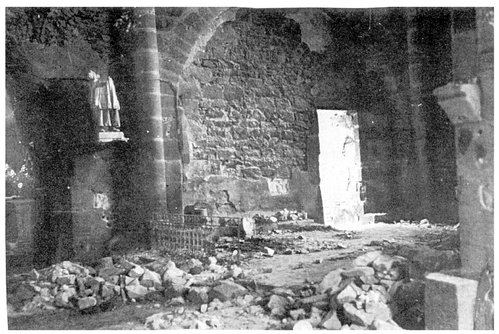
The interior of the church shortly after the removal of the human remains. Note the beheaded statue on the left with the entrance to the vestry beyond. The pillar on the right is pitted with the marks of bullets.

The altar area after the church was cleaned up. The vestry has been sealed off.
Everyone crowded into the side chapels and pressed up to the doors and windows. They coughed, choked and screamed as they inhaled the smoke which burned their throats and hurt their eyes.
‘The door of the vestry was burst open by some of the panic-stricken women,’ said Mme Rouffanche. ‘I went through with them and sat on one of the steps. My daughter came to join me.’
She heard gunfire and screaming in the body of the church and the detonation of grenades. The SS had burst in through the main entrance and were firing into the screaming, struggling mass. Then the soldiers noticed that the vestry had been invaded and set about finishing off the women crowded there. Some fired through the windows.
‘My daughter was killed by my side. I owe my life to the fact that I shut my eyes and played dead,’ said Mme Rouffanche.
When the screaming died down she heard the soldiers gathering chairs and other combustible material to pile on the bodies. She heard them leave when they had started the fire.
As the flames spread it became evident that some of the women, like Mme Rouffanche, had been feigning death. They screamed again as the flames reached them. Most of them could not move, due to their wounds or the pile of bodies on top of them.
‘I got to my feet,’ said Mme Rouffanche, ‘and, concealed by the smoke, slipped behind the altar where there are three windows. I got hold of the step ladder used for lighting the tall candles and managed to reach the centre window, the largest. I still don’t know how I managed it, but I squeezed through that window and dropped three metres to the ground.’

The confessional in which was found the bodies of two little boys (cousins) who had been shot in the back of the neck.

The high altar with the escape window behind it. The remains of a pram symbolises the slaughter of the babies.
Then she realised from a sound above that she was being followed. Henriette Joyeux, aged 23, was holding out her seven months’ old baby and pleading with Mme Rouffanche to catch it. She tried, but could not manage to hold it and the child dropped to the ground.

The altar in the side chapel which largely escaped damage.
The infant’s screams attracted the attention of some soldiers in the street below and as the two women hurried towards the garden of the presbytery they were fired on. Marguerite Rouffanche was hit five times, four times in her legs. The fifth bullet shattered her right shoulder. However, she managed to drag herself into the garden of the Bardet family, next to the presbytery, where she hid in some rows of peas and tried to cover herself with earth.
Henriette Joyeux, carrying her baby, sought shelter in the privy at the bottom of the presbytery garden, but she had been mortally wounded and died there with her baby whose skull had been fractured. Their bodies were subsequently found in a trench dug by some soldiers who returned to the scene on Monday morning.
The rest of the terrible story could only be pieced together from evidence found by the salvage teams and later by information about people living in the village who, with many visitors, had disappeared and whose remains could not be identified. Many of the children in the church must have been killed by the bullets and grenades. Babies’ bodies were found in their prams. In the right transept a large pile of charred human remains was found against a small door which was locked. Yet it appeared that this door had been open at first and two women and eight children had got out that way.
Their bodies were found in the cellar of the presbytery. The wooden confessional in the left transept, which was surprisingly unaffected by the fire, contained the bodies of two boys, cousins aged 12 and 14, who had been shot in the back of the neck. They were upright in the part reserved for the priest and were clutching each other’s hands. The vestry, with the remains of the people killed there, had collapsed into the cellar.
There were many isolated killings in and around the village. Bedridden veterans were shot where they lay or allowed to burn to death when their homes were set on fire. One of them, M Giroux, aged 78, who died in his bed, was paralysed. The bodies of several women were found in a well at the Picat farm, on the road to Saint-Junien. The remains of a child were found in the oven of a bakery.
Among the unlucky victims, apart from the five young cyclists who arrived at the time of the round-up, were some workmen on some scaffolding who were shot like pigeons. A young man from Lille, travelling to Toulouse, left the train at Limoges to visit a friend who advised him to spend a few days at Oradour, ‘a peaceful little place.’ He arrived on the morning of the 10th and managed to find a room at a hotel. Mme Villatte, with her baby Christian aged three months, was staying with her parents-in-law, tobacconists in Oradour, because she feared there might be some aerial bombardment of Limoges. The whole family perished. M Bergeron had come from Saint-Victurnien by bicycle to have some shoes repaired. M Tournier, a music teacher in Limoges, had come to give a lesson.
M. Jules Renaudin who, with his wife, was employed by the Vicomtesse de Saint-Venant at Laplaud Manor, insisted on going into the village after the shooting had started. He was warned of the danger but went to his death saying he must get his tobacco ration and would pick up his seven year old daughter Bernadette who was one of the pupils at the Lorraine School.
There were some miraculous escapes. M Hubert Desourteaux, garage proprietor, a son of the mayor, was a prisoner-of-war for two years and didn’t trust the Germans. With his brother Etienne, the mayor’s secretary, he hid in some bushes in his garden.
Bullets could be heard ricocheting near them and Etienne decided to take shelter in the house. He was shot there and his body was burnt with the house. Hubert crept into the fields at nightfall and was the only survivor of the family. He was unmarried.
Hubert’s mechanic, M Aimé Renaud, also escaped. His wife Jeanine ran to the garage to warn him that the Germans were coming. They hid in his employer’s yard, behind some bushes and a pile of stones. They listened horrified to the dreadful sounds, the shooting and screaming in the garage, the explosions, the loud German voices and the crackle and roar of the fires as the houses were set ablaze, one after the other.
They did not dare to emerge from their hiding place until late at night when Mme Renaud almost collided with a soldier. Fortunately he appeared not to notice her. They feared for the safety of their four years old daughter Annie and Mme Renaud’s mother, who both died in the church. Together they managed to get out of the burning village and across the river to try to find M Renaud’s parents.
Hippolyte Senon, a young man, had cycled out of Oradour just before it was surrounded. He went to several farms and hamlets warning people not to go to Oradour. One of the places he visited was the mill on the Glane where the miller’s young wife was terrified for the safety of her husband. He had insisted on going into the village on his bicycle, waving a white handkerchief.

Wrecked cars in the garage near the church.
She joined the other women, including the mothers of the children at school in the village, to watch with mounting horror and fear the appalling sight of the houses catching fire, one after the other.
A tenant farmer named Gaudy left one of the cottages near the Laplaud Manor to go and find his three children who were at school. He was pulled up short on the road by the sound of machine-gun fire and screaming.
One frantic mother, fearful for the fate of her four children, actually succeeded in getting in and out of the village during the occupation. She was Mme Démery whose children, André (13), Henri (12), Ernest (11) and Marcelle (10), had been taken to the church when she arrived.
Accompanied by a neighbour, she reached the children’s school. They heard shooting and screaming lower down the village but saw no soldiers. Frantic with fear, they burst into the school. Mme Démery found her boys’ caps and satchels but the school was empty of any living soul.
Another parent who got in and out during the occupation was M. Deschamps, a farm worker at La Fauvette. He thought the woods near the village were on fire and as his four daughters, Claudine (13), Renée (10), Huguette (7), and Maryse (6), had not returned from school he decided to go to the village to see what had happened.
He entered Oradour at the upper end which was sparsely guarded and was surprised to find that the main street was deserted. The doors of the houses were open but there was not a soul in sight. He went into the boys’ school and found it strangely empty. He was on his way down to the girls’ school when he spotted armed soldiers and decided to return home. He told his wife he thought all the people had been evacuated. The bodies of their daughters were among those which were never identified.
At the Laplaud Manor, Mme Forest became very alarmed when she heard the shooting and screaming which carried a long way. Why had not Michel returned with little Dominique? If there had been any danger they would have come back, bringing her father with them. Accompanied by Doctor and Mme Gaudois, who were also staying at the manor, she walked down the drive to the edge of the woods where they had a view of Oradour. They also thought there was a forest fire on the other side of the village.
‘If there is any danger to the village,’ they assured each other, ‘the people will have been evacuated.’
Among the lucky people who were out of the village that afternoon were Mme Montazeaud, whose husband Pierre, a solicitor, was among the victims, Daniel Senon, a postman who was delivering letters outside Oradour, and M Desvignes, butcher, who had gone to a fair at Saint-Victurien. The Desvignes family perished.
It was around 6 p.m., when the village was burning fiercely that Marie-Léon Foussat, the miller, cautiously approached the outskirts waving a white handkerchief. A soldier saw him and shot him.

The well at the Picat farm in which bodies were found.
A small maintenance tram from Limoges bearing company employees, stopped before crossing the bridge over the Glane and the driver, M Chalard, got out to see what was happening. He was shot as he crossed the bridge and his body was thrown into the river. The tram was driven back hurriedly.
Another tram, bearing weekend shoppers arrived an hour later. One can imagine their feelings as the tram slowly approached the burning village. One of the guards on the bridge ordered the driver to stop. No one was allowed to get out while a soldier went off on a bicycle to get orders. He returned with the instructions that everyone bound for Oradour was to get out while the rest were sent back to Limoges.
Twenty-two frightened people were marched to the hamlet Les Bordes where a house was on fire. Another house had been taken over as a command post. They were lined up before a soldier with a machine-gun while papers were checked and the men were separated from the women. A grave for a man killed on the road nearby had been dug.
One of the passengers, Louise Compain, daughter of an Oradour confectioner, who was anxious about her parents, said someone asked a soldier what had happened to the villagers.
‘Tous kaput!’ (All dead!) he answered sharply.
‘We thought there had been a fight between the maquis and the Germans,’ she said afterwards, but one of them told us, in French, ‘ We found arms and ammunition in the village, so we blew up everything and burnt the place.’ The soldier added, ‘Above all, don’t say anything when the officer arrives.’
Louise said most of the soldiers were laughing and chatting as if they had enjoyed what they had been doing. However, she noticed one young soldier sitting on a stone and wiping his eyes with the sleeve of his uniform. He may have been weeping or his eyes could have been affected by the smoke from the burning buildings.
After about two hours the soldiers encircled the terrified people, pointing their guns at them while there was a conversation between an officer and an NCO. Then to their immense relief the people were told they could go. But they were forbidden to enter Oradour. As they hurriedly moved off, one of the soldiers shouted,
‘You can consider yourselves lucky!’

The remains of the post office.
And they didn’t know until later just how lucky they were. A soldier had noticed from her papers that one of the girls lived a few kilometres from the village and offered her a bicycle he had stolen during the looting.
Among the ‘lucky people’ was M Pallier, a railway engineer from Paris. He had intended to visit his wife and two children who had been moved to Oradour to escape a possible bombardment of the capital. Travelling in a chauffeur-driven car, he intended to spend Saturday night with his family.
When they were about four kilometres from the village they met a truck and half-tracked vehicle carrying in all about fifty soldiers. They were ordered to get out and stand in a ditch while a minute examination was made of their papers. Pallier could speak German and conversed with an officer who asked if he was from Oradour. When he said ‘no’ he was allowed to carry on. Sundry objects which had been removed from the car were replaced.
They soon saw a huge cloud of smoke arising from the direction of the village and when they came within sight of it they realised to their horror that it was an immense brazier. About 300 metres from the entrance they were stopped by five or six soldiers armed with light machine-guns. They were ordered to get out with their hands raised. They were frisked and their papers were again examined. Pallier explained that he had been given permission by an officer to go to Oradour. He and his chauffeur were ordered not to move and they were eventually ordered to join the evicted tram passengers.
When the tram passengers were released, Pallier was invited by one of the men, whom he knew, to spend the night at his home at Les Bordes. His wife told them that when the Germans arrived she was ordered to prepare a meal for an officer. While she was doing this, one of the soldiers said their mission was to sack and burn Oradour because a much-decorated officer had been the victim of a terrorist attack a short distance away.
The next morning Pallier went with five or six other men to explore the ruins in the hope of finding their missing families. They were utterly shocked by what they saw and had gone right through the ruins and out of the other side when they suddenly came face-to-face with a German patrol. Pallier was recognised by one of the Germans who had stopped his car the previous day. However there was the usual identity check and they were asked if they had been in the village. They said they hadn’t yet but intended to if it was allowed. An NCO told them to get away as far as possible or they would be shot.
Pallier and his friend skirted the ruins to return to Les Bordes where they were told that the women and children had been evacuated by the Germans to the hamlet of Maférat before they set fire to the place.
An 80 year old man, Martial Litaud, who had taken shelter in a rabbit hutch during the massacre said he had been back into the ruins and could assure them that there were no more Germans there. So a party of men risked going right through to make their way to Maférat, only to discover that the rumour was false.
M Crémoux, a repatriated prisoner-of-war, managed to get out just before the village was surrounded. For a while he hid in some bushes by the river but got into the water when he heard some soldiers approaching. He was lying in the shadow of the bank when two soldiers, speaking French, passed by. He heard one say, ‘I killed twenty-six of them,’ as if he had been bagging rabbits.
Armand Senon, aged 20, whose home overlooked the Champ de Foire, stayed in his bedroom during the round-up. He was the only survivor of a family of thirteen. He had sustained a broken leg playing football and had it in a plaster cast. He saw the comings and goings of the SS, looking for anyone who might have been overlooked. They shone powerful torches into the windows and one beam touched his plaster cast.
Senon heard the fusillades after the men had been marched off. He witnessed the killing of the six young cyclists outside the Beaubreuil forge. One of them screamed, ‘Vive la France!’ before he died. Realising that escape was imperative, he limped downstairs went out by the back door and hid in the garden until nightfall. He heard his home being looted and watched its destruction by fire.
Peering through the undergrowth during the afternoon he saw soldiers firing at people who had escaped the round-up. In fact, they seemed to be firing at everything that moved, including cats, dogs and poultry.
‘One of the bastards, a red-headed fellow, crouched down within a few feet of where I was hiding to relieve himself,’ he said. ‘For one mad moment I thought of braining him with my walking stick.’
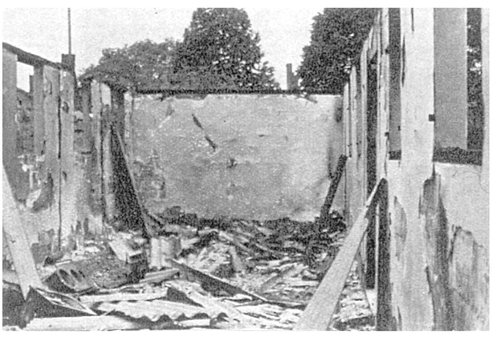
The shell of the school for the little Alsatian refugee children from which Roger Godfrin escaped while the others were taken to the Champ de Foire.
A neighbour, Maurice Machefer, also escaped but his wife failed to follow him and was taken to the church.
One entire family, together with a woman friend, had an amazing escape. They decided to stay indoors when the order for the assembly was given. A soldier burst in and shoved the two women and two children into the street, ordering them to go to the Champ de Foire. The father, hidden in a bedroom, thought he had been overlooked but another soldier found him and he was made to join the rest of the family in the street.
However, for some reason or other their escort was momentarily distracted and they all managed to slip away and hide in the undergrowth at the back of the house. Later they got away into the woods.
Young Robert Besson hid between two low walls covered with ivy and lay there for eight hours.
A woman named Blanche Taillander also had a remarkable escape.When the SS burst into the house where she was having lunch with a woman friend, they shot her friend and spared her because she pleaded that she came from Paris and was able to prove it by her identity card.
At about 7 o’clock when the firing had died down, Professor Forest, frantic with worry about his two sons, approached the guard at the lower end of the village. He started to talk in German then lapsed into French which the soldier understood.
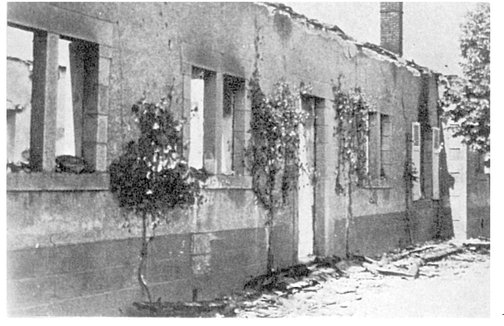
Ruins of the boys’ school.
He was an Alsatian.
As they stood near the burning church where the remains of the women and children were settling into a charred mass, the soldier said all the women and children had gone into the woods and were safe. The professor returned to Laplaud.
That night, while the other Forest children slept, their parents sat on Dominique’s empty bed, sleepless and worried.
At Orbagnac, Mme Catherine Lévêque was also frightened. Her daughter Yvonne had gone to Oradour during the afternoon to get some yeast for her mother to make a meat pie. Yvonne had been accompanied by a friend, Marcelle Ratier. Neither had returned. At 3 a.m. Madame Lévêque suddenly screamed, ‘We’ll never have our child back! I see a pile of charred bones!’
Her husband decided to go into Oradour while it was still dark. He circled the village and eventually ventured into the main street. He got a terrible impression of death everywhere and returned without hope of ever seeing his daughter alive again.
At 5 a.m., Professor Forest returned to Oradour. He asked a sentry in German ‘Where are the children?’ This time he got the blunt reply, ‘They are all dead,’ and he was shoved away at gunpoint. As he walked dejectedly up the drive at Laplaud he heard his wife screaming.
Later they received the news of the escape of Aimé and Jeanine Renaud who were their cousins. They hurried to the house at La Plaine where, they were told the Renauds had gone. But they received no comforting news from them.
So Professor Forest returned to the village for the third time. As he crossed the river bridge the smoke and stench blowing his way brought tears to his eyes. This time he persuaded the guard to take him to an officer who shouted that he knew nothing about the children and advised him to get out of the place or he’d be treated like a terrorist.
The whole neighbourhood was lit by the fire as darkness fell. The flames reached their highest when the church was engulfed and there was an enormous clang as the bells crashed down. The fire was visible at Saint-Junien and Limoges.
The first parent to get into the ruined church was a farmer named Hyvernaud. His two sons, Marcel (12) and André (6), had not returned home and at 4.30 a.m. he decided to investigate. As if by instinct, he went straight to the church. Among the blackened, stinking human remains he recognised the half-burnt body of André. His throat had been severed and one leg was broken and twisted back. He still wore one of his sabots. Hyvernaud returned to his farm at Le Breuil, two kilometres north-east of Oradour, and told his wife what he had found.
They both returned to the church with some sheets. They couldn’t recognise Marcel among the other remains so they wrapped up what was left of André and took him home. They buried him in the farmyard.
During his search for his other son, Hyvernaud had looked behind the altar where he found the remains of about twenty small children. They appeared to have been put there in the hope that they would be safe. He saw a number of dead babies in their prams.
All the houses were looted and valuables, radios, drink and food were loaded into trucks. As each house was cleared the soldiers doused the interiors with petrol and ignited them. However, one building, La Maison Dupic, a draper’s shop, was not destroyed with the rest. It was emptied of much of its stock, but the SS had a use for it later. It was selected to be a sort of guard post for the night. The rearguard had an orgy there with much drinking and singing. They set fire to the premises when they left at about 11a.m. on Sunday. About twenty-five empty champagne bottles were found near the ruins.
Armand Senon, the escapee with the broken leg, heard the last of the trucks leave but dared not leave his hiding place until several hours later. When he cautiously limped into the ruins he almost immediately came upon the body of Pierre-Henri Poutaraud, the garagist who survived the shooting in the Laudy barn. He had been shot in back and was halfway through a fence. The first living soul he met was M Devignes, the butcher, who told him that everyone had been killed and their bodies burnt. He was in tears. Senon searched in vain for any trace of his family.
A few other people made a cautious appearance after the SS had left, staring in horror at the ruins. The transformation of a peaceful, picturesque village into a smoking, stinking ruin was shocking in itself without investigation of what the ruins contained. Certain buildings were recognisable because their signs were still legible, if charred: Hôtel Milord, Hôtel Beaubreuil, Restaurant Dagoury, Café de Chêne, Boulangerie and Boucherie, among others. But they bore no resemblance to the busy, populated places of the previous day.
A few horses and some cattle roamed the streets looking for their stables and barns. Dogs sniffed among the ruins for their masters, whining and shivering. Most of the cats seemed to have taken refuge in a house on the outskirts which had been spared and were howling to be fed. Swallows darted about distraught because their nests had been burnt. Poultry and rabbits foraged in the gardens.
That same day, anxious families and friends went to the office of the Gestapo in the Champ de Juillet, Limoges, to ask for news of people and children who had been in Oradour. The Germans refused to see them but some policemen who were guarding the building said: ‘We can’t give you any details but one thing is clear – everyone has perished.’
Among the people who entered the ruins later that day were M Hubert Desourteaux and M Lévignac who still hoped to find his two sons. Léviginac ventured into the ruined church and soon emerged shocked and unbelieving. Then he heard a faint cry and traced the source to the garden of the Bardet family where he found what he thought was a negress lying between the rows of peas. It was Marguerite Rouffanche who had covered herself with earth.
She was so distraught that she begged her rescuers to throw her in the river. She had been lying there for nearly twenty-four hours. They put her in a barrow and took her to Laplaud Manor. She was covered with a mixture of blood and soil. She could hardly speak but her rescuers could just distinguish a repeated sentence, ‘All the women and children where burned in the church...’
At the manor, Doctor Gaudois cut away her clothing and did his best to clean her up. He realised that her five bullet wounds needed urgent attention but he had no facilities. However, they kept her at the manor overnight. The next morning they took her to the station at Saint-Victurnien where they managed to get on a goods train for Limoges. On their way to the hospital they were stopped by a German soldier who was curious about their patient. However they managed to convince him that she had fallen from a hay loft.
A Limoges journalist, Pierre Poitevin, subsequently visited Marguerite Rouffanche in hospital with a friend of hers. She had refused to see anyone, particularly journalists, except a few friends and relatives. Poitevin did not reveal his identity and she did not query it.
She spoke in a low voice about the terrible scenes in the church. She said her two daughters, Andrée Rouffanche, (21), and Mme Amélie Peyroux (23), had gone into the vestry with her. In the rush Amélie had dropped her baby. She found him shortly before they were both killed by bullets. Andrée had been killed at her side and she had also lost her husband and her son Jean (19).
Mme Rouffanche said she was sorry she had been unable to catch Henriette Joyeux’s baby when she dropped it from the church window. She told how she tried to cover herself with earth while she lay among the peas. Her wounds were very painful and she suffered greatly from thirst. She managed to clutch a few handfuls of peas and sucked them to alleviate her thirst.
Early on Sunday morning she heard men’s voices. She slowly turned her head and saw some soldiers milking a cow a short distance away. When they moved away she tried to crawl further into the undergrowth but her wounds made it impossible. She wished she could crawl down to the Glane and die there. But she could not move.