
CHAPTER 3
The destruction of Oradour involved 254 buildings of which 123 were houses. When the list of the dead came to be drawn up it was established that the residents, together with the refugees, totalled 393. People who were brought in from the countryside totalled 167. There were thirty-three people from Limoges and forty-three from other places. Six others were subsequently added to the list as it turned out that they had disappeared and must have been in Oradour at the time.
One man whose name was not listed was Lieutenant Knug of the SS. He was killed when a stone from the church steeple hit him as it collapsed. His family were told that he had been killed in action, fighting for the Führer and Fatherland.
After the sacking of the village the SS travelled to the village of Nieul, about nine and a half kilomeres away, where billets for the night had been arranged. Someone who saw them pass said some of them were singing to an accordion. Residents of Nieul described how they arrived in a state of excitement. They spread out in the streets, shouting to each other. Some appeared to be drunk. Most of the soldiers were billeted in the village school. After washing off their grime in the children’s toilets they drank their looted liquor and settled down for the night in the children’s classrooms. The officers spent the night in a private house.
The following day, Sunday 11 June, the soldiers made meals from poultry they had stolen. Some of them fooled around in the playground with two bicycles until they smashed them. These were identified as belonging to Oradour people, as also was a motor-cycle found in a park pond. One soldier was seen at the ground floor window of a house distributing banknotes from two canteens. Two French truck drivers named Démery and Nadaud, who had been commissioned to help with the transport of the battalion’s accoutrements from Saint-Junien, said an Alsatian told them, ‘We have just carried out quite a job. We have killed all the people of Oradour and burnt them in the church.’
The last of the SS to leave Oradour on Sunday morning, after the burning of the Maison Dupic, were seen en route for Nieul by Hubert Desourteaux. Their trucks were loaded with loot and they were towing a car which he recognised as the property of one of his customers. The rope snapped and the car crashed into a pylon.The man at the wheel was badly hurt. The others put him in a truck, together with the loot from the car and carried on. The SS in Nieul spent much of Sunday in a state of readiness seated in the trucks. They were joined by other companies of the battalion.
On the morning of the 12th a party of soldiers arrived at the ruins. Their orders were apparently to try to conceal some of the evidence of the massacre. People who had been searching for their families fled in fear while animals roaming about were shot. The men were equipped with spades and dug trenches behind the barns and warehouses where the men had been killed. They also dug a large trench near the church. Into these trenches they threw the remains of as many bodies as they would hold and flattened the earth on top. The burial of M Dupic, in his own garden, was so rudimentary that one of his hands was above ground. The bodies of the two women and eight children who were shot in the cellar of the presbytery were covered with earth and stones and bullet-riddled prams were thrown on top. The soldiers also buried a number of isolated corpses on the outskirts of the village. They left the scene at about mid-day, after firing a burst from their machine-guns. They were seen travelling towards Limoges.
For a while the Germans put a guard on the ruins and forbade anyone to enter. Some officers paid a visit and after a brief inspection left with some poultry.
Later that day, 12 June, the first official visitor, the prefect of Rochechouart, went through the ruins and described what he had seen to the prefect of Limoges, M Freund-Valade. The latter made a personal visit the following day, accompanied by the Bishop of Limoges, Mgr Rastouil. The bishop was so shocked by what they found in the church that he burst into tears and nearly fainted. In a letter to the Vichy government, in which he deplored the massacre, the prefect wrote:
‘In the church we found the remains of many human beings who had been burned. The floor was littered with empty cases of bullets bearing the maker’s mark S.T.K.A.M. and the walls bore numerous bullet holes at the height of a human being. Outside the church the earth had recently been moved. The remains of women and children had been buried there by German soldiers. There was a pile of charred clothing belonging to children.’
The prefect said a few people had managed to get into the ruins on the Sunday afternoon and some of them saw the burnt and broken bodies in the church.
‘One witness,’ he wrote, ‘swore he had seen the body of a mother clutching an infant in her arms before the altar, there was also the body of a little child, its hands joined in prayer.’
The prefect appealed to the Vichy government to protest in the strongest terms to the German government about ‘the appalling nature of such reprisals, the widespread emotion they had aroused and the terror the people were experiencing.’
On the afternoon of the 14th, Commander de Praingy, assistant director of the Défense Passive, visited the ruins, accompanied Doctor Bapt, the medical officer of health, his deputy Doctor Benech, and twenty members of the Red Cross emergency service. They were there to assess the extent of the salvage work. Commander de Praingy subsequently phoned the prefect to ask for a team composed of members of the Red Cross, the Jeunesse Secours (a young people’s aid association) and of the Equipes Nationales to accompany him to Oradour the next day. He dictated a list of the equipment needed.
On Thursday morning, the 15th, a team of 149 people, including a number of young seminarists, left Limoges by tram. They carried disinfectants, face masks, rubber gloves and shovels. Stretchers and coffins were in a trailer attached to the tram. There was also some food for the workers, who expected to be there all day.

A recovery team pulling a cart load of remains to the burial pit.
They carried a permit issued by General Gleiniger, the Wehrmacht officer in charge of the Limoges district, which read:
PERMIT
Limoges 14.6.44
The army headquarters gives permission today and on succeeding days for members of the French sanitary service (Red Cross), under the leadership of Dr Bapt (M.O.H. for the dept of Haute-Vienne), together with his assistant Dr Benech, to travel from Limoges to Oradour-sur-Glane to carry out urgent sanitary and clearing work.
This permit is valid until 22.6.44 when it must be returned to these headquarters.
Signed : The Commandant,
Gleiniger
Major-General
The odd part about this was the insistance that the document should be returned in eight days’ time, the apparent assumption being that the work would then be completed.
Gleiniger is said to have expressed profound shock when he heard of the destruction of the village and its people and realised that sanitary precautions were essential to prevent an outbreak of disease. The salvage team soaked their face masks with eucalyptus oil as the stench had become almost unbearable. During a rest period they tried to eat some of the food but they had no appetite.
In the streets they found the wrecks of two cars, one being that of Doctor Desourteaux, and the bicycles belonging to the young visitors who had been shot in front of the smithy. An odd discovery was a number of cardboard boxes bearing the name of the American munitions firm Winchester. They seemed to have been deliberately placed in the ruins when the fires were out. Surely the Germans weren’t so stupid as to think such evidence might lead people to think there was an American connection with the massacre?
Dead farm animals had been burnt or buried. In the ruins of one farm there were thirty dead sheep. Surviving cows bellowed to be milked. Working among the human debris, the salvage team felt that the accusation that the SS had fired low at first, to cripple their victims, might be correct as the legs of many corpses were shattered. In Russia, shooting below the waist was the order given to some firing squads, in order to inflict painful wounds before the final despatch of the victims.
In the church some of the religious emblems had been smashed and a war memorial was riddled with bullets. But the statues of Notre Dame de Lourdes and Sainte Thérèse were unscathed. Also intact were the recently resilvered crucifix just outside the church and, surprisingly, a wooden cross attached to a gutted house opposite. Pickaxes had to be used in the Chapelle Sainte-Anne as the mass of remains was as hard as cement.
Commander de Praingy ordered the setting up of barricades at the entrances to the ruins. Sightseers were sent away and only people who had a special reason were allowed to enter. They included some of the bereaved, although every effort was made to dissuade them, in view of the shocking sights they might see. Passes had to be obtained at the temporary mairie which had been set up in a barn at the Bel Air Farm.

A burial party, wearing handkerchiefs soaked in eucalyptus to cover the stench, removing charred remains from one of the execution sites.
There was strict surveillance to prevent looting. Items of value, such as jewellery, gold and silverware which, with a few identity cards had somehow survived the blaze, were collected and taken to the Banque de France in Limoges. Each piece bore a label indicating where it had been found. Odd finds included wallets with banknotes intact (though one had been perforated by a bullet) and numerous clasp knives. Four knives had been opened, as if their owners had been prepared to tackle the raiders. Among the remains of the women were belt buckles, corset stiffeners and lipstick tubes.
A letter stained with blood was addressed to a priest and dated 10 June. It began, ‘I am quite well at present and benefiting from the sunshine...’ A page of an exercise book belonging to an 11-year-old boy bore a sentence copied from the blackboard, ‘Je prends la résolution de ne jamais faire du mal aux autres...’
On the altar, the tabernacle had been forced open and the sacred vessels removed. A small box containing sacred relics was dug up near the church but the ciborium was never recovered. It had probably been included in the SS loot. The Bishop of Limoges wrote to General Gleiniger. After expressing his horror about the massacre in the church, he wrote, ‘It is my duty to find out what happened to the sacred vessels, not so much for their value as for what they contained – the sacred host...’ The general expressed his regret and said he was shocked by the whole affair. One of his officers, an Austrian, is said to have remarked, ‘It would have been better for Germany to lose another five divisions than to carry the guilt of the massacre of Oradour.’
Doctor Bapt reported that the bodies that could be identified were buried separately, each with its identifying cross. However, the vast majority of the human remains were impossible to identify and would be put in a communal grave.
He had gone to Les Bordes on his bicycle on the 19th when he was told that the Germans had returned to the ruins. He hurried back and found three truckloads of soldiers at the southern entrance. Some of them were in the streets and he saw two of them removing wheels from wrecked cars. He showed his permit and found the salvage team still at work. They told him that the Germans had seized the bicycles used by some of the team and loaded them on the trucks. However they got them back when they convinced the soldiers they were doing an authorised task.
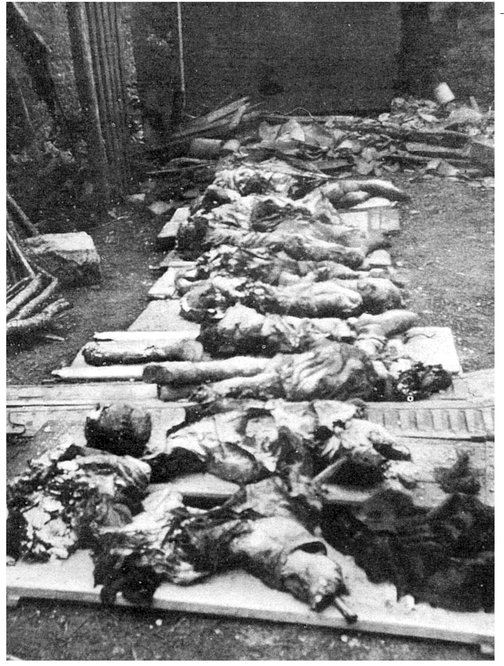
Remains laid out for collection.
This unexpected return of the Germans added to the terror of the communities in the neighbourhood who had been stunned by the massacre. Fearing further atrocities they left their homes at night to sleep in the woods.
Pierre Poitevin, a Limoges journalist, a member of the MUR (Mouvements Unis de Résistance) whose pseudonym was Jean Guiton, had clandestinely visited villages in the Dordogne and Corrèze, where the SS had committed atrocities, and got permission from his editor to visit Oradour on the afternooon of the 19th. Despite a German ban on photographs he took his camera and and had taken a number of pictures of the ruins and the salvage team at work when he was stopped by a German NCO who demanded to see his papers. Fortunately he had pocketed his camera, a folding one, but it made a bulge in his pocket. He had to wait against a wall, guarded by four armed soldiers, while his identity card was examined. He prayed he would not be frisked. Fortunately his card described him as ‘an inspector’ – as a member of the Resistance this was a safer description than ‘journalist’. He said he was working for an insurance company and had come to the village to assess the damage to property. He was also working with the salvage party.
The soldier who interpreted appeared doubtful and it was fortunate that an engineer M Fichot, who had also been questioned, confirmed his identity and they were both released. They hurried to their bicycles only to find they had been loaded on a truck. They had to ask the interpreter to help them to retrieve them. Incidentally, Poitevin buried his reports of the SS atrocities including Oradour, until the liberation. He feared a Gestapo investigation.
When the Gestapo heard there were some survivors they did their utmost to trace them. Fortunately, these stricken people were warned by the Resistance who helped them to find shelter. They also helped them financially. No official monetary help was given until July when clothing and cash were distributed at the temporary mairie at the Bel Air farm.
The salvage team worked for five days, digging up and transporting bodies while in constant fear of being interrupted by the Germans and constant danger from falling masonry. On the last day, the last cart, drawn by oxen and covered with flowers and greenery, arrived at the burial pit with its tragic load. A tricolour flag with a black veil was at the front of the vehicle. The unidentified remains of hundreds of people in the pit were covered with quicklime. Before the pit was filled in the salvage team with a number of relatives of the dead gathered round for a committal service conducted by the bishop. Two social workers, Mlles Lacoste and Dumay threw into the pit a beautiful wreath of roses gathered from the gardens of the ruined houses.
Before dispersing, the people held hands and sang ‘Ce n’est qu’un au revoir, mes frères’. Tears flowed and some of the women fainted.

The remains of the mayor, identified by a briefcase he was holding.
Every possible effort had been made to identify the bodies but most were unrecognisable. However, the body of the mayor dug from a trench was identified. He had been shot in the heart and buried with his briefcase. One report said that the body of the parish priest had been found in the church but this was never confirmed. There were two priests: the Abbé Chapelle, the parish priest and the Abbé Lorich from Alsace-Lorraine. There was also a young seminarist, Emile Neumeyer in village on that fatal afternoon. They all disappeared without trace, although the first two were noticed among the assembly at the Champ de Foire.
Compiling a provisional list of the dead was difficult because the parish registers and other important documents had been destroyed. Some help was given by the bereaved and outsiders who knew the village and its inhabitants. They walked from one ruin to another naming the people they thought had lived there.
On 6 July, the Bishop of Limoges had told a large congregation in the cathedral what he had seen at Oradour and announced that a memorial service would be held on 21 June at 9.30 a.m. As reference to the massacre in the press was forbidden, the Bishop arranged for the announcement to be made in all the churches. The service was described as ‘a memorial to the recent dead.’ Without direct reference to the occupying forces, he said 21 June would be a day of mourning, associated with expressions of sympathy for the bereaved and a protest against ‘appalling barbarity.’
The German censor in Limoges, Doctor Sahm, called a meeting of local journalists in his office in the Rue Pierre--Raymond. He first spoke of the new German offensive weapons, ‘aerodynamic meteorites’ (the V1 and V2) which were being targeted on London and deplored the lack of interest in them shown in the press.
Then he said:
‘Gentlemen, I must now speak of a matter which has had a profound effect on me. I refer, of course, to what has happened at Oradour. Please understand that we offer no excuses for what happened and I cannot tell you if the officers concerned will be punished or if they have already been disciplined. But I must stress that the soldiers did not go to Oradour without a reason. The village was full of maquis, in fact it was a maquis stronghold. On 9 June and even on the morning of the 10th they fired on cars carrying officers. The soldiers could therefore claim that they acted in legitimate defence. Concerning what happened in the church, where the women and children were sent for their safety, I must admit that I cannot understand it and we will try to find the reason.’
Then after a pause and without a word of sympathy for the bereaved, Sahm added ‘After all, gentlemen, you will appreciate that many more women and children have been killed by RAF bombers than at Oradour.’ The journalists listened to this statement in silence. There was another pause then Sahm added, ‘I think it would be preferable for you to make no reference to this affair at present.’ In the event the newspapers published many death notices placed by the families of the victims, until the Germans put a stop to the practice.

Charred bodies of women and children taken from a trench near the church.
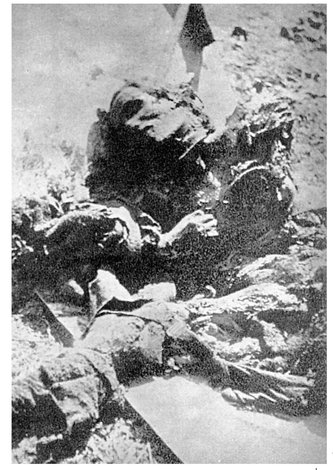
The torso of a woman with her hand clenched, near the body of a little boy.
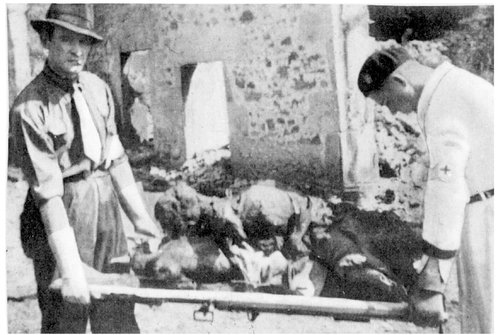
Human remains on a makeshift stretcher.
From Sahm’s statement the journalists were asked to believe that the SS did not make a chance visit to Oradour. They had been ordered to go there. But by whom and what was the real motive for the raid? If there had been any truth in officers being fired on from the village and there had been fatal injuries, impressive funerals with full military honours would have been witnessed.
Attempts were made to keep the people away from the cathedral on the 21st when all the shops and cafés were closed and flags appeared at half-mast. There was a rumour that the bishop had been arrested and that explosives had been placed under the cathedral to be detonated during the service. Before the service, the prefect warned the bishop that nocturnal work had been reported near the cathedral. The police searched the crypt but found nothing. The Bishop went to the cathedral at 9.30 a.m. to find it already full with a large crowd outside.
During the service, the prefect told the Bishop that the police could not assure him there was no danger and advised him to shorten the service. It was later revealed that a man in the pay of the Gestapo had made a noise in a cellar adjacent to the cathedral during the night. It sounded like excavation. The Bishop concluded the service with the words, ‘Mes frères, let us say the De Profundis for the dead of Oradour-sur-Glane. Let us say a Pater and an Ave for the families of the victims.’
The next day, Monseigneur Valerio Valeri, the Papal Nuncio at Vichy, sent a letter of protest to Pétain. He expressed his horror at what had happened at Oradour and implored the Marshal to transmit the feelings of the people to the German government. Pétain wrote to Hitler complaining about the campaign of reprisals which, he said, ‘would gravely compromise the reconciliation of our two peoples.’ There was no reply.
The attitude of the Vichy government was expressed by a spokeman, Xavier Vallat, in a broadcast on the controlled radio on 27 June. He referred to a woman he knew who had died at Oradour, ‘The French people are morally responsible for the death of this woman and many others’ and went on to explain that if they had not allowed a group of ‘bandits’ to cause grave unrest or false patriotism the Germans would not have been obliged to inflict punishment on so many people.
On 3 July a representative of the regional office of information asked the Bishop to arrange a memorial service for Philippe Henriot, propaganda minister for the Vichy government, who had been shot by francs-tireurs in Paris. The Bishop said such a service could be arranged but he would take no part in it, in view of the official character of the ceremony.

Boxes containing the remains of bodies awaiting collection.

The funeral cortege on the way to the service at the burial pit. The cart, drawn by oxen, was loaded with flowers.
The following day, two of the leaders of the local militia, a collaborationist force, Messrs Vaugelas and Raybaud, came to tell him that if he still refused to take part in the service it would be considered ‘a hostile act’ in the eyes of the Vichy government. The Bishop replied that he would not attend, even if it cost him his liberty or even his life. The service took place on 5 July when the Bishop was ‘represented’ by a vicaire-général and there were a few other priests. That evening, Radio Limoges complained in strong terms that a prominent ecclesiastic of Limoges had refused to take part in the memorial service for M Henriot. On 7 July, four policemen came to the Bishop with an order to take him under open arrest to a detention centre at Chatroux. Warned of the visit, the Bishop wore his impressive purple habit to welcome them. An inspector first apologised then read the order of arrest, signed by Raybaud, which accused the Bishop of being ‘a person dangerous to national defence and public security.’ The Bishop refused to move and the policemen left.
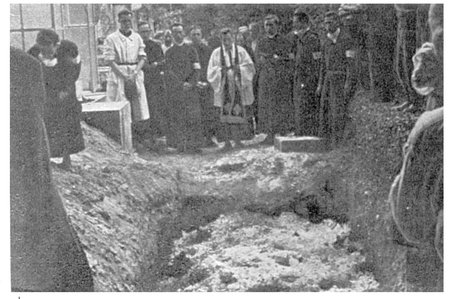
The funeral service at the pit which held hundreds of burnt bodies covered with quicklime.
Later that day, the same policemen returned with an order to take him by force if necessary. The Bishop replied,
‘My dear sirs, you are but little people in reality. You are like us, sons of working folk. I don’t want you to act against your conscience or to risk losing your livelihood, so I’ll come.’
At Chatroux his guards were polite and even sympathetic. Meanwhile the Papal Nuncio called on Pétain’s Prime Minister Pierre Laval to protest about the Bishop’s arrest which, said, could have ‘grave repercussions.’ He also told Laval in no uncertain terms what had happened at Oradour. Laval contacted Darnaud, the chief of the militia, and on 22 July an order was given for the Bishop’s release. As his car had been taken by the maquis, and the police did not provide transport, the Bishop had to walk back to Limoges, a distance of about seven kilometres. He was greeted with joy and surprise by everyone he met.
On the day of the liberation of Limoges, 21 August, people gathered round the Bishop to talk about the tragedy of Oradour and to thank him for his noble and courageous stand against the Germans and the militia.
There are conflicting accounts about what happened to General Gleiniger, the officer in charge of the Limoges district, who apologised for the massacre, of which he apparently had no prior knowledge. But what is certain is that he died shortly afterwards, either by assassination or suicide.
In September 1994, an article by René Lejeune appeared in a religious magazine under the heading: ‘ORADOUR – UN MARTYR DE PLUS.’ (Oradour – Another Martyr) Lejeune said his brother was a seminarist at Limoges in 1944 and was among those who helped to inter the bodies of the victims. He spoke of General Gleiniger as a man who tried to save the honour of his people. As soon as he heard of the massacre the general begged the pardon of the prefect of Limoges, on behalf of his fellow countrymen. The Das Reich division were furious and accused him of ‘sullying the honour of National Socialism in a disgraceful manner.’ They ambushed him just outside Limoges and killed him.

General Gleiniger, the officer in charge of the Limoges district, apologised for the massacre.
The Bundesarchiv (German archives) have a report from an NCO stationed at the military headquarters in Limoges, which says, the General was visited by three officers of the Das Reich division on Sunday, 11 June. They submitted a report of only three lines stating that there had been resistance to the armed forces at Oradour and the village had been razed to the ground. At that time, the NCO reported, tension between the SS and the Army was at its strongest and the SS officers warned Gleiniger that any sort of trouble between the two could lead to casualties.
Later, the report said, the SS arrested the General at his headquarters and put him in the back of a truck going in convoy towards Guéret. He (the NCO) and several other soldiers joined the convoy. On the way, there was a brief clash with some maquisards. When the shooting was over, the back of the truck carrying the general was opened and it was found that he had shot himself with a light machine-gun clapsed between his knees with the muzzle under his chin. Two or three bullets had pierced his skull. When the convoy reached Guéret, the SS decided to bury Gleiniger in the cemetery, but not in the part reserved for the military dead. They interred him in a rubbish dump and piled discarded and disintegrated wreaths on him. He had been regarded as a traitor.
Bundesarchiv believes this version to be true, though no dates are given. In view of the other information about the General’s activities it is apparent that the Das Reich division could not have been involved in his death. Apart from the fact that he was reported to have been in Limoges in July, when the Das Reich would have been in Normandy, they would not have taken him north-east towards Guéret when their direct route to the battlefield was north, via Poitiers.

Some of the survivors of the massacre: Front row {from the left) Armand Senon, Mathieu Borie, Daniel Senon, Clement Broussaudier, Joseph Beaubreuil, Robert Besson, Paul Doutre, Martial Machefer. Back row: Yvort Roby, Marcel Darthout (with Glasses), Maurice Beaubreuil, Hubert Desourteaux, Aime Renaud. In front is Roger Godfrin, the sole survivor of the children, orphaned by the death of the rest of his family.

Roger Godfrin, the boy who ran away from the Alsatian school when the SS arrived to take them to the Champ de Foire. His parents, father aged 37 and his mother 35, died in the massacre with their other children, aged 3, 4, 11 and 13. Roger returned to his home town Charly (renamed Charly-Oradour). He was born in 1936 and died in 2001.
In letters to Vichy from the prefect, M. Freund-Valade, dated 15, 16 and 17 June there is mention of contacts with the General. On 15 June the prefect wrote that he went to see Gleiniger on Monday, 12 June, to protest about ‘a method of repression that was contrary to all the laws of warfare and had caused horror and indignation throughout the whole region.’ It seemed that the General had received incomplete information about what had happened at Oradour and when told expressed his astonisnment and indignation.
On 16 June, the prefect reported that he had been summoned to Gleiniger’s headquarters the previous day. The general seemed shocked by the massacre. When the prefect said it disgraced the German Army, Gleiniger agreed and added, ‘This action is a crime against the German people and merits the most severe punishment for those who are responsible.’
The prefect said the French people were waiting for an announcement by the German government dissociating themselves from the massacre. He suggested that Gleiniger might ask the government for permission to release a number of local prisoners, including men from the canton of Saint-Junien which included Oradour, as a preliminary gesture of recompense. The prefect said he hoped there would be an inquiry on the spot, under the supervision of the Red Cross. He also hoped Pétain would come to see what had happened and express his sympathy with the bereaved.
He wrote to Vichy again on 17 June about the lack of interest shown by the police. He put this down to the fact that the police chief who he had appointed had been arrested by the militia. He had been replaced by a member of the Guarde Mobile de Réserve, appointed by M de Vaugelas, a militia officer. The prefect said that in view of the restriction of movement in Limoges and surroundings he had asked Gleiniger for a pass to allow him to circulate freely in the area for which he was responsible. It was refused.
Gleiniger was regarded by the army and the collaborators as a ‘softy.’ His tolerant, understanding attitude was illustrated by a notice he placed in the local press and in posters pasted up in various parts of the city. He announced that he had appealed to the Führer for permission to release a number of local prisoners. He offered to provide trucks to help in the transport of fruit and vegetables for the deprived population.
However, no prisoners were released and not only did no trucks appear, but the soldiers actually accelerated their requisition of vehicles for their personal use. In the markets, the soldiers took their pick of the produce with no regard for the needs of the people.
Pierre Poitevin, the Limoges journalist, said the General and his staff did not visit Oradour until 16 July, after which the General disappeared. He heard that he had been killed by his own men. Another version was that he had been wounded in Guéret when he fled with his troops and the Limoges militia towards the east. It seems certain that his arrest and death did not take place until after 16 July. Then who was responsible?
One theory was that he had been removed from his post and transported towards Germany under orders from Himmler. In which case, the SS would have been involved and they would probably have been members of the 19th Regiment of SS Police who were stationed in Limoges, in collaboration with the Gestapo, who would know all about Gleiniger’s ‘treason’.