
Chapter 2
Vitaly Andreevich Ulianov
Before the war, having finished six years of schooling in Kiev, I was working in the Arsenal factory, which was producing 45-mm guns. They were being installed in the turrets of T-70 tanks, on submarines, as well as being mounted on gun-carriages for use as anti-tank guns. In the summer of 1941, the factory was evacuated to Votkinsk, and I left for there along with it. In 1942, an idea was born within the factory to raise a military unit, equip it with 45-mm guns and volunteer it for the front. The factory leadership sent a letter to Stalin, and quickly received a telegram in his name, which is still preserved in the factory museum today, which permitted the formation of a battalion, but only if the 45-mm guns for it were above and beyond the planned production target. Within a certain amount of time, twelve such guns appeared, though I am deeply convinced that it was impossible to produce anything above the plan targets. The plan was very ruthless, and we were all forced to work to the limits of our strength in order to carry it out, striving to follow the slogan ‘Everything for the front! Everything for victory!’.
However it happened, the 174th ‘Komsomol’ Separate Destroyer Anti-tank Artillery Battalion was created. Enlistment in this battalion was on a voluntary basis. I and my twin brother Vil were among the volunteers. Since there were many who wanted to join the battalion, a selection process was set up via the Komsomol’s city committee.
On the appointed day, Vil came out of the room in which the selection commission was working. I asked him, ‘Vil, how did it go?’ He replied, ‘Go on in, you’ll find out.’ I entered the door and found myself in a large room, in the middle of which was a stool. Members of the district committee bureau were sitting on similar stools along the walls. There was a solitary stool in the corner of the room, where the chairman was sitting. I took a seat on the stool in the middle of the room, and the questioning began: ‘What’s your name? What’s your year of birth?’ That’s when I told a lie, adding a year to my age, and told them I’d been born in 1924, whereas I’d actually been born in 1925. The questioning continued, ‘Who are your parents? Where are they now?’
I had to spin around on the stool, because the questions were coming at me from around the room. Then suddenly someone behind me asked, ‘But will you be calling for your Mama at the front?’ Only a coward, who was afraid to show his own face, could have asked such a question behind my back. I turned in the direction from which the question had come; everyone was wearing a concentrated expression on their faces, and some even had a sign of intelligence. I said, ‘I will not call! What about you?’ This response decided matters in my favour, and they signed me up for the battalion.
However, the chairman of the Komsomol’s factory committee, who knew both me and my grandmother well (my mother was no longer with us, while my father was at the front), coincidentally found out from her that I was still only 17 years old. Literally the next day after their conversation, I couldn’t find my name on the battalion’s roster. I headed to the Komsomol committee to find out why. Despite the accusations of lying that came raining down on me, I began to try to prove that my presence at the front was necessary for victory, that there was no way they could get by without me there. When I realized that I was getting nowhere with them, I played my final card and told them that I would run away to the front regardless, though I’d rather go together with my twin brother than have to go alone. It worked! They decided to have nothing to do with me and let me go together with my brother. That’s how I wound up in the battalion, where I soon became a gun layer.
The battalion had three batteries, with each battery consisting of two platoons of two anti-tank guns each. In addition to the crews, each battery had twenty-four horses and twelve drivers, as well as a single 1½ ton truck that carried our provisions. We underwent our training in Votkinsk, for which purpose they recruited some reserve soldiers. We were quartered in school buildings and marched in formation to the mess hall. People would gather to watch us, because after all their sons, friends and acquaintances were marching in the column, but our senior sergeant thought that they had come to watch him command us, and he would showboat over us as much as he could .. .
Our training was brief; I was given the rank of junior sergeant and I became one crew’s gunner. I recall that on the artillery practice range in Kubinka, we were given an opportunity for the first time to fire an armour-piercing shell at a dug-in tank. I hit it, and then with difficulty I gained permission to fire one more round.
Soon we were travelling by train, which took us to the Voronezh Front. At the time it was trying to force a crossing of the Don River, and together with tankers we fought for possession of Kantimorovka [a German-held town on the Rostov–Voronezh railroad].
As the song goes, ‘The last battle is the hardest . . .’ That isn’t so! The first battle is the hardest, because you still don’t know anything. Do you know what the thinking was at the front? If you remained alive after your first battle – good fellow! After the second battle – a frontline soldier! And after the third battle, you were a veteran! Now you knew everything, where to crouch, where to fall prone, where to run, what to eat, and what to discard. The last battle is the most frightening; after all, no one wants to die in his last battle, he wants to return home . . .
Thus, my first battle; as I learned after the war, they’d thrown us in to seal a gap torn in the line by Manstein’s group, which was striving to bail out Paulus. We were withdrawn from the positions that we were occupying, and having conducted a march, by evening we were approaching a settlement (I no longer recall its name), which was located on a low rise. On its outskirts, an exchange of fire was going on, but it was dark and quiet in the depression into which the main road leading into the settlement descended. One could hear only the squeaks of the sledges and some snorts from the horses that were pulling our guns up the slope. Their crews were marching alongside them. The scene became somewhat eerie. Atop the gentle rise, the platoon commander Junior Lieutenant Kurbatov met us. He indicated a thatch-covered hut at the end of the street as it left the village, and said that a sniper and a submachine gunner were firing from it.
We unhitched the gun from the limber and having manhandled it off the road, set it up next to a well. This was a big mistake, because the area around the well was covered by an icy layer, created by splashes of water from the bucket. I set the sight on ‘anti-personnel’, took aim, and fired. The shell struck the roof timbers (if it had hit the thatch, it would have simply passed cleanly through) and smashed the roof. No one fired any further shots from it.
We then spent some time crouched behind the gun shield, not seeing any other targets, when suddenly a burst of fire rang out in front of us. I took a peek out over the gun shield. Several buildings were on fire, casting a yellowish glare on the road. In the light of the flames, I saw a German in a white camouflage cape about 25 metres in front of me, who was holding a machine gun braced on the top edge of a trench. He had plainly risen to take a look around. While I struggled to line him up in my gun sight, he dropped out of sight. Why did I take so long aiming the gun? Because we had done careless work when switching to winter lubrication and remnants of the summer-formula grease had become frozen. Nevertheless, I went ahead and gave the place where he’d been two or three rounds.
At that moment platoon commander Kurbatov issued the order to fall back. Huh?! We still hadn’t had enough of the fighting and had only begun to fire, and now we were falling back!? Crouching we grabbed the trails, but we slipped onto our butts and couldn’t move the gun – we could find no traction underfoot because of the ice. So then I leaped around the gun shield to the side facing the Germans and gave the gun a shove, budging it from the built-up ice onto the trampled-down snow of the road. A burst of machine-gun fire rattled against the shield and shattered the canister in which I kept the gun sight when it was not in use (I uttered an oath, because the key from the gun sight was still inside it), but somehow missed me. Without waiting for the Germans to open fire once again, I dived behind the gun shield, and together, crouching and digging our feet into the snow, we were able to drag the gun away.
When we sensed that it had become quiet, we swung the gun around and began to roll it down the street. Behind us we were hearing the sounds of a tank – the rumble of an engine and a clattering of treads. Someone shouted, ‘I hear a motor!’ To our right about 10 metres away there was a barn, but we had to move through wet snow that was above our knees in order to reach it. I suddenly recalled the film Aleksandr Nevsky and a famous line from it: ‘Die where you stand.’ So I spoke it aloud. Thank God, no one paid any attention to me. The crew grabbed hold of the gun and began to haul it toward the barn. However, the lower shield situated between the wheels began accumulating snow, and after just 1½ metres it had become impossible even to nudge the gun forward – it had become stuck in front of the wall of snow that it had thrown up. I knew the weapon superbly; there had been a reason why I’d been working in the factory’s technical control department. I had the personal identification stamp No. 183, and it was present on many parts of this gun. I said, ‘Stop!’ I bent over, freed the latch and raised the shield. The gun started moving again, and I’d redeemed myself with my action.
We rolled it into the barn and turned it in the direction of the tank, which hadn’t tarried in appearing. Just out in front of us was a building where the wounded were being gathered. Passing them, we could hear them laughing and joking – they’d done their share of the fighting and they knew that soon they’d be sent to the rear. The panzer drew even with the building, pivoted to face it, and began to shoot it up from a machine gun. I took aim and fired. The shell flew about 15 centimetres above the turret. Later, when analyzing why I’d missed, I realized that when I’d been firing at the hut and the Fritz who had the machine gun, I had set the sight on ‘anti-personnel’, but when firing at the tank, I was using armour-piercing shells, which had an initial velocity twice as great as the high-explosive shell and a different flight trajectory. It hadn’t occurred to me to change the setting! After the shot, because the spades at the end of the split trail hadn’t been dug in, the gun leaped backwards. A second shot! Another miss!
The panzer pivoted and started moving toward us. It was firing its machine guns and the bullets were striking the shield. It fired a round from its cannon, but missed – we were in a slight hollow and the shell flew overhead. After my second shot, because the spades hadn’t been dug in, the gun’s left wheel had pressed me against the wall of the barn. I had to step over the trail and aim the gun by its barrel.
I fired a total of five rounds before I finally hit the tank at a distance of just 10 metres and it burst into flames. I leaped up, waving my arms, and shouted, ‘The tank is burning!’ At this moment, Germans in white ponchos came running out from behind the tank, dashed behind a building directly across the road from us, and from there they began to spray our position with submachine-gun fire. Since I had raised the lower shield, I was wounded in the right foot, while the loader Tolia Shumilov took a round in the knee. The gun commander Dydychkin, who I hadn’t seen before this, issued the order to fall back into the yard. We ran into the yard, spotted a shed, and ran into it. It had no door and I took a seat on a bench opposite the entrance. Shumilov came running into the shed behind me, while Golitsyn who was following him was killed by a burst of automatic weapons fire at the entrance.
Through the doorway I could see a round henhouse made from a woven lattice of poplar branches about 30 metres away. A German stuck his head out of it and began to shout something. I grabbed Tolia Shumilov’s carbine, since I’d left mine behind on the gun limber. Even though I knew that I shouldn’t fire, lest I give our position away, the Fritz was shouting so brazenly that I couldn’t stand it, so I took aim and fired. The German dropped face first. A second German, not realizing what had happened, sprang over to him, exposing his back to my second shot. They began to return fire from behind the henhouse. I ducked behind the door jamb. In the exchange of fire I dropped two more.
I began to reload the carbine, and a cartridge became jammed; rather than extracting it, I tried to force it into the barrel, thereby rendering the carbine inoperable. When I realized that I’d screwed up the carbine, I raised my head and saw two Germans running toward me. Suddenly our gun commander Dydychkin jumped out from the right, stopped in front of the shed, and fumbled a bit before grabbing an RGD grenade. He gave it a shake like it was a thermometer before tossing it at the Germans’ feet. One of the Fritzes stooped to pick up the grenade and throw it back, but it blew up in his hands and the Germans were blown apart. Meanwhile Dydyshkin had darted past the door and taken cover.
We decided to hide in the shed behind a steel barrel. Tolia somehow managed to find a place behind it, but there wasn’t room for me. Germans were in the yard, shouting something. Suddenly a stout German gripping a submachine gun appeared in the doorway. He queried, ‘Rus, you in here?’ I thought that now Shumilov would begin to moan – he’d been moaning before this – the German would finish us off, and my life would end in this damned shed. But then there was an order and the German disappeared.
A short time later the Germans brought their wounded into the yard, which were soon transported away. The fighting began to subside. I said, ‘Tolia, we need to get out of here.’
‘Yes, Vitya, we must. Shall we go?’
‘Let’s move.’
We kept laying there for a few minutes. I spoke up, ‘Are we going?’ I heard his reply, ‘Let’s go.’
We lay there for a while longer, before I spoke up for the third time: ‘Well, let’s go.’ He asked me in reply, ‘Vitia, are you wounded somewhere?’
‘In the foot.’
‘In one?’
‘In one.’
‘I’m wounded in both. So you go first.’
‘OK.’
I crawled out of the shed, and since I was wearing my greatcoat (the camouflage white poncho was horribly uncomfortable, so we didn’t wear it), I decided to cover myself with snow for camouflage. I rolled around in the snow – it was useless. The greatcoats were good quality – no snow would stick to them. Realizing the entire senselessness of the endeavour, I got up on my hands and knees and started crawling. I reached the henhouse and tried not to look in the direction of the dead – it was ghastly. I turned to the left in the direction of a brick building, next to which was a pile of hay. Near this haystack, in the light of the village’s burning buildings I saw a seated old man. A woman was on her knees in front of him, while a second was walking back and forth like a pendulum not far away and moaning. I asked what had happened.
It turned out that this family had been hiding in a cellar. Some German, having raised the access door, had asked, ‘Rus, are you there?’ From down below they answered him, ‘Yes, there are civilians here.’ The Fritz grabbed a grenade and tossed it down. An old woman was killed. The old man had been badly wounded, while the woman who was walking had taken a fragment in the chest. Only the other woman had been left unharmed, but she was in a state of shock and was simply insensate. I asked them, ‘Are there Germans up ahead?’
‘Yes.’
‘To the left?’
‘Yes.’
‘Behind us?’
‘Yes. They’re everywhere.’
I then asked them to give me some civilian clothes and to hide me until our guys would arrive. To which I received the reply, ‘What business do we have with you?’ Well, I thought, I had to get out of there; otherwise they’d turn me in. Incidentally, Tolia, who I later met in the hospital, told me that having waited for 30 minutes, he set out after me in a crawl, and these same people redressed him and hid him for 48 hours. Apparently their conscience had been stirred.
Meanwhile, I slithered down the slope of the hill into the valley, rose to my knees and took several ‘steps’. Suddenly quite nearby a shot rang out. I felt a bullet pass right next to my head. I instantly dropped onto my right side and kept still. The snow was deep and damp. I heard the sound of footsteps: ‘Khryp, khryp . . .’ Silence. I had a Finnish knife with a wooden handle on my belt, but I was lying on my right arm, so I could only draw the knife with my left hand. But what could I do with it? I decided to act dead and to strike the foe in the face with the knife when he bent over to check me, well understanding that in my position, I wouldn’t be able to penetrate a greatcoat or any other outerwear. I held my breath so as not to emit any steam, but all the while it seemed to me that my heart was pounding so loudly that it would be audible several steps away. Again there was the squeak of snow underfoot and then . . . silence. I thought, ‘You have to approach and bend over. Then I’ll have one single chance . . .’ Again the sound of a footstep in the snow. From the sound I realized that the man was standing and was shifting from the right to the left, trying to get a good look at me. Suddenly the footsteps began to recede.
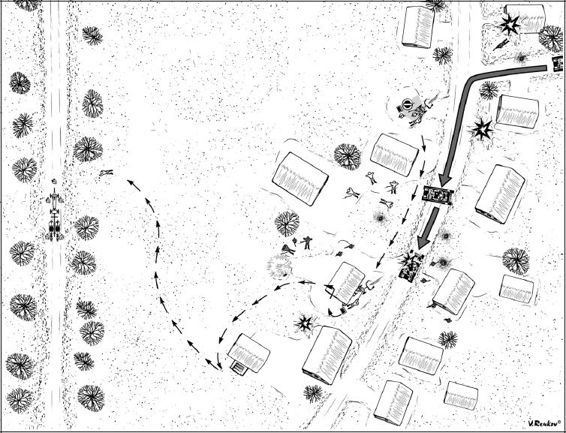
Vitaly Ulianov’s battle in the village, February 1943.
Who was it? I still don’t know, but I think that it wasn’t a German. It was one of ours, and when he saw that he had killed one of his own soldiers, he didn’t want to come any closer and had left. Meanwhile, I continued to lie there. I was now feeling warm and comfortable, and I realized that I was freezing to death. Then I rose abruptly to my knees. I was thinking, ‘Let them fire!’ However, no shot ensued, but I was afraid to look around. On all fours through a small patch of scrub brush I climbed up the opposite slope of the hollow, where a road was running along the crest.
I heard something squeaking and took a look; there was a horse team towing one of our 45-mm guns. The drivers were leading the horses by the bridles. Two men were marching on either side of the gun and one was marching behind it. Very disciplined and by-the-book. They were all our guys, but soldiers wearing helmets, while we hotshots refused to wear them: ‘We’re not infantry!’ That’s the sort of foolish courage we had. Indeed, there was no commander that would force us to wear them.
They were moving past me. When I realized that they were passing me by and would soon leave me behind, with all my remaining strength I shouted, ‘Comrades!!!’ and attempted to hurry to my right. Well, make a dash – how? Where could I, bleeding as I was, rush through deep snow?! I crawled a bit, probably just a couple of metres, perhaps even less.
I then heard a shout: ‘Who’s there?’ Then when I heard him and understood ‘OURS!’ the rest of my strength left me. I couldn’t shout a reply – I couldn’t even move. They stopped, came running in my direction, spotted the bloody trail I had left behind me, and picked me up. It was a crew from Lieutenant Bou’s platoon. They laid me on the closed gun trails and took me to a hospital.
For this battle I, the first in the battalion, was awarded the ‘For courage’ medal. After recovering in the hospital, they sent me into a reserve regiment.
En route, a comrade and I decided we had nothing to do in this regiment, so we took a seat on a train moving in the opposite direction, toward the front. True, the man in charge of our group told us, ‘I won’t give you your personal papers. You better stop and consider that you’ll be deserting.’ But it was all the same to us – we wanted to return to the front. Somehow along the way, I lost track of my sidekick.
Well, when the train pulled into Voronezh where a unit was forming up, nobody asked me how I had wound up on the train. They only asked me for my military specialty and immediately made me a gun layer in an anti-tank gun platoon of the 1st Battalion of the 92nd Guards Rifle Division’s 280th Rifle Regiment.
The commander of my gun was Senior Sergeant Korobeinikov – a man nearly twice my age. Before the war he had worked for a machine-tractor station, and he’d passed through the fires of Stalingrad. Our ammunition carrier was Maksim Strogov – a Muscovite who lived on Stromynka Street. Before the war he’d been a taxi driver, and as far as I can remember, he’d spent some time in prison for ‘hooliganism’. Our loader was Iura Vorob’ev, a guy my own age, who had the same amount of combat experience as I had.
In April 1943 we were sent to the Korocha area. We were placed in a small forest. We selected and set up firing positions on the forest fringe. Within several days an order arrived – to get crow-bars, pickaxes and shovels ready and to wash out and refill our canteens with fresh water. The following evening, our platoon under the command of Lieutenant Serdiuk, leaving behind four sentries to guard our position, set off toward the place where we would be working. We marched in darkness. We had been warned not to smoke and to keep our voices down. After some time (none of us had watches), an officer met us and directed us to follow him.
When we had arrived at the spot, he pointed at some stakes that had been driven into the soil and an outline marked on the ground, and told us: ‘This will be the covered firing position for a 45-mm gun. You must finish your work before sunrise. Camouflage the position and wait. They’ll come for you.’
How are positions set up for the sorokopiatka? We dug out a pit with a diameter of approximately 3 metres and a depth of 40–50 centimetres, around which a low breastwork was thrown up using the excavated earth. In the forward part of the pit, we created a recess for the gun, covered with logs, in which the gun could roll in case of a barrage or bombing. To the left of the gun we dug a slit trench for the gun commander and a bit behind it a pit for the boxes of shells. To the right of the gun we dug another pit to shelter the gun crew.
The work was hard. We broke up the earth with pickaxes (of which we had two) and removed the rubble with shovels. We didn’t take any breaks: we only took turns, giving each other a chance to take a short rest. We finished our work by dawn and when the officer arrived, we were having a smoke beneath the cover of our shelter halves. He looked over our work, told us, ‘Good job!’ and indicated the place where we were to go next. At the indicated assembly point, a roll call was conducted and then we moved out on our return path.
We returned to our current position just after sunrise. We received our breakfasts and then slept until dinner. With the onset of darkness, we moved up into our new positions. That’s how we advanced repeatedly: we prepared firing positions for the anti-tank artillery and dug entrenchments. As we familiarized ourselves with our new positions, we could see columns of men, one or two wide, moving back and forth along parallel courses. Their shouldered shovels would flash in the moonlight. It seemed that we had enough ‘excavators’ like us and more to spare. They were constructing a second belt of defences.
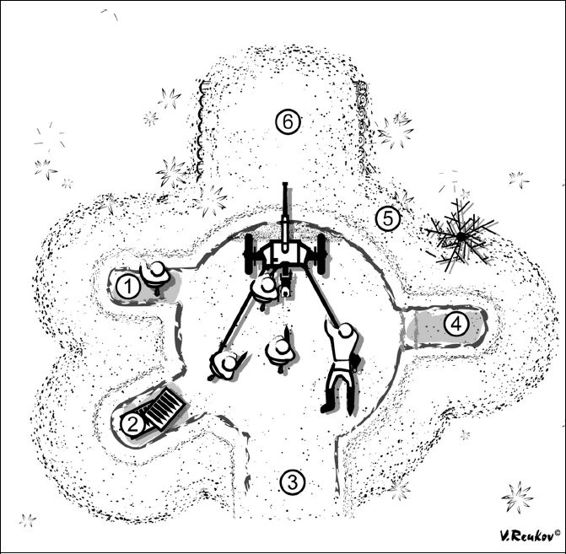
A 45-mm gun position: 1. Gun commander, 2. Ammunition storage, 3. Ramp, 4. Crew shelter, 5. Breastwork, 6. Rampart.
Upon finishing our work we would make ourselves ready: rehearse the actions for bringing the gun into the battle and calibrate the guns. We pulled back far to the rear into deep balkas [gulches in the landscape caused by erosion] in order to conduct gunnery exercises. Our targets were mock-ups of German tanks and self-propelled guns. In addition we studied the vulnerable spots of German armour in coloured ‘fold out’ instruction booklets. We prepared well.
On the night of 4 July, flashes of lightning began to play in the sky in the direction of Korocha and Belgorod, and we began to hear a rumble, whether of thunder or artillery firing we couldn’t tell. The next morning we were ordered to prepare for a march and soon we were standing in a column, nestled in the forest fringe. Vehicles drove up, out of which stepped a group of men. Two generals in handsome uniforms walked up to us, as well as several other military men. They told us that a battle had begun, in which we were also to take part. Then they asked us:
‘Do you know that the Germans now have Tigers, Panthers and Ferdinands?’
‘We know!’ we replied.
‘And the vulnerable places where you need to hit them?’
‘We know that too!’
The army commander and the member of the Military Council (we determined their status from the discussion of the generals and officers among themselves) gave speeches and expressed their confidence that we wouldn’t waver in front of the tanks, and assured us that we wouldn’t be alone on the battlefield.
Then gun commander Korobeinikov declared, ‘When the tanks come, I’ll take position behind the gun sight myself.’
I parried with the words, ‘I will shoot anyone who tries to come and take the sight when in action!’
One of the generals stopped us: ‘Well, why all this? You must trust each other. In the battle, there will be enough tanks for everyone.’
Having wished us success, the generals drove off; 30 to 40 minutes later we moved out and by dawn we were already settling into our positions, perhaps even one of those that we ourselves had dug the night before.
We were positioned on the northern slope of a wide valley, facing the Germans. No one was visible in the valley below us or on the lower, southern slope opposite us. The opposite slope of the valley smoothly levelled out into a steppe that was as flat as a table; the view extended for many kilometres. On our left flank, in the distance down in the valley was the dark smudge of a forest. In front of it, in the fringe of the woods, a battery of 76-mm guns was deployed. To the right and behind us was vegetation, in which our rear services were situated.
As far as our position went, I’d have to say it wasn’t a good one. Of course it was difficult to spot us, because our positions were well camouflaged, but after opening fire we would have no way to manoeuvre, because to roll the gun along the slope in full sight of the enemy was equivalent to death. Preparing for combat, we took our positions around our gun. We opened the boxes of ammunition, wiped and stacked the shells, including the APDS [armour-piercing discarding sabot] shells that had arrived just recently. Having finished our preparations, we took a look around.
That’s when I saw for the first time a battle, as they say, from the sidelines. Approximately 20 German panzers were heading toward the battery of 76-mm guns. My attention was caught by the following detail: when a shell would strike one of the moving tanks, it would stop. However, the tank moving behind it would also stop, making no attempt to go around the obstacle. Both tanks stood as if they’d been dug-in! One more observation: when a tank in the second wave erupted in flames, it would continue to advance for a short time, but then would suddenly disintegrate in front of your eyes. Then we realized that in an effort to intimidate us, the Germans had come up with a clever ploy. They were creating the appearance of a large number of armoured vehicles, hooking up wooden dummy tanks to a real ones! We had no other way to explain the strange spectacle we’d seen. The combat ended when the German tanks withdrew.
That night a battle flared up in the valley below us, involving our infantry. We couldn’t see anything, because the slope upon which we were positioned blocked sight of part of the valley that was closest to us. When it became light, Strogov and Vorob’ev crept down into the valley to check things out and later told us that there were several German vehicles down there. Apparently the Germans had been moving without scouting ahead and they had unexpectedly run smack into our guys, who, incidentally, also hadn’t distinguished themselves with any special vigilance. The fellows brought back an automobile seat, which gun commander Korobeinikov placed in his own entrenchment.
At dawn the field kitchen arrived with our breakfast. Pea soup with American sausage was in the Thermos. We ate while seated in the covered position of our gun, leaving Maksim Strogov up above to keep watch. Suddenly he said:
‘Tanks have shown up!’
‘Well, how many?’
He began to count, ‘One, two, three . . .’
We realized that he was counting them as each new armoured vehicle appeared on the horizon. When Maksim reached thirty, he swore and exclaimed, ‘There’s so many of them!’
We stuck our heads up out of the shelter. The panzers were visible as if spread out on a palm. It seemed as if the entire horizon was filled with them. The morning was sunny and there was a shimmering heat haze over the steppe. The Tigers and Panthers seemingly were swimming silently in this haze: their gun barrels and antennae clearly stood out.1 Among the large tanks that looked like battleships scurried little (in comparison with them) light tanks. This entire armada was rolling toward us. We didn’t begin to try to count them all – it was useless.
We didn’t speak; we understood that it was going to be a hot one and hardly any of us would survive it intact. The tanks were now about 800 metres away from us. Korobeinikov gave the order, ‘Fire!’ I replied, ‘It’s too early!’
‘Fire!’
‘Too soon!’
I knew that at this range, there was nothing we could do to them. The gun had been loaded with an APDS shell, which wasn’t effective at such a range. Korobeinikov reached for his submachine gun, as if reminding me that he could take certain measures against me. There followed another order, ‘Sight 5!’
This meant that he had determined the range to be 500 metres. I understood that if we hastened to open fire, then we’d only reveal our position prematurely. Yet one more thought flashed through my mind at that moment: ‘Why is no one else firing? What, is no one else around? When will they start?’
I had to submit to orders: I took aim and fired. The shell struck my target. A puff of dust appeared where I hit the tank. Korobeinikov ordered, ‘Another!’
I fired another shell, which also hit the target; 500 metres is fairly close range. Another cloud of dust appeared. As I later found out, the Germans had covered their tanks with an anti-magnetic paste. At the time, I was only surprised.
The panzers didn’t open fire. It was still quiet. Having drawn up to the crest on the opposite side of the valley, they stopped moving toward us. Some of the tanks turned to the right, while the rest pivoted and moved to the left, where there was a road. Possibly, the German tankers had assessed the abruptness of the ascent leading to our position and realized that they wouldn’t be able to climb it. Even if they could, they knew that they’d be exposing their bellies to us as they clambered over the military crest. They weren’t stupid. Thus they began to spread out in different directions like an opening fan.
. . . Then it started. The artillery began to work. Aircraft appeared, both ours and German. They were flying over the battlefield at an unbelievably low altitude. Our aeroplanes swept low over the German tanks, launching rockets at them and releasing bomblets over them. Meanwhile the Germans were keeping us pressed to the earth with cannon and machine-gun fire. Everywhere there was firing and explosions, and the constant din of battle. It is said correctly, ‘The earth turned upside down.’ Panzers, firing, were outflanking us on the right and left. They had crossed the valley and some were now disappearing into the woods – there, where our field kitchens had been parked that morning. Emerging from the woods, they deployed and came at us from the right, apparently having decided to take us from the flank unnoticed at short range. If they had managed to do so, then I’m not confident that we could have quickly redeployed and met them with fire. But they had missed the mark somewhat. In training, all the crews operate smoothly, and everything is worked out to the tiniest details. Battle is different.
I don’t recall who, but someone shouted, ‘Tanks on the right!’ I turned and saw three Panthers [sic] moving below us and from the right, with their gun barrels pointed straight ahead. They hadn’t seen us; otherwise they would have turned their turret toward us to fire. They were moving as if in a staggered formation, with one tank leading. The range to them was about 40 to 50 metres, and I could see each bolt on their hulls, every weld. I was completely calm, just as I am now as we’re sitting and speaking.
The turret of the lead tank entered the sight’s field of view, and as soon as the crosshairs centred on it, I fired. The shell struck the turret. This I saw plainly. The tank didn’t stop. It continued moving to the left along the slope at the same speed. I realized that I hadn’t penetrated the armour. I glanced to the right. Two more tanks were moving, one a little closer, the second trailing behind and a bit lower down the slope. I hunkered down behind the gun, knowing that I had to fire at the side. As soon as this part of the tank entered the sight, I fired. The tank didn’t stop immediately. It rolled past us to the left and then burst into flames. A puff of smoke rose from the flames within it. The second tank drew a little nearer. There was the scent of burning from it. I fired at its turret. It rocked and stopped opposite our gun. I realized that the shell hadn’t penetrated. Its turret slowly began to turn in our direction. I shouted, ‘Iura, give me another!’ The breech clanked shut. I had to lower the barrel of the gun, but I couldn’t do it! Again I fired at the turret. Why had I done so? I don’t know . . . Probably because it was occupying the entire field of the gun sight.
I managed to fire several rounds: I aimed and fired at the turret automatically. I couldn’t force myself to lower the barrel in order to strike the side of the hull. Once again I repeat that I wasn’t sensing any fear at this moment. I was totally consumed by the task of destroying this tank. The tank fired. The shell missed high. It was firing armour-piercing shells. Behind us we’d laid the Thermoses and greatcoats: they all went flying into the air.
After the first shot by the German tank, we all scrambled into the pit for the gun crew. But the German tank remained in place. After some time we crawled over to the gun and loaded it. In the gun sight I could see the side of its gun barrel: ‘Since I see the barrel, the shell will miss.’ I fired again at the turret before taking cover in the pit. The tank fired – and missed. In that fashion I managed to fire three shots. When I crawled out again and took a look in the sight, the side of the gun barrel was no longer visible. A black aperture was gazing directly at me. I placed the crosshairs of the gun sight on this aperture – and fired. Then – I blacked out.
When I came to and stood up (I’d been lying on my back), my gun was tipped over on one side and the left wheel was missing. At that place where I’d been standing, my submachine gun, anti-tank and anti-personnel grenade were scattered about and a shell crater yawned. To my right, Strogov and Vorob’ev were lying in the strangest poses. To the left, face down, gun commander Korobeinikov was silent. His head was turned and he was seemingly looking at me. When the cobwebs cleared from my head, I realized that I was only seeing out of my right eye. I wiped my left eye with my hand. When I pulled it away, I saw a grey material on the fingers – brains. I felt no pain and couldn’t figure out what had happened. I again wiped my eye. It began to see. I told Korobeinikov: ‘The tanks have been knocked out.’ He was silent. I slid over to him and grabbed him by the shoulder. His head flopped and detached from the body. The trench in which he was positioned, from which he surveyed the battlefield and gave the commands ‘Take cover!’, ‘To the gun!’, was exactly opposite the wheel of the anti-tank gun and less than a metre away from it. The projectile that the German tank had fired had struck the wheel spring casing and had blown it and the left wheel off the gun, and had swept away everything located nearby. These parts of the anti-tank gun, my submachine gun and two grenades might have been what had split Korobeinikov’s skull and decapitated him.
I peered out of the trench warily. The first tank, having advanced a bit to the left along the slope, was now motionless. I don’t know who finished it off. The second tank was burning fiercely, while the third stood with a lowered and mangled barrel. The crew of this tank was gone. The turret hatch was open. There were also no other German tanks, and the fighting was now going on behind us.
Strogov and Vorob’ev started to regain consciousness. Iura had been wounded in the neck, under the left armpit and in the left leg. I felt myself all over and didn’t find any sort of wound. Maksim Strogov was also uninjured.
We had to leave. Iura couldn’t walk. I told him, ‘I’ll carry you.’
Even though it was hot, I donned my coat – I didn’t want to abandon my government-issued equipment. We also gingerly put Iura’s greatcoat on him. Strogov said, ‘I’ll head to the right. There, I know, I might find our medics. I’ll find them and then send them back to you.’
I got on all fours, having placed the strap of my submachine gun around my neck. With Strogov’s help, Iura clambered on to me, and on all fours I began to move with him. We were making slow progress; the greatcoat kept getting trapped under my knees and was interfering. We crawled directly across the field, over the crest. Yura helped me with his good right arm.
Suddenly a vehicle carrying Germans appeared to our left, which was going in the same direction we were. The Germans noticed us. They began to fire, but they didn’t hit either Iura or me. A bullet only punched through the strap of my submachine gun. The vehicle stopped and several Germans leaped out of it and came running in our direction. We kept our heads down and tried not to move. Then there was an explosion and I heard cries. Next there was some sort of commotion. Apparently the Germans were collecting their wounded. Soon the vehicle drove away.
When I dared to look around, I saw a sign: ‘Mines’. It turns out that the Germans had run into our minefield. Whether the entire field had been mined or just the road, I don’t know. We were lucky that the Germans seemingly wanted nothing to do with us after the mine went off.
Now we began to crawl cautiously, vigilantly checking for signs of mines or the enemy. We finally made it over the crest of the hill and started down the opposite side, where we found shelter in some sort of bunker. Iura, since he couldn’t walk, requested that he be left in the bunker. I left the bunker and found a road running not far away from it. Having gone a little bit further down the road, I came across the battalion headquarters.
The chief of staff asked, ‘Where’s the gun?’
‘The gun has been destroyed, and I left Vorob’ev over there. Strogov went to find you.’
They told me that Strogov was already here. I wanted to explain to them how to find Vorob’ev and to show them the place. But I was told that there was no need to go there, because a group had already left to get him. Later my parents, who were residing in Votkinsk, received a letter from Vorob’ev, which unfortunately has since been lost.
We began to fall back together as a group. As we moved, we watched a team of horses harnessed to a 76-mm gun attempting to escape a German tank in the ravine to our left, but it was crushed together with the crew. Artillery fire blanketed us and shells began to explode quite nearby. The battalion’s chief of staff was wounded, and from our walk we went into a run, darting from cover to cover. We sheltered behind buildings and trees, and in the ditches on either side of the road.
I won’t begin to recount everything that I witnessed. But having experienced more battles later, I will say that a retreat is a depressing and awful matter. People seem to become inhuman, they run, ready to trample anyone in their way, even ready to kill one another. It is better to attack for a month than to run for just several hours. But we ran for 15–20 kilometres. Then we stopped, turned around, and went back.
Our 45-mm anti-tank gun was gone. Gun commander Korobeinikov had been killed. The wounded Iura Vorob’ev had been sent to the medsanbat [medical and sanitary battalion]. For a time, I and loader Maksim Strogov attached ourselves to some mortar crews. For the entire following day, I brought mortar shells up to the firing positions. But a day later I found myself commanding a squad in a reconnaissance platoon. The platoon leader was Junior Lieutenant Lavrentii Semenovich Beliaev, born in 1911. He was a Communist, a brave man and a most experienced scout, who subsequently became a Hero of the Soviet Union. There was much to learn from him.
Once I was on a reconnaissance probe with him. At night we stealthily reached a German observation post. We were able to get documents, three machine guns, and submachine guns. We took everything back to headquarters. We didn’t have a single loss.
Soon I found myself commanding, it seems to me, the remnants of a regiment. It happened that after one battle, we stopped for the night in a ravine. There were around sixty to seventy of us. At twilight Germans reached this ravine and opened fire on us from above. There were around fifteen or twenty of them. Firing back, we clambered out of the ravine. With the cry, ‘For the Motherland! For Stalin!’ – and with swearing – we rushed at the Germans. They hadn’t expected there to be so many Russians in the ravine, and they started running. We chased them, firing, shouting things and cursing. There was everything in these shouts: fear, which still hadn’t passed, insult, malice and guilt, because some of our comrades had been killed, while we by some miracle had remained alive.
I also was running with a rifle, but I wasn’t firing. I wanted to run down at least one German and stick my bayonet into him. It seemed to me that if I killed him cleanly with a gunshot, it would be too little repayment for everything I’d gone through, for my comrades who’d been killed in the ravine. What came over me, I don’t know. We didn’t pursue them long. They made it back to their trenches, from where the Germans in them began to fire back at us.
We stopped and hit the dirt. We had no shovels, nothing with which to dig. I had found an old tank track and tried to hide at least my head in it. This was an instinctive desire. I recall that I wasn’t afraid of death. It was frightening that I’d cease to be a soldier, a fighter. I also remember that I feared being taken prisoner . . .
So, I had dived into this tank track and I was keeping my head down. I pulled a can of American sausages out of my kit bag. I opened it, pried out the weenies and wrapped them in something, and I began to pick at the ground with the empty can. The ground didn’t yield. For some reason at the time it didn’t occur to me that the ground had been compacted by the tank. Others had also found whatever they had handy that they could use to deepen their ‘foxholes’.
In this fashion we were digging ourselves in until it became dark. Once night had fallen, someone reported that several sapper’s shovels were available. I ordered foxholes to be dug for firing from the prone position, and then passed the shovel to a neighbour. I was cheering up inside: we’re digging in – we’ll hold. Realizing this, the Germans went on the attack. They were seen coming against the backdrop of the slightly brighter western sky. One of the soldiers started to shout, ‘The Germans are coming!’
Gunfire erupted. Everyone fired without any sort of command. From the direction of the attackers, shouts and curses were audible in both the Russian and German tongue. The enemy was almost in our line. That’s when it became frightening, moreover because frequent cries were ringing out on our side: ‘Commander! My rifle is jammed!’ Many of our soldiers, located in freshly dug foxholes, had tossed their cartridge clips on the ground, and then were trying to force the dirty cartridges into the chamber. Nevertheless, though with enormous difficulty, we repulsed this attack.
Now what should be done? After the fighting ended I found a soldier with a can of grease and an individual first-aid dressing packet, and I went around all the positions. I gave each soldier a piece of bandage and cotton wadding. Then each soldier in my presence wiped clean and greased their rifle’s cartridge chamber. As they did so, I told them to prepare a place for their cartridge clips and grenades – to dig a little pit for them and to cover the ground with their tent halves. We had a total of twenty-two men. We were armed with our rifles, both German and our submachine guns, an anti-tank rifle with several rounds of ammunition and a Degtiarev light machine gun.
The Germans repeatedly attacked as if according to schedule – twice a day, in the morning and the evening. Moreover, as they advanced, it was clear that they were making these attacks without any particular enthusiasm, plainly with no hope for success. When the German lines of infantry appeared again, we all fired at them with our rifles. We shot poorly and ineffectively. When the Germans approached more closely, I would give the order, ‘Submachine gunners, fire!’
The difference between single-shot rifles and automatic fire was enormous. The Germans would immediately falter and go rolling back, and we would then cease fire to conserve ammunition. In addition, we were running low on rations, so I as the commander had to make some difficult decisions: ‘Who will go for grub? Whom should I send?’ The time when the field kitchens would arrive and the Germans attacked almost coincided. So you had to give some thought about who to send for the Thermoses and who to keep on hand for the fighting. It was necessary for the soldiers both to return with the food in time and to take his position in his foxhole, if a battle was underway.
Sometimes one or two soldiers couldn’t withstand the pressure of the German attacks and abandoned their positions. I had to fire in the air over their heads to get them to stop. One soldier disobeyed and left, but he was stopped in the ravine behind us and forced to return to our position. That in fact is when we first learned that we still had someone backing us up.
On the second day we received a few replacements. They sent up nine men, drivers and cooks from the administrative platoon, who were green and had never seen fire. They brought with them cans of sausage and everyone topped themselves up with food. However, the most important thing was that they brought shovels. I ordered full, deep trenches to be dug for standing fire, and for the shovels to be passed down the line like relay batons.
Having completed the entrenchments, we linked them with communication trenches. We obtained a fully equipped position according to all the rules of the infantry manual. I, however, kept my foxhole for firing from a prone position, to which communication trenches linked up from two different directions. It never dawned upon anyone to help me, and I didn’t even entertain the notion of forcing someone to help.
Soon a German light tank appeared and began to move along in front of our trenches, trying to entice fire in order to reveal the positions of our machine guns. One of our new replacements leaped out of the trench. The tank fired its main gun and the small-calibre shell struck him in the left arm, nearly severing it. He grabbed a knife, walked up to a comrade, and requested, ‘Take hold.’ The other guy extended the dangling part and the wounded soldier cut the few remaining tendons. They placed a tourniquet on the stump. Clutching the amputated part of his limb to his chest, he said his farewells to everyone and headed for the rear, happy, beaming and content – he was still alive! I don’t know whether he made it back to the aid station or not – he was bleeding profusely from his stump – but he set off in a joyful mood.
I recall how in the evenings, just as the exchange of fire started up, I could see arms and legs sticking out above the trenches. Many were hoping in this way to get out of the war. Of course, not everyone did this, but neither would everyone rush to a firing slit or advance in a head-on attack either. People are people. Take the example of my 45-mm anti-tank gun platoon commander Junior Lieutenant Serdiuk. I don’t know where he was while we were engaging those three Panthers [sic] back at Kursk, but I know he survived. At some point we had moved into the front line together with him as ordinary riflemen, but he ran away. We were moving through a cornfield. There was a terrible stench of corpses. He said to me: ‘Wait a minute here.’ I replied, ‘I’ll wait.’
I shouldered my submachine gun and waited, but the sun was scorching. I stood there for several hours, but I couldn’t wait for him forever. Later, after the fighting had already subsided, some men started asking me, ‘You’re still alive? Your platoon leader Serdiuk said that a shell had exploded between the two of you; he received concussion while you fell. He doesn’t know whether you’re alive or not.’
‘And where have you seen him?’
‘He showed up, totally shaken and concussed. They took him away to the rear, to a hospital.’
When the war ended, I was a battery commander. Once we gathered at the divisional headquarters for a meeting. When it began, an officer stepped into the room and said something to the division commander. The commander rose and said, ‘Comrades, the chief of the Political Department and I have been invited to the Party city committee regarding a serious matter. The commander of the division’s artillery Colonel Serdiuk will continue the meeting.’
A tall colonel rose and started to speak. As soon as he began to talk, I realized, ‘My God, that’s my Serdiuk, my platoon commander!’ I was flabbergasted. It was a horror! After the meeting ended I returned to my unit and went to see the regiment commander, where I told him what kind of bird this Serdiuk was, how he kept running away, and now he’s healthy, sleek and well groomed, wearing a pile of metal on his chest and issuing orders. I requested an investigation, a check into his personal records to see where he’d fought later.
A few days passed and I asked, ‘Well?’
‘They’re looking into it.’
Another ten days passed. I asked, ‘Well, what’s with Serdiuk, have they investigated?’
‘But he’s left for Germany.’
They were hiding him. That’s the whole morality tale for you . .. and the whole notion of honour.
We held our line for several days. Once after repulsing an attack, that night I fell asleep in my foxhole without eating dinner. I don’t know what woke me up, but when I saw several unknown men standing over me, I was gripped with terror. I was sure they were Germans or Vlasovites!2 I began to grope around in the darkness, trying to find a weapon, but there wasn’t one handy. However, thank God the commander showed up. It turned out that a unit had arrived to replace us – men from the 89th Rifle Division. He asked me to give him a detailed briefing on the situation. I told him everything and showed him the line that we were holding. I was told: ‘Tell your men to fall in and lead them down into the ravine. There you’ll be told where to go.’
I was asked to leave behind the anti-tank rifle and a machine gun. I said that the ammunition for them had almost run out. That didn’t matter to them; they had their own weapons, but not enough support weapons. At first I wanted to know whether or not I’d have to account for the weapons. They reassured me, and we set off to the rear for rest and refitting.
After the summer battles of 1943, the 1st Battalion of the 92nd Guards Rifle Division’s 280th Guards Rifle Regiment, in which I served, received replacements. Several guys from the Barnaul’ Infantry School arrived in my platoon, which because of my insubordinate nature was known in the battalion as the ‘feral PTO [anti-tank defence]’. They brought with them a new song: ‘I’ve done a lot of strolling around the world . . .’, which we liked a lot. When the regiment in September was conducting the march from Khar’kov to the Dnepr, we started singing it the very first night. We marched and sang, or more accurately bellowed. What of it? – we were young. Moreover we felt that nothing would go wrong for us. Whenever the song ended, we started it up again, and literally within 20 minutes a crowd of soldiers would encircle our platoon. The column would bunch up around us, the men keeping in step with us as they listened to us sing, until the commanders intervened and sent everyone back to their places in the column, having first established how many men and at what time they might march with us and sing. Soon the entire regiment took up the song.
Why was I commanding a platoon when I wasn’t an officer? Because I kept refusing promotions; I didn’t want to be an officer. Once I was lying in the hospital and witnessed the following scene. They would send home a wounded soldier or sergeant for six months’ leave and re-registration. They’d go home, and six months later they were to go to the commission, which would reassign them and send them back into the army. First, all this time he’d get to live at home. Secondly, he could go to work and receive an exemption from active duty. Meanwhile, an officer was sent to the military commission or into a separate regiment of reserve officers, or even somewhere else into a ‘hot command’. Officers weren’t allowed to go home. Was it because I was braver than others? No, I simply also wanted the chance to go home in case of a wound.
The march to the Dnepr was a hard one. It would begin each evening as soon as it got dark and continue until dawn, or even until the middle of the day. Each night, we in our boots and foot wrappings would march 40 kilometres. We marched along a road that had been ground by our boots and horse-drawn wagons into the finest dust powder, which coated our uniforms and made it hard to breathe. Every few days rain would fall, which turned this dust into impassable muck, making every step enormously difficult. The soaked, exhausted men and horses were a pathetic sight. Soon we not only stopped singing, we were prohibited from smoking or speaking loudly. So we marched silently; only the mess kits and gun would softly clank and rattle. Someone smoked a cigarette on the sly; the others hissed at him and swore at him for possibly unmasking the column. The mud adhered to the wagons, forming enormous clods around the hubs of the wheels. The soldiers hunched over under the weight of their wet greatcoats and ammunition. I can’t even imagine how the crews of the heavy machine guns or the 82-mm mortars could carry not only their own personal weapon and gear, but also the heavy base plates and tubes of the mortars or the mounts and the machine guns through this mud! Incidentally, we artillerymen didn’t even think of lightening our load by placing our carbines or rucksacks on the limber or gun trails – we felt sorry for the horses. I remember walking behind the gun, having clasped my hands around a bevel of the gun barrel, and having rested my chin on them, I’d sleep while on the move. Some men, having fallen asleep, would wander off the road and fall into the roadside ditches. Such a soldier would spring to his feet and begin to rush around in fear, unable to figure out what had happened or where he was.
We were fed in the evening and at dawn. It was unlikely that anyone monitored the cook or the slop he was preparing. It happened that they’d pass out lentil soup, but in your mess kit you’d find one solitary lentil – no meat, nothing other than broth. At the gun we’d receive a loaf of bread, and with a piece of string we’d strive to cut it into equal-sized portions according to the number of men. One of the men would turn his back, while another would cover a portion with the palm of his hand and ask, ‘Whose?’ The man with his back turned would give a name, and that man would receive that piece of bread. Meanwhile, you’re swallowing your saliva and dreaming that you’ll get the ends – there’s a bit more bread in them. True, once they cooked some rice kasha with milk for us. If you tell this to another veteran, he won’t believe you. I never ate a whiter, tastier kasha in my life. What an aroma it had!
In the daylight hours they’d arrange for halts in villages or in patches of woods. Everyone slept like the dead. There were no Germans nearby, and their airplanes weren’t making an appearance. Only once, in the morning, as we were marching past some orchards, a twin-engine aircraft, flashing in the sunlight, came roaring low overhead and passed along our column. I made out a dragon painted on its nose and could see the pilot, who was shaking his fist at us.
My soldiers asked, ‘Commander, why is your face pale?’
‘It’s nothing. If he takes a crack at us, we’ll all immediately hit the dirt.’
We were lucky. He pulled into a climbing turn and departed, without firing a single shot. Perhaps he was out of ammunition, or maybe he was carrying out a more important mission. Some men began firing their rifles at him only after he was already climbing away. See, I wasn’t the only one who’d been given a scare . . .
The closer we approached the Dnepr, the more frequently we encountered devastated villages and fallen trees. The Germans were trying to lay the left [eastern] bank of the river bare, so that the troops closing on the river couldn’t find any cover.
I recall when we reached the river. I’m from Kiev, and there is no river dearer to me than the Dnepr. In my childhood I swam across it, but only in certain places, where I knew the current might sweep you to a shoal of the opposite bank. This time, however, I had to swim across it three times – neither out of bravery nor of my own volition. Somewhere around 10 or 12 September, the regiment was called to form up on a hillside. It was cloudy, raw and damp. A thin, wearisome rain was falling. Everyone walked towards the place of formation quietly and dejectedly; there was no sound of conversation or jokes. Hardly anyone snuck a smoke. The soldiers in their heavy, thoroughly saturated greatcoats kept slipping on the mud, and their foot wrappings were becoming unwound. Recently, the number of formation assemblies had perceptibly increased, as well as the number of speakers at them. Some sort of new orators, which I’d never seen before, appeared.
However, this time it turned out that the new regiment commander Plutakhin, who had replaced the previous commander after he’d been killed in the summer fighting, had arrived in order to hand out medals to the personnel. He said something; I could hardly hear him. Suddenly someone jostled me: ‘Go on, they’re calling for you.’ All I could say was ‘Huh?’ But then I heard, ‘Junior Sergeant Ulianov for the Order of the Patriotic War First Degree.’ In my wet greatcoat, I made my way down the slope. I walked up and reported that I was there to receive a medal, but the regiment commander stretched out his hand in front of himself and was twirling the medal. Gazing at it, he said, ‘What a beauty!’ I took hold of his hand and declared, ‘I serve the Soviet Union!’ Then I spun around and returned to my place in the formation. Guys were clapping me on the shoulder and asking to see the medal. Gleefully, of course! Our mood brightened considerably. All was well.
That night we set off on another march. I allowed the guys to move along the dry roadside, while I, as I’ve already mentioned, slogged along behind the gun. Understand, I was just 18 years of age. I was the youngest platoon commander, and I had to command men even twice my age. Everything that happens in the platoon depends on the platoon commander – everything. You had to make the soldiers know that you’d praise them for the good, bawl them out for the bad and that you didn’t encourage snitching and didn’t like slackers. You had to take care of the platoon, keep watch over it, to make sure the men always had full bellies, and always had shells and fodder for the horses. You had to know how to take up proper firing positions. At each halt, I made certain each gun was calibrated, so therefore we always fired accurately. Everything depends on the platoon commander!
Just before crossing the Dnepr, I happened to shoot my friend Vania Frolov through the leg. The incident occurred after I was summoned by the battalion commander. I must say that the battalion commander Ivan Anikeevich Zvezdin was a very smart man. Rumours went around that he was a former colonel who’d been demoted for an affaire d’amour, because in our opinion, only a colonel could command in the way he did, take charge in his fashion, and have such an air of authority. In reality, his education consisted of just eight grades and courses for junior lieutenants, but he had combat experience from Khasan and the Winter War with Finland, which apparently enabled him to handle the battalion competently. So anyway, I departed as the fellows were beginning to prepare dinner. I returned from it when the battalion was already turning out for the next march.
I walked up to our tent. My soldiers were sitting inside, and in front of them an enamelled pot was hanging on forked branches, in which some borsch was cooking, which was emanating an intoxicating aroma. I shouted at them, ‘Why haven’t you gotten your butts in gear?’
‘Commander, what are you fussing about? Sit, have a bite. Just take a look at the borsch we’ve prepared!’
That’s when I lost it. I grabbed my pistol and fired into this borsch, thinking I would shoot a hole through the pot and show them that discipline was more important. However, the bullet ricocheted and struck Ivan in the calf muscle. Thank God, the bone wasn’t hit and the guys agreed to hush up the incident, but for several days I had him ride on the gun, because he couldn’t walk.
Once in the middle of the night, word passed along the column, ‘The regiment commander, the regiment commander.’ I turned around, and on the right behind some trees I saw two riders on horses. Then they disappeared somewhere. We marched on to the next halt. There the road made a sharp turn to the left, creating a dry salient, upon which we set up the gun. I requested pearl-barley kasha for dinner, something I never ate in civilian life. After eating, I told the men, ‘That’s all! I’m getting some shut-eye.’ I threw a tent half down on the ground, laid down on it, and immediately fell asleep. Suddenly I heard, ‘Get up, the regiment commander!’ I heard and understood that I needed to get up, but I couldn’t. I had no strength to rise to my feet. Then I heard, ‘I’m the regiment commander.’ I said, ‘You can go to hell . . .’ – and with these words I opened my eyes. I saw the commander’s orderly and the regiment commander himself were actually standing there; the commander was trying to throw back a flap of the tent half he was wearing in order to draw his pistol. When I saw this, I stretched and grabbed my submachine gun, which was lying nearby. He understood everything, turned, and they galloped away.
My men said, ‘What have you done?’
‘What? I didn’t know that it was the regiment commander; I thought you were fooling around.’
The march resumed. The next morning we stopped in some village. The day turned out to be sunny, and we hung out all our stuff to dry it a bit. In the middle of the day, two well-groomed sergeants showed up:
‘Are you Ulianov?’
‘That’s me.’
‘Give your name.’
‘Sergeant Ulianov.’
‘Grab your things, let’s go.’
‘What should I take?’
‘Whatever you’d like; you don’t have to bring anything.’
‘Where are we going?’
‘To regiment headquarters.’
I could see everyone’s faces were sour. I said, ‘Let me say goodbye to the men, just in case.’
They escorted me to the headquarters, the chief of which knew me back from Stalingrad. He asked me, ‘What are you doing here?’
‘They’ve escorted me.’
‘So it was you that acted strangely last night?’
‘I wasn’t acting strangely. I was groggy; it was simply a case of mistaken identity.’
‘OK, let’s go.’
We entered a courtyard, in the middle of which were a table, two chairs and a stool. A combat blouse and shoulder belt were draped over one chair; the regiment commander himself in his undershirt, suspenders and polished boots was sitting on the other one, drinking tea from a cup with a cup holder.
‘Comrade Lieutenant Colonel, Sergeant Ulianov has arrived at your order.’
He asked me a question: ‘Were you the one who sent me to hell last night?’
That could I say? I acknowledged that I was the one.
‘I presented you with a handsome Order, and you’re sending me to hell?’
‘I earned the Order before you arrived in the regiment.’
Then he turned to the chief of staff and said, ‘Take him away.’
They took me into the next courtyard, where 114 men like me had gathered. Someone said, ‘We’re a penal company.’ There’d been no trial, and they didn’t take away my documents and Order. After the war I found a document, in which we were referred to as ‘volunteers’. They passed out grenades and cartridges to us, and said, ‘You will cross over to the opposite bank of the stream in front of us and seize a bridgehead. As soon as you make a landing, the main forces will push off. With this, your task will be fulfilled.’
We swam across that night. There was no firing. We clambered out of the water on the opposite bank. But what could we do there? In front of us was the wall of the right bank, which rose about 40 metres above the water. That was our entire lodgement. The Germans up above began to rain fire down on us, and by evening, when the order arrived to return to the left bank, there was not more than ten of us left. The survivors were released back to their own units. The regiment moved further downstream and began a crossing there.
We approached the Dnepr in the evening. A church and belfry were visible on the opposite bank. The battalion commander ordered me to open fire at this church, suspecting the likely presence of an observer there. We rolled the gun up to the water. I understood quite well that if I fired a shot, I’d immediately come under fire from machine guns at least. In order to conceal the gun, I ordered for some of the shoreline brush to be cut down and to stick the cut branches into the sand around the gun. Once the gun was concealed, I ordered a tent half to be stretched over the barrel, in order to hide the flash of the shot from observers.
We determined that the range to the belfry exceeded 700 metres, for which the sight of the 45-mm gun had been set. Knowing that one turn of the elevation mechanism would increase the range of the shot by 300 metres, I set it for 1,400 metres. I fired and for the first time heard the rustle of the outgoing shell. I missed the belfry. The shell exploded short of it, throwing up a white cloud of dust. We saw this cloud first, and then the sound of the explosion and the yelling and screaming of Germans carried to our ears. On the next day I was informed by some scouts that had been over there that the Germans had dug some trenches in front of this church and a machine gun had been positioned there. My shell had precisely blanketed this machine-gun nest.
We rolled the gun back to the road, and down a dirt road that was edged by planted willows we moved to the crossing place. Soon we saw the raft that had been designated for us. In general, one had to have quite an imagination to call what we saw a ‘raft’, which simply consisted of several logs that had been bound together, a total of about 3 to 3.5 metres wide and covered with plank boards. We were separated from the water by a strip of wet sand, patterned by the waves washing up against it. As soon as the limber, upon which we always had fourteen to sixteen boxes filled with shells, drove out onto the sand, its wheels sank almost up to the hubs. The drivers lashed the horses so hard that the metallic rings attached to the ends of the whips scattered sparks that fell on the hides of the unfortunate animals. The loading process was accompanied by choice swearing and the shouts of those leading it: ‘Faster! Forward!’, and by the explosions of German shells and mines. With enormous effort we managed to roll the limber and gun onto the raft and to position the horses.
We pushed off and floated .. . that was, for those who weren’t there and haven’t been able to picture it, the ‘forced crossing of the Dnepr River’. This had to be seen and experienced. One had to feel the flimsy flooring of the raft that was rocking on the waves raised by the explosions of shells; to see the geysers of water erupting with the fragments of human bodies, ferries and boats, before crashing back down to the water’s surface. One had to hear the frantic whinnying of the horses, which the drivers were holding by the bridle, after each explosion. One had to experience the maddening tension and fear of waiting for the shell that’s meant for you, which you never hear, because those shells you do hear whistling and shrieking are flying past you, while ‘yours’ arrives silently. So you stand there and size up what to grip onto for balance and which way to float, backward or forwards, and whether you’ll flounder or sink straight to the bottom in the greatcoat, quilted jacket and cotton trousers, which you didn’t remove because they offered protection against the autumn cold.
Yet somehow they missed us . .. the raft nosed into the opposite bank and the horses carried the drivers onto the sand. We rolled the gun and limber off the raft and hurried to harness the team. We were being fired upon from above, but no one paid any particular attention to the bullets. With difficulty we made our way up the washed out road that climbed up the steep bank of the Dnepr from the river. By some miracles, in the chaos that reigned on the opposite bank, we found our battalion. The battalion commander embraced me and said, ‘Well, sonny, now we’ll all live!’ We were the battalion’s main assault force!
The fighting continued now on the right bank of the Dnepr. Having driven the defending Germans from the riverbank, the battalion went in pursuit. I recall one battle; we were attacking. In the heat of battle, I leaped into a railroad hut with my Parabellum pistol. In front of me was a German. I didn’t lose my head, fired, and the German dropped. Through a window I saw another German run out of a different hut. I rushed after him. He ran, limping; plainly he’d been wounded. On the move he threw away a satchel, and then discarded a jacket. Suddenly there were shouts and shots behind me. I stopped. I saw two soldiers pointing their rifles at me, who were shouting ‘Where are you going, snake?’ When they came up, and once I had managed to convince them that I’d been chasing a German, one said, ‘Senior Sergeant, we thought you were running off to their side.’ All I could say in response was ‘Eh, you let the German get away.’
In one of the battles I knocked out a German self-propelled Sturmgeschütz. True, this time I in fact selected the position not very well. The road was running along the edge of a sand pit, which seemingly had formed a ledge in it before dropping away to the bottom. I set both guns up on this ledge. This way the flash of our shot would be camouflaged by the bright sandy wall behind our backs, but at the same time our ability to manoeuvre was extremely limited. In the valley below us there were the remnants of an orchard, and a bit to our left stood a T-34 tank, next to which a German sniper had deployed. At the order of the battalion commander, I fired several rounds at this tank and the sniper fell silent.
But after I had silenced the sniper, two self-propelled guns moved out toward us from the opposite side of the valley. I don’t know if they spotted us, but nevertheless each self-propelled gun fired a round, and a fragment of one exploding shell wounded ammo carrier Vasia Lebedochkin in the butt. Here I must say that although I was now commanding the platoon, I hadn’t turned over command of the No. 1 gun to anyone else. Vania Frolov commanded the No. 2 gun. He shouted at me, ‘Vitia, fire!’, but I was in no hurry. I was confident that as they were descending into the valley, they wouldn’t be able to fire at us, while we, having lowered the barrels of our guns, would be firing at their exposed tops.
That’s exactly what happened. I clearly saw the top of the leading self-propelled gun’s rear compartment in my gun sight and fired. The assault gun stopped. The second gun approached it from behind. We didn’t see it, but plainly the Germans hooked up a cable, and reversing away, towed the damaged Sturmgeschütz back to the jumping-off positions. I didn’t attempt another shot at them; after all, my task had been carried out, because the Germans didn’t pass us.
After the fighting ended, I walked over to check out this T-34 – it had a full load of ammunition on board and the interior was as neat as a pin. Why had it stopped there? Why had its crew abandoned it? I don’t know.
Having limbered up the gun and taken our place in the battalion column, we moved on. Toward evening, we took up a defensive position near a knoll. The terrain was heavily convoluted – to the right and left of us there were similar knolls, a small ravine ran across our front, and beyond it was another rise. We were standing on our knoll, next to which ran the road, when suddenly we saw a German amphibious vehicle approaching our position. It came practically right up to us and turned. A German, sitting next to the driver, shouted: ‘Russische schwein!’ The chief of staff grabbed an anti-tank grenade and wanted to hurl it, but we stopped him. Where was he going to throw it? If he didn’t reach the vehicle with his toss, he might have only wounded his own men. Thus the German vehicle in fact got away.
That night the Germans were launching flares, giving me the impression that we’d been encircled. The battalion commander summoned me: ‘Well, what do you think?’
‘Comrade Captain, the flares are all around.’
‘What did you expect? We’re in the German rear. I don’t know what will happen here tomorrow, but prepare your platoon for battle.’
That night we dug positions on the reverse slope of the knoll, and the next morning a panzer emerged from the behind the rise that was facing us and headed toward us. It was alone; apparently the Germans had sent it out to probe our positions. The battalion commander ordered me to roll a gun out into the open, to the left of the knoll behind the line of trenches, and to destroy this tank. This was stupidity, of course; this tank would smash my gun before it even had a chance to go into action. I ordered Ivan to roll out his gun to the right of the knoll and to fire several shots at the tank, in order to divert its attention from us. He even asked, ‘What if I hit it?’
‘That’s just what you’re supposed to do. You hit it.’
While Ivan fired a couple of shots, we managed to roll out and deploy our gun. I fired, but it was a defective shell. I still don’t know why, but the shell’s tracer flew off into the bushes, while its rotating band detached and flew downward into a trench where some infantrymen were crouched. One soldier started running away from the trench beside the gun. I fired at him from my pistol, but missed. A few minutes later I looked, and he was back in this trench again, hoisting his rifle over the parapet and firing. I said, ‘Why have you come back? You ran off, so why did you return?’ He replied, ‘There are osobisty [officers of the Special Department] over there. They offered me a choice of returning or being shot.’ So he came back, and after this no one else ran off. The panzer, however, didn’t particularly meditate over this. It fired once and then made itself scarce.
At this time, we noticed about a half-kilometre to our right that the Germans were preparing for a counterattack. Several armoured personnel carriers and vehicles had driven up to there, and German troops began to leap from them like grasshoppers. I shouted, ‘Ivan, fire at the far side of their concentration and chase them toward the centre, while I’ll fire at the near side.’
After each round they packed in toward the middle. Then we shifted fire onto the mass. The Germans would scatter and then we’d repeat the pattern. At some moment, a German vehicle appeared that was towing a gun. They managed to unhook it, but then I interrupted their work. My shell exploded next to the gun. I’m not saying that I damaged the gun, but after my shot they abandoned it and the vehicle drove away. I hit a vehicle that had driven up behind the first one. It plainly had been loaded with shells, because it produced secondary explosions.
Later, an assault gun came rolling toward me. It wasn’t an ordinary Sturmgeschütz, but a heavy self-propelled gun. I was firing at it, but I couldn’t hit it – my hands were trembling and the shells passed harmlessly overhead. It kept advancing, and squeaking like a door on rusty hinges. Then this pest stopped and fired in the direction of the No. 2 gun. Shell fragments wounded Ivan. Then at last, if not with my eighth round, then with my ninth round I hit my target. It didn’t start burning; it simply stopped, while I continued to batter the Germans. The gun barrel grew hot, and practically speaking it was by now simply spitting out the shells. I was afraid that it would jam, because over a short interval of time I had fired more than 120 shells! It was then that I began running back and forth between the two guns, alternately firing my own gun and then Ivan’s. That’s how two 45-mm guns in effect broke up an enemy counterattack in strength of up to a battalion.
I took part in my final battle on 22 October 1943. The day before, the battalion commander had gathered his company commanders in a small ravine. He had called for me as well. I walked up to him, and he asked, ‘Do you have ammunition?’ I replied, ‘I do’ (indeed, the cover of my canteen had been stuffed with automatic cartridges, which were of the same calibre as my TT pistol). The battalion commander loaded the pistol, fired several rounds in the air, and said: ‘The 2nd and 3rd Battalions at the regiment commander’s order have gone to clean potatoes for our dinner. We’ll come back from battle and eat. But now, for the Motherland, for Stalin, we must take that village over there. Well, sonny, lend us a hand.’
The company commanders headed back to their companies at a run, while I returned to my platoon. We climbed up out of this small depression in the ground, and I saw the village. At this moment the horses started to dash, and I just managed to climb onto the lower gun shield and to grab hold of it with my hands. The drivers began to lash the horses, and they bolted away at such speed that it was terrifying. We flew past a large barn standing to the left of the road, and that’s when I caught sight of a woman rising up out of some burdock that had grown down the side of it and was covering a cellar. We almost ran right over her. We flew into this village. There were no Germans in it. The infantry entered it in our wake and immediately began to poke around in an abandoned German vehicle parked in the street.
Gradually everything quieted down, and we took positions next to some buildings. Suddenly bursts of automatic weapons fire rang out in our rear. I leaned out of a building and saw Germans coming, sweeping the area in front of them with fire. They passed down the street, overran a mortar battery, wiped out its crews, and then exited the village to link up with their own forces. It turned out that before retreating, the Germans had rounded up all the residents into that barn that we had passed on our way into the village, but they had remained in a few of the village’s buildings that we failed to search. When they realized that we had settled down, they decided to break out back to friendly lines, and in this they were fully successful.
The following day proved to be sunny. I was sitting in an arbour and writing letters recommending all my soldiers and sergeants for medals, including one for Frolov that wrote him up for the highest honour, ‘Hero of the Soviet Union’. Then suddenly shells began exploding in the village. I rushed pell-mell to my gun, which stood between two buildings. Then once again, like the German infantry the evening before, enemy armoured personnel carriers from our rear started passing us. My field of fire was very narrow, so I decided to move the gun, but I hadn’t managed to bring together the split trails when the battalion commander came running up: ‘Don’t touch the gun! Don’t touch the gun! Otherwise they’ll start to run!’
I glanced to my right and saw a weak line of prone soldiers who were firing through the gaps between the buildings, and realized that they were lying there and firing only because my guns were here. If I started to move it, they’d think that I was retreating and they’d start to run. So I decided to remain where I was and fire from this unsatisfactory position. However, I did well. I had a ‘short conversation’ with one halftrack – I struck it in the side and it obligingly blazed up. I left two or three burning. A panzer came rolling by after them and I also knocked it out. Nevertheless, the German main forces broke out and departed without getting involved in combat.
Soon a messenger from the battalion command post came running up to me and told me that I was wanted by the battalion commander. I went to see him at his observation post, which had been set up on the outskirts of the village in some depression in front of the last building. A plowed field stretched beyond this depression, on the far edge of which was a German earth and timbered bunker. The battalion commander said, ‘Do you see that bunker?’
‘I see it.’
‘That’s a German observation post. It must be knocked out. Can you hit the embrasure?’
‘I can hit it with an armour-piercing round.’
‘It isn’t important what you use; you must hit it in the embrasure to blind them. We’re about to go on the attack, and if they can correct their artillery fire from there, they’ll wipe us out.’
I went to get my gun, brought it back, and with my third shot struck the embrasure. I returned to the battalion commander to report that his order had been carried out. At that moment a shell exploded behind the building, followed by another explosion in front of the shell hole in which we were sitting. The battalion commander asked me, ‘Well, isn’t the artillery the god of war? What’s happening?’ I told him, ‘They’ve got us bracketed, that’s what is happening. The next shells will be right on top of us.’
At this moment, I believe two shells exploded next to our shell hole. At first I didn’t even realize I’d been wounded in the left arm and in the left and right legs. I told the battalion commander, ‘Now the parasites have shredded my boots.’
‘What about your legs?’
‘My legs are intact. I’ll go to my gun.’
‘That’s not important, sonny. If your legs were intact, we’d find your boots.’
I rose, crawled out of the shell hole, and felt that I was falling. I grabbed a tree, and then pushed myself off to move on. I heard the battalion commander say, ‘There goes my hero.’
The next thing I remember was this trench, in which two drivers of my platoon were sitting. I asked them to help me reach my gun, but they had no desire to climb out of the trench under the unceasing barrage and they refused . . . I woke up later in another trench. In front of me a soldier was sitting. I asked him, ‘Where are ours?’
‘They’ve all gone forward.’
‘The battalion commander?’
‘They’ve all left. You and several other wounded men have remained behind.’
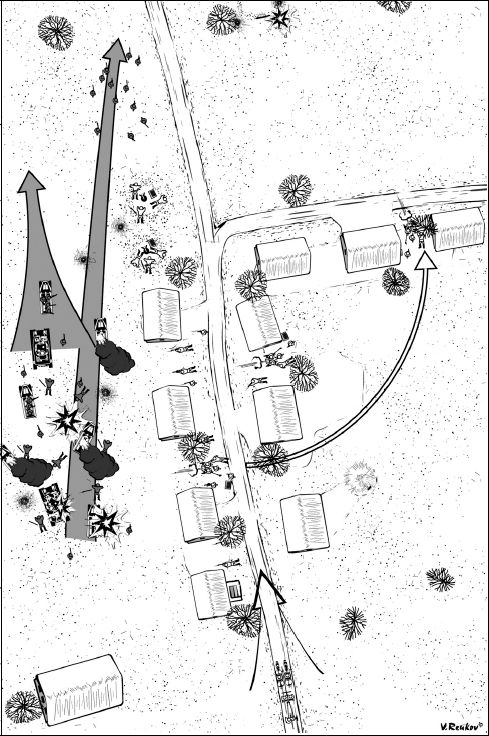
Diagram showing the last battle fought by Vitaly Ulianov.
Later I read that the battalion commander and many of the men were killed in this battle.
When night fell, an ambulance came for us. Where it took us, I don’t know, but soon we were hearing German speech. I whispered to the driver, ‘Where are you taking us, swine?’ We turned around and headed back, and soon we reached the regimental headquarters. They stopped us and asked where we were going. I identified myself and asked who was in charge here. They replied that it was the regimental chief of staff. I asked them to pass the word to him that I wanted to see him. He came up: ‘What? Have you been hit?’
‘I’ve been hit.’
‘Well, think nothing of it. You’ll get better and come back.’
I had a pouch tucked into my belt, from which I pulled out all my medal recommendations for my men, and asked, ‘Comrade Major, I request that you recommend my men for medals. Everything has been written down here; all the truth is in these letters.’
‘We’ll do it. Don’t worry.’
Later they took me to some hut and laid me down on the dirt floor. Wounded men were lying on either side of me. I saw how maggots were crawling out from under the bandages on the arm of the guy on my left. I even exclaimed, ‘Yuck, maggots!’
‘What are you afraid of? They’re eating the rotten flesh.’
I fell silent.
The next day, a general and two officers arrived. The general asked, ‘Who here is Sergeant Ulianov?’
‘I am.’
‘Son, I congratulate you on the receipt of the title ‘Hero of the Soviet Union’.’
‘I serve the Soviet Union!’
Later I found myself on a medical train, which took me to Khar’kov. A captain arrived, took me by the arms and weighed me – I weighed 47 kilograms. He carried me to a bath house. There, a women said, ‘Get undressed.’ I was embarrassed. The captain spoke up, ‘This is our Hero.’ One of the women replied, ‘Why, he’s all skin and bones. What sort of hero is he?!’ They washed me and then carried me into a school. There were beds standing in a classroom, and they laid me on one of them. Several fragments had become lodged in the vicinity of the knee joint. The doctors that came and examined my leg said that they could do nothing and assigned me to an evacuation hospital.
I was again loaded onto a medical train. It was clean and freshly painted. I was lying on a lower berth, but I wasn’t given a pillow, a blanket, or anything. We went to Zlatoust. My right leg began to swell and be painful. I began to knock for help. A nurse arrived.
‘Why are you knocking?’
‘My leg hurts.’
‘The head doctor on the train is busy; he’s conducting an operation.’
‘I don’t need the head doctor. I need for you to re-bandage my leg.’
She looked at the leg and left. Soon my temperature went up. Then a surgeon arrived, the head doctor. He brought some trays with him. He said, ‘What’s up? We’ll see what kind of hero you are.’
They opened the abscess; the devil knows how both blood and pus gushed out! The surgeon said, ‘Well, is it better?’
‘It’s better.’
‘Tough it out a bit more. Now we’ll extract the fragments.’
He began to dig around under the knee.
‘Is it painful?’
‘Yes.’
‘Then we won’t extract them. You’ll be going to a hospital anyway. There they’ll wash everything, clean it all out, and give you a new dressing.’
However, in the hospital they made no attempt to extract the fragments. So even today, I walk around with them, with these fragments.
Notes
1. Army Detachment Kempf, which was attacking in the sector defended by the 92nd Guards Rifle Division, had no Panthers. The author is misremembering.
2. ‘Vlasovite’ was the Russian term for members of the anti-communist Russian Liberation Army, which was commanded by General Andrei Vlasov. However, the term was liberally applied by Red Army soldiers to any Slav found serving with the Wehrmacht.