
Chapter 3
Nikolay Dmitrievich Markov
I was born in Moscow on 19 May 1925. We had a large family – there were seven kids in it. In 1941 my older brother was finishing the 10th grade in School No. 605 in Maryina Roshcha. I was an 8th grade student of School No. 241, which was located nearby on Sheremetev Street. My brother’s graduation night was to take place on 21 June. Since we were friends with these 10th graders, they also invited us to their celebration. We made merry until 6 o’clock in the morning – it was great! We then went home, went to sleep, but we were soon woken up: ‘Kids, get up, war has started.’
When air raids on the city began, the children of the higher grades were made to climb up onto the roofs to toss away incendiaries. Of course I remember the panic of 16 October 1941 as well. All of Moscow stopped working, everything was cast aside and looting of workshops, warehouses and shops began. I also recall piles of German leaflets that had been dropped over the city, which called upon us to surrender.
One still had to survive somehow, and I went to work in the USSR’s Prosecutor General’s Office as a labourer. I did crap work – carrying all kinds of cargo and so forth. However, I also received a labourer’s card, which provided me with 800 grams of bread a day. Office employees received 600 grams, while children were allowed 400 grams. We were all hungry in the winter of 1941/ 1942. Everyone pulled together; we became thin and gaunt, but not rancourous – we understood that a war was going on. At the time, there really was a general patriotic mood among the people.
At the end of October, when the Germans were approaching Moscow, the housing management lined all the adolescents up into a file and sent us off to the Northwestern Front to the vicinity of Dmitrov, in order to build anti-tank barriers. For two months we laboured to chop down trees and built antitank obstacles. The front was not far away – German Ramy [‘Frames’, the Russian nickname for the German FW-189 twin-boom reconnaissance aircraft] were flying and calling in fire on us, and we would take cover. The conditions were primitive, of course.
There were thirty of us from the Dzerzhinsky District, and we all were billeted in a school. The snow fell early that winter, and freezing temperatures started in the month of November. Getting up at 5 o’clock in the morning, we would thus head to our place of work 7 kilometres away on skis. The daily norm for a work team of 5 people (with 2 saws and 1 axe per team) was 125 trees, and each tree had to have a diameter of at least 25 centimetres. Only once this was done would you receive your rations. We had no lunches! We were given only black, frozen bread. Then you’d head back to your quarters, returning in the darkness. That’s how we lived in this school: no showers, absolutely nothing. We all became lice-ridden. Only when our winter counteroffensive began, around 10 December, did they let us go home.
I was drafted on 23 January 1943. At first there was the intention to send us to a specialist school, but for some reason instead we were assigned to a training company of the 1st Reserve ‘Gor’ky’ Rifle Brigade. They loaded approximately forty Muscovite men into unheated cattle cars – we were totally out of luck. The train from Moscow to Gor’ky took four days. We’d travel 100 kilometres without any firewood. They’d send work teams into the forests to get lumps of wood for the tender.
In Gor’ky, we and approximately sixty more draftees from Yaroslavl Oblast were billeted in the Red Barracks. I wound up in a training 45-mm gun battery. We trained for 12 hours a day – we receive basic training, and then more specialized artillery training, including learning how to sight and fire the guns.
It was the winter of 1943, the month of January. We would cross the Volga to an artillery range in Bor. Our platoon commander was Lieutenant Prituliak – a combative officer who’d been invalidated out of the acting army after being wounded. Here’s how he’d drive us in training: ‘Tanks on the right, prepare to fire!’ – We’d pivot the gun; ‘All clear!’ – We’d stand down for a bit; ‘Tanks on the right! . . . Tanks behind! . . . Tanks on the left!’ Even as we were travelling to the artillery range, we’d be exhausted. But we were fed! We received 600 grams of bread, gruel and a bucket of frozen potatoes per sixteen men. We divided the bread with a piece of string. Everyone wanted an end slice . . . over one month I immediately lost 13 kilograms of weight.
From Gor’ky, in the month of June 1943 we were sent to the Kursk Bulge. I wound up in the infantry, in the 2nd Guards Airborne Division’s 5th Guards Airborne Regiment. So I began my service as an infantryman. However, platoon commander Prituliak took my friend Kostia Konakhistov along with him into a battery of 45-mm guns. Kostia and I met during our training in Gorky. He was from the small town of Uglich. We slept on the same doublelevel plank bed. All the cadets suffered from enuresis and so we switched our positions every night to piss on each other in turns. I’d drop by to see him: ‘Kostia, how are things?’
‘Okay.’
Then after one battle, I went by to see him, and I asked the guys, ‘Where’s my brother Kostia?’
‘He’s been badly wounded in the stomach.’
I returned to my company and said, ‘Guys, Kostia has been killed. Let’s have a drink in his memory and toss back 100 grams each.’ We drank the 100 grams – and then onward, to the West. Later I even forgot about Kostia. The war came to an end and thirty-five years passed – then in September 1978, we met entirely by chance. I looked, and his hair was grey. We embraced and started crying. It turned out that he’d been hospitalized and survived his wound, and in 1944 he was invalidated out of the Red Army.
My first battle was a night combat at Kursk. We went on the attack, and the Germans pinned us down with fire. We hit the dirt; there was darkness all around. The battalion commander was shouting, ‘Forward, forward!’ The bullets were whistling and tracers were flying. The mood was that no one wanted to advance into that fire. Everyone was prone and digging in. But I didn’t have a shovel. Just try to dig into the ground with your nose! I decided that if somehow I survived, I’d find a shovel. Later in one village I found a real Sovok (square-pointed) shovel. The shaft split in two the first time I used it, and that’s how I continued to carry the damned thing until I found a regular, small sapper’s spade. After this I never discarded a shovel or spade, because it was your life – you’d march and it would be attached to your rucksack, and as soon as you halted, you’d immediately start digging in. That was the law. Just so: you had to have a shovel, your rifle in working order, and you had to know your assignment clearly – all the rest was fate.
Well, returning to my first battle, the platoon commander said, ‘Markov, go to the company commander. Tell him that we’re pinned down and can’t advance, because the German has blanketed us with fire.’
I head out crawling back on my belly, I look, and I see a soldier lying there. In the light of a German flare, I could see that a fragment had ripped apart his chest. He wasn’t saying anything, just mumbling. I bandaged him, but he just kept lying there, saying nothing. . . . In general I was afraid of blood as a child. But in the infantry you got used to anything. You’d be sitting in a trench, eating something. A shell would explode nearby and hurl dirt into your cooking tin – you’d just fish it out with a spoon and keep eating. Everything was filthy, and there was nowhere to wash your hands. You bandage a comrade – everything’s bloody and totally unsanitary. As far as you could, of course, you tried to keep yourself clean, but you weren’t always able to do so . . .
Anyway, I carried out my assignment, returned, and we spent the entire night lying under this fire. We hurriedly dug in (someone gave me a shovel). Then our artillery joined in, pounded the German firing positions, and we moved on ahead.
We liberated Orel, Belgorod, Kursk, and then entered the Ukraine. By 1943 we knew how to fight. Before sending the infantry forward, first we’d work over the German forward zone with all types of weapons. Artillery, aviation and tanks would play. It wasn’t like 1941 and 1942, when we plugged holes in the line with infantry! Indeed, the infantry was now seasoned, and the commanders by now had learned how to fight.
If you stood long on the defence, then you did the following: your front lines are here, and the German front line is over there. With the help of aerial photography and scouts, we determined where the German firing positions were, where their minefields were, and so forth. The companies that were to breach the German defences were pulled back into the rear and would rehearse their attacks against recreations of the sector they were to assault – the commanders would in situ work out solutions to tactical obstacles. It was no longer simply, ‘Come on, charge!’, though we still had enough petty tyrants who drove their men: ‘Let’s go, get moving, charge!’
At first I fought with a rifle, and then later with a PPSh submachine gun and a TT pistol. Once my submachine gun quit working for some reason and I picked a rifle up off the battlefield. I fired, and the bullet plowed into the ground just feet away. Huh? I was confused. I peered down the barrel of the gun, and it was warped like a bow. Of course, I threw this rifle away and found another one. I didn’t have a problem with it. We did have grenades, but primarily we stunned fish with them. After all, what’s a grenade? It’s a burden. At night, when you’re making a 30-kilometre march, you kept step. When the column halted, you’d drop where you were and sleep. In order to rouse the soldiers, the commanders would go running down the line of sleeping men, kicking them with their boots: ‘Get up!’ The men were fighting to the limits of their strength. So grenades were fine on the defence, but you wouldn’t lug them around with you on the offensive – we tossed them away. After all, we were also carrying our weapon, extra ammunition, rations, a change of underwear, a mess kit, a shovel. It was all cumbersome . . .
If it comes to the weapon I liked, then of course it would be our Mosin 1890/30 rifle. It was utterly reliable. You could drag it through sand, clean it, and keep firing. Its bullet keeps its stopping power out to 5 kilometres, while the PPSh and PPS are lethal only out to about 400–500 metres, but are only accurate out to 150 metres. Moreover the PPSh and PPS were very touchy and capricious weapons. Even as we were just heading to the front aboard a train, we lost nineteen men because of improper handling of the gun or accidental discharges.
Altogether I took part in thirteen attacks. In this phase of the war, the Germans were retreating, but they’d create a rear guard detachment in the villages. In order to drive it out, they’d send a company or a battalion. We’d attack, and the German rear guard would cut you to pieces. The fire and movement were poorly organized. The soldiers would run and shout ‘Ura!’ but not fire. That was bad. So many men we lost! Around fifty men would go into an attack, and only 20 would emerge from it. There’d be dead and wounded .. . This was war . .. By September 1943 there weren’t any of the men left in my platoon, with whom I’d started. The platoon was constantly being rebuilt and men were always rotating in and out of it. Indeed I can’t say that there was any sort of group of long-term survivors. No, there wasn’t. But as for the Germans, I didn’t have hatred toward them and I never witnessed German prisoners being shot.
We were 30 kilometres from Kiev, in the vicinity of Brovary, when I went on my thirteenth attack. I was wounded in it. A bullet struck me in the groin from the left. I woke up in a hospital. There they patched me up and sent me to the front again. First we were sent to a replacement depot in the vicinity of Zhitomir, into a convalescent battalion, and there they provided a little more treatment (someone’s hand hadn’t healed, someone else’s leg; this, that and the other) .. . We were 140 men in the convalescent battalion. Once we were sitting on a knoll next to a church. The sun was warm . .. We see the Mass is ending, all the old men and women have left the church, and the priest comes out: ‘In honour of the Russian Army, I’ll hold a service for you.’ So we went inside, all 147 men of every nationality – even Uzbeks, Georgians and Jews. How the priest preached to us! That was real propaganda! You don’t need any sort of political worker – just a priest like that one! I still recall how he spoke: ‘You must drive out this foe! He has desecrated our land! . . .’
‘Shoppers’ from the army arrived at this replacement depot one day, saying ‘Replacements are needed for a regiment.’ I thought: ‘Enough. I won’t go into the infantry, only into the artillery.’ Why? Because I had marched in the ranks of the infantry from Kursk almost all the way to Kiev. In the infantry one had the clear perception that sooner or later, you’d be killed or wounded. And then . . . Well, it was simply impossible! Your feet are all bloody. You have to lug everything. You have no tent: rain is falling, it’s wet, and you have nowhere to find shelter. You’re in the field, you have no escape, and if you do escape, you’re a deserter. It was all very hard. However, everybody and his brother relied on the infantry – it is the queen of the battlefield.
In the training regiment, we received good artillery training, so I knew both the types of shells and could calculate firing data. But now two senior lieutenants and a captain were sitting in front of me: ‘What is your military specialty?’
‘Specialty No. 7. Artilleryman.’
‘Reference mark 28, where is the battery?’
‘Left front.’
‘What types of shells do you know?’
‘Armour-piercing, high-explosive fragmentation, armour-piercing discarding sabot.’
‘Fine. You will be serving in a destroyer anti-tank artillery regiment as a gun loader.’
Screw it! I thought I’d at least be fighting a little further from the front . . .
They directed me to the 3rd Battery of the 163rd Separate Destroyer Antitank Artillery Regiment, where I indeed became a gun loader. The regiment had been destroyed at Vinnitsa, having lost all its equipment and almost 90 per cent of its personnel. The fellows that had survived and had arrived at the reforming said that very hard fighting had gone on there. The unit reformed in Zhitomir. We received our personnel and equipment (ZIS-3 76-mm guns and Studebaker trucks), and soon set off to the front under our own power.
From January to June 1944, we stood on the defence near Kovel’. This meant a lot of digging! Just as soon as we occupied our firing positions, we immediately had to dig an emplacement for the gun – 6 cubic metres; and then you had to dig a slit trench for yourself, for the gun layer, for the loader, and a communications trench. How much earth we moved! At Kovel’ some guys from the western Ukraine joined us. I recall one of these new conscripts – a fine Ukrainian, tall, nice, about 35 years of age. He died in a senseless manner. We were standing around the gun. We heard an incoming shell. We all shouted, ‘Hit the dirt!’ But he was afraid to make his greatcoat filthy – the mud was awful there. At the last moment he nevertheless began to drop, but a shell fragment struck him in the chest, killing him . . .
One of our replacements was a guy named Petr Alimpovich Peretiat’ko, born in the year 1913, from the village of Dubrovka in Chernigov Oblast. Before the war he had commanded a battery and had participated in the Finnish and Polish campaigns. In 1941, he and his battery had been standing on the Bug River. Their regiment was smashed, and he together with one of his guns and twelve men tried to get out of the encirclement. They were taken prisoner. He was imprisoned in Koshary, Poland. He escaped, but they caught him, tied him to a rack, carved strips out of his skin, and left him there. Military prisoners tended to him. He was successful on his second escape attempt and managed to get back to his own home. When Chernigov was liberated in 1943, he went up to a regiment commander and said, ‘I’m a senior lieutenant and battery commander. I was a prisoner, but I escaped.’
‘You know that there’s not time to look into your case. Grab a rifle and fall in.’
They gave him a rifle; he fell in and immediately went into a battle. After the battle, the regiment commander summoned him and told him, ‘Get ready for your rank to be restored.’
‘I don’t want to be an officer; I want to fight as a private!’
Later he was wounded and after his discharge from the hospital, he wound up with us.
He was a real warrior! A genuine artilleryman! He said to me, ‘You katsap [goat face1]! I’ll teach you how you need to fight!’ Indeed, he really did teach us kids how we had to fight. When Petia took position at the dial sight, that was it – he wouldn’t leave it no matter how much fire we were taking. We’d all pile into a trench, but he’d remain standing.
There was this case once. Petrov, a soldier from Gor’ky and a most dapper guy, had worn out his boots, and there were a lot of dead Germans lying out in front of our position. He went out and took the boots off one of them. He came back and said, ‘I found boots!’ Petia asked him, ‘Where did you get them?’
‘Off of a German.’
Then Petia raised his submachine gun and pointed it at Petrov: ‘Wherever you got them, put them back. You know what this is called? Plundering! Go around in bare feet, but don’t take them!’
There’s a man for you! Petia was our unspoken platoon commander. The official platoon commander was a ‘six-month’ junior lieutenant named Mukhin.2 Petia would say to him: ‘Mukha, where did you deploy your guns? If you don’t carry out your assignment, you’ll end up getting people killed. You must put one gun here, and the other one there. Understood?’3
‘Precisely so.’
‘Then get going and get it done!’
When we fought with Petia, we didn’t have a single non-combat loss, while other batteries did. He and I would sleep side by side – one greatcoat underneath us, one greatcoat over us, so as to keep a bit warmer.
One day we decided to organize a bath for everyone. We occupied a hut and heated up some water. We heated our combat blouses to get rid of the lice. We’re washing ourselves, and that’s when Messerschmidts appeared overhead and circled briefly before coming in on a strafing pass . . . the regiment headquarters was in the building next to our bath house. The Germans were targeting it. Naked, we went scrambling out of the hut in different directions. I dove into another hut. A bomb struck the regiment headquarters, killing the chief of staff, the deputy chief of staff, and a female signaller on the staff.
There, at Kovel, our gun was smashed and we fought as machine gunners – each crew also had a Maksim machine gun. We were standing at the front on the defence, and the Germans were also hunkered down on the defensive. We couldn’t fire, lest we revealed our firing positions. In order to give us a bit of practice, one day they pulled us out of the line in order to fire from concealed positions about 6 kilometres behind the front lines. There the battery commander saw a prepared firing position for 122-mm howitzers. Four emplacements, communication trenches – everything had been thoroughly prepared. He decided to deploy the battery in it. He then ordered the scout platoon with portable radios to return to the front: they identified targets and prepared the firing data. All the crews were at their guns, but at first only the No. 1 gun fired. After it zeroed in on the target, we made the necessary corrections to all the guns’ settings and then rapidly fired five shells at the target. We hit it or didn’t – we didn’t really care. We were resting. It was the month of May and the weather was splendid. We were at the rear! We could walk around at full height! No one’s shooting at us. It was a real luxury after being at the front, where you were always crawling, under fire . . .
So we’re sitting in this bunker, covered with straw. Suddenly we hear a ‘Pok!’ coming from the German lines, then the rustle of a shell, and an explosion in front of our positions. A certain amount of time passed. Then the sound of another incoming round – and an explosion behind our firing positions: ‘Guys, they have us bracketed! Scatter!’ We went running in every direction. The Germans dropped two more shells right on our firing positions, and then their artillery battalion, how it let loose! We didn’t have anyone killed or wounded, but two guns had been knocked out. One shell exploded right between the trails of our gun and smashed the breech end. Another gun’s muzzle brake was damaged. We’d just finished taking roll call when another barrage came down on the position. Obviously, we’d selected a position that the Germans had already pre-registered. The day cost us just one gun – ours, which had suffered irreparable damage to its breech. So we removed the muzzle brake from it and put it on the other gun – it returned to service, while we had to fight with our machine guns.
There we were fed boiled cornmeal and American Spam. Each morning and evening, one of the crew would walk to the field kitchen – in the daylight hours you couldn’t climb out of the trench without being shot. Three months – cornmeal and Spam!! It was some kind of nightmare. It made us sick to our stomachs and gave us the runs. At night we would creep out onto the battlefield and gather potatoes that hadn’t been harvested in the autumn. Since it was springtime, we were saved by the greens we would find.
Once I was chosen to fetch the gruel. It was boring to walk to the field kitchen alone – it was almost 6 kilometres away, so I dropped by the neighbouring gun crew to ask which one of them would come along with me. It had already begun to get light, and I was crouched on my knees, speaking with the senior sergeant. I raised my head a bit and immediately felt like someone had hit me in the back of the head with a log. I saw stars and fell face-first. I could hear the senior sergeant saying, ‘Well, I’m finished.’ I sat up. It turned out that a sniper’s bullet had drilled through the breastwork of the trench, tumbled, and struck the back of my helmet flatwise. The senior sergeant picked up the still warm bullet and handed it to me: ‘Here, a souvenir . . .’.
The offensive began in June 1944. Our diet improved – captured German rations and foraged food gave us some variety. True, the local civilian population itself was poor, but they were also tight-fisted. The Poles were always telling us, ‘His mother’s a bitch. The German has taken everything.’ Sometimes we’d drive into some village: ‘Lady, give us some water.’
‘I don’t have any.’
‘You don’t have water?’
‘The German picked us clean; the rest your soldiers have hauled away.’
By now, the soldiers had begun to laugh at them:
‘Lady, do you have the clap?’
‘What? We had a bit, the German got most of it; the rest your soldiers carried off on self-propelled guns.’
At the railroad station in Okun, three trains were standing, including one with equipment the Germans had captured from us. We looked and saw our ZIS-3 guns on one platform car, only they’d been re-painted in the Germans’ yellow colour. On one of the wheels of them, we saw an inscription in Russian made by one of the POWs. We took the gun off the train, test fired and sighted it in, and once again we were artillerymen.
In one of the battles, when we were supporting the attacking infantry, we received an order to advance our guns. We hooked up our ZIS-3 guns to the Studebakers, climbed into the cabs and started rolling. We were driving across open terrain. There was a village in front of us. About 100 metres to our right, two T-34s and a Studebaker were moving. We were sitting in our truck and the bullets started whistling through the air. About 600 metres remained to reach the village, when a ‘Ferdinand’ [the Russian nickname for any German self-propelled gun] emerged from it. One shot at a T-34 – it blazed up like a torch! A second shot – a second torch! The third shot, and only the Studebaker’s wheels were left to go flying in the air. All this took place in front of our eyes. Clearly, the next round would be targeting us. The driver turned the truck around, we leaped out of the cab, quickly unhooked the gun, tossed out two boxes of shells, and the Studebaker roared away. Some of the crew ran away. Gun commander Sergeant Nesterenko ran almost 100 metres away! Only the gun layer, Petia and I remained at the gun. Now we were the target for the ‘Ferdinand’, and perhaps we only had a minute or two to live. The gun layer was the somewhat cowardly Kuznetsov, 18 years of age, from Sverdlovsk. He took position at the gun sight, but his hands were shaking. I asked him, ‘Why are you trembling like that?’ He had a psychosis – he felt that the German shell was already on its way toward us. Petia walked over to him, said, ‘Get out of here!’ and then gave him a cuff that sent him flying over a gun trail. Then he barked at me, ‘Kolia, give me an armour-piercing!’ A shot! I watched where the tracer went and said, ‘Petia, the line was good, but the aim was too high.’ Then he said, ‘Give me APDS.’ I gave him a shell. He fired right away and the ‘Ferdinand’ burst into flames!
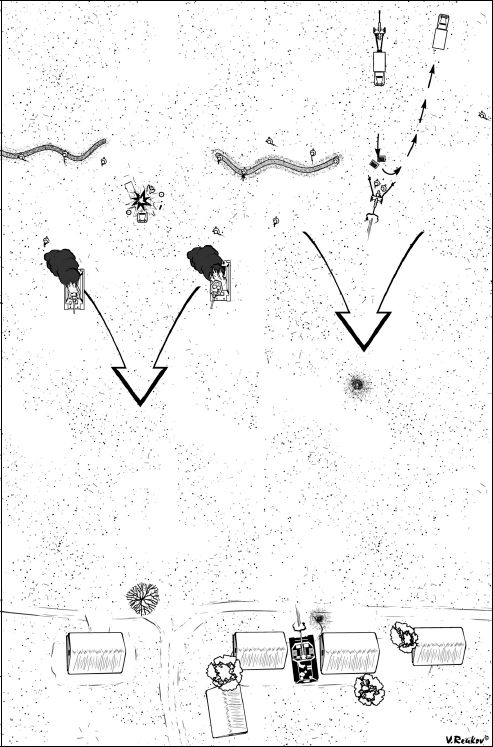
Diagram showing the battle of Nikolay Markov’s gun crew with the SPG.
Petia and I sat on a trail, looked at each other, and were silent. After all, we knew that now we were dead meat. Suddenly someone asked, ‘Who fired?’ I turned my head and saw a major, a deputy regiment commander. It turned out that he’d been crouched nearby in a trench. How he wound up there, I don’t know – I didn’t know his name. We weren’t interested in visiting with the command; we had our own circle. I remained silent, and Petia did too. Then suddenly from behind me I heard: ‘Sergeant Nesterenko’s crew.’
‘Comrade Nesterenko, I’m recommending you for the Order of the Patriotic War.’
When the fighting ended, Nesterenko did in fact receive the Order of the Patriotic War, while the crew was given 1,000 rubles for knocking out an armoured vehicle. However, we never received the money; only a receipt for the funds that showed we’d donated the money to the Defence Fund.
I had no further encounters with tanks for the rest of my service in the destroyer anti-tank artillery regiment. They were always shifting us back and forth across the front of the 47th Army. Over the remaining eight months of the war, I dug ninety-six emplacements, but I never again happened to fire at a tank. Escorting the infantry ‘by fire and wheels’ wasn’t really our experience. We rarely fired at German weapon emplacements. We were the 47th Army’s anti-tank reserve, so they deployed us only on avenues of approach that were vulnerable to tanks.
The constant work was perhaps harder to endure than combat with all its nervous stress. First, when changing firing position we had to leave the truck far behind the front line, so that the Germans couldn’t shoot it up and so there’d be no losses. This means that the crew at night had to drag the gun, which weighed more than a ton, on slings to the next firing position. Then you had to reposition all the cases of shells, each of which weighed 75 kilograms. Three men were digging the gun emplacement and all the slit trenches for the crew; three were loading and unloading the cases of ammunition; and the driver and an assistant were in the truck. It happened that when you woke up in the morning, you’d see the wall of a brick factory right in front of you! These firing positions were constructed with blood and sweat.
Each gun crew had eight men: the gun commander, the gun layer, the loader, two guys who handled the gun trails, an ammunition carrier, a driver and an assistant driver. We were a friendly family. Once we were digging a trench in Poland, and we uncovered an iron box. We opened it and found 50,000 zloty in it from the years 1936, 1937 and 1939: ‘What shall we do, fellows?’ We divided the loot evenly between us and our first thought was to play blackjack. Then someone proposed to spend it all on moonshine. We quickly reached an agreement and with the 50,000 zloty we bought fifty bottles of moonshine. This really helped us whenever we had the opportunity to relax. When I was fighting in the infantry, we received a vodka ration. In the artillery we also got one, but very rarely. So now we had procured our own moonshine.
Some of the gun crew commanders worked with their men more than others. This depended on the individual. Of course, the commander and the gunner didn’t make the trips to the field kitchen. But it wasn’t like you could say, ‘Dig a trench for me, while I stand and watch.’ If you behaved incorrectly as a commander, they might simply shoot you. No commander – no problem. There were completely different attitudes. Before a battle, a man is earnest. He works to his utmost and is pure within. The men are straight with each other. It is a completely different psychology.
For example, I was supposed to clean the grease off the shells with a rag, but if they had nothing else to do, the entire crew would help me. Usually the shells were clean – ‘From the assembly line directly to the front,’ that’s what I thought.
The loader had to prepare the shell and load the gun in a timely fashion. He needed to know the different shell types and to take the necessary steps quickly. I recall that the daily combat load was 135 shells, but I don’t remember the proportions of the different types of shells. Everything depended on what you were given. There were norms – but who knew them? Our job was to man the guns!
We had to clean the guns after every march, and it was mandatory to do so after every battle. It was the gun layer’s job to bore sight the gun and calibrate the optics. In case of some problem or malfunction, there were two armourers in the battery who would repair the guns. However, malfunctions occurred rarely – the gun was reliable.
Depending on the terrain, we would deploy the guns with approximately 50 to 150 metres between each gun. It wasn’t like in the movies, where you see them standing wheel to wheel. They might fire that way only at celebratory salutes!
I’m not a superstitious man, but I believe in fate. Before going to the front, my father told me, ‘Son, remember – don’t plunder from a foe; you’ll lose more of your own.’ I never plundered. A German is lying there and he’s wearing a watch. I’d never take it! I remembered this commandment for my entire life. I also remember once making our way from the front to the rear. We walked back to the truck, and the butt of the driver’s assistant was all swollen. We asked him, ‘What happened?’ He replied, ‘A ‘‘Ferdinand’’ socked me in the ass with a projectile.’ It turned out that he’d been sitting on a bucket, peeling potatoes. A random projectile, having ricocheted off the ground and lost most of its inertia, caught him right in the ass. It had to have been the ‘hand of fate’ that brought that projectile and his butt together!
Of course, fear was part and parcel of battle, but the scariest thing was the suspense. For example, you’re lugging a case of shells and you don’t know where the front line is or even where the Germans are. There was one frightening episode when we stumbled into a minefield. It was night, and having thrown a white sheet on one of our backs to guide the driver, we were walking toward the front lines. The Studebaker with the towed gun was slowly moving about 10 metres behind us. Suddenly there was a muffled explosion; the Studebaker’s right wheel had run over an anti-personnel mine. The wheel was smashed. The driver and a hygienist were sitting in the cab of the truck. With the explosion, the latter had barked his shin. He was howling in such a wild voice – but he wasn’t even wounded. Then there was another small explosion, and again a cry. We walked over – what had happened? It was one of our soldiers, a new replacement, from the western Ukraine. It is a law of war, you know: you walk in the track left behind by the moving truck. But he had strayed to the right of the track and had stepped on an anti-personnel mine – it removed his leg. We called for sappers. They lifted so many mines; it was a nightmare!
When you know what’s in front of you, this you can tolerate; it was who would get the better of whom. But when you don’t know the situation, the unknown gets into your head.
As for toilet paper, we had the sort when you don’t have any paper at all! There was nothing to write on; we wrote on newspaper! In the summer we used grass, in the winter, snow – that was all. As far as you could, of course, you tried to keep yourself clean, but you weren’t always able . . .
I do pay my respect to the commissars and political workers. They were engineers of human souls. It is hard for a man in war; someone has to chat with him. These fellows were civilized, mannerly. They did their duty to nurture the human soul. I myself witnessed how before a battle in Poland, the colonel and zampolit [deputy political commander] inspired the infantry. We were standing next to the infantry. Rocket shells struck, not at the Germans, but at us. When the order to charge came, he was the first to get up, and by his personal example he led the guys into the attack. It was an example, a conviction – it was what was necessary. So when I served back then, I came across a lot of Party workers in the army. It all depended on the man, but generally speaking, they were ordinary guys. They cultivated a proper attitude among the men toward each other.
I reached Warsaw’s suburb of Praga with the 163rd Rifle Regiment. The following incident took place in November 1944. We deployed our gun on the western side of some building, but dug our trenches on its eastern side, so that during a barrage its walls would create a dead space for falling shells. I remember the Germans hit us with a barrage from their ‘Vanuishi’ – their six-barrelled Nebelwerfer rocket launcher. I was the last to leap into a trench. A shell exploded on the balcony. Fragments and splinters riddled my greatcoat, but didn’t even graze me. Then it became somehow quiet. Suddenly I heard shouting: ‘Markov to the battalion commander!’
I made my way to him. After reporting, he told me, ‘You’re going to study to become an officer.’
‘I don’t want to be an officer. I’ve already seen all the filth of this war; I don’t want to be an officer.’
‘Do you understand martial law?’
‘I know it precisely.’
‘This is a combat order. Go, push off to the rear; report to the sergeant major. He knows what to do.’
I went back to the crew and said, ‘Petia, they’re sending me away to officer’s school.’
‘You’re lucky. Do you know how much more fighting there’ll be before we reach the fascists’ lair? How many tribulations? So, take our spoils of war, everything we have, and push off to see the sergeant major. We didn’t have much in the way of captured goods. Primarily, all we’d been able to scrounge was lard.
In order to reach the sergeant major, you had to run about 50 metres across some open ground to one of our knocked-out tanks. A trench had been dug beneath it, which we called the ‘Stopover’. In this trench you’d wait until the Germans quieted down and stopped shooting, and then you’d scramble out and dash another 30 metres to some low mounds, behind which the Germans couldn’t see. I said to the guys, ‘Farewell.’ I grabbed the lard and took off at a run.4 I heard the sound of firing and dived beneath the tank. When the shooting stopped, I made another dash – and got away. That’s how I ended the war.
Notes
1. Katsap is a mocking Ukrainian reference to Russians. It dates back to the 17th Century, when many Russian men wore thin beards below their chins – hence the allusion to goats.
2. ‘Six-month’ refers to a junior officer who due to the dire need for personnel, didn’t go through the full, official period of training before being sent to the front. There, if they survived their first battle, they received their commission as junior lieutenants.
3. Petia’s way of addressing the junior lieutenant, Mukha, is the Russian word for a fly.
4. Thin slices of lard have always been a common sight on many Russian dinner tables, along with pickles and marinated herring. Lard is considered a food item.