
13
War is a series of catastrophes that results in a victory.
GEORGES CLEMENCEAU, French prime minister
Every historian has a different explanation for World War I, but all agree that vanity, incompetence, and sheer bad timing all played a part.
By 1914, many politicians suspected that only a war could settle the festering feuds and clear the bad blood that troubled Europe.
Germany, whose sixteen states had united in 1871 under the most warlike of them, Prussia, was itching to prove itself. Flexing its military and industrial muscles, it stared around belligerently at the neighbors crowding its frontiers.
Staring back was France, still furious about the loss of Alsace.
Germans watched the maneuvers and exercises of France’s military with as much alarm as they saw Britain expanding its fleet and Russia creating an enormous land army on its eastern border. Not unreasonably, Kaiser Wilhelm II believed these three nations, united by treaty, plotted to encircle Germany and limit its expansion, if not dismantle it entirely. Given the efficiency with which the British navy blockaded German ports in 1914, cutting off its imports, those fears were justified.
In anticipation, the German high command expanded its fleet and extended the national rail network. If war came, the planners in Berlin’s Wilhelmstrasse wanted troops to arrive at the front in hours, not days, and fresh rather than exhausted by marching. Meanwhile, factories such as Krupp and I. G. Farben developed weapons of mass destruction: canisters of poison gas and guns so massive their shells arced briefly into space before plunging to earth at a speed faster than sound. These cannon could fire a projective forty miles. The maximum range of the French 75 mm was six.
The French might be excused for failing to foresee the power of long-range artillery, since it had never been an area of French expertise. In aviation, however, France led the world. Its pilots were the first to cross the English Channel and the Mediterranean, and while the Germans led in airship design, France pioneered fast-pursuit aircraft. It should have entered the war with a powerful air force. Instead, like the British, it struggled to catch up with Germany.
The aircraft and munitions factories of France and Britain didn’t prepare for war because nobody really believed it would happen. For one thing, business would suffer. In July 1914, just a month before Europe mobilized, an American journalist lectured the French on its absurdity.
I have been waiting twenty-five years for your European war. Many a time it has seemed as imminent as this. But it will not come! Europe cannot afford a war. There is today such a close interrelationship between big business in the capitals of Europe that an actual conflict is beyond the realm of possibility. The diplomats will fume and fuss. But they know better than to plunge their countries into a colossal struggle that will ruin Europe and set back civilization.
The very idea of war, along with its associated technologies, became the plaything of fantasy. Ever since the Franco-Prussian War, writers had speculated about the rise of a militant Germany. In 1871, British writer George Tomkyns Chesney published The Battle of Dorking: Reminiscences of a Volunteer, in which a thinly disguised Germany invaded and defeated Britain. Jules Verne dramatized submarine power in 20,000 Leagues Under the Sea and H. G. Wells’s 1907 The War in the Air foresaw Germany, joined by China and Japan, bombing the United States and Europe into ruin.
In France, however, both the public and intellectuals looked on military aviation as an amusing conceit. In the 1880s and 1890s, illustrator Albert Robida anticipated a war in which aircraft played a large part, but readers preferred his jokey suggestions about the French upper classes stepping into private airships rather than carriages. In his 1909 Aeropolis, Belgian Henry Kistemaeckers and French illustrator René Vincent imagined personal aircraft taking off from art nouveau balconies in the more fashionable arrondissements of Paris. At the end of Aeropolis, sinister Japanese arrive to menace Paris, but if anyone in Europe saw this as a warning, they took no notice.
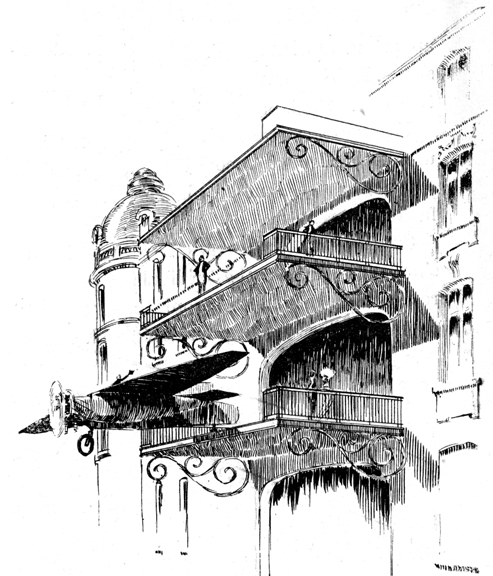
Aeropolis. Future aviation, as imagined in 1909 by René Vincent
War did come all the same, with shocking speed and largely by accident. On June 28, 1914, a group of young Serbian anarchists, incensed at Austria’s annexation of their country, swore to kill Franz Ferdinand, Archduke of Austria, on a visit to the Bosnian town of Sarajevo. All suffered from tuberculosis, in those days incurable, and so felt they had nothing to lose.
Armed with bombs and handguns, and with cyanide suicide pills in their pockets, the six lined the motorcade route. Their efforts at assassination were inept. Most lost their nerve. One threw his bomb too late and blew up the car behind the archduke’s. Then he swallowed his cyanide pill and jumped into the river, intending to drown. The water was only four inches deep and the pill was so old it just made him throw up.
At the end of the day, the last plotter, nineteen-year-old Gavrilo Princip, a melancholy idealist, stood eating a sandwich and brooding about the debacle. As the police had switched routes following the first bomb, he’d had no chance even to draw his Browning automatic pistol, let alone fire it.
At that moment, to his astonishment, the archduke’s car, having taken a wrong turn, entered his street. Trying to back up, the driver stalled right in front of Princip. Dropping his sandwich, he shoved through the crowd and, with two unlucky shots, fatally wounded both Franz Ferdinand and his wife. Blaming the Serbian government, Austria invaded, an act that automatically activated treaties committing France, Britain, and Russia to go to war with the Austro-Hungarian empire and its ally, Germany.
To fight over Serbia, an insignificant pawn in the international game, was ridiculous. But the killings took place in July. Military and political leaders were on holiday, and governments in recess. A power vacuum existed, and war rushed to fill it. Even then, Germany tried to put on the brakes. Between the kaiser, on holiday on a boat off Norway, and Czar Nicholas II in Saint Petersburg, cables bounced back and forth. In them, Willy urged cousin Nicky not to mobilize his army. Nicky, notoriously weak, stubborn, and not very bright, instead listened to his generals, stood on his dignity, and dithered. Nobody, it seems, knew how to partially mobilize Russia’s enormous but unwieldy army. Finally, on July 31, Nicky wired, “It is technically impossible to stop our military preparations which were obligatory owing to Austria’s mobilization.”
As diplomacy failed, the German generals saw their chance and activated the Schlieffen plan, their best-kept military secret. Ignoring Belgium’s neutrality and not waiting for the kaiser to sign an official declaration of war, they sent 1.4 million troops speeding there on the new railway system.
The tiny country on the North Sea became a back door through which they could enter France from the north, bypassing its forts. If, as they anticipated, France surrendered quickly, they planned to attack Russia before its army had assembled. As for Britain, Berlin regarded it as essentially a naval power and no threat on land. Taken completely by surprise, the French armies under General Joffre fell back on Paris. Even as printers were churning out postcards showing Alsatian women tearfully thanking French soldiers for liberating them, they were in full retreat. On September 7, they halted the Germans at the Marne, forty miles outside Paris. With minor variations, the two sides remained in stalemate until November 1918. Strategically, the war was over, at least in Europe. In terms of carnage, however, it had barely begun.