
14
There is indescribable enthusiasm and entire unanimity throughout Australia in support of all that tends to provide for the security of the empire in war.
SIR RONALD CRAUFURD MUNRO-FERGUSON, governor-general of Australia, in a message to the colonial secretary in London, July 1914
Why would Australians agree to fight in a war on the far side of the world?
They didn’t. They were never asked. As one historian explained:
Australia didn’t even have to declare war. Britain, as head of the family, spoke on behalf of her empire. All Australia had to decide was the extent of its participation. Most Australians saw nothing unusual in this. They also saw themselves as Britons, far from home, it was true, and in a strange land where the trees shed their bark instead of their leaves, but they were still Britons and wore three-piece suits in the pitiless sun to prove it.
No Australian was forced to enlist, least of all my grandfather. Even had the draft existed, he could have claimed exemption as a family man. But he volunteered anyway. Nobody knows his reasons at first hand, since just as our family never talked to one another, they also seldom wrote letters or kept diaries. Once you know the Baxter character, however, some pieces of evidence speak more loudly than any words.
One is another early photograph of Archie. It was taken on his wedding day in 1906. Clutching a pair of white gloves in one hand, he is a picture of exquisite discomfort in his first formal suit. He’s irresistibly reminiscent of the barrow boy hero in the popular dialect poem of C. J. Dennis, The Sentimental Bloke, suffering through afternoon tea with the family of his middle-class sweetheart, Doreen.
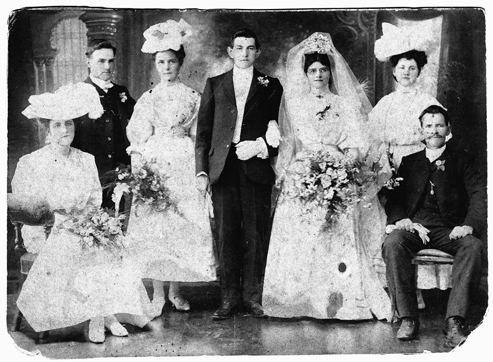
Wedding photograph of Archie and Stella, 1906
Me cuffs kep’ playin’ wiv me nervis fears
Me patent leathers nearly brought the tears
An’ there I sits wiv “Yes, mum. Thanks. Indeed?”
Me stand-up collar sorin’ orf me ears.
Archie’s other arm is linked with that of Stella Madden, his Doreen. Her steel-rimmed spectacles and prim mouth suggest the same inflexible disposition as the mother in Dennis’s poem. Cousins and friends flank them, but the eye is drawn to a truculent gent with a bushy mustache, seated to one side. He’s John Madden, father of the bride.
Both Madden and his daughter exhibit the same no-nonsense mouth, the unflinching gaze. In contrast, Archie, big-eared, wide-eyed, trusting, looks as rural as the town where he was born. Burrawang, in dense bushland eighty miles from Sydney, is the classic mountain village. Anyone raised in the Ozarks or the Blue Ridge, on a Swiss hillside, or in the forests of the Auvergne would instantly be at home among its thick-walled houses of local sandstone, their roofs steeply pitched to shed snow. There was even a local version of the troll, that monster of the European forests imported by emigrants to scare the children. The Burrawang bunyip lurked in a swamp, killing cattle by night but disappearing the moment anyone set out to catch it.
Bunyips notwithstanding, my great-grandfather James Baxter, a Scot from around Aberdeen, liked Burrawang and did well there. Back in Scotland, a branch of the Baxter family operated a lucrative business producing high-end canned goods: grouse, pheasant, poacher’s broth, and haggis soup. Encouraged, James started a bacon factory. It flourished, but it also helped kill him. His obituary in the local paper, The Scrutineer of August 28, 1891, described how “some twelve month ago he began to feel the effects of constant and undue pressure upon his stomach leaning over the edge of the bacon curing vats.”
James fathered nine daughters and three sons. On his death, the bacon factory and his two-hundred-acre farm with ninety cattle and six horses went to his widow, Eliza, and, after she died, to his eldest, Archie. He liquidated his father’s property and moved to Sydney.
With the profits of the sale in his pocket, Archie was a catch. And caught he was, by the Madden family, in the person of Margaret Stella Isabella Madden, always known as Stella. Continuing our family’s involvement with food, Archie took a job as a “canvasser,” or traveling salesman, in his case for groceries, and bought a spacious house in the inner-city suburb of Leichhardt. The couple moved in. So, however, did Stella’s father, and her brother, Claude.
Few recipes for disaster are more poisonous than living with one’s in-laws. (I could only nod in agreement at the line in the film Field of Dreams: “We lived with my wife’s parents as long as we could, almost an entire afternoon.”) There’s a certain irony, as well as a sense of the inevitability that runs through our family, that, as children, we should have shared the same house with our in-laws, and soon been at one another’s throats.
Did Archie feel himself caught in the same trap? Historian Peter Stanley, analyzing the makeup of the first volunteers to the AIF, cites “evading domestic responsibilities” as a significant motive for wanting to leave the country. Whatever his reasons, Archie appears to have needed little urging to abandon his family and, in particular, Stella’s, to fight someone else’s battles on the far side of the world. As Pasternak says in Doctor Zhivago, “Happy men don’t volunteer.”