
15
We don’t want to fight, but by Jingo if we do
We’ve got the ships, we’ve got the men, we’ve got the money too.
E. H. MCDERMOTT
But why would he do that?” Marie-Dominique asked.
“Maybe Archie just wanted to escape.”
She looked doubtful. “You would never leave us to go and fight in Australia—would you?”
I knew enough of France and married life not to answer that question.
Convinced of France’s superiority to all other countries, the French don’t understand why anyone would want to leave, even to fight on its behalf. Rather than send Frenchmen to defend their colonies in Asia and Africa, they farmed out the job. The Légion Etrangère, the French Foreign Legion, accepted, indeed invited, the world’s toughest nuts. You could enlist under whatever name you chose. Nobody asked about your reasons. The Foreign Legion, in the words of one writer, “developed into a collective exercise in convenient amnesia, acquiring a reputation as a haven for cut-throats, crooks and sundry fugitives from justice. Few questions were put to new recruits, making it an ideal repository for the scum of the earth. And with the scum came the romantics, men searching for a way to dull the pain of doomed love.”
Doomed love? Might that be why Archie left? Was there another woman? I wouldn’t have been surprised. Abrupt marriages, divorces, and quixotic romantic gestures pepper our family history. Two aunts married American servicemen during World War II. Both returned soon after, each with a child. My own father wasn’t married to my mother when I was born. For good measure, he had been married before. That I was fifty years old before he told me says something about the Baxters’ chronic inability to communicate.
Or had Archie simply felt the same nationalist euphoria as Britain? Britons needed no more excuse to join up than the ground beneath their feet. When Eleanor Farjeon asked the poet Edward Thomas why he chose to enlist, he stooped, scooped up a handful of earth, and said, “Literally, for this.” Many in Britain accepted the propaganda maps, supposedly discovered by British spies, showing how postwar Europe would look if the Germans won: a Gross-Deutschland extending from Saint Petersburg to the Spanish border, with the British Isles as a Deutsche-Kolonie. Britain a colony of Germany? Unthinkable.
Even without any mystical love of the soil, one could imagine Australians responding to a similar nationalism. Australia had only existed as a nation since its six states federated in 1901, which made it barely older than the united Germany. One couldn’t fight for one’s country if one didn’t have a country, but now that they did, both Aussies and Germans found patriotism a novel and exciting concept.
I tried to imagine Archie metaphorically wrapped in the flag of the Southern Cross. It wasn’t easy. He didn’t seem the type. But what was the type?
The “digger” image of the Great War was largely the creation of a single artist, Norman Lindsay. He was one of those belligerent little men whom Australia finds both admirable and exasperating. Billy Hughes, the wartime prime minister, was another, compensating for poor health and short stature with a furious output of work. Historian Les Carlyon described Hughes as “cranky and deaf and dyspeptic, but still bustling with energy, cracking out abuse to his hapless typists, carried along by the fever of war.”
Though Lindsay was less than half Hughes’s age, he had the same arrogance. Bigotry came naturally to him. Fanatically nationalist, he was also anti-Semitic, anti-Black, anti-gay—probably anti-Eskimo too, had anyone thought to ask. Though almost the same age as Pablo Picasso and James Joyce, he loathed the work of both and detested anything in art or literature that smelled of modernism—a prejudice he shared with Kaiser Wilhelm, who feared the new in everything but instruments of war.
Lindsay’s style, rooted in nineteenth-century French history painting, ran mostly to female nudes with Amazonian breasts and wrestlers’ thighs. When, however, in 1914 the popular weekly The Bulletin asked for anti-German cartoons, he leaped to the drawing board to create the archetypal Hun. A drooling beast, half-naked, always in the pointed helmet known as a pickelhaube, these monsters rampaged through his drawings, raping buxom Belgians and trampling babies underfoot. For good measure they sometimes carried a hatchet or meat cleaver, dripping blood.


Norman Lindsay. Monsters of Depravity and Children of Light.
At the same time, he created the archetypal Aussie: clean-cut, sturdy, muscular, white, a model of Aryan supremacy in skin-tight khaki shirt, riding boots, jodhpurs, and a slouch hat—the very antithesis of the real digger, often slouching, untidy, and belligerent. Art historian Bernard Smith acknowledged that Lindsay’s war cartoons “invariably presented Germans as monsters of depravity, the Allies as the children of light.” The propagandizing was almost too flagrant. During World War II, when it seemed the Nazis and Japanese might overwhelm even Australia, his wife, fearing Germans with long memories, urged him to flee to America.
Might Archie have been moved by such crude flag-waving? It wasn’t so great a stretch, since I admired Lindsay myself, for his technique rather than his subject matter, and owned some of his less bellicose work. He lived in the same mountains outside Sydney as my parents, and I often drove down the bush lane that ran past his house, slowing to read the sign NO PAINTINGS FOR SALE on the gate. After his death, his house became a museum. We could inspect at leisure his spacious canvases and stroll in his garden, dotted with life-sized sculptures of husky nudes, incongruously molded in gray cement.
I was still puzzling over Archie’s possible motives when another old friend came to the rescue.
I met Michael when we were asked by one of the cinema bureaucracies to distribute funds to makers of Australian short films. During a week of interviews with greedy, argumentative, and only occasionally gifted applicants, we’d come to feel like soldiers trapped in a shell hole during an artillery barrage.
Michael became a military historian and producer of films about Australia’s war effort. When he passed through France, I shamelessly picked his brain.
“When did your grandfather enlist?”
“May 1916.”
“Hmmm. That was a low point. We’d lost twenty-eight thousand at Ypres and just as many at Gallipoli, but the British were pushing for more men.”
Prime Minister Hughes wanted conscription, but only if voters approved: many Australians still resented the governor-general’s automatic assumption in 1914 that they would fight with Britain. Twice Hughes took the question to the country in a plebiscite; twice it was rejected. Even troops on the front line in France, who stood to benefit most from reinforcements, refused to support compulsory military service. “I wouldn’t wish this place on my worst enemy,” said one.
“What surprises me,” I said, “is the fact that Archie enlisted even though he had a wife and child. Who was supposed to look after them?”
“Australian soldiers got very good pay. Some of his would have gone to his wife. Enough to live on. And the recruiters wouldn’t have discouraged him. They took pretty well anyone.”
Michael explained the new tools now available to the researcher into Australia’s military history. Almost as much as the French, the Australians, it seemed, had embraced their patrimoine, particularly if it carried a rifle.
“Just go into the site of the Australian War Memorial or the National Archives and put in his name. Everything that ever happened to an Australian serviceman is cataloged five different ways.” He smiled. “Even the lice have serial numbers.”
“Would it show whether he experienced anything remarkable in France?”
“Remarkable? You mean more remarkable than being shot, bayoneted, blown up, gassed?”
“Something more personal. Intimate.” I explained about the cité des ténèbres and San Fairy Ann.
“Well, some weird stuff did go on,” he said. “When I get back, I’ll send you some books. There’s been an enormous amount published about things that previously got swept under the carpet.”
“You mean desertions? Executions at dawn? That sort of thing?”
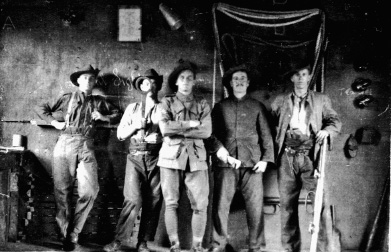
Real Australian diggers at a camp in Wiltshire, 1917
“Oh, yes, all those. But I was thinking of the mutinies, rapes, murders. And the mystical stuff too: miraculous interventions, angels . . .”
He looked at the gray sky that seemed to be settling on the metal roofs of the city as if to stifle us.
“It’s something to do with France. War here was . . .” Shaking his head as if to dislodge a troubling thought, he turned up his collar. “You think it’s going to rain?”
I watched him disappear down the winding staircase of our apartment building. Murders. Rapes. Angels? Clearly I had a lot to learn.