
32
An army marches on its stomach.
Napoleon I
The war began in 1914 as a clash between concepts noble enough to be capitalized: Pride, Patriotism, Glory. By 1917, it had degenerated, at least as far as the average Briton was concerned, into a crisis about something much more prosaic—bread.
As his train carried him under lowering clouds across a rainy eastern England, Archie, a countryman at heart, would have understood what he saw in the fields on either side of the line. There was nothing green. Everywhere was fresh-turned earth. War or no war, fields had to be tilled and crops planted.
The 1916 wheat harvest had been poor worldwide. For a century, Britain had imported most of its grain, but in early 1917 Canada and the United States had little surplus to sell. The British could buy from Australia, India, and Argentina, but that meant longer voyages, higher prices, and more risk of attack by German submarines. Hoping to head off a catastrophic food shortage, the army in March 1917 began releasing troops to help with the plowing.
At the same time, they pushed the already overstretched economy to produce more grain and vegetables. Anzacs in England who knew agriculture recognized this as “too little too late.” One wrote home, “They are making great efforts to organize the production of the country & orders came through to the Parish Council to cultivate every inch of ground they had to spare for potatoes etc. & the millers have got to put at least 5 percent of oats or barley crush in their flour. British people generally wake up a year or two after they ought to.”
In France, food shortages were even more acute because so much of the country was in German hands. The army had commandeered almost all farm horses. In the fields, it was quite usual, with all the fit men at war, to see teams of women yoked to a plow or harrow, dragging it across the fields. Jean Cocteau, as his introduction to the long poem Le Cap de Bonne-Espérance (Cape of Good Hope), reproduced without comment the report of a court-martial that took place at the end of 1916.
The accused is a forty-three-year-old man, serious and sad. Accused of desertion, he was brought before the 2nd Council of War for the Paris region, presided over by M. Colonel Chartier.
The President began by asking “Why did you desert?”
The Accused: “I asked for leave but it was refused. Even so, I needed to go to my farm at Stains, near St. Denis. I had potatoes to lift, and they couldn’t wait. When I arrived, I went straight to work on the farm. Once I’d lifted the potatoes, I returned right away. I don’t believe I was a deserter.”
The President: “You seem to forget we are at war. Leaving your post to harvest potatoes can’t be tolerated. You can’t be serious.”
The Accused: “All the same, I had to lift my potatoes.”
In Berlin, Moscow, Paris, and London, the leaders of the rival powers bickered about what to do next. Both Kaiser Wilhelm and Czar Nicholas were ditherers with schoolboy notions of politics and economics. The minutes of these meetings show them blustering, cringing, and even weeping as they argue the course of the war. Almost always, they defer in desperation to their military and naval commanders, who are adamant that victory is in sight if they just escalate the violence.
In the end, it came down to submarines. Germany pondered: if it ordered its submarines to attack vessels of all nations bringing cargo to Britain, would the Allies sue for peace before so many American ships were sunk that the United States was forced into the war? As Archie headed across East Anglia, the kaiser finally accepted the assurances of the military and naval hierarchy that unrestricted submarine warfare would starve Britain into surrender within five months. In January, the Wilhelmstrasse announced that, from February 1, ships carrying food or military supplies for the Allies, no matter what flag they flew, risked being sunk. Germany had literally bet the farm.
Among the men released to work on the land was Ellis Evans, better known for his poems in the Welsh language as Hedd Wyn. Evans spent part of his leave on the family’s sheep farm writing Yr Arwr (The Hero) as his entry to the National Eisteddfod, the Welsh literary festival. “He came back for fourteen days’ leave and wrote Yr Arwr on the table by the fire,” said his nephew, Gerald Williams. “As it was such a wet year, he stayed for another seven days. This extra seven days made him a deserter. So the military police came to fetch him from the hayfield and took him to the jail at Blaenau. From there, he travelled to the war in Belgium.”
At the festival on September 6, Yr Arwr was unanimously awarded first prize. Traditionally, the winner is called from the audience three times, with a fanfare of trumpets, to take his place in the thronelike bardic chair. To the embarrassment of the judges and guests, who included the prime minister, David Lloyd George, they only then learned that Evans had died on July 31 at Passchendaele. His empty chair was draped in black, and the festival of that year was known ever after as Eisteddfod y Gadair Ddu: the Eisteddfod of the Black Chair.
In early 1917, Britain didn’t lack black chairs. Almost every family had lost someone. In some cases, every son was killed, and often the father also. The wounded were piling up. Hospital ships from Etaples now landed at night: better the public didn’t see the numbers of injured and dead. With London hospitals full, casualties spilled into the countryside. Those who could walk were sent to the emptier counties of East Anglia—Suffolk and Norfolk. Once they recovered, the army shipped them to Codford or Hurdcott on Salisbury Plain to get back in shape before being returned to France.
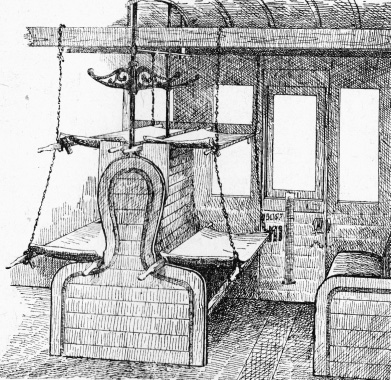
Railway carriage adapted to carry wounded
Archie’s train carried scores of men with thickly bandaged limbs or hobbling on crutches. Some had faces ripped by shrapnel; Norwich was a center for the infant craft of reconstructive surgery. Others, wheezing from the effect of gas, were expected to benefit from the fresh, chill winds off the North Sea. Everything had an air of “make-do and mend.” Country railway stations became mini-clinics where patients were stabilized and medicated before ambulances, improvised from baker’s and milkman’s vans, sometimes horse-drawn, carried them along country lanes to one of the region’s sixty-two auxiliary hospitals, adapted from schools, insane asylums, mansions, and museums.
Catton Hall, a former stately home, was typical of the hospitals and convalescent centers where Archie spent most of 1917. Patients at Catton were housed in its indoor racquetball court. The family’s private museum became a recreation room. In good weather, inmates could sit out under a covered verandah. Small open-sided huts were built for gas victims. Excursions for those who couldn’t walk were organized by roping together their wheeled “bath chairs” and towing them in a decorous caravan through the countryside.
Those who could walk were allowed to roam, providing they wore their “hospital blues”: a pair of blue flannel trousers, a jacket with pale blue lapels and cuffs, a white shirt, and red tie. Any making it to a village pub in hopes of a drink were turned away. It was illegal to serve alcohol to a man in uniform, even one that resembled pajamas. However, some hospitals provided beer, believing it hastened recovery.
For entertainment, there were tournaments, or “drives,” of whist and bridge. Visiting concert parties put on shows. The eight or ten performers of these groups, sometimes dressed in the baggy white suit and conical hat of Pierrot, generally included a pretty young singer or soubrette, a male partner for dance duets, an older soprano and a baritone to sing selections from operetta, and a mix of comics, jugglers, and magicians. The troupes competed for catchy names: Pelissier’s Potted Pageant, The Fol-de-Rols, The Lavender Follies, The Quaintesques.

Pierrots, including a Charlie Chaplin imitator
A few performers graduated from concert parties to the professional stage, but most were well-meaning amateurs, particularly those who volunteered to entertain captive audiences like the wounded. Impolite and impatient Australians severely tested their generosity of spirit. Of a group that played the convalescent hospital at Hurdcott, a patient wrote, “I’m hanged if I know why the people stick to the Australians, for they soon let everybody on the stage know if they are not pleasing them.” In World War II, when concert parties were again drafted to amuse the troops, critics suggested that ENSA, the initials of the organizing body, the Entertainments National Service Association, stood for “Every Night Something Awful.”
Norwich Military Hospital, where Archie went for his surgery, was a flat-faced three-story Victorian redbrick building, topped with an incongruous central clock tower. It had been a school. The headmaster’s office was now an operating room. It was there in February 1917 that he underwent surgery. As a nurse dripped chloroform onto a face mask to keep him unconscious, the surgeon made incisions at the top, middle, and bottom of each bulging blue leg vein, fed in a fine wire, tied it to the vein at the three incision points, then pulled out the entire vein. The process would have been repeated on each affected vein, and in both legs.
Without today’s pain-killing drugs or antibiotics to fend off infection, Archie’s recovery was lengthy and painful. Though he had not been wounded in battle, his suffering was no less acute. But when he hobbled out of the hospital, that had ceased to matter. By March 21, German submarines had sunk seven American merchant ships, an intolerable provocation to the United States. President Wilson summoned Congress and on April 6, 1917, the United States entered the war. On May 18, Congress passed the Selective Service Act, authorizing a draft. It foresaw the U.S. Army of 145,000 men being enlarged to 4 million. It seemed the war would soon be over.