
33
Over there, over there,
Send the word, send the word over there
That the Yanks are coming, the Yanks are coming
The drums rum-tumming everywhere.
GEORGE M. COHAN, “Over There”
Lithe as a seal, the woman in the red lycra maillot knifed into the shimmering green water and swam toward the picture window at the other end of the pool. Beyond the glass, a lawn trimmed smooth as a putting green sloped up to ground level. It existed only to funnel sunlight into the pool and surrounding restaurant, and appeared indifferent to the fact that, occupying as it did a hundred square meters of Paris’s most expensive real estate, each of its impeccably trimmed blades was worth about $10.
“Pretty,” I said, nodding toward the swimmer.
Clare looked over the top of her glasses and made a moue of disapproval.
“ ‘Is too slime.”
“We say ‘slim.’ ”
Clare was an old friend of Marie-Dominique. I’d known her from my first days in Paris and was almost used to her fractured English. Just after I arrived, she and Marie-Do took me on a Sunday morning promenade down the street market of rue Mouffetard. As we passed a charcuterie, the man sliced a sliver from a large sausage and offered it on the flat of an obviously razor-sharp blade.
Most sausages are pink and marbled with fat. This one was gray, with a structure of concentric rings, like those of a tree. The taste was unexpected also—a faint slipperiness and mustiness.
The charcutier said something. Clare, proud of her store-bought English, started to explain. “Is andouillette. Is make from . . . how you say . . . tripes?”
“Guts,” Marie-Do said. “Intestines.”
“Yes. Zis is ’er,” Clare went on. “ ’E say—monsieur le charcutier—’e say zat he make it a l’ancienne. In zer old way.”
I nibbled a bit more. What’s was that odd flavor?
“ ’E say,” Clare continued, “zat ’e put in zer trou de cul.”
When I looked blank, she scrabbled for a translation, but her vague understanding of the letter h got in the way. Since it’s seldom pronounced in French, locals tend to scatter it indiscriminately, leaving us to spit out those that don’t fit, like seeds in watermelon.
“Trou de cul, trou de cul, what is zis?” Clare said. Then recollection dawned. “Ha! Yes. I am knowing! Trou de cul is zer . . . hasshole!”
As any French person could tell after a glance at Clare’s rangy racehorse figure and artfully blonded hair, she came from aristocracy. Better still from my point of view, her father had been in army intelligence during World War II, close to the Free French exiles who ran the underground effort against Hitler from London. As a TV journalist, she’d built on his inside knowledge and contacts to create a formidable réseau—a private network of informants and experts. It probably overlapped that of Peter van Diemen, but though each claimed not to be aware of the other’s existence, I suspected neither told the truth. Etched deep as tattoos, the habits of espionage are not easily eradicated.
As well as being awesomely well-informed, Clare had entrée to places like this, the cercle sportif of the Union Interalliée, the Inter-Allies Club.
Housed in the former mansion of the Baron de Rothschild on rue Faubourg Saint-Honoré, a brief walk away from the American embassy, and almost next door to the foreign ministry, the club dated back to 1917. A committee of wealthy aristos and businessmen decided that generals of the Allied armies needed a place to socialize informally and enjoy some foie gras and a decent Bordeaux while deciding the fate of millions. They clubbed together to acquire the lease and refit it as a private club for the military elite.
In particular, French and British officers could mingle here with the Australians and Americans. Perfectly nice chaps, of course, in their own way. But a bit . . . well, crude. Wore their spurs to the table, poured their tea into their saucers, blew on the soup—or even fanned it with their caps. And most troubling of all, spoke no French.
If the Americans found it hard to communicate with the French, it was even harder for the French to make themselves understood. A culture gap yawned. What the French knew of the United States came from cheap fiction, visiting vaudeville acts, and the movies. Just how much they relied on such secondhand sources became clear when the editor of La Baïonnette asked artist Guy Arnoux to draw a full issue devoted to the Americans, or, as they were being called, after Uncle Sam, the Sammies—a label Americans hated, and for which they quickly substituted “doughboys.”
Perhaps the editor was being mischievous. Or did he not know that Arnoux was an eccentric, with a taste for masquerade? According to Jimmie Charters,
His studio was a veritable museum of costumes, knick-knacks, lead soldiers, models of ships, old bottles, telescopes, globes, saddles, and hundreds of other things, a truly remarkable collection. Guy would often wear the costumes, as he liked to dress up, sometimes as a cowboy, or as an officer in the navy, or as a cook, with pots and pans tied from his waist. He attended most of the costume balls of the Quarter, and was always a big success.
Arnoux’s choice of a cover illustration was easy: the heroic image of an American serviceman against the Stars and Stripes. As a model, he chose a marine, a decision followed by most French cartoonists, who found the distinctive high-crowned campaign hat with its four-sided Montana Crease a more arresting silhouette than the duller doughboy cap.
Already nervous about their own rumored fifth column of German fräuleins, the French were ready to believe reports that three years of neutrality had made it possible for a hundred thousand German agents to infiltrate the United States. On January 11, 1917, two of them blew up a munitions plant in Kingsland, New Jersey, destroying five hundred shells intended for Russia, killing seventeen people and inflicting an estimated $4 million worth of damage.

Eccentrically, Arnoux linked this to the 1905 and 1906 European tours of Buffalo Bill Cody’s Wild West Show, which remained in Paris for many months. In his illustration “The Spy,” three cowboys have just hanged a man on a tree, to which is nailed a sign “By Order of Judge Lynch.” One says truculently, “100,000 spies, yes—but more than 100,000 trees in the country to hang them from.” The cowboy theme continued with a gun-toting cowboy lassoing some Germans, saying, “Germans or cows, it’s all the same to me.” The Native Americans in Cody’s troupe so impressed journalists that they began calling Paris’s street gangsters apaches, a label that stuck. This was reason enough for Arnoux to draw some of their compatriots in blankets and war bonnets, captioned, “On the Warpath.”
For his double-page center spread, however, Arnoux relied on the oldest and soundest example of Franco-American cooperation, the friendship of the Marquis de Lafayette and George Washington. During the War of Independence, the nineteen-year-old aristocrat, drunk on the idea of revolution, had raised a regiment at his own expense and bought a ship to hasten to the aid of the rebels.
Even 150 years later, the mutual affection of France and the United States remained potent. In June, when Pershing arrived in France with his advance guard of two hundred troops of the 16th Infantry Regiment, the public reaction was ecstatic. Delirious Parisians pelted them with flowers. Women jumped out of the crowd to press roses on them. When Pershing visited the Chambre des Deputées, France’s parliament, the members stood and cheered.
On July 4, Pershing marched his men through the city to Picpus Cemetery, where Lafayette is buried, surrounded by pits into which the decapitated corpses of hundreds of fellow aristocrats were thrown during the Terror. As Pershing spoke no French, the address was given by an aide, Colonel Charles Stanton. “America,” he said, “has joined forces with the Allied Powers, and what we have of blood and treasure are yours. Therefore it is with loving pride that we drape the colors in tribute of respect to this citizen of your great republic. And here and now, in the presence of the illustrious dead, we pledge our hearts and our honor in carrying this war to a successful issue. Lafayette, we are here!”
Behind the official enthusiasm and the patriotic cheers, many Frenchmen were dubious about the Americans. Where had they been for the last three years, while the Allies were fighting the Central powers alone? Significantly, the welcome from Parisians on July 4, in contrast to the ecstasy of a few weeks earlier, was muted. The troops received only sparse applause. In his diary Paul Morand wrote of “the crowd, especially the women, weary, every spark gone, wanting only the quickest possible end to the war.”
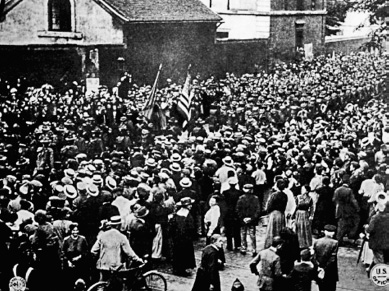

4 July, 1917. “Lafayette, we are here!” The fantasy—and the reality. “The crowd, especially the women, weary, every spark gone, wanting only the quickest possible end to the war.”
Some Frenchmen, including many in the military, distrusted the Sammies. Would there be enough of them to turn the tide? Could they fight with the ferocity demanded by the war of attrition to which the French and Dominion forces were now committed? Some in the high command were sure that, at the first shot, these pampered Yanks would cut and run.
When Pershing and his staff got their first look at the enemy, safely, through a telescope in the Saint-Quentin sector, General Pétain listened without expression to Pershing’s promises of a million men the first year, increasing to three million in 1918.
“I just hope it is not too late,” Pétain said.
He didn’t mean “too late to defeat the Germans.” With American technology and the sheer weight of numbers, Germany’s military annihilation appeared inevitable. But would it ever get that far? Having spent the winter suppressing mutinies, executing their ringleaders, and placating the troops with promises of better treatment and more leave time, Pétain feared his armies were ready to imitate the Russians—simply abandon their weapons and start walking home. If that happened, France and Britain would have no alternative but to follow Russia and negotiate a cease-fire.
After lunch, Clare and I toured the mansion. We wandered through the marble-floored corridors, the formal dining and ballroom, and out into the garden.
Clare paused after a few steps, breathed deep, and said, “Whore’s sheet.”
I halted. But she was right. The gardener had been spreading manure around the roses.
Seeing my expression, she said, “Is not correct? Whore’s sheet?”
I thought of the generals and politicians who dined out here when the weather was warm, and who, after enjoying the rôti de boeuf poêlé à la Matignon, strolled along the paths between the perfect flower beds, wrangling in a gentlemanly way over troop allocations and equipment supply while men drowned in the mud of the thaw.
“Horse shit? I couldn’t have put it better myself.”