
4
In Paris, everybody wants to be an actor; nobody is content to be a spectator.
JEAN COCTEAU
Every war has its stars: men and women who, whatever their military importance, seize the imagination. Few are conventionally heroic. The brave don’t last. They die in combat, taking their stories with them. Those who survive are often not so much courageous as cunning, self-serving, and skilled at self-promotion. Lionized out of proportion to their achievement, they and their experiences are exaggerated and falsified in the interests of patriotism, recruitment, or profit.
Because there had been no European war for forty years, the conflict of 1914–1918 produced a parade of heroes and heroines. American marksman Alvin York, fliers Eddie Rickenbacker and “Red Baron” Manfred von Richthofen, executed British nurse Edith Cavell, the poets Wilfred Owen and Rupert Brooke, and T. E. Lawrence, “Lawrence of Arabia,” all became household names, embodying the experience of war as much in what they said and wrote as in any physical heroism. Members of the Australian and New Zealand Army Corps and the Australian Imperial Force were more self-effacing, While honoring a few examples of self-sacrifice, such as the efforts, finally fatal, of Jack Simpson and his donkey to save the wounded at Gallipoli, they took more satisfaction in the “spirit of Anzac,” a collective capacity to endure.
Stars on the French side were more rare. Joseph Joffre, commander of the French army, wasn’t star material. Fat and waddling, with a bushy white mustache, “Papa” Joffre resembled Colonel Blimp, the symbol of an antiquated officer class invented during World War II by cartoonist David Low. General Gallieni’s imagination and audacity saved Paris and, many would argue, won the war, but he was sick and in retirement before war began and died before it ended. Philippe Pétain, defender of the fortress of Verdun in one of the most costly battles of the war, initially entered the pantheon, despite a manner that chilled many. They were not disappointed when he died in disgrace after agreeing to lead the Nazi puppet government of occupied France during World War II.
After the generals, the best candidates for fame were its aviators, dashing cavaliers of the sky such as Jean Mermoz, Georges Guynemer, and Roland Garros. And then such improbable outsiders as Jean Cocteau.
For an example of the brilliance, the creativity, the joie de vivre of Paris at the beginning of the twentieth century, look no further than Jean Maurice Eugène Clément Cocteau.
In 1914 he was twenty-five, a slim, chic, opinionated gay man, fox-faced and frighteningly alert, with a prodigious talent that he survived to exercise for another fifty years. “He was a maestro of every conceivable form,” enthused one critic after his death in 1963. “He wrote poetry, fiction, drama and criticism, directed several films, went round the world in eighty days, even played the drums in a Parisian night club.” He was also an accomplished artist, his signature image the high-browed pouting profile of a butch young stud, a fantasy Orpheus whose reality he would discover in the actor Jean Marais, destined to become his star, lover, and heir.
The limelight and the darkness at its edge were Cocteau’s natural environment. When he was ten, his father committed suicide. His mother was absent for long periods. The grandparents who raised him explained she was an actress, and often on tour. It wasn’t until he was twenty that Jean, looking through some photographs of the Saint-Lazare prison, recognized her among the inmates. A kleptomaniac, she served a number of sentences for petty theft.
A longtime addict of opium, Cocteau knew the Paris underworld, and applauded the pulp writers and filmmakers who created such glamorous thieves and avengers as Fantomas, Judex, and Arsène Lupin. Defying the fashion for elegant aestheticism, he found sexual partners in the demimonde—sailors, sportsmen, teenage runaways. He helped manage the career of boxer and tap dancer “Panama” Al Brown, and rescued the young Jean Genet, a gifted writer but a thief, by hiring the best lawyers to save him from prison. As a young man, he also joined the group that waited with a bath of warm water in the wings of the Ballets Russes. When Vaslav Nijinsky staggered offstage, exhausted after having mesmerized audiences in L’Après-midi d’un Faune or Le Spectre de la Rose, they stripped off his sweat-soaked costume and sponged him down—as much, it seems, for their pleasure as for his.
When Cocteau signed up for Misia Sert’s ambulance service, he was already a regular at her salon. In the way she drew the most brilliant men and women of Paris to her afternoon soirees, Misia, beautiful, voluptuous, bisexual, and rich, reminded him of the bird trainers who showed off their disciplined flights of swallows in the Luxembourg Gardens. “Angels seemed to fly around her like birds round a dresseur d’oiseaux,” he wrote.
She was painted by Renoir and by Toulouse-Lautrec, who doubled as barman at her salon. Guests included composer Maurice Ravel, who dedicated works to her, couturier Coco Chanel, who became her lover, and Marcel Proust, for whom she inspired a character in A la Recherche du Temps Perdu. Many in her circle first heard of the war when a late guest burst in with news of Austria invading Serbia. He was shushed until Erik Satie had finished the premiere performance of his Three Pieces in the Form of a Pear.
When Misia heard the news of Sarajevo, she said, “What luck! Oh God, if only there really is a war.” Dashing into the street, she was swept up in the general euphoria.
I suddenly found myself perched on a white horse riding before a cuirassier in gala uniform, round whose neck I had wound a wreath of flowers. The general excitement was such that this situation did not for a moment strike me as being strange. The cuirassier, the horse and the crowd were not astonished either, for the same spectacle could be seen throughout Paris. Flowers in wreaths, bunches, bouquets and loose, were being sold on every street corner, and a moment later you found them on the kepis of the soldiers, on the end of their bayonets or behind their ears. Everybody kissed, sang, cried, laughed, trampled each other, hugged each other; we were filled with compassion, generosity, noble feelings, ready for any sacrifice, and, as a result of it all, wonderfully, unbelievably happy.
The same spontaneity permeated Misia’s ambulance service. In Thomas the Imposter, Cocteau’s novel about the experience, he parodied her as the scatty Princess de Bormes. “Danger was in fashion and the calm was killing her,” he wrote of her restlessness at the outbreak of war. “The Princess is moved less by patriotism than a sense that something is going on from which she is barred. This fearless woman listened to the cannon like those who listen to the orchestra outside a concert hall to which the door-keeper will not admit them.”
During the first days of the war, Cocteau shared the general enthusiasm. For such intellectuals as himself and the American writer Malcolm Cowley, ambulance work was mostly a giggle. Any risk of injury and death appeared remote, even exciting. As Winston Churchill said of being a correspondent during the Boer War, “Nothing in life is so exhilarating as to be shot at without result.” Cowley and members of his crew darted out from cover in the middle of an artillery barrage to grab bits of shrapnel. “We were seeing a great show, collecting souvenirs of death, like guests bringing back a piece of wedding cake or a crushed flower from the bride’s bouquet.”
Black humor titters through Cocteau’s evocation in Thomas the Imposter of a typical trip with a volunteer ambulance unit.
Madame Valiche opened the door.
“Ten minutes halt. Refreshments! All change!”
“Where are we?” asked Clemence, still half asleep.
Guillaume jumped out of his dream onto the road. “We are at M———, fair princess, and the casualties are shouting that they are glad of it.”
Indeed, a strange moaning sound came through the cold night, curses and banging on the partitions.
“They are in pain,” said Clemence. “The road is full of potholes.”
“That didn’t stop you sleeping. And it’s for their own good. We’re taking them to bye-byes. They don’t know their luck.”
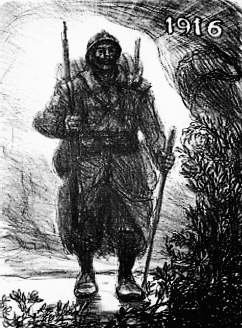
A poilu by Theophile Steinlen
Cocteau posed in his Poiret uniform against the sand dunes of the Belgian coast and was snapped, smirking, next to a privy labeled WC Réservé au Génie—“Toilet Reserved for Engineers.” (Génie also means “genius,” a title Jean didn’t doubt he deserved.) His descriptions of the wounded show a callous aestheticism, as if an awareness of beauty insulated him from pity and horror. Recruits mown down by machine guns were “poor flowering flesh; young trees, uprooted in the mud.” Of a young gunner dying of blood poisoning, he imagined how “gangrene must have crept over him like ivy over a statue.”
In Paris, Cocteau patronized a public bathhouse where one of the twelve bathrooms, for the pleasure of wealthy voyeurs, was fitted with a one-way mirror. At the front, he loitered near the showers where the poilus, or “hairy ones,” as common soldiers were known, took their first full wash in weeks. Among them were Zouaves, recruited from France’s colony, Algeria. Malcolm Cowley saw these troops as simply “huge men with blue-black faces, pink eyeballs and white teeth,” but to Cocteau they became sensual projections in negative of Antoninus, lover of the Roman emperor Hadrian and a popular subject of homoerotic statues. In his poem “The Shower,” he wrote:
The negroes are Antoninus
Seen in a black convex mirror.
Ill, they become purple.
They cough. Alas! Where are
Your islands? Your crocodiles?
Where are they?
This mirror of war as beauty was shattered by his collision with Haig and his staff in the Flanders château. Shaken, he recoiled from the triviality of his ambulance excursions. “I left the war,” he wrote later, “when I realized, one night in Nieuwpoort, that I was enjoying myself.” He got a job in Paris editing a propaganda magazine, Le Mot—The Word—and it was there, in one of those improbable examples of six degrees of separation, that his path could have intersected, however briefly, with that of Archie Baxter.