
5
But there’s something about his bearing, something in what he’s wearing
Something about his buttons all a shine shine shine
Oh a military chest seems to suit the ladies best
There’s something about a soldier that is fine fine fine.
NOEL GAY, “Something About a Soldier”
After its defeat by the Prussians in 1871, France constructed forts to bar the route from the east, which, they assumed, any future German invader must take. Colossal carbuncles of concrete, forty feet thick, bristling with cannon, they were served by thousands of men permanently quartered underground in miles of tunnels.
Supporting them at ground level was a fast-moving military machine geared to the style of fighting perfected by Napoleon Bonaparte. Its horse-drawn artillery, mostly light 75 mm field guns, could move swiftly to meet any attack. Every Frenchman underwent two years’ obligatory military service. This created a reservoir of trained troops, ready to be called up at the first whiff of hostilities. Each reservist received a carnet de mobilization, with details of where to report in the event of the war that many expected, even hoped would come.
For cavalry charges and infantry clashes in open country, France was well prepared. It knew nothing of long-range artillery, bombing, aerial reconnaissance, poison gas, the tank, and above all the machine gun. Even its colorful uniforms might have been designed to show contempt for modern warfare. Infantry wore a dark blue double-breasted tailcoat with brass buttons. The number of their regiment was embroidered on the collar. Baggy red trousers tucked into half-boots completed the outfit, which was topped with the kepi, a cylindrical cloth cap with a stiff brim: stylish but little protection against a bullet.
In forty-four years, nobody had ever worn this uniform under fire. Once they did, it proved embarrassingly visible, and the army hurriedly looked for a new design. The British, in the interests of consistency, urged them to adopt their khaki, but the French refused, for the very French reason that khaki resembled the brown fabrics favored by hunters. How embarrassing if an officer was mistaken for some farmer out with his shotgun to get a rabbit for the pot. They based their final choice, a pale “horizon blue,” on the army’s existing peacetime dress uniform, but French troops would always be more visible than the British in khaki, the Germans in gray, and the Americans whose dusty brown kit with cookie-like buttons earned them the label “doughboys.”

Fitted out for war
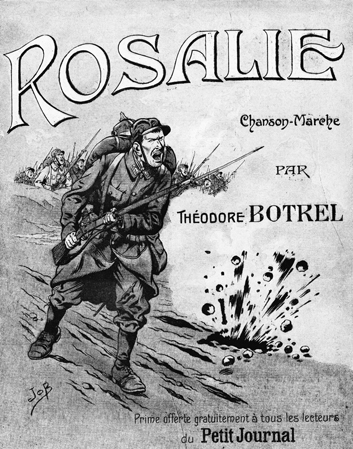
The poilu uniform—dangerously visible.
It took many weeks for everyone to receive a new outfit. “This was the period when the old uniform, in the process of changing to the new, had become unrecognizable,” wrote Cocteau. “Everyone wore it in his own way. And this cast-off kit, so comical in town, was magnificent in the armies—rank upon rank of ragamuffins.” Some officers remained fanatically loyal to the old uniform. One raged at a private in mismatched gear and ordered him to replace his blue trousers with red ones from a corpse. When the man refused, he was shot.
Pockets of such fanaticism lingered, reminders of the reverence in which France held its army at the end of the previous century. British soldiers startled the French when, following a rumored gibe by the kaiser that they were “a contemptible little army,” they began calling themselves “old contemptibles.” No officer of the Grande Armée would accept such an adjective. To do so would demean not only him but the force and, by extension, the nation. When an artillery officer, Alfred Dreyfus, was wrongly condemned as a spy in 1894 and sent to Devil’s Island, the high command hid its error for years, arguing that to reveal the injustice would undermine public confidence in the army. Novelist Emile Zola challenged this hypocrisy in his notorious broadside J’Accuse, and had to flee to England for his life.
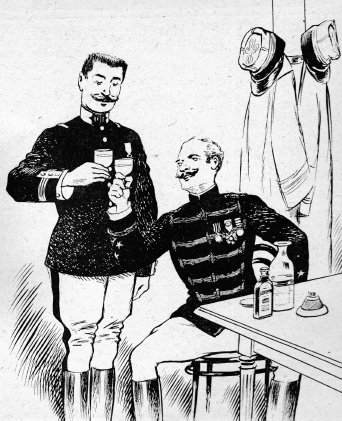
French officers toasting their tailor
Faithful to von Bismarck’s ethic of “blood and steel,” the German army dismissed the French as “chocolate soldiers,” commanded by officers more concerned with creature comforts than with killing. In late September, as the western front stabilized along the Marne, a cartoonist for the Berlin-based comic magazine Die Lustige Blätter—The Funny Pages—showed monocled French cavalry officers relaxing in a château. Servants serve champagne and help them off with their high leather boots. One officer sings to another’s piano accompaniment. Half-read novels litter the floor, and in the foreground is a lady’s fashionable hat and hatbox. The caption sneered “These Frenchmen have decided not to take any notice of our advance.” The French magazine that reprinted it meant to mock German arrogance, but anyone familiar with the high command in Paris knew the drawing wasn’t far from the truth.