
Chapter 9
Christopher W. Malone
The religious world of the Roman Army changed significantly in late antiquity. In the early third century, the legions marched behind Jupiter’s eagles, and the emperor would offer sacrifices ahead of battle to ensure success. At the end of the fourth century, an emperor might spend the night before battle fasting in a chapel and take advice from hermits in the Egyptian desert, while the army marched to victory behind Christian banners and crosses.1 The pivotal figure in this transformation was the emperor Constantine I. Constantine was the first Christian emperor, and he established the paradigm which all but one of his successors would follow. It is difficult to overstate his influence. In the Roman Army, and indeed in the Empire at large, Constantine began a process of Christianization with far-reaching consequences. Although many Christian thinkers opposed army service, he came to the faith as a result of his military victories. To honour his new patron God properly, Christian symbols patterned after his visions were emblazoned on shields and standards, soldiers were instructed in new ways to pray, and Christians who enlisted were granted privileges. It would be left to his successors to formalize and finalize this process, but Constantine’s imprint on Roman Army religion would remain.
Constantine was also instrumental in combining Christianity with imperial ideology, causing old Roman ideas to be reinterpreted in new Christian forms and leading Church thinkers to reconsider the place of warfare and violence in their worldview. This chapter will thus focus primarily on Constantine himself, his experience of battlefield Christianity, the changes he wrought in the appearance and practices of the Roman Army and what effect all this had. To truly understand him, however, we cannot operate in a vacuum, and so before turning to the emperor himself we begin by considering the problematic relationship between Christianity and the Roman Army in the period before Constantine.
Milites Christi before Constantine
Scholars generally agree that Christian participation in the Roman Army before Constantine was a limited affair, but the earliest indications of Christian soldiers actually centre around the turn of the third century. At this point we not only find Christians in the Roman Army, but an ongoing debate over their role and whether they should be there at all.2 Christians in general were a minority in early imperial society, and were mostly found in cities, whereas many army recruits came from a more rural background. It is therefore difficult to imagine large-scale recruitment, particularly combined with the disapproval of many of the Church fathers, but there were Christians in the legions all the same.3
Discussion of the Army and early Christianity is very often tightly and even contentiously linked to debates about the place of violence and pacifism in both ancient and modern Christianity.4 In 1979, Helgeland took this tradition to task, deconstructing scholarly views on Christianity and the Army based on individual scholars’ own religious and cultural backgrounds.5 Shean has since called this ‘confessional’ approach into question,6 but it highlights the importance of separating modern and ancient points of view, and of recognizing that Christianity has always been a religion incorporating multiple differing traditions.
That said, the majority of Christian authors in the period before Constantine did disapprove of Christians serving in the Roman Army. The objection was twofold -violence and bloodshed were moral and ethical issues, but there was also the problem of the Army’s traditional cultic practices, understood as idolatry, particularly the cult of the standards. The Church fathers were not unanimous, however, and questions may be raised as to how representative our written sources were of ‘ordinary’ Christians’ views.7 Patristic sources barely even mention the Army before the end of the second century, and when discussion does appear, there is already debate. Even non-Christians were aware of it: Celsus, who published a long attack on Christianity in the late AD 170s, argued that Christians were disloyal, as they refused to serve in public office or in the Army, and he urged them to do so.8 Origen’s refutation was that Christians did help the Empire – as priests, praying for victory, doing more good than soldiers.9 Origen is very much part of the anti-military tradition, though praying for victory implicitly accepts the emperor’s use of violence and warfare as righteous.10
Tertullian is the best example of the anti-military viewpoint, and is the early Christian author with the most interest in the Army. He certainly seems well-informed about military life, and his father was likely a centurion.11 Over time, Tertullian moved from disapproving acceptance of Christian soldiers to outright opposition.12 The problem with the Army, in his view, was primarily an issue of idolatry, both in traditional Army religion and the presence of Mithraism and other cults which were encountered serving in the legions.13 To follow Christ, he argues, one cannot serve the emperor – the sacramentum of one conflicts with the other.14
His major work on the topic, de Corona (On the Crown), bans military service outright. This work was inspired by an unnamed Christian legionary, who rejected the military decoration of a laurel crown at a military parade around AD 201, at which the troops were receiving a donative. He was martyred for it. Tertullian praises this legionary, and censures the other Christians who were part of the unit, and who apparently saw no conflict between their service (and laurels) and their faith.15 Tertullian also argues at length in On Idolatry that military service is unacceptable. In the course of his discussion there, he cites and refutes a number of objections to his position, which not only confirms there was disagreement within Christian communities, but also demonstrates that each side was arguing from both ethics and scripture.16
Tertullian’s contemporaries and co-religionists therefore held diverse opinions. Origen, we saw, would agree with his stance, and while Hippolytus also wanted to ban Christians from enlisting, the wording of his canons allows a Christian soldier to stay in the Army if he can avoid shedding blood and reciting the oath.17 Clement of Alexandria, by contrast, saw soldiering as just another profession – God is God of everything, after all.18 Thus, although the majority took an anti-military stance, there were shades of difference among Christian commentators.
Some patristic authors could even celebrate Christian participation in the Roman Army, and Tertullian, in his earlier career, was among them. His Apology, from AD 197/198, talks about Christians praying for the emperor and his armies, and points to Christians everywhere in the Empire, including forts and army camps (castella and castra ipsa).19 He also celebrates Christian legionaries in the famous story of Legion XII Fulminata, the ‘Thundering Legion’.20 Around AD 174, Roman troops campaigning under Marcus Aurelius against the Marcomanni found themselves cut off in the forests, out of food and water and blockaded by the enemy. Suddenly, and miraculously, the heavens opened, rain fell to refresh the Romans, and hail and lightning crashed into the barbarian camp, driving them off. Then, apparently, everyone fell to arguing about whose god had intervened. Our sources show a religious debate lasting at least into the fifth century: was it Jupiter, another rain god, an Egyptian mage conjuring Hermes Trismegistos, Julian the Chaldaean or even Marcus himself who brought the lightning?21 Or was it the God of the Christians? Already at the time, Bishop Apolinarius of Hierapolis claimed this was so, and that Legion XII Fulminata was in fact full of Christians.22
Tertullian himself was aware of this story and mentions it approvingly – Christians being present in Legion XII Fulminata suited his apologetic purposes, especially since the legion was among the loyalists who helped put down the revolt of Avidius Cassius.23 It is worth stressing that the Christian versions do not have the legionaries fighting, only invoking the miracle. Nevertheless, the idea of an entire unit being made up of Christians was apparently credible for a Christian audience in the early third century. The legion’s apparent recruiting grounds, Melitene and Cappadocia, were in a region that shows signs of Christianization fairly early, especially compared to the Western provinces, and this may have added to the credibility of the tale.
Our literary sources thus indicate a noticeable level of Christian involvement with the Roman Army – indeed debate over the validity of such service assumes it. Our earliest non-literary evidence for Christians in the Army is in fact contemporary with Tertullian’s de Corona: an epitaph dated to AD 201 for a soldier of Legion II Parthica in the catacombs of Domitilla.24 It is therefore clear that there were Christians serving in the Roman Army by the start of the third century, and some of them obviously did not agree with the view of thinkers like Tertullian and Origen that there was conflict between Christianity and armed service. Although the coincidence in timing is not definitive, the sudden appearance of this issue in our sources may well be tied to increased enlistment under the better service conditions offered by Septimius Severus.25
Christian participation in the Army increased during the third century, particularly in its later half, the so-called ‘peace of the church’ initiated by Gallienus’ cessation of official persecution around AD 260. According to Digeser, Christians of the later third century ‘quietly commingled with their fellow citizens in the classroom, in the army, in the government, and even in the palace’.26 Soldiers from the garrison at Dura-Europos, for example, seem to have participated in the town’s Christian community, as graffiti from the house church shows soldiers’ names we also find in the military district.27
Several hundred epitaphs of ancient Christian soldiers are known, but very few can be convincingly dated before AD 324.28 Their existence indicates that some Christian communities – and the soldiery – accepted and commemorated Christian troops,29 and a wide variety of ranks are attested, even in the pre-Constantinian examples: centurion, evocatus, beneficiarius, lanciarius and praetorian guards all appear.30 Christian phrases are often the giveaway for these inscriptions, especially (requiescat) in pace, which is found alongside traditional religious phrases like D(is) M(anibus).31 Two Christian soldiers, the brothers Florentius and Herodius, may in fact have fought against Constantine at the siege of Verona in AD 312.32 In other cases, thoroughly traditional material may appear with Christian symbols. Mercurelli identified a sarcophagus belonging to a praetorian guardsman who served under Gallienus, which shows several Christian symbols,33 while on a more humble scale, the epitaph of Valerius Thiumpus has panes decussati, loaves of bread with crosses on them, alongside traditional wording.34 For other inscriptions, context rather than content is key – especially for soldiers’ epitaphs found in the catacombs.35
Military Martyrs and Constantine’s Context
It therefore seems there was a significant Christian presence in the Army of the early fourth century, although certainly still only a minority. This was the period of Constantine’s rise to power, during the breakdown of the Tetrarchy. The religious ideology of the regime was based on an aggressive focus on old Roman ways and imperial divinity, and so alternative religions like the Manicheans and Christians were targeted as social and political problems. This came to a head in the last great persecution of the Christians, which began in AD 303. Importantly, it actually began with the military, both in terms of the initial purge and the supposed incident which incited it. Lactantius relates the story of Christian palace guards attending a sacrifice and disrupting the omens by crossing themselves as an apotropaic gesture – something which gives us an example of how Christians in the military may have dealt with Roman Army rituals. Diocletian subsequently ordered that all soldiers had to sacrifice or be dishonourably discharged, and the scope of persecution expanded in the following years.36
Two examples of soldiers who served the Tetrarchy and appear to have lost their posts in this way are worth noting. Most well-known is the cavalry officer Aurelius Gaius, who recounts his decorated career and exotic travels on his wife’s epitaph, finishing with an obviously Christian reference to the Resurrection.37 The other is Julius Eugenius, who had served the Tetrarchy – with distinction, his epitaph tells us – until he too left during persecution in the reign of Maximinus Daia. This tells us Eugenius had actually stayed in the service for some years after the initial decree. He nevertheless went on to become Bishop of Laodicea around AD 315, so Christians not only could and did serve in the Army, but a military background was no impediment to entering Church office at this point, and moreover a bishop in AD 340 apparently need feel no embarrassment about being an ex-soldier.38
Not everyone simply left the Army, of course, and the great persecution also produced a number of accounts of soldier martyrs.39 These are important not only as further evidence for Christian soldiers, but also for the variety of possible Christian responses to how armed service fitted with their faith.40 The most celebrated case of hard opposition is the young martyr Maximilian, who in AD 295 refused conscription on religious grounds, arguing that as a Christian he could not serve.41 Tertullian would have been pleased, but the magistrate Dion tried to talk him into it, pointing out there were other Christians in the Roman Army, even in the imperial comitatus!42 Maximilian replied that what others do is on their own consciences: ‘They know what is best for them. I however am Christian, and cannot do wrong.’43 While some Christians – and apparently the pagan Roman governor – saw no problem with Christians serving in the legions, Maximilian and his hagiographer did.44
Other military martyrs seem to have reached some kind of crisis point and decided to quit their service. Tertullian’s martyr in de Corona is an example; we also have the centurion Marcellus. We do not know how long he had been serving, but as an officer it must have been for some time. The text does not make clear whether he enlisted as a Christian or converted while in the Army, but at the festivities for the imperial birthdays in AD 298, Marcellus threw down his belt, sword and centurion’s switch, rejecting the imperial cult and announcing himself a Christian.45 He was put on trial and executed, as the judge in the text declares, for breaching his discipline and oath.46
A similar example is Julius the veteran, again a long-time soldier. He had in fact reenlisted, but refused Diocletian’s order that soldiers had to offer sacrifice. At his trial he defended himself on the grounds of his twenty-seven years’ loyal service, during which he went on seven campaigns and was the inferior of no man in the battle line -and was a Christian all the while.47 Again the judge, the prefect Maximus, encouraged him to just go along with it, even offering a bribe. Maximus clearly did not care if there were Christians in the Army – he cared that his men followed orders, even just to burn incense. Julius had apparently served for decades without encountering any religious problems. It is unclear how common this would have been, and it would certainly have depended on the individual commander, but Eusebius implies that for many soldiers Diocletian’s order to sacrifice or face dismissal was the first time they had really been forced to choose.48
All these soldier-martyrs essentially called attention to their resistance, and we read of several others who came forward during persecutions to reveal themselves.49 There were others who, it seems, would have kept on serving had they not been called out. Eusebius discusses two examples. A certain Basilides was asked by his comrades to swear an oath for some reason, but he refused, as a Christian – they laughed it off, but felt forced to present him to the authorities when Basilides’ steadfastness (or obstinacy, depending on your perspective) continued.50 The other was Marinus, a good soldier of good family, who around AD 260 had worked his way up to the rank of optio and was about to be promoted to centurion when a rival snitched to the commander that Marinus was a Christian. It was only at this point that the bishop came to him and demanded he choose between his service and his faith: Marinus chose martyrdom, but he had seen no ethical conflict prior to this, and presumably would have accepted the promotion.51
Lee wonders whether Marinus had managed to get out of imperial cult rites, or if he just went through the motions.52 The point of view of the Army in these texts is essentially that soldiers could believe what they liked, so long as they did their duty – including their duty to the imperial cult.53 Soldiers of Jewish or Mithraic faith seem to have been given some leeway in their observance of traditional military cult rites – initiates of Mithras apparently also rejected their military crowns – and it is plausible that some Christians in the Roman Army were given the same latitude.54 We should be careful not to blindly assume that all worshippers of Christ were necessarily strict in their monotheism. Severus Alexander, for one, supposedly had Christ and Abraham among his lares, and Constantine himself was hardly exclusive in his religious adherence for several years after his conversion.55
Diocletian’s attempt to purge the Army of Christians in AD 303 leads MacMullen to think there must have been few if any left by AD 312,56 but estimating numbers like this is difficult, especially since the policies of persecution were unevenly employed and questionably effective, not to mention largely ignored in the West. We know, too, that once persecution had ended, soldiers were offered their old posts back, and this was the case both for those persecuted under the Tetrarchy and those Christians briefly targeted by Licinius in AD 324.57 The Nicaea canons likewise make clear that some Christians, having left the Army, re-enlisted even during periods of persecution.58 So, even if the initial purge was effective, there is no reason to think its effects were long-lasting, as at least some men came back under the policy of toleration. Given that Constantine had bishops in his retinue even before AD 312, Christians in the Western armies may never have been as strongly pressured to leave the ranks.
The Milvian Miracle of ad 312
The tale of Constantine at the Milvian Bridge is well known, but is worth considering at some length because of its importance for understanding not only Constantine himself, but also military religion under his reign – and therefore the rise to prominence of Christianity in the later Roman Army.59 On 28 October AD 312, after a rapid but hard-fought campaign down through Italy, Constantine faced off with his rival Maxentius near the Milvian Bridge, just north of Rome. Like Constantine, Maxentius had forced his way into power during the breakdown of the Tetrarchy, and was the last obstacle to Constantine’s control of the western half of the Empire. In Constantinian propaganda, of course, he was a cruel tyrant oppressing the people of Rome.60 Maxentius initially planned to withstand a siege, so the Milvian Bridge itself had been destroyed, but he had been goaded out either by omens or by popular unrest in the city. The battle seems to have been straightforward – Constantine’s veteran force broke their enemy and sent them fleeing back towards the river, where the weight of the rout collapsed the temporary pontoon crossing which had replaced the bridge. Maxentius was one of the many who drowned.
The victory left Constantine as master of the capital and the western provinces, but the real importance of the battle is his claim that he owed his victory to the Christian God. Before the battle, Constantine had apparently experienced some kind of divine epiphany in a vision or dream, and afterwards caused his men to march under a new sacred sign in recognition of his new divine patron. The Christian narrative was, unsurprisingly, first promoted by his Christian supporters, and although imperial sources were initially vague about what had happened, the emperor came to back it as the official explanation. As such, each of our sources differs in detail on the issue of divine intervention, but all maintain the line that Constantine had some supernatural help. Even Zosimus, hostile as he is to Constantine, records omens and portents surrounding the battle.61
Christians saw Constantine’s victory as their God’s doing, and it was most likely the Christians in Constantine’s retinue who convinced the emperor this was the case.62 The earliest narrative account comes from of them – Lactantius, once professor of Latin at Nicomedia, and tutor to Constantine’s eldest son, Crispus.63 On Barnes’ dating, Lactantius was already with Constantine in Gaul by AD 310, making him a source close to events, though he may not have been present at the battle himself.64 In his book On the Deaths of the Persecutors, published around AD 315, Lactantius narrates the emperor’s dream on the eve of battle, in which Constantine was instructed to draw the heavenly sign – a cypher for the name of Christ – on his men’s shields.65
Lactantius’ description of the symbol is a little ambiguous:66 he describes a bisected X with a looped top, which can be read as describing the chi-rho monogram or christogram made up of the first two letters of Christ (Χριστός) in Greek. Though rarely used at the time, this was later employed extensively by Constantine and his Christian successors as both an imperial and a religious symbol. Alternatives have been proposed, like the staurogram  which appears in Christian literary and funerary contexts from the early third century.67 Other, more dubious interpretations, minimizing Constantine’s conversion, have ranged from an ankh to a six-pointed star, or even a spoked solar wheel. Whatever the case, Lactantius is specifically describing a Christian symbol, and asserts an entirely Christian version of events. The year that Lactantius published, Constantine was already taking tentative steps to publicly associate himself with the chi-rho: the symbol appears on two milestones from AD 312/313, and a medallion from Ticinum minted in AD 315 depicts the emperor’s frontal portrait with the symbol on his helmet (see Figure 9.1).68
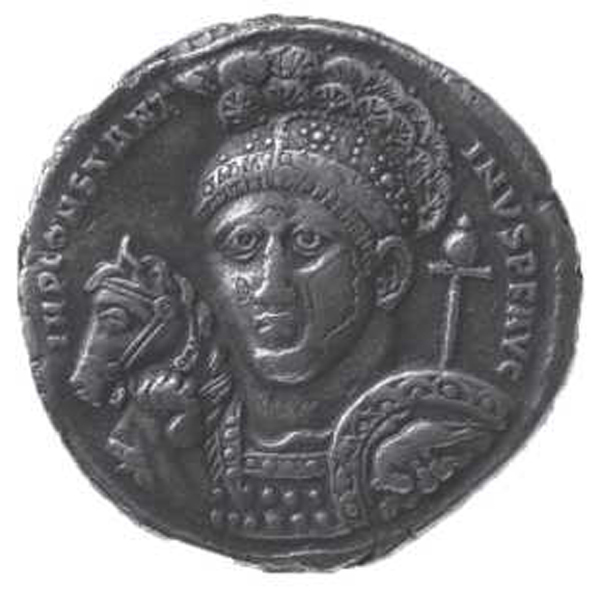
Figure 9.1: Ticinum Medallion (obverse) showing Constantine wearing the chi-rho on his helmet, AD 315 (RIC 7 Ticinum 36). (© The Trustees of the British Museum)
The other contemporary Christian source is Eusebius – probably Constantine’s biggest fan – who offers two accounts. The earlier, in his Ecclesiastical History, does not specifically mention a vision, perhaps having been published before that part of the story was well known in the East, and focuses instead on depicting Constantine as a new Moses.69 In the panegyrical Life of Constantine, written in the AD 330s, Eusebius gives us a more developed narrative, which he tells us he heard from Constantine himself.70 Here the vision occurs simply some time before the battle, not on its eve.71 Constantine was looking for a powerful god to help him, and followed his father’s example of seeking out the supreme deity.72 This god then responded with a midday vision, a cruciform trophy in the sky over the sun, and the words ‘by this conquer’ in Greek (ἐν τούτῳ νίκα) visible to all. Later, he had a dream instructing him to build a copy of the sign from the vision. Constantine consulted his episcopal advisors, who explained and interpreted his visions as sent by Christ, and so he had the new banner built, a cross-shaped vexillum topped with the christogram, which would become the late Roman battle standard, the labarum.73
Eusebius portrays an already openly Christian Constantine entering Rome in triumph after the battle, displaying Christian symbols on placards, and also describes a victory statue holding either a standard or a cross – or maybe both, if the labarum was intended – with an inscription making reference to the ‘saving sign’, in language largely reminiscent of the surviving inscription on his arch.74 It is possible that this was the colossal statue whose pieces are now outside the Capitoline museums, but scholars have been tentative about this identification. While it is not impossible that Constantine displayed Christian symbols already, the description perhaps belongs to a subsequent visit, like his decennalia in AD 315.
Divine visions on momentous occasions were hardly new. Roman culture was overflowing with signs and portents from the gods, both genuinely believed and cynically manipulated.75 The interpretation put on the victory in AD 312 was essentially traditionally Roman, in that divine favour had won the day, even though the god involved was not part of the traditional pantheon. The drama of the tale grew in the telling: when Rufinus came to adapt Eusebius’s History into Latin, for example, he inserted a new more spectacular vision, so that Constantine, anxiously praying for guidance, sees a fiery cross in the eastern sky accompanied by angels proclaiming ‘in this sign you will conquer’ (in hoc signo vinces).76
There are also surviving non-Christian versions of the events of AD 312, some of which have a claim to reflecting the contemporary ‘official’ line. Constantine’s arch in Rome – dating, again, to AD 315 – refers simply to the vague instinctu divinitatis. The battle scenes on the frieze do not show any obvious divine assistance, though Victory and Tiber are both depicted.77 We can connect this to the description of the battle in the panegyric of AD 313. Here there is no vision, and Christianity makes no appearance, but the orator seems to have understood the need to sell a religious angle to the battle, and does so in carefully ambiguous language.78 A ‘supreme deity’ is mentioned in several places as the emperor’s guiding inspiration, and the only named traditional god is the River Tiber. This ambiguity stands in stark contrast to the very traditional and overt theology of the earlier tetrarchic panegyrics, which allude frequently to Jupiter and Hercules in particular.79 It therefore seems to indicate a changing religious mood at court.
By AD 321, the battle had accrued diverse supernatural elements. Nazarius’ panegyric of that year still does not name the supreme deity, referring to ‘that divinity’ who habitually helped Constantine,80 but does describe the appearance of a celestial army to support Constantine at the Milvian Bridge, led by none other than his divine father, Constantius I.81 Alföldi suggested this was a pagan attempt to replace the now-widely publicized Christian vision.82 Rodgers instead wonders whether it was aimed more at Constantine’s last competitor and one-time ally Licinius, who, it was believed, had also been granted a vision and divine help in battle.83
Licinius had once been a hero for the Christians too, jointly enacting the AD 313 Edict of Milan with Constantine, which granted legal recognition to Christianity and established a policy of religious toleration.84 According to Lactantius, he had also defeated the last persecutor, Maximinus Daia, with the help of the Christian God, and had been granted a vision in which an angel taught him an ambiguous but monotheistic prayer for his men to recite before battle.85 Indeed, it is Licinius, not Constantine, who appears at the climax of Lactantius’ narrative, and there were most likely more Christians in Licinius’ army than in Constantine’s, since there were many more in the East in general.86
When Constantine finally decided to get rid of his erstwhile ally and marched against him in AD 324, Licinius needed to be rewritten as a tyrant and an enemy, not just of Constantine, but of the Church and of God.87 In AD 325, Eusebius added an extra book to his History, and revised earlier material to depict Licinius as a persecutor, describing Constantine’s decision to overthrow him as motivated by the plight of the Eastern Church.88 Eusebius casts Licinius as emulating Diocletian in going after Christians in military commands, suggesting incidentally that they were once again somewhat common.89 Both emperors had collaborated on the Edict of Milan, but Licinius seems to have been less interested in Christianity than his colleague. While Constantine had become convinced his summus deus was the Christian God, Licinius had not, favouring Jupiter as his patron. He may have originally accepted some Christianizing measures on Constantine’s recommendation, but he did not adopt the labarum.90 He nonetheless maintained the policy of toleration until relations with Constantine (now the darling of the Christians) broke down, and he came to recognize the Church as a potential danger.91 The conflict was presented by Christian authors as a clash of religions, and while clergy and even Constantine himself may have seen it that way, it seems unlikely that the ordinary troops would have.92
After the defeat of Licinius in AD 324, Constantine was able to project a more confident and clear Christian image. The last remaining pagan god, Sol Invictus, disappeared from his coinage, the title victor replacing the traditional pagan invictus93 and he presided over the ecumenical Council of Nicaea. The emperor’s own Oration to the Saints announces his Christianity around this time, literally preaching to the choir94 and even connecting the vague language of his early reign to Christ.95 His new faith is made clear in his AD 325 letter to the provincials of Palestine, and around the same time was announced abroad in his letter to the Persian king Shapur II.96 This letter contains what appears to be a statement of faith, as well as a recommendation of the Persian Christians to the king’s protection. The implicit threat that Constantine might otherwise have to intervene to protect their interests may point to early preparations for a war with Persia.
One of the greatest points of controversy in the study of Constantine has been the sincerity of his Christianity. Exactly when and whether he ‘really’ converted (whatever that means) is a perennial and ultimately unanswerable question, but that has not stopped historians ever since his own day.97 Constantine initially favoured the patronage of Sol Invictus, the unconquered sun god, a very common religious trend at the time, one to which his father may have adhered. His coin issues from AD 310– 323 often feature Sol, which has been seen as a religious statement, but the real importance of the Sol issues is not that they were still being minted after AD 312, but the fact that they stopped for good in AD 324.98 At the time, however, the panegyric of AD 310 related another, solar, visionary experience.99 According to the panegyrist, Constantine was shown a vision in that year which he associated with Gallic Apollo, a local stand-in for Sol.100 He saw Apollo and Victory offering him laurel wreaths, vouchsafing thirty years of rule each.101 This panegyric in particular contains a number of attempts to redefine Constantine as a ruler in his own right, rather than as part of the tetrarchic system, emphasizing his supposed descent from Claudius II, and focusing on his father and his divine support as sources of legitimacy.102
This too-early vision has exercised scholarship. It is plausible that the Milvian vision itself was not a separate event, but rather a reinterpretation two years later of the earlier vision, after Constantine had mulled it over and discussed it with the Christian clergy who were already part of his retinue. This would very much fit the pattern of a slower religious conversion which was centred around AD 312, rather than happening all at once; it likewise meshes with Eusebius’ claim that Constantine was actively searching for the right patron god.103 An alternative is that Constantine was (or wanted to present himself as) a man prone to visions, to which Eusebius does also allude.104 Attempts have been made to locate the ‘real’ vision in a natural phenomenon, such as the solar halo effect, but what exactly Constantine saw is of less importance than what he did afterwards, and how he used this idea of his visionary experience.105 This can be pushed further, to suggest that the initial use of the chi-rho symbol in AD 312, whether on shields or made into a banner, was actually ambiguous, like much of the religious rhetoric of Constantine’s early reign: while it appeared obviously Christian to a Christian audience, it could have been interpreted as solar by pagans.106 The Christian version eventually won out, and there were, after all, already solar associations that were acceptable within Christianity.107 In the end, we should not expect an all-or-nothing conversion in AD 312; as Nock demonstrated, religious conversion was and is a slow process, even though it is very often remembered later as a moment of sudden revelation in the manner of the road to Damascus – or the Milvian Bridge.108
The emperor’s public behaviour and self-portrayal are much more important than speculation about his private beliefs – and are actually accessible to us. He acted as a major patron to the Church and raised his sons as Christians, and after he gained sole control of the entire Empire, he increasingly portrayed himself as Christian to the Empire at large.109 He was also quickly willing to get involved in Church disputes ‘like a universal bishop appointed by God’, and even quipped that he was himself ‘bishop of those outside’.110
Constantine was no theologian, and his Christianity was predicated on military victory, so he honoured his new God, who had gained him Rome in AD 312 and then won him sole rule in AD 324.111 Maintaining his new powerful patron and sustaining unity among his subjects were his main interest, rather than the specifics of doctrine. Constantine’s reaction to the Arian controversy shows this clearly.112 Arian doctrine placed Christ as subordinate to the Father, rather than equal or the same being, and most of our Christian authors see it as one of the most vital and defining religious disputes of the fourth and fifth centuries. Constantine dismissed it as a silly bit of semantics, before trying to solve it by introducing a compromise formula at the Council of Nicaea.113
As part of his response to his heavenly patron, he carried through several general measures on behalf of the Church – whose political usefulness he clearly recognized, even beside his personal beliefs. First, he and Licinius collaborated on religious toleration, but then we find him giving grants of money, privileges and immunities,114 bankrolling the Bishop of Carthage as early as AD 313,115 inviting Christian priests to court,116 banning crucifixion in AD 316117 and appointing Christian governors, courtiers and officials because he knew – Eusebius explains – that they would be well-disposed to him and loyal.118 Judicial powers were granted to bishops as early as AD 318,119 marriage laws changed in AD 320 to remove sanctions on celibacy,120 and numerous churches and Christian buildings were erected in Rome, Palestine and across the Empire, demonstrating considerable interest in sponsoring the faith (including, perhaps programmatically, erecting the Lateran basilica over the demolished camp of Maxentius’ ‘horse guard’, the equites singulares).121 For Harries, the new churches and benefits were more than just patronage for a favoured cult, ‘they were a statement of Constantine’s confidence in divine support for his rule’.122
In AD 321, the dies Solis (that is, Sunday) was made a festal day, on which legal and public business was banned.123 Eusebius characterized life in the palace by the AD 330s as pious and almost church-like, the emperor himself occasionally giving philosophy lectures which touched on theological, moral and ethical topics.124 Christian symbols also began to be seen in the palace, and Eusebius even mentions a painting of Constantine trampling a dragon.125 Brown comments that Constantine took from Christianity ‘a grass-roots certainty that the Christian God “stood close by” to grant “victory” to his worshippers’, an ideal that had evolved out of the experience of martyrdom but seemed confirmed through Constantine’s victories.126 Whatever we might think of Constantine as a visionary, the Christian version of AD 312 quickly came to dominate his path, and the first connection between Christianity and imperial power had therefore come about through the military; more particularly, the first of the Christian emperors came to the new faith with an understanding of Christ as a patron god who would win him battles.
Christianizing the Roman Army
The Army of the late Empire differed in several respects to its earlier form, largely due to reforms carried out under the direction of Diocletian and Constantine.127 The size of the Army was significantly increased, both in terms of manpower and number of individual units, though these were smaller than early imperial legions. The old distinction between legionary and auxiliary was removed, and instead the Army was divided into two broad categories – the field armies (comitatenses), centralized, mobile forces with better conditions of service, and the troops on the borders (often called limitanei). The Praetorian Guard was dissolved, replaced by new imperial guards, particularly the elite cavalry of the scholae palatinae. The comitatenses were initially commanded by the emperor himself, and later the new high generals, the magistri, took over running the central field armies, while the border units were under the command of regional military duces, severing military command from civilian provincial government. Greater use was made of heavily armoured cavalry, and barbarian troops were employed extensively. New equipment also appeared, like the fearsome dragon banners (dracones). We can be confident that Constantine’s reign saw the final division of troops into comitatenses and limitanei, the creation of the new magistri and the final dissolution of the praetorians – and of course the introduction of new Christian elements.
Establishing an exact timeline for these military reforms is difficult, as our narrative sources are not that interested – though Lactantius complained about Diocletian’s reforms, and Zosimus about Constantine’s.128 Nevertheless, major reorganization was only really feasible with the entire Empire in Constantine’s hands, and so post-ad 324 is the most likely period for him to have introduced changes in Roman Army religious practices too.129 Jones, however, would backdate them slightly, arguing that the more obviously Christian elements were initially put into place as a kind of religious propaganda aimed at the more Christianized Eastern provinces during his conflict with Licinius.130
The most visible change was the introduction of the labarum, a new battle standard, directly linked to the Milvian vision.131 Eusebius gives us our fullest description of its form, apparently from eyewitnesses in the AD 320s or 330s. It was a golden pole with a cross bar, topped by a wreath containing the chi-rho monogram, made of gold and gems. From the bar hung a tapestry banner, covered in gold thread and precious stones, along with portraits of the emperor and his sons.132 Eusebius understands the entire object as a Christian symbol, and for him its cruciform shape was its most important feature.133 Originally there was just the one – it may have been first built in AD 312 (though not in the spectacular form Eusebius saw it), but the labarum was certainly in use by the AD 320s, when Constantine’s forces marched under it to take control of the East.134 Later, it seems each army may have been given its own labarum.135 In the 360s, Gregory Nazianzen described it as the primary imperial standard, above and leading the other banners, portraits and dragons.136 Adopting a Christian sigil like this, and tying it to imperial military power, helped build Constantine’s self-portrayal as the champion of Christianity.137
Constantine attached a guard of fifty or so elite troops to carry and defend the labarum,138 and it quickly became more than just a symbol – it was believed to have a mysterious protective power for the Romans, and its sheer force could rout enemies both mortal and spiritual.139 Eusebius heard from the emperor that on one occasion one of the bannermen panicked and handed the labarum off to a comrade in order to flee (so presumably its aura of courage did not work on everyone), and was immediately killed by a javelin, while the soldier now holding the standard found the labarum blocked all incoming projectiles.140
Constantine himself mentions the labarum in his letter to the Eastern provincials in AD 325, declaring it led him to victory and protected him.141 This became the standard understanding: Prudentius credited the banner with making Constantine unconquerable,142 while the Church historian Socrates insists Constantine’s army, marching under its power, defeated the northern barbarians so completely that they converted.143
Changing the legionary standards was a major step. The cult of the standards, especially the golden eagle-topped aquilae, was as old as the Empire and central to military religion – the reverence shown them was a major reason patristic authors opposed Christians serving in the Army. The Roman obsession with the standards can be glimpsed by the effort spent when they had been lost, like those regained from Parthia by Augustus. The traditional military cult attributed a certain amount of totemic or numinous power to the standards, which seem to have been genuine objects of devotion.144 Associating the new labarum with these revered objects allowed Christian troops to participate in the cult in a way they could not before, and helped elevate the status of Christianity in the Army. Redirecting the cult to include a Christian military icon would also come to influence military opinions, perhaps even to win converts – Sozomen thought this was Constantine’s aim.145 Outside of the Army, the adoption of a Christian symbol perhaps offered a rapprochement between patristic disdain for idolatrous practices in the legions and the desire of lay Christians to serve as soldiers.146
The first depiction of the labarum on coins dates to the aftermath of the war against Licinius. On the less-than-subtle SPES PVBLICA issues of AD 327–328, the labarum – depicted, as in Eusebius, as a vexillum topped by the chi-rho with three dots on the banner, perhaps the imperial portraits – pierces a serpent, generally agreed to be a stand-in for Licinius, but perhaps also for evil in general – a Judeo-Christian association that pagans would not make (see Figure 9.2).147 This was not the first time the chi-rho itself was depicted in an ‘official’ way: we already see it on two milestones dating to late AD 312/early AD 313 in North Africa.148 The vision and symbol were well-enough known to Christians in Rome that graffiti on a wall under St Peter’s, dated to AD 315 by Guarducci, depicts several epitaphs with the chi-rho, in one case paired with the Constantinian tag hoc vin(ces).149
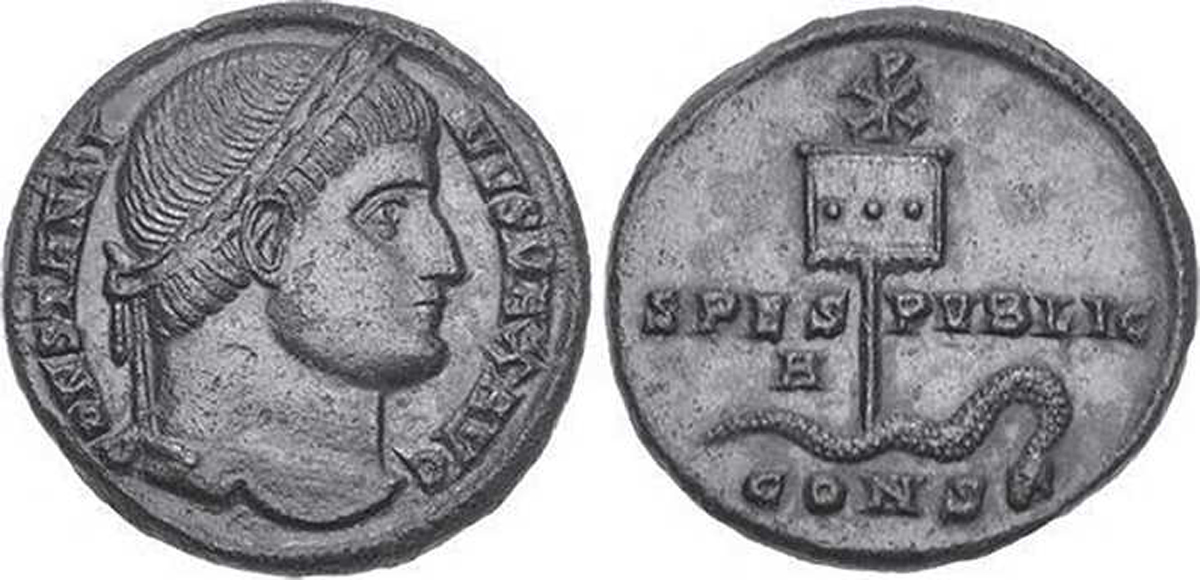
Figure 9.2: SPES PVBLICA (‘Public Hope’) issue, showing the labarum piercing a serpent, AD 327 (RIC 7 Constantinople 19). (Courtesy of Classical Numismatic Group)
It had also appeared on coinage in AD 315, on the Ticinum medallion for Constantine’s decennalia (see Figure 9.1).150 Stars and crosses of similar form are found frequently as mintmarks or decorations in field on Constantinian coins; from the Arles mint, some of them are clearly chi-rhos, while at Antioch, the staurogram appears. This was elaborated in the AD 330s: the GLORIA EXERCITVS (‘Glory of the Army’) reverse shows soldiers with standards and the chi-rho floating between them; some ROMA types show the chi-rho above the she-wolf.151 In the last years of Constantine’s reign, the labarum began to become more prominent on coins. The GLORIA EXERCITVS type was revised to have two soldiers flanking one large standard with a banner, on which the christogram appears on issues from several Western mints (see Figure 9.3).152
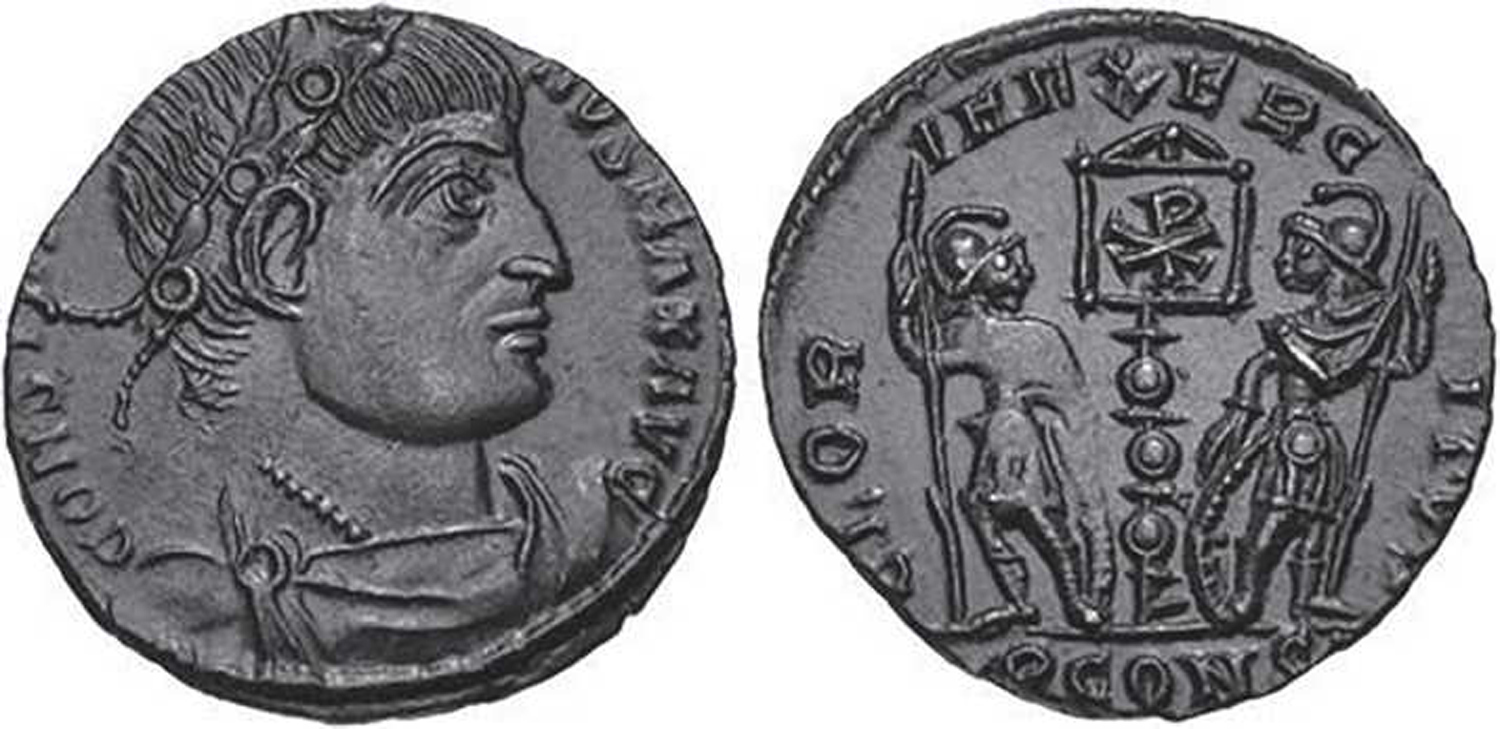
Figure 9.3: GLORIA EXERCITVS (‘Glory of the Army’), showing soldiers flanking the labarum, AD 336 (RIC 7 Arles 394). (Courtesy of Classical Numismatic Group)
After Constantine, this form of the labarum became a fixture on Roman coinage, along with the motif of the emperor as standard bearer, an innovation of Constantinian iconography.153 It is very tempting to associate this motif entirely with the labarum, though the earliest versions show the banner empty or with abstract dots or crosses; later emperors are much more clearly holding the Christian banner (see Figures 9.4, 9.6).
While Constantine’s own coins may not have put the christogram front and centre, his successors took up Christian military symbols with gusto, and the conflict to secure his inheritance shows a fight over the iconography.154 His sons all feature the labarum on their coins, usually held by the emperor himself, whether alone, being crowned by Victory, dominating captives or standing on the prow of a ship (see Figure 9.4).155 The attempted usurpers Magnentius and Vetranio also both issued coins featuring the labarum,156 and both tried to co-opt Constantine’s vision: Magnentius devoted issues to the christogram itself (see Figure 9.5), while Vetranio went as far as using the slogan hoc signo victor eris (‘by this sign you will be victorious’).157
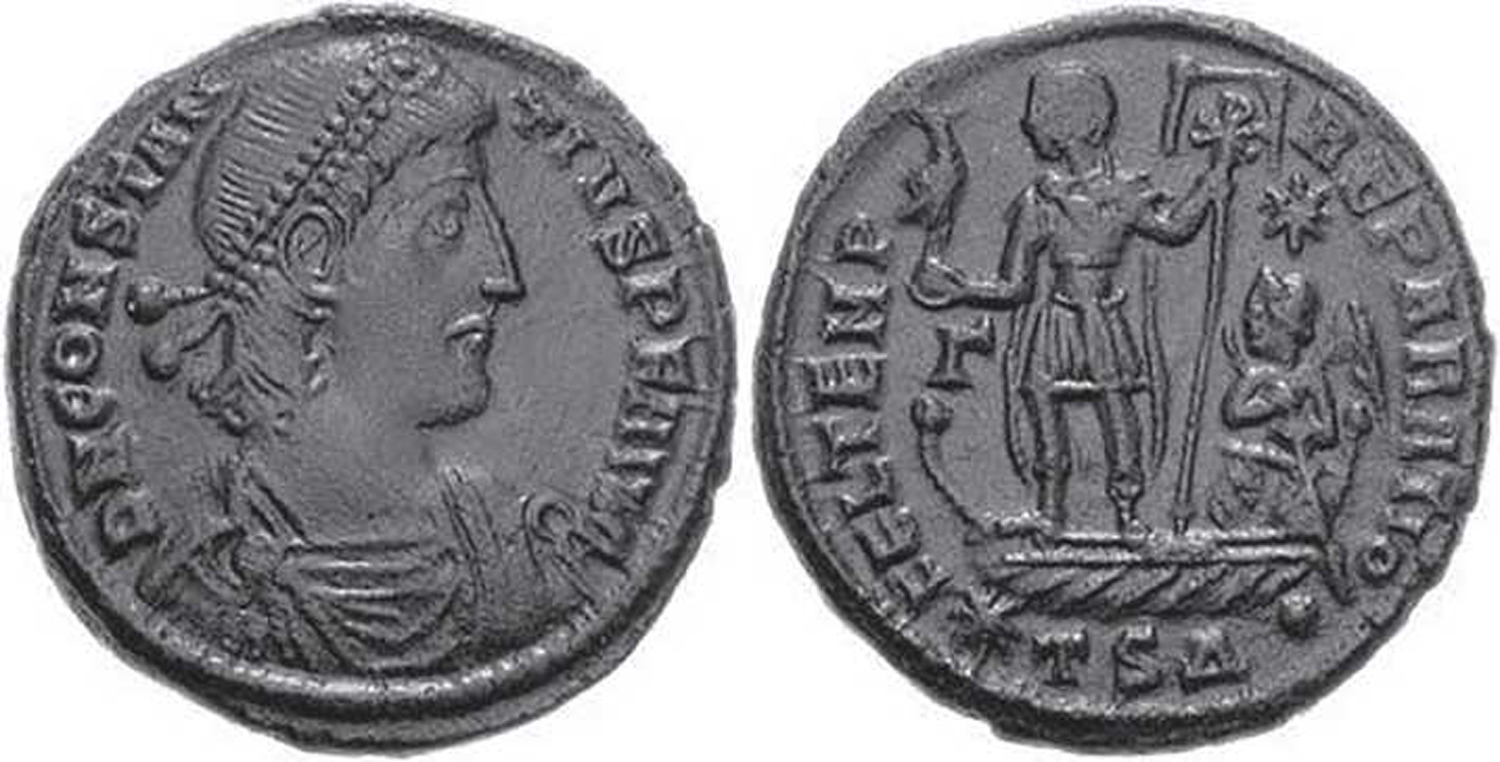
Figure 9.4: FEL TEMP REPARATIO (Fel[icium] Temp[orum] Reparatio: ‘Re-establishment of Fortunate Times’). Constantius II on galley with phoenix, Victory and labarum,AD 350–355 (RIC 8 Thessalonica 174). (Courtesy of Classical Numismatic Group)
The labarum and the standard bearer motif became a regular feature on imperial coins throughout the fourth century and into the fifth, even coming to dominate Western gold issues of the early fifth century (see Figure 9.6).158 The labarum, the first Christian symbol used by the Empire, thus shifted from a commemoration of one of Constantine’s victories to a general symbol of Christian imperial triumph.159 It does eventually disappear from the coinage, around the time of Theodosius II and Valentinian III – it was replaced by the cross, which became a vital element in imperial iconography. However, variations of the Christian standards do reappear later, often being carried by Victory herself (see Figure 9.7).160
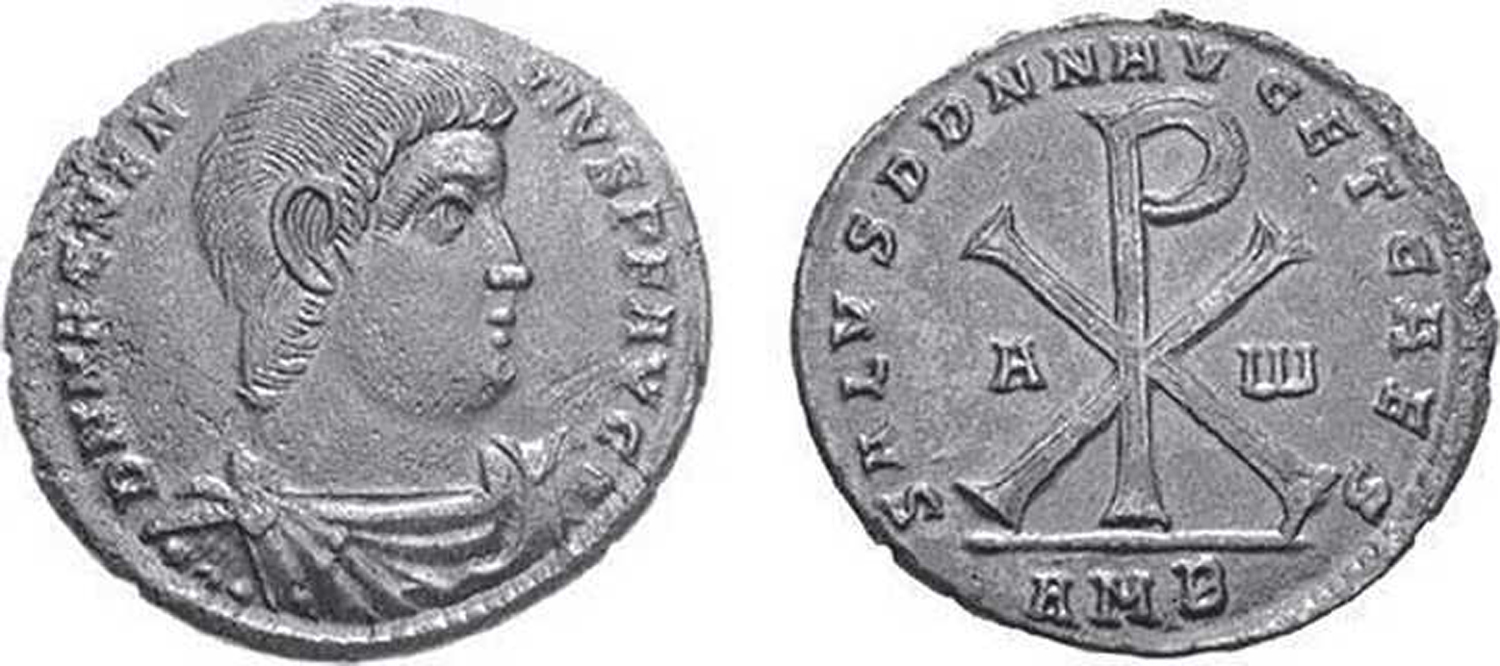
Figure 9.5: Magnentius adopts the chi-rho,AD 353 (RIC 8 Amiens 34). (Courtesy of Classical Numismatic Group)
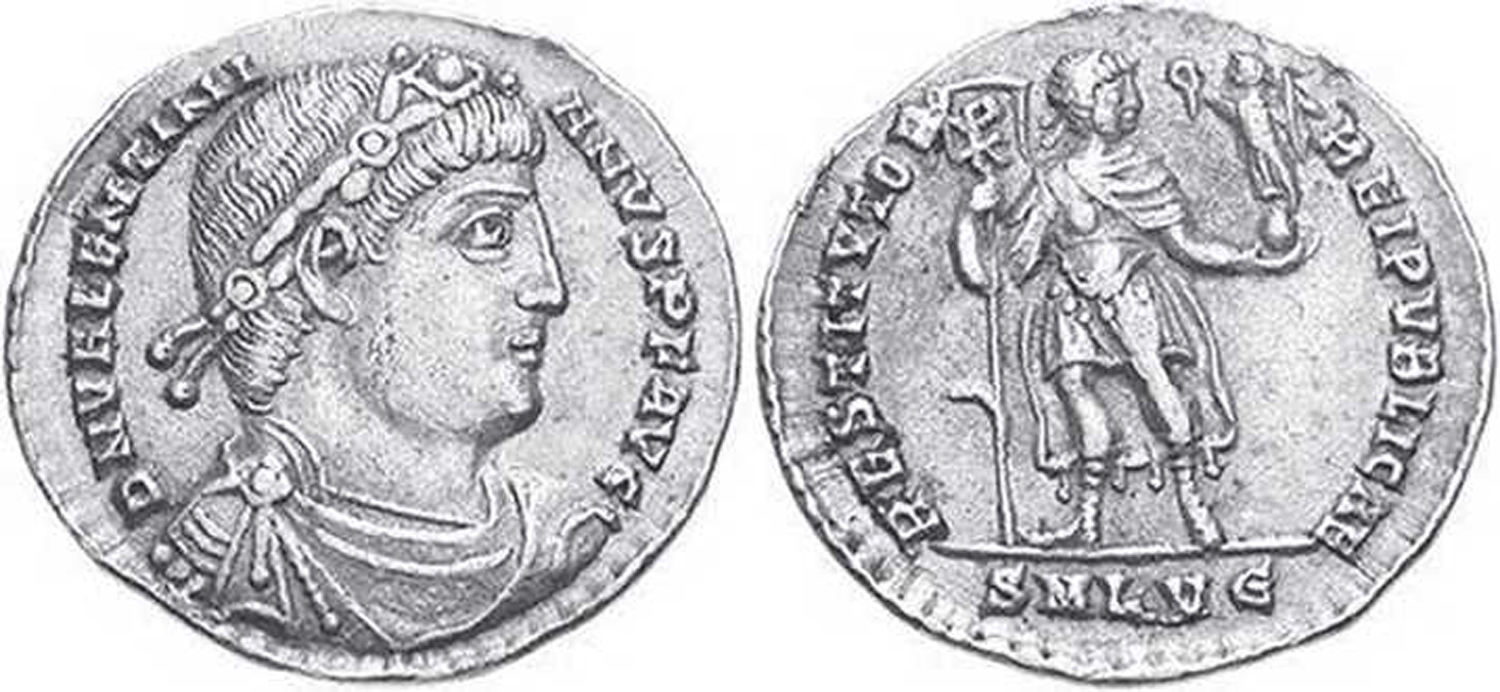
Figure 9.6: RESTITVTOR REIPVBLICAE (‘Restorer of the State’). Reverse: Valentinian I with labarum, AD 364–367 (RIC 9 Lyon 1b). (Courtesy of Classical Numismatic Group)
Although it was superseded on coinage, the labarum continued to hold its vital place in the Roman Army. Ambrose describes the troops as led by the name and worship of Christ, not by eagles or the flights of birds,161 while Jerome refers to crosses on the banners.162 The record of the accession of Leo I in AD 457 refers to multiple labara in attendance, along with other military standards, which were all lowered until the emperor was crowned, then raised aloft with acclamations.163 As late as the ninth century, the imperial throne in Constantinople was still flanked by the Christian military standards Constantine had introduced.164
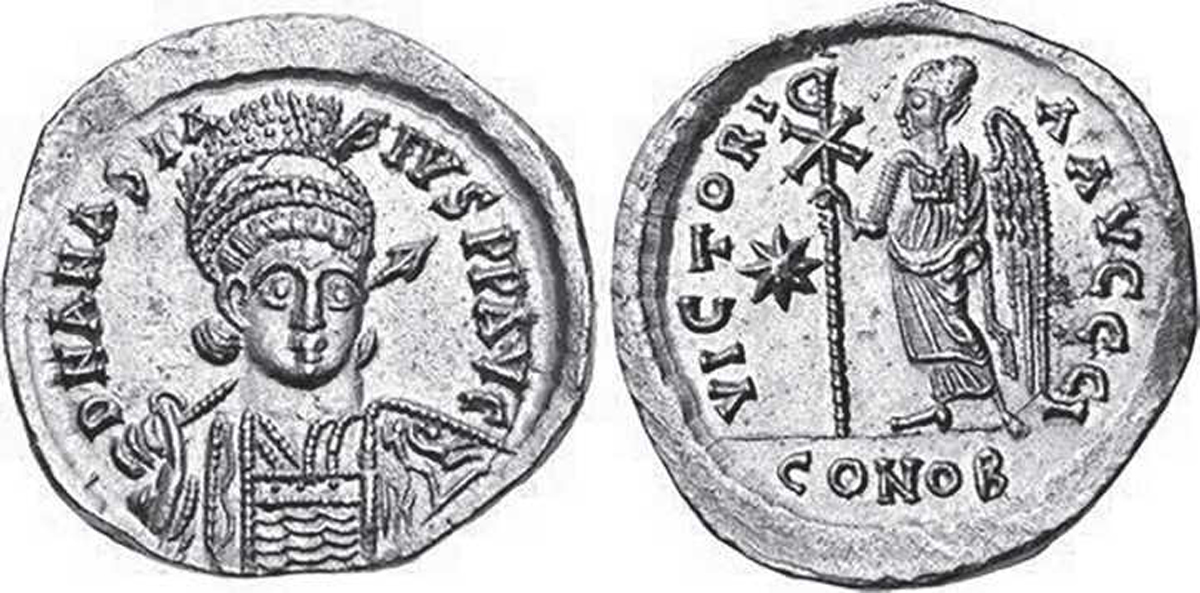
Figure 9.7: VICTORIA AVGGG (‘Victory of the Augusti’). Obverse: Anastasius I. Reverse shows Victory holding a reversed variation of the old labarum,AD 507 (Hahn & Metlich, 2013, 6a). (Courtesy of Classical Numismatic Group)
Christian symbols also appeared elsewhere in the Roman Army. In Lactantius’ account of AD 312, the christogram had been displayed not on a banner, but painted on the shields of Constantine’s men, and Eusebius does confirm that Constantine had Christian symbols marked on his soldiers’ shields later in his reign.165 No complete shields survive from the fourth century to check, but there are examples in late Roman art.166 Constantine’s first son, Crispus, is depicted on coins carrying a shield, which in some variations bears the chi-rho.167 On a silver dish from the time of Constantius II, the emperor is shown flanked by a guard who carries a chi-rho shield (see Figure 9.8);168 other tableware depicts similar soldiers, including a niello cup now in St Petersburg and a glass beaker from Cologne.169
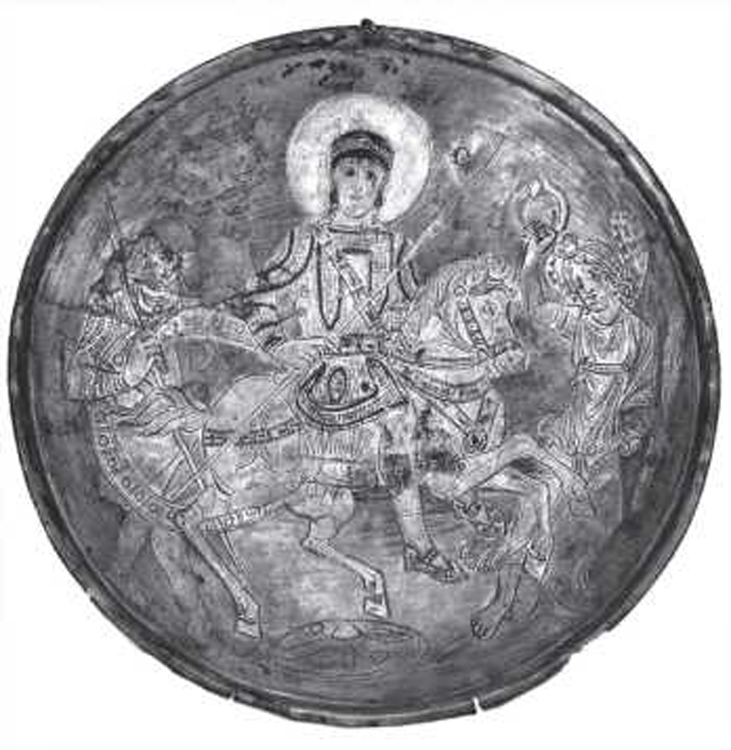
Figure 9.8: Gilt silver plate showing Constantius II in triumph: note the soldier’s shield. Photograph © The State Hermitage Museum. (Photo by Vladimir Terebenin)
Sketches of the lost decorations from the columns of Theodosius and Arcadius show soldiers carrying shields with the monogram, and christograms on shields and armour continue to appear on fifth-century coins even after the labarum ceased being depicted.170 The most famous depiction is probably the mosaic of Justinian in the church of San Vitale in Ravenna (dedicated in AD 547), which likewise shows an imperial guard with a christogram on his shield standing alongside the emperor (see Figure 9.9). Strangely, the illustrated Notitia Dignitatum does not show many Christian shield-symbols, despite a copious catalogue of designs, though a few do seem to bear crosses. Blame for this is often put on the Carolingian copyists.171 It is also possible that only select troops used the chi-rho shield, perhaps those closest to the emperor.172
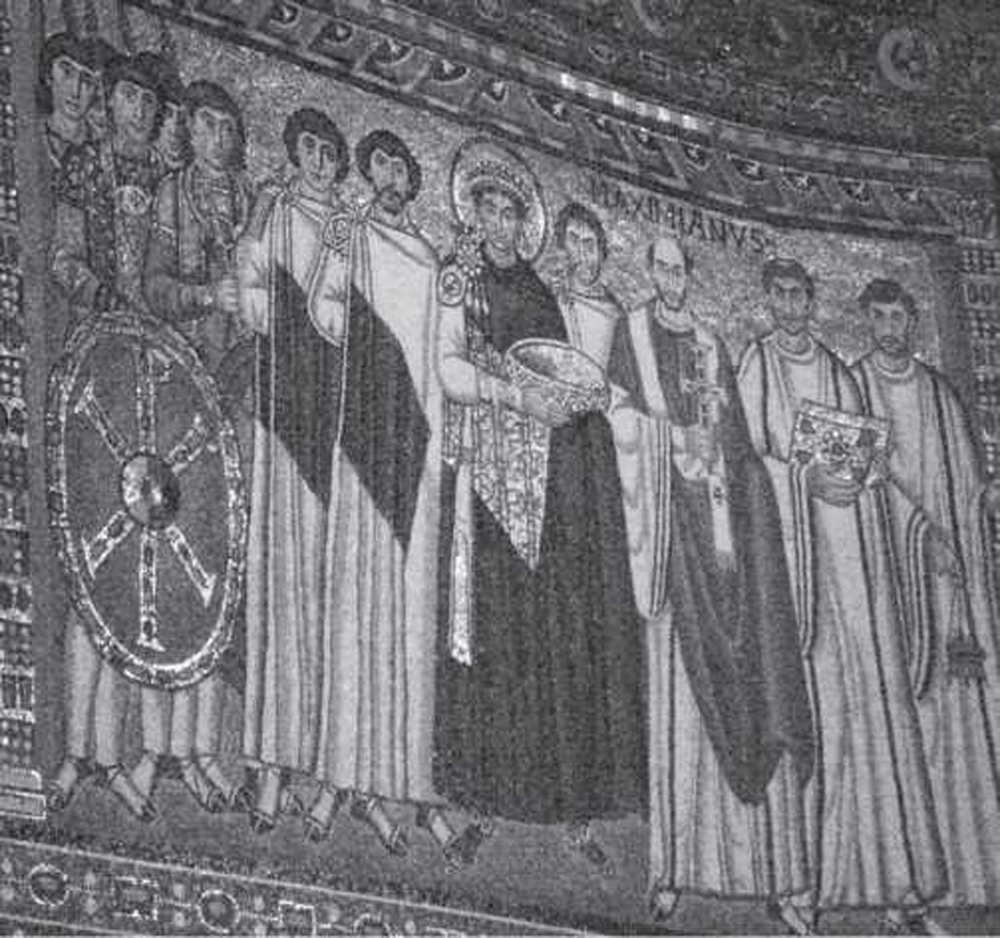
Figure 9.9: Mosaic of Justinian from San Vitale, Ravenna, AD c.547. (Photo by the author)
Helmets and other parts of military kit were also emblazoned with Christian iconography. Constantine himself had the christogram on his helmet on the abovementioned Ticinum medallion (see Figure 9.1), and Eusebius refers to his habit of wearing it.173 Coins with the emperor in the same style of helmet were issued in subsequent years, particularly AD 319. The chi-rho recurs on one variant, though more common is a six-pointed star, which, it has been suggested, may mimic it.174 In later Church historians, the symbol on his helmet becomes instead a relic: it was believed that Constantine had the nails from the crucifixion – brought back after his mother Helena’s visit to the Holy Land – worked into his helmet and his horse’s bridle as protective measures.175
There have been some finds of pieces of ordinary military equipment that have Christian symbols on them, perhaps in emulation of the stories about Constantine. Bishop and Coulston discuss a number of helmet badges and what seem to be crest pieces with gilded and copper alloy christograms. Belt fastenings have also been found with the chi-rho. Most elaborate are gilded silver helmet sheathings, found in the walls of the Roman fort at Alsóhetény in Hungary, dating most likely to the AD 370s, which have an embossed chi-rho symbol on the nose ridge, near the eyeline.176
The adoption of the new Christian iconography was joined by alterations in the religious pattern of army life. We know from Vegetius that the military oath (sacramentum) had become Christian by the early fifth century at the latest. Soldiers, of whatever religious stripe, now all swore by God, Christ and the Holy Spirit, and by the majesty of the emperor, to serve emperor and Empire.177 Lee stresses the importance of the ritual of oath-taking – not just its religious nature, but its potential use in inculcating loyalty and values, especially as a repeated part of what has always been a very ritualistic profession.178 Vegetius also records explicitly Christian watchwords like deus nobiscum among more traditional ones such as virtus or triumphus imperatoris.179 Other changes were slower to take hold. In Vegetius’ day, the war-cry was still the rolling barritus, which had been adopted from Germanic troops;180 it is not clear when this shifted, but by the sixth century at least, Christian slogans had replaced it, with ‘(deus) nobiscum! (God with us!) being customary. Maurice, however, recommends chanting the phrase with psalms and the kyrie eleison before leaving camp, rather than shouting it at the charge.181
Constantine gave the troops time off on Sundays to attend church, so Christians under arms were no longer sidelined by the Army cult. Non-Christian soldiers were issued a usefully ambiguous monotheistic prayer to recite together. This seems to point to an effort to replace some parts, at least, of existing Army rites. The prayer would read easily as a Christian prayer to a Christian, but the theology is primarily about military victory.182 Barnes suggests it may have been introduced as early as AD 313, connecting it to Licinius’ prayer reported by Lactantius, though the text is different.183 It is not entirely clear whether the prayer and Sunday leave were the general practice for the whole military, or just troops in the capitals and imperial comitatus. It is, however, in line with Constantine’s other more general measures about the dies Solis, with the banning of public business noted above.184 Exactly when the pagan associations of sun-day were drowned out by Christian ones is unclear, but already in AD 386 the emperors refer to the dies Solis as being called dominicus (the Lord’s Day) by their predecessors, so Constantine had clearly had an effect.185
Troops heading to mass presumably needed priests. Sozomen claims Constantine provided some kind of military chaplains attached to units, but there is general agreement that he is projecting his own fifth-century situation backwards.186 Theodoret, in a letter from the AD 440s, specifically mentions someone we would recognize as an army chaplain: a deacon, Agapetus from Hierapolis, appointed to a Roman Army unit in Thrace to guide them in religious matters. It appears from context that this was now a widespread practice.187 The sources are silent for something like this in the fourth century; such priests may have existed earlier, but it is very unlikely any formal or organized version was established by Constantine.188 We know other cults had priests in military units, some of whom were serving or ex-soldiers, but not in any centrally organized way, and they were cultic officials who served in the unit, not priests of the unit.189 Priests had in fact long travelled with the legions – Roman generals had always had priestly personnel, primarily to take the auspices, and of course the emperor could perform rites as pontifex maximus, as Trajan does in several scenes on his column.190 Christian clergy travelling with an army in this manner, attached to the emperor, do appear in the fourth century. Constantine brought some on campaign against Licinius,191 and intended to do so when he was planning to invade Persia – the bishops said at the war council that they would come and fight alongside him through prayer.192
There is some limited evidence from the fourth century for chapels or churches being built within forts along the northern frontiers. About a dozen are known -fewer than we might expect, but urban billeting was common in this period, which would give the troops access to regular churches.193 Constantine is also reported as having a portable church-tent, like Moses in the desert.194 There, according to Eusebius, he would attend the rites and also receive occasional revelations from on high, upon which he would rush immediately to attack the foe (and, of course, win).195 Sozomen claims Constantine also had church-tents distributed to the legions, but other emperors are reported as going to actual churches before battles, which suggests tabernacle tents may have been a quirk of Constantine’s.196 In a letter dating to AD 403, Jerome does mention the Goths marching with church-tents, but these more migratory Arian armies perhaps needed to create their own spaces for worship in the officially Catholic Roman Empire of the fifth century.197
The Roman Army thus, fairly rapidly, became ‘symbolically Christian’ in its practices and symbols, and the majority of this was put in place by Constantine.198 His measures facilitated Christians in the Army, but group conversion is a slow process. Theodoret held that the soldiers had been taught their catechism by Constantine and his sons, and that Constantius II even encouraged his men to be baptized before battle.199 But not even Constantine could create immediate cognitive change in a culturally and religiously diverse group like the late Roman Army.200 The changes in symbols and practices would exert a top-down pressure, and begin the process of Christianization, but for the time being the Army was not made religiously exclusive.
An ongoing and significant pagan presence during the fourth century is most likely.201 In a preamble to a law, probably from AD 326, Constantine’s men acclaim him with a pagan salutation: ‘Augustus Constantine, the gods [plural] preserve you for us’ (dei te nobis servent). The veterans then seek their special privileges, which Constantine of course grants. The non-Christian opening was altered when the law was carried over into Justinian’s Code, becoming the singular deus te nobis servet, and making the text (and the troops) properly orthodox.202 Theodosius II’s editors had not been so precious about the salutation, suggesting there was still some way to go in terms of Christianization in the mid-fifth century.203 Even if the emperor was already on his way to becoming Christian, some (perhaps most) of Constantine’s veterans were not Christians, but still followed him. Despite promotion and encouragement of Christianity, no choice needed to be made outside of one’s own ethics until the end of the fourth century, and soldiers could largely carry on with their own religious traditions.204
Assessing the impact of Constantine’s measures is therefore tricky. They were not empty gestures: the cult of the standards was an old practice, and the labarum is a significant introduction to it; the new oath, made upon enlistment and repeated annually, mattered.205 Christians are found as commanders and officers as early as the AD 320s – they may have received preferential promotion – and their presence only increased under Constantine’s sons. Exact numbers are elusive; both the ranks and the command structure were a mix of pagans and Christians.206 It is difficult to gain an accurate picture of religious adherence in the Army, since at any point we only know the details of some prominent individuals. Salzman’s study of Christianity in the Western upper classes found a limited increase of Christians among high military officers in the fourth century, though the effect becomes much more prominent in its last decades.207 Christians only began to predominate in the fifth century.208 The existence of Christian officers would play a role in influencing the religious makeup of the Roman Army generally, but perhaps more influential is the fact that after Constantine, all but one of the emperors were Christian.
‘Soldiers who Know Only How to Pray’
The reign of Julian offers something of a test case for how quickly the Army changed under Constantine’s new order. When Julian took power in AD 361, there had been a bit more than a generation for new ways to take root. Constantine’s sons had all been Christians, and after Julian the emperors were all Christian, though of differing confessions; the apparent ease with which fourth-century soldiers served these rulers with diverse doctrines has led some scholars to consider the Army as a whole to be largely uninterested in religious questions, in stark contrast to the noisy public religious discourse of the cities.209
Julian had been raised Christian, but once he became sole emperor he openly promoted a kind of organized paganism he termed ‘hellenism’. As Caesar he had performed his public Christianity, like attending mass for Epiphany ahead of the Battle of Vienne. He did so, in Ammianus’ words, ‘to win the favour of all and opposition of none’, which strongly suggests a level of Christianization among both populace and troops.210 Even if this was somewhat surface-level, participating in Christian rites had already become the expected and right thing for an emperor to do. However, as Julian later crows in a letter to the philosopher Maximus, once he was openly pagan, his troops came to his sacrifices anyway; something Ammianus remembers with some distaste for the excesses at Antioch.211
Julian attempted to restore the old religion in the military just as he did in the civilian sphere. The labarum was put aside in favour of the eagles and pagan images, which had been partly removed either by Constantine or, more likely, his sons.212 In a more subtle move, Julian required soldiers to offer incense when receiving their donatives, reintroducing an imperial cult rite. Libanius says this worked a charm, but in so doing indicates an awareness that different army groups had already developed prominent religious differences. Julian led an army made up partly of his own Western loyalists, and partly of Eastern troops who had belonged to the Arian Constantius II. Libanius tells us Julian’s Gallic forces were largely pagan, though there were at least some Christians in the Western ranks: men like the less-than-willing Martin of Tours, for example,213 and an escort of 350 Christian troops that Constantius had provided for Julian when he was appointed Caesar.214 Constantius’ troops, according to Libanius, lacked reverence for the gods – that is, they were primarily, perhaps entirely, Christian. Julian therefore needed to spend months training them, improving morale and gaining the help of the gods, including his donatives-for-incense scheme.215
This prompted outrage among Christian authors, aimed at the soldiers as much as at Julian. There was so little apparent resistance among the troops to the reintroduction of pagan rites that Ephraim Syrus derided the soldiers in a hymn, saying they had turned back to paganism or were even crypto-pagans, rejecting the cross and Christian banners and thereby ensuring military failure against Persia.216 Gregory Nazianzen instead fell back on stereotypes of soldiers as simple and greedy, but by default obedient.217 Both, interestingly, seem to assume that the troops were all meant to be Christian. Augustine claimed Julian’s Christian troops obeyed him only on the field, not in religious rites, but Sozomen is explicit: very few soldiers refused to participate in cult activity, but likewise very few actually converted to hellenism. Instead, ‘through ignorance or simplicity’, they just did as they were told.218 There are stories that some of those tricked gave their donatives back when they realized, and some even tried to get themselves martyred, going into exile when they found Julian was not fool enough to cooperate with that.219
In outlining the strategies Julian used to try and win over the troops, both Gregory and Sozomen refer to a combination of his personal efforts and charisma, the use of officers, rewards like the donative, and removing and replacing Christian army symbols.220 All of these are strategies Constantine himself had used to introduce a level of Christianization in the first place. Apparently they worked. Julian was nonetheless pragmatic, and kept on skilled Christian commanders who had served Constantius, even taking them into Persia; they were ultimately the ones who would elect Jovian afterwards.221 We may also detect some remaining ambiguities of the kind Constantine encouraged in his early reign. Linguistically, Ammianus recalls the use of the singular deus by the troops under Constantius and Julian in both his Christian and pagan periods.222 It was not unusual in polytheism to refer to ‘the god’ singular, of course, but the religious context of the mid-fourth century and the rote nature of shouted slogans make this stand out. The troops may have expected it by now.
It is difficult to perceive what ordinary soldiers thought at any point in history. It may be as simple as that they followed the emperor like they were trained to do; if he ordered them to offer incense, most of them would do so.223 Julian was a successful commander and had won an incipient civil war without striking a blow, and this was a powerful argument that reflected a belief as old as Rome, that divinities favoured successful commanders. If the emperor’s god (or gods) helped him to victory, then why not honour them? Constantine’s own religious experience had essentially this basis. Tomlin suggests soldiers were convinced by charisma and victory, not by doctrines, and so religious considerations did not really affect army loyalty.224 Liebeschuetz similarly sees soldiers’ religious adherence as determined by their loyalty to their emperor.225 Our sources are aware that some people did indeed simply follow the current emperor’s lead. Socrates felt Julian’s enticements to sacrifice helped show the real Christians from those in name only, and notes individuals who changed what they professed depending on the emperor’s beliefs.226 This had been an issue under Constantine as well, as some conversions were made in the hope of honours and rewards.227 Later, Libanius would warn Theodosius of the dangers of false conversions made out of force or fear.228
We might see the troops’ apparent disinterest in religious change as a sign of the slow progress of Christianization,229 but we must remember that Christian soldiers before Constantine also often went along with non-Christian rites, and this did not make them any less Christian, except to the moralists. Even if we read it as simply a religious veneer over the Roman Army, that veneer certainly worked both ways. Despite Christian authors’ horror at the troops following Julian’s rites, his religious ‘seduction’ of the troops barely outlived him. Jovian had one last pagan sacrifice performed, to read the omens, but reinstated a Christian regime for the rest of his tenure.230 According to Theodoret, Jovian originally resisted election as emperor because he did not think he could lead a pagan army – apparently he thought Julian had done a thorough job – but his troops replied that not only were they Christians, but the older men had been instructed in the faith by Constantine himself.231
Was this just a willingness to go along with the emperor’s views? There are signs that some soldiers at least were active members of their faith communities. When Jovian was met outside Antioch by Arians from Egypt, seeking to replace their strict Nicene bishop Athanasius, one of Jovian’s soldiers shouted them down – apparently he too was a staunch Nicene, despite having marched behind Julian.232 Religion mattered to some soldiers, then, and this sort of anecdote can point to individual instances of both pagans and Christians in the Army. Fundamentally, it seems that the Roman Army as a whole did not experience internal divisions around religious issues, at least not in a way that carries through to our sources. It probably goes too far to see the Army as totally indifferent, but trained obedience and discipline surely played a role in following the emperor’s lead. Constantine’s conversion, then, did not suddenly convert the Army any more than it did the Empire at large. However, his measures clearly had already changed things, since Julian took great pains to try to arrest and reverse the Christianization of his soldiers. Though the troops were still religiously mixed, a large proportion were already Christian. Constantine had begun the process of Christianization, and Julian could do nothing to stop it.
Constantine’s Legacy
After Julian, all Roman emperors followed Constantine’s lead, and the Empire slowly but surely became a Christian state. Theodosius I made Nicene/Catholic Christianity the official orthodox religion of the Empire in AD 380, pagan rites were outlawed and the Roman Army became officially Christian.233 The further we go in late antiquity, the greater the impact of Christianization, and, as the initiator, Constantine’s mark was indelible. In the diptych of Petronius Probus, for example, the emperor Honorius is shown holding a labarum with a tiny chi-rho and the inscription ‘in the name of Christ may you always conquer’. This is a clear sign of the ongoing force of Constantine’s vision a century later, and demonstrates the centrality of victory in warfare to the way Christianity was expressed at the imperial level.234
Honorius was the first, in AD 408, to decree that everyone who served in the palace, including court officials and generals, should be Catholic. This level of religious confidence was disrupted, however, as he was forced to rescind the decree in order to keep a skilled pagan general on staff.235 At the same court, Claudian felt confident enough to satirize the cult of the saints and the belief that they were effective aids in battle – but he also shows how familiar Christianity was becoming to non-Christians.236 In subsequent years, anti-heretic and anti-pagan laws continued to be passed, but in the unstable situation of the fifth century, emperors were pragmatic about keeping men in their armies. We still find pagan officers as late as the middle of the fifth century,237 and in AD 428 the emperors grudgingly confirmed that heretics were still permitted to serve, but only as ordinary soldiers.238 This was not a policy of tolerance, however: Jewish soldiers were banned in AD 418, 239 and paganism was subject to numerous injunctions. Pagans themselves do not seem to have been prevented from serving in the fifth century, though they were excluded from the civil service.240 Nevertheless, in the sixth century, religious orthodoxy was required of soldiers by law.241 Thus it seems the religious milieu of the fifth-century Roman Army was the reverse of the pre-Constantinian one. The Army itself was formally Christian, but men of other religious persuasions were still largely permitted.
The tipping point had been reached, however, and in some ways the Army itself became an agent of Christianization. It is widely recognized that the legions had always had a role in the spread of religions across the Empire – the cults of Jupiter Dolichenus and Mithras largely followed the standards, for example – but, by embedding Christianity in military iconography and practices, Constantine had set the Army up as a method of conversion.242 Although recruits still often came from less-Christianized areas like Illyricum and Isauria, a recruit’s background would not prevent them from embracing the official religious traditions of the Army once inside.243 An individual soldier’s ongoing exposure to the labarum and Christian symbols, Sunday rites, the annual oath and in the fifth century attendant priests was likely to inculcate Christianity more rapidly than the civilian world could.244 This was perhaps especially true for barbarian recruits, who became a primary source of Roman manpower. When the Goths crossed the Danube in AD 376, for example, their leader Fritigern offered to convert to Christianity as a sign of good faith and loyalty to the emperor.245 Prosper of Aquitaine is explicit about this, saying that barbarians serving in the Roman Army would often bring Christianity home with them after discharge.246 There are signs of soldiers engaging with the faith: one of Theodoret’s letters is a reply to some soldiers about a point of theology, apparently following an argument with some of their comrades.247 Similarly, when Arcadius wanted to arrest John Chrysostom, he relied on new recruits to do so, worrying that ordinary troops would balk at going after a bishop, which perhaps points to an expectation of conversion in the ranks.248
The Christianization of the Army, of course, went hand-in-hand with the wider Christianization of the Empire. Moving into the sixth century, the religious context of the Army, like that of the whole Empire, is thoroughly Christian. We saw above that Maurice’s late sixth-century military handbook assumes Christianity, with Christian chants, prayers and war-cry (deus nobiscum!), and priests leading the troops in prayer before battle.249 Icons and relics accompanied the armies to inspire the men.250 One of Justinian’s pretexts for his campaign of reconquest was the persecution of Catholics by the Arian Vandals.251 At the launching of the first expedition, a recently baptized soldier was specifically added to the commander’s ship, as a kind of charm. This does indicate that not every soldier was necessarily baptized, but also suggests how deeply Christianity had become part of the fabric of military and imperial pomp.252
Narses, Justinian’s eunuch general, was believed to receive military advice from the Virgin, and did not engage until she had given her blessing.253 The Army became so drenched in Christian practice that their enemies could take advantage. Belisarius worried that a period of Lenten fasting before Easter had weakened his men in AD 531 (rightly, as it turned out), indicating the importance of religious rites even for an army on the march.254 Theophylact mentions the Persians attacking the Romans specifically on a Sunday, since they would be unprepared on a day of rest; the Berbers in Africa also took advantage of this, and Corippus depicts priests with the army saying mass, decorating the camp like a chapel and praying for victory and divine help in the battle.255 To be fair, the Romans had also done this at least once before, as Stilicho had sent one of his pagan generals, Saul, to attack the Arian Goths at Pollentia during their Easter celebrations in AD 402.256
The Roman Army thus became Christian as a long-term result of Constantine’s actions. But, just as with the pre-Constantinian Army, the Christians in the ranks are not the whole story, and it is important to briefly consider Constantine’s influence on the way Christian authors thought about the Army and warfare. The emergence of Constantine very much changed the terms of the earlier debate, and his adoption of Christianity meant a scramble for Church thinkers to catch up -a conquering Christian emperor challenged the anti-military line of moralists held since Tertullian.257 Lactantius, notably, had rejected all killing in his Divine Institutes, even in warfare, saying that a just man may not be a soldier; faced with Constantine’s successes, his anti-military stance had to shift.258 He praises the young Constantine for his military skill, among other qualities, and of course celebrates the victorious battles of Constantine and Licnius in AD 312–313.259 Eusebius’ view, by contrast, was essentially informed by the experience of the persecutions and of Constantine’s victory and favour for the Church, and so for him war was acceptable, and he mentions no issues with idolatry in the Army, probably because Constantine’s changes meant it was no longer forced on Christian recruits.260
Church councils adapted quickly. At Arles in AD 314, far from banning Christians from the Army as Hippolytus had, it was resolved that soldiers who threw down their arms in pace were to be excommunicated. There is debate over the exact implications of this laconic phrase, particularly whether ‘in peace’ means in peacetime, that is, when the soldier is not on campaign, or whether it refers to the new peace between the Church and the Empire.261 On either reading, however, it points clearly to ecclesiastical recognition and acceptance of Christians in the Army, of the kind Tertullian would never have agreed to. We might, with Helgeland, even see it as Church leaders in the West trying to find a rapprochement between Constantine’s maintenance of old military rites and his new openness and favour for Christians.262 Later canons accepted Christian soldiers by necessity, since they became the majority, but restrictions were established on ex-soldiers’ participation in Church offices as a way of keeping armed service distinct from the service of the Church.263
Many Christian authors thus came to accept warfare as potentially positive, when carried out by a Christian emperor for the right reasons. Already in the AD 350s, Athanasius allowed that killing in wartime was a distinct category, which could be praiseworthy.264 Later martyrs and saints with no connection to the Army were given invented military connections,265 and generals found that their roles could be elevated on a par with clerics. Maximus of Turin for example commends a military count who had built a church in northern Italy – he does good work in slaying the emperor’s enemies, and now in building a new church to help fight demons.266
The best example of this is Boniface. While military governor of Africa in AD 421, he was on the verge of quitting the military and joining a monastery after the death of his wife. Augustine took it upon himself to talk Boniface out of it, sending letters and even crossing North Africa for a personal visit. Augustine argued that Boniface could serve God as a soldier almost as well as any monk. The soldier fought barbarians, the corporeal equivalent of monastic spiritual warfare against demons; Boniface’s strength and skill at arms were a gift from God, and warfare anyway, Augustine declared, was aimed at peace, stemming from love of God and one’s neighbour.267 This was a sentiment almost unthinkable for Christian moralists of earlier periods, especially the counsel to stay a soldier, rather than commit himself to the religious life. Boniface stayed in the Army, rising eventually to the rank of count, though his conflict with the rising star of Aetius put an end to his further advancement.268
Ultimately, ‘imperial Christianity’s potential to wage war was not really constrained by clerical Christianity’s adherence to the idea that war was a great evil and peace reflected God’s will’.269 But even under Christian emperors, some Christians continued to oppose military service. Violence and bloodshed were the key problems now, since army idolatry was replaced by Christian rites.270 Sulpicius Severus, for example, glosses Martin of Tours’ military career to depict him as having an anti-war stance, while Paulinus of Nola took the opposite view to Augustine and encouraged a friend to leave his military career.271 Basil of Caesarea’s measured approach nicely reflects the rethinking of the military issue that was going on. He sees military service as acceptable, recognizing that violence needed to be understood as legitimate in some contexts, and that Christians under arms were still Christians, but he still lays down a three-year excommunication for those who killed, even in open battle.272
In the Christian Roman Empire then, warfare was still contentious, but on the whole, armed service was seen as legitimate. For fifth-century thinkers, the question was not whether a Christian should fight but when it was right for a Christian army to go to war.273 It is in this context that we find the emergence of a Christian theory of just war. Ambrose had a hand in developing this, but the central figure is Augustine, who developed the model which would be taken up in the Middle Ages. Augustine’s theory distinguishes between the sinful conqueror, who is nonetheless used by God to chastise, and the pious and moderate Christian soldier, who serves God and only fights for peace.274
In developing his theory, Augustine leans heavily on Cicero, but updates and reworks him for the Christian context. This actually points to one of the major knock-on effects that Constantine had, which was to bind together Roman imperial and Christian ideologies. Traditional Roman ideas came to be expressed in Christian modes. Constantine’s conversion story centred around divine favour bringing him victory on the battlefield; other than the specific divinity in question, this was how the Romans had always thought the world worked. When Justinian attributed his successful reconquest campaign to God’s help, he too was acting in this traditional manner.275 Warfare and victory were still caught up in faith and piety,276 and defeat in battle came therefore to imply sin or even heresy, especially during civil wars.277 For example, even though the attempted usurper Eugenius was a practising Christian, his defeat by the orthodox Theodosius led to his being depicted by Christian historians as a champion of paganism.278 Ambrose closely aligns military victory and Christianity, and tells Gratian it was lack of faith that led to loss of territory to the Goths.279 Theodosius II and especially Heraclius cast their Persian conflicts in religious terms, essentially as holy wars,280 and the new Christian ideology of military victory would be taken up by Rome’s successors too – according to Gregory of Tours, the Frankish king Clovis justified his conquest of Gaul as reclaiming it from heretics.281
Conclusion
So what difference did Constantine make? In the long view, he began the Christianization of the Empire and its armies. While things may not have changed as quickly as someone like Eusebius would have liked, Julian’s attempt to turn back the tide of religious change demonstrates a significant shift occurring within a generation. Constantine’s Christianity was not really about personal salvation, but was predicated on military victory, and therefore was connected deeply to his role as emperor, in a fundamentally very Roman way of thinking. He was extremely influential in the melding of ideologies that had once been opposed: traditional Roman ideas like the importance of piety to military success or the concept of a just war became Christianized.
Constantine’s introduction of a layer of Christianity to the Roman Army would change it irrevocably. Constantine had come to Christianity in an entirely military context, and for him the Army was intrinsically connected to the faith. He established measures to facilitate the presence of Christian soldiers, legitimizing the religion and placing a new, powerful Christian banner alongside the traditionally venerated standards, ultimately supplanting the traditional Army cult. The introduction of Christian measures like Sunday leave, semi-Christian prayers and the constant focus on divine help would pave the way for army chaplains and for the military oath to become Christianized. In so doing, Constantine set up the fundamental paradigm that would produce the religious framework for the Byzantine army. When Tertullian complained that Christian faith was incompatible with the military oath, he could never have anticipated that the solution would be to combine the two, but doing just that was at the heart of Constantine’s influence on Roman Army religion.
Notes
1. All reported for Theodosius at the Frigidus in AD 393: Rufinus Hist. Eccl. 11.32–33; Sozom. 7.22–24.
2. The New Testament largely overlooks the topic, though the Gospels generally disapprove of violence (e.g. Mt. 26.52) and Jesus was given the title Prince of Peace. However, Paul’s insistence on the imminent Second Coming led him to recommend that everyone stay in their jobs, presumably soldiers included (I Cor. 7.17–24), and the convert centurion Cornelius did not resign his post (Acts 10).
3. Lee (2007), p.178.
4. Scholarly opinion has ranged from acceptance of mainstream Christian pacifism, for example Hornus (1980), to categorical rejection, like Helgeland (1974), p. 156: ‘there was no such thing as early church pacifism’ – and indeed to tendentious moralizing, as with Hall (1913) calling his study of the partnership of the Church with Constantine ‘the fatal compromise’. For a variety of perspectives, see Bainton (1946); Gero (1970); Swift (1979); von Harnack (1981); Helgeland et al. (1985); Daly (1986); Shean (2010), pp.71–103; and Gaddis (2005), who rightly points out (pp.15–16) that it is important not to look for some single, monolithic, ‘authentic’ Christian tradition on violence.
5. Helgeland (1979), pp.725–33. Bainton (1946), pp.189–90, writing at the end of the Second World War, had already considered this, stating that ‘objectivity is difficult for Christian scholars dealing with this question, because the problem is still acute’.
6. Shean (2010), pp.10–11, arguing it oversimplifies.
7. Lee (2007), pp.178–85; Hornus (1980), p.68; Shean (2010), p.11.
8. Origen Cels. 8.73; Helgeland (1979), p.750. Bainton (1946), p. 192, comments that while Celsus is clear in what he thought, he was mistaken.
9. Origen Cels. 8.69–70, 73.
10. As Helgeland et al. (1985), p.42, rightly point out.
11. So Jer. Vir. Ill. 53.1. Tertullian seems to imply it himself in Apol. 9.2, though there are MS variants. See O’Malley (1967), p.107; cf. Helgeland et al. (1985), p.24.
12. Helgeland (1979), p.733.
13. Tert. Idol. 19, Cor. Mil. 1.11; Helgeland (1979), pp.738–41; Helgeland et al. (1985), pp.21–30; Swift (1983), pp.42–46.
14. E.g., Tert. Cor. Mil. 1.11. A related side issue is the adoption of military metaphors by Christian authors, even those who reject the actual military. Paul (II Tim. 2.3–4) already uses the phrase ‘soldiers of Christ’, and from Tertullian onwards, the idea of the militia Christi (as opposed to militia Caesaris) becomes a prominent way of understanding Christian life, particularly during the hard times of persecution. Although showing its age, von Harnack (1981) is still a useful introduction to this concept.
15. Tert. Cor. Mil. 1.
16. Tert. Idol. 17.2–3, 19.1–3; Cor. Mil. 1.6, et passim.
17. A rather difficult prospect, it must be admitted. Hippol. Apostolic Tradition 17–18; cf. comments in Lee (2007), p. 179; Swift (1983), p.47; Helgeland et al. (1985), pp.35–37; Helgeland (1974), pp.160–61.
18. Clem. Al. Protr. 10.80P; cf. Helgeland (1979), pp.744–45; Lee (2007), p.179.
19. Tert. Apol. 30.4–5, also 37, 42.2–3. Cf. Origen Cels. 8.69; Bainton (1946), pp. 191–94; Helgeland (1974), pp.156–60.
20. For general discussion, see Helgeland (1979), pp.766–73; Fowden (1987); and now especially Kovács (2008).
21. Jupiter: see Kovács (2008), pp.107–12, 169–80; Hermes Trismegistos: Dio 72.8–10; Julian the Chaldaean: Claud. VI Cons. Hon. 339–55, Suida I 334; Marcus himself: SHA Marc. 24.4. See generally, Kovács (2008), pp.23–94.
22. Euseb. Hist. Eccl. 5.5.1–6; Gregory of Nyssa Homily on the Forty Martyrs, 1 – trans. in Kovács (2008), n.8.
23. Tert. Scap. 4, Apol. 5.6; Helgeland (1979), pp.772–73.
24. Leclercq (1932), n.29 (= CIL 6.32877).
25. Gero (1970), pp.285–91. Shean (2010), pp.11–12, suggests that the breakdown of the pax Romana also played a role; cf. Swift (1979), p.845; Harnack (1981), p.82, who see it as a brand-new controversy.
26. Digeser (2000), p.2.
27. Lee (2007), p.178.
28. Helgeland (1979), pp.791–93; Tomlin (1998), p.24; Lee (2007), p.178.
29. Bainton (1946), pp.192–93. Some were instead set up by soldiers for their loved ones: Hornus (1980), p.121; CIL 13.5383, 3.8752, 3.8754, 6.32691.
30. See Helgeland (1979), p.792; cf. Hornus (1980), pp.118–22; Shean (2010), pp.182–88.
31. Leclercq (1932), n.30, 31 (CIL 6.32977); CIL 6.32943, 6.32691; Madgearu (2001), p.112.
32. ILS 9075; Madgearu (2001), p.111.
33. Mercurelli (1939), pp.73–99, though the overall argument that there were many Christians in the Praetorian Guard may go too far. Cf. Madgearu (2001), p.112; Hornus (1980), pp.280–81. AE 1935, 155 belongs to another Praetorian centurion found in a Christian cemetery, but Hornus dismisses the find site as insufficient evidence.
34. See on this Madgearu (2001).
35. Leclercq (1932), no.25, 32, 33 (a centurion from Philip’s Praetorian Guard); AE 1939, 171; CIL 6.37273 (probably Severan in date).
36. Lactant. Mort. Pers. 10; Euseb. Hist. Eccl. 8.4.3.
37. Originally published in Drew-Bear (1981); a useful English translation can be found in Campbell (1994), n.391. Drew-Bear (1981), pp.140–41, argued Aurelius was forced out during the great persecution, which has found general acceptance. From the inscription, his career continues after AD 297, but when he retired is unclear. Perhaps in AD 299 – so Barnes (1996), pp.542–43 – though Colombo (2010), pp.121–26, has offered an alternative reconstruction that has him still serving as late as AD 304, arguing that some Christians remained in the comitatus, facing growing hostility.
38. Text and translation in Calder (1920), pp.44–45; see discussion in Hornus (1980), pp.120–21, who admits it runs counter to his thesis.
39. See in general, Musurillo (1972); and also comments in Swift (1983), pp.71–79; Helgeland et al. (1985), pp.56–66; and, in more detail, Helgeland (1979), pp.774–90. The martyrdoms discussed in this section are among those considered more reliable.
40. Despite the claims of Hornus (1980) and Demacopoulos (2017), pp.116–17.
41. Acta Maximiliani (Musurillo, n.17) 1–2.
42. Perhaps the palace guard, though Jones (1964), pp.52–54, suggests comitatus here means the field army; Campbell (1994), pp.237–38, follows him. Cf. Helgeland (1979), pp.777–78.
43. Acta Maximiliani (Musurillo, n.17) 2.9: ipsi sciunt quod ipsis expediat. Ego tamen Christianus sum, et non possum mala facere.
44. Helgeland (1979), p.779.
45. Acta Marcelli (Musurillo, n.18) 1–2. Helgeland (1978), p.1495, notes rejection of the uniform is part of the martyr’s behaviour in both cases; cf. Tert. Cor. Mil. 1.
46. Acta Marcelli (N recension; Musurillo, n.18) 5; Helgeland (1979), p.782.
47. Passio Iuli Veterani (Musurillo, n.19) 2.1–3.
48. Euseb. Hist. Eccl. 8.4.2–4; Tomlin (1998), pp.24–25.
49. E.g., Euseb. Hist. Eccl. 6.41.22–23, 7.11.20.
50. Euseb. Hist. Eccl. 6.5.5–6.
51. Euseb. Hist. Eccl. 7.15. Not seeking out Christians but punishing any who came to light or caused problems was exactly the policy Trajan outlined in Pliny. Ep. 10.97, presumably still in force. Nock (1952), p.226, suggests such denunciations were rare.
52. Lee (2007), p.180.
53. Helgeland (1978), pp.1496–97.
54. For Mithraic crowns, see Tert. Cor. Mil. 15; on Jewish troops in general, see Roth (2007). Shean (2010), p.253, points to the Dura-Europos church in particular as an example of leeway being offered to Christian legionaries.
55. Helgeland et al. (1985), p.55, suggest a pattern of this sort: ‘Mars for victory, spring nymphs for fresh water, Jupiter Dolichenus for weapons that do not break in combat, and Christ for when your weapon does break and you die.’ For Severus Alexander: SHA Alex. Sev. 29.1–3.
56. MacMullen (1984), pp.44–47.
57. Euseb. Vit. Const. 2.20.4, 2.33. See Swift (1983), pp.90–92; Cameron & Hall (1999), pp.24–42.
58. Nicaea Canon 12, censuring those who did this in Licinius’ army: Helgeland (1979), p.807.
59. See van Dam (2011) in general for the way the events of AD 312 were explored and retold.
60. E.g., Euseb. Vit. Const. 1.26.
61. Zos. 2.16.1–2 includes no vision, but a perplexing number of owls were an omen of divine presence.
62. Lenski (2016), p.69, lists among them Ossius of Cordoba, Reticus of Autun, Marinus of Arles, Maternus of Cologne and Lactantius.
63. The two had perhaps met in Nicomedia in the early AD 300s: Roldanus (2006), pp.34–35. Digeser (2000) stresses his influence on Constantine’s views.
64. Barnes (2014), pp.176–78.
65. Lactant. Mort. Pers. 44.
66. Lactant. Mort. Pers. 44.5–6: transversa X littéra summo capite circumflexo Christum in scutis notat. Bardill (2011), pp.161–62 discusses the history of translating and emending the MS, including the possibility an I has fallen out of the text.
67. E.g., P. Bodmer 2 and 14, with John’s Gospel; see Bardill (2011), pp.161–67; Hurtado (2006),. pp.207–11. Alföldi (1959) discusses a statuette of Constantine with this symbol on his shield.
68. Milestones: AE 2000, 1799, 1801; coin: RIC 7 Ticinum 36.
69. Euseb. Hist. Eccl. 9.9.2–13. On the dates of Eusebius’ versions, see Barnes (1980), who suggests Book 9 of Eusebius’ History was put together c. AD 313. Cameron & Hall (1999), p.204, hold he had limited information about the West before AD 325.
70. Euseb. Vit. Const. 1.28; Cameron & Hall (1999), pp.2–3, note he was probably still working on the Life when he died in AD 339.
71. This detail convinces Jones (1949), p.96, that Eusebius has the genuine story; cf. Holloway (2004), pp.3–4, who agrees he is more accurate than Lactantius.
72. Euseb. Vit. Const. 1.27, cf. 36.
73. Euseb. Vit. Const. 1.28–32; the labarum is discussed in more detail below.
74. Soterion semeion: Euseb. Vit. Const. 1.40.1–2; Euseb. Hist. Eccl. 9.9.11; Cameron & Hall (1999), pp.216–18.
75. Potter (2013), pp.150–56. Holloway (2004), pp.3–4, traces the tendency back to Sulla and the Anatolian Bellona.
76. Rufinus Hist. Eccl. 9.9. For a recent sympathetic view of what Rufinus was trying to do with Eusebius’ work, see Humphries (2008).
77. Speidel (1986), p.258.
78. Pan. Lat. 12.2.4–5, 12.4.1, 12.11.4, 12.13.1–2: called variously divina mens and deus ille. Van Dam (2011), p.105, argues that this language is too vague for any real interpretation, in contrast to Barnes (2014), p.99, who sees a deliberately Christian tinge. Digeser (2000), pp.68–70, points out that such language was unusual in Christian texts, but not entirely unknown, as Lactantius himself uses summus deus for God. For the poetical address to Tiber: Pan. Lat. 12.17–18.
79. E.g., Pan. Lat. 9.8.1, 10.2.1, 10.11.6. Potter (2013), pp.135–36, 142, points out that already in AD 311, the vague and ambiguous mens divina is the power that aids Constantine, perhaps indicating the emperor’s already changing beliefs.
80. Pan. Lat. 4.13.5; Liebeschuetz (1979), pp.289–90, detects Christian philosophical and moral ideas.
81. Pan. Lat. 4.14, 4.29.1.
82. Alföldi (1969), p.72.
83. Rodgers (1989), p.245; cf. Nixon & Rodgers (1994), p.358.
84. Lactant. Mort. Pers. 48.
85. Lactant. Mort. Pers. 46: ‘Supreme God, we beseech thee; Holy God, we beseech thee; unto thee we commend all right; unto thee we commend our safety; unto thee we commend our empire. By thee we live, by thee we are victorious and happy. Supreme Holy God, hear our prayers; to thee we stretch forth our arms. Hear, Holy Supreme God’ (Ante-Nicene Fathers’ trans.); Long (2009), p.233.
86. Helgeland (1979), pp.807–08; Swift (1983), pp.92–93.
87. See on the construction of this new policy, Barnes (2014), pp.105–06.
88. Euseb. Hist. Eccl. 9.9.1, 12, 10.8; cf. Euseb. Vit. Const. 2.3.1–2. On the date, see Barnes (1980), pp.198–201.
89. Euseb. Vit. Const. 1.49–54.
90. Jones (1949), pp.88–89, 129–30; Odahl (2004), pp.145–50; Harries (2012), pp.110–13.
91. Odahl (2004), pp.149–52; Harries (2012), pp.110–13.
92. Eusebius puts the idea into Licinius’ mouth at Euseb. Vit. Const. 2.5.2–4, cf. 2.16.2; Whitby (1998), p.192; Shepherd (1967), p.68; Potter (2013), p.210.
93. McCormick (1986), pp.103–04, sees the replacement of the pagan term in connection with the adoption of the diadem and a general refocusing of imperial ceremony and image.
94. Drake (2006), p.126; Harries (2012), pp.167–68. The date is uncertain, but probably soon after the defeat of Licinius.
95. So Heid (2007), p.413. See Oration to the Saints 26.1, cf. 15.4. Barnes (2014), pp.11–13, still sees ambiguous language, perhaps to reassure pagans at court.
96. Letter to the provincials: Euseb. Vit. Const. 2.24–42; cf. Cameron & Hall (1999), pp.44–45; Barnes (2014), pp.107–08; letter to Shapur: Euseb. Vit. Const. 4.8–14; Brown (2013), pp.60–61; see in general, Smith (2016), pp.17–64.
97. Drake (2017), p.50, has recently called it our ‘traditional parlour game’. The conversion has dominated studies of Constantine since late antiquity – where Lactantius and Eusebius linked the conversion to the Milvian Bridge, Zos. 2.29.1–4 ascribes it to his guilty conscience over the deaths of Crispus and Fausta fourteen years later (cf. Sozom. 1.5, who refuted this). Viewpoints traditionally swing between Constantine the cynical manipulator and Constantine the earnest believer; recent understandings of the emperor’s religiosity tend to view Constantine as a genuine Christian, but one who was not exclusionary nor a hardliner. Lenski (2016), pp.4–6, has compiled a recent brief review of the debates, but in general on the issue see (inter multa alia): Jones (1949); Setton (1967), pp.47–48; Shepherd (1967); Alföldi (1969); Liebeschuetz (1979), pp.279–81; Barnes (1981), pp.15–16 et passim; Kee (1982), pp.17–22; Elliott (1987); Humphries (1997), p.463; Weiss & Birley (2003), pp.252–53; Odahl (2004); Lenski (2006), p.72; Drake (1976) and (2009); Potter (2013).
98. Barnes (1981), p.48, dismissed the Sol coins as ‘the dead weight of iconographic tradition’, but they do fit with Constantine’s deliberate ambiguity about his religious leanings in his early reign, aimed at consensus-building, which was less necessary after AD 324. Cf. RIC 7 p.61; Barnes (2014), p.18.
99. See Roldanus (2006), p.35.
100. Weiss (2003), pp.238, 249–50, corrects the common reporting of this as a vision of Apollo: it was a vision of the praesens deus, and he made for the nearest appropriate temple, Apollo of Autun.
101. Pan. Lat. 6.21; Nixon & Rodgers (1994), pp.249–51, offer useful bibliography concerning this vision.
102. Pan. Lat. 6.2–4; cf. Euseb. Vit. Const. 1.13–17 for Constantius I’s religion. Rodgers (1989) and Harries (2012), pp.156–59, discuss Constantine’s mastery of image manipulation.
103. Euseb. Vit. Const. 1.27.
104. Euseb. Vit. Const. 2.12.1–2; see Drake (2017), p.66.
105. Ice in the upper atmosphere can give the sun a halo or radiating arms like a cross. The model is often associated with Weiss (1993) – recently revised and published in English by Weiss & Birley (2003). Barnes (2014), pp.74–76, discusses the often negative reception of Weiss’ model, though it has found some recent acceptance. Note that Jones (1949), pp.96–97, had also suggested the solar halo. One major flaw (which Weiss acknowledges) is that the Romans were already aware of the solar halo as a phenomenon (and an omen) in its own right. Other scholars, for example, Bardill (2011), pp.159–60, Drake (2009) and Drake (2017), pp.63–64, see no need for a literal naturalistic vision in a world where divine signs were really quite commonplace, and view Weiss’ model as reductionist. To paraphrase Drake, if Constantine had never seen his vision, does anyone really think he would have just gone home quietly and given up?
106. As a cross-section of interpretations of the new symbol: Jones (1949), pp.97–98; Drake (1976), pp.72–74; Liebeschuetz (1979), pp.282–85; Singor (2003), pp.490–96; Weiss (2003), pp.254–55; Long (2009), p.232; de Haan & Hekster (2016), pp.18–19.
107. E.g., Tert. Nat. 1.13; Jones (1949), p.131; Nicholson (2000), pp.312–16.
108. Nock (1933); MacMullen (1984), p.44; and Potter (2013), pp.158–59, may well be right in suggesting both gods were simply acceptable to Constantine during his early reign.
109. Barnes (2014), pp.108–09.
110. Euseb. Vit. Const. 1.44, 4.24.
111. Alföldi (1969), pp.19–23 (very condescending about it). MacMullen (1997), pp.81–82, similarly says the emperors of the late third and early fourth century were more or less ‘ordinary’ men, and their religiosity that of the soldier.
112. Euseb. Vit. Const. 2.64–72, 3.21.
113. Dismissive comments in his letter at Euseb. Vit. Const. 2.69.2, 2.70.6; see 3.10–14 for the council.
114. Euseb. Hist. Eccl. 10.6–7, Vit. Const. 1.41–2; C.Th. 1.27.1, 16.2.2, 16.2.4; see summary in Cameron (2005), p. 108; Jones (1949), pp.80–82. Digeser (2000) argues that this was not initially favouritism, but trying to bring the new legal religion up to pace with the rest, though after AD 324 she sees his favouritism as more open.
115. Euseb. Hist. Eccl. 10.6, 10.7.2; Barnes (1981), p.49.
116. Euseb. Vit. Const. 1.42.
117. Sozom. 1.8.13;Aur. Vict. Caes. 41.4.
118. Euseb. Vit. Const. 2.44, 3.1.6.
119. C.Th. 1.27.1, 4.7.1; Sirmondian Constitutions 1 (Pharr).
120. C.Th. 8.16.1.
121. Speidel (1986), pp.255–57; Lenski (2006), pp.71–72; Barnes (1981), pp.49–51.
122. Harries (2012), p.120.
123. Cod. Just. 3.12.2, modified later that year to permit manumissions: C.Th. 2.8.1; cf. Euseb. Vit. Const. 4.18.1–3, who interprets it as a day of prayer as well. Constantine may also have promoted 25 December as Christmas, aiming to reorientate the religious year, and perhaps syncretise Sol and Christ further: Barnes (2014), p.85; Heid (2007), pp.416–17.
124. Euseb. Vit. Const. 4.17, 4.22, 4.29; Constantine’s Oration to the Saints is perhaps an example. Van Dam (2011), p.66, comments that he ‘obviously liked to talk’.
125. Euseb. Vit. Const. 3.2–3, 49.
126. Brown (2013), p.67. Cf. Constantine’s own assertion of this in his letters: Euseb. Vit. Const. 2.28–9, 55.
127. On the nature of the late Roman Army in general, see Lee (1998); Elton (2006); Southern & Dixon (1996), esp. pp.17–37; Whitby (2004), pp.156–67.
128. Lactant. Mort. Pers. 7.2; Zos. 2.34.
129. Lee (2007), p.182.
130. Jones (1949), pp.132–34.
131. The term labarum, it is worth noting, appears not in the text of Eusebius but in the chapter headings, perhaps added by a copyist or editor to Euseb. Vit. Const. 1.31. The term was certainly in use by the AD 360s, when Gregory Nazianzen Or. 4.66 gives the current folk etymology from Latin labor. The word probably had a Gallic root – which may argue for its early adoption while Constantine was in the Western provinces.
132. Euseb. Vit. Const. 1.30–31.
133. Cameron & Hall (1999), pp.207–08; van Dam (2011), p.63. Christian commentary had recognized that the vexillum had a cross shape for some time, e.g., Tert. Nat. 1.12, who mocks the Romans for it.
134. Euseb. Vit. Const. 2.4–7, 16. Barnes (1981), p.48, opts for AD 312; van Dam (2011), pp.63–64, holds that AD 324 is the earliest possible date.
135. Euseb. Vit. Const. 1.31.3.
136. Greg. Naz. Or. 4.66.
137. Lenski (2016), p.70.
138. Euseb. Vit. Const. 2.8.
139. Euseb. Laus Const. 2, 6.21, 9.8–12; cf. Euseb. Vit. Const. 4.5.2–6.1.
140. Euseb. Vit. Const. 2.9.1–3; Sozom. 1.4.
141. Euseb. Vit. Const. 2.55.1.
142. Prudent. Symm. 1.464–69.
143. Socrates Hist. Eccl. 1.18, but cf. Sozom. 2.26, who agrees they converted but not as a result of defeat.
144. Tac. Ann. 2.17.2 refers to the eagles as the numina of the legions; Helgeland (1978), pp.1476–78; Campbell (2002), pp.37–38; Shean (2010), pp.6–7. Christians recognized this, e.g., Tert. Apol. 16.8; Nat. 1.12.
145. Sozom. 1.4; cf. Lee (2007), pp.182–83.
146. So Shean (2010), p.205.
147. RIC 7 Constantinople 19, 26.
148. AE 2000, 1799, 1801; see Lenski (2016), pp.8–9, with sketches.
149. On the site, see Guarducci (1960), pp.111 –31. Bruun (1997), p.43, instead holds that the earliest epitaph with a christogram dates to AD 331.
150. RIC 7 Ticinum 36.
151. RIC 7 Arles 381–6, 400, Antioch 98–101. See Alföldi (1932), pp.14–15; cf. RIC 7 p.62; and Odahl (2004), pp.148–49, 222–23, possibly overstating the importance of cruciform mintmarks.
152. For detail, see Bruun (1997), pp.46–48, pointing out some variations and details missed in the RIC. For types: RIC 7 Arles 394–99; Trier 586–88, 590–95; Lyons 276–78, 280–88; Aquileia 139–47; Siscia 252–56. Variant forms were the christogram, upright cross, X and O (a wreath?).
153. IC 7 Trier 27–31, 572–76, 578; Ticinum 33; Siscia 135; Heaclea 100; Nicomedia 81–83; Constantinople 65–66. Trier 549, Rome 399 and Siscia 207 all show, it has been suggested, not just a vexillum but the labarum itself, with the chi-rho. The editors are sceptical, but suggest Siscia 207 might be the prototype for later emperors’ labarum issues.
154. See Bruun (1997), pp.45–54; van Dam (2011), pp.48–50.
155. As representative examples (of over 200 types): RIC 8: Trier 30–32; Rome 107–35; Thessalonica 107–13, 119–22; Alexandria 50–53. The Constantinian type of a labarum flanked by soldiers also reappears: Siscia 85–104.
156. Magnentius: RIC 8 Trier 260–8, Lyon 108–14; Aquileia 124, 130–31, 141, 148; Vetranio: RIC 8 Siscia 260, 293–94; Thessalonica 125–27, 131–32, 135, 138; and with a labarum in each hand: Siscia 270–71, 273–74, 276–77, 280–81, 284–85, 289–90.
157. Magnentius’ chi-rho, alpha and omega: RIC 8 Amiens 34–45; Trier 318–27, 332–37; Arles 188–202; Vetranio with labarum and the slogan HOC SIGNO VICTOR ERIS: RIC 8 Siscia 272, 275, 278–79, 282–83, 286–88, 291–92.
158. This was Honorius’ so-called signifer type, named for Claud. VI Cons. Hon. 22; see discussion in RIC 10 56, 124–25. Examples of the type: RIC 10 1216, 1260–61, 1292. Cf. Bruun (1997), pp.55–56; Kent & Painter (1977), n.493.
159. Lenski (2016), p.10; de Haan & Hekster (2016); Singor (2003), pp.484–85.
160. E.g., RIC 10 950 (Zeno); Hahn (1973), pp.6a, 34 (Anastasius; Justin I). Instead of a banner, there is a pole topped by the chi-rho or staurogram. These were also depicted in the early fifth century, e.g., RIC 10 1310. Victory, alone of the old gods, remained in iconography. She may have looked enough like an angel to be acceptable.
161. Amb. Fide 2.16.142: non hic aquilae militares, neque volatus avium exercitum ducunt: sed tuum, domine Iesu, nomen et cultus. Helgeland (1979), p.806, seems to read this as a recommendation, rather than the description implied by the verb tense.
162. Jer. Ep. 107.1–2: vexilla militum crucis insignia sunt.
163. Const. Porph. Cer. 1.91. The acclamations are entirely Christian, even referring to the Christianon basileion, the Christian Empire.
164. de Haan & Hekster (2016), p.19.
165. Euseb. Vit. Const. 4.20–21; cf. Sozom. 1.8.
166. Some fragments of shields survive: see Bishop & Coulston (2006), pp.216–17; Coulston (2013), pp.475–76.
167. RIC 7 Trier 372.
168. Kent & Painter (1977), n.11.
169. See Singor (2003), p.490; Tomlin (1998), p.25.
170. E.g., RIC 10 12–15, 1902, 2013 (Victory holding shield); 37–44 (on Arcadius’ armour); 2605–08, 2612–14, 2623–39 (on Majorian’s shield). The chi-rho also appears on its own as a monogram, e.g., 2051–57, 2525–27.
171. Not. Dig. 5.7–9.22, 7.8.21 could be read as having crosses or even some stylized chi-rhos: Coulston (2013), pp.476–77; Bishop & Coulston (2006), p.218. Christianity itself is largely absent from the document: Brennan (1996), p.158; Tomlin (1998), p.36.
172. Suggested by Elton (2006), p.336, cf. Singor (2003), pp.484–85.
173. Euseb. Vit. Const. 1.31.1.
174. Alföldi (1932), pp.10–11; the RIC 7 editors disagree (pp.62–63). The issues are Siscia 61, 74,
82, 84, all from AD 319/320. Lenski (2016), p.38, stresses the importance of these coins since the emperor was in residence there.
175. Theodoret Hist. Eccl. 1.17 has this done on Helena’s orders; cf. Socrates Hist. Eccl. 1.17; Sozom. 2.1.
176. Helmets: Bishop & Coulston (2006), p.214; Coulston (2013), p.472; belt fitting: Entwistle (2010), p.25.
177. Veg. Mil. 2.5: iurant autem per deum et Christum et sanctum spiritum et per maiestatem imperatoris. The oath probably changed under Theodosius rather than Constantine: Lee (2007), p.184.
178. Lee (2007), pp.52–53. Tertullian stressed the old sacramentum as one of the great barriers to Christian participation in the Army in the early third century.
179. Veg. Mil. 3.5.
180. Veg. Mil. 3.18.
181. Maurice Strategikon 2.18.
182. Euseb. Vit. Const. 4.18–20. Like Eusebius, Odahl (2004), pp.152–53, sees this as a thoroughly and explicitly Christian move. The prayer is at 4.20.1: ‘You alone we know as God, you are the King we acknowledge, you are the help we summon. By you we have won our victories, through you we have overcome our enemies. To you we render thanks for the good things past, you also we hope for as giver of those to come. To you we all come to supplicate for our Emperor Constantine and for his Godbeloved sons: That he may be kept safe and victorious for us in long, long life, we plead’ – trans. Cameron & Hall (1999).
183. Barnes (1981), p.48; Lactant. Mort. Pers. 46.
184. C.Th. 2.8.1; Cod. Just. 3.12.2(3).
185. C.Th. 2.8.2: solis die, quem dominicum rite dixere maiores.
186. Sozom. 1.8.
187. Theodoret Ep. 2; Jones (1953), pp.239–40; Lee (2007), pp.191–92.
188. Brennan (1987), p.120.
189. Brennan (1987), pp.118–20.
190. Campbell (2002), p.42; Shean (2010), p.5.
191. Euseb. Vit. Const. 1.42.1, 2.4.1; cf. 1.52 for priests and bishops attending court.
192. Euseb. Vit. Const. 4.56.2–3; cf. Amm. Marc. 25.4.23. On the problems with the text and MS, see Fowden (1994), p.147; Smith (2016), pp.47–48.
193. Lee (2007), p.185, also indicating several dedications at the (civilian) church at Anemurium made by soldiers.
194. Euseb. Vit. Const. 2.12.1; Sozom. 1.8; Smith (2016), pp.48–62.
195. Euseb. Vit. Const. 2.12–14; cf. Sozom. 1.8, where the emperor is granted vision and divine guidance against the Goths and Sarmatians.
196. E.g., Sozom. 7.24.
197. Jer. Ep. 107.2.
198. Whitby (1998), p.192.
199. Theodoret Hist. Eccl. 3.1; cf. Euseb. Vit. Const. 4.20.
200. Shean (2010), pp.7–13.
201. Zos. 2.29.5 reports Constantine engaging in pagan rites so as not to upset the soldiers.
202. Cod. Just. 12.46.1.
203. C.Th. 7.20.2. Possible dates are AD 307, 320, 326: see Pharr (1952), pp.179–80; Campbell (1994), pp.245–46; Lee (2007), pp.182–83. Shean (2010), p.180, speculates that it may be important that pagan soldiers were being discharged.
204. Whitby (1998), pp.192–93.
205. Lee (1998), p.227; cf. Shean (2010).
206. Euseb. Vit. Const. 2.44; Shean (2010), pp.284–85; Barnes (1995), p.142; MacMullen (1984), pp.56–57.
207. Salzman (2002), pp.128–32. The situation may have been different in the East: Lee (2007), pp.185–86; cf. Barnes (1995), pp.135–47; Shean (2010), pp.409–13.
208. Salzman (2002), pp.130–31; Barnes (1995), p.145.
209. E.g., Nock (1952), pp.226–27; Liebeschuetz (1979), p.253; Lee (1998), p.228.
210. Amm. Marc. 21.2.4–5: utque omnes nullo impediente adsui favorem illiceret.
211. Julian Ep. 8.415B-C; Amm. Marc. 22.12.6.
212. Euseb. Vit. Const. 4.21; Sozom. 5.17; Greg. Naz. Or. 4.66; Woods (1995), pp.61–63.
213. Sulpicius Severus Vita Martini 2–4.
214. Zos. 3.3.2, quoting a lost work of Julian’s saying they ‘knew only how to pray’; cf. Julian Ep. Ath. 277d; Liban. Or. 18.37, 94.
215. Liban. Or. 18.166–70.
216. Ephraim Syrus Hymni contra Iulianum 3.8–11; in Dodgeon & Lieu (1991), pp.209–13.
217. Greg. Naz. Or. 4.64–65; cf. Tomlin (1998), pp.31–32.
218. August. Enn. in Ps. 124(125).7; Sozom. 5.17.
219. Sozom. 5.17; Theodoret Hist. Eccl. 3.12–13; Greg. Naz. Or. 4.82–4; see Woods (1995), p.63.
220. Sozom. 5.17; Greg. Naz. Or. 4.64–6.
221. MacMullen (1984), p.47; Tomlin (1998), p.35, noting also Jovinus, left in charge of the Gallic troops, who went on to fund a church in Rheims.
222. Amm. Marc. 17.13.33, 24.1.1. Julian spoke like this before outing himself as pagan too: 15.8.10: deus caelestis; 16.12.18: superum numen; 24.3.6: deo meque.
223. Tomlin (1998), pp.33–34.
224. Tomlin (1998), p.29.
225. Liebeschuetz (1979), p.253 n.4.
226. Socrates Hist. Eccl. 3.13.
227. Euseb. Vit. Const. 4.54.2–3; Sozom. 2.5.
228. Liban. Or. 30.27–99.
229. Lee (2007), p.183; and earlier Lee (1998), p.228, suggesting ‘acquiescence or indifference’. Tomlin (1998), pp.31–34, sees them as time-servers; Shean (2010), pp. 180–81, however, argues for a majority of genuine Christians who eagerly accepted the return to orthodoxy under Jovian.
230. Amm. Marc. 25.6.1; Tomlin (1998), pp.33–35.
231. Theodoret Hist. Eccl. 4.1. Tomlin (1998), p.35, argues this is a literary double of 3.1, where Julian fears he cannot lead a Christian force, but the story was already known to Rufinus: Hist. Eccl. 11.1.
232. Athanasius Ep. 56 app. 1 (PG 26.820). Tomlin (1998), p.35, calls him ‘a survivor who had kept his head down’.
233. C.Th. 16.1.2. Numerous laws targeted pagan rites, such as Theodosius’ final ban of sacrifice in AD 391: C.Th. 16.10.10; see Lee (2007), pp.185–86.
234. In nomine XPI vincas semper; see Cameron (2007), pp.191–94.
235. Zos. 5.46.3–4. The law in question is C.Th. 16.5.42. The text uses the phrase intra palatium militare, which, given it is addressed to both the Magister Officiorum (head of the bureaucracy) and the ComesDomesticorum (head of the palace guard), clearly refers to all branches of service in the palace. Shean (2010), p.326, is wrong to claim the law was a final ban on all pagans in the Army; cf. Lee (2007), pp.188–91, on the progress of Christianization.
236. Claud. Carm. Min. 50, cf. 32. The Christian Magister Equitum Jacobus, at whom it was aimed, had apparently criticized Claudian’s poetry. On the poem, see Vanderspoel (1986).
237. E.g., PLRE 2 Apollonius 3, Litorius; see Lee (2007), p.190.
238. C.Th. 16.5.65.3.
239. C.Th. 16.8.24.
240. C.Th. 16.10.21 in AD 415/416, and again in AD 425: Sirmondian Constitutions 6 (Pharr). There is perhaps some ambiguity on this point, as the term militia (sometimes qualified by armata, palatina, etc.) in this period was used for bureaucrats as well as soldiers, and even officials at court, but the context of the relevant laws seems to concern the administration rather than the Army.
241. Cod. Just. 1.4.20 seems to be aimed at the soldiery; cf. the comments of Lee (2007), pp.190–91.
242. A central claim of Shean (2010); cf. Tomlin (1998), p.23, who thinks Christian pacifism would impede this.
243. Shean (2010), pp.177–78, 284.
244. Shean (2010), pp.284–85.
245. Sozom. 6.37; Socrates Hist. Eccl. 4.33. Amm. Marc. 31.12.8–9 records that the Goths used a Christian priest as envoy before the Battle of Adrianople. See on this Heather (1986).
246. Prosper of Aquitaine de vocatione omnium gentium 2.33 (PL 51.717–8).
247. Theodoret Ep. 145; Lee (2007), pp.188–89.
248. Shean (2010), p.179.
249. Maurice Strategikon pr., 2.18, 8.2.1.
250. E.g., Theophylact Simocatta 2.3.4–6; cf. 5.16.11 for the wood of the Cross built into a war banner, perhaps a labarum. See Whitby (1998), pp.196–200.
251. Whitby (1998), pp.194–95; Procop. Vand. 3.10.18–21, having been berated by a visionary bishop.
252. Procop. Vand. 3.12.2.
253. Evagrius 4.24.
254. Procop. Pers. 1.18.14–23, 37, explicitly saying they have all been observing the fast.
255. Theophylact Simocatta 2.2.7; Corippus Iohannis 8.213–77, 318–50; see discussion in Lee (2007), pp.188–94.
256. Vandespoel (1986), pp.253–54.
257. Helgeland (1979), pp.757–59; Grant (1983), pp.175–76.
258. Lactant. Div. Inst. 6.20.16, cf. 1.18.8; see Helgeland (1979), pp.757–59. Swift (1983), pp.61–68, considers him a transitional figure, reflecting the change in attitude of the Christian community at large.
259. Lactant. Mort. Pers. 18.10, 52.4; see Swift (1983), pp.65–66.
260. Helgeland (1979), pp.760–62; see Demacopoulos (2017) for an assessment of how Eusebius reframes violence in a Christian context.
261. Arles (314) canon 3: see Lee (2007), p.187, for a brief discussion of the debates this canon has provoked; cf. Swift (1983), pp.90–92; Elton (2006), p.335; Harnack (1981), p.102. Hornus (1980), pp.172–75, argues that the mention of peacetime meant they could refuse to fight in wartime; Helgeland et al. (1985), pp.71–72, suggest it was aimed at people like Marcellus who left the army in protest of idolatry.
262. Helgeland (1974), pp.163, 200.
263. Rome (386) canon 3, and Toledo (400) canon 8: see Lee (2007), pp.187–88.
264. Athanasius Ep. 48 (To Amun: PG 26.1173b) in Swift (1983), p.95; cf. Grant (1983), p.176.
265. See on this Brennan (1990), pp.331–40.
266. Maximus of Turin Sermons 87.2.
267. August. Ep. 189.4–6. Euseb. Laus Const. 1.6–2.3, wrote similar things about Constantine.
268. Augustine blamed Boniface’s lust and sins: August. Ep. 220.5–7.
269. Koder & Stouraitis (2012), p.10.
270. Whitby (2004), p.176; Hornus (1980), pp.143–57; Swift (1983), pp.149–57.
271. Sulpicius Severus Vita Martini 4; Paulinus of Nola Ep. 25.1–3.
272. Basil Ep. 188.13; cf. 155, and 106 where he counsels that men should be known by their souls, not their uniforms; Grant (1983), p.176; Swift (1983), pp.93–95.
273. Helgeland et al. (1985), pp.3–4; Swift (1970), pp.536–40.
274. For Ambrose, see Swift (1970); Swift (1983), pp.97–110. For Augustine, see e.g., August. Civ. 4.15, 19.12, Faust. 22, Ep. 189.6; and commentary in Swift (1983), pp.110–49.
275. Justinian Novellae 30.11.2.
276. McCormick (1986), pp.102–11, discusses the increasingly Christian overtones of imperial victory celebrations.
277. August. Civ. 19.15.
278. August. Civ. 5.26; Sozom. 7.22; Rufinus Hist. Eccl. 11.31–3; Theodoret Hist. Eccl. 5.24.
279. Amb. de Fide 2.16; Cf. Jer. Ep. 107.2, who wondered if the Goths’ Christianity was why they often beat the Romans.
280. Humphries (2007), p.264; Whitby (1998), p.195.
281. Gregory of Tours Hist. Franc. 2.37.
Bibliography
Alföldi, A., ‘The Helmet of Constantine with the Christian Monogram’, JRS 22 (1932), pp.9–23.
Alföldi, A., ‘Cornuti: A Teutonic Contingent in the Service of Constantine the Great and its Decisive Role in the Battle at the Milvian Bridge’, DOP 13 (1959), pp.169, 171–83.
Alföldi, A., The Conversion of Constantine and Pagan Rome, trans. Mattingly, H. (Oxford, 1969).
Bainton, R.H., ‘The Early Church and War’, HThR 39 (1946), pp.189–212.
Bardill, J., Constantine, Divine Emperor of the Christian Golden Age (Cambridge, 2011).
Barnes, T.D., ‘The Editions of Eusebius’ Ecclesiastical History’, GRBS 21 (1980), pp.191–201.
Barnes, T.D., Constantine and Eusebius (Cambridge MA, 1981).
Barnes, T.D., ‘Statistics and the Conversion of the Roman Aristocracy’, JRS 85 (1995), pp.135–47.
Barnes, T.D., ‘Emperors, Panegyrics, Prefects, Provinces and Palaces (284–317)’, JRA 9 (1996), pp.532–52.
Barnes, T.D., Constantine: Dynasty, Religion and Power in the Later Roman Empire (Chichester, 2014).
Bishop, M.C. & Coulston, J.C.N., Roman Military Equipment. From the Punic Wars to the Fall of Rome, 2nd edn (Oxford, 2006).
Brennan, P., ‘Jupiter Dolichenus and Religious Life in the Roman Army’, in Horsely, G. (ed.), New Documents Illustrating Early Christianity, vol. 4 (Sydney, 1987), pp.118–26.
Brennan, P., ‘Military Images in Hagiography’, in Clarke, G. (ed.), Reading the Past in Late Antiquity (Sydney, 1990), pp.323–45.
Brennan, P., ‘The Notitia Dignitatum’, in Nicolet, C. (ed.), Les Litteratures Techniques dans l’Antiquité Romaine (Geneva, 1996), pp.147–78.
Brown, P., The Rise of Western Christendom. Triumph and DiversityAD 200–1000, rev. edn (Chichester,
2013).
Bruun, P.M., The Roman Imperial Coinage VII: Constantine and LiciniusAD 313–337 (London, 1966).
Bruun, P., ‘The Victorious Signs of Constantine: A Reappraisal’, NC 157 (1997), pp.41–59.
Calder, W.M., ‘Studies in Early Christian Epigraphy’, JRS 10 (1920), pp.42–59.
Cameron, Al., ‘The Probus Diptych and Christian Apologetic’, in Amirav, H. & Romeny, B.H. (eds), From Rome to Constantinople. Studies in Honour of Averil Cameron (Leiden, 2007), pp.191–202.
Cameron, Av., ‘The Reign of Constantine, AD 306–337’, in Bowman, A.K., Garnsey, P. & Cameron, Av. (eds), The Cambridge Ancient History, vol. 12 (Cambridge, 2005), pp.90–109.
Cameron, Av. & Hall, S.G. (ed. & trans.), Eusebius: Life of Constantine (Oxford, 1999).
Campbell, B., The Roman Army, 31BC-AD 337. A Sourcebook (London, 1994).
Campbell, B., War and Society in Imperial Rome 31BC–AD284 (London, 2002).
Colombo, M., ‘Correzioni testuali ed esegetiche all’epigrafe di Aurélius Gaius (regione di Kotiaeum in “Phrygia”)’, ZPE 174 (2010), pp.118–26.
Coulston, J.C.N., ‘Late Roman Military Equipment Culture’, in Sarantis, A. & Christie, N. (eds), War and Warfare in Late Antiquity, vol. 8 (2013), pp.461–92.
Daly, R.J., ‘Military Service and Early Christianity: A Methodological Approach’, StudPat 18 (1986), pp.1–8.
de Haan, N. & Hekster, O., ‘“In Hoc Signo Vinces”: The Various Victories Commemorated through the Labarum’, in Verhoeven, M., Bosman, L. & van Asperen, H. (eds), Monuments and Memory: Christian Cult Buildings and Constructions of the Past. Essays in Honour of Sible de Blaauw (Turnhout, 2016), pp.17–30.
Demacopoulos, G.E., ‘The Eusebian Valorization of Violence and Constantine’s Wars for God’, in Siecienski, A.E. (ed.), Constantine: Religious Faith and Imperial Policy (London, 2017), pp.115-28.
Digeser, E.D., The Making of a Christian Empire. Lactantius and Rome (Ithaca NY, 2000).
Dodgeon, M.H. & Lieu, S.N.C., The Roman Eastern Frontier and the Persian Wars AD 226–363. A Documentary History (London, 1994).
Drake, H.A., In Praise of Constantine: A Historical Study and New Translation of Eusebius’ Tricennial Orations (Berkeley, 1976).
Drake, H.A., ‘The Impact of Constantine on Christianity’, in Lenski, N. (ed.), The Cambridge Companion to the Age of Constantine (Cambridge, 2006), pp.111–36.
Drake, H.A., ‘Solar Power in Late Antiquity’, in Cain, A. & Lenski, N. (eds), The Power of Religion in Late Antiquity (Farnham, 2009), pp.215–26.
Drake, H.A., A Century of Miracles. Christians, Pagans, Jews, and the Supernatural, 312–410 (Oxford, 2017).
Drew-Bear, T, ‘Les voyages d’Aurelius Gaius, soldat de Dioclêtien’, in Fahd, T. (ed.), La géographie administrative et politique d’Alexandre a Mahomet (Leiden, 1981), pp.93–141.
Elliott, T.G., ‘Constantine’s Conversion: Do we Really Need it?’, Phoenix 41 (1987), pp.420–38.
Elton, H., ‘Warfare and the Military’, in Lenski, N. (ed.), The Cambridge Companion to the Age of Constantine (Cambridge, 2006), pp.325–46.
Entwistle, C., ‘Notes on Selected Recent Acquisitions of Byzantine Jewellery at the British Museum’, British Museum Research Publications 178 (2010), pp.20–32.
Fowden, G., ‘Pagan Versions of the Rain Miracle of AD 172’, Historia 36 (1987), pp.83–95.
Fowden, G., ‘The Last Days of Constantine: Oppositional Versions and their Influence’, JRS 84 (1994), pp.146–70.
Gaddis, M., There is No Crime for Those who have Christ. Religious Violence in the Christian Roman Empire (Berkeley, 2005).
Gero, S., ‘"Miles Gloriosus”: The Christian and Military Service According to Tertullian’, ChHist 39 (1970), pp.285–98.
Grant, R.M., ‘War – Just, Holy, Unjust – in Hellenistic and Early Christian Thought’, in Grant, R.M. (ed.), Christian Beginnings: Apocalypse to History (London, 1983), pp.173–89.
Guarducci, M., The Tomb of St. Peter, trans. McLellan, J. (London, 1960).
Hahn, W., Moneta Imperii Byzantini: Rekonstruktion des Prägeaufbaudes auf Synoptisch-Tabellarischer Grundlage, vol. 1 (Wien, 1973).
Hahn, W. & Metlich, M.A., Money of the Incipient Byzantine Empire, 2nd edn (Wien, 2013).
Hall, T.C., ‘Christianity and Politics: II. The Fatal Compromise’, The Biblical World 41 (1913), pp.86–91.
Harries, J., Imperial RomeAD 284 to 363. The New Empire (Edinburgh, 2012).
Heather, P., ‘The Crossing of the Danube and the Gothic Conversion’, GRBS 27 (1986), pp.289–318.
Heid, S., ‘The Romanness of Roman Christianity’, in Rüpke, J. (ed.), Blackwell Companion to Roman Religion (Oxford, 2007), pp.406–26.
Helgeland, J., ‘Christians and the Roman Army AD 173–337’, ChHist 43 (1974), pp.149–63, 200.
Helgeland, J., ‘Roman Army Religion’, ANRW 2.16.2 (1978), pp.1470–1505.
Helgeland, J., ‘Christians and the Roman Army from Marcus Aurelius to Constantine’, ANRW 2.23.1 (1979), pp.724–834.
Helgeland, J., Daly, R.J. & Burns, J.P., Christians and the Military, The Early Experience (Philadelphia, 1985).
Holloway, R.R., Constantine and Rome (New Haven, 2004).
Hornus, J.-M., It is Not Lawful for Me to Fight. Early Christian Attitudes Toward War, Violence, and the State, rev. edn, trans. Kreider, A. & Coburn, O. (Scottdale Penn, 1980).
Humphries, M., ‘In nomine Patris: Constantine the Great and Constantius II in Christological Polemic’, Historia 46 (1997), pp.448–64.
Humphries, M., ‘International Relations’, in Sabin, P., van Wees, H. & Whitby, M. (eds), The Cambridge History of Greek and Roman Warfare, vol. 2 (Cambridge, 2007), pp.235–69.
Humphries, M., ‘Rufinus’ Eusebius: Translation, Continuation, and Edition in the Latin Ecclesiastical History’, JECS 16 (2008), pp.143–64.
Hurtado, L.W., ‘The Staurogram in Early Christian Manuscripts: The Earliest Visual Reference to the Crucified Jesus?’, in Kraus, T. J. & Nicklas, T. (eds), New Testament Manuscripts: Their Texts and their World (Leiden, 2006), pp.207–26.
Jones, A.H.M., Constantine and the Conversion of Europe (London, 1949).
Jones, A.H.M., ‘Military Chaplains in the Roman Army’, HThR 46 (1953), pp.239–40.
Jones, A.H.M., The Later Roman Empire 284–602. A Social Economic and Administrative Survey, vol. 1 (Oxford, 1964).
Kee, A., Constantine versus Christ. The Triumph of Ideology (London, 1982).
Kent, J.P.C., The Roman Imperial Coinage VIII: The Family of Constantine I, AD 337–364 (London, 1981).
Kent, J.P.C., The Roman Imperial Coinage X: The Divided Empire and the Fall of the Western Parts ad 395–491 (London, 1994).
Kent, J.P.C. & Painter, K.S. (eds), Wealth of the Roman World ad 300–700 (London, 1977).
Koder, J. & Stouraitis, I., ‘Byzantine Approaches to Warfare (6th–12th Centuries): An Introduction’, in Koder, J. & Stouraitis, I. (eds), Byzantine War Ideology between Roman Imperial Concept and Christian Religion. Akten des Internationalen Symposiums (Vienna 19–21 Mai 2011) (Vienna, 2012), pp.9–16.
Kovács, P., Marcus Aurelius’ Rain Miracle and the Marcomannic Wars (Leiden, 2008).
Leclercq, H., ‘Militarisme’, in Cabrol, F. & Leclercq, H. (eds), Dictionnaire d’archéologie chrétienne, et de liturgie 11.1 (Paris, 1932), pp.1108–82.
Lee, A.D., ‘The Army’, in Cameron, A. & Garnsey, P. (eds), The Cambridge Ancient History, vol. 13 (Cambridge, 1998), pp.213–37.
Lee, A.D., War in Late Antiquity: A Social History (Malden MA, 2007).
Lenski, N., ‘The Reign of Constantine’, in Lenski, N. (ed.), The Cambridge Companion to the Age of Constantine (Cambridge, 2006), pp.59–90.
Lenski, N., Constantine and the Cities. Imperial Authority and Civic Politics (Philadelphia, 2016).
Liebeschuetz, J.H.W.G., Continuity and Change in Roman Religion (Oxford, 1979).
Long, J., ‘How to Read a Halo: Three (or more) Versions of Constantine’s Vision’, in Cain, A. & Lenski, N. (eds), The Power of Religion in Late Antiquity (Farnham, 2009), pp.227–36.
MacMullen, R., Christianizing the Roman Empire (ad 100–400) (New Haven, 1984).
MacMullen, R., Christianity and Paganism in the Fourth to Eighth Centuries (New Haven, 1997).
Madgearu, A., ‘A Note on the Christians’ Presence in the Sacer Comitatus before 313 ad’, Aevum 75 (2001), pp.111–17.
Martindale, J.R. (ed.), The Prosopography of the Later Roman Empire, vol. 2 (Cambridge, 1980).
McCormick, M., Eternal Victory. Triumphal Rulership in Late Antiquity, Byzantium, and the Early Medieval West (Cambridge, 1986).
Mercurelli, C., ‘Il sarcofago di un centurione pretoriano cristiano’, RAC 16 (1939), pp.73–99.
Musurillo, H. (ed. & trans.), The Acts of the Christian Martyrs (Oxford, 1972).
Nicholson, O., ‘Constantine’s Vision of the Cross’, VChr 54 (2000), pp.309–23.
Nixon, C.E.V. & Rodgers, B.S. (ed. & trans.), In Praise of Later Roman Emperors. The Panegyrici Latini (Berkeley, 1994).
Nock, A.D., Conversion. The Old and the New in Religion from Alexander the Great to Augustine of Hippo (Oxford, 1933).
Nock, A.D., ‘The Roman Army and the Roman Religious Year’, HThR 45 (1952), pp.187–252.
Odahl, C.M., Constantine and the Christian Empire (London, 2004).
O’Malley, T.P., Tertullian and the Bible: Language-Heresy-Exegesis (Utrecht, 1967).
Pharr, C. (ed.), The Theodosian Code and Novels and the Sirmondian Constitutions (New York, 1952).
Potter, D., Constantine the Emperor (Oxford, 2013).
Roberts, A. & Donaldson, J., The Ante-Nicene Fathers VII. Fathers of the Third and Fourth Centuries (Grand Rapids, 1956–62).
Rodgers, B.S., ‘The Metamorphosis of Constantine’, CQ 39 (1989), pp.233–46.
Roldanus, J., The Church in the Age of Constantine. The Theological Challenges (London, 2006).
Roth, J.P., ‘Jews in the Roman Army: Perceptions and Realities’, in de Blois, L. & lo Cascio, E. (eds), The Impact of the Roman Army (200BC–AD476): Economic, Social, Political, Religious and Cultural Aspects (Leiden, 2007), pp.409–20.
Salzman, M.R., The Making of a Christian Aristocracy. Social and Religious Change in the Western Roman Empire (Cambridge MA, 2002).
Setton, K.M., The Christian Attitude towards the Emperor in the Fourth Century, Especially as Shown in Addresses to the Emperor (New York, 1967).
Shean, J.F., Soldiering for God. Christianity and the Roman Army (Leiden, 2010).
Shepherd, M.H., ‘Liturgical Expressions of the Constantinian Triumph’, DOP 21 (1967), pp.57–78.
Singor, H., ‘The Labarum, Shield Blazons, and Constantine’s Caeleste Signum’, in de Blois, L., Erdkamp, P., Hekster, O., de Kleijn, G. & Mols, S. (eds), The Representation and Perception of Roman Imperial Power (Amsterdam, 2003), pp.481–500.
Smith, K., Constantine and the Captive Christians of Persia. Martyrdom and Religious Identity in Late Antiquity (Oakland CA, 2016).
Southern, P. & Dixon, K.R., The Late Roman Army (London, 1996).
Speidel, M.P., ‘Maxentius and his “Equites Singulares” in the Battle at the Milvian Bridge’, ClAnt 5.2 (1986), pp.253–62.
Swift, L.J., ‘St. Ambrose on Violence and War’, TAPhA 101 (1970), pp.533–43.
Swift, L.J., ‘War and the Christian Conscience I. The Early Years’, ANRW 2.23.1 (1979), pp.835-
68.
Swift, L.J., The Early Fathers on War and Military Service (Wilmington, 1983).
Tomlin, R., ‘Christianity and the Late Roman Army’, in Lieu, S.N.C. & Montserrat, D. (eds), Constantine. History, Historiography and Legend (London, 1998), pp.21–51.
van Dam, R., Remembering Constantine at the Milvian Bridge (Cambridge, 2011).
Vanderspoel, J., ‘Claudian, Christ and the Cult of the Saints’, CQ 36 (1986), pp.244–55.
von Harnack, A., Militia Christi: The Christian Religion and the Military in the First Three Centuries, trans. McInnes, D. (Philadelphia, 1981).
Weiss, P., ‘Die Vision Constantins’, in Bleicken, J. (ed.), Colloquium aus Anlaβ des 80. Gerburtstages von Alfred Heuβ (Kallmünz, 1993), pp.143–69.
Weiss, P. & Birley, A.R., ‘The Vision of Constantine’, JRA 16 (2003), pp.237–61.
Whitby, M., ‘Deus Nobiscum: Christianity, Warfare and Morale in Late Antiquity’, BICS 71 (1998), pp.191–208.
Whitby, M., ‘Emperors and Armies, AD 235–395’, in Swain, S. & Edwards M. (eds), Approaching Late Antiquity: The Transformation from Early to Late Empire (Oxford, 2004), pp.156–86.
Woods, D., ‘Julian, Abrogastes, and the signa of the Ioviani and Herculiani, JRMES 6 (1995), pp.61–68.