
Chapter 8
Oliver Stoll
Mithras – A ‘Military God’?
Mithras has been viewed as a ‘god for soldiers’ since at least the pioneering research of F. Cumont,1 but Cumont’s assertion did not rely on a meticulous analysis of documented cult members. Rather, it is based on his view that the Roman Army was a principal factor in the spreading of Mithras: in his view, the consistent westward ‘flow of recruits’ of ‘Asiatics’ (he assigns particular relevance to the region of Commagene, but also to Syria, Cappadocia, Pontus and Cilicia) and a high degree of mobility, especially of officers and the centurions among them, were constitutive of the Army’s influence in the spreading of the cult:2 the Mithraic religion had been predominantly a ‘religion for soldiers,’ a ‘military religion’. According to Cumont, it was the Oriental soldiers in particular who had maintained pious faith in their national gods (namely, the gods of their home regions) so as not to lose their protection in the tough daily life of the military. These ‘fraternities’, he asserts, were open to fellow soldiers of all origins and presented a welcome complement to the ‘official army religion’ (see Figure 8.1).
With each new deployment, the ‘convert’ thus became a ‘missionary’ – in this way, the mysteries of the deity from the Commagene region3 or Cappadocia had spread to Europe with great rapidity – and the cult’s presence became evident from the Black Sea to the mountains of Scotland and the Saharan region, extending along the entire former Roman border.4 More recent studies of the Jupiter Dolichenus cult, comparable in many respects, which similarly spread during the second and third century across large parts of the Empire and which was very popular among the soldiers, in fact attribute the rapid expansion of the cult to the ‘military networks’ and to the frequent exchange or redeployment of troops within the Empire.5 Incidentally, this cult in many ways was much more ‘adapted’ to the military than Mithras. Firstly, there was the deity’s iconography: the god dons the Roman officer’s accoutrements, and the cultic standards of the Dolichenus cult were modelled on Roman military standards, the signa. Secondly, one has to consider the prominent role allocated to commanding officers in this cult, and the relatively high frequency with which military collectives (even entire regiments) were benefactors of the god’s temples or altars. Lastly, offerings relied on the imitation of established phrases which were limited to the official Roman Army religion but here extended to the ‘private deity’.6
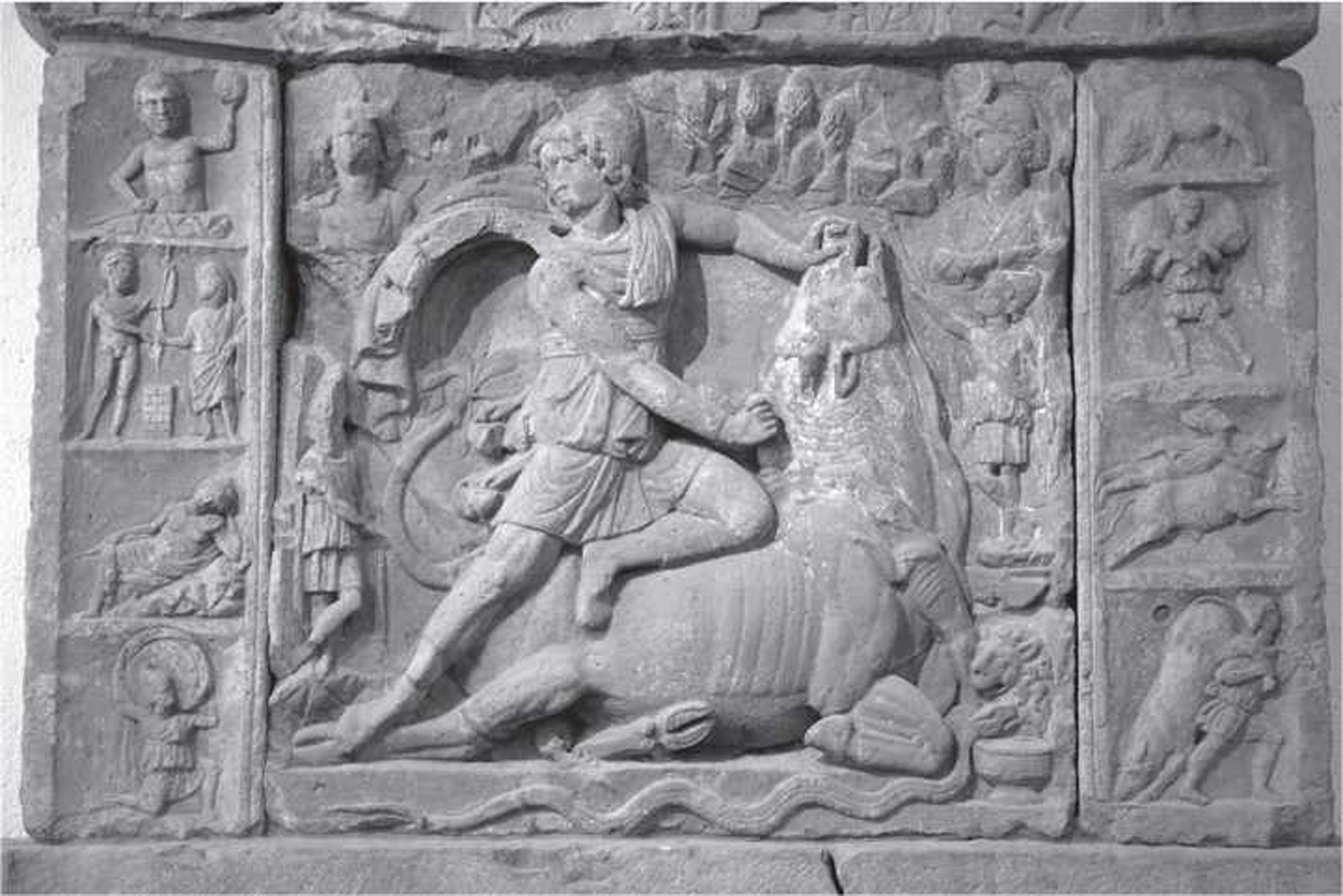
Figure 8.1: Mithras-relief, red sandstone, second century AD, from the military vicus at Heidelberg-Neuenheim (CIMRM 1283, Badisches Landesmuseum Karlsruhe). The central scene with the bull-slaying Mithras (the ‘Tauroctony’) is framed by subsidiary panels with episodes of the Mithras myth. (Courtesy of Wikimedia)
Due to its seemingly straightforward plausibility, the above interpretation of Mithras and his cult as a ‘god for soldiers’, and of the expansion of the worship of the deity, has had an enormous appeal: the Mithras cult is still considered a ‘religion for soldiers’ by many scholars, and the god continues to be labelled a ‘military deity’.7 This (errant) view doggedly persists,8 even though studies and analyses, especially those of R. Gordon and primarily of M. Clauss,9 have clearly shown that the proportion of military personnel of any kind and from all the different military branches in any of the provinces (the naval branch is the exception, as it still does not appear in the record at all), even in so-called military provinces – with the exception of Britannia (75 per cent) – at best seems to have been between 10 and 20 per cent. In the case of Dolichenus, incidentally, the rate of affiliated or benefactors who unequivocally identified themselves as soldiers and veterans was 40 per cent.10
A ‘religion for soldiers’ cannot be defined by the fact that soldiers were among the affiliated members or benefactors of a cult: if that were the case, virtually any Roman god, given a detailed analysis of cult members and a certain proportion of military among them (the likelihood of this is high, since the erection of stone monuments was a costly affair but which officers, NCOs, soldiers and veterans were able to afford), could be shown to be a ‘deity for soldiers’! From a methodological point of view, the issue of classification must follow a different logic: an official army religion exists which is determined by the calendric events of the state’s cult deities, the emperor’s cult, and the imperial dynasty’s cult which is the same for all regiments irrespective of their geographic location. Furthermore, there are cults and religions worshipped by soldiers when not on duty, in private, out of a deeply felt need for protection. Here exists a rather wide range of possibilities and points of contact with the respective civilian population: namely, gods from the soldiers’ home region, gods endemic to the deployment location whose individual protection was sought.11 Oriental religions,12 such as Mithras, count among these. Should one choose to do so, one could label some ‘semi-official’, specific military cults as ‘deities for soldiers’: those deities, that is to say, whose functions are concerned with the day-to-day activities of military duty, deities who grant protection in that sphere and are worshipped by military or tactical and administrative subdivisions of a regiment and who advance group identity, discipline, morality and cohesion.13
Belonging to this group are deities such as ‘Disciplina’ (RIB 2092; ILS 3810), in other words the divine personification of military discipline, or the ‘Campestres’ (RIB 2417; RIB 2135; CIL 13.6449), the deities protecting the parade ground, but especially the diverse genii, such as the extremely popular Genius centuriae, the genius, the protective spirit of a centuria which was often worshipped near the barracks of the respective division (CIL 3.6576; CIL 13.7494a-d). In this case, the composition of the cult membership and of the deity itself would be determined by a military context to such an extent that one could legitimately speak of a ‘cult for soldiers’ and ‘deities for soldiers’ – the situation in the case of Mithras, however, as in the case of Jupiter Dolichenus,14 is different. What should be unarguable is the fact that the Mithras cult appealed to soldiers as a private cult15 – they did not dominate the cult, and they were part of (normally rather small) male communities which were often, but not always, located along the Limes in the civilian settlements (vici) attached to the castella.
It should be mentioned that in the case of Dolichenus and Mithras, the location of sanctuaries – as a rule outside of the castella and in the civilian settlements – has its own distinct relevance. There are a few exceptions, some of which can be accounted for rather well, as at Aquincum16 and Dura-Europos,17 and some of which cannot, as at Vindolanda.18 The Mithras sanctuary of Aquincum is located in a tribune’s house and therefore has a rather ‘private character’; the Dura-Europos Mithraeum and the Dolichenus sanctuary, too, are located within the not strictly and hermetically sealed-off ‘military precinct’ of a narrow and cramped fortress town.19 The Dolichenum of the third and fourth century in Vindolanda was possibly ‘integrated’ (due to the political and military location and situation) into the periphery of the fort’s enclosure out of ‘sheer necessity’.
Mithras, a Research Survey: An Extraordinary Cult from the East?
Evidence for the Persian light-god Mithra dates back to the fourteenth century BC, but there are few common elements between the original form of worship and the Roman Mithras cult found between the late first and the fourth century AD during the Imperium Romanum. For a considerable time now, scholarship has sought to elucidate the true origin of the Roman Mithraic mysteries and the transformational processes involved; the search for the origin of the cult is the central issue of the study of Mithras.20 While one group of historians regards the Roman Mithras cult as a new creation and recognizes few connections with the Persian cult,21 another group stresses the derivations from the Persian cult which, it is argued, had undergone significant changes. A new historiographic approach in recent years indicates that the origins of the Roman Mithras cult are to be found in Italy,22 and not at all in the East.23 Early discoveries support this, as does the concentration of evidence in Rome and Ostia, from where the cult, ‘made up of component parts’, as an innovative cult, spread across the entire Roman Empire. The worship of Mithras and the development and expansion of the cult can subsequently be understood and studied as an integral, constituent part of the Roman deities, and as an element of local and regional religious history. In addition, the reciprocal exchanges between the cult and its worshippers – as well as their social origin and activities – and other cults and religious communities of the Empire equally merit further investigation.
Chronological and Spatial Expansion of the Cult
The cult of Mithras began to expand from Rome and Italy across large parts of the Roman Empire at the end of the first century AD, reaching its peak during the second and third century ad.24 What are presumably the earliest findings in the provinces are dated between 90 and 110/120 AD from Germania Superior, from Nida-Heddernheim near Frankfurt with its four Mithraea: the two donors of the altars in the so-called Mithraeum I (CIMRM 1092, 1098),25 a cavalryman of the ala I Flavia by the name of Tacitus and a centurion of the cohors XXXII Voluntariorum by the name of C. Lollius Crispus, were soldiers of these regiments stationed in this area. The fact that evidence of early offerings and of the cult has been found in the vicinity of the castella along the limites has led to the frequently heard hypothesis that the Mithraic cult in certain provinces had arrived with the Roman Army.26 Certainly, military personnel were among the most mobile population groups of the Imperium Romanum, be that as individuals or in groups, and, in the context of religions and cults, too, thus belong to the group of potential ‘culture-bearers’. Yet, as indicated earlier, the number of the military among the epigraphically attested cult members was substantially lower than that of civilians and other ‘occupational groups’.
The geographic epicentres of recorded examples of the cult are located particularly on the northern boundary of the Empire, for instance along the military borders on the Rhine,27 on the middle and lower sections of the Danube, but also in Britannia along Hadrian’s Wall or in Rome and surrounding areas, especially Ostia,28 as well as Campania (see Figure 8.2 below). As a consequence of the fact that in the nineteenth century, in the course of an emerging research area of ‘ Limesforschung’ (‘Frontier Studies’),29 the issue of military borders became particularly well researched and documented, the focus of study became somewhat distorted in favour of military sites, as it was turned away from the ‘frontier zones’ into the ‘hinterland’. This contributed to the view that the cult of Mithras was a ‘religion for soldiers’ which, as shown earlier, is not entirely correct. A considerable number of discoveries and evidence from non-military sites in recent years has begun to shift the assessment of the cult (for example, the Mithraea in Wiesloch, Güglingen and Gellep).30 Here, civilian populations definitely count among the worshippers – even following the withdrawal of the military where that was the case – that is to say, local residents from the more diverse occupational and communal groups who can be identified as worshippers in other concurrent local cults: Mithras was thus integrated into locally existing religious systems.31
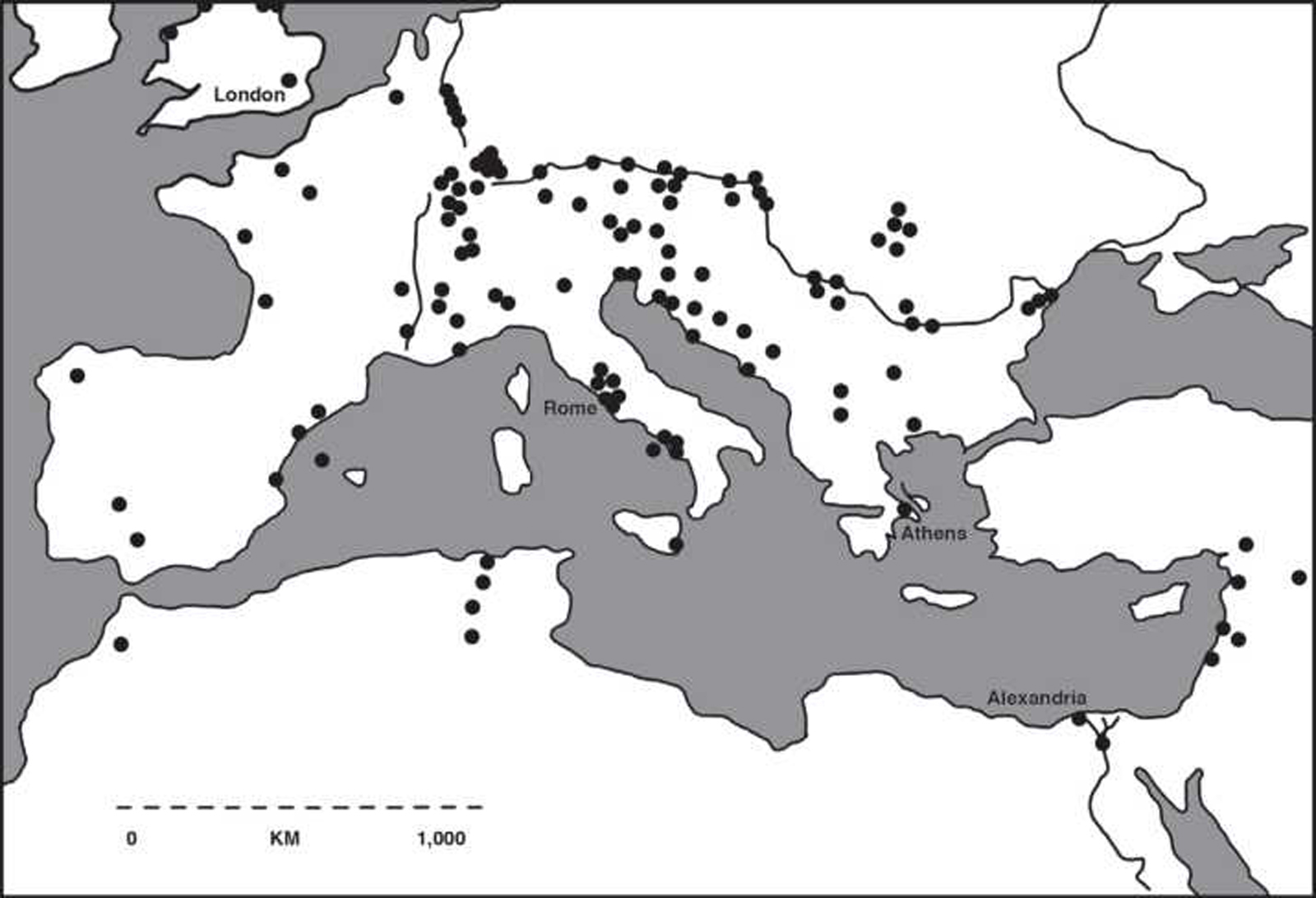
Figure 8.2: Distribution-map of Mithraea throughout the Roman provinces. Clearly visible, there are knots of evidence for the temples and cult-activity of Mithraism in Rome itself, in Germania Superior (the ‘Obergermanisch-Ratischer Limes’), on the frontiers of the Middle and Lower Danube area and their hinterland, and also on Hadrian’s Wall.
At present, approximately 140 Mithraic temples over the entire area of the Imperium Romanum have been archéologically verified, and evidence for the cult itself – with its normally rather small cult communities – exists in more than 500 locations. Evidence can be found from almost all provinces: about 700 relief representations of the bull-slaying Mithras are known, plus a further 500 reliefs in connection with the cult. To date, more than 1,000 inscriptions provide information concerning the cult, its members, distinct rituals, cult buildings and foundations. These form the basis of an at least rudimentary analysis of the social composition of almost 500 small cult communities.32 Needless to say, beside the above-mentioned concentration of findings, there are provinces and regions where evidence of the cult has so far proven scarce, for instance in Roman Spain, in the north of Africa, and both in Egypt and the Middle East. Considering the size of the armed forces in Egypt and the Middle East, which were similar to those in lower Germania (i.e., Germania Superior), the lack of military evidence of the Mithraic cult is rather astonishing – after all, these too are ‘limes zones’.33 Why is there an almost complete absence of the ostensible ‘religion for soldiers’? Nevertheless, the number of findings as evidence of Mithras worship in the Roman orient has grown in recent times, including the two Mithraea of Doliche,34 as well as the unusually colourfully painted Mithraeum at Hawarte in Syria.35 Evidence for the cult ends in the fourth century ad; given the protection and support offered by Roman emperors, Christ ultimately prevailed over Mithras. Further consideration will be given to this point below.
The Social Strata of Devotees – Once Again: a ‘Cult of the Military’?
Some may wish to maintain the hypothesis that soldiers and the military population were of particular significance in spreading the cult, but the fact is that, according to the analysis of the epigraphic evidence undertaken by Clauss, the deity’s following was composed of a much broader segment of imperial society. Other mobile groups which formed a further part might equally be assigned a more significant role in the spreading of the cult, namely, officials of the Roman administration, artisans and merchants. Among the followers of the cult are senators, men of the equestrian rank, decuriones (members of the local city-council, ordo decurionum), soldiers of all types, full Roman citizens, freedmen and slaves.36 It is possible that, to a large extent, the cult of Mithras was transported by soldiers into its area of expansion, but from there began a wide and rapid spread among the civilian population; as stated earlier,37 the proportion of active soldiers amounted at best to no more than between 10 and 20 per cent. Former soldiers – that is to say, veterans – may here be given a kind of potential ‘role as multipliers’ (cf. Aurelius Marcellus from Ulcisia Castra [AE 1926, 72] who, being a veteran, donated a shrine in AD 297 which he had pledged while in the service, ‘quod miles vovit, veteranus solvit’). As will be discussed below, neither the significance of the former soldiers’ ‘role as multipliers’, nor that of the veterans overall, can be discerned clearly. The number of ex-soldiers among the Mithras devotees in the conclusively documented epigraphy is relatively low, amounting to far less than 1 per cent of documents fitting the classification.38 But attention once more should be given to the role that active soldiers played in the cult.
Firstly, it must be noted that the Mithras cult was a cult for men, as women seem to have been excluded. Women appear in the epigraphic documentation merely as ‘accessories’ in the inscriptions of male benefactors, their husbands. The contrast to the Jupiter Dolichenus cult once again deserves attention: almost half (approximately 430) of the recorded dedications have a military connection via the dedicant or the context,39 in which, as discussed earlier, there were closer connections to the ‘official army religion’ (the deity, however, was not a part of the official religious sphere of military life and the ‘official army religion’ itself). Further, of these, nearly half of the recorded dedications of those undertaken by ‘military collectives’ (that is from tactical and administrative subdivisions, rank groups and collegia up to whole regiments with commanding officers), and especially those by officers and commanding officers, were of remarkable significance. Among those 120 offerings of the Dolichenus cult for which explicit detail is available, twenty-four instances reveal the involvement of centurions. There are fourteen praefecti, five tribuni, three legati pro praetore and the dux ripae of Dura-Europos, two primipili. Particularly noticeable, therefore, is the group of centurions and commanding cavalry officers (praefecti and tribuni); less frequent are the ‘non-commissioned officers’ (twenty in total – optiones, signiferi, custodes armorum and beneficiarii). The rank and file (gregales) and veterans appear rarely (six soldiers, five veterans).40
What is striking in the Mithras cult is the ‘majority’ of centurions and NCOs – more than 90 per cent; ordinary soldiers are rare,41 and the instances overall are mostly from the legions42 (see Figure 8.3). This raises some questions. Is the typical cult devotee to be found among the relatively privileged ‘career soldiers’ and non-commissioned administrative officers, in relatively small and exclusive communities? Does the intimate size of the group account for the adhesion of believers and for the attraction of the cult? Did it represent a kind of ‘exclusive circle’? Was discipleship in the Mithras cult regarded as a milieu conducive to ambitious social climbers who sought to build networks of like-minded devotees? This comparison between the function of the Mithras temple as a communal space for festivities and the club houses organized by associations, the collegia, has occasionally been drawn in earlier studies.43 The data concerning the military dedications and the donors should be examined more closely, but it must be said that since the printing of CIMRM, not much new relevant material has been added – but of course the latter will be included in our considerations.
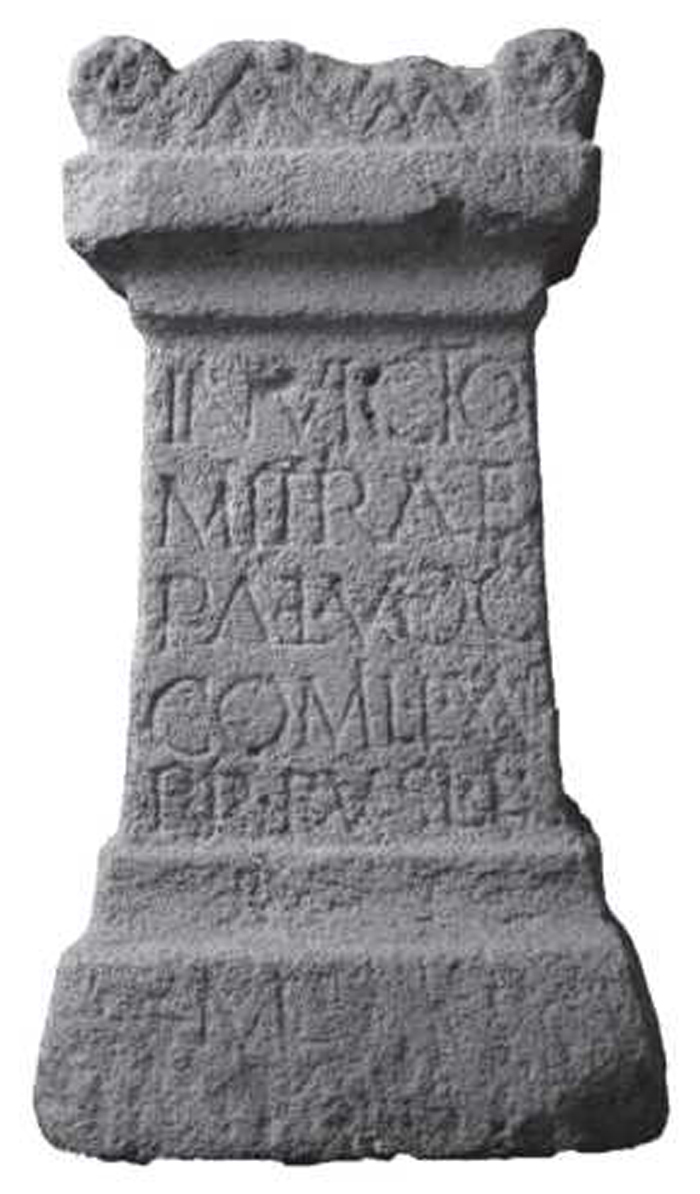
Figure 8.3: Red sandstone altar, height 64cm, second to third century AD, from Sumelocenna (Rottenburg). CIMRM 1308; Landesmuseum Wurttemberg inv. RL163, Stuttgart: dedication to ‘Invicto Mithrae’, to the ‘Invincible Mithras’, by a certain Publius Aelius Vocco, a soldier of Legio XXII Primigenia pia fidelis stationed in Mogontiacum/Mainz. (Courtesy of bpk
Given the eighty-two relevant inscriptions, there are high numbers of military members of the legions represented, whereas the alae (seven), numeri (one), cohortes (eighteen) and vexillationes (three) fall far behind. The prominence of the role given to the centurions is particularly distinct (CIMRM 53, 135, 153, 160/161, 379 [praetorians], 840, 1005, 1098, 1295, 1671, 1718, 2273, 2286, 2311, 2312; AE 1971: 418; AE 2004: 1133; AE 2011: 517). Other officers, especially from the equestrian rank or senators, occur rarely: tribunes and prefects of auxiliary cohorts (CIMRM 845, 876, 1297; CIL 8.21523; RIB 1545 – auxiliary troop commandants), senatorial tribunes of a legion (CIMRM 1790; AE 1990: 814, 818–19; see also CIMRM 139), a camp prefect (CIMRM 2271), a praefectus legionis (CIMRM 134), a praepositus legionum (CIMRM 1594, 1596), a dux (CIMRM 804) and commanders of a legion (legati legionis: CIMRM 1968/69, 1952 – an utter anomaly in the latter case, where the legatus of Legion XIII Gemina made offerings together with his wife and son).44
Rarer instances are ‘collective dedications’ in the cult of Mithras – such as in Ptuj in the time of the emperor Gallienus (ad 260–268) – undertaken by functional groups, in one instance by an entire group of non-commissioned officers and military clerks (CIMRM 1590: canaliclarii, actarii, codicarii, librarii; CIMRM 1592: tesserarii, custodes armorum; CIMRM 1594: officiales) from two legions, firstly Legion V Macedonia and secondly Legion XIII Gemina. These were all under the command of a certain equestrian officer by the name of Flavius Aper (his rank is given as praepositus), who had himself dedicated two altars to the ‘Deus Sol Invictus Mithras’ (CIMRM 1584, 1596). Regrettably, in the case of the latter altar, the reference to the two legions or legion divisions under his command has been lost. Clauss plausibly surmises that the commandant influenced the men in their endowment activities.45
Offerings by complete regiments including the commandant, such as are in evidence in the case of the Dolichenus cult, cannot be found.46 The closest match would be CIMRM 149: an offering during late antiquity undertaken by two cohorts (from the same legion, cohorts VII and X of Legion II Herculia). Some instances, arguably only rather distantly relevant, might also be CIMRM 866, a ‘group dedication’ by the milites legionis II Augustae agentes in praesidio from Housesteads, and especially CIMRM 870 (a vexillation of Legion VI Victrix from Corbridge). CIMRM 1223, too, at least concerns a group from Mainz, a turma belonging to the cohors Biturigium seeking protection, but the benefactor is not named. To the list of offerings made by military clerks from Ptuj can be added CIMRM 2177, an offering by librarii and by an actarius of a numerus Surorum in Romula. Where the ‘collective dedications by non-commissioned officers’ are concerned, CIMRM 153, 742 and 1008 can be listed, too: in CIMRM 153, a legion centurio, an ala decurio and a beneficiarius act together in their donation; in CIMRM 742, several signiferi, standard-bearers, act together; in CIMRM 1008, candidati of Legion XXX Ulpia Victrix, together with an imaginifer (‘bearer of the imago of the emperor’), make this dedication on behalf of the ‘soldiers of the legion’.
Offerings by NCOs occur with some frequency (CIMRM 743, 1677: optio; CIMRM 793: frumentarius; CIMRM 1151: immunis; CIMRM 1434, 1971: speculator; CIMRM 1485: beneficiarius; CIMRM 1638, 1639: two offerings by a custos armorum of Legion XIV Gemina from Scarabantia; CIMRM 745, 1717, 1962: signifer; CIMRM 1781: actarius; CIMRM 1805: armorum custos; CIMRM 2375: strator consularis; CIMRM 1729, AE 1979, 425: cornicularius praefecti legionis; CIMRM 1955: imaginifer; NCOs of auxiliary troops: CIMRM 1015: duplarius alae; CIMRM 1153: medicus; CIMRM 1803: custos armorum cohortis). Equally frequent, unlike in the case of the Dolichenus cult, are offerings by the ‘rank and file’ soldiers (CIMRM 1793: two soldiers of Legion II Adiutrix; CIMRM 62, 70, 867, 916, 1308 [see Figure 8.3], 1513, 1649, 1711, 1739, 1742, 1921, 1925, 1929; CIL 13.8641: soldiers of auxiliary troops; CIMRM 1092: eques alae; CIMRM 1889: miles cohortis; CIMRM 562: praetorians). In the overall assessment, then, in the epigraphic record we can note differences between the Dolichenus and Mithras cults. In the case of the Mithras cult, there is a higher proportion of centurions and NCOs, but also of rank and file soldiers, while the proportion of equestrian and senatorial military is lower,47 there are few ‘group connections’ and no genuine overlap with the ‘official army religion’.
In some places – in spite of the rather low proportion of active soldiers in the cult communities which we have repeatedly stressed – there were close connections between local garrisons and the local Mithras community: until about AD 160, the ala Noricorum was stationed at the auxiliary fort in Dormagen in lower Germania. It is thought that at that time this regiment became an auxiliary troop of the Bonn-based Legion I Minervia in Lucius Verus’ Parthian campaign and never returned to Dormagen. According to the numismatic evidence, after AD 160, the painted Mithraeum with its vaulted ceiling and stone cult relief (CIMRM 1011–1015) fell into disuse. Two inscriptions (CIMRM 1013, 1015) preserved on the relief mention cavalry soldiers, a bucinator and a duplicarius, indicating that it was members of the ala Noricorum who founded and ‘maintained’ the Mithraeum between AD 90 and 160, which was then ‘closed’48 following the regiment’s departure. Yet, a similar hypothetical account would require detailed examination: from time to time, the question is raised as to why the quantity of inscriptions offered to the deity declines in the third century ad.49 A possible answer would have been a consideration of the consequences for the Mithras cult of the so-called era of the ‘soldier emperors’ – did the abandonment of the Limes east of the Rhine around AD 260 lead to this drop in numbers because the relevant Mithraea and their communities were consequently abandoned? Or did battle casualties, or redeployment to other front lines, result in depletion of membership in communities? It is clear that the correlation between the military and the prosperity of Mithras communities is greatly overstated.
The question seems to raise its head again as to why the two cults, of Jupiter Dolichenus and Mithras, do not seem to reveal a clear overlap given their military clientele and the frequent neighbouring location in the vici of the legionary camps, garrisons and castella (for example, Brigetio, Dura-Europos and Stockstadt)? Should an overlap of members and benefactors documented in both cults perhaps be expected? That would be likely, considering the not insignificant amount of epigraphic evidence for both cults. It is therefore astonishing that a congruence, or cross-section between the cults, is hardly reflected at all in the extant record. Moreover, in several cases where it is the case, the reliability or value of the record is in doubt. In Stockstadt, where the Dolichenum and Mithraeum lay in the vicinity of the auxiliary fort, an offering to Jupiter Dolichenus was found in the Mithraeum during excavations in 1908 (CIMRM 1208);50 in Egeta, in the province of Moesia Superior, only a section of a Mithras relief was found in the local Dolichenum.51 It is not certain whether CIMRM 348.2 from San Clemente in Rome, a dedication by a priest to ‘Jupiter Dolichenus Augustus’, stems from the local Mithraeum, because the fragment was reused as part of the church floor (together with CIMRM 348.1, an offering to Mithras).
Pertaining more closely to the initial line of investigation is CIMRM 373, a relief (including a representation of Sol) with an inscription: M. Ulpius Chresimus, who refers to himself as sacerdos Iovis Dolicheni – a priest in the service of the god Dolichenus – fulfils his sacred vow for the protection of the emperors in his offering to Sol Invictus and the genius of the equites singulares Augusti, the mounted escort troops of the Roman emperors in which he himself was a member. This inscription was also found in the supposed area of the equites singulares camp on the Caelian Hill in Rome, together with, it should be noted, a further inscription to Jupiter Dolichenus.52 Strictly speaking, however, it is not Mithras who is referred to but ‘Sol Invictus’, and we cannot be certain that this inscription from the second century AD in fact refers to Mithras.53 The ensemble or union of ‘Sol’, ‘Deus Helios Mithras’ and Dolichenus is known from the Dolichenum on the Aventine Hill in Rome (CIMRM 467–75), but here military personnel were not involved as benefactors. A consecration to ‘Deus Sol Invictus Mithras’ by C. Valerius Marinianus, a cornicularius of the legatus legionis, the commander of Legion I Adiutrix, is found in the Dolichenum at the gates of the legionary camp in Brigetio – the military clerk therein fulfilled a sacred vow. A dedication in the Greek language, dating from the early third century AD, to Zeus Helios Mithras and the god Turmasgades, by a soldier of Legion XVI Flavia Firma Antoniniana by the name of Iulianos, is definitely from the Dolichenum in Dura-Europos {CIMRM 70).54
This almost gives the impression that there were ‘two systems’ that cannot be made congruent. What differences existed between the dedicants of the two cults? As noted above, the epigraphic evidence records at least some differences – the involvement of military collectives and regiments,55 the proportion of senatorial and equestrian regimental commanders, and overall of officers, and the proportion of individuals of the rank of non-commissioned officer or rank and file. Apart from the gradual differences of acceptance and ‘integration’ or assimilation in military life (viz. closer proximity of the Dolichenus cult to the ‘official army religion’), can we plausibly discern a level of ‘class distinction’ among the worshippers and different ‘spheres’ of religious entitlement? There is scope for further research in this regard. But two inscriptions from Dura-Europos must be considered. In CIMRM 53, mention is made of the restitution of the temple of ‘Deus Sol Invictus Mithras’ by Antonius Valentinus, centurio princeps and commandant of a vexillation of Legions IV Scythica and XVI Flavia Firma, that is to say a building inscription of the Mithras temple (ad 209/211). The same officer is named at the Dolichenum of Dura, but on an altar of a man freed by him by the name of Agathocles, who consecrated the altar to Dolichenus ‘for the protection’ of his patronus, the officer who otherwise is nowhere present among the findings of the Dolichenus cult in Dura.56 Would this mean that there were two systems?
The Mithras cult was never officially integrated into the Roman pantheon, but it cannot be denied that its members, be they soldiers, freedmen or slaves employed in the administration, evidently felt a sense of loyal obligation to their superior and to the emperor. A large number of inscriptions attest to the community’s expressions of loyalty pro salute, ‘for the welfare’ of the emperor or a superior (for example, CIMRM 1008, 1777); or the community consecrates the donation or endowed object in honorem domus divinae, ‘in honour of the imperial house’ (for example, CIMRM 1243; for both, CIMRM 1438). However, both formulae are conventional and widely used by other cults. Compared with the Dolichenus cult, here there are far fewer members of senatorial or equestrian rank. During the cult’s peak time in the second and third century AD, Mithras did not greatly resonate with the Empire’s ruling elites.57
‘Temples’ and Sanctuaries
Apart from cave Mithraea (such as those in Schwarzerden-Reichweiler or in Doliche),58 the floor plans, such as those excavated in Roman Germany, reveal an essentially identical basic scheme that is repeated everywhere. Based on the long rectangular floor plan, the sanctuary space is lowered into the ground, a central aisle is flanked by two raised podiums for the worshippers, and access to the sanctuary space leads through one or two vestibules via downward steps. On the front wall of the cavern was located the central cult image with its representation of Mithras’ slaying of the bull (the ‘Tauroctony’). Mithras is invariably depicted wearing long oriental trousers, belted tunic, billowing coat and a Phrygian cap on his head, just as he is pushing down the bull’s back with his left knee; with his right hand he is thrusting a dagger into the bull’s lower neck area (the left hand controls the animal’s mouth while pulling back its head).59 Subsidiary altars and sculptures (such as those of ‘Cautes’ and ‘Cautopates’, the torch bearers) supplemented the furnishings of these small sanctuaries. In many cases, the design of the sanctuary ceiling and roof cannot be discerned: in Rome and in Ostia, at least, there were vaulted ceilings featuring open holes to the sky.60 The walls were often colourfully painted with frescoes, such as in Rome and Dura-Europos, and it is safe to assume that everywhere else, the walls served as the space on which the mystai painted graffiti (see Figure 8.4).
Mithras’ temples and sanctuaries are frequently rather modest in size – as a rule of thumb, the dimensions were 6 metres in width and 12 metres in length, at least in Roman Germany. The walls were generally a combination of wood or a timberframed structure on a bedding of stone. It is likely that as a rule, a temenos, a sacred precinct, was part of the general plan of free-standing temples. Mithraea exist in all ‘settings of human habitation’, in cities, vici, near military camps and on the periphery of farming estates.61 Building materials, however, were combined in many variations: in Wiesloch, for instance, even grass sods, clay, wooden and wattle lattices and timber-framed structures were combined in the initial construction phase.62 It should be assumed that some temples were made entirely out of timber, even though archaeological evidence is obviously (more) difficult to ascertain: one example is the case of the cohort fort in Künzing along the Limes in Raetia.63 In spite of its status as a military province, Raetia has thus far provided only very little evidence of the cult’s worship.
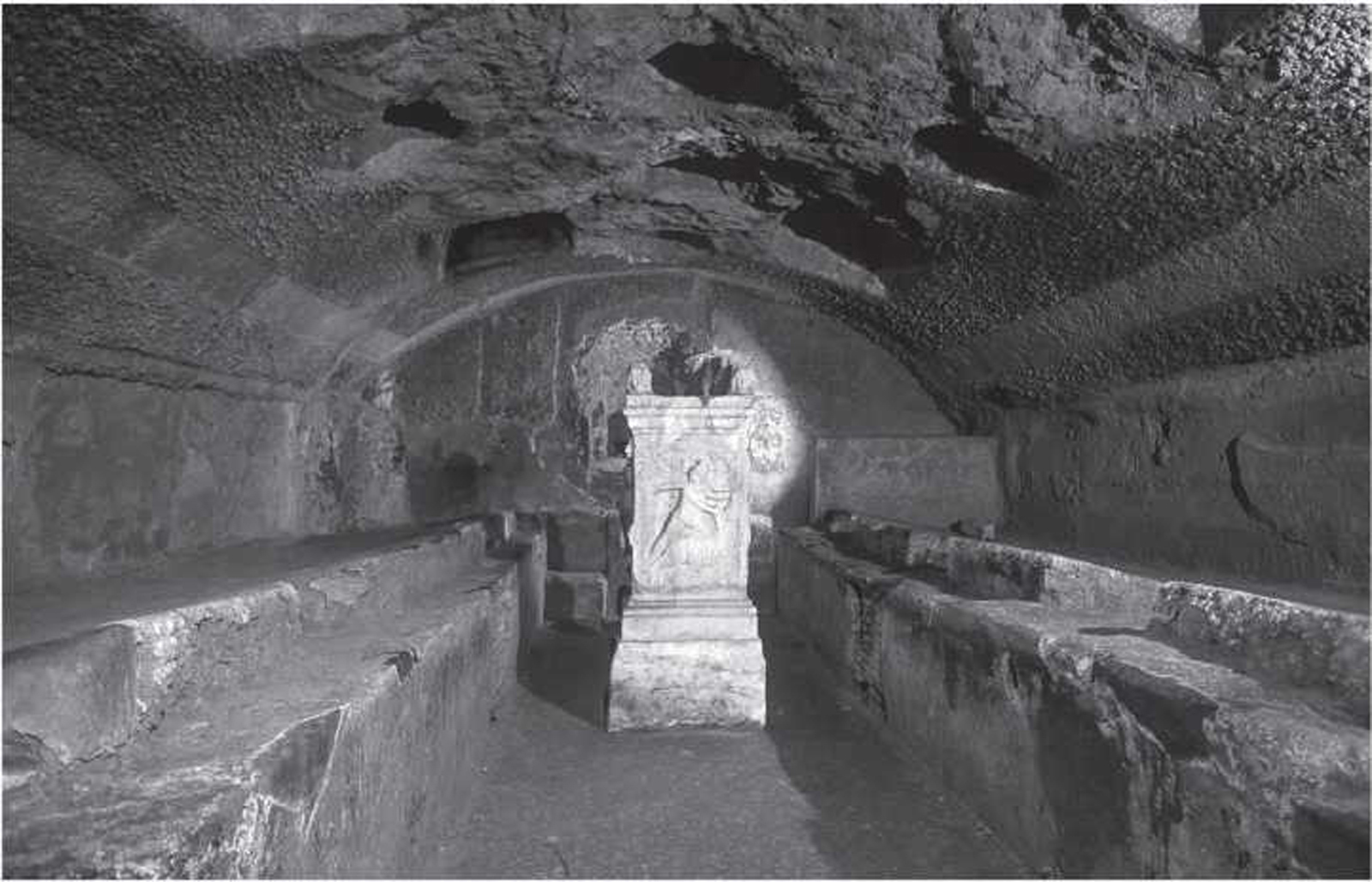
Figure 8.4: The third- to fourth-century AD Mithraeum under the Basilica St Clemente in Rome. The original ‘cave-like space’ of the subterranean temple interior (spelaeum or crypta) is almost intact: there is an altar, triclinia (‘benches for dining’, for the communal meals) and vaulted roof. (Courtesy of Alamy)
The sanctuary in Künzing was located in the so-called east vicus, some 220 metres from the principate-era auxiliary castellum, and was destroyed in the second half of the third century ad. A small community gathered here in two periods (second century AD, a post construction with lattice work walls housing a maximum of eighteen persons; third century AD, a foundation beam construction with timberframed walls for approximately twenty-five persons). At least during the second phase, the cult image seems to have been painted on plaster and did not consist of a sculptural relief; but here, too, a wide variety of options can be imagined.64 Oil lamps, sacrificial knives, a bone pit containing animal bones, drinking cups and cult vessels provide evidence for and connect the gatherings to cult practices and cult feasts (in Riegel am Kaiserstuhl, an assortment of cult crockery was found – cups, jugs, plates, cult vessels and censers).65 The benches (for reclining) would have been laid out with cushions to guarantee comfort for members participating in the feast.66
Inscriptions are almost entirely lacking in Künzing, but a small altar records an honourably discharged veteran (‘missus honesta missione’), Valerius Magio, as a worshipper of the ‘Undefeated Mithras’ (Mithras Invictus).67 Veterans, that is to say soldiers who had been discharged honourably with all attendant privileges and financial settlements, can occasionally be found as dedicants in the record (for example, CIMRM 153, 630, 1235, 1361–62, 1417, 1543, 1635, 1720, 1724–25, 1776, 1959, 1960, 2222, 2250). Howsever, these instances mostly refer to legionary veterans and in few instances to alae or Roman city troop veterans. Occasionally, as in Künzing, the honourable discharge – honesta missio – is mentioned (for example, CIMRM 630), but that practice was widespread and not unique to this cult.
After all, the veterans generally represent ‘prosperous’ members of provincial society who can frequently be found in the vicinity of their old garrison, and who were inclined to make a dedication in a cult in order to document their status and their integration into the local community. Some of these veteran inscriptions therefore ‘unite’ active soldiers and veterans of a regiment or a specific ‘army group’, namely, the ‘old comrades’ (for example, CIMRM 153 from El-Gahara), or they refer exclusively to veterans belonging to the same regiment, such as CIMRM 1235 referring to three veterans of Legion XXII Primigenia from Mainz. C. Iulius Valens, the veteran referred to in CIMRM 2222, an ex-beneficiarius of Legion VI Claudia, arguably offers his inscription because he became ‘nunc decurio’, a ‘town councillor’, of the colonia Viminacium and therefore indubitably advanced into the local ruling elite. The veteran T. Tettius Plotus, a former soldier of Legion IIII Flavia in Oescus, apparently advanced into the cult’s priesthood and reached the grade of pater. What is known about the internal structure of these small cult communities which gathered in the temples and sanctuaries discussed above? It is generally assumed that the membership of each community lay between twenty and forty individuals, but a bronze tablet from Virunum (AE 1994, 1334) is a building inscription that identifies ninety-eight members of a Mithras community at the beginning of the third century AD, a quarter of which, incidentally, consisted of freedmen.68 Due to the increase in membership numbers between AD 184 and 201, it was then decided to found a new temple.
Needless to say, given a sufficient number of devotees, several Mithras sanctuaries could co-exist ‘side by side’ near a single castellum. An example of this is found in Frankfurt/Nida-Heddernheim with its (at least) four Mithraea during the late first to third centuries AD, only two of which were already in existence when Heddernheim was a simple castellum (before AD 110, after which the ala I Flavia Gemina, a cavalry regiment and a cohort also stationed there, presumably the cohors XXXII Voluntariorum c.R., were redeployed to the Limes). Here, too, there is proof for the key argument: namely, that the cult was not exclusively sustained by the military, but by the citizens of the settlement, which in the meantime had become a civitas capital. Assuming a number of twenty to forty members per community, during the turbulent third century AD there were approximately 120–240 worshippers of the ‘invincible’ god69 in the civic settlement of Nida.
Priests and ‘Service of Worship’, Belief and Ritual
As was the case in other cults, solemn admission to the Mithras community was necessary: a ritual initiation required the ‘novice’ to prepare and study. Following the identification of a fourth-century AD Egyptian papyrus as a kind of ‘catechism’ of the cult,70 and in spite of its fragmentary state of preservation, it seems clear that the initiation was a dialogue-based ceremony, involving a series of ritualized questions and answers. The test gave proof that the new mystes had learned the cult’s key elements. Among other things, the ‘catechism’ also recapitulates the grades of initiation and the hierarchy of the cult. As stated earlier, admission was exclusive to men who had to complete different initiation ceremonies, thereby ‘ascending’ a ladder of grades of initiation (a ladder with symbolic emblems of the seven grades is depicted in the well-known floor mosaic at the Mithraeum of Ostia/the Mithraeum of Felicissimus, third century ad: CIMRM 299).71 It has occasionally been argued that, due to its apparent familiarity, this hierarchical system would have been particularly attractive to the military.72 One of the grades is even called ‘soldier’ (miles) (for example, CIMRM 1232, 1234, from Wiesbaden) and might thus have promoted the soldiers’ sense of identification with the cult. In this regard, perhaps one of the epicleses (epithets) of the god might also have been attractive: ‘Invictus’,73 the invincible (for example, CIMRM 1025, 1232, 1774, 1844).
Seven grades of initiation are recorded: ‘Corax’ (raven), ‘Nymphus’ (bee chrysalis), ‘Miles’ (soldier), ‘Leo’ (lion), ‘Perses’ (Persian), ‘Heliodromus’ (sun-runner) and the highest rank ‘Pater’ (father). These are also occasionally named in the inscriptions of the mystai (CIMRM 473: ‘raven’; CIMRM 401: ‘Persian’) or in the graffiti preserved in some sanctuaries (for example, CIMRM 498 from the Mithraeum under the Santa Prisca in Rome, and at Dura-Europos).74 Each grade and its symbol are connected to a planetary deity; for example, the ‘raven’ is connected to Mercury or ‘Pater’ to Saturn. The basic idea might have been that the initiate could ascend75 to the celestial sphere via the seven planetary spheres. A search for answers concerning practice and liturgy, belief and ritual predominantly has to rely on archaeological findings (temples, monuments, mosaics, paintings and small finds such as crockery and cult utensils), as well as on the epigraphic record, and much more rarely on references found in other source types (such as in the above instance of the ‘Mithras catechism’). While there are some (if few) literary references, these all originate ‘exterior to the cult’ (for example, the works of the philosophers Porphyry and Celsus; the so-called ‘Mithras Liturgy’, which was developed in the field of Egyptian religion and under the influence of Hellenistic philosophy, employs aspects of the cult for magical purposes; strictly speaking it cannot serve as evidence for the cult itself, or should be considered with caution).
The majority of literary references were penned by ‘Christian rivals’ (Justin, Tertullian, Firmicus Maternus),76 whose depictions of the cult were unfavourable and lack clarity. After all, the cult was the ‘main rival’ of incipient Christianity and required denunciation. The degree of verisimilitude pertaining to the Christian depictions of the cult therefore remains uncertain. Matters are complicated further by the fact that the cult was a so-called mystery religion77 – in simple terms this means that initiates and cult members were bound to secrecy concerning the cult and its rituals.
A reconstruction of the cult’s legends and myths therefore has to rely predominantly on the iconic scenes represented in the cult’s imagery, but a definitive interpretation cannot be reached. The cult’s iconic centrepiece, either a relief or painting generally affixed to the wall at the end of the temple’s central aisle, always represents the ‘bull-slaying god’, since the killing of the bull is the legend’s central element,78 while smaller subsidiary scenes on the relief frequently illustrate events in the Mithras narrative, such as the hunt for the bull. Cautes and Cautopates are placed on either side of the depiction, and dog, snake, scorpion, raven, sun and moon are also represented in fixed constellations. More complex representations offer a further series of ‘standard scenes’, such as Mithras being born from a rock, the ‘water miracle’, the hunting of the bull and the relationship to Sol, the sun god, in a depiction of the shared meal consisting of the bull’s meat and blood (or of bread and wine, respectively), as well as of Mithras ascending to the heavens in a chariot.79
The killing of the bull might be understood as a parable for human destiny: the killing does not signify the destruction of life by Mithras. On the contrary, death is part of a larger transformation – grain sprouts from the animal’s spinal cord, the dog and a snake drink the bull’s blood, the scorpion pierces the bull’s testicles, the blood becomes a grapevine and from the semen emerges the animal kingdom. The killing of the bull is therefore the central, redemptive event giving expression to the cosmic order and to the becoming and passing of the natural world. Many interpretations of the cult’s beliefs and imagery, many explanatory accounts for the ‘collection of zodiac signs in the Tauroctony’ (‘bull killing’), refer to the astrological knowledge of that era and equate the grades of initiation with the planets/zodiacs.
The cult’s enigmatic iconography is occasionally even argued to represent an ‘astronomic code’:80 it is argued, for instance, that the Mithraic legend of the killing of the bull reflects the discovery of the so-called axial precession. The rotation of the earth’s axis was discovered in the first century AD, and attendant to the precession, observable events such as the apparent movement of the celestial horizon and the gradual disappearance of stars in the evening sky. One such example was the gradual disappearance of the Taurus constellation, which was replaced by the Perseus constellation during the second century ad: this event, it is argued, is reflected in the myth of Mithras. Such an interpretation relies on a whole series of prior assumptions and will not be examined here in greater detail. In short, though, it is based on the iconographic design of the figure of Mithras discussed above, which is seen as closely related to representations of Perseus in Greco-Roman art. In this view, Mithras is considered as an almighty god, a cosmocrat, who directly influenced celestial events.
During the third century AD in particular, the connection between Mithras and Helios or Sol, the sun-god, grew closer – some inscriptions contain the phrase Deo Soli Invicto Mithrae, ‘uniting’ the deities (for example, CIMRM 1425, 1659, 1915).81 The equation of the invincible sun-god and Mithras also conferred upon Mithras a notable role as protector of the Roman Empire and its emperors. At the very latest by the time of Aurelian, the emperors preferred the sun-god; in AD 307, Diocletian and his co-emperors considered the Deus Sol Invictus Mithras a ‘benefactor of their rule’ (fautor imperii sui: CIMRM 1698). Emperor Julian the Apostate, often referred to as ‘the last pagan’ – who evidently was a Mithras worshipper – on 25 December AD 360 composed a panegyric hymn dedicated to the ‘birthday of the sun-god’, dies natalis Solis invictis, Helios (or to the ‘sun-god Mithras’). Julian considered this god the ruler over all the gods, as creator of all beings and as guarantor of protection and prosperity. Evidently, the piquancy of the hymn and of its function as a ‘birthday greeting’ to the highest god Helios/Mithras lies in the fact that in Rome, since the beginning of the fourth century AD, 25 December was of course reserved for the celebration of the birth of Jesus Christ – in the same manner as Christian theology had absorbed into itself elements of pagan sun symbolism.82
Myths become alive when they are ‘performed’ in ceremonial celebrations83 and when a member himself is able to play the role of a mythic figure. Rituals also served this purpose: perhaps the Mithras sanctuaries provided spaces ideally suited to this purpose, given their cavernous design and the images that could be mysteriously illuminated, veiled or unveiled, some of which were mounted for rotation (for example, in Nida, CIMRM 1083; Dieburg, CIMRM 1247; and Rome, CIMRM 397).84 In addition, there were the ceiling paintings (starry heavens). A double-sided rotating relief from Konjic representing a ‘normal bull killing’ on its front, features on its rear side a depiction of a cult feast including Sol and Mithras (or perhaps priests representing them?).85 At least two worshippers are shown wearing masks that presumably reflect their grade of initiation, namely the raven on the left and the lion on the right – are the worshippers here shown as performers, as ‘actors’? A number of passages from a text by an anonymous Christian author reveal that for certain rituals, the mystai were expected to flap wings, to crow (like ravens) and to roar (like lions). In a sense, the sanctuary’s atmosphere and furnishings represented the cosmos. The gathering community, reclining on the benches along the sanctuary side walls, through the cult rituals and communal meals and drinking, the cult feast,86 was bound and fused into a community of worship. Rituals gave expression to the cult’s ‘mythology’ in various ways, such as prayers or hymns, but also in ‘role play’ or masked performance, in the transposition of ‘mythic events’ into enactment by humans – namely, the ‘priests, ‘initiated’ and ‘novices’.
The Mithraic Mysteries During the Third and Fourth Century AD: Decline and Rivalry with Christianity
Mithraism is considered one of the main rivals of Christianity in the Roman Empire, developing during the same era and spread across comparable geographic regions. Justin, in the second century AD, considered it a diabolical imitation of Christianity, while Renan commented that, ‘if the growth of Christianity had been arrested by some mortal malady, the world would have been Mithraic’.87 Justin was particularly surprised by the similarity of Christian feasts and those of the Mithras cult, and the Church father Tertullian was of the view that the devil was mimicking the practices of the Christian sacraments. From Firmicus Maternus to the Church father Tertullian, the Christians viewed Mithras as a ‘god of darkness’, since the ceremonies took place under cover of darkness; the cult’s temples were ‘veritable camps of darkness’, opined Tertullian.88
At the start of the fourth century AD, the cult enjoyed a kind of renaissance. A number of pieces of evidence from the age of the tetrarchy indicate that highly ranked state officials (all the way to the top of the hierarchy) were favourably disposed toward the cult (CIMRM 1698, 2278).89 In AD 311 in Klagenfurt, in the province of Noricum Mediterraneum, the proconsul had the dilapidated Mithras sanctuary rebuilt (CIMRM 1431), and in Gimmeldingen/Rhineland-Palatinate, a new Mithras sanctuary was built as late as AD 325: this is the most recent establishment of a Mithras community on record (the exact date of the dedication is 22 January AD 325: CIMRM 1315). In the pagan restoration during the second half of the fourth century, Mithras played a part, even in Rome and within leading senatorial circles (for example, CIMRM 522, AD 377).90
But at the end of the fourth century, Mithras was defeated by Christ and by Christianity, which in the meantime had become the powerful official state religion -supported by the Roman emperors. The Christian faith had already established itself in Rome by the time of Paul the apostle (his journey to Rome in AD 60/61 indicates an already established community), and was possibly earlier than the Mithras cult, which does not emerge in Rome before the late first century.91 In contrast to other types of cult in the Imperium Romanum, the Mithras cult shared the fate of other mystery cults in that it never became a public cult supported by the state, and it was never recognized in the official festival calendar of state or Army92 – in spite of the fact that, as seen above, it had occasionally been accepted by emperors and the imperial periphery. Inscriptions and findings give evidence of the cult’s demise: although Christianity since Constantine (ad 324–337) was well on the way to becoming the state religion – fully realized only in AD 391/392 with the ban of all pagan cults by the emperor Theodosius – the old cults retained worshippers for decades.
The emperors of the fourth century oscillated between tolerance and persecution of pagan cults. The destruction of many pagan temples (of Mithraea, for example, in Königshofen/Strasbourg and Saarburg) during the last decade of the fourth century is often understood in connection with the triumph of Christianity. But religious violence always had a limited local character and occurred infrequently.93 Mithras inscriptions in the fourth century were already scarce, and we have no record of any activities taking place in Mithras temples in the fifth century. For instance, the find of coins in the Mithraeum in Pons Aeni (Pfaffenhofen am Inn) shows activity throughout the entire fourth century, but at the turn of the fifth century, the numismatic evidence there comes to a complete halt. The conclusion of the fourth century ushered in the demise of Mithras, and memory of the cult was expunged more thoroughly than was the case with other cults.94
Notes
1. Cumont (1911), pp.36–40.
2. Cumont (1911), pp.38–39; Cumont (1959), pp.102–03, 136–37. On Cumont’s influence on this point, cf. Gordon (2009), pp.380–81. On the development of studies on this topic, see also Gordon (2013b), pp.237–42. On the ostensible role of centurions and ‘national regiments’ in the spreading of oriental cults, cf. also von Domaszewski (1895), pp.138–39; however, at pp.146–47 he specifically understands Mithras as a ‘private god’, not as an ‘(official) army god’.
3. The Commagene region rightly continues to be considered a ‘zone of contact’ and a nexus concerning the genesis of the Mithras cult: Winter (2012), pp.162–63; see also Schütte-Maischatz & Winter (2004) on Mithras and Dolichenus in the Commagene region; specifically on Doliche as the ‘starting point of religious ideas’, see pp.189–201.
4. Daniels (1975), pp.249–74, laid particular stress on the role of soldiers in spreading the cult; see also Martin (2015), pp.121, 126. By contrast, cf. Clauss (1992), pp.267–70; Clauss (2012), pp.37–40.
5. Collar (2011), pp.217–46; Collar (2013), pp.79–145. The Dolichenus cult as a ‘military religion’ is discussed by Speidel (1978), pp.38–45.
6. On the iconography, see, for example, Speidel (1980a), p.11; Stoll (2013), pp.84–85; on the signa in particular, see Speidel (1978), pp.55–63. Established phrases for collective dedications of the official army religion later adapted by the Dolichenus cult: Stoll (2007), pp.461–62, e.g. AE 1998, 1156; CIL 13.11780, 11782. On the role of officers, entire regiments, and divisions: Speidel (1978), pp.4–11, further examples at pp.64–71. The new inscriptions of the Dolichenum in Vindolanda also represent these types of collective dedications undertaken by regiments and officers: see, for example, Birley & Birley (2010), pp.35–39. Further, Collar (2013), pp.79, 113–17, stresses the role of officers and their networks; cf. also Stoll (2001), pp.197–99. Most recently on Dolichenus and the Roman Army, but with few new findings, Haensch (2012), pp. 111–33. On the dedications undertaken by ‘closed formations’ (e.g., regiments), see Haensch (2012), p.125.
7. See, for example, Speidel (1980b), pp.1–2, 47: the Mithras cult as ‘a religion of the Roman army’ and its spread a result of the army (and its administrative personnel). The same view is essentially maintained in Herz (2015), p.824; similarly in Rives (2007), pp.81, 139, 141. On the ‘transportation’ of cults by the army and on its role as a bearer of culture or mediator, cf. Stoll (2001), pp.176–209; Stoll (2007), pp.468–71; Stoll (2013), pp.83–84, 94–102.
8. See, for example, Martin (2015), p.6: The membership of the Mithras cult is argued to have been ‘largely drawn from the ranks of the military’: see also pp.121, 126.
9. Gordon (2009), pp.379–450, esp. 414–15; see also Gordon (2012), p.974; Clauss (1992), pp.267–69; Clauss (2012), p.39.
10. Speidel (1978), pp.38–39; Stoll (2007), p.469; Stoll (2013), pp.96–97. Of course, nonmilitary members of these cults might have been ‘influenced’ by the military, since the social composition of the garrisons consisted of veterans, soldiers’ families and otherwise variously networked communities – Birley & Birley (2012), p.244 n.29 are absolutely correct; cf. also Collar (2013), pp.94–95 – they lived together in the sense of ‘nota et familiaria castra’ (Tac. Hist. 2.80.3). Nevertheless, as a basis for statistical proof, only the unambiguous evidence can be considered, where the inscription itself identifies the acting individual as soldier or veteran.
11. On this ‘system’, see, for example, Stoll (2001), pp.126–32, 133–209; Stoll (2007), pp.451–76, esp. 452; see also Stoll (2013), pp.79–110; and Herz (2015), pp.822–28.
12. On the concept of ‘oriental religions’ and its implications, interpretations and new scholarly perspectives, compare Witschel (2012), pp.13–38.
13. Stoll (2007), pp.453–54, 462; Ankersdorfer (1973), pp.136–39, 140, 206–13.
14. On the Jupiter-Dolichenus cult as a ‘religion for soldiers’ or on the ‘alliance of the cult with Roman state power’, although never having become an ‘official god of the army’, cf. Speidel (1978); Speidel (1980a), pp.7, 10–11 (but with also the important reservation that it was not only soldiers who were worshippers: women are named as benefactors, and sanctuaries existed in the civilian hinterlands; other members consisted of slaves, merchants, officials), 18; Schütte-Maischatz & Winter (2004), pp.68, 195.
15. Cf. Speidel (1978), pp.5, 34: ‘Mithras ... was worshipped by select groups of initiates in secret rites underground’ (34); he emphasizes the ‘private nature’ of the cult and its difference to the Dolichenus cult.
16. Kocsis (1989), pp.81–93; Kocsis (1991), pp.117–97. See also Gordon (2009), pp.407–08, who on the basis of Kocsis’ interpretation – (1989), pp.83–85 – presents in even more detail the private character of the Mithraeum; the actual benefactor of the Mithraeum had been a slave or freedman, therefore a member of the officer’s familia.
17. Cumont (1975), pp.152–214; Francis (1975), pp.424–45; see also Clauss (2012), pp.42–45.
18. Birley & Birley (2010), pp.25–51; Birley & Birley (2012), pp.231–57.
19. On the religious communities in Dura and the location of the two temples, cf. Dirven (2011), pp.201–20; see also Stoll (2001), pp.350–60.
20. Witschel (2013), pp.201–10.
21. On the ‘Persian prehistory of the god’, and on Mithras in Hellenistic Asia Minor, principally in the Commagene region, and among the Parthians and Sassanids, see the many references in Gordon (2012), pp.968–72; also Clauss (2012), pp.14–17; Witschel (2013), pp.201–05; Hensen (2013), pp.21–24.
22. For a summary of the history of the Roman cult, see, for example, Gordon (2012), pp.972–75; Witschel (2013), pp.205–09.
23. Witschel (2013), pp.208–09, summarizes the different scholarly approaches; see also Hensen (2013), p.86.
24. Gordon (2007), p.395. On the overall temporal and spatial spreading of the cult, cf. also Clauss (1992), pp.11–13, 253–60; Clauss (2012), pp.27–35.
25. Cf. also Spickermann (2003), pp.203–04. On the inscription by Lollius Crispus, cf. also Gordon (2009), pp.392–93.
26. See, for example, Spickermann (2003), p.313.
27. Compare, for example, the list in Spickermann (2003), pp.293–314 for Germania Superior only.
28. On the large number of Mithraea especially in Rome and Ostia, compare the estimates by Martin (2015), pp.10–11.
29. Gordon (2009), pp.386–89, rightly establishes the connection to the ‘Limesforschungen’ (German Limes scholarship, starting in the nineteenth century) in the interpretation of the cult.
30. Gordon (2007), p.396.
31. Spickermann (2003), p.314.
32. Clauss (2012), p.11; Martin (2015), pp.7, 90, 91.
33. On the lack of evidence in Egypt, see Martin (2015), pp.119–27; on the lack of evidence in the Middle East and the Near East, as well as the inconsistent spreading of the cult, see Daniels (1975), pp.272–73.
34. Winter (2012), pp.162–63; Schütte-Maischatz & Winter (2004), pp.79–187.
35. Hawarte near Apameia: Gawlikowski (2007), pp.337–61.
36. Clauss (1992), pp.261–79; Clauss (2012), pp.36–47; see also Gordon (2012), pp.973–74. For examples, see also Hensen (2013), p.27, e.g., CIMRM 1247: Schuster, Steinmetz; see also CIMRM 703; AE 1997, 1187: traders/merchants (negotiatores).
37. Here cf. Gordon (2009), p.395, who stresses the view that in some provinces the military did not play a very relevant role (Dalmatia, Noricum, Raetia, Moesia Superior and the two Pannonian provinces in the Danube hinterland, as well as the majority of Hispania, Gaul and Belgica – and of course Italy itself).
38. Clauss (1992), pp.263, 268–69, 270.
39. Collar (2013), p.93.
40. Collar (2013), pp.113–14. Cf. also Haensch (2012), pp.117–21, with a slight variation in the figures and tables at 125–33, with concrete epigraphic proof in each case.
41. Gordon (2009), p.417; Clauss (2012), p.39.
42. Gordon (2009), pp.423–30, offers a corresponding epigraphic list of ‘military evidence’ of the cult.
43. Gordon (2012), p.975. See also Hensen (2013), pp.32, 47, where the comparison is to cult and burial associations.
44. But this is in fact an offering devoted to ‘Sol’: according to CIMRM 1952 there is uncertainty - and rightly so – whether Mithras was the god in question.
45. Clauss (2012), p.37.
46. Speidel had already rightly noted this – (1978), pp.5, 34 n.110.
47. Hensen (2013), p.27, shares this observation concerning the higher officer ranks.
48. Huld-Zetsche (2001), pp.350–51.
49. Fleck (2006), p.299.
50. Concerning the altar discovery in the so-called Mithraeum I, the commentary and references in CIMRM 1208 point out that the altar was possibly ‘abducted’ (transferred later) from the neighbouring Dolichenum. On the Mithraeum, cf. also Clauss (1992), pp.119–21.
51. Clauss (1992), p.212.
52. Speidel (1978), pp.12–18, on the inscriptions, and 19–20 on the temple.
53. Doubts also in CIMRM 373, p.164; compare also Speidel (1978), pp.29–30, who also does not see Mithras in this instance.
54. Concerning this dedication, see also Stoll (2001), p.462 n.65; Clauss (1978), p.241: soldiers from the unit of Julian also made offerings at the Dura Mithraeum; Clauss argues therefore that the membership was ‘spread’ across the two communities; on other cross connections, see Stoll (2001), pp.353, 354.
55. Concerning the previously noted regimental dedications or those undertaken by officers and entire regiments – for example, Speidel (1978), pp.5–11, see also 68–70 – in the Dolichenus cult, it is important to consider those dedications in which the benefactor or dedicant professes his connection to the corps and to his group and regimental identity – by undertaking his dedication pro salute, ‘for the welfare’, of his regiment; see, for example, Speidel (1978), p.14, n.15 and 16 (both for the equites singulares Augusti, ‘imperial cavalry’ in Rome); 50, n.28 (Legion XII Gemina).
56. Stoll (2001), pp.353–54, 458–59 n.58, 460–61 n.61.
57. Fleck (2006), pp.297–98; Clauss (2012), p.36, notes an exception: the pagan restoration during the fourth century in Rome when some senators are in evidence as ‘cult fellows’.
58. Huld-Zetsche (2001), pp.340–51; cf. also Gordon (2013a), pp.213–17; Clauss (2012), pp.48–56; Hensen (2013), pp.32–47. The term ‘Mithraeum’ is a neologism; spelaeum, literally ‘cave’, or simply templum and crypta are the terms used in the inscriptions to designate the building (e.g., CIMRM 1397, 1431, 1673, 1846): Gordon (2007), p.394.
59. On the iconography, see Heyner (2013), pp.219–29, with further references. In particular, see Clauss (2012), pp.56–60; see also Hensen (2013), pp.48–51.
60. Huld-Zetsche (2001), p.341.
61. Spickermann (2003), p.309.
62. Huld-Zetsche (2001), p.342; Spickermann (2003), pp.308–09.
63. Schmotz (2007), pp.135–43.
64. Huld-Zetsche (2001), p.343, considers wood or painting on wood, stucco, bronze relief or bronze sculpture.
65. Huld-Zetsche (2001), p.343. Note also the wide spectrum of pottery-types from the Mithraeum in Mainz: Huld-Zetsche (2008), pp.27–76. For Mithraic vessels with figurative ornamentation, compare the notable example from Mainz with its depiction of seven ranks of initiation: Huld-Zetsche (2008), pp.77–79, 99–108. For further important ‘crockery deposits’ in connection with the cult, for example in the area of the Mithraea in Riegel or Tienen, see Gordon (2007), p.397; Gordon (2009), pp.401–02.
66. Compare, for example, Clauss (2012), p.52. On the temple as the venue of the cult feast, see also Hensen (2013), pp.36–38, on the design of the podia or triclinia; see also Hensen (2013), p.42.
67. The inscription is in AE 1998, 1007; AE 2000, 1140.
68. Compare Gordon (2007), pp.396, 400. On the size of the communities, see also Gordon (2009), p.397; Gordon (2012), pp.979–80. Cf. Clauss (2012), pp.62–64; Hensen (2013) on the role of the Mithras cult in Romanizing and integrating regions within the Imperium Romanum and the associated processes.
69. Huld-Zetsche (1986), pp.43–46; Clauss (1992), pp. 115–17; see also Spickermann (2003), pp.203–05.
70. Brashear (1992); cf. Kloft (2010), p.76; but see Martin (2015), p.120; a critical view: Gordon (2012), p.997.
71. Beard, North & Price (2011), pp.305–06.
72. Rives (2007), p.139; Beard, North & Price (2010), p.300; Herz (2015), p.824.
73. See also Clauss (2012), pp.29–32, 39.
74. Beard, North & Price (2011), pp.316–19: names, ranks of initiation, ‘hymns’, and ‘prayers’ (?) from Santa Prisca; Dura-Europos: Francis (1975), pp.424–45. In general, see also Clauss (2012), pp.124–33; Frackowiak (2013), pp.230–36; Hensen (2013), pp.29–32.
75. Huld-Zetsche (1986), pp.8–11.
76. Beard, North & Price (2011), p.305, and for select passages with further references, 311–16; see also Gordon (2012), pp.991–93, 999–1002. On the ‘Mithras liturgy’, compare Betz (2003); Gordon (2012), pp.995–97; Martin (2015), p.120. On the status of extant sources on ritual practice, cf. also Martin (2015), pp.32–34, 41–56. On the ‘theology of the cult’, cf. Hensen’s remarks (2013), pp.79–80.
77. Already in the third century AD, Porphyry refers to the cult as a mystery cult: Gordon (2007), p.394; see also Gordon (2012), pp.980–84. On Mithras as a mystery cult, cf. Kloft (2010), pp.69–81; and 82–110 on the characteristics and shared attributes of mystery cults. Cf. esp. Clauss (2012), pp.23–26; but see Gordon (2012), p.965.
78. Clauss (2012), pp.65–97; Hensen (2013), pp.48–52.
79. Gordon (2007), p.398. On the subsidiary imagery and its themes, see also Gordon (2012), pp.976–78; Hensen (2013), pp.52–60.
80. An influential view: Ulansey (1989); compare also Huld-Zetsche (2001), pp.346–50. Beck (2006) also discusses the astral symbolism in depth.
81. Compare the findings from the tribune’s house in Aquincum: Kocsis (1989), pp.83–91 (AE 1990, 814, 817–20; ILS 4250); Gordon (2007), p.401. Here the god is given a succession of names: Sol Invictus, Invictus Mithras, Deus Sol Invictus Mithras, Sol Invictus Mithras and Invictus Mythras (sic). On the emperors and Mithras, see Clauss (1992), pp.257–60. For Mithras and Sol, see Clauss (2012), pp.139–47; see also Hensen (2013), pp.72–73.
82. Kloft (2010), pp.80–81. But note the critical view of Gordon (2012), pp.994–95, 1003–04.
83. In general, see Clauss (2012), pp.98–109. For an overview, see also Hensen (2013), pp.61–72.
84. Huld-Zetsche (2001), p.352 with n.50, 51. On the ‘special effects’ of the cult and its sanctuaries, see also Gordon (2012), pp.978–79, including many references.
85. Frackowiak (2013), pp.233–34; Clauss (2012), pp.105–06; Clauss (2013), pp.243–44.
86. On the cult feast, compare Clauss (2012), pp.104–09; for ‘Kultgeschirr’ (that is ‘dishes for the communal meals in the cult’), pp.111–16.
87. Justin Apology 1.66. The quotation is from Renan, E., Marc-Aurele et la fin du monde antique (Paris, 1882), p.579: ‘On peut dire que, si le christianisme eut ete arrete dans sa croissance par quelque maladie mortelle, le monde eut ete mithriaste.’ See Ulansey (1989), p.8; cf. Martin (2015), p.10.
88. Tert. Cor. Mil. 15; Clauss (2013), pp.243–49. More generally, see also Clauss (2012), pp.159–67.
89. Clauss (2012), pp.32–35.
90. Clauss (2012), pp.33–34. On Gimmeldingen, cf. Hensen (2013), p.83.
91. Huld-Zetsche (1986), pp.5–6. On the emerging power of the Christian Church, compare Beard, North & Price (2010), pp.364–88.
92. Cf. also Clauss (1992), pp.256–57.
93. Cf. Gordon (2012), pp.1005–06; but see also Clauss (2013), p.249, on Letter 107.7 of Hieronymus (Jerome), which makes reference to a city prefect in Rome (a certain Gracchus) who in AD 376/377 is reported to have ‘destroyed, chopped up and burned ... all the unnatural likenesses in the cave of Mithras’.
94. Clauss (2013), p.249.
Bibliography
Ankersdorfer, H., Studien zur Religion des römischen Heeres von Augustus bis Diokletian, Phil. Diss. (Konstanz, 1973).
Beard, M., North, J. & Price, S. (eds), Religions of Rome I. A History (Cambridge, 2010).
Beard, M., North, J. & Price, S. (eds), Religions of Rome II. A Sourcebook (Cambridge, 2011).
Beck, R., ‘Mithraism since Franz Cumont’, ANRW 2.17.4 (1984), pp.2002–15.
Beck, R., The Religion of the Mithras Cult in the Roman Empire. Mysteries of the Unconquered Sun (Oxford, 2006).
Betz, H.D., The ‘Mithras Liturgy’. Text, Translation, and Commentary (Tübingen, 2003).
Birley, A. & Birley, A., ‘A Dolichenum at Vindolanda’, Archaeologia Aeliana, 5th series, 39 (2010), pp.25–51.
Birley, A. & Birley, A., ‘A New Dolichenum, Inside the Third-Century Fort at Vindolanda’, in Blömer, M. & Winter, E. (eds), Iuppiter Dolichenus. Vom Lokalkult zur Reichsreligion (Tübingen, 2012), pp.231–57.
Brashear, W.M., A Mithraic Catechism from Egypt (P. Berol. 21196). Tyche Suppl. 1 (Wien, 1992). CIMRM: see Vermaseren (1963).
Clauss, M., ‘Heerwesen/Heeresreligion’, in Reallexikon für Antike und Christentum 13 (Stuttgart,
1986), pp.1073–1114.
Clauss, M., Cultores Mithrae. Die Anhängerschaft des Mithras-Kultes (Stuttgart, 1992).
Clauss, M., Mithras: Kult und Mysterium (Darmstadt & Mainz, 2012).
Clauss, M., ‘Mithras und Christus. Der Streit um das wahre Brot’, in Imperium der Gütter. Isis – Mithras – Christus. Kulte und Religionen im Römischen Reich (Darmstadt, 2013), pp.243–49. Collar, A., ‘Military Networks and the Cult of Jupiter Dolichenus’, in Winter, E. (ed.), Von Kummuh nach Telouch. Historische und archäologische Untersuchungen in Kommagene. Dolichener und Kommagenische Forschungen IV (Bonn, 2011), pp.217–46.
Collar, A., Religious Networks in the Roman Empire. The Spread of New Ideas (Cambridge, 2013). Cumont, F., Textes et monuments figures relatives aux mystères de Mithra, vols i–ii (Brüssel, 1896–99).
Cumont, F., Die Mysterien des Mithra. Ein Beitrag der Religionsgeschichte der Römischen Kaiserzeit (Leipzig, 1911).
Cumont, F., Die orientalischen Religionen im römischen Heidentum (Darmstadt, 1959).
Cumont, F., ‘The Dura Mithraeum’, in Hinnells, J.R. (ed.), Mithraic Studies I: Proceedings of the First International Congress of Mithraic Studies (Manchester, 1975), pp.151–214.
Daniels, C.M., ‘The Role of the Roman Army in the Spread and Practise of Mithraism’, in Hinnells, J.R. (ed.), Mithraic Studies I: Proceedings of the First International Congress of Mithraic Studies (Manchester, 1975), pp.249–74.
Dirven, L., ‘Strangers and Sojourners: The Religious Behavior of Palmyrenes and Other Foreigners in Dura Europos’, in Brody, L.R. & Hoffman, G.L. (eds), Dura Europos. Crossroads of Antiquity (Chestnut Hill MA, 2011), pp.201–20.
Domaszewski, A.V., ‘Die Religion des römischen Heeres’, Westdeutsche Zeitschrift für Geschichte und Kunst 14 (1895), pp.1–124.
Fleck, Th., ‘Isis, Sarapis, Mithras und die Ausbreitung des Christentums im 3. Jahrhundert’, in Johne, K.P., Gerhardt, Th. & Hartmann, U. (eds), Deleto paene imperio Romano. Transformationsprozesse des Römischen Reiches im 3. Jahrhundert und ihre Rezeption in der Neuzeit (Stuttgart, 2006), pp.289–314.
Frackowiak, D., ‘“Mithras ist mein Kranz”. Weihegrade und Initiationsrituale im Mithras-Kult’, in Imperium der Götter. Isis – Mithras – Christus. Kulte und Religionen im Römischen Reich (Darmstadt, 2013), pp.230–36.
Francis, E.D., ‘Mithraic Graffiti from Dura Europos’, in Hinnels, J.R. (ed.), Mithraic Studies II (Manchester, 1975), pp.424–45.
Gawlikowski, M., ‘The Mithraeum at Hawarte and its Paintings’, JRS 20 (2007), pp.337–61.
Gordon, R.L., ‘Institutionalized Religious Options: Mithraism’, in Rüpke, J. (ed.), A Companion to Roman Religion (Oxford, 2007), pp.392–405.
Gordon, R.L., ‘The Roman Army and the Cult of Mithras: A Critical View’, in Wolff, C. (ed.), L’armée romaine et la religion sous le Haut-Empire romain (Paris, 2009), pp.379–450.
Gordon, R.L., ‘Mithras (Mithraskult)’, in Reallexikon für Antike und Christentum 24 (Stuttgart, 2012), pp.964–1009.
Gordon, R.L., ‘“Glücklich ist dieser Ort...” Mithras-Heiligtümer und Kultgeschehen’, in Imperium der Götter. Isis – Mithras – Christus. Kulte und Religionen im Römischen Reich (Darmstadt, 2013a), pp.211–18.
Gordon, R.L., ‘Von Cumont bis Clauss. Ein Jahrhundert Mithras-Forschung’, in Imperium der Götter. Isis – Mithras – Christus. Kulte und Religionen im Römischen Reich (Darmstadt, 2013b), pp.237–42.
Haensch, R., ‘Die Angehörigen des römischen Heeres und der Kult des Iuppiter Dolichenus’, in Blömer, M. & Winter, E. (eds), Iuppiter Dolichenus. Vom Lokalkult zur Reichsreligion (Tübingen,
2012), pp.111–33.
Hensen, A., Mithras. Der Mysterienkult an Limes, Rhein und Donau (Darmstadt, 2013).
Herz, P., ‘Religions: Principate’, in Le Bohec, Y. (ed.), The Enyclopedia of the Roman Army III (Oxford, 2015), pp.822–28.
Heyner, R., ‘Aus dem Felsen geboren ... Die Ikonographie des Mithras-Kultes’, in Imperium der Götter. Isis – Mithras – Christus. Kulte und Religionen im Römischen Reich (Darmstadt, 2013), pp.219–29.
Huld-Zetsche, I., Mithras in Nida-Heddernheim. Gesamtkatalog. Museum für Vor- und Fruhgeschichte Frankfurt am Main. Archaologische Reihe 6 (Frankfurt, 1986).
Huld-Zetsche, I., ‘Der Mithraskult im romischen Germanien’, in Spickermann, W. (ed.), Religion in dergermanischen Provinzen Roms (Tübingen, 2001), pp.339–59.
Huld-Zetsche, I., Der Mithraskult in Mainz und das Mithraüm am Ballplatz (Mainz, 2008).
Kemkes, M., Der Soldat und die Götter. Romische Religion am Limes (Esslingen am Neckar, 2004).
Klöckner, A., ‘Mithras und das Mahl der Männer. Götterbild, Ritual und sakraler Raum in einem romischen “Mysterienkult”’, in Egelhaaf-Gaiser, U., Pausch, D. & Rühl, M. (eds), Kultur der Antike. Transdisziplinäres Arbeiten in den Altertumswissenschaften (Berlin, 2011), pp.200–25.
Kloft, H., Mysterienkult der Antike. Götter – Menschen – Rituale. Vierte Auflage (München, 2010).
Kocsis, L., ‘Inschriften aus dem Mithras-Heiligtum des Hauses des tribunus laticlavius im Legionslager von Aquincum aus dem 2.-3. Jahrhundert’, Acta Archaeologica Academiae Scientiarum Hungaricae 41 (1989), pp.81–93.
Kocsis, L., ‘Das Haus der tribuni laticlavii aus dem Legionslager in Aquincum’, Budapest Régiségei 28 (1991), pp.117–97.
Martin, L.H., The Mind of Mithraists. Historical and Cognitive Studies in the Roman Cult of Mithras (London, 2015).
Quack, J.F. & Witschel, C. (eds), Entangled Worlds. Religious Confluences between East and West in the Roman Empire. The Cult of Isis, Mithras and Jupiter Dolichenus (Tübingen, 2014).
Rives, J.B., Religion in the Roman Empire (Oxford, 2007).
Schmotz, K., ‘Der Ostvicus von Künzing: Lage, Ausdehnung und “Sondereinrichtungen”, in Thiel, A. (ed.), Forschungen zur Funktion des Limes. Beiträge zum Welterbe Limes 2 (Stuttgart, 2007), pp.133–49.
Schütte-Maischatz, A. & Winter, E., Doliche – Eine kommagenische Stadt und ihre Götter. Mithras und Iupiter Dolichenus (Bonn, 2004).
Schwertheim, E., Die Denkmäler orientalischer Gottheiten im romischen Deutschland – mit Ausnahme der ägyptischen Gottheiten (Leiden, 1974).
Speidel, M.P., The Religion of Iuppiter Dolichenus in the Roman Army (Leiden, 1978).
Speidel, M.P., Jupiter Dolichenus. Der Himmelsgott auf dem Stier (Stuttgart, 1980a).
Speidel, M.P., Mithras-Orion. Greek Hero and Roman Army God (Leiden, 1980b).
Spickermann, W., Germania Superior. Religionsgeschichte des romischen Germanien I (Tübingen, 2003).
Spickermann, W., ‘Mysteriengemeinde und Offentlichkeit’, in Rüpke, J. (ed.), Gruppenreligionen im Römischen Reich (Tübingen, 2007), pp.127–60.
Stoll, O., Zwischen Integration und Abgrenzung: Die Religion des Römischen Heeres im nahen Osten. Studien zum Verhältnis von Armée und Zivilbevölkerung im romischen Syrien und den Nachbargebieten (St Katharinen, 2001).
Stoll, O., ‘The Religions of the Armies’, in Erdkamp, P. (ed.), A Companion to the Roman Army (Oxford, 2007), pp.451–76.
Stoll, O., ‘Einheit und Vielfalt. Religionen und Kulte der romischen Armeen der Kaiserzeit (1.-3. Jh. n. Chr.)’, in Bertholet, F. & Schmidt, Chr. (eds), Entre archéologie et épigraphie. Nouvelles perspectives sur l’armée romaine (Bern, 2013), pp.79–110.
Ulansey, D., Die Ursprünge des Mithraskultes (Stuttgart, 1989).
Vermaseren, M.J., Corpus Inscriptionum et Monumentorum Religionis Mithriacae, vols i–ii (Den Haag, 1956–60) (= CIMRM).
Vermaseren, M.J., Mithras: The Secret God (New York, 1963).
Vollkommer, R., ‘Mithras’, in LIMC 6.1 (Text), 6.2 (Plates) (Zürich, 1992), pp.325–68, 583–626.
Winter, E., ‘Doliche. Eine kommagenische Stadt und ihre Heiligtümer’, in Wagner, J. (ed.), Gottkönige am Euphrat. Neue Ausgrabungen und Forschungen in Kommagene (Mainz, 2012), pp.161–66.
Witschel, C., ‘“Orientalische Kulte” im romischen Reich – neue Perspektiven der altertumswissenschaftlichen Forschung’, in Blömer, M. & Winter, E. (eds), Iuppiter Dolichenus. Vom Lokalkult zur Reichsreligion (Tübingen, 2012), pp.13–38.
Witschel, C., ‘Die Ursprünge des Mithras-Kults. Orientalischer Gott oder westliche Neuschüpfung?’, in Imperium der Götter. Isis – Mithras – Christus. Kulte und Religionen im Römischen Reich (Darmstadt, 2013), pp.201–10.