
Chapter 2
Tristan S. Taylor1
Roman military success has since antiquity often been seen as a product of a distinctive Roman military discipline (disciplina militaris). Conversely, military failure was frequently conceptualized as a breakdown of such discipline.2 This disciplina consisted of more than the physical element of drilling, or the mental component of fear of the harsh punishments that have often attracted the attention of moderns, particularly the brutal – but rare – ritual of decimation, whereby every tenth man in a cohort would be clubbed or stoned to death by their comrades.3 The Roman military oath – or sacramentum militiae – sworn on enlistment, and at various points in time thereafter, also played an important role as a mental component of this famous discipline.4 Of course, the use of oaths as a binding element, ensuring compliance with an obligation or undertaking through fear of some divine retribution, was widespread in Roman culture specifically, and Mediterranean culture more broadly.5 Oaths were used in manifold settings, from judicial proceedings to political conspiracies (such as the failed one of Catiline in 63 BC).6 Bearing this wide spread in mind, we will here focus primarily on military oaths of loyalty.7
This military oath was hardly static – evolving to fit changing social, political and military circumstances as the basis for the Roman Army shifted from the clan-based war bands of archaic Rome, through the AD hoc citizen military forces of the Republic to the standing army of the Empire and beyond.8 The persistence of this oath is curious, as the history of Rome is marked by notable periods of civil war and apparent disregard for this oath.
A Question of Evidence
A further preliminary is to acknowledge that, in our examination of the history and role of the Roman military oath, we must deal with several evidentiary problems. In relation to the origin of the oath, and its original form, we are faced with the problem that bedevils much study of Roman history before Polybius in the second century BC. To put it simply, we have only the barest fragments from this earlier period. All of our crucial surviving accounts for this era, such as that found in Livy, were written in the first centuries BC or AD, or later. This historiography had a strong tendency to imagine the issues of the past in terms of present concerns. Further, the annalistic work of Livy is, at least in part, based on an annalistic tradition that is now lost but that, at some point, had become greatly inflated by more elaborate narrative than would have existed in the available record.9 Here, the approach used by ancient historians was somewhat different to that which a modern historian might adopt. Namely, they elaborated upon bare records of facts with narrative strongly influenced by the historian’s rhetorical training. Such narrative would provide a detailed recording of what a historian thought might plausibly happen at a given event, such as the sacking of a city or declaration of a revolt, rather than what actually happened.10 As we move through the centuries, our record does not always improve. Significant gaps appear in reliable sources due to the imperfect survival of texts and, for the third century AD – when military discipline was at a significantly low ebb – we have little in the way of reliable historical narrative.11
A second complication is not unrelated to this problem of gaps in our narrative sources. We possess no complete text of the military oath, only summaries. We do have texts of a related oath – taken by civilians during the imperial period; however, not only do these texts vary in content, but we do not know for certain how such oaths relate to the military oath (see further below).12
Finally, as all too often with the ancient world, it is nearly impossible to retrieve the voices or understand directly the mindset of the majority of those who took the oath. We have no subjective account from a soldier about what taking the oath meant to him, or what the common soldier might have thought were the implications of breaking such an oath. What we do possess are accounts recorded by historians, who were generally members of the social elite and removed from the immediate experience of most soldiers, which give us some sense of the importance that they believed the soldiers attributed to the oath.
The Republican Period: the Origins
As noted above, the evidence for archaic Rome and the early Republic prior to Polybius is very obscure, and the history of the early Roman Army is no less opaque. Such as it is, the evidence suggests an evolution from an archaic army consisting often of war bands based on the Roman gens or clan, with strong social, familial and religious ties between soldier and leader, to a citizen army in the fourth century BC that served under elected magistrates.13 The existence of an oath, both as a means of initiation and of ensuring loyalty (see further below), cannot be excluded from these archaic, clan-based war bands. As the Roman Army evolved, however, it came to serve an additional important purpose. By the fifth century, Rome’s military forces consisted of a mix of clan-based soldiers, loyal through ties of kinship to Rome’s most senior military commander – an aristocratic praetor (likely unelected) – and plebeian soldiers, who were not from the elite families or clans and lacked strong connections to them, and thus motivated more by the needs of the state than loyalty to a particular gens or clan. In this context, Armstrong has argued that the sacramentum played an important role in ensuring the loyalty of this plebeian element in the absence of the kinds of ties that ensured clan loyalty.14
Can the sacramentum’s origins be traced back further? No direct evidence is available prior to the Republic. It has been argued that the bloody Samnite ritual described by Livy as used to initiate their legio linteata, or ‘linen legion’, discussed below, provides an archaic form of the oath from which the Roman ritual derived.15 However, the passage is quite problematic: it could equally be the case that Livy – or more likely his source – has fleshed out his narrative on the one hand by retrospectively projecting aspects of the Roman ritual onto the Samnites, and on the other by including fanciful and macabre elements, such as the gory details provided of a supposedly secret ritual, like the decapitation of those who refused to take the oath.16
While the origins of the Roman military oath are lost, and its earliest forms uncertain, some idea is gained of what happened prior to 216 BC when the first-century BC historian Livy writes of an important change introduced in that year. The passage is worth quoting in full:
‘When the levy had been completed, the consuls delayed a few days until soldiers came from the allies and Latins. Then the soldiers were compelled to swear an oath [ius iurandum] by the military tribunes, which had never happened before. For until that day there had been nothing except the oath [sacramentum] to come together by order of the consuls, and not to go away except under order. In addition, when they had assembled in their decuries or centuries, by their own will they swore amongst themselves – the cavalry in their decuries and infantry in their centuries – not to leave in flight or fear, nor to leave their rank except to acquire or seek a weapon, to strike an enemy or to save a citizen. That voluntary compact among themselves and a formal process of swearing an oath were transferred to the tribunes.’17
Taken at face value, this passage tells us that prior to 216 BC, there were two oaths:
•An oath, or sacramentum, to come together when ordered by the consuls, and not to depart without orders.18 This oath was probably administered by the military tribunes.19
•A voluntary oath (ius iurandum) by the soldiers amongst themselves not to flee through fear, and only to leave their ranks in limited circumstances: to acquire a weapon, to strike the enemy, or save a citizen’s life.
The change in 216 BC altered the second oath from a voluntary one to an obligatory one, and from one sworn by the soldiers to each other to one administered by the military tribunes. It does not appear that the second oath initially became incorporated into the sacramentum,20 although subsequent narratives do not distinguish these two oaths into distinct stages. Polybius, writing in the mid- to late second century BC, tells us that the oath was taken by one person selected for each unit as ‘most suitable’,21 and the subsequent soldiers merely stated that they swore as the first person had done, perhaps using the formula ‘idem in me’ (‘likewise for me’).22
The origin of these two forms of oath are uncertain. How old are they? Do they go back to the archaic Roman Army? The evidence does not allow us to ascertain with any certainty. It may nonetheless be ventured that the voluntary pre-216 BC ius iurandum here is suggestive of the citizen-based community army, rather than the archaic gens-based army. It seems more apt for forging a sense of community within an army consisting of people of diverse kinship loyalties, than where clear kinship bonds already existed.
Sacramentum Versus Ius Iurandum
In his discussion of the change in 216 BC, Livy uses two Latin terms – ius iurandum and sacramentum – both of which are used for oaths. It has been argued that there is a distinction between the two terms, in particular that a sacramentum included something called a sacratio – where a person consigned themselves to the wrath of the gods should they break the oath. On violation of the oath, the person would become sacer – forfeit to the gods – and could be killed with impunity.23 This archaic idea can be found in Rome’s first law code, the XII Tables, formulated in the midfifth century BC, in relation to matters of good faith – thus to become sacer is a penalty for a patron who defrauds a client:24 ‘If a patron shall have committed fraud towards a client, he is to be sacer.’25
This archaic formality had become, by the time we have written sources, rationalized as discipline (disciplina). That is, rather than regarded as the purview solely of divine vengeance, breaches of oaths were treated as a matter of military discipline, enforceable in the secular realm. This is reflected in the fact that the threshold for the application of the death penalty to soldiers was, theoretically, lower than that for other citizens, with numerous breaches of discipline involving execution.26 In other words, the former concept of sacratio was now given effect as the capital penalty. Sources other than Livy use the two terms (sacramentum and ius iurandum and related words – such as the verb iuro, to swear, and their Greek equivalents) in varying ways,27 such that no clear distinction emerges between the two concepts Livy separates here.28
The Change in 216 BC
Why the change from a voluntary oath to the formal, obligatory one in 216 BC? The answer may well lie in the contemporary historical context: the turmoil that followed Hannibal’s invasion and crushing initial successes over the Romans, and subsequent divisions within the elite as to what to do in the face of this threat. In particular, there was a division between those who favoured immediate and decisive combat, based on traditional Roman martial values and ideals of uirtus, and those who preferred a strategy of exhaustion against their Carthaginian opponent.29 The soldiers themselves were divided, with the majority seeming to favour direct confrontation. This in turn led to near mutinies in response to the dictator Fabius Maximus’ – the delayer’s – strategy of avoiding direct combat, despite Hannibal’s ravaging of Roman lands and towns.30 More immediately, the oath also followed the disastrous destruction of a Roman army in a Hannibalic ambush at Lake Trasimene. In the face of such a crisis, it would not be surprising if the consuls and tribunes believed that a more consistent version of the oath, reliant on more than the voluntary will of the soldiers, was required to reinforce their commitment to the consuls in charge, whoever the consuls might be and whatever strategy they might adopt.31 As Rüpke has argued, and as we shall see further below, there is a tendency for oaths to occur in moments of crisis, where they are seen as a means of providing mutual encouragement among those taking the oath.32 Such oaths are additional to the traditional military oath, but exemplify the importance reposed in oaths in such critical times. Thus, in the wake of the disaster at Cannae, young Scipio Africanus thwarted the flight of the equites by swearing an oath accompanied by a sacratio to Jupiter:33
‘He said “I solemnly swear that I will neither desert the republic of the Roman people nor will I suffer any other Roman citizen to desert. If I have knowingly spoken false, then may Jupiter Optimus Maximus destroy my household, family and property with most foul destruction.”’34
Occasion and Content in the Republic
In regular times, the sacramentum was initially sworn at the point of recruitment.35 We also know that it was sworn when commanders changed, such as when a commander had died or was replaced on a long campaign.36 In irregular times, such as the series of crises that beset the Republic in its last century, the oath (or variations of it) could also be sworn in more diverse circumstances. These will be discussed further below.
Exactly to which gods the Romans swore, and the exact content of the oath, are all matters that are not clear – including what changes may have occurred over time. We can identify a number of general commitments, and it is clear that Livy, in his discussion of the content of the oath and its change from a voluntary to compulsory basis, does not give us all of it. Thus, Polybius also informs us that the soldiers swore to obey their commanders, and execute their orders as far as they were able.37 Dionysius of Halicarnassus, although writing later than Polybius in the first century BC, gives similar information in his version of the content of the Republican oath: to follow the consuls in wars; not to desert the standards – nor their commanders;38 and not to act contrary to the laws.39 Servius, writing in the fourth century AD, further adds that soldiers swore that they would act ‘on behalf of the state’ (pro re publica).40 As Servius includes elements of both Republican and imperial oaths in his description – such as a strict term limit for the army – it is uncertain when (or even if) this latter aspect was incorporated.
Visual depictions of oath-taking are found on some Republican coins, although these differ in their representation from literary descriptions of the taking of the sacramentum, and are thought perhaps to refer to the formation of treaties rather than to the military oath.41 For example, a gold coin from 225–212 BC, around the period of the Second Punic War, depicts two soldiers facing each other, one in armour and beardless, the other bearded and without armour, with a kneeling figure holding a pig – each of the standing figures is touching the pig with his sword as the oath is sworn (see Figure 2.1).42 No mention is made of the presence or sacrifice of a pig, nor touching it with a sword, in our literary descriptions, and this coin is thought to perhaps be a call to loyalty to Rome’s allies in the Second Punic War. A near identical type appears on the reverse of a later silver coin of 137 BC, which perhaps refers to supporting a controversial treaty with the Spanish town of Numantia in the same year.43 Later coins minted by Rome’s opponents, the Marsic Confederation, during the Social War of 91–89 BC between Rome and its Italian allies depict either a similar scene,44 or an oath taken more en masse, with two, three or four soldiers on either side of the figure bearing the pig (see Figure 2.2).45
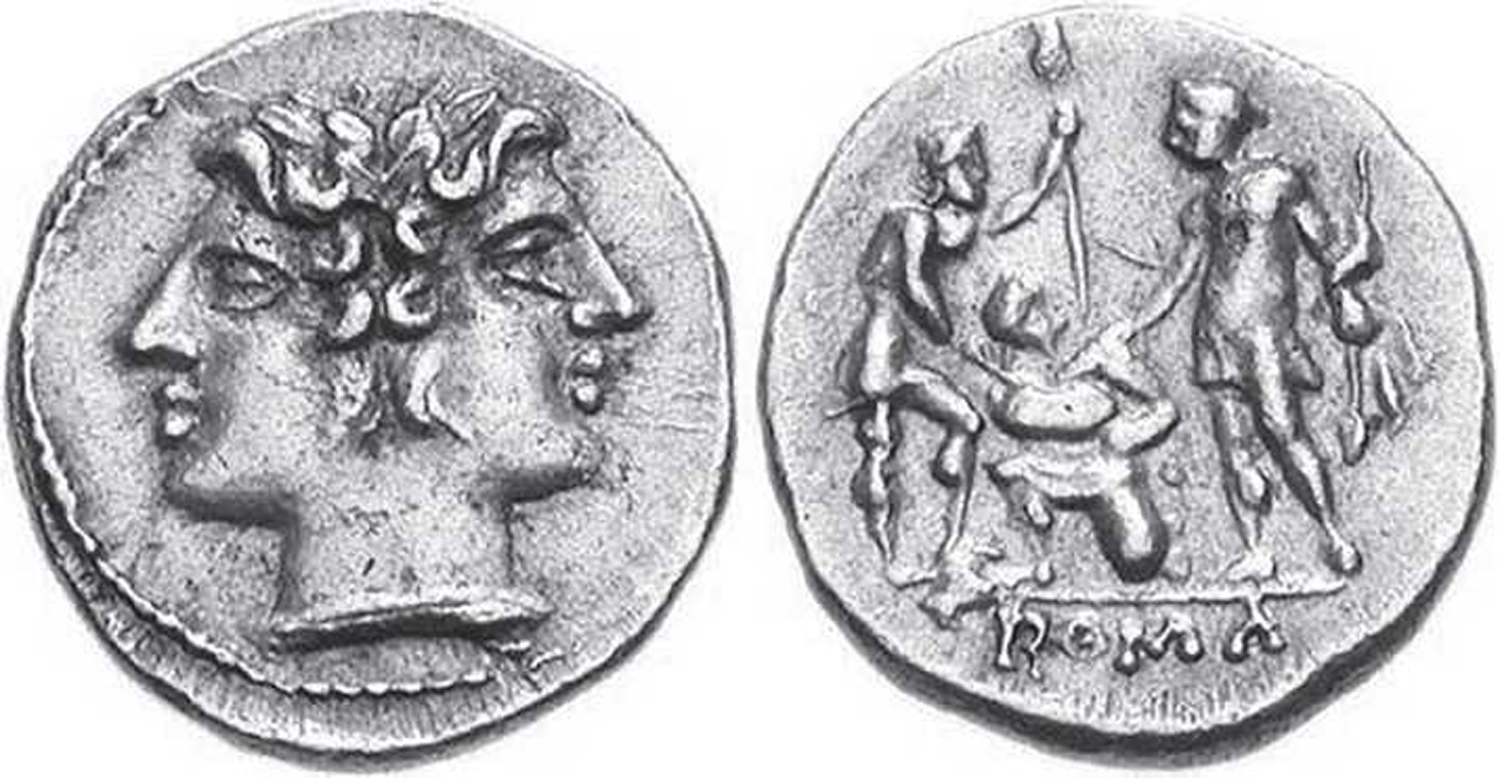
Figure 2.1: Gold half-stater. Obverse: laureate, Janiform head of the Dioscuri. Reverse: oath-taking scene. Two soldiers, one in armour and the other without, each holding a spear in his left hand and touching a pig, held by a kneeling figure between them, with their swords; legend in exergue: ROMA; 225–212 BC.(Courtesy of Classical Numismatic Group)
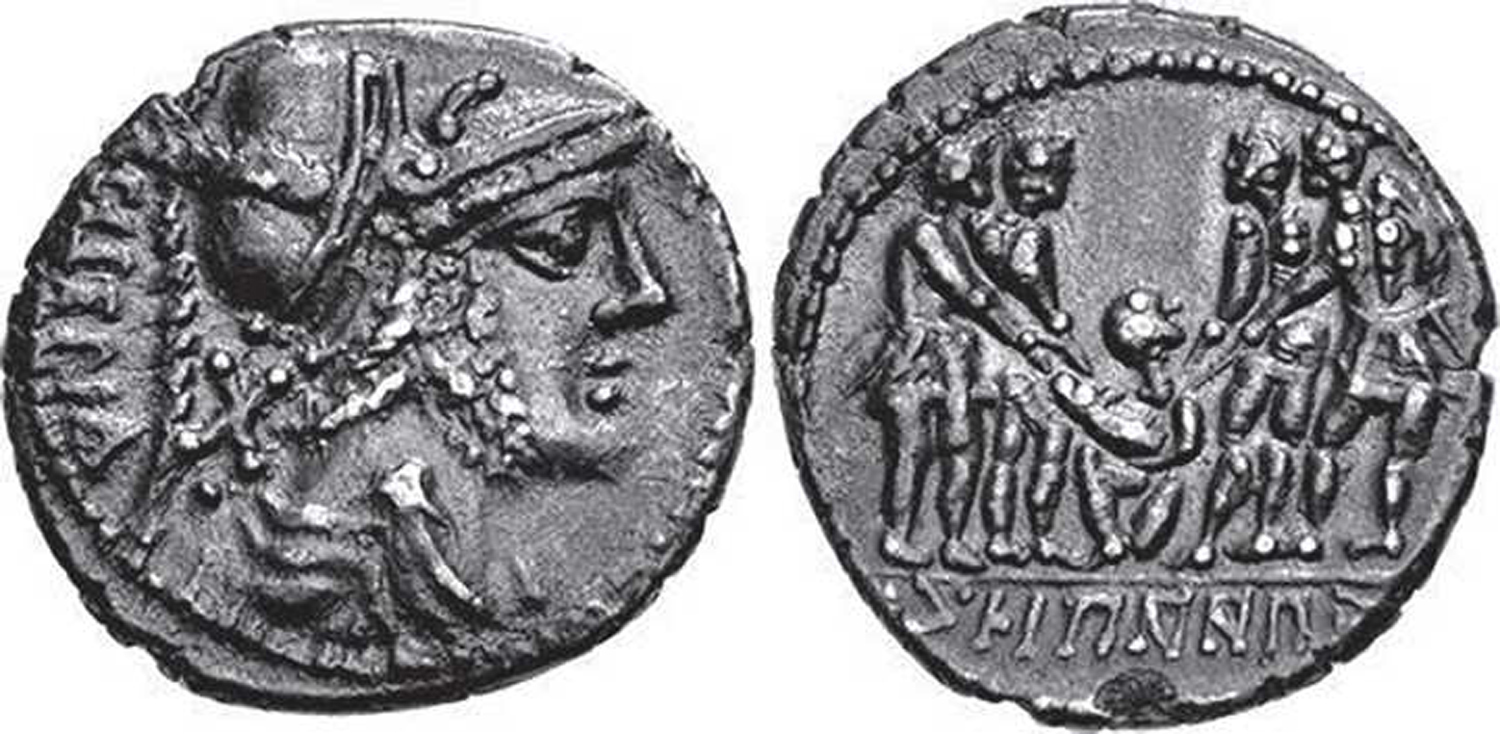
Figure 2.2: Silver denarius. Obverse: draped bust of Mars; legend in exergue: VITELIÚ (‘Italy’, in Oscan). Reverse: oath-taking scene. Four soldiers, two on each side, touch a pig held by a kneeling figure between them with their swords. Legend in exergue: C. PAAPII. C. (in Oscan); 90–88 BC. (Courtesy of Classical Numismatic Group)
An ‘Initiation’ or ‘Transition’ or a Bond of Loyalty47
Ancient Roman warfare was steeped in religion – from the fetial rite and taking of auspices prior to a campaign, to the offering of thanks to the gods at its successful conclusion.48 The Roman military oath was also part of this phenomenon. Beyond the aspect of an oath with which we are perhaps most familiar – a sacred affirmation of loyalty – the Roman military oath also marked an important point of transition: from citizen – a civis or Quiris - to soldier, or miles.49 The symbolic importance of this distinction is well illustrated by an anecdote attached to Caesar, who reportedly was able to regain the loyalty of his soldiers merely by addressing them as Quirites (citizens) as opposed to milites (soldiers), suggesting they had lost the privileged and distinct status of being a soldier.50 This is particularly true of the oath taken at the point of a citizen soldier’s enrolment in the legions. However, when the oath was sworn again subsequent to this point of enrolment, such as when there was a change of a commander or simply an annual renewal of the oath under the Empire (see below), the emphasis was instead on loyalty, in particular to the commander -later emperor – reflected in the fact that the oath had to be taken again when the commander changed.51
The transition from civis to miles had important secular aspects. Soldiers were in a somewhat anomalous position, in some respects legally privileged – thus soldiers were exempt from strict requirements on will-making – but in other respects disadvantaged: for example, they were liable to corporal punishment and even summary execution in a way that citizens were not and, between the time of Augustus and Septimius Severus, they could not marry.52
The transition also had an important religious consequence. In particular, it exempted the soldier from the pollution associated with killing.53 This emerges clearly in an anecdote preserved in the work of the first-century BC orator Cicero about the famous second-century BC politician Cato the Elder. Cato’s son had been discharged from service while fighting against the Macedonian king Perseus in 168 BC. Cato’s son wished to continue serving in the army, but his father advised him to renew his military oath or sacramentum, as Cato thought ‘it was not right [or ius] for a person who was not a miles to fight the enemy’ (negat enim ius esse, qui miles non sit, cum hoste pugnare).54 In a similar manner, Servius, the late fourth-century AD commentator on Virgil, states that the sacramentum was the distinguishing mark of ‘legitimate military service’ (legitima militia), as opposed to other types of military action.55
Was this transition between Quiris and miles the equivalent of an ‘initiation’, such as that involved in antiquity in joining a mystery religion like the Eleusinian Mysteries?56 Key to this question is the murky connection with an ancient Samnite ritual described at length by Livy in his history. Prior to a crucial battle with Rome in 293 BC, the Samnites are said to have recruited a special legion by a process known as a lex sacrata, where one man in turn chooses another man to join the army, which was then followed by a particularly gruesome ritual – alleged to be an ancient rite (ritu ... uetusto) -where each individual swore an oath cursing himself and his family if he did not follow his commander into battle, fled or did not kill another who was in flight. Those who refused the oath were themselves killed and left beheaded before the altar amongst the sacrificial victims as a warning to others.57 Livy deliberately associates this ritual with initiation into mystery religions, making an analogy between the soldiers and initiation.58 Livy further uses similar language to describe this initiation and that of the infamous Bacchanalian conspiracy, involving an actual mystery religion, which he elsewhere describes in detail.59 In particular, Livy attributes a speech to the Roman consul stating that young men who had been initiates of the Bacchic religion could not be soldiers.60 On the basis of this description, it has been argued that the military oath of the Romans can be traced back to a Samnite – or even Indo-European – origin, and that the Roman sacramentum also had a similar initiatory aspect.61 However, the Livian narrative presents a number of difficulties, such as how secret recruiting could possibly have worked in this context, and its historicity is highly dubious.62 There is, further, an important distinction here between soldiers’ oaths and mystery religion initiations in antiquity, that is, the sacramentum lasted no longer than the soldier’s period of military service; once released from service, the oath had no lasting impact – hence the need for Cato’s son to take the oath again.63 Rüpke has thus rejected the concept of the sacramentum as a ‘rite de passage’.64 Thus, we might perhaps best see the oath as transitional, without being ‘initiatory’. We can see a similar transitional oath in the famous pledge of gladiators ‘to be burned, bound, beaten and to die by the sword’ that sacralised the takers and marked their transition to a gladiator, although like the oath of a soldier, this was not necessarily a life-long transition.65
Religious Conviction
The Greek historian Polybius, writing in the second century BC to explain the dominance of the Romans to his fellow Greeks, was of the opinion that the Romans’ success was at least partially explicable on the basis of their superiority in terms of the nature of their religious convictions. For Polybius, such religious conviction helped to maintain cohesion in the state, particularly among the masses – whom Polybius, in typical ancient elitist fashion, regards as ‘fickle, full of lawless desires, unreasoned passion and violent anger’66 – and permeated Roman public and private life.67 Polybius gives an example of the strength of ‘superstition’ amongst the Romans compared to among the Greeks:
‘Members of the [Greek] government, if they are entrusted with no more than a talent, though they have ten copyists and as many seals and twice as many witnesses, cannot keep their faith; whereas among the Romans those who as magistrates and legates are dealing with large sums of money maintain correct conduct just because they have pledged their faith by oath.’68
Thus in government, so in the Roman Army – the oath was seen as a means of maintaining discipline. Violation of the oath was regarded as nefas, a concept that carried with it connotations of religious violation.69 The persistence of this religious conviction, and also Roman self-identity as a most pious people, perhaps helps explain – in part – why the military oath was to enjoy such a long life, even after numerous civil wars and rebellions that might otherwise be thought to have discredited its efficacy.
Additional Oaths
In addition to this main oath taken upon enlistment, oaths were used at other times to bind soldiers to various duties. Thus, when construction of a camp was completed, all in the camp – including slaves – were made to swear to the tribunes that they would steal nothing from the camp or 10 miles around it, and bring anything found, with some limited exceptions, to the tribunes or other officers.70 After enlistment, troops would also swear to appear at a certain location and day to rendezvous with the commander, unless a certain exemption applied.71 Soldiers also vowed not to leave behind the standards.72
The Military Oath at the Fall of the Republic
Dionysius of Halicarnassus observed that the military oath was one that ‘the Romans uphold above all others’.73 Nonetheless, it proved frangible in times of stress. The civil wars in the final century of the first millennium BC saw the paradox – to be repeated throughout Roman history from this point – of the breaking of oaths by soldiers, yet at the exact same time a repeated emphasis on the oath as an important performative demonstration of loyalty: that is, the very person who encouraged the breaking of the sacramentum demanded a new oath immediately upon the act of rebellion as a symbol of the changed bond of loyalty. Thus, as the sacramentum initially played a role in forging loyalty to a commander in the absence of gens-based ties, so oaths continued to play an important role in buttressing support for a commander as other changes to Roman military service increased the bond between soldier and general – a bond that would ultimately be exploited to lead Roman to fight Roman.
The various changes that occurred in relation to military service over the course of the Republic, particularly in the wake of Marius’ reforms to the military, are quite well known: increasing length of campaigns and service under one commander, the inclusion in the Roman Army of those for whom the army was the main hope of social advancement, and the reliance of soldiers on their commander – rather than the state – to secure for them benefits at the end of service, such as retirement money and land.74 In addition, commanders also relied on the impact of an oath in attempting to secure the loyalty of their soldiers for civil war or other ventures that could, ostensibly, be cast as against the state. As before, we do not have specific evidence of the oath’s terms in the wake of Marius’ reforms.75 The fact that the commander, as far as our evidence allows us to see, had always been a central focus of the sacramentum, made it readily malleable to use in favour of the personal ambitions of that commander.
The complex events of the civil strife of the 80s BC between Marius and Sulla provide some good evidence of this manipulation of oaths for personal advancement. Whether the oaths of allegiance sworn at these particular moments of crisis mirrored the sacramentum, or were particular to the circumstances, is not always clear in the sources. Nonetheless, on some occasions, at least, it seems likely that the oaths were peculiar to the needs of the specific situation, rather than a general oath.
We cannot hope to recover the full kaleidoscope of personal subjective experiences, or decisions, of the soldiers who made new oaths, or broke with old ones, in these times of crisis and civil war. Instead, we have to rely on generalizations and assumptions made usually by historians, and often long after events. Appian’s analysis of the civil war in 41 BC is illustrative of ancient thinking on the causes of the breakdown of military discipline in this period:
‘The cause was that the generals, for the most part, as is usually the case in civil wars, were not regularly chosen; that their armies were not drawn from the enrolment according to the custom of the fathers, nor for the benefit of their country; that they did not serve the public so much as they did the individuals who brought them together; and that they served these not by the force of law, but by reason of private promises; not against the common enemy, but against private foes; not against foreigners, but against fellow-citizens, their equals in rank. All these things impaired military discipline, and the soldiers thought that they were not so much serving in the army as lending assistance, by their own favour and judgment, to leaders who needed them for their own personal ends. Desertion, which had formerly been unpardonable, was now actually rewarded with gifts, and whole armies resorted to it, including some illustrious men, who did not consider it desertion to change to a like cause, for all parties were alike, since neither of them could be distinguished as battling against the common enemy of the Roman people. The common pretence of the generals that they were all striving for the good of the country made desertion easy in the thought that one could serve his country in any party. Understanding these facts the generals tolerated this behaviour, for they knew that their authority over their armies depended on donatives rather than on law.’76
Nonetheless, even in this period of indiscipline, the good of the state was held forth as a pretext for civil war, and this was true throughout the conflict in the late Republic. Thus it cannot be assumed that venality or mercenary motivations were the only driving force for soldiers breaking their oaths.77 Certainly, those Romans writing about the period could envisage that the oath mattered to both leaders and soldiers,78 and that the soldiers would need to be persuaded either as to reasons to break their oaths, or as to why they might be convinced that they were no longer bound by them. Caesar addresses this issue explicitly when he attributes a speech to his general, C. Scribonius Curio, as he addresses soldiers that had previously served under the Pompeian general L. Domitius:
‘They say that they were abandoned and betrayed by you, and refer to your former oath [ sacramentum]. But did you abandon Lucius Domitius, or did Domitius abandon you? Was it not the case that he forsook men who were prepared to endure the worst? Did he not seek safety for himself in flight without your knowledge? After you were betrayed by him, were you not saved by Caesar’s favour? How could he have used the oath to hold you, given that, after having thrown away the insignia of office and relinquished command, as a private citizen and prisoner of war he has himself come into the power of another? The result is a strange sort of obligation: you are to neglect the oath that currently binds you and respect one that has been invalidated by the general’s surrender and loss of citizen status.’79
Here, Caesar both imagines that allegations of oath breaking will have resonance with the soldiers, and attributes a speech to Curio that is designed to address these concerns by emphasizing the delegitimizing of L. Domitius through his loss of command.
One of the first examples of this strategic use of the oath is the consul Cinna, elected after the Roman proconsul Sulla had marched on Rome in 88 BC to prevent the transfer of command of an expedition to the East to Sulla’s rival Marius.80 Cinna was driven from Rome by his consular colleague, Octavius, after proposing to reintroduce controversial legislation. Cinna went to the town of Nola, where Sulla had left an army besieging the city. Cinna won this army over, either through persuasion or with the promise of rewards (or both), and the tribunes had the army swear the oath of loyalty to him.81 Subsequently, Fimbria, who had murdered a consul and taken his army, attempted to use an oath to secure the support of this army in the face of Sulla’s approach.82
An important turning point in this regard is located by some scholars in Sulla’s rebellion commencing in 84 BC.83 The first-century AD biographer Plutarch, who had access to Sulla’s memoirs,84 tells us that Sulla bound the army to himself by an oath to follow him as he was about to lead his army back to Italy against Rome:
‘When Sulla was about to transport his soldiers, and was in fear lest, when they had reached Italy, they should disperse to their several cities, in the first place, they took an oath of their own accord to stand by him, and to do no damage to Italy without his orders; and then, seeing that he needed much money, they made a free-will offering and contribution, each man according to his abundance.’85
In some respects, these oaths of the 80s BC are an evolution of the tradition. As we have seen, the taking of an oath in a time of crisis has a long history. Further, the oath had always possessed, as far as our evidence allows us to see, a strong personal element between soldier and commander – in fact, it is unclear when a reference to the state was included in the oath. Such a reference only appears in late sources from the fourth century AD, and may only have been included in the imperial period when the distinction between state and emperor, to whom the oath was given, had broken down.86
The two-edged nature of the oath is shown by instances where reference to it could restore order. Thus, during the civil war between Caesar and Pompey, Curio was able to restore order by reminding soldiers of their oath.87 However, the continual undermining of discipline that persisted through the civil conflicts at the end of the Republic had deleterious effects on discipline and loyalty as a whole, including regard for the sacramentum. Hence, when mutiny broke out among Octavian’s soldiers in Sicily after he had lured away those of Lepidus through promises of bonuses, and a disregard for their own oaths to Lepidus, Octavian found that reminding soldiers of their oaths – and harsh discipline – did little to restore order.88
Nevertheless, the persistence in demanding the oath must have reflected a belief that it could play some role in securing the loyalty of the soldiers, even as its repeated use diminished its reputation.89 Thus, oaths were not only used when commanders changed, but were explicitly exacted – in addition to the oath already sworn – when a crisis was suspected. Thus, in the civil war between Pompey and Caesar in 49 BC, the Pompeian general in Spain, Petreius, suspected desertion and exacted an additional oath from the troops not to desert the army and its leaders nor to adopt any course of action that had not been agreed to by all.90 Caesar goes so far as to assert the effectiveness of this oath – increasing the resolve of the soldiers on account of the new sanction (religio) of the oath.91 These oaths, while overlapping with the core of the traditional sacramentum – such as the obligation not to desert – appear also to have incorporated elements particular to the situation at hand.92
Not only did the competitors for dominance in the Roman world after Caesar bind the soldiers with oaths, they also made use of oaths on the civilian population.93 Thus, in 44 BC, with conflict looming between Antony and Octavian, Caesar’s heir had suborned two of Antony’s legions through a bribe. Antony, on the verge of marching to Gaul to confront Decimus Brutus, who had refused to surrender his command, was swearing in soldiers to himself at Tibur – both those present and a large group of veterans – when a group of senators, equites and other influential men arrived and voluntarily took an oath not to fail in friendship and faith to Antony (οὐκ ἐκλείψειν τὴν ἐς ’A03BD;τώνιον εὔνοιάν τε καὶ πίστιν). It is uncertain what to make of this formulation: the idea of εὔνοια or ‘good will’ seems out of place in the sacramentum, given what we otherwise understand of its content focused on discipline regardless of the soldiers’ disposition towards the commander.94
Perhaps more famously, in the lead-up to Octavian’s decisive battle with Antony and Cleopatra at Actium in 32 BC, Italy – along with the Gallic and Spanish provinces, Africa, Sicily and Sardinia – swore an oath of allegiance to Octavian and called on him to take command in the civil war.95 The formulation of this oath is unknown and unknowable on the present evidence.96 It does seem, however, that the unusual order of events (usually the appointment of commander preceded the oath) links the oath with an attempt to legitimize Octavian’s command now that his power to command – that had been granted to him as a triumvir, along with Antony and Lepidus – had expired following Caesar’s assassination.97 Such oaths of loyalty by civilians continue as a feature of the principate, as discussed below, and some from the imperial period have survived intact, as opposed to the text of the soldier’s oath.
The Coming of the Principate
Octavian’s victory in the civil conflict with Antony and his subsequent establishment of the system of government we today call the ‘principate’ were based to a large extent on his domination based on military power.98 Utilizing – and expanding upon – Republican precedents, Octavian secured a near monopoly of military power in 27 BC when he was granted a provincia – or command – that comprised the provinces in the Roman Empire that contained the vast majority of Rome’s legions. These he commanded through legates, rather than in person. As a consequence of this delegated command, the soldiers swore their oath not to their immediate commander, but to Octavian – now Augustus – as their supreme commander.99 As before, the oath could summon soldiers back to obedience. Thus, soldiers on the frontiers in Pannonia, restive in the wake of Augustus’ death and Tiberius’ accession in AD 14, lost their enthusiasm for rebellion out of concern for the impact of breaking their oath.100
Occasion for Taking the Oath
Both the occasion for taking the oath, and its content, underwent some change during the imperial period. During the Republic, as noted above, the sacramentum was taken on two occasions: when recruits joined the Army and when its commander changed. These two occasions for swearing the oath remained in the Empire, although modified to reflect the position of the emperor as the commander of the Roman Army. In addition, the oath became the subject of annual ceremonial renewal in the Empire.101 Thus, we find evidence of new recruits swearing an oath on joining the Army right through to late antiquity.102 However, Augustus’ creation of a standing army with fixed terms of service required a change to the oath taken on enlistment.103 Whereas, formally, the oath only lasted for the length of a campaign, now it was for the period of service, or stipendium militiae.104 As a change of commander in the Republic had required a renewal of the oath, so too in the Empire with a change of emperor, now supreme commander of all the armies.105
Although the oath was taken for the duration of service, nonetheless in the Empire it became the subject of renewal on at least two occasions, although it is unclear when each of these dates was instituted as a regular date for renewing the oath.106 By the AD 60s, it had become usual to renew the oath on the first day of January.107 However, by the reign of Trajan, it appears that the oath was renewed on 3 January, the day on which annual vows (vota) were taken for the health of the reigning emperor and that the Roman Empire might be eternal.108 In addition, by the time of Trajan, the oath was also renewed on the anniversary of the emperor’s accession to power – referred to as his dies imperii (‘day of power’).109 The importance of this additional occasion is easy to discern: it was a deliberate expression of the bond between the emperor and the soldiers who simultaneously reinforced this connection. The correspondence between Pliny and Trajan, where Trajan explicitly acknowledges his pleasure at the oath-taking of the soldiers and citizenry, shows that the emperors themselves took a keen interest in the fact that these oaths were taken.110
It is easy to see why the imperial period saw the institution of such annual symbolic expressions of loyalty to create and reinforce the bond between emperor and soldier. In the Republic, the soldiers could expect to see the leader to whom they took the sacramentum on a fairly regular basis, even in a large army that would at times be divided among subordinate commanders, such as Caesar’s army in his campaigns in Gaul. However, in the early principate, it was relatively rare for an emperor to lead an army, and even if he did, he would almost never see his entire army. Even when it became more common for emperors to command from the Severan period onwards, they would be unlikely to see the entirety of their armies. This greatly enhanced the importance of the creation of symbolic bonds of loyalty between emperor and soldier, such as the annual renewal of the sacramentum111
There also appears to have been a change from the Republic in the manner in which the oath was sworn, at least in relation to the annual renewal of the oath. Thus, in the tumult that attended the 1 January renewal of the oath for Galba, the soldiers appear in their ranks to take the oath but ‘only a few in the front rows repeated it [the oath], the rest remained silent, waiting on the courage of his neighbour’.112 This suggests that the soldiers took the oath en masse, rather than individually.113
It seems highly likely that the presence of the Roman military standards (signa militaria) at the occasion of swearing the oath helped, or was intended to help strengthen the binding effect of the oath. The hand symbol found on Roman standards has been interpreted as representing the raised hand of the soldier during the oath-taking ceremony, and its presence served as a constant reminder of this oath. Indeed, this type of standard is often depicted on coins along with legends celebrating the army’s loyalty.114
Content of the Oath
We are no better informed as to the content of the imperial oath than in the Republic, although what evidence there is suggests some continuity. Thus, Servius, writing in the fourth century AD, informs us that the oath included an obligation to obey and an obligation not to desert. The stoic Epictetus, writing around the turn of the second century AD, also informs us that the oath included an obligation to protect the safety of the emperor above all others.115 This later obligation is not mentioned in relation to the earlier Republican oaths and suggests that the military sacramentum had absorbed an element found in civilian oaths to the emperor (see below).116
Did the oath involve a reference to the state, or the senatus populusque Romanus, in addition to the emperor? Here the evidence is unclear. Two late sources, the commentator Servius and military writer Vegetius, both of the fourth century AD, indicate that the oath did include such a reference. However, when describing the beginnings of a revolt against Galba, Tacitus states that the soldiers of Legion IV did not take an oath to Galba, but rather to the ‘now forgotten names’ of the Senate and People of Rome.117 On the one hand, this could be taken to indicate that the oath did not usually include these words. However, on the other hand, this Tacitean remark may be more figurative than literal: that is, it is not that such terms were not regularly invoked in the oath, but that either the actions of the armies in the period covered by his Histories showed scant regard for the Roman state or the soldiers’ omission of Galba highlighted the presence of the res publica in the oath.118
In the imperial period, as in the Republic, there appear to have been supplementary oaths sworn by the soldiers in addition to the sacramentum upon recruitment and the annual renewal of the oath. Thus, we know that the cohort at Dura-Europos swore an oath daily that they would ‘do what has been ordered and will be ready for all orders’.119
Soldier Oaths Versus Civilian Oaths120
A further change between the Republic and principate was the institutionalization of a civilian oath of loyalty to the princeps, or emperor. Such an oath had, as we have seen, its roots in the civil conflict at the end of the Republic. While no complete text of a military oath has been preserved, several versions of the civilian oath survive in inscriptions when members of provincial communities wished to both preserve, and advertise, their demonstrations of loyalty through public commemoration.121 The texts of these oaths vary, but include at times a military orientation and also an obligation to place the welfare of the emperor ahead of oneself and one’s own – a parallel with the idea contained in Epictetus’ description of the military oath. Further, Pliny informs us that the annual renewals of oaths of loyalty could occur at the same ceremony for soldier and provincial alike.122 Similarly, there is evidence that civilians and soldiers may have taken oaths at the same time at the accession of an emperor.123
What should we make of this overlap? It has been argued that the military sacramentum was sworn by soldiers at the time of enlistment, and perhaps change of commander, but, at the annual renewals, soldier and civilian alike swore the same oath.124 However, there is no firm evidence to support this hypothesis. Further, there are some arguments to suggest why this might not have been the case. For example, when Tacitus describes the mutinous legions’ decision to give their sacramentum to the Senate and People, rather than to the emperor, this action seems more apt for the regular military oath than the personalized oath of allegiance taken by the People. Further, the distinctive aspects of the military oath would appear to be as worthy of repetition as the obligations contained in the civilian oath of allegiance.125 Crucially, while an obligation not to desert the commander seems to have been a central clause of the sacramentum, such an obligation is not included in the surviving texts of the civilian oath.126 It does seem likely, however, that the content of both the civilian and military oaths may well have changed depending on circumstances. Thus, Suetonius states that Caligula caused his sisters to be included in ‘all oaths’ (omnia sacramenta).127
Effectiveness of the Oath?
As with the Republican period, we lack any direct evidence of the subjective experience of soldiers of the obligations stemming from the oath. Thus, while on the one hand we have texts like the first-century AD philosopher Seneca the Younger’s claim in his epistles that the soldier’s primary bond was religio and it was considered nefas – or a breach of divine law – to desert the army,128 we also have plentiful evidence of soldiers breaching their sacramenta in times of civil war.
We do have some evidence that religious scruples were still of some influence on the soldiers. Thus, a mutiny at the accession of the second emperor, Tiberius, in AD 14 was quelled when soldiers became suspicious that an eclipse was an omen of the failure of their revolt.129 In AD 42, the legate of the province of Dalmatia, Furius Camillus Scribonianus, attempted to suborn the legions to revolt against the emperor Claudius. The second-century AD biographer Suetonius records that the revolt was short lived, as the soldiers refused to follow Scribonianus after an ill omen: they were unable to remove the standards from the ground.130
More directly related to the oath are examples of soldiers demonstrating some scruples in relation to it in moments where revolt was in the air, such as the civil war of the period AD 68–69, when there were four different claimants for the imperial purple. Thus, in an example already discussed, soldiers contemplating revolt from Galba chose to change the object of their oath from the emperor himself to the Senate and People of Rome.131 Similarly, soldiers who had previously sided with Vitellius either murmured or passed over Vespasian’s name in silence when called upon to make an oath to him following the significant victory of Vespasian’s army at Cremona.132 In the same way, the call to take the oath is seen as a critical time when legions loyal to Vitellius refused to take an oath to Vespasian.133
It is not only in their interpretation of the motivations of soldiers that historians refer to the oath. Such references also appear in speeches that the historians construct for their historical protagonists, which, however loose a connection they bore to whatever was actually said, should at least have appeared as plausible to the historian’s audience. In this context, the third-century historian Herodian imagines Pupienus (Maximus) would have laid great emphasis on the military oath in addressing the former troops of Maximinus Thrax after their overthrow of this emperor – he even has Pupienus refer to the oath as the ‘holy secret’ (σεμνὸν μυστήριον) of the Roman Empire:
‘In place of war you are at peace with the gods in whose name you took your oaths, and you are now being true to your military vow, which is the sacred secret [σεμνὸν μυστήριον] of the Roman empire.’134
Why did the oath appear as a restraint in some instances, but not others? It is difficult to come to general conclusions. The ancient sources themselves often explain periods of anarchy in very similar terms to those in which Appian explained the breakdown of military discipline in the Republic, such as a lack of discipline and the soldiers’ greed, of which Plutarch provides an eloquent summary:
‘Many dire events, and particularly those which befell the Romans after the death of Nero ... show plainly that an Empire has nothing more fearful to show than a military force given over to untrained and unreasoning impulses ... the Roman empire was prey to convulsions and disasters like those caused by the Titans of mythology, being torn into so many fragments, and again in many places collapsing upon itself, not so much through the ambition of those who were proclaimed Emperors, as through the greed and licence of the soldiers, which drove out one commander with another as nail drives out nail.’135
While the free-flow of bribes and other promises from aspiring claimants to the purple certainly suggest material motives as a driving force in determining whom soldiers supported, the extensive efforts of such claimants to contest the legitimacy of other claimants to the throne on various grounds relating to their suitability highlights that – as in the Republican civil wars – more than just material concerns were involved. The legitimacy of an emperor in part depended on his charismatic authority.136 As the oath focused on the individual, should that individual – such as a Nero – appear to lose his legitimacy, the oath itself could appear to lose its validity.
A Period of Turmoil: 235–285
Although the period following AD 235 was one of much greater political turmoil, with many more usurpations than had happened previously – particularly from AD 235–285, when there were over fifty aspirants to the imperial purple in almost as many years – nonetheless the sacramentum continues to be envisaged by authors writing about this period as an important component of securing the bond between emperor and soldier. Thus, upon hearing of Maximinus Thrax’s revolt against him, Severus Alexander is said to have thought it was rash of the recruits to violate their oaths, and Herodian has Pupienus invoke the sacramentum following the defeat of Maximinus.137
Why soldiers were ever-more willing in this period to break their oaths is complex, and worthy of more discussion than we might provide here.138 Nonetheless, we might identify three key factors. Firstly, the weakness of the Roman imperial succession system: whenever the dynastic system collapsed (as it did repeatedly in the third century), the absence of a clear succession system rendered the legitimacy of competing claimants more questionable. Secondly, increased external pressure from invasion, combined with the focus on the emperor as protector of the Empire, led to the support of successful local commanders as ‘emperor’ – such as for the pretender Postumus in the so-called Gallic empire in the AD 260s, when the more distant emperor had failed to provide protection. Lastly, the increased conflict from civil and external wars helped precipitate an economic crisis that, with rampant inflation, made soldiers even more susceptible to bribes in support of a new contestant for the purple.139 In essence, while the sacramentum might strengthen an army’s fidelity, loyalty largely depended on the army’s attitude to the emperor,140 which could be affected by their material and circumstantial needs – such as whether the emperor had proved an adequate leader.
The Later Empire
Although the fourth century AD was more stable than the preceding one, nonetheless this era saw more than ten usurpers – including two very successful ones who went on to reign (Constantine and Julian).141 Vegetius, writing most likely in the late fourth century AD, makes it clear that the sacramentum continued to be sworn, only adopting a Christian focus:142
‘The soldiers are marked with tattoos in the skin which will last and swear an oath when they are enlisted on the rolls. That is why they are called the sacraments of military service. They swear by God, Christ and the Holy Spirit, and by the majesty of the Emperor which second to God is to be loved and worshipped by the human race. For since the emperor has received the name of the “August”, faithful devotion shall be given, unceasing homage paid him as if to a present and corporeal deity. For it is God whom a private citizen or a soldier serves, when he faithfully loves him who reigns by God’s authority. The soldiers swear that they will strenuously do all that the Emperor may command, will never desert the service, nor refuse to die for the Roman state.’143
The Christian component of the oath represents a late development, probably of the reign of Theodosius or his children, and even then it was probably not universal.144
Despite the ongoing turmoil, oaths in the fourth century are seen as playing a role in securing the loyalty of the soldiers in the usurpations of Julian and Procopius, and in Constantius II’s efforts to recall to loyalty the soldiers who had joined the usurpation of Vetranio in AD 360.145 Nonetheless, usurpations continued, the oath being only one aspect of the bond between emperor and soldier.146
There are two descriptions of oath-taking by the soldiers during usurpations in the fourth century. Procopius, a usurper posing as a successor after feigning that the reigning emperor Valens was dead, has troops swear ‘allegiance to Procopius with dire penalties for disloyalty, promising to stand by him and protect him with their lives’, which broadly corresponds to Vegetius’ descriptions of the oath, with the addition of references to penalties.147 The most detailed description of the ceremony involved is of the soldiers swearing allegiance to the future emperor Julian as he commenced his usurpation against Constantius in AD 361:
‘All had been bidden to take the usual [sollemniter] oath of allegiance in Julian’s name; aiming their swords at their throats, they swore in set terms under pain of dire execrations that they would endure all hazards for him, to the extent of pouring out their life-blood, if necessity required; their officers and all the emperor’s closest advisers followed their example, and pledged loyalty with like ceremony.’148
Although Ammianus describes this as ‘customary’ (sollemniter), the extent to which we might generalize from it is complicated by the fact that this is an oath taken at the commencement of a usurpation. As in the civil war context of the late Republic, and at earlier points in the Empire, such a context can produce modifications to the usual form – thus, while Vegetius refers to the state in his description of the oath, the loyalty described here is intensely focused on Julian himself. The process of the soldiers holding a sword at their own throats – not earlier or elsewhere attested for the sacramentum – is most likely a reflection of the changed recruiting patterns of the Roman Army. The majority of Julian’s troops would have consisted of people from a non-Romanized background, and this custom is elsewhere attested for Quadi.149 Importantly, one officer – the praetorian prefect Nibridius – refused to swear the oath due to his loyalty to Constantius, demonstrating further the seriousness with which swearing the oath was still taken.150
Christian Attitudes to the Oath
By the time Vegetius is writing, in the late fourth or early fifth century AD, the sacramentum had become Christian, or at least could be sworn in Christian terms. Earlier Christian texts occasionally use the military oath as a foil to contrast the civil militia with the militia Christi. Such texts are quite polemical and unreliable: Christians served in the Roman Army beyond Diocletian’s purge in the early fourth century AD, so most did not openly struggle with the obligation imposed by the oath.151 Nonetheless, despite their exaggerations, the fact that the Christian sources are able to deploy the oath in the rhetorical way that they do suggests that the sacramentum was generally conceptualized more broadly as having some significance. Thus the centurion Marcellus in the late third century AD renounces his military oath, saying that he cannot serve under his oath, only for Jesus Christ.152 Tertullian, writing in the late second and early third centuries AD, also discusses the incompatibility of the sacramentum with service to Christ.153
Cult of the Genii Sacramenti
Beyond the rituals involved in the initial swearing of the sacramentum and the annual renewals of the oath, it appears that there also existed a cult specifically dedicated to the genius – or tutelary deity – of the sacramentum (the Genius sacramenti).154 What this cult involved and when it evolved are unclear, although it is clear that it was one of many cults of genii particular to the military that contributed to the morale and cohesiveness of the soldiers as a group, such as cults of the genius of the standards (Genius signorum) or particular military groups (for example, the Genius cohortis).155
Conclusion
The origins and terms of the Roman military oath may be obscure, but its longevity is clear. The persistence of the oath seems on the one hand curious given the frequency with which it was broken, particularly in times of crisis – such as the collapse of the Republic, the succession wars in the imperial period of AD 69–70 and 193–197, and the so-called third-century crisis of AD 235–285. Nevertheless, this persistence is testament to the important role that it was conceived as playing, both as marking a transition from citizen to soldier and, particularly in the Empire, as symbolizing the ongoing loyalty between the soldier and an often distant emperor.
Notes
1. This author gratefully acknowledges his appointment as a University Associate of the University of Tasmania in the School of History and Classics within the College of Arts, Law and Education, which facilitated completion of this paper. The assistance of Dr Mark Hebblewhite and Prof. Matthew Dillon is also gratefully acknowledged. Infelicities and errors are of course the author’s own.
2. See, for example, Hebblewhite (2016b), pp.128–32.
3. For a summary of punishments, see Watson (1969), pp.117–26; for decimation, see Watson (1969), pp.119–20; Polyb. 6.38. For physical and mental elements of discipline, see Brice (2011), pp.36–39.
4. Brice (2011), p.37.
5. For the use of the oath in archaic and classical Greek culture, see the helpful website maintained by Nottingham University: <https://www.nottingham.ac.uk/˜brzoaths/database/>.
6. On the use of sacramentum in civil law, see Gai. 4.14–16; Rüpke (1990), pp.80–81; Ando (2011), pp.46–63.
7. On oaths to emperors more broadly, see Hermann (1968).
8. Brice (2011), p.37.
9. The annalistic historians take the year as their organizing principle, as do Livy and Tacitus in their historical works.
10. Two key foundational works highlighting these issues and the literary approach to be taken to them (sometimes referred to as ‘New Historiography’) are Wiseman (1979) and Woodman (1988); but see Lendon (2009).
11. See, for example, Potter (1990), pp.356–69.
12. The matter of the civilian oath is dealt with at length by Hermann (1968).
13. This evolution has been discussed by Armstrong (2016).
14. Armstrong (2016), p.273 n.241.
15. Tondo (1963), pp.70, 108–12.
16. Salmon (1967), p.185.
17. Livy 22.38.1–5. Virtually identical information is given in Front. Strat. 4.1.4, which probably depends on the Livian passage: Momigliano (1967), p.253.
18. See also Livy 3.20.3–6, 8.34.7–10 for references to this oath.
19. Front. Strat. 4.1.4.
20. Rüpke (1990), pp.77–79.
21. What made a man ‘most suitable’ (ἐπιτηδειότατος) is not specified, but it may have involved someone with a name of good omen – as was the case in selecting the first person to be levied: Cic. Div. 1.45; Poma (2015), p.705.
22. Polyb. 6.21.1–3. The phrase ‘idem in me’ is found in Paul the Deacon’s eighth-century AD abbreviation of the second-century AD lexical epitomizer Festus: Paul. Fest. 250L: ‘praeiurationes facere dicuntur hi, qui ante alios conceptis verbis iurant; post quos in eadem verba iurantes tantum modo dicunt: idem in me’: ‘Those are said to make praeiurationes who swear before others using set words, after whom in the same words the others swearing merely say “likewise for me”.’
23. Brand (1968), p.91 and n.33.
24. Patron-client relationships were an important part of Roman social relations: see, for example, Garnsey & Saller (2015), pp.177–79.
25. XII Tables 8.10. See Crawford (1996), pp.689–90.
26. Rüpke (1990), p.80.
27. For example: ὅρκος (oath), ὀμνύω/ὀμνῦμι (swear); Hebblewhite (2016b), p.175 n.113.
28. See Hebblewhite (2016a), p.120 n.1; Rüpke (1990), pp.76–77.
29. On the Second Punic War, see, for example, Hoyos (2013). Virtus is a difficult term to translate, but its semantic range includes valour and steadfastness, especially as displayed in war: see OLD ‘ uirtus’ 1.
30. For example, Livy 22.14.15.
31. See also Hinard (1993), pp.257–58.
32. Rüpke (1990), pp.78–79. While Rüpke is correct that the oath passage serves multiple purposes in Livy’s narrative, this does not itself provide grounds for rejecting Livy’s dating to this year of a change to a more formal method of taking the oath.
33. Brand (1968), p.95.
34. Livy 22.53.10–11.
35. For example, Polyb. 6.21.3; Livy 22.38.1–5. See also Caes. Gall. 6.1.2 for the oath sworn at a levy (dilectus): Harmand (1967), p.301.
36. Brice (2011), p.38.
37. Polyb. 6.21.3.
38. Brand (1968), p.92.
39. Dion. Hal. Rom. Ant. 10.18.2, 11.43.2; Watson (1969), p.49.
40. Serv. Aen 8.1.
41. See, for example, Crawford (1973), pp.4–6; Crawford (1974), pp.266, 715.
42. Found in Ghey, Leins & Crawford (2010), nos 28.1.2, 28.2.1; interpretation: Crawford (1974), p.715.
43. Found in Ghey, Leins & Crawford (2010), no. 234.1.4; interpretation: Crawford (1973), pp.4–6; Crawford (1974), p.266.
44. Sydenham (1952), no. 640a.
45. Sydenham (1952), for example, no. 637 (four soldiers in total); 619a (six soldiers in total); 619, 626, 629 (eight soldiers in total).
$$$46. Ghey, Leins & Crawford (2010), no. 28.2.1.
47. Brand (1968), pp.90–91.
48. For a summary of many of these, see Vendrand-Voyer (1983), pp.27–35; Rich (2013).
49. Dyck (1996), p.145; Nicolet (1980), pp.102–03.
50. Suet. Caes. 70; Chrissanthos (2013), p.321.
51. Brice (2011), p.38.
52. See, for example, Hebblewhite (2016b), pp.120–28.
53. Tondo (1963), p.25; Tondo (1968), p.381.
54. Cic. Off. 1.36–37. The fact that this story is told twice in a row – in longer form at 1.36 and then more succinctly at 1.37 – indicates a textual problem here. It is thought that the first version (which explicitly mentions the sacramentum) is an interpolation: Dyck (1996), pp.143–45.
55. Serv. Aen. 2.157, 7.614 and 8.1. On some difficulties with these passages, see Rüpke (1990), pp.70–75.
56. On the Eleusinian mysteries, see, for example, Larson (2016), pp.268–76.
57. Livy 10.38.11.
58. Livy 10.38.2.
59. The suppression of the Bacchanalia is dealt with in Livy 39.8–19; commentary: Briscoe (2008), pp.230–94. See Tondo (1963), pp.87–94, 110; Tondo (1968), p.384; Oakley (2005), pp.400, 404–05.
60. Livy 39.15.3; Rüpke (1990), p.84.
61. Tondo (1963), pp.108–12; Tondo (1968), p.389.
62. On which, see Salmon (1967), pp.183–86; Oakley (2005), pp.396–97; Rüpke (1990), pp.81–82.
63. Rukpe (1990), p.88.
64. Rüpke (1990), pp.90–91.
65. Terms of oath: Petron. 117.5–6; Sen. Ep. 37.1, 71.23; Kyle (1998), p.87; Barton (1994), p.52.
66. Polyb. 6.56.11 (trans. Paton); see also Livy 1.19.4 on Numa’s alleged use of religion as a means of controlling the masses.
67. Polyb. 6.56.6–14.
68. Polyb. 6.56.13–14 (trans. Paton).
69. Brand (1968), p.91; see, for example, Sen. Ep. 95.35; Campbell (1984), p.29.
70. Polyb. 6.33.1; Gell. Noct. Att. 16.4.2.
71. Polyb. 6.26.2; Gell. Noct. Att. 16.4.3–4.
72. Ando (2000), pp.260–61.
73. Dion. Hal. Rom. Ant. 11.43.2.
74. See, for example, Crawford (1992), pp.123–27.
75. Hermann (1968), pp.61–62.
76. App. Civ. 5.17 (trans. White): see Brunt (1962), p.76.
77. Brunt (1962), p.76.
78. Campbell (1984), p.23.
79. Caes. Civ. 2.32.8–10 (trans. Damon): see Campbell (1984), p.21.
80. A succinct narrative of these events can be found in the classic Scullard (1982), pp.68–72.
81. Vell. Pat. 2.20.4 (promise of rewards); App. Civ. 1.8.66 (persuasion). Appian specifically refers to this oath as ὁ ὅρκος ὁ στρατιωτικός: the ‘military oath’.
82. App. Mith. 9.59.
83. For example, Campbell (1984), p.20; Phang (2008), p.119; Hebblewhite (2016a), p.122.
84. For example, Plut. Sull. 23.3.
85. Plut. Sull. 27.3 (trans. Perrin).
86. Rüpke (1990), p.89; our only references for it are Serv. Aen. 2.157, 8.1; Veg. Mil. 2.5 (clearly a late imperial context).
87. Caes. Civ. 2.32–33; Brice (2011), p.38.
88. Vell. Pat. 2.81.2; App. Civ. 5.128; Dio 49.13.2–14.1; Brice (2011), pp.48–49.
89. Brunt (1962), p.77.
90. Caes. Civ. 1.76: see Campbell (1984), pp.20–21. See also, earlier, when Fimbria attempted to have the army swear loyalty in the face of the advancing Sulla during the Mithridatic war (App. Mith. 9.59); and when Pompey’s officers, then soldiers, swore not to desert him before Dyrrachium in the civil war with Caesar (Caes. Civ. 3.13.3): see Hermann (1968), pp.62–63.
91. Caes. Civ. 1.76.5: nova religio iuris iurandi; see Campbell (1984), p.23.
92. Hermann (1968), p.63.
93. For example, in 49 BC, M. Terrentius Varro compelled the province Hispania Ulterior to swear allegiance to himself and Pompey (Caes. Civ. 2.18.15): see Hermann (1968), p.82.
94. Appian’s formulation is vague, and the possibility suggested by Hermann (1968), p.4, that they simply said ‘idem in me’ (likewise for me) as the soldiers had done, cannot be certain.
95. Aug. Res Gest. 25.1; see Hermann (1968), pp.78–89. Suetonius (Aug. 17.2) states that one town with historic loyalty to Antony was excused from swearing with the rest of Italy on behalf of Octavian’s ‘party’ or ‘faction’ (pro partibus suis).
96. Hermann (1968), p.88.
97. Hermann (1968), pp.85–86.
98. On the basis for Augustus’ power, and the importance of the military, see Crook (1996).
99. Stäcker (2003), p.293; Hebblewhite (2016a), p.121.
100. Tac. Ann. 1.28; Dio 57.4; Brice (2011), p.38.
101. Stäcker (2003), pp.295–96; Hebblewhite (2016a), pp.124–25.
102. Plin. Ep. 10.29; Veg. Mil. 2.5.
103. On the Augustan military reforms, see, for example, Raaflaub (2015).
104. Serv. Aen. 2.157; Isid. Etym. 9.3.53: see Campbell (1984), p.23.
105. For example, Dio 57.3.2; Tac. Ann. 1.7, 1.37 (Tiberius), Hist. 1.36 (Otho); Hdn 2.2.10 (Pertinax): see Campbell (1984), pp.25–27; Hebblewhite (2016a), p.125.
106. Hebblewhite (2016a), p.125.
107. Tac. Hist. 1.55.
108. Plin. Ep. 10.100–01; P Dura 54.2–6: see Hebblewhite (2016a), p.125; Ando (2000), pp.359–61.
109. Plin. Ep. 10.52: see Hebblewhite (2016a), p.125; Campbell (1984), p.27.
110. Stäcker (2003), p.296.
111. Campbell (1984), p.28.
112. Tac. Hist. 1.55: et raris primorum ordinum vocibus, ceteri silentio proximi cuiusque audaciam expectantes.
113. Stäcker (2003), p.297.
114. Hebblewhite (2016b), pp.165–66.
115. Epict. Disc. 1.14.15.
116. Hermann (1968), pp.113–14.
117. Tac. Hist. 1.55: senatuspopulique Romani oblitterata iam nomina sacramento advocabant.
118. Stäcker (2003), p.297.
119. P Dura 47: see Hebblewhite (2016a), p.126.
120. On the civilian oath, see Hermann (1968).
121. These are helpfully collected in Hermann (1968), pp.122–26.
122. Plin. Ep. 10.52, 10.100: Stracker (2003), pp.298–300.
123. Hdn 2.2.10 (Pertinax’s accession): see Campbell (1984), p.27.
124. The argument of von Premerstein, summarized in Stäcker (2003), p.300.
125. Stäcker (2003), pp.300–01; Hermann (1968), p.120.
126. Hermann (1968), p.88. The original Greek and Latin texts of many of these oaths can be found in Hermann’s appendix, pp.122–26.
127. Suet. Calig. 15.3: see Hebblewhite (2016a), p.124.
128. Sen. Ep. 95.35: ‘In such a manner, the primary bond of a soldier is religious awe [religio] and love of the standard, and the sin [ nefas] of desertion, then next easily other obligations may be given to him, and trusts exacted once the oath has been given’: Quemadmodum primum militiae vinculum est religio et signorum amor et deserendi nefas, tunc deinde facile cetera exiguntur mandanturque iusiurandum adactis.
129. Tac. Ann. 1.28.
130. Suet. Claud. 13.2. Note that Dio focuses instead on the soldiers’ belief that Scribonianus’ programme would lead them to strife: Dio 60.15.3; see Campbell (1984), p.30; Stäcker (2003), pp.302–03.
131. Tac. Hist. 1.55: see Stäcker (2003), pp.304–05.
132. Tac. Hist. 4.21: see Campbell (1984), p.31.
133. Tac. Hist. 4.21: see Campbell (1984), p.31.
134. Hdn 8.7.4 (trans. Whittaker): see Campbell (1984), p.30.
135. Plut. Gal. 1.3–4 (trans. Perrin): see Hebblewhite (2016b), pp.128–31.
136. See Ando (2011), p.293, for the impacts of charismatic authority in a civil war context.
137. Hdn 6.9.2 (Severus Alexander); 8.7.4 (Pupienus).
138. See further on this period Potter (1990); Potter (2014); Hebblewhite (2016a); Hebblewhite (2016b).
139. See Taylor (2010), esp. pp.378–90.
140. Hebblewhite (2016a), pp.141–42.
141. There can thus be counted in this century Constantine, Maxentius, Magnentius, Decentius, Vetranio, Calocaerus, Procopius, Marcellus, Julian, Magnus Maximus and Eugenius.
142. Hebblewhite (2016a), p.132.
143. Veg. Mil. 2.5 (trans. Milner).
144. Liban. Or. 30.53 suggests that oaths were still taken ‘by the gods’ by some high officers in Theodosius’ reign: Hebblewhite (2016a), pp.132–33.
145. Julian: Amm. Marc. 21.5.10; Procopius: Amm. Marc. 26.7.9; Constantius II: Zos. 2.44.1–2: Hebblewhite (2016a), pp.134–35.
146. Hebblewhite (2016a), 141–42.
147. Amm. Marc. 26.7.9 (trans. Rolfe): see Hebblewhite (2016a), p.131.
148. Amm. Marc. 21.5.10 (trans. Rolfe, adapted).
149. See Amm. Marc. 17.12.16, where the tribespeople beg for a sword to be held at their throat as part of a pledge of loyalty: Hebblewhite (2016a), pp.139–40.
150. Hebblewhite (2016a), p.140.
151. Phang (2008), pp.119–20.
152. Acta S. Marcelli, Rec. M. 2.19–21, as quoted in Hebblewhite (2016a), pp.128–29.
153. Tert. Idol. 19.2, Cor. Mil. 11.1: see Hebblewhite (2016a), p.137.
154. Attested in AE 1953, p.10; see Stäcker (2003), pp.305–06; Hebblewhite (2016a), p.127.
155. See further Stoll (2011), p.462.
Bibliography
Ando, C., Imperial Ideology and Provincial Loyalty in the Roman Empire (Los Angeles, 2000).
Ando, C., Law, Language and Empire in the Roman Tradition (Philadelphia, 2011).
Armstrong, J., War and Society in Early Rome: From Warlords to Generals (Cambridge, 2016). Barton, C.A., ‘Savage Miracles: The Redemption of Lost Honor in Ancient Rome and the Sacrament of the Gladiator and Martyr’, Representations 45 (1994), pp.41–71.
Brand, C.E., Roman Military Law (Austin, 1968).
Brice, L.L., ‘Disciplining Octavian: A Case Study of Roman Military Culture, 44–30 BCE’, in Lee, W.E. (ed.), Warfare and Culture in World History (New York, 2011), pp.35–59.
Briscoe, J., A Commentary on Livy, Books 38–40 (Oxford, 2008).
Brunt, P.A., ‘The Army and the Land in the Roman Revolution’, JRS 52 (1962), pp.69–86. Campbell, J.B., The Emperor and the Roman Army 31BC–AD 235 (Oxford, 1984).
Chrissanthos, S.G., ‘Keeping Military Discipline’, in Campbell, B. & Tritle, L.A. (eds), The Oxford Handbook of Warfare in the Classical World (Oxford, 2013), pp.312–29.
Crawford, M., ‘Foedus and sponsio’, PBSR 41 (1973), pp.1–8.
Crawford, M., Roman Republican Coinage, vols 1–2 (Cambridge, 1974).
Crawford, M., The Roman Republic (London, 1992).
Crawford, M. (ed.), Roman Statutes, vols 1–2 (London, 1996).
Crook, J.A., ‘Augustus: Power, Authority, Achievement’, in Bowman, A.K., Champlin, E. & Lintott, A. (eds), Cambridge Ancient History Vol. X: the Augustan Empire 44 BC–AD 70 (Cambridge, 1996), pp.113–46.
Dyck, A.R., A Commentary on Cicero, De Officiis (Ann Arbor, 1996).
Garnsey, P. & Saller, R., The Roman Empire: Economy, Society and Culture (Oakland, 2015).
Ghey, E. & Leins, I. (eds), with Crawford, M.H., A Catalogue of the Roman Republican Coins in the British Museum, with Descriptions and Chronology Based on M.H. Crawford, Roman Republican Coinage (1974) (London, 2010).
Harmand, J., L’armée et le soldat a Rome 105–57BC (Paris, 1967).
Hebblewhite, M., ‘ Sacramentum militiae: Empty Words in An Age of Chaos’, in Armstrong, J. (ed.), Circum Mare: Themes in Ancient Warfare (Leiden, 2016a), pp.120–42.
Hebblewhite, M., The Emperor and the Army in the Later Roman Empire, 235–395 (London, 2016b).
Hermann, P., Der römische Kaisereid: Untersuchungen zu seinerHerkunft undEntwicklung (Gottingen, 1968).
Hinard, F., ‘ Sacramentum’, Athenaeum 81 (1993), pp.251–63.
Hoyos, D., ‘The Second Punic War’, in Campbell, B. & Tritle, L.A. (eds), The Oxford Handbook of Warfare in the Classical World (Oxford, 2013), pp.688–707.
Kyle, D.G., Spectacles of Death in Ancient Rome (London, 1998).
Larson, J., Understanding Greek Religion (London, 2016).
Le Bohec, Y. (ed.), The Encyclopedia of the Roman Army (Malden MA, 2015).
Lendon, J.E., ‘Historians Without History: Against Roman Historiography’, in Feldherr, A. (ed.), The Cambridge Companion to the Roman Historians (Cambridge, 2009), pp.41–61.
Milner, N.P. (trans.), Vegetius: Epitome of Military Science (Liverpool, 1993).
Momigliano, A., ‘Review of Salvatore Tondo, Il ‘Sacramentum Militiae’ nell’ambiente cultrale Romano-Italico, 1963’, JRS 57 (1967), pp.253–54.
Nicolet, C., The World of the Roman Citizen, trans. Falla, P.S. (London, 1980).
Oakley, S.P., A Commentary on Livy Books VI–X: Vol. IV: Book 10 (Oxford, 2005).
Phang, S.E., Roman Military Service: Ideologies of Discipline in the Late Republic and Early Principate (Cambridge, 2008).
Poma, G., ‘Oath: Republic’, in Le Bohec, Y. (ed.), The Encyclopedia of the Roman Army, vol. 2 (Malden MA, 2015), p.705.
Potter, D.S., Prophecy and History in the Crisis of the Roman Empire: A Historical Commentary on the Thirteenth Sibylline Oracle (Oxford, 1990).
Potter, D.S., The Roman Empire at Bay AD 180–395, 2nd edn (London, 2014).
Raaflaub, K.A., ‘The Political Significance of Augustus’ Military Reforms’, in Edmondson, J. (ed.), Augustus (Edinburgh, 2015), pp.203–28.
Rich, J., ‘Roman Rituals of War’, in Campbell, B. & Tritle, L.A. (eds), The Oxford Handbook of Warfare in the Classical World (Oxford, 2013), pp.542–68.
Rüpke, J., Domi militiae: die religiöse Konstruktion dese Krieges in Rom (Stuttgart, 1990).
Salmon, E.T, Samnium and the Samnites (Cambridge, 1967).
Scullard, H.H., From the Gracchi to Nero, 5th edn (London, 1982).
Stäcker, J., Princeps und Miles: Studien zum Bildungs- und Nahverhaltnis von Kaiser und Soldat im 1. und 2. Jahrhundert n. Chr. (Hildesheim, 2003).
Stoll, O., ‘The Religions of the Armies’, in Erdkamp, P. (ed.), A Companion to the Roman Army (Malden, 2011), pp.451–76.
Sydenham, E., The Coinage of the Roman Republic (London, 1952).
Taylor, T, Usurpation in the Roman Empire 68–305 CE, PhD thesis (New Haven, 2010).
Tondo S., ‘Il “Sacramentum Militiae” nell’ambiente culturale Romano-Italico’, Studia et Documenta Historiae et Iuris 29 (1963), pp.1–131.
Tondo S., ‘Sul sacramentum militiae’, Studia et Documenta Historiae et Iuris 34 (1968), pp.376–96.
Vendrand-Voyer, J., Normes civiques et metier militaire a Rome sous le principat (Clermont-Ferrand, 1983).
Watson, G.R., The Roman Soldier (London, 1969).
Wiseman, T.P., Clio’s Cosmetics: Three Studies in Greco-Roman Literature (Leicester, 1979).
Woodman, A.J., Rhetoric in Classical Historiography: Four Studies (London, 1988).