
Chapter 3
Matthew Dillon
Romans went to war with the gods on their side, or, in the case of Jupiter, literally with this god at the front – carried into battle in the vanguard of each legion in the form of his sacred eagle. Mounted on a pole, the eagle, one for each of Rome’s legions, was a symbol of Jupiter and of Roman dominion wherever the legions marched. Jupiter was also the god who sent omens of victory, often a flight of living eagles. Other gods supported Rome’s military endeavours: Mars had been prominent in the Republic, but from Augustus on, Mars in his guise as Mars Ultor (Mars the Avenger) becomes a divinity of considerable potency. The goddess Victory and her ‘trademarks’, the tropaea – assemblages of arms and armour captured from the enemy – dominate coins, reliefs and architecture: and she was the only martial deity whose iconography made a seamless transition from pagan to Christian Rome. Roman beliefs in their various war-gods were expressed through a variety of state and personal rituals, and manifested themselves in art and monumental architecture. Soldiers expressed their individual piety in inscriptions on both reliefs and altars, venerating Jupiter Optimus Maximus, the main god of victory, but also numerous other Roman gods, and their own indigenous deities if the soldiers were from places other than Italy.
New cults sprang up in the imperial period: the genius (embodiment) of the emperor and deified emperors became part of the formal worship of the soldiery, and the cult of the legionary eagle and standards became quite sophisticated. The worship of Jupiter Dolichenus provided soldiers with the opportunity to venerate a deity who looked the part, dressed as a Roman soldier and girded for battle. In the imperial centre itself, Rome, the monumental temple of Mars Ultor and the columns of Trajan and Marcus Aurelius, as well as marble arches commemorating imperial victory celebrations – the triumphs – gave state acknowledgement to the contribution the Romans believed their gods made to their worldwide dominion and success in battle. Throughout the provinces, monumental tropaea and numerous triumphal arches etched the Roman gods’ dominance in war onto the urban landscape. Wherever the legionary eagles camped or marched, the gods were with Rome’s army and soldiers. Nowhere is this clearer than in the iconographic narrative of Trajan’s Column, where in one encounter with the Dacians, Jupiter Tonans (Jupiter of the Thunderbolt) can be seen casting a thunderbolt – his traditional weapon – at the Dacian enemy and striking them dead (see Figure 3.1).
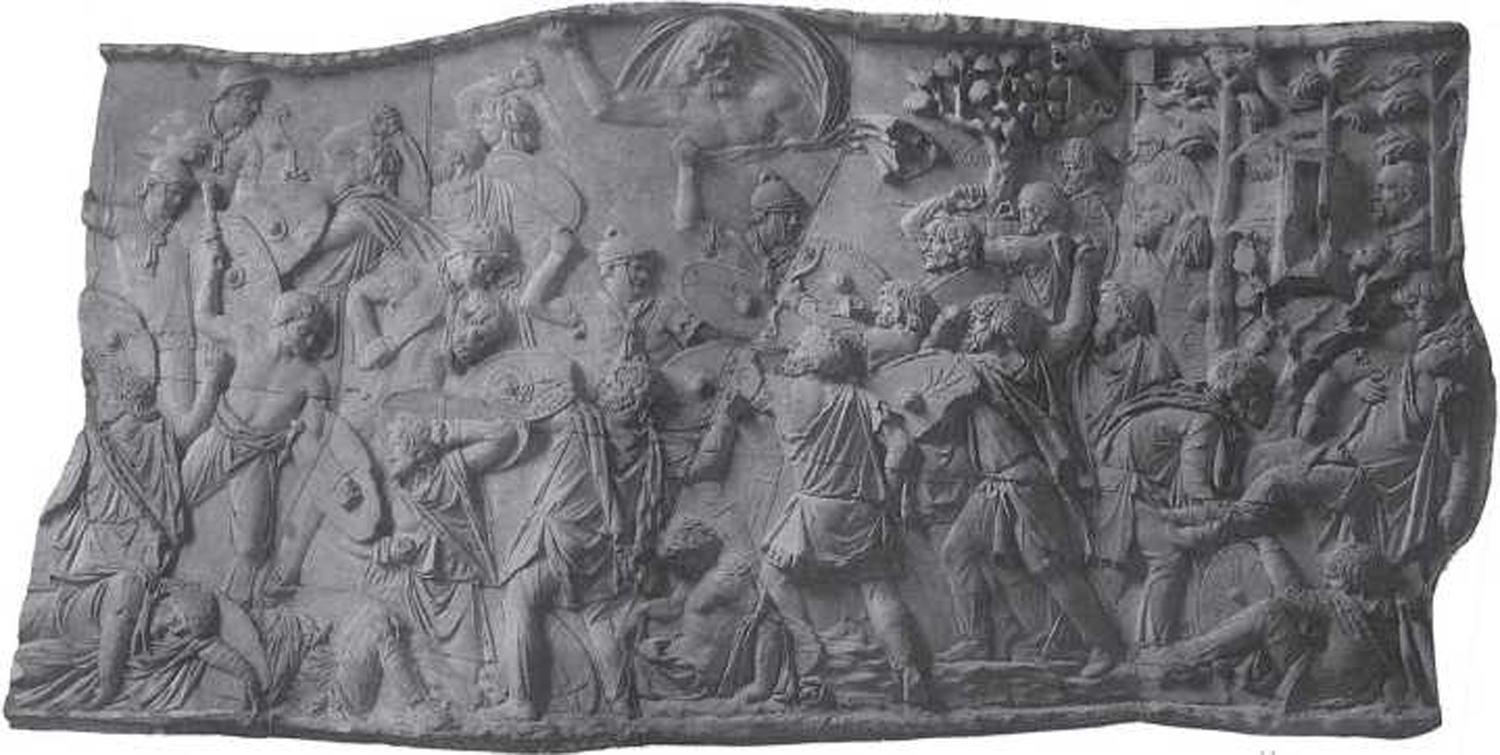
Figure 3.1: Jupiter Tonans (Jupiter of the Thunderbolt) in the heavens hurling a thunderbolt at the Dacians; Trajan’s Column (panel 24, scenes 59–62; Jupiter is at the top centre), Rome. (Courtesy of Wikimedia)
The Gods of the Roman Soldier
In the Roman Empire, the range of religious cults available to its inhabitants was extensive. Similarly, a Roman soldier, whether serving near the Thames or the Euphrates, had numerous cultic activities in which he could engage. Firstly, there was the ‘compulsory’ army religion prescribed by the state, as evidenced by the military calendar of religious observances at Dura-Europos, regulating the days for certain cult activities and their type. Jupiter Optimus Maximus as the traditional Roman military god received many dedications from soldiers, as well as in a new guise from the early second century AD, as Jupiter Dolichenus. There were also cults that grew up around the legionary eagle and the standards carried by units in the Roman Army; in addition, there were deities of the camp and the parade ground. Soldiers brought the indigenous gods of their homeland to wherever they were stationed. A wide range of religious experience for soldiers was the result, and few days would have gone by without some form of religious observance by an individual soldier or the military units (centuries, cohorts and legions) to which he belonged.
The Military Calendar of Dura-Europos
The feriale Duranum is the third-century AD religio-military calendar of Dura-Europos in the Roman province of Mesopotamia.1 This calendar, written in Latin on papyrus, covers the months of January to September in its surviving state; 1 January is missing, and it breaks off after the entry for 23 September. This calendar is assumed to have been a copy of that circulated to the legions and auxiliary formations and their constituent parts throughout the Empire. Discovered in Dura-Europos in the excavations of 1931–32 in the Temple of Artemis Azzanathkona (the latter an important goddess of Syria), which served as a document archive for the auxiliary cohort stationed in the town, the Cohors XX Palmyrenorum (the cohort of Palmyrenes serving at Dura-Europos). Dating to the reign of Severus Alexander (ad 224–235), the calendar prescribed that sacrifices were to be made for his welfare (salus) annually on 3 January.
This calendar was definitely for military rather than civilian application, as the emphasis is on military worship, including ceremonies attendant upon the discharge of soldiers and the veneration of the army standards (signa). Such military calendars presumably had a long history, probably going back to Augustus or even before.2 Yet with each new dynasty and reign they received modification: as the feriale Duranum indicates, it is ‘up-to-date’ with days for the veneration of the reigning emperor and his family. Various festivals and other celebrations listed in the calendar worked to create an official religion for the army, which provided cohesion in the military throughout the Empire.Various days are listed in the calendar, giving the type of ritual to be celebrated on that particular day (sacrifice or supplicatio: a bloodless offering of wine and incense), and if a sacrifice, what type of animal was to be sacrificed and to which god.
There are three types of religious activities: military rituals, festivals for the gods and cult observances for the imperial family. Firstly, as noted, on 3 January the cohort was to sacrifice for the safety of the emperor Marcus Aurelius Severus Alexander Augustus and for the everlasting empire of the Roman people. (Before this, there would have been an entry for 1 January specifying rites to welcome the New Year.) The votorum nuncupatio (‘a public pronouncement of vows’) was held on 3 January, when vota (‘vows’; singular, votum) were made for the welfare of the reigning emperor and his family, a practice begun in 30 BC (with Octavian, soon to be Augustus) and celebrated by all communities, not just the military, throughout the Empire. While the names of the deities to be sacrificed to on this day are largely restored in the feriale Duranum, it appears that Jupiter Optimus Maximus, Jupiter Victor, Juno, Minerva, Mars Pater (Father), Mars Victor and Victory received worship.
Two specific military events are celebrated in the calendar. On 7 February, soldiers who had completed their period of military service were discharged (the honesta missio): this was celebrated with a sacrifice to Jupiter Optimus Maximus of an ox, with cows to Juno, Minerva and Salus (‘Safety’ or ‘Welfare’), and to Mars Pater a bull, with the male deities receiving male and the female deities female sacrificial victims. On 9 May, the other exclusively military festival was celebrated, the rosaliae signorum (‘the flower festivals of the standards’), with a supplicatio (involving incense and wine): the standards (including the aquilae, or eagles) were decorated with flowers and venerated.
In addition, the calendar indicates that there were six days on which Roman festivals were to be celebrated by the Roman Army. For Mars Pater and Mars Victor, on 1 March, a bull was sacrificed for his birthday, and again on 12 May, when his circus games (circenses Martiales) were celebrated at Rome and elsewhere. The Quinquatria festival at Rome, on 19 March, was to be celebrated by the army with four days of supplicationes (19–22 March). This was a festival particularly associated with the Roman Army, with a lustratio (purification) of the army occurring on 19 March. It was celebrated in honour of Minerva, whom Ovid in his Fasti entry for this festival describes as a ‘war goddess’.3 Tertullian, in referring to soldiers wearing wreaths of olive in honour of Minerva, whom he refers to as the ‘goddess of arms’, is probably referring to this festival.4 On the dies natalis urbis Romae, 21 April, the birthday of the ‘Eternal City of Rome’, Roma received a sacrificial cow in celebration. At the circenses Salutares, on 5 August, circus games were held at Rome to honour Salus, and the army sacrificed a cow.Vesta Mater’s festival of the Vestalia, 9 June, was celebrated with a supplicatio. At his festival of the Neptunalia, 23 July, Neptune received a supplicatio and an immolatio (this term refers to a sacrifice after the sprinkling of the beast with the sacred spelt, a coarse flour). The entries for 24 September through to the end of the year are missing, but there must have been several other Roman festivals which were celebrated in these months by the cohort at Dura-Europos. Amongst them was surely the Augustalia, celebrated for the divine Augustus (who was venerated on the date of his birthday), the Armilustrium (the purification of the army at the end of the campaigning season), and the Saturnalia festival, celebrated wherever the Romans were present, in December.5 For example, from his province of Cilicia in December 51 BC, Cicero wrote to his friend Atticus that ‘the Saturnalia was a very merry time for men as well as officers’.6
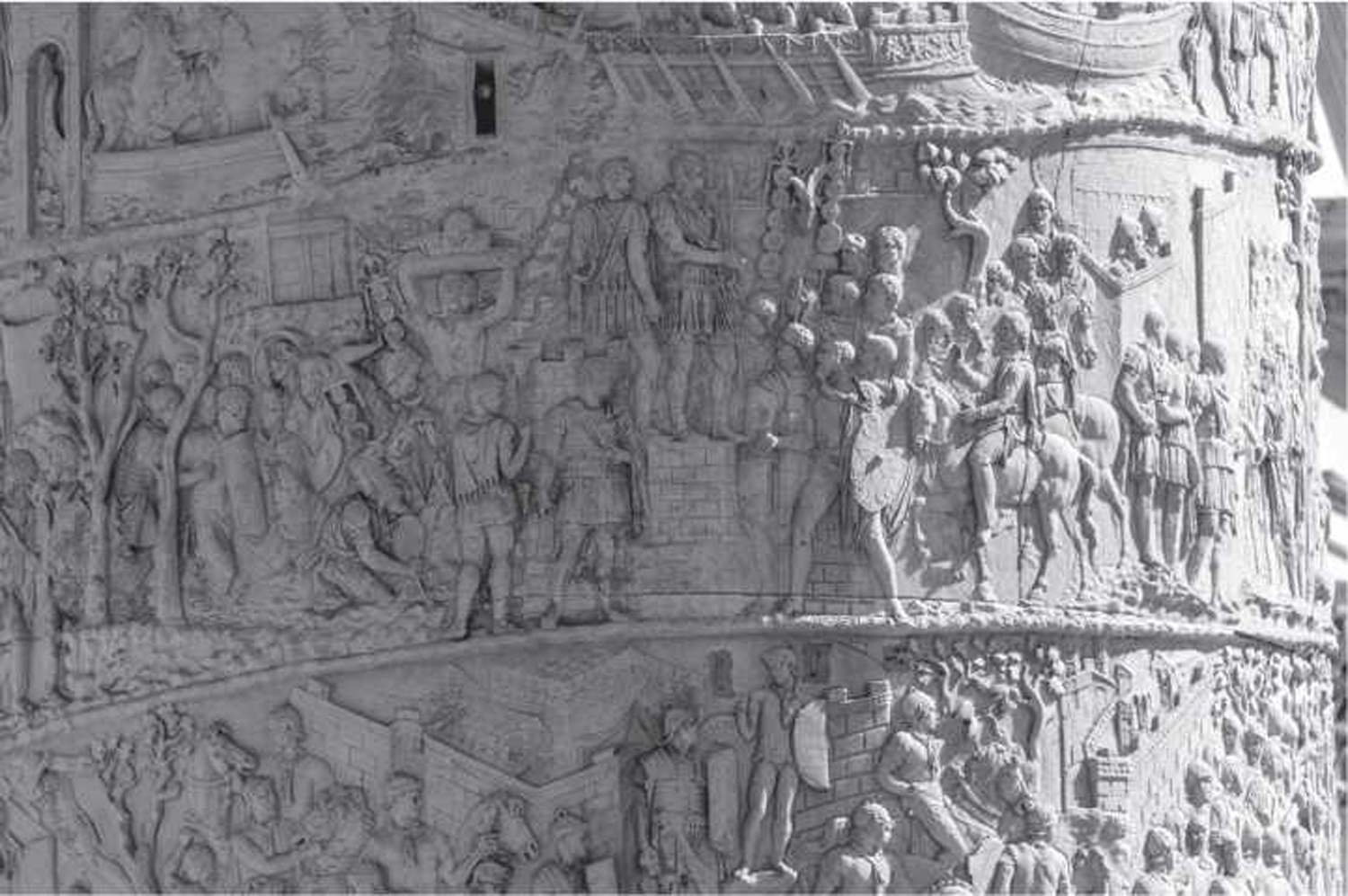
Figure 3.2. Trajan receiving an embassy of Dacians. A legionary eagle and two signa (standards) are placed prominently in front of the podium (centre) on which Trajan stands, as symbols of Roman dominance and military might; the eagle and signa were venerated by Roman soldiers. Two signa can also be seen to the left. Trajan’s Column (panel 27, scene 68), Rome. (Courtesy of Alamy)
All in all, the deities worshipped by the legions, and in this case by the cohort of the Palmyrenes, were the standard, traditional Roman gods. These were the gods venerated in a uniform pattern by all the legions across the Empire on their respective festival days: Juno, Jupiter Optimus Maximus, Jupiter Victor, Mars (Pater, Ultor and Victor), Minerva, Neptune, Roma, Salus, Vesta and Victory; some other gods may have been venerated in the missing section, 24 September-1 January. None of these are local gods, and there is no deviation from the traditional Roman pantheon. Soldiers were, however, free to worship their local gods. Another deity venerated in the calendar was ‘Parthian Victory’ for the Parthian victories of Severus, but with a sacrifice to the deified Trajan on the same day (28 January), doubtless because of his Parthian victories.
Imperial Cult at Dura-Europos
Many days were set aside in the Dura-Europos calendar for venerating deified members of the imperial family and the reigning emperor: the days when Severus Alexander, the reigning emperor, and other emperors, became emperor (the dies imperii), imperial birthdays (dies natales, for example, Augustus, Antoninus Pius, Claudius, Julius Caesar, Matidia – see below – and Trajan). Deified emperors received sacrifices (given here in the order of their reigns): Augustus, the first princeps, of course, on his birthday (as well as his adoptive father, the deified Julius Caesar); then Claudius, Nerva, Trajan, Hadrian, Lucius Verus, Marcus Aurelius, Antoninus Pius, Pertinax, Caracalla and Septimius Severus. The Severi, of course, were particularly venerated, including the genius of Lucius Seius Caesar, the emperor’s father-in-law, as well as the genius of the emperor himself. The birthday of Germanicus (15 BC-AD 19) was celebrated with a supplicatio ritual on 24 May – nearly two-and-a-half centuries after the event. He was an important military figure and clearly considered worthy of soldiers’ veneration, even though he had not been deified.
Deified women also received ritual observances: Trajan’s elder sister Ulpia Marciana and his niece Matidia;7 Faustina, wife of Marcus Aurelius; Julia Maesa, Severus’ maternal grandmother, and her daughter Julia Mamea, mother of Alexander Severus, who was the ‘deified empress’. Of note is that there was a deity, Juno Mamaea Augusta, the Juno of Mamaea Augusta, Severus’ mother. These women received either sacrifices or supplicationes.
In the sanctuary now known as the ‘Temple of the Palmyrene Gods’, in the northwest of the town of Dura-Europos, there is a small third-century AD fresco on the north wall of the temple pronaos (vestibule), including text in Greek and Latin as part of the fresco. The Latin identifies the central figure, who is burning incense on an incense stand (thymeterion), as one Julius Terentius, tribune, known from other evidence at Dura as belonging to the Cohors XX Palmyrenorum. Next to Terentius is an army vexillarius, holding a vexillum (see below: a ‘flag’ on a pole or spear) on which something, now obscure, was painted. Behind and around Terentius, his soldiers raise their right hand in adoration towards three male figures, each on a podium and each with a nimbus (‘halo’) around their heads: clearly deities of some kind, but these are not identified with inscriptions. All three are dressed as Roman soldiers, with spears; one also has a shield. These are obviously divinized Roman emperors being venerated by the cohort. A large flower in the bottom left of the fresco, not far from the signum (standard), might be a reference to the rosaliae signorum veneration of the standard on 9 May.
There is also a priest present (named in Greek); and in the bottom left of the fresco two figures wearing a mural crown (like a city wall), and identified in Greek as the Tyche of Dura and Tyche of Palmyra: the tutelary (protector) deities of these two places. The three deities, each with a nimbus, may be Palmyrene deities, or more probably are Roman emperors being venerated, given their military dress.8 The fresco shows the soldiers joined with their military tribune in making an incense offering (a supplicatio) and venerating deities; since the soldiers are doing so in their capacity as soldiers in their military unit, the desired outcome of this act of worship would have been benefits for the cohort, such as protection in battle. In addition, an incense burner from Dura-Europos has bilingual inscriptions – in Greek and Palmyrene – dedicated to the Tyche of Dura depicting an eagle flying with a palm branch (a symbol of victory) and a military standard.
Less of a religious calendar for worshipping the gods of the Roman pantheon, the feriale Duranum is in fact an imperial calendar for venerating deified emperors and some of the deified women associated with them. Of the 41 entries preserved in the feriale Duranum, 21 – half – are for divinized members of imperial dynasties.9 Thus the calendar focuses on the veneration of the emperor and his predecessors, and only a handful of festivals – which were deemed mandatory for the military – are listed. ‘Exotic’, ‘foreign’ and indigenous gods are not accorded any notice. Yet soldiers worshipped their own particular local divinities, and the evidence from throughout the Empire attests to a thriving number of cults separate from that of the official religious calendar.
Jupiter Dolichenus: The Soldier’s God
One such deity outside the official military pantheon was the ‘new’ god, Jupiter Dolichenus, always shown dressed as a Roman Army officer, who emerged as a deity in the Roman Empire sometime in the early second century AD and continued to be worshipped until the mid-third century.10 This cult was particularly prominent among the soldiery, especially in Britain and along the Danube and Rhine frontiers (as well as in Africa, Gaul and Spain).11 Dolichenus, the god’s epithet, derived from the town of Doliche in Commagene (a Roman province since AD 72), where he had a major sanctuary: how he arrived in the Roman Empire and came to have a fairly extensive cult, and why it took the form it did, are indeterminable questions also pertaining to the cult of Mithras. His origins seem to lie in the second millennium BC, when Hittite and Syrian storm gods are shown with the double axe, as is Jupiter Dolichenus.12 In the Roman Empire, he was referred to as Jove Dolichenus,13 or Jove Optimus Maximus Dolichenus,14 being assimilated to Jupiter in the latter’s capacity as a martial deity and patron (and guarantor) of the Roman Empire; he also took over Jupiter’s consort, Juno Regina (Queen Juno).
His iconography (sculpture and metal plaques: see below) depicts a military deity. A particularly fine example of a dedication, of a statue of the god standing on a sacrificial bull, comes from the site of one of his major temples at Mauer an der Url (Austria), where several important cult finds were excavated (see Figure 3.3). The inscription on the pedestal states that it was dedicated to ‘I(ove) O(ptimus) M(aximus) D(olichenus) by the (army) veteran Marius Ursinus’, in fulfilment of a vow. The god wears typical Roman legionary officer’s clothing and equipment: the moulded breastplate, slashed leather skirt, tunic, military cloak and eagle-headed sword. As with Jupiter, his attributes included the thunderbolt (held in his left hand), an important part of the synchronization of this god with the Roman deity, as well as a double-headed axe (in his right hand: damaged in this dedication), which was quite unknown for Jupiter and was of Near-Eastern origin. He is of solid build and wears the so-called Phrygian cap, which in Roman short-hand terminology stood for ‘eastern’ or ‘non-Roman’. He is standing on a bull in this dedication, as he frequently is in the cult’s iconography. Redolent of power and strength, the bull itself is worthy of the god. There is a decorative band around his waist, indicating that he has been prepared for sacrifice to the god. This is a particularly fine piece of work and will have been an expensive dedication, and perhaps also commemorates the sacrifice of this bull to the god.
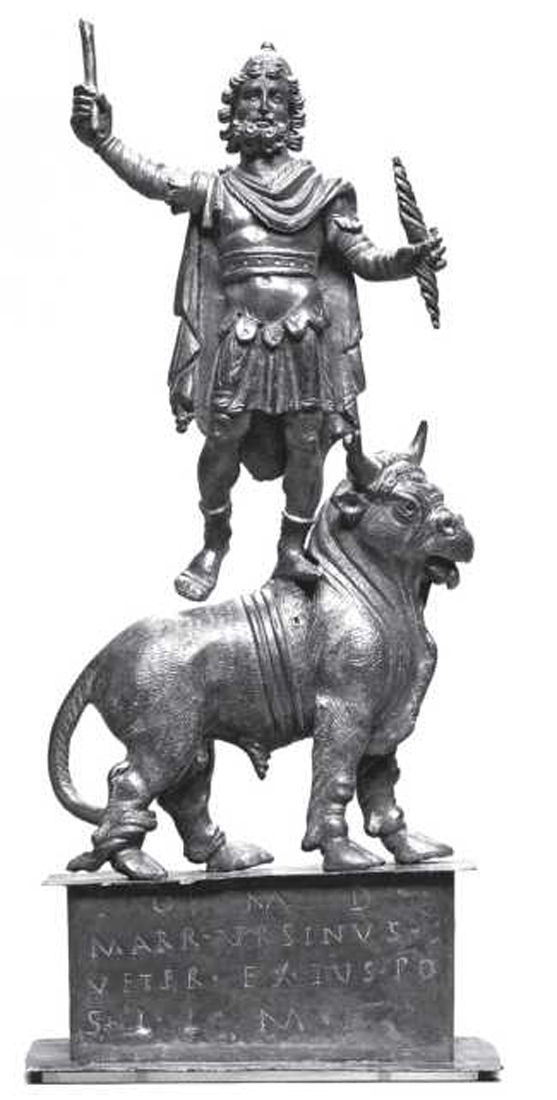
Figure 3.3: A bronze statuette of Jupiter Dolichenus from his temple at Mauer an der Url, dedicated by a veteran soldier in fulfilment of a vow. First half of the third century AD; height: 32cm. (Courtesy of Kunsthistorisches Museum Wien, Antikensammlung, Inventory M1)
Triangular bronze plaques were a major feature of his cultic paraphernalia, and were designed with cylindrical grommets to attach them to poles. These generally had four (but sometimes fewer) registers, and most have been excavated from temples in military areas.15 There is often an eagle (another attribute of Jupiter’s) in the upper register. An example from Mauer an der Url, dating to the first half of the third century AD, is 54cm high with four registers, and includes a depiction of Juno Regina, also standing on a bull, holding a double-headed axe and lightning bolt, hence mirroring her consort. This example also includes, in the lower register, two military standards with the usual decorations, one standard each flanking Jupiter Dolichenus and Juno Regina.16 Between the deities on their bulls hovers the winged goddess Victoria standing on a globe, extending a wreath to Jupiter Dolichenus; Sol, Luna and the Dioscuri (Castor and Pollux) also appear on these plaques with the god. An inscription on the base of the plaque indicates that it was dedicated by the decurion (a cavalry officer in charge of ten men), Postumius Celer.
Jupiter Dolichenus’ cult was found mainly on the western borders of the Empire where there were concentrations of military personnel, especially along the Danube and Rhine rivers, and in Britain; there were two temples in Rome (on the Aventine Hill and Esquiline Hill),17 and he had a major shrine at Dura-Europos.18 Modern scholars refer to these temples as Dolichena (singular, Dolichenum), but the cult followers simply used the word templum (plural, templa). Temples of the cult are found, for example, at the military sites of Brigetio (modern Szony in Hungary), Carnuntum (Austria), Mauer an der Url (Austria), Saalburg (Germany), Vetoniana (Germany), Vetus Salina (Hungary), Vindolanda (Britain) and Virunum (Austria). The Roman camp at Vindolanda was almost at the furthest extent of the Empire from Commagene.19 Most of these temples were modest in size, and the seating areas within, as excavated, catered for small numbers of devotees, as with the Mithraea. Part of the cult’s attraction was no doubt that of belonging to a select group: for example, the seating reconstruction for the Dolichenum at Brigetio suggests twelve worshippers.20
The (probably) first epigraphic attestation of Jupiter Dolichenus in the Empire in a specific cult context is from the city of Carnuntum (which began as a military camp) on the Danube, the capital of Pannonia Superior, from the reign of Hadrian, and the current temple (or its predecessor) may well date from this period;21 a legion was stationed there. From his temple here, too, come several outstanding representations of the god, in stone and metal, which are housed in the Carnuntum Museum (Austria). While there were a number of non-military worshippers, it is the military who are the most conspicuous in terms of dedications. Many altars were dedicated by army officers to this god, with a number of these known from Britain. One of these was dedicated to Iove Optimus Maximus Dolichenus (here Dolichenus shares Jove’s, that is Jupiter’s, stock epithets, in payment of a vow). As usual, what the vow specifically requested is unspecified:22
‘To Jupiter Dolichenus, Best and Greatest, for the safety [salus] of the detachments of Legion I Victrix, and of the army of both Germanies under the charge of Marcus Lollius Venator, centurion of Legion II Augusta. They paid their vow willingly and deservedly.’
After the end of the Severan dynasty, Maximinus Thrax as emperor in the West (ad 235–238) pillaged temples for financial reasons.23 Many shrines to Jupiter Dolichenus were destroyed at this time, judging from the archaeological evidence, and the cult declined significantly. Twelve of the god’s temples were destroyed in the provinces of Germania Superior, Moesia Superior, Noricum, Pannonia (both Upper and Lower) and Raetia. Caches of cult material have been found buried at these sites, presumably where worshippers deposited them to avoid their being looted. 24 For example, the hoard of eighty-eight cult objects (including Figure 3.3) from Mauer an der Url dates to the time of the sanctuary’s destruction.25 Archaeological evidence is conclusive that these cult centres were destroyed in about AD 235. These were in the provinces over which Maximinus Thrax had authority, and the temple contents fell victim to his financial needs. In addition, in AD 253, the Persian King Shapur I destroyed the home temple of Jupiter Dolichenus, at Doliche in Commagene, which must have been a major blow to his worshippers in the Roman Army. The cult had been decidedly popular with soldiers in the second century, being particularly prominent under the Severan dynasty.26 Closely assimilated with Jupiter, who was also a military deity, the appeal of Jupiter as Dolichenus will have been his blatantly military characteristics, as he is always shown in military dress with his weapons, ready to come to the aid of his worshippers.
The Religion of the Military Camp
An inscription on an altar discovered at Auchendavy fort in southern Scotland reads:27
‘To Mars, Minerva, the Goddesses of the Campestres, Hercules, Epona, and Victory, Marcus Cocceius Firmus, centurion of Legion II Augusta.’
This is not the only altar set up by the centurion M. Cocceius Firmus, of Legion II Augusta. There are several points of interest: firstly, the deity Epona, who was an indigenous Celtic goddess of horses, and who became popular with the cavalry serving in the Roman Army (as in this example).28 Mars, Minerva, Hercules and Victory were all associated with military activity, while the Campestres, the deities of ‘the parade ground’, had a more specialized function. Numerous inscriptions – some 3229 – in Roman Britain attest to their significance and importance for the Roman Army there. These Campestres were venerated by cavalry units: in AD 238, for example, a unit of Spanish cavalry at Condercum (Benwell) set up an inscription recording that they had restored a temple to the Campestres and to the genius of the First Cavalry Regiment of Asturian Spaniards, from the foundations up.30
Campestres, goddesses of the cavalry parade ground, were worshipped elsewhere in the Western empire, with inscriptions both of dedications and vows; several examples other than those from Britain are known.31 This is a substantial epigraphic record. These deities probably originated with the Celtic (Gallic) cavalry units serving in the Empire, but took a Latin name.32 Campestres are sometimes associated in dedications with the Matres, a triad of goddesses from Germany, venerated by the equites singulares (mounted imperial bodyguard), who were recruited largely from the Rhine.33
The Imperial Cult of the Legionary Eagles and Standards
Vegetius, writing in the fourth century AD, viewed the Roman soldiers’ celebration of festivals, religious rites and military parades as key factors in strengthening discipline.34 There was even a cult of ‘ Discipulina’ (Discipline), who received veneration from soldiers.35 An altar at Chesters (Cilurnum) in Britain provides the earliest epigraphic reference to this, being dedicated to ‘The Discipulina of the Emperor Hadrian Augustus, [dedicated by] the Cavalry Regiment called Augusta’.36 Such altars could also be dedicated to the Discipulina of two emperors reigning jointly (their Discipulinae). Two such altars were found beneath the aedes principiorum (for which see below) of a military camp.37
Each legion possessed one eagle (the aquila) as its standard (signum). This was life-size, originally of silver and then gold, shown resting on Jupiter’s thunderbolts, held aloft on a long spear (see Figures 3.2, 3.6), and this was carried into battle and in ceremonies by an individual known as an aquilifer (‘eagle-bearer’; see Figure 6.8).38 Eagles were Jupiter’s emissaries, which he sent to convey messages via omens (see below), and symbolized the god himself: the legion took Jupiter before it into battle when it carried the eagle. Vegetius indicates that the eagle preceded the first cohort of the legion, and was the symbol par excellence of the legion. A legion also went into battle with an imaginifer carrying the images (imagines) of the emperors on a standard known as a signum (Vegetius states that the eagle was the chief signum)?39 A legion’s birthday, commemorating the day on which it was formed, was the natalis (dies) aquilae – the birthday of the eagle – and was celebrated as a festival. Moreover, the cult of the legionary eagles as a whole was celebrated from 19–23 March, when festivities were held in their honour. Josephus, the Jewish author who wrote about the Roman sack of Jerusalem, observed that as the Romans under Vespasian’s command marched into Galilee, the eagle went before each legion, for the Romans considered it to symbolize dominion, a sign that they would be victorious over all those against whom they marched.40
In 210 BC, the soldiers and sailors of P. Cornelius Scipio (Africanus) were said by Livy to have been so willing to perjure themselves that they were prepared to swear falsely by the signa, by the eagles and by their military oath. Clearly, these should have been inviolable, and Livy writing under Augustus obviously thought that his contemporary readers would agree.41 Tacitus could write of the numina (‘spirits’) of the legionary eagles,42 and in relating one historical incident refers to the standards and legionary eagle being housed together in a legionary headquarters.43 Dionysius of Halicarnassus could in fact compare the eagle standards to divine statues.44
Each of the cohorts (and possibly each century) of an imperial legion had its own signum, carried on a spear, with each signum carried by a signifer. This spear was decorated with a wreath at the top, within which was often a hand (palm outwards), or the hand might simply be on top of the lance, not encircled by a wreath; there were several circular ornaments down the length of the spear, with tasselling underneath these towards the end.45
Another standard, the vexillum (plural, vexilla), a banner of square cloth also held on a long spear, attached by a short horizontal pole, was carried by a vexillarius.46 It is unclear which units within a legion had a vexillum: possibly the centuries or the cohorts. Auxiliary units also possessed standards: the foot soldiers a signum and the cavalry a vexillum. The legionary eagle and standards appear several times on Trajan’s Column, in particular when the Roman army crosses over the Danube on the platoon bridge (see Figure 3.6), and as Trajan receives a Dacian embassy (see Figure 3.2), while to the left of that two signa are visible (see Figure 3.2). One scene on the column shows soldiers with two standards and a vexillum (see Figure 5.1); and a vexillum is depicted being carried by the goddess Victory on a coin of Augustus (see Figure 1.2), and on the Bridgeness Slab (see Figure 3.4).47 To carry the eagle, to be an aquilifer, was an honour, and the funerary monument of the aquilifer Gnaeus Musius as erected by his brother ensured that he was commemorated in this role (see Figure 6.8).
Not only was the eagle in the imperial period especially venerated by its legion, but so too were the signa of the cohorts of the legions:48 Tertullian criticized Roman army camp religion as consisting entirely of worship of the signa. In this, he is subsuming the aquilae under the category of signa (as does Vegetius). He argues that the Romans set the standards of the legion above the very gods themselves, even Jupiter. He mocked the pagans by noting that the vexilla and signa were in fact in the shape of the (Christian) cross (because the spear bar holding the parts of the signa formed a cross: a long cross with a short bar).49 In the Christianized army, the signum was surmounted by the chi-rho symbol, and the chi-rho appeared on the vexillum (see Figures 9.2–9.4).
Signa were housed in a special room in the building which served as the headquarters of an army camp; this room is sometimes termed by historians as the sacellum (sanctuary), but it could be referred to as the Capitolium, as in an inscription at Aalen, and often as the aedes principiorum (the shrine of the standards at headquarters), in the vicinity of which, in Roman Britain, altars have been excavated.50 Catiline, in keeping a legionary eagle in his own home, placed it in a room which Cicero refers to as a sacrarium (a place where sacred objects are housed).51 On the Bridgeness Slab (see Figure 3.4), the suovetaurilia of Legion II Augusta takes place before a small shrine, and depicts a signum within: this is the shrine within which the signum was housed.
One of the ‘distance’ slabs from the Antonine Wall in Britain (giving the length of the wall as completed by a particular legion), from Hutcheson Hill, depicts in its middle register an eagle standard held by an aquilifer who leans forward slightly, bent at the hips, looking downward and averting his gaze from a draped standing female figure who has in her left hand a patera (shallow bowl), tilted downwards (denoting that she has just poured a libation from it), while she has her right arm raised and her fingers level with the beak of the eagle on the standard. She is perhaps the goddess Britannia, in this way congratulating Legion XX for its role in conquering the area. Her fingers hold a small circular object – apparently a miniature wreath – up to the beak of the bird, a legionary eagle. Each of the two registers, left and right, depict a naked, bound captive who looks towards the central scene.52
In 53 BC, Crassus the triumvir suffered a crushing defeat at the hands of the Parthians at Carrhae in Mesopotamia, losing his own life, thousands of soldiers and several legionary eagles. This spectacular disaster had been foretold by several omens, one of which was that the first eagle to be raised as the army set out turned around of its own volition, and that when the sacrifice for the purification (lustratio) of the army was being made, Crassus dropped the entrails of the sacrificial victim when the diviner handed them to him.53 There was an earlier ‘precedent’ for this, the disastrous battle for the Romans when Hannibal trounced them at Cannae in 216 BC, which was also portended by several omens, including the signifer of the first hastati formation (as the Roman Army was then organized) being unable to remove the signum from the ground, despite several soldiers coming to his assistance.54 No such ill-omens from aquilae and signa are, perhaps surprisingly, recorded to have preceded the disaster in the Teutoburg Forest (ad 9) at the forest itself – but Augustus at Rome felt that there had been several omens of disaster when he looked back on events shortly afterwards (see below). Nearly 300 years later, entrails could still be ominous: when Diocletian sacrificed continuously for good omens at Antioch in AD 299, he failed to achieve these; his diviners blamed the Christians who were present, who had made the sign of the cross. According to Lactantius and Arnobius, this was one of the reasons why Diocletian was persuaded by Galerius to persecute the Christians.55
In addition to the eagles being numina, according to Tacitus, and worshipped according to Tertullian, cults of the genii (singular, genius) of various aspects of the Roman military establishment were prominent in the imperial period. ‘Genius’ refers to the embodiment of some object, place or person. A living emperor was not worshipped, but his genius was venerated, especially in the Roman Army. Moreover, from the legion down, nearly every unit of the Roman Army had a genius which received worship. The first known dedication by an army unit to their genius is that by Legion XI in Germany. There are numerous known dedications to the genius of a century by members of such a unit, as well as (though fewer) to the genius of a legion.56 A temple to the Campestres and the ‘Genius of the First Cavalry Regiment of Asturian Spaniards’ has been noted above.57 Such cultic activities, particularly at the level of the century, served no doubt to unite its members, creating an esprit de corps, in the same way as did any sacrificial practices undertaken by soldiers as a group.
The Bridgeness Slab: Sacrifice by Legion II Augusta
Eighteen distance slabs survive from the length of the Antonine Wall in Britain, placed on the southern side; these record the length of the wall completed by a particular legion or part thereof.58 Legion II Augusta commemorated their work in building 4,652 paces of this wall by commissioning and erecting a sandstone slab in AD 142–143 (Figure 3.4): it is called the Bridgeness Slab after its find-spot (Bridgeness, West Lothian, in 1868).59 Despite Roman themes, it was nevertheless executed by a Celtic artist. On the left, a cavalryman holds his spear aloft in battle, while underneath him, to the left, a Celtic warrior is prostrate under his shield while trampled by the horse. Next to him, a warrior has been impaled by a spear in his back, while on the right, a soldier is overcome by psychological terror and cowers, his left hand in his mouth, biting his fingers, with the sword he has thrown down below him. A fourth figure, in the middle of the horizon of the scene, has been decapitated, with his head to the right. In the middle of the slab is the inscription:
‘For the Emperor, Caesar Titus Aelius Hadrianus Antoninus Augustus Pius, Father of his Country, Legion II Augusta completed [the wall] for a length of 4,652 paces.’
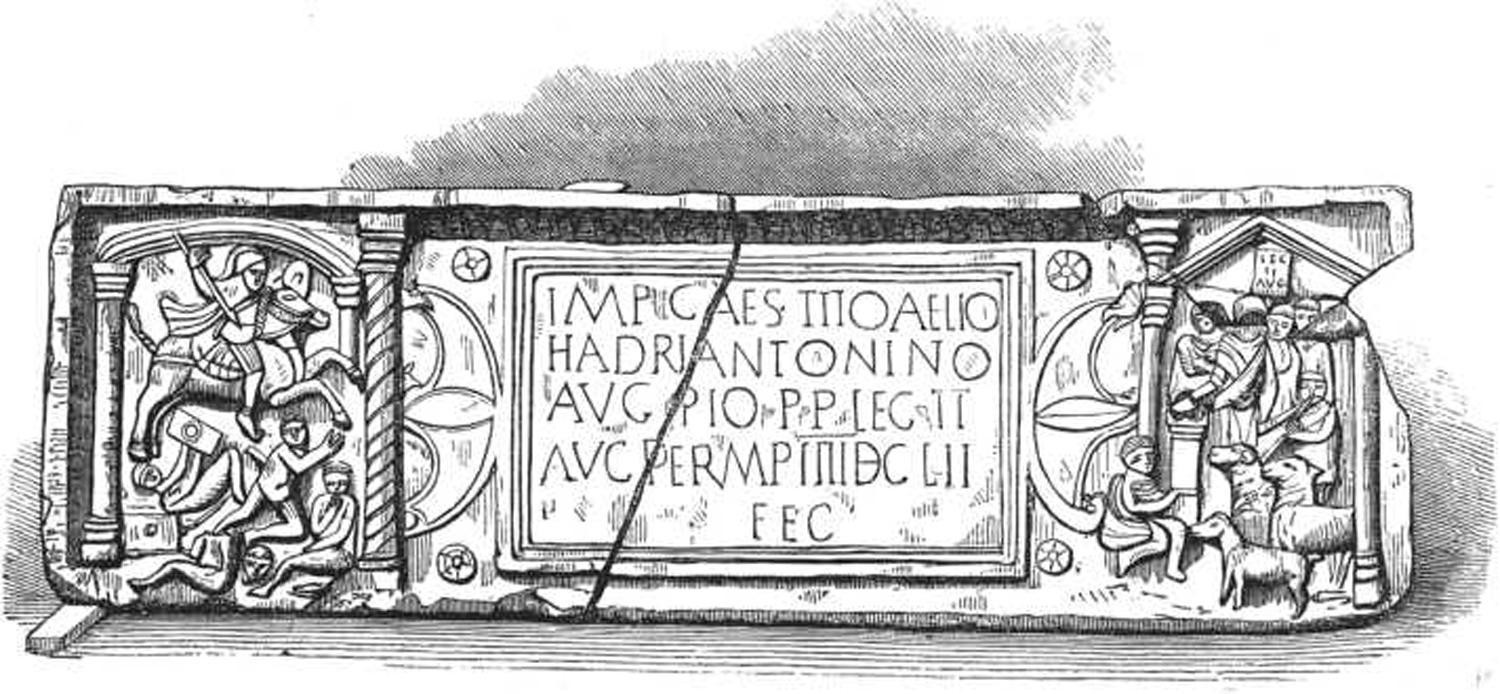
Figure 3.4: The Bridgeness Slab, commemorating Legion II Augusta’s building of a section of the Antonine Wall; AD 142–143; width 2.743 metres; height 0.864 metres. National Museum Scotland (Hunterian Collection) X.FV 27. (Courtesy of Alamy)
On the far right, a religious rite, a suovetaurilia, is taking place, almost certainly to mark the completion of the construction by the soldiers.60 A suovetaurilia was the sacrifice of three male domestic animals; these could be a piglet, lamb and calf, which was known as the suovetaurilia minora (or suovetaurilia lactentia; from lac, milk), but in military contexts three adult male victims – a boar, sheep and bull – were sacrificed: the suovetaurilia maiora. This was often performed as a lustrum, a purification, of the Roman Army.61 Cato the Elder describes a suovetaurilia in a non-military context as a purification involving leading the three victims around the border of a farm and invoking Mars, as well as Janus and Jupiter, and then conducting the sacrifice.62 Examples of the ritual are found on Trajan’s Column (see below).
In this scene on the Bridgeness Slab, the figure at the altar with a shallow bowl (patera) from which he has just poured a libation of wine onto a tall, narrow (typically Roman) altar, and behind whom the legionary flag, the vexillum (clearly marked ‘Leg[io] II Aug[usta])’, is displayed, is the commander of this legion. His officers cluster around him. Crouched at the altar is the victimarius, who is responsible for dispatching the three sacrificial victims to the gods. A double-flute player is present, playing with cheeks distended. Bracketing the scene is a very small shrine, an aedes or aedicula.
Other distance slabs, but not all, from the Antonine Wall have a religious theme. For example, a slab of Legion VI has its inscription panel held aloft by two winged Victory figures, who stand on globes (marking Roman dominion over the world).63 On their left stands Mars as god of war (presumably Mars Victor or Mars Ultor), and on their right a female figure, Virtus Augusta, who in her left hand holds a sheathed sword and in her right hand the legion’s vexillum which identifies her, reading as it does ‘Virtus Augusta’ (‘Augustan virtus’; manliness or courage). Another slab of interest shows a semi-recumbent, winged goddess Victory, her left arm resting on a globe of the world, holding in the crook of her arm a large palm tree, the ancient symbol of victory.64 Her pose here is typical of that for river gods in Greco-Roman art, as the site is near to the River Clyde; moreover, waves are lapping around her knees. With the conquest of this area of Scotland complete, Victory is resting from her labours.
Many other gods were worshipped by soldiers. Not all of these of course would have been for military reasons. Yet the predominance of inscriptions set up by soldiers or their military units relates to military deities and invokes their assistance. Through public display of their piety by means of inscribed altars and dedications, soldiers called the gods’ attention to their piety and to their needs. There was a very real sense of genuine piety and trust in the gods – both those mandated by the state as requiring worship and other more personal deities.
Omens of victory and defeat sent by the gods
For the Roman Republic, Livy provides a wealth of omens which accompanied Roman military activity, as well as a number experienced by the Romans in nonmilitary contexts. For example, prior to the catastrophic military defeat at Cannae by Hannibal, the gods gave several signs to the Romans of their impending defeat. Unfortunately, Julius Obsequens did not continue his Liber de prodigiis (Book of Prodigies) into the imperial period: he was the fourth-century AD epitomator of the prodigies recorded in Livy for 249–11 BC. For the imperial period, there is no continuous narrative such as Livy’s or a record such as Obsequens’ compilation.65 But Tacitus for the first and second centuries AD provides evidence that, in the early imperial period, the connection in Roman religious thought between warfare and divination was still in place. For example, he reports that three bad omens attended Paetus’ campaign against the Parthians which ended in disaster in the reign of Nero. Yet Paetus, much like Clodius Pulcher who threw the sacred chickens overboard when they failed to give a favourable omen, did not heed the signs sent by the gods: Tacitus specifically notes that Paetus rejected them.66 Suetonius, too, in about the same period, was extremely interested in recording omens in military contexts (see below), and reports an omen in which Tiberius trusted when on campaign – one which had always reassured his forebears as well: if, on the night before battle, the lamp he was working by went out without any reason, this was a propitious sign for the coming battle.67
Germanicus and Victory Omens
When in AD 15 Germanicus, Augustus’ grandson and Tiberius’ adopted heir, led an attack against the Germans – in particular the Cherusci tribe – Tacitus records without any incredulity the omens which occurred. Germanicus had a dream before the battle that his toga was bespattered with the blood of a sacrificial victim, at which his grandmother Augusta (Livia) handed him a clean toga to replace it. He was encouraged by this omen, as well as by favourable auspices. These auspices would have come from an actual sacrifice which he performed prior to battle, which was propitious. When examined by the professional soothsayers – haruspices – who travelled with the army – the entrails of the victim were favourable. Tacitus follows this with a rousing speech from Germanicus, in which he pointed out to his troops how they could in fact defeat the Germans.68
As they engaged the enemy, Tacitus reports that a ‘most splendid omen’ (pulcherrimum augurium) was seen by Germanicus: eight eagles flew in front of the Roman army towards and into the nearby woods, where the Germans awaited. He duly shouted encouragement to his soldiers that they should advance into battle and ‘follow the Roman birds’, the true numina (‘spirits’) of the legions (propria legionum numina).69 Of no concern to the modern historian is the veracity or otherwise of the incident: what matters is that the Romans believed that the gods could send a sign, an augurium (an augury), to encourage them before battle, and that this sign portended success. These eagles, the numina of the legions as Germanicus terms them, were interpreted as having been sent by Jupiter, for they were his particular messenger. Success in fact followed this god’s support, with the Germans thoroughly routed and their dead strewn across a 10-mile area. The Roman soldiers constructed a mound and piled up the captured arms as if erecting a victory trophy (tropaeum). A dream, the auspices of the sacrifice and the augury of the eagles had all vouchsafed the support of the gods, especially that of Jupiter.70
After the disaster in the Teutoburg Forest in AD 9 when Varus lost his life, as well as the three legions’ eagles, with thousands of soldiers slain in battle, Dio notes that Augustus recollected what he realized had been a series of bad omens both before and after the battle. As Dio lists them, they comprise a compendium of the unpropitious, including lightning striking the temple of Mars (Ultor) in Rome, comets and a statue of Victory which faced towards the enemy in the province of Germania turning and facing Italy.71 Suetonius notes that in the aftermath of the disaster, Augustus vowed ‘great games’ to Jove (Jupiter) Optimus Maximus for an improvement in the state of the Republic, as had been done, Suetonius notes, during the Cimbric and Marsic wars. As in the past, the vow was quite conditional: when the state recovered, Jupiter would be honoured and thanked with the games. Augustus followed, as in many instances in his reign, an historical religious precedent.72
Dreams such as Germanicus’ were not unusual, with the most famous martial dream in the Republic being that of Sulla in 88 BC, in which he dreamt of Luna Lucifera (light-bearer) or the Cappadocian war goddess Ma-Bellona handing him a thunderbolt with which to smite his enemies.73 In AD 15, Aulus Caecina, the legate of Lower Germania, on the eve of battle against the Germans, dreamt according to Tacitus of Publius Quinctilius Varus, who had recently lost three legions and their eagles – as well as the accompanying auxiliary force – in the Teutoburg forest disaster. In an ‘ominous dream’ (dira quies), Varus appeared to him covered in blood, rising out of the swamps, calling to him. As Varus’ hand stretched out to him, Caecina thrust it away. This presaged a good ending: while the campaign started badly for the Romans, they were victorious, and the dream had predicted the outcome.74
Omens in the Year of the Four Emperors (AD 69)
There were several bird omens in connection with the battles fought amongst the contenders for the throne in the ‘Year of the Four Emperors’, AD 69. Moreover, there were numerous omens and prophecies related to the four claimants to the principate: Galba, Otho, Vitellius and Vespasian, with the last, as the successful contender, attracting positive omens, while the others experienced unpropitious signs in their attempts at power (except initially for Galba). Tacitus describes AD 69 – with its four claimants to the throne, numerous battles and the loss of tens of thousands of lives, including 50,000 when Rome fell to Vespasian’s forces – as preceded by several omens of forthcoming disaster, and numerous prodigies (prodigia) were recorded, including Caesar’s statue in the forum turning east (towards Vespasian).75
Galba succeeded Nero as the first of the four emperors in mid-AD 68. He was encouraged by several portents, collected by Suetonius, which Galba must have circulated amongst his troops and followers. A young girl of ‘honest background’ prophesied that there would one day be a Roman emperor from Spain (Galba was governor in that province). This prediction was confirmed by the priest of Jupiter at Clunia, who, following instructions in a dream, found the girl’s very prediction recorded in the inner shrine of the temple – and it too had been spoken by a girl, some 200 years earlier. The combination of prophecy, dream and antique context was a formidable combination. To this was added the discovery of what could be termed a sacred relic: while a town was being fortified as Galba’s headquarters, an ancient ring was uncovered, with a precious stone engraved with a Victory goddess and a trophy of arms (see below for a discussion of the Roman tropaeum). Even further, a ship full of weapons arrived in Spain from Alexandria – with no captain, sailor or passenger aboard. This last removed ‘all doubt in anyone’s mind that the war was just and pious, to be undertaken with the gods’ approval’. All of these omens came true and Galba became emperor: but only from June 68 to January 69, when he was assassinated by Otho’s soldiers.76
After Otho murdered and succeeded Galba, he was challenged by Vitellius. Prior to the battle between their forces at Bedriacum (in northern Italy) in April AD 69, Vitellius divided his forces into two, one led by Fabius Valens, which was to proceed against Otho, and another by himself. An eagle went before Valens’ forces, flying just before the army on its journey, and was of course seen, as Tacitus notes, as ‘no doubtful omen of great and successful achievements’, which indeed it was, with Valens defeating Otho’s forces at Bedriacum.77 Otho committed suicide after the battle, his death also presaged by a bird omen, although Tacitus seems apologetic about reporting it:78
‘While, however, I must consider that it is far from the seriousness of the work which I am writing to collect here fabulous accounts, to entertain my readers with fiction, I must not, however, malign the veracity of the reports [of the omens] which have been circulated.’
Galba appeared in a dream to Otho, his murderer, which so frightened him that he fell violently out of bed. On the next day, while Otho was taking the auspices a great storm arose, which was taken as a bad omen. Later, Otho fell over while sacrificing, presaging that he had undertaken a task he could not fulfill.79
Suetonius also notes the propitious omen of an eagle sent to Valens (Vitellius’ general), but not to the force led by Vitellius. Moreover, Suetonius records, equestrian statues of Vitellius as emperor which were being erected all collapsed with broken legs, the laurel crown he was wearing as emperor fell into a stream, and, at Vienna, sitting on a judiciary tribunal, a rooster perched on his shoulders and then his head. Suetonius notes that ‘the outcome corresponded with these omens’. He does not need to indicate to his readers what the omens meant: the imperial statues collapsing heralded the collapse of Vitellius’ power, while his imperial wreath falling off meant the loss of the imperial status it represented. The omen of the rooster had an interesting fulfilment and had to be explained: Vitellius was killed at Rome, when Vespasian and his soldiers conquered the city, by one Antonius Primus, who ‘when he was young, had the surname Becco, which means, “the beak of a rooster”’.80
Suetonius, in his life of Vespasian, adds another bird omen, that two eagles fought on the battlefield at Bedriacum in April AD 69 before the forces clashed. One defeated the other, but then a third eagle flew in from the east (or as Suetonius puts it, from the direction of the rising sun), signifying that while the eagle Vitellius had defeated the eagle Otho, the forces of the eagle Vespasian, from the east, were going to win against Vitellius’ forces in a second battle at Bedriacum (neither Vespasian nor Vitellius were present at this second engagement there, which took place in October).81
Many centuries later, Dio Cassius reported other omens preceding Vitellius’ death in the battle in the city of Rome in AD 69. However, these might be ones invented since Suetonius wrote his biography, or Suetonius might have chosen only a few examples out of a larger number of omens which were reputed to have occurred. ‘Baleful omens’, Dio commences, took place: a comet was sighted, the moon appeared to have two eclipses – on the fourth and then the seventh day of the month – and two suns were seen simultaneously, the one in the west being pale (i.e., Vitellius), and that in the east strong and iridescent (i.e., Vespasian). On the Capitol in Rome, many large footprints were seen, as if spirits (daimones) had descended from the hill. The soldiers on duty at the temple of Jupiter that night said that the temple doors had crashed open, without human agency, with a great noise, and some of the guards had fainted with terror.82 When Vespasian’s troops were in the city and Vitellius knew he was defeated, he recollected that at a sacrifice over which he had presided, vultures had swept upon his sacrificial offerings, scattering them and almost knocking him over as he addressed his troops.83
Vespasian’s Omens Predicting his Ascent to the Imperial Estate
Vespasian (ad 69–79), ultimately the successful claimant to the throne in AD 69, established the relatively short-lived Flavian dynasty to which his sons Titus (ad 7981) and Domitian (ad 81–96) succeeded. Just as Otho and Vitellius met their ends as predicted by omens, Vespasian also received prophetic intimations – except his were favourable, and for these Tacitus is the main source. When Vespasian was contemplating seizing power, one of his supporters, Mucianus, encouraged him in a speech which the historian reports. After this, others with him remembered prophecies spoken by seers, as well as relevant movements of the stars, while Tacitus remarks that Vespasian now recollected omens from his own past and recalled one concerning a cypress tree on his estate when he was a young man: the tree had fallen over, but on the next day was upright again and fully rejuvenated. The haruspices interpreted this as signifying that he would reach the highest of positions.84
A similar omen of an overthrown and rejuvenated tree had occurred, Pliny remarks, in the wars against the Cimbri and at the Battle of Philippi (42 BC, when Antony and Octavian defeated Brutus and Cassius). He also reports a tree at Cumae that sank into the ground prior to the civil war between Pompey and Caesar, with only a few branches left still above ground. The Sibylline Books were consulted, and the oracle was that great loss of life would occur, and the closer to Rome, the greater the loss.85
After Mucianus’ speech, Vespasian went to the sanctuary of the aniconic god Carmelus in Judaea, where he sacrificed. The officiating priest, Vespasian’s freedman Basilides (see below), examined the sacrificial entrails several times and informed Vespasian that in whatever he attempted he would succeed. This oracle, in particular, was one which Vespasian’s supporters discussed in his presence – ‘nothing indeed was more often on men’s lips’.86 Interestingly, Tacitus notes that ‘as for the hidden decrees of fate, the omens and the oracles that singled Vespasian and his sons out for imperial power, we only believed in them after his successes’.87
Suetonius, too, records several omens signifying that Vespasian would defeat Vitellius and become emperor. As Vespasian was a successful princeps, and deified on his death, the divinatory narrative is quite extensive. These omens, of course, were not simply to demonstrate that events had been preordained by the gods, but were a means to legitimize the imperial power which had been placed in his hands: the gods had brought the prophecies to fruition, indicating their approval of his victory over Vitellius, and his assumption of the imperial toga. Suetonius’ veritable catalogue of omens and predictions were divine validations of Vespasian: a statue of the deified Julius Caesar in the Roman forum turned to the east, while others involved mud in Vespasian’s toga, a severed human hand brought to him by a stray dog, a runaway plough ox, a cypress tree (as in Tacitus), a tooth, and a prophecy from the god Carmelus. Josephus (the historian), when he was put in chains by the Romans under Vespasian in Judaea, said he would be released by Vespasian when the latter became emperor; and a prophetic dream was sent to Nero. Last in this compendium of Vespasianic imperial omens, Vespasian went alone to consult Serapis in his temple in Alexandria to inquire how long his rule would last if he seized imperial power. There he had a vision of his freedman Basilides – even though he had gone into the temple alone and Basilides was so crippled with rheumatism that he could not walk. The name Basilides comes from the Greek word for king, basileus, and clearly Suetonius intends his audience to realize that this had been an omen. In his account, Tacitus specifically states that Vespasian recognized that the vision of Basilides was an omen because of the fortuitous circumstance of his name, and because Basilides at the time was some 80 miles away.88 Basilides, therefore, was a key player in providing divinatory, and hence divine, support to Vespasian’s claim to the imperial purple.89
Tacitus also describes the prodigies (prodigia) which attended the fall of Jerusalem to Titus in AD 70: these were meant to indicate after the event that the city was preordained by the gods to be destroyed. Tacitus observed that the Jewish people, imbued with an ‘obnoxious superstition’, did not undertake sacrifices and vows (as Romans would) to expatiate the omens of their destruction: heavenly hosts battling in the skies with gleaming armour, the Temple irradiated by light from the clouds, and the doors of its inner shrine suddenly opening of their own accord, with a nonmortal voice crying out that the gods (plural) were leaving the Temple (clearly a Roman invented this omen), with a noise as if of departure. Next he relates a prophecy in the ancient writings of the Jewish priests that at this time the East would become powerful, and rulers coming from Judaea would gain universal empire: these prophecies, continues Tacitus, applied to Vespasian and Titus.90
Omens, prodigies and any sort of unusual phenomena were signs from the gods, to be heeded and respected. They particularly occurred in times of military conflict, crisis and disaster. Omens conveyed by eagles were sent by Jupiter; others were not usually ascribed to any divine agent but viewed as being sent by ‘the gods’ generically. Vespasian’s assumption of the imperial throne was given added legitimacy by the various signs which occurred in AD 69. Throughout imperial history, omens continued to play a role, generally recollected or invented after the event, in indicating the gods’ interest in the outcome of conflict and their support for the Romans, or in the civil wars of AD 69, their preferred imperial candidate.
The Sacred Topography of Roman Imperial Warfare
In the Republic, numerous temples had been vowed on the battlefield by Roman generals requesting divine aid, but temple construction in return for divine assistance was not a marked feature of the imperial period. That fewer were dedicated was probably due to the fact that many of the gods already had temples due to the Senate and the religious devotion of successful generals. Moreover, it was now the emperor alone who dedicated temples, rather than military commanders, and perhaps the most notable temple constructed was that by Augustus for Mars Ultor. In the imperial period, the doors of the temple of Janus were rarely closed (closure signifying that the Empire was conducting no wars), but Augustus boasted that this had occurred three times during his principate, and Nero later considered that a closure during his own reign was worth commemorating on coins. Trajan’s monumental stone column in Rome, as well as its imitation by Marcus Aurelius, bears witness to the belief that the gods intervened directly in battles when circumstances required, and gods are depicted in their columnar reliefs. A marked feature of the imperial period was the erection of stone arches, not only in Rome but throughout the Empire, to commemorate military triumphs, and many of these reflect the divine assistance which victorious emperors believed they had received from the gods in battle. Art and architecture depict many tropaea of arms and armour taken from the enemy. The term tropaea also became attached to large permanent monumental structures, such as those of Augustus and Trajan which celebrated victories over Rome’s enemies.
The Gods Sanction the Declaration of War by the Roman State
In 32 BC, Octavian carried out the fetial rite, the ius fetiale, which the Romans employed in declaring war against their enemies: in his case, against Cleopatra (as a foreign power, being Queen of Egypt). Dio is the authority for the ritual followed: Octavian and others, dressed in their military cloaks, went to the temple of the war goddess Bellona in Rome, and Octavian in his capacity as a fetial priest (a fetialis, plural fetiales) performed the rites to declare war.91 In his Res Gestae, Augustus lists being a fetial as amongst the various religious offices which he held (he was a member of all the priestly colleges). Dio does not describe the rites involved, although Book One of Livy does so in connection with Roman conflicts with the Latins, and various other sources mention the ritual, which may have been one of the traditions revived by Augustus after a considerable lapse of time.92
The priestly collegium (college) of the fetials at Rome had twenty members, of whom two were involved in any declaration of war: one called a verbenarius (whose role was limited to carrying certain herbs employed in the ritual) and the other the pater patratus (the ‘ratifying father’), responsible for carrying out the main ritual actions. His role was to dip a spear with a shaft of cornel wood in blood (from a sacrifice), either with its wooden tip sharpened in a fire or with an iron tip, and to throw it into enemy territory. This indicated that war had been declared, but was also part of a process whereby the Romans ensured that the gods would know that the war was a just war (iustum bellum) and that they could therefore rely on divine assistance. The pater patratus called Jupiter to witness that Rome had been wronged, and then in making the declaration of war called upon Jupiter, Janus Quirinus (Janus of the Roman People) and the celestial deities, and those of the earth and the underworld, to witness the act. In this way, the Romans ensured that they called upon their gods to witness that they had acted appropriately and justly.
When Rome’s wars extended beyond Latium and into territory with which it did not have borders, as in the case of Cleopatra, the traditional practice was followed at the temple of Bellona of casting the spear into symbolic enemy territory, which action served as a declaration of war.93 Ovid notes that a small pillar stood in the temple grounds from which the spear was thrown.94 Marcus Aurelius, also according to Dio, performed the rite in AD 178 when going to war against the Scythians. Here he mentioned Aurelius hurling a bloody spear, kept in Bellona’s temple, adding that he heard of this from men who were present at the time.95
This rite is not heard of again after AD 178. Although this does not mean it was not practised, the likelihood is that it was not, as Dio was clearly interested in reporting it on these two occasions as a historical curiosity. Octavian was interested in reviving old, lapsed rituals, which explains his action: moreover, he wanted to declare the war on Cleopatra (and so Antony) in the name of the Roman people, as in the formula for the declaration of war which Livy quotes,96 to stress that this was not a civil war, but a war against a foreigner. As the declaration took place within the grounds of the temple of the goddess Bellona, the sacral nature of going to war was emphasized.
The Spolia Opima
A portion of the sale of the booty acquired in war (the manubiae) was dedicated to the gods, and this was often used by generals in the Republic to pay for the construction of the temples they had vowed. Yet the ultimate spoils of battle were the spolia opima, ‘highest spoils’, the armour and weaponry taken from an enemy commander killed in battle in single combat. While Livy, on the authority of a conversation with Octavian himself in 29 BC, indicated that it had to be a Roman commander with consular imperium (see below) who slew the enemy commander, the antiquarian Varro indicated that any Roman soldier who slew an enemy commander could dedicate the spolia opima: but this never eventuated.97
Jupiter Feretrius received the spolia opima in his temple on the Capitoline Hill.98 Such a dedication was a great honour to the dedicant, as in Roman history there were only three cases of spolia opima dedicated to the god: Romulus, who defeated Acron of Caeci; A. Cornelius Cossus, who in 428 BC killed Lar Tolumnius, king of the Etruscan city of Veii (see below); and C. Claudius Marcellus, who in 225 BC killed Viridomarus, the king of the Insubrians. One of Marcellus’ descendants minted coins depicting Marcellus carrying into the temple a tropaeum (see below) of Viridomarus’ armour and weapons.99 Propertius in his elegy on the temple devoted several lines to each of these three dedicants (also see below).100 The issue of spolia opima occurs only twice more in the annals of Roman history. Dio reports that amongst the various honours voted to Caesar after returning from Spain in 45 BC was that of dedicating spolia opima in the temple of Jupiter Feretrius – even though he had not actually slain an enemy commander in the field of war.101 Presumably this honour was to reflect his numerous military achievements and the commanders he had defeated (but not killed in battle). Battlefield encounters between Roman generals and their enemy counterpart were largely a thing of the past, but Caesar could be accorded this honour, which only three Romans – one of them his ancestor Romulus – had achieved.
One commander under Octavian in 29 BC did have a claim to be able to dedicate spolia opima to Jupiter Feretrius. Marcus Licinius Crassus, grandson of the Crassus who was Caesar’s and Pompey’s triumviral colleague (and who had lost the eagles to the Parthians), as proconsul of Macedonia killed in battle Deldo, king of the Bastarnae, a tribe from across the Danube. Dio notes that he would have dedicated the armour in Jupiter Feretrius’ temple if he had been supreme commander.102
Dio is here clearly relying on Livy’s history, which does not mention Crassus but provides an interesting account of the second commander who won the spolia. Livy indicates that he had previously written that A. Cornelius Cossus, who in 428 BC had killed the commander of the enemy, was a military tribune and had dedicated the spolia opima.103 But Octavian informed Livy that he had himself seen in the temple of Jupiter, on the linen breastplate dedicated by Cossus, that he had in fact been consul (that is possessed consular imperium) when he killed his enemy. Livy therefore inserted this new information into his history, revising it upon Octavian’s information. Clearly the contemporary situation is being referenced: Crassus was not allowed to dedicate the spolia opima because he had proconsular not consular imperium. Cossus had been a consul – Crassus was not. This might seem a quibble, but it was one that allowed Octavian, as he was in 29 BC, not to diminish his glory in having restored the temple,104 in which only three dedications had taken place, all from much earlier in Roman history.105
Propertius wrote a forty-eight line elegy on the temple, probably about ten years’ after Crassus missed out on the award, specifically referring to the three dedicants, and his elegy, intended for an imperial audience, reflected the Augustan reality that there were only three commanders who had earned the spolia: ‘three sets of armour from three leaders’.106 Nero Claudius Drusus, Tiberius’ younger brother, aspired to achieve spolia opima, even going so far, Suetonius writes, as to pursue German commanders on the battlefield in an attempt to kill one and so have the distinction of dedicating their armour.107 He did not succeed.108 The rectangular temple itself was a small one (there was no need for much interior space), and the longest sides of the temple were a mere 15ft.109 Augustus restored it, and ensured M. Licinius Crassus did not undermine his prestige for having done so. In the period of the Empire, no spolia opima were dedicated to Jupiter Feretrius.
Other Booty for the Gods
Rome’s gods would always receive their share of any booty from war, especially particularly valuable items. It was the custom in the Republic that the general commanding a victorious army would undertake to make dedications to the gods: several of the temples in Rome had been built in the Republic by generals making use of the funds from the spoils of their campaign or campaigns. Augustus continued this pious tradition of thanking the gods for the victories of the Roman Senate and People. In his Res Gestae, he placed particular emphasis on the religious activities he had undertaken with the spoils from his wars: the temple of Mars Ultor (Mars the Avenger) and Augustus’ forum were built from these. In addition, he writes:110
‘From the spoils of war [manubiae], I consecrated gifts in the Capitoline temple, in the temple of the divine Julius, in the temple of Apollo, in the temple of Vesta, and in the temple of Mars Ultor, which cost me in the vicinity of some 100,000,000 sesterces.’
When Vespasian dedicated the Temple of Peace at Rome in AD 75 to celebrate the destruction of Jerusalem and the conquest of Judaea, he deposited there many of the spoils from the Temple in Jerusalem, including solid gold vessels and musical instruments, and also collected there artworks from around the known world.111 Many of the spoils of war from Jerusalem depicted on Titus’ arch – items such as the menorah, the sacred seven-branched lamp-holder from the Temple – were dedicated to this god, Peace, in thanksgiving for the conquest of the city and the Jewish people.
Aulus Gellius in the second century AD discusses the meaning of the term manubiae.112 In a scene in his Attic Nights, his friend Favorinus, when walking through Trajan’s forum, asked his companions what they thought the meaning was of the phrase ‘ex manubiis’ (‘from the manubiae’), prompted when Favorinus gazed at the roofs of the colonnades where there were gilded statues of horses and military standards (signa), underneath which was written ‘ex manubiis’.113 He points out that the manubiae were not the actual spoils of war, but the financial proceeds from the sale of these spoils, and that Trajan’s horses and military standards on his colonnades were paid for from this.
The Ara Pacis Augustae: Altar of Augustan Peace
Complementing Augustus’ temple of Mars Ultor, the Ara Pacis Augustae, Augustus’ ‘Altar of Peace’, stood on the Campus Martius (Field of Mars). This was voted by the Roman Senate on his return from Spain and Gaul on 4 July 13 BC, and was dedicated on 30 January 9 BC. By senatorial decree, each year the magistrates, priests and Vestal Virgins were to perform a sacrifice to Pax Augusta, ‘Augustan Peace’.114 The altar resides within a 6-metre-high engraved marble wall, forming a rectangle about 11 by 12 metres: the altar inside is reached by steps, but is too small for actual animal sacrifice, which must have taken place outside. Augustus and his family are shown in the well-known processional scene on the southern and northern walls, presumably processing to the altar complex.115 Coins of Nero depict the altar, but after Augustus’ reign there is no literary mention of it. Nero must have been advertising a connection with Augustus’ altar (and that princeps) and periods of peace in their reigns, just as he advertised that he also was responsible for the closing of the doors of the temple of Janus.116
Augustus’ Temple of Mars Ultor
Octavian had vowed to build a temple to Mars Ultor (Mars the Avenger) to avenge his father, Julius Caesar, before the battle at Philippi between the triumvirs and the senatorial forces in 42 BC.117 Forty years later (2 BC), Mars received the fulfilment of this promise (see Figure 1.1). ‘Ultor’ in Octavian’s vow refers to ‘revenge’ against his adopted father Caesar’s assassins, who were defeated at Philippi; the temple was also to house the eagles recovered from the Parthians. Mars’ temple was the main feature of Augustus’ forum (forum Augusti), so much so that it was sometimes referred to as the forum of Mars (forum Martis). Even in its current ruined state, the temple is an impressive, imposing structure, signifying the importance of this god in Augustus’ military and imperial ideology. As Augustus notes, it was built from the manubiae of his successful campaigns.118
With eight white marble Corinthian columns (hence the temple is referred to as octostyle) 18 metres in height on three sides, and raised – as was usual with most Roman temples – on a podium, the frontage measures some 20 metres. A bronze winged Victory stood on both front corners of the temple roof; within was a large statue of the god himself. Coins minted in Spain and Ephesus, depicting legionary eagles returned to Rome in 20 BC in a round temple (tholus) and inscribed ‘Mars Ultor’, apparently have no reference to an actual temple at Rome: the standards were dedicated in Augustus’ temple in his forum when it was completed. Housing the recovered eagles was clearly a primary function of the temple.119
Augustus also states that in this year of the dedication he gave games for Mars (ludi Martiales) for the first time, and the Senate decreed that henceforth each year the consuls would organize these with Augustus. The consuls were involved, not only because they were Rome’s chief magistrates, but because of their military responsibilities.120 Mars’ temple also became the focal point for various activities related to the military, as Dio describes.121 Those making the transition from boyhood to enrolment amongst those of military age were to visit the temple frequently, while those setting out to their military commands were to depart Rome from the temple, presumably after worshipping in it and invoking Mars’ assistance. (Suetonius notes that Augustus decided that the Senate was to meet in this temple when deliberating on whether to declare war.)122 The Senate also met there to vote on whether a victorious general should be awarded a triumph. Once a general had celebrated his triumph (in the imperial age, only someone connected with the imperial family could do so), they were to dedicate to Mars the triumphal paraphernalia of sceptre and crown in the temple, and bronze statues of them were to be erected in Augustus’ forum. Other sources indicate that Augustus set up here statues of all the generals throughout Roman history who had held triumphs (the triumphatores).123
Dio also reports that the cavalry commanders were to celebrate a festival (panegyris) annually in front of the steps. Furthermore, any military standards recovered from an enemy were to be housed in the temple. Dio’s extensive summary of activities now to be associated with the temple through Augustus’ initiative exponentially increased the prominence of Mars Ultor: it was very much an Augustan cult, and as such was emphasized by many of his successors, notably Trajan. Mars Ultor appears on the coins of those who rebelled against Nero in AD 68: Vindex in Gaul and Galba in Spain. The god is depicted naked, helmeted and advancing with shield and spear, both raised, with a sword at his side. Such a numismatic choice of this god by the two rebels seems unusual: it is hard to see how they were taking vengeance on Nero. Augustus’ own relationship with Mars Ultor was, however, well-known, and these two were presumably seeking to make a connection with the founder of the principate.124
Trajan dedicated his column in his new forum on 12 May AD 113, mirroring Augustus’ dedication of the temple of Mars Ultor on the same day about a century earlier: 12 May 2 BC.125 In addition, it has been argued that the dedication of the column was to coincide with the beginning of Trajan’s Parthian campaign for that year, AD 113.126 Mars Ultor also appears on the coinage of the emperor Septimius Severus (reigned AD 193–211); in AD 193, Severus defeated several contenders for the throne after Pertinax’s death. His coins date to the time of his campaigns against the Parthians, presumably explaining his invocation of Mars Ultor,127 who appears on his coins in full battle dress, unlike the heroic but armed nude of the AD 68 issues. Alexander Severus also portrayed Mars Ultor, similarly fully armed and in the same pose as on one of Severus’ coins, presumably in imitation of him.128
The Temple of Janus Closed under Nero
When the Roman state declared war in the Republic, the doors of the temple of Janus – Janus Geminus (Twin) or Janus Quirinus (of the Roman people) – would be opened, to be closed again when peace was secured. In the imperial period, the same held true. Janus was a double-headed deity, whose temple was located close to the Roman forum and as such in a conspicuous place near the heart of the city’s political life. Ovid refers to Janus as ‘hiding’ in his temple during times of peace, with the temple doors closed, so that peace could not escape from it.129 Varro, who describes many of Rome’s rites and practices, states that the practice of opening the doors in times of war was instituted by Numa, Rome’s second king (to whom the Romans ascribed the introduction of many religious practices);130 while the ascription to Numa might well be legendary, the practice was clearly an ancient Roman tradition. Rome’s wars were so extensive during the Republic that this temple’s door were rarely closed from the third century BC on.
Augustus took due credit in his Res Gestae for closing the temple, specifically noting that it was an ancestral custom that the doors were shut when the Roman people had been victorious on land and sea throughout the Empire: that is, when all conflict had ended. He boasts that the temple before he became princeps had only been closed twice, but that while he was princeps the Senate had authorized the closure on three occasions, indicating Augustus’ pursuit of peace throughout the Empire and on its borders. In Book One of Virgil’s Aeneid, set many centuries prior to the first princeps, Jupiter issues a prophecy to Venus, Aeneas’ mother, that Augustus (referred to obliquely, not by name) will close ‘the gates of war’ (that is, Janus’ temple).131 The first closure occurred as part of the celebration of the victory over Mark Antony and Cleopatra VII in 29 BC after the Battle of Actium (31 BC); the second in 25 BC at the conclusion of the war against the Cantabrians; the third occasion is unknown.
Nero’s coinage takes up this theme in connection with the peace made in his reign with the Parthians, and the closing of the temple doors in AD 65. Clearly he was seeking to draw a direct comparison with his great-great-grandfather Augustus. Issued in several denominations, silver coins depict Nero on the obverse with his various imperial titles. On the reverse, the closed doors of the temple of Janus can clearly be seen, with a garland hung across the entrance arch to symbolize peace. The lattice window, a prominent feature, also appears, placed up high in the wall: this barred window symbolized that Peace was safely locked within so that she could not escape. ‘Peace having been obtained for the Roman People on land and sea, the doors of Janus have been shut; coin issued under the authority of the Senate’ (PACE PR TERRA MA[RI]QPARTA IANVM CLVSIT, SC) reads the legend (see Figure 3.5).132 His doors were not closed for long, however, with the rebellion in Judaea causing their opening again soon after in AD 66.
The Christian historian Orosius (ad 375–after 418) records that Vespasian and Titus, after their triumph in AD 71 for the suppression of the Jewish revolt and the sack of Jerusalem, closed the gates of Janus’ temple.133 Vespasian’s dedication of the temple of Peace (see above), which he commenced building in AD 71 after the Jewish War and dedicated in AD 75,134 may have been intended to complement this closure. Peace’s temple, known to the Romans as one of Rome’s largest and most magnificent buildings, was destroyed by fire towards the end of the reign of Commodus, but was rebuilt, probably by Septimius Severus.135 As with Nero, the Flavian emperors were eager to mirror the Augustan achievement, which was especially important for them as the new dynasty replacing the Julio-Claudians. After this, specific occasions when the temple of Janus was closed are not known. Ammianus Marcellinus mentions that the temple doors were open when Constantius visited Rome in AD 357.136
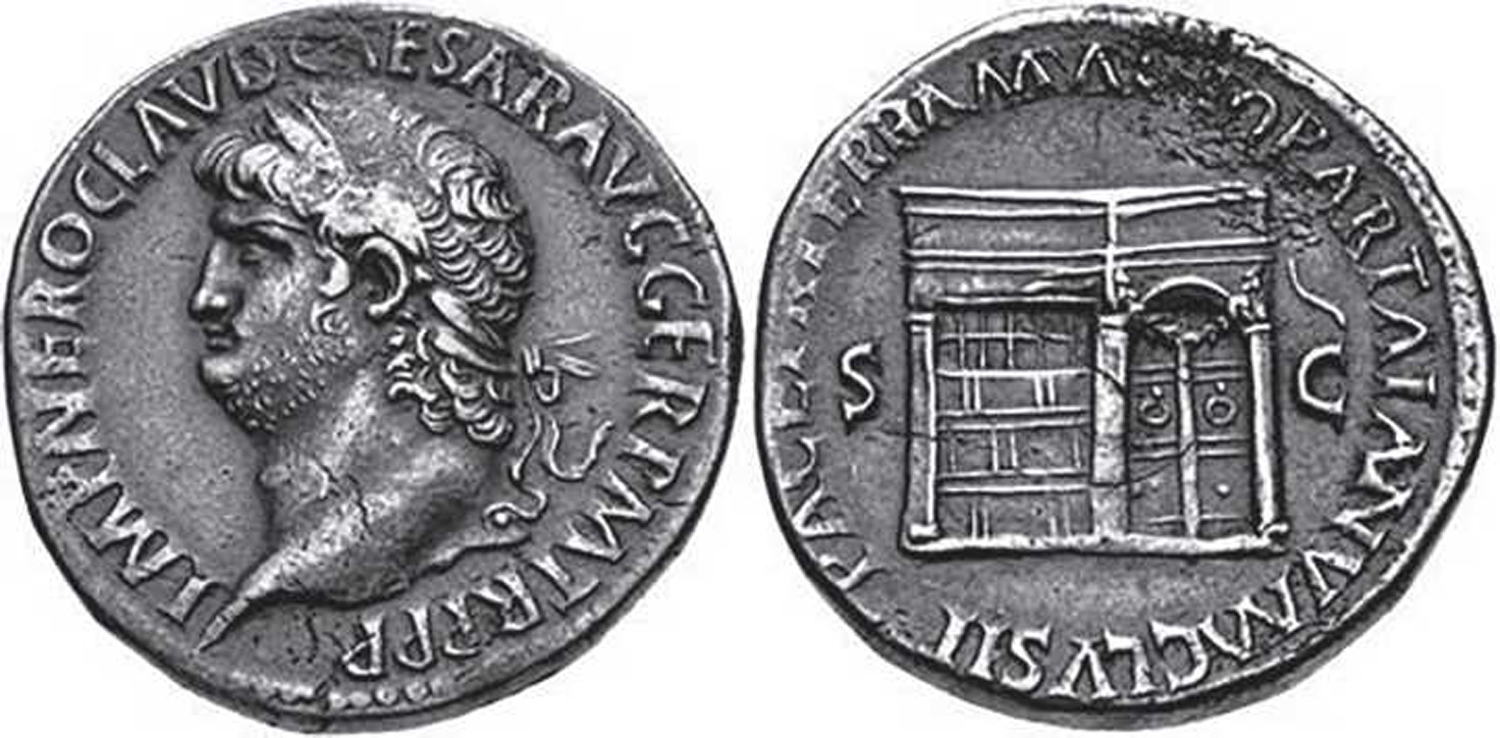
Figure 3.5: Silver sestertius depicting Nero’s closure of the doors of the temple of Janus. Obverse: bust of Nero (reigned AD 54–68). Reverse: the closed doors of the temple. Minted AD 65. (Courtesy of Classical Numismatic Group)
The Gods of Trajan’s Column: Jupiter Tonans
Augustus had vowed in 26 BC and consecrated in 22 BC a temple on the Capitoline Hill in Rome to Jupiter Tonans, ‘Jupiter of the Thunderbolt’, because of a narrow escape he had from lightning when campaigning against the Cantabrians in Spain. Of solid marble, the temple quickly became popular with worshippers.137 Jupiter Tonans appears on Trajan’s Column, which was voted by the Senate and the People of Rome, and constructed as part of the impressive Forum of Trajan; it was probably dedicated in AD 113.138 Trajan’s Column consists of specific panels, each with a number of scenes, representing the events of his First (ad 101–102) and Second (ad 105–106) Dacian Wars. His column is 30 metres high, with the pedestal it stands on 5 metres tall. Consisting of twenty hollow drums of Carrara marble, each some 4 metres in diameter, one upon the other, 155 scenes are engraved in a spiralling fashion from bottom to top. In this way, the spiral frieze has a length of some 190 metres; the scenes are about 1 metre high. Trajan appears fifty-nine times. A bronze statue of him stood at the top; it went missing in the medieval period, and in 1587 a statue of St Peter was placed on top and remains there.
In a dramatic battle encounter between the Romans and Dacians, Jupiter Tonans is depicted in the heavens (panel 24, scene 61).139 He energetically raises his right arm to hurl a thunderbolt (once metal, but now lost) at the Dacians who are attacking the Roman forces. His intervention means that the outcome is clear and the Dacians will be defeated.
Two other gods are portrayed on the column. On the pedestal on which it stands, winged Victories on one side hold the dedicatory inscription, and there are piles of arms and armour on all four sides. At the very base of the column itself, in the scenes depicting the commencement of the campaign, the river god Danuvius (the modern River Danube) watches passively as the Roman army crosses his river into Dacia on a pontoon of boats: his enigmatic gaze and the smooth unruffled waves of his waters indicate his consent to the crossing and his support for Trajan’s invasion (Figure 3.6).140 The placidity of the river towards the Romans is in stark contrast to the turbulence when the cavalry allies of the Dacians are crossing to come to their aid, and some riders are shown tossed from their horses into the waves (panel 31). Trajan clearly viewed the support of the god as crucial, and he features on the reverse of several coins of this emperor’s reign.141 Marcus Aurelius also portrays the god Danuvius on his column as present at the start of his campaign (for which see below). As on Trajan’s Column, the god looks on benignly as the Romans cross his river, in this case holding his right hand over the water to calm it. In much the same way, about a century earlier, Ovid had referred to the River Rhine as giving Germanicus its waters ‘as his slaves’.142
Trajan, at the outset of the campaign in Dacia, is shown pouring a libation onto a lit altar outside his tent in the Roman camp (panel 8).143 He is dressed in his capacity as Pontifex Maximus, the high priest of Rome, and to the right are three animals – a bull, sheep and pig, all decorated – being led by a soldier as part of the traditional suovetaurilia ritual. Musicians are present, as at all sacrifices, to drown out any outside noise and sounds of ill-omen. The bare-chested figure to Trajan’s left is the victimarius (plural, victimarii), whose role is to dispatch the victims: his clenched right hand would have closed around a metal axe, now missing. This suovetaurilia is presumably a lustratio exercitus, a purification of the army before battle.144
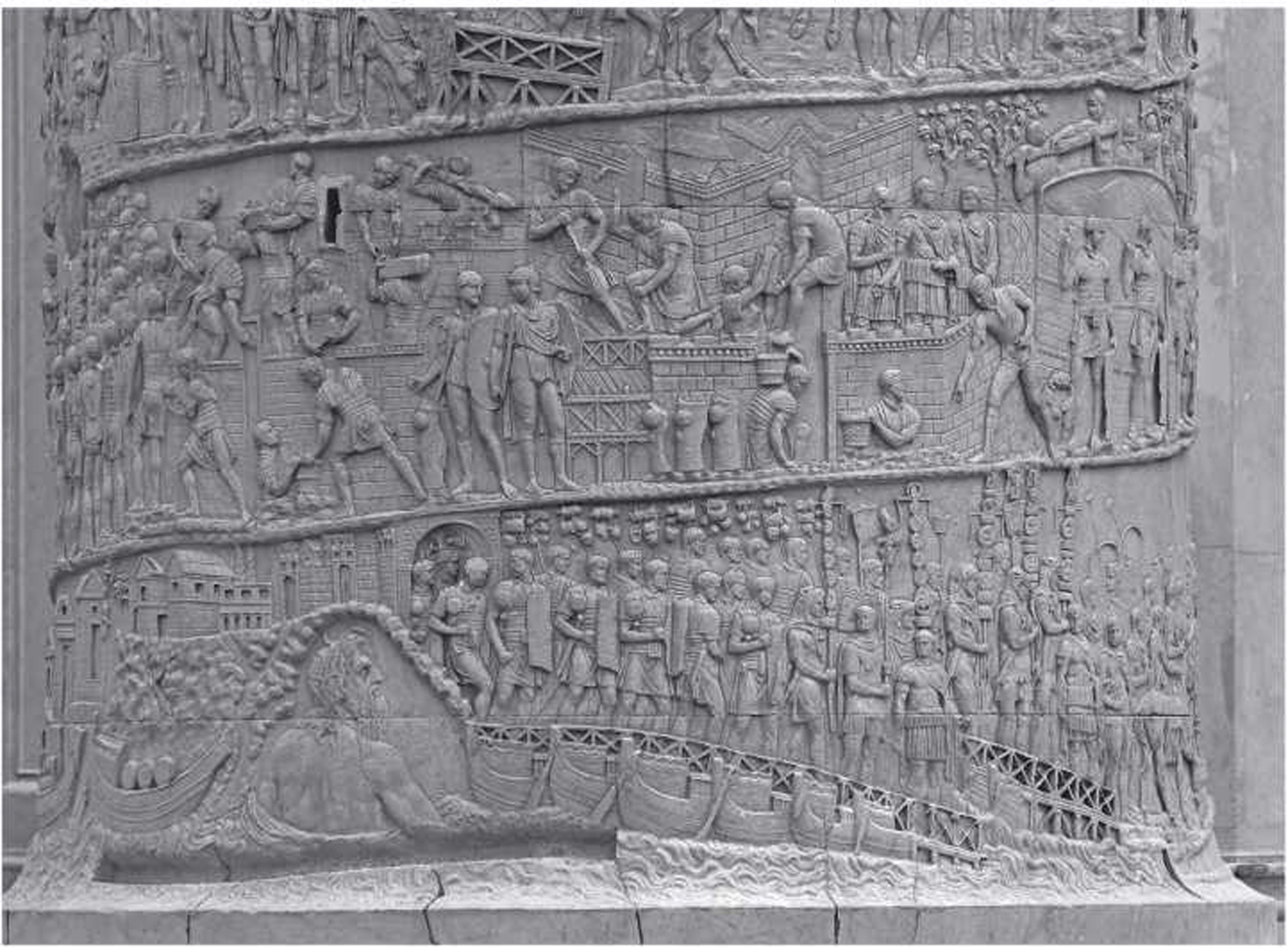
Figure 3.6: The river god Danuvius (Danube) and Roman standards. Danuvius looks on benignly as Roman soldiers invade Dacia using the bridge Trajan had constructed over the god’s waters; note the eagle and standards (right) which the soldiers carry as they lead the army across. Trajan’s Column (panel 3, scenes 11–15), Rome. (Courtesy of Alamy)
Another suovetaurilia scene occurs later in which Trajan, in his priestly robes, holds his hand over an altar, perhaps placing incense on it; the three sacrificial animals are depicted, together with victimarii and their axes (panel 53).145 Later, Trajan presides in ordinary clothing over a sacrifice of a bull at a harbour town (panel 87). A few scenes later, at a particularly magnificent sacrifice of several bulls, each held by a victimarius, Trajan, in non-military clothing, pours a libation at one of six wreathed altars (panel 91). These were no doubt thanksgiving sacrifices for victory.
War, however, broke out again soon after, and Trajan is again shown sacrificing at his bridge over the Danube (panel 99). As the campaign proper commences, he is greeted by his soldiers (panel 102); as Pontifex Maximus, he conducts a suovetaurilia to purify the army, the lustratio (panel 103); and then he addresses his troops (panel 104: the adlocutio, delivered before battle). This is the last of the several religious scenes on the column. Trajan brings the war to a successful conclusion and Dacia becomes a Roman province. The female deity Dacia appears on Trajan’s arch at Beneventum (for which see below), kneeling before Trajan, who appears to be extending his arms (they are broken off) to lift her up. Two local (Dacian) river gods are also depicted.
While the deities Danuvius and Victoria appear on Aurelius’ Column in imitation of Trajan, Aurelius is not shown, unlike Trajan, as an assiduous sacrificer. Like Trajan, however, he commences his campaign with the traditional suovetaurilia, shown early in the sequence of scenes on the column, in a badly damaged relief (scene 6). Aurelius is in a toga with several victimarii, with the usual bull, boar and ram, each with an attendant, as well as musicians.146 In one scene, far into the visual narrative of the campaign, Aurelius is depicted sacrificing, in military dress, pouring a libation onto a flaming altar, with no sacrificial victims present (scene 76). His attendants have their mouths open, clearly making a prayer in unison. While the whole scene might be simply a random afterthought, showing Aurelius sacrificing, it might reflect a libation and prayers for a specific occasion at this point in the campaign.
The Rain Miracle on the Column of Marcus Aurelius
Aurelius’ Column in Rome, constructed in the period AD 176–193, and voted by the Senate and the People, shows 116 scenes of his successful campaign against the Marcomanni in Germania (ad 169–175).147 Only a few scenes on the column itself relate to religion and warfare:148 that of the goddess Victory and the tropaea, the suovetaurilia, and the libation and prayer (see discussion above). This might have been balanced by the scenes on the column’s four-sided pedestal: the sides each carried reliefs of sacrifices and Victories, but these, already damaged, were destroyed in 1590 as part of a restoration of the monument.149 Tropaea were also shown on Marcus Aurelius’ triumphal arch in what is now Tripoli in Libya.
Other religious episodes are iconographically expressed on Aurelius’ Column: a lustratio exercitus (scene 6); Aurelius offering a sacrifice at a river crossing (scene 13); and another sacrifice at a river (scene 30). Aurelius, having triumphed over Rome’s enemies, also celebrated a triumph in Rome in AD 177, and commemorated this with the traditional Roman triumphal arch, constructed from AD 177–180 to celebrate, as with his column, the defeat of the Marcomanni (and the Quadi and Sarmatians). The arch is now destroyed. Eight panels from this arch were reused in Constantine’s triumphal arch, and three more panels depicting Aurelius, now in the Capitoline Museum, clearly also come from Aurelius’ arch. Incorporated into the south side of Constantine’s triumphal arch, on the right-hand side of the attic, a relief shows Aurelius making the traditional suovetaurilia sacrifice, with the pig, sheep and bull clearly visible, as part of the lustratio ritual. A young boy (the camillus) holds an incense box; Aurelius is pouring a libation from a patera bowl, now missing, unless the intention of the artist is to show him placing incense into the flames on the altar. A decorative ribbon around the adult pig is clearly visible, and a legionary standard with eagle is held high.150 Setting out against the Marcomanni, Aurelius publicly invoked the gods.
Two religious episodes in particular were recorded on the column, one of which attracted the attention of both ancient pagan and Christian authors. Firstly, the scene on the column which is called the lightning miracle (scene 11):151 at the siege of a Roman fort, the enemy siege tower and the enemy themselves are blasted by a visible bolt of lightning. The tower is in flames and the enemy are struck down, with one of the enemy, who has fallen forward and who has in vain attempted to protect himself by holding his shield above his head, shown alight.152 A hand-grip is clearly visible on the thunderbolt, which is therefore a fashioned weapon, wielded by some supernatural agent, who is not depicted – presumably Jupiter was responsible. This scene recalls that involving Jupiter Tonans coming to the aid of Trajan (see above).153 The author of the life of Marcus Aurelius in the Scriptores Historia Augusta writes that the emperor had summoned the lightning from heaven through his prayers,154 and it is possible that the author has taken his details from the column itself.
Quite independent of any connection with Trajan’s Column is the second episode. When Marcus Aurelius and his army were in the territory of the Quadi in AD 174, and the Roman troops were suffering from the extremes of thirst, divine intervention caused it to rain. A panel on the column (scene 16), depicting what is now known as the rain miracle (Aurelius is not present), illustrates the event:155 a male god with long sleeves, similar to wings, representing rain clouds, is depicted above the Roman soldiers and enemy. A sudden downpour of rain of such strength is occurring that some of the Roman soldiers are shown holding their shields above their heads to protect themselves from the deluge, while some of the enemy have been killed by its impact (see Figure 3.7).156 According to Dio’s description of the incident (see below), the enemy were blasted with lightning and killed (but no lightning occurs in this scene, so Dio or his epitomator is wrong on this detail and has compressed the previous thunderbolt miracle into his account of the torrential rain).157 A soldier in the top corner (scene 16) looking up at the sky is raising his right hand in a gesture which could be interpreted as prayer (he is not visible in Figure 3.7).158 Alternatively, he could simply be drawing attention to the coming rain (he is facing away from the rain, but that is an effect of the diachronic sequence – he is part of the scene before the rain has started falling).159
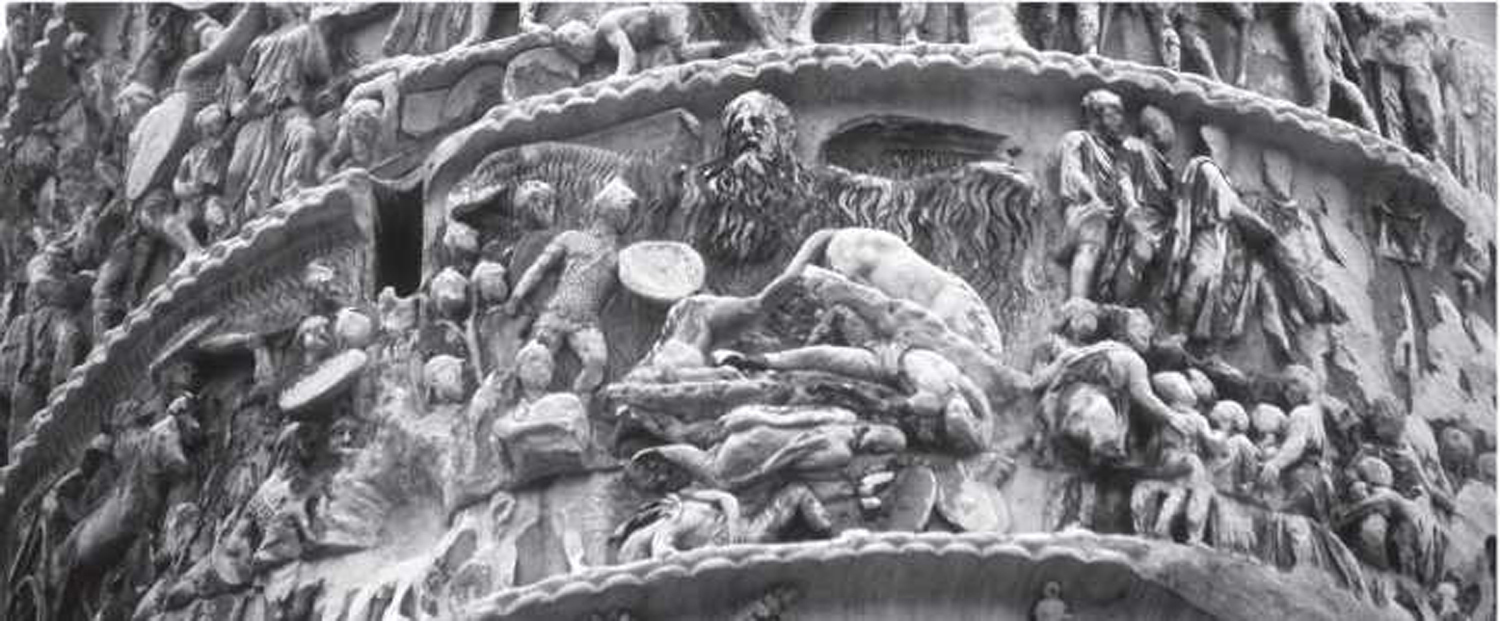
Figure 3.7: The rain miracle on the column of Marcus Aurelius. A rain god sends a deluge to relieve the Romans of their thirst and to destroy the encircling enemy. Column of Marcus Aurelius (scene 16), Rome. (Courtesy of Alamy)
Most detailed of the literary descriptions of the miracle is that by Cassius Dio, but this is known only from the summary made of Dio’s history by the eleventh-century AD Christian author Xiphilinos, who paraphrased Dio’s account – and then criticized it in detail.160 According to Dio, the Roman army was suffering from thirst, being hemmed in by the Quadi so that they could not break out and obtain water, when a deity took the situation in hand. Dio records that an Egyptian magician (magos) with Aurelius caused it to rain by invoking the gods, and especially Hermes (who for the Romans was Mercury), god of the air (aerios). Earlier than Dio, the Christian author Tertullian, in his Apology (about AD 195) – written only two decades after the incident – and his ad Scapulam (ad 211–13), wrote briefly that the Christian soldiers in Aurelius’ army prayed for rain and their God sent it.161
Xiphilinos, in his precis and criticism of Dio’s account, agreed with both Tertullian and Eusebius in his Church History162 the Christian soldiers in a particular division of the army were responsible for the rain. Eusebius recounts that in Aurelius’ army there was a legion known as the Melitene, which included Christian soldiers, who in their dire need for water kneeled on the ground and supplicated the Christian God for rain. He cites an earlier Christian author, Apollinaris, that the emperor therefore named this legion the ‘Thundering Legion’.163 Tertullian,164 as well as Eusebius, also mentions letters of Aurelius in which the emperor acknowledged that the army had in fact been saved by the Christians, but clearly any such letter (Xiphilinos mentions one letter) was a forgery. Christian authors were eager to have it believed that the pagan emperor Aurelius acknowledged that the Christians saved an entire Roman army and brought about the defeat of the enemy.165
Xiphilinos adds a few further details, including the fact that the prefect of the army informed the emperor that there were Christians in the army, who through their prayers were able to accomplish anything. Aurelius therefore asked the Christian soldiers to pray to their God, who immediately heard the prayers and sent the rain (and a thunderbolt to kill the enemy). This account gives Aurelius an active agency in events, in which he seeks the help of the Christians and asks – not orders – them to have their deity intercede for him. Some enterprising Christian also penned an oracle, which made its way into the Sibylline Oracle collection, that in answer to Aurelius’ prayer, the Christian God sent rain out of its proper season of the year.166
That rain fell for the Romans just as they were suffering severely from lack of water, and were penned in by an enemy who were prepared to wait for them to die of thirst, seems indisputable, and is recorded on the column. Very early on – within twenty years it was being referred to in Christian writings – a narrative existed amongst the Christians that it was Christian soldiers who prayed and made it rain so that Aurelius could defeat the barbarians threatening the Empire. Christians were serving in the Roman Army at this date (though there would certainly not have been an entire legion specifically made up of Christians), and probably they did pray for rain when on the point of death. No pagan source mentions Aurelius or the pagans praying, only that the rain was conjured up by an Egyptian magician with the army. Pagan and Christian practices were already side by side by the last quarter of the second century AD, and in this case something of a contest for the credit of the miracle occurred.
Triumphal Processions and the Gods
There are three relief panels from Aurelius’ arch now in the Capitoline Museum in Rome: one, a scene of imperial clemency, is known as the ‘Clementia’, the second is of an imperial triumph and the third depicts Aurelius sacrificing outside the temple of the Capitoline triad in Rome.167 The triumph scene has Aurelius in his triumphal chariot, drawn as usual by four horses and advancing towards the Porta Triumphalis, the Triumphal Gate (see Figure 3.8).168 A winged Victory hovers above him, with three figures portrayed on the upper register of the chariot. On the left is Neptune with his trident: this is Neptune as Neptunus Redux, ‘Neptune who brings about return’, who has protected the emperor on his nautical return from the East.169 On the right is the war goddess Minerva, and in the centre, a seated figure, with one bare breast, represents the goddess Roma of the Amazon type (i.e., the warrioress Roma). In the lower register, on the chariot and slightly obscured by the horses, are winged Victories. The relief of the procession deliberately includes one temple, the identity of which is uncertain; it is presumably one of the many temples along the triumphal route, and the temple of Jupiter Tonans, Jupiter Custos or Saturn have all been suggested.170
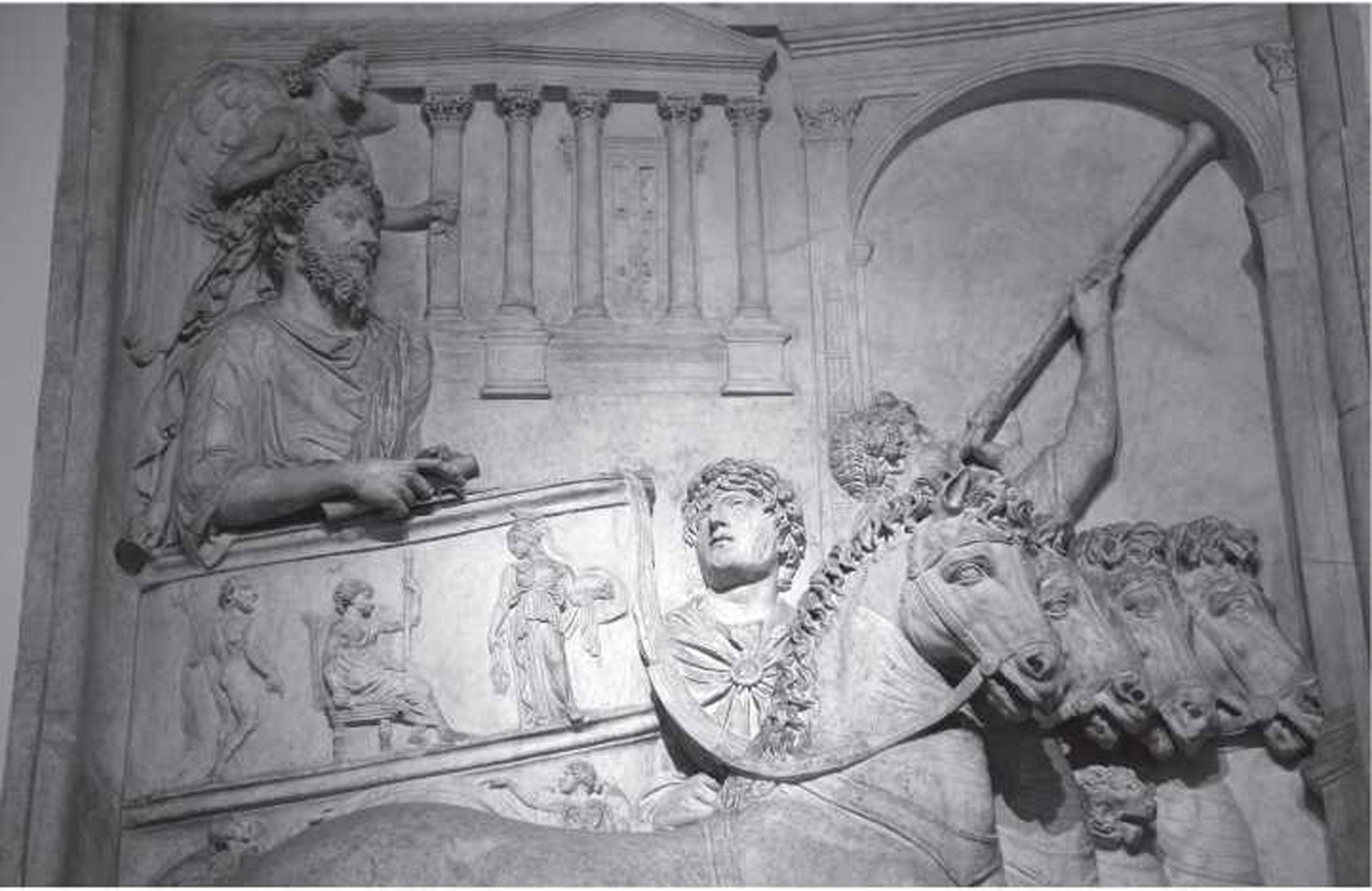
Figure 3.8: Marcus Aurelius in triumphal procession in Rome, relief in the Capitoline Museum (Inv. Scu 808). (Courtesy of Alamy)
Thanksgiving Sacrifice after the Triumph
One of the panels in the Capitoline Museum depicts Aurelius presiding over a sacrifice outside the temple of Jupiter Optimus Maximus on the Capitoline: its three doors, leading into the chambers of Minerva, Jupiter and Juno, are clearly visible. A large bull stands next to the victimarius, who has his axe ready to dispatch it.171 Aurelius holds a patera over the altar to pour a libation onto it. Jupiter’s priest, the flamen Dialis, is present to the immediate right of Aurelius, conspicuous by his spiked hat (his spike is shown on the column behind him). Aurelius, with his head covered (capite velato) for the sacrifice, is officiating as Pontifex Maximus.
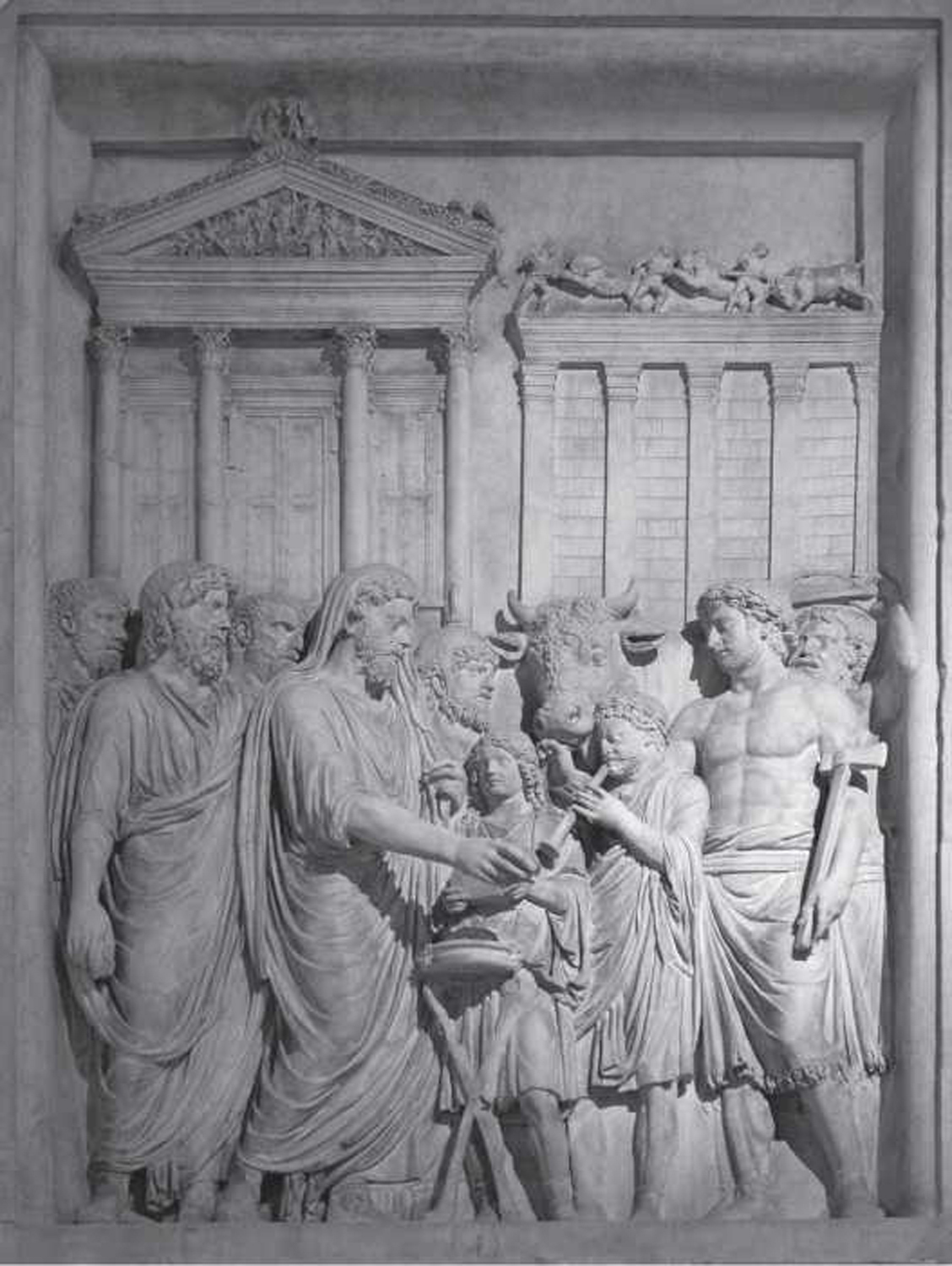
Figure 3.9: Marcus Aurelius making a thanksgiving sacrifice to the gods for his victory over the Marcomanni and others. Relief from his triumphal arch, Capitoline Museum Inv. Scu 807. (Courtesy of Alamy)
A thanksgiving to the Capitoline triad for victory is also shown as part of the triumph celebrated by Tiberius on a silver skyphos (cup) from the Boscoreale treasure. On one side of the cup, Tiberius processes in his triumphal chariot, on the other a victimarius is about to bring his axe down upon the head of a bull, in front of a wreathed temple of Capitoline Jupiter.172 This triumph was that of either 7 BC or AD 12.173 Tiberius and Aurelius through their sacrificial acts outside the temple of Jupiter Optimus Maximus, Rome’s greatest god, thanked him for their military victories. Trajan and Aurelius, war-leaders and heads of state, displayed their piety through libations, incense burning and the sacrifice of the suovetaurilia which purified their armies in the lustratio rite, invoking the gods of the Roman state to bring victory to the Roman Army: without divine support, there could be no success. After a triumphal ceremony, an arch was erected to commemorate their victory and, as can be seen in Aurelius’ case, the reliefs expressed the emperor’s thanks to the gods for their assistance.
The Victory Trophy: Tropaeum
The ancient Greeks had invented the tropaion, or battle-trophy, which was erected on the site of the engagement by the side which had been victorious on the field of battle. A tropaion consisted of a set of the armour and weapons taken from the enemy, affixed vertically to a wooden pole, log or branch. Rome adopted the practice, and the trophy was known in Latin as the tropaeum (plural, tropaea). One is shown being erected in the lower register of the early first-century AD so-called Gemma Augustea (‘Augustan gem’), an engraved piece of double layered (white and black) Arabian onyx (see Figure 3.10). The figures on it are carved in low relief raised only a few millimetres: the width of the gem is 230mm and the height is 190mm. It is probably by the famed Greek sculptor Dioskourides. The gem has been copied in modern times. It has two registers, the upper one depicting Augustus and the lower one the tropaeum scene.
In the upper register, left, a male – possibly Tiberius – descends from a triumphal chariot with a winged Victory (there are clearly four horses, indicating a triumphal chariot, with one of the horses no longer in its traces: compare the position of the outside horse in Figure 3.8). Next to him stands a young Germanicus – although the latter was not deified, he was still receiving veneration from soldiers in the third century AD in the religious calendar from Dura-Europos (see above). Then there is a seated goddess with helmet and spear; her sword sheath is also visible. She is resting her feet on a breastplate and shield, with a helmet placed on the breastplate: she is probably the military aspect of the goddess Roma (and her resemblance to Augustus’ wife Livia will have been deliberate). Enthroned sitting next to her, naked from the waist up and hence signifying his apotheosis as a Roman god, is the deified Augustus holding a sceptre representing his authority, and a lituus, the main ritual implement of the Roman augurs, with the eagle of Jupiter, looking up at him, under his throne. Augustus’ zodiac sign, Capricorn, is shown between Roma and himself. He is being crowned with a wreath by a goddess. This is possibly Oikoumene, goddess of the world, and she is shown as usual with a turreted crown. The wreath itself is the corona civica, made of oak leaves and awarded to those who had saved the lives of Roman citizens in battle; Augustus had been awarded this (as had Julius Caesar previously) in 27 BC by the Senate.174
Oikoumene and the male god next to her look directly at the wreath, drawing the viewer’s attention to it. This male divinity has been identified as Oceanus, who with Oikoumene represents the realms of the world over which the gods had given Augustus and the Romans suzerainty. Leaning casually against Augustus’ throne is a goddess with well-endowed breasts who holds a cornucopia (horn of plenty); she might well be Tellus Italiae, the personification of Mother Italy, and the two children with her (one carrying a sheaf of grain) are personifications of Italia’s fecundity.
In the lower register, four soldiers are shown raising a heavy log vertically, on top of which is attached a set of arms and armour; next to it (left) is Tiberius’ zodiac sign, the scorpion. Several captives are shown, in a generic ‘barbarian’ style. If Tiberius in the upper scene is descending from a triumphal chariot, these captives could refer to his triumph in 7 BC or AD 12. If this does not represent a triumph (which is unlikely), then perhaps this is his entrance (adventus) into Rome in AD 9 after his successful campaigns against the Illyrians. One of the four soldiers is shown in helmet and military uniform and cape: given the other divine figures in the lower register (as in the upper), this is probably the god Mars (perhaps as Mars Ultor, Augustus’ favourite manifestation of Mars; see above). Diana, generally a goddess of hunting, is shown with two spears with their points to the ground (indicating a cessation of hostilities), and the god Mercury (wearing his traveller’s hat, with his left hand on his sword sheath to indicate he has housed his sword). Both are showing mercy to the vanquished: the pax Romana has been established.175 The cameo stresses the first emperor’s relationship with the gods, his victories, the pax Romana over which he presided and of course Rome’s military successes under the auspices of the gods.
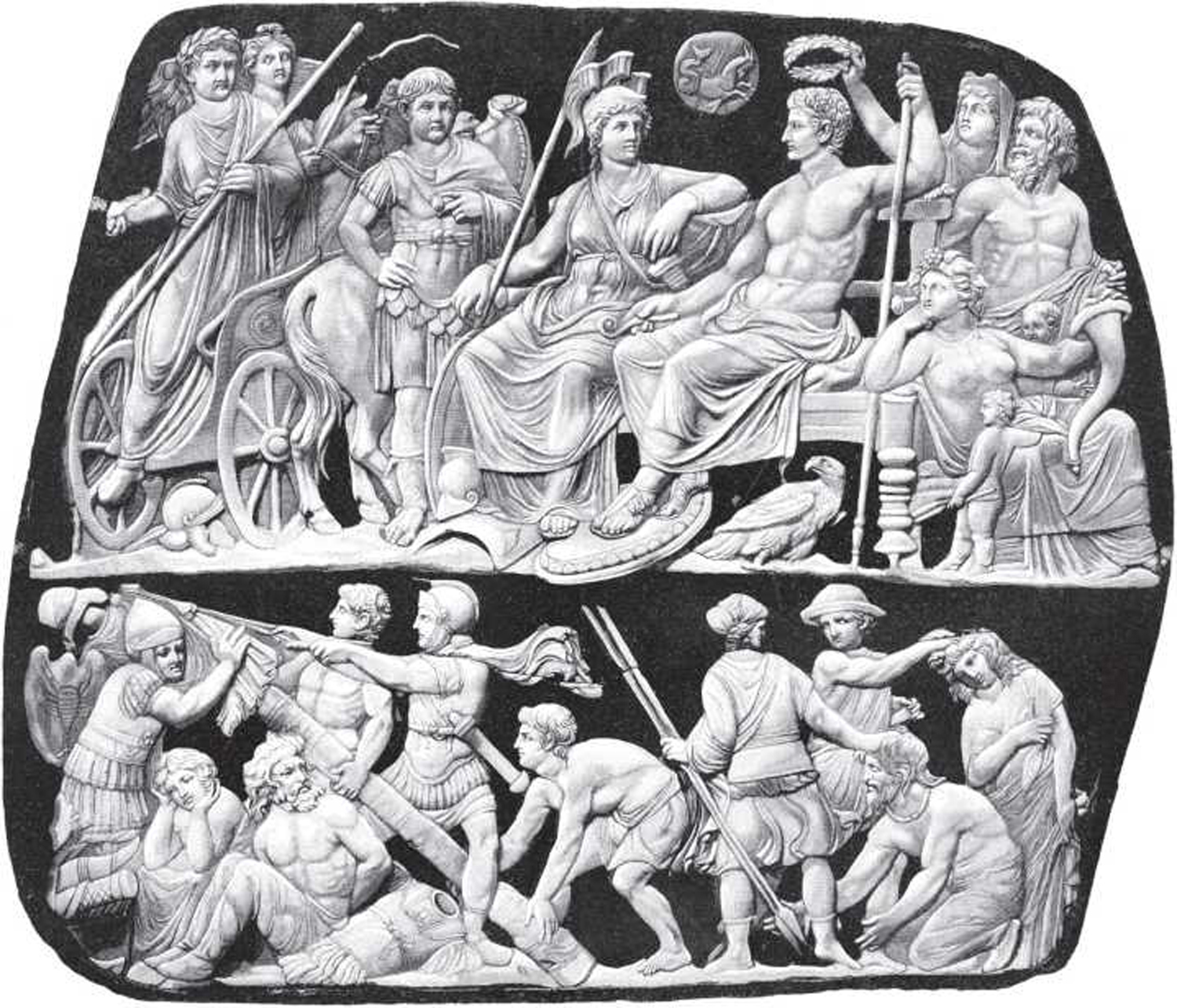
Figure 3.10: The Gemma Augustea depicting gods with the divine Augustus, in the upper register. Mars assists in raising the tropaeum (left), while Diana and Mercury show mercy to captives (right), in the lower register. Double-layered Arabian onyx; AD c.20s-30s. Kunsthistorisches Museum, Vienna, inv. IXa 79. (Photo courtesy of Alamy)
Tropaea also frequently appeared on coins in the aftermath of a military victory. Coins, for example, from the reign of Domitian (ad 81–96) show the emperor on the obverse, wearing a laurel wreath of victory, and on the reverse the goddess Minerva, armed with shield and spear and wearing a helmet, who has her right hand on a victory tropaeum (see Figure 3.11). Such coins were intended to advertise Domitian’s military victories – an important consideration given the brilliant military successes of his father and brother. This particular example is from Judaea, where it might have had particular resonances due to Vespasian and Titus’ victories there, but such coins were also issued elsewhere in Domitian’s reign. He did have a predilection for Minerva apart from her military aspect, but the coins indicate that he considered that her assistance was intrinsic to his military victories;176 she also appears as a fully armed goddess on many of his coins.177
In addition to setting up a tropaeum on the field of battle when victorious, using the arms and armour of the defeated enemy, tropaea were rendered in stone and used in the imperial period to decorate the arches which commemorated the victory of a Roman general awarded a triumph (from 29 BC he had to be the emperor or a member of the imperial family to so triumph, or if a general, the emperor celebrated the triumph in his own name). Upon his death, Drusus (brother of Tiberius) was voted a triumphal arch with tropaea on the Via Appia by the Senate.178 His son Claudius also had a victory arch erected for his conquests in Britain. Coins of his reign show this, with the legend ‘de Brittanis’ (‘for Britain’), surmounted by a cavalryman with a tropaeum of arms, each with two shields, on either side of him.179 This victory arch was dedicated at Rome in AD 51 or 52 – there was also one at Gesoriacum (Boulogne), from where Claudius had embarked for Britain. There are scant remains of this arch: the dedicatory inscription survives, but there is no mention of divine assistance,180 unlike Trajan’s later reference to Mars Ultor at Adamklissi. Other coins of Claudius’ reign show a triumphal arch, also with a cavalryman and two-shielded tropaea on the reverse, and with the legend of his father Drusus’ titles and his bust on their obverse; some, but not all of them, have ‘de Germanis’ (‘for Germany’) on the arch. This was Drusus’ triumphal arch, erected posthumously (see Figure 3.12; the obverse is not given). Claudius through his coinage was displaying both his own and his father’s arch, and the similar statuary crowning the attic was intended to draw favourable comparisons with his father.181 Nothing is known about the tropaea of Germanicus which were erected near the temple of Fides in Rome.182
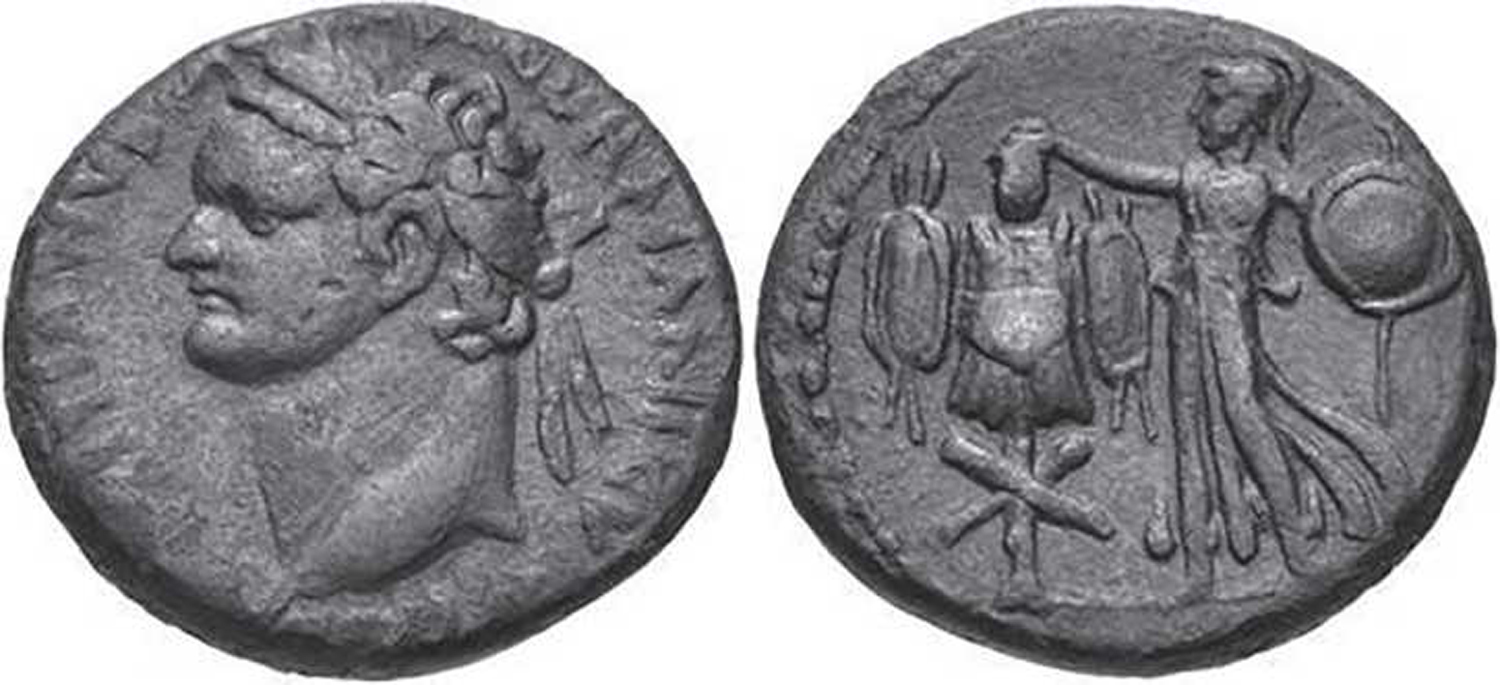
Figure 3.11: Silver denarius. Minerva as war goddess puts the finishing touches to a tropaeum (reverse). Obverse: wreathed bust of Domitian. Reign of Domitian, AD 81–96. (Courtesy of Classical Numismatic Group)
After the successful conclusion of his first Dacian campaign (scene 78), Trajan’s Column shows double-shielded tropaea (as on Drusus’ arch) with a helmet and Dacian clothing on the traditional branch, with a pile of captured weapons below (see Figure 3.13). In between the tropaea, the winged goddess Victoria (victory) prepares to inscribe a shield, to make clear that Trajan is dedicating this armour to the gods, or perhaps is writing ‘Dacia conquered’. An aureus depicts Trajan in the guise of a heroic nude Greek athlete with a spear in his left hand standing next to a tropaeum and apparently putting the final touches to it. There is a Dacian at his knees, extending his right arm upwards to ask Trajan for mercy.183 Another divine correspondence between Trajan’s and Marcus Aurelius’ columns is that the goddess Victoria also appears on Aurelius’, who once again is drawing a parallel not merely to the columns, but to the campaigns of his illustrious military predecessor. Aurelius reads from a scroll to his assembled soldiers, perhaps announcing military decorations for some of them, while a winged Victoria commences writing on a large shield. To her left and right stand typical tropaea, with captured enemy clothing, shields (two shields per ‘arm’, as on Trajan’s Column) and weapons (scene 78).184
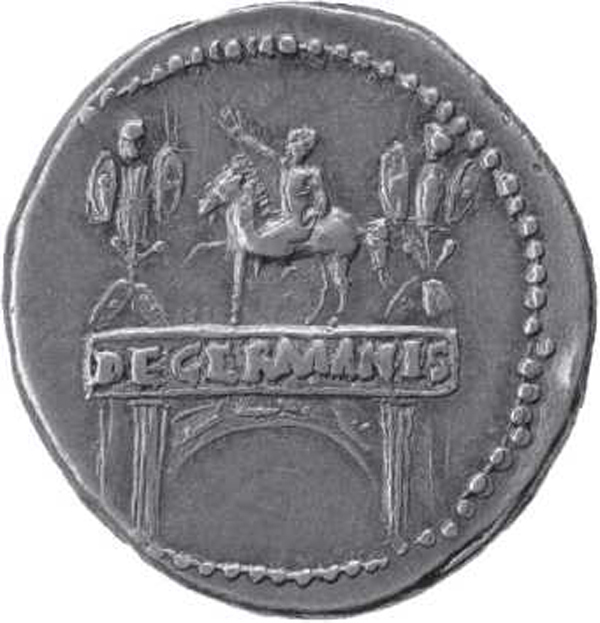
Figure 3.12: Gold coin (aureus). Drusus’ victory arch with stone tropaea, with the legend ‘de Germanis’, ‘for Germany’, with a tropaeum from his campaigns on either side of an equestrian statue of Drusus. (Courtesy of the Trustees of the British Museum, BM 1864,1128.243)
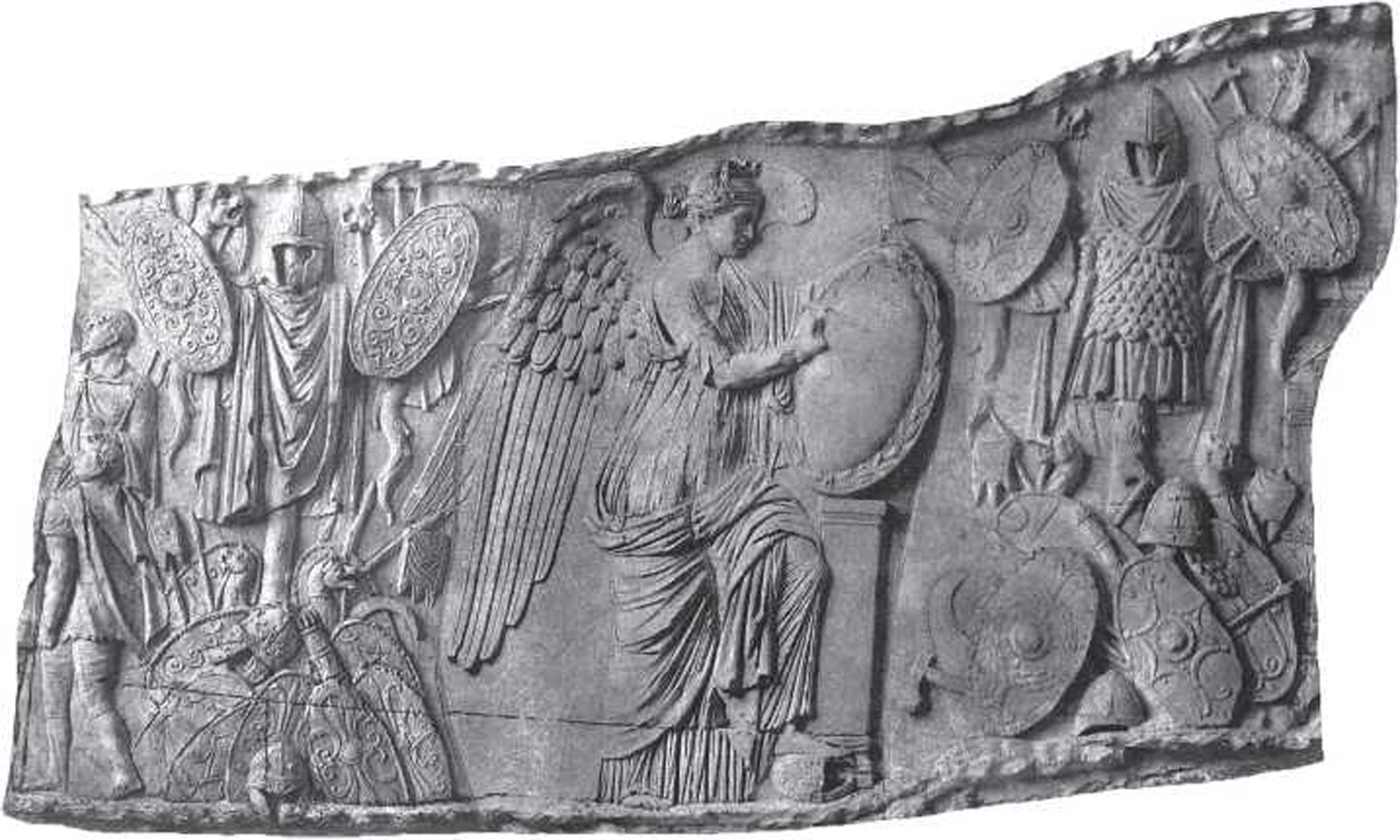
Figure 3.13: The winged goddess Victoria prepares to inscribe a shield, with a double-shielded tropaeum of Dacian clothing and weapons on either side of her. Trajan’s Column (panel 78, scenes 204–06), Rome. (Courtesy of Wikimedia)
Winged Victories each carrying a tropaeum appear in the spandrels (the space between the curve of an arch and the next horizontal feature) of the arch of the emperor Septimius Severus (reigned AD 193–211) in the Roman forum: the Victories each carry a long branch with the tunic and head-gear of a defeated enemy.185 Similarly, on the marble arch of Trajan at Beneventum in southern Italy, dated to the mid 110s AD, marking his extension of the Via Appia,186 the faces of the piers of each long side (east and west) of the single arch show carved winged Victories (in the second, narrow registers), who in this case are making sacrificial offerings of bulls. What has not been noted previously about these is that they are cutting the beasts’ throats: this is the sphagia ceremony which is depicted in Greek art, the sacrifice that occurred just before battle was joined, and which Victories (Nikai in the Greek) were thought to perform, for success in battle.187
There are the usual winged Victories in the spandrels of the Beneventum arch, but not carrying tropaea. Above the register of Victories making sacrifices, on the left side (south pier, west face), Mars is portrayed in the garb of a Roman officer, his shield on his left arm. He appears with Trajan and children, accompanied by three goddesses, around one of whose shoulders he rests an arm. This is a reference to Trajan’s alimenta scheme, which provided subsidies for the support of children in Italy, and the goddesses presumably represent deities of prosperity. Mars is present, perhaps as Mars Pater, Father Mars.188 (There was a nearby temple of Mars.) Clearly, however, the association between Trajan and Mars will have been largely due to Trajan’s Dacian conquests.
A panel on the arch also shows the Capitoline triad (Jupiter, Juno and Minerva), with four other deities (who are unidentifiable). Jupiter carries his sceptre and in his right hand he is holding out his thunderbolt. He is facing towards and into another relief which depicts Trajan taking his leave for the Dacian campaign, and Jupiter is presumably indicating to Trajan that the divine thunderbolts will come to his assistance (as indeed they did).189 In the interior of the span of the arch, that is in the vault, a winged Victory crowns a standing Trajan.190 On the west side, in the middle of a scene in a panel on the south pier, a bearded figure who is naked to the waist holds a thunderbolt. This is, of course, none other than Jupiter, with Trajan to his left and a Dacian chief to his right making his surrender: Jupiter’s presence seals the sacredness of the occasion, which would have involved the exchange of sacred oaths.191
Mainly found throughout Roman Germany (and in Belgica, Belgium), with a few other examples elsewhere, are the remains of several so-called ‘Jupiter columns’. Most date to AD 150–260 and were set up both by civilians, and by Roman and auxiliary soldiers, both serving and discharged. Many such columns were about 4–5 metres high (though a few are as high as 12 metres), fairly slender, not necessarily decorated and surmounted with a statue of Jupiter (sometimes on a horse, in which case he is shown trampling a Giant) carrying his thunderbolts (as in the example in Strasbourg’s Musée Archéologique).192 The most famous example comes from Mainz, where it was excavated, with the pieces now in the museum there. It would have stood about 10 metres high, plus the statue of Jupiter on top. An inscription indicates it was set up by the local community, was about 10 metres high and dates to the reign of Nero, with the inscription indicating that it was dedicated for the health (salus) of the emperor. It has a tropaeum on an upright branch, presumably referring to a military victory of Nero’s reign. There is a completely modern reconstruction of the Mainz column at the Roman fort at Saalburg (near Bad Homburg), which stands 12.5 metres high.
The Monumental Tropaea of Augustus
As in Greece, however, there was, in the Roman imperial period, a second form of the tropaeum, which comprised a permanent monument to victory on the field of battle or nearby.193 In the imperial period, the first of these was that of Octavian to commemorate his victory at Actium in 31 BC. He established a city, Nicopolis (‘Victory City’), near Actium in 29–27 BC, and restored the existing temple of Apollo there, establishing a four-yearly festival (the Actia) with contests, with Apollo of Actium as the presiding deity. He dedicated ten ships captured in the battle to Apollo, and these were housed in boatsheds near Apollo’s existing sanctuary.194
Suetonius notes that Octavian also decorated the area where his camp had been at Actium with ‘naval spoils’, and consecrated the area to Neptune and Mars, gods who, with Apollo, had fought for Octavian.195 Dio also notes that the structure erected on his campsite was dedicated to Apollo.196 Germanicus visited the city and saw the spoils dedicated by Augustus:197 the ruins are still standing of a permanent marble tropaeum which had been decorated with the bronze rostra (ramming beaks) of thirty-six ships,198 with the monument measuring some 62 by 50 metres. According to the dedicatory inscription, Octavian consecrated to Neptune and Mars the camp from which he set out to fight the enemy, and decorated the monument with the spoils of battle.199 Its wording ‘peace having been obtained on land and sea’ (pace parta terra marique) must refer to the closing of the temple of Janus at Rome in the aftermath of the battle. This tropaeum was a permanent reminder of Octavian’s gratitude to the gods whom he saw as having enabled his victory, from which he emerged as master of the Roman world.
A permanent tropaeum was erected by Augustus in c.25–20 BC at modern St Bernard-de-Commagne, ancient Lugdunum Convenarum, in southern France in the central Pyrenees. His monument survives as three rectangular bases on which sculptural groups were placed. These remains include a marble statue of the emperor, on whose breastplate a double-shielded tropaeum was carved with two bound captives at its base, as well as statues of a Victory and the usual captives, and a marble tree trunk with the traces of a tropaeum. This monument probably celebrated Augustus’ victories in the region against several tribal groups in Gaul and Spain.200 At another triumphal arch at modern Orange (ancient Arausio) in France, possibly dating to the reign of Tiberius to commemorate the quelling of a local revolt, the artist or artists took a different approach, with the bays above the lateral arches, instead of having tropaea, depicting an assorted medley of weapons and armour captured from the enemy. Some of the shields are inscribed with the names of Gallic chieftains, to indicate their subjugation. A similar approach was taken in the lower attic, in which naval spolia (such as ship rams) are piled up.201
A particularly spectacular monumental tropaeum is that of Augustus at La Turbie in France, the Tropaeum Augusti (or in modern parlance, the Trophée des Alpes). Constructed in 6 BC to commemorate Roman victories over forty-six tribes in the alpine region nearby (see Figure 3.14), it is located on the border of what was the province of Gallia (Gaul) Narbonensis with Italy.202 Pliny recorded the dedicatory inscription, to the effect that the Senate and People of Rome constructed it for Augustus (as it was under his imperium and auspices that the conquests took place). A circular structure on a square base, the rotunda had twenty-four columns, its current height being 35 metres; the whole was surmounted by a colossal statue of Augustus, and hence the structure may have reached a total of 50 metres high. There is a carved tropaeum on the west face with two captives underneath.203
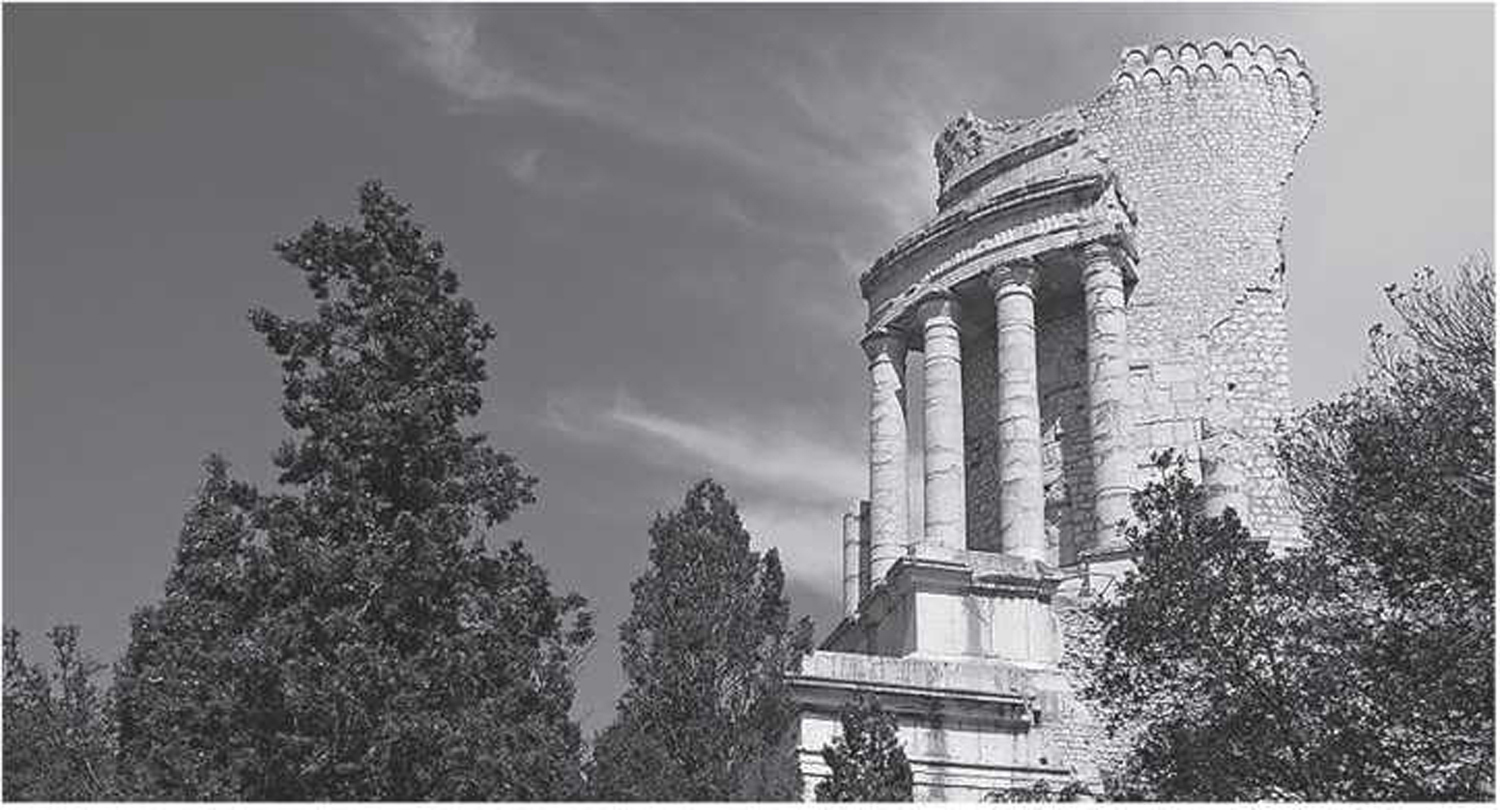
Figure 3.14: Augustus’ monumental tropaeum at La Turbie in France. (Courtesy of Wikimedia)
The Monumental Tropaeum Traiani at Adamklissi
Trajan’s tropaeum at Adamklissi, also circular, was almost certainly architecturally modelled on Augustus’ at La Turbie, in order to stress a continuum between the achievements of Augustus and Trajan. Trajan constructed a large, permanent tropaeum in AD 107–108, now referred to as the Tropaeum Traiani, for his defeat of the Dacians and Sarmatians in AD 101–102, at what is now Adamklissi in modern Romania, then the Roman province of Moesia Inferior (see Figure 3.15).204 According to an inscription on the monument, it was dedicated to Mars Ultor (Mars the Avenger).205 A circular structure some 30 metres in diameter and probably about 18 metres in height (or even 38 metres, depending on the reconstruction), it was decorated with fifty-four carved metopes (a sculptural relief carved on a stone slab) around the uppermost part, each metope being separated from its neighbour by a triglyph (a stone slab with three carved vertical bars), depicting Romans fighting these tribesmen. None of the surviving scenes – although six are missing – is religious in nature: perhaps one of the lost scenes was the essential suovetaurilia sacrifice made in the field prior to a campaign.206
Situated around the actual top of the drum in crenellation form were twenty-six metopes portraying enemy captives. The structure itself may have been surmounted by a traditional tropaeum of captured armour on a wooden support several metres high.207 On a monumental altar (12 metres square and 6 metres high) separate from the tropaeum were listed the names of about 3,800 Roman and auxiliary soldiers; a few fragments of names on the altar survive. This altar probably dates to Domitian’s reign and commemorates the dead from his campaign in the region.208
Trajan’s tropaeum is unique in terms of a Roman monument commemorating Roman soldiers, celebrating the fact that Mars Ultor had given him victory against these tribesmen. Trajan dedicated Adamklissi to Mars Ultor, possibly in vengeance against the Dacians for the eagle lost under Domitian, which Trajan recovered.209 When Trajan had engaged the Dacians near Tapae and defeated them, he gave honours to the fallen Roman soldiers, ordering that an altar be erected to them and that funeral rites for them be held there annually.210 Presumably there would have been annual commemoration services at Adamklissi as well.
Not all of the tropaea erected were of such a permanent character as Adamklissi: Florus writes that Drusus constructed a tumulus, an earthen mound, as a tropaeum in 9 BC after a victory over the Marcomanni, decorating it with the spoils and insignia of the defeated.211 Similarly, Germanicus constructed a less permanent trophy in AD 15, although Tacitus refers to it as a monument. He piled up the arms captured from (the many thousands of) the enemy slain, and had an inscription erected that having conquered the ‘nationes [peoples] between the Rhine and Elbe rivers’, he dedicated these arms to Mars, Jove (Jupiter) and Augustus. These three were Rome’s war god Mars, its supreme god Jupiter and the deified Augustus (Germanicus’ grandfather), the latter now seen as worthy of receiving the spoils of war and presumably, as with the other two deities, viewed as having lent his divine support to Germanicus.212 Upon the death from natural causes of Drusus, Tiberius’ son, in AD 23 he was honoured by the army with the erection of a tumulus around which, on a set day each year, the soldiers would make a ceremonial run (the decursio), and the cities in Gaul (hence it appears the tumulus was in that country) would observe the day with prayers; the Senate voted him a marble arch, with tropaea, to be erected on the Appian Way.213
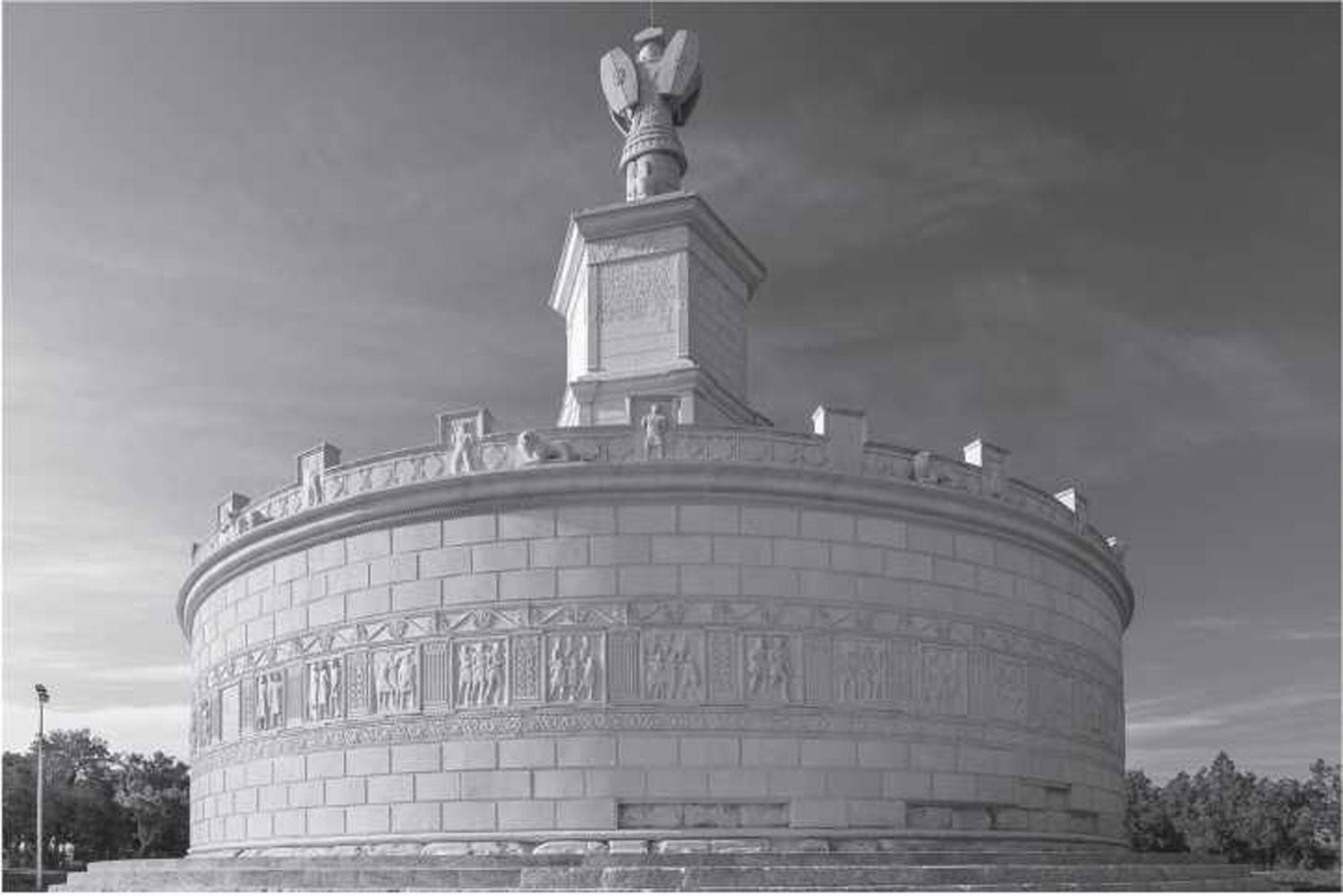
Figure 3.15: A modern reconstruction of Trajan’s tropaeum monument at Adamklissi. (Courtesy of Alamy)
Tropaea as stone monuments, as piles of weapons or in the form of the traditional attaching of a suit of captured armour from the enemy onto a wooden fixture, were a necessary material expression of Roman victory in the Empire. Architecture in the form of temples, altars, arches and columns, and media such as coinage, the Gemma Augusta and carved reliefs, celebrated Rome’s relationship with the gods believed to support the Empire in its wars and conquests. These visible, tangible expressions of Roman thanksgiving to their gods were seen as necessary to ensure that the gods knew that their assistance was appreciated. Above all, it was Jupiter Optimus Maximus and Mars Ultor who were thought to be the primary war-gods.
Conclusion
The religion of the Roman Army in the Empire was diverse and manifold. There was compulsory worship directed by the current regime with its military religious calendar, though this is not to suggest that the soldiers did not enter into these ceremonies willingly and enthusiastically. Various cults were associated with the legionary eagles and standards, and with the camp itself. Soldiers venerated the traditional Roman gods, but nothing prevented their attachment to their own indigenous gods or from becoming involved with ‘Eastern’ cults such as those of Mithras and Jupiter Dolichenus. Soldiers articulated their devotion through the erection of inscribed altars and other forms of dedication. Individual soldiers, generals, emperors and the very state believed without qualification that the gods decided the outcome of battles. Numerous incidents, especially in the first-century AD civil wars, indicate that the Romans believed the gods did take sides in military conflicts, and that they encouraged a commander such as Vespasian to engage in war to secure the imperial throne, sending him positive omens and unpropitious ones to the eventual losers.
At the state level, the support of the gods was sought through rituals such as the declaration of war, with the fetial priests in the temple grounds of the war goddess Bellona carrying out ancient ceremonies. Suovetaurilia sacrifices proclaimed the commencement of war. Demonstrable large-scale indications to the gods of the state’s devotion to them and thanks to them for their assistance came in the form of the temple of Mars Ultor and many reliefs on triumphal arches, not to mention the columns of Trajan and Marcus Aurelius, representing the gods within actual battle contexts. Emperors are shown taking part in sacrifices and in the company of the gods, or near their temples, and Trajan was careful to indicate on his column that he had regularly sacrificed to the gods while on campaign in Dacia. Coins displayed the original tropaea of battlefields, and invoked, together with triumphal arches, the goddess Victory, the personification of battle, glory and military success.
Rome’s military success depended on the gods, and the individual and state devotion to war gods and cults of many varieties indicates that this belief was strong, personalized and also institutionalized. The religious life of an individual soldier, his century, cohort and legion, was a busy and regular one. As a state, the Romans equipped themselves with augury, temples, regular sacrifices and thanksgivings, preparing for ordinary and extraordinary military commitments and exigencies. The gods received worship on a regular basis, and of course during the extraordinary crisis of war. Whether the legions were at peace or at war, Jupiter as his legionary eagle went with them, providing his support. And when Jupiter gave way to Christ, in Roman belief the divine was still with their armies, delivering them victories over their enemies.
Notes
1. P Dura 54; editions: Fink et al. (1940); translations: Fink (1971), pp.422–29, no. 117 (with Latin text); Helgeland (1978), pp.1481–88; (with Latin text); translation: Hekster & Zair (2008), pp.127–29, no. 26 (somewhat patchy). See Irby-Massie (1999), pp.14–17. For the calendar, see Nock (1952), esp. pp.187–88; Gilliam (1954); Fishwick (1988); Pollard (2001), pp.142–44; Stoll (2007), p.453; Hekster & Zair (2008), pp.54, 66.
2. Fink et al. (1940), pp.28–29; Nock (1952), pp. 194–95; Gilliam (1954), pp. 183–84; Birley (1978), p.1510; Helgeland (1978), pp.1487–88; Fisher (1988), esp. pp.349–50.
3. Ovid Fasti 3.814.
4. Tert. Coron. 12.2. See, for the Quinquatria, Fink et al. (1940), pp.94–97.
5. Cf. Fishwick (1988), pp.359–60.
6. Cic. Att. 5.20.5.
7. Gilliam (1954), p.187.
8. For a sound overview and discussion of the fresco, see Kaizer (2006), outlining previous scholarship and convincingly arguing that these are three Palymyrene deities. Many scholars consider the triad to be Palmyrene, but an imperial group makes more sense.
9. Fink et al. (1940), pp.181–90.
10. For the cult of Jupiter Dolichenus, the standard treatment is Speidel (1978); see also Nash-Williams (1952); Tóth (1973); Walsh (2016); Walsh (2020).
11. See the catalogue of cult material in these locations in CCID.
12. See Nash-Williams (1952), pp.72–73; cf. Speidel (1978), pp.1–2.
13. For example, AE 1940, 71.
14. For example, AE 1940, 72, 73. See RIB 3253, discussed below.
15. For the plaques, see Turcan (1996), pp.163–64.
16. Kunsthistorisches Museum Wien, Antikensammlung Inv. M5.
17. Platner-Ashby (1929), p.292; Richardson (1992), p.218; Turcan (1998), p.127.
18. For the geographical locations of the cult, see Nash-Williams (1952), pp.73–74; Turcan (1996), pp.167–68; in Britain and Pannonia: Walsh (2020). For Jupiter Dolichenus and the army in Britain, see Irby-Massie (1999), pp.67–91.
19. For the sites, see Ratimorská & Minaroviech (2009), pp.1, 5; Walsh (2020), pp.277, 279–80; note esp. Collar (2011). For Vindolanda, see esp. Birley & Birley (2012).
20. Ratimorská & Minaroviech (2009), p.11, fig. 28.
21. CCID, no. 217.
22. RIB 3253, AD 217 (AE 1967, 259). Legion II Augusta also erected an altar to the ‘Discipline of the Augusti’: RIB 1127.
23. Hdn 7.3.5; see esp. the discussion of this passage by Tóth (1973), pp.112–13, 116.
24. See, in particular, the discussion of Tóth (1973), pp.109–11, who lists these provinces and the sites themselves, with a detailed analysis of the destructions. Cf. Walsh (2016), discussing temple building and restorations in Noricum and Pannonia.
25. Tóth (1973), pp.109–11.
26. Spiedel (1978), pp.74–75; Walsh (2020), pp.287–88.
27. RIB 2177 (CIL 7.114; ILS 4831c); Hunterian Museum F.27; Keppie (1998), pp.104–05, no. 36, pl. xiii.
28. For Epona, see Linduff (1979); for the cult in Britain, see Irby-Massie (1999), pp.154–55.
29. Birley (1976), pp.108–10.
30. RIB 1334 (see same for the date; CIL 7.510).
31. Irby-Massie (1996), pp.298–300.
32. For the Campestres, see esp. Irby-Massie (1996); for the cult in Britain: Irby-Massie (1999), pp.152–53.
33. See Irby-Massie (1996), p.293.
34. Veg. Mil. 3.4.3, cf. 1.1.2; see Stoll (2007), p.453. For the cult of the standards, see Irby-Massie (1999), pp.38–45.
35. Birley (1978), pp.1514–15; Le Bohec (1994), p.107; Stoll (2007), p.453.
36. RIB 3298 (AE 1979, 388).
37. RIB 990, 1127. See Birley (1978), p.1514, for other Discipulina inscriptions from Roman Britain (RIB 1128, 1723, 1978, 2092).
38. For the term aquilifer and signifer (carrier of the standards, the signa), note Tac. Ann. 1.48; Veg. Mil. 2.6, 2.13. For the imaginifer: Veg. Mil. 2.7.
39. Veg. Mil. 2.6, 2.7, 2.8, 2.13.
40. Joseph. Bell. Jud. 3.6.2.
41. Livy 26.48.12: signa militaria et aquilas sacramentique.
42. Tac. Ann. 2.17.7; see Helgeland (1978), pp.1476–78.
43. Tac. Ann. 1.39 (the vexillum was kept in Germanicus’ domus, literally house: his quarters); cf. Pliny Nat. Hist. 10.16.
44. Dion. Hal. Rom. Ant. 6.45.2.
45. For the hand as part of the signa, and for this as an iconographic reference to the swearing of the soldier’s sacramentum (oath), see Taylor in this volume.
46. Veg. Mil. 2.13.1.
47. Also in other scenes, usually but not always involving military activity: scenes 24, 28, 52, 55–56, 66, (perhaps 67), 68, 82, 103, 104, 112, 121–22, 127–28, 136, 154, 193–94, 197–98, 203, 208, 226, 230–31, 258–59, 269–70, 275–76, 279, 284, 301, 335, 339, 347 and 365; note the cavalry vexilla at scenes 20–21.
48. For the religious rites for legionary eagles and signa, see esp. Stoll (2007), pp.457–58; cf. Wheeler (2009), pp.31–35.
49. Tert. Apol. 16.8; he repeats the claim at Tert. Nat. 1.12.15–16.
50. AE 1989, 581; cf. Hdn 4.4.5. The aedes principiorum appears in inscriptions from Roman Britain. The term was first found in RIB 3027, published in 1961.
51. Cic. Catil. 1.24, 2.13.
52. RIB 3507 (CSIR 1.4, 53–4, no. 149, pl. 37), cf. 2198. Keppie & Arnold (1984), no. 149; Le Bohec (1994), pl. 5, fig. 7; Keppie (1998), p.66, fig. 28, 81–82, no. 9, pl. 5; Durham & Fulford (2013), pp.90–91, fig. 7.
53. Plut. Crass. 19.3–6; Dio 40.17.3–18.2; Val. Max. 1.6.11.
54. Cic. Div. 1.35.77; Livy 22.3.11;Val. Max. 1.6.6.
55. Lactant. Mort. Pers. 10 (cf. 11–17); Arnob. Adv. Nat. 1.46.9.
56. Speidel & Dimitrova-Milceva (1978), p.1545, discussing AE 1926, 69. See their list of military units with genii at p.1544, structures associated with the army (e.g., the castra, camps, with their Genius castrorum) at p.1549 and passim for a discussion of military genii. See also, for the military genii in Britain, Irby-Massie (1999), pp.45–47.
57. RIB 1334.
58. Sixteen of these eighteen can be seen in The Hunterian Collection, University of Glasgow, National Museums of Scotland. A map at Keppie (1998), p.3 fig. 2 shows their location along the Antonine Wall.
59. The Bridgeness Slab: RIB 2139 (CIL 7.1088); The Hunterian Collection X.FV 27. See MacDonald (1900), p.53, no. 5; Phillips (1972–74), with pl. 9; Keppie (1998), p.61, fig. 25, p.63, fig. 26; Henig (2004), pp.228–29, fig. 12.6; Stoll (2007), p.454, fig. 25.1. The aedicula on the right is matched by one framing the cavalryman, but with an arched roof.
60. Actually, while there is clearly a ram and perhaps a bull, the third animal cannot be a sow – it is clearly a dog; even allowing for some clumsiness on the part of the Celtic artist, there is nothing porcine about this canine. He might have misunderstood his instructions to carve a pig.
61. E.g., Livy 1.44.2.
62. Cato Agr. 141; see also Varr. Rust. 2.1.10, cf. Ling. Lat. 6.86–87; Val. Max. 4.1.10; Fest. 154L.
63. RIB 2200 (CIL 7.1135); MacDonald (1900), p.54 no. 3; Keppie & Arnold (1984), pp.54–55, no. 150, pl. 37; Keppie (1998), pp.83–84, no. 11; Irby-Massie (1999),p. 243, no. 109. Virtus Augusta appears in many inscriptions, particularly referring to imperial victories: e.g., RIB 844, 1995.
64. RIB 2208 (CIL 7.1141; CSIR 156); MacDonald (1900), p.56, no. 1; Keppie & Arnold (1984), p.57, no. 156, pl. 38; Keppie (1998), p.23, fig. 12, p.65, fig. 27, p.88, no. 16; Keppie (2014), p.353, fig. 3.
65. See, for Roman prodigy lists, Rasmussen (2003), pp.224–25.
66. Tac. Ann. 15.7.1–18.
67. Suet. Tib. 19.
68. Tac. Ann. 2.14.1.
69. Tac. Ann. 2.17.2; victory: 2.17–18.
70. Trophy: Tac. Ann. 2.18. For this dream and eagles, see Allen (1961), pp.558–59, in the context of other dreams in military situations. For omens in Livy, Suetonius and Tacitus, see Krauss (1930).
71. Dio 56.24.1–5.
72. Suet. Aug. 23.2.
73. Plut. Sull. 9.4.
74. Dream: Tac. Ann. 1.65.1; the campaign: 1.65–68. Note too the dream of Otho (see above): Suet. Oth. 7.2.
75. Tac. Hist. 1.86.
76. Suet. Galb. 9.2, 10.4.
77. Tac. Hist. 1.62.2–3; see esp. Morgan (1993), pp.321–24; cf. Helgeland (1978), p.1474.
78. Tac. Hist. 2.50.2; Dio 63.10.3; see esp. Morgan (1993), pp.321–24.
79. Suet. Oth. 7.2. Galba experienced an omen too: Suet. Galb. 4.2, which he misinterpreted.
80. Suet. Vitell. 9, also at 18; there was a previous bad omen for Vitellius at Vitell. 8.2.
81. Suet. Vesp. 5.7.
82. Dio 64.8.1–2.
83. Dio 65.16.1.
84. Tac. Hist. 2.76–78. For the cypress tree as an omen, see also Suet. Vesp. 5.4, cf. 5.2 (below), Dom. 15.2; Dio 66.1.
85. Pliny Nat. Hist. 17.243; see also 16.132–33.
86. Tac. Hist. 2.78 is discussed esp. by Morgan (1996); see also McCulloch (1980), pp.239–42. See also Suet. Vesp. 5.2, 5.4, 5.7, 7.3, discussed below. For Basilides and his role in these omens, see Scott (1934).
87. Tac. Hist. 1.10.3.
88. Suet. Vesp. 5.4–7, 7.1; Tac. Hist. 1.86.1, 4.82. See also, for similar omens pertaining to Vespasian, Dio 59.12.3, 66.1.2–4; Oros. 7.9.3. Suetonius’ details of Vespasian’s visit to the god Carmelus are significantly different from those in Tacitus.
89. Tac. Hist. 5.13.2; Suet. Vesp. 5.4; Oros. 7.9.1–2.
90. Tac. Hist. 5.13.1–2; Suet. Vesp. 5.4.
91. Dio 50.4.4–5. For her temple, see Platner-Ashby (1929), pp.82–83; Richardson (1992), pp.57–58; and for Bellona as a war-goddess, Serrati (2020), pp.21–22, 30–36 (with fig. 2.2).
92. The main description is at Livy 1.32.6–14, esp. 13; see Serrati (2020), pp.19–22 for a detailed discussion; Dillon & Garland (2021), pp.94–95.
93. Wiedemann (1986), p.482 argues that until Octavian’s performance of the rite, no source had mentioned spear-throwing; cf. however, Serrati (2020), pp.20–22.
94. Ovid Fasti 6.205–08. See also Serv. Aen. 9.52, discussing the fetial rite, the role of the pater patratus, and the spear and the pillar; as well as the Latin lexicographer Festus 30L; and the fifth-sixth-century AD author Placidus, at 14. On the column, see Platner-Ashby (1929), p.131.
95. Dio 72.33.3.
96. Livy 1.32.13, cf. 7, 11.
97. Varro as cited by Festus 204.4–6L, discussed by Harrison (1989), p.410.
98. For the temple of Jupiter Feretrius, see Platner-Ashby (1929), pp.293–94, with ancient sources; Richardson (1992), p.219.
99. See Dillon (2020), pp.84–85, and, for the coin, fig. 3.4.
100. Prop. El. 4.10.5–34; for Propertius, see further below.
101. Dio 44.4.3. See Harrison (1989), pp.408–09, who defends Dio’s account from scholars – for example, Syme (1959), p.80 n.85 – who doubt this honour, recorded as it is only by Dio.
102. Dio 51.24.4.
103. Livy 4.19.1; spolia opima, 4.20.2.
104. Nep. Att. 2.30; Aug. Res Gest. 19; Livy 4.20.7. It was one of the eighty-two temples which he stated that he had restored at Rome: Aug. Res Gest. 20.
105. Livy 4.20.7–11; with esp. Syme (1959), pp.43–45; also Harrison (1989), pp.409–11; Garani (2007), pp.101–02. Livy does not mention Crassus’ case but is clearly alluding to it. Livy 4.32.4 repeats the information that Cossus as military tribune (as at 4.19.1) dedicated the spoils: clearly he forgot to revise this later reference. See Dillon & Garland (2021), pp.671–72.
106. Prop. El. 4.10.2; Harrison (1989), 411; Garani (2007), esp. pp.101–02.
107. Suet. Claud. 1.4.
108. For Drusus and his quest for spolia omina, see Rich (1999).
109. See Dion. Hal. Rom. Ant. 2.34; cf. Livy 1.33.8.
110. Aug. Res Gest. 21.2. Cf. Suet. Aug. 30.2.
111. Joseph. Bell. Jud. 7.5.7. Individual (non-Jewish) artworks in the Temple of Peace: Paus. 9.6.3; Pliny Nat. Hist. 12.94, 34.84, 35.102–03, 35.109, 36.27, 36.58.
112. Gell. Att. Noct. 13.25 (485).
113. Gell. Att. Noct. 13.25.1–2 (485); also 13.25.2–29.
114. Aug. Res Gest. 12; InscrIt xiii.176; Ovid Fasti 1.709–22; for the altar: Richardson (1992), pp.287–89. For an exhaustive study of the artistic features of the altar, see Castriota (1995), with numerous plates including reconstructions.
115. Richardson (1992), p.288.
116. Richardson (1992), p.287, refers to coins of Nero.
117. Ovid Trist. 2.549–52, Fasti 5.577; Suet. Aug. 29.2.
118. Aug. Res Gest. 21; see for the temple, dedicated on 12 May 2 BC, Suet. Aug. 29.2, 56.2; Ovid Fasti 5.545–98; Vell. Pat. 2.100.2; Dio 55.10.1–8, 60.5.3; Macrob. Sat. 2.4.9; InscrIt xiii.490. See Platner-Ashby (1929), pp.220–23; Richardson (1992), pp.160–62.
119. Two temples: Platner-Ashby (1929), p.330; but see Simpson (1993) (esp. on Dio 54.8.3) correctly arguing that there was only one temple of Mars Ultor in Rome, in Augustus’ forum; Richardson (1992), pp.245–46, considers there was only one temple. For the coins, see Beckmann (2016), pp.132–34, with figs 5–9; Matthew (2020), p.146, fig. 5.
120. Aug. Res Gest. 22. Dio 55.10.6–9 describes the ludi of 2 BC; cf. Dio 60.5.3 for a celebration under Claudius.
121. Dio 55.10.2–4; a similar, smaller list is given at Suet. Aug. 29.2, and note Calig. 44.2.
122. Suet. Aug. 29.2.
123. Suet. Aug. 31.1; Ovid Fasti 5.563–566; Pliny Nat. Hist. 22.13; Gell. Noct. Att. 9.11.10; Dio 55.10.3; SHA Alex. Sev. 28.6 – references from Platner-Ashby (1929), p.221.
124. See Beckmann (2016), pp.136–37, with figs 10–11.
125. Simpson (1977), p.94 n.31; with Beckmann (2016), p.124.
126. Beckmann (2016), pp.124, 126.
127. As suggested by Beckmann (2016), pp.140–41, with figs 12–13.
128. RIC 4.2, Alexander Severus, no. 636. See Manders (2004), p.128, fig. 1.
129. Ovid Fasti 1.277–82. For the temple of Janus, see Platner-Ashby (1929), pp.278–80; Richardson (1992), pp.206–07; and, for the closing of its doors: Silberberg-Peirce (1986), pp.306–08; DeBrohun (2007), pp.257–60; Dillon (2020), pp.7–8.
130. Varro Ling. Lat. 5.156, 5.165 (see also Livy 1.19; Plin. Nat. Hist. 34.33).
131. Aug. Res Gest. 13; Suet. Aug. 22.1; Dio 51.20.4. Jupiter’s prophecy: Virg. Aen. 1.291–96.
132. RIC 1.326 (R2).
133. Oros. 9.9; not mentioned by Suetonius; with esp. Townend (1980), p.238.
134. Suet. Vesp. 9.1; Platner-Ashby (1929), pp.386–88, with references; Richardson (1992), pp.286–89.
135. Hdn 1.14.2–3; cf. Amm. Marc. 16.10.14; Richardson (1992), p.286.
136. Amm. Marc. 16.10.1. See below for his visit to Rome.
137. Aug. Res Gest. 19.5; Suet. Aug. 29.3, 91.2; Ovid Fasti 2.69; Mart. Ep. 5.16.5, 7.60.1–2; Pliny Nat. Hist. 34.78–79, 36.50; Dio 54.4.2–4; CIL 12 pp.244, 248; CIL 6.432 (ILS 3046), 6.2241, 6.2295, 6.32323, line 31; InscrIt xiii.504. See Platner-Ashby (1929), pp.305–06; Richardson (1992), pp.226–27. The hexastyle (six-columned) temple with a statue of the god within is shown on a silver denarius of 19 BC (CNG 90).
138. CIL 6.960; with Dio 68.16.3; see for the column, Platner-Ashby (1929), pp.238–39; Richardson (1992), pp.176–77.
139. LIMC 5 Iuppiter 342.
140. On the Roman cult of the Danube, and the god’s appearance on the two columns, see esp. Kovács (2017), pp.47–50.
141. Kovács (2017) draws attention to the coins at BMC 3.84–85, 395–99.
142. Ovid Fasti 1.285–86. Cf. Stat. Silv. 4.3.81–82: a river god cedes his banks to Domitian.
143. There are three suovetaurilia scenes shown on Trajan’s Column (scenes 8, 53 and 103).
144. Ryberg (1955), pp.109–13, pl. 36–38; ThesCRA iv.68, no.28.
145. Ryberg (1967), pl. 28, fig. 28.
146. See Petersen (1896), p.54, for this description of the damaged relief.
147. Aur. Vict. Caes. 16.15; cf. CIL 6.1585.
148. For the column itself, there are many studies: see, for a recent overview, Beckmann (2012); Kovács (2008), p.155–68.
149. For the column, see Platner-Ashby (1929), 132–33; Richardson (1992), pp.95–96.
150. Ryberg (1967), pp.37–43, pl. 27, fig. 27, pls 29–31, fig. 29–31, esp. pl. 31, fig. 31; ThesCRA iv.86, no. 93. For the eagle and standards: Ryberg (1967), pp.39–40.
151. Kovács (2008), p.178, figs 3–4; Beckmann (2012), p.258, fig. 15.6.
152. See the description of this scene in Petersen (1896), pp.56–57 (scene 11). Petersen gives plates and German commentary on all the scenes of Marcus Aurelius’ column and remains an indispensible resource. He does not mention any altar or sacrifice.
153. It has been suggested that scene 11 depicts Aurelius sacrificing to request divine assistance – Kovács (2017), p.52 – but there is no altar, and Petersen’s interpretation that Aurelius is addressing the Germans across the river is correct – Petersen (1896), pp.55–56.
154. SHA Marc. 24.4; see Beckmann (2012), p.259.
155. Kovács (2008), pp.179–80, figs 5–8; Beckmann (2012), p.258, fig. 15.5.
156. For the rain miracle, see the exhaustive study of Kovács (2008), esp. pp.137–53, also Kovács (2017), pp.50–56. Note also Israelowich (2008).
157. But cf. Kovács (2017), p.52, who thinks Dio is nevertheless correct (but clearly this is a miracle of rain alone).
158. LIMC 5 Iuppiter Tonans 343.
159. See Petersen (1896), pp.58–59, with plates.
160. Kovács (2008), p.30.
161. Tert. Apol. 5.25, Scap. 4; Eusebius refers to the passage in Tert. Apol. at Eus. Hist. Eccl. 5.5.5. Dates: Kovács (2008), p.24. The key passages of Tertullian, Dio, Xiphilinos, Eusebius and others are given in the Latin and Greek and translated into English by Kovács (2008), pp.23–93, with discussion. See also for the sources, Israelowich (2008), pp.85–91.
162. Eusebius Hist. Eccl. 5.5.
163. Eusebius Hist. Eccl. 5.5.4.
164. Tert. Apol. 5.25.
165. Euseb. Hist. Eccl. 5.5.1–7. For his account, see esp. Sage (1987).
166. Sibylline Oracle xii.194–200; text and translation at Kovács (2008), pp.38–39.
167. Ryberg (1967), pp.15–20, figs 9–13.
168. On this gate, see Platner-Ashby (1929), pp.418–19.
169. Ryberg (1967), p.16, citing coins of Aurelius showing Neptune.
170. Ryberg (1967), pp.19–20.
171. LIMC 5 Iuppiter 359 – Ryberg (1955), pp.157–58, pl. 56.86; Ryberg (1967), pp.21–27, esp. 22–23, pls 15–16, figs 14b-14c.
172. Boscoreale skyphos: height 10cm, diameter 12.5cm; Musée du Louvre, inv. no. BJ2367.
173. See esp. Ryberg (1957), pp.20–22, 141–43, figs 13, 77.
174. Aug. Res Gest. 34; cf. Suet. Caes. 2.
175. See Jeppesen (1994) for a different interpretation of the identity of the figures; for the usual interpretation, see Fischer (2016), pp.41–44, 42 fig. 3.1. In particular, Jeppesen views the deities in the right lower register as Bendis and Neoptolemus rather than Diana and Mercury, as the former represent Thrace and Greece, and the campaign being celebrated as that against the Illyrians north of those regions.
176. RPC 2.2305. For his devotion to the goddess, see Suet. Dom. 4.4, 15.3 (Minerva appears in a dream to Domitian and tells him that she can no longer protect him as Jupiter has disarmed her: his assassination followed shortly after.) This coin was also minted in Pamphylia, where in a variation she carries thunderbolts in her left hand: RPC 2.1524a.
177. E.g., RPC 2.38, 2.1532a.
178. Suet. Claud. 1.3 (specifically mentioning the tropaea on the arch); Dio 55.2.3.
179. See the reconstruction of the arch at Barrett (1991), p.18, fig. 5 showing the tropaea.
180. CIL 6.920a; ILS 216.
181. Coins: Barrett (1991), p.2, figs 1 (Claudius’ arch) & 2 (Drusus’ arch). For Claudius’ arch, see Dio 60.22.1.
182. Richardson (1992), p.402.
183. E.g., BM 1896,0608.22 (RIC 2.70); AD 101–102.
184. The figure is from Cichorius (1896–1900), pl. 57 (scene 58). Cichorius’ publication of the column and its scenes is still invaluable.
185. Jones (2000), p.56, fig. 11.
186. The discussion of Merrill (1901) is still very useful; for the reliefs, see the figures at Torelli (1997).
187. LIMC 5 Iuppiter 364a; Torelli (1997), p.146, fig. 1, p.147, fig. 2, p.151, fig. 7, p.152, fig. 8, p.157, fig. 18, p.158, fig. 20.
188. Torelli (1997), p.146, fig. 1, p.153, fig. 10.
189. LIMC 5 Iuppiter 364b. The suggestion is that of Merrill (1901), p.49; for the scene, see Torelli (1997), p.161, fig. 24.
190. Torelli (1997), p.163, fig. 26.
191. LIMC 5 Iuppiter 364a; Torelli (1997), p.151, fig. 7, p.152, fig. 9.
192. See for an introduction to the Jupiter columns, Woolf (2001), esp. pp.118–19.
193. For Greek tropaia, see Stroszeck (2004); Schmitz (2020); for Greek and Roman trophies (tropaia and tropaea respectively), see ThesCRA iv.357–359; for the Roman monumental permanent tropaeum, esp. Picard (1957).
194. Strabo 7.7.6.
195. Tropaeum: Suet. Aug. 18.2. For the tropaeum at Actium, with plans and photographs, see esp. Murray & Petsas (1989); see also the invaluable archaeological report of Zachos (2003). The gods fought for Octavian: Virg. Aen. 8.698–706 gives the list of gods on his side, namely Neptune, Venus, Minerva, Mars, Bellona (a Roman war goddess) and Apollo (of Actium).
196. Dio 51.1.3.
197. Tac. Ann. 2.53.
198. See esp. Murray & Petsas (1989), pp.55–56, cf. 103–07.
199. For the Latin text of the inscription (the letters are each 1ft high) and discussion, see Murray & Petsas (1989), pp.76–77, trans. at p.86; see also Zachos (2003), p.76.
200. See Picard (1957), pp.257–74; ThesCRA iv.358–59, fig. 9; Schenck-David (2003).
201. See Rodríguez (2020), p.406, figs 2–3.
202. Pliny Nat. Hist. 3.20.136; the actual inscription: CIL 5.7817 (AE 1973, 323).
203. See, for the Tropaeum Augusti, Schenck-David (2003); ThesCRA iv.358 no. 10; Picard (1957), pp.291–301; Hope (2003), p.81, pl. 1; Stroszeck (2004), pp.306–07, fig. 7; Rodríguez (2020), pp.11–12, fig. 10. Schenck-David (2003) has several photos of the remains of the sculptural elements, and a reconstruction (p.31, figs 3–4).
204. See, for the Tropaeum Traiani, Picard (1957), pp.391–406; ThesCRA iv.359 no. 12. The fundamental study is that of Florescu (1960); and there is also a solid discussion by Richmond (1967), as well as by Turner (2013). Also useful are Rossi (1997); Stroszeck (2004), p.306; cf. Hope (2003), pp.91–92.
205. CIL 3.14214 (ILS 9107; AE 1980, 794).
206. As Richmond (1967), p.37 suggests.
207. See esp. the reconstruction at Richmond (1967), pl. 12a.
208. For the altar, see Turner (2013), pp.279–86 (esp. 285–86, 288, suggesting probably correctly, that the altar may in fact be a monument from the reign of Domitian). For the inscribed names: Turner (2013), pp.286–300.
209. Eagle recovered: Dio 68.9.3.
210. Dio 68.8.
211. Flor. Epit. 2.30.23.
212. Tac. Ann. 2.22 (with 2.21; this episode occurred after another battle immediately subsequent to that involving the eight eagles: see above). See Richmond (1967), p.32 on the deities involved: he supports amending the Latin to read Mars Ultor and Augustus (deleting Jove), but this is not necessary; cf. Hope (2003), p.81. Note too Germanicus’ burying of the remains of Varus’ three legions, and Germanicus’ recovery of the standards: Tac. Ann. 1.62; Suet. Calig. 3.1–3; Dio 57.18.1.
213. Suet. Claud. 1.3–4. Cf. Suet. Caes. 84.4; Dio 56.42. A decursio by cavalry and infantry is shown on the pedestal of the column of Antoninus Pius in Rome.
Bibliography
Allen, W., ‘Epic and Etiquette in Tacitus’ “Annals”’, Studies in Philology 58.4 (1961), pp.557–72.
Ando, C., ‘Interpretatio Romana’, CPh 100.1 (2005), pp.41–51.
Barrett, A.A., ‘Claudius’ British Victory Arch in Rome’, Britannia 22 (1991), pp.1–19.
Beckmann, M., ‘The Column of Marcus Aurelius’, in van Ackeren, M. (ed.), A Companion to Marcus Aurelius (Chichester, 2012), pp.251–63.
Beckmann, M., ‘Trajan’s Column and Mars Ultor’, JRS 106 (2016), pp.124–46.
Birley, E., ‘An Inscription from Cramond, and the Matres Campestres’, Glasgow Archaeological Journal 4.4 (1976), pp.108–10.
Birley, E., ‘The Religion of the Roman Army: 1895–1977’, ANRW 2.16.2 (1978) pp.1506–41.
Birley, A. & Birley, A., ‘A New Dolichenum, Inside the Third-Century Fort at Vindolanda’, in Blömer, M. & Winter, E. (eds), Iuppiter Dolichenus. Vom Lokalkult zur Reichsreligion (Tübingen, 2012), pp.231–57.
Cichorius, C., Die Reliefs der Traianssäule, vols 1–3 (Berlin, 1896–1900).
Collar, A., ‘Military Networks and the Cult of Jupiter Dolichenus’, Asia Minor Studien 64 (2011), pp.217–46.
CCID: Hörig, M. & Schwertheim, E., Corpus Cultus Iovis Dolicheni (CCID) (Leiden, 1987).
Dillon, M.P.J., ‘Introduction: New Perspectives on Religion and Warfare in the Roman Republic: 509–27 BC’, in Dillon, M.P.J. & Matthew, C. (eds), Religion and Classical Warfare: The Roman Republic (Barnsley, 2020), pp.1–16.
Dillon, M. & Garland, L., The Ancient Romans. History and Society from the Early Republic to the Death of Augustus (Oxford, 2021).
Durham, E. & Fulford, M., ‘Symbols of Power: The Silchester Bronze Eagle and Eagles in Roman Britain’, Archäeological Journal 170.1 (2013), pp.78–105.
Fink, R.O., Roman Military Records on Papyrus (Cape Western Reserve University, 1971).
Fink, R.O., Hoey, A.S. & Snyder, W.F., The Feriale Duranum (Yale, 1940).
Fischer, C.J., ‘A Woman’s Weapon: Private Propaganda in the Imperial Cameos of the Early Roman Empire’, in Fischer, J.C. (ed.), More Than Mere Playthings: The Minor Arts of Italy (Newcastle, 2016), pp.39–54.
Fishwick, D., ‘Dated Inscriptions and the “Feriale Duranum”’, Syria 65.3–4 (1988), pp.349–61.
Florescu, F.B., Monumentul de la Adamklissi, Tropaeum Traiani (Bucharest, 1961).
Garani, M., ‘Propertius’ Temple of Jupiter Feretrius and the Spolia Opima (4.10): A Poem Not to be Read?’, AC 76 (2007), pp.99–117.
Gilliam, J.F., ‘The Roman Military Feriale’, HThR 47.3 (1954), pp.183–96.
Harrison, S.J., ‘Augustus, the Poets, and the Spolia Opima’, CQ 39.2 (1989), pp.408–14.
Hekster, O. & Zair, N., Rome and its Empire, AD 193–284 (Edinburgh, 2008).
Helgeland, J., ‘Roman Army Religion’, ANRW 2.16.2 (1978), pp.1470–1505.
Henig, M., ‘Roman Religion and Roman Culture in Roman Britain’, in Todd, M. (ed.), A Companion to Roman Britain (Oxford, 2004), pp.220–41.
Hope, V.M., ‘Trophies and Tombstones: Commemorating the Roman Soldier’, World Archaeology 35.1 (2003), pp.79–97.
Irby-Massie, G.L. ‘The Roman Army and the Cult of the Campestres’, ZPE 113 (1996), pp.293–300.
Irby-Massie, G.L., Military Religion in Roman Britain (Leiden, 1999).
Israelowich, I., ‘The Rain Miracle of Marcus Aurelius: (Re-)construction of Consensus’, G&R 55.1 (2008), pp.83–102.
Jeppesen, K.K., ‘The Identity of the Missing Togatus and other Clues to the Interpretation of the Gemma Augustea’, OJA 13.3 (1994), pp.335–55.
Jones, M.W., ‘Genesis and Mimesis: The Design of the Arch of Constantine in Rome’, Journal of the Society of Architectural Historians 59.1 (2000), pp.50–77.
Kaizer, T, ‘A Note on the Fresco of Iulius Terentius from Dura-Europos’, in (no ed.) Altertum und Mittelmeerraum: die antike Welt diesseits und jenseits der Levante (Stuttgart, 2006), pp.151–59.
Keppie, L.J.F., Roman Stones in the Hunterian Museum (London, 1998).
Keppie, L.J.F., ‘The Hunterian Collection and its Museum’, Journal of the History of Collections 26.3 (2014), pp.355–62.
Keppie, L.J.F. & Arnold, B.J., Scotland (Oxford, 1984).
Kovács, P., Marcus Aurelius’ Rain Miracle and the Marcomannic Wars (Leiden, 2008).
Kovács, P., ‘Deities in Trajan’s and Marcus Aurelius’ Column’, Acta Archaeologica Academiae Scientiarum Hungaricae 68.1 (2017), pp.47–58.
Krauss, F.B., An Interpretation of the Omens, Portents, and Prodigies Recorded by Livy, Tacitus, and Suetonius (Philadelphia, 1930).
Le Bohec, Y., The Imperial Roman Army, trans. Bate, R. (London, 1994).
Linduff, K.M., ‘Epona: A Celt among the Romans’, Latomus 38.4 (1979), pp.817–37.
MacDonald, J., ‘The Inscriptions of the Distance-Slabs of the Vallum or Wall of Antoninus Pius’, Transactions of the Glasgow Archaeological Society 4.1 (1900), pp.49–64.
McCulloch, H.Y., ‘Literary Augury at the End of “Annals” XIII’, Phoenix 34.3 (1980), pp.237–42.
Manders, E., ‘Religion and Coinage: Heliogabalus and Alexander Severus. Two Extremes?’, Talanta 36 (37) (2004), pp.123–38.
Matthew, C., ‘The Cult of the Eagles in the Roman Republic’, in Dillon, M. & Matthew, C. (eds), Religion and Classical Warfare: The Republic (Barnsley, 2020), pp.129–54.
Merrill, E.T., ‘Some Observations on the Arch of Trajan at Beneventum’, TAPhA 32 (1901), pp.43–63.
Morgan, M.G., ‘Two Omens in Tacitus’ Histories (2.50.2 and 1.62.2–3)’, RhM 136.3–4 (1993), pp.321–29.
Morgan, M.G., ‘Vespasian and the Omens in Tacitus “Histories” 2.78’, Phoenix 50.1 (1996), pp.41–55.
Murray, W. & Petsas, P., ‘Octavian’s Campsite Memorial for the Actian War’, TAPhS 79.4 (1989), pp.1–172.
Nash-Williams, V.E., ‘Iuppiter Dolichenus’, G&R 21 (1952), pp.72–77.
Nock, A.D., ‘The Roman Army and the Roman Religious Year’, HThR 45.4 (1952), pp.187–252.
Nock, A.D., Essays on Religion and the Ancient World, vol. 2 (Oxford, 1972), pp.736–90.
Petersen, E., Die Marcus-saule auf Piazza Colonna in Rom (Munich, 1896).
Phillips, E.J., ‘The Roman Distance Slab from Bridgeness’, Proceedings of the Society of Antiquaries of Scotland 105 (1972–74), pp.176–82.
Picard, G.C., Les trophees romains: contribution a l’histoire de la religion et de l’art triomphal de Rome (Paris, 1957).
Platner, S.B. & Ashby, T, A Topographical Dictionary of Ancient Rome (London, 1929).
Pollard, N., Soldiers, Cities, and Civilians in Roman Syria (Michigan, 2001).
Rasmussen, S.W., Public Portents in Republican Rome (Rome, 2003).
Ratimorská, P. & Minaroviech, J., ‘Roman Sanctuary of Jupiter Dolichenus in Brigetio and its Hypothetical Reconstruction’, Anodos. Studies of the Ancient World 9 (2009), pp.1–14.
Rich, J.W., ‘Drusus and the Spolia Opima’, CQ 49.2 (1999), pp.544–55.
Richmond, I.A., ‘Adamklissi’, PBSR 35 (1967), pp.29–39.
Rodríguez, G., ‘Before and After Rome: The Incised Contours Technique in the Art of Gallia Narbonensis’, Theoretical Roman Archaeology Journal 3.1 (2020), pp.1–17.
Rossi, L., ‘A Synoptic Outlook of Adamklissi Metopes and Trajan’s Column Frieze: Factual and Fanciful Topics Revisited’, Athenaeum 85 (1997), pp.471–86.
Rüpke, J., Domi Militiae. Die religiöse Konstruktion des Krieges in Rom (Stuttgart, 1990).
Ryberg, I.S., The Rites of the State Religion in Roman Art (Rome, 1955).
Ryberg, I.S., Panel Reliefs of Marcus Aurelius (New York, 1967).
Sage, M.M., ‘Eusebius and the Rain Miracle: Some Observations’, Historia 36.1 (1987), pp.96–113.
Schenck-David, J.L., ‘Le trophée augustéen de Saint-Bertrand-de-Comminges ou les tribulations antiques et modernes d’un monument triomphal dans les Pyrénées centrales’, La revue du Louvre et des musées de France 1 (2003), pp.29–36.
Schmitz, M., ‘Thanking the Gods and Declaring Victory: Trophies and Dedications in Classical Greek Warfare’, in Dillon, M., Matthew, C. & Schmitz, M. (eds), Religion and Classical Warfare: Archaic and Classical Greece (Barnsley, 2020), pp.325–61.
Scott, K., ‘The Rôle of Basilides in the Events of A.D. 69’, JRS 24 (1934), pp.138–40.
Serrati, J., ‘Religion and Roman Warfare in the Middle Republic’, in Dillon, M. & Matthew, C. (eds), Religion and Classical Warfare: The Republic (Barnsley, 2020), pp.17–52.
Silberberg-Peirce S., ‘The Many Faces of the Pax Augusta: Images of War and Peace in Rome and Gallia Narbonensis’, Art History 9.3 (1986), pp.306–24.
Simpson, C.J., ‘The Date of Dedication of the Temple of Mars Ultor’, JRS 67 (1977), pp.91–94.
Simpson, C.J., ‘A Shrine of Mars Ultor Re-Visited’, Revue belge de philologie et d’histoire 71.1 (1993), pp.116–22.
Speidel, M., The Religion of Jupiter Dolichenus in the Roman Army (Leiden, 1978).
Speidel, M. & Dimitrova-Milceva, A., ‘The Cult of the Genii in the Roman Army and a New Imperial Deity’, ANRW 2.16.2 (1978), pp.1541–55.
Stoll, O., ‘The Religions of the Army’, in Erdkamp, P. (ed.), A Companion to the Roman Army (Chichester, 2007), pp.451–76.
Stroszeck, J., ‘Greek Trophy Monuments’, in Bouvrie, S. des (ed.), Myth and Symbol ii: Symbolic Phenomena in Ancient Greek Culture (Bergen, 2004).
Syme, R., ‘Livy and Augustus’, HSCPh 64 (1959), pp.27–87.
Torelli, M., ‘“Ex his castra, ex his tribus replebuntur”: The Marble Panegyric on the Arch of Trajan at Beneventum’, Studies in the History of Art 49 (1997), pp.144–77.
Tóth, I., ‘Destruction of the Sanctuaries of Iuppiter Dolichenus at the Rhine and in the Danube Region (235–238)’, Acta Archaeologica Academiae Scientiarum Hungaricae 25 (1973), pp.109–16.
Turcan, R., The Cults of the Roman Empire (Malden MA, 1996).
Turcan, R., The Gods of Ancient Rome, trans. Nevill, A. (Edinburgh, 1998).
Turner, B., ‘War Losses and World View: Re-viewing the Roman Funerary Altar at Adamclisi’, AJPh 134.2 (2013), pp.276–305.
Walsh, D., ‘The Fate of Temples in Noricum and Pannonia’, AJA 120.2 (2016), pp.221–38.
Walsh, D., ‘Military Communities and Temple Patronage: A Case Study of Britain and Pannonia’, AJA 124.2 (2020), pp.275–99.
Wheeler, E.L., ‘Shock And Awe: Battles of the Gods in Roman Imperial Warfare’, in Wolff, C. & Le Bohec, Y. (eds), L’armée romaine et la religion sous le Haut-Empire romain (Lyon-Paris, 2009), pp.225–67.
Wiedemann, T, ‘The Fetiales: A Reconsideration’, CQ 36.2 (1986), pp.478–90.
Woolf, G., ‘Representation as Cult: the Case of the Jupiter Columns’, in Spickermann, W. et al. (eds), Religion in den germanischen Provinzen Roms (Tübingen, 2001), pp.117–34.
Zachos, K.L., ‘The Tropaeum of the Sea-Battle of Actium at Nikopolis: Interim Report’, JRA 16 (2003), pp.65–92.