
Chapter 3
General Anderson’s XVI Corps, which had recently participated in the drive from the Röer, had been earmarked to lead Ninth Army’s assault across the Rhine and although the Corps was a relatively new formation, the two assault divisions, the 30th Old Hickory Division and the 79th Cross of Lorraine Division were both veterans of the campaigns across Western Europe.
Major General Ira T Wyche had commanded the 79th since its first campaign in Normandy, liberating Cherbourg three weeks after D-Day. Major General Leland S Hobbs had also led 30th Division since Normandy and its first taste of action was in the bloody battle for St Lô against the 116th Panzer Division. General Simpson had Brigadier General John M Devine’s 8th Armoured Division, nicknamed the Thundering Herd, waiting in reserve to exploit the breakthrough made by the infantry. 35th Division and 75th Division would follow in the wake of assault divisions, expanding the bridgehead while XIX Corps waited ready for the breakout. Ninth Army’s final Corps, the XIII, held the west bank of the Rhine facing Düsseldorf, south of the crossing sites.
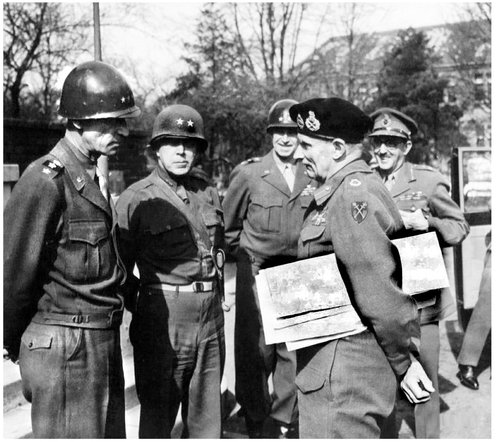
Generals Simpson and Anderson look stern during a meeting with Field Marshal Montgomery; General Bradley and General Alanbrooke, Montgomery’s Chief of Staff. 111-SC-203441
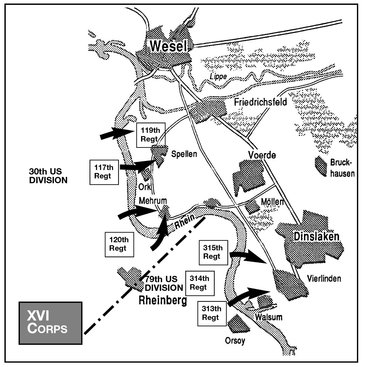
30th Division held the left sector of XVI Corps front, an area five miles wide, extending from the Lippe canal to Mehrum. A dyke protected the east bank of the river but the flood plain beyond was flat, open farmland dotted with small villages, farmhouses and orchards. To be successful, Major General Hobbs’ men would have to advance two miles while it was still dark, engaging the Germans’ main defensive line along two railway embankments before they could regroup.
The ground climbed steadily beyond the railways, rising into a high wooded ridge seven miles east of the Rhine where a partially built highway, one of Hitler’s planned Autobahns, ran along the edge of the Staatsforst Wesel, a five mile deep area of thick woods. General Hobbs’ men would have to advance through the forest along a network of trails while their supporting armour was confined to the handful of roads. 8th Armoured Division would have to wait until the infantry had cleared the woods before it could launch its attack between Dorsten and Kirchellen, two towns twelve miles beyond the river.
79th Division held XVI Corps’ right flank and the meandering nature of the river put its front two miles east of 30th Division. General Wyche’s men would cross an hour later to account for the difference, reducing the chance that German counter-attacks might drive a wedge between the two divisions. Once again a large dyke ran along the far shore across the full length of the sector and beyond the embankment. Wyche’s men faced open farmland dotted with villages, small woods and factories.
The delay to 79th Division’s crossing had added one extra problem. The assault battalions only had three and a half hours of darkness to clear the villages beyond the dyke and form a secure flank along the Neue-Ernscher Canal. General Wyche had arranged to shell the area south of the canal with white phosphorous shells at first light, creating a smokescreen across the division’s sector. The chemical smoke would cover his reserve battalions as they moved towards the division’s final objective, the town of Dinslaken.
The Air Campaign
While preparations on the ground were growing towards a climax, a relentless bombing campaign was being waged on Germany. The Allies had enjoyed air superiority for the majority of the campaign in north-west Europe and by the end of 1944 the Luftwaffe’s presence in the skies had virtually ended. During the second week of February the American, British and Canadian Air Forces began a bombing campaign across northwest Germany, attacking rail bridges, viaducts and canals in support of the forthcoming operation. Over the weeks that followed, Allied bombers carried out 1,792 sorties, dropping 31,635 tons of bombs on targets extending from the southern side of the Ruhr in a huge arc up to the port of Bremen on the North Sea coast. The main target was the German transportation system and as the Allied bombers destroyed bridges and railways, one by one the routes leading towards Germany’s industrial centre and 21 Army Group’s area were cut. Operation INTERDICT NORTHWEST GERMANY carried on relentlessly and by 21 March reconnaissance planes reported that ten out of seventeen bridges had been destroyed while five others had been seriously damaged. Meanwhile, after giving air support to 21 Army Group’s advance to the Rhine, 2nd British Tactical Air Force and the 29th US Tactical Air Force joined the campaign to seal off the Ruhr. Between 11 and 21 March fighters and fighter-bombers carried out over 7,000 sorties directed against the road and rail systems of the Ruhr.
Infantry Planning
Battalion commanders in 30th and 79th Division were briefed about the forthcoming operation on 9 March and a few days later the two divisions moved to Nijmegen in Holland to begin training on the River Maas. After rehearsing on dry land, the GIs moved onto the river and the landing craft coxswains helped the soldiers as they practised entering and leaving their assault craft. New elements were added to the training each day and the programme culminated in a full dress rehearsal carried out at night.
The planning for Operation FLASHPOINT had been carried out in meticulous detail at the highest levels and steps were taken to ensure that every GI knew what to expect. Briefings and planning meetings were staged daily and the arrangements made at 314th Regiment’s headquarters were typical:
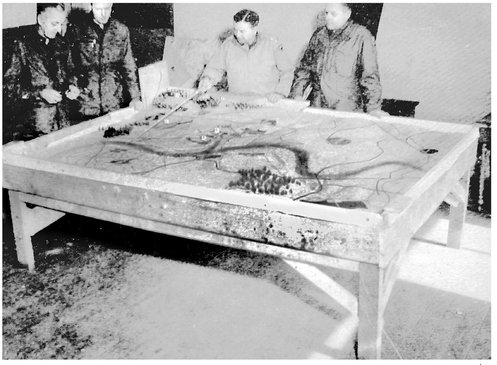
A sand table 8ft by 6ft was prepared covering the actual crossing of the Rhine. Each house, road and railroad track was represented by pieces of wood and the river and woods by coloured dyes. Each grid square on the 1/25,000 map was blown up to one foot by one foot. Upon completion each battalion was allotted sufficient time so that their platoon leaders could be present at the table for an orientation. Each company was allotted two hours each for its officers.
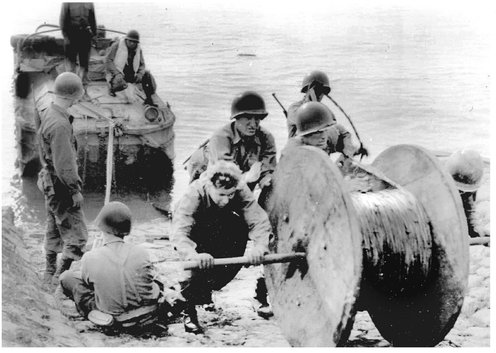
Signallers practise laying cables with the help of a DUKW.
Officers study their objectives with the help of a sand table.
Thousands of maps covering the east bank of the Rhine had been produced and each squad leader was issued with the street plans of the villages en route to his objective. Aerial photographs were also issued in large numbers and several battalion commanders were flown over the crossing sites to view their objectives. Nothing was being left to chance; by the time the GIs were moving to their embarkation points along the riverbank on the night of 23 March, every man knew what was expected of him.
Although observation posts along the river sent back daily reports of troop movements on the far bank, General Hobbs and General Wyche wanted first hand information about the condition of the shoreline and the German defensive works on the embankment. 75th Division had failed to get patrols across the Rhine but as soon as 30th and 79th Division moved into their assembly areas on the west bank, plans were made to send men to the far bank.
120th Regiment was due to cross opposite the village of Mehrum on 30th Division’s right flank and its patrolling regime was repeated all along Ninth Army’s front. Lieutenant James Butler led a five-man patrol across the river during the early hours of 20 March. They pushed off the shore from Ettroig and their boat was swept 400 metres downstream before it touched down on the far shore ten minutes later. After waiting motionless for a short time, they scrambled ashore noting that the shoreline was ideal for assault craft. Crawling inland, Butler’s men penetrated the German lines to a depth of 600 metres, finding nothing to cause concern. After returning to their boat, the patrol drifted back to the safety of the west bank before it was light.
The following night Lieutenant Michael Esquivel led a second patrol and again they crossed without being seen. While two men stayed by the boat, Esquivel pushed inland to investigate a second dyke that had been built to protect Mehrum during winter floods. After crawling past a line of foxholes, moving so close that they heard the sentries whispering, the three men crawled over 500 metres, finding a second line of outposts along the dyke. One German soldier challenged the group but Esquivel’s men froze and stayed silent in the darkness, leaving the guard to carry on his patrol. Lieutenant Esquivel had seen enough, the dyke did not present a serious obstacle to infantry, he could withdraw to the boat and return to the far bank.
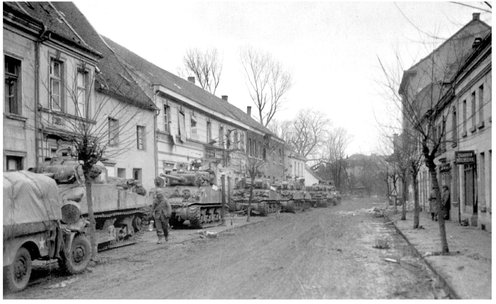
Sherman tanks line up in the streets of Rheinberg behind Ninth Army’s front. 111-SC-201895
Patrolling all along XVI Corps’ front gave Generals Simpson and Anderson the information they needed to plan the final details of the attack. Observation posts and reconnaissance planes completed the picture and as D-Day drew near Generals Hobbs and Wyche could chose their crossing points and plan the first stage of the assault with confidence. The only question remaining was how ready were the Germans?
The meandering Rhine varied from 300 to 500 metres wide where XVI Corps planned to cross and although it could be turbulent along the shoreline, where sandbanks lay lurking beneath the surface, the speed of the river was only five miles per hour. A minimum draft of three metres in the main channel meant that the planners could include all the medium landing craft and small assault craft, and the patrols had proved that the far shore was usually an ideal mix of sand and gravels, suitable to land on. The flood dykes rose to five metres high and on 120th Regiment’s front a second winter dyke had been built some distance from the river to protect the villages, however, they were passable to both infantry and tanks.
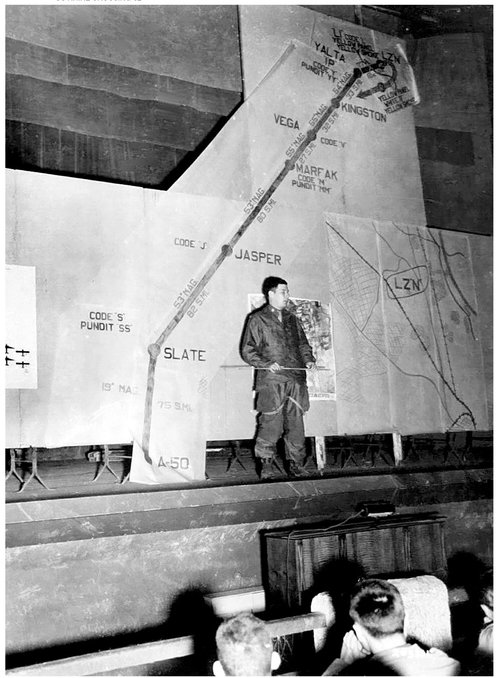
17th Airborne Division’s flight plan is explained during a final briefing.
The Countdown Begins
As the assault troops practised and planned for the forthcoming assault, the build up of supplies along the west bank of the Rhine was reaching a climax. The engineers had worked around the clock to construct new railheads and a network of roads leading to the riverbank along Ninth Army’s front and in places bulldozers had been forced to demolish buildings so that lorries could carry landing craft down to the water’s edge.
Over the past two weeks 37,000 British and 22,000 American engineers had been preparing for the crossing, stockpiling thousands of tonnes of ammunition, fuel, bridging equipment and food in camouflaged dumps; over 138,000 tonnes had been stored in Ninth Army’s area alone. The concentration of men and materials behind 21 Army Group’s front was going to be one of the largest ever assembled and while over one million men trained and worked to make Operation VARSITY a success, Ninth US Army assembled 2,070 guns while 3,411 artillery pieces rolled into position in Second British Army’s and First Canadian Army’s sectors.
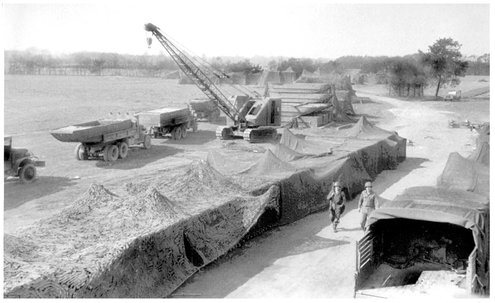
It was impossible to conceal the build up of men and equipment on the west bank of the Rhine but deception and camouflage were used wherever possible to try to deceive the Germans waiting across the river. Dumps and camps were camouflaged while dummy installations were built in other parts of 21 Army Group’s front to try to draw attention away from the real crossing sites. As a final touch, hundreds of generators covered the river with a twenty mile long smokescreen during the ten days before D-Day.
Tonnes of supplies and ammunition were stockpiled and then camouflaged on the west bank of the Rhine. 111-SC-203428
While operating in Germany the Allied soldiers had for the first time to accept that they were not liberators and civilians had to be evacuated from the assembly areas to reduce the chances of spies reporting troop movements. Ninth Army had also taken steps to conceal the arrival of 30th and 79th Division, (the Wehrmacht rated both as Schwerpunkt or attack divisions) and their movement towards Rheinberg would arouse suspicions in the German intelligence service. Communication teams remained behind as the two divisions made their way towards their assembly areas and busied themselves passing false messages to give the impression that neither divisions had moved. As an added precaution officers and men were ordered to remove divisional patches and paint out vehicle markings to fool spies.
As the ground troops moved towards the Rhine, the Allied air campaign began to intensify during the final seventy-two hours and the Eighth US Air Force changed to military targets, concentrating on airfields and barracks, paying particular attention to airstrips used by jet aircraft. The 9th US Bombardment Division joined in the aerial assault, directing 2,000 medium bombers against the communication centres, rail yards and flak positions north of the Ruhr. The Royal Air Force’s Bomber Command attacked targets north of the Rhine and over the course of three days the combined might of the Allied air forces flew over 11,000 sorties. One bombing mission on 21 March scored an unexpected success. It demolished part of First Parachute Army’s headquarters and severely wounded Generaloberst Alfred Schlemm. Although Schlemm stayed at his post throughout Operation VARSITY, his health deteriorated and he was forced to retire on 28 March; his injuries no doubt affected his ability to command at a crucial time.
While the Air Forces pounded targets across north-west Germany, 21 Army Group continued to assemble and by nightfall on 23 March 750,000 British, 330,000 American, 180,000 Canadian, 15,000 Polish, 7,000 Belgium, 6,000 Czech and 1,700 Dutch troops were in position; Operation VARSITY was a truly multi-national affair.
The Germans
In spite of 21 Army Group’s attempts to keep the build up of troops a secret, First Parachute Army’s staff on the opposite side of the Rhine knew that the Allies were preparing to cross. It was impossible to disguise the fact that over one million men, hundreds of vehicles and thousands of tonnes of supplies were being moved close to the river. Even so Generaloberst Johannes Blaskowitz, Commander of Army Group H did not know the answer to two burning questions. Exactly where would the Allies cross and when?
Tension mounted as rumours about the imminent Allied assault spread and on 20 March General Blaskowitz ordered a high state of alert. He correctly guessed that the Allies would attack between Emmerich and Dinslaken and had spread his limited resources to cover every eventuality. First Parachute Army’s artillery fire increased as D-Day approached and as the guns searched for targets on the far bank, patrols tried to cross the river to find out what 21 Army Group was planning; hardly any returned. Despite Allied air superiority, Luftwaffe pilots flew lone sorties low over the Allied side of the river looking for evidence of the build up.
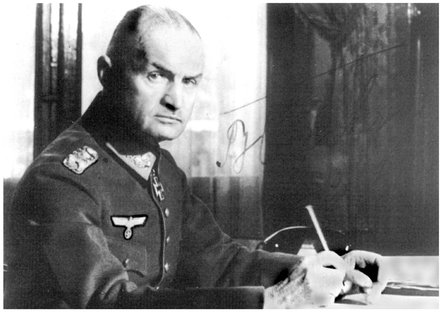
Generaloberst Johannes Blaskowitz knew 21 Army Group was going to attack across the Rhine in the Wesel area; the question was when?
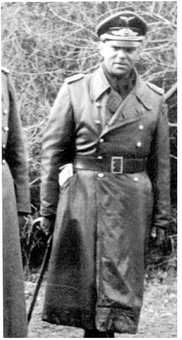
Generaloberst Alfred Schlemm, First Parachute Army’s veteran commander.
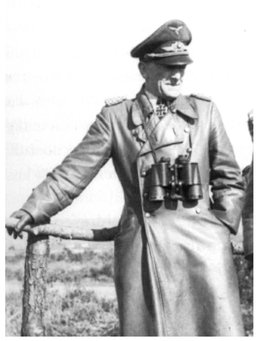
General der Fallschrimtruppen Eugen Meindl would have to contend with Second British Army crossing the Rhine to his front while XVIII Corps landed to his rear.
First Parachute Army would face the brunt of 21 Army Group’s attack and the injured Generaloberst Schlemm, a veteran of operations in Crete, Russia, Italy and the Reichswald, had three infantry corps to hold his sector. His only reserve was a depleted armoured corps. II Parachute Corps held the front opposite the British crossing sites at Emmerich and Wesel. General der Fallschrimtruppen Eugen Meindl’s command was the strongest of Schlemm’s corps, having three divisions, 6th, 7th and 8th Parachute Divisions, and although each only had around 3,500 men they were still expected to be worthy opponents. General der Infantrie Erich Strabe’s LXXXVI Korps held the riverbank from Wesel upstream to Dinslaken. 84th Division, a weak formation of only 1,500 men led by General der Infantrie Heinz Fiebig, held the riverbank either side of Wesel. General Anderson’s XVI Corps faced the southern sector of LXXXVI Korps, held by 180th Infantry Division. LXIII Korps, commanded by General der Infantrie Erich Abraham, held the area opposite the southern flank of XVI Corps. The Hamburg Division, a makeshift formation of old men and teenagers led by a few battle weary convalescing soldiers, held the front opposite 79th Division. 2nd Parachute Division held the Rhine south of the selected crossing sites.
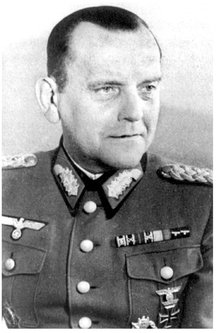
Generalmajor Heinz Fiebig’s 84th Division held the riverbank either side of Wesel.
XXXXVII Panzerkorps, comprising the 116th Panzer and 15th Panzergrenadier Divisions formed First Parachute Army’s reserve; a sizeable force on paper but the trials of the past six months had considerably weakened both formations. Allied intelligence believed that the Panzer Division only had seventy tanks while the Panzergrenadiers had fifteen Panzers and twenty-five self-propelled guns. Independent armoured units added another forty tanks and a heavy anti-tank Battalion was also reported to be operating in the area. The armoured reserve brought the total strength facing 21 Army Group’s twenty-two mile sector to around 85,000 men and 150 armoured vehicles.
Although the Germans lacked men and tanks, one type of weapon they had in abundance was the anti-aircraft gun. During the days leading up to the attack the number of artillery and anti-aircraft weapons on the east bank of the Rhine had increased significantly. Generaloberst Blaskowitz had correctly anticipated that the Allies would use airborne troops to expand the bridgehead but he believed that the landings would take place deep behind his lines; the miscalculation meant that many flak weapons were positioned ten miles north-east of Wesel, some distance from XVIII Airborne Corps’ landing grounds. Even so, the number of anti-aircraft weapons waiting for the paratroopers grew daily as Blaskowitz moved guns from Holland into First Parachute Army’s sector. In the days leading up to Operation VARSITY the number of 20mm calibre weapons in Generaloberst Schlemm’s area increased from 153 to 712, while another 114 heavy weapons, including several batteries of the feared 88mm flak guns, were positioned in the fields around Hamminkeln and Wesel.
The tension mounted as the Allied air attacks increased and on 20 March Generaloberst Schlemm asked General Strabe for a report on the anti-aircraft defences between Wesel and Dinslaken. Two days later the order was passed to 180th Division’s headquarters: the details were still being compiled as XVIII Airborne Corps flew overhead.
Patton steals the limelight
With all the attention being lavished on 21 Army Group’s planning, there was a hint of resentment amongst the rest of the US Army’s hierarchy. Despite the fact that the Americans had four times as many troops as the British in Europe, Eisenhower had chosen Field Marshal Montgomery to lead the drive into Germany. The crossing at Remagen on 7 March had brought some light relief to SHAEF’s headquarters as they contemplated the forthcoming crossing of the Rhine, but as the date for 21 Army Group’s attack drew nearer, 150 miles south of Wesel General George S Patton, Third Army’s flamboyant leader, was planning to steal Montgomery’s limelight. Patton was furious that he was not allowed to advance across the Rhine, leaving his men waiting along the river, while the preparations for Operation VARSITY swallowed up massive amounts of supplies and equipment. He refused to wait and, without consulting General Bradley, devised a plan to sneak across the river before Montgomery.
There would be no massive air offensive, no shattering bombardment and no Airborne troops in Patton’s plan; just infantry and an assortment of assault boats kept in Third Army’s area for minor river crossings. The two chosen places were in 5th Infantry Division’s sector at Oppenheim and Nierstein, upstream of the town of Mainz and within striking distance of Frankfurt. The location had been chosen because the meandering river presented 5th Division with a natural staging area needing only a small number of troops to protect the bridgehead. It was a risky plan and one likely to create waves in the Allied High Command if it succeeded. Patton did not care about upsetting Montgomery and ordered Major General Stafford Irwin to cross on the night of 22 March, twenty-four hours ahead of 21 Army Group.
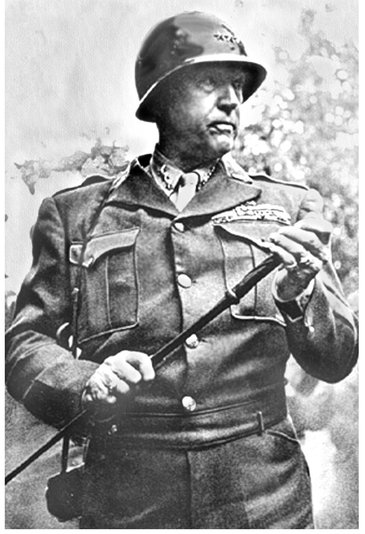
General George S Patton.
While the anxious GIs crossed the Rhine in their flimsy assault boats, no doubt cursing their leader’s impatience, the German reaction was minimal. Irwin’s men reached the far side with light casualties and stepped onto dry land; Third US Army had crossed the Rhine. It appeared that the Germans were as stunned as the Allies and as men and equipment flowed onto the east bank, the chances of eliminating the bridgehead diminished by the hour. Ferries carried tanks and tank destroyers across the river while engineers built a treadway bridge and by mid afternoon the whole division was on the far bank.
Delighted by the coup, Patton called General Omar Bradley, 12 Army Group’s leader to pass on the news, mischievously pointing out that he had crossed without any assistance, an obvious dig at 21 Army Group’s meticulous preparations. On the afternoon of 23 March, only hours before Operation VARSITY was due to start, Bradley reported Third Army’s bridgehead to the press corps, repeating Patton’s jibe at Montgomery. The news no doubt confused Feldmarschall Kesselring and the German High Command; for a second time American troops had crossed the Rhine with ease.
As a final show of defiance Patton ordered his driver to pause momentarily as he crossed the Rhine a few days later. Stepping from the jeep onto the pontoon bridge, Third Army’s controversial leader stared at the river below before relieving himself; it was Patton’s own comment on the great river’s defensive capability.