
Chapter 2
The prelude: The Trojan War as an instance of the East-West clash
Contemporary scholarship prefers not to acknowledge the historicity of the Trojan War as described in the Iliad, considering it a work of historic fiction, possibly including a nucleus of events, but very distant and corrupt. The ancient Greeks thought otherwise, and so did the Persians, who, although unaffected by these distant events, knew perfectly well how to seize a pretext (Her I.4).
This modern denial leads to underappreciating information embedded in the epic. Cardinal among such is the fact that the Greek world of the time was to a considerable extend facing westwards. In Odyssey travelling from western Greece to Sicily seems a matter of everyday life (Hom Odyss xx.383), and at least two characters originate from Sicily (Hom. Odyss xxiv.210) or further away.
The assembled fleets as described in The Iliad support such thoughts. The House of Pylos mustered 90 ships (Hom Iliad II.591–602), second only to the fleet of the undisputed leader, the Mycenae, with 100 (Hom Iliad II.569–76). With the territories of Pylos at the time being a third of the current district of Messene and much less than the Laconian kingdom of Menelaus, which was covering the same latitude and furnished only 60 ships (Hom Iliad II.581–7), one should wonder how Nestor had been able to maintain so many ships. And the answer is easy; his kingdom was well-poised for Western trade.
One more cardinal issue is the centre of the Greek world. At the time the centre, and also the centre of gravity, must have been the Gulf of Corinth. Heavily populated then and even now, it was instrumental for the communications and commerce among the states of central Greece and those of the northern Peloponnese, with the most important kingdoms lying around it; not around or across the Aegean – yet. This is the reason for the extreme popularity of the Oracle of Delphi, positioned conveniently near the north shore of this ‘internal sea’.
The Herodotean account (Her I.94) mentions that the Italian nations originated from Asia and were members of the Trojan alliance/confederacy. After the defeat and fall of Troy, they migrated, bypassing Greece, to Italy. This is clearly a prequel to the Aeniad and it has been considered a fact by the Romans throughout their history. This migration meant that henceforth mainland Greeks would be between hostile landmasses: the emerging Asian waves pushing from the east and the migrated hostile Asian populations pressing from their west, from Italy.
The colonial status within the Mediterranean
The Persian rise coincided with a deep and multi-dimensional crisis in the Hellenic world – an era of interwoven ideological, geoeconomic, national and tribal frictions and international challenges. The Greeks had again become prominent in the Mediterranean and beyond, thanks to a brilliantly set and competently executed colonial plan of some 300 years. Its first eastward phase took place a mere century after the Trojan War and the Mycenaean collapse that ensued and was triggered by the Dorian conquest of southern Greece, especially Peloponnese. Though, this colonial endeavour was the result of the Trojan War (Thuc I.12,2–4), the latter’s reality at least accepted, if not believed, by both antagonists of the Persian Wars (Her I.1–4). The Trojan War on the one hand destabilised the Greek mainland but on the other destroyed an aggressive Asian alliance in control of a powerful European constituent (Iliad II.844–50) and thus permitted a Thracian invasion to Asia Minor. The net result was the fragmentation of the interior of Asia Minor, which allowed the Greeks a break from the eastern threats during the ascent of Phrygia in the mainland. Actually, it allowed the Greek mainland states to form or reform, recuperate from the shock of the Mycenaean crash (or meltdown) safely, establish the eastern colonies which became collectively, even if inaccurately, known as Ionia, and colonize the Black Sea.
Some two centuries after the establishment of most of the Ionian colonies, a westward colonial wave developed and a single generation implemented most of it. Thus, within five years a loose Greek colonial empire is set in the Euxine, the Mediterranean and possibly beyond. But the system almost immediately proved unstable, less by overexpansion or overextension and more due to internal, inherent malfunctions. The colonies were official businesses, grafted with the customs, the morals, the lineage and tribal organization of the Metropolis. More importantly perhaps, with the religious worship consisting of ritual, sects, ceremonies, symbols, relics and sacred artifacts or statues/pictures of the home deities and perhaps their clergy and, last but not least, with the form of government. Sending a colony was about relieving the frictions caused by the numerous and impoverished populace in the Metropolis; but it was also about creating trade networks and sources of essential goods. The leaders were chosen amongst the aristocracy, perhaps among the most restless members of it. The colonial project was not coming cheap; the governing aristocracies had the necessary funds and accepted the risk to invest them for expected gains in cash, status, and internal peace. Returning colonists of aborted projects were not welcomed (Her IV.156). But the more or less troublesome and ambitious members of the aristocracy who were sent away were enticed with promises concerning actual social rise, unattainable in the Metropolis.
On the other hand, the radical throng selected for deportation served as rowers in the 50-oar galleys/pentekonters, which were the vector of the colonization, as fighters upon landing and as a workforce once the land had been secured, so as to build from scratch a new city-state. Understandably, they had not left an intolerable existence back home to face dangers, enemies, uncertainties and hardship only to become the lowly subjects of the disgruntled parts of the home aristocracy across the sea. They had their own hopes and dreams for opportunities and El Dorado.
What ensued was a prelude of the European colonial crisis of the 16th century. Wealth was produced, and in volume, but its distribution left once more many dissatisfied. The combination of the questionable repute of the colonists with the drift of the financial activity from the Metropolis to the colonies brought forth several issues that ignited civil strife in many levels: within cities, metropoleis and colonies alike, among cities, and in some cases between a metropolis and its colony. The net result was a Hellenic World War.
The war for the Lelantine Field (Thuc I.15,3; Her V.99) implicated the whole of metropolitan and colonial Greece and brought the whole Greek world back by one or two centuries; the war between Sybaris and Croton ends with the extermination of the former (Her VI.21). The human casualties are horrific. This development averts the firm establishment of Greek colonies in the western Mediterranean basin. In this way, the probable master-plan of the Greek colonization, that is to turn the whole of the Mediterranean into a Greek lake (similarly to the Roman Mare Nostrum), while achieving the expulsion of the Carthaginians from Sicily and the central Mediterranean, fails (Burn 1962; Grundy 1901; Green 1970).
The failure was not lightly taken, nor uncontested. More colonial waves were sent and would keep coming up to the mid-fifth century, but they were half-hearted, in some cases private efforts and even more riddance-minded than before (Her V.42). The most important is that they were targeting a Mediterranean environment now vigilant and in many respects ready for them.
An issue of prime importance, although unrecognized, is the adoption of the secret of the Greek expansion by their antagonists: the Hoplite kit and methods. The Hoplite is the platform that brought the Greeks to Babylonia, Egypt, Ethiopia, East Euxine and the coastline of SW Spain, Tartessus. Now he is not only Greek, he is also Phoenician/ Carthaginian, Etruscan, Roman, and later Illyrian (Snodgrass 1965; Sekunda & Northwood 1995).
And, most important, the bliss of the colonies saps the fighting prowess of the colonists, especially of the newer generations. The now wealthy colonists were not eager for aggressive undertakings likely to disrupt business and cost them their own lives. They preferred strife, so as to collect something from their fellow citizens. Contrarily, the impoverishment of the Metropolis reinstates, or at least maintains, its martial prowess, while its inhabitants and citizens are also engaged in strife.
The radical brew in the Greek world
The constitutional struggle was fierce: the colonization was an opportune by-product of aristocracies getting rid of rivals and anyone deemed unwanted, and thus the colonies were aristocratic in constitutions. But once a middle class was firmly established, tyrants were selected to overthrow the aristocrats; and they did so in a tidal wave sweeping both the western colonies and the mainland (Nilsson 1929), except for Sparta. The peculiar constitution of the latter firmly established a residual, constitutional monarchy, or rather diarchy, with two royal families each providing a ruling king. This royal duo was coupled to an oligarchy providing a senate, and a body of all-powerful but once-in-a-lifetime representatives of the People (this means The Peers), the Ephorate, the latest but most influential power in Spartan politics. It was five-strong, possibly representing the five original villages which formed the Spartan state.
In the mainland, the city-states able to recuperate and profit from the ‘global’ commercial network formed by the colonies took the constitutional changes a step further: during the fifth century, they made their move towards more egalitarian formats, which brought about, as a final result, the radical democracy. This sequence occurred in Athens. The lore projected in the Periclean era suggested that it was their second time; the first time was with their arch-hero, Theseus, whence the process was allegedly initiated and completed within a generation.
Things were different in Ionia, as the primitive equalitarian regimes developed there were trampled by the conquering Persians before evolving to Democracy. The tyrants known by the narration of Herodotus in Ionia during the late sixth century were a step backwards, not the focus of the public struggle against the aristocrats, but the once-upon-a-time ruling aristocrat(s) who struggled to return to power. In this struggle, different breeds of Enemies of State are recruited by the Aristocrats, whatever the occasional definition of ‘enemy’ may have been, to help them to power, or to keep them in power. A standard case was a tyrant becoming a wilful subordinate to an alien overlord, preferably of feudalistic background so as to favour appointed rulers over elected magistrates. The tyrant, appointed or recruited by the alien despot, was supported and preserved by the latter; he mostly kept the public order and collected tribute. He did not rule but only administered (with some leeway for corruption, of course) as the intermediary between the overlord and his hapless subjects, as exemplified by Histiaeus of Miletus, Koes of Mytilene and the would-be Hippias of Athens (Her IV.137 & V.96 & V.11).
The Dorian ebb
At the same time, the predominantly Dorian western commerce and colonial expansion ebbed. The western expansion was, to a great extent, a Dorian project in terms of mainland Greece geopolitics. Not only Aegina and Corinth had been the two most sophisticated colonial and trade powers (both of Dorian demographics) but the co-ordinator was the Oracle of Delphi, a shrine very near to Doris, the cradle of the Dorians, where Apollo, the prime Dorian deity, was introduced and worshipped.
But by the mid-sixth century the Dorian championship changes from Argos to Sparta (Her I.70 & I.82), both major states in times Mycenean, but currently occupied and colonized by the Dorians since circa 1000 BC, with their old inhabitants enslaved, integrated or expelled (Paus III.1,5 & III.2,5–7). Sparta in particular, a typical Dorian meta-Mycenean state, with the usual quarrelling, strife, industry and trade instincts and interests, suddenly, somewhere in the sixth century changed course radically (Thuc I.18,1). By an apparent withdrawal from the international trade map and a deep alteration in government, law and politics, it became a peculiar state, but definitely the most prominent war machine: the exemplary military, though not militaristic, state and of unsurpassed power and prestige within the wider context of the Greek Metropolis (Dickins 1912; Hodkinson 2006). Sparta, as the new champion of the Dorians, was the official protector of the Oracle, but was not interested in colonization, nor in international trade any further. Sparta did not share the vision for a westward Greece.
The Return of the Phoenicians
The Hellenic crisis allows a Carthaginian counter-attack (Burn 1962), assisted by the emerging Italian power, the Etruscans (Her I.166). Raised through commerce with Greek profiteers and merchants and kick-started by a powerful immigrant group of artisans, soldiers and politicians who followed the expelled Damaratos of Corinth, circa 660 BC (Polyb VI.11a, 7; Dion Ha Ant Rom III.46,3–5; Strab VIII.6,20 & V.2,2; Livy I.34,2), the Etruscan power stems from their early and proper adoption of the Hoplite Phalanx and especially their weaponry (Diod XXIII.2). Expelled with all his retinue and supporters, Damaratos, the ruling aristocrat of the Bacchiad dynasty had been overthrown by the ascending tyrant Cypselus. Fleeing from home, he lands in Etruria and with some persuasion and more brazen arguments, he hellenizes the Etruscans with Hoplites and pottery. The Hellenization did nothing to mend Etruscan morals and beliefs: they remained forever a feudalist state, like most Italians of the era, and somewhat monstrous and cruel in worship and distraction (Tzetz Chiliad VIII. 882–8). Human sacrifice and institutional manslaughter, in the form of gladiatorial games, continued and were immortalized in masterpieces of painting and sculpture, while part of their aggressiveness turned to, and was expressed through, trade. It would be tempting to suppose that during the fierce struggles of the sixth century, some Greek states took the side of the Etruscans and other Italians, as happened later, with the Athenian expedition in Sicily in 415–3 BC, where the Athenians recruited Segesta and other non-Greek states against the Sicilian Greeks/Sikeliots (Thuc VI.17,6).
In any case, within 30 years, the Carthaginians checked the Greek advance in Sicily (Her V.42; Burn 1962) after having, in alliance with the Etruscans, intercepted the Greek expansion to Corsica, attempted by Phocaeans fleeing the first wave of the Persian conquest under Cyrus’ general Harpagus (Her I.164–6). The battle of Alalia cost the two allies dearly, but caused the withdrawal of the Greeks (Her I.166) and thus had been a decisive strategic success.
It was so decisive that the Greeks in the first years of the fifth century were considering a mass migration to Sardinia, which was closer, by the full manpower available from a massive flight from Ionia in the face of the Persian punitive campaigns against the rebels. This was refuted by Hecataeus the Milesian (Her V.124–5) who had – or was to acquire – precise knowledge on Persian matters; too accurate to exclude some unknown agenda. He was to become a cardinal source for Herodotus.
This behaviour reminds us of the case of the most ardent of the Phocaeans who had migrated when facing the lieutenants of Cyrus (Her I.164) and were to re-emerge in the initial, ill-omened counsel of the Delphic oracle to the Athenians to migrate to the west, allegedly in early 480 BC (Her VII.140), which most probably suggested as their destination the site of the deserted city-state of Siris. Such counsel was incorporated into the argumental toolkit of Themistocles before the battle of Salamis (Her VIII.62).
With the gift of hindsight, this could have been the salvation of Ancient Greece: the transplantation of the state of the Athenian Democracy to Italy would have reinvigorated the expansion there to reach and tame the Roman blitz before maturation, while still nascent. And, most importantly, a troublemaker would have been evicted from mainland Greece, thus easing the whole Ionian-Dorian rivalry. This rivalry was obsolete at the mainland, but was rekindled by the Athenians so as to muster mainland supporters against the Spartans in the years of Herodotus. The bitterness between the two Greek tribes had already been fiery in Italy, but a national cause might have eased it much more easily than in the ancestral lands, while the division between Greater Hellas and Greater Peloponnese (the former in Italy, the latter in Sicily) provided one more barrier.
The Athenian candidacy
In this vacuum, Themistocles of Athens, an ardent supporter, instigator and champion of the masses and one of the three paramount visionaries of that unimportant state, reset his own and the state’s sights on the west. Consequentially, he must have become a privileged mediator for the Oracle. In times past he would have been dismissed as an antagonist of the Dorians. Their metropolitan commerce was facing competent antagonism from Athens for quite some time; both Solon and Peisistratus shifted the export focus to the west since the east, a privileged market due to the close relationship of Athens and Ionia, was practically closed by the fact that the Athenians had sided with the losers of the Lelantine War. And, not to a small extent, by the later rise of the Persians. By choice and by luck, when a silver vein was discovered in Athens, a new acolyte could be based there to proceed with the faltering westward plans of Delphi. This understanding with the Oracle allowed the Athenian entrepreneur and later politician to call, in his time of need in 480 BC, upon the Oracle’s ‘understanding’.
The westward thrust of Athens peaked under Themistocles and was supported by the Oracle of Delphi. With Sparta’s attitude, especially under the infamous Cleomenes I who was prone to disengage Sparta from the spiritual leadership of the Oracle, or to manipulate it, if things were not going his way (Her VI.66), Themistocles might have been posing as the answer to the prayers of the priesthood of Delphi. Once the championship of the Dorian stock, which formed the main body of believers for the oracle, was seized by the new-model Spartans from the Argives, the Oracle needed a vigorous state to reinvigorate the western expansion and colonization policy. The new Spartan state, with its differentiation of priorities and absence from the arena of exporting commerce, was a good and steadfast champion of the Oracle in Greece, neutral to trade antagonisms and very pious, but very reluctant to enforce expansionist and commercialist policies (Her V.42–43 & 46; Dickins 1912). This was especially so once the clouds were gathering to the East, a fact not missed, forgotten or forgiven by the Syracusan Greeks (Her VII.158) who were bearing the brunt of Carthaginian aggression. Indeed, the Persian pressure on Ionia is transduced almost instantly to the mainland in a way the Lydian one had never been. Thus, the westward expansion takes lower priority, and few new operations are planned, while reinforcements in manpower are scant.
Despite these facts, the Greek colonies of southern Italy, or at least some amongst them – with Cumae being the epicentre, or rather the fulcrum – were able to crush the Etruscan power and aggression at the point of its becoming an existential threat. And they did so twice in two successive generations: in 524 BC (Dion Ha VII.3) and 478 BC (Pindar, 1st Pythian Ode). Ultimately though, they fail to capitalize on their success as they are too busy brawling with each other (i.e Her VI.23). Petty local bitterness simply makes the feud between Ionians and Dorians more complicated and lethal, as other races (such as the Achaeans) take part but not always on a consistent side, as will be discussed later.
Thus the western Greeks were unable to tame the successors of the Etruscans, i.e. the Leucanians, Oscans, Brutians and Romans, early enough, so as to contain an Italian deluge southwards. As the western expeditions of Spartan kings (Archidamus III of Sparta) and pro-Macedonian Hepeirote champions (Alexander the Molossian, Pyrrhus) ultimately failed (Strab VI.3,4), Magna Grecia will eventually succumb within two centuries to the Italians and ultimately to Rome – the same Rome whose allies were saved by Cumae in the nick of time from another Etruscan project of murderous punishment for a republican coup against their local petty Etruscan dynasty (Lib II.14,6–7).
With Carthage, the Greeks fared even more poorly: they were never able to utterly neutralize it as a threat and/or to uproot its Sicilian bridgeheads, as a continuous flow of African and West European mercenaries was periodically fed to the island.
The Time Of The Persian
In this timeline, more or less, in the mid-sixth century, the Persians in Central Asia present their own military and much less political revolution under Cyrus II the Great and conquer vast areas within a formidable generation. The Persians under Cyrus II the Great are a rather poor but definitely competent and a hardy nation. Delbruck (1920), in 19th century Imperial Germany is well-poised to notice a knightly disposition in the Persian army, which probably was the case, at least under Cyrus II and his son(s) and definitely in the fourth century. This miraculous horde makes contact with the Greek world in Ionia, and the latter expresses mixed feelings.
The Persians at the time of Darius I, or even of Cyrus II, had passed through a consolidation phase that led their many tribes and communities, with local governance through chieftains, to an empire (Waters 2014a). As Herodotus has it, they considered the more – or rather less – equalitarian forms of governance of similar Greek communities not as retarded but as backstepping, because this diffusion of authority was inhibiting the natural consolidation of power. Indeed, it took the Greeks another two centuries to reach – or fall into – a monarchical model under Alexander and his successors; and even then the adoption of that model was far from total. Although this distancing from consolidating power was exactly what most Greeks wanted, the Persians thought of it as inability and incompetence which, by divine right, they had to address through their King-of-Kings and his blessed authority – a concept remarkably similar to Chinese ones referring to the Heavenly Mandate for the ruler.
The Ionians, or rather the Greek colonials in Asia, were reluctant to fight even against Croesus of Lydia, let alone against the ascending Cyrus II of the Persians. Some of them were happy to see Croesus fall, delighted by the crumbling of the Lydian dynasty, the first destroyer of their freedom (Her I.6 & I.26–8), but were frustrated by the prospect of delivering their autonomy and dignity to the Persians (Her I.164 &168). More of them were rather happy to be integrated in a global empire, run by feudalists with little respect for commerce, money, tribute and similar debasing issues, but very prone to protect such endeavours among its subjects so as to profit by taxation and dues and keep them occupied instead of contemplating revolts. An empire provided a secure investor environment and access to a huge market, from the Aegean to Bactria in Central Asia. Commerce would be conducted under the active protection of the conquerors, with a most reasonable tribute (Her III.89). Such Greeks were the Milesians, who had just lost their business associates in the West, the Sybarites, literally exterminated after their defeat by Croton (Her VI.21).
Others, with profitable dealings with the Lydians, are truly bitter, especially considering an imminent trade embargo with India and the Far East by the new key-master of Asia. Both areas are sources of luxury items and known and appreciated enough to have been included in the lore of the god Dionysus (Benaissa 2018). But the religious tolerance, the political moderation and the administrative flair of Cyrus are recognized by everyone, even if actually nothing extraordinary (van der Spek 2014). And thus many Ionians will assist the Egyptian campaign of his son, Cambyses, spontaneously (Her III.44,1 & 19,3 & 139,1).
Still, the hard facts were that the successful colonization of western Asia Minor had created a buffer zone, a protective barrier which was shielding the Greek mainland from eastern invaders and this was no more. Although Ionia was subject to the Lydians, a modus vivendi was developed more or less and the latter were sucked into the Hellenic world, presenting no existential threat. The Persians showed no such signs. Greece had been for the first time (but by no means the last) squeezed in macro-geopolitical pliers (Map 2.1). Persians pressed from the east and Carthaginians and Italians – spearheaded by the Etruscans – from the west (Strauss 2017; Deligiannis 2014). As long as the Persians, mainlanders par excellence commanded no fleets, the Hellenic World was almost safe and, more important, poised to do business with the vast East once more as they did with Croesus. A degree of bribery and flattery might have been necessary and unpleasant, but it was all that was needed.
Things change with Darius I; as soon as the empire is firmly established, a centralized, religious despotism ensues (DB 55, 63, 72, 73). The knightly, feudalistic character (Delbruck 1920), implied by Herodotus’ references to Persian (I.125) and Median (I.101) tribes, if applicable at the time, is more form than function, with the possible exception of some areas of special interest, as the backward Bactria and even Persia proper, where Xenophon partially corroborates Herodotus (Cyrop I.2,5). Now all resolutions lie upon the Throne – a principle indicating anything but a really powerful aristocracy. With Darius I, all three tiers of the Persian society, slaves (mariaka), retainers/bondsmen (bandaka) – who are free – and aristocracy (azata) are bandaka of the King, who does as he pleases with absolute, god-given power (Sekunda & Chew 1992). Possibly the class of mariaka are the ones unable to graduate to the public training system due to lack of means (Xen Cyrop I.2,15).
The spontaneous surrender of the Phoenicians shortly before Darius, during the reign of Cambyses (Her III.19,3), brought a most unwelcome trade and naval competitor within the empire and its huge internal market. Their fleet allowed both the conquest of Egypt and the ultimate fall of Cambyses and the rise of Darius to the throne by their flat insubordination to a campaign against Carthage (Her III.19). It was no mystery that they enjoyed the support, patronage and preference of the newly established King of Kings. As a result, the Greek commerce, flourishing under Cambyses and Cyrus, declined sharply; the Phoenicians were now the trusted merchants uniting the empire with the west through Carthage, their colony.
Furthermore, the hillbilly-knights of Cyrus practically despised money, resulting in a tolerable taxation; their notion of wealth was land, livestock, subjects. But Darius I really loved money: greedy and efficient, he was proud of in his taxation and revenue system, the best-organized feature of his empire, possibly with the help of the bankers of Babylon after its final submission. The whole administration was centralized, in a totalitarian manner, with himself receiving divine blessing and status so as to legitimize his dubious rise and to discourage possible rivals and imitators (DB 55 & 63). And now, taxation is really heavy, and not dependent on taxpayers’ revenue. With a set taxation and evaporated trade, as the empire is not on the best of terms with overseas Ionian trade associates, the Ionians face bankruptcy and starvation.
Thus, with Darius, the international Greek commerce with the East plummeted and this holds true for both conquered and free Greek city-states; the latter are simply embargoed from the empire. A demonstrably hostile superpower emerged in striking distance from the mainland of the Greek world, not buffered any more by the eastern colonies as it was for some three centuries. The two main sources of wheat imports were effectively blocked: within a generation, Egypt falls to Cambyses and Darius conquers Thrace, but, most importantly, he also occupies the Straits to the Euxine, thus cutting the commerce with the Black Sea colonies and the natives which were providing a considerable portion of the necessary wheat. The only available source of cereals now lies to the West – Sicily, allegedly home to Demeter and sacred to her, the matron-goddess of agriculture. Even this sole but considerable source is insecure. It is threatened by Carthaginian progress and disposition. The Delphic Oracle has been extremely accurate in its predictions and priorities. The Persian menace manifoldly increases its prestige, despite limiting its international influence by removing from power the most affluent and firm late believer, the Lydian King (Her I.13–14).
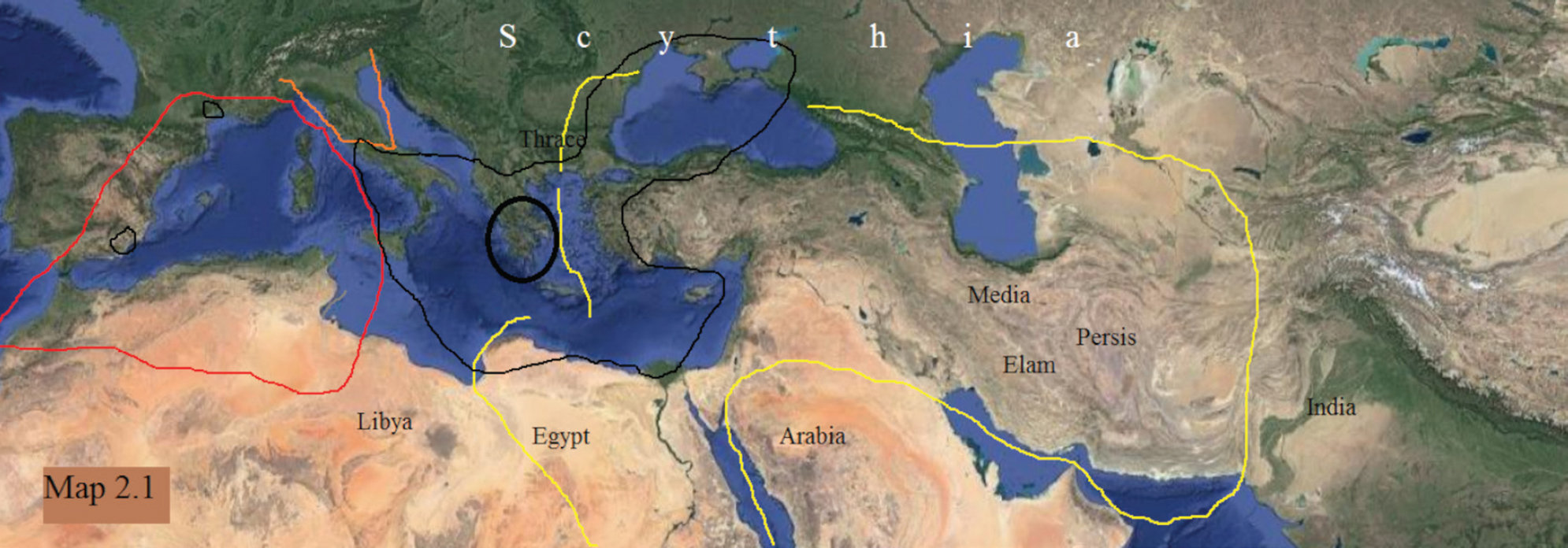
Map 2.1. The Achaemenid Empire (yellow lines) with its three nuclear geopolitical entities (Persis, Media, Elam) threatens the Greek World (black line) from the east and south, as the western Phoenicians (red line) and the Italians (orange line) press from the West.