
Chapter 3
The Persian military system was decimal (Lazenby 1993; Fields 2007), with the ten-man file (Dathabam) being the basic unit, the century (Satabam) being the technical unit, the thousand (Hazarabam) being the tactical unit and the myriad (Baivarabam) the operational unit (Sekunda 1989 & 1992; Fields 2007). Half-commands, based on the number 5, that is of 5, 50, 500 etc. troops (Xen Cyrop II.1,22–6), and possibly of vessels as well, must have been divisions of a unit rather than separate echelons. Consequently, the second-in-command was able to readily assume the command of half the force for a tactically or administratively differentiated mission (Sekunda & Chew 1992).
The oriental innovation
The Persian expansion was based on a novel spin-off of the standard Middle Eastern mode of warfare. By combining missile warfare with the mobility of cavalry and the protection, massiveness and steadfastness of infantry, albeit not in the tactical level, the Persians fielded a veritable power multiplier. Our reconstitution of their military establishment of the early 5th century provides for cavalry/Asabari (Fields 2007) organized in units used for independent action, flanking attacks and assault with missile weapons. These latter were mainly javelins (Her IX.18 & IX.49), which reminds the palta of the time of Xenophon (Xen Hell III.4,14; Anab I.8,2) but bows were used as well (Her IX.49). Peculiar metal helmets (Her VII.84) and perhaps a panoply, a complete suit of armour, under the clothes was used, as insinuated by the scale armour of one of the high commanders, Masistius (Her IX.22). Thus, either the full cavalry force or a part of it (Delbruck 1920) may have been already armoured, as might be deduced from the obscure reference to cuirassiers (Her VIII.113), regardless of conventional scholarship, which considers the 4th-century armoured Persian horse a development due to the unpleasant contact with the mainland Greek Hoplite heavy infantryman (Sekunda 1989; Sekunda & Chew 1992).
Still, their armour in the 4th century is more prominent (Xen Anab I.8,6), and during the 5th century, the Persian cavalry supposedly charged only broken, frontally engaged, numerically insignificant, out of formation or fleeing enemy infantry units and implemented raiding warfare and hot pursuit autonomously (Hammond 1968). It is more than possible that the Persian Asabara was, in the day, armed with both javelins and bows, plus sidearms. After all, this was the Scythian standard and, actually, the Byzantine and Sassanid standard of a later day. Similarly to Sparabara infantry, this approach effectively doubled, in functional terms, the available manpower and was far from marring the focus of the knightly warriors, who had time and means aplenty for this dual training. This format was very important given that cavalry was supposed to fight isolated and with a numerical disadvantage. It is supported by Herodotus’ statement that ‘The Persian cavalry were armed like their infantry’ (Her VII.61,1), implying directly both spear, or perhaps shafted weapons in general, and bow (Her VII.84). This is corroborated by the royal self-introduction of Darius (DNb 2), repeated verbatim by Xerxes (Xnb): ‘I am a good archer on horseback and on foot, I am a good spearman on horseback and on foot’ (Llewellyn-Jones 2012) and also by a list of the kit of the Persian cavalryman during the last quarter of the fifth century, where javelins, shield and quiver were included in the kit of the mounted warrior along with sidearms (Fields 2007).
The lore that limits the education of the Persian scions to riding, archery and candour (Her I.136) refers obviously to azata nobility and directly implies the ability of all cavalry, not of a portion, to shoot the bow. The insightful analysis of Matthew (2013a) which concludes that the Persian shafted weapon was not only shorter but also thinner and flimsier than the Greek dory, with a very limited reach as it was balanced at the middle so as to be suitable for casting, too, most probably refers to the cavalry weapon (palton/javelin) and explains a certain reluctance of the Persian nobles to come to grips with Hoplites, in stark contrast to knightly forces of Medieval Europe armed with the long stout lance, held underarm.
Persian cavalry did not shirk from close engagement (Photo 3.1): adequately protected and suitably armed, with the advantage of the mass of their mounts, the imperial Asabari cavalrymen would close in with enemy infantry, even unbroken, to trample and slaughter (Sears & Willekes 2016). The first is attested for Artybius’ horse, which reared and trampled enemy troops (Her V.111,1); the latter by Xenophon, when a Greek trooper is mentioned as holding his entrails with his hands (Xen Anab II.5,33); a secure indication of a slashing blow by sabre, not a piercing thrust by shafted weapon or arrow. But smashing onto a phalanx front were dory spears which were inclined densely and in successive lines, wielded by armoured infantrymen, partly impervious to initial missile barrage during the charge, that was another thing altogether.
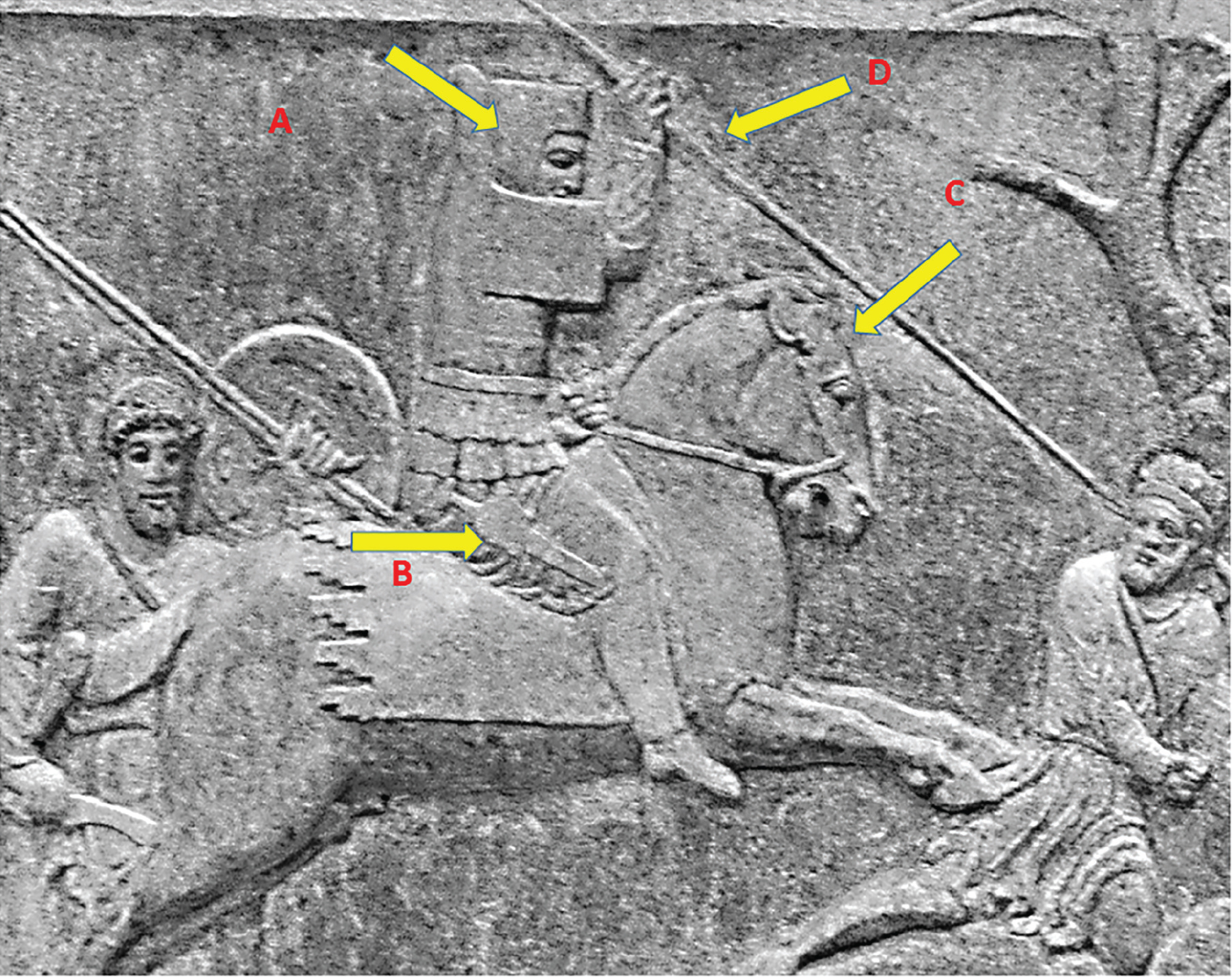
Photo 3.1. Persian asabara cavalryman, with helmet (A), akinaka dirk (B), horse armour (C) and downward thrusting shafted weapon (D).
The decimal organization of the cavalry and its assignment by units to infantry armies indicate a highly organized and disciplined force, standardized and thus organized centrally and consequently not suffering from a number of limitations and drawbacks inherent in knightly armies. As the governance of Darius was very centralized, the carefree European knight might be an unsuitable paradigm for his and Xerxes’ cavalry. But there were no combined arms. In many descriptions of battles, even before the invasion of Xerxes, the cavalry is missing from the accounts, and it is never reported to have taken positions at the two flanks of the infantry line. It is always in one body, not divided between wings or any other tactical entities; this is implied in Malene (Her VI.29,1) and explicitly stated at Plataea, (Her IX.32,2). The Achaemenid cavalry operates independently at Plataea in 479 BC (Her IX.14; 17,3; 20,1;40; 49,1) and before, at Eretria in 490 BC (Her VI.101,1) and when pursuing the Paeonian fugitives in 499 BC (Her V.98,4).
The size of the Persian mounts, coming from the Nyssean Fields in Media, was astonishing (Her IX.20; VII.196) and a factor contributing to the success of such cavalry. Additional momentum when charging or casting javelins, higher seat for downward crushing and cutting blows, higher speed and the endurance to carry weaponry and additional armour; all this contributed to the legend and mystique of a force actually much smaller than indicated by its lore. The usual proportion was supposedly less than 1:10 cavalry to infantry (Sarantis 1975; Ray 2009), the latter being the Greek optimum (Plut Vit Aris 21). In Marathon, a force of at least 18,000 and probably 24,000 infantry was probably supported by one hazarabam of cavalry (Lazenby 1993).
There is a theory suggesting the opposite: that an imperial army corps under Xerxes was composed of five infantry and one cavalry baivaraba, making a 1:5 cavalry-to-infantry ratio (Munro 1902). Solid facts are that some Persian subjects, such as the Sagartians, were fully mounted (Her VII.85); that the classical Greek doctrine favoured already a 1:10 ratio (Her VII.158; Plut Vit Arist 21), which Alexander improved to 1:7.5 when invading Asia (Diod XVII.17,4), to be increased by Arrian to 1:4 (Arr Tact 10,8 & 18,1).
The infantry (pasti), on the other hand, was the main branch of the Persian military at the time (Fields 2007); the line infantry were the famous Persian archers, allegedly combined so effectively with the cavalry to create a combination of manoeuvre and firepower which catches the imagination of modern scholars. In fact, the combination was operational, not tactical. These two arms in the Achaemenid army had neither the training, nor the doctrine to fight in a combined and integrated fashion (Hammond 1968). They were fighting together occasionally, but still separately – not unlike today’s air and land campaigns, which overlap to a degree, but are not fully integrated.
Infantry-wise, the Persians had recast the already ancient fighting duo of shield-bearer and archer, seen in Mesopotamian illustrations and occasionally mentioned in the Iliad (VIII.266–72), so as to maximize the firepower. The Persian version included one shield-bearer (similar to the pavisarii of the Middle Ages) followed by nine archers, in a single file, which provided a deep landing zone for the arrows (Sekunda 1989). This depth accommodated for errors in aiming and was also excellent for assaulting in depth an enemy deployment, destroying its cohesion. It also insinuates that the archery duels were fought with arrows flying at relatively low angles, in direct shooting; else the spara shield would offer but little protection to the rear ranks. The high angle used by the English archers during the Hundred Years’ War may not be an accurate paradigm. Xenophon, having fought both against and alongside Persians, mentions high-angle shooting by Cretan archers as an oddity due to the lack of proper ammunition (Xen Anab III.4,17) and, while corroborating Herodotus on the large size of the Persian bows (Xen Anab III.4,17 and Her VII.61,1) he makes clear that their range was less than the range of the Rhodian slingers (Xen Anab III.4,16), implying direct shooting.
Moreover, all archers were armed with spear and sidearm (sabre, dirk, as well as the ‘akinaka’ or axe and the Scythian ‘sagaris’) as was the shield-bearer; thus they could all engage in hand-to-hand combat (Raaflaub 2013); again the reader of the Iliad feels at home (Il XV.466–75). Once the arrows caused casualties and disruption, a violent charge disintegrated the enemy, and this onslaught was performed by all the field troops, increasing both impact power and killing efficiency.
This was the Persian line infantry, called Sparabara due to the Spara, the long, rectangular leather-and-wicker-made shield of the file leaders; very different and lighter than the (mainly) plank-constructed pavises of the Middle Ages. Other nations of the area, like the Medes, used it or a version of it and, in any case, adopted it under the Persian sovereigns. It is possible that their use of such kit pre-dated that of the Persians, but this cannot be surmised. In his seventh book, Herodotus describes at least three more national contingents outfitted similarly to the Persians (Her VII.62).
The spara was rectangular and flat, thus providing a standard coverage without any seams and openings, especially when in contact with the other spara of the rank. It was easy to set on the ground, to create a seamless barrier or rather field fortification from where to shoot in relative safety, without burdening the wielders’ hands and interrupting his firing sequence. It was very light, which allowed the wielder high mobility, such as forced marches, violent charges, manoeuvring at a jog and pursuing fast and hot. Its beauty though was that it was not issued to all troops, but only to file leaders.
It is unclear whether all troops of such a combined formation were called Sparabara; this issue relates, most probably, to the existence or not of shields for the nine archers-spearmen. The reliefs of Persepolis show Persian archers in ceremonial dress, with conventional quivers or combined ‘gorytos’ quivers/bow cases, carrying spears and occasionally straight dirks (akinaka). What is a bit more confusing is that Greek pottery shows sabres, or rather cleavers, but the Persian reliefs and Herodotus refer to akinakes dirks (Her VII.61). The cuirass might have been issued selectively (Charles 2012). The obvious choice is to the dathapata file leaders of the sparabara who would bear the brunt of close-quarter combat and perhaps missile barrages; such armour must be identified with the Egyptian-style mentioned in Herodotus (Her I.135) and seen in Greek art (Photo 3.2). Additionally, the other type of cuirass, the iron-scale type (Her VII.61) was issued to or otherwise used by cavalry, at the very least by noble cavalrymen (Her IX.22,2) if not by the entire mounted host of Persian stock, and/or by the elusive cuirassiers (Her VIII.113,2), should they have been an infantry unit (Charles 2012).
It is also unclear whether the spara-bearing file leader (Photo 3.2), portrayed with cuirass or jerkin (obviously the Egyptian-style mentioned in Her I.135 made of stuffed linen) in Greek pottery, had been an archer as well. The spara could be solidly planted on the ground, as seen in the pottery, so both hands were free, but only a portion of the above mentioned representations show the bow (not quiver), for spara-related troopers. Herodotus (VII.61) endows all Persian national infantry with a full kit of wicker shield of unstated shape and size, short spear, longbow hanging from the shoulder (from where it could be brought to notch position with just one move within the left palm), with one quiver at the back (for fast drawing of the reed arrows), with iron scale-armour and with a dirk hanging from the belt to the right side. And here lies a problem: there is not one image of a Persian with so full a kit, making the description of Herodotus reading like the inventory of the infantry unit, not the standard-issue kit of the infantryman.
The spara was quite a feat of manufacturing, despite the mundane materials; and of sizeable footprint. The size and form of the spara (Photo 3.2C) allowed the formation of a veritable shield wall, as mentoned above, with the file leaders planting their spara one next to the other to create a portable and movable linear field fortification, from which they were entrusted to repulse by spear-thrusts any enemy resilient enough to cross the hail of arrows and assault their shield wall. It should be noted, though, that – contrary to some views – there can be little possibility of more than one spara-bearers per datha (10-man file). Even less so for an adjustable number of spear-bearers according to the tactical situation (Ray 2009). The idea that an array of weapons was available to all soldiers and the selection was done before deployment is impractical in anything but pitched battle, as it denies the ability to deploy promptly after a forced march or in battles by encounter.
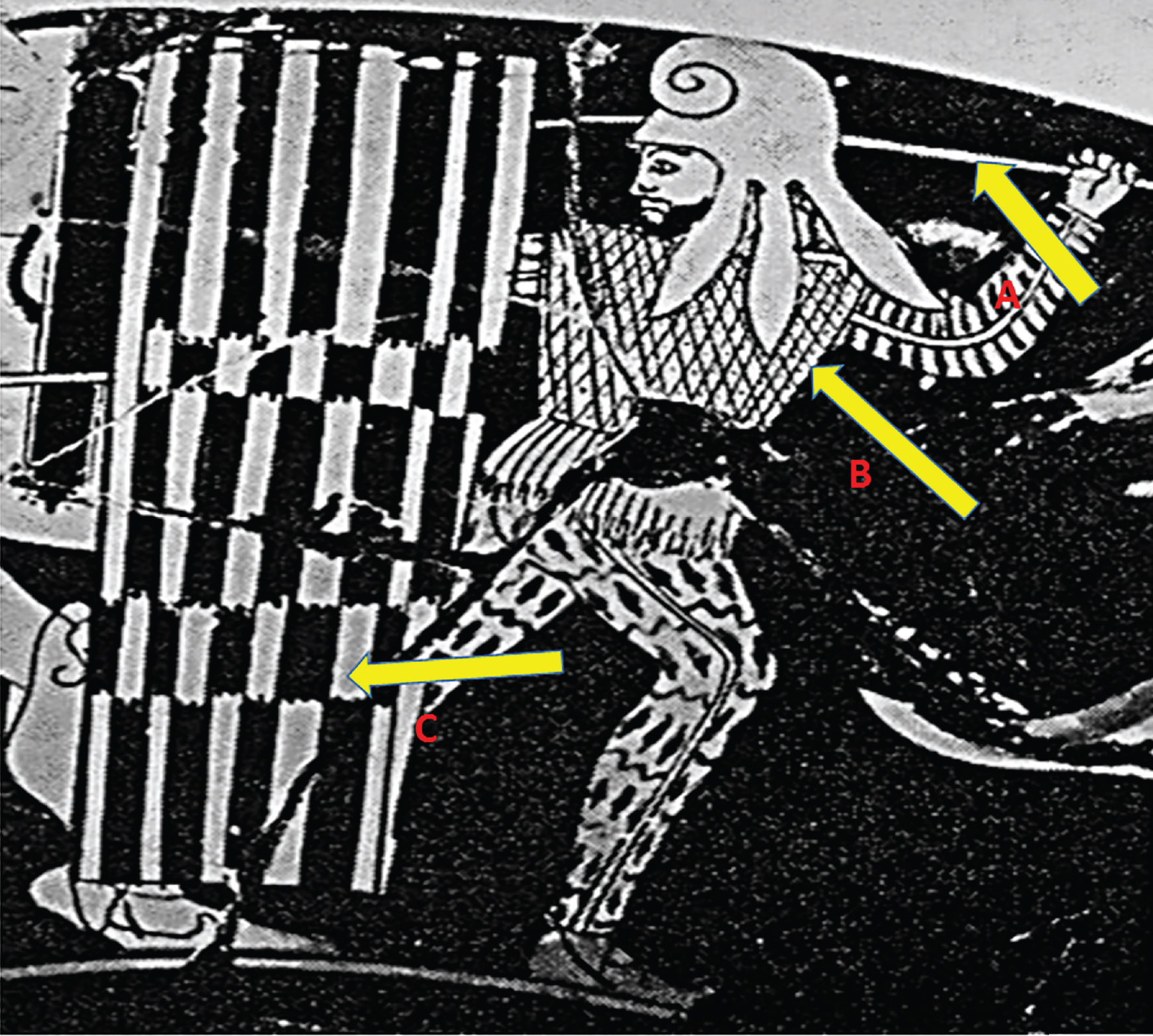
Photo 3.2. Sparabara, equipped with (A) spear, (B) jerkin/corselet, ostensibly of Egyptian style (Her I.135) and probably made of stuffed linen and (C) the rectangular, leather-and-wicker, big spara shield.
Thus the Persian armies had multiplied their firepower, as almost all of the line infantry shot bows and then doubled as shock troops (Raaflaub 2013). The Persians had practically doubled the effective sizes of their armies, and by fielding quite large ones they were really able to cloud the sky with their arrows (Her VII.226). An ethnic Persian boy was taught from the age of 5 until 20 to ride, shoot the bow and speak the truth (Her I.136), and then he was serving his tour of four years as a conscript private (Strabo XV.3,18), followed by either a military career or a release to the civilian life as a reservist (Strabo XV.3,18; Ray p31–32). There is a slight problem, though: the infantry was by far the decisive Persian arm; Xenophon (Cyrop I.2,15) estimates the Persians, obviously the conscription-liable, to 120,000. The bondsmen/ bandaka were the intermediate social stratum, between the slaves/ mariaka and the Aristocrats/ azata (Sekunda & Chew 1992) and accounted for the equivalent of the free citizenry, who obviously were the bulk of the manpower. These could not own a horse and had no war use for it. So how, and, most importantly, why should they have to ‘learn to ride since childhood’? Most probably, the renowned motto referred to the scions of the Persian nobility, similarly to the – slightly more expansive and diversified – syllabus of Homeric heroes and medieval knights. Or this kind of training was provided to all enfranchised Persian youths who could afford the public training (i.e. azata and bandaka) since the acquisition of a horse could happen during manhood due to gains or promotion, training in their early years should have anticipated such a case.
The long Persian bow, firing a long, hollow arrow shaft (Her VII.61) had quite a range (Xen Anab III.3,15). The massive firepower practically reduced any need for defensive weaponry, which brought down the cost and increased the flexibility, speed and endurance of the troops. Although Persian troops are regularly mentioned as unarmoured (Her IX.62,3), Herodotus mentions iron-scale cuirasses for the Persian national infantry, possibly implying the first-rank sparabara (Her VII.61). Such armour was a quantum leap compared to the bronze-scale panoplies of centuries past. Moreover, quilted jerkins and equivalents to Greek linothorax models are shown in pottery for imperial troops – basically archers and/or sparabara. By any account, the protection afforded by the Persian shield and armour was optimized against arrows, as they were the only actual threat to the Persian war machine, and secondarily against the chance slashing blow in the melee. Still, this picture of both literary and representational evidence is very far from the picture of ‘naked’, fully unarmoured troops explicitly referring to the Persian line infantry and considered a focal reason for their defeat in Plataea (Her IX.62,3).
The short spear with the apple-like (or spherical, sensu lato) counterweight (Her VII.41) was more important than usually acknowledged. Short in length, it was handy in congested conditions, such as the melee after a storm of arrows. Its spherical counterweight and short length made its use safer for the rest of the ranks, contrary to the constant danger for the following ranks represented by the butt-spike of the Greek spear. This, usually disregarded, spherical counterweight allowed holding the shaft far towards the back end, which permitted maximization of the useful length and reach within a handy total length with minimal projection backwards – a feature further enhancing the collective safety and reducing the cumbersomeness of such a weapon. It must be noted that the Greeks had difficulty in spearing in congested conditions and preferred spear-fights at a distance in set-piece battles and/or on open ground.
The Persian spearman, due to his more nimble weapon, could be more mobile in the open and more dexterous in congested conditions, although at the cost of a somewhat reduced reach. Some projections assign central grip at an overhead position as the sole technique of using the Persian infantry spear, resulting in limited reach, 1.4m. Both this conclusion and the notion of fragility due to smaller diameter (Matthew 2013a) might be due to a misunderstanding that confuses the dual-use palton of the cavalry with the counterweighted infantry spear attested by Herodotus (VII.41,3) and shown in various reliefs. The counterweight allowed, as mentioned before, a very asymmetrical hold, near the rear tip, and also both high and low positions, with the latter offering longer reach and being reminiscent of the Iklwe of the Zulus under Shaka; the former was the only suitable grasp for use from behind a fully developed spara wall, where spearing over the upper edge of the spara was mandatory.
Moreover, the counterweight allowed a police function, as a less-than-lethal club for riot control, and an alternative military function: as a lethal club to strike at heads and to break inflexible shields and armour, thus giving the user a dual-use weapon: a battle club with quite a reach paired to the conventional spear. This is by itself a noteworthy innovation compared to the armament of the Assyrians in the Army of Xerxes, which included lance, club and dagger (Her VII.63).
Furthermore, it is as yet unresolved what the Persian spearman-archer was doing with his spear when shooting arrows: leaving it lying on the ground would make picking it up rather difficult; the possibility that the sphere allowed it to balance upright should be taken into consideration and tested, at different types of ground. Without the butt-spike of the Greek weapons (see Photo 3.4) it might have been planted on the ground head-on (Ray 2009), which would expose its point to damage and rust; but also infest it with soil microbes, adding a septic dimension to any wound.
After all, the sparabara may have not been intended for the defensive pinning and bleeding of the enemy, as is commonly projected (Ray 2009). Their purpose must have been the decimation and stunning of the enemy. This would allow them to tilt sideways or retract by any other means the few and light spara, thus enabling the massive exit of the spearmen-archers. The latter would deliver a violent charge with close contact weapons to disintegrate the enemy by eroding his unity and dissolving his line, very much like the practice of the Roman legionaries some centuries later. Without this in mind, one cannot explain the use of spears hardly reaching a target positioned two ranks ahead by all the ten ranks. Practically the fighting style of the Persian infantry was very Roman-like, perhaps lacking the body armour in kind or, at the very least, in type and using the bow instead of the javelin as a missile and the short spear instead of the gladius-type sword for close-quarter melee.
The practice of enumeration of the Persian host of Xerxes reported by Herodotus (VII.60), whence 10,000 men were standing and a fence was built around them to promptly enumerate the army, was rather a measure to divide the army to baivaraba; then, each baivarapatis would segregate and delegate hazaraba to his hazarapata, who would then delegate sataba to the satapata designated by baivarapatis and so on to the dathabam.
The file of ten men was both operational and administrative. It was the administrative unit, but also the standard file of one shield-bearer who led and commanded the file (Dathapatis) and nine probably unshielded archers. All ten men were armed with spear and sidearm. Thus, the standard file depth of a Persian unit was ten, and to increase depth for better defensive function or adaptation in confined spaces, the successive deployment of units in successive lines was probably the standard procedure. If a higher echelon was depleted or undermanned, the personnel were reassigned and restructured to create full units. For example, a Persian century (Satabam) may be understrength, chiefly because some dathaba are taken for other – guard/outpost – duties; thus less than ten dathaba were present. In mobilization, such detachments would return to bring it up to strength for expeditionary duty. Still, low manning and casualties are also reasons for understrength dathaba. Consequently, a Satabam, if left with 70 men, would cut 3 Dathaba and use the manpower to fill 7 Dathaba to full strength (Ray 2009; Sekunda & Chew 1992). The net result was that understrength units may cover smaller fronts but always had a steady, 10-man deep landing zone for their arrows, assaulting at depth the enemy.
The infantry baivarabam was probably escorted by 1,000 cavalry, a hazarabam, but this is speculative as the 1:10 cavalry to infantry ratio is a Greek standard (Plut Vit Aris 21). Still, if more than one baivaraba took the field, as in Marathon, it is not clear whether a single cavalry hazarabam would be attached, being considered the cavalry arm of an expeditionary force, or the ratio – had it been thus – remained steady with additional cavalry hazaraba being dispatched. The use of the cavalry was to control space in width and depth (Her VIII.23), to provide awareness, and to take independent action (Her IV.20) similar to the Confederate cavalry of Johnson under Lee in the American Civil War. It did support the actual fighting and in cases was proven decisive, as in the battle of Malene (Her VI.29). This supposition provides two possible, complementary conclusions: that the optimal heavy infantry/cavalry ratio of the Greek military experts, 10:1, might have been based on the Persian system, but it also might not; and that extended or total absence of either the infantry or cavalry from a battlefield (as happened in Marathon, 490 BC) was not unusual under the Persian doctrine. No cavalry is mentioned in Mycale, 479 BC and in the early 4th century, Greek invasion forces regularly clash with cavalry forces deprived of infantry, with mixed results (Xen Hell IV.1,19; III.4,14 & III.4,22–4).
This independent, poorly integrated mode of action is occasionally noticed and remarked (Hammond 1968) and had been adopted by the Athenian cavalry under Pericles (Thuc II.22,2). In truth, it does not exclude a combined-arms approach but makes the limits of the latter more obvious. Additionally, the explicit notion of Herodotus that the imperial cavalry had been arrayed by itself in Plataea (Her IX.32,2) parallels the dispositions reported by Xenophon above. Thus, the notion of Persian cavalry stationed at the wings, in Parataxis, for example in Marathon (Sekunda 2002) is not convincing; whenever the imperial cavalry was deployed for pitched battle to support an infantry force, a Protaxis in one body, in front of the infantry line, or Epitaxis in one body behind the infantry line, is more plausible.
It is an issue of debate whether the rank and file of the Persian dathabam had smaller, elliptical and/or crescent-like shields for personal defence in close-quarters combat. This issue lies at the heart of a more complicated issue. Were the sparabara (sensu lato) the only type of Persian infantry? Because sparabara were archers and not all Persian infantry were archers, after all. There is pottery showing Persians with the (small) shield and spear, lacking bows. Additionally, in the battle of Issus archer units were specifically mentioned (Arr Anab Alex III.13,1), implying that the Persian line infantrymen were not such. These observations can be explained by the successive transformations of the branch, but they do call for some further research.
The personal defence shields of the Persians of the ranks behind the dathapatis might be the relatively large double-scalloped shields, which are seen in Persepolis reliefs arming spearmen with no archer attire (Photo 3.3 middle; then there is a crescent-like shield similar to the Thracian peltast (Photo 3.11C), and a single-scalloped circular shield (Photo 3.6D) used by Persian spearmen in Greek pottery. One cannot be sure whether such shields were used by the rank and file of the dathabam of sparabara or by different troop types, such as the Arstibara and the Takabara.
The sparabara was line infantry. For many other functions, from amphibious operations and naval engagements to assaulting fortifications and patrolling extended areas they were not ideal; capable perhaps, but not ideal. Line troopers may build, or acquire an empire, but they cannot sustain it. A lesser, more persistent and cheaper troop type is needed for such tasks; usually medium or light infantry. The Greeks reached the same conclusion despite their sentimental and ideological reliance on the Hoplite – and then the Romans likewise. Once imperial expansion started, at any rate and scale, medium troops were necessary. The Greeks had the Psiloi and afterwards the Peltasts (Photo 3.11C). The Persians probably developed the takabara (Sekunda 1989; Sekunda & Chew 1992), medium infantry armed with shield and spear and possibly with a sidearm (Photo 3.5D), although their emergence is disputed in temporal terms. A very late appearance some decades later is proposed by some scholars, based on Greek art (Sekunda & Chew 1992). After all, sparabara were light enough, definitely by Greek standards, but objectively as well; Alexander’s Phalangites were in some cases used as light troops and were considered such (Arr Anab Alex III.23,3), although by default they were troops of the line and heavily armed (Arr Anab Alex I.28,7).
Though there is no reason for buying into this argument for the late takabara emergence; had they been another arm of the infantry branch, they could be used as flank-guards for the sparabara or as the main troop type of an expeditionary force. It is uncertain whether they were in the field during the Persian Wars or had been a later development of future decades, as mentioned. Their shield, the taka, was reminiscent of the Greek-mentioned pelte (Photo 3.11C), but its identification with the three aforementioned types is unclear; the double-scalloped shield (Photo 3.3) most probably does not qualify. The scalloped-off circular shield (seen in Greek pottery for shield-and-spear Persian infantry) is a better candidate; as is the crescent semi-circular one and, apart from the possibility of a problem of artistic fidelity, there is also the distinct possibility that they both were taka; simply different models. The latter would imply spin-offs of the same item due to evolution or different local lines of manufacture.
Takabara presence is conceivable at Marathon. Herodotus (VI.112) narrates that the Persians thought the Greeks were frenzied to attack them at a run without the support of archery (NOT archers) and cavalry, which means they were perfectly familiar with charges as long as they were properly supported. This report should have ended any argument for a defensive Persian infantry function centuries ago and outlines how a Persian charge was meant to develop; with archery and cavalry support. But there is no mention of anything reminiscent of a spara wall, and the hand-to-hand contest leading the Persians to push back by quite a distance an unyielding Hoplite Phalanx fits poorly in the Sparabara context, with the unwieldy spara-shield. The above may, of course, have been due to Herodotus’ comparatively inept description of Marathon. Still, Sparabara are explicitly mentioned in Plataea and Mycale in 479 BC, but not in the first two days at Thermopylae – an action allegedly ideal for the takabara. If the imperial troops in Marathon were takabara (Photo 3.6), which is a sounder choice for an invasion fleet and amphibious actions, separate units of archers should be understood. After all, a charge supported by archers means that it was not conducted by the archers.
Another reported troop type, the Arstibara-spearman (Sekunda & Chew 1992) comes to complicate things even further. Darius must have been one, as Herodotus, who evidently speaks Persian, refers to him as spear-bearer and not guardsman or anything similar. The Persian war court had a Master of the Bow (Vacabara), a Master of the Horse and a Master of the Spear (Arstibara), who is believed to be a Chamberlain rather than the director of line infantry (Sekunda & Chew 1992); but this might have been an additional, administrative office for his title. As the line infantry used bow and spear, one can assume that the spearmen had nothing to do with the double-role line infantry. Indeed, reliefs show spearmen without shield or bow. Even if the court names and ceremony reflected a previous era, with separate archer and spearman units, before the advent of double-role Sparabara, there are issues to tackle. If (some categories of) spearmen were called Arstibara, were they shieldless? If not, could the term include the takabara and the dathapatis of the Sparabara and been descriptive and generic? This would have been the case, if the rank and file of the Sparabara were spearless, as Greek pottery implies; still, the context of such scenes is usually missing. In an army of different (combined or not) arms, everything is possible; simply, we lack sufficient clues to reach a conclusion. Herodotus’ testimony, for what it is, does not corroborate. In the cases where sparabari are implied, the Corps of the Immortals in the Parade of Xerxes’ army and in the Battle of Plataea, spears are mentioned for all the troops in the former case and are implied in the latter.
But the actual function of Arstibara seems to have been different. They most probably were bodyguards of the king and the viceroys/satraps (Kuhrt 2001), possibly to the number of 1,000 per commission (Her III.127,1; VII.41); not field troop types, not a generic description of field troops’ kit and function, a praetorian guard of sorts, similar to the Bodyguard of Alexander the Great (Kambouris & Bakas 2017; Kambouris et al 2019), and responsible for the protection and security of top officials (Sekunda 2002), not field duty – except if necessary. They would guard the palace and, when on campaign, the tent of the King/Karana, and his selected position, either within the army, as Darius III, who took the field in person at Issus (Arr Anab II.8,11), or at a remote observatory-headquarters-command platform, as Xerxes did at Salamis (Her VIII.90,4) and Thermopylae (Her VII.212,1). This guard function did not require a shield; both hands had to be available to allow prompt and successful intervention if need be. It was an excellent opportunity for royalty and aristocracy who wished to become ‘networked’ to fulfill their military obligations. Thus, spearmen without shields and bows in Persian representations must have been the Arstibara guards, probably corresponding to the aichmiforoi-doryphoroi (spear-bearers) of Herodotus (Her III.127,1 & 139,2). When and if deployed for battle, as most probably at Plataea, they might have been issued with shields, perhaps the double-scalloped ones also seen in reliefs arming spearmen without bows (Photo 3.3 cente). Still, the scalloped shields may be characteristic of one specific guard unit, as Herodotus mentions two guard units (1,000-strong each), but only one may be the King’s Arstibara. This view is supported by the fact that shielded and shieldless spearmen appear together (Photo 3.3 right), which means a mixed guarding pattern. Contrarily, the Immortals, an elite corps but actually a field unit, not guards (Charles 2011), are depicted with both spear and bow, as proper sparabara (Photo 3.3 left).
The actual novelty which troubled the Greeks was the massive archery combined, in space and time, by cavalry manoeuvre and infantry onslaught. Although, as mentioned earlier, Persians did not use combined arms in any modern sense (Hammond 1968), the mainland Greeks did not know that and had to prepare for such an unfortunate eventuality, especially once details of the battle of Malene (Her VI.29) became available but remained foggy. It was the last battle before the Persian invasion and the only one decided by the cavalry – and possibly the only one in Ionia where the imperial cavalry had played any role. More armour for the Hoplite was not the solution to this problem and was discarded in the 6th century either as a failed experiment against massive archery or as the ultimate evolution of the Hoplite kit for more individualistic and initiative-intensive missions, i.e. within a colonial context. The reason for the rejection of this solution may have been due to cost, or technical considerations. Evidently, up to that day, the Greeks had not found any definite answer to the eastern challenge and were still experimenting: drill, tactics, technique and weaponry were all taken into consideration. The intellectual efficiency was to decide the struggle. For 230 years Greeks and Persians were trying to learn from everywhere and to adapt to each other. Greeks showed a marked superiority in terms of military intellect during the Third Persian War and were able to adhere to it despite many setbacks, until they delivered the coup de grace by the hand of Alexander the Great, in 330 BC.
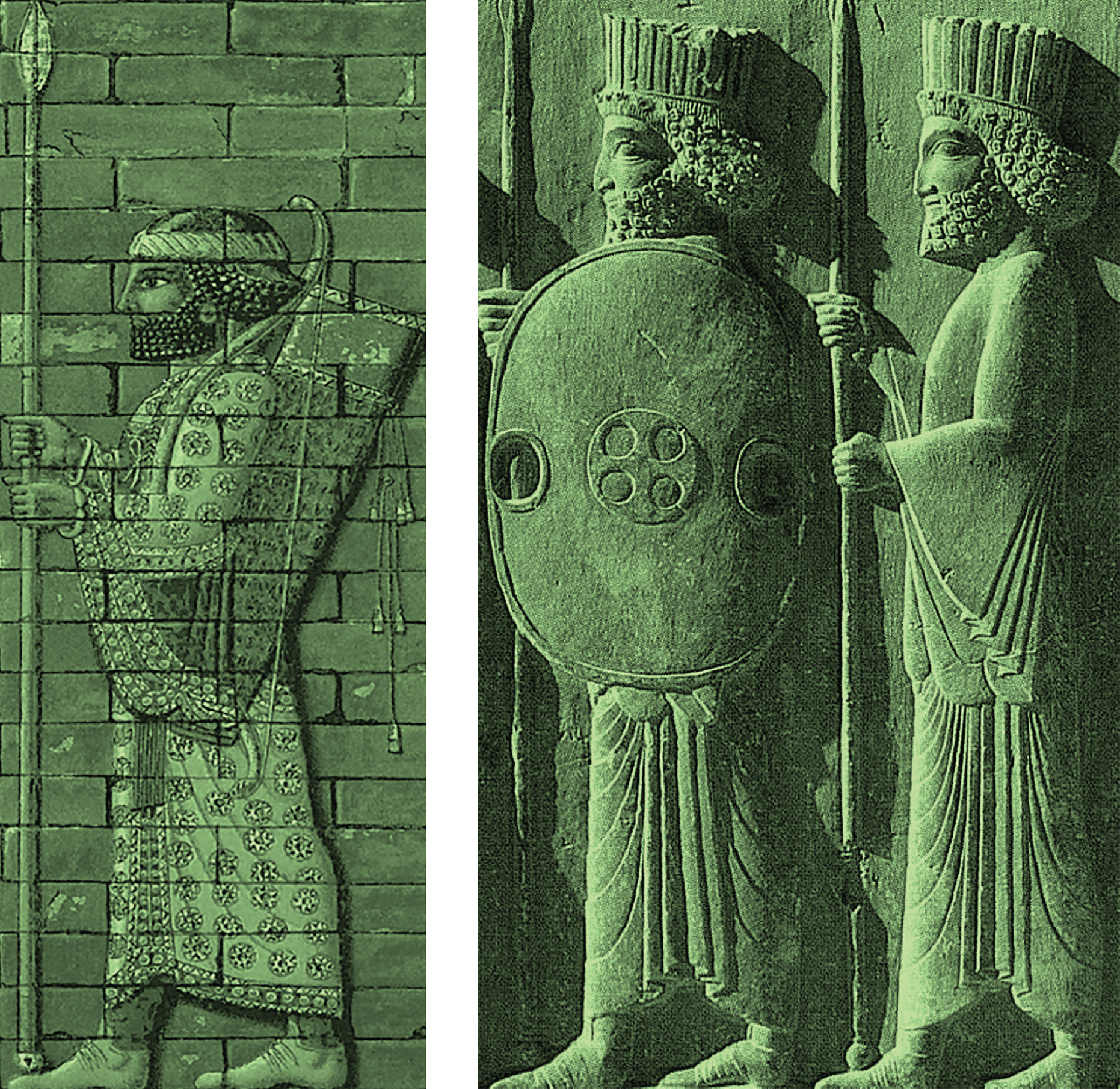
Photo 3.3. Elite achaemenid troops, in ceremonial Persian, or rather Elamite, court dress. Left: with bow, quiver and spear and retracted headgear an Immortal elite infantryman. Right: two different guardsmen (spear-bearers) with headgear erected. One of them is shielded, indicating members of (the two) different guard units.
The Greeks
For the Greeks, the thing is quite different. Most of the Greek mainland, that is east of the Pindus mountain range, operates the Hoplite heavy infantryman (Photo 3.4), fully armoured and excellently protected. His frontal aspect was that of invulnerability, presenting, when at the ready, minimal exposure: with the shield in position and adopting a striding stance; an oblique stance angled at the line of the front (Luginbill 1994) with the upper body leaning slightly forward, left projected, right denied, there were virtually no naked spots. This hoplitic preponderance was true though for the civilized societies, the city-states.
More backward states/areas, like Aetolia, were content with javelineers and slingers, a common choice throughout Eurasia at the time. They lacked the material, intellectual and social means and the mentality to field Hoplites, and perhaps the need to do so. At the time, in mainland Greece, the Dorians ruled supreme, along with relatives – more or less distant – and friends; consequently, their method and style were the commonest. They fielded the most numerous and most efficient Hoplite armies and imposed the accepted tradition. Missile warfare was allegedly despised among almost all civilized Greek states, especially the bow and that, mostly, among the Dorians, with the notable exception of the Cretans. Similarly, the Dorians had little intimacy with the horse, perhaps due to their hilly/mountainous origin. Other Greek tribes were more broad-minded and appreciative of archery, especially against non-Greeks, and of cavalry as well.
Greeks of that era were not unfamiliar with combined arms concepts, largely – though not exclusively – due to the Mycenaean tradition. Still, the reality check found them poised to face the innovative land threat of the Persians while they themselves were based on the Hoplite, which was a standard troop type of extremely wide distribution. He had literally conquered the Mediterranean and created lore and mystique, but had fared poorly against the Persians, at least in Egypt and in Asia Minor, if not in Mesopotamia as well. Still, only in Asia Minor were the Hoplites fighting in defence of their own country and communities and under their own officers throughout the chain of command. The change from contempt to utter terror between 500 and 490 BC, evident in Herodotus, shows that previous clashes had not instilled any doubt regarding the ability of the Hoplite to tackle the Orientals.
Glory of times past: the Hoplite
It is a common mistake to consider the Persian Wars as the defining moment of the Greek fighting model to prominence. In part, Herodotus is to blame, trying to assign more laurels to these generations than their true share and demeaning previous Greek military achievements. His motivation might have been to read or sound more pleasant to his Athenian democratic audience while keeping an otherwise balanced and reasonably objective account.
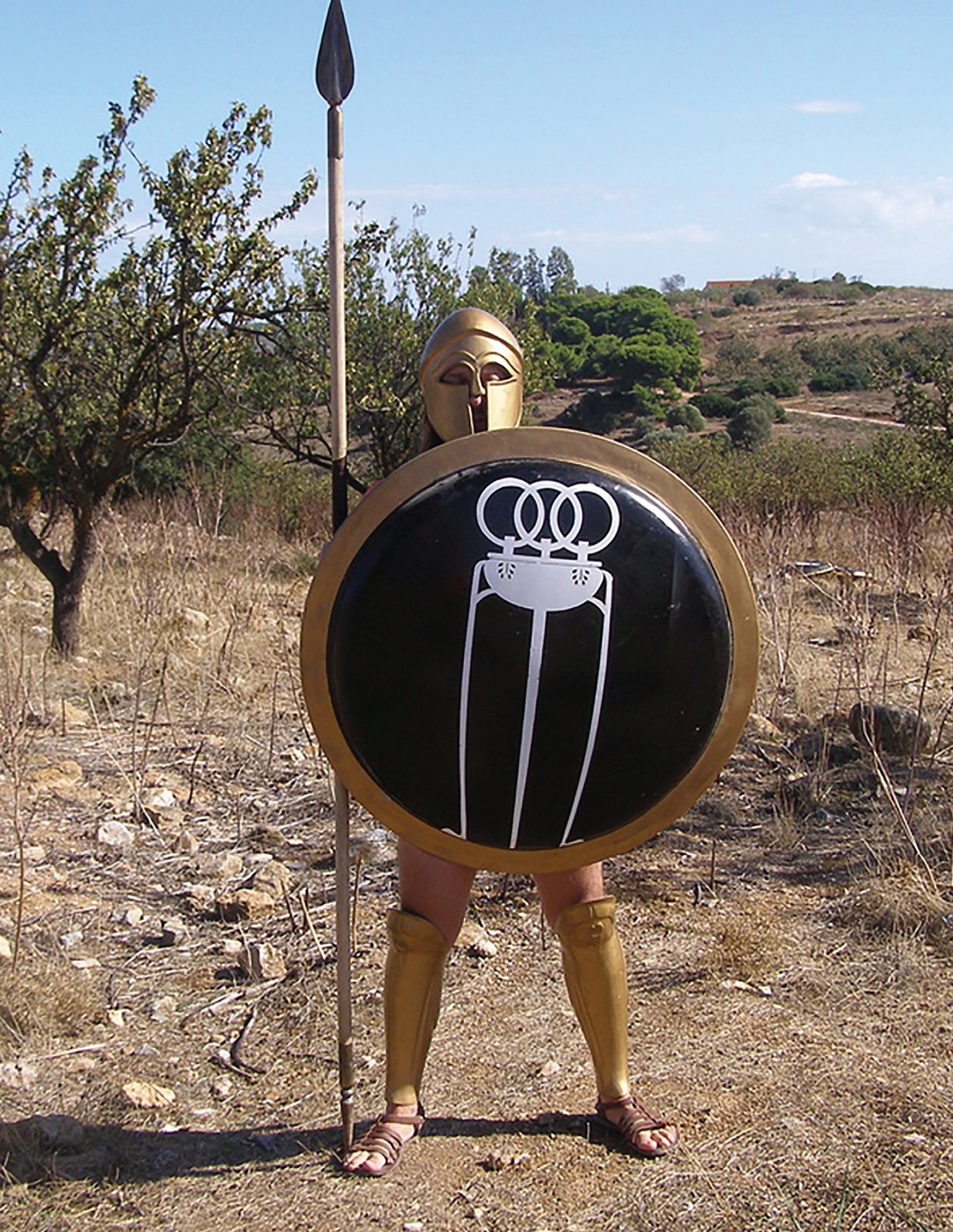
Photo 3.4. The Hoplite at attention. The warhead of this model of dory spear is wide to reduce penetration so as to facilitate extraction and increase the width – and the resulting bleeding – when thrust in soft tissue. The sauroter butt-spike allows firm fixing on the ground without compromising the warhead. The large hoplon shield, which named the troop type, is prominent and perhaps the reason the Persians referred to Greeks as Yauna Takabara: shield-bearing Ionians (Greeks), despite the administrative context of the reference (DNa 29) which focuses on their status as subjects and thus shows them disarmed. The helmet here is the fully enclosed Corinthian model, but crestless. (Copyrights: Association of Historical Studies “KORYVANTES” - koryvantes.org)
At that time, the Hoplite was a long-established troop type. Armed and armoured to tackle multiple attacks from all directions in individual combat, he was even better and more effective in collective action (Raaflaub 2013): the phalanx formation was sweeping its opponents from the battlefield (Nilsson 1929) and fending off clouds of missiles by the overlap of the concave, large Argive shields, preferably, but not necessarily, coupled by full panoply (Plut Apoph XXVIII). Although a sword was important for hand-to-hand combat, the main weapon was the spear, long so as to reach over the shields of a tight phalanx and bring down a horseman before the latter could use a slashing sidearm delivering downward thrusts and blows (Snodgrass 1967).
The Hoplite made possible the first and, more importantly, the second waves of the Greek colonial expansion, enabling small numbers of colonists to stand against multitudes of locals (Krentz 1985). The style and attire were exported, copied and imitated. Fugitives from Peloponnese, the retinue of Demaratos of Corinth (Polyb VI.11a, 7; Dion Ha Ant Rom III.46,3–5; Strab VIII.6,20 & V.2,2; Livy I.34,2) taught it to the Etruscans, instigating their ascendance, and – directly or indirectly – to other Italian peoples, amongst whom were the Romans.
As already mentioned, the Hoplite reigned supreme for at least a century, conquering the central and western basins of the Mediterranean. Corinthian pottery illustrating Hoplite battle may well represent, in some part, the clash between Greek colonists and barbarians having adopted the same gear, as were the Etruscans, the Romans etc. (Snodgrass 1967). In such clashes, better familiarization would offer the Greeks an advantage, but this was not always so, nor had it been always decisive as quantity always mattered between technological equals.
In the east, the Hoplite gear was adopted by populations of distant Greek origin or intermingled with Greeks, such as the Lycians, Carians, Cypriots etc. and even the Phoenicians might be added to the list, at least partially, as they adapted the Hoplite kit (Her VII.89). Moreover, the Hoplites had established presence in the Middle East as celebrated mercenaries in Babylonian service (Alc fr 350) and, of course, in Egypt (Her III.11). If Diodorus is to be believed (in this particular case an anachronism is possible) even during Xerxes’ reign, mercenaries, Greek in form and origin, were used for internal security missions (Diod XI.6,2). Indeed, during Herodotus’ time, this was the case. The policy might have been introduced earlier, though, due to the excellent record of Hoplite mercenary service in terms of reliability and effectiveness.
Origin and evolution
The Hoplite was the main type of warrior of many different states and this supremacy lasted for quite some centuries. His birthday is unknown, but what IS known is that he showed considerable adaptability. When his armour emerged, it was expensive (Nilsson 1929); one might add quite expensive as it elaborated on previous Mycenean armour, which means it required considerable quantities of metal, while mere novelty is always a reason for inflated prices, even for cheaply fabricated goods. But it DID constitute a quantum leap in protection and user-friendliness. Thus, its acquisition being a sign of status, it remained expensive on purpose and an upper-class privilege. So, the 6th-century Hoplites are citizens of means, aristocrats and bourgeois alike, thanks to the expansion of commerce and the wealth it created. The considerable investment represented by the Hoplite kit could be used to earn a living as a mercenary, as was the case with Antimenidas, the brother of the poet Alcaeus (Alc fr 350), or to secure privileges at home – especially if the investment of an aristocrat was expanded to arm any trustworthy clients, as might be the case with the above mentioned poet Alcaeus himself (Alc fr 357). This context would have been the standing social format for the Etruscans and, to a considerable extent, for the Romans before the advent of the maniple (Snodgrass 1965 & 1967; Nilsson 1929). Such social mechanics inform against a rigid phalanx formation (Anderson 1991), which demands discipline and belongs to later evolutionary stages.
A well-armed and trained Hoplite could wreak havoc to opponents less well-kitted, similar to the effects of fully-armed heroes of the Homeric tradition (Iliad V.600–6) who might have used less ergonomic and closely-fit armour. The Hoplite armour provided, in its fullest form, full and all-round protection, obviously meant for open-order melee (Anderson 1991). The Argive shield, the definition of the fighter, was a technical feat, as with its double-grip system it allowed better handling, more secure holding, a better distribution of the weight among wrist (handgrip-antilabe), lower arm (armband-porpax), and shoulder (outward rim-stephane) and a steady protection footprint irrespective of turning (Anderson 1991; Hanson 1991; Snodgrass 1967; Sekunda 2000; Krentz 1985; Luginbill 1994; Goldsworthy 1997). If its distance and tilt were kept steady, turning it around its axis during combat did not open any windows of vulnerability, while the convex shape deflected blows and allowed offensive use, especially shoving. The aristocrats must have been very reluctant to allow the arming of non-aristocrats with such a marvel (Snodgrass 1965; Anderson 1991; Hanson 1991).
Still, it was a matter of cost, and between armies of aristocrats, the one with the most Hoplites was winning. To field more Hoplites, an issue of vital importance in early Greece, both in the colonial quest and in the mainland strife where whole communities were wiped out after a defeat in the field (as in Her IV.1), bourgeois started buying into Hoplitikon, the body of Hoplites. This evolution demanded concessions in government and privileges, giving rise to oligarchies, and resulted in more Hoplites but of lesser quality. The bourgeois had other things to do, especially the merchants and the farmers, and thus were unavailable for the long training of an Aristocrat. Still, the Hoplite kit as a whole system had a secondary function – a safety mode, requiring less training should massive acquisition be required for the entire force. If masses of Hoplites simply took a close position so as not to allow infiltration of enemies and provide mutual cover frontally and laterally, they could sweep off the field a less numerous, even if better trained, force of opponents if they held together. After all, the Hoplite kit was by design modular, and some parts could be discarded, if not due to weight, definitely due to cost. The rest, and especially the Argive shield, allowed a tight formation with extreme cohesion in two dimensions – an innovation never before attempted in such extremes. The troops interacted in a coordinated manner not only by ranks, but also by files, bringing the weight of a whole file of men onto one shield, to shove the opponent. This was the Hoplite phalanx.
Enter the phalanx
Once collective action became important, cohesion was the most important factor, as it afforded a good measure of passive and active defence of the individual. In a wide Hoplite body, some normalization was also needed. Formal training to learn basic skills and scheduled calls-to-arms to refresh the drill were only one side of the coin. Skills were instilled individually through dance and athletics (Krentz 1985; Anderson 1991) and such engagements, reasonably pleasurable, probably constituted the other, more sustainable part of the training syllabus of the Hoplites throughout Greece. This syllabus was not as formalized and differentiated as the Athenian ‘Ephebeia’ of the 4th century (Arist Ath Pol 42,4–5; Recaldin 2011; Ridley 1979), but it should have done the trick.
And the trick was that the phalanx setting demands steadiness most of all, which is the combined result of strength, endurance, resilience, determination and courage. The decision of the clash is usually swift (Adcock 1957; Sekunda 2002), a fact that lightens the requirements in stamina. Nimbleness, agility, dexterity, speed, ambition, bravado, aggressiveness, all basic factors for the heroic fighter, are secondary – or worse; they may become counterproductive if sapping the solidity. Even pure strength is of little importance. Thus, senior citizens can be used effectively, if not within the first ranks, definitely bringing up the rear, as the experience, cool head, cold blood and sheer persistence make them invaluable to the stability and coherence of a phalanx body, while increasing its numbers. The latter are expanded thanks to technology and innovation: the linothorax, with or without metal scales (Photos 3.11B & 3.12A), is cheaper, lighter, more ergonomic and less burdensome to wear in terms of chafing, heating and scratching or bruising the wearer.
This private soldier provides his own rations, addresses his specific needs, his weaponry and his motivation AND decides where, when and whom to fight (Hanson 1989 & 1991 & 1999). He is strictly individualist but a concerted team-player, self-supported, life-long amateur (Rey 2011) who distrusts mercenaries (Hanson 1983 & 1989 & 1999). He has come a long way from his ancestor, made renowned as a spear-for-hire and, to a lesser degree, as a single combatant belonging within a warrior elite (Anderson 1991). It is he who will emerge triumphant from the Persian Wars. The State saves huge sums by not investing in extended campaigns, deep magazines and collected and stored provisions (Hanson 1989 & 1991 & 1999), in elaborate fortifications and long-standing troops for garrison duties. It simply supervises the correct fulfillment of civic duty in terms of training, mobilization and, to a less extent, outfitting.
When the Persian Wars erupted, the Hoplite, as a warrior and a socioeconomic entity had undergone quite some evolution, as mentioned above, and operated mostly within the phalanx. In conceptual and technological terms even more so. His panoply had evolved in all three main parts (helmet, cuirass, greaves) and most of the secondary parts, such as thigh and arm guards and lower-belly guard (Photo 3.11A) had been discarded to reduce weight and cost; that is in the mainland, as in the West the need for enhanced protection in fluid battlefields resulted in retaining them for some time. The dory spear, after some evolution (as is the pair of single-pointed, cast-and-thrust weapons of the 6th century), had been standardized to a single, thrust-only weapon. It was powerful enough to negotiate armour and long enough to counter cavalry and protrude out of the front of the phalanx in order to intercept the foe before a physical impact onto the shields of the first rank (Anderson 1991; Snodgrass 1967; Matthew 2013a). It was outfitted with a leather strap or rope thong (visible in art and misidentified regularly for the launch thong of javelins) attached to a similar handle to secure the grip even when sweat, blood and fatigue make the shaft slippery. And there was a butt-spike (sauroter) to allow solid fixing in the ground, without corroding the warhead (Photo 3.4). The sauroter could be used in an emergency as a warhead, i.e. in cases of shaft breakage due to hacking or shattering, and offered a counterweight that made a hind grip possible, to capitalize on the length of the shaft in terms of reach (Matthew 2012).
The Hoplite spear was used in low (Photos 3.6C & 3.12B), underarm (Photo 3.6B) or overhead (Photos 3.5C, F & 3.12A) grips, with the scholarly debate on the subject still raging. There was also the reverse overhead (Matthew 2012), with the spear positioned as in overhead but the arm and hand oriented as in low (Photo 3.5B).
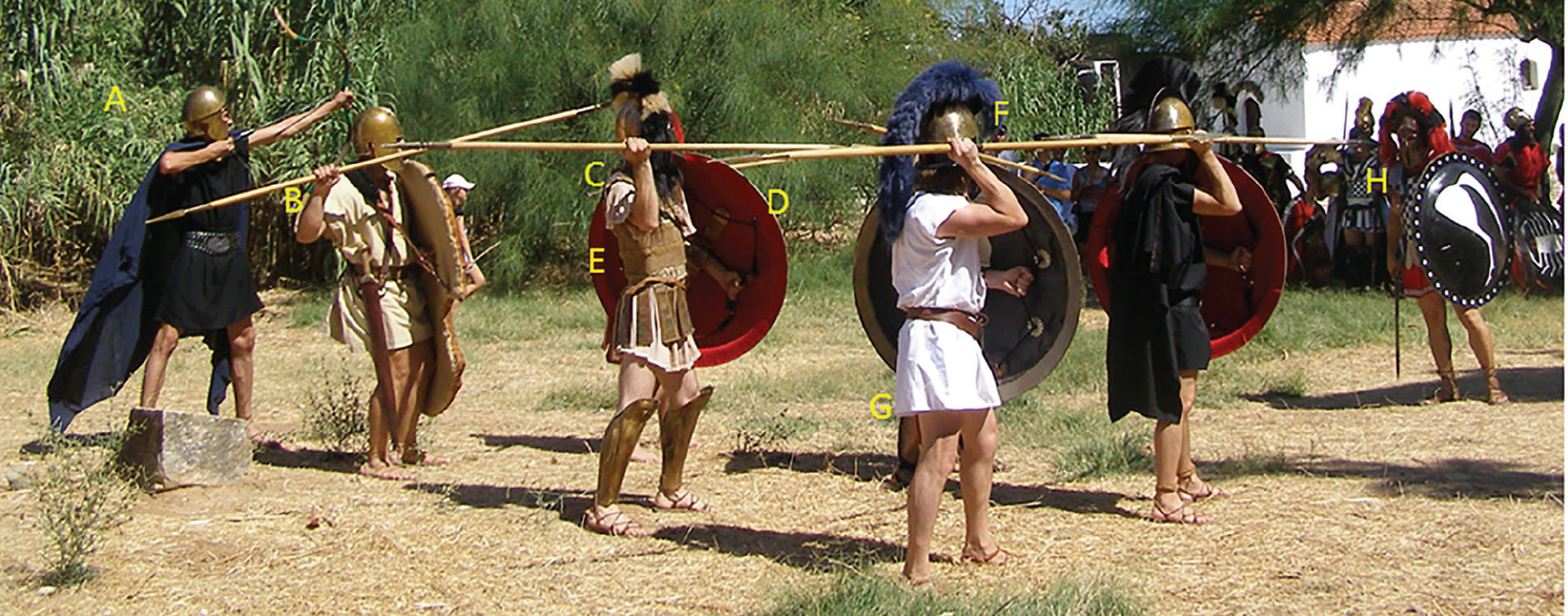
Photo 3.5. Different iterations and types of Greek infantry (details in text). (Photo from the “Marathon 2011” International Reenacting Event. Copyrights: Association of Historical Studies “KORYVANTES” -koryvantes.org)
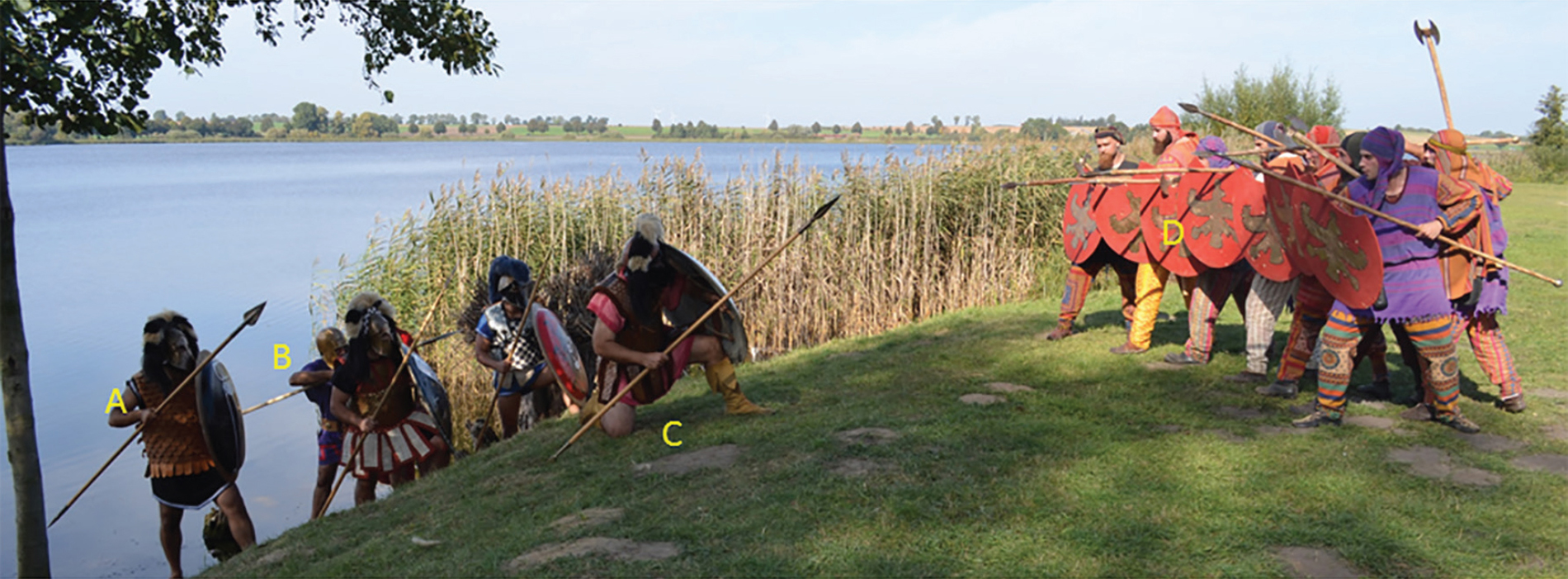
Photo 3.6. Hoplites against takabara. (Photo from the “Marathon 2011” International Reenacting Event. Copyrights: Association of Historical Studies “KORYVANTES” - koryvantes.org)
The low and underarm grips, preferably with the shaft at a high angle, so as not to cause injuries to the troops that followed (Photo 3.6A), could be used at a run, as they permitted free movement of the torso and lower body, accurate aiming and transfer of the kinetic energy of the body to the spear-point for a lethal penetrating effect through armour. Both low and underarm grips were adequate to spar with an enemy (Photo 3.12) and repel cavalry; the latter suggested a semi-kneeling position (Photos 3.6C and 3.7). But with closely packed phalanx, in synaspismos mode with interlocked shields, the overhead grip (Photo 3.8) was the best choice, similarly to sparabara practice.
The interlocked shields could not open for a thrust: re-enactment has shown that the right part of an Argive shield must be placed behind the left part of the shield of the trooper to the right to produce a line withstanding the shock delivered by enemy troops crashing on the shield wall, and not the opposite as is usually assumed (Figure 3.1 upper and lower rows, respectively).
In such cases, low or overhead grips are possible, but not underarm. Contrary to some views (Matthew 2013a; Matthew 2012) the overhead grip was immensely practical and is well attested in art, although some confusion with javelin casting did occur (Matthew 2012). The overhead grip produced shorter reach indeed, but when used from a standstill, as in a phalanx confrontation, it was putting a much higher proportion of the body weight onto the thrust, thus achieving better penetration. Additionally, the downward thrust was taking the blow behind the shield of the enemy (Photo 3.12A) and between the latter’s shield and helmet, to either unarmoured or less armoured areas. Such were the vicinity of the lower part of the face and the lower neck, at the upper side of the ribcage, especially when linothorax jerkins were used instead of full metal cuirass (Photo 3.12A). The spearhead of the dory at the time of the Persian Wars must have been narrower than it had originally been, that is during the sixth century, in order to achieve better penetration, whereas the very wide base of earlier models (i.e. Photo 3.4) was intended to maximize wound width and bleeding and restrict the depth of the penetration so as to facilitate extraction of the weapon.
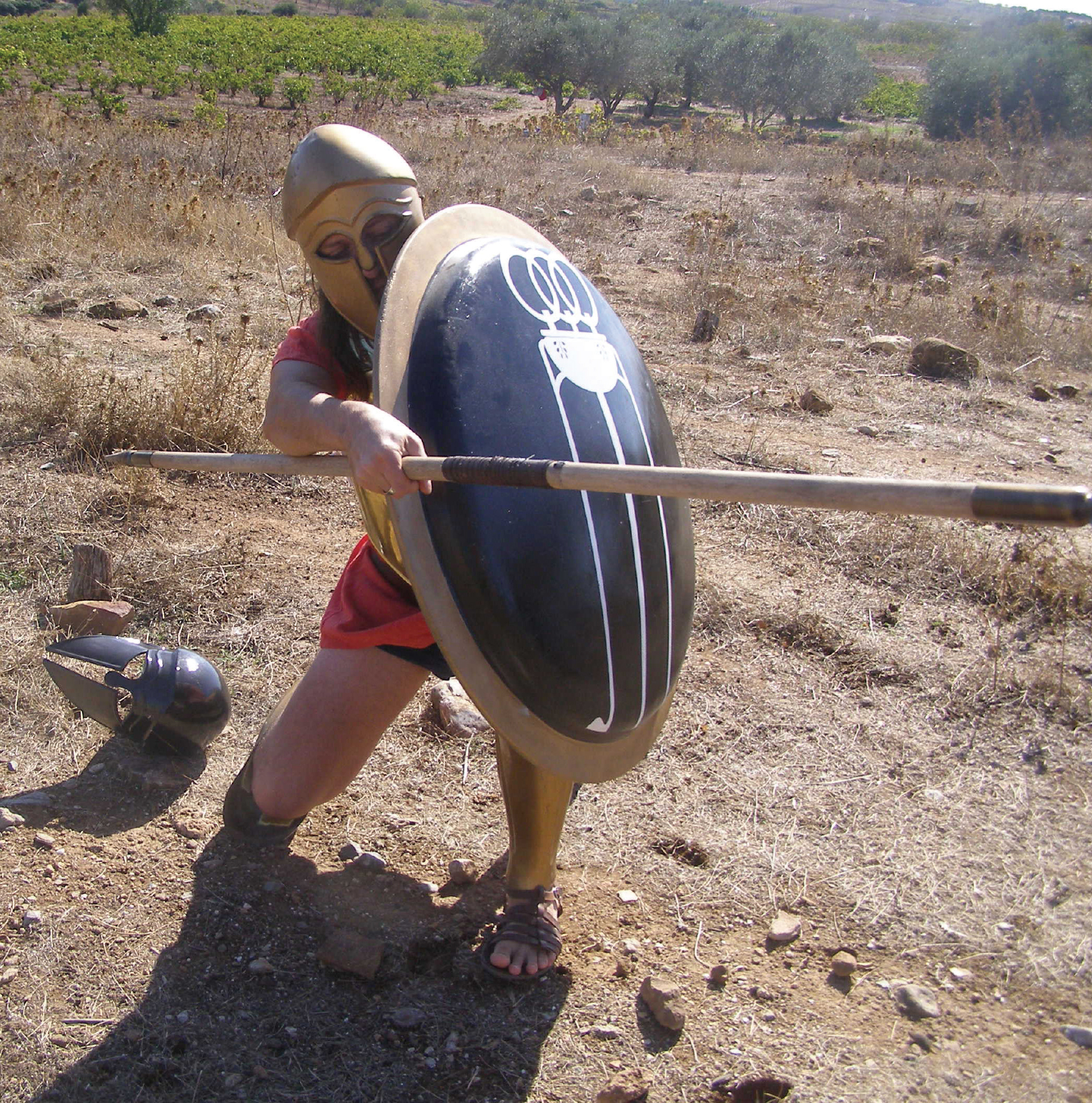
Photo 3.7. Hoplite in semi-kneeling position extending to thrust from an underarm grip against higher positioned enemy, as was cavalry. (Copyrights: Association of Historical Studies “KORYVANTES” - koryvantes.org)
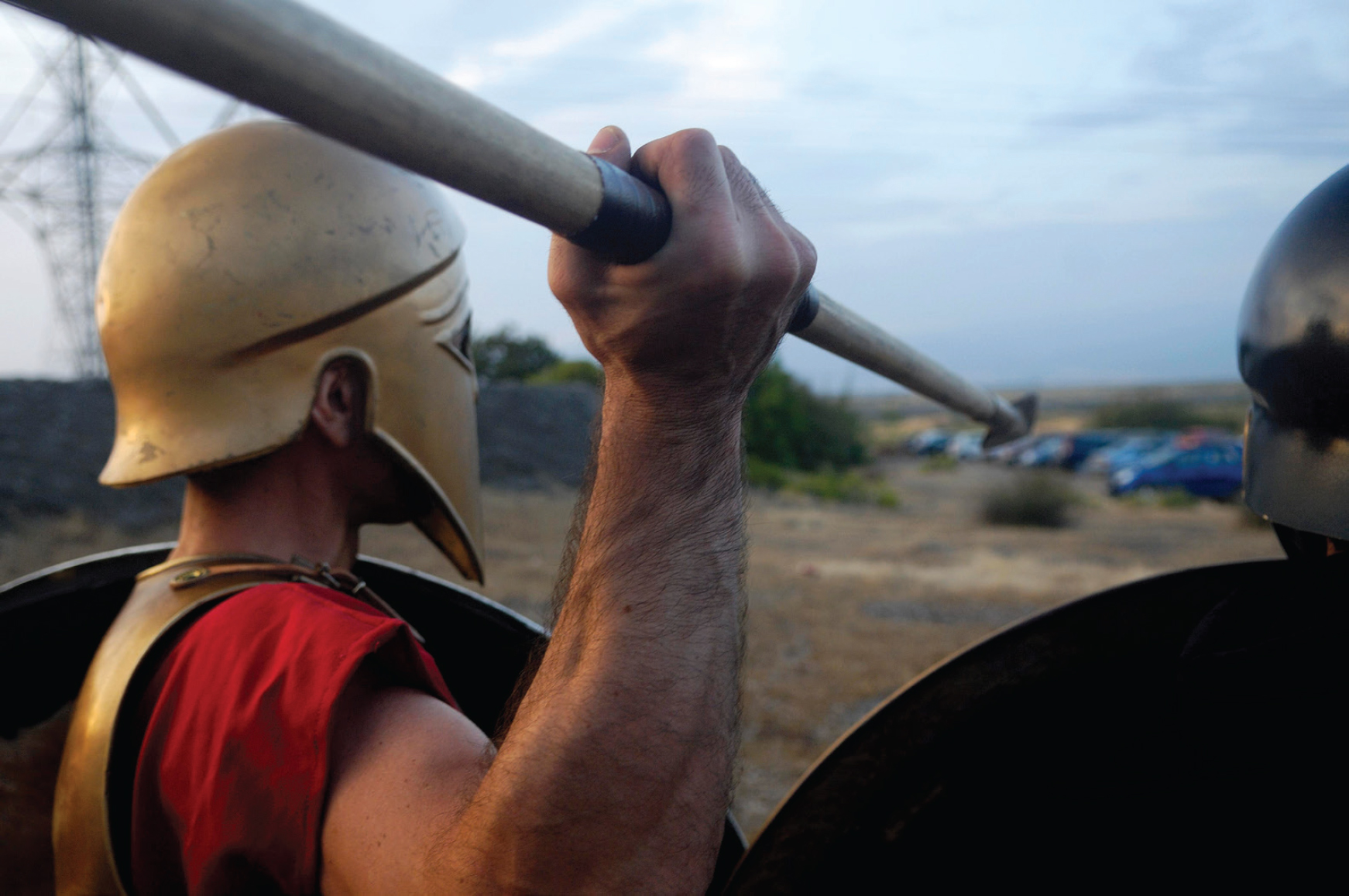
Photo 3.8. The overhead grip is the only one allowing powerful thrusts in close-packed phalanx formats, especially synaspismos. (Copyrights: Association of Historical Studies “KORYVANTES” - koryvantes.org)
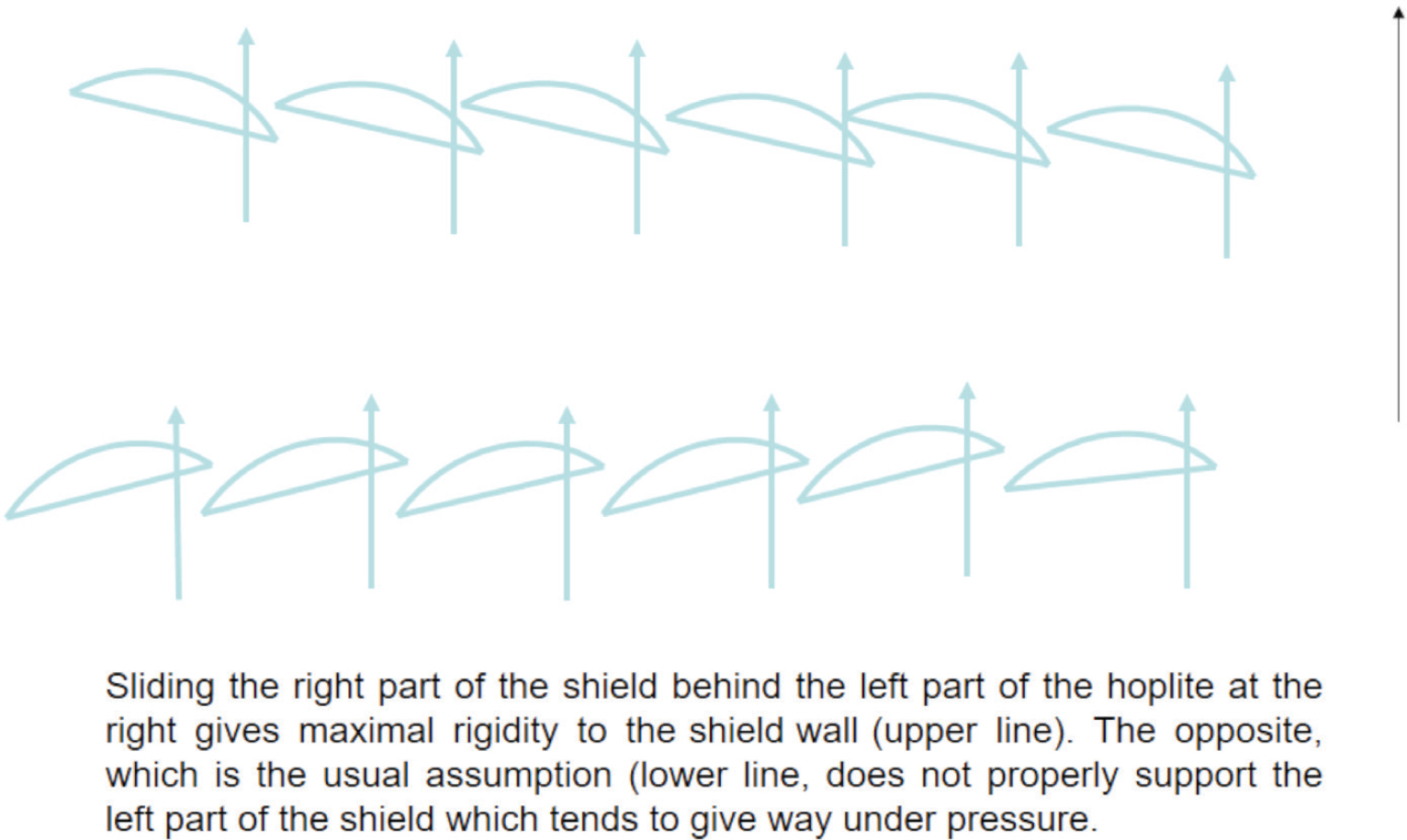
Fig. 3.1.
The hoplon shield – another term for the Argive shield and the origin of the name of the Hoplites – had been improved in terms of ergonomics and manufacture; its bowl was deeper and bronze-faced and so more resistant to tear from slashing weapons. Additionally, it was handier against contacting enemies, allowing the wielder actually to wear it and put his weight in it, to shove off opponents and also support friendlies within the phalanx when at a shove. Its carriage, especially the peculiar central armband, the porpax, improved it in terms of technology and handiness as well, as did the complete suspension subsystem, with the long-haul cords and bands (Photo 3.5D) which made the shield an expeditionary sack for utensils and supplies when on campaign, wearable as a backpack.
A leaf-bladed straight, cut-and-thrust sword replaced the longer, straight or triangular one of the geometric era as slash-and-thrust sidearm (Photo 3.9B, C respectively). A concave curved sabre, the Kopis (‘cleaver’) possibly came into fashion at roughly the same time (Snodgrass 1967; Anderson 1991). The kopis could be mass produced and was intended for slashing blows with less dexterity and skill, especially in a vertical or diagonal direction against enemies bereft of heavy headgear. In its most advanced, forward-curved version (Photo 3.9A) it allowed a thrusting blow by skirting the upper face and rim of the Hoplite shield, thus targeting the face of the enemy with minimal warning. It also could be driven behind the shield by a diagonal thrust up and forward, piercing either the neck or the upper torso (Kambouris 2000).
The Hoplite phalanx which emerged triumphant in Thermopylae and Plataea was more than an assembly of Hoplites. Collectivity and co-ordination are quintessential for a phalanx, outputting much more than the sum of the parts – a real synergy. Such collective action demanded a very high degree of familiarization among troops, as seen in contemporary re-enactment experiments, drills and exercises. Thus, the phalanx was not a well-dressed assembly of troops, but a precisely (sensu lato) positioned entity, the precision all the more important in case of shoving or manoeuvring. The Hoplite had to know, feel and create empathy with the troops surrounding him, and thus the positions were set within a phalanx and altered only during drill and transformations. A century later Xenophon declares that Spartan peers were the only Hoplites trained to fight in phalanx next to any of their peers (Xen Lac Pol 11.7) and that they could manoeuvre in combat, changing front, depth and density in a way simply impossible for other Hoplite forces.
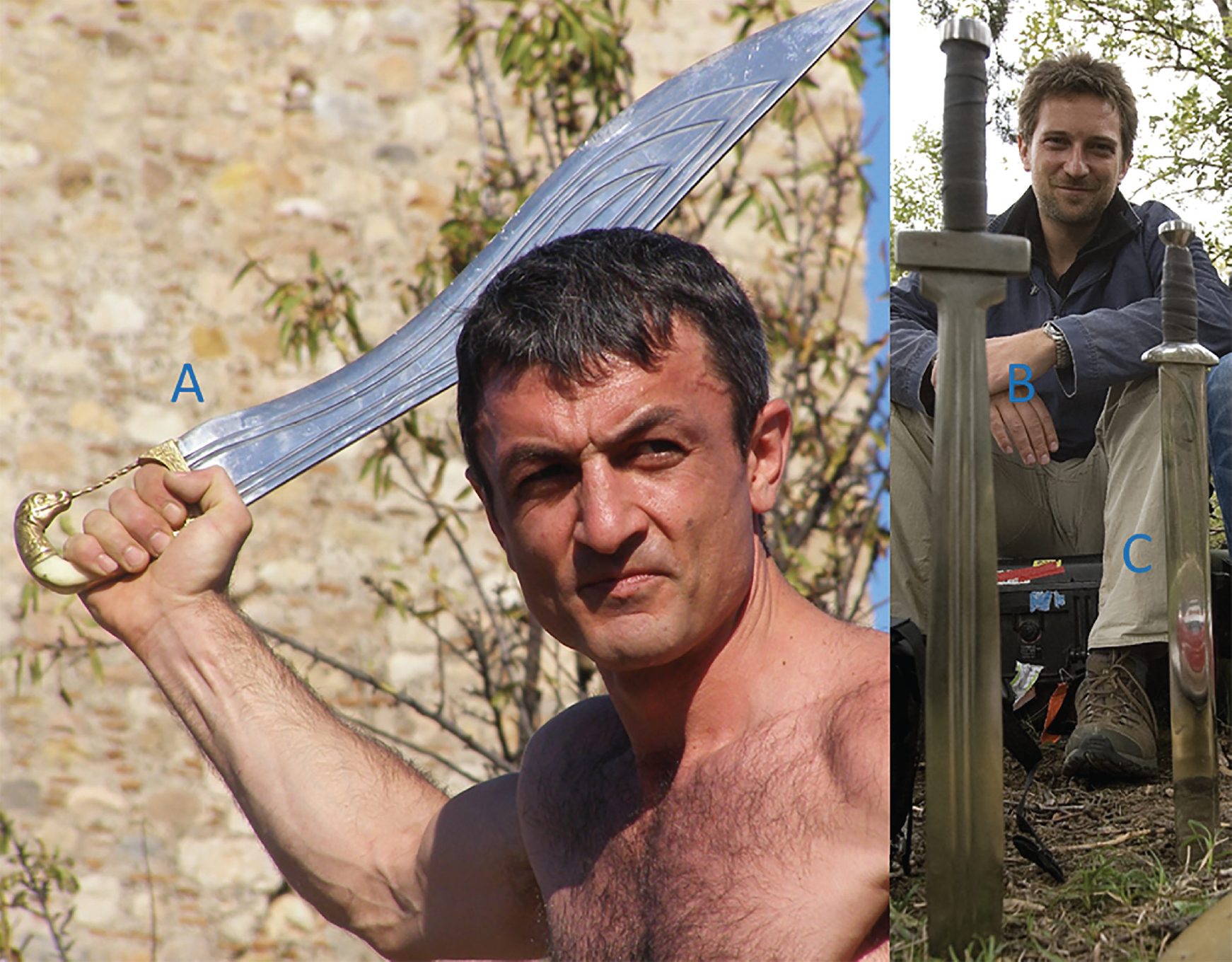
Photo 3.9. Different eras and models of Hoplite swords (B, C) and sabre (A). (Left: Copyrights: Association of Historical Studies “KORYVANTES” - koryvantes.org; Right: Courtesy of Association of Historical Studies “KORYVANTES”. Photo: A.Haimantas)
The above mentioned drill changes the relative positions of individual Hoplites within a phalanx and is practical only with warriors able to fight effectively in the vicinity of any of their peers, or at the very least of a rather large selection of their peers. The argument that follows predicts that a phalanx of a certain city or community may become with training and drill a rock-solid formation, or even a nimble and somewhat flexible, still solid, formation. But a phalanx of different states fighting next to each other is another thing altogether. This might have been a valid reason for numerous Hoplite defeats: especially in the years of the Ionic Revolt, posting Hoplites of different contingents, which had never trained together and perhaps each group were using different tactics (depth and density, mode of advance) might have invited defeat.
Accordingly, it should be noted that three out of four successful major engagements of Hoplites during the Persian Wars were accomplished by homogenous, single-state phalanxes. In Marathon, it was the Athenian phalanx, with just 10 per cent Plataeans at the far left (Her VI.111; Just II.9; Nepos Milt V). In Thermopylae, Leonidas was rotating city contingents in a very narrow front (Her VII.212), allowing them to fight each by themselves. And the massive battle of Plataea was decided by two separate actions: the Athenian phalanx tackling the Medizing Greeks and the Spartan taking on the Orientals; the small Tegean contingent was accustomed to fighting by the Spartans, while at the same time it was tiny and set, it too, at the extreme left of the Spartan line (Her IX.28).
Then why field Hoplite armies of multiple contingents? For numbers. A Greek phalanx may carry all before it and win the day promptly by shock: either by massive spearing or by the collision of its first line with the opponent’s. If neither happens or neither proves decisive, the orthodox approach is the concerted shoving action of the whole phalanx, which concentrates the weight of the whole of the file onto the shield of the file leader. It is the shove (othismos), which performs miracles, but needs some time to take effect and also needs the greatest possible density and depth. To achieve this, a finite number of troops will present a rather short phalanx. In such a case the opposing formation may envelop the wings and launch flank or even rear attacks, destroying the phalanx before the greater depth can be brought to tell. This fact puts great importance on the size of a phalanx, especially in symmetrical clashes; the sales-pitch for the phalanx, that it was a formation where few could overcome many, applied mainly to asymmetrical engagements, against non-Hoplite assemblies and troops. Then it was another story: a phalanx was needed to counter a phalanx.
Mobility supreme
The new, better, closely fitting and more protective greaves (Photo 3.10A) increased the mobility in rough terrain and the protection from missiles when the formation advanced, compared to the shorter previous models (Photo 3.10B). The new, semi-open helmets like the Chalcidian model (Photos 3.10C and 3.5A) increased awareness, which seems a no-need in the confines of a phalanx, but becomes a must whenever concerted, co-ordinated action is at a premium. Combined with the linothorax, which was occasionally stiffened with metal additions such as scales (Photo 3.11), the sum allowed more flexibility, manoeuvrability and mobility in general, which translate into capability for mobile tactics, at least for a portion of the troops.
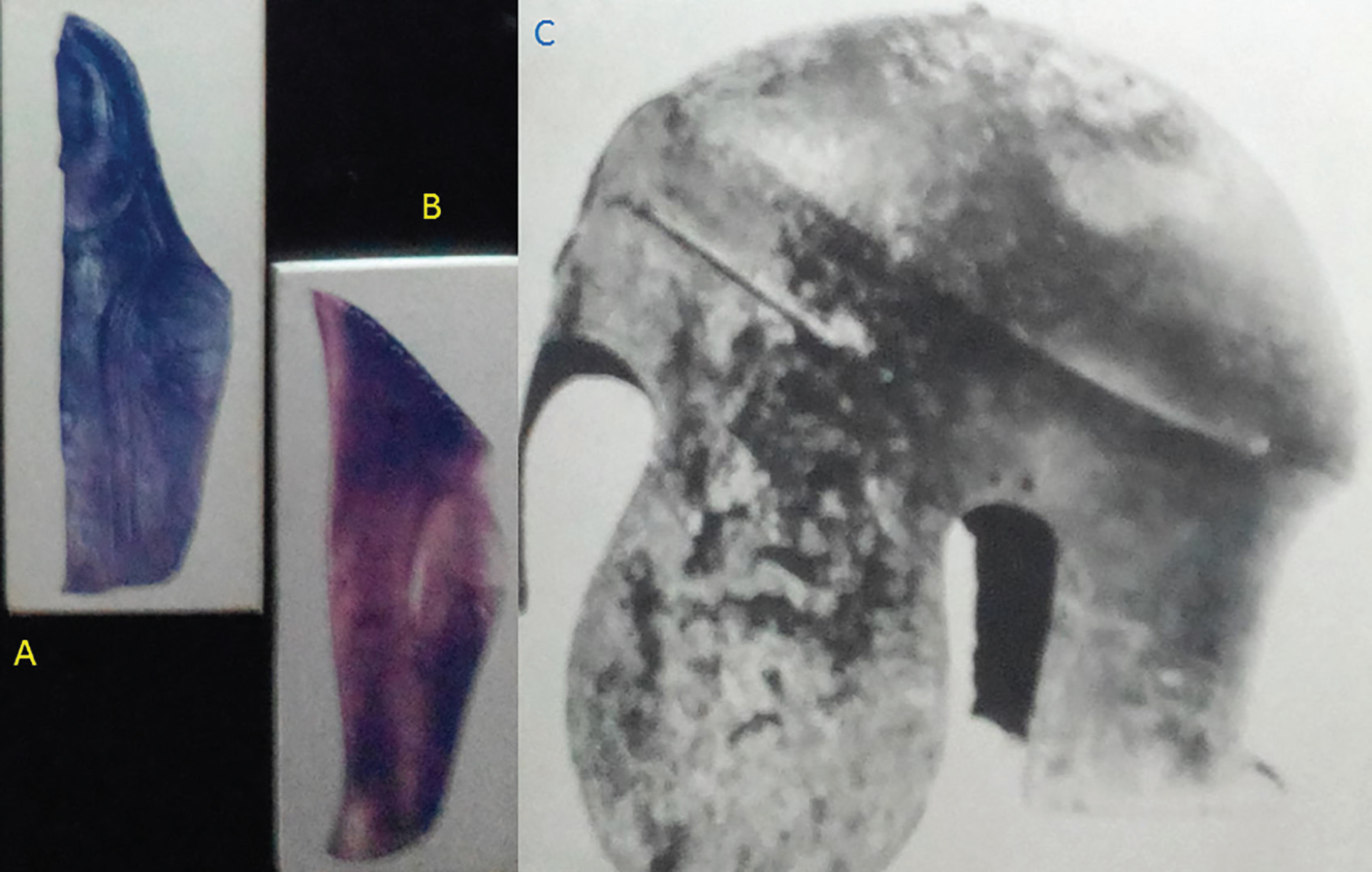
Photo 3.10. Greaves (A,B) and helmet (C) from the Athens War Museum. (Photo courtesy: Maj General HA-Ret Papathanasiou B.)
Thus, the standardization recedes. Young troops are trained for extreme mobility, to rush to the charge so as to shirk aimed volleys of arrows by marring the distance estimation in both direct and indirect shooting and to deny the enemy time for more volleys. They are the Ekdromoi, which will become renowned in the 4th century by Xenophon, but must have started their drill as early as the late 6th century. The Ekdromoi are the younger Hoplites, usually 20–30 years of age, (Xen Hell V.4,40 & IV.5,15; Sekunda 1986), able to charge at a run, as the one attested in Marathon and practised in the guise of Hoplitodromos since 520 BC at the Olympic Games and other Panhellenic festivities and sports events (Sekunda 2000 & 2002; Sage 1996; Sweet 1987). They may have adopted lighter body armour, such as linothorax (Photo 3.12A), jerkins (Photo 3.5E) or no body armour at all (Photo 3.5G) to gain additional mobility. As the evolved, lightened kit, exemplified by linothorax, is represented since the mid-6th century on pottery, one may doubt the causality of the changes; the new fashion was much cheaper, easy to store and much more comfortable. Still, the Persian danger at least accelerated ongoing developments towards more mobile tactics.
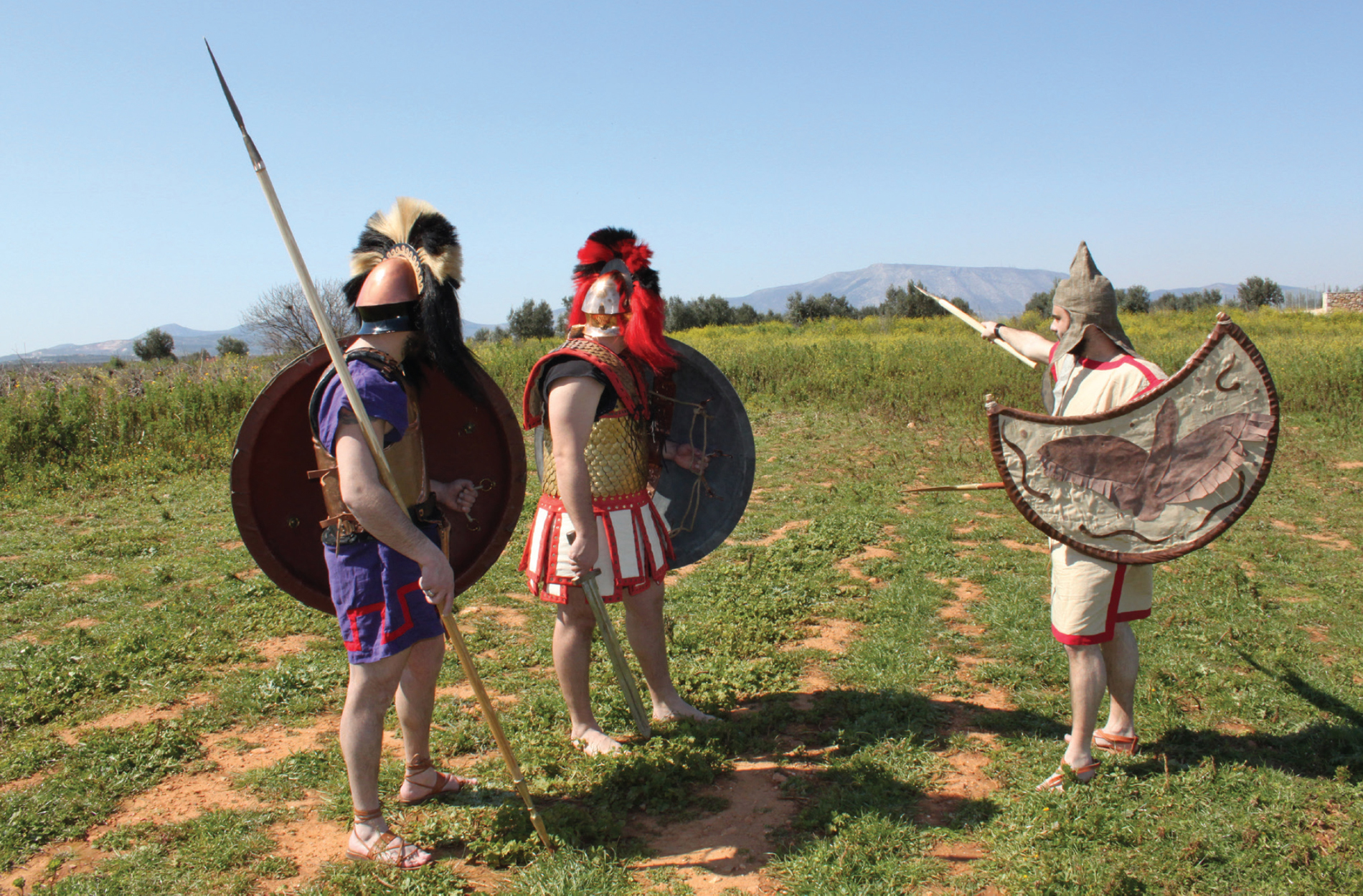
Photo 3.11. Two Hoplites (A, B) with transverse-crested helmets indicating Lacedaimonian high-rank officers; metal cuirass (A), linothorax with copper scales (B) and a Thracian peltast javelineer (C). (Copyrights: Association of Historical Studies “KORYVANTES” - koryvantes.org)
The Specialists return
The phalanx is an offensive and a defensive formation, the competent use of which requires excellent commanders and decently trained men. Still, a conquering phalanx does little more than disrupt the enemy formation. To increase the loss exchange, the winner will ultimately engage in close-quarters combat with the vanquished (Plato Laches 5), but from an advantageous position. This close-quarters battle, reminiscent of the highly dexterous heroes of the past, is a personal matter – at least in Athens. The Hoplomachoi (literary ‘Weapons-fighter’) are the Close-Quarter-Battle instructors (Sekunda 2000 & 1998; Anderson 1991; Krentz 1985) who teach, for a handsome fee, the proper use of shield, sword and spear, their combinations, proper moves with and without them, evasions, parries and so many more intricacies (Photo 3.12).
The catch is that men trained adequately in such combat may prove unwilling to remain within the phalanx where success and failure – which means death – are out of their control as they depend on sheer luck and on concerted action. It is a return of the Hero and thus Plato vehemently opposes and discourages such practices with the doubtful argument that the Spartans do not allow such ilk to teach to Lacedaimon; nor even to enter the borders (Plato Laches 6). This is a rather misguided conclusion: during the Persian Wars the late phases of all land actions and of some sea actions degenerated into confined CQB fighting and not sustained solid-phalanx engagements. In these conditions the Greek Hoplites had better weapons, training and skills and engaged with an advantage; after all, the Athenians introduced the skill topic into the syllabus of the reshuffled Ephebeia in 337 BC (Recaldin 2011). The Spartans had introduced, at the end of the 5th century, the Laconian blade, an extra-short sword (practically a dirk) requiring close proximity and utmost dexterity in its use (Plut Apoph VI & LXIX). This begs the assumption that they drove CQB gurus away because they did not need them as they were already masters of such skills themselves (Krentz 198); and because they were fearful of their expert prying eyes.
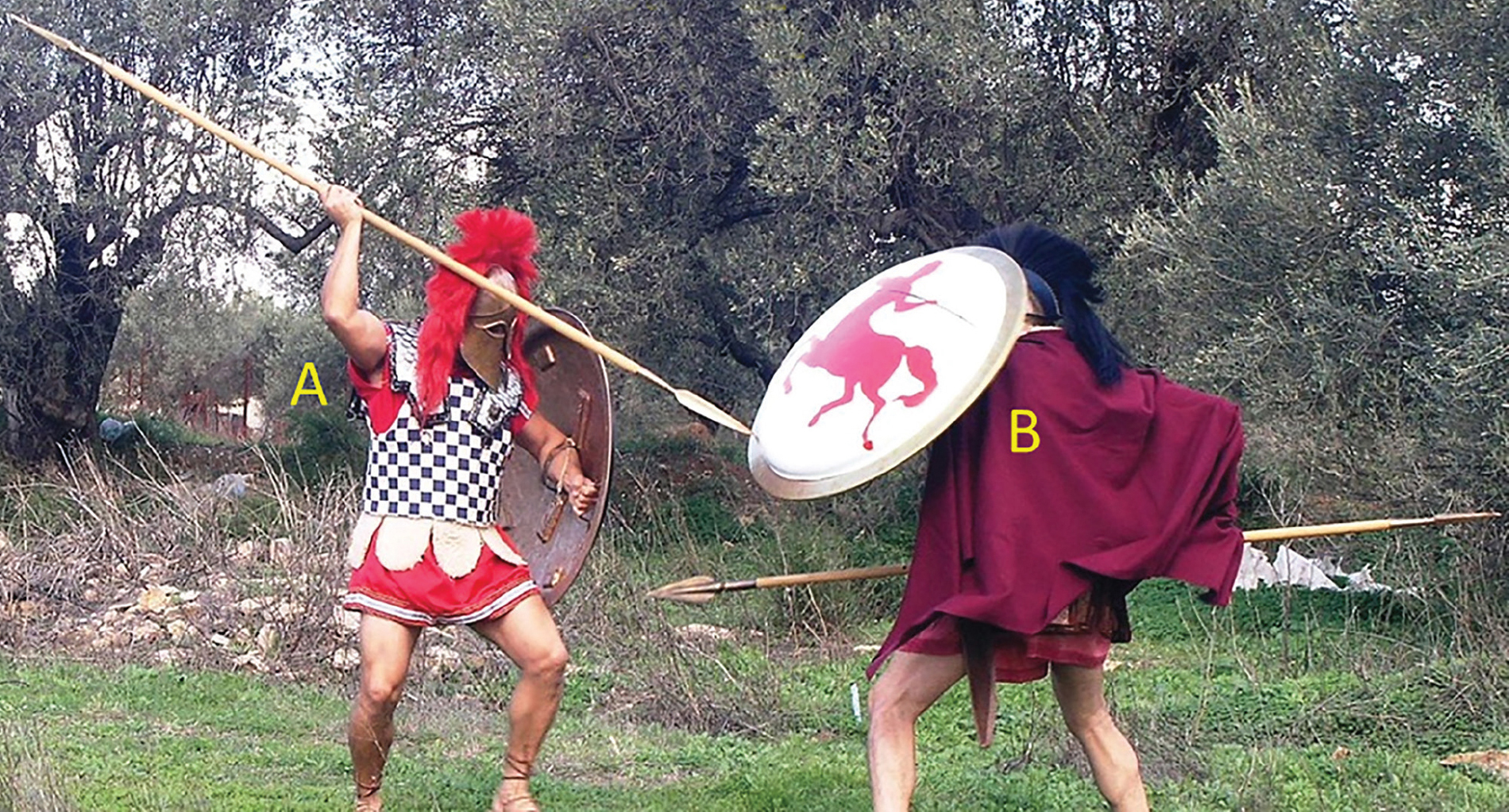
Photo 3.12. Hoplites sparring. (Copyrights: Association of Historical Studies “KORYVANTES” - koryvantes.org)
Professional, mercenary Hoplites were the last phase of the Hoplite Epos, closing full circle. Starting with the voluntary military service of the 4th century for imperial campaigns by both Athens and Sparta, the expertise in the new set of skills became once more the property of the few; civic bodies of full-time soldiers, the Elites or Picked ones (Epilektoi) appear once more after 418 BC at the very latest (Thuc V.72,3). Actually, even at the heyday of the Citizen-Hoplite, in the Persian Wars, mercenaries were available in mainland Greece, and some went to seek employment by Xerxes (Her VIII.26). It is the dislike of the era for such practices and the lack of cash that prohibited wider use of such services from the Greek side; still, one can doubt whether the political correctness of some narrators would have allowed the transmission of such stories of mercenary virtue. After all, Herodotus clearly states that the Cretans sent no help to the imperiled mainlanders (Her VII.171), but this obviously refers to allied troops dispatched under state sponsorship. It by no means extends to mercenary or even volunteer contingents which could well fit with the testimony of Ktesias (FgrHist688F13.146–8) for Cretan archers fighting for the Greek Alliance in Salamis.
The Hoplite could take on any troop type in a field action. He was at his best if supported by cavalry and missile troops, but was often used exclusively. This ability, to face any opponent, defeated the purpose of using them with other troop types. He was the quintessence of standardization and equality; and the ability to afford the attire provided civic rights and defined the constitutional status of the states raising and fielding him and with different results in different cases (Hanson 1983 & 1999).
All told, the Hoplite was a thing of the past, established and well-known. The Persian Sparabara was a novelty, bringing a new operational context, the really massive archery (Snodgrass 1967). But after the first encounters in the mid-6th century, the Hoplites evolved rapidly to cope with the Persian threat. As stated above, the main changes were:
(1)The development of new skills and tactics, such as the running charge, which was made possible by the introduction of hoplitodromos, a feature of athletic festivities since the late 6th century and
(2)The modification of the Hoplite kit, especially shield, helmet, sword and cuirass, for more mobile tactics.
Beyond the phalanx
All the above does not mean that the Hoplite was preferably deployed alone, especially in major actions. True, mercenary Hoplites (the original form) were contracted alone, without support elements and arms; this remained so for 200 years or more. Additionally, seldom, if ever, other troop types of mainland Greece are known to have served as mercenaries abroad. But this had been so because their employers usually operated adequate light infantry, missile troops and cavalry of their own, or were hiring them from other sources. The mercenary market for the Hoplites was always the same: a need for heavy, shock infantry to support or spearhead other, more mobile but less protected and steadfast troop types. This does not mean that there were no other troop types at home; it does mean though that the Hoplite reigned supreme.
Before the Persian Wars the Greek cavalry made it into legend and excellent scholarship tackled the issue adequately (Gaebel 2004; Spence 1993; Bugh 1988). There are areas in Asia Minor, in Italy and in Sicily where Greek colonies had been credited with excellence in mounted warfare. Both Magna Grecia and Sicily had adopted the Hoplite as the main warrior type and still operated effective and massive cavalry arms; the example being Syracuse, with its cavalry winning the day at the battle of Himera, 480 BC (Diod XI.25,1 & XI.21,2 & XI.22,1). There is no conceivable reason to deny the same for mainland Greece whenever and wherever the conditions had been favourable. Actually, the Thessalians and the Boeotians (both Aeolians by race) had decent cavalry arms and a campaign was launched by the Allies to fend off Thessaly from the Persian invasion and thus recruit a considerable cavalry arm (Her VII.173). Despite such intentions, the Persian diplomacy prevented the alignment of both areas with the Greek Alliance, thus writing off any prospect for a worthwhile cavalry arm. The remainder of the Alliance fielded only token cavalry formations, as were the 100 Athenian cavalry, led by Cimon, son of Miltiades, who boarded the triremes first, after offering to Athena the reins of his horse and taking an Argive shield to fight as a marine (Plut Vit Cim V.2). As a result, the only viable option for the defence of Greece on land was dismounted, infantry warfare; in that function, there were available superb Hoplites and a collection of mediocre light troops (mostly javelineers), who were definitely inferior in numbers, if not also in quality when compared with the vast arrays of javelineers available to – and employed by – the Empire
The notion of a one-dimensional way of warfare for the Greeks is due to some extent to Herodotus. While he never states so, he has Mardonius delivering a notorious speech criticizing both the Greek propensity for bloody outbursts of strife and border conflict and the semi-formalized form of warfare that decides issues quickly but with considerable bloodshed (Her VII.9). Starting from this, the Athenian-centric scholarship maintains that this semi-formalized, practically ritualistic kind of Hoplite warfare was the norm. This bloody ritual involved Hoplite phalanxes operating under strict knightly rules – a prequel of medieval warfare amongst knights, minus the concept of the Lance and the presence of the Sergeant. The essence of Greek warfare remained unaltered until a revolution in military affairs during the Great Peloponnesian War. This line of thought (Sekunda 1986) places the introduction of hit-and-run peltast warfare to the Greeks as late as the mid-5th century, during the Athenian expansion in the Macedonian-Thracian region, exemplified by the defeat at Drabescus (Thuc I.100,3) and a second contact during the Archidamian War, in 430 BC at Spartolus (Thuc II.79,4–5). Such concepts were integrated into the Athenian war machine by 425 BC in Sphacteria (Thuc IV.32,2–3) and evolved to their highest with Iphicrates (Xen Hell IV.5,13 & IV.8,34 & 37) in 390 BC.
This had never been so. The ritual mentioned was similar to modern international laws of war, not to the rules of a game of football. They were meant to contain atrocities, although with limited success – not unlike modern efforts along the same lines. The ritualistic clash never happened, but by convention – not unlike the mutual abstaining from the use of chemical weapons during the Second World War. Herodotus’ account is full of stratagems and ruses, where the Spartans excel (Her VI.77–8), but others also make do. The example of Phoceans against the Thessalians (Her VIII.27–8) is quite enlightening. Additionally, Thucydides refers to Chalcidian peltasts off Spartolus, in 430 BC and the local peltasts in Amphipolis, in 422 BC (Thuc II.79,4–5 and V.10,9 respectively) who dealt heavy blows to the Athenians. But the Theban peltasts did so in Delium in 424 BC (IV.93,3) and Thebes at the time had nothing to do with Macedon or Thrace. Athenian light infantry in Sphacteria, one year before, was not Thracian-type peltasts (Photo 3.11C), nor were the Aetolians who smashed an Athenian expedition in 427 BC.
Furthermore, there is nothing in Herodotus’ account to dismiss the existence of Greek light infantry, nor to indicate doctrinal or ideological disinclination to employ it, or lack of operational know-how. On the contrary, the reference that Spartan Helots were the only light troops adequately armed for proper operational use (Her IX.29,1) indicates intentional, planned and not ad hoc deployment of a massive light infantry arm, understanding of the peculiarities of such troops and adequacy of armament. The latter implies proper kopis sabres of fine Spartan steel as sidearms instead of agricultural tools (i.e. axes, cleavers) and fighting javelins instead of hunting ones. Furthermore, even the sub-standard armament of the light troops of other city-states, which are explicitly earmarked for combat despite their deficiencies, shows clearly a universal understanding of light infantry operations and their integration in an expeditionary doctrine by all the Greek states. Be their role actual fighting, skirmishing or simply plundering, reducing and devastating the enemy territory, the Call to Arms was, for every Greek male, a functional combat, not a mere support slot (provisioning, engineering, repairs, MedEvac).
Modern warfare instead of rituals
The campaign of 479 BC to expel the Persians from the mainland, with its moves, countermoves and manoeuvres, with the arguments and intentions, shows a mature concept of warfare where battles are instrumental but not necessary events. Similarly, despite some obvious failures as in Thermopylae, the campaigns of 480 BC are exemplary regarding the conduct of flexible positional/territorial warfare, which was the only possible solution due to the vast imbalance of power and strategic mobility. These remarks can be integrated into the fragmental accounts of Herodotus on the third Messenian war that erupted in 464 BC (Her IX.64). So, a picture emerges, that of continuous employment of the principles of modern territorial warfare all the way to the start of the Great Peloponnesian war; a picture alien to ritualistic clashes of phalanxes. After all, it is probable that Herodotus projects his own thoughts about the prevalence of Hoplite warfare instead of territorial warfare as the most suitable way for the armed settling of differences between Greeks, by narrating alleged Mardonius’ arguments to Xerxes (Her VII.9). This shows a clear grasp of the principles, requirements, advantages and disadvantages of territorial warfare by both the historian and his audience and may constitute an insinuation for the operations developing at his time. It is either irony or poetic justice that the campaign of Xerxes, and that of Mardonius, suffered greatly due to the imaginative application of territorial warfare practices.
The latter are not a myth, nor a retro-projection (Lazenby 1993). They did occur, possibly – but not certainly – in a way similar to what we reconstruct in retrospect, but this conformity might not have been the norm. As we observe today, operations within the same theatre of war may not develop identically and may take different forms, not just the most modern or the most current or common; we should extend the concept to times past. The occasional clash would have developed as a function of the level of technology, society and intellect, but also of the personal, political or ideological affections and preferences of the main players involved (leaders or civic bodies).
Heavy infantry was decisive. Its clash determined the victor in a set-piece battle and all other events and results were confirmed or nullified by the result of the phalanx clash. The verdict of a Hoplite clash was final, but this was also an ideal outcome. There have been battles where the verdict of the heavy infantry was overruled by other arms, although mostly at a later date. And of course, not all battles were set-piece. Carian Hoplites exterminated a Persian contingent during the Ionic Revolt by a brilliant night ambush (Her V.121) and so did the Phocians against a Thessalian onslaught some generations back (Her VIII.28).
In short, heavy infantry and cavalry (if available) cost much and caught the public eye in parades, public speech and argumentation much more than more humble arms. Catching the lights of publicity and being a symbol of power and martial virtue has always been a factor in developing an arm/branch, according to vogue and technology. Tanks and jets are the most trendy weapon systems today, but that does not mean that other ones are berated or of limited importance. This was the case during the Persian Wars as well.
Box 3.1
Xenophon offers a possible and plausible explanation for the takabara, that has not been adequately explored previously. The fictious character of Cyropaedeia makes his assertions debatable, especially as they sound very much like projections of Sparta. Still, he provides some interesting details: at his time the Persian nation was made up of 120,000 Persians (Xen Cyrop I.2,15), although whether this incudes only full citizens (mariaka being excluded) and what age-classes is not clear. These are divided into twelve tribes (Cyrop I.2,5), although Herodotus (I.125) enumerates only nine. Each tribe was further divided horizontally in four age-classes: boys, youths, adults, elders. (Cyrop I.2,4).
There is also a division in social classes, although Xenophon does not elaborate on the latter and implies just two classes, enfranchised and disenfranchised Persian nationals (Cyrop I.2,15). The criterion was family income adequate for a boy to follow the public schooling. Graduation was prerequisite for enlisting the youths so as to be eligible for full citizenship (ibid). Becoming a youth at age 16–17 (Cyrop I.2,8) meant a ten-year military service as standing army, and expeditionary forces and garrisons were routinely manned by such youths (Cyrop I.2,9) who were archers/spearmen (i.e. sparabari), but also learned the Persian palton double-use javelin (Cyrop I.2,9), so as to serve as cavalry, obviously if they could afford a mount or get subsidized. Their deployment is at a 50 per cent of their total force in a rotational basis (Cyrop I.2,9). Once the ten-year tour of duty was over they were full Persian adults/citizens, liable for mobilization for 25 years (Cyrop I.2,13), following which they entered the Elders (Cyrop I.2,13).
The Adults, when mobilized, for home or expeditionary duty, were not archers (Cyrop I.2,13). Xenophon mentions they were close-combat fighters, using sabre, shield and being endowed with cuirass (ibid). It is explicitly stated that their shield is as depicted in contemporary art (ibid), which rather settles the issue for the identity of the takabara as depicted in Greek art. Additionally, the mention of cuirasses (ibid) allows a plausible identification of the takabara with the Persian cuirassiers (Her VIII.113,2). Xenophon does not mention spears, but does not exclude them, as he does with bows and javelins (Cyrop I.2,13). Thus, spears may be within the arsenal of the takabara, as they are a prestigious weapon among the Achaemenids, since it is used by the Guards of the King and his representatives, the satraps. Under this light, the possibility that the spear is artistic license by the Greek pottery-makers is unwarranted.
Still, other troop types WERE berated at the time. This had much to do with politics, especially in oligarchies. The aristocracy, and later the middle class as well, probably did frown upon the lower classes in social and martial terms. The same held true with the medieval knights and their contempt for the infantry; still, the medieval battle cell, the Lance, included infantrymen and entrusted them with vital duties and responsibilities. The conclusion is that both the alleged unavailability of and contempt for non-Hoplite infantry by the Greek communities of the time may have been current or historical projection and misunderstanding; or a social reality, perhaps due to prejudice among classes and parties. It may have been a retrospective interpretation of events and attitudes due to the realities and realizations catalyzed by the Great Peloponnesian War which were developing while Herodotus and others were creating their works. But it also may have not been so after all, or, at least, not so much so.