
Chapter 8
The operations during the multi-year confrontation that was the Ionian Revolt – longer by far than the actual Greco-Persian wars, which were decided within two campaigning seasons at the very most – are by definition difficult to recreate. The rebellion occurred at the end of the standard campaigning season, after the fiasco at Naxos, which weakened and demoralized the Persians and had the Ionian fleet concentrated and still mobilized and fully manned. When the event came into being, the fleet was back, the imperial infantry that made up the invasion land army (Her V.32) was perhaps on its way home – or deactivated – while the naval arm was still concentrated and not demobilized (Grundy 1901). With the winter at their heels, the Imperials could do little. The rebels were able to get organized and ask for assistance. Only Athens and Eretria obliged (Her V.99,1), both instigated by sentiments of friendship, kinship (Her V.97,2), mutuality (Her V.99,1), greed (Her V.49,4 & 97,1) but conceivably by alarm as well (de Souza 2003). Aristagoras would have told them of the imperial projections against Euboea first – where Eretria was situated – and the mainland afterwards, with Athens being literally next door. The initial phase of the imperial invasion plan was the recent attack of the empire against Naxos; a failed attack it was, but a most direct display of intentions. It was a plan suggested by Aristagorus (Her V.31) and he was in charge (Her V.33,4 & 31,2), but these details must have been omitted during his eloquent requests for assistance.
The Athenians dispatched twenty vessels (Her V.99,1); they might have sent pentekonters, not triremes, to assist Aristagoras’ insurrection (Haas 1985). There are many reasons for that, which may have applied exclusively or inclusively. It may have been a matter of arms acquisition; Athens might have no triremes at the time, or not enough of them, to dispatch and to risk. It might have been a matter of policy: pentekonters might have been supplied by private interests and most of the rowers/troops may have been their associates or volunteers. It might have been an issue of strategic consideration: twenty pentekonters were manned by 1,000 rowers which were doubling as soldiers, while the trireme needed four times that number, an astounding 4,000 men, thus increasing the expenses but also the exposure of Athenian human resources. Or, last but not least, it may have been a matter of objectives and ulterior motives. Pentekonters were much better for transporting considerable loads, a fitting choice for an expedition possibly instigated by greed and intended primarily to loot and plunder, as is obvious by Aristagoras’ arguments to the Spartans (Her V.49,4). It is almost certain that the essence, which persuaded the Athenians, had been the same, plus some emotional arguments that the Milesians, and the Ionians in general, were colonials under Athens and thus they were entitled to ask for assistance.
The Athenians were bound to oblige. If the Athenian government at the time was against Cleisthenes and his Medizm, which must have been the case due to the dispatch of reinforcements, it is most likely that it would also have been very sensitive to the Ionian ancestry and clinched the argument. This Ionian ancestry had been feverishly attacked by Cleisthenes, by disowning the four Ionian tribes and replacing them with ten Attic ones based on residence, not bloodline (Her V.69,1). The immigrant status of his family, with its preposterously close tyrannical associations; the similarly originated wealth, which was donated by Croesus (Her VI.125), a king; and the close blood relations with Cleisthenes of Sicyon, a bookcase tyrant (Her V.69,1) meant that their democratic credentials and their patriotic ones were at the very least debatable (Grundy 1901). By attacking the roots of the natives and proposing another, alternate, Pelasgian lineage as Herodotus feels duty-bound to mention (Her I.56,2) although he disproves of it himself (Her VI.137,-2), the immigrant family became integrated into the body of the population. So it did with other immigrants and their origin was washed into residence rather than bloodline, thus allowing them to occupy privileged positions in public life thanks to their wealth.
The first rebel operation, with the opening of the sailing season of 499 BC (the most probable year) was the mass escape of the Paeonians (Her V.98); the conception of a real mastermind. The megalomaniac Achaemenid emperor, treated with extreme caution and leniency by the Greek sources for incomprehensible reasons despite slaughtering, crucifying and enslaving people due to his own (Her V.14) or his wife’s whim (Her III.134,5) was not to take lightly the loss of his human property. Without risking one man, the rebels fixed a rendezvous with the fugitives, massively transported them to the safety of Chios and from there, at leisure, via Lesbos to the Thracian Aegean coast, and more specifically to Doriscus (Map 7.1). In this way, the fugitives were able to return home by land (Her V.98). The Persian control in this area, hammered to its ultimate extent through the wedlock of the line of Megabazus with the Argead kingdom in Macedon (Her V.21,2) which became if not subject, then either tributary or allied, was evidently a thing of the past. The fugitives were never harassed, although at Doriscus a viceroy was in place since Darius’ Scythian expedition (Her VII.59,1). The Persian control was shaken off once more (Her V.103,2) in the region along the straits (Her V.27,2; Ktesias 25) and, as later developments show (the campaign of Mardonius – see below), in the whole of Europe as well. From the expedition of Darius to the campaign of Xerxes there is never a satrap of Skudra (the European imperial territories) mentioned in the narrative or the sources, nor a satrapy enumerated in the Persian Empire. It is possible that the governor Artayctes was established at Sestos (Her VII.33) most probably after the crossing of Xerxes in 480 BC and definitely not earlier than the campaign of Mardonius in 492 BC.
A Persian cavalry force, operating as always independently, was pursuing the fugitives and did so all the way to the shore; it had been mobilized too late, as it was not able to intercept them in time (Her V.98,4). This was the object of the rebel-fugitive conspiracy; to drag the imperial cavalry out of position as west as possible, opposite Chios (Her V.98,4) and have it there out of breath (Map 7.1). While the rebel navy were taking the revolt north, to the Hellespont, and south, to Caria and Cyprus, an amphibious task force with the token reinforcements of the mainland (Her V.99,1) entered the scene. They had one eye (or both) on pillage and loot, but their presence was prone to implicate the mainlanders definitively and unequivocally. And they made their move.
It was a most resolute decision (Grundy 1901), to attack the nest of the serpent; as the conflagration expanded in the periphery far and wide, attracting or pinning imperial garrisons or yeoman forces, the rebels emerged, as mentioned previously, off Sardis, possibly hoping to raise the Lydians into rebellion (Grundy 1901) and exterminate the Persian base of power in all respects: head, troops, infrastructure and seat. Their failure to raise the Lydians was fatal. This human buffer allowed the Persians to retire in the keep of the citadel in decent order and numbers, covered by the fire outbreak. The latter may have been an accident, a deliberate action of the rebels to cause panic so as to stun resistance and infiltrate the fortified citadel or a Persian desperate measure to intercept the invaders by a wall of flames. The rebel operation was based on surprise, swiftness and the Lydian co-operation. The third being an abject failure, the first being degraded by the compromising of the second due to the fire, the raiders must have plundered the burnt capital and left as fast and far as possible. They could not besiege the citadel and everything moving in Asia Minor, from the garrisons and the mobilized militias and reserves of the satrapies to possible imperial levies, including the cavalry found off-position, would converge to Sardis conveniently allowing more and more areas to embrace the revolt, having got rid of garrisons and occupation troops.
The just as brilliant retirement through the mountains, back-stepping on their ingress route (Her V.101,3), made things difficult for their pursuers. The raiders went through perfectly known terrain, but their pursuers had to cross the mountains themselves, a tricky business, perhaps fraught with ambushes and traps, in unknown terrain, and turning away from the destroyed and despoiled, highly vulnerable capital. The operation, seen as a raid, was a dream success: much loot must have been obtained, Sardis would be neutralized as a commissariat and command hub, the Persian prestige was once more tarnished with the Satrap fleeing to the citadel for his life while his capital was turning to ashes under his feet, and the raiders back at their starting point unmolested. No surprise that this event made even some less than enthusiastic cities endorse the rebellion (Her V.103,2).
But things were not all as they seemed. The seat of the Persian power was the citadel of Sardis, not the lower city, and the personnel needed for peaceful and wartime administration must have suffered very few casualties. The shock was great, but both the resources and hardware, which were safeguarded by the walls, were intact and allowed the development of a response. Burning the city alienated the Lydians to pure enmity towards the Greeks and they were the natural human shields of the Persians. This phase of the war had not been won and this accounted, strategically, as a defeat. The empire would be able eventually to concentrate and dispatch overwhelming force; a massive defeat would have cleared the rebel territories from imperial infringements and imperial officials with intimate local knowledge, contacts and intelligence. Furthermore, such a victory would have attracted more subjects under the banners of rebellion. The Lydians for one were perfect candidates, having seen the satrap slain and his suppression mechanism destroyed.
Three task groups had converged on Sardis, as previously mentioned. They were under Otanes, Hymaes and Daurices, all married to Darius daughters (Her V.116,1) but not necessarily residing in Persis, since members of the royal family were assigned to the most distant satrapies, as Masistes and Achaemenes (Her IX.113 & VII.7). Finding the Persians mostly alive and well, the lower city destroyed and the raiders gone, they could do little more than try to exact revenge. They doggedly followed the rebels to their lair (Her V.116). Herodotus believes they caught up with them in Ephesus (Map 8.1), before they had time to board their fleet and leave the way they came (Her V.102,2). This is rather strange. Had they been in Ephesus, they would have retired into the city to board at ease, making insulting gestures to the Persian field armies. The truth for the battle of Ephesus, the first imperial success, was that the rebels were most probably spontaneously inclined to fight considering the battlefield and their decent odds; they were not brought to it by the Persian pursuit.
The rebels had excellent morale, having outgeneralled the Imperials, burnt the capital and failed to exterminate the Satrap and the base of the imperial power by a very narrow margin. They had spoils aplenty. They had a fine army arrayed, believing that the Persians were inferior troops in an open battle as Aristagoras was claiming at Sparta, while describing the sparabara (Her V.49,3); he probably believed it himself, as it was not some lack of field prowess that brought the subjugation of Ionia to the Persians beforehand (Her I.161–76). With the Imperials taken by surprise, mobilized in a hurry and out of breath in their pursuit, while the rebels had time to regroup, rest, organize and deploy, the latter enjoyed every possible advantage. To these, one should include the security afforded by a great walled city nearby and the proximity to the sea, plus plentiful provisions. If they could beat this Imperial force they would recuperate their failure at Sardis; the Persians would have trouble assembling another such force.
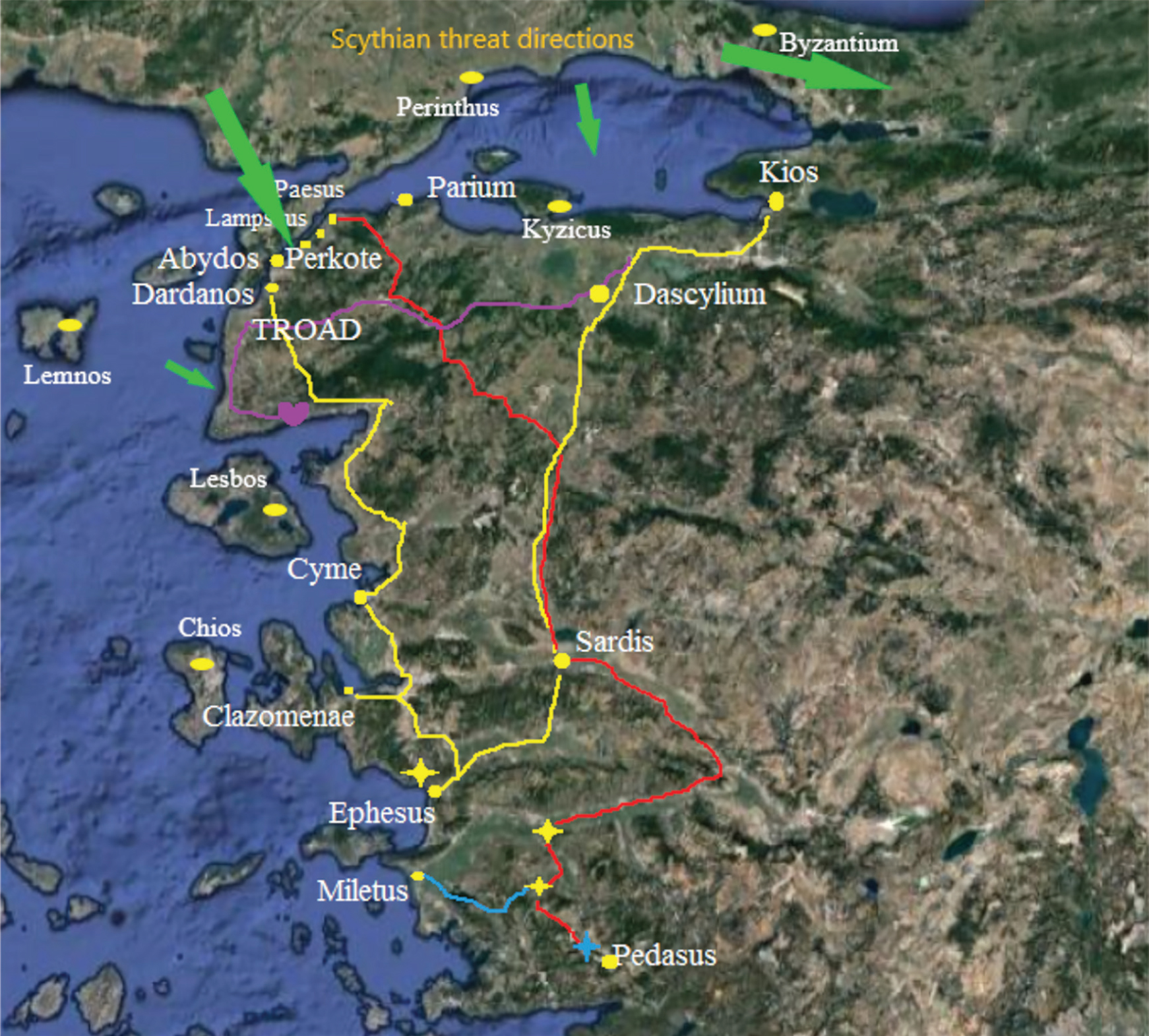
Map 8.1.
Green arrows: The possible attack routes for Scythian invasion.
Yellow lines: Initial moves of Suppression forces
Purple line: Hymaes contingency campaign in Troad
Purple heart: possible location of Hymaes’ death
Red line: Daurices transition and campaign in Caria
Blue line: Milesian reinforcements for the Carians
Stars: battles. [Blue: insurgents’ victory; Yellow: imperial victories]
They considered the options. The first was to win the battle for the rebellion with their superior Hoplites then and there. The second was to simply board their vessels and leave, exposing Ephesus to the Persian wrath, and, most importantly, to the Persian engineers and siege warfare, which had brought about the subjugation of Ionia before (Her I.162,2) and the collapse of the defence of the most formidably fortified cities in Babylonia and Egypt. They opted for the first. To be able to collect the spoils and go back, or move to another theatre, the rebels had to resolve the issue then and there, possibly while the Imperials had no cavalry, as none is reported by Herodotus. In any case, the battle was a clear defeat, shattering once and for all the morale of the rebel infantry, but – this is very important – neither their determination nor their resilience. Ephesus was not stormed, but seems to have been knocked out. Next time it emerges into the narrative (Her VI.16) it plays a dirty role in favour of the empire (Grundy 1901; Burn 1962) although its role during this early time is questionable.
The rebels and their mainlander allies were badly mauled. The Athenians, there for the plunder, understood their mandate was over, took their survivors and their part of the spoils and went home (Her V.103,1). It was a clear desertion. Whether by cowardice, recall, despair and casualties or due to the expiration of their mandate, they had come, they had plundered and they had fled. Aristagoras, who despised the Persian troops (Her V.49,3) and refused to listen to Hecataeus who proposed a naval strategy (Her V.36,2–3), opting for Hoplite decisive engagements instead (Grundy 1901) was just as astounded; he correctly understood that if the rebels could not smash Imperial forces in the field, Persian siegecraft had already spelled their doom in advance. It was rather insightfulness – albeit belated – rather than faint-heartedness (Her V.124,1) that drove his actions since, in any case, he initiated Plan B, a mass evacuation (Her V.124,2).
The three Persian generals, Otanes, Daurices and Hymaes had crushed the rebel field army and thus could move freely by land. They dispersed to operate independently, so each had a powerful army at his command, enough to take a whole theatre (Map 8.1). Two of them turned to the north, one (Hymaes) to southern Propontis and one (Daurices) to the Hellespont. The third, Otanes, who must have been the known general of years past (Her V.25,1) as the satrapy of Dascylium was first given to Megabazus and some years later is in the hands of Megabazus’ son Oebares (Her VI.33,3), stays put. Actually, he embarks, with the home troops of Artaphrenes, into a most unimpressive campaign of suppression, resulting in two cities taken (Her V.123) with utterly unknown temporal specifics as to when, in what order and after how much delay for each. Still, these two cities, one in north Ionia and the other in southern Aeolis (Clazomenae and Cyme respectively), sliced off the rebels of the northern theatre from Ionia proper, the cradle of the revolt and brought the Imperials once more to the Aegean coast and in possession of a major port. In any case, the Erythraean headland was holding, along with most of the nuclear part of Ionia (Burn 1962).
Actually, from Ephesus, both task groups, one of Daurices and the other under the joint command of Artaphrenes and Otanes must have moved northwards from the coastal road. The former moved to the north without losing any time in the Aegean and once in Troad, he must have entered the plateau from the western approaches of Mount Ida. Emerging in the plain he moved north to the entrance of the straits and started reducing the Asian coastal cities and sealing the Hellespont for any Scythian incursion. His success in reducing five cities in so many days (Her V.117) speaks for the (lack of) fighting spirit of the latter (Burn 1962), as the area most probably went into rebellion due to coercion by the Ionian fleet. At least one of the five cities, Lampsacus, was strong enough to have caused quite some issues to Miltiades when he lorded over the Chersonese (Her VI.37). Daurices intended, most probably, to continue to the east, to reduce the southern coast of Propontis starting with the city of Parium and including the peninsula of Kyzicus, until reaching the area of operations of Hymaes and making contact with the latter’s rearguard. Hymaes, starting from Ephesus, took the inland road from Sardis to Dascylium and emerged to the SE coast of Propontis, where he reduced the city of Kios (Her V.122,1) and obviously intended to keep up in order to seal off the Bosporus, the second major access point for the Scythians. Understandably the rest of Propontis had a lower-priority vulnerability, as the Scythians would need proper, massive maritime transportation to cross, not simple ferrying services as in the Hellespont and the Bosporus. This threat was becoming less intense once the Asian part of the Hellespont was restored into Imperial control and the shipping of the rebels could not find refuge in its ports to negotiate the rather temperamental stream and weather of the Hellespont.
The last area of vulnerability to an amphibious attempt by the Scythians, improbable though possible, was the NW corner of Asia Minor, Troad and Aeolis. It was the third army, of Artaphrenes-Otanes, which was supposed to deal with it. Starting from Ephesus they moved on the same coastal road that Daurices followed, but they intended to reduce as many cities as possible, actually to subjugate Ionia anew, and then move to Aeolis and assist the garrisons left by Daurices to keep the Hellespontine cities docile. But they failed to accomplish this plan as throughout the campaign they took hold of just two cities, as already mentioned. This would make Hymaes double back before securing the Bosporus, to secure the far more vulnerable NW frontier of Asia, as will be discussed later.
And then the lightning strikes: Caria declares in its entirety – more or less – for the rebellion. Daurices, having half-finished in the Hellespont, as he had concluded the Reconquista of the Asian shoreline of the Straits and was approaching the coast of Propontis (Her V.117), was best positioned to respond, and had the best army. He surged south (Her V.117), trying a whirlwind campaign that would stunt the new rebels before they had time to organize. His ‘buddy’, Hymaes, takes over the vital area of the Hellespont, leaving behind the less vulnerable Propontis (Her V.122,2). The new developments with Caria made Troad vital, as the insurgents could use it as a base to undo Daurices’ work in the Hellespontine area; at the same time, the force of Artaphrenes-Otanes is not available; it has to stay near Sardis should a Carian army emerge. Thus, Hymaes was the only available solution. He must have retraced his steps west to Dascylium and from there continued west, to take the eastern slopes of Mount Ida in the plain of Troad (Her V.122). After a brief time, during which he subdued all the wider area of Troad and thus brought the whole shore of NW Asia Minor under the Imperium, he died (Her V.122,2), possibly from disease, as nothing else is reported by Herodotus. This is the end of the operations of his army, which features in the narrative no longer, but might have been the one mentioned in the area some years later under Harpagus (Her VI.28,2).
The empire is not safe from the Scythians, as Hymaes’ demise left his business in NW Asia Minor unfinished. At the same time, Cyprus and Caria were in full revolt, threatening to raise other, eastern areas as well. In this context the empire seems hollow; an army, probably local levies of the satrapy, is assembled and directed to Cyprus along with a fleet. Caria is on fire, Europe (Skudra) is a lost affair and the only thing that may change the scales is time for the empire to prepare and mobilize vast resources. It is at this time, at the latest, that Darius dispatches Histiaeus to the coast, given that the burning of Sardis figured in their face-to-face meeting (Her V.106).
At the same time, Daurices, with an excellent track record as he had participated in the battle of Ephesus and had reduced at least five rebellious cities in the Hellespont, almost sealing the vulnerable Asiatic coast by himself, was moving to Caria, to take the new rebels as unawares as possible. From Paesus, his last conquest, he turned SE, skirted Mount Ida from the east so as to find the Dascylium-Sardis road, which he followed SE after Sardis until he emerged in the valley of Meandrus river, where he turned west to Caria.
He failed to catch the Carians unprepared; the latter had mustered their army to an advantageous position, at the confluence of the rivers Meandrus and Marsyas. While the Carians were deliberating deployment behind Meandrus, to use it as a defensive barrier, or crossing and lining up in front of it, to make escape impossible and thus fight with superior resolve (Her V.118,2), the Persians arrived, crossed the river Meandrus and attacked (Her V.119,1), showing how superior morale and determination is prone to render tactics ineffective or even irrelevant.
There are no accounts of the battle, but it is important that the location is mentioned, the casualties also (for the battle of Ephesus nothing of the two has been recorded by Herodotus) but neither tactics nor anything else. Most importantly, there is no mention of cavalry and it is most likely that there was none. The fighting was bitter, the Persians prevailed and as they were fleeter, the pursuit must have devolved to a carnage; still, not the butchery that a cavalry pursuit would have caused. The Carians, badly beaten, with a 5:1 negative exchange rate, were able to extricate themselves and assemble at Labranda, to the south, with their morale shattered and actually considering mass migration or asking for terms (Her V.119,2). And there the Ionians, headed by the Milesians, the foremost perpetrators of the rebellion, came inland to their aid (Her V.120) – a gesture the Carians were never to repay.
The third act was something of a repeat; the Persians were triumphant, and from the rebels the Milesians, who had been foremost to assist the Carians, ended up worst (Her 120); something probably indicating their prolonged stay on the battlefield while others fled. In a short while, all three major rebel conscription areas, Ephesus, Miletus and Caria had been smashed on the battlefield by one Persian army, justifying the failing spirits of Aristagoras (Her V.124,1).
At that point, Daurices was a hero of the Persian Empire, level with Zopyrus and others. Taking a page from the book of his father-in-law he had almost single-handedly suppressed the Ionian revolt by reducing city after city and winning battle after battle. He had quelled any doubts of the efficiency of the lighter Persian line infantry against the heavy behemoths, the Hoplites, destroying the morale of the rebels. His whirlwind campaign in the Hellespont kept the Scythians out. In his wake Lydian levies were following (Her V.121), possibly ardent loyalists, but, after the burning of Sardis, just as probably a wider assortment of political and social factions. His winning two battles in a row with the Carians was somewhat standard in Darius’ counter-insurgency booklet (DB 18–9; 26–8;29–30; 35–6). At this point he must have thought to capitalize; with the Carian host beaten time and again and practically decimated, it was a nice opportunity to invade and quell the rebellion before it became established – an excellent PsyOps (Psychological Operations) and propaganda deliberation. If he succeeded, which was almost certain, the revolt would have been contained to Ionia and Aeolis proper to the north, to the latitude of Cos to the south, and some kilometres deep. Cyprus and some other rebel cells in Asia Minor would be quelled fast enough and then it would be time to resolve the issues in Europe.
If this was indeed so (Ray 2009), his move southwards began just after the battle of Labranda, in the same campaigning season, with the highest morale and confidence; other scholars (Grundy 1901) believe that the invasion was initiated at the next campaigning season, with his army being reinforced by units under the other two commanders (Her V.121). But his confidence, to the point of arrogance, and the practices of his overlord and father-in-law better support the version of the immediate invasion. Confidence makes arrogance and the latter erodes caution. The multi-victorious army, knowing it had smashed the enemy field armies, advanced speedily and confidently.
The Carians, though, mustered anything they had, scraped the bottom of the barrel and lay in wait, in ambush, attacking at the dead of night. In one stroke the scales were tipped. Ray (2009) tries once more to reconstruct the battle with imaginary data, but Herodotus reports the extermination of the most successful Persian army ever taking the field against the Greeks, with all three of its commanders slain. The two others were not mentioned before but their corpses must have been collected and identified among the dead; Myrsus, the commander of the Lydian loyalists, or avengers, was also killed in action (Her V.121).
Caria was spared the invasion; but with its army decimated at Marsyas and Labranda, it could not –or would not – play any further role. The extermination of Daurices and his army had, in some hours, created a very different reality: one-third of the Persian forces had been eliminated, along with their most capable commander. Another commander had died, Hymaes (Her V.122,2) leaving his army leaderless. And the third commander, Otanes, was engaged in a rather overcautious, if not timid expeditionary tempo. This was a surprise: he had been most energetic when appointed a decade or more ago (Her V.26–8). Although the narrative of Herodotus does not reveal when he had his meagre successes by storming two cities (Her V.123), which may have been before the double disaster of the army of Daurices and the demise of Hymaes, it is possible that the caution was a directive of Artaphrenes as Sardis was in cinders and he needed a powerful army nearby to protect the rebuilding effort and discourage opportunistic and/or repetitive raids from other interested parties, such as Mysian bandits, amongst others.
In any case, Darius must have been in great consternation. His forces, battered and demoralized, were inadequate to make any further progress. Fortunately, they had incapacitated the enemy before plunging into their current plight, but the issue clearly demanded royal troops. What was even more important was that the casualties and the manoeuvering had left other satrapies practically defenceless and very vulnerable to possible insurrections. Darius knew everything about insurrections and their dynamics. Thus it is perfectly understood that the Persian offensive took quite some time to occur in Ionia. The first available forces must have been delegated to the near satrapies to stabilize them and preclude any further expansion of the revolt. Quelling the revolt in Cyprus did much to further this effort.
At the same time, the rebels were trying to find their footing. Despite their miraculous salvation thanks to the victory of Heracleides in Caria (Her V.121), it was obvious that they were no match for the Persian infantry after all. They lost all the battles, although the infantry battle at Cyprus was lost due to defection and treason (Her V.113,1). On the other hand, they were doing well at sea where they were more than holding their own. Hecataeus had been right in that they could win the war if they concentrated their efforts at sea. Their navy had flawlessly executed two massive amphibious operations, the evacuation of the Paeonians (Her V.98) and the transportation of assault forces to attack Sardis (Her V.100). They had soundly beaten the Phoenician fleet off Cyprus, in a battle where the engaging marines were Greeks and Phoenicians; the Persians were disembarked, along with their other vassals, and left the two marine nations to fight it out between themselves. The result was a signature Greek victory (Her V.112,1), which makes a bit weird any historical claims that the Greeks in later decades were particularly afraid of the Persian armadas – or of the Persian naval power and the Phoenician prowess – and considered the Imperials undefeated at sea (Plut Vit Them 7).
At this point, it is possible that Datis the Mede enters the stage (Burn 1962; Holland 2005). There is no reason to deny his origin as a Mede; the nation had provided the Empire with loyal and capable commanders (Her I.2 & I.156,2 & I.161–2). After all, Herodotus specifically considers him of Median race (Her VI.94,2) and thus the notion that he was the Satrap of Media (Sekunda 2002) is unsubstantiated. His sons were cavalry generals under Xerxes (Her VII.88,1), but not satraps, neither in Media, where the Satrap must have been Tigranes, a Persian and Achaemenid (Her VII.62,1.), nor anywhere else. Similarly, the same scholar’s view that his army was mainly drawn from his own satrapy is not very convincing, neither for the campaign of 490 BC nor for the one of 494 BC.
Datis must have been a most prestigious and important official (Lewis 1980; Holland 2005), possibly the long arm of Darius in quelling the revolt, the role originally assigned to Histiaeus. The latter had not been dispatched to the thick of the rebellion as an advisor for the local officials there, nor as a mediator with the rebels. Before leaving Darius’ presence he had promised to subdue Sardinia (Her VI.2,1) and thus he had an executive mission. He might well have been appointed Karana, head of all the Imperial forces and officials in-theatre (Sekunda 2002; Lewis 1980), as was later Cyrus the Younger (Xen Hell I.4,3) and Memnon the Rhodian (Arr Anab II.1,1). If so, one may speculate that this was insulting to the ego and authority of Artaphrenes, let alone pricking his jealousy. In such temper, the Achaemenid Satrap must have set up the foreigner Karana, thus manipulating him to escape and be branded traitor and massacred all the recipients of his letters (possibly sealed by Darius himself) who had expressed any kind of consent towards his mandate; or, by massacring said recipients, he prompted Histiaeus to defect (Grundy 1901). Subsequently, given half a chance, he murdered the Greek to cover his own tracks; the severed head sent to Darius could produce no testimony nor apology and explanations to the latter (Her VI.30,1).
As Datis carried the imperial standards to Athens later on, and Histiaeus had promised to conquer Sardinia (Her V.106), it is almost certain that Datis had replaced Histiaeus in form and function. He was a very shrewd and capable man. He may have had Darius convinced that sending in troops by land was counterproductive: they took time to approach, needed money and support to do so and were exposed to ambushes by an enemy who knew their whereabouts – especially now that the most fervent loyalists, the Lydians, had been knocked out. Datis must have been instrumental in raising an imperial, not satrapal fleet (Burn 1962), intending to accomplish three things: to transport fast considerable forces from the Middle East to the Aegean; to challenge the rebels for the control of the sea; and, once having wrested it, to be able to attack by land and sea, while at the same time safeguarding the empire from any notion of Scythian landings.
The dispatch of a massive fleet, including this time the Cilicians and the newly re-conquered Cypriots plus the Egyptians (Her VI.6), took time but it was to be the ultimate Persian campaign in the area. This fleet was massive, with the Phoenicians thirsty for revenge, plunder and extermination of the Black Sea commerce where they had never dared to venture. And it was not just a fleet; it was bringing an army on its decks. The levelling of Sardis was not merely a military setback and disaster for the prestige of the empire, nor simply a humanitarian crisis, it took out the best located and capacious Persian military base. Supplies could not be concentrated, stored and delegated; troops could not be mustered, stationed, billeted, outfitted and trained, as was to happen when Xerxes led his own invasion (Holland 2005; Her VII.32 & 37 & 146). Thus an armada, with its commissariat in the bellies of some vessels, was a very promising approach.
The possibility that the armada was under Datis, and Mardonius was under his command (Burn 1962), is very enticing; it is a most curious thing that Herodotus mentions not one of the Persian commanders of this final campaign, although he has mentioned quite a number of the previous ones by name – some of them quite obscure. However, the above does not apply if indeed this expedition refers to the one which called to the Dodecanese and met with a miraculous reverse at Rhodes, a fact that persuaded the Achaemenid commanding officer to consider the city of Lindos as under divine protection and leave (Burn 1962). The templar inscriptions narrating the miraculous salvation of Lindos may imply that Datis was the chief of the imperial fleet which fought at Lade (Her VI.6) and attacked Rhodes and other islands off insurgent Caria en route to Ionia to quench the rebellion, with Mardonius as his subordinate. Or that he did so in 490 BC, en route to Ionia and then to his appointment with the Fates, at the plain of Marathon. The last piece of information makes the older dating most probable (Burn 1962), along with the fact that Mardonius is nowhere mentioned to have attacked Rhodes in 492 BC, although he had plenty of time and he was in person with his fleet during the trip from Cilicia to Ionia (Her VI.43,2–3) where he met his designated army.
The showdown was to happen off Miletus, the lair, epicentre and refuge of the rebels, which housed the Ionian fleet, the main rebel arm after the unexpected discrediting of their infantry. The rebels concentrated their fleet, 353 triremes (Table 8.1), at Miletus. It is interesting that the Ionians proper, in terms of geography, that is the inhabitants of Ionia on the Asian coast, contributed very few vessels, except Miletus with 80. All the major contributions were from the islands, especially Chios, Samos and Lesbos with a total of 230 vessels amongst them. Ephesus had not been among the rebel muster, and suffered no despoiling (Burn 1962); nor had any city of Caria (Her VI.7–8).
The Greeks would fight this time against a major, or rather, imperial fleet, not a satrapal force. They were heavily outnumbered as the enemy had a round figure of 600 ships-of-the-line (Her VI.9), equal to the royal fleet at the Scythian expedition (Her IV.87,1). The fact that a border, basically counter-insurgency action requested the naval arsenal of a royal expedition says much for the magnitude of the threat this revolt had been for the crown. Notions that the Persian admirals would not revert to subversion due to their massive numerical advantage are ill-founded and rather intended to cast doubt on the Persian numerical advantage. A good general, as says Sun Tzu (Art of War IV.15) fights after the battle is already won. But, most importantly, royal fleets had never been tested in a sea battle, and their cohesion and ability to combine and co-operate in different languages and procedures was an issue, making the High Admiral most uncomfortable; later cases which may be ridiculed by Persian executives, knowing nothing of sea fights and sailing in seasoned mariners’ vessels (Aesch Persai) may well cover a very real need for seamless vocal communication within but mainly among vessels, especially of different marine nations within the empire. Up to then, though, the imperial fleets were shadowing or carrying the land army, as in Egypt, Scythia and in many other cases. They had not fought a sea battle, at least not to our knowledge, and their morale would have been somewhat shaky as the last confrontation of an imperial detachment against the rebels had been a resounding defeat off Cyprus (Her V.112,1).
Table 8.1. The rebel fleet (islands in italics)
|
City |
Vessels |
|
Samos |
60 |
|
Lesbos |
70 |
|
Phocaea |
3 |
|
Erythrae |
8 |
|
Chios |
100 |
|
Teos |
17 |
|
Myous |
3 |
|
Priene |
12 |
|
Miletus |
80 |
|
Total |
353 |
The rebels had mustered their naval squadrons in the vicinity of Miletus (Her VI.7–8) and knowing that the imperial resources far exceeded their own, they were deliberating on how to address the issue of being in a clear numerical disadvantage despite scraping the bottom of the barrel (Her VI.7), a fact sapping their cohesion. The commander of three out of 353 rebel vessels, Dionysius of Phocaea, might have been selected on merit as well as to alleviate frictions and jealousy from among the major contributors (Burn 1962). The scheme is not unheard of, as it was followed in the battle of Lepanto (Rados 1915) and very successfully. Dionysius promised victory should they allow him to train them and to teach them a manoeuvre which was perfectly suited to their present condition, but required the utmost discipline, co-ordination and cohesion; both skill and drill (Her VI.8 & 11). It was the Diekplous, (Fig 8.1) possibly of his own invention, as nobody had ever heard of something similar. The alleged ability of the imperial navy in 480 BC to execute this manoeuvre (Her VIII.9), an issue conjectured but never proven, may have passed to the Imperials through rebel captains who were captured during and after, or defected before, the battle of Lade.
The diekplous – a Greek naval term for ‘infiltrating the enemy’s line of battle’ – was changing the scales. In those days, ramming was the standard method of engagement. Both Greek and Phoenician representations show rams in vessels since the 7th century at the latest, and despite fervent and even prejudiced attempts to explain them as cutwaters, the fact remains that using a finely constructed, extremely expensive, precisely balanced vessel of almost 200 men, some of them top professionals and one of them a millionaire, as a hauler to load it with 10–20 Hoplites and thus degrade its speed, sap its balance and leave the fate of 200 in the hands of 10 or 20 is simply unorthodox if not outright idiotic. The crew could be best exploited by being the propulsion for the ramming. This was the only valid reason for so cumbersome a vessel, in operational terms, that is seaworthiness, autonomy, capacity at such high price in human resources and their sustenance.
Ramming was intended mainly as a flank attack, perfectly applicable in small-scale encounters or against pirate vessels, but much more challenging in massive fleet actions of extended lines. The larger fleet could always take the smaller at the flank, or a fleet considerably faster could do that to one more cumbersome by extending faster (Fig 8.2) flank-wise (Periplous). Otherwise, it was a grim action of repetitive ramming, recoiling to get some distance so as to build up speed for another attempt to ram, or to evade the enemy onslaught; an action between vessels prow-to-prow, like a phalanx infantry match. The comparison between sea-fights and land encounters is followed many times but it may be somewhat speculative. Having said that, it must be remembered that the officers were the same men who commanded fleets and armies in all naval states, and the national ideology in conflict matters always carries extreme prestige and weight.
As the vessels approached, clashed and recoiled to ram again and again until battering the enemy, grappling an enemy vessel upon contact – or even upon approach – and boarding it with a marine contingent could decide the issue with minimal danger for the friendly hull, while providing prisoners (for labour or ransoming) and a decently operational vessel for the fleet. Boarding thus was, in prow-to-prow confrontations, a decisive action and the most sustainable mode of naval battle, which favoured the side with the better or bigger number of fighters; the larger and higher vessels that could load more marines and were able to withstand some battle damage due to ramming and collision; and compact formations.
The above are the methods of fighting which must have governed both Lade and the naval battle off Cyprus. The diekplous of Dionysius made all these considerations somewhat irrelevant. It was about darting between two enemy vessels, not onto them. Shearing their oarage was an added blessing; but the main purpose was to get behind them, U-turn and deliver a ram attack from the hind quarter or the flank. Similar endeavours along the enemy line could collapse it by creating gaps and thus expose its vessels to front-quarter ramming or even flanking and periplous (Fig 8.3). It is obvious that larger vessels, with longer oars, needing more room abreast, offered more tempting opportunities for diekplous. The beauty of this tactic was its applicability to a less numerous fleet, with vessels with or without size, endurance or durability advantage. It favoured the resolute and precisely navigated, agile warship.
The Ionian crews had had enough after some short days of really hard training (Her VI.12), and probably of remaining at the ready all day long to allow no opportunity for sneak attacks to the Imperials and to exploit any opportunity themselves – as was to happen at Aegospotami in 404 BC (Burn 1962), where the Athenian fleet was caught off-guard and exterminated (Xen Hell II.28). It was nothing short of a mutiny, the crews refusing to undergo even standard training (Her VI.12,4). Thus the diekplous was out of the question. Some captains correctly understood the issue as a disastrous defeat in the making (Her VI.13,1); but also something just as threatening, a radicalization of the crews and respective social strata, which was prone to infect the citizenry beyond the constraints of the fleet and develop to sedition, with rioting, violence, disorder and factional cleansing. Herodotus, an ardent democrat, refers only to the former of the two as a concern of the Samian commanders, leading them to give in to the imperial subversion efforts and accept an understanding (Her VI.13,2). Having a soft spot for Samos and privileged sources of information, Herodotus acquits the Samians of treachery by advancing such reasoning (Her VI.13). He also overplays their role in the naval victory off Cyprus (Her V.112,1) and their participation in the second Ionian revolt, before and during the battle of Mycale (Her IX.103,2 & 99,2 & 91–2); he does not scold their ardent Medizm in Salamis (Her VIII.85,2) and is apologetic for their hideous actions in Sicily (Her VI.23) where they were seeking refuge after the defeat at Lade (Her VI.22).
Although Herodotus tries to implicate the Lesbians in the treachery, the fact that Lesbos suffered retributions (Her VI.31) while Samos did not (Her VI.25,1) means that the desertion was agreed only between the Samian commanders and the Imperial authorities through the tyrant Aeaces (Her VI.13,1). The Lesbians did not play the traitor but the coward, seeing the Samian squadrons at their side (Her VI.8) making sail (Her VI.14,2) and leaving their flank hanging, vulnerable to periplous.
Considerably smaller, the rebel fleet was probably jammed in the straits between Lade and the mainland to protect their flanks from such an eventuality and deny access to the Imperials through the strait between Lade and the mainland. The E/NE to W/SW orientation satisfies Herodotus’ report of a roughly West-East orientation of the battle line(s) (Her VI.8,1) while allowing for the Greek squadrons which cut through the imperial line to turn either to the north (Chians) or to the south (Dionysius) to escape (Her VI.16,1 and Her VI.17, respectively). It also allows for the flight of the Samians and the Lesbians northwards, to their homelands (Her VI.14,2 and 14,3 respectively), before the initiation of the engagement (Map 8.2). Now the Imperials rolled the frontally engaged rebel fleet from the open sea, the position of the Samians to the West (as it was nearer Samos), towards the East, the position of the Milesians (Her VI.8), by the mainland coast and nearest to Miletus. The spontaneous nature of the flight of the exposed Lesbians (Her VI.14,3) explains why they secured no leniency (Her VI.31–2).
Dionysius, with his command, performed the diekplous, did some damage, and then escaped as he knew the rebellion was now a lost cause. After exacting some revenge by sailing off Phoenicia, boarding and commandeering vessels and supplies necessary for the trip, he moved to the straits of Sicily and Italy and had a great career as a pirate (Her VI.17). Whether he or his descendants made contact with Themistocles, during the latter’s initiation of the western naval policy of Athens (Green 1970), thus providing intelligence on diekplous and shipbuilding for triremes, remains conjectural. But his raid must have driven home a warning to the imperial naval staff, making them extra-cautious after the battle of Salamis in 480 BC and perhaps precipitating the recall of the Phoenician squadrons at that instance (Diod XI.27,1 & 19,4; Her IX.96,1). Similarly, the leverage to defeat a confederate Greek fleet was also duly noted, to be used further and it is the main reason for any degree of true Imperial gullibility displayed at Salamis (Her VIII.75–6; Diod XI.17,1–2).
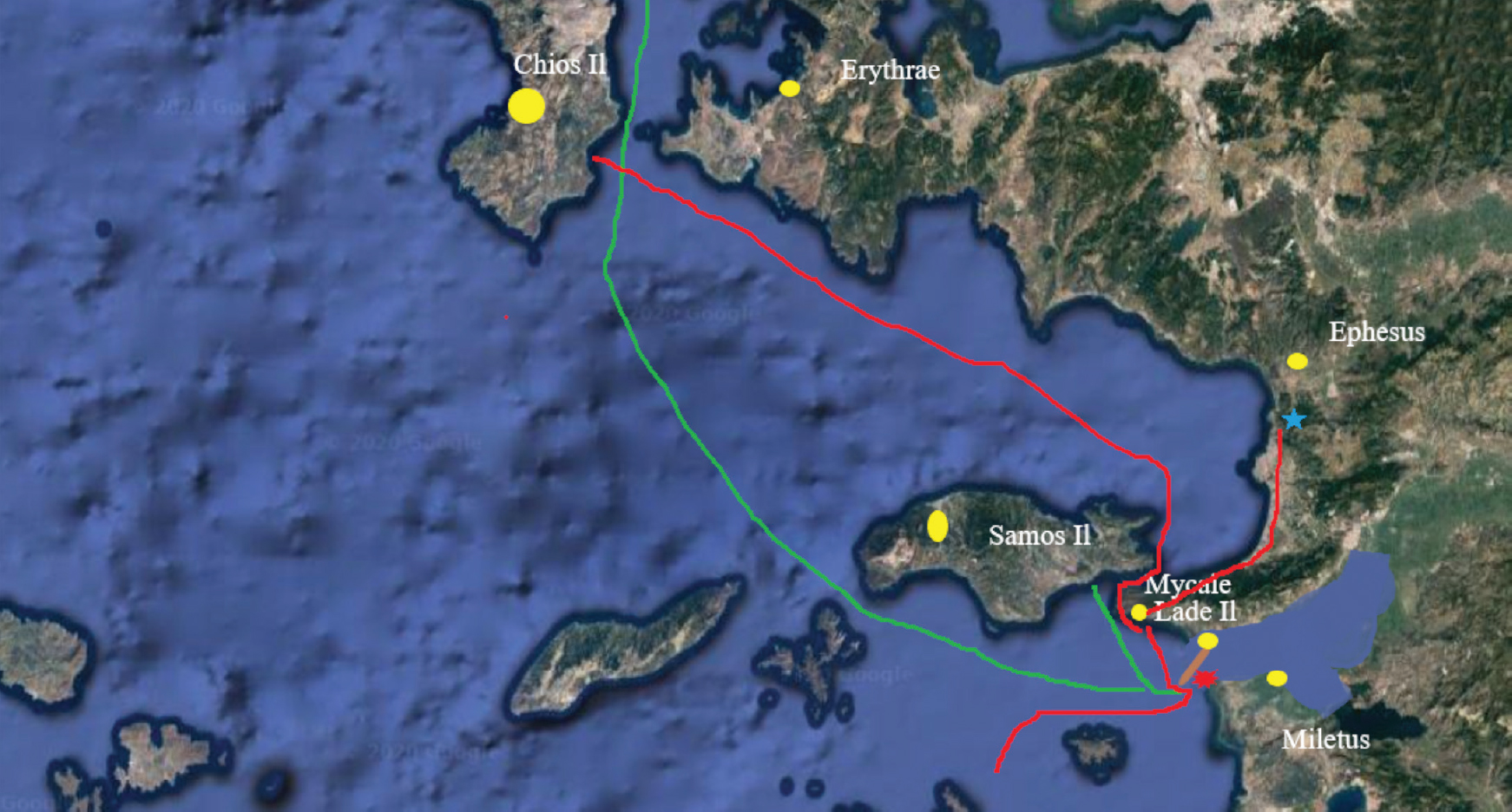
Map 8.2.
Green lines: The desertion of the Samian and Lesbian squadrons before the battle
Red lines: the escape routes of the Chians and the Phocaeans after the battle (red star)
Blue star: the slaying of shipwrecked Chian crews by the Ephesians
The biggest contingent of the rebel muster was the Chian, of 100 vessels, posted at the centre of the line, more or less (Her VI.8). Having its flanks secured, it adopted an alternative strategy, as diekplous was not an option anymore. The Chians went for a boarders’ fight. The naval battle was to be fought in the straits to negate flanking, thus speed and manoeuvreability for the rebels were irrelevant. It was going to be a frontal, Hoplite-like action. The Chians reinforced their boarders’ units, to forty Hoplites per vessel (Her VI.15,1), a massive 4,000 Hoplite force which accounted for a significant part of their total Hoplite host, no doubt. If the Chians had the same social percentage of Hoplites as in Athens, the 20,000 sailors were entrusted with the lives of 4,000 Hoplites, which is one fifth. At least an equal number must have been available, which means the boarders were almost half of the total Hoplite levy. This means they could not be Elites, as Herodotus clearly and emphatically considers them (Her VI.15,1); at least not in the same sense as Mardonius’ guard at Plataea (Her IX.63,1), the Athenian 300 Hoplites in the same battle (Her IX.21,3) and similar units mentioned by Thucydides, with the 600 of Syracuse (Thuc VI.96,3) being the largest. The 1,000 Argives (Thuc V.67,2) were another unit type but still, they were 1,000, a mere 25 per cent of the Chian boarders. Only the Arcadian unit of the 4th century, the massive 5,000 Epilektoi of Arcadia (Diod XV.67,2 & XV.62,2), also known as Eparitoi (en Hell VII.22), has been comparable in numbers.
The massive boarding parties constituted undoubtedly a tactical innovation, at least in that day; or, rather, a backward surprise (Thuc I.49). In any case, its astounding effectiveness caused the Persians to adapt by furnishing additional marine detachments formed by competent, dependable and loyal central Asian troops in later campaigns (Her VII.184,2), a fact that changed their tactics and created vulnerabilities. It must be remembered that up to that day the naval engagements were committed with the native marine complements; throughout the campaigns of the Ionian Revolt, but also during previous ones, there is no mention of non-native boarders, only of transported troopers. At the battle of Lade, at the battle off Cyprus (Her V. 112,1) and then during the punitive naval campaign to suppress any coastal cells of the rebellion (Her VI.33,3), it is clear that the Phoenicians, not the Persians, are the causative agent. Persian forces may have landed at Chios and Lesbos (Her VI.31,2) as they are big islands, but the rest of the campaign of 493 BC is attributed to the Phoenicians (Her VI.25,1 & 34); the other three naval nations, that is Cilicians, Egyptians, Cypriots (Her VI.6) are not mentioned any further, perhaps due to insignificance, or, conceivably, but less probably, having been dismissed to save Darius some costs.
Herodotus says nothing about how the Milesians fared in battle. But the Chians, at the centre, fared decently. Their massive boarding parties surprised the Imperials and wreaked havoc, breaking through the enemy line and taking enemy vessels as prizes (Her VI.15,2). There are no numbers reported, and it is not clear whether they cut the Imperial line because they were able to capture enemy vessels, or diekplous allowed them to cut the line and subsequently, instead of ramming, they boarded and occupied the enemy vessels. The thing is that a number of their vessels (it is not reported whether high or low) were badly damaged or actually incapacitated and could not make full speed, but could sail for some time and distance to a safe coast at Mycale (Her VI.16,1), not far from Miletus (Map 8.2). This implies vessels damaged by front-quarter ramming and smashing, as flank ramming is fatal for the hull – a corroboration for the arguments presented before on the prevailing tactics of the time. The Chians left the Milesian territory, moving on foot. But on their way north, to get near their island and cross back there, they went through the Ephesian territory where the natives mistook them for pirates and slaughtered them, as they were exhausted and battered (Her VI.16,2). True, the morals of the day, but especially the proceedings of Histiaeus (Her VI.5,3 & VI.26 & VI.28) do indeed make the story believable. Still, the Ephesian attitude – and conduct in general throughout the events – implies something more sinister, something involving the Imperials pursuing the Chian fugitives and perhaps putting a price on their heads (Her VI.16,1).
The fall of Miletus and the extinguishing of the revolt
The Persians in 494 BC united all their armies to one and turned to Miletus, ignoring other cells of insurgents (Her VI.6). It is understandable; it was the hearth of the rebellion. Crushing it would decide the issue for the Empire then and there. But it was just then that they could do so, because they had seized the initiative, nullified the Scythian threat and contained the uprising. Moreover, their assets now included one army standing headless in-theatre (that is NW Asia Minor); another, rather slack army nearby under a not very inspired but very cautious dual leadership; a new commander-in-chief (C-in-C)/ karana, possibly endowed with additional land troops as reinforcements, but definitively with a brand new navy. The most important was that now they had a unified command over all their forces in-theatre, land and naval. (Her VI.6).
Thus, after their victory near Lade, they pursued the defeated fleet (Her VI.16,1), but engaged in earnest in besieging Miletus by land and sea (Her VI.18). Their siegecraft was once more successful, raising a question over the need for a seaward blockade. Such conditions are necessary when starving the population, not when storming the fortifications. The massacre that followed (Her VI.19,3) had a terrible effect on Greek conscience and although it fuelled much defeatism, as it was supposed to, it also stabilized resolve and grew determination, especially with the Athenians who watched the notorious play ‘The fall of Miletus’, only to fine the author Phrynichus and forbid it to be performed ever again (Her VI.21,2) – a democratic resolution which would have made the Inquisition proud. The imperial fleet wintered in the destroyed city (Her VI.31,1), allowing the message of abstract terror to spread, and in the first days of the next spring, they proceeded with the mopping up (Her VI.31). It is possible that since Samos was very near, they installed the Medizer tyrant Aeaces immediately (Her VI.25,1), before the winter lull. It is this winter that Histiaeus, having heard of the fall of Miletus (Herodotus says nothing about the duration of the siege, but it must have been short, the remaining part of the late summer and autumn after the battle of Lade) aborted his operations in the vicinity of the Bosporus (Map 8.3), where they were intent on building a privateer navy, and land in force to besiege Thasos (Her VI.28), the intention behind this decision being discussed later.
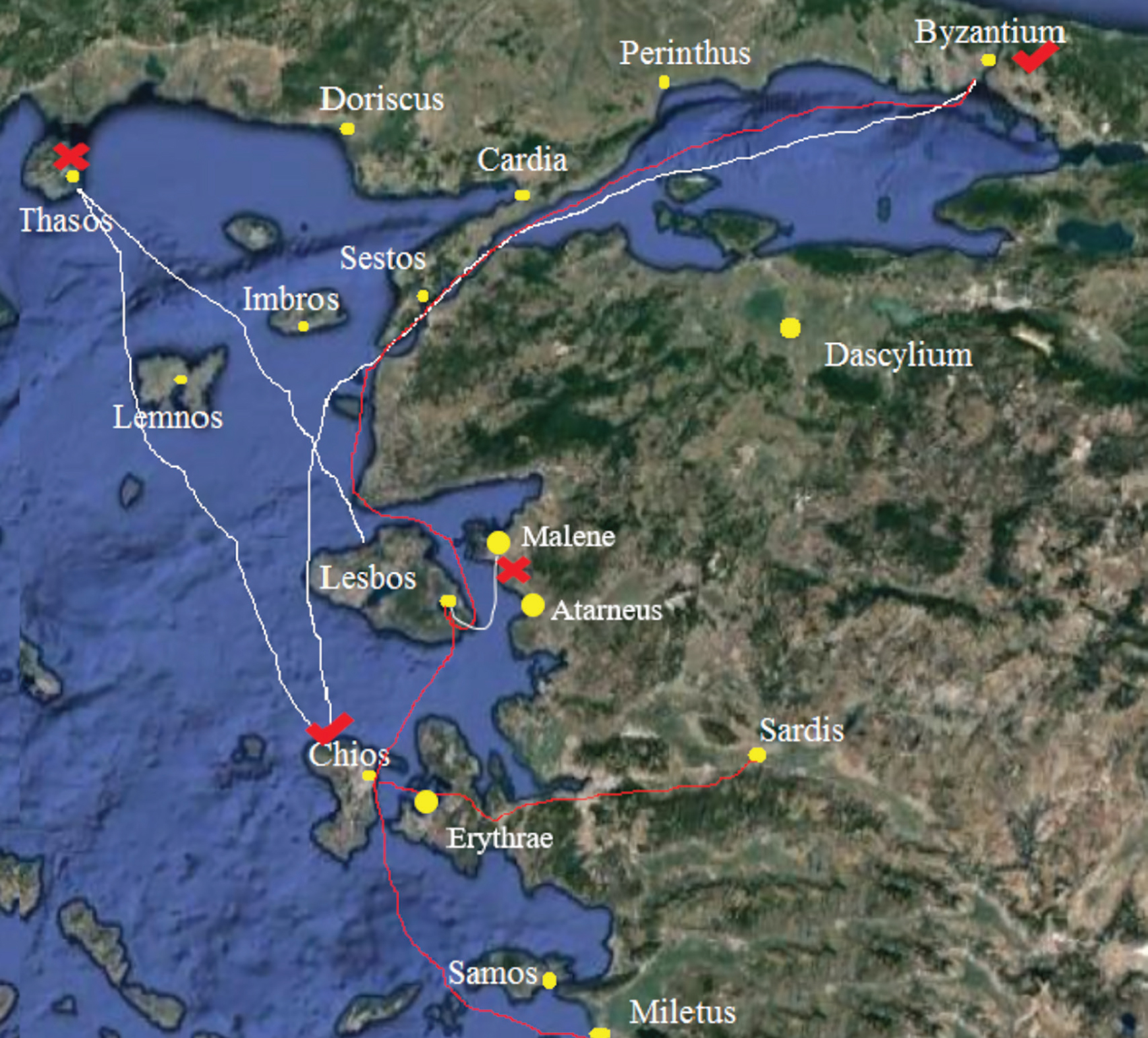
Map 8.3.
Red line: Histiaeus’ escape and his venture to Byzantium
White line: Histiaeus’ proceedings after the battle of Lade.
Red ticks: Histiaeus’ successes
Red X: Histiaeus’ failures/defeats
The imperial fleet first subdued the large islands (Map 8.4), Chios, Lesbos and Imbros (Her VI.31,1), the second not reaping any benefit from the desertion at Lade (Her VI.14,3), which means it was due to terror and cowardice, not treason (Burn 1962). For these operations, the relatively small boarding parties of the fleet were sufficient, 6,000–12,000 men. The crews would assist as devastators, support troops, engineer troops and light infantry, but still, it is possible, or rather probable, that units of the land army were used to effect amphibious attacks and then net the population (Her VI.31,1) who obviously considered any kind of defence as vain. It is not clear whether the fleet or the combination of fleet and army were used to subdue any Aegean coastal cities of the Asiatic mainland, but the army, possibly delegated to several task groups, stormed all the remaining continental cells of the resistance (Her VI.31,2); these were the very ones they had skipped a year ago to concentrate on Miletus (Her VI.6). Amongst them were the five cities sending small naval contingents in Lade (Table 8.1).
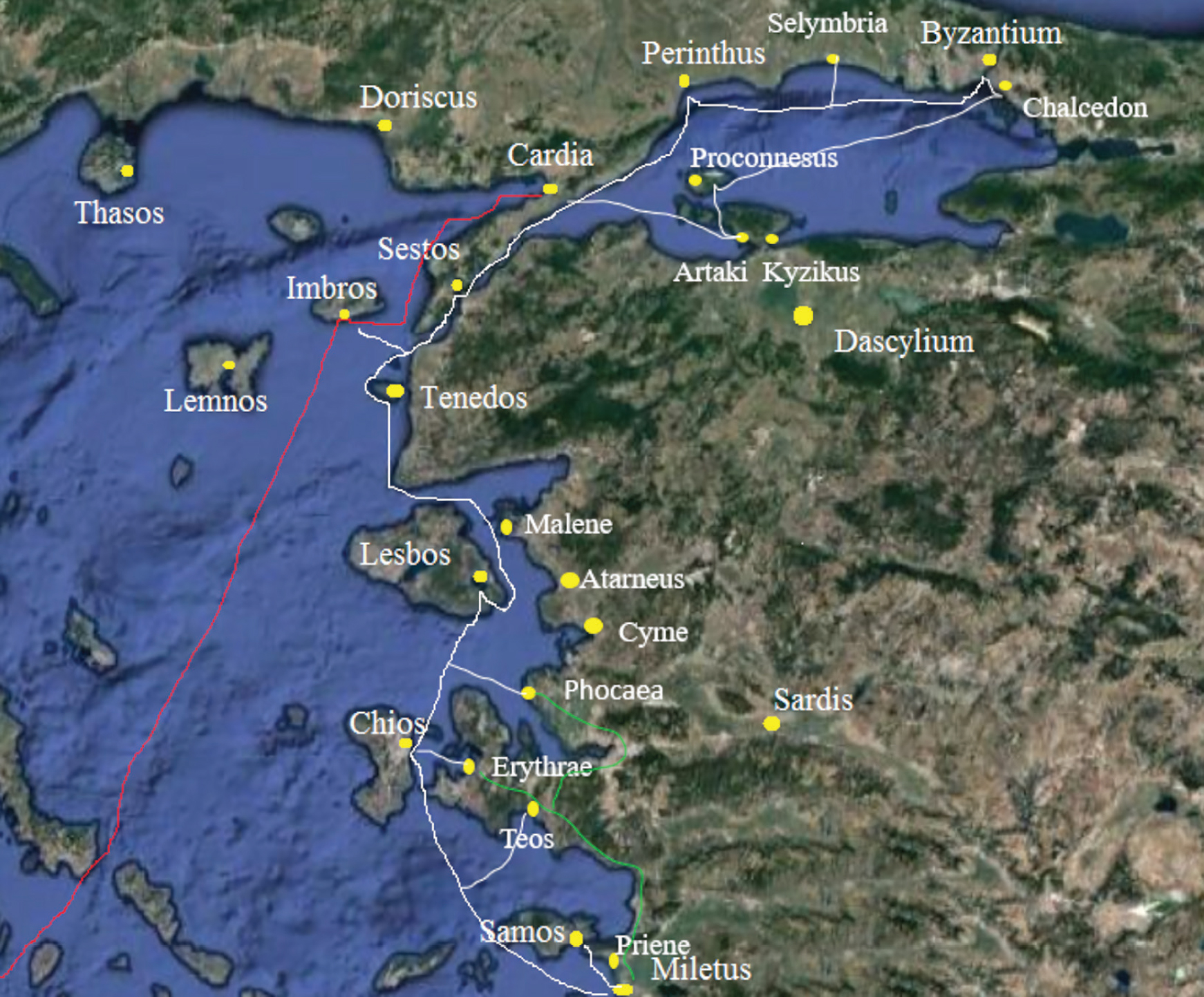
Map 8.4.
White line: the mopping up by the imperial fleet
Green line: The possible course of the imperial army for extinguishing the revolt in the mainland
Red line: The escape of Miltiades
This period is the latest conceivable, regarding the Persians’ dealings with Caria; it is more probable that developments followed the fall of Miletus promptly (Her VI.25,2). Caria offered no further resistance and submitted by convention, although Herodotus mentions that some cities (without naming them) were besieged before surrendering or being stormed (Her VI.25,2). In effect, Caria is never heard of after the ambush off Pedasus where Daurices was slain (Her V.121). It may be that Caria had capitalized on the success of the ambush and kept neutral or had already capitulated (Grundy 1901), so that Herodotus’ narrative of the ultimate Carian surrender (Her VI.25,2) may be either erroneously dated or suggestive of the official conclusion of a very closely kept understanding. The above perfectly explains why the Persians granted territories of Miletus after its razing to Carians, and most specifically to the important city of Pedasus (Her VI.20), located very near the stage of the extermination of a whole army under Daurices (Her V.121).
After finishing with the major islands and, at the same time, with Histiaeus’ private army (Her VI.28–9), the imperial fleet entered the Hellespont and delivered swift vengeance to the European side (Her VI.33), which included Miltiades’ fiefdom, but also to the cities of Propontis and of the Bosporus. It is important that the fleet never took any stroke of oar into the Black Sea, and that there were still cities in the Asian coast of Propontis which up to this time either capitulated more or less of their own free will with the Persian authorities (Her VI.33,3) or were still defying the Pax Persica. This indicates that Hymaes’ campaign had stopped short of them and nobody (i.e. his successor) thought it necessary to continue along these lines; one more piece of evidence supporting the Scythian Invasion hypothesis mentioned earlier.
The next day: When the End completes the Beginning
Herodotus tries to present the story of the campaigns of Histiaeus, after his defection and his forming a privateer band, in some context (Her VI.26–30), to make it more relevant and clear. His purpose is commendable in terms of history, but in terms of operations the crucial time factor is not meticulously laid down; especially the relative timing with other events. It is obvious that his sources are wanting, and he himself, a first-generation historian, was not familiar with the Persian protocols as intimately as was Xenophon, who not only travelled and mingled with Persians, but also fought for one of them against them in their own country. Thus, Herodotus does not know the status of Histiaeus when sent to the coast, nor his exact and purported relations with Artaphrenes, the local Satrap. Most of all, he has no idea of his intentions and how the latter evolved and changed.
Histiaeus was ambitious and wanted to run, or reign over, something more than an ungrateful metropolis (Her IV.137,2). He wanted his own kingdom, his own city and subjects, but he could envision himself as an independent ruler in all probability within the sphere of the Achaemenid patronage (i.e. protection and, should the need be, imposition). What he could not tolerate was being the subject of some arrogant Satrap, like Artaphrenes, subject to his whim and greed (Grundy 1901). From the moment he asked for Myrcinus, a land being literally at the Far West of the Empire (Her V.11,2), not yet shaped into a satrapy, this was his plan, which was unacceptable to Persian aristocracy at its very core as shown by the intervention of Megabazus (Her V.23,2). It is not at all certain that when he first escaped to the rebels his intentions for the uprising were genuine; he might have intended to quell the rebellion, to be a hero and get the king’s permission to rule his fiefdom in Myrcinus under the royal protection. But Artaphrenes was very glad to have him branded as a traitor (Her VI.1–2). If Histiaeus tried to replay Zopyrus (Her III.158,1), neither the Ionians were gullible enough (Her VI.2,2–5,2), nor Artaphrenes inclined to assist him. After that, Histiaeus defected for real.
The logical sequence, as already mentioned, is that when at Sardis, he contacted by the letters which might have had the royal seal, important figures among the local Persian administration, possibly to enact another policy for containing the revolt and to assume supreme leadership in-theatre. Artaphrenes executes all who declared for Histiaeus for presumed, assumed or attested treason, which means he set Histiaeus up, forcing him to escape to evade a possible murder attempt. In this way the Milesian incriminated himself. But it may be that, as Herodotus has it (Her VI.2–4), Histiaeus first escaped – or simply moved away – from Sardis as a first step. This he might have done sensing hostility if not immediate danger, or as part of his plan, whatever the latter had been. Then, from relative safety or having been where his plan dictated, he dispatched his letters, allowing by his absence Artaphrenes to taint him as a defector and thus charge the recipients with treason, execute them all and make any proof of Histiaeus’ possible undercover mission disappear.
It is very probable that Histiaeus, once the Persians established their land supremacy (there is no way to know his thoughts and convictions on the subject before the verdict of battle), was set to organize a mass migration, at least of the Milesian citizenry, to his fiefdom in Myrcinus (Her V.23,1), which was then beyond the Persian reach. There he would be a benefactor to his subjects and perhaps a moderator with the Persians, having orchestrated an internal migration which was prone to further the imperial interests in Europe by creating a fortified, rich and advanced base and commercial hub, possibly the capital of a new satrapy.
As the Ionians had no intention of allowing him any leeway (Her VI.2–5), he persuaded some Lesbians – incidentally, of Aeolian, not Ionian, stock (Her VI.8,1) and very possibly representing private concerns – to provide triremes for a most notable plan: to control the Bosporus and commandeer a fleet out of the merchant shipping of the Ionians which emerged from the Black Sea (Her VI.5,3). This means that the Bosporus was not under the sway of the Imperials at the time; indeed, its gates, Byzantium and Chalcedon, were subdued only in 493 BC by the imperial Navy (Her VI.33). Many of the vessels would have been high-capacity merchantmen, good for mass transportation of freight, but many others would be private double-role pentekonters (Fields, 2007), with excellent freight capacity but also considerable fighting potential in both naval and amphibious contexts. They were more flexible and thus better than the triremes on many accounts. With the triremes as his core, which could pursue and overtake any type of vessel (Fields 2007), he could create a privateer navy to enact his migration schemes, as the ‘official’ Ionian fleet of triremes could not be replaced, outdone or overtaken. Histiaeus was not to tackle any imperial fleets at that time.
Once Miletus was levelled, Histiaeus tried to change the timetable; he had been hopelessly outrun by the facts. He went to Thasos (Her VI.28,1), to acquire loot and more ships and possibly real estate; the Thasians had a fleet (Her VI.46,1) but did not man it to defend, which means it was available for the taking should Histiaeus have been victorious. Just as important, they controlled considerable territories on the opposite mainland coast (Her VI.46,3), and this system of island–mainland was a dream for Histiaeus’ migration plan, after Myrcinus became unavailable, or too restricted for a massive migration, or both. If he could subjugate Thasos within the winter, at the first sign of the spring he could realize the migration with the ships he had plus the survivors of the Ionian fleet. But there was a catch: without subduing Thasos, his plan for mass migration could not work. The establishment of the Thasians was by definition competitive to the Myrcinus project and perhaps the Thasians had a hand in the ultimate failure of the latter and the death of Aristagoras (Grundy 1901). With Myrcinus aborted for quite some years, maybe six, since the campaign of Daurices and the demise of Aristagoras, Thasos and its estates on the mainland were the only suitable receiving grounds available immediately to the prospective refugees (Grundy 1901). It must have been along these terms that he persuaded some Ionians too to join this operation (Her VI.28,1), and the latter must have been the very bellicose and desperate Chians (Grundy 1901).
The clock was ticking and once the imperial navy mobilized, next spring, to exploit its victories off Lade and at Miletus, Histiaeus’ original plans were irrelevant, as he had logged no progress in Thasos (Her VI.28,1); he needed more time, but the storming of Miletus, instead of a prolonged siege effecting starvation, had wrecked his plan (Burn 1962). He also needed stronger forces, even at that point, to try to salvage something out of the wreck. He assembled as many troops as possible by conscripting fugitives (Her VI.26,2 & 28) and tried to enlist the devastated Chians (Her VI.26), beaten in the battle of Lade (Her VI.27) and slaughtered near Ephesus (Her VI.16,2). Always defiant, with their home squadron they tried to resist (Her VI.26,1). Histiaeus, already holding a grudge since they had him ejected some years ago when he first appeared as a master rebel (Her VI.2,2 & 5,2), fell upon them with his armament and allegedly obliterated the island (Her VI.26,2); not fully, as the Imperials found something to destroy, pillage, slaughter and net (Her VI.31). But he must have caused quite some damage before recruiting some Chians.
Having acquired, bled and increased his army, he had to feed it (Her VI.28). Instead of bringing in supplies beforehand, he had used his navy counterproductively in assault missions and spent any accumulated provisions; the same was true for the rebels, who used their fleet for defence and not for collection of supplies. Now that their fleet was beaten, there could be no supplies. A brilliant plan was to seize some from the opposite, Asian coast (Her VI.28,2), which was already subdued by the Persians, or it would have been shortly after. A reasonable endeavour, to rob the enemy of supplies and increase one’s own. The operation was set for the first sign of reaping next spring, perhaps in May (Burn 1962), after a sorrowful winter. But, in an exemplary failure of intelligence, a Persian army under Harpagus (a Persian and thus unrelated to the general of Cyrus who had originally subjugated Ionia) was nearby (Her VI.28,2); the Greek contingent was numerous, so as to quickly loot and fetch as many supplies as possible, and, although caught at a disadvantage it gave the imperial infantry quite a match (Her VI.29,1). It is almost directly stated that the imperial army was infantry only (Her VI.29,1), probably being the army of late Hymaes (Ray 2009), last seen in the Hellespontine area (Her V.122,2), now under a new commander. Most likely it had moved south, towards Miletus during the converging last year’s attack (Her VI.6), and now it was returning north under the mandate to conclude the suppression and perhaps assist the fleet against the coastal cities and islands (Her VI.31). Histiaeus must have supposed it was still south, out of position, a fatal mistake as its commander must have learnt some lessons from previous rebel practices which had succeeded in defeating in essence, although not in fact, the satrapal forces by rendering them irrelevant in space and time, like the imperial cavalry during the raid at Sardis (Her V.98,4 & 100).
The result of the battle and the conclusions on the Persian use and low availability of cavalry have been discussed previously, as has the fate of Histiaeus and the reasons for such proceedings, which thoroughly displeased the King of Kings (Her VI.30,2). What must be discussed here is the immediate intentions of Histiaeus had he been successful in obtaining supplies for his forces. It remains purely conjectural, but he must have intended to attack the Imperial navy while the latter was preparing for the campaign but before it started from Miletus (preferably), or as early as possible afterwards, before it gained momentum. Finding the enemy fleet ashore, either dragged to the beach or resting at anchor, the small navy of Histiaeus would aim for a surprise attack. Ramming anchored vessels would be like spearing fish in a barrel; boarding, taking and towing them would be just as easy. For beached vessels, home-made incendiaries could be used to destroy or at least incapacitate them. Home-made incendiaries, based on rags, brushwood and fat or oil and primed by stone or torch could be placed in multiple sites of a vessel by two-man teams to spread fast, while the raiders would move quickly from ship to ship and prevent the stunned crews from reaching the sea to try to quench the flames.
Five two-man teams could work per trireme simultaneously and be done in 2–4 minutes; then approach another and a third. This is the limit in terms of time (15–20 mins) before resistance gets organized, and in terms of weight and volume of incendiaries carried while retaining a decent fleetness of foot. A pentekonter, without any boarders, could dispatch three such squads of 5 pairs and keep 20 rowers in position, for the ship to be ready to depart. A trireme could dispatch 10 such squads, for 100 oarsmen, while 50 remain at the ready. The merchantmen could bring along the incendiary supplies and marines, who would assist in the torching and also tackle enemy crews and/or security details. By these, purely conjectural, estimations, if the eight triremes of Histiaeus were intact and fully manned, in under half an hour they could destroy 8x3x10=240 enemy vessels, one-third of the enemy fleet; the complement of each pentekonter could disable 3x3=9 ships. All these are conjectural, but might have been the only realistic, although far-fetched, plan of Histiaeus, a known opportunist and risk-taker, to stop the disaster from concluding into the devastation it was to become.
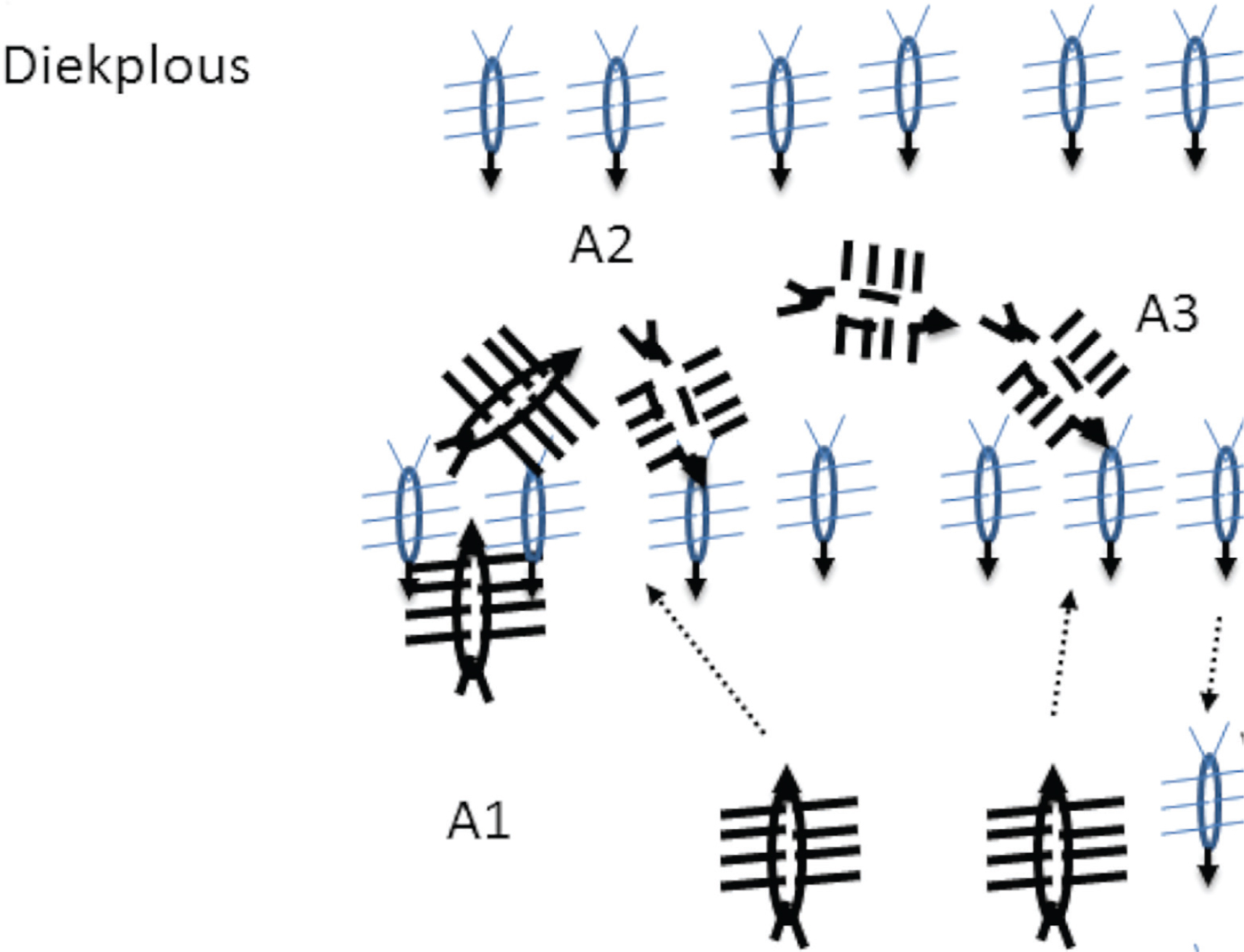
Fig. 8.1.
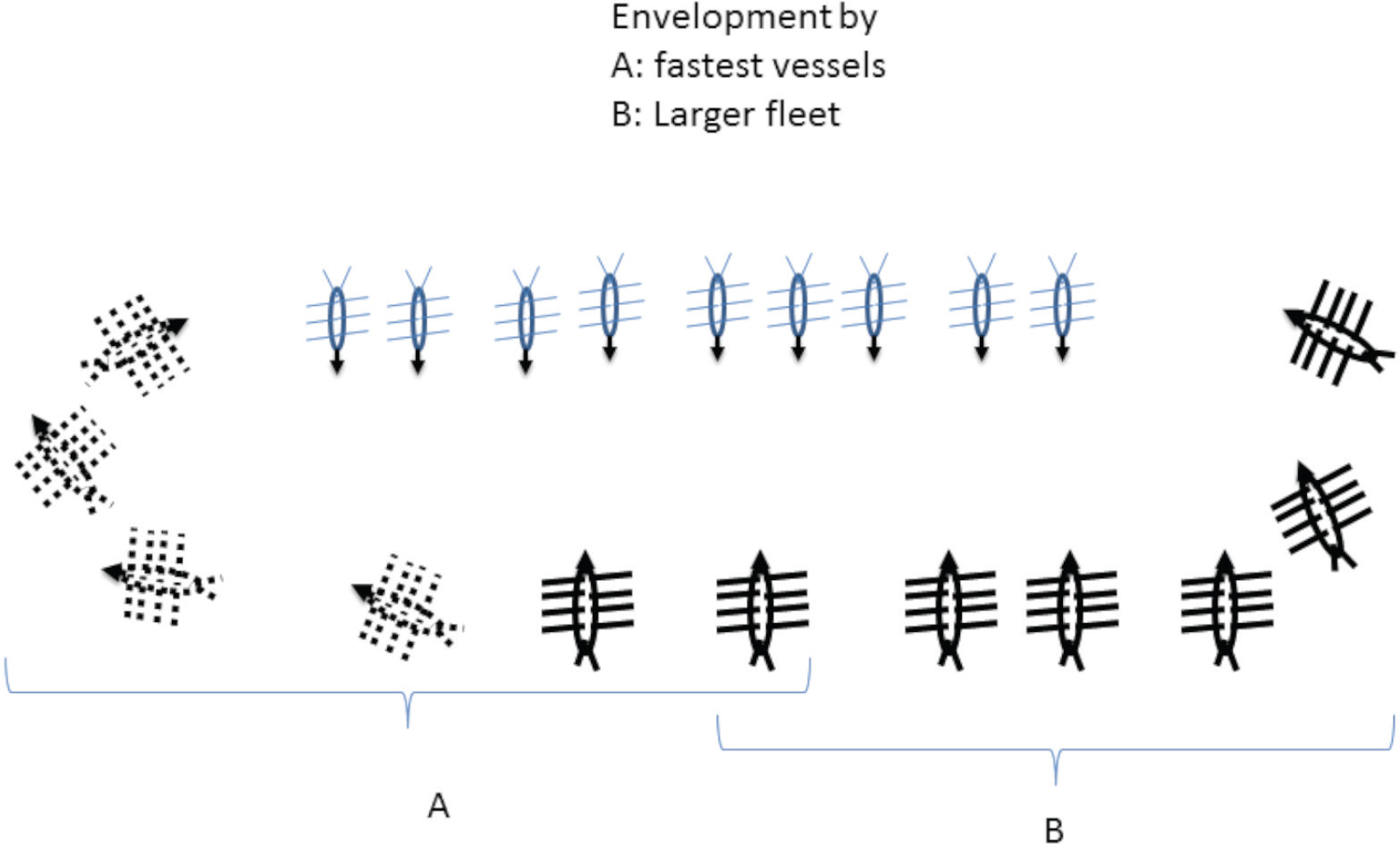
Fig. 8.2.
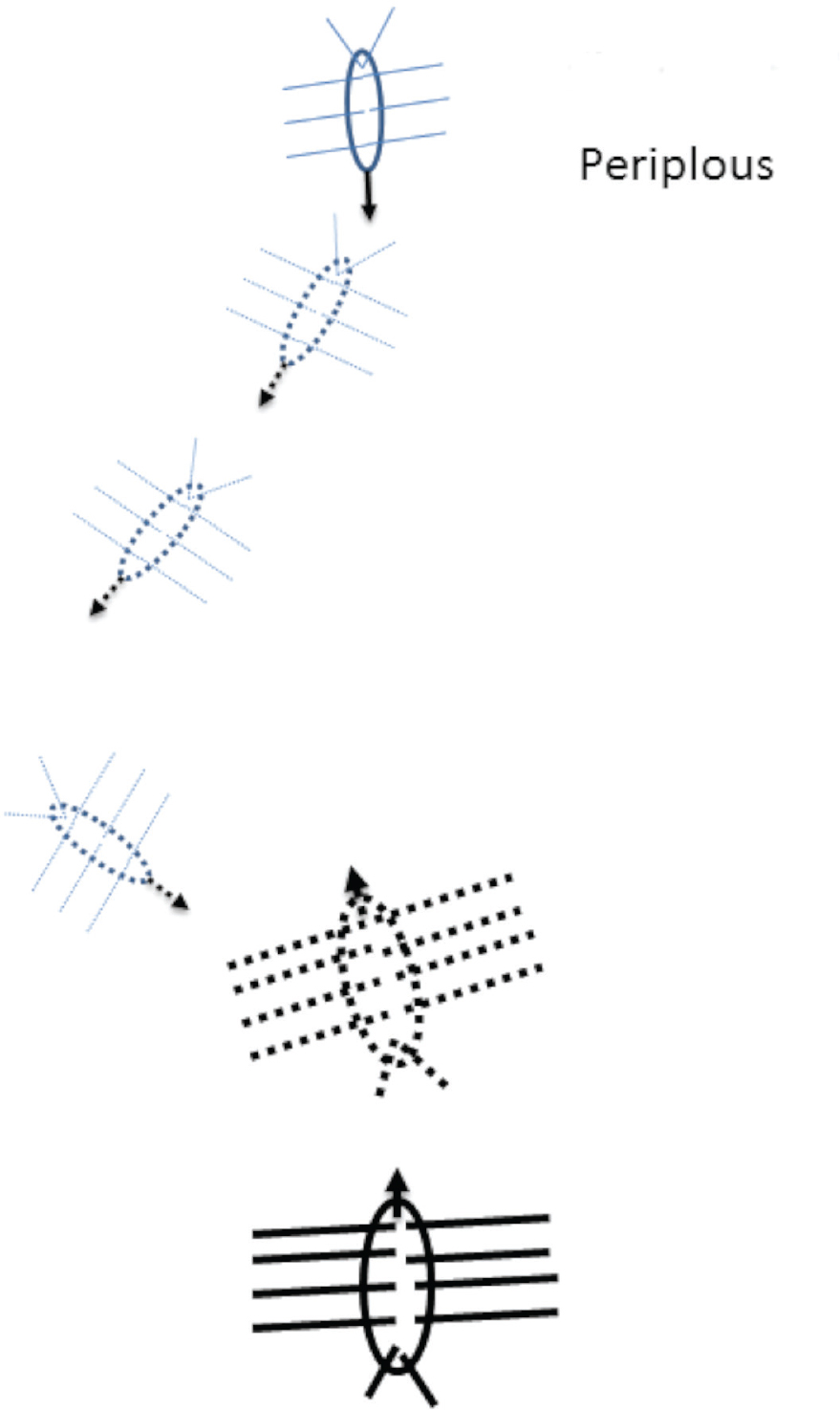
Fig. 8.3.