
Part II
Chapter 7
The fiasco that was the Scythian campaign had some unforeseen long-term results. The empire had some territorial gains, having conquered lands in Thrace; the campaign though had been an unqualified disaster, as becomes obvious by the rebellions in its wake, especially of Byzantium, which made Darius cross back to Asia by veering to the west, at the Hellespont and also made prolonged Imperial counter-insurgency campaigning in the area a must. This phase went better and Darius was able eventually to retire at Susa and perhaps his new capital, the secret city, Persepolis (Mousavi 2005) – a city unknown to the Greeks until the invasion of Alexander the Great, or shortly before.
In Susa, or rather with the Persian court, resided Histiaeus the Milesian, as the token of gratitude he asked for saving the Persian army at the Ister, the fief of Myrcinus at the (literal) Far West of the Empire, had been deemed risky for the interests of the Emperor (Her V.23,2). The prize was granted, but the opportunity to enjoy and make good use of it was denied. Histiaeus, after at least ten years in this golden cage, knew he was never to see the sea, nor to achieve his ambitions of becoming something more than a Persian puppet tyrant (Grundy 1901); perhaps a vassal king. Herodotus has him instigating the Ionian revolt on these grounds. His son-in-law and cousin Aristagoras, governing in his stead, on the other hand, had no reason to do so, ruling practically alone for a decade thanks to the Persian spears. Herodotus understands that Aristagoras found himself poised to revolt due to his unenviable position after a failed campaign (see later), when his Persian colleague/co-commander, or rather supervisor, Megabates, was bound to file complaints against him. Additionally, Aristagoras was expected to pay the expenses of the failed expedition himself (Her V.35,1), since the Throne gave him credit, sanction and help but did not take over the costs (Her V.31,2). As the fleet was at anchor, just after the ignoble return (Her V.36,2), Aristagoras revolted, seized the expeditionary fleet (200 galleys minus any possible casualties due to accidents, as there was no sea-fight in the campaign) and relinquished his tyranny (Her V.37,2). This set the whole of Ionia on fire and Aristagoras went to seek help abroad (Her V.38,2).
Concerning the Ionian Revolt, Herodotus is at his worst. He is clearly biased against the rebels, presenting them as troublemakers who caused evil to both Greeks and barbarians (Her V.97); who marred the perfect nirvana of the eastern Greek world, which was flourishing under a spirit of co-operation and understanding within the bosom of the benevolent Achaemenid empire; undisciplined; militarily inept at times; when they shirk engagement, cowards and when they do not, definitely stupid or…. irresponsible (Grundy 1901; Burn 1962). Of course his Carian- and Dorian- bloodline had this kind of feud with the northern neighbours embedded in the DNA. But Herodotus is also a devoted Atticiser and promotes an argument to the tune of ‘serves them right’ regarding the Athenian oppression and milking the Asiatic Greek cities of his era (Burn 1962). In these chapters, Herodotus seems not simply neutral, or even distanced, but demonstrably pro-Persian, speaking for the wrongs the Ionians did to the king, in daring to rebel and helping some of his captives (the Paeonians) to escape back to their homeland (V.98,1). This absurd stance, noticed and severely criticized since antiquity (Plut De Her Mal 24) is going to change in his narration only when it is the Athenians who reconsider their position from that of spontaneous dependence to resilient resistance or, rather, rebellion.
In truth, although his animosity and bias are declared and self-evident, there were objective difficulties he faced regarding the facts and their interpretation. He must have been unable to find precise info, as in his day the then rebellious teenagers were 60+, and the adults of the years of the Ionian Revolt, with a somewhat clearer view on events, were long gone. The timing of the events, especially the temporal sequence of events unfolding at different locations, is extremely problematic despite his best intentions and efforts. In spite of these facts, his account, in terms of objectivity and historicity, is infinitely better than the surviving Persian historical accounts of any event, exemplified by the Behistun inscription that mentions dryly ‘he lied to the people’; ‘great host’; ‘I ordered my slave to go smite these followers of the Evil’; ‘Ahura mazda willed it thus’.
The Ionians had some tribal characteristics: they were not very warlike for some generations; they were refined and kick-started the classical Greek civilization, by nurturing sciences, philosophy and the civilized life in general. They were merchants; most of them, after a more or less decent resistance, became privileged subjects of the Lydian kings, functioning as liaisons with mainland Greece and reaping profits from commerce within the Lydian Empire and its network of allies and partners. They were becoming rich, and although Cyrus denied them their previous privileges, the commerce within the much larger, Persian empire was fruitful. Many of them were very happy being loyal subjects in a multi-national experiment, even if they were nowhere near the master race.
Another thing is that the Ionians had developed a new form of self-government, much more representative and equalitarian; it was Democracy in all but name, which is erroneously attributed to the Athenians. The Ionians had a considerable proportion of names ending in ‘agoras’ like Molpagoras, Aristagoras, Pythagoras and so on; this suffix indicates the Agora marketplace, fomenting not only commerce, but also politics. Their progress on the subject can be followed by Cyrus’ answer to the Lacedaimonian embassy sent to warn him against meddling with the Greek colonies in Asia. Not knowing the Spartans proper, he declared that he had no fear, especially of people who constitutionally lied and deceived each other as a form of government (Her I.153,1). Sparta had nothing to do with this; Athens was a side note in the pages of history, and deep under the aristocratic brawling which culminated in the rule of Peisistratids. But the Ionians were exactly what Cyrus had in mind… He was right in principle, wrong regarding the subjects. The Spartans were fearsome…
Cambyses was no Cyrus, but there is no indication of any friction between him and the Ionians. On the contrary, their competitors, the Phoenicians, seeing the Ionian profits within the empire, surrendered spontaneously (Her III.19,3) to become loyal subjects and take a portion of the pie. They did well in both; still, Cambyses had no preference for them, as the Ionians were loyal and had precedence. The flat Phoenician refusal to campaign against Carthage (Her III.19,2), although without immediate, harsh disciplinary action, must have been noted for further use by the emperor. With Cambyses, the Ionians were at their best, give or take, as he had no grudge against them as had Cyrus, whose overtures to them against Croesus had been rejected (Her I.141,3).
With Darius, things changed. Taxation became systematic and extremely heavy (Burn 1962). Herodotus’ list proves that a tiny strip of land paid a yearly tax of 400 talents of silver (Her III.90,1), when Cyprus, Phoenicia and Syria together paid 350 (Her III.91,1). It is no accident that after the Ionian Revolt Artaphrenes revised the quota (Her VI.42,2). The Phoenicians gained precedence over the Greeks, and, even worse, Darius’ wars closed markets and resulted in contributions on top of regular taxes. The Ionians were impoverished, while the Persians, with a natural detestation of everything equalitarian, used to govern through networks of personal acquaintances and relationships of personal trust. Thus they established tyrannies in Ionia; not the tyrannies of the mainland or of western Greece, which were starting as a public rising headed by a champion against the aristocrats to degenerate to authoritarianism at a later stage. In Ionia, the tyrannies were clearly a step back to totalitarian, unconstitutional regimes. Combined with impoverishment, the Ionians had had enough of Darius’ greedy benevolence (Burn 1962).
And greedy he had been: either as a personal opportunity to aggrandizement, or to find a pretext to mobilize the Ionian fleet and thus hijack it and initiate revolt (Grundy 1901), Aristagoras proposed a campaign against Naxos to Artaphrenes (Her V.31,1–3), in terms of pure conquest and looting. Naxos had delivered no harm, but was rich and a nice step towards the even richer Euboea and the Greek mainland. Artaphrenes had been watching his northern neighbour, seated in Dascylium, adding new conquests: the fiefdom of Miltiades at the peninsula of Helle (Her VI.36,1) in Thrace, the fiefdom of Peisistratus at Sigium, granted by Hippias to the Crown (Her V.96), and the islands just to the west, conquered by Otanes (Her V.26). Compared to these, Artaphrenes had procured the official but not factual subjugation of the Athenians, who were the nominal overlords of both the above fiefs (Her V.96 & VI.140,1), but little else, as they were far away. To claim Athens, he needed an approach, and this enterprise of Aristagoras was a nice chance. He had to ask for Darius’ permission and, as expected, the greedy monarch sanctioned the campaign, and doubled the expeditionary fleet to 200 galleys, from the 100 which were requested by Aristagoras (Her V.31,4). Why 200? This must have been the fleet proportion of the satrapy of Artaphrenes (Burn 1962) since this was in fact a local, border action. The balance towards the Ionian fleets of independence or the Ionian quota to the Imperial grand fleet of Xerxes must have come from the northern satrapy ruled by the line of Megabazus, or Megabazus himself, seated at Dascylium.
The attempt at Naxos
The royal sanctioning for the expedition at Naxos was granted and a task force with a Persian nucleus expanded by ‘allied troops’ (Her V.32) – probably Iranians – was sent to meet and board the 200 vessels prepared and manned by Artaphrenes (Her V.31,4). The crews were Ionians, as were most of the marines, but for the imperial troops sent by Darius. In this Herodotus might be mistaken; the dispatch of the troops would take some time, and sanctioning a local muster from satrapal forces and military fiefs within the satrapy of Artaphrenes is a much better guess. The army, if not the expedition as a whole, is commanded by a royal cousin, Megabates (Her V.32), which most probably means he was the son of Megabazus (see Chapter 6) and a sister of Hystaspes, father of Darius and Artaphrenes. There was friction between Megabates and Aristagoras, the soul of the operation (Her V.33–4), which culminated in disaster.
The fleet sailed from Miletus north, allegedly for the Hellespont (Her V.33,1), which directly implies a volatile condition there despite the operations of Megabazus and Otanes (Her V.2 and V.26 respectively). When it had reached Chios, it suddenly turned southwards, so as to catch a north wind and approach Naxos fast and unexpectedly (Her V.33,1). But despite such precautions, the element of surprise was lost. Whether Herodotus has it right and Megabates sabotaged the operation to get even with Aristagoras (Her V.33,4), or Aristagoras and some friends did it to leverage events which were to ignite the revolt, long-planned beforehand (Grundy 1901), the islanders were tipped off and had taken every precaution for a siege. The legendary Achaemenid efficiency (and proficiency) in siege warfare must have taken a vacation, as after a prolonged four-month siege Naxos was still holding (Her V.34,2). Money, supplies and morale failed the raiders who simply fortified a position for their local Quislings (Her V.34,3) and left for Asia in disgrace, calling at Myous (Map 7.1), near Miletus and landing the troops. The latter either started the return trip to Central Asia by the king’s road or were demobilized locally to their fiefs for the winter, while a similar order was expected for the fleet. But before the order arrives, a pre-existing ring of Ionian conspirators convenes in Miletus and takes the chance: they go to Myous and raise the Ionian crews and boarders of the fleet to revolt. And they do it with utmost success (Her V.37,1). By this move the eruption of the revolt happens while the imperial loyalists (the land army element) are away, the insurgents are concentrated and in position, and most of the imperial commissaries, that is the tyrants of the various Ionian and Carian cities, are still gathered in one place and unsuspecting with their squadrons (Her V.36,4) while getting ready for the trip homewards.
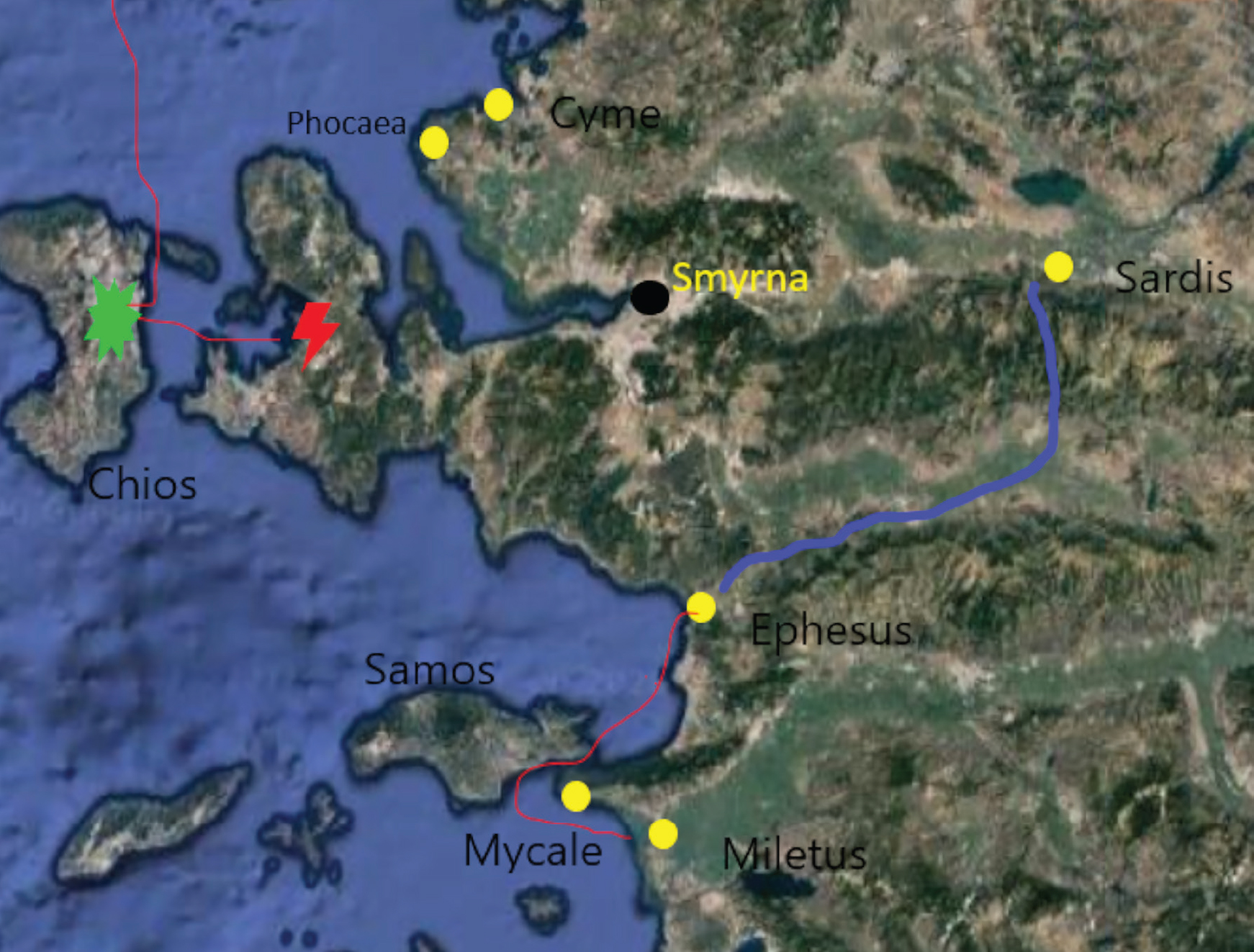
Map 7.1. The opening moves. The rebel fleet (red lines) draws enemy cavalry masses off position and lands a Milesian-led army near Ephesus to attack Sardis stealthily (blue line) as the imperial cavalry are drawn out of position (red lightning), chasing the escaping Paeonians (green blast) who boarded the rebel fleet opposite Chios to Europe.
The insurgency erupts
The first move of the insurgents, after capturing but not slaying their tyrants (Her V.37–8) – a most grievous mistake – was to launch some propaganda and secure some advantages. Sparing the tyrants made the uprising look humanitarian in the extreme. To double this impression, the Ionians got in touch with the deported Paeonians who were abducted by Megabazus and carried to Asia on Darius’ whim (Her V.98,1). The Ionians offered them sea transportation to Thrace, had they had the guts to approach the sea by themselves. The deal was struck and the Ionian fleet first took the Paeonians from Asia Minor to Chios (Map 7.1), which was nearby, to save them from the royal pursuit and then, more leisurely, took them to Lesbos and from there to Doriscus in the coast of Thrace (Map 7.2), whence they returned to their motherland on foot (Her V.98,2–4). Offering the wretched expatriates, or rather deportees, such assistance was a propaganda triumph, as the subjects of the king could believe that their salvation was coming from Ionia, should they simply do their part. The Thracians and all of Europe were witnessing the Ionian benevolence and magnanimity (Grundy 1901). Additionally, the external assistance from the mainland, forthcoming in limited numbers (Her V.97,3 & 99,1), almost insignificant, was still even better propaganda; the rebels were not alone.
And then, the masterstroke: Herodotus considers the liberation of the Paeonians an act of pure malice against the king (Her V.98,1). That the enslaved men were free and back at their hearths counts for nothing in the age of the Athenian Empire, except if these were Athenians. This is obvious. What is not obvious is that in this way, beyond the propaganda spinoffs, all the available Persian cavalry was pursuing the fugitives towards the coast, most probably opposite to Chios (Her V.98,4). And its whereabouts could be deduced by the rebels as they were keeping track of the trail of the Great Escape, more or less. Thus, the insurgents formed a task force at Miletus, the headquarters of the rising, from where the fleet of the rebels ferried them to Ephesus by sea, away from any imperial detachments converging to isolate or besiege Miletus, the nest of the rebels (Map 7.1). From Ephesus, taking local guides (Her V.100) the rebels marched inland and up the river Caicus out of Persian eyesight, as the operational eyes of the Persian high command, the cavalry, were engaged in the pursuit of the Paeonian fugitives. Then, the insurgents crossed the Tmolus mountain range (Her V.100) and found themselves conveniently outside Sardis, the seat of Artaphrenes, the Satrap of Lydia and actually western Asia Minor, the brother of the king.
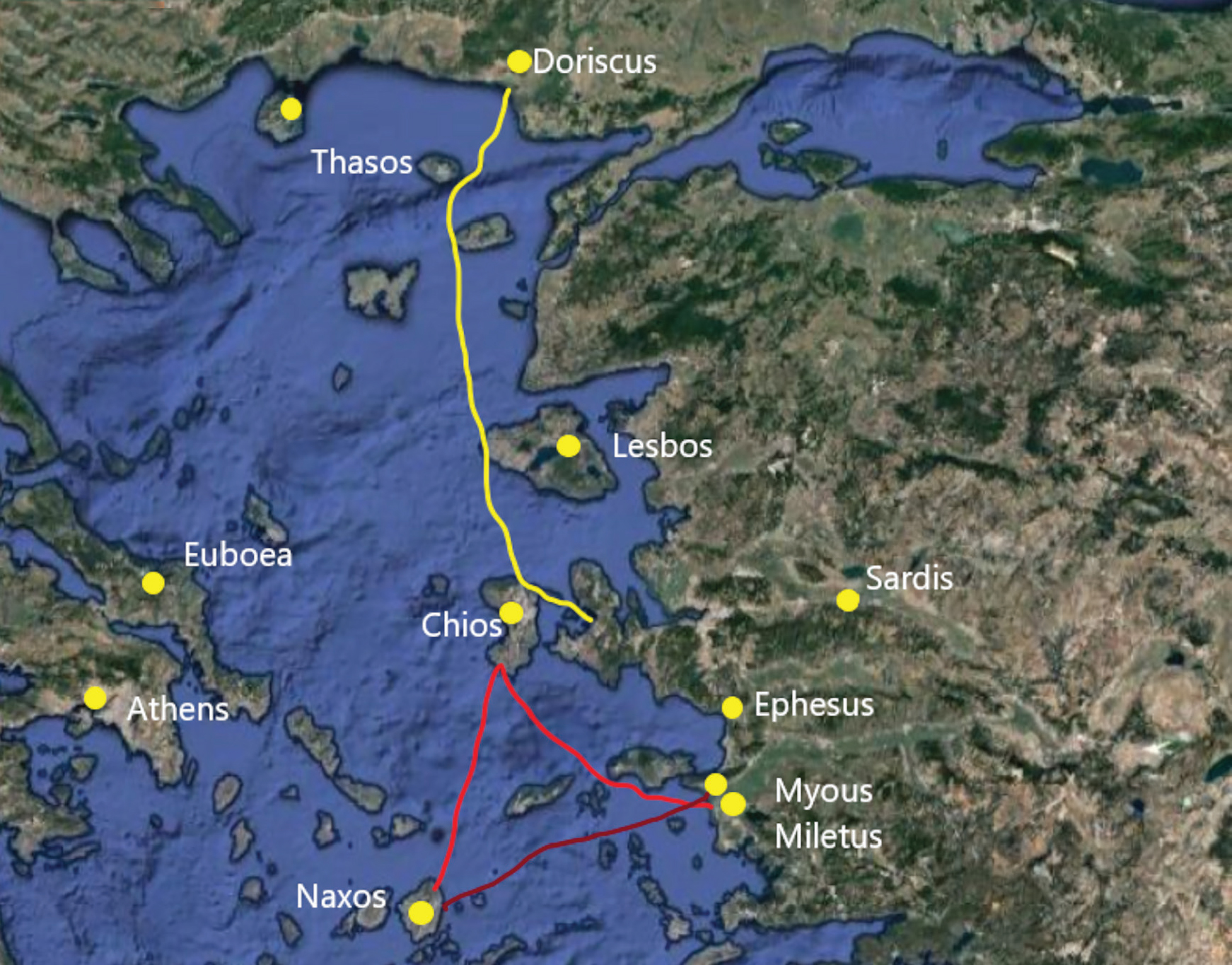
Map 7.2. The operational foreplay. The imperial raid to Naxos (red) and the embarrassing return (deep red) brought the Ionian squadrons at Myous, where they rebelled and subsequently transported the Paeonians from across Chios to Europe (yellow line).
The surprise assault of the rebels had caught everybody sleeping (ibid) and in the panic that followed the taking of the lower city of Sardis, a fire started. Greeks, through Herodotus, attributed it to accident, due to the panic of the inhabitants; a lamp in a household was dropped and started the fire. The Persians preferred another story, that this was done intentionally – a perfect reason to exact revenge and to fraternize fully with the Lydians, who were supposed to rise to assist the Greeks. In truth, it might have been initiated by the defenders as a barrier against the aggressors; in any case, it was due to the Greek attack, no matter what the details – and one should remember that some Ionians might have nourished a grudge against the Lydians, their previous overlords, no matter how light the occupation had been (a subjective assessment, no doubt). The other fact was that the whole lower city was burnt, including the most revered temple of Cybele. The Greeks paid homage to this particular deity and had adopted her in their own Pantheon. Moreover, the burning of temples was considered by them uncivilized, petty and sinful. Arson by premeditation is not unthinkable, but rather implausible on their behalf; the later Persian allegations that they were burning the Greek temples in revenge were pretentious in the extreme (Her V.102,1). They were burning everything for reasons of religious nature relevant to the version of Zoroastrianism forwarded, or rather imposed, by Darius and Xerxes.
On top of an existential insult to the Lydians and a lasting pretext to the Persians, who felt responsible for the outrage against the deity of one of their subjects (Tuplin 2017), the fire had one more reverse effect: it herded the Lydians and Persians of the city so they formed up and presented, ad hoc, a formidable resistance which repulsed the Greeks (Her V.101,2–3); the latter stood no chance of storming the citadel, once its guard stayed put and was reinforced by the lower city dwellers. Knowing that further reinforcements would converge, they withdrew the way they came (Her V.101,3). The city where the satrap was seated being burnt to ciders, even by accident, was a huge blow to imperial prestige and a massive bonanza for the rebels. Before any particulars were made known, the rebellion, fed by the mainland metropolis, had the chance to spread more or less spontaneously. From the unenthusiastic and previously battered Hellespontine region at the north, where some persuasive arguments in the form of the rebel triremes and marines were needed (Burn 1962), to the Carian cities at the south and in Cyprus (Her V.103,2 & 104).
Still, the Persian administration and military power at Sardis was left intact, despite heavy material damage to go with the collapse of Persian prestige; the Greeks had stolen the picture but not the substance. They had no victory to show. As they were retreating, the Persians caught up with them before they had time to get to their ships and leave. They may have not been on to this idea, but their retreat made Herodotus draw this conclusion. In any case, a set-piece battle took place out of Ephesus, the best possible battleground for the Greeks. The Persians of Sardis, their Lydian allies and the reinforcements which converged from the other satrapies perhaps outnumbered but definitely outdid the rebels. Herodotus speaks of a disaster (Her V.102), with the Eretrians losing their general (Her V.102,3) and the Athenians, after the defeat, leaving with no booty (Sekunda 2002) or rather deserting the rebels, never to return (Her V.103,1). It is possible they were recalled by a new, pro-Persian Athenian government (Burn 1962), actively (by a direct decree/order) or by default; the expeditionary period was over and their mandate not renewed. Still, the events that followed show that the defeat was not decisive; the rebels were able to retain the initiative to help the Cypriots and try to interdict Persian reinforcements and onslaughts (Grundy 1901). But contrary to Aristagoras’ assertions to the Spartans (Her V.49,3–4) – and most probably to the Athenians as well – and to the belief of all Greeks, mainlanders and colonial rebels alike, the imperial land forces were not easy to defeat and kill; they overpowered the urgently mustered Hoplites.
The troops sent by Eretria and Athens seem a trivial contribution in terms of numbers but this is but one reading. True, twenty vessels from Athens and five from Eretria, the latter triremes according to Herodotus, the former not explicitly so (Her V.99,1) and thus conceivably pentekonters (Haas 1985), were a very small fraction of the fleets involved. The initially mobilized Ionian fleet consisted of 200 vessels (Her V.31,4) and at Lade, it was a staggering 350 (Her VI.8,2). But they were a hefty 40 per cent of the Athenian fleet, at a moment when the relations with Aegina were once more only just short of open war. The five Eretrian vessels, new technology triremes, were the contribution of an old ally to another, settling a debt from the War for the Lelantine Field (Her V.99). After the rough handling of Chalcis by the Athenian democracy (Her V.77), Eretria must have been a major sea power once again, and definitely the major one in Euboea. It may have exercised influence over several of the Cyclades and its navy may have dissuaded Aegina from further humiliating Athens (Burn 1962).
Once Darius learned of the events, and being aware thanks to his postal service with just a weekly delay, he made several moves, the first being the mobilization of the nearby satrapies. But, possibly without expecting his orders, the near satrapies had already mobilized and ran to the rescue, this implying definitely Cappadocia and possibly Armenia as well. Otanes was also moving to Sardis, and he must be considered as a purely military commander rather than the Satrap of Dascylium. At the same time, Artaphrenes perhaps moved as well against the rebels to besiege Miletus (Plut De Her Mal 24), although this may have been a corrupted tradition of his sending troops to do so, not leading them himself. These troops may have been local levies of his satrapy and/or the troops of the expeditionary force who were demobilized or returning to central Asia and were recalled while on the march.
The second move of Darius was to send Histiaeus to try to contain the explosive progress of the revolt. The timing is uncertain; he may have done it immediately, but he may have thought the uprising a matter of course; he had been quelling rebellions for sport by now, it was the trademark of his reign. Thus, it is also plausible to have reverted to such a move only some years later, definitely after the events at Sardis on which he deliberates with Histiaeus, and because of subsequent, much more negative developments. In any case, Darius had singularly misjudged his man, as Histiaeus wanted exactly this thing (Her V.107); still, perhaps the Milesian vagabond had a number of alternative plans and he was not committed to betraying his benefactor and captor. But arriving at Sardis, understandably, as a senior officer by the King’s Road with a more than handsome retinue, he was confronted, in a friendly chat, by Artaphrenes who told him flatly that he considered him, not Aristagoras, the kingpin of the revolt (Her VI.1,2). Histiaeus perhaps intended to help the Imperials contain the revolt and become thus a hero once more; there was no other, really promising, prospect for him. But caught in panic he made his escape, being well manipulated by Artaphrenes, and thus showed his hand. He had to escape to the rebels, who, of course, really had no intention of receiving him (Her VI.5,1). They hated him for his Medizm, for his tyranny, for his bad breath but they also distrusted him, considering him an agent of the king (Her VI.2,2), as the king himself kept doing (Her V.108,1). The rebels, learned men and travellers, might have been informed of the story of Zopyrus infiltrating the rebellious Babylonians only to betray them to his master (Her III.158) a mere twenty years ago.
Herodotus reports a conspiracy between Histiaeus and prominent Persians at Sardis, who were apprehended and executed after Histiaeus’ messenger betrayed the correspondence to Artaphrenes (Her VI.4). Both the exact content and the timing of Herodotus may be doubted. Indeed, a dissension within the Persian aristocracy is by no means impossible, especially since the previous Satrap Oreites had been eliminated by Darius (Her III.128,5), who later appointed his own brother Artaphrenes. Herodotus implies that the letters to the conspirators were written after Histiaeus had escaped, but this is less probable than the opposite. Thus, Artaphrenes would have not merely been saying that he considered him culpable of treason but would be proving it to be so. The time from sending Histiaeus to the coast under imperial mandate (taken as just after the fall of Sardis) till his execution is six years, and his proceedings among the rebels until his demise, as recounted by Herodotus, do not seem to account for so long a time. This implies a time of sojourn near Artaphrenes, before the latter exposed – or rather trapped – the devious Milesian.
The third move of Darius was to send reinforcement army/ies. Being nepotistic by conviction, Darius dispatched three sons-in-law, husbands of his daughters (Her V.116), supposedly each in command of a separate force, although all three of them moved together as fast as possible, probably following the King’s Road. The event is in doubt; very possibly these armies were the product of the mobilization of the nearby satrapies, as already mentioned. The timeframe is also problematic. Herodotus probably compresses the timeline; he is often accused of doing so almost by choice, as his wording more than encourages such a feeling. The clearest example is the time between the abortive Greek expedition at Tempe, by his own account late spring or early summer of 480 BC (Her VII.174 & 37.1) and the following one to Thermopylae, definitely within August of the same year (Her VII.206); in Herodotus’ wording one tends to believe they were in quick succession (Her VII.175 & 177).
A possible timeline for the eruption
The revolt must have erupted in early autumn, as the fleet had retired from Naxos to Myous, near Miletus (Map 7.2), but was not yet disbanded (Her V.36,4). The weather would have made the Imperials leave before the autumn gales as their supplies would have been dangerously low, being gathered for a rather short border action and not for a prolonged campaign. Such timing allows for the whole winter to be used by the rebels to get organized and find accomplices within the empire; to conspire with the Paeonians; to request assistance mainly, but not exclusively, from their mainland brethren (Her V.38,2) and have it delivered by ship (that is at the opening of the sailing season), plus to instigate Caria, Cyprus and the whole of the Hellespont (Her V.103,2). Darius would have learnt the events in less than ten days from any dispatch, which would have been sent from Myous, Miletus or any other rebellious city by the Persian garrisons and their collaborators through Sardis. This means that if Darius had permanently mobilized or high-readiness forces and could dispatch them immediately, they may have appeared in-theatre by mid to late winter. Any time needed for further preparations by royal forces would move the ETA (estimated time of arrival) accordingly. Satrapal forces were nearer but might still require mobilization.
The season was the most important factor. Although Darius had possibly conducted at least one winter campaign during the year of his consolidation (Holland 2005), it is a given that such proceedings were ill-advised, as transportation would be much more difficult and of greater volume to include provisions of fuel and winter clothing, blankets, tents and footwear, plus the provisioning for man and beast with higher calorie rates per day. For the man, it is always the same, as summer or winter the expeditionary force would draw from depots, be they friendly or non-friendly upon invasion, although at a somewhat higher rate in winter. But the beasts would have to be supported wholly, especially the horses, during a season with no available grass to graze. Thus, winter campaigns do not happen during the Persian Wars, with very few very late autumn – not proper winter – exceptions, as was the siege of Sestos in 479 BC. This was the main idea: initiate the revolt so as to have a whole winter to consolidate, despite some modern scholars believing that during wintertime the Imperials, especially the local authorities, started containment measures such as a prompt attack and siege – or, rather, investment – of Miletus (Grundy 1901) by the local loyalist forces. Even in this scenario, as operational moves are by definition limited due to supplies and weather, the immediate response of the Empire would have been limited and any off-theatre reinforcements, which would have to be mobilized out of season and expeditiously, and would have been relatively few as well. The exception was, as already noticed, the expeditionary force of the Naxos’ campaign, which already could not have been very far away.
This is the time of the Great Escape of the Paeonians. The time is earlier than wished for by the imperial cavalry to feel comfortable giving chase, but at least as late as needed for the fugitives to be able to negotiate the road on foot, and for the Ionian vessels to be able to sail the, understandably short, distance for a mass evacuation, and later for a mass transportation to Doriscus. Still, transporting the Paeonians to the Thracian shore means there was no Persian force worth its name to impede the disembarkation on the spot, although Doriscus (the spot) was a military establishment since the campaign against Scythia (Her VII.59,1). Nor would any other Imperial force, had it been available, be there to intercept the overland march to their homeland. It was as if there were no Persians/Persian forces in Europe.
The Imperial cavalry, which ultimately gave chase while the fugitives were still on Asian soil, had been enticed out of position. Thus, it is in early spring that the rebels attacked Sardis (Map 7.2), burnt it and then retired. Conceivably (Grundy 1901) but not probably, they had already been besieged in Miletus by local, satrapal forces, and with this move, they both outmanoeuvred the mass of the Imperials and compelled them to abort the siege so as to save Sardis (Plut De Her Mal 24).
The news of Sardis, the westernmost Imperial capital, where the Great King himself resided for some time perhaps a dozen years previously (Her V.11,1), being ablaze sets Caria on war footing, and perhaps this was the catalyst for Cyprus as well. There is a tradition that a Phoenician fleet had been intercepted and crushed off Pamphylia (Plut De Her Mal 24), possibly manned by the Phoenicians of the island (Burn 1962). Such a fact allowed freedom of action in Cyprus for the local rebels and for the Ionian fleet in the western waters (Grundy 1901), making a seaward suppression effort impossible for the empire at such an early stage (Burn 1962). How the rescue operations of the Paeonians, this naval battle and the amphibious attack at Sardis are interwoven in a temporal continuum is a tough question, but the naval engagement must have taken precedence as the other operations required naval superiority if not sea dominance and the Phoenicians would have prepared through the winter to launch at the first sign of spring.
The possibility of the Eretrian fleet scoring a blow to the Phoenicians (Burn 1962) must not be rejected. The event is reported to have happened just before the amphibious attack at Sardis and implicated the Eretrian fleet delivering a decisive blow at the Pamphylian sea, the SW corner of Asia Minor, against a Cypriot fleet, (Plut De Her Mal 24), obviously moving NW to intervene in the rebellion and coming from the Phoenician cities of the island who were the closest reliable naval power to the rebellious area. Such an event would have proved that the mainlanders were in for the ride and in quite a capacity and accounted for the disproportionate weight the otherwise minuscule mainlanders’ contribution seems to have made to Darius’ risk assessment (Her V.106,1).
The Hellespontine region may have been more enthusiastic and joined in, or less so and needed to be coerced by an Ionian naval expedition (Burn 1962). In any case, in a little more than six months from the eruption and being in its second calendar year, the rising seemed an unqualified success, stopping at the southern shore of Asia Minor, where Lycia and Pamphylia were not participating – but they might. No real military success had come to date; Lydia, the most powerful prospective ally and accomplice had been alienated by the burning of Sardis (Grundy 1901); an event so beneficial for the Persian cause that one would be tempted to pin it to the most machiavellic Persians.
Early suppression efforts
The withdrawal of the rebels from Sardis must have been the result of the reinforcements converging there. Herodotus mentions three Persian generals, all married to Darius daughters. One of them is Otanes, probably not one of the Seven, nor his son who will partake in Xerxes’ invasion as commander of the Persian home troops, but the one last mentioned ten years before as taking over the command, or rather the army of Megabazus to mop up NW Asia Minor and invade the islands of Imbros and Lemnos (Her V.26). Thus, contrary to some scholars who perceive these three generals as commanding reinforcements from the imperial heartland containing royal troops (Grundy 1901), it might be that these generals are provisional military commanders of nearby satrapies, the two-Hymaes and Daurices probably accounting for the provisional forces converging from ‘beyond Alys’ (Her V.12,1) and Otanes from the neighboring satrapy of the Coast, i.e. the Hellespontine and the Black Sea coast.
Their armies must have included Persian garrisons and fief holders from the local Iranian – or strictly Persian – military colonies (Lazenby 1993) planted in these satrapies plus, conceivably, native troops mobilized by the respective satraps; Myrsus, of Lydian royalty perishes later in the service of imperial forces (Her V.121). This reading complies with some known facts: Darius I, following Cyrus II, had posted a military commander in each satrapy, who must have been responsible for the Persian fief-holders (and other Iranians) planted there. This practice was standard for conquered lands, not for voluntary submission, and thus Miletus, which yielded voluntarily to Cyrus (Her I.169,2) had been exempt before the rising but included in the programme after the suppression of the revolt (Her VI.20). Darius, a staunch believer in the sanctity of family ties, along with most Persian aristocrats and especially the other six conspirators (Her III.84,2), tended to assign this post to members of his extended family. This suggestion implies that the commanders of the individual contingents which made up the army of Xerxes were not the respective satraps, but the generals of the satrapies, although some arrangements had to be made eventually to this scheme.
The timeline of Herodotus, without giving any definite duration for the operations around Sardis, clearly mentions that the Persian reinforcements gave chase, caught up with the withdrawing Greeks outside Ephesus and engaged them; the wording gives the impression of very tight temporal succession, almost immediacy (Her V.102,2). The ‘catching up’ is somewhat disputable; the fact is that the two sides engaged, which means the rebels did not seek refuge behind the walls and might thus have been waiting for this engagement with confidence. It must be noted that the Persians were victorious and the Persian cavalry is not mentioned. Any attempt to reconstruct such a battle is pure speculation and attempts to guess numbers, battle order and succession of events (Ray 2009) are unsatisfactory. Indeed the rebels, including the contingents from the mainland, were soundly beaten; the Eretrians were mauled much worse than the Athenians, having lost their commander. It is the first recorded set-piece battle between Hoplites and Persian line infantry plus imperial subject troops.
Herodotus speaks of a great disaster, but this is mainly to exonerate the Athenian retreat and the refusal for any further assistance until after the battle of Mycale (Her V.103,1). His account (Her V.102,2–3) is exaggerated (Grundy 1901); Ephesus may have been knocked out and ever since not participating in – or even actively counteracting (Her VI.16,2) – the rebellion. It is true that Herodotus never specifically mentions Ephesus as taking part in the rebellion. Actually, when the rebels raided Sardis they left their ships at the territory of Ephesus (Her V.100), not at the port of the city – a note which invites a great Why. The assault force took guides from Ephesus (ibid) but there is no direct mention of Ephesian troops rallying under the standards of the rebellion and boosting the numbers. Even when joining battle with the Persians, it is not mentioned specifically that the rebels were admitted within the city walls before or – and this is important – after their defeat. Herodotus simply states that the defeated fled to their cities (Her V.102,3). A really laconic and out of context later comment is clarifying that the Persian victory sent the rebels running to their ships (Her V.116) and obviously this was their exit strategy which allowed them to return to their different countries and cities (Her V.102,3).
Athens did exactly the same – extracted her troops back home. The defeat was a perfect pretext for what must have been a new, pro-Persian if not actively medizing government, possibly of Cleisthenes’ medizing party (Grundy 1901). It might have held sway until 493 BC or so, as heavily fining a tragic poet for causing guilt and consternation to the Athenians for their treason of the Ionians (Her VI.21,2) is only understandable under this light. On the other hand, both the Athenians (Grant 2012) and the Ionians (Grundy 1901) were thinking that their Hoplite prowess was eminently superior to the effeminate oriental battle practices and the result of the battle woke them up to most unfortunate prospects (Grundy 1901). The former retired in haste across the Aegean and the latter made preparations for mass evacuation to one refuge or another, considering Sardinia, the island of Leros and finally Myrcinus, the fief of Histiaeus in Thrace. The latter implies the place was considered at the time a safe haven from the threat of the imperial forces (Her V.125). The operations continued for quite some time, actually almost four years if not more, thus the Persian victory was not decisive. There is another indication, rather conclusive: after their victory, the Persian generals divided the theatre of operations and each took over an area, but one of them, tipped that Caria revolted, turned his attention there (Her V.117).
This particular development shows clearly a number of events and associations: the Sardis expedition was within the same expeditionary period, despite the somewhat hazy timeline of Herodotus. Some scholars (Grundy 1901) firmly believe that the division of the rebellious areas among the Achaemenid generals and the suppression missions took effect after one more year.
Caria revolted after the battle of Ephesus (Her V.103,2), which was a clear Persian victory. Thus the rising happened after the news of the burning of Sardis, possibly a bit exaggerated, had time to get there and sink in. The Ionian victory at Sardis, no matter how insignificant, primed the Carians and the defeat off Ephesus was not important enough to make them reconsider; alternatively, they might have rebelled before the battle occurred, or, as noted above, before the news of the battle came to the attention of the citizenry. Thus, one of the Persian generals, Daurices, was diverted to quell Caria. Most probably the Hellespontine region had rebelled before the battle of Ephesus, with some persuasion from the rebel fleet, and Caria after it. The Achaemenid general assigned to the Hellespontine region had been diverted to assist the threatened satrapal capital, Sardis, which had been left exposed perhaps due to an early attempt of its home troops against Miletus. This allowed the rebels to ignite the rebellion at the Hellespontine region, which was also bereft of troops. Once Sardis was safe and the rebels soundly beaten on land, Otanes remained in the vicinity while his colleagues from further east were diverted to operate at his original, wider area of responsibility. Actually, the Hellespont was the theatre of much more intense counterinsurgency than Ionia and Aeolis, the core areas of the rebellion, at least during the opening Persian moves.
The Carians were soundly beaten by the army of Daurices that descended upon them, leaving his campaign at the Hellespont unconcluded. This was another field victory for the Imperials achieved without any mention of cavalry and with the Persians advancing confidently and crossing a river before attacking the lined up Hoplites (Her V.119,1). This is in stark contrast to Mardonius’ skulking behind a river in Plataea, 479 BC, and expecting the Greek Hoplites to cross and attack him (Her IX.40). The defeated Carians retreated in despair (Her V.119,1), but were reinforced by Ionian forces, especially Milesians, gave it another try but were again decisively defeated (Her V.120). Although once more the effort to recreate the battles is unconvincing, the proposal that after these brilliant results the Persian commander tried to seize the opportunity, invade Caria and perhaps subjugate it anew before the rebellion became stabilized there is persuasive (Ray 2009). But this time his confidence, maximized by the string of three battlefield victories, took him into the jaws of defeat. A night ambush by the remaining Carian forces practically exterminated his command, himself and his colleagues – or lieutenants – Amorges and Sisimakes (Her V.121). Ray (2009) believes that a healthy fraction of his troops survived but this is debatable after a night action in a foreign, hostile country without many friends around. On the other hand, it is indeed possible that a bait of some kind, as later in Salamis, was used to lure the Imperials into a careless advance (Burn 1962), as they usually refrained from night operations but for the most expedient cases, as with the night flanking manoeuvre of Hydarnes in Thermopylae (Her VII.215).
If one reads Herodotus without prejudice, the conclusion might be that the campaign of Daurices in Caria took place in the next expeditionary season than the battle of Ephesus, with Daurices reinforced by the other two Persian commanders previously mentioned (Her V.121). The participation of Myrsus, Lydian royalty and obviously a loyalist, means Lydian satrapal levies were included in this task force, which is weird, as the Satrap Artaphrenes would have good use for these troops in-theatre. It is possible, but highly improbable, that Daurices was the military commander of Artaphrenes’ satrapy (and thus the commanding officer of Myrsus), leaving Otanes for the same role at Dascylium and Hymaes at Cappadocia. This makes for only one army group coming from beyond Halys to succour Artaphrenes in the first phase of the revolt. Of course, there is also a possibility that Amorges and Sisimakes were, in fact, satrapal generals from further east in Asia Minor who came to the rescue and not Daurices’ lieutenants.
Herodotus’ narrative at this point captures most probably two (Ray 2009) but conceivably three years of the Ionian revolt. There are three other lines of events that may have developed simultaneously and desperately need some kind of alignment. The first is the revolt of Cyprus (Her V.104); the second is the fate of the protagonists, Histiaeus (Her VI.30) and Aristagoras (Her V.126,2). And the third is the developments in the peninsula of Helle, the fiefdom of Miltiades, and the expedition of the Scythians in these territories (Her VI.40).
Cyprus: a decisive sideshow
The revolt of Cyprus must have taken place before the battle of Ephesus (Her V. 108). Instigated by Onesilus of Salamis, younger brother of the steadily pro-Persian King Gorgus whom he deposed without exterminating (Her V.104,2) – a common but lethal mistake of the insurgents (Her V.38,1 & VI.9,2–3), it spread throughout the island. Salamis was situated at the heart of the eastern bay of Cyprus, and the rebellion was countered by the Phoenician cities of the south/southeast, Amathous reportedly (Her V.104,3) and Kition probably (Burn 1962). The imperial force tasked to suppress it was mustered under Artybius at Cilicia and crossed to Cyprus on Phoenician vessels (Her V.108), most probably by landing to Kerynia at the northern side of the island, to outmanoeuvre the Ionian fleet sent for assistance (Her V.108,2). The latter was probably patrolling off Salamis, the epicentre of the revolt of Cyprus, as was the case with Ionia, where the fleet was assembling at Miletus. As a result, the Persian army had to cross the mountain range of Pentadaktylos to approach Salamis and make contact or relieve Amathous (Burn 1962).
The satrapy of Phoenicia must have contributed vessels, marines and crews but not land forces; still, Persian troops stationed there might have been mobilized and participated. The forces of Cilicia, Persian and native, must have been the backbone, under Artybius, who must have been the general of the satrapy, as Cilicia was self-governed by the local Syennesis line of rulers (Her V.118,2). It should be noted that Behistun does not mention Cilicia as a satrapy; nor Phoenicia; the latter must have been included either in Arabia or, less probably, in Assyria. It is not very clear which timeframe of the Persian state is commemorated in the list of Behistun, but 23 lands are mentioned while Herodotus mentions 20 satrapies returning taxes plus Persis, and Xerxes’ army included 29 commands based on territorial muster and conscription.
Irrespective of the exact administrative background, the possibility that Artybius led an imperial relief force coming from the heartland of the empire to quell the rebellion in Ionia or Cyprus (Grundy 1901) cannot be dismissed either – and local forces might well have been herded to enhance it. The imperial officers had recruited subject militias massively to boost the numbers of crack Persian troops (Her V.110), a clear precedent of Marathon and possibly a standard operating procedure for the imperial administration. Loyalist troops in Cyprus might have joined, but not necessarily so; they were the militia of one city only (Her V.104,3) or, at most, of a few plus some exiles from the other cities and the rebel army might have been positioned so as to interdict such moves. It is important that once more there is no mention of Persian cavalry, but for the mount of the commander (Her V.111). In Cilicia, there was a special cavalry division of Rapid Deployment Force character (Her III.90,3) but probably it could not be readily transported; this must have been the reason for the later design and construction of horse-transports by the imperial shipwrights (Her VI.48,2), as in Cyprus the local chariotry (Her V.113,1) may well have been the only cavalry force of any consequence (Burn 1962).
Artybius crossed and disembarked his army uncontested, before any intervention from the rebels. But an intervention did occur, although belatedly. An Ionian fleet of unknown size appeared, took some counsel with the natives (Her V.109), engaged and defeated the Phoenician navy (Her V.112,1). The latter, after having disembarked the invasion force, sailed round the NE promontory of the island probably, to approach Salamis. Its defeat and rout left the Persian land army stranded on the island and set the stage for a spectacular disaster for the Imperials. The early demise of the invading general during the decisive clash by the hand of the rebel commander (Her V.112,2) advanced this possibility. Alas, a massive defection turned the tables (Her V.113,1). It was initiated by the chariotry of Salamis proper (Her V.113,1) showing the pro-Persian sentiments of the upper class, evidently friendly to and aligned with the deposed Gorgus. They were swiftly followed by the contingent of Curium (Her V.13,1). The rebel host was disintegrated. The victorious Ionian fleet left in the wake of the decisive defeat of the land army (Her V.115,1) or due to the more or less spontaneous submission of Salamis, once Onesilus and his supporters had been beaten and killed in battle (Her V.113,2) and the Salaminian loyalists, surviving from the battlefield, returned home uncontested.
This development must have been interpreted by the Ionian fleet as a good reason to retire to its home ports and bases (Burn 1962). Thus the naval supremacy was forfeited by the rebels and the vanquished imperial navy resumed operations to support the victorious land army and the replacement of Artybius, never mentioned by name, possibly reinforced from the Asian mainland, was able to reduce the isolated cities one by one with siege warfare. Of course, any number of Cypriot cities must have capitulated readily and were not stormed (Her V.115,1). The end result was that Cyprus was reconquered rather fast; Soloi, the most reliable and eager ally of Onesilus, its contingent being deployed along with the Salaminians against the Persian division of the army of Artybius (Her V.110), was the last city to be reduced. It withstood a siege for five months, but eventually fell (Her V.115,2). Conceivably the successful Persian sieges were simultaneously carried out against a number of cities in order to finish with the rebellion in Cyprus as fast as possible (Her V.115,1), thus accounting for a full campaigning season to pacify Cyprus (Her V.116,1) but no more than that.
The (lack of) use of Cilician shipping during the campaign, which featured prominently in the invasion of 480 BC, is as weird as the silence on the subject of Cypriot fleets, which were even more prominent in the 480s. The former was smaller than the Phoenician one, but could have provided most welcome assistance and was in-theatre from the first moment. Perhaps its size made Artybius wait for the main, Phoenician naval force and then the Cilician contingent was never mentioned even if participating. For the Cypriots it might have been an issue of managing manpower; the need for troops on land might have undermined their ability to man their fleets, or such fleets may have been underdeveloped or politically unavailable if skippers and owners were loyalists which is the most probable interpretation. The question is the Ionian fleet. It represented a massive effort in terms of human resources with 20,000 mariners required for the manning of 100 vessels. If the operations in Cyprus unfolded simultaneously with the battles of Ephesus or the events in Caria, the rebel land forces would have been depleted or, at least, lower than standard. This would apply to the field armies and to the garrisons defending the walls of the rebellious cities.
The joker and the schemer
On the subject of the instigators, Aristagoras must have been killed in action after the battle of Ephesus, while trying to secure the European fief of Histiaeus (Her V.124,2), against the natives’ bitter resistance (Her V.126). The effort was to secure a refuge, since the land operations looked like a huge disappointment. At the same time, Histiaeus must have been nearby. His usefulness for Darius, a master in quelling and suppressing revolts (DB 52–4), would have been early after the onset of the rebellion, to allow for imperial mobilization and to contain the spread of the revolt. Alternatively, he would have been invaluable if the immediate containment efforts had failed and things were going sour. The latter version implies that he was dispatched after the fall of Sardis and the disaster of Daurices and supports the suggestion of a Babylonian revolt at this approximate time, instead of shortly before the campaign of Xerxes in Greece (Gertoux 2018), as it would account for the inability of the Empire to send more household troops.
Histiaeus was an important imperial official, on a grandiose mission (Her V.106), thus he must have had with him a considerable retinue, especially a bodyguard. Once at Sardis, Artaphrenes challenged him, but at this point, Herodotus’ timeline must be off: Histiaeus was a brilliant opportunist and wily plotter and would not have been uncovered that easily. Possibly he had a dispute with Artaphrenes over his mandate and the latter’s inadequacy in preventing and containing the uprising. The issue is recurring, as Aristagoras’ troubles with the imperial administration started in a similar way (Her V.33,4 & 35,1), over the specifics of the chain-of-command shared between a foreign dignitary of high status within the empire and a Persian and member of the extended family of the monarch (incidentally, Artaphrenes’ nephew). Histiaeus must have sent letters to prominent Persians (Her VI.4,1) while he was still at Sardis, not after he had escaped. His intention must have been to introduce himself as the supreme commander in theatre, Karana, and call for their support, acceptance and loyalty based on the imperial mandate bestowed upon him. Artaphrenes must have executed without trial everybody sympathetic or responsive to such a call (Her VI.4,2). Subsequently, Artaphrenes accused the isolated Histiaeus of conspiracy. He was not guilty, but would have no chance to prove his case, nor a hearing by the king; and so he changed sides (Her VI.2,1). His capture and death occurred after the fall of Miletus (Her VI.28–29), thus he was active in the vicinity of the Bosporus for quite some time (Her VI.26), perhaps counted in years.
What were his actions? He tried of course to assume the leadership of the rebellion, or at least to participate, but he failed. He failed at his city, where his character, beliefs and allegiances were known, and in other rebel fortresses and bases (Her VI.5,1–2); but he was accepted in Lesbos (Her VI.5,2), with territory lost repeatedly to the Athenians and then conceded to the empire by Hippias, as was the Sigium (Her V.94,1). From there he raised a buccaneer squadron of eight triremes and moved to the Bosporus, to control the exit of the straits, commandeering the vessels passing by and thus creating his own fleet (Her VI.5,3). This is a safe sign that at least the European, if not both sides of the straits were controlled by the rebels. Once Miletus had been sacked, Histiaeus sailed to and besieged Thasos (Her VI.28), hoping to get both plentiful resources from the gold mines of the islanders located on the mainland (Her VI.46), and an island refuge in case things became even worse in Ionia. These were exactly the thoughts and course of action of Aristagoras, which means that Histiaeus was the schemer who devised the contingency plan followed by the latter.
Histiaeus’ presence with his fleet at Lesbos, while the epicentres of the action were Miletus and the Hellespont (Her VI.288,1), leaves some questions unanswered. Once gone rogue, he wanted to atone or to betray the revolt to Darius and be pardoned? Most probably he played double jeopardy. Though, in his effort to secure supplies, he raided the shore just opposite Lesbos, where a considerable Persian force was operating under a certain Harpagus who is not mentioned before (Her VI.28,2). The objectives of this imperial force are open to speculation. Perhaps, although the Imperials were around Miletus, this force was keeping in order the re-conquered Hellespontines and thus Harpagus may have been the successor of Hymaes (Ray 2009) who had died of disease earlier (Her V.122,2). Harpagus was victorious in the clash with Histiaeus’ private army; in this case, Herodotus specifically reports that it was the cavalry, returning in the nick of time, which won the day for the Imperials charging the already engaged Greek phalanx (Her VI.29,1). Herodotus’ wording is very specific and makes a good listener or reader curious as to where this cavalry had been in the first place and whether it was under the command of Harpagus or was an independent command which operated nearby at the time and thus Harpagus’ command may be understood as deprived of cavalry. Histiaeus was taken alive, but once in custody, Artaphrenes and Harpagus murdered him to make sure there would be no pardoning by Darius (Her VI.30), nor any uneasy versions of previous events presented to the monarch.
The Scythian connection
The most important issue of that time, and the least understood or known, is the whereabouts of Miltiades; in this issue, the haze of time and lack of sources is exacerbated by the bias of Herodotus. Still, there are some facts: Miltiades suggested the destruction of the bridge at the Ister and the Scythians had requested with envoys to the Ionians exactly that. It is more than probable that Miltiades had contacts with the Scythians, at least with their envoys and his proposal was actually a suggestion to conform to their plan. Even if that occasion had been their very first encounter, which is dubious, the resulting understanding and the common objectives suggest that they established a relationship. When Darius crossed to Europe, some or other Ionian would have tipped him off about Miltiades’ proceedings, if for no other reason than to demonstrate his own loyalty, reliability and allegiance and reap the imperial gratitude which was always a reliable prospect (DB 63). Histiaeus would be the most probable such agent, but Miltiades considered a Parian, Lysagoras (Her VI.133,1) as the culprit, long after Histiaeus was dead.
The Scythian campaign had been an unqualified disaster (Grundy 1901) as the Persians were continuously sending expeditions or feigned expeditions to Thrace (campaign of Megabazus and Otanes shortly after 513 BC; feigned campaigns of Megabates and Aristagoras in 500 BC. The Persians would set course to Thrace, for example, and then midway turn west to take the islanders unsuspecting. It was a disaster, no matter how many new territories were added to the empire – or were claimed to have been occupied by the Empire – the objective was not realized, the Scythians remained impervious to imperial lessons, the imperial prestige was tarnished and the casualties were significant. The retirement of Darius’ host induced an avalanche of defections and revolts, with the bridge over the Bosporus being destroyed – or the infrastructure for its forming compromised – by the locals, who suffered severe retribution later by Otanes, the general of the Hellespontine regions (Her V.27,2). Darius thus had to cross from the Hellespont (Her IV.143,1), squarely in Miltiades’ fief. Was there an understanding? Or was it precisely at this point that Miltiades became exiled from his fiefdom, and possibly found refuge (Burn 1962) at the court of his father-in-law, King Olorus, in Thrace (Her VI.39,2)? It is a given that after the fall of Miletus Miltiades returned, or migrated, to Athens with most of his personal belongings and retainers in four triremes. Although he had some loss, starting with five triremes, which is at least 1,000 sailors and most likely many more boarders, as he had been maintaining a personal bodyguard of 500 (Her VI.39,2) says a lot for his affluence. One vessel was captured by the Phoenician navy and the captain, a son of Miltiades, was brought to the king’s presence. Instead of revenge on a proxy, Darius actually turned the man into a prominent vassal, probably at the instigation of the Peisistratids, who had previously profitable understandings – and undertakings – with his father (Burn 1962). It follows that Miltiades retained considerable resources when returning to a city owning, or able to mobilize, only fifty galleys as a state fleet, whatever the definition of state fleet at the time. What happened between Miltiades’ self-exile to Thrace and his escape to Athens?
After Darius’ return to Asia, the Scythians returned the favour to the empire; they crossed the Ister and invaded south, all the way to the Hellespont. Herodotus narrates that Miltiades ran into exile to avoid their onslaught, and returned to his seat after they retired. Perhaps he genuinely understands it to have been so and it is not due to his bias, but it is difficult to believe this as the facts do not add up. First, how, after his expressed intention to destroy the empire and the king’s person, had he been left in charge of his fief, when Megabazus and Otanes were either pacifying or conquering the region(s) anew (Her V.1–27)? Second, how exactly did the Scythians cross the Ister? Had they had the means, they would have done so to pursue the Persian host, not wait a decade or so for a punitive expedition. Third, Miltiades was the one Greek who they would NOT brutalize, nor his territory; he had the guts to play by their plan and they knew it. Failure to see it to fruition was not his fault; on the contrary, he suffered retributions by the Persians. And fourth, when exactly did these events unfold?
A much more logical reconstruction of events is as follows: Darius is tipped off about Miltiades’ intentions and the latter escapes even before Darius crosses back over the Ister, or shortly afterwards. Darius cannot cross from the Bosporus back to Asia due to rebellions, possibly erupting in concert with the Scythians, which implies Miltiades had an even more focal role in the events. These rebellions, especially at Byzantium, do not allow safe embarkation of the imperial troops to the fleet and/or local vessels; thus Darius advances W-SW to the Helle’s peninsula, invades Miltiades’ fief, from where his fleet performs the crossing of the army uncontested and unmolested.
Miltiades of course has fled to his father-in-law, in Thrace. This implies the imperial control did not include the whole of Thrace, not even in a nominal form. There, Miltiades remains in (self-)exile, while his territory is absorbed into the empire. Moreover, the empire stages its punitive expeditions of Megabazus in Thrace from this base, at least until securing, in conditions of utmost urgency, another staging point with facilities allowing transportation and billeting of troops, Perinthus (Her V.1). It is Miltiades who comes to an understanding with the Scythians so that as they invade the necessary means to cross the Ister might have been supplied by Miltiades’ collaborators in Thrace or rebellious cities of the Black Sea region upon the explosive phase of the expansion of the Ionian Revolt, in 498 BC, after the burning of Sardis. The Scythians had overrun the Persian Thrace down to the Hellespont and were contemplating how to cross it and invade Asia. They do not find any solution, their supplies dwindle so they pack their spoils and retire. Consequently, the Persian occupation in Thrace and Europe is no more, except for some fortified positions, as is Doriscus, and Miltiades is restored, not because the Scythians had retired, but because they destroyed the Persian power base in the area and the peninsula of Helle was free of the imperial yoke once more.
This Scythian raid and attempt to invade Asia from the Hellespont, which meant utilizing Hellespontine vessels, must have been timed with the Ionian revolt, or slightly after its eruption, as Miltiades, a personal enemy of Histiaeus, most probably had no clue of the conspiracy. The Scythians needed little in terms of preparations. Thus, the rise of the Hellespont created a very flammable situation for the Persians: the Scythians were roaming through their new conquests and showing every intention of invading Asia. The Ionian fleet had appeared nearby instigating revolt and offering transport services to the Paeonians from Asia to Europe. Such transport services might become available to the Scythians in the opposite direction. This prospect is the only rational explanation for the actual prioritization and division of tasks among the three imperial task forces after saving Sardis and beating the raiders near Ephesus: two out of three were delegated to the Hellespontine region, and the third embarked on a very conservative disciplinary campaign, almost timid. The two forces in the north were attempting to seal the Hellespont against any Scythian seaborne invasion and one of them was diverted to the south due to the rebellion in Caria, which could arouse the whole southern coast of Asia Minor, possibly all the way to Phoenicia, thus cutting the strategic supply line through Cilicia and destabilizing the whole western part of the empire.
The Persians were mostly successful, as the rebellion was contained in the south and suppressed in the north. The Scythians, unable to cross, retired, but the European territories of the Empire, the Skudra, were no more. Miltiades returned to his fief, according to Herodotus, three years before his final expulsion (Her VI.40), meaning between 497 and 496 BC. Histiaeus, who might have attempted to assist the Scythian crossing, had no trouble sailing up the Hellespont (the Asian coast being perhaps under imperial control due to Daurices, the European under the rebels) and made camp near the Bosporus for quite some time, commandeering – or arresting/ mustering/ seizing, words are a matter of perspective – vessels coming from the Black Sea to Propontis, mostly merchantmen (Her VI.5,3). His ulterior motive must have been to prepare for another attempt to mass transport European troops to Asia; conceivably from his fief in Myrcinus, had Aristagoras not made a mess (Her V.126) of his instructions, or a new wave of Scythians. Alternatively, it might have been to be ready for a mass migration of the Ionian Greeks to Europe. In any case, the rebellion continued for some years, with Miltiades giving the example in Europe while some bases of the Empire, such as Doriscus, were holding out but without any spectacular result in re-establishing the Imperium at these lands; it was perhaps this failure and caution instead of aggressiveness which later prompted Xerxes to replace the respective commanders (Her VII.105).
Epilogue
The events narrated previously may have been developing from 499 BC (the year of the rebellion) to 497 BC at the latest, if the night ambush in Caria happened during a second campaigning season of the Persians. After this disaster, the Persians are no longer heard to operate in Caria and the Carians to partake in the rebellion (Grundy 1901). Histiaeus’ capture dates perhaps in 493 BC. The battle of Lade, with the imperial fleet facing and, after initiating a mass defection, annihilating the rebel one (Her VI.14–5) is usually considered as taking place in 495 BC but more probably in 494 BC, with the siege and fall of Miletus following suit in the sixth year after the eruption of the rebellion by Aristagoras (Her VI.18). The massive mopping up which swept the rebellious islands of Lesbos and Chios and the Hellespontine region was undertaken by the victorious Imperial fleet during the next campaigning season (Her VI.31 & 33), probably during the year 493 BC, to be followed by the expedition of Mardonius in 492 BC (Her VI.43). This means at the very least a two-year lapsus in the Herodotean narration of the Persian operations. It may be surmised that at this time the Carians were effectively withdrawn from the operations – perhaps under a separate treaty (Grundy 1901). The same must be understood for several Ionian and Aeolian cities, including Ephesus (Burn 1962; Grundy 1901), which was unspoiled, and Kyzicus (Her VI.33,3). The Asian coast of the Hellespont and much of the Propontis were already suppressed once more into bondage (Her V.117 & 122), although Miltiades was keeping the fire of the rebellion kindled at the European coast of the Hellespont and Histiaeus was operating in the vicinity of the Bosporus.
Herodotus reads rather confidently for his timelines up to the ambush near Pedasus and is certain since the campaign of Lade. However he realises that something is amiss in between and keeps providing temporal points through the story of Miltiades (Her VI.40,1) and the total duration of the Cypriot revolt (Her V.116) as well as the duration of the insurgency from the rise to the fall of Miletus (Her VI.18). Modern scholarship deals with this very thorny issue by supposing that the chronicles of one or two missing years were lost to Herodotus, or that Herodotus’ timeline, accounting for two years, is compressed and the events of the first phase should be understood to fill up to five years (Grundy 1901; Burn 1962); alternatively, that the disaster in Pedasus required another imperial army which took some time to be raised (Grundy 1901).
But reshaping and reshuffling Herodotus, especially when he insists he knows accurately something, is a questionable practice. It is more probable that something happened and caused that lull in the operational tempo of the empire. If the Babylonian archives mentioning Xerxes as king count his time as co-regent as regnal years, the respective events must be predated by the years of the regency, which are 11–12 and the two Babylonian revolts attested for the beginning of his reign actually took place during his regency, long before he became king, perhaps in 496 BC (Gertoux 2018). These uprisings may have been the consequences of the imperial reverses in the efforts to suppress the western uprising or direct results of the revolt per se as it was spreading from the far west to the Levantine areas. This conflagration at the heart of the empire accounts for a lull in the western front and the observed lack of westbound imperial armies as the flow of forces was interrupted in Mesopotamia and the available reserves were redirected to the much more vital central sector of the empire.
When the Babylonian uprising had been resolved, imperial forces were freed and promptly dispatched to the west. Up to then, the suppression must have been assigned to more or less local forces mobilized by the neighbouring satrapies (Her V.102,1) and not imperial troops as suggested by some modern scholars (Grundy 1901). This theory explains the consternation of Darius when conversing with Histiaeus (Her V.106,1) and the latter’s dispatch to the western theatre. Darius, a seasoned counter-insurgency veteran sounds vexed with the events as he should not have been, had there not been some serious complications. Nor should the appearance of a few thousand mainlanders (Athenians and Eretrians) been of consequence. But the obvious Athenian tendency to export their mischievous political system was leading by default to rebellions that may have spread in the realm like a wildfire. The latter coincided with the prospect of a Spartan invasion from the west (Her VI.84,2), as a consequence of their proclamation to Cyrus (Her I.152,2–3), followed by a pact with a clause for a Scythian invasion either in Central Asia (Her VI.84,2) or through the Dardanelles (Her VI.40,1). Were all these meticulously planned and executed or spontaneously happening while a Babylonian uprising erupted? Darius had no way to tell and the sum, real or prospective, was another thing altogether, a worst repetition of the multiple fronts of 521–519 BC (DB 16–30).
Once the Persians destroyed the rebel fleet and razed the rebel base at Miletus (Her VI.18), they took a year to recapture the major islands (Her VI.31) and the Hellespontine cities (Her VI.33,1) in a brutal campaign of reprisals (Her VI.32) by their mostly Phoenician navy (Her VI.41,1); reprisals that might have been rather selective, though, in terms of class, person and/or clan (Burn 1962). Most, but by no means all, of the affected areas were at the European side, as Hymaes and Daurices had already reduced (most of) the Asian coast (Her VI.33,1). Still, Herodotus’ description of the fate of Kyzicus (Her VI.33,3) implies that not all the Asiatic coast had been pacified. In any case, the Phoenicians stopped only due to their mystical terror of the Black Sea, refraining from a pursuit of the Greek fugitives into the bosom of the Euxine (Her VI.33,2).