
Chapter Ten
Storm’d at with shot and shell,
Boldly they rode and well,
Into the jaws of Death,
Into the mouth of Hell
Alfred, LordTennyson
Mid-morning, 28 November. Hamhung, Northeast Korea.
From a distance, the bundled-up men slinging packs and equipment onto truck beds, then clambering aboard themselves, looked like US marines. On their feet were the high ‘shoepac’ winter boots; they were clad in the bulky, knee-length khaki parkas; and slung from their shoulders were: M1 carbines, M1 Garands and BARs. But a distinguishing feature stood in the tactical drabness: Under the parka hoods peeped green berets. Drivers gunned engines; gravel crunched; then the long convoy – twenty-two trucks and one weapons carrier – jolted off. 41 Commando was moving out.1
The commando, 235 strong, had arrived at the northeastern Korean port of Hungnam from Japan on 20 November, then proceeded 8 miles inland, to the industrial city of Hamhung. A rear-party stayed in the city: 217 men would move up to the front. Now, they were en route to join their American brethren, the powerful, 13,500-strong 1st US Marine Division, or 1st MARDIV.
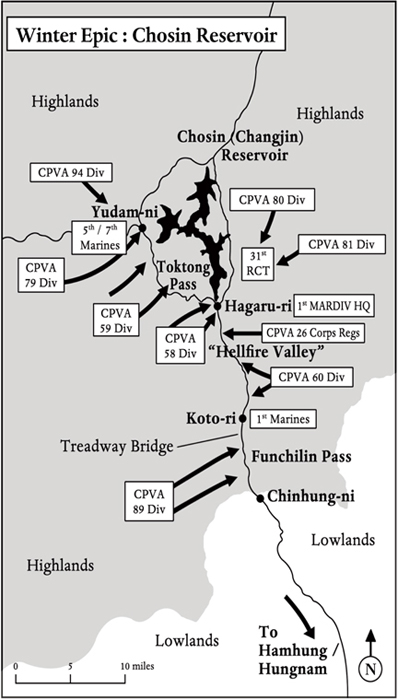
The US marines, following the Inchon and Seoul operations on the west of the peninsula, had been re-embarked and landed for operations in Korea’s northeast. This was the province of X Corps, separated from General Walton Walker’s 8th Army in the west by Korea’s mountain spine. The commandos were to take on a specialised role: They would join X Corps’ spearhead, 7th Marine Regiment at Yudam-ni, as a reconnaissance unit screening the Americans as they advanced northwestwards over mountain tracks to link up with 8th Army.
Having enjoyed Thanksgiving, some of Lieutenant Colonel Drysdale’s men were expecting combat to sputter out. ‘A few stray guerillas’ was what Corporal George Richards had heard of expected enemy. ‘We wanted to be in at the kill,’ said Lieutenant Peter Thomas. ‘Like so many wars, it was, “Home by Christmas, boys!” This was the last operation before the collapse of North Korea.’
Not everyone was gung ho. ‘I enjoyed the commando raids but had misgivings about going in as infantry and being involved quite heavily,’ said Marine John Underwood. ‘I had a different mental attitude.’ Underwood’s CO also had (private) doubts: Unconvinced by victory forecasts, Drysdale had anticipated, just five days previously, that his men would be embroiled in ‘a long and very unpleasant winter campaign’.2
Still, morale was high. 41 Commando was the only non-ROK, non-US unit in X Corps. As their convoy left Hamhung, GIs outside the city shouted, ‘Who are you? Turks?’ Commandos yelled back identifying themselves.3 Soon, the factories, warehouses and railway yards were behind.
They were heading away from the sea, the customary refuge of marines. The road took them through the skeletal orchards of the agricultural lowlands – much of it churned to a morass by vehicles – then, some 30 miles from the coast, began a steep ascent to the snow-covered highlands, 4,000 feet above sea level. This was where 1st MARDIV was deployed around Chosin Reservoir in Hamgyong, the Korean province abutting Siberia.
* * *
The high country of Hamgyong is the peninsula’s most forbidding landscape.* Here, the bones of Korea – ‘the dragon’s back’ – break through the land’s crust and climb skyward in their most dramatic fashion: Viewed from the sea, the great grey mountains present a castle-like wall. In summer, Hamgyong’s highlands are a sparsely populated, alpine landscape runnelled by crystal streams, roamed by deer and over flown by eagles. In winter, the terrain is unearthly: A moonscape of frigid rock and frozen water, scoured by bitter, 35 mile per hour winds whipping up blizzards from Siberia.
The area’s reputation dates back to the Dark Ages. 1st MARDIV’s rear echelon at Chinhung-ni, the township squatting at the base of the high country, was the limit of exploitation of a sixth-century warrior king whose conquests laid the groundwork for Korea’s unification: Advancing from the south, Chinhung prudently halted his march at the foot of the highlands.4 More recently, Hamgyong was where the Japanese were rumoured to have carried out atomic weapons research during the Second World War.
It was a fitting location for such activities, not just due to its isolation, but because the height of the reservoir, deep inside the highlands, made it ideal for hydro-electric generation. The mighty pumps of three turbine stations had supplied fully one third of the electricity generated across Hirohito’s empire, feeding the hungry factories in Hamhung which were, by some accounts, the largest industrial complex in East Asia. Because of the war, these facilities now lay abandoned. They were also glittering with frost and dusted with snow, for on 14 November, a cold front had descended. Temperatures after dark plunged to minus 24 degrees Fahrenheit.
Past Chinhung, 41 Commando’s line of vehicles shifted gear as they laboured upwards. As the altitude increased, the temperature dropped. On the open trucks, commandos huddled into parkas, but the bitter winds, glaciated with snow flurries, lashed their faces.Icicles of mucous dangled from nostrils; lungs were seared; back teeth ached. Numbed men shivered – and not just from the cold. Beyond the lurching tailgates of their trucks, the frosted lowlands, dotted with villages and towns, spread under the gaze of awed commandos like the map of a winter fairytale.
Soon, however, the vista was lost, obscured by soaring granite shoulders as the track wound round ‘switchbacks’ – crescent-shaped hairpin turns curving round the mountain contours. The convoy was now crawling under battlement-like ridges, for this was the 10-mile pass that guards both the highlands: Its name, Funchilin means ‘Yellow Grass Pass’ for from here on, the weather is so extreme that green no longer appears. The road itself was enough to turn a driver’s hair grey. On one side, it was overshadowed by rocky cliffs and slopes, stubbled with scrawny fir saplings; on the other, it dropped away into an abyss hundreds, then thousands of feet deep. Yet this track – a shelf chiselled into the cliffs – was the Main Supply Route, or MSR, for the entire 1st MARDIV. Running parallel to it, and crossing it at one point, was a rail line, complete with cable to haul trains up. No trains ran; the track had been put out of action earlier in the war. The dead communications artery was somehow portentous.
Drysdale considered the terrain ‘poisonous’5 and many troops would use an identical adjective to describe it: ‘god-forsaken’. ‘I had not been in a landscape like that before,’ said Underwood. ‘It was absolutely bleak.’ Compared to the heights they were now penetrating, the commandos’ rugged training grounds on England’s southwestern moors were like nursery gardens. ‘It was big country,’ said Corporal Ron Moyse.
Commandos of literary bent might have recalled American Civil War writer Ambrose Bierce’s grim line, No country is so wild and difficult but men will make it a theatre of war, for their trucks were now rolling over shapeless, blackened humps lying in the road. Only their tattered uniforms gave these objects away as enemy bodies, left, unburied, from fighting weeks earlier.6
Before long, came signs of a very-much-alive enemy. Pairs of Corsairs – the navy-blue, gull-winged USMC close-support fighters – were wheeling, diving and strafing invisible targets over distant ridges. ‘They were going over, you saw a plume of napalm and thought, “Oh, something’s happening,”’ said Lieutenant John Walter, the officer who had not completed his commando course. ‘Then we started stopping. This was totally unexpected.’ The route from the coast to 41’s destination, the combat base at Koto-ri, was supposed to be friendly territory. With no resistance anticipated, the commandos were engaged in an administrative, not a tactical move. All heavy weapons were crated; the only operational concession had been the stripping away of the trucks’ canvas tarps.
During unexplained halts, frozen men dismounted to brew up. The reasons for other stops were clear: To let ambulance jeeps loaded with bloodied bundles pass them southward, heading for the coastal lowlands. Rumours spread. A US marine heading south warned the commandos to prepare for enemy cavalry.7 Apprehension rose. ‘There were explosions in the mountains, shell bursts going up and we were thinking, “What’re we going in to?”’ said Richards. The drive continued.
Just below the head of the pass, squatted a bunker-like concrete construction: The hydroelectric valve station. In front of it, spanning a plunging chasm, was a concrete bridge, and under the bridge, diving down the mountainside for 2,900 feet like roller coaster tracks, were four parallel water pipes. The trucks rolled across. Beyond the pass, the road continued onto a hilly plateau. At 16:30 the convoy arrived inside the Koto-ri perimeter.8
* * *
The marine combat base, built around the little mountain village, guarded the entrance to Funchilin Pass. Early winter darkness was already settling as the commandos began unloading. Amid grey and white mountains, the drab base with its crated supplies, bundled up men and snow-covered tentage reminded many of a Klondike gold mining camp – albeit one bristling with weaponry. Large, bell-shaped canvas tents, clearly stencilled ‘US Marines’ – for the corps jealously differentiates itself from the US Army, a force marines despise – clustered everywhere. Marines had pioneered ‘warm-up tents’ containing space heaters and lit by petrol lanterns, through which squads were rotated to thaw out. Other tents had other purposes. Commandos chuckled when the downdraft from a helicopter whipped away one tent, revealing four marines, trousers round their ankles and buttocks blue with cold, squatting over a pit containing brown stalagmites of frozen excrement: a field latrine.9 Between the tents, gunnery, tanks and vehicles, bonfires were flickering here and there, indicating that the base was not anticipating an attack, but Corporal Dave Brady noted with some foreboding that artillery barrels were not pointing north, but toward every point of the compass: all-round defence.10
In command at Koto was a living legend: Colonel Lewis ‘Chesty’ Puller, commander, 1st US Marine Regiment. A born marine, the Virginian had, like the other commanders of 1st MARDIV, won his spurs in the tropical carnage of the Pacific campaign, winning four Navy Crosses. By 1950, he was revered throughout the Marine Corps,11 and famed for his off-the-cuff quotability; on first espying a flamethrower, he is reputed to have asked, ‘Where do you fix the bayonet?’12 He was a cigar chewer and whiskey drinker – perhaps explaining Koto-ri’s callsign: ‘Whiskey One’ – whose men took perverse pride in serving under the toughest marine of them all. ‘Puller was like Patton: It takes a bastard to be a good leader,’ said one. ‘But he was a loving bastard.’13 This was the warrior Drysdale joined in conference as 41 Commando deployed for the night around the perimeter.
Puller was the archetypal US marine. Founded in 1775, the corps had won a global reputation in the Second World War. In close combat, the corps had blended headlong assaults with maximum firepower to steamroller fanatical Japanese as it traversed the Pacific, island by bloody island. Some US soldiers criticised marines for their simplistic tactics, but while the corps made heavy call upon its men’s aggression, it also pioneered an innovative system of close-air support. In defiance of the post-the Second World War watering-down of America’s armed forces, the corps maintained brutal training, the arrogance of an elite and a swaggering machismo. In Korea, the division was composed of professional officers and NCOs; the Second World War veterans called up for Korea; and young volunteers and reservists. Many marines hailed from the South – America’s prime martial recruiting ground. In Korea, they had proven their mettle at the Pusan Perimeter, the Inchon landing, and the Seoul street fighting. Here in the east, they had briefly met the Chinese during their ‘First Offensive’ and defeated them. The enemy had since vanished.
Royal Marines had only served alongside their US brethren once previously – in 1900, as part of multinational forces fighting China’s Boxer Rebellion – but they shared a common heritage. At Koto, a US marine examined the cap badge on Brady’s beret. The British badge featured a globe of the eastern hemisphere; the American, the western. ‘Yup, you got one half, we got the other,’ the marine told Brady.14 While 27th Brigade were unimpressed by the US Army, the commandos soon gained tremendous respect for the marines. It was mutual. Corporal Don Saunchegrow, a weapons-carrier driver assigned to the US marines’ bath and shower unit in the lowlands before being tasked to convoy 41 Commando up to Koto, found British accents and slang difficult to comprehend, but was impressed: 41 were, ‘a hell of a rough unit’, he thought, ‘like a bomb waiting for a place to go off’.15
Yet the two corps had divergent approaches, and in the days to come, the tactical differences between unorthodox, fast-moving, lightly-armed commandos, versus orthodox, firepower-reliant, shock troops would be highlighted as they faced a trial of ice and fire that had no parallel in their combined histories. Oddly, in their second shoulder-to-shoulder campaign, the two corps would be fighting the same enemy faced in 1900.*
1st MARDIV was a component of the 84,000 strong X Corps, commanded by US Army General Edward ‘Ned’ Almond. Almond had not enjoyed a distinguished the Second World War career, but in the Far East, had become a privileged member of MacArthur’s inner circle, where he was known as ‘The Big A’, ‘Ned the Dread’ and – thanks to his closeness to the supreme commander – ‘The Anointed One’.16 On assuming command of X Corps, he had proven to be a highly aggressive commander, as keen as his master to finish the war speedily, who flayed subordinates when they did not meet timetables. He also had a taste for generals’ privileges: His command caravan contained a hot shower and flush toilet, while his table was supplied with fresh rations from Japan.17
* * *
In late November, X Corps was scattered across Hamgyong’s mountains. The US 7th Infantry Division – and its large contingent of half-trained ROK troops – had reached the Yalu at Hyesanjin, while the ROK 3rd and Capital Divisions were striking north up the coast. But the unit deepest in the mountains was 1st MARDIV, deployed in a 34-mile string of positions that stretched from below the highland plateau, to the western flank of the frozen reservoir itself, 65 miles inland.
The rearmost battalion of Puller’s 1st Marines was in reserve at Chinhung-ri. Eight miles further north, through Funchilin Pass, lay his regimental base, Koto. Eleven miles further north was his third battalion, at the village of Hagaru-ri, just south of the frozen reservoir. Hagaru was where 1st MARDIV’s commander, Major General Oliver Prince Smith, was busily establishing supply dumps. The bulk of Smith’s fighting men – the 5th and 7th Marine Regiments – were deployed at Yudam-ni, 14 miles northwest of Hagaru and west of the reservoir. Smith’s ‘devil dogs’ would be X Corps’ spearhead as it wheeled left to link up with the 8th Army. Completing the X Corps’ deployment were two infantry battalions and one artillery battalion: the 7th Infantry Division’s 31st Regimental Combat Team, east of the reservoir.
Smith – commonly known as ‘OP’ for his initials and sometimes as ‘The Professor’ for his patrician manner – was almost the diametric opposite of his subordinate, Puller. The silver-haired, 57-year-old Texan was a Christian Scientist who neither drank nor swore, but was greatly respected for his combat command record from the Pacific.18 Yet as winter settled upon the reservoir, Smith, far from leading the kind of surging advance so beloved of marine commanders, was behaving with an almost un-corps like prudence. The subdued, pipe-smoking professional was deeply concerned at the headlong strategy dictated by MacArthur and Almond.19 Making matters worse, the wary Smith and the thrusting Almond had clashed as early as Inchon.
Their disagreement at Chosin was professional, not personal. Marines are seaborne troops, but Smith’s vanguard at Yudam was 78 road miles from Hungnam Port. 1st MARDIV’s MSR was a single road. Should things go wrong, this rat-run was enfiladed for half its length by hills and mountains. Although there had been, since the puzzling Chinese disengagement in the first week of November, no major contacts, Smith had deliberately slowed his advance to about one mile a day. Moreover, he had engineers hacking an airfield out of the frozen soil at Hagaru. So worried was Smith about his deployment, that he had taken the highly unusual step of complaining to the Marine Corps Commandant in Washington. But in Korea, there was no over-ruling Almond. The advance would continue. The war was all-but finished.
The strategic fragility of his positions was not the only thing troubling Smith, for his organic air asset, the US Marine 1st Fighter Wing, based at Yonpo Airfield near Hamhung, was flying reconnaissance. What they were reporting in the high country was sinister in the extreme.
Just prior to 41 Commando’s arrival at Koto-ri, Marine Captain Lyle Bradley had been patrolling in his Corsair fighter-bomber south of the Yalu. The Minnesota native was, like most 1st MARDIV officers, highly experienced: He had flown combat in the Second World War, then been recalled from reserve to join the ‘Black Sheep’ squadron – a unit so famed from the Pacific that it inspired a TV series – in Korea.
It was one of those intensely bright, late November days. The sky was a translucent blue; the crystalline clarity of the air magnified vision. Bradley and his wingman were comfortable in their cockpits, for their rugged, propeller-driven ground-attack aircraft included heaters. They droned over a landscape that unfolded below them like a rumpled blanket of grey and white. Controlling their aircraft lightly, they scanned the terrain.
‘I was scanning, and could see trails on top of the mountains – hundreds of footprints,’ Bradley said. ‘Who could be out there hiking in large numbers?’ Although low-level flying was risky – pilots had been briefed that enemy were stretching cables across valleys to shred aircraft – Bradley wanted a closer look. Swooping down to 20 feet, he skimmed over the ridgeline, close enough to ‘even see the types of shoes’. At stalling speed and minimum height, he followed the ridge and its trail of footprints down to where they terminated, at a mountain village. In the village were ‘hundreds of guys in uniforms, all squatting around’. Then he was past.
Alarmed, he banked for a second pass. Nothing. Every man in the village had disappeared. Back at base, he filed his findings. Another pilot in a different squadron, Gerald Smith, had reported the same. For Bradley, what was particularly significant about the tracks in the snow was not just their numbers but also their direction. They could not have been made by fleeing enemy stragglers for all the footprints pointed south – heading for the marines.
* * *
The spoor Bradley had spotted in the snow represented only a tiny fraction of the force secretly massing in the frost-bound mountains.
The CPVA’s crack 3rd Field Army – all 120,000 of them – had been infiltrating northeastern Korea for weeks. Now they were poised to strike. Half of this force, the CPVA’s 9th Army Group – comprising the 20th Army (58th 59th, 60th and 98th Divisions) and 27th Army (the 79th, 80th, 81st and 94th Divisions) – was heading for the reservoir.20 The two armies totalled some 60,000 men. The coming battle would pitch eight Chinese divisions against the marines’ one; in manpower terms, with 13,500 marines and 4,500 soldiers facing them, the Chinese would have 3–1 odds in their favour.21
And this would be no ordinary battle. Commissars ensured men were fully indoctrinated against the foe. A pamphlet read: ‘the Wall Street house-dog, General MacArthur, demanded that the American so-called “marines” be immediately placed at his disposal … [the marines] have abundantly covered Korean soil with the blood and tears of hundreds of thousands of Korean women, old men and children’. The Royal Marines also came in for a propaganda broadside. A Tass broadcast spat: ‘The basic training of Royal Marines is aimed at making bandits and killers of them … in addition, they are steeped in the murderous traditions which have been established in the corps during its more than 300 years of bloody history’.
In his eve of battle address, 3rd Field’s commander, General Song Shi-lun, finished with a demand for ruthlessness that made clear to his troops that the struggle to come was to be less a battle, more a cull: ‘Kill these marines as you would snakes in your own home!’22
* * *
None of this was known to commandos settling in for the night as darkness descended on Koto. American C-rations were issued. ‘Pork and beans are things I see in my dreams; iced tea’s rotten, seems like hot tea can’t be gotten; it’s chicken all the time,’ hummed Brady, ever the joker.23 Some American rations, however, were received wonderingly by troops from a nation still suffering wartime rationing: One young commando told the US marine who had presented him with a can of cocoa that it was a delicacy that ‘even the bloody king himself don’t get!’24
Commandos were allotted sentry positions on Koto’s northern perimeter. The foot-and-a-half deep permafrost proved impossible to dig into; men scratched what holes they could with bayonets. Everyone was heavily bundled up – underwear, long johns and string vest; shirt, one or two woollen pullovers, battledress top and trousers; combat jacket and trousers, pile-lined parka; gloves and gauntlets – but at night, the cold became shocking, and the commandos had not been issued Artic sleeping bags. Duty was one hour on, one hour off. In off-hours, commandos piled into the warming tents where mess tins of coffee bubbled on petrol-burning stoves, and cans of rations defrosted.
Most commandos would find it a tense, sleepless night – and not just because of the cold. Something was underway. Throughout the hours of darkness, Koto’s guns thundered. The booms reverberated, for the mountains around the base made it a quadraphonic acoustic arena, and on distant ridges, the shells detonated with split-second white flashes. But no attack came.
* * *
Dawn, 29 November, Koto-ri.
From the rim of the distant North Pacific, a pale sun rose and peeped over the frost-glazed ridges. Deep-frozen commandos stamped feet, rubbed animation back into numb limbs, slapped frost from parkas. As the landscape took shape, they were astonished to see what daylight revealed: The opposite ridge was alive.
‘The place was swarming with Chinese – about 300 yards away – among these steep-sided fir trees, you could see them moving, and some were walking around the bottom of the valley,’ recalled Walter. ‘They were not in military formation, they were just walking about.’
Marine Teddy Allen heard a hiss past his head, but it was only when he saw a nearby twig break that he realised he was under fire. Either because of the ammunition the Chinese were using, or because of freak acoustics caused by the temperature, the sound was not the ballistic crack that Allen, one of 41’s best shots, was used to from the range.
Action had begun. The order was passed: fire at will. ‘It was just excitement, so I put my shooting skills to work,’ Allen recalled, as he settled down and began sniping at upper bodies sky-lined along the ridge. For the first time, he was shooting live enemy, but felt nothing. ‘The thing is, the enemy are not human, they’re targets; you don’t think of them as fathers or as children.’ His marksmanship was successful. The popular Captain Ralph Parkinson-Cumine arrived at Allen’s position, cheerful as ever. ‘I hear you got one – well done!’ he exclaimed.
Walter was less pleased. Remembering the road trip of the previous day, he was appalled at the enemy’s proximity: ‘It was an administrative, not a tactical move!’ he said. If the Chinese had arrived earlier, they could have wiped out 41 Commando in their vehicles.
41 Commando was not to know that 8th Army in the west was already reeling from Peng’s great counter-offensive, launched late on 25 November. Here, in the east, Song’s had struck on the night of 27–28 November. The 5th and 7th Marines at Yudam had been hit hard, as had 31st RCT. After a night of confused fighting, enemy melted away to avoid air strikes. Still, their presence did not entirely evaporate in daylight. On the afternoon of 28 November, Drysdale, jeeping well ahead of his commando, had attempted to drive forward to the 7th Marines at Yudam, but was halted at a roadblock; he returned as his men arrived at Koto. X Corps, however, did not grasp the gravity of the situation. While 41 Commando were trucking up from Hamhung, General Almond had helicoptered into 31st RCT’s perimeter.
Almond’s Korean command had started during the war’s most successful phase: the Inchon landing in September. Then and since, everything had gone the UNC’s way. Perhaps this was what made him slow to realise that these assaults were not a last-ditch enemy counter, but the first wave of a mass onslaught.
Facing officers of 31st RCT, Almond did not order withdrawal, or even consolidation. Instead, he told stunned GIs to resume the advance. His words, to a unit that had spent the previous night fighting desperately, and now stood on the brink of destruction, have gone down in history. ‘We are still attacking and we are going all the way to the Yalu,’ Almond said. ‘Don’t let a bunch of goddamn Chinese laundrymen stop you!’ A battalion commander, Lieutenant Colonel Don Faith, protested that 31st RCT was under siege from two enemy divisions. Almond shot back: ‘There aren’t two Chinese divisions in all North Korea!’25 It was a disastrous underestimate. Before departing for his headquarters on the coast, Almond handed out three silver stars, America’s third highest award for gallantry. Faith hurled his into the snow in disgust. Less than 48 hours later, the 32-year-old colonel would lie dead among the wreckage of his command. As darkness fell on the 28th the troops around the reservoir braced themselves for night.
Now, on the morning of the 29 November, to the amazement of commandos like Allen and Waters, Chinese vanguards had reached Koto – 25 miles south of the marine spearhead at Yudam. X Corps in the reservoir area had been broken up into four separate pockets. The 5th and 7th Marine Regiments were bottled up at Yudam. The 31st RCT was in dire straits east of the reservoir. The central marine base at Hagaru was surrounded, while Koto was screened by light forces. General Song’s enemies were isolated on four ‘islands’. Blocking the ‘bridge’ connecting these islands – the single-lane road that led to the coast – was a simple matter, since the Chinese held the ‘sea’ – the rugged countryside. For UNC forces around Chosin Reservoir, extinction loomed.
The coordinated assaults all the way along his deployment confirmed Smith’s worst fears. His division was vulnerable to being consumed piecemeal; the only unit not in imminent peril was his reserve battalion in the lowlands, at Chinhung. The immediate priority was to cling to Hagaru in the centre, his Divisional HQ. Hagaru was essential, for if the marine regiments west of the reservoir, and the army regiment east of it were to withdraw, they had to pass through Hagaru; it stood on the road junction that was their only viable line of retreat. Problem: The garrison defending it comprised only a single, under-strength marine battalion, 3rd Battalion, 1st Marines, as well as ad hoc formations from the dozens of support and echelon units engaged in the building of the airfield and administering supplies piling up there. A full Chinese division, the 58th, had already attacked on the 28 October, though having arrived late, had not had the advantage of a full night to fight through.26 If the 58th reorganised and attacked again, it could overrun the lynchpin of Smith’s command.
Never before – not even in the darkest days of the Second World War – had an entire marine division faced destruction. Urgent reinforcement of Hagaru was critical. The senior combat unit available to fight north stood at Koto: 41 Commando, Royal Marines.
* * *
Puller and Drysdale had spent the night conferencing. A composite force, led by 41 Commando, would knife through the 11 miles to reinforce Hagaru. German soldiers in the Second World War had called units patched together to cope with desperate situations ‘alarm units’, but in Korea the practice was to name them after their commander. Thus was born ‘Taskforce Drysdale’. It comprised 41 Commando, Royal Marines; Captain Carl Sitter’s George Company, 3rd Battalion, 1st Marines, joining the rest of their unit beseiged at Hagaru; Captain Charles Peckham’s Baker Company, 31st Infantry Regiment, 7th Infantry Division; and various marine headquarters and service units. The force’s 922 men would mount 141 trucks and jeeps.27 Drysdale had only received his orders and the makeup of his scratch command at 20:00 on 28 November 28 and knew none of his subordinates, yet delivered orders to sub-unit commanders briskly and concisely – orders that Sitter considered the best briefing he ever received.29
Taskforce officers then departed to brief their own men. In the frosty morning, Drysdale held a parade inspection of 41 Commando, checking that each man was shaved, his weapon cleaned. This was not spit-and-polish discipline, it was a calculated move: the colonel wanted his men feeling fresh.30 Michael O’Brien, the 19-year-old commando, was impressed with his stickler of a CO. ‘He was a harsh man, a kind man, a leader,’ he said. ‘I would have followed him to hell.’ Watching US marines – mostly unshaven due to the cold – were astounded to see a unit parading before jumping off into combat.31
The convoy assembled. Drivers gunned freezing engines. Men’s steaming breath mingled with exhaust smoke. The line of march was sorted out, sub-units assembled, troops assigned to transport. Vehicles were loaded with equipment and ammunition, mortars and machine guns prepared for rapid deployment. Individuals checked and rechecked personal weapons. Gloved fingers pressed shining cartridges onto the springs of magazines, pouches were stuffed, hand grenades primed. 41 Commando’s RSM, ‘Sticky’ Baines – who one US marine considered, ‘the roughest, toughest, most lethal-looking son-of-a-bitch I ever faced in my life’,32 – stalked past his commandos. ‘Good luck, lads!’ he said with an encouraging wink.33
It was an unusually kindly gesture from that baleful man, but an appropriate one. The sudden, drastic change in situation had scratched 41’s original mission – recce over the mountains – for good. Even with the flimsy information available, it was obvious to every commando that this breakthrough operation was a desperate one. Men steeled themselves.
‘We knew we were going to get into the thick of it and we were going to have a job to get through,’ said Marine Gordon Payne. ‘Word had got round that the Chinese were up there in their thousands, waiting for us. I suspected we were going to be hammered, but strangely enough you had no fear, you think, “It’s not me who’s going to get hit, it’s him; I’m alright, it won’t be me.”’ Two days earlier, Brady had been utterly convinced of UNC superiority: ‘Here we were, part of a magnificently equipped, huge, international group of armies, armed to the teeth with the latest weaponry … we were on a collision course with an enemy we could piss all over!’ Now, about to cross the start line, the jocular corporal faced reality: ‘We were deeply in the shit!’34 His commander was less vulgar but equally laconic. Drysdale told his taskforce officers, ‘This won’t be a walk in the sun.’35
Eleven miles is no great distance, and the road connecting Koto to Hagaru was not nearly as dramatic as that through Funchilin; it was a track wending through reasonably level ground, albeit commanded on both sides by hills. Herein lay the problem. Fighting up a ridge-dominated route is a devilish business. Given the necessity for speed and the taskforce’s lack of numbers, a broad front sweep to clear terrain and secure the road was not feasible. Instead, it would be a narrow front, motorised thrust – a mission more suited to panzer grenadiers than commandos and marines. The tactical imperative was to seize commanding heights, securing the convoy so it could pass safely below. Drysdale’s plan was for 41 Commando to take the first ridge, then for George Company to leapfrog and seize the next. Meanwhile, the US Army’s Baker Company would advance along the track, dismantling roadblocks.
Yet this was no mailed fist striking north. With air and artillery support, the column packed a formidable punch, but its forearm – the soft-skinned trucks and jeeps conveying the troops – was unprotected. Air reconnaissance had reported nine roadblocks 36 and several patrols on the road the previous day had simply vanished into thin air.37
Song had assessed the importance of Smith’s lifeline, and deployed accordingly. Awaiting the battalion-sized relief column in the hills were three Chinese regiments of the 58th and 60th Divisions.38 Taskforce Drysdale was driving into odds of nine-to-one against.
Under a low, leaden sky, the snowscape beyond the perimeter was bathed in dense, yellowish light. Ahead of the drab, olive-green vehicles lining up inside the base, the grey road twisted through white lowlands and snow-covered hills. The only signs of civilisation in this melancholic wilderness were the telegraph poles lining the road and the parallel rail track. At 09:30, 29 November, Taskforce Drysdale’s lead elements rolled out of Koto.
Eleven miles to Hagaru-ri.
* * *
Things started well enough. Brady was at the head of the column on foot with other members of Captain Pat Ovens’ assault engineer troop, checking for mines with electronic detectors and metal probes. Just 100 yards beyond Koto was a knocked-out American tank. As the convoy moved past, bursts of small arms fire cracked down from the hills – to be answered immediately by a 15-minute barrage from marine artillery.39
Then came the first of what would be greeted by many commandos as their saviours: a USMC air strike. The enemy position, east of the road, was just a mile outside Koto. SBS Marine Jack Edmonds, in the fourth of 41 Commando’s vehicles, watched the stubby fighter bombers shriek overhead in shallow dives. Barrels tumbled from the Corsairs’ bellies and ploughed into the snow. ‘The position where we were coming under fire from was enveloped in a massive ball of flame –100 yards long and 100 yards wide,’ Edmonds said. When the oily black smoke cleared, he was surprised to see Chinese ahead in sitting positions: ‘There was not a mark on them, no sign of burns on them, at first you thought they were alive, as some others were lying there burning; napalm is a terrible weapon.’ Those not roasted alive had been asphyxiated. Commandos concurred with Edmonds’ horror of napalm, but were impressed by the Corsair pilots. ‘They flew so low, you could see their faces, their accuracy was fantastic,’ said O’Brien. After the strike was a momentary silence – then the resumption of shooting from the hills.
On the road, engineers tried to ignore the shots as they continued probing for mines when a US marine beside Brady gasped, ‘Look at those motherfuckers go!’ Brady looked up. Charging up the hillside to the right of the road – bayonets fixed, green berets standing out against the snow – was 41 Commando in skirmish line. The men were firing and manoeuvring, sections leapfrogging each other at speed, up the slope. Brady felt a surge of pride and affection for his unit.40 This was the core commandment of mountain warfare: Clear the heights.
In the leading wave was Walter. ‘This was the first real attack I’d been involved in and the opposition did not look too formidable, so off we went,’ he said. Higher up the hill, the slope steepened. Commandos were scrambling up on hands and knees, when a voice to Walter’s right yelled, ‘Look out sir!’ A rifle was jutting out over a crest just above his head. It was so close, Walter grabbed the barrel and looked into a slit trench with a tiny, one-man tunnel for protection against air burst dug into its wall. A Chinese lay curled in the bottom. ‘I called out, “It’s alright, he’s dead”– then he winked! He’d been feigning death! At that point I should’ve shot him, he could have had grenades or anything, but he came up looking like Dick Whittington – he had a little hanky on the end of a stick! He did not want his rifle.’ The enemy soldier, ‘meek and mild’, had had enough. He climbed out, and was motioned off down the hill a prisoner. What next?
In the face of airpower and the fast-moving commando assault, enemy resistance had crumbled. The job was done, the hill cleared. SBS Corporal Harry Langton was consolidating, when he was called for a quick O Group. Langton sat down on a boulder. ‘It turned out to be a Chinese who had been hit by napalm – he had rolled himself into a ball, he was just a gooey mess, unidentifiable as a human,’ said Langton. ‘Napalm was effective but very, very bad.’
Commandos filed back down to where B Company was clearing the first roadblock as George Company went in against the second hill. Resistance had stiffened. With sergeants roaring and positions being blasted with a bazooka, Corporal Raymond Todd was reminded of a John Wayne movie. But marines were going down, shouts going up for ‘corpsman’ – marine medics. One commando considered the marine tactics clumsy. ‘The Americans depend a lot on firepower and suffer a lot of casualties,’ said O’Brien. ‘By going to ground and picking targets, we suffered fewer casualties.’ Still, George Company took its hill. As firing died down and dirty smoke drifted up, one incident astonished the men on the road.
41 Commando had overrun an enemy machine gun position in their attack when a single Chinese appeared near George Company and raced toward the crewless weapon. George Company opened fire. The man ran through the fusillade, oblivious. Then he was running across the front of 41 Commando, who also opened up, to no more effect. Hundreds of eyes tracked the lone enemy soldier through rear-sights as he reached the machine gun. When he stopped, commandos found the range. The Chinese jerked violently as he was cut down. A dozen commandos all claimed to have killed him, but Todd admired the lone enemy: ‘He was a brave man,’ he said.
Though renowned for their camouflage, enemy on the hills were easy to spot. ‘We could see the Chinese,’ said Payne. ‘Some were wearing white camouflage suits, some were in dull khaki. There were a lot of them.’ Their visibility meant that Heavy Weapons troop could duel enemy sharpshooters and machine gunners from the road, where Thomas set up a Browning machine gun and bought a position 200 yards up a slope under fire. ‘You could see puffs of snow, so you could adjust fire from there,’ Thomas said. ‘We got the better of them.’
But however inspiring the hillside attacks had appeared, their effectiveness was limited. The taskforce lacked men to remain behind and picket the ridges, so enemy simply rolled with the punches: Walter watched the enemy filtering back after his men had taken the first hill. ‘The Chinese were very sensible: They just drifted down, another 500 feet or so,’ he said. ‘They were not there to hold a position, just potting at us and being in the way. They did not have to chance their arms.’ And the attacks had eaten valuable time. ‘It had not worked, so we got back down on to the road,’ said the big PTI, Corporal Ron Moyse. ‘We realised it was not going to be easy.’
On the road, Brady was dealing with a ‘box mine’ – a simple wooden box packed with explosives and a pressure detonator, which was crude but effective, for it could not be picked up by a detector and would blow the wheels off a vehicle – when snow around him spurted up. It took him a second or two to realise he was under fire. He dropped prone. Though he could not see where the shooting was coming from, he fired his carbine in the general direction: ‘It made me feel a little better to be doing something slightly aggressive rather than just lie there and think of England.’ He was astonished when a US marine stood up next to him, and started rapid firing from the hip. ‘Get down, you fucking idiot!’ Brady bawled. The American looked down at Brady, and informed him that in his position, the only place he could be hit was the head – the most fatal spot. Faced with this logic, Brady was dumbfounded: Had all his tactical training been mistaken? Seconds later, there came a ‘fleshy smack’ and the American crumpled, his lower leg a tangle of crimson muscle and white bone. He was dragged away, leaving a pool of frozen blood on the snow. ‘I had just witnessed the perfect example of a self-inflicted wound administered by the enemy!’ thought Brady. The mine dealt with, he remounted. In the truck, Brady was surprised to notice, as he lit a cigarette, that his hands were shaking.41
The convoy rolled forward, leaving the hills to the enemy. Shunted off the road was an abandoned truck, victim of an ambush the previous day. Sprawled on its back beside the truck was the corpse of a US marine sergeant. The dead man’s face was turned toward the ashen skies, his eye sockets full of snow. ‘This was the first time I’d seen a US marine abandoned,’ said Todd, who had seen the corps in action at Inchon. ‘Usually they would take ridiculous risks to get their dead back. It struck me with some force that we were in a difficult situation.’
* * *
The hill assaults and the stop-start motion as the road was cleared of mines and obstacles ate time. By midday, just 2 miles had been covered and the column was ‘still meeting steady opposition from the front and right flanks,’ the Commando War Diary stated. Drysdale postponed an attack on the third hill along the road, Hill 1182, and radioed Puller.42 Puller told him to sit tight: A company of marine tanks had become available. This would grant punch. The armour comprised the seventeen tanks of Captain Bruce Clarke’s Dog Company, 1st USMC Tank Battalion. Drysdale would spread the armour in pairs throughout his column, providing both firepower and protection to the soft-skinned vehicles, hopefully keeping adventurous Chinese at a distance.
When the tanks arrived at 13:30 however, Clarke – imbued with cavalry spirit, despite the fact that he was operating in an infantry support–convoy escort role – insisted that his armour operate massed. This was ‘a grave tactical error, but since they were not under my direct command, I had to accept the decision,’ Drysdale stated.43
The tanks clattered up to the column’s head. As progress resumed, the order of march was the tanks; George Company; Drysdale and his CP in a jeep; 41 Commando; Baker Company; and the marine support and echelon units. No further attempts would be made to clear the ridges, for the column had to break through by 17:00, when daylight would start to fade. Taskforce Drysdale would use its armoured snout to bludgeon aside the roadblocks, and dash through the enfilade.
With their enemy in plain view, barely fighting back, Chinese fire was getting accurate. ‘You’d hear this awful wail: “Corpsman!” ‘ recalled Thomas. The cry would summon an ambulance jeep, threading through the column. ‘Bullets were whistling over the top and through the trucks, jeeps were going backward and forward trying to get back with stretcher cases,’ said Richards, who had so liked the Chinese he had met in Singapore and Hong Kong. ‘It seemed a bit frightening, sometimes they tipped a stretcher over the side – the body was dead.’ Payne was unsettled by the increasing racket. ‘Bullets would zip here and there, they would rattle into the lorry,’ he said. His preconceptions about what combat would be like were off the mark, he realised: ‘War films do no justice to the real experience of coming under fire.’
And a new sound was now being heard. A distant thunk; a pause; then a booming crump, accompanying a fountain of dirty white erupting along the track. Bracketing the convoy, these geysers pelted the men in the back of the trucks with snow and frozen clods of dirt. The Chinese were bringing mortars into action.
At the head of the column, tanks were continually halting – they could not fire accurately on the move – traversing turrets and blasting away at targets moving on the ridges. But every time the tanks stopped to shoot, the entire, three-mile long column behind them concertinaed, with unpleasant results for vehicles that halted opposite an enemy firing point. ‘If the tanks stopped to do any shooting it would be the luck of the draw whether your truck stopped in front of Chinese 25 yards away or there were no Chinese there at all,’ said Todd. The repeated stops were generating a sense of apprehension and urgency. ‘Things had gone pear-shaped,’ thought Payne, in the middle of the convoy. ‘The front of the convoy was encountering roadblocks, it would stop and start and we were saying, “What the hell? Let’s get going!” ‘
Payne was in the back of an open truck loaded to the gunwales with gear – bed rolls and packs – as well as mortars, machine guns and ammunition. Rounds from the hills cracked overhead and pinged as they ricocheted off the metalwork. Although the shots were sporadic, they were taking effect; men were being hit. Payne glimpsed a casualty, an American sitting beside the road: Half of the man’s face had been shot away. ‘He was alive – just,’ said Payne.
The effect of the temperature on the badly wounded was just one horror Chosin Reservoir had in store. In the cold, blood froze more quickly than it could coagulate, with the result that hideous wounds, which would normally prove fatal did not kill outright. Men with limbs blown off might survive until they reached warmth. Then, once blood started flowing, they had little chance.
Though under constant fire from tanks and Corsairs, the enemy had had plenty of time to dig in and zero his weapons on the road. In the trucks, radios were being wrecked, and units mixed up as men dismounted to take cover, then remounted. Cohesion, command and control – hardly strong points of Taskforce Drysdale, which had been patched together in a matter of hours – was disintegrating.
At 16:00, Drysdale’s radio communications broke down completely; not only were his signals put together at short notice, the cold froze the chemical processes that generated electrical current inside the batteries.44 The column was a mile south of the roadside hamlet of Pusung-ni. Ahead, the valley narrowed. West of the road was the frozen River Changjin, then frosted countryside rising up to hills. To the east, was a railway embankment running parallel to the road, then high ground undulating up to more hills in which the enemy had embedded machine guns and mortars. Over this bleak landscape, daylight was fading and there was not much more than an hour remaining until dusk.
Given imminent darkness, increasing casualties and tortuous progress, Drysdale made the decision to withdraw. At about the same time, a liaison officer from Koto arrived bearing a message from General Smith. It was unequivocal. The relief force’s arrival was ‘imperative’, the message made clear. The column was to break through to Hagaru, ‘at all costs’.45
‘At all costs’– Smith’s order was an unusual one for a general commanding troops of a democracy. It dictates, quite simply, that the mission takes precedence over men’s lives. It was an order Smith did not deliver lightly, but he had no good option. If Taskforce Drysdale did not break through to Hagaru … if the Chinese launched a big attack … if Hagaru was overrun … the bulk of 1st MARDIV and 31st RCT were doomed. These were stern facts; Drysdale understood them. His response was terse. ‘Very well, then,’ he said. ‘We’ll give them a show!’46
Word was passed that the taskforce would press onward, smashing its way through every obstacle, hell or bust. ‘Our orders were to get on any truck that was moving and get through, we have got to save those at Hagaru,’ recalled O’Brien. ‘Save them? We were in a bit of a problem ourselves!’
And the protective air patrols were becoming ineffectual: Lacking night-vision equipment, the Corsairs, whose overflights had done so much to keep Chinese heads down, could no longer remain on station. The enemy moved ever closer. ‘They potted at us while the light was there,’ said Walter. ‘But as the light dimmed they got more and more adventurous.’ In the gloom, O’Brien could see the Chinese gathering on the hilltops.47 This alarming development was noted by air reconnaissance, who reported huge enemy units converging upon the road. To the pilots, skimming over masses of Chinese in their white camouflage, it looked as if entire hillsides were in motion.48
Night fell over the mountains. The moon rose, glittering on the snow. ‘It got dark,’ said Moyse. ‘Things started to happen.’ Ghostly hosts were descending the hillsides, infiltrating the villages, infesting the monsoon ditches beside the road. The death of Taskforce Drysdale – thus far a gradual process of attrition, as a man was picked off here, a truck crippled there – began to accelerate to manic speed.
For the commandos, marines and soldiers, the true nightmare was now beginning.
* * *
What would take place was not a battle, but a 6-mile running night fight, as a series of close-range ambushes flared up at different points along the flanks of the column. The Chinese held all advantages. First, they outnumbered their prey. Second, they were shooting from static positions on the ground – more accurate platforms than moving vehicles. Third, they were low; their enemies on trucks were high. Fourth, they had enfilade; the slow moving, stop-start column was a virtual shooting gallery. Survivors would liken the after-dark action to the massacre in a Western, with settlers firing from covered wagons but being relentlessly whittled down by swarming Indians.
The spearhead of the column – its powerful armoured ram of tanks, followed by the marines of George Company, who retained their cohesion, with Drysdale in his open jeep among them – was fighting furiously as it drove into the first ambushes. A grenade landed in the vehicle of US Marine William Baugh; Baugh dived onto the explosive, sacrificing himself in an act that earned him a posthumous Medal of Honour (one of seventeen to be awarded at Chosin Reservoir).49 The lead vehicles bore down on a cluster of tents: the marines thought they had finally reached American lines, but the tents were occupied by the Chinese: Another ambush.50 Drysdale was hit in his jeep when a Chinese hurled a grenade from a ditch, wounding him in the arm.51 At 19:30,52 the vanguard of the taskforce crashed into Hagaru: the leading tank rolled over a jeep owned by the marines holding the perimeter roadblock; a second ran out of fuel on the spot.53 Devoid of armoured muscle, the bulk of 41 Commando and the units further behind, would now bear the full fury of the enemy attacks.
Tripping multiple fire blocks, men were constantly leaping over the sides of trucks to return fire from ditches; one commando landed on top of a group of Chinese, who got up and ran.54 The priority was to keep moving, even though the road surface was liberally strewn with box mines and satchel charges and grenades were being hurled under passing vehicles. ‘It was confusion, chaos, if there was any control at all, it was junior officers and NCOs,’ said Moyse. ‘People had got on and off trucks, so it was a mix. When you saw a moving truck, you’d try and get on. In the confusion, all you could do was reactionary, firing back, everyone did that on an individual basis.’ Yet however shredded their tyres, however, riddled their bodywork, however bent out of shape their chassis, the drivers’ task was to keep rolling, squeezing past or shoving aside wrecks in the road.
Visually, the scene was a kaleidoscope of flashes and movement. Muzzles winked and flashed. Green tracers streaked through and over vehicles, ricocheting off bodywork; red tracers zipped back into the darkness, split-second explosions detonated a performance of flashing chaos. ‘Lots of explosions, tracers flying about, things on fire, trucks on fire, people running about, people trying to get on trucks,’ said Moyse. ‘You could see muzzle flashes, and grenades, the blur of somebody running by.’
The cacophony was hellish: the clatter of gears; the roar of engines; the screams of wounded; the boom of explosions; and the relentless crackle of firing. ‘I can’t put into words the noise, I remember a group of us singing, “We’re a shower o’ bastards” and firing,’ said O’Brien. ‘We could see ’em running and darting, blowing bugles, shouting, screaming.’
The taskforce had one advantage: the Chinese, in their white quilts, were more visible in the darkness than the dark khaki of the UNC troops. The enemy were yelling at each other, Moyse noted, but most commandos were keeping quiet, neither panicking nor giving away their positions, just firing away individually. The night fighting training was paying off.
Yet 41 Commando was being gunned down. Moyse was in the back of a truck when it passed a fireblock that let rip as his vehicle passed just 5 yards away. One commando, Royston Woolidge, was immediately killed; others wounded. ‘I was sitting on the right-hand side of a truck which was loaded up to the gunwales with kit. We were sitting on the edge, and I was kneeling, and as a result, avoided getting shot through the legs. They raked the side of the truck. D Troop commander Captain “Daddy” Marsh, who had both legs over the side, was shot through both thighs and the guy next to me, “Tanky” Web got shot through the eye; it came out the back of his head he was a mess, an absolute mess.’ Moyse attempted to administer morphine to Marsh who was in severe pain, but the officer blew up. ‘I’m in charge!’ he roared. ‘While I have control of my senses, I’ll command the situation!’
Walter was in the same truck. ‘It doesn’t take many wounded in a truck to focus the collective intention to try and help with bandaging and treatment – you rather lose interest in what is happening outside.’ Walter’s interest was reignited when the vehicle juddered to a standstill; its driver – a prime target – had been hit. Walter was impressed at the man’s reaction: ‘The truck came to a halt – the US marine driver was extremely good, he halted the truck rather than going into the ditch, and dove into the passenger seat.’ But he could not continue driving. Walter crawled into the cab. He had never driven a vehicle before in his life – let alone a truck full of wounded commandos in a close-range, night-time firefight – but this was no time for reticence. ‘The driver said, “That thing on the right? Put your foot there and keep it down!”’ Walter recalled; he stamped on the accelerator. ‘We roared off into the night.’
The commandos were discovering that the opposition’s light machine guns and submachine guns were more effective than their own. ‘We had a bloke named Claridge who stood in the front of the cab firing a BAR, blazing away, but it was attracting fire to him,’ said Edmonds, near the head of the commando’s vehicles. ‘The Chinese had burp guns and Brens, and the Brens proved better than the BARs.’ The enemy was so close that it was possible to make out the details of their weapons; Richards could see Chinese firing a short-nozzle Bren, a more advanced design than the commandos had ever been issued.
Other men were finding that their own small arms lacked stopping power. ‘They just poured down the hillside, wherever you looked, they were everywhere, bodies coming at you,’ said Langton. The SBS corporal was armed with a .30 calibre carbine, a weapon popular for its light weight, its light ammunition and its automatic option, but its low-velocity round was not doing the job against the adrenalised enemy bound up in multiple layers of gear and clothing. Langton fired at one man – certain he’d hit him, he switched his sights onto another enemy – the Chinese were streaming past – in his peripheral vision, he glimpsed his original target continuing towards him – the corporal pivoted and rapid-fired. ‘Eventually he fell,’ said Langton. ‘I formed the impression that this carbine did not pack enough punch.’
Lieutenant Peter Thomas, had procured a more satisfactory weapon: A Thompson submachine gun, the ‘Chicago Typewriter’ of the gangster era. Its heavy .45 bullet was a man-stopper, but without tracers, Thomas could not see his fall of fire in the darkness. He was snap-shooting at movement when he heard a crack and felt something whipping at his trousers: A round had passed between his legs. Thomas retaliated with a burst of fire and a blast of swearing that shocked his men; he had previously criticised instructors who used bad language. Thomas impressed one of his troops. ‘We were walking alongside the trucks by this waist-high bank at what we called “the marine crouch” – you keep your head down! – and we came to a 20 or 30-yard break in the bank,’ Payne said. ‘Thomas stood in the centre, enemy were 100 yards away, bullets were coming in thick and fast, and he was standing in full view, encouraging us. I thought that was brilliant.’
A classic leadership lesson taught to British officers is, ‘If your men are wet – you should be wetter!’ A junior officer’s job is to communicate, manage and inspire, but most critically, these tasks need to be done in the thick of things, leading by example. This – and the fact that by concentrating on leading, they are less aware of incoming fire – makes officers high-visibility targets who customarily suffer the highest casualty rates. Such would be the fate of a number of commando officers this night.
When a truck brewed up, it was critical to shove it off the road or it became a de facto roadblock. O’Brien’s truck was passing a section of the road where it fell away on the left, when Chinese swarmed down the hillside on the right. He and fellow commandos leapt overboard and fired across the road. ‘Chinese were heaving grenades,’ he said. ‘I saw chaps being blown apart, you’d see his head just go.’ A passing driver was hit; as it came to a halt, blocking the road, O’Brien’s Troop Commander, Captain Parkinson-Cumine jumped onto the running board and grabbed the steering wheel. ‘He shouted “All push, lads!”’ said O’Brien. ‘We pushed if off the road and it started to trundle left, down the hillside, and I heard him shout, “Back to the road!” – he was a very forceful man.’ The commandos scrambled up and resumed shooting. One man was missing: Parkinson-Cumine. As Walter’s truck drove by, he caught a split-second glimpse of a prone man attempting to rise – then he was past. If it was Parkinson-Cumine, it was the last time he was seen. ‘He saved so many lives,’ said O’Brien. ‘This is where awards should have been made, but weren’t.’
41’s medical officer, Surgeon Lieutenant Knock was furiously busy, dashing from casualty to casualty. ‘He was a very brave man,’ said Richards. ‘I saw him jump out of a truck, treat wounded, get hit himself in the leg, but get back in the truck; twice I saw him wounded.’ Then Doug Knock himself was killed. Another KIA was Corporal Joe Belsey, the marine who had begged to join 41 despite Drysdale’s prohibition on married men: he fell with a bullet in his head.
Todd and his section were having ammunition problems. Their bullets were packed into five-round clips for the old US Springfield rifles, rather than in eight-round clips for the Garands. Lying beside a truck Todd fumbled frantically with numb fingers, transferring rounds from one type of loader into the other, when someone kicked him in the sole of his boot. It was the RSM. Upright in full view of the enemy, ignoring all incoming, Baines was carrying correctly packed ammunition. ‘How much do you need?’ Baines asked. ‘Two bandoleers, please,’ Todd answered, adding, ‘Don’t you think you should be taking cover?’ ‘When I want your opinion, I’ll ask for it!’ Baines snarled, and moved on. ‘We were under heavy fire and he just ignored it,’ Todd said. ‘It saved the day.’55
But even in the commandos, there were weak links, and combat of the intensity now underway ruthlessly exposed anyone found wanting. ‘One corporal panicked and we had to deal with him,’ said Moyse. ‘Somebody thumped him.’
The column was experiencing in the most literal sense, that phrase beloved of military historians: ‘cut up’. ‘We were getting chopped up like a snake getting chopped up into little pieces,’ said O’Brien. By fragmenting the convoy, the Chinese could cut off and overrun isolated sections. This tactic granted different segments of the column short breathing spaces between one firefight and the next. ‘A group 100 yards ahead could be in pitched battle, and your group could be looking around, sizing up the situation, not taking any fire at all,’ Todd recalled.
Edmonds was unable to see what was happening to his front, and was annoyed that his section was split between two trucks. His own truck had already lost three drivers, when the Chinese opened fire from the doorways of cottages lining the road 15 yards away. But with the cottages on fire – their thatch ignited by tracer or phosphorous – the enemy were silhouetted. Edmonds spotted a target. ‘I could see him in the glow,’ the SBS man said. ‘I fired and hit him.’ Another Chinese ran to assist the casualty. Edmonds killed him. He felt no emotion. For the youthful O’Brien, the action – Chinese and commandos blazing away across the width of the road – was a fearsome ordeal. ‘It’s not like an atom bomb dropping, this is hand-to-hand fighting, you’re fighting for your life, you’re killing a chap right opposite you,’ he said.
Yet even amid this high-velocity melee were dashes of humour.
Marine Fred Hayhurst was shot in the leg. His truck juddered to a halt; Hayhurst toppled into the monsoon ditch along the road. A commando medic, SBA Bill Stanley, thudded down beside him. The two were close friends. On hearing that his mate was wounded, Stanley told him, ‘No favouritism! Sick parade, eight o’clock in the morning!’56 When firing temporarily eased, Hayhurst was shoved into the back of a truck piled with wounded.
In a lull, Major Dennis Aldridge, the 2I/C, spotted a glove lying on the ground. ‘We came under fire, and we were in the ditches and Aldridge, a rum character, picked up this glove and amid all this chaos he was just walking up and down, asking, “Alright, who’s lost a glove?”’ remembered Edmonds. The show of nonchalance injected a priceless – if temporary – morale boost. And the glove was important, for in the hyper-excitement of combat, few men noticed the cold, but once out of action, its insidious effect would be impossible to ignore and by then, frostbite might already have set in: Thermometers at Hagaru were registering minus 24 degrees that night.57
Aldridge proved a tower of strength directing the fighting. ‘American fieldcraft was not as good as ours,’ said Moyse. ‘They’d just stand up and fire.’ Moyse watched the commando officer dash over to a US marine standing by the roadside blazing away, and render him prone with a boot to the backside.
Chinese mortars were deadly accurate. One scored a direct hit on 41’s ammunition truck. It went up like a shower of fireworks, then blazed furiously, rounds cooking off in every direction. Lance Corporal Gersham Maindonald, the Guernseyman who had been the best recruit, was in a truck immediately behind. He yelled at Baines – who, being responsible for ammunition supply, was nearby – asking permission to try and squeeze past the blaze. It was a risky proposition: The truck could catch fire, or be blown apart by a secondary explosion. Baines assented. The Chinese opened up all around. The American driver inched past, while Maindonald and his mate, Jimmy Pepper, fired ahead with a BAR.58
By now, many men had realised that vehicles drew fire. Abandoning trucks they fought through on foot.
Among them was Todd: He and his mates had created a ‘foxhole’ in the back of their truck by piling stores around themselves and firing from within. Then an enemy machine gun found the range and a burst ‘cut straight through’. Two men were killed outright. Todd was shot through the arm. Survivors baled out. Todd noticed groups of men who appeared aimless; a US marine pointed out that they were American soldiers who had no esprit de corps. Then Todd was flung down; he’d been hit again, in the chest. Still, he kept on, reaching tents pitched off the road where the spearhead had been shot up earlier. Expecting them to be occupied by Americans he shouted out. Chinese within responded with a fusillade. Todd stumbled back to the road, when a truck jerked up alongside. ‘Like a lift, corporal?’ a voice asked. It was Maindonald. Momentarily taken aback at the polite enquiry, Todd assented, and was dragged inboard by Pepper. The truck continued to a point where the valley was extremely hilly, with acutely angled cliff faces. Up a re-entrant, Maindonald could see, in the firelight, Chinese massing to attack. He let rip with his BAR, scattering the assault force. Then, just ahead, he heard voices shouting, ‘Hi, Limey!’ They were inside the perimeter.59
Still crashing through the firefights was the Heavy Weapons Troop truck, driven by Saunchegrow. The American Bath and Fumigation corporal had expected only to ferry commandos up to Koto before returning south, but in the hellish gauntlet, he rose to the occasion. His weapons carrier, ‘Old Faithful’ was riddled. The tarpaulin was shredded, the wooden deck slats in the back shattered from grenades and box mines. Wounded crammed in the back clung to the framework over sleeping bags and packs acting as a temporary floor. On the road ahead, a line of seven trucks was blazing furiously in the night. There was no way past. Saunchegrow swung his steering wheel, juddered off the road, and continued cross-country, rattling and banging over frozen ground.60
The truck was a mobile fortress: A machine gun was mounted on the bonnet, while an escort of unwounded commandos led by Thomas jogged along in front of and to the flanks of the vehicle. Ahead, they could see long, yellow-white flashes jetting from the barrels of Hagaru’s artillery, but the muzzle flashes could not explain the surreal sight that Hayhurst, lying in the pile of wounded in the back, made out ahead. ‘As we approached Hagaru it was like approaching the Blackpool Illuminations; the array of lights seemed to be silhouetting us to enemy fire.’61 The mysterious lights, so utterly out of place on a night-time battlefield, were like a beacon in a storm, luring the splintered taskforce onward.
Suddenly the truck’s flank escort – Thomas’ running arrowhead – was challenged; they had run into a marine sentry post. Thomas went forward, grabbed an officer by the hand and blurted, ‘I’ve never been so glad to see an American!’ They had made it. The arrivals were informed that they had just driven over a minefield but had been saved by the permafrost, which had hardened the earth to such an extent that there was no give in the ground to trigger the pressure detonators.62
Inside the perimeter – there was no trench system, just strong points – it became clear what the lights were. Engineers with bulldozers were using massive arc lights for illumination as they worked round the clock and under the gaze of enemy on the high ground to complete the emergency airstrip. ‘It was like being in the middle of Times Square,’ said O’Brien. ‘Lights noises, people working – it was unbelievable, these Americans with cigars in their mouths were carrying on as if nothing was wrong.’
Saunchegrow’s pepper-potted vehicle would be the last into the base. Other groups were arriving on foot. RSM Baines formed one party into a Waterloo-style square, with wounded in the centre, unwounded on the outside to fend off attackers. Among them was Langton, scouting ahead. ‘Everywhere was turmoil: flares, gunfire, tracers even Chinese going past us, they appeared to be running toward trucks or running away, or to get their share of booty – I am not sure what was happening,’ he said. ‘If they came within close range, we fired and moved on.’ Baines’ group made it in.
Inside the perimeter, Drysdale* had found his way to General Smith’s CP. In the operations tent at midnight, by the dim light of the Coleman lamp, the tall officer – green beret on head, iced blood dripping from two shrapnel wounds in his arm – saluted and reported to leadership: ‘41 Commando present for duty!’63
In fact, Drysdale’s Commando was very much attrited. Trapped behind the leading troops were elements of the Heavy Weapons Troop, Assault Engineers Troop, and the Commando HQ. Mixed up with them were the soldiers of B Company, and a variety of US marine echelon elements. The vehicles still in the valley had now lost all momentum: they were sitting targets.
* * *
Modern warfare is, in many ways, a matter of mathematics. The range, rate and angle of fire of weapons; the quantities of ammunition supplied; the numbers in a certain zone; the killing range and radius; the siting, observation and communications of units; and so on. However, such calculations cannot account for certain factors. One is luck. The other, for which no mathematical formula yet exists, and for which predictive indicators are little help, is the human factor. In desperate circumstances, many persons bow to the inevitable. In identical circumstances, others – notably, trained and motivated men – defy the inevitable; rise to the occasion and battle odds that are, on paper, insurmountable.
Trailing Saunchegrow’s vehicle had been Payne. He was shooting down from the back of his truck at countless muzzle flashes winking alongside the road: He could see enemy falling, but was unsure if it was due to his own shooting or someone else’s; everyone in the truck was shooting with every available weapon. Things seemed to move in a blur: Payne felt a sense of self-preservation, but no real fear. Programming had taken over; he was returning fire as he had been trained to do. They were halted by something in the road. Then there was ‘a terrific bang’ – probably a mine or mortar – and the sagging truck shuddered to a halt. Rounds whined into mortar ammunition crates. Fire raked the rear of the 6–6 truck; Payne’s friend Joe McCourt was hit by a full burst of fire and killed immediately; a ricochet ripped across Payne’s forehead, knocking him temporarily unconscious. He came to seconds later, to find another corporal, Chris Hill, lying dead. (In fact, Hill was badly wounded but would die in captivity). Like many men that night, Payne felt nothing from his wound, the combined cold and adrenalin killed the pain. The truck was finished. Ahead, the track was completely blocked by the burning vehicles Saunchegrow had avoided. Payne leaped to the frozen ground and with five other commandos, fled into the countryside. After a couple of hundred yards, they paused to look over their shoulders. Enemy had come down onto the road to loot the stationary trucks, blazing like funeral pyres. Darting in and out of the darkness, quilted Chinese looked like goblins dancing in the flames.
Payne’s small group scrunched through the snow in silence but in the hills, could hear the echoes of movement and the clink of metal on metal of men digging in, or adjusting weapons. The commandos held a whispered conference. Perhaps it was other members of the taskforce who, having abandoned their vehicles, were preparing a defensive position? Warily, they advanced up the hill. As they broke the skyline, a challenge rang out. Chinese. Just two or three yards ahead of them stood a black silhouette, its weapon levelled. Thinking fast, Corporal Joe Cruise responded with a line of gibberish that was obviously not English. With a ‘huh?’ the enemy soldier hesitated for an instant.
Engaging the man’s brain was a brilliant gambit by Cruise, a fatal mistake by the Chinese, for it gave Cruise the instant needed to raise his own weapon and shoot. He could not miss. The enemy soldier tumbled, dead. The commandos dropped prone, anticipating an immediate counterattack. ‘The Alamo!’ thought Payne, bringing his carbine into his shoulder and laying a Colt .45 on the snow in front of him for last-ditch use. Seconds passed. To his amazement, nothing happened. The commandos scrambled backwards down the hill. Ahead was the frozen river. There was no choice but to cross. Its banks were lined with frozen clusters of reeds, and as the commandos stepped on them, they cracked like gunshots. Then they were on the ice. Payne looked back. Just 100 yards behind, pursuers had appeared. ‘Christ Almighty!’ Payne thought: They were sitting targets. Yet the Chinese did not shoot; perhaps the commandos were indistinguishable from the dark river. They kept moving as silently as possible, but the ice proved thin. It cracked. One step, two steps, then the water rose over their boot tops and seeped down into their socks. The frigid shock took Payne’s breath away, but there was nothing for it but to wade on, climb out of the river and head north. The battle was well behind them, but there were innumerable footprints in the snow. Friend? Enemy? They continued. Payne’s water bottle was frozen solid and now the same thing was happening to his feet: he could feel them solidifying into boots of ice. Suddenly a challenge stabbed out of the darkness. The commandos dived instinctively for cover, before realising that the voice –‘Who goes there?’ – was American. They had reached Hagaru. They yelled back, but the marine guards were not convinced of their identity. The freezing commandos began singing, ‘God save the King’ as proof of nationality. They were ushered inside the perimeter. They would be the last group of Taskforce Drysdale to make it.
Back on the road, battle raged. Brady had been with three members of his Assault Engineer section when the truck ahead of him exploded; there was an eerie silence, then the sound of whistles signalling a Chinese assault. He and fellow commandos rolled over the side of their truck and into the monsoon ditch just as a volley raked the vehicle. Around him American soldiers were blazing away in response, but Brady could make out no targets in the darkness. Like all commandos, he had been trained in night fighting and knew that wild shooting gives the enemy a muzzle flash to register on. He held his fire, waiting. Shadows ahead. Brady squeezed off a double tap. The response was an intense burst of automatic fire that forced Brady to scrabble even lower. Then Chinese soldiers in quilted uniforms were charging all around him, past him. Overrun! Brady became ‘a berserk inhabitant of an abattoir’. He shot down several of the enemy, then whipped out his bayonet and tried to slit it onto his muzzle. To his horror, it would not hold. It took him microseconds to remember that the blade he was fumbling was made for a carbine he had ditched earlier in favour of a rifle. Illuminated by flashes of grenades and tracer, another squad of Chinese charged out of the darkness. One ran straight into Brady. He lashed out with the bayonet he was holding – the blade caught in the enemy’s face – the man screamed – then the hilt was wrenched out of Brady’s hand as his victim tumbled to the ground.
The attack was past. Sudden silence, then an American voice calling, ‘God help me … medic! Medic!’ Brady was torn between assistance and self-preservation. More fire overhead. Self-preservation won. Rifle cradled in his forearms, Brady crawled frantically forward, though a scatter of bodies. Behind him, someone screamed, ‘Surrender! Every man for himself!’ Yet another line of Chinese was advancing directly ahead of him. Brady lay as still as he could among the bodies; enemy padded by on both sides of him, intent on the convoy. He continued crawling through the snow. Shooting on the road died down. Looking back, he could see Americans, identifiable by their helmets, jumping down from trucks, hands in the air. He looked for the berets of fellow commandos, but could see none.
He continued toward the silent hills then ahead of him, a dark figure rose from the snow. Brady caught a split-second glimpse of an Asian face, illuminated by the fires from the road, and the motion of throwing. A grenade! Brady was so terrified that he ‘would have definitely defecated’ had there been time. He tried to bury himself in the snow and counted … one, two, three, four … nothing. Like many Chinese grenades it was a dud. Brady could not believe his luck. He twisted into a firing position, hardly daring to breathe. ‘Where are you, you bastard?’ he wondered. About 10 yards away, the enemy broke cover. Brady made out empty hands flailing for balance as the man fled clumsily through the snow: Suddenly, he tumbled. To his astonishment, Brady registered smoke whisping from his own muzzle: He had fired on pure instinct. Slogging through the snow he continued upward; he knew he had to find a lying-up point in the hills before daybreak. He felt desperately lonely.64
Geoff King, the Pounds Force veteran, had been firing from the running board of a moving vehicle, when everything went blank. He came round on the road – he was not sure if he had been out for minutes or seconds – temporarily deafened. He heard nothing, just saw enemy faces hurtling forward out of the darkness: ‘They were all around us, through us,’ he said. Everywhere men were struggling, fighting. Suddenly, he was winded, doubled over by an impact to the stomach. A Chinese had run right into him, spitting him with a bayonet in the abdomen – he was so close King could feel the breath on his face – the Chinese pulled up with his weapon, a disemboweling stroke – King straightened up reflexively, bringing his BAR up into firing position. ‘I let him have it!’ King said. The Chinese was thrown violently backward by a full magazine. ‘I was a Christian, but you have got to destroy what is in front of you,’ said King. Then the pain hit: ‘It was like someone pushing a stick into my stomach.’ The melee passed; his hearing returned. Someone was talking about surrender. Remembering the atrocity he had witnessed in Pounds Force, King was having none of it. He hurled a phosphorous grenade and staggered off, alone, for the hills, praying under his breath. His wound had frozen. Ahead, he heard American voices, but was not sure if they were POWs. He crawled carefully past. They were all armed. He returned to one and tapped him on the shoulder, to be told that he had just come through Hagaru’s minefield. He was directed to a dressing station.
In the valley behind, the column had ground to a terminal halt. Some 500 Americans, Britons and South Koreans were trapped among the line of stalled and wrecked vehicles that stood on approximately a mile of road, midway between Koto and Hagaru. These scratch groups formed several pockets of resistance.65 Compressed into narrow perimeters on, in and under vehicles and in roadside ditches; illuminated by burning vehicles; the desperate survivors of Taskforce Drysdale faced an enemy who surrounded them, outnumbered them and dominated them.
At the rear of the Commando were HQ Troop and the engineers of Captain Pat Ovens. The commandos were mixed up with American soldiers, who were preparing to surrender.66 Ovens, however, was determined to try to escape. He asked nearby commandos – about twelve men, in the monsoon ditch – if they would join him on his risky venture. Among them was the Scottish commando Andrew Condron, the man who had felt himself fully trained to get out of tight situations. That training would now be tested. ‘I didn’t have much hesitation,’ said Condron in response to Ovens’ enquiry. Condron knew there was no assistance imminent: as a signaller, he had tried several radios, reaching nobody. Ovens led the commandos in a fast crawl along the ditch to a point where there seemed to be no enemy. Ahead, lay snow-covered open ground to the east of the road, but the combination of burning trucks, mortar detonations, sizzling flares and shining moon, lit the area, Condron thought, as brightly as day. The order came to dash across the open ground, one-by-one, at 10-second intervals. The first half a dozen men made it – then they were spotted.
Mortars plunged down, tracers whipped overhead: ‘It was a bee’s nest!’ Condron said. He and the last few commandos ran, dived, crawled, ran again. Making the cover of a dark hill, Condron and two others found that Ovens and his group had disappeared. Ahead, trickled a stream. An NCO, who Condron did not know, led them into the freezing water, but as he rounded a tree growing out of the bank, he jerked back as a shot rang out, tearing through his neck and exiting through his head. Condron and the other commando froze. In the silence following the gunshot, they heard American voices. ‘You’ve shot my mate!’ Condron roared, then cursed. The Americans, who had also escaped the road, were apologetic. They had made out a figure, and, not recognising an American helmet had fired. Condron ripped off the man’s ID tags and retrieved his pay book. A captain told Condron that he and his group were going to stay where they were until it got light, when hopefully a rescue force would arrive. Condron decided to remain with them. He removed his shoepacs and soaked socks, which he hung from the tree. They immediately froze solid. He rubbed circulation into his feet, wrapped his beret round one foot, his scarf round the other, and replaced his shoepacs. In a few hours it would be dawn.
Trapped on the road with a mixed group was Richards. Earlier, he had piled into a canvas-sided truck, full of Christmas mail. When the convoy had stalled for the last time, someone leapt over the tailgate. Two or three followed him, but the next man to go was shot in midair; a sniper had sighted in. To stay on the truck was suicide. Those left inside whipped out bayonets, slashed through the canvas and tumbled into the ditch like laundry. There, a commando corporal was trying to care for wounded South Koreans and Americans, injecting them with morphine, bandaging. Richards could see the burning trucks blocking the road ahead. Firing at any noise or flashes we could see, he was awed at the noise of incoming fire from many different calibres: ‘Czzrrrrr! Crash! Snap!’ A night fighter skimmed over the column, dropping a string of flares in its wake. All they did was illuminate marines and commandos for the enemy.
In the same ragged perimeter was Underwood, the commando who had been wary of entering heavy ground combat. Now he was under a crossfire: Tracers were streaking along the length of the road from a promontory ahead, as well as from the flanks. Enemy bugles added an eerie quality to the battle. Mortars thunked from the hills, blasting trucks to scrap. ‘It was dreadful, and it was so cold that those wounded under trucks were screaming, they were freezing and dying, but there were no orderlies,’ said Underwood. ‘There were bodies around, it was pretty hairy. Up till then I had not been scared, but I was terrified then.’
Commandos and marines returned fire with whatever was at hand. Underwood’s carbine froze. He grabbed a Garand from a wounded man, and resumed shooting. There were few clear targets: ‘We were firing into the unknown.’ He was deeply impressed by a group of marines operating a 75mm recoilless rifle. That weapon is essentially a giant bazooka, but while it packed a heavy punch, it also had a terrific back blast which illuminated the crew. Using the flash as their aiming point, the Chinese responded with a fusillade each time the gun fired, hitting a man here, another there. But the Americans continued to step up and serve the weapon, fighting back. ‘You go through procedures,’ said Underwood. ‘We were using what we had.’ Leadership was absent: no commando officer in this segment of the convoy had survived. A corporal ordered Underwood, ‘Stay here, I’ll find out what’s happening!’ He disappeared, never to return.
But one officer was moving from man to man, group to group, re-positioning, supplying a few extra rounds, urging men to fight on. US Marine Major John McLaughlin had been liaison officer with X Corps assigned to Hagaru; here, he knew that if his group could hold out until daylight, when the marine air would come on-station, they had a chance. But the position was past desperate. His enclave was surrounded, wounded were dying from the cold, and the only means of self-defence – ammunition – was dwindling. By now it was approximately 04:00; there were another two hours to daybreak. Firing was becoming desultory as defenders clicked on empty chambers. An American prisoner, taken down the road, appeared out of the darkness with a message from the Chinese. McLaughlin opted to bluff, telling the man to tell the Chinese that if they surrendered, he would treat them according to the Geneva Convention – and feed them hot food. It was a brave attempt, but a Chinese officer responded that if the pocket did not surrender in 10 minutes, it would be liquidated. McLaughlin tried to stall again, saying he had to sort out his wounded. The Chinese downgraded his offer: five minutes.67
McLaughlin moved among survivors, spelling out options. ‘He was a good man,’ said Underwood. ‘He explained the predicament to everybody, he said, “I’ll try and get a surrender if we can get medical supplies.” He asked me, “What do you want to do: Fight to the last, our position being hopeless, or surrender?”’ Realistically, there could be only one answer. ‘We threw away the working parts of our weapons,’ said Underwood. ‘We’d take our chances.’
Firing dwindled. Wary squads of Chinese emerged from the predawn murk. ‘We thought they’d be gun-happy,’ Richards said, but when he raised his hands, a Chinese soldier pushed them down, saying, ‘No, OK, OK!’ Some had already been looting trucks; Richards spotted an enemy wearing his own Denison smock – it had his name written on the back. A Commando SBA, seriously wounded, appeared. He wanted a drink, but there was no way he could have one. His jaw had been shot away, leaving him without a mouth. The Chinese placed him in a roadside hut, where he would soon die. In broken English, unwounded prisoners were told that they would be looked after. Then they were herded into groups and marched into the hills. The sky was lightening.
As day broke, the white-clad Chinese battalions south of Hagaru faded into the landscape to avoid early combat air patrols. Seventy-five vehicles – some blackened and smouldering, others in near-perfect working order – jammed the road in a hopeless tangle. In them, beside them, on them and under them, corpses sat and lay among the detritus, frozen like toppled statues.
The valley between Koto and Hagaru bore no name on issue maps, but after the night of 29–30 November 1950, it gained one; a name coined by the leader of 41 Commando himself. It is this name which has gone down in marine legend, denoting the funnel up which ‘Taskforce Drysdale’ drove, fought and died: ‘Hellfire Valley’.
* Hamgyong retains its dark reputation today. Lacking arable land, it is customarily among the hardest hit by the shortages and famines that have ravaged North Korea since the late 1990s, and was the site, in 2006 and 2009, of underground nuclear tests. It is also the location of one of the most feared places in Asia: ‘Reeducation Facility No 15’, the Yodok Labour Camp. Holding an estimated 30,000 inmates charged with political crimes, it is one of the largest facilities in Kim Jong-il’s gulag.
* By an eerie coincidence, a ceremony took place in the Royal Marine Barracks, Portsmouth, on 28 November, in which the ‘Canton Bell’ – captured by Royal Marines during the Opium Wars – was presented to US Marines. It was announced at the ceremony that 41 Commando had just joined 1st MARDIV in Korea. (See Hayhurst, p.108.) Given the time difference, the ceremony was underway at the same time Taskforce Drysdale was fighting toward Hagaru-ri on 29 November.
* For his ‘courageous action’ and ‘outstanding leadership’ of the Taskforce, Drysdale was awarded the US Silver Star.