
Chapter Nine
Grenadiers of my Guard! You are witnessing the
disintegration of an army!
Napoleon Bonaparte, the retreat from Moscow
Evening, 26 November 1950. Pakchon.
For the first time since Seoul, Middlesex Major John Willoughby relaxed. His D Company was stood down, ‘without a care in the world’. A mobile bath unit had arrived and filled a cut-down 44-gallon drum in the courtyard of the house that Company HQ had requisitioned with hot water. The major wallowed happily.1
27th Brigade, in I Corps reserve, had pulled back into Pakchon on 25 November.2 From there, Willoughby had watched the juggernaut roll by. ‘MacArthur’s offensive has begun – almost too good to be true. All day long, the American Army has poured past along the road to the North. Vehicles of every variety and tanks in a nose-to-tail procession winds on without end.’ He was pleased to see the cautious speed: Unlike the October charges, the GIs were advancing at the pace of infantry patrols clearing the path.3
Willoughby was half asleep in his bath when he was called to the field telephone. Had his company seen anything? Four men on white horses had been reported reconnoitring brigade positions at a nearby crossroads. A dark vision flashed across his mind’s eye: War, Famine, Pestilence, Death: The Four Horsemen of the Apocalypse. His reaction was two words: ‘Oh God’.4
* * *
At approximately the same time, 19:30, Brigadier Basil Coad was signalled by 8th Army, who warned him to prepare to move to another front. At 23:15, further orders arrived: ‘Army ordered us to pass to IX Corps earliest, obviously things were not going well there.’ The brigade would move early on 27 November.5 IX Corps, east of I Corps and west of ROK II Corps, was commanded by General John Coulter. 8th Army Commander Walton Walker had been dissatisfied with Coulter during the Pusan fighting due to his insistent calls for help. After the breakout, Coulter took command of the newly activated IX Corps, which had been guarding supply routes against NKPA guerillas.6 This corps was now the centre of 8th Army.
Earlier the same day, Daily Telegraph reporter Reginald Thompson had visited IX Corps. The first two days of the advance had gone as planned, but at HQ, Thompson found ‘anxious tension’. The US 2nd and 25th Divisions had met enemy in the north and were holding, but the town of Tokchon to their east – which should have been miles in the rear of ROK II Corps, on the 8th Army’s right flank – seemed to have fallen. Clearly, ‘something had happened’.7
At 07:45 on 27 November, Coad raced off. The brigadier was shaken by what he found at Corps HQ, a mess of tentage penetrated here and there with chimneys for space heaters. ‘The hysteria was quite frightening,’ Coad wrote. ‘This day and the succeeding ones were extremely difficult for the brigade as a succession of pretty impossible tasks were handed out by Corps HQ, which required a good deal of diplomatic arguing to avoid the brigade, without supporting arms, being hopelessly committed.’8
His brigade mounted trucks at 10:00. Under heavy overcast, 27th Brigade rumbled over the Chongchon, where ice floes were grinding against the bridge pilings, then along roads down which a stabbing wind was blasting clouds of yellow dust,9 arriving at their new concentration area at 15:00.10 The battalions dug in near the mining village of Kunu-ri, a road and rail junction among gaunt hills. Officers discovered what had rattled Coad. ‘The ops map showed the dispositions of three US divisions … each bearing the note “exact location unknown” or a query mark with menacing red arrows jabbing at them indicating that they were under mass attack.’ Willoughby noted:
To their right … there did not appear to be any UN forces at all, but instead a large arrow curved north to south towards 8th Army communications. It was a particularly large thick arrow, bearing the figure, also in red, ‘two million’. The military situation depicted was quite dreadful even allowing for the ridiculous overestimate. A force of 20,000 across the line of communications would be bad enough, even 2,000 would probably have done it.11
While US divisions thrusting north had hit Chinese holding attacks, Marshal Peng had launched his main effort against the ROK troops holding 8th Army’s east flank on the night of 25 November. The ROK 7th and 8th Divisions were shattered, the 6th crumbling. ROK II Corps, Walker’s right flank, was now a 25-mile void. By 21:30, general withdrawal was being discussed by IX Corps. That night, the US 2nd and 25th Divisions began retreating.12 MacArthur’s war-ending offensive had lasted just three days. 27th Brigade was placed at one hour’s notice to move.13
* * *
Dawn brought no relief. ‘At 05:00 hours, the situation was described as critical,’ the Brigade War Diarist noted. Six enemy divisions were advancing in a broad envelopment through the wreckage in the east: 8th Army faced being rolled up from the right flank.14
Coad was again summoned to IX Corps HQ. Coulter proposed a number of counter-attacks – though he could lend the brigade no support arms.15 One was to strike east towards Tokchon, to cauterise the evisceration of ROK II Corps. Coad, expecting to be cut off, and with Corps unable to provide locations of either friendly or enemy units, resisted strongly, saying he could see no useful purpose in taking his brigade there.16 He counter-suggested that 27th Brigade would be most usefully employed holding open the Kunu-ri-Sunchon-Chasan route, the easternmost of the two main roads running south to Pyongyang, a critical line of communications. Coulter agreed.17 Officers were relieved at Coad’s insistence. ‘This was considered to be a pretty good order, because by now, “BlindFreddy” could see that High Command had lost its grip,’ reckoned 3 RAR Captain Ben O’Dowd.
Men were equally relieved, for the rumour mill was spinning in overdrive. ‘News came that 250,000 Chinese troops had crossed the border, heading straight toward us,’ I said to Roy Vincent.’ ‘If they are coming toward us and are moving at 4 miles an hour and are 20 miles away, in four or five hours time they will be overrunning us,’ recalled Argyll Henry Cochrane. ‘In the morning, we got ordered to move.’
The distance to Chasan was 23 miles, down a road flanked by hills and mountains. Transport would be provided for the brigade only after Corps HQ moved south.18 No trucks arrived. ‘They gave you vehicles to move forward,’ said 3 RAR Sergeant Tom Muggleton. ‘But they were not that plentiful when you wanted to move back.’ Crucial hours passed. The battalions – first the Argylls, then 3 RAR, then the Middlesex – would march.
Briefings were terse. At Brigade HQ, a captain told his men: ‘There’s no transport, so we go on foot. There’s a roadblock reported five miles behind us. We fight through that and proceed to our new positions. Remember what I’ve told you: we fight as a team!’19Paddy Boyd, the Argylls’ giant RSM told his Jocks, ‘You’ll carry full magazines in your rifles and Bren guns. If the road is clear, you’ll march to Sunchon. If the road is blocked, you’ll fight through to Sunchon. But you will go through to Sunchon.’20
With light snow falling, the infantry deployed into alternate tactical files, covering both sides of the track, 50 yards between platoons. Vehicles were in the centre of the column. At 13:45, music skirled as Wilson’s A Company, in the lead, stepped off into the unknown. ‘We led with the pipers,’ said Argyll Adjutant John Slim. ‘The locals loved it and it let the enemy know we were coming!’
A tented US field hospital was bypassed. ‘We wanted to say, “Get out! Go!”’ recalled Middlesex Lance Corporal Don Barrett. ‘Lorries went past, stacked with bodies piled up, off to a mass grave.’ Retreating vehicles showered the marchers in dust. A US artillery battery, guns firing in all directions – including south – was passed next.21 The road climbed into a pass through the hills. Through a gap, men saw a distant train, sitting abandoned in the east.22 Hours passed; miles too. Heavy breaths in, out. One foot in front of the other, again and again. A watching reporter, David Walker of the Daily Express, wrote, ‘There was something about the spirit of these troops as they followed the pipes, whose music curled contemptuously through these hard, unfriendly hills, that seemed to raise them far above ordinary men.’23
Feet were suffering. The nails driven through the soles of ammunition boots channelled the chill into marching feet; boots did little to soften the impact of the frosted, iron-hard track. Roy Vincent, in a mortar carrier, picked up suffering Jocks with blood welling out of their lace holes, tears frozen on their cheeks. Laggards were encouraged by a CSM’s warning: ‘If you don’t keep up, the next man you’ll find coming down this road will be Joe Stalin!’24
Darkness fell. The temperature, too, began its night-time plunge. The occasional convoys that had passed earlier dwindled until the brigade was alone in the rugged hills south of Kunu-ri. Machine gun fire echoed somewhere to the southeast.25 The long snake of soldiers trudged on. On either side, ridges loomed sinister and indistinct in the darkness; the forlorn wail of the bagpipes echoed from the crags. With the fall in temperature, the sky cleared. Far above, the black vault was sprinkled with a storm of stars. Among their chill glitter, Major David Wilson sensed an other-worldly presence.
If the profession of soldiering has a spiritual side, one vehicle to that state is the night march. This is when exhausted troops, lulled by the trancelike rhythm of the plodding column, switch over to autopilot and half-asleep, half-awake, leave behind bodily aches and retreat deep into thoughts and dreams. So it was for the major that night. The pipes keened. The hills were a perfect ambush site – though nobody yet knew it, the pass would be an abattoir 36 hours hence – but Wilson sensed spectral allies: Ranks of Argylls long dead, looking down upon their descendents in their hour of need, guiding them out of peril. Years later, Wilson would come across a line in a poem that captured his feelings on that march: Those soldier stars/That pace the beats of heaven.26
The Middlesex’s D Company was marching down a narrow pass when Sergeant Paddy Bermingham was almost deafened by a rifle report beside his ear. A flurry of shots rippled along the side of the column. In the muzzle flashes, the silhouettes of his platoon were briefly illuminated, freezing the scene for an instant. The fusillade ceased. The column continued; nobody had been hit, returned fire or even taken cover. Bermingham was mystified; he could only guess it had been a hit-and-run squad, who, seeing the strength and tactical disposition of its intended prey, decided against prosecuting the ambush.27
Brigade transport, reaching the harbour area near Chasan, unloaded and, with extra US vehicles, returned to carry the infantry, most of whom had marched 15–20 miles. The last to be picked up were the Diehards, arriving at the harbour area at 03:15.28 Men collapsed onto frozen paddies, rolling in rice straw under blankets and ponchos. The brigade had made it through Kunu-ri Pass.
While the brigade night marched, 8th Army Commander Walker and X Corps’ Commander Almond were summoned to Tokyo for an emergency evening conference. Even MacArthur was now forced to admit reality: The UNC faced ‘an entirely new war … conditions beyond its control and strength’.29
Victorious Chinese had broken cover: Air reconnaissance reported thousands of enemy flowing through the hills.30 While Peng’s soldiers were close to their dumps, MacArthur’s were in enemy country, at the end of long, tenuous supply lines. More critically, 8th Army, burdened with artillery, tanks and vehicles, were funnelled into a single, narrow dimension: the roads. The unhampered CPVA, traversing the terrain cross-country, could appear on ridges above the roads, in villages beside them, in ditches below them. For the UNC, the entire countryside beyond the dirt roads had become hostile territory.* 27th Brigade was a cog in the machine of total war – a machine that was now spinning wildly out of control.
* * *
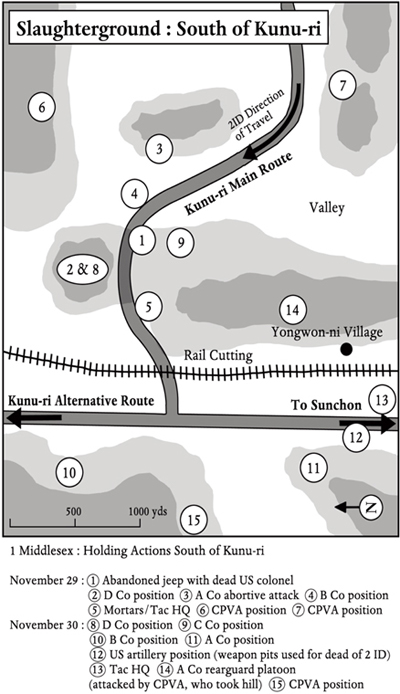
Men were shaken awake at dawn. IX Corps had given 27th Brigade three tasks. 3 RAR were to hold the Taedong River ferry at Chasan. The Argylls were in reserve; they were later given two further roles, which were both cancelled, indicating the state of staff work at Corps.31 At 07:00 orders came for the Middlesex to advance back up the road they had marched down the night before, to the village of Yongwon-ni, where it was reported that the enemy had cut the road. There were no tanks, no artillery, no trucks. Repeated requests were made. Finally transport – but neither guns nor armour – arrived at 10:00.32
Orders were to secure the pass area; send a patrol through it to contact the US 2nd Infantry Division, or 2ID, in Kunu-ri; and search villages, bringing in any suspicious characters.33 Chasan to Yongwon was 15 map miles; Yongwon to Kunu-ri was a further six, but the winding route and rising contours made it longer. 2ID were fighting north of Kunu-ri. If the enemy held Yongwon, their escape route south was cut. Diehards saddled up, attaching bed rolls to the backs of belts, slinging small packs and 100-round canvas bandoleers over parkas, filling pouches with Bren magazines and clipping braces of hand grenades to belts. ‘We lined up inside the trucks trying to look warlike,’ said Lance Corporal Don Barrett. ‘This was now enemy territory.’
The track winding into the hills, with their pine forests spilling down onto the road, was devoid of life, the roadside villages empty. Even the ubiquitous refugees had disappeared. A radio message crackled through: enemy ahead. The warning was shouted from truck to truck. Suddenly, lead vehicles halted. Men jumped out, deployed. Ahead, lay a bullet-riddled jeep in a ditch; sprawled in it was a dead US colonel and his driver.34 A tense silence. ‘Nothing stirred, and all at once the mountains about us seemed much higher, more inaccessible, more menacing,’ wrote Shipster. ‘The valley ahead and the pass beyond were absolutely silent. Nothing moved except for the shift of elbows supporting binoculars, scanning every ridge and crevice above us.’35
A group of male civilians in dirty white clothing appeared. The tension cracked. D Company rounded them up. With the convoy halted, Man made his dispositions. C Company would hold hills overlooking the road above Tac HQ. D Company would seize the first hill feature to the north, then A Company would take a hill overlooking the mouth of the pass. B Company was held back to exploit.36 An abandoned artillery truck was parked against the railway embankment on the left, still full of shells. Kit bags and various bits of gear littered the roadside, indicating a hasty withdrawal. ‘It looked a bit ominous,’ said Barrett.
Willoughby’s D Company advanced up-valley. Directly ahead, the road climbed into the hills, disappearing for a few hundred yards, reappearing as it curved on a shoulder round the western contour of the slopes, then disappeared from sight again into the pass at the top. His men scrambled up a grassy ridge on the left of the road to cover A Company’s advance. ‘Five American fighters came in low over the hills behind us and machine gunned the wooded slopes above the pass and little figures could be seen running about.’ Willoughby noted: Enemy.
Movement was spotted to the north. ‘In the distance at the top of the pass, a small cloud of dust appeared and a solitary jeep careered down, jinking and bouncing from one side of the road to the other,’ Willoughby remembered. ‘The slopes above it came to life with flashes of rifle fire and still the jeep came on.’ It disappeared behind a shoulder and was seen no more.
D Company was watching A Company preparing to attack when suddenly ‘fire was opened on us from the hills on our flanks, every ridge and peak appeared to be occupied and mortar and machine gun fire began to be intense,’ the major noted.37 Black mortar bursts blossomed, followed by the distinctive ripping of a Russian machine gun. The slower Middlesex Vickers hammered back. Battalion mortars thunked.
B Company, ahead of D but behind A, was poised for a jump forward. Barrett was in cover next to the railway line that curved to the left of the hills; behind was an old tunnel and about 1,000 yards away, he could see Chinese milling around – ‘most peculiar!’ Two Mustangs dived into the attack. ‘One came and fired on A Company’s hill and a burst went between my LMG section and the rest of us, ground was spurting up about a meter high with a whoosh!’
A Company continued for its objective. The lead platoon crested the summit to be swept with a violent fusillade of machine guns, mortars and grenades. The platoon commander, twice wounded, was killed and nine men hit.38 The company reeled back.
Man, seeing the Chinese movement on the hills, realised he was facing more than he could handle, but radio communications with the Brigade were down. Willoughby was ordered to hand over control of his company and report to Brigade HQ in person, ‘informing them that the battalion would have to disengage if it could’. He jumped into a jeep. ‘As I drove along the deserted road I didn’t know whether I preferred the loneliness of this journey to the fireworks display amongst my friends.’39
The fighting was about 75 yards ahead of B Company. Barrett could see A Company retreating; as they came through, he was ordered to bring up their rear; this was a leapfrog retrograde movement, company covering company. As Barrett’s section withdrew, bullets were knocking bits of what looked like cotton off trees all around. They took cover beside the road. When shooting halted, Barrett led his men up onto the track. Firing resumed, rounds from unseen marksmen whipping between the dispersed Diehards. ‘I thought, “What a fantastic section, they never ran, they just marched on,”’ Barrett recalled. Then someone shouted, ‘Run, you silly bastards!’ They did. Passing through the RAP, Barrett saw a lot of jackets covered in blood: ‘I remember thinking, “What a bloody mess.” ‘
US trucks were waiting; radio contact had been re-established and Coad had ordered Man to extricate before dark. IX Corps was furious, until Coad explained how precarious the situation had become.40 ‘Coad was not everybody’s cup of tea but he was mine,’ said Man. ‘He was responsible that his little British contingent was not left out; there were occasions when one or more battalions under his command would have been left out to no good event.’
Exactly how precarious the position was would be discovered by the last sub-unit to extract, D Company.
Sergeant Paddy Bermingham had been withdrawing, when Man himself appeared. There was confusion; the CO told them that B Company were not through yet. (In fact, they had come through right behind A Company.) Bermingham and his men redeployed on their ridge and faced north, the sergeant worrying about shooting up B Company as they approached. It was now around 17:00. The pre-dusk gloom was settling. A column of vague figures, in company strength, advanced toward Bermingham. The combination of dull light and dusty binoculars prevented the sergeant from identifying them until they had closed to within 100 yards. Enemy. Bermingham yelled at a nearby Bren gunner to fire a full magazine. The man let rip, but to Bermingham’s ‘absolute horror’ the Chinese did not take cover: They stormed forward, firing submachine guns and screaming ‘Sha! Sha!’*41
In the urgent intensity of combat, some men pulled off feats that observers might consider heroic, but were in fact due to adrenalin creating tunnel-vision concentration that shut down peripheral awareness. ‘I was up on one knee firing, my blokes were lying down firing, and one says, “Harry! Get down!”’ recalled Corporal Harry Spicer. ‘Bullets were hitting bushes all around, but I was so engrossed I hadn’t noticed. If you saw it in a movie, you’d say, “What an idiot!”’
The Chinese charge lost momentum as it hit the bottom of the hill, but around one flank, one enemy got behind a Diehard, grabbed his weapon and shot him with it. The soldier, one of the battalion’s best boxers, was just grazed. He leapt up – the Chinese did not know how to operate the Lee Enfield’s bolt to reload – decked him with a punch, retrieved his rifle and fled, helter skelter, with the rest of the platoon to the bottom of the hill. To Bermingham’s surprise and relief, the Chinese did not pursue. Trucks were waiting 50 yards down the road. The sergeant, counting all his men in, was dragged over the tailgate of the last truck, whose black driver, a the Second World War GI, had been calmly firing his rifle from the bonnet. The trucks rolled off, past a rearguard of Vickers machine guns in Bren carriers. Once again, Bermingham was surprised that the enemy did not fire after the retreating Diehards.
Ahead of the withdrawing trucks, the reverberation of heavy firing of a calibre Bermingham did not recognise, evidenced Chinese in their rear. Round a bend was a US truck mounted with twin anti-aircraft guns, firing at just 40 yards range into a ridge parallel to the road. Sky-lined enemy, infiltrating along it, were perfectly aligned as the mounted Vickers platoon rolled up and opened fire. The CPVA were ‘hosed off the ridge’. Then the convoy was clear.42
The Middlesex harboured 8 miles south at the railway station of Choptong-ri, alongside the reconnaissance company of 1st Cavalry Division, 8th Army’s reserve, which was deploying on the eastern flank. Given the chaotic nature of the fighting, Diehard casualties proved lighter than feared: one killed, twenty-six wounded. But this meant the battalion was down one platoon, and no replacements were expected.43
There would be heavy work on the morrow. A US RCT was tasked to pass through the Middlesex the following day and strike north; around midnight, word arrived that it was unavailable.44 At 02:40 on 30 November, Corps HQ told Coad that 2ID would be coming out in daylight; the Middlesex were to advance back up to the pass, and deploy south of grid line 85 at Yongwon, covering the Americans as they broke out south. Coad requested guns and armour to beef up the Diehards. After ‘a good deal of argument’ these were allotted.45
Meanwhile, a group of bedraggled Turks had arrived at Brigade HQ, attempting to converse with Coad in French. ‘They had a reputation as fierce fighters,’ Baldwin said. ‘If they were in disarray, then God help us.’
* * *
The Turks were, indeed, in disarray. On 28 November, they had been sent to restore IX Corps’ right flank following the erosion of ROK II Corps – the operation Coad had prudently resisted. The brigade lacked radios and trucks, and their US liaison group lacked language skills. In their first engagement, they ambushed ROK stragglers. Then they came under massive attack. In conditions of utter confusion, the Turks, with their preference for the bayonet, forged a legend, but were unable to hold; the 5,000 strong brigade suffered over 1,000 casualties. 2ID, in Kunu-ri was under attack from the north; now its eastern entire flank was totally exposed. If the division did not get out, it faced annihilation.
D Company, with five US tanks under command, would lead the Middlesex back up to their limit of exploitation on grid line 85, Yongwon, to cover the division’s southward breakout. Diehards were told 2ID would be ‘pushing the Chinese in front of them, it would be like shooting fish in a barrel’.46 Willoughby found the commander of the US Patton tank platoon, Lieutenant Robert Harper ‘cheerful and enthusiastic’. The risk, as Willoughby saw it, was how soon they would make enemy contact. He plotted the move carefully, showing Harper on the map where he wanted him to slow and proceed cautiously. Then D Company clambered onto the tanks, which set off north ‘at a terrifying speed’. The bend in the track where Willoughby wanted to slow down was passed; the tanks did not de-accelerate, until reaching the positions of the previous day. ‘We leapt off our transport and flung ourselves in the nearest defensive positions,’ Willoughby noted. ‘Nothing happened … my heart had been in my mouth for those last few minutes.’ Enemy had disappeared. A light aircraft swooped over, dropping a sack of red-silk squares. Assuming these to be recognition signals for 2ID, Diehards passed them around.47
The remaining companies arrived and deployed. A Company took positions overlooking Tac HQ south of the empty village; C and D on hills to the south of the pass, with B in the left rear. At 11:00 enemy were sighted and fired upon by battalion mortars. As D Company was deploying along a ridge facing north, there was an explosion on the south slope: A US 105mm artillery battery had arrived and fired a ranging shot directly into D Company’s hill.48
Given the previous day’s communications problems, Lieutenant Peter Baldwin had been dropped off to establish a hilltop signals relay between the Middlesex and Brigade. He and his section set up a transmitter on high ground. ‘It was very mountainous with the MSR winding round the edges of mountains, when this black bomber appeared and started circling,’ Baldwin recalled. Suddenly, it swooped in on an attack run. Signallers took cover as bombs detonated, while Baldwin stood, frantically waving a fluorescent marker panel. ‘It was frightening, but being an officer one is meant to show leadership,’ he said. ‘Luckily he made only one run.’ Nobody had been hit; Baldwin later discovered it was a carrier-based aircraft with no information on the marker panels. A massive air support operation was gathering to support 2ID’s run south.
Ahead of D Company of the Middlesex, noise of firing broke out, then five American tanks appeared through the pass. Willoughby was on the road when the leader skidded to a halt, and an officer jumped out. ‘Gee, that was a hot ride!’ he said, climbed back inside, and trundled off before Willoughby had a chance to ask him 2ID’s status. The remark, however, led him to believe all was well.49 Diehards waited. Shipster wondered whether 2ID’s infantry sweep would appear over the eastern or western shoulder of the pass.50
Willoughby was scanning through binoculars at the distant gap in the hills when he saw a ‘bumper to bumper’ column of vehicles appear slowly on the visible stretch of road, the shoulder cut into the mountainside. The Chinese ‘had done another disappearing act,’ he concluded. But a distant crackling grew in volume and urgency: gunfire. The major could see occupants jumping out of vehicles, while others tipped over the edge and rolled down the mountainside.51 The Diehards were capturing a shock glimpse of 2ID’s death agony as it retreated from Kunu-ri.
* * *
Even the name has a hollow, foreboding reverberation: Kunu-ri. A village among hills; a crossroad; a rail junction. South of it, the road – down which 27th Brigade had marched – wound between barren slopes. At its high point, ‘the pass’ was a narrow, 450-yard stretch of road enclosed by steep embankments, 50 feet high. Here, the US Army would face its most hideous ordeal since the Battle of the Bulge.
2ID had been under mounting enemy pressure from the north since the start of the Chinese offensive on the night of 25 November. Now, it was the most exposed unit of the 8th Army. Its depleted and exhausted men had a 6-mile stretch of road to cover to reach safety – the Middlesex covering the position south of the pass. 2ID’s CO, General Laurence Keiser, knew there were Chinese in his rear, but not their strength. A tank platoon had passed down the road on 29 November, reporting that it had come under fire, but there were no physical obstacles, no roadblock.52 Early infantry attacks by Keiser’s exhausted men and ROK units with 2ID to clear the Chinese from the heights had failed, but Keiser believed – due to the fog of war, faulty radio communications, and confused command and co-ordination between the 8th Army, IX Corps and 27th Brigade – that he could bounce any ambush. Adding to this belief was his understanding that the Middlesex, with whom he lacked communications, were attacking north to link up with him about one mile down the road; in fact, the Diehards were deployed at grid line 85 awaiting 2ID and unable to support it in the pass.53 Instead of attacking in a divisional sweep clearing the ridges, Keiser’s division would drive south through the pass in series of column. It would prove a catastrophic mistake.
With 2ID’s right flank wide open, a full Chinese division, the 113th, was infiltrating the hills overlooking its line of withdrawal. Throughout 30 November, they would, in the classic military maxim, ‘reinforce success’ feeding in more men, more weapons. Mortars, and as many as forty machine guns would create a fire block, that, by the evening, would cover at least 3 miles of 2ID’s 6-mile escape corridor – a route soon to be named ‘The Gauntlet’. So it began.
One by one, units motored into the enfilade. As vehicles drove under the Chinese guns, men were shot off tanks and trucks. Wrecked vehicles created blockages, further funnelling the retreat into kill zones. Progress was stop-start as GIs leapt from vehicles, which often then drove on without them. Unit integrity was collapsing, and with Keiser fighting his way south, firing an old Springfield rifle, command evaporated. Dead lay in the road; wounded piled up in the ditches. Roiling clouds of dust spoiled the Chinese aim, but they had laid their sights on the road, so could barely miss. Diving aircraft, trying to eliminate emplaced weapons on the ridges, added to the maelstrom with bombs, rockets and napalm, some of which poured onto the road. The 8th Army commander Walker, overhead in an observation aircraft, cursed at the confusion, shouting ineffectually at the men to fight.54
* * *
It was survivors of this carnage who began appearing at Yongwon around midday. A clutch of jeeps piled with wounded and dead, their tattered tyres flapping wildly on the road, passed through the Middlesex position. In the distance, Willoughby watched another vehicle column appear, attempting to double-bank the first. ‘There were some simply dreadful scenes up there,’ he wrote. ‘A long stream of survivors now started to reach us from below the pass, first in twos and threes, then a steady stream, many wounded, utterly forsaken and in tears.’ Willoughby wondered if the spectacle would affect the morale of his young soldiers; it seemed only to strengthen their resolution. ‘One of the saddest aspects of this human tide was they were all themselves lone, solitary refugees hoping for sanctuary,’ Willoughby noted. ‘Many were wounded and dragging themselves along, but never did I see a comrade helping another, I don’t believe this was lack of humanity, but total bewilderment.’55
‘It was just a massacre,’ said Frank Whitehouse. ‘You don’t forget it, it is still a memory I carry with me.’ Further south, watching splintered 2ID trucks pass with crimson streaming down their sides, Wilson was reminded of descriptions of naval battles in the age of sail, when blood poured from the scuppers of shot-up warships.56
Tanks arrived, driving at full throttle. ‘They came roaring down the pass, through this gully and back onto the road, firing with their main armaments and .50 calibres,’ said Barrett, on low ground with B Company. Two men were hit next to Private Ken Mankelow. ‘One of my platoon members got a 50 cal through both cheeks of his buttocks,’ he said. ‘It tore a terrible wound in his bum, but he did survive.’ The second Diehard was killed.
Lieutenant Colonel Man, seeing what was happening, planted himself in the middle of the road; when the first Patton rocked up, the little officer icily asked the tank commander to stop killing his men. The situation was tense; a senior NCO stood beside Man, rifle at the ready.57 Hundreds of wounded were treated, swamping the battalion aid post. Keiser arrived, conversed briefly with Man, then headed south. Shocked survivors streamed through.
By 16:00, the pass ahead had become still and silent; through binoculars, officers could see vehicles locked together and immovable; the stream of survivors seemed to have stopped. Man had been in contact with Brigade HQ, who had ordered him to use his own judgment when to disengage.58 But by now, some time after 16:00, enemy vanguards, debouching from the hills, were infiltrating around the Middlesex as they mounted their vehicles.
The US 105mm battery, near Tac HQ, opened fire directly into the Chinese. ‘We could see them down below firing over open sights,’ said Spicer. ‘We couldn’t see the Chinese, they were shooting into the hillside, the enemy were in the scrub.’ Diehards pulled back, clambering onto trucks, jeeps and land rovers. The Americans were ‘fighting their guns magnificently,’ Willoughby thought, but bullets were zipping in from several directions and the road was enfiladed by machine gun fire. ‘I don’t know why none of D Company were hit because from my land rover I could see the dusty road ahead being churned up by bullets we drove through.’59
The artillery was moving, too; Barrett could see bodies lying in their gun pits. (In fact these were the dead from 2ID.) ‘By now, the Chinese had got to the edge of this hill, maybe 50 feet up, peeping over,’ said Barrett. ‘One man was hanging off the back of the artillery vehicles and was shot off. I went out on the wing of a truck with my legs dangling over.’
Last out were A Company, covering Tac HQ. Rogers saw dust spots around his feet: ‘Half the Chinese Army were shooting at me!’ The enemy had taken over positions vacated by the Diehards, to the north and southwest of the road. Rogers was pinned down in low ground. CSM Danny Cranfield – a black soldier from St Helena – yelled ‘Stay down!’ ‘I’m sleeping!’ Rogers shouted back. In a pause in the fire, Cranfield leaned in, grabbed Rogers and dragged him back. An enemy grenade landed – Cranfield picked it up to hurl it back – it detonated in his hand. Though the Chinese used percussion, rather than fragmentation bombs, it still caused a horrific injury: the flesh of Cranfield’s fingers was ‘peeled back like a banana’. In shock, he was evacuated south.
At Tac HQ – by now under both mortar and small arms fire – Man had been furiously busy, overseeing evacuation of US casualties, arranging American tanks to fire cover, directing traffic. Now, amid frantic noise and movement, he exercised leadership. ‘Colonel Man was sitting on a shooting stick, reading a map,’ Rogers said. ‘It was for the sole purpose of steadying the blokes.’
Corporal Bob Yerby’s platoon found itself rearguard. Suddenly – as so often in this war, as if from nowhere – a crowd of Chinese appeared and ran right into the Diehards. Then it was close combat. ‘We turned round – we had bayonets fixed, we nearly always did – we were hitting with rifle butts killing anything in front of us, just berserk,’ Yerby said. ‘It was intense, like a melee in football, you were shooting at anyone who was not one of your chaps.’ After perhaps seconds, perhaps minutes – as if by mutual agreement – the two forces broke breathlessly away from each other. Yerby’s platoon pulled back.
Speeding vehicles were laden to the limit with Middlesex clinging on and American wounded piled in the back. Drivers drove furiously, knocking down roadside cottages60 and plunging through creek fords, sending up great sprays of water.61 As they passed Choptong-ri, Willoughby glanced across to the RAP manned by the Middlesex medical sergeant: He had treated 250 men, exhausting all his morphine and dressings.62
At Chasan, MO Stanley Boydell was working frantically to stabilise casualties; his stress was so great, that Boydell himself was subsequently evacuated to Japan. The shuttling of casualties caused problems, with some drivers reluctant to return north. ‘This was dealt with by an order to put a man with a gun on each truck,’ Boydell recalled. ‘Until we were on board he was not to allow that truck to move.’
Heading south, Yerby found himself shuddering uncontrollably following the hand-to-hand action. ‘Afterwards it was scary, but at the time, nothing; I suppose something takes over, you are not rational,’ Yerby recalled. ‘When it is over, you look at your hands,they are shaking like the leaves on a tree, it was, “God! Did that really happen?”’
At Brigade HQ, Thompson watched a dust-coated Coad listen as a young 2ID officer explained why they had tried to bounce rather than fight through the enemy fireblock. Coad’s gaunt, lined face looked grimmer than the journalist had ever seen it.63
Yet some 2ID units were still coming through well after nightfall, hours after the Middlesex withdrawal; the silence and lack of movement noted by the battalion at around 16:00 must have been the gap between one serial moving through the pass and the next. And the division’s rearguard, the 23rd RCT under one of the 8th Army’s most effective officers, Colonel Paul Freeman, did not run south: it took the western road from Kunu-ri toward Anju, escaping almost unscathed. Freeman’s departure, however, left remaining elements exposed from the rear. There were poignant scenes as the 2nd Engineer Battalion, realising they were finished, burned their colours.*
The massacre in Kunu-ri pass cost 2ID 4,037 casualties and 114 artillery pieces lost.64 Keiser was relieved of command,* though it was IX Corps’ General Coulter who had ordered him to take the southern road, despite an offer from I Corps that 2ID take the Anju road – the route taken by Freeman.65 On the day of the disaster, Coulter was moving his IX Corps HQ to Pyongyang.
The disastrous turn of events compelled ludicrous self-justification An 8th Army communiqué on 29 November claimed: ‘The assault launched by 8th Army five days ago probably saved our army from a trap which might well have destroyed them. Had we waited passively in place … from beyond the Yalu, [the enemy] would have undoubtedly brought the 200,000 troops known to be assembled there … The timing of our attack was indeed most fortunate.’ Some correspondents thought it a joke.66 It was not. The ‘massive compression envelopment’ announced less than a week previously had been conveniently forgotten.
On the same day as 2ID’s ordeal – but a world away in Washington – the catastrophe was reflected in talk of the most ominous kind. President Harry Truman, in a press conference, refused to rule out atomic weapons. A shaken Prime Minister Clement Attlee departed for talks with Truman. There could be no conventional reinforcement of the UNC from Washington. So flensed had the US military become, post-1945, that no divisions would become available for Korea until 1952.67
The disintegration of ROK II Corps, the savaging of the Turks and the 2ID catastrophe had established Chinese mastery of the battlefield. High Command’s grip slipping: Orders were given that shipping in Pusan was to stand by, as evacuation of the peninsula might become necessary.68
This opinion rapidly prevailed among the 8th Army. Awed by the landscape, stupified by the cold, horrified by the carnage and stunned by the reversal of fortune, the morale of an army expecting to be ‘home by Christmas’ flickered and died. Headlights glared through a great haze of dust as miles-long columns – bulldozers, artillery prime movers, tanks, trucks, jeeps – drove frantically south, away from the ‘enemy hordes’.
8th Army was unmanned. The longest retreat in US military history –‘The Big Bug-out’ – had commenced.
* * *
At Brigade, signs of decontrol were alarming. Turks – ‘hellish good soldiers’ in Slim’s opinion – straggled into the Brigade HQ area: Argyll subaltern Owen Light watched survivors marching grimly with wounded and dead strapped to their backs. They were in a dangerous mood. ‘The Turkish brigade commander arrived at Brigade HQ and said, “I will not fight under American command any more!”’ said Captain Reggie Jeffes, who heard reports of Turks assaulting GIs. 2ID remnants still arrived: A tank rumbled bycarrying an agonised soldier with his arm trapped under the turret, an injury that would probably necessitate amputation if a working MASH could be located.69
‘American command was very dicey indeed, issuing orders and counter orders continuously,’ Jeffes added ‘Absolute panic stations.’ December 1, Willoughby thought, was ‘a day of confusion and everything except us were driving for all they were worth southwards – where? No one knew.’ 27th Brigade was now attached to 1st Cavalry Division, covering the northeast as 8th Army rearguard. The brigade was ordered to establish blocking positions. ‘The situation is vague and confused,’ the Brigade War Diary noted. Without authorisation, 1st Cavalry units withdrew from a position that day when enemy soldiers were seen on high ground.70 On 2 December, reports came of heavy enemy movement. The Brigade Operations Log was skeptical: ‘It is the opinion that certain units are giving this information in order to extract … orders for premature and quite unjustifiable withdrawals.’ Meanwhile, communications was lost with 1st Cavalry HQ.71
3 RAR was dispatched to cover the Yopa-ri bridge across the Taedong River. They deployed below forested hills. Captain Ben O’Dowd’s A Company skirmished with a Chinese patrol, capturing their bivouac – hollowed-out rice stooks, laid out with bed rolls. It was torched. After dark, there were occasional bugle calls and the rumble of UNC artillery in the hills to their front. It was a bright, moonlit night; O’Dowd fretted that his Diggers’ dark uniforms would make them easy targets against a fresh snowfall. But no attack came. The following morning, the Australians retreated across the bridge, blowing it behind them.72
At Brigade HQ, Jeffes heard that Lieutenant Colonel Bruce Ferguson’s land rover had stalled. He did not get along with the fiery Australian: During the advance, ‘Ferg’ had ordered him to recover vehicles 50 miles back. Jeffes replied that was too far, he could only do that if they had gone off the road. Ferguson replied fine, he would push them off. Now, Jeffes pulled up at Ferguson’s vehicle, next to two US tanks shooting into the hills. Ferguson looked up from his map. ‘Christ! King fucking bluebell himself!’ he spat; Jeffes’ call-sign was ‘Bluebell’. Ignoring the abuse, Jeffes cleaned the land rover’s points, the engine caught, and Ferguson was delighted. ‘I could do nothing wrong after that,’ Jeffes recalled. ‘The fact that I had gone, and not sent a fitter.’
Meanwhile, the Argylls had been dispatched into rugged hills with a taskforce of the 1st Cavalry. A withdrawal order came late in the afternoon. A Company was ordered to head south down a craggy ridgeline, onto a road, to be met by transport. In vain did Wilson complain that the route was 2 miles off his map, and night was falling; orders were orders. He led A Company cross-country on the basis of verbal descriptions – and remarkably reached the RV. There he was told that orders had changed and he and his exhausted (and furious) men were to return the way he had come. It was 02:00. The US FOO attached to the battalion was ordered to leave, but Wilson was impressed and touched when the young subaltern sought out Lieutenant Colonel Neilson to apologise for leaving the Argylls without artillery.73 Marching through the night, Wilson and his men exfiltrated over a frozen river without enemy contact.74 Even so, the isolation and scarce intelligence were giving even the Argyll’s fiercest men the jitters. Slim dreaded the hourly turnover of vehicle engines to prevent them from freezing: ‘That told the bloody Chinamen where we were.’
On 3 December, Willoughby’s D Company of the Middlesex was adjacent to a company of 1st Cavalry covering the road to Pyongyang. He introduced himself, and was told by an officer, ‘If during the night you see two red Verey lights, collect together everyone you can and go in that direction’ – south. That, Willoughby mused, would leave both D Company’s flank and the road wide open. Returning to his men, he heard reports from air reconnaissance of 20,000 enemy approaching. Ahead, under a heavy sky, lay fir forests and grey mountains. An air strike roared over, machine gunning suspected Chinese. ‘We watched with some awe their bullets striking the ground and floating away as ricochets into the gloom,’ wrote the major. Bombers followed, until the light failed. ‘In the unreality of almost total silence, we settled down to make what we could of the night,’ Willoughby noted. ‘There seemed to be every prospect of our having to fight it out to gain time for the UN army to extricate itself from this appalling muddle.’ Over the radio, he listened to the BBC: Attlee was claiming that the UK had no quarrel with China. Camouflaging their positions with pine sprigs, the Diehards hoped that air’s estimates of enemy numbers were exaggerated. No contact. The next morning a patrol recced a ford where the USAF claimed to have wiped out a Chinese battalion. All that could be found were two dead civilians and a slaughtered ox. The flanking 1st Cavalry subunit appeared to have disappeared in the night.75
The brigade would follow. Coad had considered the rearguard operations ‘pointless’, but was ‘astounded’ when at Divisional HQ on 3 December he was ordered to withdraw 135 miles the following day.76 But the brigade, the last 8th Army unit to drive south, was pleased with a US unit newly attached, the 2nd Chemical Mortar Battalion. ‘They were great guys, all West Point,’ said Argyll subaltern Alan Lauder. ‘Very able, always up beside you.’
The pullback was a ramshackle affair. As usual, there was insufficient transport; as usual, the Middlesex rode on mudguards of trucks, with other men lying in the trailers of the mortar battalion, clinging to each other. ‘In this manner, we reached the junction with the main road ahead of the enemy,’ said Willoughby. ‘By how much, we shall never know; the wind had returned and it was a fearful journey.’77
Some officers maintained morale: Wilson sounded his hunting horn to rally his company and Jocks responded appropriately, barking like hounds.78 But many soldiers wondered just how far behind the Chinese were. ‘There was fear that at any second you could be pounced upon,’ said Yerby. ‘You were constantly jumpy.’ ‘I was quite relieved to be going southward but was not relieved in the style in which we were doing it,’ added Shipster. ‘We knew that survival depended on cohesion, keeping together and strictest discipline.’
As the brigade joined the southward rush, 8th Army seemed to be disintegrating. ‘We could rely on each other, but we did not know about anyone else,’ said Spicer. ‘Covering the withdrawal was worse than going forward, you were waiting for the enemy, and you knew if they came, there was nobody to help.’ After Pakchon and Kunu-ri, the brigade had learned to respect US artillery, but even gunner officers were flagging. ‘Three times I personally met the observation officer in his jeep coming back,’ said Man. ‘We were stationary, but he was terrified of being left out, he was certain we were going to go without him.’
There were scenes of near mutiny. ‘This truck came down, and on its front was written “Pusan!”’ Man recalled. ‘The officer sitting beside the driver got out and rushed up to my policeman who was trying to clear the road, and this chap said, “You can’t hold me up, I’m an officer!” and my soldier knocked him down. The RSM of the Argylls was so delighted, he turned his back and of course did not see it.’
Panic could be infectious. ‘The American transport troops allotted to us – very nice fellows – had only one intention: Get back as early as possible, and we had to put guards on transport,’ said Shipster. ‘I remember two drivers had taken position to cover the transport, and their conversation went, “Did that bush move?” All three in unison said, “Yes, let’s get the hell out of here!”’ A Digger story circulated of a truck driving at 40 mph being overtaken by a running GI – who was still in his sleeping bag.79 ‘The Americans were not trained for this kind of warfare,’ said Argyll Harry Young. ‘It was a bloody shame, because they were hell of nice guys.’
Paddies were filled with burnt-out vehicle carcasses shunted off the road. ‘I remember passing an American tank which was broken down and I told the American chap, “We’re the last troops, you’d better burn that before the Chinese get it,”’ said Man. ‘Some weeks later I got a rocket from Japan, saying, “British officers will not give orders to Americans to burn their tanks!” It didn’t worry me.’ But not all machines were effectively destroyed. ‘One of my drivers joined the convoy driving this mobile crane!’ recalled 3 RAR Signals Sergeant Jack Gallaway. The huge vehicle was later blown up.
It was a good time to learn how to drive. ‘It didn’t matter if you bumped into someone, or another vehicle,’ said Argyll MO Douglas Haldane, getting to grips with his ambulance jeep. ‘I was not really an acceptable driver when I came back; I had to get proper lessons!’
By now, the brigade’s remaining vehicles were in a parlous state. One Argyll mortar carrier clanked to a halt. It was swiftly unloaded, and the Jocks jumped on a truck after opening the fuel cocks for the last unit to set fire to. ‘It must have made a hell of a show,’ said Roy Vincent. ‘Sixty six high explosive, six smoke bombs and two petrol tanks – quite a bang!’
At the rear of 27th Brigade’s column trundled Jeffes’ REME Scammel recovery truck, dragging eight clapped-out vehicles.
* * *
The retreat’s backdrop was the cruelest winter in memory. The frosted countryside undulated and rose up into mountains that were hard and jagged. Some days were dark and overcast; the coldest ones were bright and clear. At night, a full moon – ‘Chinese moon’ in UNC parlance, referring to the enemy’s mastery of darkness – reflected off snow and frosted ruins with a ghostly, silver splendour. ‘Cold hurts, when you can’t get out of it,’ said Boydell. ‘The cold was worse than anything.’
The first heavy snow had fallen after dark on 3 December. ‘I was in a slit trench with my poncho on top of me and I woke up and wondered what this weight was,’ said Lauder. ‘It was 4 inches of snow.’ Lauder could not open his eyes; his lids had frozen together. Jeffes, sleeping under a jeep in an Arctic sleeping bag bartered from an American colonel for whisky, woke to find his nose attached to the chassis by a stalactite of ice. The warm-weather Australians suffered most. ‘You’d be stuck, crammed in a hole, and in the morning you’d be lifted out and get your legs straightened out and start walking,’ said Sniper Robbie Robertson. ‘But the Diggers did not complain, you didn’t say, “Ah it’s cold” – you knew it was bloody cold.’
Men piled on whatever clothing they had. Boydell wore several pairs of pyjamas under his uniform, and a long coat taken from a dead American officer over it. Some British winter gear was decent: String vests kept sweat from freezing on the skin; ‘woolly pullies’ with neck drawstrings captured body heat. But most US winter kit – pile waistcoats, parkas and caps – was far superior to its British equivalent. Mitten gauntlets, which hung on a cord around the neck, were good, but needed a hole cut for the trigger finger. By now most men looked like Americans – though Man insisted on wearing his peaked cap and was once spotted with a pile cap and his peaked cap on top.80 If men removed their boots when they wrapped themselves in blankets or sleeping bags, the footwear would be frozen stiff in the morning. ‘You’d put your feet in the fire to warm them up, and your boots would shrivel up a bit,’ said Young.
Rations froze solid. ‘You could not put a pick through a tin of beans, you had to thaw it out,’ Young recalled. Tins were cooked over spirit stoves, but cold proved insidious. ‘When a can of, say, pork and beans was heated, the outside would bubble tantalizingly, but when you put the spoon in, it met a frozen centre,’ said 3 RAR Intelligence Officer Alf Argent. Diggers discovered a unique way to heat food. ‘If you dented a can and threw it in a fire, when the dent was blown back out, it was time to pull it out and eat,’ said Stan Connelly. ‘It was like a pressure cooker.’ While driving, Willoughby heated rations by wiring tins to his vehicle’s exhaust manifold. But war scenery ruined appetites. Jake Mutch and his mates were about to eat a tin of meat noodles when they noticed a nearby dead enemy nearby with his head split. ‘His brain looked exactly like the bloody stuff in the tin,’ Mutch said. ‘None of us could eat it.’
Water bottles were carried inside clothes or they solidified. Men melted snow for water, but found it took long minutes to produce a single cupful. In barracks, men avoided sergeant majors, but now they tracked them down: CSMs were in charge of rum rations, doled out with a large spoon. It helped keep the cold out, especially when added to hot tea.
Ablutions were problematic. ‘You tried to shave, you’d have this mess kit of water, you’d put your razor in and it would freeze into a block,’ said Argyll Lieutenant Owen Light. ‘One soldier had this funny moustache, and half of it broke off!’ At night, men lit small fires at the bottom of their slit trenches, looting villages for charcoal braziers. ‘We used to put them in trenches or carriers to keep our feet warm,’ said Argyll Adam MacKenzie.
Vehicles froze to the ground when, during the day, the sun thawed the top layer of frost. Caution was necessary with vehicles and weapons; exposed flesh stuck to metal, leaving painful strips. Weapon oil froze; rifles and Brens were cleaned dry. When riding tanks, men put their boots on the exhausts until they began to char. The worst was being exposed when the wind howled in. ‘Crossing frozen rivers, the terrible winds were so sharp, they were like spears,’ said Yerby.
With 27th Brigade being rearguard, most villages it entered were abandoned. Men tore apart ruined homes for firewood; if cottages were standing, men piled in for the night. Flues ran from kitchen stoves under floors, creating highly effective central heating; that system, and the kimchi pots, which kept vegetables frozen for the winter, impressed the technically minded Jeffes: ‘Very, very clever!’ But fires had to be stoked judiciously. By now, even Coad was carrying a carbine, and one evening, in a Korean home, he put his weapon and magazines on the hot floor. In the middle of the night, the weapon cooked off. ‘There was a certain degree of chaos when that went off, I can tell you!’ said Jeffes. Argyll Intelligence Officer Sandy Boswell went into one where shivering men overloaded the stove and the house burst into flames. Argylls tumbled out, but the battalion war diary did not survive. Neilson ordered Boswell to re-write it from memory.
As the retreat continued, there would be fewer houses but more fires, for as 8th Army exited North Korea, it was leaving nothing standing in its wake.
* * *
Previously, devastation had been incidental: Collateral damage from bombs and guns as the front steamrollered up the peninsula, touching a village or district here, bypassing one there. Now it would be deliberate. On 2 December, 8th Army ordered all food stocks to be burnt, bridges destroyed, boats sunk. Locomotives, carriages, signals, rails, port facilities, oil tanks, cranes – all would be denied the enemy. This was ‘scorched earth’.81
‘Every village we went through we set fire to, it was, “Get out and burn it,”’ said Whitehouse. ‘This was official policy: “Don’t leave anything!”’ Men struggled for words to describe the scenes. ‘It was like walking through a film set, when you describe it to people, it seems far-fetched,’ said Yerby. ‘The hills, the mountains, the hovels destroyed, the snow … it was something you don’t see every day of your life.’ Destruction extended for mile after mile. ‘You’d see Americans with zippo lighters, lighting up the eaves of buildings,’ added Gallaway. ‘I was told to find a village to camp in, I was driving down this road looking for one, and I just couldn’t find one that was not destroyed.’
Some men took part almost joyously in the arson. ‘The Aussies had a load of beers and were dishing them out, they had a big fire and we were all dancing around,’ said Argyll Quartermaster Andrew Brown. ‘There was this North Korean barrack full of stuff, and eventually I thought, “We’ll deny them this,” and got a driver to go along with his jerry can, set a match, and up she went. Nice!’
Others felt guilt at the vandalism. ‘You used to wonder, “There’s a nice home here, like a croft, and we went and destroyed it,”’ Mutch said. ‘As a country boy, I was concerned with the animals and cattle walking about unclaimed.’ Much livestock was killed. ‘Dead animals were everywhere beside the road,’ said Digger John ‘Lofty’ Portener. ‘There were cattle – everyone had a cow in Korea – with their legs sticking up, frozen stiff, I imagine they were shot by airplanes.’ There were worse sights. ‘During the retreat, I saw some enemy soldiers who had been crushed by tank tracks and these pigs, which were running loose, were eating their remains,’ recalled Australian correspondent Harry Gordon. ‘That is something I have not been able to get out of my mind.’
Incidents were surreal, nightmarish. ‘We did a night march through a forest on fire beside this river,’ recalled Light. ‘It was not a pleasant thing, we thought we’d get burnt alive.’ The Argylls walked warily along a track through the trees, pines crackling and popping all around them, sparks flying. ‘I have no idea why it was on fire,’ Light added. Perhaps it was the work of the CPVA, who used smoke as top cover; perhaps the USAF, who napalmed forests to light the way for units moving at night.
Those youngsters who had been curious to experience war in Hong Kong now recognised their naivety. ‘When I went, it was for the excitement of getting somewhere,’ mused Private James Beverly. ‘Now I thought, “Am I ever going to get out of here?”’
The spectacle of a nation put to the torch was lurid, Biblical. In daytime, the orange glow from innumerable blazes was diffused through the dust haze and reflected in the snow clouds, illuminating the holocaust with a dull, evil light. When twilight settled over the mountains, scrub on their slopes, blazing from napalm, flickered like a lacework of amber against the blackness.*
* * *
If the dead were a terrible sight on the long, long retreat into South Korea, the living were pitiable.
A Korean winter is the season of retreat inside cottages; of thick quilts on warm floors; of heavy, pungent stews; of the companionship of three generations living together under beamed roofs. Not in the burning winter of 1950. Between 400,000–650,000 refugees swarmed onto roads and tracks, fleeing with the UNC from their wasted land.82 Many – Christians; those who had welcomed or assisted the 8th Army – feared communist retribution. Others – their homes destroyed and livestock dead – had little choice but to join the freezing Via Dolorosa.
Down wind-tunnel valleys, through blackened villages, across broken bridges, the suffering tide rolled south. With the armies having appropriated young males, the refugees were old people, women and children, and with military traffic dominating the roads, they were forced onto secondary tracks. Bundled up, they piled their possessions on A-frame backpack carriers and carts. Babies were strapped to backs, little children scurried alongside carrying pathetic parcels from homes they would never see again. ‘When everything they have is on their backs and it is snowing and they are in a long line to get away from battle and there is nothing you can do and the odds are they will probably die in the cold …’ said Boydell. ‘These things are horrendous.’
This was a procession not just of two cultures but of two centuries. UNC soldiers rolled by in vehicles; Koreans stumbled along on foot or in bullock carts, the latter often rolling on tyres salvaged from abandoned jeeps. With civilians lacking road priority and amid a commonly expressed racial contempt for the ‘Gooks’ there was frequent abuse. ‘The American drivers were not kind to them,’ said Barrett. ‘They would try and scrape along the side of the bullock carts just for fun. If I’d been braver I’d have reprimanded ’em, but they were driving me.’
Making matters worse were orders to halt refugee columns to prevent infiltration. ‘At night you had to get very tough, you had to block the roads and shoot at them,’ said Wilson. ‘You can’t hold a position at night with people wandering around in all directions. It was not funny.’
Some soldiers resisted orders to fire on refugees. MFC Henry Chick Cochrane was ordered by Captain Colin Mitchell to bomb a bridge. ‘He said, “I want a bomb down there,” I said, “Right, I’ll plot it on the map,”’ Cochrane recalled, but when he looked, the bridge was crawling with refugees. He refused the order. Captain Fairrie, the mortars officer arrived and talked with Mitchell. Then Fairrie told Cochrane, ‘You’ll be alright now.’ Mitchell returned and asked if Cochrane could hit the bridge. ‘I said, “I’ll knock any brick you like off it – but not at the moment.”’ Mitchell left.
There were countless tragedies. 3 RAR Intelligence Officer Alf Argent passed an old man mutely standing beside the track with a dead child in his arms, hit by a truck or tank, tears glistening on his cheeks. Willoughby noted the silence of the refugees; even children were mute. Passing a temporarily halted convoy, he saw ROK troops assisting some refugees, who had just thrown their bedding and bundles into the truck, when, before they could clamber aboard, the column started up again. The refugees – two children, a mother and a baby – were left standing helplessly, watching their only possessions disappear in the dust.83 In utter despair, some mothers abandoned offspring. ‘You’d see women on the edge of iced rivers, they’d take babies off their backs, put them in a hole in the ice and let them go,’ recalled Mankelow. ‘Others put babies on the side of the road and kept walking, just walking …’
The plight of children was most heart-rending. ‘Argylls are good at helping people, when we gave the children chocolates and sweets, they were over the moon,’ said Mutch, ‘Poor wee mites!’ At other times, kindliness was overturned. ‘The Jocks were kind to women and children, but there were times when we completely ignored them, we were quite rough getting them out of the way,’ admitted Slim. ‘Like all people in that sort of situation, the refugees were mesmerised, in shock. They were smart to get out of the way.’
Yet desperation was a spur. Thompson watched a boy with a smaller child on his back, climbing the skeletal girders of a downed viaduct, leaping gaps with a 50-foot drop below. Silhouetted against a slate sky, the reporter thought him, ‘a heroic figure, greater than tragedy’.84
On 3 December, with Washington apparently considering nuclear options, South Korea’s defence minister opined that his people would rather die in an atomic blast then become communist slaves.85 Whether the electorate concurred is uncertain, but the passengers of one of the last trains south had no opinion. Man saw it chugging into a station: it was so packed, that desperate refugees had lashed themselves to the locomotive and its carriages. In the sub-zero temperatures, wind chill had done its work: Every one of the external passengers was frozen dead.
The retreat rolled on.
* * *
Pyongyang was ringed with fire. Many units had already retreated when, with enemy forces sweeping down from the northeast, Walker had given official evacuation orders on 3 December.86 With transport so congested, it was impossible to evacuate all UNC dumps in the city: Most were to be destroyed in place. Massive detonations sounded as huge stores of equipment, food, clothing, ammunition, explosives were blown. The resultant fires were so fierce that units of the US 24th Infantry Division, ordered into the city to salvage left-behind equipment, were unable to enter;87 conflagrations actually raised the air temperature despite the freezing weather.88 Great columns of black smoke rose thousands of feet.
Wastage was immense. A US engineering battalion destroyed 185 of their own railway flatcars.89 One newly-arrived unit, however, refused to follow suit: 27th Brigade’s latest addition, India’s 60th Field Ambulance. Having disembarked in Pusan in late November, 60th Field arrived in Pyongyang on 3 December with six months of supplies to find chaos and destruction. In defiance of orders from US Transportation Command that he abandon the six months of medical supplies, the unit CO, Lieutenant Colonel Rangaraj, concentrated his men and equipment in five carriages of a train, de-coupled it from the rear, and had two of his soldiers, former railwaymen, get up a head of steam. With armed soldiers, including paratroopers of the US 187th Airborne Brigade – the 60th Field ambulance was parachute-trained – standing on the footplates, the hijacked train chugged south, against the protests of transport officers.*90
On 4 December, 27th Brigade approached the capital. ‘The Brigade, having led the UN forces out of Pyongyang … now performed the duties of rearguard into Pyongyang,’ Coad noted. ‘Very fitting.’91 The city resembled a painting by Hieronymus Bosch. ‘Coming back, everything was on fire, Americans were blowing everything up,’ said Rogers. ‘You felt the blast from 2 miles away, then this mushroom cloud went up.’ The brigade detoured round the suburbs. Some soldiers had witnessed such destruction before. ‘I’d seen Manila after MacArthur finished with it,’ said Gallaway. ‘I thought this was the normal thing you did with cities: you demolished them.’
North of the city, 27th Brigade met what was to have been its relief: the newly arrived 29th Brigade, deployed north of the city as covering force. There was, in fact, no imminent exit from Korea for British troops. After four days of meetings with Truman, Attlee was reassured by Truman on the atomic question (though the allies remained divided over policy toward Peking). In return, Attlee promised that British soldiers would stand alongside their American allies in Korea. Men from the two brigades roared and jeered at each other as they passed. ‘We were shouting, “Where you been? What took so long?”’ recalled Spicer. ‘But we also said, “Good to see you, mate!”’ The 29th, having looted American dumps, hurled booty into the 27th’s vehicles as they passed.
29th Brigade had not yet seen action and appeared beautifully equipped. ‘They looked frightfully smart in their quite useless British winter kit,’ said Wilson. ‘We were dressed like tramps in American kit which was much better, but we were absolutely filthy.’ The approaches to the Taedong bridges were defended by 29th Brigade’s massive Centurion tanks. The pontoons sagged under their trucks as 27th Brigade rattled across. ‘I could see nothing at all of Pyongyang, just a blaze from beginning to end,’ said Lieutenant Peter Baldwin. ‘We were passing through at night, the sense was that the Chinese were right behind us.’
Much of Pyongyang’s populace was fleeing. With military sand-bag and pontoon bridges guarded for the exclusive use of troops, refugees waded the ice-rimmed Taedong, or took scarce boats. There was one more option, and that is what photojournalist Max Desfor – engulfed in the retreat like everyone else – encountered. He was photographing refugees in boats, when something caught his eye. He walked round a corner of the riverbank to a promontory and there he saw it: a felled bridge sticking out of the water, its twisted girders alive with refugees. ‘They were scurrying along the girders with what little belongings they had on their shoulders, just inching along, hanging on, it was an awesome effort,’ Desfor said. ‘It was heart-rending, I had to wind my mechanical camera, but my hands were so cold I could only make eight exposures.’ He climbed into a jeep to rejoin the pullback, not knowing he had taken the iconic photograph of the Korean War.
UNC rearguards exited Pyongyong on the evening of 5 December. The area of North Korea south of the capital would not be defended. On 4 December, the US Joint Chiefs had been informed that 8th Army was retreating south of the 38th parallel.92 On 6 December, air reconnaissance reported Chinese units, complete with supply camels, entering Pyongyang.93 The only communist capital captured by free world forces in the course of the Cold War had been held for less than two months.
* * *
South of Pyongyang, the endless military traffic crawled in a stop-start column at less than 2 mph, barely faster than the plodding refugees.94 Open vehicles were freezing, but the brigade was under-supplied with transport; some days, the battalions marched.
During night halts, men dug in, as much for cover from the vicious wind as from the enemy, hacking into permafrost with picks. ‘Boots on the ground,’ said Lauder. ‘You don’t control it unless you are there with a gun.’ The ground was doubly dangerous: North Korean guerillas, as well as Chinese regulars, were now appearing. ‘In the hills we’d often come across holes; you couldn’t turn your back on them,’ said Argyll Ron Yetman. ‘Somebody would fire or drop a grenade down, because you didn’t know if there was a Korean in it.’
On 5 December, a company of Diggers was sent to relieve a US unit under attack. They arrived to find nobody at the scene, but equipped themselves from the litter of abandoned American kit, including two jeeps.95 In this jittery atmosphere, brigade units were assigned as close protection for Corps HQ. At sunset on 7 December, a bugler sounded retreat, sparking a minor panic among some echelon troops, for whom a bugle at dusk meant only one thing. They later conceded it was ‘kinda jazzy’.96 Yet the guerillas were no mirage. At dawn on 9 December, the vehicle column came under automatic fire from a pine-covered ridge.97 The guerillas had chosen their time and place well: The rising sun was at their back, blinding those trying to spot and fire on them. But it was a hit-and-run raid; the ambush was brief.98
On 6 December, it was announced that King George VI had awarded Coad an OBE for services in Korea. The following day, Man was summoned to Brigade HQ. ‘The brigadier was leaning on his jeep, absolutely played out,’ Man said; the lonely strain of command had caused a breakdown. Coad was evacuated to the rear for a rest; Man temporarily assumed command.
On 11 December, 27th Brigade retreated across the 38th parallel – two months to the day it had advanced in the opposite direction. As he re-entered South Korea, 3 RAR Lieutenant Alf Argent’s eye was caught by a new road sign parodying those of the advance. It read, simply: ‘You are crossing the 38th parallel Courtesy of the Chinese Communist Forces’.
The brigade deployed in the hills above the town of Uijongbu, astride the key attack route to Seoul, 15 miles south. Uijongbu was an empty ruin, the gaunt hills surrounding it deep in snow. The temperature was now minus 20 degrees, but at last, a defensive line was being formed. 27th Brigade hacked through the permafrost into concrete-hard earth.
What lay behind them? The twisted steel skeletons of girder bridges, half sunk in iced-over rivers. Brick chimney stacks marked the graves of houses; charred piles of straw were all that remained of cottages and huts; downed telegraph wires lay in tangles. Shards of brown glaze – smashed kimchi pots – jutted from the ground, alongside the upturned carcasses of dead cattle, rigid hooves pointed skyward. Here lay a silver chopstick, there a piece of broken lacquerware. And against the frozen grey ash of ruins, a flicker of white: a calligraphic scroll blowing on the winter wind.
* * *
There would be no close pursuit. The Chinese lacked vehicles, but more germanely, had no reason to fight: 8th Army was fleeing North Korea of its own accord. Peng had aimed to take a line from Wonsan to Pyongyang, across the ‘waist’ of the peninsula.99 In fact, his offensive had liberated all of North Korea on the western flank. It was an astonishing victory for under-armed troops from a nation whose martial ability had been derided since the Opium War of 1842. A new superpower was striding the global stage. Red China had stood up.
The final act in North Korea, however, had yet to play out. While 27th Brigade had been operating south of Kunu-ri, even more dramatic events had been underway 80 miles northeast. There, 41 Commando, attached to the crack 1st US Marine Division, had deployed deep into Korea’s most hostile terrain. Bored into that terrain was a strange, amoeba-shaped water feature known to Koreans as ‘Changjin’. On the colonial-era maps the troops were issued, however, it bore its Japanese name.
It was this name that the fascinated and horrified American and British publics would learn as they unfolded newspapers to read of an impending catastrophe, an Asian Stalingrad threatening the annihilation of their crack troops, surrounded 70 miles inside freezing highlands by a force three times their own number.
That pairing of Japanese nomenclature with English common noun still echoes through history, denoting the coldest, darkest, most harrowing clash-of-arms of the Korean War. Chosin Reservoir.
* In 1941–2, the British Army had faced a similar situation in Malaya and Burma: The Japanese had mastered the jungle; the road-bound British had not.
* ‘Kill! Kill!’ though none of the British knew it at the time. The war cry dates back to the 1900 Boxer Rebellion.
* Every year on 30 November, the 2nd Engineers – still stationed in Korea – burn their colours in remembrance of the 1950 tragedy.
* Some US historians have been critical of 27th Brigade at Kunu-ri, but Keiser did thank the brigade for their assistance that day. In a letter to Coad on 5 December, he wrote: ‘I personally wish to express my sincere appreciation to you and your command for your valiant efforts … your assistance in helping our forces open the KUNU-RI – SUNCHON road resulted in the safe passage of a large portion of the 2nd Infantry Division through the blockaded area.’ See 27th Brigade War Diary
* ‘Scorched earth’ was rescinded in January. Even senior US officers considered the destruction excessive. (see Appleman, 1989, pp. 356, 361–2). In the House of Lords, Lord Strabolgi asked whether a scorched earth policy was in effect in Korea, and if so, whether the British government had been consulted. Lord Henderson, Undersecretary of State for Foreign Affairs replied that UNC forces, ‘have not adopted any such policy in Korea … particular care has been taken to ensure the safety of public utilities.’ (See Hansard, 23 January, 1951) This was either ignorance or disingenuous. Even US Department of Defense broadcasts used the term. Discussing the demolition of Hungnam Port (see Chapter 11) the voiceover of Combat Bulletin 106 states: ‘In the UN’s new scorched earth tactics, few buildings are left in which Chinese Reds will be able to hide from observation or air attack’.
* US Transport Command subsequently demanded a court martial for Rangaraj. When US General Matthew Ridgway approached Colonel Frank Bowen of the 187th Airborne to learn details, Bowen said if he court martialled Rangaraj, he would have to do the same to forty of his own paratroopers. The matter was dropped. Details in correspondence from Smallbridge to Gandevia, 1992. The Indian Field Ambulance married up with 27th Brigade on 14 December.