
Chapter Two
Wild, dark times are rumbling toward us
Heinrich Heine
29 August, Pusan Docks.
A strange, flatulent drone, followed by an agonised wail, echoed across Pusan docks. Waiting Koreans – VIPs, military officers, a schoolgirl choir – forming a welcoming committee gazed seaward in astonishment. Men in skirts, formed up on the aft gun turret of a great, grey man-of-war and plying piped sacks, seemed to be the source of the din. Could these be the first non-American ground troops joining the UN Crusade?
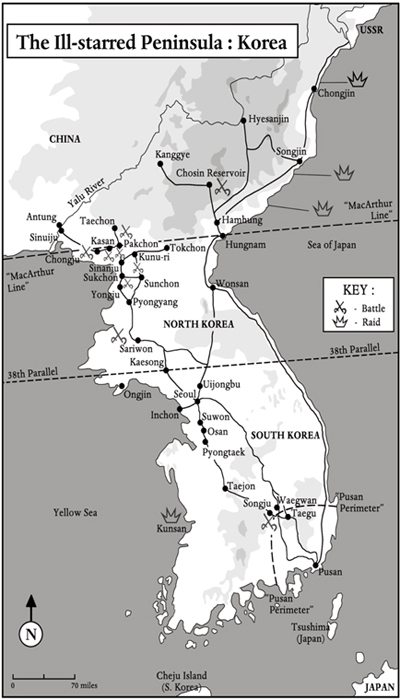
27th Brigade was closing on the port. Under a bright, colourless sky, soldiers lining the decks of HMS Ceylon and HMS Unicorn could see, in the foreground, scores of ships, for Pusan was the funnel through which reinforcements were being shovelled to feed the UN war machine. Then the city itself – a dirty smudge on the landscape – and behind it, the great mountains that climbed up the peninsula, coated in the vivid green of summer scrub. The port city was the hub of UNC operations in a rectangle 50 miles deep and 100 miles wide: The ‘Pusan Perimeter’, the last remaining territory on the peninsula not controlled by the North Korean Peoples Army.
The Argylls and Middlesex had disembarked together in a war zone before – they had been the first two regiments ashore in France in 1914 – but 27th Brigade’s arrival in Korea was not auspicious. In Pusan HMS Unicorn, carrying the Diehards, ran aground. Assistance was dispatched. ‘There was a very fussy Korean tug alongside with a large funnel and the captain had more gold braid than an admiral,’ said REME Captain Reggie Jeffes. ‘It had a funny type of bridge – rather like a greenhouse, lots of glass and wooden bits and pieces – and the cross trees on his mast got caught up with this huge life raft on the side of the carrier; it broke loose, dropped down on his bridge and shattered it! Of course, all the troops were peering over and cheered like anything, and this was an enormous loss of face for the poor Korean captain who promptly took his tug and left in high dudgeon.’
Still, the tug had done its job. Freed, the Unicorn moved to dock behind the Ceylon.
Approaching the quay, Diehards were sent below by the Unicorn’s captain. ‘We were told it was going to be like Dunkirk so we were all geared up, we were down below prepping guns and grenades and getting pep talks on field action,’ said Corporal Bob Yerby. It was a pleasant shock when the men spotted, not NKPA machine gunners, but the Korean reception committee and international media waiting to record their arrival. Aural ambience was provided by an African-American marching band blaring out ragtime, ‘Colonel Bogey’ and ‘God Save the King’. ‘Where the hell is the war?’ wondered Yerby.
The Argylls on HMS Ceylon had not suffered the ignominy of being posted below. As the cruiser glided in, the Highlanders presented a formidably warlike array: Jocks in tam-o’-shanters thronged the decks while martial music piped the battalion ashore. ‘There was great excitement among the Americans at our pipes and drums, they had never seen anything like this!’ said Robert Searle. Trooping ashore, the Highlanders –‘the ladies from hell’ to US troops – were handed bouquets of flowers by shy schoolgirls.1 Among the reception committee were a number of ludicrously armed US service troops, prompting the adoption among some Argylls of an ageless infantry prejudice – disdain for men in the rear. ‘They all wanted to be John Wayne and Gary Cooper, with .45s, knives and carbines,’ said Ralph Horsfield. ‘I don’t know if they were trying to impress us or what: They were base wallahs – forklift truck drives and dockside workers!’ At least one Argyll, however, was not showing a heroic face to the world: Second Lieutenant Owen Light had been berthed in the gunroom with midshipmen, and on the previous night ‘we allowed ourselves to be lulled with gin’. Aboard the moving warships, soldiers had been cooled by the breeze; in Pusan’s sweltering humidity, Light, loaded down with gear, sweated off his hangover.
Lieutenant Colonel Andrew Man was not having a good day. Firstly, his advance party had been met on the docks by a British attaché. ‘He had a face like a boot and seemed imbued with the American idea that all was lost, and pretty well told us to go back again,’ Man said. ‘He annoyed us intensely!’ The Middlesex CO was equally irritated by the attention lavished on the Highlanders, who had disembarked before his battalion (as they had in 1914). ‘The bouquets all went to the Argylls, these lovely exciting Scotsmen got all the attention,’ Man sighed. ‘But one always expects Scottish regiments to catch the eye.’ Major John Willoughby suffered his CO’s wrath as a result: ‘This infuriated Andrew Man waiting on the jetty, who began shouting abuse for not having us all on deck.’2 Willoughby’s D Company remained behind to unload brigade stores into warehouses, while the rest of the troops, issued with their first American C-ration packs and 50 rounds of ammunition, marched off to the rail station for the trip up-country.3
‘The atmosphere of their arrival was far removed from that of a military operation, it was a pageant of international goodwill,’ noted the Daily Telegraph.4 Men were handed gifts. James Beverly, accepting a South Korean flag made of sacking, folded it and put it in a pocket for good luck. But the seriousness of the business at hand became evident when sergeants ordered men to load and lock their weapons – orders that were never issued on trains.5 In the station, as the locomotive gathered steam, the last carnival ambience evaporated as another train clunked to a halt alongside. Curious soldiers glanced over. Its passengers were hundreds of mangled American soldiers: fresh meat from the battlefront. ‘We could see them lying there in bandages,’ said Middlesex MO Stanley Boydell. ‘This was rather disconcerting, to say the least.’ The grim sight was left behind as the brigade train drew out of the station.
* * *
The ‘hard-class’ wooden carriages the brigade was occupying had previously carried refugees. Littered with garbage and infested with lice, they had been disinfected by naval decontamination squads, but even so, ‘Jock the Doc’ Haldane spoke for many when he characterised the train ride as ‘prehistoric’. Passing through the provisional capital of Rhee Syngman’s besieged republic, few soldiers were reassured by their first sights of the land they had come to defend. ‘Pusan was a filthy hole, diseased, crammed with refuges, it was quite horrible,’ said Man. ‘If somebody had said bubonic plague was rife, I would not have been a bit surprised.’
The utilitarian port city was swollen with countless thousands of refugees who had fled to this last refuge from the communist onslaught. Spreading from Pusan’s outskirts were shanty towns of huts patched together from rough planking, the ever-present rice straw mats, and bits of military castoff material – cardboard ration boxes; cans hammered flat; military ponchos. Here, an olive green steel helmet was suspended over an open fire, in use as a cooking pot, bubbling with a watery rice porridge miserably flavoured with a few dried cabbage leaves. There, another one was lashed to the end of a pole to empty the heaving, fly-infested ‘honey pot’ receptacles of the rickety wooden latrines, from whence the stinking contents –‘night soil’ – were conveyed in carts to fertilise the paddy fields outside the city.
Even in the early months of the war, the sprawl of the ‘International Market’ was spreading. But this was no Asian market jammed with exotic bargains like the racy street stalls of Hong Kong; this was a bazaar of desperation, of survival. The alleyways were swarming. Grunting men hefted improbable piles of goods on wooden A-frame backpack carriers; maimed and disabled soldiers begged on corners; raucous women at makeshift stalls sold or bartered everything from fish to agricultural produce, from rubber shoes to Hershey chocolate bars. The clamour was a thousand voices shouting and arguing in staccato Korean, with, here and there, jaunty, Japanese-style music blaring from gramophones. The smell was a blend of garlic, kimchi – the pungent Korean pickle –wood smoke and the filth of the gutter.
Flitting through the chaos at waist height, tugging at the uniforms of wandering American soldiers were Dickensian apparitions: The ubiquitous scruffy children, holding their palms out imploringly for gum or candy and intoning ‘Miguk, miguk’ – Korean for ‘American’. Many UNC troops were moved to see these rag-clad, dirty-faced urchins, topped with scarecrow-like shocks of un-brushed hair. Few looked older than twelve, but many had even tinier children bound to their backs. Countless families had been broken up in the chaotic retreat, yet the duties implicit in the elder sibling relationship still compelled these pathetic orphans to somehow care for their younger, more defenceless brothers and sisters. ‘I remember faces,’ said Ray Rogers. ‘Just these bewildered faces.’ And the orphans haunting the shanties of Pusan were just one minute fragment of the vast human tragedy Kim Il-sung’s invasion had precipitated.*6
* * *
On their stop-start train, sampling the interesting new American C-rations, 27th Brigade chugged out of Pusan into the countryside. After transferring to US trucks, they disembarked some 20 miles southeast of Taegu. The concentration area was a boulder-studded, sandy stream bed, trickling with clean running water and shaded by willows. It was an idyllic spot; here they would work up before being inserted into the line.
Nearby was the HQ of 24th Infantry Division, the first American occupation unit that had landed in Korea from Japan, and been defeated in a succession of battles, losing its commanding general, William Dean, captured in the defence of Taejon after taking on a T34. ‘In welcoming Brigadier Coad, the US commander said he was particularly glad to receive a British contingent because they were experts in retreating,’ Willoughby heard. ‘Well, we shall see.’7 Their first sight of American combat troops gave some men pause for thought. Argyll adjutant John Slim looked on critically. ‘They just retreated,’ he said. ‘Everyone runs at times, but the 24th Infantry Division was not ready for war.’ Yerby got talking to one of the coloured truck drivers; the US Army of 1950 was still segregated along racial lines. ‘This guy got out a sleeping bag and his feet stuck out the bottom. He said, “When the Gooks come, you pull the bag up and bug out!” ‘ These were new terms: ‘Gooks’ were enemy, ‘bug out’ was a retreat.
Still the allies were well supplied – and generous. Haldane was woefully under-equipped: His Regimental Aid Post, or RAP, had ‘a couple of crates of blankets’ six stretchers, sedatives for battle fatigue casualties, and three bottles of anti-diarrhoea solution. Americans gave him a full medical pannier. ‘I could have done an appendicitis operation with the instruments there!’ he said.
Soldiers discovered what poor cousins they were beside the Americans. US units had stainless steel kitchen units, water-filled drums to clean their mess tins – British troops were expected to use a handful of sand – and, hanging from trees, water skins filled with ice. ‘It was the first time we had seen the American way of living in the field, it was fantastic to see ice water in the field, it struck us as very funny,’ said Horsfield. ‘The Americans had fantastic organisation.’
The 3.5-inch ‘bazooka’ anti-tank rocket launchers were issued. ‘One per platoon, with six rockets!’ Willoughby, whose D Company had rejoined the battalion, noted. ‘None of us had fired it and I had no alternative but to make two members of the crew fire one rocket each and hope I would not regret it.’8
Willoughby fretted at the speed with which the brigade was heading for the front. Many young soldiers were unused even to keeping their rifles – which in the depot were locked in the armoury – handy at all times, leading to urgent reproaches from NCOs. ‘Wonderfully willing as our National Servicemen are, they are at best half trained and I expect they are all as frightened of being pitch-forked into battle as I am,’ he wrote. ‘May we have time to learn without too many casualties.’9
That possibility looked unlikely after company commanders were summoned for a briefing in Taegu, the market town that was, bar Pusan, the only Korean settlement of any size still in UNC hands, just behind the front. In the town, the officers noted two stalls servicing the US Army: ‘Very Gentle Laundry’ and ‘Kindly and Clean Laundry’ – both situated over open sewers. Refugees thronged side streets, and ROK recruits were drilling and singing: ‘It is said they are put into the line after two weeks, where they either get their throats cut by the “Gooks” or are shot for desertion,’ Willoughby noted gloomily.10 Some ROK officers were dangerous-looking men, veterans of the Japanese Army, but many recruits were virtual children, lost in helmets and uniforms far too big for them.
One minute before midnight on 2 September, 27th Brigade was placed under command of US 1st Cavalry Division.11 Chaos reigned. Willoughby and fellow officers had been waiting for their briefing in front of a headquarters building when an American brigadier drove up in a jeep, skidded – showering all those waiting with dirt – and raced off. ‘The building came alive with figures carrying boxes of files to parked vehicles and it was evident that all was everything but well in high places.’ A briefing officer arrived, stating that during the night, the NKPA had forced the Naktong in seventeen places. Willoughby noticed nearby rear echelon officers, ‘frantically pumping bullets into targets almost in desperation’, as they honed rusty musketry skills.12 ‘There were very dramatic descriptions about what was going on,’ recalled Major John Shipster. ‘I remember an American marine colonel going up to Colonel Man, and the question was, “What’s cooking?” and the reply was, “We’re hitting it out, punch for punch up there!” All this lingo was slightly alien.’
The headquarters seemed overrun with reporters – horrifying many British officers, whose units, unlike their American counter-parts, lacked PR staff. General Hobart Gay of the US 1st Cavalry Division had just returned from a reconnaissance, and was surrounded, Willoughby stated, by ‘US press, a considerable crowd of whom followed his every move, stopping him for close ups and crowding in when he issues his orders.’ Brigadier Coad appeared ‘rightly appalled’; Man told journalists that if they appeared in his area, they would, ‘incur his greatest displeasure’.13
As the brigade turned in, the night was disturbed by the rumble of artillery and the glow of flares to the north.14 Coad had hoped for an acclimatisation period. It was not feasible. ‘The Americans were under such pressure they asked the brigade commander if he was prepared to go into the line,’ said Jeffes, the REME officer who was still waiting for the brigade’s transport to arrive from Hong Kong. ‘He said, “Yes” – he had to.’
After dark, in pouring rain, a long line of trucks arrived at the brigade forming up-point. One ran over a tangle of signal cables and wrapped them round its axle. ‘With great singleness of mind, one American procured a machete and hacked through every cable,’ Willoughby noted. ‘I could not help wondering what sort of impact this might have in the early hours, in the middle of an enemy offensive, on the HQ.’ In darkness lit by distant, flickering gunfire, drenched platoons mounted up, then the convoys headed for the Naktong River, the key defensive feature of the ‘Pusan Perimeter’.15
* * *
Throughout the night of 4 September, 27th Brigade’s men deployed onto frontline positions on the east bank of the Naktong. Heavily loaded down with weapons and ammunition, the men slogged up the muddy hillside tracks under the pelting rain. The outlook was not promising.
Their hills, set back some 1,000–2,000 metres from the riverbank, were overlooked by higher, enemy-held hills on the west bank and also to the south, where the river looped around. The brigade’s frontage was 16,500 metres (18,000 yards) – twice that of a division, i.e. a unit three times its size. There was a gap of 8,200 metres (9,000 yards) between the brigade and its left flank unit, the US 2nd Infantry Division.16 Across the river, was deployed a North Korean division.17
Willoughby arrived at his allocated sector – 4 miles, a ludicrous frontage for a company, with an open right flank – to find GIs sitting on their trenches, firing off coloured signal lights and tracers in celebration of their imminent departure. ‘That they were able tomake a carnival without attracting enemy response was reassuring, but it ruled out any possibility of reoccupying their positions,’ Willoughby sniffed. The American commander had a force of 200 infantry, eight AA guns, six tanks and 200 Korean police. ‘The whereabouts of his troops were only too evident and we were naturally only too anxious to get his men out as quickly as possible … he was singularly unspecific concerning enemy positions and activities, beyond a warning that they operated almost always after dark with patrols regularly crossing the river and snipers left behind.’18
Departing GIs proved full of advice. ‘They were asking about our rifles and stuff; they said, “You need to have this kind of automatic, they’ll be on top of you before you know it,”’ recalled Frank Whitehouse, the Stafford man who had volunteered for the Middlesex. ‘Typical Americans – they talk a lot.’ The Americans were surprised at the British numbers. ‘They said, “Where are the rest of you?”’ recalled Diehard Lance Corporal Don Barrett. ‘We said, “We are the rest!” ‘
The key defensive priority in war is to fortify and hold high ground, dominating terrain. The soldiers furiously dug staggered, two-man slit trenches ringing the hilltops in all-round defence. ‘Before you think of food or anything, you dig,’ said Argyll Private Jake Mutch. ‘It was bloody hard, stony, but we hacked through. You felt better when you were under cover.’ Rocks were piled along trench parapets, tins filled with stones strung on foliage to give aural warning of attacks. Once positions were dug, crates of ammunition and rations were humped up. The conditioning of the New Territories paid dividends. ‘We were proud fit, not bullshit fit,’ said Captain John Slim. ‘After Hong Kong we could run up the biggest bloody hill with a pack.’
Inexperience was glaring. When Barrett had dug in under his platoon commander’s orders, the dispositions were found to be suicidal: ‘He dug in three sections shooting into each others backs!’ The platoon sergeant rearranged the positions. Argyll subaltern, Owen Light, was discovering who was in charge. ‘The Jocks were tough, they were not people who’d be pushed around by any miserable second lieutenant,’ he said. When another young lieutenant offered one soldier advice on digging, the man spat back, ‘I’ve been a fucking miner all my life; you are going to tell me how to use a spade?’
As daylight illuminated the brigade’s first day in the Naktong Valley, gruesome evidence of combat took shape. Diehard Ken Mankelow and his mates found their entrenching tools hitting the former defenders of the hill: A ROK unit who had been buried in their trenches. ‘We had to dig them out, there were maggots crawling out of their skulls,’ he said. Barrett, on the same position – ‘Boot Hill’ – found it covered in ‘bits of bodies’ from an attack two weeks previously; it was a ‘bit pongy’. To reach a forward OP, it was necessary to crawl through human detritus, while in front of the hill, a minefield was ‘chock full’ of decaying North Koreans.
The brigade’s neighbours on the line, it was discovered, were not soldiers. So desperate was South Korea’s manpower shortage that the police force was taking on a combat role; 230 men were holding a line adjacent to the Middlesex’s D Company. The first meeting between Willoughby and the constabulary proved memorable. Their leader, Captain Hong, ‘an absolute caricature of a Japanese general’ who smelt of stale brandy and was later to be exposed ‘as an entrepreneur of anything saleable in Taegu, and in particular, army rations’ appeared at Willoughby’s CP. He was accompanied by a boy named Hur (‘who could be fourteen or could be eighteen’), who had learned English at a missionary-run school, who acted as an interpreter. In welcome, Willoughby praised the police and told them what an honour it was having them attached to the Middlesex. In response, Hong spoke for several minutes. Willoughby waited for a translation of this lengthy speech: ‘Captain Hong, he say, “Yes,”’ was Hur’s summary. Willoughby then asked about the police positions. This query prompted a pantomime from Hong: ‘First he turned himself into a windmill, then a machine gun mowing us all down, and finally he shot himself in the temple with his forefinger.’ He finished by demanding that one hundred British soldiers be placed under his command. Instead, Willoughby lent him his CSM and a Bren gun, which the NCO instructed the police in. Willoughby wondered how much faith to place in his new allies: They were ‘a pretty scratch lot armed with rusty Jap rifles … I hope I can keep them on my side.’ A Middlesex sanitary corporal, Jimmy Fields, who had learned basic Japanese as a prisoner-of-war, was made liaison officer.19 The police, split into two companies, were dubbed ‘Army Group A’ and ‘Army Group B’ and incorporated into the brigade defences.20
With yawning gaps between units, Battalion HQs were sited for all-round defence; even Coad’s Brigade HQ had a section of line to hold.21 The brigadier was disgusted with the muddled state of affairs thus far. He had been ordered to insert his men into the front by first light on 5 September, then, two hours later, told they had to be in position by last light on the fourth. ‘With very few exceptions, American staff officers never leave their HQs, even to visit lower formation HQs, and never in our experience did a staff officer come to look at any ground,’ he seethed in a secret report to Whitehall. ‘Information about the positions of flanking units has always been impossible to obtain from formation HQ.’ 22
Amid the steamy late summer humidity, 27th Brigade settled into their positions, gazed out over the landscape, and waited to see what the Korean War would bring.
* * *
In common with most modern conflicts, where soldiers lie in carefully camouflaged positions, the front appeared lifeless, deserted. But it was, in its way, beautiful. Korea is known as ‘the land of embroidered rivers and mountains’, and from their hilltops, gazing into No Man’s Land, this landscape spread before the British soldiers’ eyes. Above, impossibly high, spread a luminous blue sky. Beyond the foresights of rifles and Bren guns resting on the parapets of slit trenches, untended rice fields sparkled green. From higher positions, the water-filled paddies reflected the summer sky and its dazzle of sunshine like a patchwork of mirrors. Among them, here and there, were dotted hamlets of mud-walled, thatch-roofed huts and cottages, set amid little copses. All were abandoned; some were burned down; others smouldered. As the eye wandered further north, it came to the broad blue loop of the Naktong, its flow almost imperceptible. Beyond it, largely treeless – most of the peninsula was deforested – but carpeted in lush green scrub, loomed the enemy-held hills, the shadows of clouds scudding across their slopes. And behind them, wave after wave of mountains cascading northward into a hazy blue infinity. It was a landscape that had endured for eons: the lone signs of the twentieth century, bar the soldiers’ weapons, were the telegraph poles lining the empty tracks that wound through the paddies. Silence, broken only by the incessant background drone of cicadas and the occasional squawk of a radio, hung over all.
The skies were not always blue. When the post-monsoon down-pours came, they came with a vengeance. Grey clouds descended, blanketing the hills and merging onto the ridges like fog. Then, the deluge. Heavy pellets of rain speared down, churning the ground into thick ooze. On the edges of their trenches, huddling under largely useless ponchos, soldiers sat with the litter of camp life – matchboxes, cigarette packets, empty cans, ration-box cardboard – swirling around their knees. Chilled men swore at their circumstances and the rain, and waited impotently for it to cease. When it did and the sun returned, the hills gradually took shape through the grey, until all that was left of the rain clouds were tendrils drifting up from the slopes like smoke, giving the terrain the appearance of a Chinese watercolour painting. Soldiers upended boots, emptying brown water onto the mud, and strung soaked jungle greens from branches and makeshift washing lines, where they steamed in the haze. The cicadas took up their buzz once again.
‘It was all peace and quiet,’ said Man. ‘But it was an ominous peace.’ The motionless Asian landscape was primed with invisible menace, a menace Light encountered on his first morning on the Naktong, as his company commander pointed out – there were no maps – to indicate the positions his platoon was to occupy. ‘We were walking in the countryside, suddenly there was this terrible bang, and we hit the deck,’ Light said. Dirt geysered out of a paddy, then rained down. After a few seconds, the officers stood warily. ‘We just had to get on, there was no real terror, it was surprise,’ said Light. ‘Someone was watching us; it brought home that this was no game, this was real.’
Across the river, brilliantly concealed, lay the angular bulk of self propelled guns, or SPGs. These Russian-made armoured vehicles – essentially, tanks without turrets, granting them low silhouettes – mounted 76mm guns. They were potent weapons, and on the Naktong, were used by the NKPA to inform 27th Brigade that there was, indeed, a war on. A sudden crack – the simultaneous shriek of a shell – the near-instantaneous crump of detonation – redundant yells to ‘Take cover!’ – men tumbling into water-filled trenches – dirt showering down – sudden silence. Then the pick-pick-pick as men scratched trenches a little deeper.
‘Stonkings’ from SPGs and mortars dug in across the river granted most men their first experience of hostile fire. ‘It always seemed to be when we were going to have something to eat they would start mortaring or shelling,’ said Argyll Lance Corporal Joseph Fairhurst. ‘If it made a particular noise it was coming over you – shhhh – it if made another noise – ssssss – it was coming on top of you.’ The SPGs were most dangerous. While mortars would ‘thunk’ when fired, giving men a few seconds to take cover before the bomb, describing a high parabola, landed, many SPG shells were high-velocity, direct-fire weapons; they hit at the same moment the gunshot was heard. Corporal Harry Spicer’s baptism of fire occurred when his position was subjected to a ten-minute mortar barrage. He knew he was largely safe against anything but a direct hit if he stayed below ground – bombs explode outward and upward – but found the noise of mortars detonating close-by ‘absolutely terrifying’ their volume beyond anything in his experience. The ground in Spicer’s trench vibrated with each impact.
Various retaliations were plotted. ‘We’d all say, “I think that’s it over there, there’s smoke!”’ said Fairhurst. ‘So they’d call in an air strike. You’d see planes come in, swoop down the valley, they’d start at the bottom of the hill firing rockets straight up to the top, they’d say, “That should’ve shifted them.” Half an hour later, the blinking gun or mortar would start up again!’ Willoughby was at Battalion HQ where he witnessed one attempt to eliminate an SPG. A sniper sergeant returned from a reconnaissance on the riverbank, saying an SPG had pointed at him. Man called his mortar officer, who contacted an American artillery battery. Coordinates were sent. Minutes later, a twenty-minute artillery barrage whooshed over the CP, its shells impacting across the river. Willoughby, uninvolved, quietly checked his target map. The ‘SPG’ was almost certainly a wrecked truck he had previously marked.23
* * *
27th Brigade had been dispatched to Korea then rushed to the line post haste but once installed on the Naktong, the war seemed to slow down. Bar maggot-eaten corpses and long-range fire, signs of fighting were surprisingly few. ‘The extraordinary vulnerability of my position, and the merciful inactivity of the enemy induces a strange unreality,’ wrote Willoughby.24 ‘Everything seems so peaceful … the river meanders across my front, a mirror of the cloudless sky, it is too gentle for war.’25
The clear air and hilltop vistas granted soldiers grandstand views of distant actions. Vincent and the Argyll mortar platoon watched one drama across the river: A flight of Mustang fighter bombers were buzzing the hills when a North Korean momentarily let his fire discipline slip. ‘Somebody opened up with a machine gun,’ Vincent said. ‘One Mustang did a perfect loop and blew the top of the hill off. I bet he wished he’d not opened up.’ Willoughby watched American jets strafing a ruined village. ‘I wondered if it was worth it for them to fly from Japan for that,’ he wrote.26
With such distances between the hilltops the soldiers inhabited, patrols were constantly roaming between them. They proved good exercise, good tactical training, and good practice in reading the maps that were now starting to be issued. The patrols – sections of eight men in jungle green, eyes shaded from the sun under jungle hats, weapons at the ready and canvas bandoleers slung across chests – passed frequently through the villages in the rear. With North Korean and local communist guerillas operating in the region, it was critical to show a presence, to dominate not just the physical, but also the ‘human terrain’, assuring the villagers that the UNC was present and active. On these patrols, Jocks and Diehards began to encounter South Koreans.
The Naktong Valley hamlets were huddles of cottages, many fronted with dangling bundles of bright red and green chilli peppers drying in the sun, while pungent kimchi fermented in half-buried earthen jars. The villagers lived under thatch, dressed in the white peasant attire they had worn for centuries and tended their paddies with oxen. ‘It is a gentle countryside of rice and cotton fields and apple orchards,’ wrote Willoughby. ‘The village elders sit about in their white robes and tall hats smoking their long-stemmed silver pipes and none of us has the slightest idea what they are thinking of.’27
Being miles – and centuries – removed from the ideologies and politics of Pyongyang and Seoul, Moscow and Washington, many villagers had little idea of what was happening to their country. The destructiveness of warplanes and artillery was beyond their ken, leading some to believe that their president had hired a devastatingly powerful shaman to obliterate his enemies from the North.28
Private James Beverly, the Bermondsey Cockney, was amazed by both landscape – ‘I was from London, I’d never seen a hill before!’ – and lifestyle – ‘all the manure from the water buffalo and the sewage from the Koreans went into the paddy fields. The whole country stunk.’ For British troops familiar with Singapore and Hong Kong – both of which suffered pockets of poverty, but which were cosmopolitan trading hubs – Korea seemed lost in time. ‘It was not similar to Hong Kong: The New Territories had modern cars and buildings, Korea was like going back in history, seeing bullocks pulling carts, no roads, and small, poorly built houses,’ said Yerby. ‘Lord! The world had forgotten them. I was a bit shocked that any country could be that poor and have nothing.’
* * *
On active service, many men found themselves less busy than they had been in peace-time Hong Kong. There was stand to at last light and at first light. In the evening, two-hour sentry ‘stags’ were arranged. But during the day, when not on patrol, there was little to do but cook, clean weapons, write letters, improve trenches and bullshit with mates.
Food was largely the US C-rations, one cardboard box per man per day. Though best eaten hot, it could be consumed cold, and contained a range of tins and brown-paper wrapped packages. The entrée, heated over a tin of solid spirit (‘canned heat’) varied: meat stew, spaghetti and meatballs, meat and noodles, frankfurters and beans, ham and lima beans. ‘C rats’ also contained hardtack crackers, an oatmeal block, instant coffee, sugar tablets, chocolate, gum, a ‘jelly bar’, candy, nine cigarettes and an ingenious little can opener. ‘The chewing gum, the cigarettes and the toilet paper were nice – but I am no fan of frankfurters and ham and lima beans,’ said Yerby. ‘But there were times when the cooks managed to make a good old stew – that was good stuff.’
Field hygiene was essential as, given the intimate living conditions, were one soldier to come down with a bug, the rest of his section would suffer the same. Behind the fighting positions were latrine trenches and ‘tin holes’ where empty ration cans, which attracted swarms of flies, were buried. But sanitary drills did not guard against every possible infestation. Peter Jones, the Argyll who had seen naval action, found himself hosting unwanted visitors: ‘It was very alarming passing an 18–24 inch tapeworm.’29
Real leaders were standing out. ‘In Hong Kong it was more regimental: “Yes sir, no sir, stand to attention,”’ said Whitehouse. ‘In Korea, there was none of that, they were easygoing officers, they were very good and led from the front.’ ‘You tend to get more “lead swinging” when troops are not in action,’ added Stanley Boydell, the Middlesex MO. ‘If troops are involved in something life-threatening, a lot of attitudes change, particularly if officers are recognised as being highly competent; they may have been regarded as disciplinarians, but then troops realise they are efficient and lifesaving.’
While many subalterns lacked experience, company-level officers had learned their business in the Second World War. ‘He was a very good officer, very strict,’ said Argyll Ralph Horsfield of his company commander Miles Marsten. ‘He had us all digging in and keep heads down and no movement whatsoever.’ Willoughby was teaching his young Diehards the tricks of the trade. In the silent landscape, the loud bells of field telephones were disconnected; calls were made instead with discreet whistles down the line. To make the enemy think there were more Middlesex than they were, he sent pairs of soldiers out to different locations before daybreak to light cooking fires. He also took a 2-inch mortar crew with him whenever he went out to visit platoon positions, and sent half a dozen bombs from the positions to give an impression of greater firepower. And he disguised a Bren gun carrier as an SPG, using a pole and shell cases for the barrel and a jam tin for the muzzle brake; the decoy actually fooled a visiting ROK officer.30
Conversely, unfamiliarity with the countryside, and nerves, showed. Second Lieutenant James Stirling’s platoon – his ‘tiny little army’ – found themselves cut off on their isolated position. ‘We were surrounded and had an airdrop of American rations and ice in bags – this was quite dangerous, about a hundredweight of ice – as we had not been able to get water,’ Stirling said. ‘Then the CO walked into my perimeter; we were not surrounded at all, it was just rumour.’
Not all officers welcomed CO visits. Man and Coad visited Willoughby’s company position by jeeping along the road in clear view of enemy. Three days later, Willoughby’s positions came under sustained shellfire, ‘No doubt a consequence of the brigade commander’s circus last Sunday.’31
Under Korea’s fierce sun, the men’s lightweight jungle-green uniforms, salted with sweat, faded. Argyll quartermaster Andrew Brown found himself running out of trousers, as in Hong Kong, many of the men had their laundry done by Chinese washerwomen, who slapped the clothes on rocks, a method that cleaned them but wore the cloth. ‘Eventually, you could just about recognise the battalion by their split arses,’ Brown said.
Henry ‘Chick’ Cochrane of the Argyll mortar platoon and a mate, soaked after a downpour, approached an American supply dump in the rear to beg some clothes. ‘They gave us American jackets, really good jackets, really good boots – lovely!’ he said. Returning to their lines, the two bumped into Slim stalking through the paddies. ‘We saluted him,’ Cochrane recalled. ‘He recognised us and said, “Get ’em off!” We had a laugh about it.’ As the war proceeded, the rugged terrain and extreme climate would wear out British kit, and 27th Brigade would come to look increasingly American.
There were some pluses to British gear. Cochrane was talking with some GIs behind the line when discussion turned to weaponry. An argument ensued as to what was better: the bolt-operated British Lee Enfield or the semiautomatic American M1 Garand. A competition was quickly arranged: the winner would be the first man to put ten rounds through a can 50 yards distant. Bets were laid, cigarettes piled up as the winner’s trophy. Cochrane used the quick-firing method taught to British troops – ‘I used the bolt with my forefinger and thumb, and fired with the middle finger’ – but even so, the American had only to squeeze his trigger, and was shooting faster. But after firing his eighth round, the clip pinged out of the American’s M1. ‘My rifle only holds eight!’ the GI ejaculated. ‘I know!’ crowed the Argyll as he finished first: the Lee-Enfield had a ten-round magazine, obviating a reload. ‘You sure caught me that time,’ the American conceded. ‘I’ll write home about you!’
Some members of the brigade grew very fond of the GIs. ‘We needed a lot of warm heartedness from the Americans to supply us – we had no guns, no tanks, and we were supplied with food and rations,’ said Shipster. ‘I can’t speak too highly about them [Americans].’
Others were more critical. The Middlesex CO was at his most irritable when two excited US colonels arrived at his CP. They had been driving when they came under fire from a sniper on a hill, they told Man, so took cover in the monsoon ditch alongside the track. ‘Along came my ration truck with a couple of fellows inside,’ Man recalled. ‘They stopped their truck, saw these American colonels in a ditch and went up with their rifles and sorted out this chap.’ The two American officers recommended that Man award the two Diehards medals. Man was having none of it. ‘They were doing a normal day’s work,’ he sniffed.*
Enemy snipers, like the mortars and SPGs, gave the brigade respect for NKPA fieldcraft. At the back of Beverly’s trench was a sapling. One day a pair of bullets thudded into it, just inches from the Diehard’s head. ‘They could see you, but you could not see them,’ Beverly said.
But despite everything – rain, mortars, SPGs and snipers – there were pleasant moments. When the sun descended, the soldiers on their hilltops were treated to a remarkable spectacle: ‘There were beautiful sunsets, like nothing I had set eyes on before or since,’ Julian Tunstall, a Middlesex private, wrote.32 But once darkness settled, nerves were stretched.
‘In the front line, nights are always hateful, they last for ever and the trees whisper to each other in perpetual disquiet, bushes seem to move and starving dogs from some deserted village roam among us and send old tins clattering down the hillside,’ wrote Willoughby. ‘All about our little perimeter … young soldiers in pairs leaned forward against the wet parapets of their narrow trenches grasping a rifle and staring into the darkness.’33
It was dangerous for men to move beyond their own slits. On Mankelow’s position, the latrine trenches were at the back but one man went out in front behind a bush. ‘There was a white flash, someone opened up, we all fired,’ Mankelow recalled. ‘Officers came and stopped it, then they were saying, “And you couldn’t even hit the bloke!”’ Some young officers were so spooked by the dark that they simply did not sleep. ‘We thought the North Koreans were superhuman and could come at night without making any noise, so we sat up all night with fingers on triggers and every rabbit that hopped, people fired,’ recalled Stirling. ‘By the end of three nights, we were absolutely bushed, and an order came down from the CO: All officers were to sleep at night.’
Though the anticipated enemy assault had not materialised, British soldiers on the Naktong were being wounded and killed. The Argylls suffered their first casualty on their first day in the line: A subaltern was accidentally shot by his own sentries and evacuated on 5 September.34
While the dug-in men would learn that they were largely safe from sudden fire, jeeps speeding along the dust tracks between the positions were at risk. ‘If you sent a jeep down the road they would shoot at you if you went along,’ said Jeffes. ‘And if you went too far you ran into a North Korean machine gun nest – we lost one or two vehicles where they missed the turning for the Argylls and came across this wretched machine gun.’
It was a jeep accident that would precipitate one of the war’s countless little tragedies. Reg Streeter, the batman to the Middlesex Intelligence Officer, Captain Jeff Bucknell was killed when his jeep overturned near one of the forward company positions. The two men, both boxers, were ‘really good mates’, whose friendship, unusually, crossed rank boundaries. Bucknell subsequently armed himself and headed down to the river, toward the North Koreans, alone. He was never seen again. Dark rumours circulated. ‘He was tied up with barbed wire and burned,’ said Yerby. ‘At least, that is what we heard.’35
* * *
Roving patrols were becoming routine. With 27th Brigade familiarised with the terrain, more dangerous operations – fighting patrols – were instituted. In the brigade’s first offensive operation, the Argylls’ C Company was tasked to take out a North Korean position. A force of North Koreans of unknown size had moved across the Naktong and were digging in on a hill on the Argyll’s left flank, where there was a 6,000-yard gap before an American unit.36 They had been spotted by the keen young Lance Corporal Harry Young. ‘I was one of those guys who was well alert, well trained and I had been brought up in the hills: My father used to be a gamekeeper and I had done gamekeeper duty,’ he said. ‘I told the platoon commander I could see maybe two platoons about a mile away on this hill feature.’ On 6 September, a daylight patrol under Captain Neil Buchanan was tasked to bump the enemy outpost by advancing to contact. In his briefing, Buchanan warned his men that they were facing a savage enemy; wounded had to be retrieved.37
27th Brigade’s first offensive action got underway. In tactical formation, the patrol moved warily toward the suspected enemy-held feature. The patrol was strong – 15 men – but carried only one significant automatic, a Bren. At the hill, the patrol split into two sections, one on either side of a stream, and advanced through the cover of the pine trees dotting the hillside. The only sound was the grunt and pant of men labouring up the hillside – then the air was rent with multiple ripping crackles. Muzzle flashes flickered among the trees. ‘The North Koreans had realised we were going to walk right into them, and opened fire,’ said Young.
The PPSH 41 Shpagin submachine gun was the key Soviet automatic of the Second World War. Despite lacking range, accuracy, and (in common with all submachine guns), stopping power – tactically speaking, it is a better result for a man to be wounded than killed outright, for a wounded man will occupy the attention of up to four more comrades who will have to drag him away, and his screams and the sight of his wound will demoralise the rest of his unit – it boasted a fearsome rate of fire. Its nickname, ‘the burp gun’ derived from the distinctive, 900 rounds-per-minute ‘brrrrppp’ of its burst – far faster than the 500 rpm of the British Sten submachine gun and Bren light machine gun. Moreover, like most Soviet weapons, it was crude but robust, and was fed with a 71-round drum, giving it a longer burst capacity than the Bren or Sten, each fed with 30-round magazines. These were the weapons that, from cover, lit up the Argylls.
Leading men spun down, bullets ripping into them. Six of the 15-man patrol were hit in the first fusillade. Young, further back, oddly felt no fear. Programming took over. ‘There’s nothing going through your mind,’ he said. ‘It was a very serious situation – you had to go for it!’ He returned fire. His targets – small men, dug into spider holes with bushes pulled overhead as top cover – were visible but he could not tell if his shooting was effective: ‘It is very difficult to tell if you have a hit.’
At the head of the patrol, Buchanan had been riddled. Crippled; unable to move; realizing that any recovery attempt would bring more of his Jocks into the enemy kill zone; the captain yelled at his men to escape, ordering them to make no attempt to rescue himself or his wounded batman, lying nearby. The order – which contravened his earlier command to leave no man – sealed his own fate.
The leading men – including Walker, the patrol sergeant, bleeding from nine wounds – tumbled back under fire, extricating the way they had come. Jocks grabbed the wounded, helping them walk or dragging them backward. Young and another soldier covered the retreating survivors, rapid-firing over their heads, then withdrew themselves.
The bloodied patrol sloshed down into the rice fields. ‘There were a few odd shots as we came back across the paddy,’ Young said. ‘But we were not pursued.’ Behind them, gun smoke drifted through the pines. Supporting their wounded, the Argylls trudged back to the C Company position. As he settled down, Young found he was suffering no nervous reaction to the short but sharp firefight.38
Five miles from C Company, in the peasant cottage that was the Argylls’ Battalion HQ, the progress of the Buchanan patrol had been grimly followed over the radio. ‘We all felt it was rather an audacious patrol,’ said Slim. ‘He was very isolated and there was no way to support him – we had no bloody artillery when he walked into that ambush.’ Lieutenant Colonel Neilson ordered his MO to jeep immediately to C Company to deal with the four casualties.
Douglas Haldane leapt into a waiting vehicle, which hurtled along the dust track toward the company. The doctor registered a distant and mysterious ‘plunk, plunk’. Seconds later, fountains of mud sprayed out of the paddies, bracketing the jeep. ‘They were mortars, they came out of nowhere,’ said Haldane. ‘It was the first time I had experienced anything like that; it was not pleasant.’ ‘Jock the Doc’ made it to C Company unscathed, where he was confronted with his first bullet wounds. ‘The ammunition the North Koreans were using was small bore, so you got entry, but not exit wounds,’ he said. ‘It amuses me to see cowboys and indians being shot on films with a .45 and the bullet being removed, and then they get up and go on their way: If you are hit even on the finger, you go down; even a small bore is shocking to the system.’ He got to work on the four bloodied men, but there was little he could do: ‘I was virtually rendering first aid with field dressings.’ Haldane’s treatment stabilised them for helicopter evacuation the following day. A spotter plane was requested to search for Buchanan and Taylor.39
As is so often the case in war, losses prompted a second, equally risky operation. ‘The OC got on the wireless and said, “I want you to take a patrol to the valley where Neil was, and see if you can get a prisoner to find out what happened,”’ recalled Light. The inexperienced subaltern was appalled: Not only does a snatch patrol have to advance into close – literally, hand-to-hand – range of the enemy, but Light was certain the NKPA would be waiting for just such a move. ‘I thought, the man is off his head!’ he recalled. ‘It must have been a hornet’s nest!’ But orders were orders.
Light and five men smeared their faces with dirt, removed all heavy equipment, taking only weapons, and walked out of their perimeter toward the target. In visual range of the objective, they dropped and began crawling – an exhausting form of movement. ‘We heard noises,’ Light said. ‘We crawled forward, and saw them all quite clearly digging like mad, about twenty of them, with pickaxes and spades about 30 metres away and chaps standing with rifles and burp guns. I thought, “There is no way in the world to get a prisoner!”’ Light ordered a withdrawal. The Jocks exfiltrated.
As he returned, Light worried about his company commander’s likely reaction. He was pleasantly surprised. ‘I said, “It was impossible!” and he said, “OK, well, there you are. You’ve had your first active service patrol.”’ It is a general principle of military operations that the commander on the ground should not be overruled by those not at the situation. Marston followed that rule. Light was learning.
The clash provided the Jocks with disconcerting intelligence. ‘I remember saying to the colonel, “When it comes to automatic weapons, we are outgunned!”’ said Slim. ‘So we got all the colour sergeants and quartermasters together with as many three ton trucks as we could, and sent them back to where the American stores were kept. We had – being a good Highland regiment – whiskey in crates marked ‘Office Equipment’ and we tried to buy each platoon a .30 calibre machine gun and a ‘grease gun’ or a Thompson submachine gun with it. Americans are good at war – they give you what you want.’
The aerial recce failed to spot the bodies of Buchanan or his batman; they remained un-recovered. The Argylls’ first encounter with the NKPA had been a defeat. ‘The good thing about the Highlander is that he speaks his mind, but is not rude,’ Slim said. ‘We drank with the Jocks, mostly beer or rum, and they’d say, “Didn’t we make a bit of a mistake there?”’ The Argylls settled into the hills to await the enemy’s next move.
* * *
While the forward companies patrolled the paddy fields and held their hills against the NKPA, a different kind of enemy was operating behind the lines. Roy Vincent, the Argyll mortar man, became aware of this when his second fire mission – his first had been on targets at the river – was to his rear. Light learned of enemy in the rear when, on a night patrol behind his position, his patrol halted in a village and they drank from the village well. The next morning, the patrol discovered that the well was stuffed with dead bodies. The Jocks had boiled their water – ‘it did not do us any harm’ – but polluting wells with corpses is a classic guerilla tactic.
Roaming behind the front were bands of South Korean communists and North Korean infiltrators. In the mornings, in the mountains to their rear and on their open left flank, the brigade could see ‘lots of little fires where they were brewing up their morning tea,’ recalled Jeffes. On 12 September, a special unit was tasked to deal with them.
A battalion of Korean police was placed under the Diehard’s second-in-command, Major Roly Gwynne: ‘Rolyforce’. Gwynne was perfectly spoken and always immaculately presented with a silk cravat and gold wristwatch complimenting his combat uniform, but in defiance of his debonair appearance, he was one of those unflappable leaders of the ‘officer and gentleman’ school, who in Coad’s words ‘seemed to revel in this kind of warfare’.40 Gwynne chose some of the Middlesex’s most experienced NCOs, as well as American signallers, to buttress the police for the mission. Among the scratch force was Sergeant Paddy Redmond, the Irish ex-commando. ‘Major Gwynne said, “This should suit you: We’re going up into the mountains!”’ The force – British soldiers, Korean police and porters – were trucked to the base of the mountains, where they dismounted, and began a six-hour climb into the granite ridges.
Reaching the summit of the range, Redmond’s unit set up a covert hide, scanning for the enemy brigade believed to have infiltrated across the river. ‘It was windswept, rainswept and we had no tents, no cover, just dig, sleep in shallow trenches and scan the horizon,’ said Redmond. ‘This is what I’d joined the commandos for.’ Given the terrain, the unit’s call sign was appropriate: ‘Billygoat One Six’. The police, thought Redmond’s unit, were a ‘rag tag lot, like a paramilitary’. One company had no firearms, only hand grenades; the unit mortar had no sights and the wrong calibre bombs.41 Redmond had little faith in them should the North Koreans mount an attack.
The hills, Gwynne’s men had been briefed, were empty of civilians. Anyone moving around was hostile. Redmond and the other NCOs alternated duties, manning hides and leading reconnaissance patrols down the slopes, but it was when the Dublin native was scanning from a peak that he spotted movement 1,000 metres below. ‘We located them in the valley,’ he said. Through binoculars, he learned how the enemy concealed themselves: ‘They had burrowed into the sides of the hills.’ Now they were in the open, visible to the naked eye. Working excitedly with an attached American signaller, he called in the grid reference for an air strike. The flight arrived on time, shrieking down the valley toward North Koreans, caught out in the open. Earth erupted as bombs landed, then a great sheet of orange flame tore along the valley floor as napalm went in. ‘They were very good at delivering what you asked for, it was awesome!’ Redmond said. The Dubliner was so exhilarated that he forgot radio procedure, yelling, ‘Fuck it, that’s it!’ into the handset. This was economy of force: ‘We were killing them without having to fight them on the ground,’ said Redmond. His party remained in their hide to scan further. ‘The next day, if there was no movement, you knew it had been a good strike.’
Prowling through the mountains; operating with local troops; living on their wits; calling in destruction from above; it was an extraordinary operation for the men of ‘Billygoat One Six’. ‘Major Gwynne said he would not have missed it for the world,’ Redmond recalled. ‘It was like an adventure to us, it was away from ordinary soldiering, you had a bit of freedom.’
But there was a darker side to this war behind the lines. Because guerillas do not wear uniforms, blurring the distinction between civilian and combatant, atrocity is the handmaiden to irregular warfare. While the ROK Army battled the NKPA, ROK police and paramilitaries were waging a campaign against insurgents. Fuelling the flames was the fact that in traditional Korean society, women had rigidly defined roles and were kept firmly under the thumb of men, but invading communists had promised wider roles for females and had established women’s committees in captured areas. The promise of emancipation was a strong lure for many South Korean women. One day, Redmond’s Korean police squad returned from a patrol with two female prisoners. ‘The cops were a law unto themselves, and they reckoned these were North Korean soldiers or South Korean sympathisers,’ Redmond said. ‘They were always patrolling down the mountains, and you’d hear a few screams; they took them away and just shot them. War is war.’
Other men, on the front, were coming across similarly disturbing incidents. ‘Suffering thirty years of Japanese domination had taught the Koreans some really bad habits,’ said Slim. Watching a group of South Korean policemen conducting an ‘interrogation’ – a mass beating of a suspect with batons and clubs – Tunstall wondered if his allies were worth fighting for.42 The Middlesex MO witnessed something he did not, at the time, comprehend. ‘We noticed these trucks going up into the hills crowded with people and coming back empty,’ Boydell said. ‘We thought they were just being transported.’ Only later, when he read about atrocities, did he realise the likely fate of the trucks’ occupants: execution.
* * *
On 11 September, A Company’s commander, Marston, returned to the UK to Staff College. Second Lieutenant James Stirling was one of the first to meet his replacement. He went up to ask a question of A Company’s sergeant major who was talking to ‘a very scruffy soldier’ wearing a tam-o’-shanter and no badges of rank. ‘I said, “I hear you have a new company commander, he’s a bit of a fire-eater.”’ Stirling recalled, ‘And this scruffy soldier said, “Boy! Who are you?”’ It was the new company commander, Major David Wilson.
Wilson could have rested on his considerable laurels. He had fought and survived the Malayan disaster – he had escaped by sea, fought at Kohima in Burma and commanded the battalion in Palestine, but was keen to get into the new war: ‘I was chuffed, this is what one joined up for,’ he said. Just before departing the UK, he watched the classic Western She Wore a Yellow Ribbon about the 7th Cavalry – a unit he would soon get to know well. Then he was flying out. ‘Within 24 hours of leaving civilisation, one was in the front line – very similar to the parachutists who jumped in Normandy,’ he said. He was impressed by the Jocks on the Naktong – ‘very fit, very tough’ – and found the terrain and nature of the war familiar from his formative soldiering experiences on the Northwest Frontier. Many older Argylls knew Wilson. Light first saw his OC when he spotted the major stalking around in full view of the enemy. ‘Look at the way he walks!’ a Jock said to Light. ‘He’s as fit as anything!’ Fearless, cheerful, scruffy, energetic and idiosyncratic – ‘the Jocks would have followed him anywhere, if only out of curiosity’ said Intelligence Officer Sandy Boswell – Wilson would prove one of the brigade’s most effective battle leaders. It would be Wilson who, just four days after his arrival, orchestrated revenge for the Buchanan patrol.
A Company occupied the most exposed Argyll position. While enemy strength was unknown, a regiment was believed to be just over the river, and the company was in range of – and had been fired on – by enemy mortars and at least two SPGs. At 19:00 on the night of 16 September, in pouring rain, the company exfiltrated in darkness in preparation for a forthcoming river-crossing operation. At 04:00, the company was ordered to return: The operation had been aborted. Jocks cursed. They were ordered to rest up and dry out in a nearby village, and reoccupy their position on 17 September. Wilson had his company back in place at 17:30, but their various movements had not escaped the eyes of the enemy. At dawn on the 18 September, an enemy fighting patrol crept up and showered a forward Vickers section with hand grenades.43 Light’s platoon heard, but could not see the fight, when one of his men hissed, ‘Somebody in front of us, sir!’ A man was crawling toward them. It was a survivor from the Vickers section, which had suffered a man killed. The wounded man was taken in by Light’s platoon.
The North Korean probe prompted a deadly game in the scrubby hills. That evening, the Vickers section was withdrawn and an Argyll patrol under Sergeant Morrison sent out to intercept further enemy patrols. ‘I’d told him to go about 50 metres below our platoon position and do nothing and sit and watch and see what was happening and if it was a small patrol, to open fire,’ said Light. At 20:30, Morrison’s men spotted enemy heading toward 1 Platoon. ‘He came back and reported, “At least twenty came past us!”’ said Light. ‘This was good information.’ By whispered telephone conversation, this was passed along to all platoons. Twenty men was a strong force, a fighting patrol. With action imminent, the company’s scale of sentries was quietly increased to fifty per cent.
At 04:00, gunfire and explosions shredded the night as the NKPA patrol attacked the empty Vickers position. It then opened up – ‘reconnaissance by fire’ – in the direction of 1 Platoon. This would usually prompt flares and a storm of reactionary shooting, giving away positions to the attackers. But in an extraordinary piece of fire discipline, the platoon, commanded by Sergeant Robertson, held its fire. ‘It is difficult to describe in ordinary language the control this NCO was able to exercise over his platoon,’ noted Wilson. The enemy fighting patrol was now within the company lines but would have to withdraw before daybreak – when they would be in the sights of Robertson’s Jocks. The patrol had cut the company telephone lines; Wilson requested a situation report by radio. Robinson whispered that enemy were all around him, but as soon as dawn cast light, he would ‘let them have it’. At 05:00, daylight broke over the position. Argylls further up the position heard an outbreak of intense firing mingled with screams and panicked North Korean shouts. At 05:15, shooting ceased.
Light was ordered to lead a fighting patrol down to sweep in front of 1 Platoon’s position: battlefield clearance. Wilson’s A Company After-action Report records what the patrol discovered: ‘10 dead with 3 wounded, which we did not recover.’ No Argylls had been hit. All in all, the action had been ‘A most satisfactory day’s work’ the report concluded.44 The Brigade War Diary for the day reported, ‘several wounded were lying on the slopes below, who probably died later from wounds’.
The war diarist may well have been ignorant of what actually happened, as the After-action Report’s phrase ‘did not recover’ is disingenuous. It provides cover for an event which reveals how military occurrences jarring to civilian sensibilities can be buried in everyday language, while the grisly incident it camouflages demonstrates how brutalised British troops on the Naktong had become even at this early stage of the war.
Reports of North Korean atrocities had widely circulated. Tales of Japanese fanaticism in the Second World War – such as suicidal wounded soldiers grenading Allied medics who came to their aid – were common currency, and the brigade was aware that Korea had, until recently, been a Japanese colony which had, moreover, supplied some of the Emperor’s most notorious POW camp guards. Light himself had seen an abandoned American tank surrounded by dead enemy: the crew had, rather than surrender, fought till they ran out of ammunition, then been killed. The NKPA’s reputation for fanaticism and atrocity would not engender mercy in their enemies.
‘We knew there were quite a few of them,’ Light said, so took two sections – 16 men – on the clearance. The patrol moved warily down through the trees. Reaching the area of the firefight, they encountered, as expected, the victims of 1 Platoon’s close-range fire. Enemy soldiers – dead, dying and wounded – lay in the dirt. The Highlanders halted and looked on.‘There were several there, we could see grenades primed under them,’ Light recalled. ‘Not all were dead. You couldn’t touch them.’ He ordered his men to stand off, then from a safe range, the Argylls opened fire, coldly finishing off the wounded. ‘Those with grenades were ready to blow us to pieces,’ said Light simply. ‘So they were shot.’
A war crime? Not according to the officer responsible for discipline within Light’s battalion. ‘Quite right – those were sound tactics,’ said Adjutant Slim. ‘Light was an outstanding officer. We were learning about the North Koreans on the Naktong, and it is a very Oriental thing to leave your wounded crying and blubbing; if you go and talk to them, there may be another ambush. They made the right tactical decision.’
There may have been another, more personal reason behind the clinical killing, one that would not stand up in any court of law, but, as a precedent, pre-dates any judicial system. Light’s men knew one Argyll had been killed, and had seen the mangled Jock from the Vickers section hit in the initial attack. ‘It’s always the thing,’ said Slim, ‘that if you share a slit trench with a man, and he gets killed, you say, “I’ll get one back for him.” It’s legitimate.’
The killing on the lower slope of A Company’s position on 19 September was not just tactical common sense; it was soldiers’ justice.
* * *
On 15 September, Gwynne and his men had been ordered to leave their counter-guerilla unit and return to brigade. Command of the force was handed over to the local police chief, who left for Taegu; the operation subsequently collapsed.45 The situation on his flank was less important to Coad than the concentration of his brigade, for orders were now coming down from higher command for an operation to force the Naktong.
The need for intelligence of enemy dispositions over the river was suddenly critical. While the brigade held its line knowledge, of the NKPA across the river was severely lacking. Willoughby has been introduced to a ‘miserable looking youth’ who had been offered US$2 by the Americans to reconnoiter, cross-river. The ‘spy’ returned to report: ‘Many, many enemy on other side of river.’ As intelligence, this was ‘quite meaningless’ Willoughby thought.46 With nothing worthwhile or actionable coming from the local ‘line crossers’, on 18 September, Man sent a cautious patrol over on shallow reconnaissance. It found nothing to report. On 20 September, a deep penetration would be made.47
D Company was tasked. Willoughby plotted the ‘tricky little operation’ carefully. One platoon and a section of Vickers machine guns were sited on the riverbank as patrol base; a full platoon would cross. Telephone cables were laid from the riverbank to Company HQ, a battery of US artillery was on call, and the Vickers were sighted in; the patrol would remain within their 2,000-yard range.48
Among those going over was Corporal Harry Spicer. ‘We were sort of excited,’ he recalled. ‘It was, “Ah, at last we are going to do something!” ‘ The platoon moved down to the Naktong after dusk. In their lying-up point in a local hut on the riverbank, they were introduced to one joy of rural life. ‘We all got lice,’ Spicer said. ‘They bite or suck and you are scratching all the time. We’d pick ’em off like little worms.’
Dawn, 20 September. The platoon silently entered canvas boats and pushed onto the misty river. The Naktong was broad, its flow sluggish. The platoon crossed without incident. A section remained to guard the boats on the sandy beach while the other two sections readied their weapons, spread out into tactical formation and began moving through the sunlit countryside parallel to the river. There was no sign of enemy, even though they were now, literally, patrolling under the noses of the North Koreans on the hills.
‘We got about a mile and we were looking up the hill and saw someone moving, and then a lot of movement: It looked like a guy waving troops up from the rear of the hill,’ said Spicer. Seconds later, some 130 enemy cascaded over the crest and occupied trenches on the forward slope. Still, not a shot had been fired, but parties of enemy in company strength were now visible flanking the patrol along the ridge: the patrol was being pincered.49 Then came a multiple whiplash as bullets cracked overhead: A camouflaged machine gun on high ground was ranging in. Most of the platoon was in the cover of the riverbank, but Spicer’s section was in the open, right in the gun’s beaten zone. ‘It was the worst moment of my life,’ Spicer said. ‘You can’t do nothing, bullets were that close to me, I made a dent trying to get in the flaming ground!’ Desperately pressing himself flat, he could not see the enemy weapon that was trying to kill him. A helpless thought flashed through his mind: ‘If you are going to hit me – hit me!’
Abruptly the firing ceased – perhaps as the gunner reloaded; perhaps because all his targets had gone to ground. ‘Dash to the bank!’ Spicer yelled. His section got up and took off. Firing resumed. As if in a slow motion, Spicer saw bullets pelting into the ground and kicking up dust all around his platoon sergeant. A signaller ditched his radio; one man panicked as his webbing, cut by a round, fell, entangling his legs. As Platoon Sergeant Paddy Bermingham cut him free, it crossed his mind that such destruction of equipment would constitute ‘a hanging offence’ in the CO’s book.50 A man was hit in the back. ‘It was in and out, just a flesh wound, he didn’t realise,’ Spicer said. ‘You are so engrossed in what you were doing, you don’t realise what was happening.’ Focus was on immediate priorities: Get up! Move! Get down!
The Middlesex Vickers returned fire, temporarily suppressing the enemy weapon. ‘We got up and moved; they fired again, we got down,’ Spicer said. Two members of a three-man US artillery FOO section with the platoon disappeared, but their officer remained. ‘One went down, we carried him out, but that officer was good,’ said Spicer. ‘He was ashamed his guys took off, he said he’d court martial ’em.’
Under intermittent fire, the patrol ran and crawled back along the riverbank for the boats. Under cover of the bank, out of the line of fire, Spicer told his platoon commander he was worried an enemy patrol might cut them off before they reached the boats. ‘Oh yeah?’ his platoon commander panted back. Another burst. Men took cover. Fire ceased. Quizzical looks. ‘Was that you, sir?’ Spicer queried. ‘Er – yes,’ replied the officer; he had tripped and his Sten had gone off. The dash resumed. The Vickers hammered again: Spicer later learned that an enemy patrol was, indeed, trying to cut them off, but the Diehard guns drove them back. The boats were waiting. The patrol tumbled in, pushed off, and headed for safety across the river. ‘That patrol was just a couple of hours,’ said Spicer. ‘The only thing we found was they were on top of the hill!’
Willoughby extracted more information from the exercise. The enemy’s failure to press home an attack on the patrol – which suffered two wounded – suggested the riverbank was lightly held. The major was irritated, however, that his commanding officer arrived to monitor the operation from the Vickers firing point. ‘I could have done without AM’s presence,’ he confided. Still, at least someone was happy from the adventure: A Reuters correspondent interviewed the men who had returned from the adventure.51
It had been a close call. Something close to rapture swept those who had been caught in the enemy machine gun sights. One patrol member had a hole through his headgear; Spicer was amazed to discover a bullet had gone through the sleeve of his shirt. In the excitement of contact, he had not noticed. ‘The reaction was, “Gee whiz!” ‘ Spicer recalled. ‘We got away with it!’
* * *
For those men of 27th Brigade not involved in patrol skirmishes – i.e. the vast majority – the defence of the Naktong remained an adventure which, despite its monotony, discomfort, after-dark tensions and occasional mortal risks, still held the flavour of a rather exotic camping trip. After the urgency of deployment, the war was anticlimactic. ‘We thought they had raced us out here – and nothing has happened!’ said Mankelow. ‘I never saw a Gook over the Naktong,’ added Barrett. ‘It was totally quiet.’
The unexpectedly gentle introduction to war had, however, bonded units. ‘The days along the river line were heaven sent,’ Willoughby wrote. ‘We have barely seen any action – just enough to learn to acclimatise, to know each other.’52 This state of affairs was about to change, drastically.
The days of defensive operations, of the restricted fronts of the ‘Pusan Perimeter’ were numbered. Unknown to 27th Brigade the NKPA had been ground down. The last major communist offensive against the UNC perimeter had been launched on 27 August. 27th Brigade, had, remarkably, not come under attack; the assault had fallen, instead, upon ROK and US units. By now, 8th Army Commander General Walton Walker had the benefit of interior lines of communications, greatly increased troop strength, and air and naval firepower. By 12 September – seven days after 27th Brigade entered the line – the enemy offensive had burned out. In the closing days of the month, the UNC had 156,500 troops defending Pusan against the NKPA’s 70,000.53
The balance had changed. The UNC was shifting gear, from defensive to offensive. 8th Army Headquarters was all abuzz. Generals and colonels plotted on maps. Field telephones rang; radios squawked. Olive green typewriters clattered as clerks drafted orders. Officers packed sealed papers into valises, climbed into jeeps and motored off for CPs. In the second week of September, along the Naktong, a new rumour was making the rounds, a new word being heard: ‘breakout’.
For this operation, the primary force would be the powerful I Corps, consisting of the US 1st Cavalry Division (actually a motorised infantry division), the US 24th Infantry Division, the ROK 1st Division – the best South Korean unit – and the US 24th Infantry Division. In preparation, I Corps was beefed up with extra armour, extra artillery and 27th Brigade.54
Coad had received preliminary orders to prepare for an offensive on 13 September: an assault river crossing. What would follow would be an example of the slack US staff work the brigadier would come to loathe. The next day, the plan was changed; instead the brigade would seize a bridgehead further north. D-Day would be the 16th. US units jumped off, but were immediately held up. 27th Brigade was ordered to proceed to its forming-up areas at 16:25 on the same day. Given the lack of progress of the US assault, Coad queried these orders – why give up ground? – but they were confirmed. The brigade’s forward companies started the move from their positions but were recalled when High Command rescinded the orders at 20:50 – hence the confusion with Wilson’s A Company and the subsequent firefight, as the NKPA moved to occupy the abandoned position. The confused orders also led to the disintegration of Gwynne’s police operation.55
Only on 20 September did the brigade finally receive firm movement orders. That day – the same day that he had extricated his patrol from enemy fire across the Naktong – Willoughby and his men were summoned rearward. Relief took place after last light. Diehards trucked off to the line. Behind the front, all was intense activity. ‘It seemed as if whole of 8th Army must be on the move,’ the surprised major wrote.56 The Argylls were moving too, Wilson’s A Company on the flank being the last to embark. The trucks carrying his men, Wilson suspected, had been used for recent battlefield clearance: they ‘smelt horribly of dead bodies’.57
One phase of the Korean War was drawing to a close, a new one was opening. For 27th Brigade, battle was imminent.
* The manic activity of the wartime markets planted a commercial, entrepreneurial seed that was one of the foundations of South Korea’s extraordinary post-war economic ascent.
* Man’s parsimony with medals would later anger some of his soldiers. ‘We had the lowest record for awards, because Colonel Man expected people just to do their job,’ said Don Barrett, who, in later years, would become an unofficial regimental historian, chronicling many of the brigade’s activities in Korea. ‘But at the time nobody cared.’