
Chapter Three
It’s hard to know if you’re alive or dead
When steel and fire go roaring through your head
Robert Graves
Dawn, 21 September. Staging Area, East Bank, Naktong River.
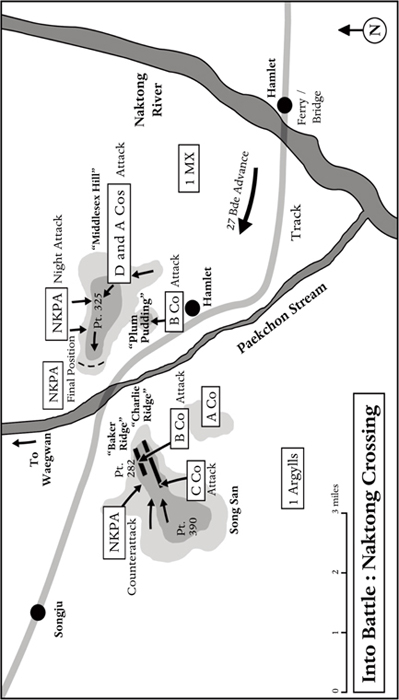
Looking around, the recently arrived Middlesex were pleased to see their new surroundings. Having been trucked off their positions in the hours of darkness, they had been dumped here, some 600 yards east of the Naktong, beside a maize field with a clear stream flowing through it. Ahead to the west, a track wound toward a village nestling in a copse on the riverbank. Beyond, lay the river; beyond the river, a ridge of dark hills obscured further view. Disregarding the considerable activity of senior officers nearby, it was, after eighteen days on the line, idyllic. Boots were gratefully removed and feet dipped in the cool stream; coffee began to brew.1
Stan Boydell, the Middlesex MO was with Tac HQ party when the ground around him erupted. Shellfire. For Boydell, it was the first experience of bombardment; the first casualty in the new phase of operations was Medical Sergeant Bill Bailey, who dived into a foxhole and broke his wrist. ‘No matter what was wrong with you, he’d say, “Have an aspirin,”’ said Sergeant Paddy Redmond. ‘When he shouted, “I’ve broken my wrist,” someone called out, “Have an aspro!”’ Amid the chaos, Father Tony Quinlain stood. ‘He was very experienced, he got up in the middle of shelling,’ Boydell recalled. ‘He was saying, “Don’t worry, these are not high-explosive, these are anti-tank shells.”’ Boydell and his party moved back to a US Field Hospital where they were treated to rations the British found remarkable: fresh steaks. A US tank commenced shooting across the river. ‘Nothing like a few shells to increase the congregation!’ Quinlain confided to Boydell
Explosions continued. The SPG was dubbed ‘The bastard’.2 Many Diehards had been anticipating a day or two’s rest before going into action. An uncomfortable realisation spread: What they had assumed was their rest area was, in fact, the staging area for an attack.3
Soldiers had long anticipated the moment when the UNC would go over to the offensive. As that moment drew near, foreboding grew. Patrolling the Naktong was one thing; entering the crucible of battle was another. Major John Shipster, who had fought in the worst combat in the Second World War, wondered whether young National Servicemen were equal to the challenge. ‘I’d been in Burma and been wounded three times with Indian troops,’ he said. ‘I found them extremely fine soldiers, and wondered what it would be like with British soldiers.’ Others were equally nervous. ‘We really knew nothing about our enemy,’ Major John Willoughby confided to his notebook, ‘Looking across at those fearful hills, it was no good pretending that we could scarcely wait to get among them.’4
The hills – approximately 3 miles across the river – constituted an NKPA defensive network, for the road leading to the crossroads town of Songju, itself some three and a half miles behind the hills, ran between them. A US armoured reconnaissance company had already forded the river, hoping to open up a secondary axis on the left flank of 24th US Infantry Division, but were halted by the entrenched hills. 27th Brigade was to seize the hills, thus opening the road, for Songju was a key link on the northwest route that led up to Kumchon, Taejon, Suwon and Seoul. The brigade would fight under 24th Division command.
Coad sited his Brigade HQ on the river’s east bank. The Middlesex would carry the hills on the right side of the road; the Argylls, those on the left. But first they had to force the Naktong. The men would cross over a single-file footbridge, vehicles and heavy equipment by pontoon ferry.
At 16:00, Lieutenant Colonel Andrew Man led his company commanders across the river on the rickety bridge built by US engineers, mounted armour of the reconnaissance company and rolled up the poplar- and telegraph pole-lined track to a hamlet, a kilometre south of the hills, where the company was leaguered. En route, Willoughby saw ‘a beastly sight’: flattened enemy dead, run over repeatedly by trucks.5 ‘We found this collection of Americans in a complete huddle, everyone touching everyone else, obviously very unhappy,’ said Man. ‘We joined this rather terrified lot.’ Their apprehension was understandable: armour without infantry protection is vulnerable, and they had already been mortared and attacked by a patrol. Still, Man could not help being critical of their dispositions: ‘They could hardly have been sited more closely together, or have presented a more worthwhile mortar target.’6
Behind him, his battalion was in motion. By company, the Diehards stood, shouldered small packs, hefted weapons and, one by one, set foot on the bridge. It had been blown earlier in the war, then jury-rigged by first North Korean, later US engineers. Some 300 yards long, it was a makeshift affair: Concrete slabs from the original bridge; bits of assault boats; rubber floats; wooden planking; and sandbags.7 The river, blue from afar, proved muddy brown, close up. Its current was swift.
In dispersed file, the Middlesex advanced. Though they could not see their camouflaged enemy, they were under observation from the hills; behind the hills, lay North Korean artillery. On both sides of the bridge, great columns of water jetted up as shells slammed into the river, soaking crossing men. The advance continued. ‘People were marching as per normal, we thought the chances of being hit were remote,’ said Ken Mankelow of B Company. ‘And your mates were there – you had to put on a bit of a face.’ For most, this was their first experience of sustained shellfire. Soldiers yelled snatches of bravado at each other to reinforce courage. ‘We’d shout out to the one in front or the one behind, “Next one will get you!”’ Mankelow recalled. ‘This was just to get yourself psyched up.’
Over the bridge, the companies spread out to advance. Then, approximately 300 yards short of the village, shells began landing among the lines of men, blasting up clods of earth and clouds of black smoke.8
This was the moment of truth: Would the young Diehards crack and go to ground – a nightmare for officers, for getting stalled and frightened men moving is a dangerous, difficult business – or would they continue?
‘We went to ground on a sandy beach and the officers said, “Don’t stop for anything! Don’t stop!”’ recalled Lance Corporal Don Barrett. ‘So we didn’t stop, and when shells came in we kept ploughing on, suddenly the company commander shouted, “Down, Down!” and they burst across the road.’
The test was passed. ‘The moment we came under fire it was just like being back in Burma again,’ said Shipster who – like countless soldiers throughout the ages – found his fears evaporated as the tension of anticipation was released and the business of command commenced. ‘My doubts left me completely.’ Willoughby was equally heartened. ‘Sometimes a whole section would disappear in the black smoke of shell bursts, only to reappear seconds later, unchecked,’ he wrote. ‘It was a brave sight to see these little crocodiles of eight or so men walking steadily across the open fields, without hesitating. In my heart, I felt we should be all right tomorrow.’9
B Company dispersed around the village; A and D Companies veered right, with A securing a preliminary ridge for the attack; the ridge proved unoccupied. All men began digging in. The advance over the river to their start lines had cost the Middlesex one killed and four wounded.10
It was 19:30.11 Man had wanted to capture the first feature before dark, but time was against him. Instead, he would launch his Diehards on a consecutive, two-phase dawn attack on the 22nd. B Company would seize the preliminary feature, ‘Plum Pudding Hill’ (so-named for its shape), then D Company would storm the second, larger feature, ‘Middlesex Hill’, beyond. A Company was reserve. Once objectives were taken, the companies would go firm while the Argylls – crossing behind the Diehards – carried the hills left of the road.
In the first British assault of the Korean War, Man demanded maximum aggression. Cheerfully waving his walking stick – the only weapon he carried bar his belted service pistol – he told Corporal Bob Yerby, ‘If you don’t hit the bastards, I’ll reduce you from five stars to three!’ – stars being the pay ranking for NCOs. In darkness, Second Lieutenant Chris Lawrence, whose 4 Platoon, B Company, would spearhead the attack, delivered a quieter briefing. ‘Chris was very reassuring on this type of thing,’ said Mankelow. “‘We are here; do as the NCOs tell you; keep calm”; it was a good briefing.’ The platoon was ordered to rest, though for most, sleep proved elusive. To their rear, the ferry bringing the brigade’s vehicles and heavy weapons over the Naktong, had been knocked out.12 And the North Koreans, anticipating a British attack, were preparing: All night long, Diehards could hear enemy above, digging in deeper.13
What happens in a battle? Strategists talk of different formats: The encounter battle; the battle of annihilation; etc. What would happen on the Naktong River would be the most basic battle: a violent land grab. The attackers would ‘advance to contact’ until they came under ‘effective fire’, i.e. fire that causes casualties – then fire and manoeuvre through the enemy. The challenge for attackers is dislodging the defenders, thereby enabling the land to be grabbed. The defenders can be made casualties, but if they are entrenched – as the North Koreans were – the best that can realistically be hoped for is for fire to keep their heads down while the attackers manoeuvre onto, into and through their position. If they get into close range, attackers can kill defenders with small arms, or can close to within such proximity that the enemy, seeing doom approaching, surrenders or runs. If he runs, he can be slaughtered. Given that a relatively small number of combatants actually become casualties, a battle is, essentially, a test of wills. Will the attackers give out as his ranks are cut down on the way to the objective? If so, the attack grinds to a halt, requiring a second wave to pass through: ‘maintaining the momentum’. Momentum is critical, for a moving unit is harder to register and hit than a stationary one. In the worst possible case, attackers break and flee. For the defender, that outcome is best achieved by counterattack. The attacker must hope that the defenders’ collective determination – for military endeavours are collectives ones – erodes as he watches the assault wave approach despite everything the defender can throw at it. If determination does, indeed, erode, individual defenders will either cower in terror, hoping desperately that the situation will pass him by; crack, drop weapons and raise hands in the (often vain) hope of being taken prisoner; or simply flee – something which may well precipitate his comrades to do the same. If neither side breaks before the actual clash, fighting enters close quarters. In that case, eviction takes place at the point of the bayonet.
* * *
B Company were roused pre-dawn. At 07:00, they rose, spread out and set off toward their objective. Covering fire from the battalion’s 3-inch mortars and Vickers machine guns – which had been manhandled over the footbridge during the night by B Echelon and attached Korean porters – opened fire reassuringly, hitting the feature, but the tanks the Middlesex had expected to join the assault wave did not move.
Man was incredulous. ‘The Americans were supposed to support me with tanks, my platoon commander went off and the tanks would not go with him!’ he said. ‘An incredible business!’ In fact, the commander believed the road ahead was mined; after some discussion with B Company’s OC, two American tanks began firing cover from just in front of the village.14
Regardless of the armour, the infantry was going in. In the vanguard, two sections up, one back, was 4 Platoon. Hefting a heavy Bren gun, Mankelow was just behind Lawrence as the lieutenant led his men up the slope. ‘It was, “Here we go”, and it was up the hill, keeping your eyes ahead and to the sides, make sure your mates are OK, NCOs reassuring you,’ Mankelow said. The angle steepened. The platoon scrambled. They took the first ridge without opposition – it proved to be a false crest. They were, by Mankelow’s reckoning, about halfway to the true summit when it started.
Willoughby was watching from below at the precise moment battle was joined. ‘At once, the whole of the hill came alive with machine gun, rifle and what I guessed to be anti-tank rifles, for they gave a sharper crack and a bright white muzzle flash,’ Willoughby noted. ‘It was an impressive sight.’15
Mankelow registered shouting and a crackle of firing – then spotted a volley of grenades spinning towards him. ‘I was wondering when these grenades were going to explode,’ he said. ‘But NCOs were shouting, “Keep going! Get under them!”’ Diehards dashed upward, grenades detonated with thumps, bullets whip-lashed overhead. Mankelow was inspired by the silhouette of Lawrence leading through the smoke. ‘You think, “He is a big tall bloke; they have not hit him; so why me?”’ He pressed upward.
The reassurance proved momentary. Firing broke out behind Mankelow’s section. North Koreans in spider holes, bypassed by the advance, were shooting. ‘You think, “I hope someone will take care of him!”’ he said, but maintained eyes forward. His Bren hammered against his shoulder and his No. 2 clicked on fresh magazines as he laid down fire. Some was suppressive: ‘The thing was to fire back, to keep their heads down.’ Some was direct: ‘It was fairly heavily wooded, you just saw a bit of movement,’ he said. ‘If it shot back, you shot again.’
Gunfire. Shouted commands. Flying dust. Flickering gun-sight silhouettes of enemy among the dwarf pines. Suddenly, Mankelow and his section were on top of the North Koreans, 10–15 feet from their trenches: ‘It got up-close and personal, not hand-to-hand but really close – we were at point-blank range – we fired, they fired – some got up and ran, they just melted away, disappeared – everything was going pretty fast.’
It took Mankelow some moments to realise his platoon, in the open, had carried the summit of ‘Plum Pudding’. Lawrence’s men had advanced so far, so fast, that successive platoons had not passed through: The platoon had taken B Company’s entire objective.*They had been aided by the NKPA defensive layout: Their trenches were covering the road, so most were on the left of the feature, but Lawrence had attacked from the right.16
A single tree crowned the summit. NCOs dashed around, positioning men, for the ideal moment for a counterattack is when attackers are uncoordinated. ‘They spread us around and said, “Fire if you see anything!”’ Mankelow recalled. No counterattack came. As their adrenalin dissipated and their tunnel vision broadened, Mankelow and his mates had leisure to look around. A sudden rip of firing below. A stretcher party heading for the hill had been ambushed by enemy in a monsoon ditch; two Diehards were killed. The North Koreans were below 4 Platoon’s sights: They fired down.17 The ambush party was wiped out. More stretcher-bearers arrived. Casualties were evacuated. An odd normalcy settled. Platoon survivors broke out rations and began eating. It was 09:00.
Twelve enemy lay stiffening on the position. Lawrence’s platoon had lost three killed, three wounded. Among the former, Mankelow was struck to see the body of Teddy West: He had turned nineteen the day the battalion landed in Pusan. Among the latter was Corporal Joe Pentony, hit by a burst through the torso. ‘He’d tried to take out a machine gun nest and he’d paid the price,’ said Corporal Bob Yerby of A Company, who saw him at the casualty evacuation point. ‘He’d had morphine and was quite relaxed; he asked me for a cigarette, then they took him away.’ Sergeant Paddy Redmond, recently returned from anti-guerilla operations, was appalled to see the severity of his wounds; he had been Pentony’s best man at his wedding in England one year before, just prior to the battalion’s departure for Hong Kong. Pentony would die in hospital in Japan. A sight that stayed with Yerby was that of some Americans, killed by mortars. ‘They were lying there and their feet were bare and each had a tag on their big toe,’ he recalled. ‘For some reason, that shocked me.’
A burial party was assigned to dispose of the enemy dead in a ditch, but one corpse proved unusually large. ‘We could not get one chap in, so one man tried to smash his head into it with a shovel,’ said Barrett. Unknown to the Middlesex, a camouflaged enemy was watching these grisly proceedings. ‘This anti-tank rifle fired at us,’ Barrett recalled. ‘He didn’t like to see this chap knocking his head in with a shovel!’
From ‘Plum Pudding’, B Company had a grandstand view as D Company went in against ‘Middlesex Hill’. ‘We were sitting and eating and could see figures moving up the hill, and because you had gone through it yourself, you knew exactly what they were going through,’ said Mankelow. He felt oddly distant. ‘It was like remote control, it was like watching a movie with our own people.’
B Company’s business was finished. D Company’s had just begun.
* * *
Willoughby’s men had moved up to their start line, a ridge held by A Company, pre-dawn. With the ferry inoperable, they had received neither rations nor reserve ammunition. The looming objective, ‘Middlesex Hill’ looked like, the major thought, ‘a long dumbbell with a knot at each end’. It was 325 metres high: ‘The whole hill stared down at me – it seemed from a fearful height – and looked awful.’ Like Lawrence, Willoughby decided on an indirect approach, a flanking attack. If he could reach the foot of the steepest part of the hill on the right, his men would be in ‘dead ground’ – i.e. ground invisible, due to the angle of the slopes, from the top. They would scale the shoulder and site Brens on the right-hand knob to cover an assault along the ridge that would roll up the position and clear the left-hand knob. Everything depended upon making the dead ground. Mortar smoke would screen D Company as it dashed across some 800 metres of open ground in full view of the enemy.
The time was now around 8:00. Lawrence’s men were winning ‘Plum Pudding’. Willoughby’s radio crackled: It was Man giving the command to attack. ‘We’re off now!’ Willoughby yelled. ‘Fix bayonets!’ roared the lead platoon commander. ‘Look the business!’ As his company broke cover, Willoughby pressed the radio mike to his ear, ready to call in mortar smoke as soon as the enemy fired. Then Man came over the net, urgently, ordering an immediate halt. Willoughby was ‘in two minds’ to disregard this – he wanted to make the cover of the dead ground – when a barrage of 155 millimetre artillery blasted up geysers of earth directly on his line of advance.18
Man, attempting to direct the battle from his CP, seethed. ‘The only people who had shells were the Americans, and I had the greatest difficulty in discovering who was doing it,’ he said. The reconnaissance company eventually made contact with the artillery unit; its fire was directed by a spotter plane that was unaware of the British operation. 24th Division’s staff work, it seemed, was sloppy. A long radio argument ensued while D Company lay exposed in front of their objective. Man overheard the discussion: The barrage could, ‘on no account be stopped as a United States Reconnaissance Company was held up!’ This was too much. Man grabbed the microphone, identified himself and explained ‘with considerable restraint’ that the hill in question was being attacked by his troops, who were assisting the reconnaissance company in question; moreover the fire was endangering British soldiers’ lives. Man’s message was assented to with ‘a rather subdued “Roger”’.19
D Company’s attack had been stalled, but with the artillery sorted out, there was now gun support on call – though arrangements were ad hoc. Willoughby directed the fire of the US medium regiment by radioing Man at his CP; Man then passed the orders by telephone to the US reconnaissance company commander; he ran across to one of his tanks, who signalled back to the observation plane; the aircraft conveyed the message to the actual guns. ‘It worked quite well after a time,’ Willoughby said.20
The barrage rolled up the hillside, erupting in clouds of earth and smoke ahead of the company. The assault recommenced. Willoughby’s men made the dead ground, and began scrambling up the right shoulder. ‘Hill? More like a blooming mountain,’ said Frank Whitehouse. ‘The tin hats went – they just got in the way – where we were it was like the side of a house, we climbed with rifles slung.’ So far, so good. The lead platoon crested the rise, but as it set foot on the ridge, it was swept with automatic fire. Second Lieutenant Geoffrey White was killed instantly; his sergeant, a corporal and another man were all hit; the platoon radio ceased transmission.21 Willoughby ordered Sergeant Paddy Bermingham to grab all spare ammunition available, go forward and sort out the platoon. Bermingham and a corporal, heavily loaded, staggered upwards and made contact. After checking that White was, indeed dead, they repositioned the platoon’s Brens and radio, which had been screened by rocks.22
With D Company now holding just a toehold on the right of the hill, the situation was precarious. The ridge, D Company could now see, was a 200-yard long ‘dog leg’ under complete enfilade from enemy dug in, slightly lower down, on the hill’s reverse slope. ‘The smallest movement from us drew machine gun fire in long bursts, and every time I peered over the top, I was nearly blinded by stone splinters,’ noted Willoughby, whose command problems were compounded: His signaller had collapsed with exhaustion. The prospect of a charge along the ridge was ‘most uninviting’ the big major thought. Man dispatched reinforcements; A Company began climbing the hill. But additional numbers did not solve the problem. Pondering this, Willoughby was unexpectedly joined on the ridge by an American FOO. ‘He took in the situation at once and said, “Leave it to me,”’ Willoughby recalled. The newcomer delivered terse coordinates over his radio.23
The US gunner was concerned that his battery, already firing on ‘Upper Registry’ would not clear the ridge but the mission was called in anyway.24 Distant thunder – a tremendous force rushing overhead – then the whole length of the enemy position on the rear slope disappeared under thick black smoke. Dead on. Willoughby watched ‘in awe and some caution, because even at 200 yards, a lot of stuff comes back’. The barrage lifted. ‘I think that should do,’ the American told Willoughby.25
A platoon each of A and D Company charged ahead, their objective the enemy-held outcrop at the far end. ‘Away they went with fixed bayonets,’ wrote Willoughby. ‘They swept over the outcrop, kept straight on and in no time I could see them thrashing around in the enemy position, but no return fire.’26 The ridge was taken. Three Maxim heavy machine guns, shielded and wheeled, were captured; approximately forty enemy dead lay scattered around.27 Some were in a gruesome state. ‘They had had a fire, and a North Korean who had been hit was lying in the fire,’ said Corporal Harry Spicer. ‘His rifle ammunition was going off and bits of him were blowing up, blood was flying up.’
Yet there were still more enemy. Willoughby moved forward to the left outcrop, where he found himself, ‘looking down about 150 yards on another ridge below, manned for almost its whole length by North Korean soldiers staring up at us from their now hopelessly exposed position. One, presumably an officer, appeared to be looking me straight in the eye. Both sides seemed equally surprised.’ This was the North Korean entrenchment covering the Songju road. A number of Diehards were standing around looking astonished, except for one corporal who engaged in a rifle duel with an enemy below.28 Other men joined in; the enemy replied. ‘We were looking slightly down on them, I was No 2 on a Bren, we were firing and all of a sudden, the Bren jumped out of my mate’s hand – the flash eliminator had been ripped off!’ said Whitehouse. ‘We changed the barrel and continued firing.’ Whitehouse could see the effect of his fire: Dust was churning up among the enemy trenches. Facing well-equipped, motivated troops, a recent briefing flashed through Willoughby’s mind: ‘We had been assured that the enemy were a motley mix of weary units from various formations … from our position they were anything but a rabble, from the glint of their steel helmets to dark uniforms and equipment.’29
The American FOO arrived again. ‘Again, there was the sound of the almighty overhead, a storm of black smoke, and when it cleared there was no sign of anyone,’ Willoughby wrote. ‘It was a remarkable feat of gunnery for the target area was at right angles to the earlier shoot and it was not a simple question of lifting a few hundred yards and shifting right by a small angle, yet the first time, the whole length of the target was engaged. He was an exceptional character whose competence impressed me deeply.’30
With the last North Korean position obliterated, a platoon went down for the grisly task of checking bodies. The Diehards were as suspicious of enemy casualties as the Argylls had been. ‘Someone shouted, “One here alive!” and then there was a shot,’ said Whitehouse. ‘Major Willoughby did not agree with that at all, but we had heard stories from Americans – they painted a terrible picture of the enemy.’
By a mixture of fire – the US bombardment had been critical – and manoeuvre – the Diehard’s approach up the steepest part of the hill had taken them into the rump rather than the teeth of the enemy position – ‘Middlesex Hill’ had been captured. The North Korean reaction was not long in coming.
At approximately 15:00 hours, enemy riposted against A Company deployed along the ridge. ‘We saw chaps coming down behind us,’ said the Major Dennis Rendell. ‘We got quite a lot of those.’ Rendell radioed battalion mortars and as the North Koreans advanced up gullies toward him, the ex-paratrooper directed bombs in, right on top of them. ‘They had a marvellous shoot,’ he said. ‘You saw bodies coming up when the bombs hit – very satisfying!’ The counterattack was driven off.
Evening fell. D Company was almost out of ammo, and had had neither water nor food for thirty-six hours. Willoughby radioed Man twice. ‘I appreciate your difficulties – out, goddamn it!’ the testy CO replied. But men arrived with jerry cans of water. After his parched men had been re-hydrated, Willoughby urged them to dig: ‘Dig for your lives depend on it!’31
Embedded in the rocky dust, A and D Companies settled in for a tense night. At around 02:00, thunderous crashes and white flashes impacted along the position. Heavy mortars: 120mm. Spicer was jolted. ‘We’d thought, “Thank goodness that’s over,” then it was all on again,’ he said. ‘I stayed in the bottom of trench – you feel the ground shaking.’ The fire lifted. It had been a short but violent barrage, ‘a fiendish experience,’ Willoughby thought as he looked out. All equipment above ground had been shattered.32
There was one casualty: Private Sharpe, one of the tallest men in the company. Bermingham went to check him. It was so dark that the sergeant could not see the extent of his wounds, but knowing how shallow the man’s trench had been, guessed where he had been hit, and began feeling his head. Bermingham’s probing hand made contact with ‘a large area of jagged bones’; Sharpe’s head had been over the parapet when the mortars landed, and shrapnel had carried away a chunk of skull. He was buried on the position.33
In a final attempt to dislodge the Middlesex, the enemy launched a pre-dawn attack on the 23 September.34 In the gloom, the force advanced up toward the section of ridge held by A Company. Their movement was spotted almost immediately.
‘Don’t ask me who fired first; it might have been us,’ said James Beverley, the Cockney who had earlier thought Korea’s hills looked like mountains. ‘There is fear to start with, then the adrenaline kicks in and you are more interested in firing than anything else.’ For Yerby, the Palestine veteran, fire orders are redundant: ‘There is none of this, “Enemy in front”, it was, “Pick your targets! Fire!” I don’t think anyone needed any encouragement,’ he said. ‘You were firing at silhouettes coming up the hillside; you shot at one, and if he went down, you shot at another. Everybody had been on the ranges in Hong Kong – the firepower was hectic.’ As a release of tension, rapid fire proved infectious: Along the ridge, soldiers worked bolts, squeezed triggers, braced for recoil, fired again. ‘The .303 frightens you, it’s got a kick like a mule, they say it can break your collarbone,’ said Beverly. ‘But you get used to it, you hold it in tight to the shoulder.’ Some soldiers, in action, cower in cover, declining to fire, but the Middlesex had been a machine gun battalion in the Second World War, and that heritage was rubbing off; the furious shooting rate obviated the old British Army adage of ‘one bullet, one body’. ‘I put 150 rounds through that rifle,’ Beverly said. ‘Just don’t ask me what I was shooting at!’
The enemy, decimated, had barely got off their start line. ‘We realised then, we were in a war,’ said Yerby, who had experienced nothing so intense in the Middle East. ‘Up to then it had not dawned; this was our first involvement.’
The battle for ‘Middlesex Hill’ was over: it had cost five killed, seven wounded (one mortally).35 The Diehards had successfully assaulted into the teeth of an entrenched position held by superior numbers, then held against counterattacks. Bermingham was ordered to check enemy cadavers on the lower slopes: The sergeant counted 253.36 All were found to be carrying white civilian clothing – enabling them to blend in with the civilian population. The battalion’s booty included the Maxim machine guns, as well as LMGs and a sniper rifle.37
The aftermath had a shock in store for Whitehouse. The private gasped when he heard the identity of the last man killed on ‘Middlesex Hill’. Sharpe had been the soldier who had woken the barracks with his screaming the night before the brigade’s departure from Hong Kong; his nightmare, Whitehouse realised, had been a premonition.
Secure on their objectives, the Diehards were perfectly positioned to watch the Argylls repeat their feat as they assaulted the hills on the western side of the Songju road. The Highlanders were advancing into what remains perhaps the most hellish combat space entered by British infantry since the Second World War.
* * *
Like the Middlesex, the Argyll’s day on 21 September had begun pleasantly enough. After trucking off their defensive positions on the Naktong, the mortar platoon assembled in an orchard. ‘The platoon was more curious in the orchard girls than in the battle, they were all topless and all young, picking these apples!’ said Jake Mutch, the Stirling lad who had joined the Army after barely taking a train back home; in rural Korea, breasts exposed by the traditional short blouse were common. ‘Soldiers were all whistling and yelling in Glasgow accents, but the girls just smiled and threw these apples – lovely apples which we stuck in our ammo pouches.’
Other units were exposed to grimmer sights, as the battle elsewhere along the front had hit serious resistance. Second Lieutenant James Stirling was shocked to see heaped trucks driving by. ‘These hordes of American wounded were coming back down the road – it was not at all reassuring for a 19-year-old,’ he said. Previously, the fair-skinned subaltern had only had sunburn to fear; now, with battle looming, things were getting serious: ‘I was terrified I would be frightened and show it,’ he said.
‘The Bastard’ was in full flow: Shelling was getting heavier and more accurate. Reggie Jeffes, the Brigade REME officer, was moving along the riverbank to check the ferry when, there was ‘a hell of a bump right behind me, I was knocked on my face and there was a great burning sensation in the middle of my back. I thought, “My God, I have been hit!” I lay there quietly and the pain went. I had heard that if you are very seriously hurt, you won’t feel anything, so I thought, “Ahhh, this is terrible.”’ Jeffes twitched each leg; both seemed to be working. Reaching cautiously back, he discovered a tiny shell fragment, ‘about an eighth of an inch’ in the pleat at the back of his uniform. It had not penetrated his skin, but, being red hot, had given him a minor scorch.
Relieved, he returned to Brigade HQ, and was drinking a mug of tea when another shell came in. The HQ was under camouflage nets, but the SPG had spotted the sun catching the windscreen of a vehicle. Jeffes and others dived into a foxhole as the shell detonated. A signaller had not moved fast enough: Shrapnel ripped through his abdomen and out through his back, taking his stomach with it, killing him outright. ‘I was sick because I suddenly realised that could have been me,’ said Jeffes.
With the Middlesex across, the Argylls advanced on the river. The scene was a battle portrait. ‘We’re ready to go, we’re gonna cross the river, in big formation, well spread out, all heading for this river,’ said Henry ‘Chick’ Cochrane. Appropriate accompaniment was on hand. ‘Being Highlanders, we played the pipes as we were attacking.’
But crossing after the Middlesex, the Argylls’ journey would prove dicier; the SPGs dug in outside Songju, had zeroed in.38 Shells bracketed the bridge. Major David Wilson found the crossing ‘a most unpleasant way to run the gauntlet’.39 Stirling was showered with water and lost his tin hat, but crossed unscathed. ‘It was both exciting and frightening,’ said Lieutenant Sandy Boswell, the intelligence officer.
Not all men were lucky. Mutch was carrying a 36-pound mortar base plate on a Korean A-frame, a well designed, wood-and-rope peasant carrying rack, similar to an external-frame rucksack. He was mid-stream when a tremendous light flashed at his feet – Mutch felt a force like a kick in the stomach – he went down – a man behind moved to help – ‘Leave him!’ roared Captain Robin Fairrie, ‘Get off the bridge!’ – Mutch felt someone grab him by his belt – he was dragged, bumping, across. His mate, Adam MacKenzie, had ignored Fairrie’s order and hauled Mutch to the far shore. There, MacKenzie dropped him in the cover of the riverbank. Momentum could not be interrupted for a single casualty.
A shell had detonated just feet in front of Mutch. Remarkably it had not severed the rickety bridge, but a slice of hot shrapnel had plunged, like a bullet, deep into Mutch’s abdomen. ‘At first it hurt,’ he said. ‘Then there was no pain at all.’ Numbness signals a serious wound: pain receptors shut down as the nervous system floods with endorphins. Mutch could see blood leaking down his uniform, feel it soaking him. Alone, he lay on the Naktong bank. A memory of his uncle – with whom he shared the same name – flickered through his mind. The uncle had been killed at Dunkirk. ‘I thought, “This could be it: there’s nobody here,”’ he recalled.
Then, voices: ‘Alright Jake, we’ll look after you!’ He looked up. Two orderlies had arrived, to stretcher him back over the bridge. Shelling continued. ‘I thought, “Another bloody bomb!”’ Mutch said, but the party passed unscathed. On the west bank, he lost consciousness. He came to briefly in the Middlesex RAP where his documents were stamped, ‘Jake Mutch, Argyll and Middlesex Highlanders’. When he awoke, he was in hospital in Japan.
The rest of the platoon had got across, to a small unit of American engineers on the far bank. Incoming – mortars and SPGs – continued. ‘I remember jumping over these two or three slit trenches with Americans in, they were looking at us and calling us a mad lot because they were mortaring,’ said Cochrane. However, Cochrane, and his mates, mortar men themselves, were counting intervals. ‘You could more or less count the seconds when one is going to drop here, one there.’ A brief incident fortified morale, when an American sapper officer told his men, ‘Stand up and watch the best little army in the world come through,’ recalled Roy Vincent, another mortar man. ‘It made us feel good,’ Vincent said.
With his Jocks over the Naktong, Neilson made his pre-battle appreciation. His objectives were similar to Man’s: A saddle-shaped hill, the two high points on it linked by a ridge: Points 390 and Point 282. In front of the big feature squatted a smaller hill, Hill 148. Wilson’s A Company was tasked to seize this preliminary objective, securing start lines for the attack on the main feature.
Pre-attack, Wilson fell into conversation with an American master sergeant of the Reconnaissance Company, commanding five Sherman tanks. The major’s customary charm worked: The NCO agreed to support the Jocks’ attack. Wilson lent him a company radio for communication and at 16:00, led his platoons as they spread out and began striding toward Point 148. They crossed Paekchon Stream, a tributary of the Naktong running adjacent to the Songju road – it was only waist deep – then the road itself.
Under fire from the tanks, and watching the Highlanders’ inexorable approach, the small party of North Koreans on the hill decamped. A Company took Hill 148 without opposition and dug in. It was now 17:30.40 With Willoughby’s company facing such significant resistance on ‘Middlesex Hill’ Brigadier Coad – showing the prudence that, later in the campaign, his men would be so grateful for – did not want the Argylls embroiled in a fight that could drag on into darkness. He ordered Neilson to stand down his assault until dawn.41
The battalion prepared for battle. Beside the stream, Dr Douglas Haldane established his RAP: a makeshift shelter with ponchos and some hessian covering usually used to screen field toilets, with the medical pannier laid out. Briefings were delivered to the assault troops. B and C Companies, who would attack at dawn, took a good look at their objectives before night fell.
After it did, there was a minor drama. Stirling and fellow subaltern Jock Edington, were ordered to recce the start line, a dry riverbed forward of the lying-up area. The two officers did do – ‘one dry ditch looked very much like another,’ Stirling reckoned – then headed back. Approaching they heard a sharp click-clack: A rifle bolt being locked. ‘Password!’ a Scottish voice barked. Neither officer could recall it. Edington, in front, froze; Stirling thought it sensible to take cover behind. ‘What’s the bloody password?’ Edington hissed over his shoulder, then spotting Stirling’s prudent position, added, ‘What the bloody hell are you doing down there?’ The sentry heard it all. ‘Come in Mr Edington,’ he said. ‘I know who it is!’ The two officers proceeded into the perimeter.
Jocks rolled up in ponchos and blankets. Orders were to make no noise; no cigarettes were to be lit. ‘We were highly trained and whatever the situation was going to be up there, we were prepared to accept it,’ said Harry Young, the corporal who had taken part in the Buchanan patrol. ‘But I’m not sure if I slept that night.’ Artillery thundered in the distance, but otherwise it was a quiet night.42 For many Argylls, their last.
* * *
At 04:45, Neilson established his Command Post, or CP, on Point 148 with A Company. From here, he would direct the battle. Men who had managed to sleep were quietly woken. At 05:15, the Highlanders jumped off. In the grey darkness, long skirmish lines of men advanced in silence, in the classic infantry assault: Dawn attack.
Major Alastair Gordon-Ingram’s B Company reached the foot of the hill without incident and began the ascent. Jocks, slung over with canvas bandoleers and pouches stuffed with Bren magazines, found it hard going through shale, boulders, dwarf pines. Lance Corporal Joseph Fairhurst was on point. ‘We got going, climbing up through all these bushes, I don’t know how the heck anybody didn’t hear us,’ he said.
The leading platoon broke skyline. This proved a false crest, a ridge that ran parallel to the main ridge, 30–40 yards further up. More interestingly, just a few yards distant sat some fifty North Koreans, cross-legged, calmly eating rice out of baskets. Corporal Richard Peet, in Fairhurst’s platoon, was staggered. Each side, equally shocked, stared at the other. A moment’s pause. Peet’s platoon sergeant, Paddy O’Sullivan, yelled, ‘Up and at ’em!’ Jocks charged. ‘We ran over the top and all hell broke loose,’ recalled Fairhurst. O’Sullivan fell almost immediately, shot in the groin. ‘He went down and then there is me running up with the chaps and all of sudden I hear a brrrrppp – it felt like someone had kicked me straight in the stomach,’ said Fairhurst. ‘A fellow behind a bush had fired a burp gun on me. I fell down, tried to get up, my legs would not move so I just lay there.’ Peet ran over. ‘Good God lad, how are you?’ he spluttered. Peet and another corporal, ‘Big Bob’ Sweeney, dragged Fairhurst to a tree, stuck a cigarette between his lips and asked him the location of the burp gunner. Fairhurst indicated, ‘and Sweeney led ’em all forward, charging with bayonets’.
Some enemy had returned fire, but most, breakfasting and without arms close at hand, were gunned down. The charge continued across the saddle and up to the far ridge, where a few enemy survivors had managed to scramble, and were throwing grenades, Peet recalled. Then the Argylls were at the top. The CSM arrived and ordered men to dig in and prepare for counterattack. B Company had lost ten men killed or wounded in the skirmish, including two lieutenants and one sergeant. Fifteen North Koreans lay dead.43But one position had been bypassed. In a short, sharp engagement, this was taken out by Second Lieutenant David Buchanan’s platoon. All of B Company was established on the top ridge by 06:18.44
Meanwhile, Major Jim Gillies’ C Company had been advancing with two platoons up, one back. Corporal Harry Young’s platoon was on the left flank of the battalion. Closing on the hill, tank fire started to prep the position ahead of the advance. Gravel and stone showered on Young’s men. They continued climbing. ‘We came over the top, we took the feature, we did not see anybody,’ he said. C Company had taken their objective without even encountering the enemy. They were in position at 06:30.45 The company started to dig in. Stirling had been positioned by his company commander to cover the rear, slightly down-slope from the two roughly parallel ridges. The ground was too hard to penetrate, so Stirling’s men began constructing sangars, or stone parapets.
So far, so good. The Jocks had gone firm on and around Point 282 with minimal losses. B Company was on the right, holding the higher ridge, ‘Baker Ridge’. C Company was on the left, holding the lower ridge, ‘Charlie Ridge’. But the knots of soldiers strung out along the granite now realised they were overlooked by a higher position, Point 390,* some 1,500 yards east of Point 282, connected by a saddle and still occupied by enemy. Neilson had hoped that C Company would exploit forward fast and take that, but they were disorganised.46 Both companies had become entangled in the advance; redeployment would take time to sort out.
The NKPA, seeing enemy below them, beat the Argylls to the punch. Putting their height advantage to effect, they began firing down with machine guns and mortars. While mortar detonations kept the Highlanders’ heads down, enemy began infiltrating from the high ground, using the cover of the scrub which coated the hillside to close with the Argylls’ and open fire with burp guns. A series of vicious, close-range firefights broke out. The most exposed platoon, on the left and so closest to Point 390, was Second Lieutenant Jock Edington’s. Edington and his platoon sergeant were both hit by gunfire, just metres away from Young. Unwounded men dragged the injured back.
Stirling and his platoon, holding the reverse slope, were not yet in the action but were seeing the results. A shirtless sergeant stumbled past the subaltern, blood leaking from seven holes stitched across his upper body. Stirling was appalled, thinking he had taken a full burst. In fact, a single high-velocity bullet had entered one arm, continued through, torn diagonally through one pectoral muscle, out, in through the next, out again, and finally lodged in his far arm. Stirling’s friend Edingon arrived; he had been shot in the leg. ‘He was hit in the femoral artery so I put a tourniquet on him,’ Stirling said. Then he remembered a lecture by the MO who had said that it had to be constantly loosened or he would lose the leg. Stirling tried that – blood gushed. Realising that his friend needed medical evacuation, it struck him, for the first time, how difficult it would be to get wounded down 900 feet of steep-sided hill, much of which was shale: Four men would be required for each stretcher, or ground-sheet. Edington, bleeding out, lost consciousness.
Young, in Edington’s platoon, had remained in position, lying low and returning fire against infiltrators. Under sensory overload – ‘It’s very confusing, so much is happening’ – he did not realise his platoon’s plunging numbers. In a lull, he looked back to find, to his amazement, that his thirty-strong unit had been reduced by casualties and those evacuating them, to just two men. It was now around 10:45.47 Young and the other survivor, Pete Martin, fell back on the other two C Company platoons, further up the ridge. The Argyll perimeter was being compressed. Ammunition was dwindling.
Down below, the Argylls’ 3-inch mortar platoon was duelling. ‘We were mortared by a bigger weapon than a 3-inch and started looking for him,’ said Roy Vincent. ‘When you are looking for a mortar, you shift your aim and try and find him in different places.’ Robert Searle was sent off to get some signalling equipment. He returned, running at a crouch in the cover of a 5-foot high paddy dyke when he heard a shrieking. ‘We knew it was mortars, they exploded all around us,’ he said. ‘The noise was tremendous.’ Soil and dirt showered down. The duel continued. ‘The enemy lobbed over bombs that knocked the heck out of the hill at the back of us,’ said Vincent. ‘The order would come to fire five rounds rapid, then jump into the slit trench and wait for him to have his turn!’ Eventually, the invisible enemy ceased fire. The Argyll mortars had no idea if they had hit him.
The position of the Argylls on and around Point 282 was now more perilous than that faced by the Diehards’ A and D Companies the previous day. They had been on the highest ground, so had line of sight into the enemy positions. For the Argylls, the situation was reversed: They were overlooked. Moreover, the Middlesex had enjoyed the support of US artillery. At 11:00, with the Argylls heavily engaged and their casualties mounting, 24th Infantry Division recalled the American FOO team from the battalion.48
It was an extraordinary decision. With North Koreans out-gunning Jocks with automatics, abandonment by artillery meant the loss of their key equaliser, as the tanks down below could not elevate their guns high enough to support the Argylls, nor did the battalion mortars have the elevation to hit Point 390. Gillies and Gordon-Ingram both radioed Neilson; Neilson contacted Coad.49 ‘A protest was made to 24th Divisional HQ and alternative support was promised,’ Coad recalled. ‘But nothing arrived.’50 Jeffes, at HQ watched things deteriorate. ‘The brigade commander was absolutely furious,’ he said. Lacking firepower or reinforcements, Coad and Neilson were losing control of the battle. The Jocks on Point 282 were on their own.
* * *
North Korean counterattacks were gaining steam. B Company was now under pressure as heavy as that facing C Company, as enemy assaulted up the cover of a re-entrant. ‘4 Platoon and 5 Platoon were holding this gully and were holding these North Koreans, I am led to believe in battalion strength, attacking these two Argyll platoons,’ said Peet. Peet himself was raked with machine gun fire from Point 390; he slid down onto the reverse slope for cover. ‘You’d better get back up, or we’ll be overwhelmed,’ a wounded sergeant lying there told him. He crawled back up; another sergeant told him to get back down again: The whole area was in the gun’s beaten zone.
By 11:45, the forward companies had sustained around 50 casualties, and had lost numbers of men evacuating the casualties down the hillside – a one-hour trip each way.51 Neilson’s CP, some 400 yards from the action, was under intense pressure to assist the fighting companies. ‘There were screams for help going back down the line to us and to Brigade from the forward companies,’ said Intelligence Officer Sandy Boswell, listening in on the net. ‘Eventually, the only support we could get was an air strike.’ Neilson ordered it in on Point 390.52
With the brigade lacking any radio link to the ground attack pilots, Peet, up on the hill, was ordered to help spread air recognition panels – brightly coloured silk sheets, three feet long by a foot wide – on the ground in the colours of the day, so ID-ing the Argyll position for the pilots. They were laid out in the form of St Andrew’s Cross; one was orange, one was crimson. Then Peet crawled into cover and began sniping at movement. For some reason, the machine gun above had ceased fire.
Perhaps the enemy gunner had taken cover, for air arrived promptly on station at 12:15.53 Those Argylls not shooting glanced up. Three Mustang fighter bombers droned overhead, banking and circling, getting eyes on the target. ‘We thought at that minute that they were going to attack this gully where the North Korean Army were,’ said Peet. ‘I sat there watching this airplane drop this thing. I didn’t know what it was.’
* * *
The first two Mustangs swooped low along the ridge, for the optimum drop altitude of their weapons was approximately 25 feet above ground. Plastic canisters tumbled from their bellies. Each 100-gallon egg contained a brownish, sticky solution of naphthalene and palmitate, a saturated fatty acid. This solution had been developed at Harvard in 1942, but saw only limited use late in the Second World War. It was far more widely used in Korea: So effective was it that UNC aircraft would unload approximately 250,000 pounds per day. The viscous solution itself was an incendiary, designed to burn at higher temperatures – yet more slowly – than raw gasoline. It was also designed to stick to its target. It takes its name from the first syllables of its two key ingredients: napalm.54
Unlike conventional explosives that burst up and out, it is not possible to escape napalm by ducking underground. Being liquid, it runs down into trenches, cracks and crevasses. Whatever it touches, it adheres to, burning into vegetation, buildings, vehicles and people at a temperature of 800° C – eight times hotter than boiling water. Humans caught in such intense conflagrations become virtual fossils: In the Second World War, the heat generated by incendiaries baked and dehydrated the dead, turning humans into mummies, known in German as bombenbrandschrumpfeichen, or ‘firebomb shrunken flesh’.55 Those not completely drenched but splashed with liquid fire suffer agonising wounds: So hotly does napalm ignite that it generates fifth-degree burns, scorching through skin, fat, muscle and bone; survivors suffer keloids, un-erasable scars. Finally, the intense heat of its ignition deoxygenates air, generating massive amounts of carbon monoxide: Those victims at the centre of the blast who are not cooked end up killed by carbon monoxide poisoning.
Fire terrifies all animals and most humans with a deep, perhaps atavistic fear, for it is nature’s primary agent of destruction; many representations of hell across unrelated cultures and religions feature a burning pit. The demonic aspect of napalm was recognised by reporters in Korea who saw its effect and who dubbed napalm ‘hell bombs’.* This was the munition dropped on Song-san at just after 12:15 on 23 September.
The Mustangs, however, did not drop their loads on the enemy weapons on Point 390, the infiltrators advancing through the scrub on the ridge against C Company, or on the gully up which the North Korean attackers were swarming. They delivered their ordnance squarely on top of the Argylls of B Company.
For onlookers, it was a nightmare. In echelon, Quartermaster Andrew Brown, watching the battle from afar, watched the air strike with satisfaction. ‘We thought, “Ah, tremendous,” it was just a sheet of flame,’ he said. ‘Little did we know it was our fellows. Later when we found out – oh, God …’ ‘We were cock-a-hoop when the Mustangs arrived,’ said Adjutant John Slim. ‘Then we heard the screams.’
The napalm burst with its characteristic roaring ‘whooompf’. A jet black mushroom cloud, tinted with amber, writhed into the sky. Blast-furnace heat and a petroleum stink swept Point 282 as a wave of orange flame tore along the hilltop like lava and rivulets spewed over the sides of the ridge: This was ‘friendly fire’ at its worst. Highlanders caught in the inferno were plunged into hell on earth. Everything in the path of the chemical – trees, rocks, soldiers – flared up. Burning, figures writhed, staggered and fell into charred heaps.
For good measure, the Mustangs dived on Point 148 in a strafing run. Jocks tumbled into slit trenches as running lines of dust fountained up across the position. ‘They killed one of my corporals,’ said Second Lieutenant Owen Light. ‘One or two Jocks were all for opening fire with Bren guns but it would have been pointless, so I put a stop to that.’ Finally, the spotter aircraft droned over the Middlesex position waggling wings: ‘Mission Accomplished’.56 The air strike had taken mere minutes.
With the napalm strike coming after the withdrawal of artillery support, there was ‘almost disbelief ‘ at the CP. An American tank commander told mortar man Roy Vincent, ‘This is the first time I am ashamed to be American.’
In the wake of the attack, shocked survivors – perhaps forty men – saw sights that would be indelibly seared into their memories. ‘That is one day I will never forget, it did affect me, it has never gone out of my mind,’ said Peet. ‘It was terrible, to see Argylls running around on fire covered in petroleum jelly, terrible, there were lads lying everywhere burnt.’ ‘One officer, skinned alive, took 20 minutes to die.57 Those men who had napalm sticking to them, burning into them, screamed terribly.’
‘I remember standing with my mouth open with amazement when I realised what had happened,’ said Stirling, who wondered, momentarily, if the Mustangs had been enemy aircraft. His position, on the rear slope, had saved him: ‘The napalm was within 100 yards of me,’ he said. ‘But I was behind a huge rock.’ Not all his men were so well covered. One soldier, a redhead, was burned across his backside by a stream of napalm that rolled down the hillside and over him while he lay prone. Agonised, the soldier ripped off his burning uniform. Stirling ordered the man away: his pale skin stood out – a perfect target on the drab hillside.
While the redhead was lightly burned; others were horribly disfigured, skin hanging off in strips. ‘There was a young fellow and the skin on his face had come off like a surgical glove,’ said Peet. ‘He said to me, “Dickie is my face alright?”’ Peet assented, though in truth, the injury was so bad he could not recognise who it was. He urged the boy to get out. ‘I said, “Don’t stay there lad, we can’t hold these Koreans, they are overwhelming us, you’d better come with me.” He said, “Alright.”’ Peet started downhill, but when he looked back the soldier had not moved: He had frozen into shock. Another smouldering Argyll was given a cigarette by a mate; when he removed the cigarette, the flesh of his lips came away with it.58
Were such a disaster to occur in a normal situation, it would force the halt of all everyday activity in the surrounding area, as all resources are focused exclusively on assisting the victims. This was no normal situation. The battle still hung in the balance. With the napalm burning out, enemy movement up to and along the ridgeline could re-commence at any moment. It was essential to regain Point 282, where two platoons of B Company at the top of the gully had been incinerated. But the position – and the nerve – of the Argylls on the summit now balanced on a knife edge. In truly desperate situations, even the best military units can collapse; if one man flees, it can trigger a stampede. What prevents this? Discipline, example, leadership. On the ridge below Point 282, the surviving Argylls were galvanised by a man whose name would become legendary in the regiment.
* * *
Major Kenny Muir, the Argylls’ second-in-command, had, in the early hours of the battle been a spare cog, for unless his commanding officer becomes a casualty, a 2I/C has little to do. On his own initiative, Muir had rounded up a party of stretcher-bearers, given them extra ammunition to carry, and with Neilson’s permission led them up the hill at around 09:00. There, he had taken de facto command of the two companies on the ridge – arranging ammunition distribution, deployments and casualty evacuation. Amid the air attack, while everyone else was trying to make himself as small as possible, Muir had stood, waving air recognition panels around his head.59 Was Muir simply keen to get stuck in, or was there a more personal reason behind his action?
An Argyll officer who had seen Muir the night previously, recalled the major complaining bitterly to him about the CO and the RSM, and it was well known that Muir and Neilson did not get along.60 By getting up onto the hill, he had placed himself in a key position – where he could lead more decisively than the CO or the brigade commander, both largely ineffective witnesses to the drama. But it was in the wake of the firestorm that he showed true mettle.
‘Major Muir arrived and rounded us up,’ said Peet. Stirling left the wounded, as he, too, was called up to where Muir, Gillies and Gordon-Ingram were regrouping about 30 yards down-ridge from Point 282. ‘Gordon-Ingram and Muir said, “We have to get this high ground,”’ Stirling said. ‘There were about 30 left of two companies, they told us to grab any weapons we could find, we were going to do a charge down and up to the ridge B Company had been on.’ ‘Baker Ridge’ overlooked the valley from which enemy assaults had surged up; the NKPA were expected to launch a final attack any minute. It was essential to beat him to it, to seize Point 282, the dominant height, before the North Koreans. Remarkably, given the furnace that had been upended over the hill, Point 282 was still held by a single Argyll, the wounded Private William Watt, who was shooting onto targets below.
The entire ridge was blackened and smoking, but fires were fizzling out. Abandoned weapons lay everywhere. Stirling grabbed a Bren in each hand. Others scooped up loose ammunition. Gillies and a small group on ‘Charlie Ridge’ opened covering fire as Muir, armed with a Sten, led fourteen Highlanders into the charge. From Hill 148, Wilson saw, through the smoke haze, the line of running men. He understood immediately what was underway: ‘This was the age-old drill that had applied on the Northwest Frontier … you never left wounded behind.’61
Yelling, Muir’s motley crew surged down from ‘Charlie Ridge’, across the saddle and up the slope to the parallel ‘Baker Ridge’, thumping down next to Private Watt on his lonely outpost. There was no enemy in the immediate vicinity. Presumably terrified by the Mustangs, the North Koreans had pulled back. Highlanders took prone positions and aimed weapons down the crags. They had beaten the NKPA to the summit – just.
‘You could see where they were massing down below, a lot of figures moving around, forming up to attack,’ said Stirling. Jocks opened fire on the troops approaching through the trees. Green tracers from North Korean assault weapons streaked up. Red tracers from the Argylls streaked down. The wave receded. ‘They all went back when enough had got wounded,’ said Stirling. ‘Then they’d attack again.’
The subaltern could see every detail of his enemy: ‘They all had burp guns and were in dirty white military-type shirts.’ His Bren kicked, targets tumbled – ‘they were 150 yards away, you could see the ones you fired at going down’ – but he felt no remorse at the mass homicide he was committing: ‘It was them or me.’ In the thick of the fight, the greatest pre-battle concern of the young subaltern whose family boasted such formidable warriors was lifted: He felt no fear. ‘I was pleased about that,’ Stirling said. ‘That was what I had been more frightened of than anything.’
Several North Korean thrusts were stalled; the enemy seemed around 400 strong.62 Behind the screen of fourteen Jocks – as thin a red line as any in the regiment’s history – wounded and dead were dragged away by stretcher parties of Argylls, aided by Middlesex volunteers who had spontaneously dashed across to assist. Ammunition was getting critical: even a five-round ‘service burst’ from a Bren was ‘a luxury that could be ill-afforded,’ noted Gordon-Ingram.63
By now it was approximately 14:00. The candle was burning low on Muir’s little band.64 Their constricted perimeter around Point 282 was a maelstrom, for North Koreans had advanced through cover; the Jock screen was under fire from three sides.65 ‘The North Koreans were overwhelming, we were running out of ammunition, it was getting drastic,’ said Peet. Muir was a dynamo. Having emptied a Sten, he was firing a 2-inch mortar at minimum elevation. Oblivious to incoming crossfire, he was frequently kneeling or standing to encourage his men.66
Impotent spectators on Hill 148 radioed for a retreat. ‘I think I was the last person to talk to Kenny Muir on the wireless,’ said Wilson, snatching glimpses of the fighting through field glasses while fending off a probe that was now developing against A Company. ‘I said, “There is nothing I can do to help you, for goodness sake get off!”’
Muir ignored the advice. It is impossible to say what the motivation behind his behaviour – behaviour that everyone who witnessed it agreed was extraordinary – was. Perhaps there was an urge to outperform the CO. Certainly, there was determination to hold off the North Koreans and save the wounded for Muir, like Wilson, had served on the Northwest Frontier. There may have been another, more distant factor. Scientists have long been baffled by the issue of battle altruism, but some believe that heroism – essentially, selflessness, the willingness to sacrifice oneself for the group – is hardwired into human genes. According to this theory, heroism was both by-product and reinforcement of the group’s cohesiveness that made certain primitive tribes successful in war, thus ensuring ‘survival of the fittest’.67
This, then, may have been the impulse behind Muir’s last actions that day. Did the 38-year-old major, who had been an Argyll officer all his adult life, and whose father had commanded a battalion of the regiment before him, see his duty as being not just to those men around him – after all, he was not a member of B or C Companies – but to a wider tribe, the Argyll and Sutherland Highlanders? This seems feasible, for though the task of evacuating the wounded had been carried out, Muir was not finished. In defiance of all odds; deaf to all advice; animated by battle spirit; the major seemed determined to retain indefinitely the ground the Jocks had won at such cost. ‘Neither the Gooks or the US Air Force will get the Argylls off this ridge!’ he urged his Highlanders.
They were Kenny Muir’s last words. A burst of machine-gun fire raked his thighs and torso – a terrible wound. Gordon-Ingram assumed command. By now, there were only ten men – some wounded – left on the ridge, and only one magazine each for their three Bren guns.68 Further resistance was impossible. Gordon-Ingram ordered the retreat. His party joined Gillies’ cover group – also ten strong – and tumbled down the hillside in bounds, covering each other. They were all that remained of the more than 200 soldiers who had assaulted the hill nine long hours earlier.
Muir, dragged off in a groundsheet, was dead before he reached the foot of the hill. Wounded remaining on the slope were scooped up in the withdrawal. ‘I saw a young man with his knee cap blown off, so I got hold of the lads with me, we put him in a groundsheet and carried him down,’ said Peet. ‘Flies were landing on the raw flesh so I covered his knee up, and he kept saying, “Look, I can move my foot!” He did not know his whole kneecap had gone; it was the movement of the groundsheet he was being carried in.’
Stirling was among the last men coming down the hill when his left hand registered something like an electric shock: a burp gun bullet had passed right through. ‘It was a very low velocity, small bullet,’ he said. ‘But there was quite a bit of blood and I had no bandages.’ After the stinging zap, the pain subsided. Stirling continued to level ground, where Light, at the A Company position, greeted his friend. ‘The dreaded Stirling came down the hill and I said, “How did you get on?” He said, “I’ve been shot through the hand!” I said, “Does it hurt?” He said, “Not really, but I’m starving,” so I said, “My rations are over there.”’ Stirling helped himself, then departed for the RAP.
With the last Argylls retreating from Point 282, the enemy, in plain view of the mortar platoon, was advancing around the foot of the hill, threatening A Company and attempting to cut off the escapees. The Vickers and mortars opened up, the latter firing at minimum range with minimum propellant. The wound radius of a 3-inch mortar bomb is around 100 yards; the Argylls were shooting inside 500 yards. ‘You just got on with it, the Number Two was plonking bombs down the barrel,’ said Adam MacKenzie, who had, the previous day, dragged the wounded Mutch off the bridge. ‘Afterward, we thought, “How close was that!” The bombs exploded in puffs of smoke. Hundreds of little bursts of dust in a 100-yard radius marked the impact of their shrapnel into the ground.
Unusually – for mortars fire in a parabola over hills or other obstacles – the mortar men could see the effect of their fire on the enemy. Likewise, their bombs were being ejected at such short range, and on such low charges, that the enemy could plainly see the bombs plummeting towards them. ‘We saw one North Korean trying to catch a bomb,’ said MacKenzie. ‘It was pure instinct that made him put his hands up.’ The soldier was obliterated. The enemy probe was driven off; the remnants of B and C Companies regrouped at the foot of the hill as the wounded were taken to the RAP.
* * *
Haldane had been on alert to expect casualties when Neilson warned him that ‘things were not going the way they should’. A number of gunshot victims from the earlier fighting had already arrived. When the burn victims started to come in, the RAP was inundated.
‘I treated them with anything I could lay my hands on,’ he said. In his hessian-lined shelter, he applied yellow antiseptic cream, gauze strips coated with petroleum jelly, pain killers and American-donated plasma – though getting a drip in was difficult. ‘A first-degree burn gave you redness, second- and third- went through the skin – you blister first, and the skin peels – and further degrees burned through the tissue underneath and even bone,’ he said. ‘There was redness, blistering and peeling. Most of those burned black were left up the hill; most of those coming down were in a lot of pain.’ As more wounded arrived, those who could walk were sent back, across the stream toward where they could get transport to take them across the river. ‘My job was triaging and shipping them out,’ Haldane said.
With the worst cases unable to walk, American casualty evacuation helicopters were landing nearby. Stirling and other walking wounded held down the RAP’s hessian strips, to prevent dust from the rotors blowing into burn wounds. The helicopter – ‘egg beater’ in GI parlance – was a new and unfamiliar form of ambulance; stretcher pods tied to the skids. As they lifted off, some wounded, shocked and half conscious, thought they were ascending to heaven’s gate.69
Haldane would treat around seventy men that day. ‘I don’t think I’d say it was traumatic, it was a busy medical day,’ he said. ‘But at the end, I felt deflated.’ For his efforts, a number of Argyll officers felt ‘Jock the Doc’ deserved a decoration. ‘He was a wonderful man,’ said Slim. ‘He was a GP, but ended up being a bloody good surgeon – he had to hack bits off.’
The first sign the Middlesex had of the casualties was when they saw a line of blackened men stumbling from the Argyll positions toward Paekchon Stream. ‘I have never smelt burning flesh before, this horrible smell,’ said Yerby. ‘The guys were black like they had been down a coal mine.’ Men of B Company, including Don Barrett, ran to assist the Jocks. Observing the charred men, an appalling realisation struck Barrett. ‘We are like pork,’ he said. ‘We crack like pork.’
The ordeal of those wounded not helicopter-evacuated continued. The casualty evacuation chain led across Paekchon Stream, then down to and across the Naktong. It was a fraught journey. The stream was under observation by snipers firing anti-tank rifles; two jeeps were immobilised, bullets through their engine blocks.70 With enemy artillery observers still overlooking the Naktong, the river crossing remained dangerous: Four Middlesex stretcher-bearers suffered a direct shell hit as they crossed the Naktong bridge, killing three.71 The bridge was cut three times that night.72
Fairhurst, the gut-shot lance corporal, had a particularly harrowing trip. After being injected with morphine and evacuated off the hill unconscious, he came round at the bottom. ‘There were two Yanks and a jeep with a stretcher on it and we hightailed it down the road,’ he said. When they reached the stream, shelling started. ‘The Yanks got me off the stretcher, and dropped me straight in the water!’ It was only waist deep. Fairhurst was taken to a dressing station, then lifted into an ambulance, where a drip was put in his arm. With another casualty in the rack above him, the ambulance jerked off. ‘It was getting dark and we were going along this road, two black Americans driving, bumping up and down,’ he recalled. ‘All of a sudden there was one hell of a bang, the ambulance tipped over and everything went hazy.’
It was pitch black when he came to. The Argyll found himself lying outside; the other casualty was hanging upside down inside the wrecked ambulance, and the cab, with its drivers, was blown apart – whether from mine or shell burst, Fairhurst could not tell. He crawled into a monsoon ditch where he lay until headlights approached. He staggered up and waved. His next memory was of waking up in hospital in Osaka covered in tubes. ‘You were very lucky,’ an American nurse told him. He agreed.
Stirling, shot through the hand, had a less fraught trip to and through the long line of UNC hospitals. He walked down to the river, then was taken by truck to a railhead, and placed on a hospital train. In Pusan, he boarded a hospital ship, landed in Tokyo, and was transferred to Tokyo General Hospital. From there, British military authorities dispatched him to a hospital in Hong Kong, and finally, a hospital in Glasgow with a group of other men who had been wounded on Point 282. ‘That was the end of my distinguished military career!’ he said.*
On the battlefield, silent Argylls dug in around A Company – the only cohesive company left. Light had a hungry night; preparing to cook that evening, he was furious to discover that Stirling had taken all his rations. B and C Companies’ remnants were amalgamated under Gordon-Ingram. Night fell. US tanks fired on the hill. ‘The noise was tremendous, when a tank shell goes over, there is a tremendous crack,’ said Searle, with the Mortar Platoon. ‘It was unnerving everyone … after what had gone on earlier in the day, we were not very confident in their shooting.’ Officers counted heads. The butcher’s bill for Point 282 totalled seventeen killed or missing, seventy-nine wounded.73 Of the total casualties, sixty-one had been caused by the bombing.74
While the day’s grim events were digested at the Battalion CP, one officer was going through personal hell. ‘When the air strike went onto the companies, I thought, “Oh God, I have issued the wrong panels!”’ said intelligence officer Boswell. ‘It was not till much later the next day that I was able to check the records and see I was right. It was a huge anxiety.’
What nobody in 27th Brigade yet knew was that the UNC’s offensive, which had started on 16 September, had broken enemy resistance on the Naktong front. The British attack had been the final blow. On 23 September – the same day the Argylls went into action – NKPA besieging the Pusan Perimeter had commenced a general retreat. If the attack had been delayed by one day, the hills, abandoned, could have been taken without a fight. ‘I think the battalion was a bit shocked because of what had happened and because they were unable to hold the ground,’ said Haldane. ‘As it turned out, the Gooks disappeared during the night. It was an awful lot of effort for no return.’
* * *
On the evening of 23 September, Brigadier Coad drove to meet US 24th Infantry Division commander General John Church, to press for artillery support – the loss of guns had led to the air strike. ‘Church was not very helpful, and merely said he had NO artillery to spare,’ Coad recorded.75 He had a more satisfactory chance meeting with General Walton Walker, the 8th Army commander. The following day, the US 68th Anti-Aircraft Artillery Battalion arrived. ‘That I am sure was the work of General Walker,’ Coad wrote.76
27th Brigade was subdued after its first battle. ‘We sat in little groups, with our mates, we spoke about the ones who had been killed, sort of discussed it among ourselves, then we buried it,’ said Private Ken Mankelow. ‘We did this while having our mugs of tea, nothing morbid – just matter-of-fact.’
The assistance the Middlesex had extended in voluntarily evacuating Argyll casualties was gratefully acknowledged. ‘From that moment the Argylls and the Middlesex became allied regiments,’ said Lieutenant Colonel Andrew Man. ‘We are honorary members of each others messes; English and Scottish regiments don’t often have that sort of link.’ ‘They helped us Jocks,’ said Corporal Harry Young. ‘We were blood brothers.’
The quality of the enemy could now be realistically assessed. ‘We were quite pleased for having got bloodied and not suffered very much,’ said Shipster. ‘Our wariness of the enemy from that point on, I think, became less pronounced.’ Other men tempered their view of the enemy’s professionalism with his brutality. ‘War is interesting: You can both hate and admire the enemy,’ said Slim. ‘The North Koreans were very good infantry soldiers,’ said Barrett, whose CSM told him that a couple of men had been found tied to trees, bayoneted. ‘But it seemed unwise to put your hands up – very unwise.’
In the Argylls, three topics of conversation dominated: Lost friends, Kenny Muir and the USAF. ‘I felt terrible, a lot of them lads were friends of mine who had joined the army with me, we had been together for quite a while,’ said Corporal Richard Peet. ‘Corporal Whittington, a great pal of mine, was burned to death. I saw his platoon get covered in napalm, and I could do nothing about it.’
Nobody had expected Muir to do what he did. ‘It was an amazing performance by an individual who had been slightly reserved to that day,’ said Boswell. ‘Muir was always cheerful, a hell of a nice little fellow,’ said Vincent. ‘He was a cocky little Jock.’ Some wondered if he had been too fiery. ‘A major up the hill with Kenny said if Kenny had not been killed, they would all have been killed,’ said Quartermaster Captain Andrew Brown. ‘He would not have let them go.’
Opinion was divided over the air strike. ‘It made [the battalion] hopping mad,’ said Wilson. ‘But we realised war is war and mistakes happen.’ Certainly, the USAF provided tremendous tactical advantage when on target, but some members of Brigade HQ were less equivocal. When the US anti-aircraft unit provided by Walker arrived to support the brigade, it started to move into a position that had been shelled. ‘We watched the Americans move into this location and we were so angry, we did not tell them,’ said Jeffes. ‘And of course they had headlights on and everything, and in due course these SP guns popped at them and of course the Americans sped off very quickly.’
The first major operation under American command had not been a happy one. Poor staff work had resulted in companies leaving positions on the Naktong, then being ordered back. The Middlesex had been unsupported by US armour in their initial advance; their second-phase attack was halted by US artillery fire. US artillery support had proven critical at ‘Middlesex Hill’, but the Argylls had their US guns withdrawn in mid-battle, then been bombed. The Middlesex’s CO passed harsh judgment. ‘The Americans were utterly awful!’ Man said.
Still, Jeffes, the officer who had declined to warn the American unit about shelling, would soon see the USAF in a better light – and the mystery of the invisible SPGs would be solved. ‘A day or so later, an Air Contact Team went up this hill by jeep to get better communications, the SP guns started firing at this jeep and the ACT chappie spotted the smoke and put in a napalm strike and took them out,’ Jeffes recalled. ‘They were in the side of this hill, they had dug a tunnel there and were hiding – they would drive out, fire and then go back in. They were very difficult to spot.’*
* * *
In the aftermath, Walker signalled Tokyo for an explanation about the air strike. Air Chief Marshal Cecil Bourchier, senior British liaison officer at MacArthur’s HQ, communicated with Major General Earle Partridge, the CO of the US 5th Air Force, and flew in to speak to 27th Brigade on 25 September. He dispatched a report to Whitehall on the following day.
His findings uncovered three key errors. Firstly, the US ACT were not up front, so did not have eyes on the target. Secondly, the spotter aircraft’s map had a different scale to that held by the ACT. Thirdly, the plane had radioed back that the correct air recognition panels were, indeed, being displayed, but the ACT officer – who had no eyes on the target – ordered the strike in, on the basis that the NKPA often copied UNC air recognition panels.77
Americans were contrite. Partridge subsequently relieved all USAF officers concerned, guilty and innocent.78 On 25 September, the US Minister in London, Julius Holmes, sent a letter of apology to Prime Minister Clement Attlee, calling it ‘a tragic mistake of identity by their United States air support’.79 On 3 October, Colonel Charles Bicking, commanding the USAF’s 93rd Bombardment Wing in California, sent a cheque for US$882.85, ‘a voluntary and spontaneous contribution from the personnel of the Wing … it will indicate in small measure our regret, as it will show our deep feeling for our comrades-in-arms’.80
Bourchier attempted to suppress a press release about Point 282, but it was too late: The media had got hold of the tragedy.81 Citing Reuters and AP, the News of the World on 24 September led with the incident, noting that artillery support had been withdrawn and air recognition panels set out; it also reported the fury of some Argylls. On 25 September, The Bulletin editorialised with some insight: ‘The real lesson of the Korean tragedy is that when British forces are sent into battle they should be far better balanced in the matter of arms and equipment … it seems that in this case, the US planes were called in only because the Argylls could not obtain artillery support’.*
Though Bourchier’s attempt to keep the story quiet failed and the friendly fire incident was reported, there was one issue on which Whitehall did, indeed, pull off a cover up – of a sort.
The first Victoria Cross of the Korean War was awarded, posthumously, to Major Kenneth Muir. His citation, published in the London Gazette on 5 January 1951, records his final words as: ‘The Gooks will never drive the Argylls off this hill’. The ‘Gooks’ were the North Koreans; at this stage of the war, ‘Gook’ was an American-coined term applied to the enemy, rather than the racial pejorative for Asians it was soon to become. But his full quote – ‘Neither the Gooks nor the US Air Force …’ – was reproduced in Major Gordon-Ingram’s detailed B Company after-action report, a copy of which was inserted into battalion and brigade war diaries. Given that Gordon-Ingram was alongside Muir in his final action, there is no reason to doubt his veracity. Why, then, were Muir’s defiant – if bitter – last words truncated? ‘That part about the Yanks was conveniently left out,’ said Man. The conclusion is inescapable. Whitehall wished to minimise embarrassment to Washington.
The whitewashed quote of Kenny Muir, VC, has been reproduced in every published work since.
* * *
Reinforcements arrived with the brigade, not simply to replace casualties, but to bring the battalions – which had deployed under strength – to appropriate manning levels. A trickle had been arriving previously, but on 28 September, a draft of volunteers from Highland regiments joined the Argylls; on 1 October, a company from the Queen’s Regiment, another London and Southeastern-recruited unit, reinforced the Middlesex.
Among incoming Jocks were two National Service subalterns, Alan Lauder from Dunfermline and Edward Cunningham from Edinburgh. The pair had flown PanAm from Hong Kong in Tokyo, landing pre-dawn. At the airport, unprepared movement officers told them to find their own way to the British Embassy and enquire there how to proceed to Korea. They did so, knocked on the door, and were politely invited in for a 07:00 breakfast. Three days later, the two flew out to 27th Brigade in a C-47 alongside Bourchier, where the two learned of the Point 282 tragedy, which Bourchier was off to investigate. Upon landing, they were picked up by Quartermaster Andrew Brown in a truck and headed for the Naktong crossing. They immediately came under shellfire. ‘We took cover in a Korean house where there were some dead Americans, then had to get over the bridge before they could reload,’ said Lauder. ‘Exciting is the only word you could use for it at that age.’ These events took place within thirty minutes of landing in Korea.
The two were welcomed by Neilson at Battalion HQ, then dispatched to their respective companies; Cunningham to Wilson’s A, Lauder to Gillies’ C. Cunningham – ‘Ted’ to the British, ‘Red’ to the Americans, on account of his ginger hair – was greeted by Wilson, whose charisma was immediately apparent. ‘There was a degree of theatre about Wilson, he was a character!’ he said. The company’s talk was all of Muir. ‘That’s where the action was,’ Wilson told Cunningham, pointing at Point 282. ‘That’s where Kenny Muir lost his life.’ Arriving at his platoon position, Lauder was greeted in a manner appropriate. A man called Kerr shouted, ‘Christ boys – another officer! Ye are the third one we have had in six weeks sir, ye’ll nae last long!’ Lauder was the only platoon commander in the decimated C Company.
Another A Company arrival was a short, slight private from Edinburgh, Eric Gurr. His was the kind of hard luck story common in the 1930s and ‘40s. English by birth, he had been brought up in Scottish orphanages and been drafted in 1944; the atom bombs bought the war to an end before he saw action. He entered the hotel business but found it was, ‘long hours, low pay’ so rejoined the army, ‘for more low pay!’ He had served with the Black Watch in Palestine, then, as a re-enlistee was sent East to reinforce the Argylls. After seven days of flying from the UK, he found himself in front of Wilson: ‘A smashing guy, a good company commander.’
Ronald Yetman, a professional soldier from Richmond, Surrey had joined the Argylls because one of his mates had wanted to join a Scottish regiment. He volunteered for the Hong Kong draft. ‘I was a soldier, I had been trained but had not experienced war, like all young men I was eager,’ he said. A six-footer and a marksman with an LMG, he was made a Bren gunner in B Company.
Joining the Middlesex was Davenport native Corporal John Pluck, a volunteer who had been through the Army’s junior leaders course – the top training ground for promising NCOs. Arriving at the battalion, he found the situation confused, but morale ‘first rate’, with much being made of Chris Lawrence. The first few days of active service he found ‘just like training’.
* * *
Operations were ongoing. Reports came in of good progress by American units advancing north. On 25 September, the 27th Brigade War Diary reads: ‘The Brigade is now to move up to Songju and take up positions to deny enemy movement to the North and East and protect the left flank of I Corps’.
Led by the trundling American Shermans, the Middlesex headed into the pass through the hills they had fought for. Signs of NKPA retreat were everywhere. ‘Both sides of the road through the pass are littered with every variety of military equipment: mortars, medium machine guns, anti-tank guns and vehicles,’ Willoughby noted. But enemy had maintained discipline. ‘I was struck by the methodical way in which in every case a vital part had been removed and in many cases a booby trap had been set up. This was a disciplined retreat.’82
In their wake, the NKPA had sprinkled deadly gifts for the road-centric UNC. Brigade HQ was driving in convoy on the 26 September, when, ‘all of a sudden, the 15 hundredweight truck with the Defence Platoon went up with an enormous bang,’ said Jeffes. One – possibly two – linked mines had gone off under the truck. One man was killed; the rest, though blown into the air, survived. A pioneer sergeant, a mine expert, arrived. ‘He said, “They lay them in threes,” so people prodded around and found another mine.’ The column continued, until another heavy vehicle, a Bedford truck, arrived. ‘That went up – the front offside of the vehicle disappeared into the air,’ Jeffes said. He radioed for his Scammel recovery vehicle, but first probed the ground with his own bayonet: he could not afford to lose the Scammel. There were no more mines.
Men laid sandbags on the floors of vehicles as bottom protection, but given that mines could blow a vehicle right off the road and scatter its metalwork over one hundred yards, such measures were, at best, damage limitation. And not all traps were on the road. A Diehard foot patrol entered one empty village to discover wires everywhere; the entire settlement was rigged as a giant booby trap.83
Songju was occupied without resistance. In the town square stood a battery of North Korean artillery. Each muzzle was peeled back like a banana – disabled with explosives. The crossroads town, it was discovered, had been a critical supply dump for the Naktong fighting, making its capture – it had been a secondary axis – more critical than originally thought. ‘They had dumps in Songju, ammunition and so forth,’ said Man. ‘So we made quite a name for ourselves, we British.’
The town was also the first location in which the brigade would see, close up, the devastation of the war. ‘Songju had paid a dreadful price for liberation by the UN. In black heaps of smouldering ruins, only the main road offers a recognisable feature,’ wrote Willoughby. ‘Sadly, a tattered banner is displayed to read, “Welcome UN Army”. A smell of death pervades everything.’84 A pathetic column of civilians cautiously re-entered the town, carrying maimed neighbours and relatives, hoping for treatment. Diehards treated twenty-five civilians who had been wounded after gathering a deadly harvest: butterfly anti-personnel bombs dropped by the USAF. Many wounds had gone septic, and fingers were lost to gangrene.85 The Middlesex used up all their medical supplies.
Julian Tunstall, the sensitive soldier who had so enjoyed the Naktong sunsets, saw one boy with a completely shattered leg: He didn’t utter a murmer. ‘Then, as so often later, I was to admire the courage and endurance of these people who were suffering such insane cruelty through no fault of their own,’ Tunstall wrote.86 Even Man, no wilting flower, was moved. ‘Casualties among the civilians were quite awful,’ he said. ‘I’ve seen terrible wounds, all the skin burned off – living skeletons.’
Such scenes spurred reflection. ‘It made you think quite deeply whether it was morally right to go in and decimate the country of a simple people who probably did not give a damn if they were communist or what, their main concern was just to get enough food,’ said Boydell, who began to question the frequent use of the word ‘liberated’. ‘It crossed my mind that this is a funny sort of “liberation” because these people would perhaps have been better off without us.’
With Songju secure, the Middlesex fanned out through the countryside. ‘There were numerous T34s burnt out along the roadside and SU74 self-propelled guns that had been dealt with likewise,’ said Shipster. ‘Stark symbols of the efficiency of American air attacks.’ The Middlesex War Diary noted, however, that there were few small arms found, and the roads were also littered with epaulettes – presumably torn off to prevent identification.87 Abandoned enemy positions were masterfully constructed, Willoughby discovered. Their slit trenches, 6 feet long, 2 feet wide and 4 feet deep were similar to the British, but were ‘almost an art form’ with all fresh soil carefully spread and perfectly concealed. ‘No wonder we could see nothing on the river line,’ he thought.88
Though the enemy main force had departed, unlucky stragglers abandoned by their comrades lingered. In one village, Willoughby encountered a POW under guard in a house. Wounded, with his knee festering with gangrene and covered in maggots, he was clearly in great pain. The major explained that he was English, part of the UN Forces, and promised medical treatment. This was translated by Hur, the young interpreter. The translation over, the prisoner struggled up onto one elbow. Willoughby leaned in. The POW spat squarely in the major’s face. ‘This was my first face-to-face experience of communist indoctrination,’ Willoughby wrote. ‘It left me with considerable misgivings.’ The prisoner had looked to be about thirteen.89
Reports of enemy were vague. In a hamlet Willoughby was using for a patrol base, civilians were questioned. ‘The answer is invariably, “Yesterday many enemies came and they took away one ox” and arms are stretched up toward the hills. We have no way of telling whether this refers to the remnants of a defeated army, or local brigands, or folk tales to satisfy our curiosity,’ the major wrote.90
They were strange days. Not only enemy, but many civilians had also fled and hidden. In one empty cottage, Corporal Frank Screeche-Powell, an Irishman in the Diehards, came across an ornate brass gramophone. He wound it up and put a record on; to his astonishment, it was Bing Crosby’s ‘Red Sails in the Sunset’. He left it: ‘It wasn’t mine to steal.’ Despite the autumn sunshine, abandoned villages were eerie places. Patrolling through one, Mankelow entered a cottage. ‘There was an old lady there, I spoke to her, then I noticed she had wire round her neck,’ he said. ‘She had killed herself – I got out, quick. Those things stick in your mind.’
Everywhere were little tragedies. Columns roaring up the rural tracks left minimal room for traditional transport. When a patrol of Middlesex halted at a small bridge, Shipster looked down. Below, in the dry river-bed, a bullock cart was overturned with a family sitting astride the shaft, weeping. ‘I remember getting seven or eight soldiers to go down, give them what rations we had and help them mount the side of this culvert and get on this road,’ he said. ‘The sad thing was we could not help them any more – their bullock was dying.’ Soldiers did what they could. Screeche-Powell took a sandbag full of rations to the traumatised occupants of a half-demolished house beside the road, showing them pictures of his own wife and child. ‘Sadness took my heart, going through houses, empty except for a few childrens’ playthings.’
Yet the war had receded northward. ‘Another lovely day … the past few days belong to a dreamland as if we had always been at peace,’ Willoughby recorded. ‘This is a strange, fey country.’91 Struck by the beauty of the landscape – villages nestling among paddies, streams winding between hills – he was losing interest in operations. ‘The sun, the blueness of the skies and the golden glory of these fields among the mountains is suddenly so unbelievably beautiful,’ he wrote. ‘This is unexpectedly a Shangri-La where past days are forgotten.’92
Information trickled in. On 29 September, the brigade received notice that it was receiving a South Korean Presidential Unit Citation for ‘outstanding and heroic performance of duty’.93 There was also more weighty news – news both exciting and disturbing.
D Company had acquired a decent radio and the announcer was talking of heavy fighting in the capital. ‘The commentary is given with such intensity, as to leave one breathless and chained to the set – can anything be left of Seoul?’ Willoughby wondered. But Seoul was 140 miles to the northwest. What enemy could be there? 27th Brigade had understood that the entire NKPA had been besieging the Pusan Perimeter, while the UNC force ‘must have been assembled while we were told we were about to be driven into the sea’, Willoughby wrote. ‘Not for the first time, I am left wondering.’94
In wartime, intelligence is disseminated on a need-to-know basis; most men learned of the wider strategic picture through news reports. While Walker’s 8th Army, with 27th Brigade attached, had been in action on the Naktong, another UNC force, the eager D Company listeners crowding around their set learned, had launched an amphibious operation aimed at Seoul. They had landed at a place called Inchon.
* Lawrence won the Military Cross for the attack. ‘It was his calmness that I remember,’ said Mankelow. ‘He would stand up and walk among you, you are lying down and there is this tall chap – very reassuring. He was brilliant.’ Recounting the action sixty years later, Mankelow was moved to tears at the memory of his platoon commander’s leadership.
* In some accounts, Point 388.
* The US Armed Forces reportedly ceased use of napalm in 2001.
* In Scotland, Stirling had one more duty to discharge: Visiting the parents of Neil Buchanan, MIA on the Naktong, and his cousin David Buchanan, KIA on Point 282. ‘That was not an easy job,’ he said. Neil’s mother held out some hope that he was still alive; Neil’s father took Stirling outside and asked him to speak frankly. Stirling told him that he did not believe there was a chance. Neil’s body was later recovered by Sandy Boswell, a school friend of Neil’s, who later returned to the ambush site with Harry Young. The two visited the spot of the patrol action and coaxed village elders to show them the burial site. Buchanan’s body was identified by his sidearm lanyard and shoulder pips.
* The lessons learned in the Korean War are still applied by the NKPA today. One of its most feared threats is its massed, long-range artillery, dug into tunnels and ranged on Seoul.
* Although Bourchier’s findings were covered in Farrar-Hockley’s official history of the Korean War, rumours of a cover-up still circulate. A two-page story by Angus Macleod in Scotland’s Sunday Mail, on 21 January 1993, ‘Death on Hill 282’, stated: ‘Troops were told to keep quiet, newspaper reports were censored and Britain’s files have been stamped Top Secret until 2025’. In fact, troops were quoted in newspaper reports on the 24 and 25 September; the coverage looks uncensored; and this author failed to find any file regarding the incident in the National Archive stamped ‘Top Secret until 2025’. The US side, however, appears reluctant to discuss the issue. The official US Army history, Appleman’s From the Naktong to the Yalu fails to mention 27th Brigade’s part in the Naktong Crossing offensive at all.