
Chapter Seven
The gates of mercy shall all be shut up,
And the qesh’d soldier, rough and hard of heart,
In liberty of bloody hand shall range
With conscience wide as hell
William Shakespeare
Early afternoon, 30 miles north of Pyongyang.
Ahead shone a rectangle of brightness. Men ran toward it, tumbled out, disappeared. AP photographer Max Desfor was last in line: He ran along the vibrating metal floor, through the door and into nothingness. ‘I felt the jerk of parachute, then all of a sudden I saw the ground coming up to meet me and I was there,’ he said. ‘It only takes 30 seconds to land from 700 feet, I landed fine and remembered to bend my knees!’
Remembering to bend knees upon landing is basic for a trained paratrooper, but not for a civilian who had never jumped before – even less so for one whose sole pre-training was a verbal tip delivered by a paratrooper sitting opposite Desfor as the aircraft was flying for its drop zone. Even for the adventurous photojournalist, this was high risk.
The day previously, Desfor had been accompanying 27th Brigade – ‘they were well trained and there was a feeling of safety with them, it was the same thing with the marines; they were safer than the 24th Division or the ROKs’ – when he had heard of a parachute operation being planned. A sympathetic British officer jeeped him to Kimpo, to join the first jump of the war.
Now, on the ground behind the North Korean front line, Desfor ditched his harness. The second wave was coming down, lines of parachutes blossoming as planes droned by. Desfor raised his lens: ‘It’s a beautiful picture, the sky filled with paratroopers.’ The first incident on the ground was a wounded trooper. Desfor ran over for a picture – to find a rival correspondent for United Press. ‘I said, “Gee, I’d take your picture if you were AP, but you’re UP!”’ he said. In fact, six correspondents had joined the drop. Paratroopers regrouped and moved on their objectives.
The 187th Airborne Regimental Combat Team, 4,064 men, had landed on two drop zones around the towns of Sukchon and Sunchon – watched through Ray-ban sunglasses by MacArthur himself, circling above in his personal Constellation. The towns, 15 miles apart, were 33 miles north of Pyongyang.1 The mission, Desfor was told, was to cut off retreating NKPA and recapture American POWs being conveyed north by train. This latter mission was critical, for on the UNC advance north from the Naktong, along with over 7,000 civilian victims, some 485 American and 1,002 South Korea POWs had been discovered killed.2
The sky soldiers had achieved surprise, landing in the rear of a retreating enemy regiment. But airborne troops are light troops. Prompt relief by ground forces is essential.
* * *
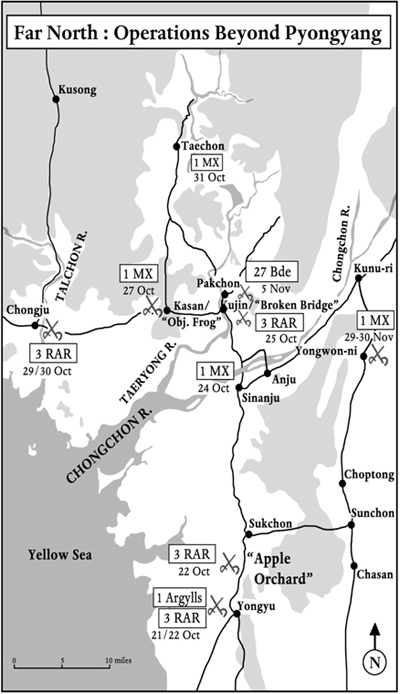
Soon after dawn on 21 October, orders were received that 27th Brigade was passing from the command of 1st Cavalry to 24th Infantry Division. The 24th was still south of Pyongyang, but an American liaison officer arrived at Coad’s HQ, carrying a map trace and orders:3 27th Brigade was to strike north, securing the town of Sinanju and its river crossings on the Chongchon River.4 This was a significant thrust: Sinanju was over 50 road miles from Pyongyang. The 1st ROK Division would be advancing on a parallel axis east of the brigade. Complicating matters was a circle drawn around the town of Sukchon with the words ‘187th ACT’, yet the brigadier had no information about the drop.5 In short, Coad was to spearhead the UNC drive north on the western flank, and relieve, en route, an airborne unit about which he had no information, all while under command of a division which lay south of Pyongyang – a division, moreover, of which Coad’s brigade had unpleasant memories from the Naktong breakout.
27th Brigade started north at 12:00 the same day. It was slow going. ‘All the bridges had been demolished and we forced our way though churned-up fords,’ Willoughby noted. ‘We passed the remains of the Pyongyang fire brigade – virtually new fire engines which looked as if they had been driving nose to tail when they were caught by the USAF.’6
Once clear of the suburbs, the advance accelerated through open countryside with the Argylls leading. A series of phase lines – Cat, Dog, Rat, Mouse, Elephant, Lion, Tiger – were passed without incident. The country was getting hillier, but there was no contact until they closed on the town of Yongyu, some 21 miles north. The leading company dismounted; the enemy fled. The whereabouts of the American paratroopers were still unknown, and it was dusk. Coad ordered 27th Brigade to ‘go firm for the night and curl up.’7
As darkness was falling, Lieutenant Colonel Neilson briefed Second Lieutenant Alan Lauder, the recently arrived reinforcement, to reconnoiter forward and fix the location of the paratroopers. The subaltern and a section of Jocks mounted a Sherman, and trundled warily into Yongyu. All went according to plan; they linked up with Americans dug in on the north edge of the town. ‘We had no problem getting in,’ Lauder said. ‘An American officer there said, “Great, we’re pleased you’re here.”’ With these Americans of K Company, 187th Airborne located, and the main battalion some 2 miles north, Lauder’s little force returned to the Argylls, half a mile distant.8 All was quiet; a link up could be made at dawn, then 3 RAR would pass through and take point.
At 23:30 firing broke out.9 A retreating North Korean force from the 239th Regiment had blundered into the airborne and were trying to break through. In confusion, some assaulted the Argylls’ A Company.10 Flares fizzed above; muzzles flickered in the blackness. Light’s platoon were in cover behind a scattering of oval Korean grave mounds. Light heard grenades go off, and a man in a neighbouring platoon cry out. The platoon commander shouted, ‘Where are you hit?’ The Jock replied, ‘In the arms, the chest and the legs, sir!’ Light came under intense fire – ‘bullets were going everywhere’ – so told his mortar man, McCardy, that it was time to move. Light gave him a push; the man fell over, dead, one of two Jocks killed that night. ‘There was terrible fighting going on and we could hear Korean voices around us in the dark,’ said Lauder. ‘Very tense!’ The Argylls held, but clearly the airborne were under pressure.
At dawn, Lauder was again assigned to contact the US positions by Neilson; he took his platoon and three tanks. By now an American colonel had appeared. ‘He insisted we follow this retreating North Korean regiment through the town; this seemed a bit ambitious to me, so I said we were a recce patrol and had to report back,’ Lauder recalled. ‘He said it was an American tank and it would do what he told it.’ The Sherman gunned its engines; Jocks clung on as they entered, again, Yongyu’s main street. It was just a couple of hundred yards from end to end but by now, ‘there were lots of dead enemy bodies around, some still dying in the road – not very nice! – and bullets whizzing past your ear,’ Lauder recalled. At the north of town, Lauder told the tank commander that he and his men were dismounting, adding that it was not a good idea for such a small force to pursue the enemy. The tank commander – after speaking to his battalion CO on the radio – agreed and halted.11 K Company were firm, north of the town, but beyond Yongyu, Lauder could see heavy enemy forces moving through orchards.
Neilson, having heard from Lauder over his battalion net, reported to Coad on the presence of the US colonel. Coad was fuming – the small force could easily have been overrun in the town. He drove forward to confront the officer himself and in a sharp exchange, ordered him back to Corps HQ. The colonel departed.12
3 RAR would take vanguard and link up with the main body of the airborne, somewhere north of Yongyu, after Argylls secured the town. It proved a nest of snipers, presenting a tricky tactical problem: While snipers could not prevent combat units like 3 RAR from motoring through, they could pick off rear and command elements. Relief of the airborne was urgent, there was no time to clear Yongyu, house-by-house. The solution had been discussed on the Naktong within days of the brigade’s landing: ‘Subject to the urgency of the situation and there being no civilians present’, Middlesex officers had decided, ‘the only suitable action will be … bypass the village and burn out the defenders’.13 The Argylls put this ruthless tactic into practice. Yongyu would be put to the torch. ‘Burn them out!’ Wilson ordered.14
Some troops had misgivings. ‘When you are told to burn a town, it first causes some concern that you should do such a thing – then you wonder how to start it,’ recalled Peter Jones, the Argyll who had been aboard HMS Jamaica. ‘The houses were mainly wood, and a match to the ceiling straw had amazing results.’15 When phosphorous grenades were bought into play, the blaze caught, racing from roof to roof. ‘I threw a grenade on this thatch and it went up,’ said Light. ‘The brigade major came up-column and said, “What are you doing and who gave you these orders?” I said, “Major Wilson!” and he said, “Oh!”’ The men grew enthusiastic. Jocks set to ‘with great dash and relish, and soon had some good fires burning,’ Coad noted approvingly.16
3 RAR drove through choking smoke. ‘When we were through the town, it was like coming into a spotlight, it was so bright,’ said Butler. Before long, the Argylls were being asked to douse their conflagration; accompanying US artillery could not pass through the searing heat.17
Brigade HQ, south of the town was deluged with refugees from the town; sympathetic soldiers gave up their own rations and provided straw to sleep on. ‘Some of these civilians will long remember the help given by British troops outside Yongyu,’ the War Diarist noted on 22 October. As there is no mention of the firing of the town in the diary, the diarist was presumably ignorant of the fact that it was British troops who ignited the homes – albeit due to the exigencies of war. It was yet another in a series of tragedies suffered by the Koreans of 1950. Worse ordeals lay ahead.
* * *
None of this was on the minds of Diggers advancing to contact with the support of 18 US Shermans. North of Yongyu, the first troops Green’s CP bumped into were Lauder’s recce patrol, halted following Coad’s intervention. ‘The Aussie colonel was very interested to know what we had seen, and he immediately put in an attack on the orchard,’ recalled the Scotsman, who decided he had better swiftly return to his own battalion, otherwise, ‘I could see myself getting involved in this too; they were quite a gung ho bunch, the Aussies.’
At Sariwon, 3 RAR had been the anvil. In this operation, they would be the hammer, but Green would have to wield it judiciously, as, apart from the company still dug in north of Yongyu, the exact location of 3rd Battalion, 187th Airborne, was not demarcated. All that was known was that 5 miles north was the town of Sukchon, the drop zone. This complicated Green’s task as he could not use artillery; it might hit friendly troops.
Diggers were especially keen to advance as they had recently been issued, not with individual C-rations, but B-rations: large tins, designed to be heated in field kitchens. Many had labels missing, with the result that platoons found themselves issued with tins of sauerkraut, turnips, carrots and tomato juice. In the orchards ahead, huge apples beckoned. Other Australians were keen simply to fight.
In the vanguard was C Company, commanded by Alamein veteran Captain Archer Denness. The Kalgoorlie native neither drank nor swore – an unusual distinction among the Diggers, not noted for restrained drinking or genteel language – but was fit and aggressive; his troops nicknamed him ‘Armour-piercing Archie’.18 Mounted on Shermans and trucks, Denness’ men probed northward up a road running through a broad valley. Some 500 yards to the east was an apple orchard climbing up gently rising high ground; to the west were paddy fields among which stood wigwam-shaped sheaves of harvested rice straw, each slightly over the height of a man.
Action started from the orchard. ‘We were passing this cutting and this sentry stood up – he must have been asleep – and shot,’ said Bandy. ‘Someone shot him, we all jumped off the tanks, and Denness shouted, ‘No artillery! Bullets and bayonets!’
Lacking support weapons, C Company would rely on old-fashioned infantry tools: gunpowder, sharp steel and testosterone. Two platoons surged into the orchard and up the slope.
‘This ridge line was about 200 feet high, covered with apple trees, and when you fired these apples fell off the trees,’ Bandy said. Most of C Company were young soldiers who had not seen action; Bandy was so busy controlling them that, ‘I did not fire a bloody shot myself.’ Enemy were in trenches and foxholes, and many – presumably exhausted by the previous night’s action – were asleep. Moreover, they were deployed north, facing the airborne; they were unprepared to repel an assault from the south. They panicked.
‘A lot of enemy got out of their fighting pits, they were so untrained,’ said Butler, whose platoon was firing cover from the road. ‘They were killed for their trouble.’ Any unit that panics and breaks in action is ripe for massacre, and so it was for the NKPA: C Company’s body count was even more spectacular than Light’s assault south of Sariwon. ‘It was all over in 15 minutes, it happened so quick, it bamboozled them,’ Bandy said. ‘They thought they would get a warning, but we were on them and killing them, they panicked and were all over the place.’
On the low ground, Denness ordered Butler’s 9 Platoon to head north, straight up the road, raised on a dyke, that ran toward the suspected American positions. The terrain was flat and open: Butler deployed his men in waist-deep monsoon ditches flanking the road and started advancing. At a culvert under the road, Sergeant Jack Harris’ men fired a round through – directly into the leg of another Digger advancing on the other side. Harris dashed over to the man and ripped open his trousers with a bayonet. The damage was hideous: ‘The exit hole was bigger than my clenched fist, with splintered bone and blood making a gruesome mess.’ Harris fumbled for his gauze and dropped it in; it disappeared into the wound. Butler arrived and ordered Harris to get moving; medics would clear casualties. Gasping, the man begged Harris not to tell anyone he had been hit by friendly fire – then handed over his the Second World War Luger. Harris was assigning men to clear the next culvert when a Digger emerged from it, a tiny Korean child in his arms and a family following him: He had been about to grenade the culvert when two children – followed by their twelve-member family – scurried out. Escorting them to the rear, the grinning Digger, a huge man, looked, ‘comical but magnificent,’ Harris thought.19
The next obstacle was a bloodied horse and its overturned cart, surrounded by six dying enemy soldiers, blocked the road. As they attempted to heave the obstacle out off the track, Butler’s platoon came under fire from enemy dug in on hills. ‘Most of the enemy continued to focus north’ – toward the GIs – ‘and were not aware we were there, but as we got closer, more would turn around,’ Butler said. Bursts zipped overhead; Diggers returned fire at enemy in plain sight. ‘The sheer weight of opposition was getting too much for us, when suddenly the company commander marched down the middle of the road!’ said Butler. ‘He was in full view, his signaller was going up and down dodging bullets, and I had to get out of the drain to talk to him!’ Denness had bought support: two Shermans. Their main armament, shooting into enemy positions less than 50 yards away, retrieved the situation. ‘Their battle power was enormous,’ Butler recalled.
The tanks finished the horse. The leading Sherman rolled over the creature – a leg caught in the tracks – the tank shuddered, its engine strained – the helpless animal was hurled up, off the road and into the paddy. The loud ‘thunk’ it made as it landed in the dry paddy prompted one enemy to peer over a bund: Harris nailed him with one round. The horse raised its head once, looked at the advancing soldiers, then died.20 The path was clear to advance the final few hundred yards to the American positions.
Distant paratroops could now see Australians closing. An airborne officer watched with astonishment the butchery inflicted by a single, fearsome Digger, ‘Bluey’ – so called because of his red hair – Smith.21 A giant of a man, Smith ‘loved the army, and he had guts,’ Bandy reckoned. Smith lunged into a North Korean trench, bayonet fixed. He emerged soaked in crimson. Asked if he was wounded, he replied, ‘You should see the other jokers!’22 In the trench lay eight dead enemy.23
Sniper Robbie Robertson, with Green’s Command Post behind C Company, had watched Denness’ men go in. ‘They just overran the enemy, kept them off balance, they did not give a shit that they were outnumbered,’ he said. The CP was moving through an uncleared section of the orchard when they hit a line of trenches and bunkers – two- or three-man dug-outs, with top cover, still occupied by live enemy. NKPA charged out; a melee surged around the CP. ‘It was close combat, we were three to four paces from these bunkers,’ Robertson said. Diggers threw grenades through openings, then fired in: ‘You follow up with fire as they might burst out, away from the grenade.’ Robertson was passing one when another soldier dropped a grenade it. It was hurled back out. Robertson dived down – the grenade went off – an enemy soldier sprang out of the bunker, firing a burp gun. His burst barely missed the sniper: ‘All three rounds went into the ground under my chest, and I fired three shots as I scrambled to my feet,’ he said. ‘You can fire just as quickly with a bolt as a semi-auto; the rifle bucks anyway, so you have to re-aim.’ The enemy soldier went down. Robertson was trained to kill at 1,000 yards; this target had been at muzzle-to-muzzle range. Even though combat was whirling all around, the marksman in Robertson could not help noting his group: Three tight rounds through the North Korean’s cheekbone. ‘In a position where you’re being gunned to death – well, it makes for accurate fire!’ he said.
Signals Sergeant Jack Gallaway was impressed at his CO’s behaviour: Green, ignoring the fighting, was scanning map boards and controlling the battalion action. Panicked enemy were running around in the open. Over open sights, Robertson fired again and again. ‘I was a sniper and when we place a shot we don’t miss – down he goes!’ he said. D Company was summoned to assist the headquarters troops in finishing off enemy survivors.
While C Company cleared the orchard, Private Stan Connelly of B Company was covering their flank when a North Korea leapt out of a rice sheaf at him. ‘He jumped out, he had a fixed bayonet and took a poke at me,’ Connelly recalled. ‘I reflexively parried the thrust with the Bren, and my number two shot him dead.’ Connelly was slashed across the hand, but continued advancing.
C Company had reached a treeline at the end of the broad valley. It was approximately 14:00.24 ‘I was talking to David Butler, who had a bullet hole through his web belt, when we saw movement in the scrub,’ said Sergeant Tom Muggleton, the Mortar Fire Controller. ‘So we approached, and could see this great scrape of red earth, and in it were several paratroopers.’ ‘By God, we’re pleased to see you!’ they told the Diggers. The Americans – bar a couple who attempted to surrender to C Company, wearing Russian-looking greatcoats – were relieved. A staff sergeant approached Bandy. ‘Nobody can tell you what it’s like to come back from the dead!’ he said, in tears. A US officer presented Gallaway with his .45 pistol. ‘I said, “You can’t just give me that!”’ Gallaway recalled, ‘And he said, “Ah – I just lost it!”’
The Australians had overrun the NKPA and linked up with the Americans. Job done, Butler and his platoon sat down and cracked open ration tins for lunch. Their surroundings hardly impelled appetite. ‘There were dead all around us as we ate,’ he said. ‘God knows how many bodies.’ But the butchery was not over yet. Enemy holdouts, bypassed during the narrow-front advance up the road, were sniping from rice sheaves. Butler was ordered to sweep through, clearing the paddies. The lieutenant ordered his men to form extended line and fix bayonets. Then they strode forward.
Unlike the British bayonets – the needle-like ‘pig stickers’ – the Australians carried the old pattern ‘sword bayonets’ with their broad, 18-inch blades. Though no more lethal than the British weapons – in edged weapons combat, the stab is deadlier than the slash – they were more fearsome looking, and unlike the dull, blued steel of the British bayonets, the Diggers’ blades were bright. Seeing the inexorable advance of the tall figures in slouch hats, their bayonets reflecting the crisp sunlight, the hidden enemy panicked, breaking cover and running. The resultant drama awed spectators.
Coad was passing up the road. Fascinated, he stopped to view a scene that was more hunt than battle. ‘An Australian platoon lined up in a paddy field and walked through it as if they were driving snipe,’ Coad wrote. ‘The soldiers, when they saw a pile of straw, kicked it and out would bolt a North Korean. Up with a rifle, down with a North Korean.’25 Viewing everything from high ground had been a young war correspondent from the Melbourne Sun, Harry Gordon. As overnight copy editor, he had been following the war closely since its outbreak, so when an Australian press pool was assigned to Korea, he was his paper’s top choice. Gordon had not covered the Second World War; Korea was his first conflict, and he was keen to see it up close. ‘It was an amazing experience to see,’ he said. A bullet shattered the windscreen of a jeep nearby from which a photographer was shooting; Gordon stayed put. ‘Diggers were stabbing and kicking into rice bundles, enemy would run out and be cut down,’ he recalled. ‘It was close-range, brutal stuff.’
Butler’s action finished the fight.* In one of the most lop-sided battles of the war, 3 RAR had lost seven wounded; the enemy had lost 150 dead and 239 prisoners.26 ‘It was a turkey shoot,’ said Muggleton, the MFC whose mortars had been redundant. ‘It was a one-way affair.’ The action, a masterpiece of old-fashioned infanteering, became known simply as ‘The Battle of the Apple Orchard’. Those there knew they had set a standard. ‘After that, you couldn’t hold the Diggers!’ said Bandy. ‘We thought we could take on the world!’
Middlesex passed through 3 RAR and linked up with the main body of the airborne late in the afternoon. ‘It was one of the worst sights I saw: All along the road were dead North Korean soldiers in ditches,’ said Green. ‘They must have been some mothers’ sons at one time. We were looking at them from the height of a lorry and they looked a mess.’ Still, they delighted in the fruit. ‘There were beautiful apples, we stuffed our uniforms, they would have absorbed a bullet!’ reckoned Stafford volunteer Ray Rogers.
The first airborne operation of the war was over. Some airborne – such as the group Desfor, the photographer was with – barely saw any action. Those relieved by 27th Brigade were a different story. The NKPA 239th Regiment, which had been deployed to overrun the 3rd Battalion of the 187th, had been effectively annihilated.
The trainload of US POWs was a different matter. Bandy later witnessed their fate. ‘They were massacred in this tunnel, they were hanging out of the carriages and on the ground,’ he said. ‘That kept us going – a bit of spite.’ Seventy five POWs had been murdered north of Sunchon; twenty-one survived.27
Diggers assessed their post-battle reactions. ‘It was just a day at the office, no after-effect or anything,’ said Connelly, who patched up his bayonet wound with tape. ‘When you’re young, you can live through anything – we were envious of C Company!’ Others were more stirred. ‘Afterward, you did get the shakes a bit,’ said Robertson. ‘You tended to be full of adrenalin, so when you stopped, you shook, but it did not last long, you settled down.’ It had been a good day for the sniper: ‘I think I got about twenty-four in that fight, though I don’t announce it with a megaphone,’ he said. Word of his lethal accuracy spread, earning Robertson a nickname: ‘The Hitman’.
One Australian was more thoughtful. Sergeant Jack Harris had seen scores of enemy dead littering the battleground, but the memory that stayed with him from that bloody day were the soft brown eyes of the horse as it lay dying in the paddy field.28
* * *
On 23 October, Argylls drove up to modern-looking apartment blocks: This was Sinanju, the city on the Chongchon River, 27th Brigade’s limit of exploitation. Having spearheaded 8th Army’s advance 55 miles from Pyongyang, the brigade had hit no resistance in the mountains between Sukchon and Sinanju, but as they closed on the river, leading Argylls came under ineffective fire from the north bank.29
Sinanju itself was clear of enemy, but smashed up. The road bridge that carried the main Pyongyang highway north had been blown; the rail bridge marked on maps did not exist.30 Coad ordered the Middlesex to prepare to cross. ‘This river was understood to be our final objective,’ wrote Willoughby. ‘We were very tired, but our orders for a rest were crushed by orders to cross the river tomorrow morning by daylight.’31
US engineers would provide thirty boats. How fast did the river flow and when was high tide? A frightened local was found; using sign language and drawing in the dust with a stick, he conveyed that high tide was at 18:00.32 Coad wanted to cross that evening, but that left little time for reconnaissance, and Man wanted to see how the river looked at high tide. A dawn crossing was planned.
A river assault crossing is one of the riskiest operations of war. Barrett was nervous when he heard orders: ‘The expectation is that the crossing in assault boats will be opposed and casualties heavy’.33 There were only enough boats to lift two companies at a time. A and C would lead, followed by Tac HQ and B Company; finally, Willoughby’s D. The major was as worried as Barrett: ‘There could hardly have been a site less likely to offer surprise,’ he wrote. ‘There is nothing to do but wait and morosely speculate on news that the rise and fall of the tide at Inchon was 36 feet.’34
Coad was equally concerned. A ‘very agitated’ US engineering officer had arrived at his HQ, telling him that he could not guarantee patching up the bridge, meaning the Middlesex – assuming they made it across the river – would be isolated on the north bank, without transport or heavy weapons. ‘The situation was now serious,’ Coad wrote; he had had no personal contact with a senior commander for ten days.35
The crossing would take place 4 miles downstream from the town. At the crossing point, Diehards were ordered to stay off the skyline until darkness, and not to show any lights. At dusk, Barrett and his mates lay flat and looked over at their objective. There was a 1,000-yard approach to the river, with no cover; then the Chongchon itself, approximately 800 yards wide. Beyond, everything was overlooked by foothills that tumbled down to within 400 yards of the northern bank. ‘The Aussies were moved up behind us,’ Barrett said. ‘Coad expected us to take heavy casualties.’
October 24 dawned with a hard frost. This was soon burned off by bright sunshine, but the autumn chill had been noted by higher command; two days earlier, the Diehards had been issued with an American field jacket to wear over their lightweight tropical kit. The crossing did not begin until 08:30.
A Company hefted assault boats – each carried an eight-man section – down to the river, splashed in, and set off for the opposite bank. Ray Rogers, with A Company, was apprehensive: ‘There were these moth eaten oars, and I had the radio: If I went into the water, I was not going to get out!’ Oars slapped water. Men panted. Minutes passed. ‘The closer we got to shore, the tenser we got,’ Rogers said. Watchers on the south bank held their breaths, waiting for the rip of automatic fire. Across, Rogers jumped out of his boat with the company CP – to sink knee deep in freezing black mud. ‘Are they waiting till we are stuck?’ he wondered desperately. ‘Have they got a bead on us?’ Nothing. The sections advanced inland. Still nothing. ‘It was relief – sheer relief!’ said Rogers. The NKPA had abandoned the Chongchon.
The following companies did, however, face opposition – from the river itself. The tide had turned and assault boats were swept away. Willoughby found his company being tossed along, ‘at an alarming rate, our progress toward the far side seemed minimal and there was no sign of the rest of the battalion’.36 The situation was not aided by lack of propulsion. ‘Each section got into a boat, but it was where are the paddles?’ recalled Private Ken Mankelow. ‘We were told, “Use your rifles” but you can’t use a rifle to paddle.’ As the tide retreated, mud islands appeared mid-river, on which several boats grounded. Whitehouse leapt overboard to push his boat off; he sank to his waist in freezing black mud. ‘This was 20–30 yards from shore, I thought it was solid, but it was mud all the way,’ he said. ‘It was a bit of a shambles, nobody knew where anyone was going, boats were going by left, right and centre.’
Across the river, a reception committee waited. ‘There were civilians pulling us out, it was comical!’ said Barrett. ‘They were all in their Sunday best, old men with black hats, running up and down to welcome us.’ His platoon advanced inland from the riverbank to a little fenced-in village. A striking woman – ‘very tall, wearing a khaki siren suit and speaking English’– threw her arms around the Diehards, thanking them for saving her. Barrett was bemused.
A local junk was commandeered to help move some of the boats; it too went aground on an island, to be shifted by Diehards who jumped over and shoved it off. Finally, Man’s men were across. They regrouped and advanced.
While the riverine drama was underway, Brigade HQ received fresh orders. Sinanju and the Chongchon had been their original target line; now they were to advance 10 miles further north to Pakchon, then wheel left for the town of Chongju, a further 20 milesnorthwest.37 Chongju marked the western flank of the ‘MacArthur Line’, the line at which non-Korean UNC forces would halt. Only ROK troops would continue to the Yalu River, the China frontier. 24th Division signalled Coad, indicating the imminent end of operations: ‘One more stroke will do it.’38
Local developments seemed to support this optimism. Sixty-six POWs were collected from around Sinanju, including a beautifully dressed officer, who had, however, little information to impart. ‘One would hazard a guess that his desertion was not a great loss to the North Korean Army,’ 27th Brigade’s War Diarist commented.39 The problem of how to get the rest of the brigade and its transport across the Chonchon was solved when orders were received to head 5 miles east to the town of Anju: 1st ROK Division had secured a crossing, a sandbag bridge.40
Over the Chongchon, Diehards had occupied the high ground by evening. There was relief at the bloodless – if embarrassing – operation. ‘It was chaos, and if anybody had been opposing us, they would have wiped us out laughing,’ said Mankelow. ‘Later we had a tea and a fag, everybody said, “What a screw up!”’ The battalion – the very tip of the UNC spear – in the hills without supporting arms, spent an uncomfortable night without blankets. For the first time, the temperature dropped below freezing;41 the Argylls water bowser froze solid.42
The brigade spent 25 October entering and enlarging the Middlesex bridgehead. Late in the afternoon, 3 RAR broke out and advanced upon the village of Kujin and the town of Pakchon, 5 miles north of the Chongchon. They were not the first brigade members into Pakchon, however. The pace of the advance and the axes taken were now confusing members even of Brigade HQ. Two MPs responsible for traffic direction were posting brigade signs – codename ‘Nottingham’ – on the outskirts of Pakchon when someone opened fire on them. Enemy was still in residence; the pair was ahead of the vanguard. ‘Two crestfallen and somewhat indignant MPs were soon returning to the sanctity of Brigade HQ,’ the War Diarist noted.43
* * *
North of the Chongchon, Kujin and Pakchon both lay on the east bank of the Taeryong River. For 27th Brigade to thrust west for Chongju, the Taeryong would have to be crossed. The 3 RAR’s advance company, together with Shermans of the US 89th Tank Battalion, made Kujin at 16:00. NKPA engineers had dealt with the massively-built, 300-yard long brick bridge spanning the river: Its central span had been blown and dropped 20 feet into the water, making it impassable to vehicles. ‘It looked like the gap of a large, missing tooth,’ thought Gordon.
Yet the fallen span might provide a base for infantry to climb up onto the un-demolished section: Men began knocking together two rough scaling ladders. Two sections of B Company would go over on initial reconnaissance. Still, this did not solve the problem of a vehicle crossing; transport would not be able to cross this bridge. Green ordered D Company to advance up to Pakchon, where there was a ford.
The recce patrol from B Company was first up the scaling ladders and across the bridge. There was no enemy fire. On the west bank, the patrol – fully exposed, and well forward of the battalion – were proceeding warily, when some fifty enemy appeared on a ridge to the right, hands held high. As the would-be POWs approached, firing broke out from further up the high ground – apparently to discourage surrenders. Meanwhile, a US light observation plane, buzzing overhead, reported at least two companies of enemy dug in the high ground. The patrol, with ten POWs, prudently withdrew east.
At 17:30, a brace of US Shooting Star ground attack jets thundered over the Australians, making strafing runs on the enemy positions. Few of the Diggers were impressed; the jets simply moved too fast to be accurate. After their departure, Green ordered mortar and artillery fire. The high ground over the river was churned up in great smoke and dust clouds.
At 18:30, D Company returned from Pakchon to the battalion area with a haul of 225 prisoners. American engineers with them had discovered a damaged ford, and would work overnight to make it passable for vehicles. A platoon of D remained with them as escort.44
His right flank secured, determined not to allow enemy to reinforce the crossing – and perhaps encouraged by collapsing North Korean morale – Green made a decision. ‘The CO said, “If we don’t get across that bloody river tonight, we will never get across,”’ recalled Bandy, who overheard the orders. Green would thrust A and B Companies across the river to seize a bridgehead on the west bank. It was an aggressive plan. The companies would take a while to negotiate the ladders in the dark, and if heavily attacked, would have the river to their backs.
Among the point platoon was journalist Harry Gordon. ‘The sun was sinking, there was a deep pink glow as we went up the ladder to engage the enemy and establish a bridgehead,’ he recalled. ‘Nobody seemed to know more than that B Company was going over.’ The platoon waited for orders to launch them across. Some men were smoking, others talking in low voices. ‘One man beefed about his underwear, one wanted a T-bone steak,’ Gordon, armed only with his notebook, recalled. ‘There was a mood of tense expectancy; this was the nervous talk before battle.’
‘OK! Time to move!’ the platoon commander, Lieutenant Eric Larson, told his men. Cigarettes were scrunched out, packs shouldered, greatcoats buttoned and weapons cocked. The evening was chilly: Frost covered the ground, puddles were iced over. Up on the concrete bridge, Larson’s men advanced into the dying glow of the sun.
The crossing of the felled span proved easy enough, but it was time-consuming getting over. The first man reached the west bank at 19:00. The sunset had almost faded, the moon had risen. Gordon moved forward with the ‘congestion of slouch-hatted silhouettes’ to the west bank, where there was a brief huddle. ‘Alright, let her go!’ Larson whispered. A flare went up in an orange burst. The platoon advanced toward their objective, a low, scrub-covered hill.
The men, Gordon noted, had unconsciously adopted a semi-crouch. ‘You’d pay two bob to see this at the pictures,’ whispered a private. ‘But we’re getting it for nothing!’ Nobody answered. The platoon crested the first ridge without contact. There were signs of enemy: a clutch of burp guns, abandoned uniforms. ‘The North Korean troops had turned peasant,’ reckoned Gordon. The platoon continued for a second hill.
A burst of automatic fire ruptured the chill silence. Larson, in the lead, had opened up with his sub-machine gun. ‘There was a heave in the shrubbery, and a body slumped out,’ said Gordon, 10 yards behind. A North Korean, wounded in the air strike, had tried to throw a grenade. ‘There were several of these living booby traps,’ said Gordon. ‘Larson had seen movement and did not hesitate, though it shocked the wits out of me!’ Moans emanated from the scrub; advancing Diggers, ‘put them out of their misery’. Stay-behinds on suicide missions were ominous. Clearly, despite earlier surrenders, courage had not deserted every enemy soldier.
All around, voices started talking – voices speaking Korean. ‘Someone fired into the voices,’ Gordon recalled. ‘Suddenly, it was awfully noisy.’ The reporter found himself in the midst of a close-range, night firefight. All around were blue and orange winks of burp gun muzzle flashes; Diggers fired back into silhouettes. ‘There were North Koreans in far greater numbers than anticipated, and they were fanning out,’ said Gordon. He dived and weaved, trying to stay in sight of Larson. The platoon seemed to have the enemy on three sides. ‘We were like a pointing finger,’ said Gordon. Larson, realising that he had exploited too far forward, led his men back toward the bridge. Sporadic mortar fire was now landing. ‘We were jumping, running and scrambling,’ Gordon recalled. They tumbled back to where A and B Companies which had crossed over behind Larson’s platoon, were digging in.
Private Stan Connelly had advanced with his platoon when his officer disappeared over the side of the ridge: He had been tackled by a North Korean. There was the sound of a struggle than the lieutenant re-appeared, shouting, ‘He got my rifle!’ The platoon took up defensive positions, expecting a charge. None came. They started digging into the gravel-hard earth. The two companies were deployed along a ridgeline parallel to the river, separated by the cutting through which the Chongju road led onto the bridge. A Company was on the left; B, the right. At 19:30 they came under ineffective fire: the shells, probably armour piercing, simply buried themselves in the earth rather than exploding. Ineffectual mortar fire also began landing. From 10:30, firing picked up.45
Lying prone on the A Company perimeter was Private Mick Servos; he had not been able to dig a slit trench. He registered an odd zinging sound: Behind and above his position was a steel electricity pylon and enemy rounds were hitting it. The noise was comforting: ‘We were not frightened,’ Servos said. ‘They were firing too high.’ But these were not shells, they were bullets. The enemy was closing into small arms range.
On the eastern bank, the men of C Support and Headquarters Companies could hear the rising crackle in the darkness over the river. At 23:00, Green sent Sergeant Reg Bandy’s platoon across to reinforce A Company. Bandy’s mate, Jack Harris was anxious; he warned the big NCO to keep his head down; Bandy promised to hug the ground, slapped Harris on the shoulder, and set off over the bridge into battle.46 Reaching A Company, Bandy’s men dug in.
A chill drizzle fell. Through it, small arms fire intensified steadily. At 04:00, Diggers lying in cover made out a new sound: A squeaking and clanking approaching through the darkness. A heavy gun cracked. In its momentary flash, the Australians saw what they were facing: A pair of enemy tanks – the feared T34 – along with a force of some sixty infantry, including a motorcycle sidecar and a Russian jeep.
Like the rest of 27th Brigade, the Diggers had been issued the 3.5-inch bazooka. Crews loaded rockets into their ‘stovepipes’, carefully aimed and – nothing. The weapons would not shoot. Nor could fire be called in from over the river; the mortar fire controller, Sergeant Tom Muggleton with B Company, was having radio problems. These equipment malfunctions left the Australian infantry defenceless. The T34s continued to advance. Obviously they were not going to stand off, they were going to drive right through the 3 RAR companies and on to the bridge.
Armour at close range appears so fearsome, so indestructible that a term has been coined – ‘tank fright’ – to denote the panic it can spark. If a unit breaks and runs, it can be slaughtered, either by tank gunfire, or – horribly – by thrashing steel tracks. With the river at their back, the Diggers had nowhere to run. But a tank has its own problems at night. Unless it has infantry spotters calling in targets, crew vision is highly restricted. And the infantry were vulnerable, for the North Korean force was being lit up, both by the flashes of their tank guns, and by their accompanying motorcycle, which had a slit in the cover of its headlight.47
Thus far, the Diggers had not returned fire; to do so, would give away their position to the tanks. Now, with the enemy between 100 and 150 yards off, A Company let loose. ‘We let them into the trap and hit them with everything we had,’ said Servos. ‘We could see them going down all over – it was a hell of a play!’ The enemy infantry were decimated by the Diggers’ opening volley, but some took cover and returned fire. A runner next to Bandy was shot through the skull. ‘One of my guys saw the muzzle flash and got him at about 150 yards,’ the sergeant said.
The tank fire was less accurate. One of Bandy’s men was lying behind a burial mound: the T34 blasted the top two feet of it off, but did not get the Digger in its cover. The power pylon took further punishment from the tank fire. ‘They were just blasting away,’ said Bandy. ‘They did not know where we were, there were no flares, the tank could not lay on us.’
Although their infantry escort had been wiped out, the T34s continued to prowl within close range of the Diggers’ positions; one actually lumbered into the cutting between the two companies. ‘They were practically on top of B Company HQ,’ said Muggleton. ‘It was a very tense night, they came down and blew a bloke’s head off at Company HQ, 40–50 metres away.’ The mobile fortress halted some 10 yards from a foxhole occupied by a pair of Diggers; up close, it looked ‘about the size of the Taxation Building, and equally fearsome’. The two spent the night huddled in their hole, listening to the tank crew’s fire orders.48
Wounded were being evacuated across the broken bridge. It was a desperate business. By the light of gun flashes, under sniper fire, stretchers were secured with rope, lowered some 20 feet over the edge onto the broken span resting in the water below, then transferred to folding boats waiting to be hauled to the RAP on the east bank by ropes. After his adventure with Larson’s platoon, Gordon had retired across the bridge to write up his adventure. From there, he witnessed the biggest drama of the night.
In one of the first boats was a corporal, Jim Delaney, and a soldier wounded in the buttocks. The latter had just been transferred to the boat when things went wrong. ‘The boat hit some rubble, skewed in the swift current, banged into a pylon, swerved and capsized,’ recalled Gordon. Both men were spilled into the icy river, and seized by its six-knot flow. Delaney, a non-swimmer, floundered. His wounded companion shoved him toward one of the bridge pylon supports, where a rope was thrown to him, but was swept away himself.
Overseeing the evacuation was 3 RAR’s Drum Sergeant Tom Murray. He stripped down and dived off the bridge into the frigid black water. Reaching the casualty, Murray clutched him in a lifesaver’s embrace and swam him to the east bank. Gordon was amazed. ‘I had covered hangings and plane crashes, so I had seen some bad things, but this was inspirational, the casual heroism,’ he said. ‘I was transfixed, it was a privilege to see it unfolding before your eyes.’* Murray re-clothed himself and continued directing operations on the bridge.
A grey dawn broke. Chilled Diggers looked around to see the damage. In Connelly’s section, one man was dead, another seriously wounded with a head shot. The light also illuminated more enemy – for Muggleton, targets. ‘It was the best mortar target I’ve had in my life!’ he said. ‘Two tanks, and about a company of men on a little crest.’ Excited, he radioed back to the baseplate position – to no avail: His set was ‘as dead as a doornail’. The MFC was apoplectic.
His target, did not tarry: Vulnerable to airpower, the enemy were retreating. Servos’ section was ordered up the road to where the mechanised attack had been halted. Enemy dead had been evacuated, but the track was covered in debris and bits of uniform. The jeep – a Russian model – was recovered intact and put into use by the battalion.* It had had a senior occupant, because a briefcase was recovered.
It proved to be the property of one Lieutenant Colonel Kim In-sik, commander of 17th Tank Brigade’s reconnaissance unit. In it, were documents including the brigade’s War Diary, which detailed its movements all the way from the Naktong. Other papers stated that the brigade had twenty operational tanks and six artillery pieces, and was planning to defend Chongju, 27th Brigade’s limit of exploitation, 20 miles west of Kujin.49
While Servos’ section cleared the road, Muggleton stormed back across the bridge to the mortar platoon, ranting about the ‘bloody useless SCR 536 radio’. ‘The OC said, “You should be court martialed for leaving your post!” I said, “What the hell am I going to do if I have no radio?”’ The sergeant calmed down when he was given a better set, but could not forget that perfect target.
Green’s gamble had paid off. His battalion had bounced the Taeryong; established a bridgehead; broken counterattacks; faced down – without support – enemy armour; and driven it into retreat. ‘After that, they can send them by divisions,’ the elated CO told his HQ staff. ‘This battalion will hold them!’50
There was an immediate investigation into the failed bazookas. It was discovered that the battalion had been given new models, and their electric firing mechanisms were still packed in grease. Solvent was applied and the bazookas made ready.51
For 3 RAR, it had been a more expensive battle than the ‘Apple Orchard’. The fight for Kujin – or, as the Diggers dubbed it, ‘The Battle of Broken Bridge’ – had claimed twenty-two wounded and eight killed, plus an American forward observation officer dead; one hundred North Koreans had died, fifty were captured.52
Among the fallen Diggers was an A Company NCO, Sergeant McDonald. Lengthy books have been written about the last words of famous persons; McDonald’s are unlikely to appear in any such work, but speak volumes about the Spartan spirit of Charlie Green’s men. Hit in the groin, McDonald was informed that there was nothing that could be done to save him; femoral artery severed, he was bleeding out. The NCO digested this information, then spoke. There was no self-pity, no melodrama. ‘Oh, fuck it,’ he said. ‘Give us a smoke, will you?’ McDonald was handed a cigarette. He sat and smoked, bled and died with the lit cigarette dangling from his lip.53
* * *
At dawn on 26 October, the Argylls crossed the Taeryong to widen the 3 RAR bridgehead. They met no opposition. At 13:00, the Middlesex piled onto the 89th Tank Battalion’s Shermans and drove over the river crossing at Pakchon.54 Clusters of Diehards stood on the hulls, clinging to the turrets as the tanks churned across the shingle riverbed, leaving broad wakes. On the far bank rose great, fog-like banks of smoke from artillery preparation. The Middlesex dug in near a village, their start line for an attack the following morning. After dark, the Diehards came under tank fire: Armour piercing shells tore through the houses of the village with a high-velocity ‘whoofing’ sound.55 Willoughby was convinced the enemy were shooting at silhouetted Shermans; he instructed the American tanks to take hull down positions below the ridge crest.56
Given the heavy fighting the Australians had encountered, the proximity of enemy armour and the intelligence from Colonel Kim’s documents, Coad shortened his bounds toward Chongju. The Middlesex objective on 27 October was just 5 miles west: the high ground overlooking Kasan crossroads on the Kujin-Chongju road: ‘Objective Frog’. The urbane Major Roly Gwynne – Man had been taken sick – orchestrated a textbook attack: A single company would deploy to secure a phase line – a village or ridge. There, it would go firm, to be leapfrogged by the next. Air support was on call. Tanks would shoot from the road.
The first phase line was the village of Yongsong-ri. At dawn, US air reconnaissance had identified this as the source of the previous night’s shelling and an air strike had gone in. At 09:00, as the Diehard spearhead approached, it was blazing furiously and erupting with irregular explosions; it had been used as an ammunition depot.57 C Company attempted to enter; but was repelled by the heat. In the confusion, a Sherman reversed into the OC’s Bren Carrier: the major’s legs were crushed.58
Once the fires died down, C Company secured the ashes of the village, while A Company moved through into open country. Beyond the village, waiting enemy tanks and infantry opened up. One shell scraped along the hull of a Sherman and ricocheted off into a paddy, killing two Diehards taking cover. When the ambush was sprung, signaller Ray Rogers was riding on a trailer towed by his company commander’s jeep. The trailer was covered with a tarpaulin, and as the jeep accelerated along the road, Rogers clung on for dear life. He could plainly see an un-camouflaged T34 standing about 250 yards off, its turret traversing, its gun following the racing jeep. A Sherman fired, scoring a direct hit. The T34 brewed up. A burning enemy crewman leapt out of the vehicle; machine guns finished him.59 Two T34s broke cover; they were set upon by aircraft. Enjoying the battle’s spectacular developments was a BBC reporter, though he cursed when his recorder broke down just as US artillery 155mm support fire howled in.60
D Company passed through A. Ahead was a circular valley, surrounded by low ridges. Small arms erupted from high ground to the right, where A Company had been fired at. The gruelling pace of operations was telling: Willoughby was distressed to see his soldiers trudging along, ‘too weary to take any reaction either to the crack of the bullets or the platoon commander’s orders’. Willoughby roared – ‘maybe I had a louder voice’ – and led his men into action.61 ‘Major Willoughby said, “Walk, don’t run”, as if it was a training exercise,’ recalled Whitehouse who was feeling particularly vulnerable – he was carrying a bright yellow air recognition panel. ‘As we got near to where we thought they were, the order came, “Charge!” and we started running like mad dogs, shouting and screaming.’ Some 300 yards ahead, a platoon of enemy stood up and started, ‘running like hell’. None of Willoughby’s soldiers reacted: ‘They were young men from decent families and no-one fired until, in desperation, I let off my rifle and missed, then the rest opened fire in a half-hearted way and also missed,’ the major wrote. ‘We were simply punch-drunk, strained and fatigued.’62
B Company leapfrogged D Company to carry the next ridge. Mankelow was advancing when tanks were spotted ahead. ‘We were not sure whose tanks they were – we thought they were Yanks – then suddenly they opened fire,’ he said. The brigade was well supported; an air strike went in almost immediately. The US ground attack jets gave no aural warning of their approach; part of their deadliness was that they were only heard when they had thundered overhead. ‘They came straight down firing cannon, we cheered ’em on, you could see explosions going up and then they dropped napalm,’ said Mankelow.
There was a pause in the attack, as the battalion consolidated. The next objective was a ridge running across the road some 1,000 yards forward: Objective ‘Frog’ itself. D Company advanced. Tanks, artillery and air strikes blasted up a maelstrom of dust in the dry paddies. Willoughby’s men took the ridge without casualties. All that now remained was digging in and clearance patrols to secure the area.
Corporal John Pluck was sweeping with his platoon in skirmish line when someone shouted, ‘There’s a Gook!’ Pluck turned – an enemy cap was bobbing above the scrub – Pluck brought up his Sten and released a two-round burst. The target went down. Pluck examined his kill. ‘I’d put two rounds in his chest, but the chap was already wounded by a shell splinter, he had had a little fire going, he was cooking some meat, and his rifle was stacked beside him, he was no danger whatsoever – I saw his head move and fired, it happened in a second.’ Pluck realised the man was helpless, and probably wanted to surrender: ‘It was so unnecessary.’ The battalion dug in around Kasan crossroads. It was approximately 16:30.
In what Coad considered ‘a very sticky action’,63 three Middlesex were dead and four wounded; an estimated seventy-five enemy had been killed and twenty POWs taken. Ten tanks and two SPGs had been knocked out, most by napalm air strikes.64 While a tank – essentially, a box of armoured steel – may not appear combustible, it is: paint burns, fuel and oil blazes, ammunition explodes. Moreover, if napalm pours into, or splashes up into air intakes, it creates a hellish conflagration inside. All this makes fire the bane of tank crews; a burning armoured vehicle turns red hot, roasting those inside.
Curious soldiers wandered over to examine brewed-up T34s. Corporal Harry Spicer and his mates found a roll of material on one of the hulks. With bitter nights now descending, they cut it up and distributed it. Perched upright in the turret of his smoking machine watching the looting Diehards, was the charred cadaver of the enemy tank commander, blackened like a fossil. It was a sight Spicer would never forget.
* * *
While Diehards had been fighting for ‘Frog’, Brigade HQ received unsettling intelligence; some 400 enemy were advancing on Pakchon from the north. With his three battalions all across the Taeryong, this placed Coad in a dicey position: If the enemy retook Pakchon and Kujin, the brigade echelons would be overrun, its fighting elements cut off on the wrong side of the river. The Argylls were being warned to cover the town when the US 5th Regimental Combat Team appeared from the south. The Americans had caught up with the brigade. It was a timely relief.65 While 27th Brigade continued its attack westwards, 5th RCT would strike north for the town of Taechon.
On 28 October, the Argylls passed through the Middlesex. Overflown by a spotter plane, they advanced nearly 15 miles; one SPG was knocked out by an air strike. An officer of the 17th Tank Brigade was captured; he told interrogators that he had been tasked to defend the approaches to Chongju, but his brigade had taken severe losses on the Taeryong – i.e. fighting the Australians.66 Chongju is an important road and rail junction, though for 27th Brigade, of more import was the fact that it was their final objective, on the west bank of the River Talchon. A ridge of high, wooded hills on the riverbank afford strong defensive positions. On 29 October, 17th Tank Brigade would meet 3 RAR on these hills for a last battle.
The Diggers passed through the Jocks for the drive on the town. D Company led 3 RAR up the highway to where it passed into a cutting through a pine-covered ridge. There, spotter aircraft radioed that there was enemy infantry and armour dug in on both sides of the highway: a massive roadblock. Green halted his advance to soften up the positions. For three hours, air strikes – launched by screaming F80 jets and droning P51 propeller fighters – pounded the area with bombs, rockets, napalm and machine guns. Nine enemy tanks were reported knocked out.67 Then Green unleashed his bayonets. D Company would attack left of the cutting; once they went firm, A Company would take the right.
At 14:30, D Company advanced. It immediately came under fire. An American Sherman was knocked out by a dug-in T34; clearly the air strikes had not been as effective as claimed. 10 Platoon seized high ground on the right, enfilading enemy firing into the other two platoons as they strode across the paddies. As the Diggers fought up through the trees, Private Jack Stafford spotted a camouflaged T34. Though he had no anti-tank weapon, he could see that the vehicle had an external fuel tank attached; unlike the rest of the vehicle, the barrel was not armoured. Crawling into position, he fired from 20 yards with his Bren. The fuel ignited and the tank brewed up.*68 At 16:30, D Company had secured the left of the road.69
At Battalion HQ, a message was received: D Company was being sniped. HQ dispatched its own human hunter. ‘Being a sniper, when you went to a company because they were in a bit of bother, nobody spoke to us,’ said Robertson. ‘They were silent, I thought, “What’s this about?” But we were hit men, a different breed to them.’ Robertson and his spotter were shown the direction the enemy sniper was believed to be shooting from. Moving carefully – ensuring they had foliage behind them, not breaking skyline – the pair sunk into camouflage, and slowly scanned likely firing points. ‘You have to study for a while – you have to make sure he is not studying you!’ said Robertson. Then he noticed something: ‘In a tangle of leaves and branches, there was a straight bit.’ The North Korean’s rifle had given him away. Squinting into his telescopic sight, Robertson lined up the crosshairs, the thick, blunt aiming post – ‘I would have liked a sharper aiming post’ – on the head of the sniper in his hide. He squeezed the trigger. The result was unspectacular: no leap, no scream, no red mist. ‘We just saw him collapse,’ Robertson said. ‘That’s about it.’ The target had been ‘switched off’.
It was A Company’s turn to assault. The company commander, Captain Bill Chitts, approached American tankers, asking them to support his attack. Perhaps rattled by the earlier hit on the Sherman, they declined. Chitts was furious. ‘Get your fucking tanks out of the fucking road, I’ll do it myself!’ he snarled.70 The advance began. ‘This was a normal infantryman’s job,’ said Mick Servos. ‘Go in and kill the enemy!’ Moving just behind the assault platoons in Chitts’ Tac HQ was MFC Muggleton and an American FOO. Ahead, a rolling barrage of 155mm US artillery and Australian 3-inch mortar fire was churning up the front face of the ridge, blasting clouds of smoke and scrub into the air ahead of the leading platoons. ‘Mortars are more frightening than artillery they spread all over the place,’ said Muggleton. ‘The barrage was about 100–150 yards ahead, and as we got up the hill, it fired on the reverse slope.’
Daylight was dying as A Company fought through the enemy positions. The MFC heard unfamiliar explosions: he later found out they were bazookas. The weapons that had misfired at ‘Broken Bridge’ were now working fine: Three dug-in tanks were destroyed as A Company assaulted the ridge. ‘They thought they would blow us off the face of the earth with the tanks, but A Company knocked them out!’ Muggleton said. Both D and C Companies were secure on their objectives. Green moved B Company astride the road, placed his HQ behind them and C Company for rear protection. It was about 18:00.
At Brigade HQ, a collection of tents and stationary vehicles under camouflage netting, officers were monitoring the battle over the crackling radio net. The Diggers were being counter-attacked. At that moment, Coad was summoned to 24th Division for a command conference – a 35-mile road trip.
On 24 October, MacArthur had unilaterally extended the line beyond which non-ROK UNC forces could operate: All UNC troops, not just ROKs, were now to strike north for the Yalu River. The US Joint Chiefs of Staff requested an explanation for this change of plan. MacArthur responded that he had latitude under existing directives, and following the Wake conference with Truman on 15 October, to issue the order. With ROK II Corps attacking through central Korea, it appears that MacArthur wanted X Corps in the east, and I Corps – spearheaded by 27th Brigade and ROK 1st Division on their right flank – in the west to accelerate the pace.71 Regardless of Chinese sensitivities, the ‘MacArthur Line’ had evaporated, the UNC was going all the way: The Yalu, not the Chongchon, would be the final frontier. This was behind Coad’s summons.
Upon arrival at 24th Division, General John Church asked Coad if he wanted 27th Brigade relieved. ‘A difficult question, I thought, as the relieving Regimental Commander was also present,’ Coad wrote. ‘I pointed out that we were alright to go to the Yalu, but we were slowing up and as speed was essential, fresh troops would obviously go faster.’72 The decision was made to pass 24th Division’s 21st RCT through to make the final dash to the Yalu.
East of Chongju, battle raged on. In darkness, North Koreans counter-attacked D Company furiously. ‘This one fellow, we called him “Horace”, he was about six feet five, he wouldn’t die,’ said Opie. ‘He just kept carrying on, he was moaning … it took me half a mag to finish him off.’ The enemy made it to Battalion HQ, but were repulsed by the defence platoon. Unable to break through, they had to return the way they had come. Under Lieutenant David Mannett, Diggers of 10 Platoon held their fire until enemy were within yards, then opened up. By 21:00 it was all over.
Unable to overrun D Company, enemy attention shifted to A. At 21:30, waves of NKPA charged in. Noise and confusion. ‘We could hear them – mansei, mansei! all night,’ said Muggleton. ‘We could not see them, all we could see was the flash of rifles.’ Gunnery was called in. ‘Chitts said, “Bring it as close as you can!”’ Muggleton, working with the American FOO, recalled. The shocking red and white detonations of the 155mm shells flashed in the blackness, their impacts dangerously close – within 10 yards of Digger slit trenches.73 Prone behind a burial mound, Muggleton, his back teeth reverberating from blast, wondered what the mound’s occupants thought: ‘They were buried sitting up and I don’t know what they were thinking, looking down on us from heaven – or up from hell!’ The MFC was impressed by the US 90th Field Artillery FOO: ‘He was only a little fellow, it was a marvellous shoot!’
At Battalion HQ, Captain Ben O’Dowd watched Green in action, verbally calming one company commander and keeping the guns firing. ‘We had trouble keeping the American artillery firing all night, they would stand down,’ he said. ‘We reckoned Charlie couldn’t sleep without guns firing!’
Just before midnight, Coad returned to Brigade HQ, where he learned that 3 RAR had not advanced beyond its first objective – the ridgeline bisected by the highway – but had gone firm.74 At D Company, fighting had died down. Gallaway was sent forward with a can of coffee and discovered exactly how close the combat had been. Gallaway poured Opie a mug, then, noticing another man in the trench next to him who appeared to be sleeping, asked Opie, ‘What about your mate?’ ‘I dunno if he wants any,’ Opie replied, grabbing the man by his hair and holding up his head. The ‘mate’ was a dead North Korean. ‘Len was a very cool customer,’ Gallaway said. ‘He just knew no fear.’
Morning found 3 RAR in full possession of the ridge; they had seized it from a battalion 500–600 strong, supported by dug-in tanks; an estimated 150 enemy were killed, including thirty-four in front of Mannett’s platoon. Nine Australians had been killed, thirty wounded.75 It was 27th Brigade’s stiffest battle since the Naktong.
With resistance cracked, Chongju lay open. 3 RAR exploited forward, while the Middlesex advanced to take hills to their north. By now, even officers were feeling the strain. At Man’s O Group, one company commander was reduced to tears; Willoughby took him aside, guaranteeing that he would support him ‘at the first sign of trouble’. The attack swept through a forest. Willoughby urged his men to stay in close visual range and remain silent. From their flank came heavy burp gun fire: Shipster’s C Company was using captured weapons to shoot into anything suspicious. ‘A waste of ammunition and it tells the enemy exactly where you are,’ thought Willoughby crossly.76 There was no opposition.
The Argylls passed through, crossed the Talchon River and entered Chongju. Under the guns of Shermans, files of Jocks penetrated the ruined and empty streets, past the burning telephone exchange. The only opposition was sniper fire. The town was secured at 17:15.77
There was an air of finality. ‘We thought this was the end of the party, we thought there might be a parade in Pyongyang,’ said O’Dowd, anticipating a possible occupation role. His CO agreed. ‘We are unlikely to be in any more big battles,’ Green told his signals officer. ‘We have made it.’78
Diggers picked over what many expected to be their last battlefield. Argent, examining destroyed T34s, was surprised to find one with a British radio, presumably sent to the USSR during the Second World War. The tank was a veteran: Its logbook showed it had been serviced in East Germany. Sniper Robertson recovered his opposite number’s weapon. Looking it over with professional interest, he discovered that the short Russian scope had a light-gathering lens, but its sharper, thinner aiming post was so fine, it was impossible to make out against a dark background. The thicker post on his own rifle, however, could even be used by moonlight.
But there were pockets of danger. As the Diehards dug in, a section was sent to recce a village at the base of B Company’s hill. Barrett heard the section shout up that there was enemy in the settlement. His platoon commander, Lieutenant Gus Sander, a Jewish refugee from Germany, did not believe it. He went down the hill. Kicking open the door of a cottage, he walked into a burst. Barrett’s section was summoned. The corporal hurriedly stuffed pouches with all ammunition available and led his men down to the village. In the dimness behind the open door of one cottage, he made out an armed enemy hiding behind a woman holding a child; he could not shoot through the human shield. A sudden brrrrrrppp: Barrett was under fire from another burp gunner. His section hit the ground, returned fire. Sanders and another wounded man were dragged out. Barrett backed out of the village, covering the with-drawal with a Bren.
Sanders was dead. Padre William Jones was appalled to see him. ‘He was a marvellous kid,’ Jones said. ‘Any mischief in the mess, he was in the middle of it.’ Jones oversaw a field burial and returned to Battalion HQ, when two soldiers approached him. They told him that they were Jewish and so was Sanders – a fact Jones had been ignorant of – and asked to say a prayer over his grave. Jones consented. They drove to the grave, under a roadside tree. In that lonely place, the two Diehards intoned a Jewish prayer. Meanwhile, a strong fighting patrol had stormed the village. The burp gunner in the house was killed, the sniper armed with an anti-tank rifle was flushed out of a rice sheaf and gunned down.
3 RAR Sergeant Jack Harris had played no role in the previous night’s battle. He was sitting with his platoon on high ground, when an agitated American dashed up, reporting an enemy SPG digging in below Harris’ position. A skeptical Harris took a bazooka team and descended into the valley to investigate. As the patrol neared a ruined village, Harris spotted movement, then was spun round: A bullet had gone through his left hand. Seconds later, agony struck: the round had carried away his knuckles. Harris’ bazooka operator took aim at the nearest cottage and pulled his trigger. Flame erupted from the back of the launcher – the rocket shot out – explosion – the house was obliterated. The action was over. A medic hurried down, shooting Harris with morphine and evacuating him. At the RAP, the CO appeared, telling the sergeant that he should not have gone after the gun; it could be destroyed by air strike. Then Harris was stretchered off to the US MASH at Anju.
Leaving his battalion, the sergeant wept, but a thought nagged him. He had not seen the reported SPG, and was sure it had not been destroyed.79
* * *
Gloom was settling over the high scrubby ridges overlooking the Talchon when a 16-year-old boy returned to 3 RAR Battalion HQ east of Chongju from an errand. His name was Choi Yung. In the chaos of war, he had fled his North Korean home, hoping to reach Seoul, but become lost. Scrabbling around the Kujin battlefield some days earlier, he had been adopted by 3 RAR’s medical section. Now, he found the Diggers uncharacteristically hushed. He was told why.80 ‘The Boss’ had been hit.
Exhausted by the previous day and night, Lieutenant Colonel Green had stayed awake to visit his companies,81 file casualty reports and prepare a telegram for his wife, Olwyn, regarding the possible purchase of a farm – the couple’s dream.82 With the Argylls having leapfrogged 3 RAR, Green was at last able to retire. Battalion HQ was in a re-entrant. On the ridge above, C Company was digging in, under desultory fire from a hidden SPG. Green’s tent had been pitched near a single tree that stood in the HQ area.83At around 18:10, he retired.
The tall Australian had been lying in the tent when a single SPG shell hit the top branches of the tree and detonated.* A piece of shrapnel scythed down, ripped through the canvas and into his abdomen. His batman rushed into HQ to report. HQ personnel, medics and reporters crowded around as the colonel was stretchered off on a jeep for the Anju MASH. Few men held out any hope. The RAP had barely enough bandages to staunch Green’s wound.
Everyone there claims to have heard Green’s last words. ‘He was disemboweled; the last words I heard him say were, “Can I have another blanket?”’ Gordon remembered. ‘Who is going to look after my men,’ was what his batman recalled, but others heard it differently. ‘They say he said, “Who is going to look after my men?”’ recalled Robertson. ‘But what he said was, “Who is going to look after Olwyn?”’ Only later, when the sniper learned the name of Green’s wife, did he understand his CO’s words.
Diggers were devastated. Their quiet, unsmiling CO had not been an easy man to know, but all recognised his cool competence: It was Green who had forged their battalion into such a fearsome war machine. There was bitterness toward an unjust fate: The only man hit by a fluke shot. ‘Just his flaming luck,’ said Gallaway. ‘The war is over and he buys a farm!’ In an echo of Trafalgar, O’Dowd passed judgment: ‘Kismet.’84
Lieutenant Colonel Charles Hercules Green died the following day. Coad, who attended his funeral, would keep a photograph of the Australian colonel to hand for the rest of the campaign. ‘Coad described him as the finest battalion commander he had ever known,’ said Gallaway. ‘That was our sentiment, too.’ MacArthur and Australian Prime Minister Menzies sent their regrets.85 The following day, MacArthur’s headquarters awarded Green a Silver Star, the second highest US medal for gallantry, for the ‘Apple Orchard’ battle.*86
The battalion’s seasoned second-in-command, Major Bruce Ferguson, was expected to take over. Instead, a familiar face arrived. ‘We’d got rid of him once already,’ spat O’Dowd. ‘He was completely useless!’ Lieutenant Colonel Floyd Walsh – originally passed over by Canberra for lack of combat experience – was 3 RAR’s new commander.
* * *
Coad’s men were halted 50 miles south of the Yalu, their nine-day rampage through North Korea over. They had led the UNC advance 70 map miles up North Korea’s western flank, crossed three rivers, relieved an airborne battalion, won four battles and forced four rivers.
It had been an exhilarating charge. ‘I loved it, I loved all the fighting, it was thrilling, exciting,’ said Servos. ‘It is an exciting and invigorating experience to participate in a full-scale pursuit of a beaten enemy,’ Shipster added, musing. ‘Perhaps these primitive feelings have their origins in man’s early background as a hunter?’87 ‘There was a feeling of satisfaction, a feeling of elation,’ Captain John Slim said. ‘We’d almost done the job.’
The final push was underway. US formations would exploit north to seize the town of Sinuiju, the key river crossing on the Yalu. Across the front, other UNC formations were closing on the border. The end seemed near. On 22 October, MacArthur had diverted arriving ammunition ships back to the US. 1st Cavalry started turning in equipment; the 2nd and 3rd Infantry Divisions, Tokyo High Command was informed, would soon redeploy to Europe.88 With combat dwindling and reconstruction pending, a Civil Assistance Command was activated on 30 October.89
27th Brigade became 24th Division’s reserve. With 29th Brigade’s arrival from the UK imminent – its commander Brigadier Tom Brodie was due to visit Coad on 31 October90 – happy expectations circulated around 27th Brigade, for 29th Brigade was their relief. Jocks and Diehards were told they would soon be sailing for home base.91 ‘We were looking forward to seeing the night spots in Hong Kong!’ recalled Light. Willoughby was simply relieved. ‘It is a wonderful feeling knowing that peace is so near, for we really have had enough,’ he wrote.92
In their outposts, awaiting official news of war’s end and transport to Hong Kong, men scanned the sere landscape stretching toward the frontier, gazing into bleak infinity. North of Chongju, the terrain is relatively gentle, corrugated only by rolling hills; northeast, it ascends into mountains. The gold and crimson mantle of autumn was now fading from their slopes, laying bare a winter undercoat of grey and umber. Over this stark vista hung an immensity of brooding sky, its heavy clouds presaging an early winter.
North lay the Yalu and the wilds of Manchuria, but the river’s southern bank was the limit of exploitation. Once UNC forces reached it, Kim was finished, Korea reunified and the fighting over. Was the beast of war satiated with the peninsula’s brief – it had lasted just four months – but intense bloodletting?
Perhaps not. The late Colonel Kim’s diary, captured by 3 RAR, was portentous. ‘The time for the overall counter-plan is here before us now … to change the tide of battle from defence to attack,’ it read.93 Moreover, UNC air reconnaissance was reporting increasing two-way vehicle traffic across the Yalu, as well as the appearance of new aircraft in Manchuria.94
This intelligence did not percolate down to 27th Brigade’s men, shivering in their slit trenches, nor had many dwelled on the strategic significance of the ‘MacArthur Line’s’ evaporation, but some soldiers were picking up sinister feedback from the frosted scrub and jagged horizons beyond their gun sights. Some of this may be put down to rational signs: In recent contacts, resistance had stiffened, and, unlike the population further south, who had turned out in numbers to greet the UNC, waving flags and throwing apples, those locals in the north who had not fled into the hills were cold, unfriendly. But other signals were being detected by more primitive antennae, for frontline soldiers develop a near-supernatural sixth sense.
Late on 30 October, Shipster was informed that the US 21st RCT would pass through Chongju. ‘I was relieved to hear this because I had a premonition that things were not right,’ he said. Watching the Americans driving through the burning town in a cloud of dust, headlights blazing, he was amazed to hear that they had got 20 miles unopposed.
The same evening, the Middlesex were ordered to return east, to hold the town of Taechon, backstopping the US 5th RCT heading north. Lieutenant Colonel Man was unhappy with what he found. ‘There was a nasty smell about the village we found ourselves in, it was pretty ominous,’ Man said. ‘When you have been fighting a war, you get a pretty good smell of what is happening.’ Shipster’s instinct persisted. ‘I remember meeting Colonel Man on the roadside and he said, “There is something odd going on,”’ Shipster recalled. ‘And I said, “Colonel, I think there is something odd going on all around us!”’
The Highlanders, – those fey fighting men from the north – were also sensing the invisible malevolence settling over the wasted land. ‘It was beginning to feel slightly hostile, the natives had got more sullen, you got the feeling they knew something we didn’t,’ said Lauder. ‘I had a feeling – I wasn’t even discussing this with other officers – this uncomfortable feeling that we were too far north.’
Dug into a ridge above Chongju, Second Lieutenant Ted Cunningham gazed out of his trench as daylight faded. At his feet, the empty town presented a disquieting sight: Its grid of streets was blazing in the blackness, but there were no inhabitants to put the fires out. ‘We were overlooking the town, it was going up in flames, and it was very clear that we were out on a limb, just us,’ Cunningham said. ‘It was quite eerie; there was an unreal feeling.’
31 October 1950 dawned with a chill: Halloween, the ‘Feast of the Dead’. In austere Britain, children recalled tales of ghosts and witches. Eight thousand miles to the east, their brothers, fathers and uncles were about to encounter something far more terrifying, a force that would stun the world as it struck with shock suddenness out of the winter descending over the Korean killing grounds.
That day, a Middlesex patrol brought in two prisoners. One was North Korean. The other was Chinese.95
* For the day’s work, Butler won a US Silver Star; Denness, an MC.
* Murray was awarded the George Medal for his actions that night.
* The jeep was later shipped to Australia. It is still used on Anzac Day parades.
* Stafford received the US Silver Star for this action. In fact, the tank was, according to Len Opie and 3 RAR’s War Diary, abandoned at the time.
* Was it an SPG? Most accounts agree that it was, but Gallaway is convinced it was a drop-short US mortar that had been firing in the vicinity earlier. ‘I watched the thing explode, and it was black powder, like a mortar,’ he said. ‘I know what I saw.’
* Although both Man and Neilson received DSOs for the Naktong Crossing battles, Green received no British award. Given the performance of 3 RAR, it seems odd that he was not granted a bar to the DSO he already held. Some Diggers are bitter about this to this day, though it should be added that a number of British soldiers complain that 27th Brigade’s awards for the campaign were parsimonious.