
Part Two
Oh! Wherefore come ye forth in triumph from the north, With your hands, and your feet, and your raiment all red?
Thomas Babington Macaulay
Chapter Eight
She goes ten thousand miles on the business of war
She crosses mountain passes as if flying
Northern gusts carry the sound of army rattles
Cold light shines on iron armour
Anon, ‘The Ballad of Fa Mu-lan’
08:00, 5 November. South of Pakchon.
Breakfast beckoned Major David Wilson: A nearby American unit had invited the ever-cheerful Argyll major to join them. A hot meal was welcome. Wilson and his Jocks had spent the previous night shivering between taped-together blankets, for the barren paddies, the scrub on the hills to the east, the dirt road and the rail line that ran through this stark desolation were all dusted with frost. To the west, glittered the icy Taeryong River; to the south, the Chongchon.
As he wandered over to the Americans – a clutch of tanks and an artillery echelon – Wilson could see, several miles to his north, smoke from what looked like shell impacts. Given that the commotion was between the bulk of 27th Brigade and his own A Company, some 5 miles south of the three battalions, and given that nothing had come through on his radio – telephone lines to Battalion HQ seemed to be down – he assumed it was inconsequential. The morning was frigid but clear, and he could hear no gunfire.
The meal proved outstanding: hot cakes, syrup, bacon, scalding coffee. Wilson was shovelling it down when he was called over to one of the tanks; his CO was apparently on the radio. Wilson leaned into the Sherman and picked up the mike. It was, indeed, Lieutenant Colonel Neilson. He sounded agitated. An unidentified enemy force had infiltrated between Wilson’s company and the brigade. The major was ordered to ‘get as many characters as I could’ and eliminate a ‘roadblock’ on the brigade’s line of withdrawal. Air support was en route. Wilson rallied his Jocks. ‘It was a pity about the breakfast,’ the major thought.1
The briefing was swift. One platoon would remain to guard the American detachment. Wilson would lead two platoons to attack up the road. The two platoons, with a section of Vickers and a section of 3-inch mortars, mounted trucks and Shermans and clattered north up the frozen track.
27th Brigade had seen no combat over the last five days, but there had been unsettling rumours, menacing sightings and a rushed redeployment. Now, the Highlanders would meet a new enemy in battle. ‘The Chinese invented fireworks,’ mused Private Eric Gurr who, in Second Lieutenant Ted Cunningham’s platoon, was in the assault force. ‘We should’ve guessed they’d do something on November the Fifth!’
For the slightly built Scottish orphan, Guy Fawkes Day, 1950, would be the most traumatic day of his life.
* * *
The history of Western military entanglement in twentieth-century East Asia is, to a great degree, a history of disaster. In 1905, a shockwave rippled across the globe when Japan defeated Russia, the first significant loss inflicted on a European power by an Asian nation. In late 1941 and 1942, Imperial Japan bloodied the US Pacific Fleet at Pearl Harbor, defeated US forces in the Philippines and shattered British prestige in Malaya, Singapore and Burma. In October 1950, French units were wiped out in jungles south of the Chinese border in Indochina – the first major offensive by Ho Chi Minh’s Vietnamese communists that would culminate in the bloodied mud of Dien Bien Phu in 1954. America’s agony in Vietnam lay far ahead. Even by these standards, the experience the UNC would suffer in North Korea in winter 1950 ranks high as a catastrophe for Western arms.
The architects of that catastrophe were an army of ghosts. They were invisible: Under cover of darkness, low cloud and the smoke of burning forests, their drab columns had been marching south since 19 October – two days after 27th Brigade took Sariwon – unseen by UNC air reconnaissance. In frost, they draped themselves in white sheets. In daylight, they lay up under camouflage or in villages; at night, they forged deeper. And they were inaudible: They used no radios, meaning UNC signals intelligence were entirely ignorant of their presence Their leader had set up shop in a disused mine shaft on 19 October. He was a marshal in China’s People’s Liberation Army. His name was Peng Te-huai.
The son of peasants who had died when he was nine, Peng, fifty-two, had lived with his beggar grandmother and worked as a child miner before joining the army as a private. Built like a bulldog, his strong back and shoulders bespoke his harsh early life. During the Chinese communists’ Long March, he had risen to one of two key military commands, beside Marshal Lin Biao. While the latter specialised in feints and surprises, Peng favoured frontal assaults and battles of annihilation. For Peng, a battle was not won unless he replenished from enemy dumps.2
Peng’s commander, Communist Party Chairman Mao Tse-tung, had donned military uniform when the Korean War broke out.3 Having forced the US-supported Chiang Kai-shek to retreat to Taiwan and proclaimed the People’s Republic in October 1949, Mao was in contact with fellow communists in Pyongyang and Moscow. In July, following Kim Il-sung’s invasion, Mao had beefed up troops in Manchuria, for Stalin had undertaken to build forty-seven industrial enterprises in China, thirty-six in the northeast – adjacent to Korea.4 As the war turned against Kim, Peking began considering intervention: A fortnight after Inchon, Premier Chou En-lai publicly warned that China would act if UNC forces crossed the 38th parallel. London fretted; Washington brushed it aside.5
The best place to defend a frontier is well forward of it, and Mao was convinced that Korea’s rugged landscape provided the ideal terrain in which to fight America in a confrontation he considered inevitable.6 Peng agreed. Comparing the US to a tiger, he wrote that it is the nature of a tiger to consume humans; its time of attack depends only upon its appetite.7
While many at the time saw Chinese intervention as ideologically grounded, Peking had abundant historical precedents for a defense of Korea, a traditional tributary state and geo-strategic buffer on China’s northeast flank.* Chinese armies had battled Japan in Korea in the sixteenth and nineteenth centuries. In 1931, Japan used Korea as a springboard for the invasion of Manchuria, which then became the base for the 1937 invasion of China. China’s rationale to buttress North Korea was encapsulated in a proverb:‘When the lips are destroyed, the teeth feel cold.’8
And Mao was not averse to force. He was massing troops opposite Taiwan, and on 7 October, had invaded Tibet. On 8 October – seven days after ROK troops had crossed the 38th parallel – Mao decided to commit. On being informed, Kim clapped and shouted, ‘Excellent!’9 When Stalin – preparing to wash his hands of the defeated Kim – read, on 13 October, of Mao’s intentions, the dictator was moved. ‘The Chinese comrades are so good!’ he declared.10
But there would be no open declaration of war; Mao’s expeditionary force would operate as a ‘volunteer’ legion, similar to the international brigades which had battled Spanish fascism. In reality, the ‘Chinese People’s Volunteer Army’ or CPVA, were regulars of the People’s Liberation Army. Mao was not gambling only with the other men’s children: His own son, Captain Mao Anting, joined Peng in his mine shaft HQ, where he would become among the CPVA’s first KIAs.
Chinese troops were immunised to harsh terrain, austere rations, endless marches. This could have been said of Chiang’s nationalists – who had impressed neither British nor American observers in the Second World War – but Mao, recognising the potential of peasant soldiers, had instituted reforms. PLA troops were not physically abused by officers; equality was emphasised; rations were adequate; discipline was fair; a system existed for handling complaints; and corruption was eradicated.11 Given the brutal injustices of traditional Chinese life, these were radical innovations. Moreover, political officers indoctrinated troops in fighting for ‘the honour of the Chinese’.12 For a nation which boasted an ancient and sophisticated culture, but which had suffered over 100 years of foreign humiliation – the Opium Wars, the loss of treaty ports, the Boxer Rebellion, two Sino-Japanese wars – nationalism was a significant spur.
The NKPA had been a conventional, Soviet-style force; the CPVA had a different modus operandi. Equipment was primitive, but effective. Warm, quilted cotton uniforms were reversible: drab on one side, white on the other. A bandoleer of rations, usually ground soybean flour, was slung around torsos. Re-supply came via trucks, mule train, coolie labour, or captured dumps. Weapons were a mix of Chinese, Japanese, Soviet and Western small arms, mortars and light artillery. Many assault troops had no firearms, carrying instead sacks of hand grenades. Camouflage, concealment and night movement were highly developed. If spotted in the open by aircraft, men were trained to freeze, making them appear like trees. They could cover 18 miles cross-country per day – a pace comparable to the 20 miles of Caesar’s legions, but over far rougher terrain than Roman roads.13
Pre-combat CPVA tactics – infiltrating enemy lines to set up machine guns inside perimeters; moving behind enemy positions; establishing ambushes on lines of communication – were those of the guerilla. But what the UNC would find most terrifying was the assault. This was unleashed, usually at night, in Napoleonic fashion: In response to bugles, gongs and whistles, attackers – massed as close as possible to UNC positions – would break cover and surge forward in waves.
The CPVA formations deploying secretly into Korea in 1950 were the PLA’s elite: ‘iron troops’.14 Their guerilla tactics, their shock arrival in theatre, and their numbers – China, with 475 million people, was the world’s most populous nation – granted tremendous psychological advantages. Though the CPVA had crossed the frontier on 19 October, they would wait another week before revealing their presence: The enemy was being lured in deep, a strategy summarised in a brutal saying: Open the gate – beckon in the dog. Close the gate – beat the dog.15
While the UNC could boast approximately, 300,000 men,16 its frontline strength in North Korea was around 130,000: four US divisions, six ROK divisions and 27th Brigade.17 By the last week of October, the crumbling NKPA, numbered perhaps 80,000,18probably including some 40,000 guerillas.19 Now they were joined by some 210,000 Chinese in nineteen divisions, poised to crush the spearheads approaching the Yalu.20
China’s covert deployment into North Korea ranks as the most successful mass infiltration of modern warfare. And dating back to antiquity, every Chinese knew the reality of warfare. Eighth-century poet Li Bai had written of the endless burning of beacon fires, of desert battlefields strewn with bones, of ravens pecking out the entrails of dead soldiers and draping them in the branches of wasted trees. Twentieth-century ‘People’s Volunteers’ had been fighting their entire lives. Early modern China had been wracked by warlords; in 1937, Japan invaded; after 1945, it had been civil war. For the guerilla columns, North Korea, China’s ragged edge of empire, was just the latest front in a war without end.
And Peng’s soldiers had few illusions. The wiry men marching south called themselves ‘human bullets’;21 the Yalu crossings into Korea were dubbed ‘The Gates of Hell’.22
* * *
At 11:15 on 1 November, Brigadier Basil Coad had received orders. His brigade was to hold Taechon, but withdraw from the hard-won town of Chongju. This seemed odd: The final US and ROK advance to the Yalu was underway. At 21:30, Coad was summoned to 24th Division HQ. He found it full of ‘excitable American staff officers, all chattering’. Divisional Commander John Church was at the maps. His words were explosive: ‘Coad, the Chinese are in! the Second World WarI has started!’23
On 26 October, 8th Army had driven into … something. A reconnaissance platoon of ROK 6th Division reached the Yalu that day. They were wiped out by unknown forces. Next was ROK 7th Regiment, shattered the same night. Two ROK regiments drove north to assist. On 28 October, they too were annihilated. To the left, the ROK 1st Division ran into trouble at the mining town of Unsan. On 30 October, US 1st Cavalry were sent north to assist 1st ROK. Its lead regiment, 8th Cavalry, was surrounded. Two battalions managed to escape; the third was wiped out in an action that shocked media compared to the Little Big Horn massacre. In four days, two ROK divisions and an American regiment had been virtually destroyed. And on 31 October, enemy jets flashed into action over the border: MIG-15s.24
Faced by an unknown foe, High Command was losing its nerve. ‘It was order, counter-order,’ said Argyll Adjutant John Slim. ‘The disorder was beginning.’ 3 RAR remained at Chongju – there was only enough transport for one battalion – while the Argylls joined the Middlesex at Taechon. There, on the 2 November, the 5th US RCT came barrelling south ‘in a hell of a hurry’.25 The following day, 21st RCT pulled back through 27th Brigade
On the 3 November, after two days of confused orders, 27th Brigade was told to hold bridgeheads over the Taeryong River at Pakchon so 8th Army could resume its offensive – something that seemed a distant possibility given the overall situation. For officers plotting movements on maps, it was clear the fighting was burning across the front, from east to west. The unit furthest west was 27th Brigade; in Coad’s words, ‘25 miles out in the blue’.26
* * *
First came the refugees:27 Terrified streams of Korean peasants, telling of the approach of massive enemy forces. Then US aircraft were fired on from hills to the brigade’s southeast.28 Orders were received at 08:00, 3 November, to abandon Taechon and retire south on Pakchon, but 27th Brigade knew that transport might not be forthcoming. Sure enough, no trucks arrived. The situation was so confused, that Coad drove to 24th Divisional HQ for clarification, where he intercepted an American officer carrying an air recce report. The report stated that heavy enemy forces were converging on Taechon from north and northwest. The Argylls and Middesex were completely exposed. There was no time to wait for transport; Coad ordered immediate withdrawal.29
Middlesex Major John Shipster had earlier taken a patrol north of Taechon, where he had discovered a group of strange-looking dead enemy: All were bigger than North Koreans; all were wearing odd uniforms. ‘We had not seen a Chinaman before, he was beautifully turned out,’ said Lieutenant Colonel Andrew Man. ‘He had a lovely pair of fur-lined boots – which my drum major purloined for his own use – a lovely hat and nice clean uniform and he was dead on this hillside.’ As the major and his CO were discussing the find, ‘The radios burst into activity, saying that China had entered the war and orders were given immediately to about turn!’ Shipster recalled. Coad’s ‘immediate withdrawal’ orders were received at around 11:00.30 At the Argyll HQ, the news was phlegmatically delivered by the CO. ‘The colonel came in,’ recalled Captain John Slim. ‘He said, “There’s a problem: The Chinese have intervened.”’
By now, Diehards and Jocks on hilltop outposts scanning the swathe of mountains to their north, were seeing astonishing sights.
‘In the distance – I don’t know yardage, but beyond firing range – the hills in front of us just changed colour,’ said Middlesex Private James Beverly. He started when he realised what he was seeing: The uniforms of huge numbers of enemy swarming down the slopes. ‘God!’ Beverly said. ‘There were more Chinese than any other country, and I reckon half of them came over the fucking border!’
‘I was on a mountain top, we had a great view across this valley about a mile away, and I could see them,’ recalled Argyll Second Lieutenant Owen Light: silhouette after silhouette marching past a gap on a distant ridgeline. He began counting. ‘I stopped at 3,000,’ he said. ‘I had 33 men!’
Word spread. ‘People were talking: “Bloody Chinese are in,”’ said Diehard Private Edgar Green, in rear echelon. ‘One bloke said, “We’re not going to get out of this now!”’ Even Diggers were unnerved; one told Signals Sergeant Jack Gallaway, ‘We’ll run out of bullets before they run out of soldiers!’
The road between Taechon and Pakchon winds 12 miles through hills and ridges, ideal ambush country. Instead, brigade columns would head southwest for the Kasan crossroads, where 3 RAR were pulling back from Chongju to hold the junction, then turn east to Pakchon. Ahead of the British battalions, Sergeant Paddy Redmond was tasked to mark the route. With a truck and three soldiers he was halted, signposting, when he spotted an enemy squad moving among trees just across the road. At the same moment, the Chinese spotted the Diehards. Redmond froze. ‘They did not interfere with us, and we did not fire,’ he said. ‘It was a tense moment; they were the width of a road away!’ In one of those remarkable incidents of war, it had been ‘live and let live’, neither side willing to fire the first, fatal shot.
The Argylls led. As Middlesex saddled up, one soldier accidentally brushed one of the hundreds of rice straw sheaves standing in the paddies. It fell, revealing a carefully hidden crate of Russian artillery ammunition. Diehards were astounded. A fast check was made. All around, the endless stooks concealed identical caches.31 The arsenals indicated a clandestine preparation for an imminent offensive; but there was no time to destroy it.
Previously, the under-equipped brigade’s reliance upon insufficient US transport had been a frustration. Now it was a peril. The Middlesex left dangling from any vehicles available, including that of a US mortar unit swept up in the retreat.32 ‘Our company jeep carried about eight, the company truck a further dozen, and the rest of us clung to the guns of the US Army,’ wrote Major John Willoughby. The withdrawal came not a moment too soon. The brigade rearguard – Middlesex carriers and Shermans of the US 89th Tank Battalion – fired on Chinese entering Taechon from the north as Diehards cleared it from the south.33
Confusion and poor signals held dire implications for some units. Willoughby’s trucks rolled past a relaxed American outpost. ‘They seemed disinterested in their circumstances, making coffee, spreading out bedrolls and so forth,’ he wrote. ‘It was not till long after that it struck me that perhaps they were unaware of the changed circumstances. Poor chaps.’
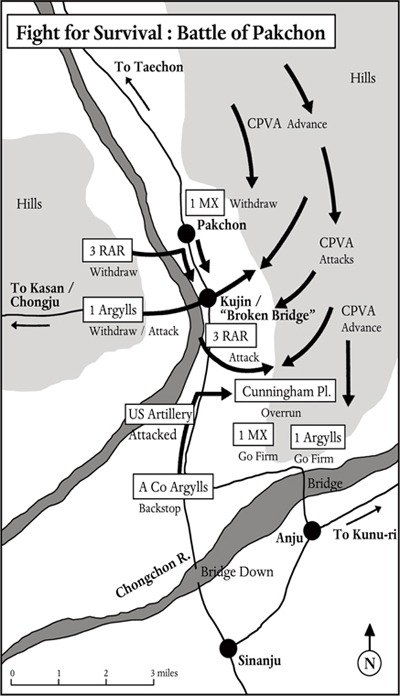
By 16:00, the brigade was redeployed around Pakchon. The Taeryong crossings they were covering were the ford at Pakchon, and 2,000 yards further south, the broken bridge at Kujin, where 3 RAR had fought on 25–26 October. The Middlesex held an arc north and east of Pakchon; the Argylls and 3 RAR covered approaches to the bridges on the west bank. The Shermans of 89th Tank Battalion and the 105mm guns of the US 61st Artillery Battalion were leaguered south of Pakchon, east of the river.
27th Brigade now came under ‘Taskforce Davidson’ named for the deputy commander of the US 24th Infantry Division, Brigadier Garrison Davidson. This was unsatisfactory to Coad: taskforce commanders lacked command and control infrastructure. ‘The Americans used taskforces quite a lot,’ the brigadier noted. ‘My experience was they are mostly unsatisfactory, and practically always disastrous.’ A six-mile gap yawned between 27th Brigade and Davidson’s 19th RCT to the east. Coad asked Davidson to position a battalion on high ground between the two units. ‘He said he would try, but never did,’ Coad wrote.34
Coad’s position was precarious. Over half of his brigade was deployed west of the Taeryong, yet every indication was that an attack would come from the north or east. Moreover, the brigade had the Chongchon, behind it, 6 miles south. ‘The position was an extremely bad one and asking for envelopment,’ Coad wrote.35 As insurance, Wilson’s A Company was deployed as backstop, securing 27th Brigade’s rear.
By 01:00 on 4 November, the last US units had pulled back through 27th Brigade from north and west.36 Coad’s men were anchoring the left flank of the entire 8th Army. The fourth was quiet, but an unsettling battle indicator was the swarm of refugees fleeing across the Chongchon: some 20,000 crossed in two days.37 After dark, combat was heard in the east: ‘We saw a lot of fireworks,’ said Captain Reggie Jeffes at Brigade HQ. ‘They were obviously being heavily attacked.’ One of 19th RCT’s battalions abandoned its equipment and vehicles, and fled across the Chongchon. 27th Brigade’s right flank yawned open.
* * *
At 09:00 on 5 November, the Middlesex, deployed furthest north, had been warned to prepare for ‘any eventuality’.38 It was not long in coming. Shipster was huddling with his C Company in a dried riverbed when his CSM pointed eastward. ‘I looked over and there was a seemingly endless column of Chinese passing us about half a mile away, all with their headdress spiked with cut-down branches, and their uniforms spiked with vegetation,’ recalled Shipster. He was reminded of Shakespeare’s line that sealed the doom of Macbeth: Fear not, till Birnham wood./Do come to Dunsinane. ‘The only thing was to sit tight,’ the major said. ‘I don’t know how many thousands were in that column, it seemed endless, it was part of the main Chinese army moving southwards.’
Argylls, too, were learning the gravity of the situation. ‘There was something wrong because these huge mortar bombs – much bigger than North Korean mortars – were landing in front of our positions: You hear a wsssssh, then a crump, then frost flies up,’ said Argyll Corporal Harry Young. ‘At that stage, we noticed a lot of movement behind us.’ Robert Searle was with the Argyll mortars not with Wilson’s force when fire orders came. The direction was ominous: ‘We were firing back the way we had to go.’ A sergeant major doubled past Corporal Richard Peet’s section: ‘Conserve your ammunition!’ he advised. ‘We’re surrounded!’
For Coad, assimilating reports of enemy and learning of the plight of the US artillery in his rear, ‘the anticipated had obviously happened’: Enemy were striking deep into his echelon, through hills to the east. ‘It was now obvious that the Chinese were in strength behind us,’ the brigadier fretted. ‘Air reported an entire division.’39
Coad called Davidson – mercifully, rear phone lines had not yet been cut – requesting orders. ‘He had no idea at all,’ Coad wrote. ‘He left it to me to do the best I thought.’40 Coad made a fast decision. 27th Brigade would redeploy south, seizing high ground overlooking the Chongchon crossing. He could count on no assistance from US ground forces: A brigade ration truck driver was at 24th Division HQ where an American general* told him, ‘We think the world of your brigade and wish them luck!’41
To reach the Chongchon, the Argylls and Australians would have to cross east over the Taeryong; the Middlesex would march south. Coad’s plan was in three phases. 3 RAR would attack southeast of the Argylls and go firm on high ground to the east of the road,screening it. The Middlesex would then pass south through 3 RAR, take the hills overlooking the Chonchon and dig in. Finally, the Argylls would pass behind both battalions and hold the Chongchon crossing at Anju. 27th Brigade’s rat-run was a single track across the paddies east of the Taeryong.
HQs were all business. At brigade, Lieutenant Peter Baldwin and his signals troops hurriedly packed. ‘We were due to bug out, we knew we were having to pass through the enemy and the camp commandant called everyone together and gave a great lecture about the traditions of the British Army and don’t let comrades down,’ he recalled. A fellow signals officer cursed; the speech had put the fear of God into the HQ personnel. At the Middlesex Battalion HQ, Padre Jones arrived for his Sunday service. ‘Keep away from us, Padre,’ an officer snarled. ‘There is enough trouble without you as well!’42 Radios crackled. NCOs bawled orders. Soldiers buckled on gear. Vehicle engines coughed into life.
27th Brigade was in a race for survival: A 6-mile fight past or over any enemy in its path. If the Chinese halted them or beat them to the Chongchon crossing, they would be cut off from their rear, surrounded and destroyed. To hold open the road behind his battalions, all Coad had was David Wilson’s scratch force.
* * *
Wilson’s little battlegroup – four US Shermans, two platoons of Jocks, including carriers with two mortars and machine guns, the major himself in his Land Rover – rolled north for the battle smoke, reaching a situation reminiscent, Wilson thought, ‘Of older and better days’: C Battery of the US 61st Artillery had formed their six guns into a semi-circle and were firing point-blank into Chinese who had infiltrated under cover of paddy bunds. ‘As men of the guns were hit, other men would come forward to take their place,’ Wilson noted. ‘A most inspiring sight!’43 Lacking anti-personnel rounds, the howitzers were shooting down, bouncing their shells off frozen paddies into enemy just 30 yards away; this unusual method explained, presumably, why Wilson had heard no firing.
The Shermans buttoned up and rolled forward, turrets swivelling for targets. Jocks dropped from their hulls, deploying into skirmish lines. The dry paddies around the battery came suddenly alive: Enemy, realising they were being counter-attacked, broke cover. ‘Gooks started up like quails or partridges, in all directions,’ Wilson noted. ‘Excellent shooting was had over the LMGs and 3-inch mortars. At the same time, the four tanks were having excellent practice at Gooks moving north along the railway line to Pakchon.’ In twenty minutes, the battery position was cleared.44 The artillery was secure, but had fired most of their ammunition.* The question was now how to hold open the road. ‘I was told, “for God’s sake, hang on where you are!”’ Wilson recalled. Some 800 yards to the east, a low range of hills dominated the track. Wilson ordered Second Lieutenant Ted Cunningham’s platoon to seize a key hill, while he deployed the rest of his force along the road.
Henry ‘Chick’ Cochrane was with the mortar half-section. ‘Major Wilson came along – he was mad! – and said, “Jock, there’s Gooks up there! Put a couple of mortar bombs on top!” I said, “Right ye are!”’ Cochrane’s crew dropped bombs into the mouths of their tubes. The bombs thunked up and out. Seconds later, puffs of black smoke erupted on the low, brown hill. With the barrage on target, the mortar men began walking explosions along the ridge.
Cunningham’s platoon skirmished eastward, two sections moving, a third firing cover. Crunching over the frosted paddies was Gurr. ‘Bullets were buzzing around and hitting the ground round about,’ he said. ‘It was pretty nerve racking.’ He could not see who was shooting at him, but the marksman vacated as the Jocks closed. The hill was taken without casualties. Cunningham deployed his three sections – not nearly enough men to cover the position – into a fragile perimeter. The summit was bare but heavy scrub and pines covered the slopes.
From the hill, enemy movement was plainly visible, 300, 400 yards to the east. ‘I said to my mate, “I think the Chinese have pulled us into a trap,”’ Gurr said. He was deeply uneasy: He had fought North Koreans, but there seemed to be many, many more Chinese. Then movement ceased; the swarm of brown uniforms vanished. Gurr relaxed. ‘We thought that was that,’ he said.
It was approximately 10:30.45
* * *
While Wilson was attacking from the south to pinch out the enemy force in the brigade’s rear, Neilson ordered his remaining two companies to head east over the Taeryong – across the ‘Broken Bridge’ 3 RAR had fought for a week earlier – and attack from the north. B Company clambered across first. Rounds cracked overhead. Major Alastair Gordon-Ingram, who had survived Point 282 and Sariwon, went down, a sniper bullet through his shoulder. Doctor Douglas Haldane evacuated him by light US aircraft that landed on the dirt road.
B Company, across by 10:00, advanced on an enemy-occupied hamlet. Captain Colin Mitchell led a platoon, as Argylls ‘pepper potted’ forward – one man firing, the other manoeuvring – a style of advance that confuses defenders, granting no clear targets. The attack took its objective; in the settlement, sprawled some twenty enemy dead. As his Argylls consolidated, Mitchell kicked one body over to take a look. It opened an eye. Mitchell fired with his Luger, roaring, ‘They’re alive!’ Argylls shot down into the ‘corpses’. It was over in seconds. The Chinese had been playing dead, waiting to be bypassed, so that they could take the Jocks from behind.46 The dead were rechecked. An officer picked up one Chinese by his belt. The man was hit in the stomach: Undigested rice spilled out of his belly.47 B Company exploited eastwards another mile, taking up positions behind a prominent paddy bund, covering the road so vehicles could pass safely southward.
A Company had saved the American artillery from the south. B Company had attacked north of it and gone firm. C Company was crossing the Taeryong. The situation in the Argyll sector seemed stabilised – then reports of a fresh emergency arrived. Slim was at Tac HQ when Wilson came over the radio. The major kept a cheerful face in front of his Jocks, but did not hold back from higher ups. ‘He was saying, “Come and help me!”’ Slim recalled. Wilson needed it. At 11:00, Cunningham’s lone platoon, on the hill dominating the brigade’s line of withdrawal to the south, had been overrun.
* * *
‘Overrun’. The word itself cannot convey the terror it would hold for the men of the UNC in North Korea in 1950. What does it mean in actuality?
‘You felt really exposed, there was a feeling of isolation,’ said Cunningham, on his thinly held hilltop. ‘And you had not met the Chinese in battle before, you had no idea how they went about things.’ The teenage subaltern was about to find out.
Gurr, who had thought the Chinese had retreated, was on one knee in Cunningham’s forward, eastward-facing ten-man section, peering into the distance when things happened with heart-stopping suddenness: An enemy emerged from scrub directly in front of Gurr. ‘He was on top of me – right on top of me! – I could have put my hand out and touched him,’ Gurr said. There was no space even to raise his rifle to fire. ‘I thought, “This is it, I’ve had it!”’ The enemy fired his burp gun – bullets passed between Gurr’s legs – the barrel rose – a round tore into Gurr’s thigh with the force of a hammer strike – another went through his thumb. Beside Gurr was fellow Argyll John Meighan. A Chinese rammed his bayonet into his chest – Meighan raised his rifle, fired – the man jolted back, dead – another enemy dashed past, shooting. Meighan was shot through the wrist. The force of the bullet – possibly a dum-dum – splintered the bones. Meighan lost consciousness.48 More Chinese surged over Gurr; he played dead. He could hear intense gunfire and a sound UNC soldiers would come to dread: the discordant notes of a bugle. The Chinese had leveraged their excellent fieldcraft to close up tight below the hill. Their earlier disappearance had not been a retreat; they had ducked behind paddy bunds and crawled alongside them. Making dead ground at the bottom of the hill, they had infiltrated through ground scrub.
In the centre of his platoon, Cunningham’s first indication of action had been automatic fire hammering from his forward section over the crest. Then he saw the shadows flitting through the scrub and pines all around. ‘We had a perimeter but they were coming round the contours on three sides of us,’ Cunningham said. ‘There seemed an awful lot.’ As his CP was engulfed in chaos, Cunningham’s stress levels went hyper. He was speaking on the radio to Wilson – Wilson urged him to hang on, the hill was critical – while trying to keep a grip on events all around, redeploying men from his rear section to the forward sections. Individual gunshots coalesced into a relentless crackle. Intra-platoon communication was by shouting.
Bullets kicked up dust. Argylls tumbled. ‘Suddenly, our numbers dropped,’ Cunningham said ‘We were losing a lot of men, we were being decimated.’ His sergeant was hit in the head. ‘He fell on top of me, it was one of the most unpleasant experiences … ghastly, blood everywhere … I would not wish anyone to have to hold somebody who’s had their head blasted away.’
Below, on the road, the mortar section heard disaster unfold. ‘All I heard was shouting through the wireless, “Five rounds rapid!” in a sort of a panicked voice,’ recalled Cochrane. ‘The last words were screaming for mortar fire.’
The platoon was finished. ‘They came over the top, they were in among us, it was the end,’ Cunningham said. ‘I told people to get out, then I got myself out as fast as I bloody well could.’ Scrambling and weaving down the western slope, bursts whipped over his head as Chinese shot down. ‘The firing was gratuitous,’ he said. ‘The noise of it, the pinging, was like a cowboy film.’ At the base of the hill, stunned survivors tumbled into a ditch in dead ground, out of sight of enemy above. In mere minutes, the thirty-strong platoon had lost five killed, six wounded.49
On the hill, Gurr lay still. The bullet in his thigh stung; the top of his thumb dangled from a flap of raw flesh. Chinese were consolidating. A few feet away, a wounded Argyll sang ‘God Save the King’. ‘I think he was delirious,’ Gurr said. He hissed: ‘For God’s sake! Play dead!’ The singing soon stopped; the man had died. A Chinese soldier approached and stood over Gurr. Terrified, the Argyll froze as the man kicked him over and started rummaging through his pockets. Gurr was carrying a fountain pen, a birthday present. The enemy removed it, examined it, then – noting that the Scotsman lived – replaced it, motioning at him to place his hands on his head and lie still. Gurr did so. The soldier left.
Another burst – probably from a Chinese who had spotted movement and fired instinctively – tore into Gurr. One round grazed his head, another ploughed into his shoulder, another his chest. Riddled; bleeding out from five bullet wounds; the Scotsman’s pain numbed in the chill air. Consciousness slipped away.
* * *
South of the Argyll B and C Companies were 3 RAR. Unlike the Argylls and Middlesex, who had seen the enemy numbers beyond Taechon, 3 RAR, the last battalion to retire from the west, had not yet met any Chinese. Diggers had been infuriated by the 2 November order to evacuate Chongju, the town they had fought for where Lieutenant Colonel Green had been killed. ‘We were shocked, we were not used to this,’ said Sergeant Tom Muggleton. ‘You stood your ground!’
Now, on 5 November, they were retreating again, but action was clearly imminent for it was Sunday, and the battalion had been in action on the three previous Sundays, at Apple Orchard, Broken Bridge and Chongju.50 The battalion crossed the Taeryong without resistance at 11:30 and mounted US trucks, which began heading south. As they rattled toward the Argyll mortars on the road, they came under fire from the east.
The mortar men, having heard Cunningham’s platoon being overrun, now saw enemy skirmishers heading for them. ‘I said to the bloke on my right, “Take the mortar sights off, wait till they are within 100 yards, then dump it in the water and I will see you in Pusan!”’ Cochrane recalled. He was relieved to see approaching Diggers. ‘These Aussies came and said, “Alright Jock?” and we said, “Yes, but no ammo!”’ The Australians, setting up their own mortars, handed over a few cases. ‘The party was going to start!’ reckoned Captain Ben O’Dowd.
Massive air attacks had been laid on. For the first time in support of 3 RAR, this included the elite Mustang pilots of Australia’s 77 Squadron. An ACT turned their radio volume to maximum. ‘You could hear the pilots saying, “There he is, get that bastard on the left!”’ said Sergeant Reg Bandy. ‘It was like being at the pictures!’ Huge clouds of smoke and dust billowed over the hills as rockets and napalm did their work.
3 RAR would attack eastward and retake the hill lost by Cunningham’s platoon. In this, his first action, Lieutenant Colonel Floyd Walsh deployed two companies – A on the left, B on the right. Diggers dismounted, shook out into extended line, fixed their long bayonets and waited. Walsh radioed Coad. ‘When you want me to launch the attack, I only have to press the button,’ he reported. ‘Well, press the bloody thing!’ the brigadier snapped.51 The attack was on. It was 14:00.
With their objective some 800 yards across open ground, the long line strode forward, each man spaced at least 10 feet from the next to minimise the effect of enemy automatics. ‘We were not told how serious the situation was, it was just another big attack,’ said A Company Private Mick Servos, who had so enjoyed earlier combat. The line came under fire immediately. ‘A machine gun nest was on the hill firing at us, I could see him firing, see bullets landing,’ Servos said. Bursts were hitting just ahead of the advancing line; Servos watched spurts of dust arrowing towards him from the right as the gunner swivelled. ‘I thought I had better jump – then it felt like the wind had picked up a house and the house had hit me.’ He collapsed. Five rounds had punched right through his thigh. ‘I almost got a DSO – dick shot off!’ he said. ‘I was lucky, it shot all the muscle out of my leg, but did not hit bone.’
Other men were falling. Next to Private Stan Connelly in B Company, the company clerk went down. ‘His head exploded like a watermelon, he dropped dead beside me,’ Connelly said. ‘This upset me, but the attack had to go on.’ The Diggers could not lose momentum to care for casualties. Wounded and dead lay behind in the paddy.
Mortars Lieutenant Phillip Bennett, the victor in the grenade-pistol duel in one of the Diggers’ first actions, watched keenly. ‘We could see our fire going where it was being asked for, on the enemy side of the hills,’ he said. ‘You see lots of bursting ammunition, clouds of dust, smoke and God knows what – pretty good for morale!’ Once the companies entered scrub at the hill’s base, he lost visual.
Another officer had a uniquely privileged perspective. ‘The Aussies attacked – a full battalion attack!’ said Cunningham, at the foot of the hill. ‘One was amazed that they were doing this with the fire coming off the hill, it was awesome – a lot of people, the full monty! – I was in a position that you would never see it from unless you were enemy.’
Diggers passed through Cunningham’s clutch of Argylls and ascended. Connelly, hefting a Bren, was exhausted as he approached the crest, but joined the final charge. ‘We surged up,’ he said. ‘I saw a couple of enemy, threw the Bren up on my shoulder and fired from there, using it like a rifle.’ The Chinese had watched the big Australians stride through their machine gun fire; as they closed for the kill, the enemy broke. ‘We could see their backs and were picking them off as they went,’ Connelly said. Now, the Chinese were overrun.
The firefight jolted Gurr back to consciousness. ‘Aussies were coming up the hill, bayonets fixed, throwing phosphorous grenades,’ he said. Blood-spattered from five wounds, shaven headed and slight in stature – like a Chinese – Gurr was mistaken for enemy. An Australian levelled his bayonet and charged. ‘I yelled, “I am an Argyll!”’ he said. He was recognised. Lying nearby was the wounded Meighan. As he was being tended to by two Australians, a Chinese leapt from cover, aimed at the three soldiers and pulled the trigger of his burp gun. Click. The enemy, with an empty magazine or a stoppage, froze, helpless. Lieutenant Noel ‘Chick’ Charlesworth, the platoon commander, took aim and pulled his own trigger. Click. The officer’s magazine was also empty. The Chinese fled.*52
The position was secure by 15:00, the survivors’ ordeal over.53 ‘I was glad to be alive,’ said Gurr.* Among the Diggers’ dead was Lieutenant Eric Larson, who had led the vanguard over ‘Broken Bridge’. On the hilltop, men began digging in immediately, including D Company on an adjacent ridge. The effect of the napalm attacks – ‘heat treatment’ in Digger parlance – was appalling. Private Len Opie found a Chinese with his arm burned off; Opie grabbed him to hurl him into a pit and his arm came off, ‘… so I achieved what very few people had, I beat him over his head with his own arm.’ C Company and Battalion HQ dug in on the low ground, holding the road.
Fire continued to come in. ‘We had one bloke, on the skyline like a ballerina, he said, “I can see them,” then he said, “I’ve been shot!”’ recalled John ‘Lofty’ Portener. ‘He dropped his tweeds, he’d been shot through the scrotum, we could see a white testes. We bandaged the bastard up, we used a towel – just the bag was torn! It was a bit of a laugh.’
Crumps and explosions of dirt began walking along the ridges: The Chinese were using mortars. A Company’s CP took a direct hit, its forceful commander, Bill Chitts being severely wounded in the legs – a development that would have serious consequences. Argylls and Diggers helped wounded down the slopes.
In the paddy, Servos, his thigh bleeding heavily, lay helpless. ‘I’d got left,’ he said. ‘High and dry.’ It was late afternoon when two walking wounded spotted him and lifted him. The three supported each other, hobbling toward the road, when a tank approached from the north. One of the walking wounded said, ‘If that’s an enemy tank, we’re finished!’ It was a Sherman.
The commander leaned out of his turret and invited the three bloodied Diggers aboard, warning them to hang on. ‘There’s a roadblock ahead!’ he said, ‘I’m gonna knock through and shoot shit out of it!’ Pockets of enemy were scattered all along the east side of the road; the Australians clambered behind the right of the turret. All were in a bad way: Servos’ damaged leg was agony, the second man’s hand ‘was hanging off’, while the third’s arm ‘looked like a butcher’s shop’. The engine revved and the Sherman barrelled down the track, dust blasting up behind. The Diggers clung to the vibrating hull. As the tank passed enemy shooting from the side of the road – a fire block, not a roadblock – its turret rotated left and it let rip with its heavy machine guns. Then they were past.
Up in the hills as afternoon faded, two Diggers probed forward of B Company. ‘One guy, Ron Tully, said, “Come with me, I want to get some souvenirs” – he wanted pistols or something,’ recalled Connelly. The two walked cautiously to the forward edge of the feature where a re-entrant was packed with dead Chinese ‘lined up almost head-to-toe’. Connelly was apprehensive, but Tully went down among them and was busily searching the first ‘body’ – when it produced a grenade. ‘I don’t know if it was to commit hara-kiri or to get Tully, but he failed to throw it,’ said Connelly. ‘It exploded and spattered Tully with his brains.’ The two dashed back inside the perimeter. Tully ‘went to pieces,’ and Connelly was rattled. Was the pile of enemy actually dead, he wondered, or were they lying doggo, to rise and attack after dusk?
* * *
While the Diggers took the high ground, the rest of the brigade, to the north, had been moving. Second Lieutenant Alan Lauder, with the Argylls’ C Company, was leading his platoon eastward over the broken bridge where a US officer greeted them grimly with, ‘The shit’s hit the fan!’ Jocks burst into laughter. The American was astounded by their amusement, but it was his phrase: No Argyll had ever heard it before.
Laughter dried up when Argylls, high up on the bridge, got their first look at the battlefield. ‘We began to see enemy, they appeared to be in vast numbers swarming all over the hills within half a mile, like ants,’ Lauder recalled. With a lurch, he realised that what was happening was contrary to all experience in Korea thus far. ‘This was the first time we’d seen a large body of enemy coming toward us rather than running away.’
C Company joined B in its holding position east of the road. ‘We were told to stand and hold at all costs,’ said Ron Yetman. ‘This was my worst time in Korea.’ As brigade vehicles passed behind the prone Argylls, something started to happen on the high ground. ‘All the bushes across the valley on the hill opposite started moving,’ said Yetman. ‘I didn’t believe my eyes! There were hordes of them, and just two companies of Argylls!’ Even the ferocious Mitchell wondered if the end had come: The Argylls were now, ‘a thin red line indeed’.54
Evening the odds, was the unprecedented pounding from the air. Lauder watched astonished as Australian Mustangs, flying at almost zero feet, raced under power cables in strafing runs on the ridges.
The Middlesex had been alerted to move at 12:50, but had not started until 14:00.55 ‘We received orders to concentrate on the main road as quickly as possible. A truck company arrived … with them were three US liaison officers, who, having decided that the time had come to rejoin their formation south of the Chongchon, had run into a roadblock blocking the escape route, and brought us news that we were cut off,’ wrote Major John Willoughby. ‘However, come what may, we had to occupy those formidable hills overlooking the river crossing before the Chinese got there.’56
Jammed together on trucks, the battalion headed south through Pakchon’s ruined streets, before emerging into open country. ‘I thought, “Peking here were come!”’ recalled Frank Whitehouse. Every man knew this was a different kind of battle to previous experience. ‘You were not fighting for king and country,’ Beverly said. ‘You were fighting to stay alive.’
Skirmishes erupted along the roadside as Diehard dismounts fought past pockets of enemy. ‘We were told to head for a point down the road, so we fixed bayonets and marched down,’ Corporal Bob Yerby said. ‘Anyone who popped up we shot at them, there were bullets whistling over your head.’ Dead enemy were passed. ‘We just kicked them to one side and carried on; we had to get out.’ It was clear the Chinese meant business. ‘They were not going to turn and run, they were going to fight,’ Yerby reckoned. ‘Your hearingintensified, your nerves intensified tenfold; something big was happening all around us.’
As the Middlesex bore down on 3 RAR, the Diggers were attacking eastward, their Vickers and mortars beside the road shooting cover. ‘We drove through this attack at right angles, through the dust and smoke,’ wrote Willoughby, whose D Company were leading. ‘Machine guns were obligingly holding their fire while we passed in front of them.’57
The Middlesex continued until they reached their objective southeast of 3 RAR: the ridge overlooking the Chongchon. As Diehards debussed preparatory to attacking upward, Willoughby ordered his CSM to keep the trucks nearby for any eventuality. The NCO obliged, threatening to shoot any driver who left without orders. As his men took up assault positions, Willoughby scanned his objective through binoculars. He could see figures, apparently wearing Australian slouch hats, waving at the Diehards to come up. However, they were running. ‘Australians never walk or run, they stride across anything,’ Willoughby thought. Focusing in, he saw they were Chinese: Twigs in their headgear for top camouflage stuck out horizontally.58
A US FOO arrived, and the hills fountained up as his barrage landed. Middlesex advanced upward. Their objective was taken without fighting; seven enemy lay dead on the ridge. Diehards dug in. Thanks to US transport and firepower, Man’s men had beaten the Chinese to the ridge.
At 15:00, relieved Argylls watching the camouflaged enemy mass in motion to the east, got orders to head south, B Company on trucks, C on tanks. ‘It was almost like hitching a lift,’ recalled Haldane. ‘Get me back!’ Neilson’s Jocks passed behind the Middlesex, and dug in on the hills directly opposite the crossings over the Chongchon River at Anju. Along with brigade administrative elements, the US 61st Artillery crossed south over the river and set up their guns facing north.
By nightfall, 27th Brigade had given up the Taeryong, but was holding a three-mile bridgehead north of the Chongchon. The Argylls were on the east of the line, the Middlesex in the centre and 3 RAR to the west, a mile north of the other battalions. The Battle of Pakchon had been a touch-and-go series of fast moves and repeated crises: ‘An exciting enough day for anyone,’ Coad noted dryly.59 ‘The Brigade today, by forceful action, extricated itself from a difficult position,’ the War Diarist wrote with understatement. Demolitions equipment was discovered on dead Chinese; they had been planning to blow the bridge, trapping the brigade.60 This realisation prompted some unpleasant business at the crossing. ‘Civilian casualties came down the road that night, a lot had been hit in cross-fire, and blood was dripping from their hand carts,’ said Captain Reggie Jeffes. ‘Of course, you had to inspect every one very carefully because the Chinese were quite likely to try and get through this way.’
And 5 November 1950, was not yet over.
* * *
The western slopes of the low ridgeline the Australians were occupying were bathed in the orange glare as the sun dissolved in the Yellow Sea. ‘I don’t want to see that old sun go down,’ sang Gallaway as he hacked into frozen ground at Battalion HQ. His sentiment was shared by many. A, B and D Companies were on high ground. C Company was astride the road covering Support Company and Battalion HQ.
To the northeast, the mountains turned purple as darkness fell. Bugles sounded in the east: enemy companies were manoeuvering. Mortar flashes lit up the Diggers’ positions. Firing began crackling along the ridges.
3 RAR’s mortars – firing rapidly in response to DF requests – had been set up near Battalion HQ. Chinese counter-mortar fire, seeking them, now began to impact around Battalion HQ. Walsh ordered O’Dowd to relocate the headquarters 1,000 yards south. This was a significant movement, at night, and would necessitate the loss of telephone lines to the rifle companies. O’Dowd protested. Walsh insisted. Listening in on the net, Coad permitted the withdrawal of Battalion HQ, but insisted the rifle companies stay put. The operation – requiring the striking of tents and loading of vehicles with equipment – to an undefined location, in the dark, under enemy fire, proved chaotic.
Then at 20:00, Walsh ordered the rifle companies to withdraw.
‘We had just got it under control, when the CO gives orders to move back half a mile,’ Bandy said. ‘Everybody was pissed off, we knew it was stupid.’ Gallaway heard it all happen. ‘We knew from radio traffic that something bad was going on, we could hear officers arguing, Major Wally Brown abused Colonel Walsh whole-heartedly, he was not pleased with life at D Company,’ Gallaway remembered. ‘When we got orders to pull out we were down that road like Brown’s cows, it was black dark, we didn’t know what was going on.’ Walsh’s decision was extraordinary. His companies were in contact, they had no clear rear areas to head for, there were no timings, no planning data.61 In his first battle, 3 RAR’s new CO had lost his nerve.
B and D Companies were commanded by veterans: In firm positions, neither obeyed Walsh’s order immediately. C Company, on the road, under the tight control of ‘Armour Piercing Archie’ Denness complied. ‘We were in some strife,’ recalled Lieutenant David Butler, whose platoon had cleared the ‘Apple Orchard’. Enemy probed towards the company from the west, trying to make the Australians give away their position. Denness’ men held their fire. Then a heavy machine gun let loose from across the river. A .50 calibre machine gun can shoot down an aircraft or demolish a brick building; Butler found being under its arcing tracers, ‘Very, very uncomfortable.’ When the command came to break contact, Butler was too busy to be frightened: He had to make sure all his men were with him during the withdrawal. In silence, the company moved down the road in single file toward the supposed location of Battalion HQ, every man primed to utter the password, ‘Acid Bath’ when challenged.
It was A Company, on the left flank, who would suffer the worst for Chitts, wounded, had passed command to an inexperienced 22-year-old, Lieutenant Algy Clark. Clark’s orders over the radio were to regroup on the road, where he would be met by Walsh. Clark’s training told him that withdrawal in contact requires units to be thinned out, check points established in rear, and an RV established. None were apparent, but he obeyed. As Clark was planning the move, Chinese assaulted his CP. Two privates were shot, his CSM killed, a man lost his head to a grenade, and Clark took shrapnel in the face. Control disintegrated.62
Among A Company was Don Woods, a Vickers gunner from Tasmania who had joined the Army after hearing what a cushy posting Japan was. Earlier, as the enemy stormed up, he had been firing into Chinese – visible in his muzzle flash – from about 15 feet: ‘They were close, you could see the whites of their eyes!’ he recalled. One Digger nearby was bayoneted in his foxhole, but Woods’ position seemed to be holding. Then things went wrong. The machine gunners heard movement from slopes above and behind them. ‘We said, “It’s A Company!”’ but it was not: A shower of stick grenades landed among the two machine guns. Woods was lifted by blast – shrapnel thudded into his thigh. Amid the company’s disorderly withdrawal, enemy had infiltrated above them. ‘We were left on our own,’ Woods said. ‘There was a breakdown in comms, it was bloody frightening – we knew we had to get out.’ The gunners feverishly whipped the locks out of their weapons, disabling them. Woods, in pain but mobile, hurled a grenade behind him to slow down pursuit as they set off. Other men did the same: their withdrawal was covered by the detonations. One Digger, badly wounded by shrapnel, was dragged along by his webbing. Woods snap shot at shadows. In darkness, in utter confusion, surrounded by enemy, he wondered if he would see his family again. The group reached level ground. Ahead, they heard an unmistakable clanking, and moving lights. It was an American tank on the road. The survivors climbed aboard, and were carried south to Battalion HQ.
Charlesworth, meanwhile, had ordered his platoon back and was counting men through when he reached thirty-five; he was counting enemy. He shouted a warning to his Diggers and opened fire. Then he too came under fire from the abandoned high ground. His platoon broke up; small groups of men fought their way along to B Company or down to the road.63 Clark, wounded but still effective, was leading survivors of Company HQ through the darkness. Shadowy enemy were blundering around everywhere, but seemed as disorganised as the Diggers. ‘By acting boldly and confidently’, Clark discovered that enemy avoided his group. He led his men south.64
By the early hours, only D Company was in position. The remaining companies were, in Butler’s words, ‘in a blob’, on the low ground, locations unknown to Battalion HQ. An enemy attack to finish off 3 RAR seemed inevitable. From the dark hills echoed a haunting sound: A bugler piping ‘The Last Post’. Men wondered if it was a wounded Argyll or Digger left behind.*65
Coad learned of Walsh’s disastrous conduct in person. ‘Bruce Ferguson arrived at Brigade HQ with another officer to complain and say the battalion was in chaos,’ recalled Reggie Jeffes. Shocked, Coad ordered the Middlesex to establish roadblocks to their west in case of an enemy breakthrough. This was done. The Diehards were not under attack, but were tense. ‘During the night the Americans had obviously bought a great deal of artillery to positions south of the river,’ recalled Willoughby. ‘The noise of shells passing overhead was continuous.’66
Dawn. A chill mist wreathed the frosted countryside. All lay eerily silent. Coad drove straight for 3 RAR to see for himself what had happened. In the shambolic Battalion HQ, wounded were being treated; a medic plucked shrapnel from Woods’ leg with pliers. The brigadier bumped into O’Dowd. Shoving a map in front of him, Coad asked the captain where the rifle companies were. O’Dowd had no idea. Coad stabbed his finger on the map, telling O’Dowd exactly where he wanted them deployed. Then he drove off to locate Walsh.
Sergeant Tom Muggleton was nearby when the two met. ‘I didn’t know why Brigadier Coad was there,’ said Muggleton, who sensing the imminence of something dramatic, made himself scarce. ‘I was hiding in a bush and there was a lot of hand-waving going on.’ Muggleton did not overhear what was said, but the result of the meeting was summed up by 3 RAR’s War Diarist. ‘Lieutenant Colonel F.S. Walsh was re-posted to the Australian Operational Research Team attached to 8th Army Headquarters.’ Coad had sacked him on the spot.
It was a dicey thing for a British brigadier to do to an Australian colonel in mid-battle, but no Digger complained. ‘We never liked Walsh, we didn’t think he was competent,’ said Muggleton. ‘All the decisions he made were wrong.’ ‘That night was not the best effort of the battalion,’ agreed Bennett. ‘But it was the entire responsibility of the CO who didn’t have the strength of character to handle it.’ In Walsh’s place was appointed an officer who was, in Bennett’s opinion, ‘A man’s man and a soldier’s soldier’: Second-in-command Major Bruce Ferguson.
Pakchon had been a bloody affair: Twelve Diggers had been killed, sixty-four wounded.67 A Company was decimated. With the Australians at their mercy, why had the Chinese not finished them?
* * *
Supported by Shermans, patrols advanced cautiously into the mist to answer this question. They found nobody. ‘The Chinese had disappeared, it was incredible,’ said Woods. ‘Our boys went back and got our machine guns.’ On 7 November, patrols probed further. Leading one, up a nameless valley and into nameless hills, was Cunningham.
‘My platoon were in front again – I don’t know why, because we were depleted,’ he said. ‘We were going across this paddy, and I remember watching this extraordinary barrage walking along this hill – puffs of smoke and earth flying up in a straight line.’ His luck had held on 5 November; now it would run out. ‘Suddenly, I found I could not walk,’ he said; an invisible impact had flung him violently to the ground. Wilson pelted over, took one look and stabbed him with a morphine syrette. Cunningham feeling no pain, looked down. ‘My legs had been shattered by shrapnel, they were at funny angles, I had a head wound, but could not know how bad that was, and I had stomach wound that looked very gory, there was a lot of blood,’ he said, ‘I was messed up, but didn’t know the implications.’ He went under, coming round in the brigade dressing station. There, he was thrust into a US ambulance that bumped off south over the Chongchon.
Cunningham and five of his ill-starred platoon had been wounded by mortar fire, but it was not an enemy bomb: it was a ‘drop short’ from their own battalion.68 The Chinese had broken contact completely.
All patrols discovered were bodies of enemy dead, some buried, others not. 3 RAR patrols skirmished and captured three North Koreans, but there were no major engagements. The story was identical across the entire front. After a week of action, the Chinese had not simply disengaged, they had disappeared.* 27th Brigade had reacted effectively at Pakchon, but was fortunate to have been attacked on the final day of the enemy offensive.
The next twenty days remain the strangest period of the Korean War. Across the entire front, as cautious units retook terrain lost in the shock onslaught, fighting dwindled away to patrol skirmishes. 27th Brigade advanced in line with ROK and US troops, who the brigade sometimes found slow in keeping up – a big change from the lightning charges of October.
The Brigade War Diary captures these operations. 9 November:
The day was quiet in the Brigade sector. 11 November: Progress was held up and the ROKs did not appear to be getting on … [1st Cav] were reported to be advancing, but were not up to the line by the end of the day. 13 November: Apart from patrolling, no other operation was carried out today. 16 November: Advances carried out along the whole divisional front with no opposition reported.
They were strange days. To the northeast, magnificent mountains faded into the blue distance; in the foreground, the landscape bore the imprint of war. Beside bare paddies lay charred villages. Here and there sat trackless tanks and trucks, stationary beside the road, telling the story of the earlier retreat. Bridges and viaducts were twisted, broken skeletons. And everywhere lay death. Digger patrols came across atrocities: men and women with their hands wired together and shot.69 Encased in ice on the edge of the Chongchon, a civilian body lay frozen near the riverbank, ignored by all.70
Far above could be seen one of the twentieth century’s most apocalyptic spectacles. Trailing long, white vapour trails across the icy blue sky were massed formations of glinting silver crosses: B29 Superfortresses, heading for the Yalu Bridges.71 On 8 November, Sinuiju, the border town was visited by 77 B29s. Two thirds of the city was devastated.72 MacArthur, his confident prediction that the Chinese could not intervene disproven, was upping the ante.
Wounded were treated. Servos and Gurr made it to a US MASH. ‘It was well organised, on the go, lots of wounded coming in,’ said Gurr. ‘There was shouting and some screaming, people in agony,’ recalled Servos. A minor operation was performed on his leg, and it was drained. Then he was flown to Japan, as was Gurr. All his bullets were removed, but for one in his chest.
The mangled Cunningham, in a morphine daze, spent two days bumping south in an ambulance before being flown out. In Osaka, a decision was made on the youth’s legs. ‘They thought that if they amputated one, they would have a better chance of saving the other,’ he said. ‘A lot of people would have advocated a double, so I said almost casually, “You’d better do it, and do your best on the other one.”’ The operation was carried out, but Cunningham was not sorry for himself. ‘The deepest feeling was the disappointment of not being able to hold the hill,’ he said. ‘And I seem to have lost a lot of people I’d got to know.’ He was moved to the British hospital at Kure in preparation for a long rehabilitation.
Back at Brigade, a disappointment was overcome. After the announcement of an imminent return to Hong Kong in Chongju two weeks previously, it had been rumoured that 10 November would mark relief day. ‘In the morning, the colour sergeant said, “I want a list of how many people want to draw Hong Kong dollars on the boat,”’ recalled Lance Corporal Don Barrett. ‘At 12 o’clock they said, “It ain’t going to happen.”’ Following Chinese intervention, and at the suggestion of Air Vice Marshal Cecil Bourchier in Tokyo, the Imperial General Staff in London had agreed, on 6 November, that 27th Brigade would remain in theatre, regardless of 29th Brigade’s arrival.73 Willoughby broke the news to his company, moving from section to section. ‘They all took it marvellously, no complaints, a few wry smiles and silence thereafter,’ he wrote. ‘It is a bitter disappointment. Only ten days ago, we thought this war had been won.’74
Battered units were reinforced. O’Dowd took over the 3 RAR’s decimated A Company, ‘kidnapping’ Muggleton as his CSM. Among his reinforcements was the Australian Army’s first Aboriginal officer, Lieutenant Reg Saunders.
But there was no action. On 11 November, the Argylls commemorated a solemn Remembrance Day – every man had lost a recent comrade75 – and the RSM put the men through some foot drill, impressing a passing US colonel, who halted his jeep to watch.76Captain Robin Fairrie kept his Jocks amused, patrolling the riverbanks and bagging duck. ‘He had this shotgun which had been his grandfather’s,’ recalled MacKenzie. ‘Well, his bivvy caught fire and the shotgun got ruined, so he took it out, dug a hole and gave it a burial.’ Shipster’s C Company scattered corn kernels soaked in alcohol near the river; drunken pheasants were subsequently scooped up for the pot.77 Correspondent Harry Gordon and some Diggers went grenade fishing in the Taeryong; after C-rations, the stunned fish proved delicious. 3 RAR’s intelligence officer, Alf Argent, was startled when a British officer asked if he had bought a shotgun: The mountains, apparently, offered excellent bear hunting.
In the regimental journal, nameless Middlesex wags jotted down the terminology of the campaign for posterity:
Many enemies – Reported by all civilians. An uncertain number of possible enemy seen in an unspecified area at an unspecified time. The basis of all intelligence reports.
Patrols – Military excursions for the purpose of collecting firewood.
Prophylactic fire – Designed to give an operational atmosphere to an advance up an unoccupied valley.
Pinned down by fire – ‘Say! Was that a shot?’
Perimeter – To be held at all costs. Only to be abandoned if attacked.
Change of plan – An eventuality inseparable from any operation.
Situation fluid – ‘Hold on to your hats boys! Anything can happen!’
Fire for effect – This means any forward troops may expect to be shelled at any time from the rear.
Harassing fire – This is designed to keep friendly troops awake all night. It is no inconvenience to the enemy.
Let’s get the hell outta here! – Vide Chapt 1, Para 1, of the American Military Manual ‘Actions to be taken in the event of an emergency’.
Let ’em roll – Op. order for the advance. Only alternative to [previous].
Air support – A two-edged weapon.
The big picture – A nebulous panorama of the strategical situation, mainly derived from air survey.
Your difficulties are appreciated – ‘Sorry, we cannot help – carry on!’78
On 13 November, a gift arrived from Prime Minister Clement Attlee: A UN flag previously flown over Trafalgar Square. Coad planted it at Brigade HQ. Three days later, Brigade HQ established itself – for the third time – in Pakchon. By 17 November, the town was showing signs of normality as the populace began to reappear.79 In the mornings, women crouched on the Chongchon’s bank, doing the endless laundry.80
The first light snows had fallen on 12 November.81 ‘The joy was watching the Aussies when the first snow came,’ said Argyll Intelligence Officer Sandy Boswell. ‘They were like children, they’d never seen snow before, they leapt out of their trenches and had snowball fights and it was great to see these big tough fellows playing around like that.’ The snow did not set. Soon it would.
On the morning of the 14 November, Willoughby was sitting in his jeep eating ‘a miserable breakfast of cold beef stew’ when he registered an ominous, unidentifiable sound: ‘I gradually became aware of a distant, drawn-out moan.’ For microseconds he could not work out what it was, then he was buffeted by a freezing blast: ‘The most ghastly wind I have ever experienced descended upon us from the North.’ The morning temperature was a few degrees above freezing; it plunged 22 degrees in two hours. By noon, all food had frozen it its tins, water bottles solidified. Willoughby, eyes streaming, feared for his ears. ‘There was no escape; all our wintry yesterdays were gentle,’ he wrote. ‘Mother-in-law’s breath!’ cursed a passing Digger.82
The wolfish wind was carrying the Manchurian winter down the mountain passes. That day, a number of vehicles suffered cracked cylinder blocks and heads; British, US and captured Russian antifreeze all seemed ineffective.83 By now, most men were wearing jungle greens, British battledress and a US parka, but the cold was piercing. Soldiers, shivering uncontrollably, lined slit trenches with rice straw torn from paddy stooks and cottage roofs, and with quilts from looted homes.
By late November, most men were outfitted with US gear. ‘We got winter clothing – long johns, hoods, pile hats, pile jackets – jolly good,’ said Barrett. ‘The British contribution was a dish cloth about the size of a handkerchief, they said, “Tie it round your neck” but it didn’t reach!’ ‘You’d never recognise them as Scottish battalion,’ said Argyll Quartermaster Andrew Brown, who used his initiative to ensure his men got the best. After being offered a drink of medical alcohol by a US supply colonel he realised that the British had a valuable currency. ‘The military attaché from Japan arrived and I said, “If you could get a case of whiskey it would sort out a lot of problems!” The going rate for a bottle of whiskey was 100 pairs of slacks or 50 pairs of boots.’ But cold weather gear was not waterproof. On 17 November, rain fell, soaking men, who rapidly froze.84 On 25 November, 27th Brigade was assigned to Corps Reserve and moved into Pakchon. Thankful Diggers dubbed the move ‘Operation Defrost’.85
* * *
Amid these low-intensity operations, men reflected on their experiences. 27th Brigade had only been in North Korea since 11 October, but the period seemed like a dark dream, for this was war in enemy territory in an era predating the concept of ‘hearts and minds’.
Looting was commonplace. ‘I regret to say some Americans would, if they saw someone with a watch on, take their watches off,’ recalled Cunningham. But it was not just the Americans. Brigadier Coad drove past a Middlesex patrol which had clothed themselves with drapes and clothing from nearby homes for extra warmth. He sent back a lighthearted order: ‘No more pink tea towels!’86 By the time rations arrived at forward units, local houses had been raided for anything edible as poor villages proved larders for hungry men.87 ‘Once we stopped at this location in North Korea and one of the lads killed this pig,’ said Argyll Ralph Horsfield. ‘I remember this guy cooking pork in this big Korean dish, in the fat of the pig itself.’ It might not have occurred to brigade soldiers, but for a Korean peasant family, loss of livestock could be disastrous. Destruction, verging on vandalism, was frequent, with houses being torn apart or even burnt for soldiers’ warmth ‘I felt privately that it got out of hand,’ admitted Woods. ‘People knocked down homesteads for fire, I felt it was excessive.’
By now, most soldiers had been confronted by the gruesome effect of various munitions. Some sights would haunt men decades later. Barrett passed the victims of an airburst: ‘They were laid out like stars, stripped of clothes and dotted with little red dots on the edge of their slit trenches, just splattered with red blodges.’ Argylls rolled into a village where an enemy column lay smoking: ‘The main street was dead bodies, all burnt to cinders,’ recalled Corporal Richard Peet. ‘We got on to tanks and just ploughed straight down.’ Mixed up with the scores of human corpses were bullocks and the debris of carts. ‘The North Korean unit had been annihilated by air strike, it was just appalling,’ Lauder said. ‘There is not a nice way of fighting a war.’
That was particularly true given the almost indiscriminate application of air power permitted following the Chinese offensive. ‘Various sources of information have revealed that enemy troops are in the habit of putting on civilian clothes and living in the villages by day. By night they once again become soldiers,’ 27th Brigade’s War Diary noted on 7 November. ‘A policy has now started to strike villages by day and buildings which might be harbouring enemy troops. When planes are in the area and cannot find a target, they are to attack any likely looking village.’ [Author italics]
Napalm caused the most horrific deaths. At Pakchon, Barrett’s patrol encountered a hideous naked cadaver. ‘I came across this body all burned – there were no extremities left at all, everything was gone; no fingers, no toes, no eyes or ears – but the hair was still in place and the pubic hair was still in place,’ he said. An evil curiosity filled him. ‘I touched it with a stick and it just crumbled; I could not tell if it was man or woman.’
When snipers fired from villages, the brigade didn’t bother with risky infantry clearances. ‘Villages that resisted were burned,’ said Lauder, who had been told by veterans of the raid/counter-raid campaigns along the Northwest Frontier, that guerillas hid weapons in thatch. So it proved in Korea. ‘When we set fire to North Korean villages, the thatch exploded like firework displays.’
Collateral damage was immense. ‘When Yanks use their artillery, they don’t mess around,’ said Gallaway. ‘They obliterate the bastards.’ While some officers and reporters professed distaste for profligate American force, others preferred to wield firepower rather than risk manpower. ‘Given the option of going in with a bayonet and having bombers going in and flattening it, I’d prefer the latter,’ said Lauder.
Absent rules of engagement, civilians in the path of the advance were at immense risk. Reporters Max Desfor and Reginald Thompson were behind advancing Argylls during the dash on Sariwon when firing broke out ahead. They hurried forward, to find Jocks standing above an overgrown ditch. In it was a bundle of white bedding and a young mother, shot dead. With her were two toddlers. One sat in silent shock; the other, tinier child, was tearing at its mother’s hair, screaming. Desfor clicked his shutter. ‘It was heart rending,’ he said ‘Why did I shoot it? Because it was there, this was war; this is what should not happen.’ A medical corporal removed the orphans. Their mother was left in the ditch.
Then there was the behaviour of allies. Reporters were shocked to see GIs stripping North Korean POWs naked to humiliate them, and some Australians had seen US paratroopers roughing up POWs after the ‘Apple Orchard’ battle.88 At a US medical post, a wounded Digger watched a group of Americans sitting round a stove, periodically poking a badly wounded North Korean on a stretcher, making bets on how long he would live.89 And with South Korean anti-communist paramilitaries roaming behind the front, brutality was rampant. ‘I was walking though a village at dusk and heard screaming,’ recalled Digger Stan Gallop. ‘There were South Koreans beating North Koreans with wooden rods, breaking their arms. We could imagine what was going to happen.’
Yet it was not just Koreans and GIs who were guilty of brutality. One of the most sensitive Diehards, Julian Tunstall, was struck by two aspects of the campaign: ‘racial discrimination’ and ‘brutal destruction’.90 He recalled three NKPA prisoners lashed to a jeep trailer, cord cutting deeply into their flesh. One was beaten around the face by a British NCO, then they were forced to strip naked and wash while a mob mocked them.91 Thompson remarked with disgust of correspondents hefting weapons and talking of killing ‘Gooks’ but for soldiers the temptation was stronger, the opportunities broader.92 The cruel gift that war grants men – to destroy and kill, free of moral and judicial restraints – was taking effect. Australian and British soldiers had entered a heart of darkness, for in a conflict tainted with racism and coloured with atrocity, amid a landscape upon which massive destruction had been unleashed and in which mutilation and death were commonplace, ethics eroded and the devil beckoned. In the South, British soldiers had shot wounded enemy. In the North, some brigade members would descend further.
Barrett had bypassed 3 RAR at Yongyu. A Digger corporal had a silenced Sten gun for mercy killings of badly wounded, and discussion was underway as to whether he ought to finish an enemy who had lost most of his face. Then, from the paddy came a burp gun burst. ‘Out in field was an Aussie and he’d had two Gooks – he’d taken their burp gun – and he motioned and they started walking away,’ Barrett remembered. ‘It misfired, so he called them back. One came back and fixed it. They walked away, then he mowed them down.’ The prisoners had been shot in cold blood. ‘I spoke to one Aussie, and said, “We have difficulty telling North from South,”’ Barrett recalled. ‘He said, “We don’t care. North, South, they’re all dead.”’ Len Opie concurred. ‘We used to rush through villages firing into bunkers but half the time we didn’t know until later that they were probably civilians,’ he said. ‘In those days, nobody worried too much.’
POWs were not the only victims of unsanctioned, but sanction-free killings. Frank Screeche-Powell, the Irish corporal, was with the Middlesex Mortars Platoon who had just finished a shoot on the edge of a ruined village, when an elderly Korean appeared among the rubble. ‘This old man came through fossicking, I think he was just looking for something, he was not armed,’ he said. ‘One of our guys – he was a bit gung ho – shot him.’ Screeche-Powell was stunned. ‘The old man was unarmed, he was not a threat,’ he said. ‘Most mortar men never get to shoot their rifles, that was probably the only time he used it.’ The corporal was tempted to shoot the soldier himself, but did not. Nothing was said; the killer did not even face a reprimand. The murder of the old Korean would replay across Screeche-Powell’s memory for the rest of his life.
* * *
The Chinese offensive, unannounced by Peking and discrediting MacArthur’s assurances to Truman, had administered a terrific shock to the UNC. Moreover, the B29 offensive against the border bridges – 12 spanned the Yalu and Tumen rivers – had failed: The two rivers would soon be totally iced over. And the disengagement on 6 November was a puzzle. Had China’s attack simply been a warning? Did the sudden disappearance of the enemy indicate his defeat? Were the Chinese regulars or volunteers?
While these questions were being debated in Washington, MacArthur remained welded to total victory. After the Chinese evaporated, he demanded a resumption of the UNC offensive on 15 November but concurred when 8th Army Commander Walton Walker argued for a delay.93 Still, MacArthur stuck to his previous aims: destruction of enemy forces; unification of Korea. He refused to countenance a defensive line along the 40th parallel, just north of Korea’s ‘waist’ – the narrowest part of the peninsula – a strategy promoted by Washington’s Joint Chiefs and London’s General Staff that would deliver control of most of Korea, bar a buffer zone south of the China border.94 MacArthur’s planned final offensive would be on a wide front, for the peninsula broadens in the north: The Korea–China frontier is twice as wide as the ‘waist’. Like the fingers on a hand, advancing UNC units would spread out the further north they penetrated.
D-Day was set: 24 November. Convoys crawled through the grey hills, trucking supplies up to the front. Innumerable artillery barrels pointed north. Tanks squatted under traditional gates in ruined village courtyards, engines idling to keep from freezing. Muffled troops stood around fires burning in 44-gallon drums. The days counted down.
But before the attack could begin, an obsession had gripped the Americans: They were determined to celebrate Thanksgiving on 23 November in grand style, and with typical American generosity, every UNC unit would eat its fill. The logistic feat which delivered prawn cocktail, turkey, cranberry sauce and pumpkin pie to units across Korea astonished soldiers from less prosperous nations.
‘In the midst of all this mayhem, we got turkey!’ said Butler. ‘They’d gone to endless trouble, they’re a different race.’ Morale climbed. ‘We got stuff we’d never seen, certainly not in post-war UK,’ Mankelow recalled. There was a poignant scene at 27th Brigade HQ. A courtyard had been cleaned, a table set with linen, and the black American truck drivers invited to be seated. In the British Army at Christmas, officers serve men; this tradition was transferred to Thanksgiving. The GIs were first embarrassed, then entered the spirit of it.95 The banquet was remembered by most as the best rations they would have in Korea.
24 November dawned icy, clear, brilliant. MacArthur flew from Tokyo, landing in his Constellation at Sinanju on the Chongchon, then jeeped for I Corps and 24th Division. There, he uttered the words that would brand this offensive. ‘Home by Christmas!’ he said, telling General John Church, ‘Don’t make me a liar, fellow!’96
The UNC attack would be a ‘massive compression envelopment’ between the pincers of 8th Army in the west, and X Corps in the east. ‘If successful, this should for all practical purposes end the war’ MacArthur’s communiqué read. The man himself was then flown slowly along the Yalu Valley, peering out at the terrain below, assuring himself that no enemy was there in force. Indeed, MacArthur’s Tokyo intelligence unit estimated less than 100,000 Chinese had joined the first offensive; the CIA estimated CPVA inside North Korea at 30–40,000.97
H-Hour was 10:00. ‘Today marked the opening day of the offensive which it is hoped would reach the Manchurian border and finish the Korean War,’ 27th Brigade’s War Diary noted.* Assault units crouched on their start lines. The 8th Army attack – the US 2nd, 24th and 25th Infantry divisions, the ROK 1st, 7th and 8th divisions – jumped off as planned. From west to east, 8th Army advanced in line abreast: I; IX and ROK II Corps. Across Korea’s mountain spine, X Corps was also in motion. The offensive rolled north. Keen to get the job done, to be ‘Home by Christmas’, to be out of this freezing waste, many soldiers were still replete with Thanksgiving treats.
They had been fattened for the kill. MacArthur’s intelligence estimates were woefully inaccurate, for China’s early November disengagement had been for logistical, not tactical reasons; the CPVA’s primitive supply lines could only sustain an offensive for a week. Peng’s ‘human wave’ had not receded into Manchuria; in the past eighteen days, ever more CPVA had poured through ‘The Gates of Hell’. Unseen, unheard, thirty-six Chinese divisions – as many as 388,00 men,98 lay 10–12 miles ahead of the 8th Army, waiting for their enemy to enter the killing zone.99 Not only did they outnumber the 342,000 strong UNC, they were heavier in combat troops, lighter in logistic troops, and in the days to come, would concentrate.100 And this would not be a limited offensive, this would be a massive counter. Brilliantly camouflaged; invisible to the eyes of reconnaissance pilots and Douglas MacArthur himself; they stood poised to annihilate the advancing imperialists and drive them far from China’s frontier.
The United Nations Command was driving blindly into the jaws of the twentieth century’s greatest trap. Over the great, grey mountains of North Korea, the perfect storm was about to break.
* Many pundits today wonder why economic dragon China supports basket-case North Korea. A shift from economics to geopolitics and a reading of Northeast Asian history is instructive. Strategically, North Korea, a buffer state against US-supported South Korea and ancient foe Japan, remains as vital for China today as it was in late 1950.
* According to Willoughby, the general said: “Gee, I’ve done all I can for them!”
* The rescue of the 61st Artillery generated letters of commendation for 27th Brigade from no less then four American generals, as well as Major Joseph Knott, the 61st CO, who wrote that his men were, ‘greatly impressed by the discipline, coolness and workmanship of the British under fire’. See 27th Brigade War Diary, Appendix C.
* In 1997, David Wilson put Meighan in contact with the Australian platoon commander, Charlesworth. Meighan phoned him from Scotland, thanking him for saving his life. See Gurr, Eric; Charlesworth, Chick; Meighan, John; A Hill in Korea, www.britains-smallwars.com
* Also in 1997, Wilson wrote to Gurr, giving him details of Paterson’s grave – the corporal whose radio message was abruptly cut off was evacuated alive from the hill, but died of his wounds in hospital, and was buried in Singapore – and apologising for sending him into battle so badly briefed. Gurr, letter to author, 2010.
* They never found out; the piper’s identity remains a mystery.
* Some sources, including 27th Brigade War Diary and the Australian official history, mention 3 RAR scouts seeing an ‘estimated 800’ enemy retreating north on 7 November, and calling in air and artillery strikes, caused ‘heavy casualties’. However, there is no mention of this incident in 3 RAR’s War Diary, nor in any Digger interviews that this author conducted.
* Curiously, the WD gives the wrong date – 25 November, not 24th.