

February 8, 1817–January 25, 1872
HIGHEST RANK:
Confederate General
ASTROLOGICAL SIGN:
Aquarius
NICKNAMES:
Dick, Old Bald Head, Old Baldy
WORDS TO REMEMBER:
“It don’t hurt a bit to be shot in a wooden leg.”
July 5, 1863. As the Army of Northern Virginia retreated south from its defeat at Gettysburg, Lieutenant General Richard Ewell was conferring with Robert E. Lee and James Longstreet when enemy artillery rounds began wreaking havoc with the slowly moving column. Enraged, Ewell begged his superior for permission to wheel his corps around and strike the Federal pursuers. Lee refused, however, insisting that now was not the time. And though he didn’t voice it, there must have been another thought going through Lee’s head at the moment: a wish that Ewell had felt this aggressive four days earlier, when it really mattered.
Such inconsistencies had once been unheard of in Dick Ewell. In the Shenandoah Valley, he had been Thomas “Stonewall” Jackson’s sturdy right hand, and he had gone on to inherit the Second Corps when Jackson fell. But that was the problem: Who could fill Stonewall’s shoes? Someone had to do it, and Ewell was as good a choice as any. But it wasn’t long before the inevitable comparisons began to be drawn—not least at Gettysburg, where many Southern men found themselves wondering aloud, “If only Jackson were here …”
Born in Washington, D.C., Ewell grew up in Virginia. His family was poor and his father was drunk, then dead. Ewell never really knew him. After his older brothers went off to make something of themselves, Ewell helped to run his mother’s denuded household, becoming precisely the sort of honest, industrious fellow that had “West Point bound” blazoned across his seamless brow. He graduated from the academy in 1840, a good student—though rough-hewn—who drew snickers with his lisp but impressed everyone with his unmistakable potential. What followed was a long, arduous affair with America’s colorful Southwest, replete with Indian strife, otherworldly boredom, and intermittent droughts. During the Mexican War, he caught malaria and lost a brother to enemy fire. He was awarded a brevet to captain for his troubles. Life on the frontier suited him; he earned respect from soldiers and fellow officers alike for his brusque, can-do manner and supplemented his income with shrewd speculations in cattle and silver mining. He was smart, mindful of the ladies, tough when he needed to be, and incorruptible. Such qualities made military careers in those days, and Ewell’s was no exception.
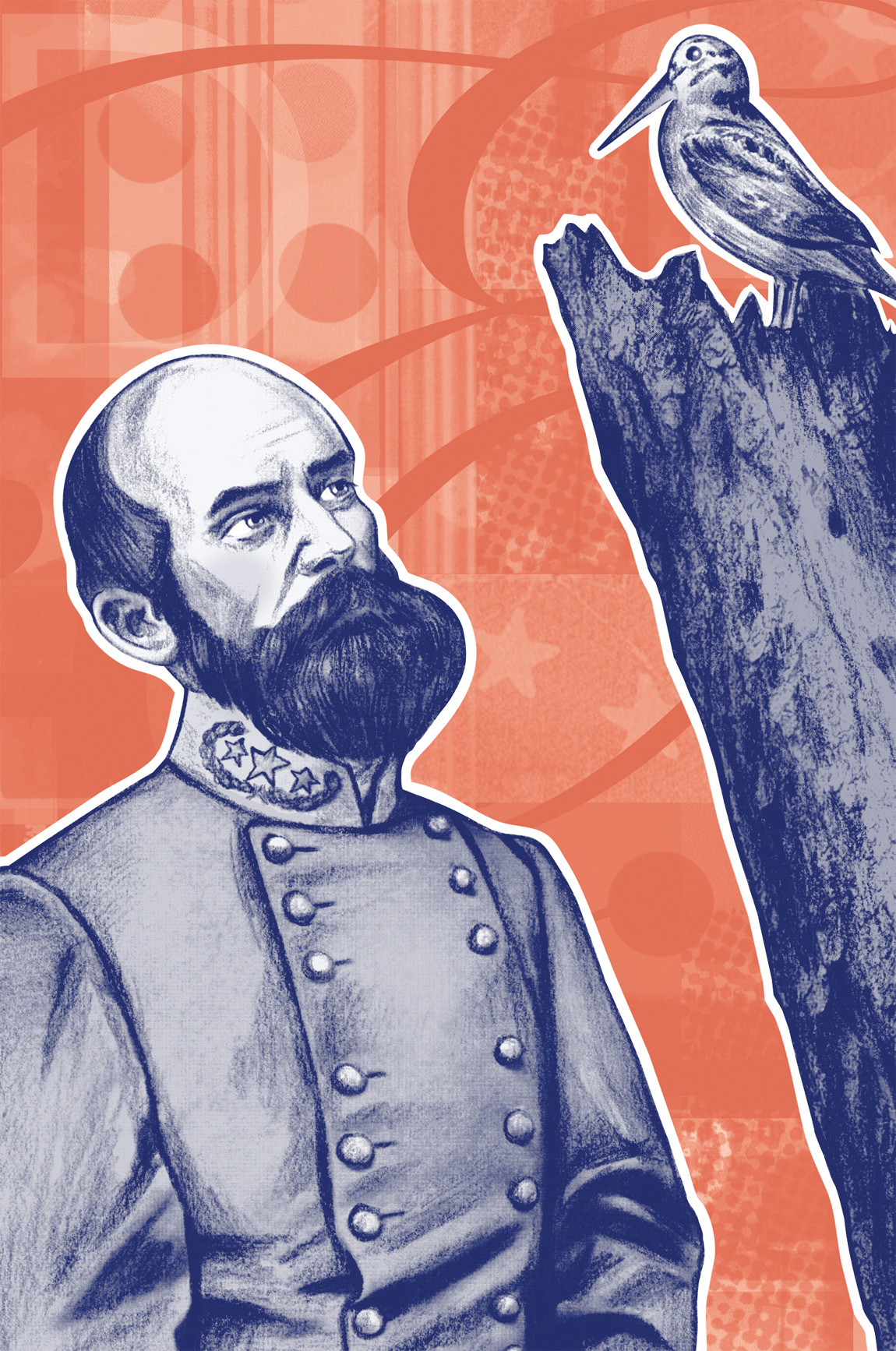
With his bulging eyes, beaklike nose, and a habit of cocking his head to one side, it’s no wonder so many people compared Richard Ewell’s appearance to that of a bird.
Siding with his native Old Dominion at the outbreak of civil war, “Old Baldy,” as he quickly became known, was a Confederate asset—an officer of dragoons with combat experience and plaudits from some of the most important soldiers in the country (the great Winfield Scott had commended Captain Ewell’s ability during the Mexican War). Material like this was not lost on Southern authorities, but Ewell became the butt of war’s bad joke at First Bull Run, where a confusion in orders rendered him and his brigade on the right flank while matters came to a decisive head on the left. It was a bad start, to be sure, and one for which poor Ewell drew no small amount of press attention.
But what do the papers know? It wasn’t long before General Jackson was being sent west to the Shenandoah Valley, and Ewell went with him. There Ewell learned several things: first, that the nickname “Stonewall” may have had more to do with Jackson’s penchant for withholding information from those around him than any gift for standing firm against assault; second, that this could be profoundly frustrating; and third, that Jackson was either a genius or a lunatic. Ewell proved his worth by keeping up with Jackson’s lightning pace, providing a tough, reliable counter to the latter’s shamanistic excesses. Jackson was in charge, though, and that suited Ewell just fine; with precise orders (when they were forthcoming), Ewell was in his element, comforted by the assurance that the greater course of things was somebody else’s problem.
Ewell handled his division ably during the Seven Days’ Battles, during which so many other Confederate leaders bungled, foundered, or—in Jackson’s case—slept. The next campaign, however, witnessed the defining tragedy of his life. At the beginning of theSecond Battle of Bull Run, on August 28, 1862, Ewell was gravely wounded in his left leg during a hot fight near Groveton, Virginia. Rushed to a house several miles from the battlefield, the general was put under the saw the following day. The amputee’s survival was in doubt for some time, as Ewell’s health had never been very good since his malarial days before the war. But ensconced at Dunblane, the home of his cousin Jesse Ewell, Dick made a gradual and impressive comeback.
The question was: a comeback to what? Jubal Early had taken over his division and would probably retain the post. Besides, Early was a friend, and Ewell didn’t cherish the prospect of testing their relationship. That some sort of place would be found for him, however, was not in doubt. Ewell was more than just one of the highest-ranking major generals in the Confederate army; he also had a solid record as a dependable, assertive leader. He executed orders with flair and enthusiasm, and he fought with imagination. Indeed, he had come to be regarded as brilliant by many—particularly those who had witnessed firsthand his mental celerity on the battlefield, his mouth straining through a litany of profanities to clearly elucidate the visionary plans hatching beneath his shining pate. Old Baldy was colorful, popular, and deeply respected. Jackson himself, in a letter to Lee, admitted that he would gladly follow Ewell in a descent on Washington. That’s no ordinary compliment.
Jackson’s greatest effort on behalf of his old protégé, however, was a bit graver—literally. His death from wounds incurred at Chancellorsville inspired Lee to shake up the command structure of the Army of Northern Virginia. And to Dick Ewell went the vaunted Second Corps. This was natural; after all, Ewell had been a central part of the Confederate martyr’s most successful accomplishments. The decision was largely cheered by the officers and men. But was Ewell, scarred by such a savage battle wound, up to it?
Those who wondered had their answer soon enough. Nine months after receiving his wound, Old Baldy was back in action. And though he had lost a limb, he’d gained a wife. Lizinka Campbell Brown was Ewell’s first cousin, a widow whose first match had made her one of the wealthiest women in the South. A longtime recipient of Ewell’s affections, Lizinka was a prize—a prize, as he would eventually learn, that came with a price. But in the spring of 1863, exciting things were in the air. Fortified by the love of a good woman, General Ewell strapped on his wooden leg and headed out in search of his destiny. It was a propitious time to do so: The Army of Northern Virginia was ambling for Pennsylvania in the second of Lee’s attempts to take the war to the enemy. And Ewell’s Second Corps was slated to lead the way.
To many observers, the new corps commander looked sickly, frail, or worse. He mounted his horse with difficulty (one can hardly fault him) and the color always seemed absent from his face. The old flame remained, however, as Ewell proved soon enough. Charged with clearing the Federals out of northern Virginia to make way for Lee’s invasion plans, Dick orchestrated a truly brilliant descent on Winchester, a Union stronghold, capturing well over three thousand of the enemy and routing the rest. It was a Federal disaster and Ewell’s finest hour—an elegantly simple plan that was cunningly conceived and thoroughly executed. The whole affair had been swift, neat, and merciless. From the privates in his corps to the newspapers in Richmond, everyone sang Ewell’s praises.
Thus ensured of immortality, the general was on to Pennsylvania, the vanguard of an invading army in high spirits and encouraged by the real possibility of dealing a blow that could precipitate the war’s conclusion. Ewell would find himself at a crossroads in history. And he would take the wrong road.
The Battle of Gettysburg was an accidental fracas that evolved, rather quickly, into a scramble for high ground. The first round went to Ewell’s Confederates, who—working in concert with elements of A. P. Hill’s corps—found the enemy, trounced him, and took the town (along with a horde of prisoners). But the beaten Federals weren’t simply flying to the four winds; instead, they made a fighting retreat south to the high ground that dominated Gettysburg and its environs. The prominence in question was Cemetery Hill, where the bluecoats commenced preparations to receive an assault that they were sure was coming fast.
And they weren’t the only ones who had made this assumption. Indeed, an assault on the demoralized defenders of Cemetery Hill was taken as a virtual fact by men and officers on both sides. Ewell, however, wasn’t so sure. To begin with, he had arrived in the area of Gettysburg with the standing injunction from Lee not to bring on a general engagement until the rest of the army had joined him. That had not yet happened. While Ewell was chewing this over, he received further instructions from Lee that seemed to give him permission to take the position if he thought it was prudent to do so (Lee made it clear that Ewell’s corps would not receive any support in the action). But did Ewell have enough fresh men on hand? He wasn’t at all sure. Nor was he sure whether the position on Cemetery Hill was being reinforced with fresh enemy troops (it was—eventually). And while all this back-and-forthing was going on inside Ewell’s head, his officers were gritting their teeth at the realization that every lost moment gave the blue bellies on the hill more time to improve their defensive works.
All of which is to say that Ewell was displaying a degree of caution that, though controversial, wasn’t necessarily inappropriate. But there was another overriding factor at work: Jackson would have gone up that hill immediately. Of this there can be no doubt. And Ewell, already viewed as Stonewall’s de facto successor, had stepped into a moment that served most keenly to highlight their differences—a moment pregnant with significance.
The high ground south of Gettysburg would stay in Union hands, despite two more days of battle. And while Ewell hadn’t lost the battle all by himself, many thought he’d done his share. For Robert E. Lee, the lieutenant generals that commanded his three corps were the primary weapons in his arsenal—the men whose expertise and character were called upon to transfer Lee’s discretionary orders to the needs of the moment. As such, they had to exhibit a large degree of independence. Ewell had some trouble with this. Though he had made an invaluable division commander, his performance at Gettysburg seemed to lack the assertive dynamism that Lee required in a corps-level leader.
It wasn’t enough to get him sacked, of course. But Lee had his eye on him and began to develop doubts. Ewell led the Second Corps ably right up through the Battle of the Wilderness in May 1864. But that same month, in the carnage of Spotsylvania, his bad judgment harvested a frightful crop of corpses and essentially gutted one of his divisions. Evidence suggests that this was the final straw for Lee, whose gentlemanly sense of protocol required an excuse to ease the blow. A searing bout of diarrhea came to the rescue, crippling Old Baldy and compelling Lee to put Jubal Early, whose fighting abilities he increasingly admired, at the head of the Second Corps. Ewell did everything short of riding a bucking bronco to prove his recovery, but to no avail. Lee had lost his faith in the gallant hero of Winchester.
So what had happened? Was it the stump? Some contemporaries blamed Ewell’s erratic performance on the severe wound he received at Groveton. But those closest to the general blamed his wife. Since his return to duty after the loss of his leg, Lizinka had assumed an increasingly important role in Ewell’s life—too important, according to some observers. In fact, Dick openly conferred with her over military decisions, especially crucial personnel choices such as promotions. “Petticoat government,” his staff called it. And whether or not they were exaggerating, one thing’s for sure: Ewell himself failed to hit the issue head-on, allowing it to fester and create divisions that would otherwise not have been there.
At any rate, the Second Corps was no longer his. Jubal Early shared Dick’s love of drink, cynicism, and profanity, and had long been a friend to whom he turned for advice. Now “Old Jubilee” had taken his unit, souring the relationship and leaving Ewell without a job. Or at least a job he could be proud of. In June the one-legged warrior was put in charge of the defenses of Richmond, a post that—to a man who had raced along the Shenandoah Valley with Stonewall’s “foot cavalry” and stormed the forts around Winchester—was more like a punch in the kidney than a transfer of responsibility. Nevertheless, Ewell was still one of the most valuable military leaders in the Confederacy, and the capital at Richmond was no backwater. Here was a defensive effort worthy of a man with Dick’s talents.
But that was not Ewell’s legacy in Richmond. When Ulysses Grant’s final offensive came crashing toward the Rebel capital, Ewell was given an order by the secretary of war that he was loath to carry out: burn Richmond’s vast warehouses full of cotton and tobacco. Though he fought the idea and was only obeying orders, Ewell was blamed by antagonists from the North and South for much of the destruction that left Richmond a smoking wreck. He led his troops westward in Lee’s general retreat and was captured at Sayler’s Creek along with nearly all the men under his command.
Ultimately, Dick Ewell died as a man keen on growing things rather than killing them. After spending time in a Boston Harbor prison following the war, he returned to his wife and commenced devoting his time to something that had fascinated him since his days in the Southwest: agriculture. Spring Hill, Lizinka’s principal property in Tennessee, was developed into an extraordinarily successful stock farm. Ewell also managed properties in Mississippi. When he died in 1872 from a frightful wave of pneumonia that also claimed his wife, he had done his best to become a loyal citizen of the nation whose government he had once fought against—and to put behind him the nightmarish war that had done its damnedest to kill him.

SEE DICK CUSS. CUSS, DICK, CUSS.
Early in the war, during the Battle of Fairfax Courthouse, Ewell—still a colonel—took a bullet in the shoulder. When a nearby soldier inquired after his health, the colonel spat back that it was none of his damned business and to get back in the ranks. It was vintage Dick Ewell: irascible and vulgar. According to one man who knew him in the old army, Ewell could “swear the scalp off an Apache.” A soldier who fought under the general during the Civil War called him “the most violently and elaborately profane man I ever knew” whose oaths “seemed the result of careful study and long practice.” Old Baldy himself is believed to have remarked that, with his swearing and Jackson’s praying, the pair could whip the devil himself.
Interestingly enough, it was Stonewall’s piety that inspired Ewell to take a more religious course in his personal affairs, which meant taking the profanity down a notch or two. But that was easier said than done—particularly at such moments when an expletive seemed all but irresistible. At Spotsylvania, Ewell taunted his routed soldiers by screaming, “Run, goddamn you, run!” and beating them with the flat of his sword. Lee saw the display, which played a role in the commanding general’s decision to bump Ewell permanently from the Second Corps.
THE SINCEREST FORM OF FLATTERY
In May 1862, Stonewall Jackson sent Ewell a message that “with the help of divine Providence,” he had captured much of Union general Robert Milroy’s wagon train. An exasperated Ewell shouted, “What has Providence to do with Milroy’s wagon train?!” It was an excellent reminder of the gulf that divided Ewell, earthy and indelicate, from his churchy comrade-in-arms. They were an odd pair, to be sure, and their success in the Shenandoah Valley belied a vast difference in temperament. But in time Ewell came to view the old VMI professor as an uncanny virtuoso and stopped his practice of asking fellow officers if they had considered the possibility that Jackson was actually insane. A longtime lightweight in spiritual matters, Ewell is said to have witnessed the spectacle of Jackson praying one night alone in his tent and walked away with a newfound eagerness to embrace the faith.
Ewell never did make a very believable pilgrim. But he did share some other curious characteristics with Jackson—stomach troubles, for one. Dyspepsia was a constant irritant for Ewell, and he adopted a diet that Jackson would’ve appreciated: bland oatmeal gruel, bread, tea, fruit. Breakfast often consisted of lettuce and cucumbers washed down with coffee. He even adopted some of Jackson’s curatives, including cold water for neuralgia and avoiding pepper because it was theoretically so bad for the legs. When it came to alcohol, however, Ewell couldn’t have been more different from Stonewall. Ewell loved the stuff, especially Madeira wine, which he credited with playing a major role in helping him recover from his amputation.
OLD BALDY
Dick Ewell was never accused of being a good-looking man. With bulging eyes, a beaklike nose, and a habit of cocking his head to one side, he seemed like some hapless avian spy who remained unaware that his shoddy human costume was giving him away. In fact, so many witnesses compared him to a woodcock that one suspects they had all gathered at some point and come to a consensus on the description. Capping his fowl physiognomy was Ewell’s most distinguishing physical characteristic: a gloriously hairless head as smooth as a magpie’s crown. Unburdened by functioning follicles almost since its owner’s West Point days, Ewell’s dome made him stand out at a considerable distance, even through the chaos of a battlefield. When he grew a full beard as if to compensate, someone asked him about the contrast. He replied that the condition resulted from the fact that he used his head more than he did his jaws.
WOODEN YA KNOW?
True to form, Ewell proved difficult to rescue in the frantic moment after his grievous wounding at Groveton. Hoisted by Alabama soldiers hoping to carry the wounded general to safety, he demanded that they put him down, pay him no more attention than any other wounded soldier, and get back to killing enemy troops. He was no more accommodating to the surgeon whose saw had an appointment with his leg the following day. “Tell the #@%$ doctor that I’ll be #@%$ if it shall be cut off, and that these are the last words of Ewell,” growled the distressed patient. But the wooden leg that ended up replacing his amputated one proved more than adequate. At the Battle of Gettysburg, a sniper’s round struck Ewell in his prosthesis. He later instructed a fellow officer on the merits of going into battle with a fake limb. “You see how much better fixed for a fight I am than you are.” He would use the peg years later on his Spring Hill farm when challenged by an especially aggressive Angora billy goat. After being knocked to the ground by the animal, Ewell fended off further attacks with his prosthesis until help arrived.
CALL PETA!
Though Ewell suffered three wounds during the war, including the one that cost him his leg, his mounts fared much worse. Ewell had five horses shot from under him by the end of the conflict.