

November 9, 1825–April 2, 1865
HIGHEST RANK:
Confederate General
ASTROLOGICAL SIGN:
Scorpio
NICKNAMES:
Little Powell
WORDS TO REMEMBER:
“If the Union is dissolved I shall make tracks for home, and offer my services to the governor, and intimate my modest desire for a brigade at least. I’ve been a sub long enough, and wish now to seek the bubble reputation at the cannon’s mouth.”
Of all Robert E. Lee’s principal lieutenants, A. P. Hill remains the most enigmatic. James Longstreet was the old warhorse, “Stonewall” Jackson the pious eccentric, Dick Ewell the bird-faced whiner, etc. Hill, on the other hand, was the little guy who was always ill, who fought brilliantly and made spectacular mistakes, who boasted an aristocrat’s breeding but favored calico shirts with the sleeves rolled up. He was proud and humble, careful and rash, robust and sickly, solicitous and quarrelsome—an illustrious and deeply flawed hero who seemed to personify the star-crossed rebellion for which he gave his life. His death at the Confederacy’s eleventh hour couldn’t have been more fitting.
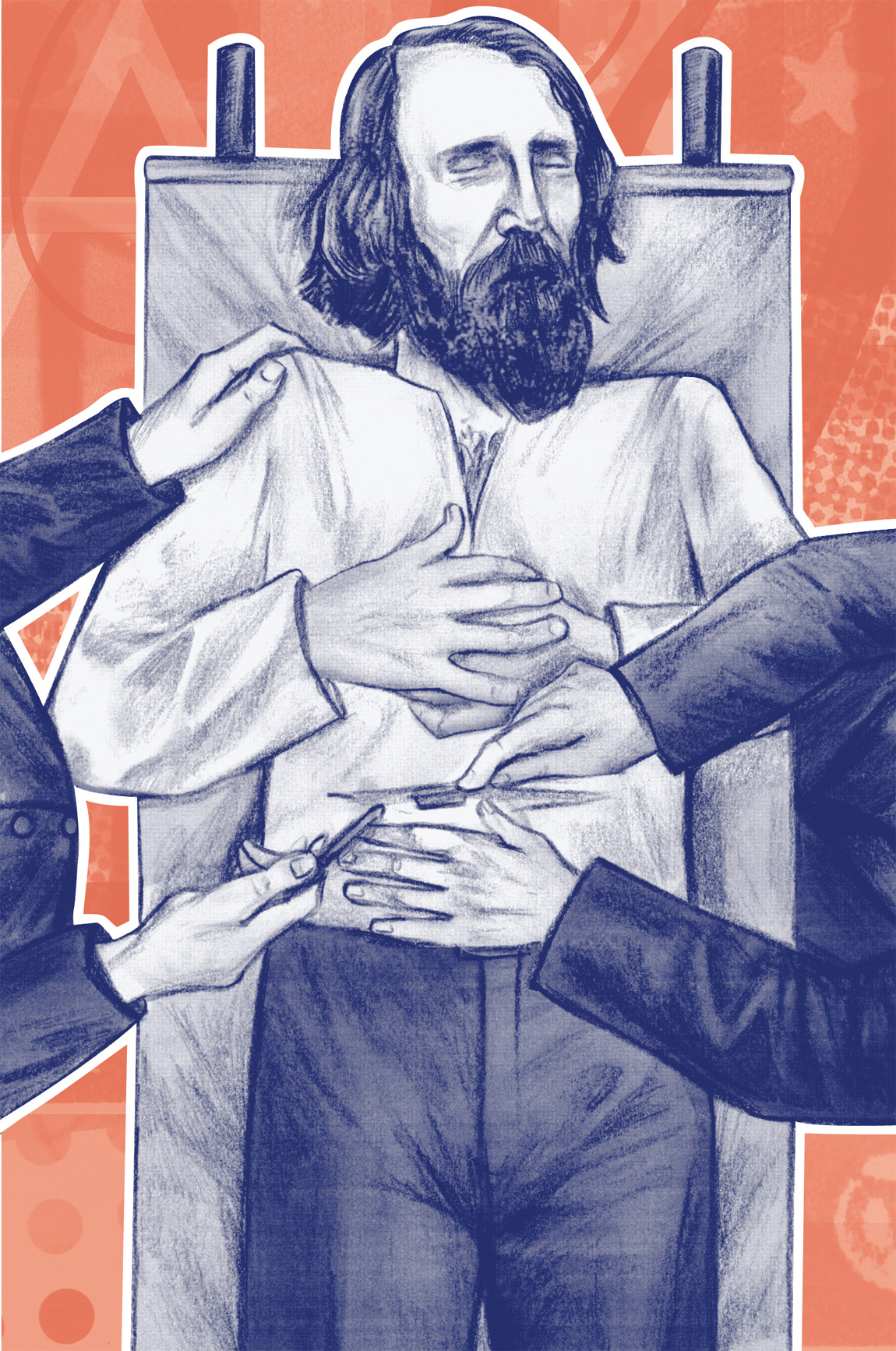
Descended from a martial lineage that included Revolutionary War heroes and an Indian fighter named Ambrose Powell who rubbed shoulders with James Madison, “Powell,” as his family called him, was born in Culpeper County, Virginia, to landed wealth. His good education prepared him well for West Point, but debilitating sickness led to prolonged absences, and he graduated a year late in 1847. Bouts of infirmity that robbed him of his full physical and psychological ability throughout his life would only intensify late in the Civil War. Though the precise nature of his ailment was a mystery for years, biographer James I. Robertson drew on the input of medical experts to confirm a popular theory: Powell’s suffering began with a case of gonorrhea contracted in 1844 during a stop in New York City, leading to recurring inflammation of the prostate that was as incurable as it was painful. Until his dying day, Hill had to live with intermittent breakouts of prostatitis.
A. P. Hill’s good luck charm was a ham bone that he received from his mother as a keepsake. He carried it for most of his life and was rumored to be without it on the day he died.
The condition was with him during the war in Mexico, to which he arrived late but in plenty of time to catch a nearly lethal case of typhoid fever. And it blossomed brutally in Florida, adding to the interminable misery of boredom, humidity, insects, and yellow fever that made the notion of dying at the hands of a Seminole war party seem positively delightful by comparison. From the lawless wastes of south Texas to the sublime isolation of Key West, Powell Hill did his time on the nation’s frontier and then some, often numbing his pain with drink. With a slight build and unsteady constitution, it is hardly surprising that he took a much safer job in Washington at the Coast Survey in 1855. He quickly became popular in capital social circles, where his wit, eloquence, and obvious good breeding endeared him to officers and civilians alike. In the summer of 1859, he married a widow named Kitty Morgan McClung, sister of future Confederate celebrity John Hunt Morgan. It was a perfect, loving match, and Hill would take extraordinary pains to be with “Dolly,” as he called her, even during the harrowing months of war.
The arrival of war in 1861 was greeted by Hill with ferocious enthusiasm. Though opposed to slavery, he was appalled by the willingness of the federal government to take up arms against his beloved Virginia. But just as important, he saw an opportunity to write his chapter in history. Through years of service in lousy locales, he’d hungered in vain for promotion, and he knew his time had come. Self-assured and passionate, Hill took the bit in his teeth and, during the blood-soaked years that followed, he rarely let it go. Like Stonewall Jackson, against whom he would bitterly quarrel, he seemed transformed by military action, as if the cacophonous, mutilating maelstrom of the battlefield were somehow his natural environment. Quick, decisive action—some would say “impetuosity”—became his hallmark.
But that lay in the future. For now he had to settle for a colonel’s commission in the new Confederate army, a regiment of fellow Virginians to command, and an irritating lack of action. In fact, 1861 was a pretty underwhelming year for Hill. To his extreme dismay, he and his troops even missed the war’s first great clash at Bull Run when they were shunted off to a quiet sector of the front as soon as they showed up. He impressed his superiors as an officer of quality who saw to the efficiency and welfare of his men, and he was rewarded with a brigadier general’s rank. But just as telling was the Richmond newspaper that reported the promotion of “A. P. Hall of North Carolina.”
All that would change during the Peninsula campaign of 1862. Leading a brigade in Longstreet’s division, Hill made his mark where he knew he would: under enemy fire. At the Battle of Williamsburg, while opposing ranks separated by less than fifty yards unleashed gales of lead into each other under a drenching rain, Hill could be seen walking the battle line, his eyes flashing beneath a soaked felt hat and his voice hoarse with commands. He led with guts and intelligence, and he led from the front. Promotion soon followed as the Army of Northern Virginia struggled to fit hordes of new recruits into a coherent command structure. By the end of May, Hill had become the youngest major general in the Rebel army—at the head, oddly enough, of the largest division. With conspicuous irony, he christened it the “Light Division,” and a legend was born.
What followed were the glory days of “Little Powell” and the Confederacy. But the Army of Northern Virginia first had to do some maturing, as did the Light Division, and Lee’s offensive of the Seven Days’ Battles offered more than enough opportunity. The growing pains, however, were horrific. At Mechanicsville, Stonewall Jackson’s tardiness conspired with Hill’s own impulsiveness to conjure a bloodbath: the Light Division, hurled against unassailable defensive ground, was decimated by relentless musketry and artillery fire. It was even worse the following day at Gaines’ Mill, costing Hill’s division a grisly 2,600 killed and wounded. Throughout the Seven Days’ Battles, Little Powell displayed some trouble making the transition from brigade to division command and occasionally erred on the side of recklessness. But he proved himself as a tough frontline fighter.
He also proved just how peevish he could be, when a squabble sparked by the Richmond press over proper credit for winning the Battle of Frayser’s Farm mushroomed into a full-blown feud with his superior, James Longstreet. Things got so bad between the two that Longstreet had the waspish Virginian placed under arrest; Hill responded with an absurd request to settle the matter with a duel, which, thanks to the intercession of Robert E. Lee, never took place. But all this was nothing compared with the battle royal that erupted with Jackson, now overseeing the Light Division. Hill, who had rebelled against his mother’s Baptist fervor as a young man, found Jackson’s odor of sanctity a little cloying. The thing that really bugged him, however, was Stonewall’s … well, stonewalling. Jackson, flinty and detached, had the maddening habit of withholding vital information from his subordinates, a trait that mixed poorly with Hill’s penchant for rash decision-making. Nevertheless, throughout the campaign that climaxed in the Second Battle of Bull Run, from Cedar Mountain to Chantilly, Hill and Jackson manhandled their Union adversaries even as they increasingly loathed each other. Things between them finally snapped just as Robert E. Lee was commencing his daring invasion of Maryland in September 1862. Hill, infuriated by Jackson’s habit of issuing orders to Light Division officers without going through him first, vented weeks of pent-up frustration at Jackson, who was already fuming over Hill’s inability to get his men up and marching on schedule. And suddenly—for the second time in less than three months—Little Powell found himself under arrest.
Incredibly, the hostility between Hill and Jackson would not truly end until the latter’s death. It lived on in hotheaded correspondence that proved at least two things: Stonewall Jackson often abused his rank like a tyrant, and A. P. Hill could be a prima donna.
But in September 1862, much more pressing matters occupied them both. At Antietam Creek, Maryland, George McClellan had the greatest chance he was ever going to get to utterly destroy the Army of Northern Virginia. With A. P. Hill guarding Harpers Ferry miles to the south, Lee found himself without the Light Division, facing a much larger force, with the Potomac River barring any hope of retreat to his west or south. Riding from flank to flank, furiously filling gaps in the line by moving troops to the most hotly contested areas, Lee began to wonder if it all might end then and there. As if in answer to his prayers, dust clouds to the south announced the arrival of Little Powell. Hill, having been alerted by messenger to the situation, had driven his men on one of the most celebrated forced marches of the Civil War, all the while exhorting them with shouts of “General Lee is in trouble, and he needs you!” His arrival could not have been timed better by a Hollywood director. The famously reserved Lee even broke down and hugged him. Coming up from the south, elements of Hill’s exhausted division drove into the flank of Ambrose Burnside’s Federals, starting a retreat that spread like wildfire. Hill had saved the Army of Northern Virginia with fewer than three thousand men—the other half of his division had yet to arrive.
If Antietam was the bloodiest day in American history, it was also the greatest day in A. P. Hill’s life. He even delivered an encore performance at Boteler’s Ford on the Potomac: While bringing up the rear of Lee’s withdrawal into Virginia, Hill turned around and trounced a force of pursuing Federals. This guy had become the Army of Northern Virginia’s trump card.
One can only hope that he savored the feeling, for it was not to last. Back in August, at the Second Battle of Bull Run, Hill had made a bizarre and pronounced blunder by leaving a gap between two of his brigades big enough for assaulting bluecoats to pour through. The Rebels had still carried the day, but the debacle was indicative of Hill’s capacity to slip in the unlikeliest of circumstances. Now, in December, he did it again at Fredericksburg, allowing a veritable chasm of six hundred yards to yawn ominously between two of his brigades on his part of the front line. It was an invitation the enemy couldn’t refuse. In fact, the only appreciable gains the Union army made on that day of defeat were made precisely at that point, throwing Hill’s men into a flurry of desperate activity and costing no small number of lives. Worst of all, Hill wasn’t even there to fix his mistake—he had established his headquarters at the far left end of his sector and was nowhere to be found when all hell broke loose.
His poor performance at Fredericksburg (often attributed to the loss of his daughter Netty to diphtheria just before the battle) notwithstanding, Hill was probably the finest division commander in the Army of Northern Virginia. Naturally, he was promoted to lieutenant general and given an entire corps to command—a mistake, as events would prove soon enough. The origins of that decision lay in the chaos of Chancellorsville, on the evening of Jackson’s great flanking maneuver. Little Powell was riding with Stonewall when a sheet of friendly fire grievously wounded the hallowed Second Corps commander. Hill was one of the few in the party to escape mauling in that unfortunate incident, but he caught a piece of shrapnel in the leg not long afterward. Command of Jackson’s corps then fell temporarily to Jeb Stuart. But in the reorganization of Lee’s army that followed, Hill—once he recovered from his wound—was considered a natural to replace the great Stonewall (ironic, perhaps, considering the enmity that had divided them). And while Lee ended up giving the Second Corps to Dick Ewell, he had a Third Corps created especially for the hero of Antietam.
Call it the Peter Principle, call it whatever you like, but Hill proved much more adept at leading smaller units “at the cannon’s mouth,” as he liked to say, than he did at orchestrating the big picture from a corps commander’s perspective. When the Army of Northern Virginia invaded Pennsylvania in the summer of 1863, Hill, while in Cashtown, sent a division east to forage for supplies and shoes in Gettysburg. Though guided by Lee’s directive not to bring on a general engagement (he had yet to concentrate his entire army), the division got ensnared in a fight with Union forces and managed to bring on a general engagement anyway. Hill has often been blamed for starting the Battle of Gettysburg by sending a division on a reconnaissance that should have been conducted by a smaller force—one that wouldn’t have invited a major fight. Whatever the truth, virtually every one of the Army of Northern Virginia’s commanding generals blew it at the epic three-day struggle that ensued. Lost in the transition between division and corps command, Little Powell seemed nonplussed at best. On the second day, with one of his divisions slated to support Longstreet’s poorly executed assault on the Union left, Hill, listless and possibly confused, failed to galvanize his men for their part of the plan. And, though commanded by Longstreet, the epic tragedy known as “Pickett’s Charge” on the third day included two of Hill’s divisions—responsibility for which fell through the cracks that existed between the two incommunicative corps commanders. Hill had become more a spectator of war than a participant in it.
For the Third Corps, the dreadful pain of Gettysburg was followed in October by the unmitigated disaster of Bristoe Station. Having stumbled upon a corps of hapless Federals, the ever-impetuous Hill decided to bag them then and there, before they could get into battle formation. Prudent reconnaissance would have revealed another Union corps waiting behind an embankment to the southeast, but Hill wasn’t in a prudent mood. When the trap was sprung on the division that he had sent rolling forward, slaughter ensued. It may well have been the nadir of Hill’s career.
His old nemesis, prostatitis, returned with a vengeance the following winter, adding considerably to the burdens of his command. Through much of the battles at the Wilderness and Spotsylvania in 1864, Hill confined himself to an ambulance because mounting a horse was so painful. He feigned recovery long enough to direct an abortive assault against tough Federal positions at the North Anna River toward the end of May and to savor the victory at Cold Harbor days later. Once the war settled into the protracted siege ofPetersburg, Hill and his Third Corps sallied from the trenches on numerous occasions to prove they could still deal out the damage—not least at the celebrated victory of Reams Station, where the great Winfield Scott Hancock’s Union corps essentially flew the coop. And Hill was sick as a dog through the whole thing.
By April 1865, he was as wan and fatigued as the thin gray line that guarded Petersburg from imminent Federal attack. When the storm did break, Hill became the most prominent victim of its suddenness and chaos: Riding with a courier in search of his retreating troops, he found himself amidst the enemy and was shot from his horse. Given his ardor for a South that was even then beginning to disappear, it is perhaps good that he didn’t live long enough to watch the finale.

HIDING IN PLAIN SIGHT
Powell Hill had a thing for calico shirts, including a red one that became his trademark on the battlefield. But such plain apparel could lead to confusion. On the march to Antietam, for instance, Hill berated a teamster in the wagon train who was beating his stubborn mules and was promptly and gruffly told to mind his own business. The fellow didn’t even recognize the commander of the Light Division (and was struck by the flat of Hill’s sword for his mistake). In fact, Little Powell’s homespun appearance saved his life on at least two occasions. In 1863, while personally reconnoitering fords in the Rappahannock on the eve of the Gettysburg campaign, he led his horse briefly into the river to get a better look at the opposite bank, where Federal pickets stood guard. After he left, a Rebel called out across the water, asking the Yankees why they hadn’t taken a shot at General Hill, who’d been sitting on his horse in the river plain as day just a moment ago. They shouted back that they thought he was the officer of the guard and not worth the trouble. An even closer shave occurred during the nightmarish inferno of the Wilderness in 1864. Hill and some of his staff arrived at a farm, where the cleared land offered an opportunity to study the surrounding topography. Quite suddenly, Federals appeared at the edge of the woods behind them and began dismantling a fence that stood in their line of march. They were perhaps a hundred yards away. With impressive composure, Hill and his companions slowly and casually walked their horses away from the enemy soldiers and back into the concealment of the forest. Only later did they discover from a prisoner that the bluecoats at the fence thought Hill and his fellows were local farmers.
Below the Belt
One of Ambrose Powell Hill’s closest friends at West Point was a brilliant bantam from Philadelphia named George McClellan. The Civil War would test that friendship, of course. But another, smaller conflict made trouble for the relationship long before that. And it had a name: Ellen Mary Marcy, the woman who would ultimately become Mrs. McClellan. In the winter of 1855–1856, McClellan—anointed by the Marcys to be their daughter’s future husband—was thousands of miles away observing the Crimean War. Hill entered Ellen’s life around this time and quickly captured her heart. In seemingly no time at all, he had proposed and she had accepted. Convinced that Hill was beneath Ellen’s station, Mr. Marcy was beside himself with disappointment and pleaded with his daughter to end the thing. It was Mrs. Marcy, however, who took the gloves off. After doing a bit of digging, she came upon evidence of Hill’s bouts with venereal disease and leaked the information to those in the Marcy circle. The fall-out not only destroyed Hill’s engagement with Ellen; it also began a testy feud between Mrs. Marcy and George McClellan, who had long since returned to America, conferred with his old buddy, and bowed out of his association with Ellen like the gentleman he was. But Mrs. Marcy had tagged him as the one who’d fingered her as the cur who had spilt the incriminating information about Hill, a fact that McClellan adamantly denied. At any rate, it seems that everybody had come out of this mess with a bruising—except Powell’s sister, Lucy, to whom he ended up giving the engagement ring that Ellen returned to him.
LUCK BE SOME GRAVY TONIGHT
Of all the things that Powell Hill took with him to West Point, the strangest—and most indispensable—was a ham bone, bestowed to him by his mother, Fannie, as a keepsake. He kept it with him the rest of his life as a good-luck charm and is rumored to have been without it the day he was killed.
SOME FINAL THOUGHTS
A. P. Hill was buried three times. His first resting place was in the private cemetery of the Winston family in Chesterfield County, Virginia, largely because the location was relatively close at the time of his death. His remains were moved in 1867 to a plot in Richmond’s Hollywood Cemetery to rest with other heroes of the Confederacy. Finally, in 1891, he was relocated to rest beneath the monument to his memory that was erected at the intersection of Laburnum Avenue and Hermitage Road in Richmond. Fittingly for the irreverent Hill, not one of the interments was accompanied by a religious ceremony of any sort.
But Hill had another distinction after life, and one that has become legendary: His was the only name that both Stonewall Jackson and Robert E. Lee mentioned in their deathbed deliriums. “Order A. P. Hill to prepare for action!” cried Stonewall just before his death. “Pass the infantry to the front immediately!” Lee cried simply, “Tell Hill he must come up!” Whatever Hill’s merits as a commander of troops, it cannot be denied that occupying a place of prominence in the minds of the Southern Confederacy’s two greatest heroes while in their death throes ain’t bad.