
Part One

“I knew that ship and loved her. Her officers and men were my friends.”
— Franklin D. Roosevelt, letter to Houston mayor Neal Pickett, Memorial Day, 1942
CHAPTER 1
Off the island of Bali, in the silhouette of mountains made sacred by the favor of local gods, a warship plied the black waters of an equatorial sea. The night of February 4, 1942, found her moving swiftly toward a port on the southern coast of the adjoining island of Java. She had sustained a deep wound that day, an aerial bomb striking her after turret, charring and melting the gun house and its entire stalk. The great blast killed forty-six men. Her captain now sought port to patch his ship and bury his dead with honors. For the flagship of the U.S. Asiatic Fleet, this was the first blow of a war not yet sixty days old.
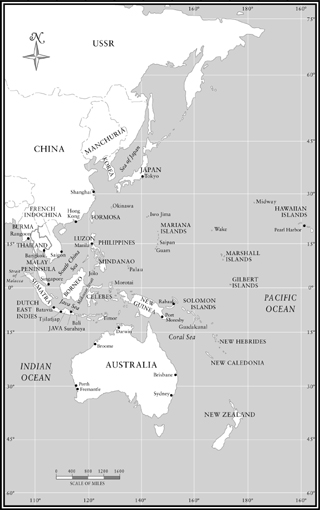
The USS Houston, a heavy cruiser, was the largest combat vessel the U.S. Navy had committed to the Dutch East Indies. She was bound for the port of Tjilatjap. Its colliding consonants compelled American sailors to give the town the more symphonious nickname “Slapjack” or, chewing their words more bitterly, “that lousy dump.” As the thunder of Japan’s opening offensive washed over Indonesia in early 1942, Tjilatjap was one of three havens that Allied warships still maintained in these dangerous waters. With the enemy’s invasion fleets pressing down from the north and his planes attacking from land bases ever closer to Java, those harbors were fast becoming untenable. The previous day, February 3, Japanese bombers struck Surabaya, the city in the island’s east that was home to Adm. Thomas C. Hart’s threadbare squadron of surface combatants. To the west, the port at Batavia (now Jakarta) was a marked target too. As Hart’s commanders well knew, Japan’s aviators had needed just forty-eight hours after the start of war on December 8 to smash American airpower in the Philippines, sink the two largest Allied warships in the region—the British battleship Prince of Wales and the battlecruiser Repulse—and land an invasion force on Luzon. The Imperial red tide knew no pause. Flowing southward, operating at high tempo by day and by night, the Japanese executed a leapfrogging series of amphibious invasions down the coasts of Borneo and Celebes, each gain consolidated and used to stage the next assault. The shadow of the Japanese offensive loomed over Java, where the Allies would make a last stand in defense of the old Dutch colonial outpost and aim to blunt Japan’s onrushing advance toward Australia.
At midnight of February 3, alerted by Allied aircraft to the presence of a Japanese invasion fleet in Makassar Strait, north of Java, the Houston had departed Surabaya with a flotilla of U.S. and Dutch warships—the aged light cruiser USS Marblehead, the Dutch light cruisers De Ruyter and Tromp, and an escort of eight destroyers. Under Dutch Rear Adm. Karel W. F. M. Doorman, the striking force steamed by night to avoid Japanese aircraft. But the distance to their target was such that the Allied ships had no choice but to cross the Flores Sea by daylight on February 4. No friendly fighter planes were on hand to cover them. It was about ten o’clock on that bright morning when Japanese bombers began appearing overhead, ending Doorman’s mission before it ever really began.
That day had started as so many of them did, with the Houston’s Marine bugler putting his brass bell to the public address microphone and blowing the call to air defense. As men sprinted to their general quarters stations, they could look up and see the Japanese bombers droning by, one wave after the next, nine at a time, fifty-four in all, locked in tight V formations, silvery fuselages glinting in the sun. Nosing over into shallow power glides from seventeen thousand feet, the twin-engine G3M Nells began their bombing runs.
Capt. Albert Harold Rooks steered his ship through the maelstrom of splashes, some of the bombs landing close enough aboard to fracture rivets belowdecks, some falling in patterns dense enough to conceal the six-hundred-foot-long ship behind a temporary mountain range of foamy white seawater. Watching the Houston under bombardment, a sailor on another ship said, “All this water just sort of hung in the air. Then it started to fall back, and out from underneath all this stuff comes the Houston going thirty knots.” A master ship handler, the fifty-year-old skipper had an intuitive sense of his cruiser’s gait. He was expert in dodging the bombs that fluttered earthward in the midmorning sun, never hesitating to stretch the limits of the engineering plant or test the skill and endurance of the throttlemen and water tenders and machinists, who gamely kept pace with the sudden engine orders and speed changes, risking the destruction of their delicate machinery by the slightest misstep. Relying on the smart reactions of his snipes as an extension of his own hand, Rooks maneuvered his cruiser like none the crew had ever seen, accelerating and slowing, ordering “crashbacks” that wrenched his engines from full ahead straight into full astern, thus steering not only by rudder but by counterturning the propeller screws, the starboard pair surging ahead while the port pulled astern. “He handled that ship like you or I would handle a motorboat,” said Howard R. Charles, a private in the Houston’s seventy-eight-man Marine detachment.
By acclamation Rooks was one of the brightest lights to wear four gold bars in the prewar U.S. Navy. He had been Admiral Hart’s aide when the Asiatic Fleet boss was superintendent of the Naval Academy. On the teaching staff at the Naval War College in Newport, Rhode Island, in 1940, Rooks showed a keen analytical mind, and it was with no evident sarcasm that colleagues called him the second coming of the great naval strategist Alfred Thayer Mahan. In the few months since taking over the Houston in Manila, the quietly authoritative skipper had moved out of the shadow of a beloved predecessor and won, it seems, a reputation as a sort of minor deity.
An SOC Seagull floatplane was on the Houston’s catapult, propeller whipping the air at full throttle, its pilot ready for an explosive-charged launch. Under normal conditions in the days before radar, the SOCs were used for reconnaissance and gunnery spotting. Flung aloft from catapults mounted on the quarterdeck amidships, the biplanes would fly out ahead of the ship, climb to around two thousand feet, and spend two or three hours weaving back and forth on either side of the cruiser’s base course heading. In combat, they could loiter over an enemy fleet, signaling corrections to the gunnery department. The Seagulls were light enough to grip the air at a speed as low as sixty miles per hour, permitting a leisurely reconnaissance pattern. But now the idea was to get the vulnerable, combustible planes off the ship before the Japanese got lucky with one of their bombs.
As another formation of bombers crossed overhead, the antiaircraft officer couldn’t stand waiting for the SOC to get airborne. His five-inch guns, elevated high, roared. At once the muzzle blast, just ten feet from the plane, tore the canvas skin right off the plane. As Lt. Harold S. Hamlin recalled, “the pilot found himself sitting on a picked chicken—the blast had removed every stitch of fabric from the plane. Pilot and crewman scrambled out, and the forlorn-looking plane, naked as a jay-bird, was jettisoned.”
The Houston belched so much smoke from her after stack that the antiaircraft crews lost use of the aft rangefinder, bathed in black soot. So they aimed by eye. Good as the crews on her eight open-mount five-inch guns were, they were shocked to find that their ammunition was of little use. Their first salvo arced skyward right into the midst of the bombers. But only one of the four rounds was seen to explode. That sorry proportion held up through the day. Of the four hundred odd antiaircraft shells the Houston’s crews fired, nearly three hundred were duds. In the prewar years, the Navy Department, mindful of costs, had refused to let its ships fire live rounds in antiaircraft gunnery drills. The Houston’s gunnery officer had appealed time and again for permission to use live ammunition but was turned down. The projectiles thus saved had been left to sit and age in the magazines. Now, as the realization dawned on them that most of their stored projectiles were little more than outsize paperweights, the antiaircraft crews became “mad as scalded dogs” and fired all the faster, if to little result.
During the bombardment that rained down on them that morning, the light cruiser Marblehead was straddled perfectly by a stick of seven bombs, engulfing the old ship in giant splashes. Two struck home, and a near miss, detonating underwater close aboard to port, did as much damage as the direct hits. Fifteen men were killed as fires raged fore and aft. With part of her hull dished in, scooping in seawater at high pressure, seams and rivets leaking, the Marblehead listed to starboard, settling by the head, her rudder jammed into a hard port turn. Seeing her distress, Captain Rooks turned the Houston toward her to bring his gunners to bear on the attackers. As he did so, another V of bombers passed overhead at fifteen thousand feet. A second flock of bombs wobbled earthward. They missed—all of them except for the stray.
Some say that the lone five-hundred-pounder must have gotten hung up in the Japanese plane’s bomb bay on release. With its carefully calculated trajectory interrupted, it wandered from the path of its explosive peers, arcing down outside the field of view from the pilothouse, where Rooks, head tilted skyward, binoculars in hands, was watching the flight of ordnance and conning his ship to avoid it. Unseen until it was far too late, the wayward bomb found the ship. It punched through the searchlight platform mounted midway up the Houston’s sixty-foot-high mainmast, rattled down through its great steel tripod, and struck just forward of the aft eight-inch gun mount, whose triple barrels were trained to port, locked and loaded to fend off low-flying planes.
The bomb’s blast reverberated all along the Houston’s length, and up and down its seven levels of decks. The sickened crew felt the cruiser lift, rock, and reel. When fires ignited the silk-encased powder bags stored in the number-three hoist, a vicious flash fire engulfed the gun chamber and reached down into the powder circle. Yellow-white smoke washed over the fantail.
Intense heat inside the heavily perforated gun house, or perhaps a firing circuit shorted out in the deluge from the fire hoses, caused the center eight-inch rifle to discharge. The untimely blast startled the crew, and they collided with one another diving for cover. The powder-fed storm of flames took nearly four dozen of Captain Rooks’s best men. They never stood a chance, not the doomed crew inside Turret Three, nor the men in the powder circle and handling room below them, nor the after repair party, cut down nearly to a man at their general quarters station, right under the hole in the main deck. In nearby crew’s quarters, men were found blown straight through the springs of their bunks. Scraps of clothing stuck in the springs were all that remained of them, identification made possible only by the stenciling on their shirts. They could not have known what hit them. But far worse was in store for everyone aft should the flames reach the eight-inch powder bags piled in the magazine.
Fearing a catastrophic explosion, Cdr. Arthur L. Maher, the Houston’s gunnery officer, rallied the firefighting crews and sent two petty officers into the scorched ruin of the gun mount searching for survivors. One of them, aviation machinist’s mate second class John W. Ranger, played a hose on the other, Charles Fowler, to keep him cool. Then Ranger joined Fowler inside, armed with a carbon dioxide canister to fight the flames, the heat from which was already bubbling grease smeared on the eight-inch projectiles kept in ready storage.
By the light of a battle lantern in the turret’s lower chambers, gunner’s mate second class Czeslaus Kunke and seaman second class Jack D. Smith dogged down the metal flaps that separated the magazine from the burning handling room and flooded the magazine and powder hoist. “I told John [Ranger] if we had not stopped the fire before it arrived at the magazine he would have been the first Navy astronaut,” Smith wrote. Their quick thinking and a measure of good fortune saved the ship from a final calamity.
With the Houston’s main battery hobbled and the Marblehead damaged, Admiral Doorman aborted the mission, ordering the wounded cruisers to Tjilatjap for repair. As evening fell, Captain Rooks steered his bruised ship toward safety, out of the Flores Sea through Alas Strait, then west into the easternmost littorals of the Indian Ocean. Steaming in the shadows of the holy peaks of Lombok and Bali, the Houston’s crew gathered their dead shipmates on the fantail. The Houston’s two medical officers, Cdr. William A. Epstein and Lt. Clement D. Burroughs, exhausted themselves patching up the wounded and easing the worst of them into death. “I’m convinced they were never the same again,” wrote Marine 2nd Lt. Miles Barrett. “For weeks their nerves were completely shattered.” An ensign named John B. Nelson had the chore of identifying the charred corpses as they lay in makeshift state. Nelson’s eyes filled with tears as he studied the remains, identifying some and guessing at others. Then they were covered with a canvas tarpaulin to await burial. A carpenter’s mate oversaw the crew detailed to assemble caskets from scrap lumber. Their hammers tapped and tapped, marking time through the night. “War came to us in a real way. It knocked all the cockiness out of us,” said Sgt. Charley L. Pryor Jr. of the ship’s Marine detachment. “We saw what war could be in its real fury, just in those brief few moments.”
A ceremonial watch was set in honor of the dead. Seaman first class John Bartz, a stout Minnesotan from the Second Division, held his rifle at attention on the midwatch, fidgeting in the starlit darkness. What unsettled him was not so much the corpses but their unexpected movements at sudden intervals: arms and legs twitching, rising and reaching in death’s stiffening grip.
“I’m telling you, it was spooky,” Bartz said. “It was really scary when you’re standing there, a young kid about eighteen years old. I was glad to see my relief at four.”
CHAPTER 2
The horrors of the bomb blast challenged the mettle of a crew that had developed its esprit from altogether different experiences. By 1942, only a few of them had been on board long enough to remember the ship’s heyday in the thirties, when a president was proud to call himself their shipmate. Most of those who had sailed on those unforgettable voyages had left the ship. Yet the high spirits lived in the older sailors’ memories. It was a sort of living dream, a skein of folk history that wove itself into the banter in the mess halls and set the Houston’s men apart from the other seadogs in the fleet. The five-year reign the ship enjoyed as Franklin D. Roosevelt’s favorite ride would survive the worst onslaughts of the Japanese.
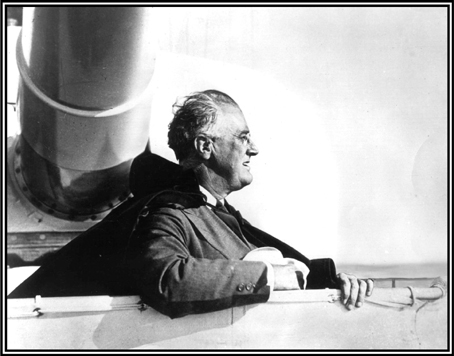
Four times in the 1930s FDR had joined the Houston on long interoceanic trips. Whether it was because she had been launched in September 1929, right before the stock-market crash that brought on the Depression, and thus stood as a sort of shining symbol of the nation in its heyday, or whether it was an accident of circumstance, no one quite knew. Most of them seemed willing to accept it as the natural by-product of their shipshape tradition of discipline. “The spit and polish of the U.S. Navy was ingrained in us,” one sailor wrote, “and up to the moment he arrived on board we worked every minute to have the ship in readiness. Not a speck of dust, or corrosion on bright work, paint work, and our white teakwood decks shone with a snowy whiteness that came from many hours of scrubbing and holystoning. The ship was in perfect order.” The wheelchair-bound commander in chief appreciated the custom-engineered conveniences the shipfitters and metalsmiths installed whenever he came aboard. Ladders were replaced with electric lifts, handrails bolted along bulkheads, and ramps laid here and there to enable him to explore her decks and compartments.
“Bring the boat around,” Roosevelt would tell the brass at the Navy Department whenever the urge or the opportunity beckoned. In 1934, he rode on board the Houston from Annapolis to Portland, Oregon, by way of the Panama Canal and Honolulu. In October 1935, he went from San Diego to Charleston following much the same southern route.
On the morning of July 14, 1938, as the ship was approaching San Francisco, the rumor circulated that the president was readying himself to join them once again. As the Houston eased into the harbor, some sharp-eyed sailors on deck could see the dockworkers breaking out the telltale fittings that heralded the arrival of a special visitor. FDR drew a rousing crowd at the new San Francisco–
Oakland Bay Bridge. Shortly after the Houston tied up to a pier, another crowd began to form. At 2:30 p.m., the ship’s loudspeaker announced, “All hands shift into the uniform of the day: officers, full dress blue; crew, dress blue. Affirm.” Less than an hour later the crew was manning the rail, the honor guard and band assembled on the quarterdeck, the quartermaster standing ready to break the presidential flag at the mainmast.
When the crowd began cheering, a sailor named Red Reynolds spotted the presidential limousine. He was surprised to see that FDR’s wheelchair was already on board the ship. It sat empty on the quarterdeck, at the end of a forty-foot-long ramp, a steep “brow,” reaching down to the dock. The limousine pulled up on the pier and stopped at the brow’s base.
“I was wondering, What now?” Reynolds wrote. “The President is paralyzed. His legs were shriveled. No larger than my arms. How will he come aboard? Then, to my amazement, I watched him lean from the back seat, reach out, grab the brow rails with both hands, and, hurtling through the air, draw himself to an upright position. Then hand over hand, he slowly progressed up the brow, his feet dangling inches above the deck of the brow. Stopping occasionally, smiling and nodding to the crowd. Saying a few words to the crowd and leading off with his old familiar words, ‘My friends.’ As he reached the top of the brow, he reached out, grasping the arms of his wheel chair, swinging his body into the air. Raising his right hand to a smart sailors’ salute to ‘Old Glory,’ as she waved back from her station on the main deck aft. As he dropped the salute all honors were rendered and his first words were, ‘It’s good to be back home again, Captain.’ The feelings of the crew were perhaps best expressed by all shouting, ‘What a shipmate!’”
Further out in the harbor, the battleships and heavy cruisers of the United States Fleet awaited their commander in chief’s review. They were lined up in four rows, “so evenly spaced that a giant ruler might have been laid among them, touching each,” observed Reynolds. It was said to be the largest concentration of U.S. naval power assembled to date. At 3:45, the Houston backed away from Oakland Pier. Roosevelt parked himself on the communications deck to take in the spectacle.
Steaming beneath the San Francisco–Oakland Bay Bridge and turning west, the Houston stood out of San Francisco Harbor, making ten knots. As she came abreast of the fleet flagship, the Pennsylvania, the battleship let loose a full broadside in salute. The roar had scarcely faded when the Houston passed by the Idaho. She issued a salute with a blast from her own battery. The fleet review progressed in a stately, thunderous rhythm, the baton of the ceremonial cannonade passing from one battleship to the next as the Houston slid past, the band on her quarterdeck playing “The Star-Spangled Banner,” crews on all ships lining the rails, officers resplendent in full parade dress, epaulets, braid, and buttons shining gold against deep blue in the afternoon sun. When the last battleship had discharged its honors, the heavy cruisers of the Scouting Force picked up the powder-charged tribute. When the majestic show ended, the Houston set course for San Diego.
On arrival there, the president left the ship on some matter of business, then returned to make yet another grand entrance, thrilling the crowds on Kettner Boulevard. This time Eleanor Roosevelt was on hand, sitting dockside on one of the bollards around which the mooring lines were slung. Bantering with sailors through open portholes on the cruiser’s second deck, she told the crew to take good care of Franklin. She said, “Don’t let him get too tired, don’t let him catch cold, don’t let him smoke too much.” At 5:15 p.m., the Houston backed from the pier in San Diego and got under way again. Surrounded by pleasure craft, she stood out of the harbor, passing Fort Rosecrans, and set course for the far side of the continent, Pensacola by way of Panama.
In the twenty-four days that ensued, the president would for the third time win his stripes as a friend of the Houston and a fisherman worthy of the tallest tales. When he fished, he shunned the sleek, custom-built forty-foot cabin boat, perched on deck with its black hull trimmed with gold plating and a gold presidential seal affixed on each side of the bow. He preferred the cruiser’s regular motor launch. And instead of venturing out accompanied by the chief boatswain’s mate, the motor machinists, and a select cadre of officers, FDR asked—insisted, in fact—that a twenty-year-old coxswain named Russell be his personal guide. He liked the kid. Hailing from coastal Maine, Russell had fishing in his blood. That was good enough for Roosevelt. As soon as the carpenter’s mates had removed the special chair from the presidential cabin boat and bolted it to the deck of the launch, the aviation crane hoisted out the small craft and Coxswain Russell and his crew of enlisted kids went fishing with the leader of the free world.
Yellowtails and sea bass, groupers, big jacks and small sharks—they hit ravenously and often. The president, flush with jokes and stories, had the boat party rolling with laughter. Returning to the ship one evening, he told Russell to take the boat out again and angle alone for a change. Spotting his coxswain pulling away in the launch without orders, Capt. George Nathan Barker ordered him sharply to come back alongside. Whereupon, Red Reynolds recalled, “the President turned and told the Captain to simmer down, that he had told Russell to fish some if he liked. That was one of a number of times the Captain had to tuck his tail and back-water. Barker was captain of the ship, but Roosevelt was the Supreme Commander.”
FDR had a knack for remembering names and faces from previous times on board. When the baker, Donahue, offered him a doughnut, the president said, “Get Kielty to give us some coffee.” He went up to another sailor he recognized, a gunner’s mate named Wicker, and said, “I thought you told me in ’34 you were getting out of the Navy. What did you do, ship over?” Wicker replied, “Well, sir, I was going out, but I figured you’d make another cruise on Houston, so I shipped over for another four years so I could be with you again.” Roosevelt smacked him on the hip and said, “Don’t give me any of that blarney. You’re a career man.”
Barker ran a tight ship, but the buoyant presence of the president encouraged him to let up. One day the boatswain’s pipe shrilled and routine inspections were called. There followed a pause and then another rising whistle. “Belay that last word,” came the announcement. “Repeat, belay that last word. There will be no field day; there will be no inspection…. By the word of the President all of us are on a three-week vacation.”
Whatever virtue lay in the idea of recreation lasted roughly until the Houston had crossed the equator, on its ninth day out of San Diego, July 25. The enlisted men at that point discovered their commander in chief’s well-developed fondness for membership in exclusive clubs. It was on boisterous display during the traditional crossing-the-line ceremony, the gaudily theatrical hazing ritual inflicted upon sailors who have not sailed across the equator before by those who have. The pollywogs learned to their dismay that FDR had crossed the line eighteen times already. As “senior shellback,” the president reveled in the festivities. Though his entourage of aides and Secret Service agents declined to participate in the silliness, their demurral did not withstand the power of high-pressure saltwater hoses and some time to reflect while bound to stanchions, baking dry in the sun.
Roosevelt gave up a day of fishing to wheel around topside, relaying orders from King Neptune and taunting pollywogs with tales of the ocean deity’s vengeance. The details of what happened next are privileged, as proceedings of the ceremony tend to be. The following noon, as lunch was being served to as many new shellbacks as could rouse themselves from their bunks, the ship entered the volcano-flanked anchorage at Tagus Cove in the Galápagos Islands and the boats were hoisted out for another presidential fishing charter. Roosevelt seemed to think an important rite of passage had been completed. That evening, returning to the ship with catches in hand, he was overheard telling his mates, “Today you became men.”
That the president loved the ship was not altogether surprising, for warships have a way of seizing the hearts of those who come to know them. The Houston was like that. Her captains tended to be bighearted and popular disciplinarians whose personalities helped animate her sleek, powerful lines. That she was neither stout enough to stand and slug with her foreign peers nor modern enough to track them with radar and destroy them from afar was immaterial to the mythology that grew up around her. After Roosevelt’s 1938 tour, the Houston was designated as the flagship of the United States Fleet. She had that distinction fleetingly, from September to December. But she would ever after be known as FDR’s cruiser, and that legacy would stay with the Houstonthrough the ordeal ahead, when the ship and the president who loved her were oceans apart and fighting their own wars.
As the damaged cruiser raced for port on the night of February 4, 1942, the Pacific war in full vicious swing, memories of antebellum pomp and circumstance lay in shrouds. The story of its crew’s struggle would unfold far beyond the reach of the president, far from the Pacific Fleet, battered and smoldering in Pearl Harbor. They were forgotten, if not by their loved ones then certainly by a public outraged by losses much closer to home, and discarded by war planners who had no choice but to leave them to fight a holding action of indefinite length while their nation retrenched for a struggle whose theater of first priority was on the other side of the world. There were, for now, no more planes to send them, no more ships to reinforce them. Franklin D. Roosevelt was busy with a war plan that would leave his favorite warship fending for herself against increasingly doubtful odds.
CHAPTER 3
The Houston had been christened in line with the ambitions of its namesake city’s elite. In January 1927, wishing to paint Houston’s name on the gray hull of a newly forged symbol of America’s might, the city’s leaders rallied behind former mayor Oscar Holcombe in petitioning the Navy Department to name a cruiser for the second-largest city in the American South. In short order, a blitz of entreaties from Houston’s citizenry was hitting the desk of Navy Secretary Curtis D. Wilbur—nearly two hundred resolutions from civic organizations, five hundred Western Union telegrams from individuals, and five thousand “classically composed appeals” from “home-loving boys and girls who comprise our scholastic population,” wrote William A. Bernrieder, executive secretary of the Cruiser Houston Committee. Within nine months of the campaign’s start, the Navy announced that its newest cruiser would be named the Houston. She would be a flag cruiser fitted to accommodate an admiral’s staff and designated to replace the USS Pittsburgh (CA-4) as flagship of the U.S. Asiatic Fleet.
Electric-welded, lightweight, and fast, the USS Houston (originally designated CL-30) was drawn up to pack 130,000 shaft horsepower, more than the entire U.S. fleet did in 1898. The shipbuilders at Newport News Shipbuilding and Drydock in Newport News, Virginia, birth state of Sam Houston, launched her on September 7, 1929, at a cost of $17 million. On that grand day, the citizens of Houston showed up in Virginia in numbers that powerfully impressed Newport News president Homer L. Ferguson, who attested, “Out of 319 launchings at the yards none was more colorful, nor bore more unmistakable signs of careful preparation.”
“No detail, however small, was overlooked by naval architects, engineers and scientists in making this cruiser the supreme combination of all that is superb and efficient in fighting ships,” William Bernrieder would tell Houston’s KPRC radio audience. The crew slept not on hammocks but on actual berths with springs and mattresses. There were mailboxes throughout the ship, a large recreation hall with modern writing desks and reading lamps, footlockers instead of musty old seabags for personal storage, and hot and cold running water—not just for officers but for the crew as well.
Commissioned in the summer of 1930 and reclassified from light cruiser to heavy cruiser a year later, the Houston acquired her lifelong identification with the fabled U.S. Asiatic Fleet from the beginning. The ship was the Asiatic Fleet’s flagship until 1933. By the time she returned in that capacity in November 1940 under Capt. Jesse B. Oldendorf, relieving the Augusta, tensions with Japan were escalating dangerously.
The Asiatic Fleet was, in effect, the frontier detachment of the turn-of-the-century Navy. In the tradition of Theodore Roosevelt’s Great White Fleet, its ships toured Asia’s imperial wilderness, showing the U.S. flag. Though it was always led by a single heavy cruiser or battleship that served as its flagship, the fleet’s signature vessel was the gunboat, 450-tonners that ranged inland—as far as thirteen hundred miles up the Yangtze River—to safeguard U.S. interests in China. One officer who commanded a Yangtze gunboat called them “seagoing fire departments.” By virtue of its exotic station, basing its ships wherever the seasons or the tremors of faltering European empires required—Shanghai, Tsingtao, Manila—the fleet enjoyed a cachet among sailors that always outweighed its meager physical assets. Free from stateside hierarchies and rigmarole, Asiatic Fleet sailors acquired a signal swagger and style. Admiral Hart held a high opinion of them. “Like their officers, the men were regulars and were of longer average service and experience than the rest of the Navy…. No man ever commanded a better lot.” In 1905, a midshipman named Chester Nimitz had served his first sea duty with the fleet, on board the twelve-thousand-ton battleship Ohio. Thirty years later he was back, commanding the fleet’s flagship, the cruiser Augusta.
Few American military men have served their nation as isolated and far removed from support as the men on “Asia Station.” On the world maps that schoolchildren studied—Mercator projections that invariably centered on the North American continent and whose edges cleaved the world vertically at 110 degrees east longitude—they patrolled the extreme edges of the planet. It was not possible to be farther from home. In such an exotic setting, even the most worldly American boy would have been an innocent, but the Houston’s crew were provincials by most any measure. Decades before, as the Navy was pushing to build a modern battle fleet—an ambition that got a boost with the victory over Spain in 1898—the commandant of the Newport Naval Training Station declared, “We want the brawn of Montana, the fire of the South and the daring of the Pacific slope.” As a Navy Department official wrote in 1919, “The boy from the farm is considered by the naval recruiting service to be the most desirable material.” At a time when judges were still sentencing criminals to rehabilitation by service in the fleet, the Navy would take whatever able-bodied, hardy-souled young men it could find. The arrangement was useful for all concerned. In the Depression and immediately afterward, new recruits joined not to redeem the free world but to save their hardscrabble selves. In a ship such as the Houston, the children of the “hungry thirties” entered a self-contained meritocracy in which they might find a way to thrive.
Smart discipline could mold the hardest cases into sailors. Pfc. John H. Wisecup from New Orleans, tall, lean, profane, and shockingly effective in a fight, no longer got into fisticuffs in the disciplined confines of the Houston’s Marine detachment. Such behavior had nearly brought a premature end to his Navy career. Driven by an aggressive machismo that seemed to have no greater expression than a drunken brawl, he had a checkered service record but enjoyed the saving good fortune to have had at least one commanding officer along the way who, when Wisecup crossed the line, saw enough virtue in him to spare him from a general court-martial.
Prominent among those virtues was his fastball. A dominating right-hander, Wisecup had taken his New Orleans Jesuit Blue Jays to an American Legion regional title and had played in the minor leagues before enlisting in the Corps and finding himself hotly recruited to play for the Marines’ Mare Island squad. The commander there was a colonel named Thompson. A devout baseball fan, he took a liking to Wisecup—or at least to his right arm. He had seen what it could do to the Army and semipro teams that challenged the Marines for supremacy on the base. That fondness paid dividends for Wisecup when he got into a boozy fistfight with another Marine who happened to work as a guard at the base prison, famously known as “84” after its building number. Wisecup took the guy apart.
The next day Colonel Thompson hauled in the private, heard his story, and passed along some dire news: “You know, they want your blood at ‘84,’ John.” Wisecup said that he suspected as much. “If I give you a general court-martial,” the colonel said, “you’re going to do your time right over there. You know what’s going to happen?” Again Wisecup said he knew. The colonel offered him a way out. The USS Chaumont was in port. The 8,300-ton Hog Island Type B transport had won fame as the ship that had first landed Marines in Shanghai in 1927. It was a coveted billet for anyone looking to join the fabled Fourth Marines on Asia Station. The colonel told Wisecup the Chaumont was at the pier and that if he was smart he’d go along with a new assignment. “Go pack your gear and get aboard,” Thompson said. In pulling that string for his ace, the colonel gave him a free ticket not only out of the doghouse but to glory road.
Wisecup boarded the Chaumont—and blew the opportunity on his very first liberty. Overstaying his leave, he returned to the ship and was given an immediate deck court-martial. Tried and found guilty, he got ten days of bread and water and a stiff boot out of the China Marines. Halfway through his sentence, another ship moored alongside, and Wisecup was ordered to transfer to her and finish serving his sentence there. The other ship was the USS Houston.
Wisecup was not meant to be a China Marine. But he was clearly meant to stand out on the Houston. When the troublemaker hauled his seabag up the gangway, he saluted the officer of the deck and announced, “Sir, Private Wisecup, reporting for duty. Where’s the brig?” Wisecup did his time and managed to stay out of the lockup thereafter. He adapted to a world of regimentation and polished pride. Captain Rooks’s Marines were not allowed topside except in full dress, shoes polished and shirts triple-creased. Forced to vent his insuppressible rages privately, Wisecup maintained a serviceable reputation, though in time his steel locker door was permanently bowed in.
The tradition of the seagoing Marine dated to the Revolutionary War, when Marines shot muskets from a man-of-war’s fighting tops. It spoke to the depth of the leadership tradition that grew from the Houston’s heady early days, and of the talents of 1st Lt. Frank E. Gallagher, Gunnery Sgt. Walter Standish, and 1st Sgt. Harley H. Dupler of the Houston’s detachment in particular, that a man such as John Wisecup was put in a position to make something of himself. It was true of all the crew to one degree or another, such was the contrast between life on board ship and the deprivation of the times. A sailor named James W. Huffman left his faltering family farm in the San Joaquin Valley, California, in 1933 and hustled his skinny frame to the San Diego Naval Training Center mostly in order to eat. And because the Depression destroyed families as well as livelihoods, more than a few Houston sailors had enlisted to escape broken homes. Howard R. Charles, a Houston Marine private, put himself in the path of a world war by escaping the wildfires of another: an escalating violent struggle with his stepfather back home in Hutchinson, Kansas. Melfred L. “Gus” Forsman, a seaman first class, didn’t need a push. He left Iowa in April 1939 to become a Houston sailor, dreaming of seeing faraway lands. But as he soon learned, anyone aspiring to a life of adventurous globetrotting found he had been sold a bill of goods. Fuel was expensive, and ships were kept in port as often as possible. Most enlisted men found their ambitions checked by a system of class that generally reserved the prestige of an officer’s commission for the white, the Episcopal, and the wealthy. The accoutrements of the good life found in officers’ country—silver service worthy of Hyde Park, a Steinway baby grand in the wardroom, all gifts of the citizens of Houston—were as much the ornaments of expectation as of accomplishment.
Several members of the Houston’s Marine detachment were veterans of the illustrious Fourth Marine Regiment, the unit that helped defend Shanghai’s International Settlement from the brushfires of combat between Japanese and Chinese forces. According to a veteran of Asia Station, Rear Adm. Kemp Tolley, the Fourth Marines were “the seaward anchor of the Yangtze Patrol during the period which might be called the Patrol’s heyday: 1927 to its flaming end on Corregidor.” One of its battalion commanders, the colorful Maj. Lewis B. “Chesty” Puller, had served in the Augusta’s Marine detachment under Captain Nimitz. The Houston’s Sgt. Charley L. Pryor Jr. had gotten his first stripe from Puller himself during his tour on the Augusta. In 1940, liberty in Tsingtao was an adventure unto itself. “Marines were never slow in tangling with men of the various other foreign detachments,” Tolley would write. “A very satisfactory state of belligerency could be established by a leading question or a facetious remark concerning a Seaforth Highlander’s kilt.”
Brawling frolics with soldiers of friendly nations were one thing. The Japanese were another. Charley Pryor had seen them training for war, witnessed their exercises, saw squads and company-sized units drilling in the hills and on the beaches in and around Shanghai. He wrote his parents in Littlefield, Texas, of brawls between Marines and militant Japanese nationals. “Everyone hates the Japs and though we are all told to take anything they say or do to us, it just won’t be done. I will try to kill the Japanese who so much as lays a hand on me. I am just like everyone else so I know the rest will do the same thing.”
As Hitler’s armies tore through Europe and Russia, the International Settlement became electric with energy, swelling with Jewish refugees from Austria. They brought some of Vienna with them, erecting bistros and wienerschnitzel stands alongside the tea and silk shops. String combos played on the streets. But by December 1940, as many people were fleeing the Settlement as arriving there. Distress was in the air. A Time correspondent wrote:
The first sting of winter hung over a dying city. Its tide of fleeing foreigners has reached flood last month with the evacuation of U.S. citizens; its foreign colony has shrunk to a scattering of bitter enders…. The roulette tables at Joe Farren’s, the Park Hotel’s Sky Terrace, Sir Ellis Victor Sassoon’s Tower Night Club has none of their old sparkle. Industrial Shanghai is sinking fast.
The Marines’ experience in China was excellent preparation for what the Houston’s officers had in store for them. For thirteen months leading to the outbreak of war, Cdr. Arthur L. Maher, the gunnery officer, had run a training program rooted in the idea that competition through intersquad rivalry was the key to high performance. The 1,168-man wartime complement was full of senior petty officers who had a talent for promoting competition between divisions. In the deck force, it was up to men such as boatswain’s mate first class Shelton “Red” Clymer—“a real tough old bird,” said one sailor—to get green recruits ready for war. In the engineering department belowdecks, any number of experienced hands kept the screws turning. Lt. Cdr. Richard H. Gingras and his hard-driving machinists ran the ship’s two steam power plants. “The caliber of the senior petty officers was way above anything that I’d seen in these other ships,” said Lt. Robert B. Fulton, the ship’s assistant engineering officer. “Other ships were struggling to get basic things together. None of them could compare to the caliber of personnel on the Houston.”
In dealing with the Japanese leading up to war, the U.S. Congress had been considerably less surly than the leathernecks of the Fourth Marines. Certainly, Japan had not always been America’s enemy. During World War I the two nations had enjoyed a de facto alliance, Japan fondly remembering Teddy Roosevelt’s anti-Russian posture during the Russo-Japanese War and eager for the chance to relieve Germany of its colonial island holdings in the Central Pacific: the Mariana, Caroline, and Marshall Islands. Worried about provoking Japan, the U.S. Congress voted in February 1939 against appropriating $5 million to upgrade the Navy’s forward base in Guam. Though in April 1940 Adm. Harold R. Stark, the chief of naval operations, had relocated the United States Fleet from the West Coast to Pearl Harbor in Hawaii, overseas the Navy would make do with the bases it already possessed.
The imperial Japanese notion of peace was as consistent in application as it was different from the rest of the world’s understanding of the term. Serene dominion over continental and oceanic Asia was the Tokyo militarists’ idea of peace, clearly articulated by Japan but widely misunderstood in the West. “Japan was the only important nation in the world in the twentieth century which combined modern industrial power and a first-class military establishment with religious and social ideas inherited from the primitive ages of mankind, which exalted the military profession and regarded war and conquest as the highest good,” wrote the historian Samuel Eliot Morison. The Japanese Imperial Army, which by 1931 had become the dominant voice in Japanese government, adopted the ancient ambition of Japan’s mythical founder, Emperor Jimmu: the principle of hakku ichiu, “bringing the eight corners of the earth under one roof.”
With Formosa and Korea in hand, spoils of previous wars, Japan cast its ambitious eye on China and its iron- and coal-rich northern provinces. Imperial troops had been there in sizable force since the “Manchuria Incident” in 1931. In a malevolent gambit that seemed to preview the Reichstag fire in 1933 Weimar Germany, the Japanese garrison conspired to bomb the South Manchuria Railway, which it controlled, in order to justify more aggressive moves against its enemy. An escalating cycle of provocation and skirmish ensued. In July of 1937, a year in which Emperor Hirohito’s Japan allocated sixty-nine percent of its budget to the military, the intensifying fighting provoked Japan to launch a full offensive in northern China. Aiming to avoid embargoes mandated by the U.S. Neutrality Acts, Japan called its savage campaign against civilians and city-dwelling foreigners a benevolent occupation. But the strain of China operations soon compelled Japan to look farther afield for oil, timber, rubber, tin, and other materials to wage the war. Playing on the tensions between the Soviet Union and Germany to maximize its freedom of action in Asia, Tokyo turned its covetous eyes southward, to the Dutch East Indies.
Sumatra, Java, Borneo, Celebes, Bali, Timor, and the 17,500 other islands in the scimitar-shaped archipelago held a world of natural wealth. Ten thousand species of birds, fish, flora and fauna were its surface manifestations: exotic deerlike pigs, dwarf buffalo, tree kangaroos, Komodo dragons, one-horned rhinos, and freshwater dolphins. Land’s boundary line with the sea was smudged every year by the onset of monsoons, typhoons, and windblown wave crests during the rainy season. But it was the treasures below the ground—oil, tin, manganese, roots that gave life to rice plants, and trees bearing rubber—that interested Japan.
In the years preceding war, American diplomats had driven a hard bargain with the Japanese, constraining them with naval arms treaties and holding out the threat of boycott and embargo to compel them to walk the line. Americans watched but did not seem to appreciate the fervor with which Japan was seizing control of the Asian mainland. Weary of war, some believed that messy foreign entanglements could be avoided, saving their suspicions for their own military or for Wall Street financiers and arms traders who they thought had profiteered during the Great War. In June 1940 the U.S. Army’s total enlistment stood at 268,000 men. It was inconvenient to contemplate that during the first six weeks of the Rape of Nanking, nearly half that number of Chinese civilians and prisoners of war, as well as some American civilians, had been slaughtered by the Japanese Army.
The naivete of the isolationists concerning Imperial Japan’s ambitions was matched only by the ignorance of the average enlistee concerning its capabilities. Most American servicemen saw the Japanese as too many newspaper cartoonists sketched them: bucktoothed simpletons who would wilt when faced with U.S. Marines and tough sailors in their impregnable ships. But the perking belligerence of the Japanese dispelled any such misguided popular stereotypes among U.S. military planners. They saw the threat. As 1940 wound down, with the Japanese drawing up plans to seize the Dutch East Indies, American military dependents were sent home from the Philippines. Admiral Hart relocated the Asiatic Fleet from Shanghai to Manila in November 1941, allowing Rear Adm. William A. Glassford to stay on as long as he could in Shanghai as head of the Naval Purchasing Office and nominal boss of the Fourth Marines. The American position on the mainland was, according to Kemp Tolley, “about as hopeful as lighting a candle in a typhoon.”

In August 1941, Edith Rooks traveled from Seattle to Honolulu to say farewell to her husband as he prepared to take command of the USS Houston in Manila. Understanding the temperature of the times, Captain Rooks could not restrain himself from a moment of candor. He took stock of the developing crisis over China and told Edith that he would be unlikely to come home from this assignment alive. As his son would explain, “He said the power of the Japanese was far greater than what we could muster, and he did not expect to return.”
The 1914 Naval Academy graduate, having made captain in February, was a star performer and seemed bound for flag rank. His assignment to the Asiatic Fleet flagship was for two years—the minimum length of sea duty to make him eligible for promotion to rear admiral. On August 28, Rooks found the Houston at Cavite Navy Yard in Manila and two days later relieved Capt. Jesse B. Oldendorf as her commander. The next day he wrote Edith and reiterated his mixed feelings. “It’s a shame to wish away time at our age, but two years is a long time, and I don’t look forward to it with pleasure.” In 1941 even a keen observer such as Rooks, long a student of geopolitics and now able to observe the Pacific theater firsthand, had trouble teasing out the flow of events. “My opinion of the Jap situation keeps changing. If I understand the press reports coming out of Tokyo, they are making some very grave decisions right now. I think they will finally decide against war with us, but I certainly might be wrong.”
In other writings, Rooks’s pessimism prevailed. His analytical mind told him that whatever her industrial advantages over the long term, America would not long stand up against a determined Japanese offensive in the western Pacific. He appreciated the Japanese Navy’s capabilities. Samuel Eliot Morison would write, “Few Allied naval officers other than Captain Rooks of the USS Houston believed the Japanese capable of more than one offensive operation, but they exceeded even his expectation.”
If he did not wish away time entirely, Rooks marked its passing with the precision of a chronometer. “Well, September is almost gone,” he wrote Edith after a month in command of his ship, abandoning longhand and breaking in his new Underwood typewriter, acquired in Manila for forty-five dollars. “Day after tomorrow it will be one month since I took over the Houston, and two months since I left you in Honolulu. That makes two twenty-sixths of the time, or 1/13 gone. When you say it that way, it doesn’t sound so interminable, does it?”
In time he seemed to realize the cumulative effect on Edith of reiterating his pessimism. In his correspondence to her during the ensuing months leading up to war, one can sense him doing penance for his earlier candor. “The longer they keep from striking, the less chance that they will start anything. For one thing, America is growing stronger every day,” he wrote on October 5.
He told Edith he thought the Japanese would attack Siberia if they attacked at all. “They are really in what must be for them a very unsatisfactory position. An attack on Siberia will not solve their pressing need to obtain oil and other supplies. In a movement to the South, where such supplies are, they will inevitably be opposed by the combined power of the United States, the British Empire, and the Netherlands East Indies. If they make no move at all, our embargo will slowly but surely sap their economic and industrial strength and will probably ultimately defeat their effort in China.” Two weeks later he noted that “the Jap situation is sizzling this week end, with the fall of the cabinet, and with the torpedoing of our destroyer Kearny on the east coast. I suppose it means real trouble…. Well, come what may, I am ready for it.”
For a short time still, the Philippine capital would be a sanctuary from the kind of chaos that was overtaking Shanghai. A few months into his tenure as captain, with the Houston moored at Cavite, Rooks returned to his stateroom after an evening on the town and wrote Edith, “It is an interesting fact to me that there seems to be no particular fear or nervous tension here at all. Everyone seems calm, cool, and cheerful. They have of course been facing such crises for months, not to say years, and are inured to them…. As for me, I face the future with the utmost confidence. My job is turning into one of the biggest in the Navy at this time, and I am fortunate to have it. The ship is in excellent condition as far as material and training is concerned. Whatever weaknesses she has are those of design. Service in these hot southern waters is of course very uncomfortable when the ships are sealed up for war operations, but we will have to take that.”
He seemed eager to revoke his farewell prophecy in Honolulu. “I have a feeling that fate is going to be kind to me,” Rooks wrote to Edith, “and that on some happier tomorrow we will be walking the streets of Seattle in company, as we now do in spirit.”
CHAPTER 4
In November 1941, the tension that gripped the naval base at Cavite was palpable. A war warning was circulating. Aware of the Asiatic Fleet’s vulnerability in Manila, Admiral Hart scattered the vessels.* The Houston was stripped down for action. The admiral’s flag quarters were cleared of all unnecessary accoutrements. The nicer furniture was stored ashore in Manila, including the silver service and the baby grand piano. One afternoon, when the Houston’s softball team went out to meet a challenge from sailors at Canacao Naval Hospital, the familiar peacetime routine prevailed. Three hours later, the ballplayers returned to find the well-ordered chaos of a warship preparing to get under way.
A shore patrol went to round up stragglers still on liberty. Yard workers hustled to reinstall the ship’s four carbon arc searchlights, which had been detached and set aside for replacement by newer models. They doubled their efforts to install two additional four-barreled 1.1-inch antiaircraft mounts. Welders dropped over the sides to burn portholes shut. The ship’s degaussing cable, wrapped around the ship’s hull to produce a magnetic field to defeat magnetic-triggered mines, was hurriedly tested and calibrated. The Houston was going to sea. FDR would fish with it now from afar, pursuing more formidable quarry.
At nine a.m. on December 1, the Houston set course for Iloilo, 238 miles south of Manila, while the light cruiser Marblehead and the destroyers headed for bases in Borneo. Navy war plans had long provided for such a withdrawal. The prewar consensus had been that the Asiatic Fleet would leave the area entirely, biding time in the Indian Ocean until the main Pacific Fleet had advanced far enough west to join in a counteroffensive. Hart was initially reluctant to abandon the Philippines without a fight. As late as October 1941 he suggested keeping his small fleet in Manila and fighting alongside General MacArthur. But Secretary Frank Knox’s Navy Department deemed it too risky. A compromise was reached under which the Houston would move further south but stay nominally in the region, leading the fleet from Surabaya, Java.
Stopping at Iloilo, Rooks rendezvoused with Admiral Glassford, recently evacuated from China. When Glassford’s Catalina flying boat splashed down in the bay just before dark on December 7, a motor launch from the Houston retrieved him and brought him to the ship. “Let’s get the hell out of here,” Glassford reportedly said upon stepping aboard. The Houston was soon en route to Surabaya.
The Houston’s escape was a close one. The Japanese swung their blade east and south on December 8 (December 7 in the United States). The Houston radioman who received Admiral Hart’s Morse code transmission perfunctorily copied the block of characters, dated the sheet three a.m. local time, tossed it into the basket, then asked himself, “What did that thing say?” It said: “Japan started hostilities. Govern yourselves accordingly.” “We had hardly cleared Iloilo entrance when we heard gunfire astern of us and saw a ship aflame,” Cdr. Arthur Maher recalled. Hidden in the dark backdrop of Panay’s mountain ranges, the Houston avoided notice of the Japanese pilots. She joined a pair of Asiatic Fleet destroyers, the Stewart and the John D. Edwards, in escorting two fleet oilers and the old seaplane tender Langley out of the war zone.
Anyone overconfident about America’s prospects against Japan might have asked why the invincible U.S. fleet was on the run. En route to Surabaya, Captain Rooks called his officers and department heads to the executive officer’s cabin and informed them that war had started. On December 10 more than fifty twin-engine Japanese bombers struck Cavite unopposed, burning out most of its key installations, destroying the harbor facilities, and sinking a transport ship. When Tokyo Rose came on the radio that night, she purred an optimistic report that President Roosevelt’s favorite heavy cruiser had been sunk. The men of the Houston were at once flattered and unnerved by the attention. Embracing their status as a priority target not only of the Japanese military but of its propagandists too, they would coin a defiant nickname for the ship: the Galloping Ghost of the Java Coast.
Their cocky optimism took a blow when the toll of the Pearl Harbor raid and the destruction of General MacArthur’s air force on Luzon were reported in dispatches. A Navy Department communiqué that arrived on December 15, typed up and posted in the mess hall, detailed the losses: the Arizona sunk, the Oklahoma capsized. The damage to the Pacific Fleet left the United States with, in Samuel Eliot Morison’s words, “a two-ocean war to wage with a less than one-ocean Navy. It was the most appalling situation America had faced since the preservation of the Union had been assured.” The crew was stunned, if unsure what it all meant for them beyond an end to fifty-cent eight-course dinners and nickel shots of whiskey in Manila’s cabarets.
By Christmas, Wake Island had fallen. Manila, under daily air attack from Formosa, had been abandoned and declared an open city by MacArthur, whose soldiers, with the men of the Fourth Marines, would soon be bottled up on the Bataan peninsula. Singapore faced a siege. Where might the Allies finally hold the line? On New Year’s Day 1942, with Japanese amphibious forces closing in on Borneo and Celebes to the north, an American submarine entered Surabaya’s harbor in Java flying the flag of a four-star admiral. Admiral Hart disembarked weary, having made the thousand-mile journey from Cavite mostly submerged, breathing stale air. Ashore, he gathered his energies and took a train west to Batavia, headquarters of the Dutch Naval Command. It was clear to all the Allied commanders in the theater that their last stand in the southwest Pacific would be made in Java.
The British and the Americans had formalized their joint command relationship at the end of December, at the Arcadia Conference in Washington, where President Roosevelt and Prime Minister Churchill endorsed a Europe-first strategy and established the Combined Chiefs of Staff to centralize American and British strategic decision making. To defend the Dutch East Indies, and ultimately Australia, a four-nation joint command, ABDACOM, was organized on January 15, combining American, British, Dutch, and Australian forces under the overall command of British Field Marshal Sir Archibald Wavell. Ground forces on Java included principally Dutch and Australian garrisons, about 40,000 strong, under Dutch Lt. Gen. Hein ter Poorten. ABDA’s meager and ill-supported air forces were placed under Royal Air Force Air Marshal Sir Richard Peirse. As senior naval commander in the area, Admiral Hart was named head of the naval component, formally colloquialized as “ABDAfloat.”
Low-level confusion, or at least a lack of focus and unity of purpose, surrounded most every aspect of the ABDA naval command. The confusing unit nomenclature reflected this. The Houston and the other combatants of the U.S. Asiatic Fleet were known as “Task Force Five” when they were on convoy duty, but were part of the “Combined Striking Force” during joint offensive operations. When Admiral Hart was named commander of ABDAfloat, he put Admiral Glassford in command of Task Force Five and installed his capable chief of staff, Rear Adm. William R. Purnell, an old hand at working with the British and Dutch, as acting Asiatic Fleet commander, based at Hart’s former Surabaya waterfront headquarters. Hart himself relocated to Field Marshal Wavell’s ABDA flag headquarters in the mountain resort town of Lembang, seventy-five miles southeast of Batavia and several hundred miles from Surabaya. The interlocking responsibilities and haphazard lines of international communication were a recipe for frustration.
Hart readily saw that conflicting national priorities would hamper everyone’s ability to fight. In the prewar conferences attended by Admiral Purnell, it became clear that the Royal Navy was worrying less about defending Java than about saving its imperial crown jewel, Singapore, at the tip of the Malay peninsula. Long before war began, the Americans and the British had debated the merits of holding Singapore. The Americans considered it hopeless once Japanese land-based airpower came to bear on it. But Wavell insisted that the British garrison there could endure a Japanese assault indefinitely. “Our whole fighting reputation is at stake, and the honour of the British Empire,” he wrote after the island came under Japanese assault, in a February 10 letter that largely paraphrased a cable he had received from Prime Minister Churchill that same day. “The Americans have held out on the Bataan Peninsula against heavier odds; the Russians are turning back the picked strength of the Germans; the Chinese with almost complete lack of modern equipment have held the Japanese for four and a half years. It will be disgraceful if we yield our boasted fortress of Singapore to inferior forces.”
Hart preferred to orient the Allied effort toward the defense of Australia. Already the Americans were setting up a major base for its service force—supply ships, tenders, and other auxiliaries—at Darwin in northwestern Australia, the receiving point for convoys of troops, equipment, and supplies arriving from points north and east. The U.S. Asiatic Fleet surface battle group, Task Force Five, consisting of the Houston, the Marblehead, and the thirteen old destroyers of Destroyer Squadron Twenty-nine, joined by the modern light cruiser Boise, was well positioned at Surabaya to guard the lifeline to Australia.* The British made their home port at Batavia, four hundred miles to the west, a better position for running convoys to Singapore. The heavy cruiser HMS Exeter, which had won fame in 1939 hunting the Graf Spee in a legendary pursuit that ended with the German pocket battleship’s scuttling at Montevideo, was the largest Royal Navy ship in the theater.
Painfully aware of Germany’s occupation of their continental homeland, the Dutch were naturally displeased that an American, Hart, was to head the naval defense of their homeland in exile. His appointment to lead ABDAfloat put him in natural conflict with the head of Dutch naval forces in the area, Vice Adm. Conrad E. L. Helfrich, a jut-jawed bulldog of a commander who preferred attack to retreating defense. Born on Java, he knew the region’s straits, coves, and shallows. At the Surabaya conference he reportedly pounded the table and demanded a squadron of heavy cruisers to resist the Japanese onslaught. Though he discovered there were limits to the resources America and Britain could assign to his cause, he still thought Allied surface forces could stymie the enemy convoys, even without air cover.
In a secret prewar analysis that he completed on November 18, 1941, labeled “Estimate of the Situation,” Rooks showed his almost prescient strategic acuity, detailing in 107 typed and hand-annotated legal pages the soon-to-be-exploited weaknesses of the scattered Allied forces in the Pacific. From Singapore’s vulnerability to blockade and land assault to Manila’s exposure to air raids, Rooks catalogued the full range of the Allies’ shortcomings.
The remedy, he argued, was boldness, commitment, and unity. As Captain Rooks sized things up, the best way to contain the enemy’s swelling tide was to base a combined Allied superfleet at Singapore. For a time in 1941, the British discussed reinforcing the Far Eastern Fleet with as many as seven additional battleships. Rooks argued that such a force, augmented by Allied cruisers and destroyers, might contest Japanese control of the South China Sea and block Japanese aggression against the Philippines, Borneo, and Indochina. “When this fleet becomes strong enough to prevent Japanese control of the South China Sea the war will be well on its way to being won,” Rooks wrote. But he ultimately recognized the futility in it. Such a dramatic effort would require an unlikely concentration of resources and will. He saw that without stronger air forces to cover them, with long lines of supply and replenishment, and led by commanders unacquainted with local waters, even a fleet of dreams would have had a hard time of it. Alas, the means had to carry the end. When Rooks took the Houston out of Darwin and headed for the combat zone in the Dutch East Indies, he left behind a copy of his “Estimate” with a colleague. He left behind his optimism too. Historians would be the arbiters of Albert H. Rooks’s ability to divine the shape of things to come.
It would fall to the scattered navies of four nations to save the Dutch East Indies. It would fall to Franklin Roosevelt’s favorite ship; to the Exeter and three smaller cruisers of a Dutch flotilla defending its own imperial shores; to an Australian light cruiser, the Perth, whose pugnacious skipper had made his name in the Mediterranean; to several squadrons of old destroyers still capable of running with bone in teeth but whose better days were behind them; to Capt. John Wilkes’s submarine force, operating on the run without spare parts or a good supply of torpedoes. It would fall to ships and submarines because there were not enough planes. The ineffectiveness of the aerial campaign over Java would make the ships’ work all the tougher. At the dawn of the age of naval air power, ushered in by its leading and most audacious practitioners, the Japanese, Thomas C. Hart’s ABDA naval force would fight largely without wings. But it would most certainly fight.
*The U.S. Asiatic Fleet consisted of the Houston, the Marblehead, thirteen old destroyers (Destroyer Squadron Twenty-nine), twenty-six submarines, six gunboats, and assorted support vessels.
*The Boise (CL-47) was not originally part of the Asiatic Fleet. Assigned to the Pacific Fleet’s Cruiser Division Nine, she was pressed into Asiatic Fleet service after escorting a convoy to Manila that arrived on December 4, 1941, just in time to get trapped there by the outbreak of the war.
CHAPTER 5
In the two months leading up to the Houston’s catastrophic bomb hit in the Flores Sea on February 4, ABDA ships had seen action only sporadically. To the chagrin of her crew, the Houston’s primary task during that period was convoy escort. Per orders of the Navy Department, Rooks’s cruiser joined the seagoing wagon train of transports ferrying American and Australian troops from Australia to Java. As often as not, the easternmost leg was Darwin, but sometimes the Houston steamed east as far as Torres Strait to pick up convoys coming up from Sydney and around Cape York Peninsula.
For infuriating stretches of time, the Houston stood at anchor off Darwin, swinging to the tides. The crew chafed to grapple with the Japanese fleet. “It got to be so bad,” wrote Walter Winslow, a Houston floatplane pilot, “that when I was in the company of Australian naval officers, I began to feel almost ashamed to be a part of the vaunted United States Navy.” A heavy cruiser with presidential pedigree deserved better than shepherding the sows of the service force.
Failing that, her crew certainly deserved a liberty call more interesting than what Darwin had to offer. The outpost of fifteen hundred souls was the capital of the Northern Territory, but that title was out of proportion to the dimensions of the town’s grid, three blocks by two, its single-story buildings roofed in corrugated iron, horses and carts providing the only public transportation. The flinty terrain and the red clay streets that swirled up with dust when they weren’t boggy with rain evoked memories of the nineteenth-century frontier. Sailors from America’s rural precincts may have enjoyed the fleeting illusion that they had come home again. For most of the Houston’s crew, though, the town was a disappointment. Hopes of meeting Australian girls faded in light of the reality that mostly only men were there. The first major Allied combat unit in the area was the 147th Field Artillery, a federalized South Dakota National Guard unit that was trucked up from Brisbane on January 18 to help defend Australia’s northern frontier. Drinking warm beer with Australians and South Dakotans was a pleasing diversion as far as it went. But it grew sour when the town’s beer supply vanished. Such shortages had struck Darwin before—its buildings had the broken windows to prove it. No sooner had the town restocked from the last run on its beer supply than a bunch of thirsty Yanks descended upon them again. The town’s supplies of canned food disappeared too, snapped up by Houston men eager to have snacks handy in the gun tub.
When the mayor of Darwin complained to Captain Rooks about the market-crashing effects of his crew’s appetite, the fleet’s service force replenished the town with fresh fruits and vegetables, canned peaches, hams, fruit cocktail, and olives, all originally meant for the U.S. troops in now-abandoned Manila. One of the Houston’s senior floatplane pilots became a small-town celebrity by procuring some American beer from a supply vessel in the harbor and bringing it ashore. “That’s the closest I’ve ever been to becoming the president of Australia,” Lt. Tommy Payne said.
Offensive operations fell to other ships of the ABDA fleet. On the night of January 22–23, a U.S. submarine patrolling Makassar Strait, the Sturgeon, intercepted a Japanese invasion force bound for the key oil center of Balikpapan, Borneo, closed with the convoy, and fired a spread of torpedoes. Seeing several bright explosions, Cdr. William L. Wright radioed his higher-ups, “Sturgeon no longer virgin.” When PBY-4 Catalina flying boats spotted more enemy shipping heading for Balikpapan, there was no doubt as to the enemy’s intentions.
Word was relayed to the other ships of Task Force Five, awaiting orders in Kupang Bay in eastern Timor. With the Houston busy far to the east, escorting a convoy from Torres Strait back to Surabaya, Admiral Glassford had at his disposal the Boise and the Marblehead and the destroyers John D. Ford, Pope, Parrott, and Paul Jones. He was excited about the approach of a Japanese surface force in a place where his ships might finally be able to do something about it. What followed was the U.S. Navy’s first offensive operation of World War II and its first major surface action since the Spanish-American War. And the Asiatic Fleet’s largest ships would miss out on it.
On the morning of January 23, Glassford’s flotilla set out to strike at the Japanese landings at Balikpapan. The Boise, Glassford’s flagship, hit an uncharted pinnacle rock, tearing a long gash near her keel and forcing her to Tjilatjap for repairs. No sooner had Glassford transferred his flag to the Marblehead than trouble struck that ship too. Mechanical problems with a turbine limited her to a speed of fifteen knots. The John D. Ford, Pope, Parrott, and Paul Jones sortied alone to ambush the Japanese landing force off Balikpapan that night.
Approaching the big Dutch oil center near midnight, Commodore Paul Talbot, in the John D. Ford, discerned a dozen transports anchored in rows outside the harbor, neatly silhouetted against the fires consuming Balikpapan’s refining and storage facilities, set ablaze by the Dutch in retreat. The destroyers accelerated to twenty-seven knots.
The Japanese marus never saw them coming. On the first run, the Parrott sent three torpedoes bubbling toward a row of transports anchored about five miles outside the harbor entrance. The other American ships followed suit, and as Talbot reversed course back to the south, explosions began to rend the night. The 3,500-ton transport Sumanoura Maru threw a tower of flame five hundred feet high. Rear Adm. Shoji Nishimura, in the light cruiser Naka, took his ships away from the action in search of his presumed assailant, a U.S. submarine. But his impulsiveness left Talbot’s squadron alone with its quarry. Another transport, the Tatsukami Maru, erupted and sank, as did an old destroyer. The Kuretake Maru actually got up steam, not unlike the Nevada at Pearl Harbor. But the Paul Jones got her, putting a torpedo into the five-thousand-tonner’s starboard bow and leaving her sinking, stern high out of the water. A last torpedo, from the John D. Ford, damaged still another transport. Their lethal work done, Talbot’s ships joined up and headed for Surabaya as Nishimura’s destroyers chased phantoms.
Given the totality of the surprise, their success in the Battle of Balikpapan was only middling: four of twelve transports sunk and one torpedo boat. The Japanese seized the valuable oil port anyway. But in the context of disastrous circumstances, the attack was a lift to the spirits.
Admiral Hart never got word from Washington about when, if ever, more combat ships would arrive to help him against the onrushing enemy. Nor was he told when the main Pacific Fleet would finally go on the attack and relieve the pressure he was facing from the Japanese. Though Vice Adm. William F. Halsey’s aircraft carriers struck the Marshall and Gilbert Islands on February 1, the Japanese were making bolder strides to seize control of the western Pacific.
Life would have been easier for Hart if the Japanese military were his only foe. Internecine squabbles hampered him—but more threatening still were the daggers being sharpened in private. Field Marshal Wavell was of mixed mind regarding Hart’s suitability for command. He complained to Winston Churchill via telegram that the fall of Manila had given the American “exaggerated ideas of Japanese efficiency.” Wavell described Hart as “a quiet attractive character and seems shrewd. But he is old and openly says so and gives me the impression of looking over his shoulder rather too much.” Hart was conscious that “almost no one had ever been retained in a sea-going command beyond the age of 64.” There was, he wrote, “a movement toward youth in all sea commands.” Tall, thin, and white-haired, the sixty-four-year-old habitually joked about being an “old man.” This might have been a gambit to build collegiality through self-effacement, but it only eroded the Allies’ confidence in him. Tommy Hart was, in his own words, “a worrier who never could sit back and coast until whatever was in hand was tied down and double-rivetted.” He would compose a diary of three thousand pages, the handwriting decaying into a shaky, arthritic scrawl by the end.
Hart was caught in a political crossfire from both east and west. At home, as the U.S. Army and Navy maneuvered to assign blame for the Pearl Harbor debacle, General MacArthur was trying to saddle him with the loss of the Philippines. Hart had to contend, too, with the Dutch admiralty’s bitterness over their exclusion from ABDA leadership. Admiral Helfrich was not only commander in chief of the Royal Dutch East Indies Navy but minister of marine in the Dutch government. His civilian authority underscored the awkward fact that Hart superseded him in the military hierarchy. Helfrich’s counterpart, General ter Poorten of the Dutch Army, was a co-equal of Hart’s. For Helfrich to stand beneath his peer seemed hard for him to take. He ribbed Hart about the inefficacy of U.S. submarines in the theater. The American suspected Helfrich might have withheld information from him, and even lied about the readiness of Dutch warships for counterattacks against the Japanese.
Hart sympathized with the Dutch and took pains to suggest to Helfrich that he had accepted the ABDAfloat post only reluctantly and had not lobbied for it. “I did not like to be commanding Admiral Helfrich on his own home ground,” he later wrote. As a sop to Dutch national pride he delegated to Helfrich the task of dealing directly with Rear Adm. Doorman, the commander of the Dutch surface combatants in ABDA, whom Hart would later put in command of a reconstituted Combined Striking Force.
Restrained and decorous in public, Hart never criticized the Allies in the press. In private, though, he was candid, even blunt, incapable of endorsing sunny pretenses about the military situation as he saw it. He could be intimidating to underlings. An Asiatic Fleet destroyer captain remarked, “I was scared of the old devil. It was a well known fact that he could shrivel an individual to a cinder with but a single glance of those gimlet like eyes.” When it came to jousting with foreign contemporaries, however, he appears to have been something of a pushover. Hart’s candor would be his own worst enemy. As disarming as he must have hoped his references to his age might be, it only gave Helfrich leverage in his back-channel effort to undermine him. If Hart’s combat instincts and the readiness of his ships would determine his fortunes in theater, his political survival would hinge on battles fought in Washington, a continent away.
Word of the “strategic withdrawal” of British troops down the Malay Peninsula arrived on January 31. The erosion of their position defied the royal imagination. Yet there the Japanese were, somehow vaulting the length of the jungle-sotted peninsula, on the verge of seizing “the Gibraltar of the East,” Singapore, Britannia’s most important naval base east of Ceylon. The quick collapse highlighted the futility of the British preference for convoying troops, and the grand waste of using all available Royal Navy and Dutch surface ships to escort convoy after convoy of troops bound for precipitous surrender.
Admiral Hart’s position within ABDA was nearly as tenuous as that of the British stronghold. On February 5 he received a telegram from Adm. Ernest J. King, the commander in chief of the United States Fleet, informing him that an “awkward situation” had arisen in Washington. Wavell, thinking that Hart’s pessimism was sapping the vigor of the naval campaign, urged Churchill to find a “younger more energetic man” for the job. Churchill in turn cultivated Franklin Roosevelt’s doubts, already seeded by General MacArthur. As a result, when King contacted Hart it was to suggest that Hart request detachment for health reasons and yield his command to Admiral Helfrich. Anguished that he might depart under a pall, Hart complied, and the Dutchman was promptly named his successor. Hart confided to his diary on February 5, “It’s all on the laps of the gods.” Two days later, the U.S. Asiatic Fleet was officially dissolved and renamed U.S. Naval Forces, Southwest Pacific, nominally under Admiral Glassford. The American flotilla took its place as a component of the Combined Striking Force, under the overall command of Helfrich, who in turn delegated its tactical control to Rear Admiral Doorman.
Doorman was aggressive, but even the boldest deployment of cruisers faced dim prospects under enemy-controlled skies. The Combined Striking Force’s February 3 sortie, abandoned after the Houston took that terrible bomb hit on Turret Three, revealed the difficulties that even the most powerful surface squadron would have in a theater dominated by enemy planes. As his damaged ship docked at Tjilatjap in the first week of February, Captain Rooks might well have seen the evolving Allied predicament as similar to Spain’s doomed attempt in 1898 to hold Cuba and Puerto Rico during the Spanish-American War as an American invasion loomed. He had studied it at the War College. The commander of Spain’s Caribbean Squadron, Adm. Pasqual Cervera, had seen the futility of defending “an island which was ours, but belongs to us no more, because even if we should not lose it by right in the war we have lost it in fact, and with it all our wealth and an enormous number of young men, victims of the climate and bullets, in the defense of what is now no more than a romantic ideal.”
CHAPTER 6
Romantic ideals dissolved quickly in the Pacific war’s early days. As the last Allied base in the Sunda chain beyond the reach of Japanese bombers, located in the center part of the island’s south coast, away from the pincers of Japanese airpower encroaching from east and west, Tjilatjap had drawn a multinational crowd of ships, naval and merchant alike, seeking to elude the onslaught. It was clear that nothing could be done for the grievous wound to the Houston’s after turret. Although support ships were on hand to service destroyers and submarines short on ordnance, stores, and parts, the Houston’s after turret was a permanent ruin, its internal circuitry burned out, breechblocks and firing locks frozen into place. The crew used a dockside crane to hoist the turret assembly back onto its roller bearings. Shipfitters patched the roof of the gun house with a big steel plate, draped a canvas shield over the turret’s side, and trained it aft, creating the appearance of combat readiness. Two fractured longitudinal support beams under the main deck were replaced with rails from the train yard near the docks. The Houston’s forward antiaircraft director was jury-rigged back into service, and stocks of antiquated five-inch projectiles were replaced with five hundred live rounds taken from the Boise. The most modern ship in the theater, the Boise had been forced to Ceylon after running aground off Timor. Her last contribution was leaving her valuable ordnance behind.
The most important service was rendered to the Houston’s deceased. The crew stood at attention in their dress whites as the dead followed the wounded ashore. As they were loaded onto Dutch Army flatbed trucks, the ship’s band performed Chopin’s funeral dirge. The solemn procession marked the turning of a page. Among the men killed in the inferno in Turret Three was warrant officer Joseph A. Bienert, a boatswain, whose last act before the bomb struck was to order one of his electricians forward to check the circuitry on a malfunctioning five-inch projectile hoist. The order spared Howard Brooks his life. The electrician’s mate returned aft to find Bienert sitting there with his insides blown out. “Oh, don’t bother with me,” Bienert said. “Go help someone that you can help. Don’t bother with me.” Bienert was the only man among the Houston’s fifty-four officers and warrants who had been on board for President Roosevelt’s memorable cruise in 1938, when the band was playing a very different tune.
As the funeral procession motored off along Tjilatjap’s dusty streets to the beachside cemetery, an uneasy feeling became palpable among the newly war-wise sailors. Crossing-the-line initiations, tropical fishing expeditions, and the ceremonial frivolities of peacetime life seemed a world away. “Suddenly,” Lt. (jg) Walter Winslow wrote, “I had the weird impression that we were all standing on the brink of a yawning grave.”
The ship’s twenty wounded, along with about fifty more from the Marblehead, were put on a Dutch train for transport to Petronella Hospital in the town of Jogjakarta. Meanwhile, work parties, having used up the supply of lumber in the holds, gathered more of it ashore and returned to the ship to continue making coffins, forty-six for their own dead and thirteen more for the Marblehead’s. All available hands kept busy hewing the rough native mahogany until they could no longer stay awake. For the second time in as many days, exhausted crewmen collapsed to the lullaby of saw on wood and hammer on nail, which didn’t trail off until about two a.m. “A weird silence enveloped the ship, broken only by the slow tread of sentries making their rounds,” recalled Walter Winslow.
On February 8, three days into his tenure as a lame duck, Admiral Hart flew from Lembang to Tjilatjap and surveyed the damage done to his ships. The Marblehead, arthritic even in the best of repair, was finished. A Dutch naval architect managed to hoist her bow onto the little floating dry dock so her breached hull could be patched. But nothing could be done for her damaged rudder. In a few days the Marblehead would be westbound to the Brooklyn Navy Yard by way of Ceylon, steering with her engines and staying afloat via submersible pump and bucket brigade.
What to do with the Houston was a more complicated question. Hart knew that his star skipper deserved a voice in the matter.
For his part, Captain Rooks wondered about his family. He had received no mail of any kind since November, had had no word about Edith or his two sons, Albert junior, just twelve, and Hal, breezing through Navy ROTC at Harvard and destined for a Pacific tour in a heavy cruiser of his own. He was eager to share news of the battle with them within the censor’s necessary limits.
From Tjilatjap he cabled Seattle to assure Edith he was okay before she saw any publicity about the hit the ship had taken in the Flores Sea. “Well, the big news is that we have been in action. We were in the so-called Battle of the Flores Sea,” he wrote her. “I cannot give you any details inasmuch as I do not know whether our Navy Department has made any announcement of it or not…. I was not hurt, and came out of it with a good reputation. The crew delegated the ship’s chief master at arms to congratulate me on the way the ship was handled…. Throughout I remained cool and composed, and suffered no nervous or other shocks as a result of the experience.”
In the middle of the combat theater Admiral Hart was able finally to take the full measure of the Houston’s fifty-year-old captain. “When it comes to judging the ability of men as cruiser captains, one usually cannot tell how they will turn out until they are tried,” Hart would later tell Edith. At Tjilatjap, Hart observed the demeanor of his onetime aide and wrote, “Rooks still had perfect poise. His nerves were absolutely unshaken, his attitude and outlook as to the future were perfect and, in fact, I could see nothing whatever upon which I could base the slightest criticism (and, as you know, I am exacting and critical). After I left the Houston I told myself, ‘Well, now I know that I have in Rooks just the kind of cruiser captain that the situation out here calls for.’”
Under normal circumstances, a damaged main battery was cause for a mandatory appointment with the yardbirds. But nothing about ABDAfloat’s circumstances was normal. The striking force could not afford to do without one of its two heavy cruisers. Conferring with Rooks on the day of the funeral, Hart could see that sending the Houston home for repairs was an unaffordable luxury, at least until the promised new light cruiser Phoenix arrived in early March to take her place. Even with its cauterized after turret, the Houston still packed a stiff punch in its forward eight-inch battery.
But Hart feared that ordering the damaged ship to remain in theater and contend with the coming storm would amount to a death sentence for one of the best-trained, highest-morale crews in the fleet. He reportedly told Rooks that he “didn’t want our folks to accuse him of manslaughter, and there was a battle coming that was already lost before it was fought.”
Hart’s worries about “manslaughter” were probably overstated in view of the crew’s eagerness to assume the risk. It was exactly what most of them wanted. Some of the men got together and wrote a letter to their captain pledging that wherever he and the ship went, that’s where they would go too. Though it was a truism to a degree—deserters don’t get far at sea—the sentiment was emotionally genuine. “I think they looked at him as just another god,” said Gus Forsman. “Admiration for the Captain bordered on worship,” some officers would later write. “Everybody believed that the Good Lord had His hand on his shoulder for the things that he brought us through,” said Paul Papish, a storekeeper third class. That knack for inspiring confidence seemed to come naturally to Rooks. But it would never get too deeply into his head. According to Frank E. (Ned) Gallagher, a second lieutenant with the Marine detachment, “He always knew who he was and never wanted to be anybody else.”
For Albert H. Rooks, whose ship had been bloodied without the opportunity to respond in kind, there was no other decision but to stay and fight. He would not see the Houston pulled out at the very moment she was needed most. Though he longed for home, was in fact counting the days, his own concerns came secondary to his role as commander of the most powerful U.S. warship in the Asiatic theater.
Although Tommy Hart would live to regret putting the ship’s fate in the hands of her proud skipper, there was no denying that the ship still had some wallop left in her. “After telling me that he would take his ship out again in a few hours,” Hart wrote, “Rooks pointed to the wreck of his after turret and said, ‘A Jap cruiser will have one strike on us, but with the two remaining we will try to break up his game.’ Such was the spirit.”
CHAPTER 7
Valentine’s Day 1942 was one of emotional reckonings and commitments to faith. Rooks wrote Edith in longhand, his penmanship more hurried than it had been before. “I am going out into the troubled zone this evening,” he wrote, “and I don’t know where we will end up. Two nights ago a dispatch came indicating we were to return to the United States. You can imagine the thrill we got—I dreamed about it all the rest of the night. But the next morning a dispatch came correcting the other. Our name had got there by mistake.”
The present was as heavily shrouded by doubt as the future. The Houston’s captain took refuge in the notion that a man’s destiny was out of his hands. “I trust that everything is going well with you and the boys and your father,” he wrote. “Keep your spirits up. In these times one must cultivate a faith in his fate. May God protect and strengthen you.”
That night Tommy Hart joined sixteen soon-to-be-former Asiatic Fleet colleagues at the Savoy Hotel in Bandung, Java, for a farewell dinner. He was feeling more than a little fraught about it. Haunted first by the fear he was leaving behind good men to die under foreign command, he worried too that his reputation had been sullied by his abrupt and awkward dismissal, that the perception might arise in Washington that he was guilty of some failing of character or competence. No doubt at the end of the twenty-five-day, eight-thousand-mile journey back to the nation’s capital, his political foes would await his return with some relish.
The Asiatic Fleet’s officers toasted their veteran leader’s retirement. Then Hart stood to speak but could not summon words. As a brash young officer, he had once declared his wish to end his naval career on the bridge of his flagship, blown to eternity by a large-caliber salvo. He settled for a less dramatic exit. Faltering with grief, he at last managed only to say: “Well, boys, we all have a busy day tomorrow, so we’d better break this up.” In the receiving line afterward, his fleet intelligence officer, Lt. Cdr. Redfield Mason, grabbed Hart’s hand with both of his and said, “Goodbye, sir, you are the finest man I’ve ever known.” Hart couldn’t recognize anyone through the brine that welled in his eyes. That night he wrote in his diary, “Oh it was hard.” Wartime farewells were always wrenching, but “leaving them out here in the face of a dangerous enemy and commanded by God knows whom or how” was more than the old admiral could stand.
The next day he was driven to Batavia in a battered sedan for transit west. He was last seen in Java standing alone on the pier in Tanjung Priok, Batavia, wearing civilian clothes, awaiting the arrival of a bomb-damaged British light cruiser to ferry him home.
If a fighting spirit prevailed, the men of the Houston would have to suffer through one more turn as a convoy escort before exercising it. The cruiser was ordered to Darwin once again on February 10.
She began the return journey on February 15 leading a convoy of troop ships to Timor, the easternmost of the Lesser Sunda Islands. All hope of keeping supplies flowing between Australia and Java required that Timor stay in Allied hands. The outpost held the only airfield, at Kupang, that enabled Allied fighter planes to cover the sea-lanes to and from Darwin.
The four transports, escorted by the Houston, the destroyer USS Peary, and the Australian escort sloops Warrego and Swan, carried a few thousand Australian Pioneers, infantry specially trained in construction and engineering, as well as a battalion of the U.S. 148th Field Artillery Regiment, a federalized Idaho National Guard unit once earmarked to reinforce General MacArthur in the Philippines before his lines collapsed. They found themselves in Australia by accident. Their convoy had been one week out of Pearl Harbor when the war started. Now, as Admiral Hart was donning his civilian clothes to depart Java, the troops set sail for Timor, the Australians filling the 11,300-ton U.S. Army transport Meigs and the 5,400-ton Matson Line freighter SS Mauna Loa and the Americans boarding the British cargo ship SS Tulagi and the transport SS Port Mar.
Around noon on the first day at sea, the Houston’s bugler sounded the call to air defense. As the men ran to battle stations, a Japanese H6K Mavis flying boat appeared overhead, circling out of gun range. The plump four-engine plane lumbered in and made a pair of bombing runs on the cruiser from ten thousand feet, but the Houston’s concentrated flak drove her away. The Mavis was chased by a lone P-40 Warhawk fighter scrambled from Darwin and guided toward the Mavis by the Houston’s gunners, who sent a volley of five-inch shells bursting in the aircraft’s direction. The two planes disappeared over the horizon, leaving the sailors to guess which one’s demise caused the subsequent flash of fire and the pillar of black smoke.
The fact that enemy air power could reach them just one day out of Darwin was more troubling to the crew than the attack’s negligible results. “We believed that by being south of the Malay barrier we had nothing to fear from the Japanese bombers and would have time to rest our jangled nerves,” Walter Winslow wrote. The Japanese knew full well they were coming. As Tokyo Rose announced that afternoon, “I see the USS Houston is escorting four transports to Timor, and they’re going to be in for a big surprise.”
Around eleven a.m., the promised surprise came: a formation of nine Mavises and thirty-six twin-engine Mitsubishi Type 97 bombers, flying from the newly secured airfield at Kendari on Celebes. As they formed up into the dreaded nine-plane Vs and began their runs, the Houston drew most of their attention.
Lt. Jack Lamade climbed into his aircraft on the port catapult and its gunpowder charge detonated, propelling him to sixty miles per hour in a fifty-foot run. As his biplane clawed skyward the lieutenant set course for Broome, a coastal town five hundred nautical miles to the southwest. Lieutenant Winslow was unable to get airborne at all. The concussion of the five-inch guns shredded the fabric of his wings and fuselage.
Most of the troops embarked in the transports had never witnessed the U.S. Navy in action. The Houston made an impressive spectacle as Captain Rooks circled his charges, trying to draw the attention of the planes. “She was a wonderful sight, a fighting cruiser racing away at the uttermost limits of her energy,” wrote a sailor on the Warrego. “Above the smoke of her guns poured a smoke screen, as her bow like a hissing knife slashed through the ‘drink’ at speed that churned a stern wave boiling almost up to her after rails. We stared dumbfounded.”
Since the Japanese planes always seemed to drop their bombs from the same altitude and release point relative to the Houston’s course and speed, the cruiser’s senior aviator, Lt. Tommy Payne, had devised a “maneuvering table” that helped Captain Rooks calculate when to order the helm turned to avoid bombs, as he had done with such success in earlier actions. Rooks lay on the deck on the bridge, watching the planes with his binoculars and shouting helm orders as the bombs fell.
“They dropped them so close to us that the shrapnel just pecked along our splinter shields all around us,” said Charley Pryor, who manned gun number eight, the portside five-inch mount closest to the fantail. Like even the oldest salts on the ship, Sergeant Pryor was stunned by Rooks’s audacity at the helm. The skipper turned the cruiser so sharply that seawater washed up over the quarterdeck. There were moments, Pryor recalled, when “in the foretops, all they could see under them was green sea, no ship.” For harrowing moments, the swirling flood reached to the knees of men standing on deck.
“I’d often wondered and worried…whether I’d be capable of doing my job or not,” said pharmacist’s mate Griff L. Douglas, an eighteen-year-old who had earned a decade’s worth of wisdom on February 4 while patching together maimed survivors. “I knew I’d been trained well, but it worried me all the time. I thought, ‘Well, I know I’m scared,’ and I’d think, ‘Well, maybe I can’t do my job.’ But after that, I never worried about it anymore.”
The ship spat skyward so much flak that she appeared to burn. Her gallery of eight five-inch guns put up a total of 930 rounds, two and a half rounds a minute for each gun for forty-five minutes straight. The projectiles taken from the Boise made a startling difference in the conduct of the enemy planes. “You could just see them rocking up there,” said Marine Pvt. Lloyd V. Willey. With the concentrated smoky black bursts whistling shrapnel past their windscreens, the bombers retreated to a higher altitude. Seven fell victim to the Houston’s gunners. Already worn down from day after day of steady vigilance, the crews were relieved by men from other stations as the heat exhaustion got to them.
The soldiers on the transports had little else to do but gape as the cruiser shaped a weaving course around and through them. A yellow-orange curtain of fire seemed to envelop the Houston, while overhead another curtain—the black shroud of the heavy cruiser’s shell bursts—sheltered the transports from the planes. Bombs landed all around her—“All the sea boiled up and Houston was gone,” wrote E. L. Cullis. Another Warrego sailor said, “Good God! They’ve got her!” But then, Cullis wrote, “from walls of water surely two hundred feet high, from clouds of flame-shot smoke, Houston emerged, racing ahead. A miracle. We sighted her mast. Then her upper deck—it was a rippling sheet of flame. She was surging and bouncing and skidding like a toy ship spinning upon whirlpools.” By the time the bombers vanished, the only friendly casualty was a U.S. soldier on the Mauna Loa, hit by shrapnel from a near miss. He was taken aboard the Houston, but her pharmacist’s mates were helpless to save him.
As the convoy slugged north by night, the startling news came that Timor was already in enemy hands. The convoy promptly turned around and set course again for Darwin. The frustration aboard the Houston was palpable, leavened only briefly by the consoling wild cheers the troops in the four transports sent up—the Australians the loudest—as their sleek protector took station at the head of their column on the return journey. Ham sandwiches and cups of coffee in hand, faces and dungarees black with gun grease, the crewmen of the Houston came topside to bask in the celebratory roar. “It was a proud moment,” recalled Bill Weissinger, a gunner on the number-one five-inch mount on the starboard side. “The men were crying and may not even have realized it. The tears were streaming down their face and making clean channels down their cheeks.”
CHAPTER 8
The astonishing progress of the Japanese in oceanic Asia was putting the entire issue of defending Java into doubt. They were advancing in a pincer movement. The Imperial Navy’s Western Attack Group, with seven cruisers, twenty-five destroyers, and fifty-six transports and cargo ships, was under way from Camranh Bay, Indochina, on course for Batavia and western Java. The Japanese Eastern Attack Group, with one cruiser, six destroyers, and forty-one transports, accompanied by three cruisers and seven destroyers of the Eastern Covering Group, threatened Surabaya and eastern Java. Fighting blind, without air cover or reconnaissance, the ABDA nations would be hard-pressed to muster enough strength to stop either arm.
On February 15, Singapore capitulated, less than a week after Field Marshal Wavell declared its unbreachable strength. That same day, with the Houston at sea between Timor and Darwin, Admiral Doorman led his striking force up the Karimata Strait to challenge the enemy’s advance toward the Sumatran oil center of Palembang. The Japanese found him first, hitting him with a naval air raid that damaged the Australian light cruiser Hobart and two U.S. destroyers. Doorman returned to Batavia with nothing to show for his dash. In the east, prospects were no brighter. The capture of Timor meant that Surabaya, Java’s capital, would come under regular land-based air attack. Allied ships would operate in the Java Sea at their deep peril, exposed to attack from three directions.
The Houston returned to Darwin with her Timor convoy on the afternoon of February 18, refueled from a barge, and set sail again around 5:30 p.m., under orders to rejoin Doorman. It was just as well for the Houston to be clear of Darwin’s waters. The next night, the crew heard Tokyo Rose announce that the Japanese First Carrier Fleet, under Vice Adm. Chuichi Nagumo, leader of the Pearl Harbor striking force, had launched a devastating surprise attack on the port.
A strike of 188 fighters and dive-bombers from the Akagi, Kaga, Hiryu, and Soryu, fresh from the Pearl Harbor raid, overwhelmed the ten American P-40 Warhawks sent to intercept them and, bolstered by fifty-four bombers flying from Kendari and Ambon, left the airdrome a shambles, its storage facilities ravaged, and thirteen ships sunk, including the Meigs, the Mauna Loa, and the destroyer Peary with most of her crew. Tokyo Rose added the Houston to the list, a fictional flourish so familiar by now that it no longer much amused anyone. That day too Japanese fighters swept over Surabaya and elements of the Japanese Sixteenth Army, ferried across the Java Sea from Makassar Town, went ashore on Bali.
With his ships dispersed near and far, from Sumatra to Tjilatjap and from Surabaya to Darwin, Doorman could not mount a concentrated naval assault on the forces creeping toward him. Field Marshal Wavell was losing heart altogether: “I am afraid that the defense of the ABDA area has broken down,” he observed on the twenty-first. Two days later he received orders from London to abandon Java altogether. On February 25 he secretly boarded a plane and departed with his staff for Ceylon, leaving Java’s defense to the Dutch. There was no longer an ABDA naval force for Admiral Helfrich to lead. With Wavell’s departure, the multinational command ceased formally to exist and Helfrich became his nation’s own last hope.
As for the Americans, consigned to defeat by the U.S. Navy and poised to make a last stand under a foreign flag, their final lot was now cast. At dusk on February 21, the Houston arrived again at Tjilatjap. The crew was angered to find that the Dutch crews who manned the fueling station were nowhere to be found. Refueling would be a matter of self-service. A working party from the ship’s engineering department went ashore and took whatever the lines would give them—just three hundred tons—before the glow of dawn forced Captain Rooks to leave port for the comparative safety of sea.
As the Houston threaded the protective minefield outside the harbor and turned west toward Sunda Strait, accompanied by the destroyers Paul Jones and Alden, Walter Winslow asked the navigator, Cdr. John A. Hollowell Jr., where they might be headed. “In a fatherly way, he draped his arm around my shoulder and, as though talking to himself, said, ‘Son, we’re going to hell, we’re going to hell.’” As the ship navigated the strait, rudder and engines straining against the strong currents, Ens. Charles D. Smith looked back at that perilous stretch of water and remarked, apropos of nothing, “Say, didn’t I just hear a gate clang shut behind us?” This struck Paul Papish as a premonition. The storekeeper would never shake the memory.
Making a successful transit north through Sunda Strait, the Houston rejoined Rear Adm. Karel Doorman’s striking force in Surabaya on the afternoon of February 24. The harbor of the capital city in east Java was marked by a towering column of smoke, the product of repeated Japanese air raids whose latest victim was a freighter, her hull laid open and sprawled on her side with a full cargo of rubber aflame. By day the smoke was a handy navigation aid for inbound Japanese aircraft. By night, its flames would be a beacon for any warships or submarines stalking the port. Captain Rooks anchored the Houston in midstream, a few hundred yards from the docks, where several warehouses were on fire. The crew watched sailors and soldiers ashore scrambling around with hoses.
That night, with their ship still tied up, the crew topped off the Houston’s capacious fuel oil bunkers, then watched in fascination as a Dutch minelayer opened fire on the grounded merchantman with her deck gun, trying to quench her blazing cargo of rubber by shattering the hull and letting in the sea. Instead of sinking, the vessel just burned more fiercely. A Dutch torpedo boat motored in and launched a torpedo at her, to no better effect. For sailors on the Houston, these attempts to scuttle the floundering inferno made quite a spectacle. “With all the confusion going on around us,” Walter Winslow wrote, “we slept very little that night.”
Even with the return of the Houston, Admiral Doorman’s ability to blunt the Japanese drive against Java was limited at best. Before leaving the theater, Field Marshal Wavell had written Winston Churchill, describing the intractable problem of defending a six-hundred-mile-long island with a handful of cruisers and destroyers. “If this [naval force] is divided between the two threatened ends of the island it is too weak for either. If kept concentrated it is difficult, owing to distance involved, to reach a vital point in time. Wherever it is, it is liable to heavy air attack.” Without fighter cover, the number of ships the Allies had to oppose the Japanese was almost academic. The Houston’s sailors marked time by the regular appearances of Japanese bombers overhead, three and four times a day.
The members of the threadbare U.S. fighter squadron charged with providing land-based fighter cover in the Dutch East Indies were mostly veterans of the Philippines campaign, evacuated and taken to Brisbane, Australia, where they set up a makeshift training program for the green second lieutenants arriving from the States and cobbled together several squadrons from available parts and personnel. It wasn’t the way the Army Air Forces preferred to organize itself, but there were enough planes and people on hand to patch together five squadrons. Assigned to Java, the Seventeenth Pursuit Squadron (Provisional) came into being on January 10. Maj. Charles A. Sprague’s pilots had flown their P-40E Warhawks from Brisbane to Darwin and then on a thirteen-hundred-mile, six-leg flight up to Java.
Under the overall command of Col. Eugene L. Eubanks in Malang, Sprague’s pilots found a home at the Ngoro (or Blimbing) airdrome, located about forty miles southwest of Surabaya. Flying from the sodden rice fields of their hidden hive, they took to the skies daily in flights of eight, twelve, and sixteen P-40Es to intercept Japanese air strikes and escort the AAF’s own bombing strikes against Japanese targets in the area. The Dutch air warning service relayed ground observers’ aircraft sightings and all-clear signals to Surabaya via wire or native drumbeats. Sprague’s aviators typically got no more than twenty-five minutes of advance notice to get into the air. By the time they reached interception altitude of 21,000 feet or more, as often as not the bombs had already fallen. Gamecock-tough but ill-equipped, they could do little to prevent the daily pasting Surabaya was taking from Japanese bombers. Their own airdrome was substantially safer, owing to their proficiency at hiding their planes under tangles of tapioca brush.
After the fall of Kendari on January 26, the attacks had been coming incessantly. All during February, the squadron’s pilots waged a determined campaign to intercept the inbound bombers, flying occasional reconnaissance and strike missions over Bali, Lombok, and the surrounding Java Sea as well. They suffered every handicap possible for a gang of aviators, from shortages of spare parts, fuel, and Prestone to muddy airstrips, perpetual bad weather, and a lack of early warning about enemy strikes. That the Japanese opposing them were fiercely well trained, with skills sharpened through years of war on the Asian mainland, was the final imbalance. Nearly every day this pickup squad took to the skies in their P-40s to tangle with the Japanese. Even when the Dutch coast watchers gave them sufficient warning, sometimes the old planes couldn’t get the job done. The oily life was being flown out of them. Their weary engines often had trouble reaching the bombers’ cruising altitude—around 27,000 feet—which was close enough to the P-40E’s service ceiling to make interception difficult even on the best of days.
Refusing to wear insignia, not only out of egalitarian esprit but also from fear of Japanese snipers, Sprague got up every day and fought, driven by pure, haunted anger. The Japanese had captured his wife and children in the Philippines. His anguish over their fate was well-known to his men. Soon enough they would be anguishing over him.
On the morning of February 20, the squadron escorted a motley dive-bomber strike against Japanese shipping off Bali following that island’s fall. While a handful of Douglas A-24 Banshees zoomed down to attack the ships, Sprague turned his sixteen Warhawks against a swarm of Japanese Zeros closing to intercept.* In the ensuing melee, the American fliers claimed four Zeros. Four P-40s were lost. Returning to Blimbing, the pilots were saddened to find that Major Sprague was among the missing. Eventually word reached the squadron through the native rumor mill that their commander had been taken captive by the Japanese. With their commander missing, Sprague’s squadron, seldom noted or written about, acquitted themselves proudly as the dark clouds of war scudded south, flying and fighting in conditions as bad as anything outside the Flying Tigers’ better-publicized aerial domain. Over time, though, they bled out through attrition.
As February drew to an end, the threat from the air seemed to herald worse tidings from the sea. The snooping eyes of submariners aboard the USS Seal reported a convoy of Japanese troop transports off Bawean Island, just a hundred miles north of Surabaya. On the morning of February 24 Admiral Helfrich ordered five ships of his Western Striking Force, led by the HMS Exeter, the HMAS Perth, and three British destroyers, to leave Batavia and join Doorman at Surabaya. He projected that Japanese troops would reach Java’s shores by the morning of the twenty-seventh. On February 25, belated word arrived from General MacArthur that a hundred Japanese ships had been seen gathering at Jolo. That same day a reconnaissance plane reported that some eighty enemy vessels were en route south in Makassar Strait. The aircraft was destroyed before further details could be sent. On the twenty-sixth, the crew of a Catalina patrol plane spotted fifty to sixty transports and destroyers farther west, in Karimata Strait between Borneo and Sumatra. Japan’s serpentine arms were reaching out to seize Java. The sightings put urgency to the growing certainty that the Allies needed a decisive victory, and soon.
On the morning of February 26, the Houston returned from a fruitless nighttime sweep of the waters between Surabaya and Bawean Island with the Dutch cruisers De Ruyter and Java, dropped anchor in the channel between Java and Madura Island, and endured yet another assault by Japanese aircraft. With the harbor defenses by and large abandoned, the Houston was the port’s principal antiaircraft installation and its most inviting target. “It was the first time we’d ever fired at anchorage,” remembered Charley Pryor, “and we fired right up to the maximum limits…about eighty-eight degrees. And so we fired that way, and then the opposite battery would pick them up when they crossed over.” With their five-inch guns elevated to fire nearly straight up, the crews had to reckon with their own ordnance coming right back down on them. The larger chunks weighed as much as three pounds, “jagged things a half-inch thick, maybe three or four inches wide at one place,” said Pryor. At one point the Dutch authorities in Surabaya asked that the ship refrain from directing its antiaircraft fire over the city for fear of harm to its residents.
For the crew, awake all night at general quarters and unable to sleep by day as bombers attacked overhead, there were no breaks for meals. The best they could hope for was ham sandwiches and coffee served at their battle stations. “At the end of three or four days of this, we were really at the end of our physical and psychological endurance,” seaman first class Otto Schwarz recalled. But high spirits endured. At the sounding of the all-clear siren, the Houston’s band would gather on the quarterdeck and bounce out swing tunes, bucking up crewmen exhausted by the full-time alerts.
If the Houston’s luck in ducking the bombardment was cause for celebration, the arrival of reinforcements for the Combined Striking Force should have inspired a ticker-tape parade. At 2:30 on February 26, three British destroyers stood in, followed thirty minutes later by the HMS Exeter and light cruiser HMAS Perth. “I cannot ever remember a more heartening sight than those five grey ships steaming into the harbor,” wrote Lieutenant Hamlin. The arrival of Capt. Oliver Gordon’s Exeter in particular lifted everyone’s spirits. Though she was armed lightly for a heavy cruiser, with just six twin-mounted eight-inch guns, and displaced less than nine thousand tons, typical given the requirements of the naval treaties, she was highly regarded for her part in hunting, with two other Royal Navy cruisers, the German pocket battleship Graf Spee halfway across the Atlantic in 1940. It was among the legendary chapters in the Royal Navy’s history. Such gallantry the Allies would need again now.
As the British ships were arriving, Admiral Helfrich, in Bandung, sent an urgent message to Doorman reporting a force of thirty Japanese transports on the move 180 miles northeast of Surabaya. “Striking force is to proceed to sea in order to attack enemy after dark. After attack, striking force is to proceed towards Tanjung Priok. Acknowledge.” Helfrich’s instructions suggested both optimism and desperation. He was clearly hoping that the Combined Striking Force could repel the Japanese invasion force in the east and then, continuing to Tanjung Priok—Batavia—stage an encore against the western group.
Late in the afternoon of the twenty-sixth, Doorman summoned his commanders to his new headquarters in an electric company office in a residential neighborhood of Surabaya. Speaking fluent English, he said that British radio intercepts of Japanese naval communications indicated that Japanese convoys were steaming east and west of Borneo. He even knew which destroyer squadrons were escorting them. Doorman reviewed the plan for Java’s defense, discussed the formations the Combined Striking Force would use by day and by night, and described each vessel’s role in them. He reviewed the status of his ships, reminding his skippers of the grave wound the Houston had taken. The bomb blast on February 4 had cost him three of his fifteen eight-inch guns. Without her aft turret, the Houston was unfit to bring up the rear of a column.
With the fall of Borneo, Celebes, and Bali, the enemy’s land-based planes were even closer now. Carriers were nearby and possibly battleships too. A Kongo-class battleship had been reported near Singapore, and another in Makassar Strait. Doorman said the probable landing site for Japanese troops would be either the north shore of Madura Island or the oil fields at Rembang in the west. Accordingly, he warned them, a new minefield had been laid off Tuban, west of Surabaya. Then Doorman said something that perked the ears of every captain in the room—and provoked more than one cynical laugh: “There is a possibility in this action we may have some fighter protection.”
The prospect of air cover had been tantalizing. Great promises had been heard about shiploads of planes and pilots en route from the United States via Australia to bolster the defense of the Dutch East Indies. Doorman was expecting the imminent arrival at Tjilatjap of the seaplane tender USS Langley, bound from Fremantle with a load of thirty-two ready-to-fly P-40Es and thirty-three pilots, and the cargo ship Sea Witch, loaded with twenty-seven more Warhawks, disassembled and packed in crates. Helfrich had ordered them to head for Tjilatjap in a daylight run—a bold decision that carried considerable risk.
Those risks would materialize for the worst. The two ships parted company en route—the Sea Witch could not keep up—and the Langley crossed paths with land-based bombers of the Japanese Eleventh Air Fleet, patrolling south of Java to extinguish just such an effort. Nearing Tjilatjap on the morning of February 27, the old carrier was set upon by Japanese fliers, struck by five bombs, and left to be scuttled seventy-five miles south of Tjilatjap. The Sea Witch later made port undetected, unloaded her crates, and withdrew to Australia. But there would be no time to assemble, much less deploy, the Warhawks. They never got out of their crates. As the officers gathered in Admiral Doorman’s headquarters seemed already to know, the gallant fliers of the threadbare Seventeenth Pursuit Squadron had all the aircraft they were going to get.
At 8:55 p.m. that night, barely an hour before Admiral Doorman was to get under way, Admiral Helfrich amplified the spirit of urgency with one further exhortation to his Eskader Commandant: “You must continue attacks till enemy is destroyed.” This much can be said for the outclassed Dutch admirals: In defense of their second homeland, they did not shy from a fight. For the first time their best ships were gathered in one force. If their enemy’s exact whereabouts still lay shrouded in some mystery, there was no doubt they planned to announce themselves soon. Karel Doorman’s force would enter that fight one-eyed if not blind, and with only the dimmest sense of the forces marshaled against it. But the showdown for Java was coming. Captain Rooks’s Houston and the rest of the Combined Striking Force would be ready.