
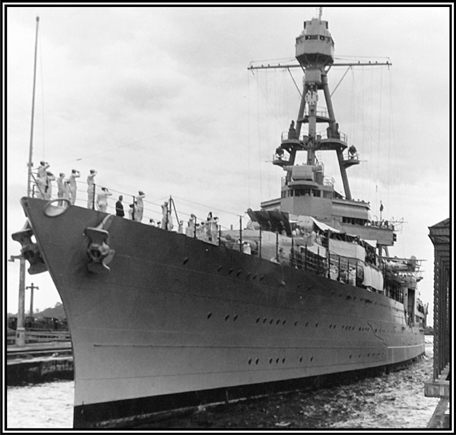
* The Banshee was the Army version of the Navy’s SBD Dauntless dive-bomber.
Part Two

Life brings its own education, and the life of the sea permits no truancy. It says to a man, learn to be a seaman, or die. It takes no slurring answer, it gives no immunity…. The ocean cannot be cheated…. It may not be crossed except by those who know the stars.
— Lincoln Colcord
CHAPTER 9
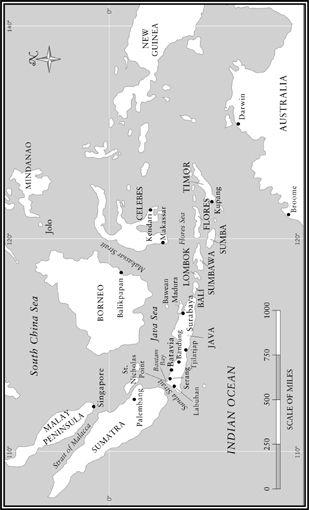
The invasion convoy was twenty miles long, arrayed around two parallel columns of troop transports steaming a mile apart, 650 yards between ships, their extended line humped upward gently by the curve of the earth. Heavy with arms and vehicles and khaki-shirted soldiers enflamed with pride of empire, with backpacks, leather boots, and bundles of battle flags that leached red dye in the squalls and deck wash, the transports of the Japanese Eastern Attack Group pushed through the seas, zigzagging at ten knots.
The majestic sight of it transfixed the captain of the destroyer Amatsukaze, escorting the formation to port. But Cdr. Tameichi Hara’s awe contended with his better judgment. Befitting a responsible commander, he fretted about the uncertainties and risks of the audacious operation. As the rhetoric of conquest was reduced to actual soldiers and ships and planes moving by complex schedules, human imperfection and weakness were becoming all too evident. Hara worried that Allied submarines would be drawn by the transport captains’ carelessness—the black smoke churning from their stacks, their loose attitude toward radio discipline and nighttime blackout doctrine. The flare of a cigarette, seen through the wrong submarine’s periscope, could bring ruin to the entire group.
The two heavy cruisers assigned to guard them, the Haguro and the Nachi, the latter the flagship of Rear Adm. Takeo Takagi’s Eastern Covering Group, trailed the vulnerable convoy by some two hundred miles, exhibiting the supercilious leisure of a triumphant fleet. Those ships would be essential in a face-off with Allied cruisers. Each cruiser carried a main battery of ten eight-inch guns mounted in five double turrets, plus sixteen torpedo tubes loaded with the new Type 93 heavy torpedo, nicknamed the “Long Lance.” Oxygen-fueled and wakeless at a racing-boat speed of as much as forty-nine knots, they delivered a hull-busting thousand-pound warhead up to 43,600 yards—over four times the range of American torpedoes.
Conceit seemed to flow from the highest levels of the Japanese command. The Combined Fleet commander in chief, Adm. Isoroku Yamamoto, flying his flag in the battleship Nagato, moored near Kure in the Japanese home islands, was little bothered by the small force of Allied warships reported to be gathering against him. When he ordered Admiral Nagumo’s carrier force to strike Darwin on February 19, he urged the destruction of dockside storehouses and shore facilities and instructed Nagumo to let the few Allied warships in the area slip away if necessary. “We must secure oil and other resources of the Dutch East Indies,” Yamamoto announced. “That is of higher priority than pursuing any small American force.” The USS Houston had been declared sunk more than once; why trouble with her now? He ordered his invasion forces to sail against Java even before Nagumo and his carriers could join them in support. “The landing operation does not require the support of a major task force,” he declared. He deemed the Allied fleet “completely demoralized” and “no longer in shape to attempt any major action.”
Under the overall command of Rear Adm. Shoji Nishimura in the light cruiser Naka, the Eastern Attack Group had sailed from Jolo on February 19, embarking the Imperial Japanese Army’s 48th Division, veterans of the Philippines conquest. General MacArthur had duly reported them to ABDA. Stopping at Balikpapan, the convoy absorbed most of the 56th Regiment. As Nishimura’s group approached Java from the east, farther to the west Vice Adm. Jisaburo Ozawa’s Western Attack Force, originating from Camranh Bay in Indochina, was southbound with fifty-six transports. The two invasion forces reached slowly south toward their prize.

Rear Adm. Karel Doorman, flying his flag in the light cruiser De Ruyter, left Surabaya harbor near sunset on February 26 sure that invasion was imminent, though less certain what course he should take to head it off. As his ships departed, the wrecked docks were dotted with old men, women, and children—relatives of Dutch sailors, perhaps—waving farewell. Spirits were high, but his squadron’s departure went less than smoothly. As the striking force was getting under way, the De Ruyter struck a tugboat hauling a water barge, sinking both of the smaller ships.
Doorman’s flotilla—De Ruyter in the lead, followed by the Houston, the Exeter, the light cruisers Java and Perth, and nine destroyers from three nations—cleared the narrows between the west coast of Madura Island and Java and reached open water. The time for hedging bets had passed. After months of indecision and scattershot planning, the Allies had a powerful surface force under one command. Doorman would take it to sea and risk everything in defense of his homeland’s exotic outpost.
As the Houston made way, the Exeter turned out and passed her. From her mainmast the British heavy cruiser was flying a bright white battle ensign, twelve feet on a side, illuminated by a ray of the setting sun. Paul Papish on the Houston, seeing the British ship, couldn’t help but think that as impressive a spectacle as it made, the ensign tended to defeat the elaborate camouflage painted on her hull. As the Exeter went by, sailors on the Houston could hear a tune playing over the British ship’s loudspeakers: “A-Hunting We Will Go…” The buglers on the Dutch destroyers blew what sounded like a hunting song too. “Even when we found that it was merely a bugle call to close water-tight doors it still had a fine challenging lilt to it,” remembered Lieutenant Hamlin.
Admiral Doorman took his column east along Madura Island until about 1:00 a.m., turned north, then reversed course west for the rest of the night. He led his ships as far as Rembang, then doubled back east. The Japanese fleet continued to elude him. Probing the night by eye, his lookouts found nothing. Then dawn came, dependably bringing with it the drone of Japanese aircraft. The air-search radar on the Perth detected them above the cloud layer. At nine o’clock a plane broke through and dropped a stick of bombs that splashed harmlessly in the vicinity of the destroyer HMS Jupiter. The attack was a mere gesture. It was the fact that the Japanese had spotted them that carried the greatest threat. Appearing sporadically over Doorman’s Combined Striking Force through the morning of February 27, the Japanese fliers shadowed it and kept Nishimura apprised. Duly alerted, the commanders of the heavy cruisers Nachi and Haguro doubtless knew they would have plenty of time to catch up with the transports and form up for battle.
By noon, with his destroyers’ oil bunkers getting light, Admiral Doorman chose to return to Surabaya. The consecutive nights’ failure to find and engage the enemy did not sit well with Admiral Helfrich. On hearing of Doorman’s return to port, he signaled his striking force commander, “Notwithstanding air attack you are to proceed to search for and attack enemy.” But the air attack was not the reason for Doorman’s withdrawal. He responded to Helfrich, “Was proceeding eastward after search from Sapoedi to Rambang. Success of action tonight depends absolutely on getting good reconnaissance information in time, which last night failed me.” To underscore the condition of his ships and men, Doorman signaled Helfrich at 12:40 p.m., “This day the personnel reached the limit of endurance. Tomorrow the limit will be exceeded.”
About that there was little doubt. The only question was how well and for how long the Striking Force’s sailors could function beyond human limits. Some of the gunners on the Houston had been on alert for twenty-one consecutive hours—an unheard-of marathon of tension, concentration, and strain. On the other ships, things were no better. “Throughout Perth there was general frustration and weariness, accentuated by the enemy’s power to sit over them with aircraft and make fools of them on the surface,” a quartermaster on that ship observed.
At 2:27 p.m. the Allied ships were entering the channel through the protective minefield that lay outside Surabaya’s harbor when at last it happened. From Admiral Doorman came word that a Dutch PBY had sighted southbound Japanese transports twenty miles west of Bawean Island. Doorman had wanted good reconnaissance. Now, it seemed, he had gotten it. “The word spread like wildfire throughout the Houston,” wrote Walter Winslow. “Suddenly, men were no longer tired. This time we were hunting no specter force.” The enemy, long sought and seldom encountered, was less than a hundred miles away. Doorman passed the order to turn around in midchannel and led his squadron back out to sea.
CHAPTER 10
No perfect account can be written of the major naval battle that ensued north of Java on the afternoon and night of February 27, 1942. The documentary record of the Battle of the Java Sea suffers from the deaths of so many key participants and from the loss of so many sunken ships’ logbooks that any narrative is bound to disappoint those who expect naval actions to be carefully tracked and cataloged. But if the details don’t always collate, the truth of the battle is not difficult to tease out.
At 2:45 p.m., as Karel Doorman led his squadron to sea, he sent this message to his captains: “Am proceeding to intercept enemy units. Follow me. Details later.” Absent more specific orders, they would be left to ponder those details for themselves. In the Houston, Captain Rooks called “a hurried but deadly serious” conference in his wardroom, where his gunnery officer, Cdr. Arthur Maher, outlined the obvious and daunting objective: to destroy the enemy invasion convoy, after first disposing of any combatant vessels that might be escorting it. While there was no telling how many Japanese warships might be lurking nearby to protect the valuable flotilla, reportedly it was an inviting target, consisting of thirty-five to forty troop transports.
If only Doorman’s aviators could get a look at it for themselves. The Houston’s aviation contingent had been sidelined. Rooks had just one of his original four Seagull floatplanes left. Enlisted pilot Lanson Harris, Lt. Thomas B. Payne, Ens. John B. Stivers, and Lt. (jg) Walter G. Winslow had practically as little to do as Lt. Jack Lamade, who was still cooling his heels on the Australian west coast. With the onset of the air attacks on the Striking Force in Surabaya, Captain Rooks realized the futility and risk of maintaining his own aircraft. He ordered Lt. Payne, the ship’s senior pilot, to fly the last operable SOC off the ship and find a safe place to hide it while the fleet was at sea. As the crew raced to battle stations, Lanson Harris joined the other idlers from the aviation division seeking a good place to watch the coming battle. Walter Winslow climbed to the signal bridge, scanning the northwestern horizon for Japanese ships and looking on with no small amount of anticipation.
Three British destroyers, the Jupiter, the Electra, and the Encounter, were arrayed left to right in line abreast, forming a van scouting line perpendicular to and about five miles ahead of the cruiser column. Doorman’s De Ruyter led the main body of the Striking Force, followed at nine-hundred-yard intervals by the Exeter, the Houston, the Perth, and the Java. Though the formation looked impressive, its deployment suggested its shortcomings. The Striking Force’s destroyers had been run so hard during the previous few weeks that Doorman could not deploy them as he would have wished. Hamstrung by cranky engineering plants, the John D. Edwards, Alden, Paul Jones, and John D. Ford weren’t fast enough to pass to the head of the formation and take up position on Doorman’s port bow. They settled instead for following in column astern the cruisers. Doorman’s two Dutch tin cans, the Kortenaer and the Witte de With, steamed on his port beam in part because the Kortenaer had boiler trouble that limited her speed to twenty-four knots. Destroyers were called many things—dogs, wolves, cans, thoroughbreds—but never albatrosses.
The Striking Force’s other deficiencies were less apparent to the eye, if equally likely to hamper its lethality. Foremost among these were communications. Despite the development of radio and years spent by different navies creating signal flag systems, Doorman’s ships had a hard time talking to each other. Each nation had its own signals and communications in good order. A naval authority called the system used by the U.S. Navy “a tactical instrument of collective genius, as reliable and thoroughly tested as the laws of physics. It was a treasure of efficiency, cohesiveness and clarity.” But within this multinational force, those virtues were notably overboard. The squadron’s communications were hastily jury-rigged in a futile attempt to accommodate differences in language and protocol.
On the De Ruyter, Doorman broadcast his orders to the Striking Force via a shortwave transmitter in his native Dutch. This was fine for the Java, the Kortenaer, and the Witte de With. But the English-speaking vessels confronted unneeded complexity. A U.S. Navy liaison officer stationed on the De Ruyter, Lt. Otto F. Kolb Jr., and a signalman first class, Marvin E. Sholar, translated the orders concurrently and relayed them via signal light or tactical radio to the Houston, which in turn passed the orders to the Exeter, the Perth, and the destroyers. As a consequence of the translation and rebroadcast, confusion could easily arise as to the sequence of orders. Commanders often could not reconcile them. Even a common language did not guarantee effective communications. If signal flags had to be used, the British and the Americans might as well have been speaking alien tongues, because the British used signal flags that no one else could read.
“Everyone knows that you cannot assemble eleven football players who have never seen each other before, and go out and beat Notre Dame,” Lieutenant Hamlin wrote. “Even if they are good, they need to have some workouts to learn the signals and get to know each other. This team never got any workouts. Two hours after it assembled it was out on patrol.”
“Follow me,” Doorman had ordered. Traditionally, such a command enabled an admiral to lead his column without need of signals. Understated simplicity could work well enough if the squadron shared a foundational understanding of how the commander preferred to maneuver and fight. In this case, noting the murky situation faced by the newly gathered ships of the abortive ABDA organization, critics have said that more should have been required of its commander. The unasked follow-up to Doorman’s order might have been “And then what?”
The battle proper begins at 4:02 p.m., when lookouts on a British destroyer spot three Japanese floatplanes in the north. Visibility is clear, northeasterly winds at Force 1 or 2, the seas rolling with ten-foot swells. On the horizon a blur of gray smoke appears. It grows into a thicker streak of smoke, revealing the presence of distant ships. The minutes pass and soon, by 4:14, steel masts and the tops of foreign superstructures are rising on the northern horizon. Spotting the sprouting thicket of steel, a British destroyer in the van, the Electra, signals to Admiral Doorman: “One cruiser, large destroyers, number unknown, bearing 330, speed 18, course 220 degrees.” Three minutes later, the Electra sends a signal that brings chills: “Two battleships, one cruiser, six destroyers.” Before the report of battleships has a chance to register, another British ship returns a correction: “Two heavy cruisers.”
Anyone privy to the signals exhales in relief, for the difference between battleships and heavy cruisers is as between life and death. Battleships were known to be about. Admiral Nagumo’s carrier group sailed with two of them, the swift Kongo and Haruna,tracking these waters without enemy peer. But these are not battleships—if they had been, their presence would have been forcefully announced at a range of twenty miles. Much to the relief of Commander Hara and the rest of the Japanese destroyer captains, the cruisers Nachi and Haguro are with them now. Admiral Takagi has ordered Nishimura’s troop carriers to withdraw while the cruisers and destroyers settle the question of their access to Java’s beaches.
Within minutes, Lt. Bruce D. Skidmore, stationed high in the Houston’s foremast, reports enemy cruisers bearing thirty degrees relative to starboard, steaming southwest on a nearly perpendicular course to the northwesterly oriented Allied line. The enemy fleet reveals itself slowly, like a winter forest growing out of the equatorial sea. The steel branches proliferate. There is no telling how large it is. On the Houston, a sinking feeling sets in that they are outnumbered. Yet somehow it manages to coexist with a prickle of excitement that the ship is finally going to get to do what it was built for. “We realized help would come, but not today,” said Marine Pfc. Marvin Robinson. “The feeling was—and I think the skipper had a large part to do with this feeling—‘Looky fellows, let’s give them hell. Let’s give them all we’ve got. They’ll be here.’” There is not a man on the Houston who doubts the crew’s morale, even in these most adverse conditions.
A halo of copper-orange flame envelops the silhouettes of two heavy cruisers, the Nachi and the Haguro, before clouds of cordite smoke conceal them and a light reverberation of thunder rolls in behind. Excitement has gotten the better of the Japanese. Admiral Takagi’s flagship and its sister ship in Cruiser Division Five have opened fire at nearly thirty thousand yards. The range is too long by some two thousand yards. The projectiles take more than a minute to travel that far. Well ahead of Doorman’s column, white towers of seawater rise, stand briefly, then collapse from their base, the spray-whipped peaks drifting as mist.
Doorman evaluates his predicament, gauges time and motion, worries that the Japanese ships might beat him to the intersection of their converging courses. If that happens, the enemy will cross his formation’s T, thereby exposing his lead ships to full broadsides from the entire opposing line. Doorman changes course twenty degrees to the left, paralleling the course of the enemy cruisers. The maneuver momentarily hangs the three leading British destroyers out on the cruisers’ starboard bow, closest to the Japanese. The HMS Electra, the right-hand ship in the scouting line, attracts vicious fire. From fifteen thousand yards, the light cruisers and even a few destroyers can reach her. A spectrum of dye-colored foam rises around her. The Electra’s commanding officer, Cdr. C. W. May, has the ship “twisting like a hare” chasing shell splashes. Whether by reason of signaling problems or Admiral Doorman’s tactical preference, the lead British destroyers are kept on a leash. They do not form up to attack with torpedoes. Doorman orders His Majesty’s tin cans to scurry to the safety of the Allied column’s disengaged port side and form up into a column, awaiting their moment.
From overhead comes the buzzing of aircraft, as yet out of sight. Admiral Doorman has requested air support, but the call has gone unheeded. These planes are probably not friendly. On this day Surabaya’s air defense command will concentrate its meager resources on bombing Nishimura’s convoy, not protecting Doorman’s fleet. In the late afternoon, three A-24s escorted by eleven P-40s attack some Japanese troop transports heading for Java, claiming one sunk. Meanwhile, direct support comes from surprising quarters: A PBY Catalina, the type that has first spotted the Japanese fleet this morning, unloads a bomb at a Japanese destroyer. The big patrol bomber would have been more profitably used keeping station over the enemy force, reconnoitering it for Doorman’s benefit. A few U.S. Army B-17s of the Nineteenth Bomb Group, operating from Malang, make bombing runs over the Japanese escorts as well, but to no result.
Watching from the starboard side of the Houston’s signal bridge, Walter Winslow is awestruck by the sight of the fabled Exeter in action, her forward eight-inch twin turrets engaging a light cruiser just coming within range nearly dead ahead. His reverie ends a moment later when he is seized as if by a great hand and thrown against the signal bridge’s gray steel bulkhead, his battle helmet skittering across the deck. The Houston’s own main battery has let loose. Lieutenant Skidmore in Spot One watches the salvo’s flight all the way to its laddering impact, red-dyed splashes rising amid the Japanese cruisers. Via sound-powered phones he sends word from the foretop: “No change to opening range.” Winslow dares to rejoice: Though the first salvo has drawn no blood, it is right on target.
The Houston had a reputation as one of the best gunnery ships of her type. However, as in the gunnery departments of the other members of the Northampton class, things were done the old-fashioned way. She carried no radar to automate the gunlayer’s craft, no remote-control servo motors to take muscle and sweat out of the business of training and elevating guns. Ranges were triangulated by eye, as the fire-control officer optically centered his twin scopes on the target, their angle of convergence registering on a mechanical indicator dial that showed the range in yards. That datum was shouted down a voice tube to the plotting room, or Central Station, deep belowdecks, where the plotting room officer, Lt. Cdr. Sidney L. Smith, operated the ship’s mechanical analog computer. Smith cranked other vital data into the machine—the target’s bearing from the gun director, estimates of its course and speed, and the Houston’s own course from the gyrocompass repeater and her speed from the pitometer—and as the guns lashed out and shells landed, observers spied the shell splashes and called down to Commander Smith gun angle corrections, or “spots.” “Our first shots were fired almost ahead, only about twenty degrees on the starboard bow,” wrote Lieutenant Hamlin, “and with the ship charging ahead at twenty-eight knots the backward kick of those two forward turrets shook the old Houston like a leaf.”
The spotters on the Houston had a clear enough view of the forces arrayed against them: two heavy cruisers just ahead of their starboard beam, and two light cruisers, each leading a pack of destroyers, closer in but farther to the west, bearing about thirty degrees relative.
As the pointer in Turret Two, James W. Huffman sat on a brass bicycle seat in a tight corner of the gun house, sweating in the dim red glow of the battle lanterns. Gripping a two-handled wheel that elevated the three guns, “Red” Huffman kept his eyes fixed on a large synchro-driven indicator dial within which a pair of small illuminated lightbulbs, or “bugs,” revolved in concentric tracks indicating the guns’ actual and on-target elevations. When the turret officer—Ens. Charles D. Smith commanded Turret Two—ordered him to “match bugs,” he would crank his hand wheels to align the bug showing the battery’s actual elevation with the outer bug showing the elevation needed to bring it on target. At the sound of a buzzer activated by the turret captain (a chief petty officer) Huffman would jerk the trigger built into the grip of his left-hand elevation wheel and the big guns would fire. The roar and recoil of the triple eight-inch rifles arrayed beneath him could unhinge the five senses. “Jesus Christ, you just can’t imagine,” Huffman said. “You lose track of every damn thing.” To reload, Huffman lowered the guns to a five-degree elevation so the loaders and rammers below him could stuff the breeches with projectiles and enough powder bags to suit the range. Then he matched bugs again, jerked the handle trigger, cringed at the deep rocking report, and repeated the cycle again.
Turret One developed mechanical difficulties from the fifth salvo, when a fuse box jarred loose from the turret’s bulkhead, disabling the electro-hydraulic ramming mechanism.
From that point on, according to Lieutenant Hamlin, the crew in the Houston’s forwardmost turret loaded and rammed the breech by hand, keeping pace with Turret Two on all but a few salvos. “This is a thing that you couldn’t do in peacetime,” Hamlin wrote, “no gun crew could do it, but they did.”
Some seventy men worked in each of the Houston’s two functioning main battery mounts. Below, loading the two hydraulic hoists that fed the handling room from the Houston’s magazines was exhausting work. Seaman second class William M. Ingram said they were at general quarters so often that he scarcely ever slept in the First Division’s crew compartment. He barely even knew where his bunk was. He kept a pillow and a blanket in the starboard-side powder box. Spartan accommodations and relentless working hours notwithstanding, the gun crews sent five, sometimes six projectiles a minute rushing out at Japanese cruisers that were doing the same thing right back to them.
Scoring a hit with a naval rifle at the extreme range of more than eighteen statute miles was a bit like rolling snake eyes twice in a row. Arcing down after seventy seconds of flight, the projectiles fell at angles nearly vertical to the sea, both minimizing the chance of a hit and rendering a crippling waterline blow virtually impossible. Further reducing the odds was the erratic path of the targets, each ship turning in irregular zigs and zags. This kind of fight had been long rehearsed in exercises wherein victory emerged through seamanship: forming columns quickly to take the initiative, keeping the column closed and free of gaps to concentrate firepower and simplify command, and orienting it to greatest advantage relative to the enemy and the elements, a challenge complicated by wind, heavy seas, and smoke.
For some fifteen minutes as the opening salvos flashed and roared over the Java Sea, the Japanese concentrated their gunfire on the Exeter, leaving the Houston undisturbed. Captain Rooks’s target was the rear Japanese heavy cruiser, the Haguro, trailing Takagi’s flagship Nachi by about half a mile. The Houston’s guns roared, landing 260-pound projectiles all around the enemy ship. Japanese spotter planes launched by catapult from the Nachi and other of Takagi’s ships ranged up and down the length of the Allied column on its disengaged side, safely out of reach of the Houston’s expert gunners. Takagi’s cruisers made good use of the floatplanes’ spotting reports: Their salvos straddled the De Ruyter, Houston, and Perth as well as the Exeter. From the third salvo on, the Nachi’s and Haguro’s “overs” were missing the Exeter by as little as three yards to the disengaged side, indicating the steepness of the projectiles’ fall. Captain Gordon reported a “near-miss underwater well aft” that flooded some compartments and “had the apparent effect of lifting the whole ship in a most remarkable manner.”
But Admiral Takagi wanted a torpedo fight. It was the Japanese Navy’s way of war. Even if he could outshoot his enemy—his cruisers’ eight-inch guns numbered twenty to Doorman’s twelve—his navy’s tactical doctrine favored the undersea missiles as the weapon of decision. His destroyer squadrons were well practiced in the deadly craft. And already Rear Adm. Shoji Nishimura’s destroyers were racing in to demonstrate it. The enemy ships were as yet beyond the range of Houston’s secondary battery of five-inch guns, but the six-inchers of Doorman’s light cruisers would soon take them up. Capt. Hector M. L. Waller of the Perth grew frustrated at his uselessness in a long-range duel. “What possible bloody good can we do here? We should be in there having a whack at them—not sitting here waiting to be sunk.”
At 4:30 the Naka and the seven destroyers with her had closed to within sixteen thousand yards of Doorman’s force. They swung out to port and the torpedoes began hitting the sea. The Haguro joined this volley too, sending eight Long Lances bubbling toward the Exeter. The Japanese ships fired forty-three in all. Admiral Doorman also favored closing the range. His destroyers had torpedoes, but more urgent was the need to bring into the fight his light cruisers’ six-inch guns, the one category of arms in which the Combined Striking Force had superiority.
While the Exeter threw salvos at a light cruiser, broad on the starboard beam, the Houston’s forward main batteries slammed away at a heavy cruiser. After the sixth salvo Lieutenant Skidmore announced, “Straddle.” Four salvos later, flames and enemy blood flowed. Supervising his crew as they rammed the breeches by hand, Lieutenant Hamlin in Turret One couldn’t see much from within his shuddering armored gun house. But through the turret periscope he did see “a dull red glow of the exploding shells” on an enemy cruiser. “I saw us hit this enemy cruiser one very good wallop indeed. I saw flames shoot up from her after high turret and smoke and flames come up in the waist in the neighborhood of the ack-ack battery.” Hamlin recalled:
I whooped lustily and dashed for the voice tube to the gun chamber. The gun crews there do a job requiring closer timing and teamwork than any other game in the world. They have no time to watch the show. I shouted, “We’ve just kicked hell out of a ten-gun Jap cruiser.” The boys came back with a short cheer and I turned to find the talker happily occupying the periscope.
Commander Maher, the gunnery officer, whose vantage point was considerably better than Hamlin’s, observed that the Houston’s target was “put on fire early in the engagement” and mentioned “a fire in the vicinity of the forward turrets.” According to Maher, at 4:55 p.m., a little over half an hour into the battle, “the target was aflame both forward and amidships. The target ceased firing and fell out of column under the cover of the smoke from the fires and from her own funnel.” Ray Parkin, the Perth quartermaster, wrote, “Clouds of black smoke poured out of her top up to three-hundred feet high, but she kept firing.” Captain Gordon of the Exeter, his gunnery officer, and members of his fire-control team saw hits around the “lower bridge structure.” An aerial photo taken by an American P-40 pilot around this time shows a fast-moving Japanese ship trailing an outsize column of black smoke. When men on the Houston heard that a Japanese ship had ceased fire, turned, and withdrawn, spontaneous cheers rose.
With the apparent momentary withdrawal of one of the enemy heavies, the Houston turned her guns on the second. But she would score no further hits on the Japanese cruisers. A frayed electrical lead in the forward main gun director, coupled with the whipping back and forth of the towering foremast housing, led to problems with the Houston’s gunnery deflection adjustments. “The range was perfect,” the turret officer in Turret Two, Ens. Charles Smith, recalled, “but as we continued to fire on this second ship, we could not tell just exactly where the salvo was going to land. Sometimes it would be five mills to the left, sometimes on and sometimes ten mills to the right.” To a ship that prided itself on gunnery, the failure was intolerable.
The Japanese machinery of war was far from perfect too. As more than forty torpedoes were racing toward the Allied cruisers, several were seen to explode prematurely, rending the sea just a few minutes out of their tubes. Captain Hara on the Amatsukazelamented the defective mechanisms. And he marveled at the apparent professionalism of the Allied captains. They seemed to know just when to throw the helm, combing the wakes of the Japanese torpedoes and presenting the smallest possible profile to the deadly fish.
For the Allies, the seeming ritual nature of the engagement ended less than an hour after it began. A medium-caliber projectile struck the Java, while an eight-incher arced down and slammed into the Houston. The latter passed through main deck aft of the anchor windlass, penetrated the second deck, and tore through the starboard side above the waterline without exploding. Another hit ruptured an oil tank on the Houston’s port side aft, but it too failed to explode. Either the warheads were duds or the ship’s treaty-mandated limitations on weight, which dictated lighter armor protection than would become typical for a heavy cruiser, paid the dividend of failing to detonate a projectile engineered to sink ships with heavier hides.
CHAPTER 11
Salvo after salvo exploded into the sea around us,” wrote Walter Winslow, the grounded aviator. “I was mesmerized by the savage flashes of enemy guns, and the sight of their deadly shells flying toward us like giant blackbirds.” Torpedoes approached more stealthily. Their initial release, seldom seen, had to be inferred from the movements of ships. Shortly after five p.m., the Jintsu and six of the eight destroyers with her in Destroyer Squadron Two snaked in toward Doorman’s force, approached nearly head-on until they were about seventeen thousand yards away, and then withdrew behind a smoke screen. The telltale sequence meant that a second wave of torpedoes was on the way, this time sixty-eight in all, forty-eight from the six destroyers and a total of twenty more from the Jintsu and the two heavy cruisers. Trailing the Allied column, the captains of the U.S. destroyers couldn’t see much, but one commander wrote, “Throughout this madness, everyone was painfully aware that torpedoes were knifing their way through the sea toward us, yet Admiral Doorman took no evasive action.”
Then, all at once, all of Doorman’s ships seemed to be swerving out of line. The Exeter, in line ahead of the Houston, had taken a hit. An eight-inch projectile punched through a gun shield on her starboard secondary battery, killing six, then penetrated downward and exploded inside a boiler in the B fireroom, killing ten more men. Power to her main battery failed, quieting her guns. As burst steam pipes screamed, Captain Gordon’s ship slowed to eleven knots, hauling sharply out to port. “We were appalled,” Walter Winslow wrote, “to see a billowing white cloud of steam spewing from the Exeter amidships.”
The British cruiser’s portside sheer threw Doorman’s column into confusion. The concussive quakes of the Houston’s gunfire had shaken her Talk Between Ships radio into malfunction. The delicate arcs in the ship’s signal spotlights were shattered too, and smoke obscured the alphabet flags and Aldis lamps used for communications in their stead. Captain Rooks, unable to communicate, saw the Exeter turn and suspected he had missed a signal from Admiral Doorman. The flagship De Ruyter lay ahead somewhere, shrouded in the smoke. So Rooks turned too, coming abreast of and then passing the wounded Exeter. Maher ordered the Houston’s main batteries to check fire as the turrets rotated in unison, rumbling about to stay on target through the turn. The De Ruytercontinued on course for a moment before Doorman, realizing what was happening behind him, threw a hard port rudder to avoid losing his squadron.
As the cruiser column frayed amid the mounting confusion, Captain Waller of the Perth noticed the sorry state of the Exeter, billowing steam from the depths of her engineering plant. Aiming to cover the British heavy with a smoke screen, he swung the Perth in a counterclockwise loop to the north, racing astern of the south-turning Houston eight hundred yards to the engaged side and firing floating smoke pots into the sea that churned out white clouds. The thirty-foot-high wall of smoke gave the Exeter a reprieve.
The sight of Waller’s ship in action stirred Lieutenant Hamlin’s pride: “I’ll never forget the Perth as she came by there. She was a magnificent sight. Absolutely at top speed, streaming smoke and with battle flags flying at both yardarms and a great big white ensign aft, all guns firing and she looked like a warship really should. One of the finest sights I have ever seen.” In the chaos brought about by the Exeter’s sudden trauma, however, no one seemed to realize the risk in turning south while enemy torpedoes were coming in from the west.
“The sea seemed alive with torpedoes running from all quarters,” recalled Walter Winslow. Some surfaced and porpoised as they ran out of fuel. Others erupted in blasts of spray and debris, self-destructing at the end of their long-range runs. One of them, drifting along at the end of its run, actually hit the Houston, gently glancing off the cruiser’s hull. “It was not going at sufficient speed to detonate,” wrote Ensign Smith, “and it bounced off and fell away.” Not knowing the astonishing range of the Japanese Type 93, many officers thought they had come from submarines. The Dutch destroyer Kortenaer, trailing the cruisers on the disengaged side and now, with the southward turn, screening them to the west, found herself broadside to a spread of Long Lances. One struck her on the starboard side.
A tremendous explosion produced a tower of seawater that swallowed her nearly from forecastle to fantail. When the splash crashed back down upon itself, the ship was revealed again, lying broken in two, jackknifed and foundering, each ruined half of her gray-green camouflaged hull pointing helplessly to the sky like a partly submerged V. According to Ensign Smith on the Houston, “There was only fifteen or twenty feet separating her bow from her stern.”
“Passing close aboard,” wrote Winslow, “we saw a few men desperately scrambling to cling to her barnacled bottom while her twin propellers, in their last propulsive effort, turned slowly over in the air.” A few sailors flashed a thumbs-up sign at the passing American heavy before the remains of their ship disappeared beneath the swells. “No ship stopped to take on survivors,” Winslow wrote, “for any that did could easily have shared the same fate.” The Kortenaer was gone within a minute, her crew left alone to contend with the sea.
Admiral Doorman had ordered his ships to leave survivors alone. In torpedo-riven waters, the risks of stopping were too great. The captains of the leading British destroyers did what they could under the circumstances, scrambling to lay smoke around the Exeterand give Doorman time to reassemble his cruiser line. Though they built a solid smoke wall, it had no roof. Japanese spotting aircraft droned overhead, radioing back details of the chaos.
At around six p.m., as daylight was beginning to fade, the De Ruyter appeared through the smoke and haze, blinkering the signal “Follow me,” a repeat of Doorman’s earlier cryptic command. Captain Rooks, watching the sea for torpedoes and ordering his guns to engage any Japanese ships closing with the wounded Exeter, took the Houston in a clockwise circle and steadied the helm on an easterly course behind the flagship. Captain Waller, having finished laying smoke around the Exeter, saw Doorman’s signal and fell back into line with his retiring peers. The Java followed.
The Exeter’s engineering crew, struggling to coax electrical power from their shattered machinery, seemed to be making progress. Before long, her main battery came back to life, throwing salvos through the smoke at targets somewhere to the north.
Admiral Helfrich was helpless to aid his fleet in its hour of need. At 5:25 p.m., from Bandung, ABDA’s naval commander ordered Admiral Glassford, commander of U.S. naval forces in the theater, to send his submarines to intercept the Japanese convoy, as yet hovering out of sight to the northwest. For Admiral Doorman, there was no telling what the silent service was up to, but his destroyers had torpedoes and now the tin cans were finally able to respond in kind, if not in unison. Doorman signaled, “British destroyers counterattack.” Too widely dispersed to form up in column, they made individual sorties.
The Electra, first into the breech, met ferocious gunfire from the Japanese. In quick succession, three shells struck her. The first, below the bridge, severed internal communications and the gun director’s signals to the mounts. Another hit the forward switchboard, shutting down power in the forward part of the ship. The third destroyed the after boiler room, and with that the Electra shuddered to a stop. When a fusillade of projectiles tore away the ship’s forward gun mount, the searchlight platform, and then one of the rear guns, the captain, Commander May, ordered the ship abandoned. The two other British destroyers in Doorman’s force, the Encounter and the Jupiter, arrived in time to see the Electra burning and dead in the water. The Encounter fired her torpedoes through an opening in the smoke. Attacking separately, the Jupiter was unable to get a torpedo solution on the enemy, and so she stood close by the Exeter, driving off with her gunfire two Japanese destroyers probing the smoke for the wounded cruiser.
The Perth was doing her own probing, firing her six-inch main battery at mastheads visible above the smoke. Once Doorman’s cruisers dialed in the range, the Japanese ships withdrew, and the Exeter, now making fifteen knots, was finally spared. Five miles to his east, through dusk’s failing light, Captain Gordon spied a shaded signal lamp on the Witte de With instructing him to follow the Dutch destroyer back to Surabaya immediately. The two ships would peel away and head south. Leaving the battle scene, they reached port without further drama.
All throughout the engagement, the American destroyers had little clue what was expected of them. The commander of the John D. Edwards, Lt. Cdr. Henry E. Eccles, would remark acidly, “The crystal ball was our only method of anticipating the intention of Commander, Combined Striking Force.” When orders finally did come, they did little to dispel the need for wizardry. As his cruisers retired south, Doorman signaled the destroyers to turn north and make a torpedo attack. Then he canceled the order. Shortly he issued a new one: “Cover my retirement.” At that point, low on fuel, the destroyers had little else to contribute to the battle. Their swimming torpedoes didn’t contribute much either. From long range, as could be expected, they all missed.
The fog of war was billowing out thicker than any smoke screen. One question loomed large: At 6:30 Admiral Doorman radioed Helfrich at Bandung, “Enemy retreating west. Where is convoy?” In the De Ruyter, Doorman curled sharply back toward the northwest, leading the Perth, Houston, Java, and four U.S. destroyers, perhaps in search of an opening through which to locate and attack the Japanese troopships. Clearing some smoke around 7:30, they again ran into the ubiquitous Nachi and Haguro.
As Captain Hara related it, the two heavy cruisers were unprepared for the encounter, having stopped to retrieve floatplanes they had launched at the battle’s outset. As the Allies approached, the Nachi’s boatswains were busy with the amidships crane. When they finished hooking up and bringing the last plane on board, the Nachi’s engines roared to life. The Japanese ships laid smoke to cover their withdrawal and within a few minutes were at eighteen knots. Though Admiral Takagi refrained from using his searchlights because he knew he was vulnerable, his ships opened fire with their main batteries at thirteen thousand yards. The cruisers traded salvos for about ten minutes until the Perth’s Captain Waller, spotting flashes along the length of the silhouetted enemy ships and suspecting a torpedo launch, turned sharply away. Evidently wishing to spare his cruiser’s faltering ammunition stocks, and perhaps despairing of his chances of blazing a path to the invasion convoy through the gunfire of its most powerful escorts, Doorman broke off the engagement. He swung his squadron away to the south.
The Nachi and Haguro, both of which would go on to post gaudy combat records through the Pacific war, had escaped a most dangerous trap. In Doorman’s failure to see the plight of the momentarily exposed Japanese cruisers, he forfeited his best chance yet of reaching the transports concealed behind them over the northern horizon. The record reflects no sign that the Allies ever appreciated the tactical opportunity that had just washed over their bows and drained out the gunwales. Like so many opportunities, it had arrived unannounced and vanished without ceremony. They would get only one more like it.
CHAPTER 12
Night fell. The wind went away with the sun, and the torn seas were permitted to slumber, smooth and glassy and glinting with the light of a rising full moon. The Japanese ships were gone. What wounds they might be tending were, and might ever remain, unknown. The wounds suffered by the Combined Striking Force were many and manifest. And for all their sacrifices, the danger to the Dutch East Indies loomed as great as ever. Thousands of Japanese troops were out there still, no doubt growing restless as soldiers out of their element will. They would bide their time at sea.
As Admiral Doorman led his ships southward toward Java’s northern coast, he received from the Dutch commander of the Surabaya naval district a three-hour-old report from a U.S. bomber that forty-five enemy transports, three cruisers, and twelve destroyers were just twenty miles from Bawean Island. Given the unfortunate vintage of the sighting report and the swift setting of the sun, his chances of intercepting them seemed about as good as the prospects for his home island in general.
The persistence of daylight had been his last hope to find and destroy an enemy who was all too lethally well trained to fight after dark. Ahead a lighthouse stood near Toeban, warning Doorman of his proximity to land. Nearly as dangerous as the newly planted minefields off that coastal town were the shoal waters that threatened the keels of his deepest-draft ships.
During the lull on the Houston, hastily prepared sandwiches and coffee were distributed. Crews in the engineering compartments, gun mounts, and magazines, worn from the nonstop action, paused to eat and rest. Their hardware had withstood similar strain. Turret One had fired 261 salvos since installation, 97 just that afternoon. Turret Two had fired 264, 100 that afternoon. The life of an eight-inch gun was about 300 salvos. From the long barrels of the rifles, the liners were creeping out as much as an inch or more from the muzzle. The gun casings were so hot they could not be touched for hours. The ventilation systems in the shell decks, handling rooms, and magazines were utterly inadequate. Fighting 140-degree heat, men who didn’t lose consciousness altogether during the battle stood in three inches of melted gun grease, sweat, and urine. The violent sheering of the ship sloshed that fetid brew everywhere, into the breech trays and onto the powder cases. The mixture of human and industrial stenches crept into every compartment without a watertight seal.
Doorman changed course to the west, paralleling the north coast of Java. Shortly after nine p.m., the four U.S. destroyers that had so doggedly brought up the Striking Force’s rear had become too low on fuel to continue. The destroyers weren’t the only Allied ships low on critical consumables. The Houston had passed word to the Perth’s Captain Waller via voice circuit that her two forward mounts were nearly out of eight-inch ammunition. The shortage was the unavoidable result of an unprecedented four-hour gunnery marathon. At one point Otto Schwarz of the Houston, stationed on the shell deck below Turret One, had been assured by a chief that naval battles were always over in a hurry. He told Schwarz there had never been a naval battle that lasted longer than twenty or twenty-five minutes. The limited stock of ready ammunition in the turret would be all the gunners would need. Some eight hours later, the men in Schwarz’s compartment were still hauling greasy shells out of the storage racks. When they were gone, the crew began the backbreaking job of hand-carrying 260-pound projectiles, swaddled in slings made from cloth sheets, from the aft magazine up through the labyrinthine passageways leading forward, across the deck, and down into the two forward handling rooms.
Twice between eight and nine p.m., lookouts called out sightings of enemy destroyers to the east. But they were phantoms, alive only in the imaginations of the watch personnel skittish from four hours of combat. What other threats lurked in the night could only be guessed. Mysterious yellow lights appeared in the water, seeming to rise from the deep in the wake of Doorman’s ships as they steamed. Some observers thought the lights marking their path were the by-product of their disturbance of a shallow sea. “As fast as we popped one group of lights astern, another popped up about a hundred yards to port,” Walter Winslow wrote.
In fact, the lights were not surfacing from below. They were floating down from the sky, parachute-harnessed calcium flares dropped by Japanese spotter plane pilots every time Doorman changed course. The flares traced their track so relentlessly that Jim Gee thought the Japanese had tied them together on strands to be caught by the Houston’s prow and dragged along behind her “like a long string of Christmas lights.” What little chance Doorman had to break through and attack the transports vanished. Takeo Takagi knew his every move.
Karel Doorman was about twenty minutes into his westward coastal run when a great blast swallowed the last ship in his line. The flash of the explosion settled into a moonlit flood of steam, and against that hellish backdrop sailors on the Dutch light cruiser Java looking astern could make out a lamp signaling, “jupiter torpedoed.”
At least it seemed like a torpedo. The explosion tore the British destroyer’s hull on the starboard side, abreast of the number-two boiler room’s forward bulkhead. Though more Long Lances lay in store for this Allied fleet, this was not one of them. It was a mine, part of a Dutch field planted off the coast that very day in anticipation of the coming invasion. Admiral Takagi had declined to pursue Doorman south out of this very fear. Her back broken, the Jupiter floundered and settled and took her time sinking, joining the Kortenaer and the Electra in death. Just seventy-eight of her crew reached the beach, and another handful were later retrieved from the sea by the Japanese.
Perhaps thinking he might seize a last opportunity to reach the convoy, Doorman steered north again, knowing that with every thumping turn of his ships’ steam-driven screws, Japanese aircraft watched him from overhead. At about 9:50 p.m., Captain Waller spied one, glinting by the moon’s light. Shortly thereafter the Allies’ new northerly course was etched in blazing calcium, another string of floating flares tracing their track.
Nerves rattled as the ships passed back through waters that had been their battlefield in the afternoon. The swells here and there were dotted with men adrift—survivors of the Kortenaer. The orders to ignore them stood. The area was still too hot for a rescue attempt. Clinging to or standing in their life rafts, the Dutch sailors blew whistles and hollered, looking for help. As the Houston passed within sight of the survivors, her deck force threw a raft overboard and illuminated the area with a flare. The HMS Encounterstopped—on whose authority it remains unclear—and took aboard 113 in all.
There was yet an enemy to hunt, and the quarry reappeared around 10:30 p.m. The Nachi and the Haguro, last seen some four hours earlier, now materialized to port, bearing down from the north on an opposite parallel course before looping around and tracing a parallel northerly course at a range of thirteen thousand to sixteen thousand yards. Concerned with dwindling ammunition stocks—the two cruisers had fired more than twelve hundred rounds that afternoon, and 348 more after dark—their commanders fired at a deliberate pace. It was futile to engage at that range by night. Star shells couldn’t reach that far. The phosphorous-filled projectiles needed to burst beyond their target in order to silhouette it properly. The Houston fired several illumination rounds, but they fell short, as did those fired by the Japanese. But the night afforded its own illumination. Lieutenant Hamlin wrote, “We stopped shooting star shells and settled down to just shooting at each other by the starlight.”
A few projectiles landed close enough aboard to thrash the sides of the Houston’s hull underwater like chains flailing at a tin roof. Japanese guns scored on the De Ruyter, hitting the flagship on the quarterdeck. For good measure, the Nachi and the Haguro put a dozen more torpedoes into the water, sixty degrees to starboard, at targets eleven thousand yards away. The ships entered a rainsquall as their commanders counted down the torpedo runs.
Captain Waller was conning the Perth behind his squadron flagship. Seeing the De Ruyter turn and surmising that Doorman had spotted inbound torpedoes, he changed course on cue. The Houston and the Java followed the Perth, pregnant minutes passing before the night was again lit by a blast. It was the Java, taking a torpedo aft. Charley Pryor, scanning the Houston’s port quarter with binoculars, saw her blow. He saw bodies flying through the air, silhouetted by flames, the water burning. Red and pink streamers flew everywhere from the column’s rear. The blast was powerful enough to be felt by crewmen topside on the Perth. Flames leaped above Java’s bridge. She sank so quickly—in about eight minutes—that her steel had no time to melt.
Another torpedo struck the De Ruyter so soon after the first one hit the Java that some witnesses took it as a simultaneous cataclysm or confused their sequence. The flagship “blew up with an appalling explosion and settled aft, heavily afire,” Captain Waller observed. “It happened with the suddenness and completeness that one sees in the functioning of a good cigarette-lighter—a snap and a burst of flame,” wrote Lieutenant Hamlin. The inferno’s heat was so intense that sailors on the Perth, following several hundred yards behind the flagship, could feel it on their faces. “I thought it would fry us,” one Australian recalled. “It was so close you could smell burning paint and a horrible stink like burning bodies.”
Reprising what happened that afternoon with the Exeter, the sudden crippling of the De Ruyter derailed the column like a jackknifing freight train. “Captain Rooks frantically maneuvered his cruiser to avoid torpedoes,” Walter Winslow wrote, “and then ordered the Houston into a hard right turn, unaware that the Perth, whose captain was now the senior officer, was overtaking us to starboard in an effort to assume the lead.” Captain Waller had to stop his port engine and turn the helm all the way over to port, and the Perth “just scraped by the port side” of the burning flagship. The Houston sheered out to starboard, nearly colliding with the Perth. Rooks ordered emergency full astern while Ens. Herbert A. Levitt grabbed the wheel from the helmsman and brought the ship back to port, avoiding the Australian cruiser by a mere twenty-five yards.
As the De Ruyter’s crew gathered forward to escape the flames eating the back half of the ship, the fires reached the forty-millimeter antiaircraft ammunition stowage, and small explosions began popping amid the sailors. Glowing metal fragments shot into the night as the ordnance went off en masse. As the fires worsened, Admiral Doorman had no choice but to order abandon ship. One of his last earthly acts was to instruct the last two serviceable vessels under his command, the Houston and Perth, to head for Batavia rather than stand by to recover his survivors. The standing order that disabled friendlies should be “left to the enemy’s mercy” came with no exemption for an admiral. Left behind, the De Ruyter fought the clutches of the sea for nearly an hour and a half before she finally sank. Ensign Smith in the Houston “counted nine separate and distinct explosions before we cleared the horizon.”
Karel Doorman was never seen again. Admiral Helfrich had ordered him to fight to the end, and that is precisely what he did. “The Houston and Perth raced on into the night,” wrote Walter Winslow. “Behind us blazed the funeral pyres of our comrades-in-arms, whom we deeply mourned.”
CHAPTER 13
As the growl of naval gunfire washed ashore on Java, only the most naive of the battle’s proximate witnesses could fail to appreciate its sinister meaning. An American B-17 pilot stationed there recalled, “Walking to the telephone building I could hear a dull rumble in the hot midnight air coming from far over the water. The few people in the blacked-out streets assumed it was distant thunder. I knew it was the little Dutch Navy in its final agony out there in the dark.” The men of the U.S. Nineteenth Bomb Group at Malang were closely acquainted with the mounting disaster. The sound of the naval battle out to sea seemed to herald the end. A pilot recalled, “Java died that night in the gunfire which came rolling in over the water.”
But two ships yet lived. By night the Houston and the Perth raced westward, bound for refuge and replenishment. For a time, the Japanese pursued them. Admiral Takagi, whose cruisers had ranged miles to the northwest by the time their torpedoes hit the two Dutch cruisers, had wanted to finish them off. As crewmen on the decks of the Nachi and Haguro leaped and danced and shouted “Banzai!” as fires raged on the waters to their southeast, Takagi approached the Java and the De Ruyter in their death throes and instructed his gunners not to waste precious ammunition on them. “They are done for,” he said coolly.
At midnight the Nachi and Haguro spotted silhouettes to the south-southeast. As Takagi’s destroyers sought in vain to locate and engage them, his cruisers opened fire on “four cruisers.” But whatever they were shooting at slipped away. Puzzled by the disappearance of the surviving Allied ships, Takagi called off his search around three a.m. Commander Hara would call the admiral’s inability to finish off the survivors “the last Japanese mistake of the battle,” though it would become clear soon enough that mistakes had been predominantly the domain of the Allies.
The Houston and the Perth formed a short column and chased rainsqualls to elude their pursuers. Standing orders were for all ships to sail to Batavia if the squadron got scattered. They were to make the three-hundred-mile run to refuel, then pass through Sunda Strait, head down to Tjilatjap to evacuate Allied soldiers and airmen gathering on Java’s south coast, then continue on to Australia. At 8:40 p.m. on the night of February 27, the Houston sent a dispatch labeled “Urgent” to Admiral Glassford: “HOUSTONandPERTHretiring to Batavia Arrive about 1000 tomorrow X Request pilots and air protection if available.” Whoever could manage it found a place to sack out on deck. The heat and smell in the lower decks were simply too much. Hatches were thrown open, letting the hot ferment of battle vent into the night.
Though the ship’s stocks of ammunition and fuel were low, the crew’s morale, as ever, was improbably high. It had been high when they were spending day after day at general quarters at Surabaya, helpless against the droning assault of Japanese bombers. It had been high when they finally entered battle against the Japanese Navy, and high still as their enemy routed them. Now, more understandably, morale was high because at last, against all odds, they were about to see sunrise on February 28. When one Allied ship after another was bursting into flames all around them, no one would have put much money on it.
The terror they had experienced was a frightening preview of the trials the U.S. Navy would face after dark against their well-practiced enemy. Before the war, plenty of reasons were found—compelling enough in peacetime—to neglect difficult and dangerous night exercises. Adm. James O. Richardson, commander in chief of the United States Fleet, wrote, “In the era before radar, close-in night exercises brought great risk of collision, loss of life, and expensive ship repairs.” In other words, they were very much like actual night battles. He might have endorsed them by the same measure. As a result of this hesitancy, Navy commanders would not see nighttime torpedo attacks launched by hard-charging cruiser and destroyer captains until they confronted the real thing under the least forgiving of circumstances.
Captain Rooks was well aware of the rigorous emphasis his enemy had given to night fighting. In his analysis of the Japanese threat titled “Estimate of the Situation,” written just three weeks before Pearl Harbor and turned over to a colleague for safekeeping when the Houston was in Darwin in January, Rooks referred to the Japanese claim to being “the world’s most capable users of the torpedo” and described their aggressively realistic doctrine for their use in night actions. There was no denying their lethality. The Allies’ bloody discipleship at the feet of the Imperial Japanese Navy’s torpedo virtuosos began with the Battle of the Java Sea. That Rooks, his ship, and gallant crew had survived it was sheerest happenstance.
Once daylight came, revealing no enemy ships nearby, it seemed reasonable for the first time to hope that the Houston might escape the flash flood of Japanese power and regroup in Australia for the long war ahead. “I don’t think there was ever a minute that we didn’t feel that we were going to make it, that we were going to come out on top of this,” said Jim Gee of the Houston’s Marine detachment.
Arriving at Batavia in the early afternoon of February 28, the two ships were stalked briefly by a flight of Japanese torpedo bombers before Dutch Hurricane fighters scattered them in a rare and probably accidental moment of interservice cooperation. At three o’clock Admiral Glassford reached Captain Rooks via secure telephone. “He was so very cheery,” Glassford would write to Edith, “and the more so because [he] had gallantly engaged the enemy.” As the admiral gave Rooks his instructions, a harbor boat met them outside the breakwater and its pilot guided them through its protective minefield.
There wasn’t much to protect. As the Houston and Perth entered port, several merchant ships could be seen resting at odd angles on the harbor floor. What the Japanese planes had not yet smashed lay abandoned in place. Once bustling with industry, Batavia’s port district, Tanjung Priok, looked like a ghost town. As the cruisers moored to the pier to refuel, keeping up steam for an early-morning departure, it was clear that most of the harbor workers were gone. The Javanese and Malayan natives had learned to resent four centuries of European rule. But the Japanese were an as yet unknown quantity. The natives heard promising talk of a Greater East Asian Co-Prosperity Sphere. They would find a safe place to await the arrival of the “liberators.”
Rooks and Waller went ashore and took the Australian officer’s staff car to the British Naval Liaison Office. There they received an encouraging report. According to Dutch air reconnaissance, Sunda Strait was wide open. The closest imperial warships were seventy miles to their northeast, heading east. The enemy had nothing within a ten-hour sail of the passage. Rooks and Waller were warned not to fire on any friendly patrol craft that would likely be watching Sunda Strait.
Escape seemed to be on everyone’s mind. Ashore, the Dutch were more interested in rendering the port useless to the Japanese than servicing the Allied ships that now needed them. With evacuation plans in motion, sappers were readying to blow up the dockside warehouses and other facilities. Workers at the soon-to-be-demolished canteen store were generous with their inventory, allowing the sailors to make off with whiskey, cigarettes, and other goods previously earmarked for the “Victualling Officer, Singapore.” Captains Rooks and Waller divvied up a dozen large life rafts that were stacked up on the dock. But more precious cargo eluded them.
The supply of fuel oil available to ABDA naval forces was desperately short. With the sea route from the massive refineries at Palembang, Sumatra, imperiled by Japanese forces, tankers could no longer make the run to Java. The island was down to its native capacity, just 22,000 tons per month. Java’s storage facilities, though large, were located inland and now effectively inaccessible given the abandonment by many native workers. Admiral Helfrich accordingly notified his naval commanders, “Oil position is serious. Every effort must be made to reduce expenditure provided operations against the enemy are not prejudiced…It is essential that oil be moved from Surabaya to Tjilatjap and Tanjung Priok as soon as possible.”
When it was sprayed into the furnaces that heated a ship’s boilers, the Dutch oil, lighter and less viscous than standard American Bunker B, didn’t produce enough volume for a ship to generate full power. With the warm Java Sea waters already impairing the efficiency of her condensers, the best the Houston could do was twenty-seven or twenty-eight knots, well short of her rated thirty-two. At Tanjung Priok on February 28, only 760 long tons of furnace fuel were on hand, and the Dutch were inclined to be miserly with it. Admiral Helfrich had instructed the port authority at Tjilatjap to keep the available fuel for their own nation’s fleet. “No further fuel will be issued to U.S. naval vessels,” Glassford informed his commanders. “Unless otherwise instructed we will fuel our [ships] from [the oiler] PECOS.”
The harbor authorities rebuffed the Houston’s and Perth’s requests for fuel, informing Lt. Robert Fulton, in charge of fueling, that it was on reserve for Dutch warships.
When the Americans and Australians informed them of the disaster off Surabaya and the loss of most of the Dutch Navy, the harbor masters yielded a bit. Some cajoling and arm-twisting got three hundred tons of oil pumped into the Perth, bringing her bunkers to half capacity. The Houston got somewhat less. One of the dud projectiles that struck her during the Java Sea action had penetrated her oil tanks, making it impossible to fill them above a certain level without leaking an oil trail. But some thought her 350,000 gallons on hand was adequate to reach Australia.
It was clear the Houston would not make the trip in her accustomed high style. Like the Perth, she was about as battered and salt-worn as her crew. “Concussion from the main batteries had played havoc with the ship’s interior,” Walter Winslow wrote. “Every unlocked dresser and desk drawer had been torn out and the contents spewed all over. In lockers, clothes were wrenched from hangers and dumped in muddled heaps. Pictures, radios, books and anything else not bolted down had been jolted from normal places and dashed to the deck.” The well-appointed admiral’s cabin, which marked the Houston as a flagship, standing ready for use by any flag officers or adventurous U.S. presidents who might happen to come aboard, was a mess of ruined luxuries: overturned furniture, shattered glass and china, and drifts of soundproof insulation torn and jarred from the bulkheads. Scarcely a piece of glass was intact. Portholes, lightbulbs, mirrors, searchlight lenses, crystal tumblers, picture frames—all had been shattered by the impact of battle. The concussion of Turret Two, which often fired while rotated to an extreme after bearing, had popped rivets and metal fittings and battered the weather shields girding the bridge, as well as damaged the signal searchlights on the navigation bridge. The guns themselves needed replacement.
The Perth was equally bad off. After the battle, an exhausted Hector Waller went to his cabin to rest for a spell. The forty-one-year-old captain sorely needed it. “He had been off-color for days,” remembered a Perth sailor. Jaundice had cast his skin in a pale yellow. Arriving in his cabin, he had to sweep his bunk clean of glass shards before lying down to rest.
On both ships, the buzz now centered on two things: what might have been in the disastrous battle they had just survived, and what might yet come to pass in the urgent days ahead. As to the first question, the American sailors speculated how it might have gone differently had the Boise or Marblehead or Phoenix been with them. For the men of the Perth, the absent savior was their old Mediterranean squadronmate, the heavy cruiser HMAS Australia, whose gunnery, they said, was as good as it got. The Aussies felt that if a proven fighter such as “ol’ Hec” had been in command rather than Admiral Doorman, the Combined Striking Force would have been handled more aggressively and decisively.
Captain Waller’s reputation had swelled with his successes in the Mediterranean. Commanding the destroyer HMAS Stuart, he had won two Distinguished Service Orders, one for his gallant turn during the Battle of Matapan, where the Stuart contributed more than a destroyer’s share to the Royal Navy’s greatest victory since Trafalgar and helped end Italy’s challenge to the naval balance of power. Waller had a reputation as a fighter and a hands-on commander. He liked to read and send his own signals. He proved his marksmanship by blasting floating mines with his own rifle. Visiting the governor’s palace in Malta, he had had both the temerity to tell the island’s First Lady that her famous rose garden was poorly pruned and the skill to wield the clippers himself and improve it. “Leaning against his bridge rail or walking the quarterdeck or even in civilian clothes he seemed to broadcast strength—the inner controlled strength of a man who knew where he was going, and knew why,” Ronald McKie wrote. Heavy-shouldered and balding, with rounded facial features, he was stern and serious-minded but given to seasonable playfulness. His odd mix of traits enabled his dour aspect to become its own brand of charm. Though his full given name, Hector Macdonald Laws Waller, might have suggested he had been bred to dine with fine silver, he lacked pretense utterly. A naval career had in fact been his sole professional purpose since the age of nine.
The consensus among the Monday-morning quartermasters was that the three light cruisers should have operated independently of the heavies and charged with the destroyers straight at the Japanese, while the Houston and the Exeter blasted away from afar. The Americans could only guess at the destruction they would have wrought had their after eight-inch battery been working. Its untapped potential was plain to see—and haul. For the better part of that afternoon in Tanjung Priok, the crew continued loading projectiles from the after magazine on bedsheets and carrying them six hundred feet to the depleted forward magazines and handling rooms. The treacherous hike was considerably easier to do while the ship was moored rather than pitching and rolling at sea in the midst of battle.
Beyond the second-guessing, most of the sailors were elated to have survived at all. Having paid their way, they felt they had earned some respite now in safer harbors. “Everyone was lighthearted, and thinking that we had done our share, and done our best,” Lloyd Willey said. “We thought it would be great to see the United States again.” Others looked forward to more immediate good times in Australia.
While the crew was trying to get refueled, the Houston floatplane pilot who had stayed behind with his aircraft in Surabaya, Lt. Tom Payne, radioed word that he would fly to Tanjung Priok that afternoon to rejoin the ship. When he arrived, approaching the harbor from the sea, the raw-nerved crew of a Dutch shore battery opened fire on his Seagull at long range. As explosions of flak burst all around him, Payne touched down beyond the breakwater, cursing vigorously. As he began to taxi in, a Dutch torpedo boat motored out to inspect him. The Houston’s crew watched with some trepidation, unable to inform the boat that it was their shipmate. To their relief, it circled Payne’s aircraft and escorted him back into the harbor. “Tom was hoisted on board,” Walter Winslow wrote, “perplexed, to say the least, by his less than cordial welcome.”
CHAPTER 14
Naval service is a highly technologized trade. In it, life is simplified to the degree possible around the practical application of repetition-driven training. In the age of practical mechanics, efficiency was the route to advancement—and, in war, to survival. Training was designed in part to reduce war’s emotional calamities to the mastery of innumerable arcana, mechanics, and procedures. And yet somewhere along the way this rational world seemed to turn back on itself and touch a spiritual plane. As sailors’ worlds contracted around their narrow specialties, it was easy for them to feel as much like initiates in a mysterious brotherhood as cogs in a machine. Vestiges of the mystical remained. And despite their determined optimism, dark superstitions lurked everywhere.
While she was preparing to leave Fremantle for the East Indies, the Perth had been recalled three times before finally receiving orders to depart at 11:30 on February 13. Confronted with the unlucky date, Captain Waller intentionally delayed standing out till after midnight on the fourteenth. One did not idly tempt the fates. Unease was already rife on that ship. The Perth sailors realized at one point that two chaplains were on the roster, and contemplated the apocalyptic implications. “One was bad enough,” Ronald McKie wrote, “but two—that was lethal.” Another omen: While the Perth was firing on Japanese planes, a portrait of Marina, Duchess of Kent—it was she who had rechristened the ship as the Perth in 1939 after she was acquired from the Royal Navy as the HMS Amphion—fell from the wardroom bulkhead and crashed to the floor. Clearly dark ghosts were at work.
But perhaps the most striking portent involved the feline mascots of the Houston and the Perth. “I don’t know if Captain Rooks had anything to do with this or not, but it seemed very strange,” remembered Seldon Reese, a seaman first class on the Houston. As Rooks walked down the gangplank for a meeting of commanders, the ship’s cat “took off down that pier into Java like some big hound dog. You never saw a cat move so fast in your life.” Apparently the animal had had enough of life on the ship, be it a favorite of the president or not. Crewmen who witnessed the incident were nearly as spooked as their feline ex-shipmate. It gave substance to a fear expressed by Lieutenant Winslow—“that, like a cat, the Houston had expended eight of its nine lives and that this one last request of fate would be too much.”
The Perth’s black cat, Red Lead, had been given to a sailor at a New Year’s Eve party in Sydney in 1941. The feline had lived life as seagoing contraband until one day his owner devised to sneak topside and release the cat when Captain Waller was on duty on the bridge. The affection-starved animal snaked around Waller’s legs. To the delight of the sailor, the captain adopted the cat, removing the risk of its expulsion by officers junior in rank but superior in adherence to the book. In port now, Red Lead tried three times to desert the ship. The master-at-arms finally had to put him in “irons,” sticking his paws in a kerosene can with holes cut in it. The animal seemed to know something.
At dusk on February 28 the two ships got under way from Batavia. The Dutch destroyer Evertsen, also in port, ought to have joined them, but her commander had no orders and her boilers had no steam, and either deficiency was enough to keep her in port no matter how much the cruiser captains may have wanted her as an escort. Without a harbor pilot to guide them, trusting their own charts and the coming full moon—it would be bright enough to allow the antiaircraft rangefinders to take navigational fixes on shore—Rooks and Waller led their ships through the minefield channel without incident, and increased their speed to twenty-two knots. Their bid to reach Australia was all that remained.
Walter Winslow wandered out on the quarterdeck by the port-side catapult tower. Looking astern, he watched Java’s darkening junglescape shrink in the flow of the ship’s trailing white wake. “Many times before I had found solace in its beauty, but this night it seemed only a mass of coconut and banana palms that had lost all meaning. I was too tired and too preoccupied with pondering the question that raced through the mind of every man aboard. ‘Would we get through Sunda Strait?’”
On the Perth, officers in whites assembled on their own quarterdeck to salute the striking of the ensign at sunset. Captain Waller held Red Lead, scratching him absently as the bugle pealed. An officer on the Houston had asked, as his ship was passing north through Sunda Strait on February 24, whether anyone had heard what he had: the sound of a gate clanging shut. The Perth’s engineering officer, Lt. Frank Gillan, felt a similar breath on his neck as he saluted the falling flag. According to Ronald McKie, “He felt that this moment at sundown was a dividing line between the past and the future and that somewhere a decision had been made affecting his life and the lives of them all.”
Another night fell, quieter than the last. The two ships sailed west toward what they hoped would be a more promising tomorrow.
CHAPTER 15
The sea was calm. The moon would soon rise, bright and full. Those who managed to sleep did so fitfully. Those who could not sweltered in the nighttime heat. On the bridge, Captain Rooks and the rest of the officers of the watch clung to the reassuring Dutch reconnaissance report that the strait to the west was clear. Though the Japanese fleet seemed to be everywhere, at the moment the two ships seemed to be catching a break. The Japanese controlled all of the waterways leading out of the Java Sea except one. Sunda Strait, the narrow outlet into the Indian Ocean, lay open.
They had nothing to guide them but their eyesight. The Houston, with no radar, relied on the limited capabilities of the Perth’s air-search set, but it was generally confounded by the mess of islands cluttering these waters. So all eyes watched the dark. Off duty and hungry for sleep, Walter Winslow went to his cabin, navigating by the dim blue glow of battle lights set close to the deck at his feet. He switched on a flashlight briefly to find his cabin door, stepped in, and moved to his desk. Sitting on top of it was a carved wooden figurine, a Balinese head that he had bought on his first visit to Surabaya and had seen fit to name Gus. Standing in the dark, Winslow said, “We’ll get through this O.K., won’t we, Gus?” He felt sure his little friend on the totem had responded with a nod.
Eleven o’clock came and went. Soon the lighthouse on Babi Island was visible about a mile and a half off the starboard bow. Ahead and to port, Java’s coastline dropped away where Bantam Bay opened up, then returned in the form of St. Nicholas Point, marking the northern opening of Sunda Strait. About seventy miles separate St. Nicholas Point, located at the strait’s fifteen-mile-wide northeastern bottleneck, and the Java Head lighthouse that marks its southwestern opening into the Indian Ocean. In the center of the strait lies a rocky cluster of islands whose very name evokes cataclysm. The explosive self-destruction of the island of Krakatoa in 1883 reverberated from Bangkok to western Australia, shook the hulls of ships eighty-five miles east in Tanjung Priok, sent aloft the ashen remains of six square miles of rock, and killed some 36,000 people. It had reformed the contours of this rocky passage between the Sumatran and Javanese headlands. Because the entire Dutch East Indies lie along the fault line between the Eurasian and Australian tectonic plates, Java and the seas surrounding it are ever alive with volcanic activity.
Sunda Strait’s powerful currents run always to the south, counterparts to the northerly flows that prevail in the straits east of Java, in a sense making the entire island a vortex in a whirlpool more than six hundred miles across. Krakatoa’s remnants are eddies in Sunda’s flow, creating currents and rips strong enough to sink ships, the wreckage of which swiftly washes into the wide Indian Ocean. The deep paroxysms of geology that opened the celebrated passage had catered to the needs of traders and adventurers ever after. Merchants and travelers alike would use Sunda Strait for east-west transit. For those getting rich selling pepper and nutmeg, or exploring Oriental and Polynesian frontiers, it was the gateway to opportunity and discovery. And it had known war as well. For Kublai Khan, transiting the strait in the year 1293 with a thousand ships and twenty thousand men, it was an avenue to pacifying an upstart Javanese king who had snubbed the Mongol leader by sending his ambassador home less his nose. For Captain Rooks, who had brought his ship north through this strait seeking a fight with the enemy, it offered a route to survival.
“Ever since the night of the 23rd,” wrote Lieutenant Hamlin, “when I last looked at this body of water, I had been getting on fine with a thoroughly fatalistic attitude. Not pessimism, just a fatalistic attitude. Now I began to see rosy visions of the Houstonsteaming into an Australian port. Then the long trip home for a new turret, and a visit with my wife.”
On the Perth, yeoman of signals Eric Piper was “pacing the flag deck exhorting everyone to be alert.” It was no idle pep talk; many of the sailors were faltering from exhaustion. When Lt. Lloyd Burgess finished his four-to-eight-p.m. navigator’s watch that evening, he was so tired he couldn’t remember a single order he had given or the name of a single crewman he had spoken to.
The strait ahead demanded the strictest vigilance. On either side, land formed a backdrop that rendered ship silhouettes invisible after dark. Commanding the machine-gun platform high in the Houston’s foremast, Marine gunnery sergeant Walter Standish remarked to Sgt. Joseph M. Lusk and Pfc. Howard R. Charles, “They could hide a battleship out there, and we’d never see it until it attacked.” The shoreline’s shadows were a hazard of sorts, but after long stretches of combat duty on the open sea, Charles welcomed the sight of the Java mainland. “If we sink, at least there’s land nearby,” he thought, making a mental note of a constellation, the Southern Cross, that would mark the way to shore if the worst came to pass.
Around 11:15, Captain Waller spotted something, a dim silhouette low and dark on the water lying in the embrace of the shadows. He took it for a Dutch patrol craft and ordered his chief yeoman to flash a challenge on the Aldis signal lamp. After several prickling seconds the response came, a greenish light blinking a stream of nonsense. A stickler for good signal work—it was one of the few subjects where the captain’s sense of humor left him—Waller ordered the challenge repeated, and as his yeoman did so, the unidentified vessel turned, revealing the telltale silhouette of a Japanese destroyer even as it started making smoke.
Captain Rooks spotted the ship just a beat after Waller did. Keeping station on the Perth nine hundred yards astern, he too considered it a Dutch picket until it became clear it was moving much faster than a patrol boat would. He ordered general quarters as a precaution and relieved his officer of the deck, Lieutenant Hamlin, who scrambled down to take station in the officer’s booth of Turret One.
On the flag deck of the Perth, whose magazines were even lighter than the Houston’s, with just twenty rounds per six-inch gun, Bill Bee sensed activity on the bridge above him. Manning the starboard eighteen-inch carbon arc spotlight, he noticed the cruiser’s A and B turrets, the twin-mounted six-inch batteries just forward of him, swinging out to starboard. “I looked in the same direction as the guns were pointing and without the aid of night binoculars I could make out four objects which appeared to be destroyers coming towards us bearing about 020 degrees.” The Perth turned slightly to port. The Houston followed. The first hint most of the American cruiser’s crew got that anything was amiss was the sudden, startling flash and shock of the Perth’s main guns ripping into the night up ahead.
As the general quarters alarm began its dissonant electronic barking (its energizing effect never diminished: even a veteran like Lieutenant Winslow leapt from his bunk and “found myself in my shoes before I was fully awake”), Lieutenant Hamlin could see a red Very flare arc skyward from the vicinity of the unidentified ships. Captain Rooks, spying the dim shapes dead ahead and to starboard, ordered the after five-inch guns to illuminate them. They barked, lofting star shells to seven thousand yards, but the rounds burst short, producing a bright white glare and no silhouettes for the Houston’s gunners to range on. Another salvo extended the range, but still the phosphorous rounds failed to reach beyond and silhouette the target. When the Houston’s own main battery let loose, the range was just five thousand yards.
From his cinematic vantage point on the Perth’s flag bridge, Bill Bee was optimistic about the gunfire’s results. “Our first salvos appeared to strike home on the leading DD’s and I was expecting another burst from the forward turrets when flashes of gunfire from a number of directions diverted my attention. Houston too had now joined in the fray.” The blast of the Houston’s first salvos nearly knocked Ens. Charles D. Smith clean overboard as he raced from his stateroom to his battle station in the officer’s booth of Turret Two. In short order Smith’s guns joined the fight. Exactly how many ships they faced, and of what type, was as yet unclear. The Houston had just fifty rounds left per eight-inch gun after the marathon engagement in the Java Sea. “We were desperately short of those eight-inch bricks,” wrote Lieutenant Winslow, “and I knew the boys weren’t wasting them on mirages.”
Run for the strait or attack into the bay? For Captains Rooks and Waller, there was no real choice at all. With a full moon rising, the night offered only a thin cloak to movement. The long silhouettes slipping through the narrow waters around Sunda Strait could not fail to find them. Of course, cruiser commanders only ever go to sea with one purpose in mind: the destruction by gun salvo of every enemy ship they can bring within reach.
When the Houston was preparing to depart Tanjung Priok, seaman first class William J. Stewart had overheard an officer in the communications department tell Captain Rooks that the ship’s stash of confidential publications was gathered and ready in case it became necessary to dispose of them by throwing them overboard. Stewart knew enough about security procedures to appreciate the implication that danger lay ahead. “I figured we were in for trouble that night.”
Around 11:30 p.m., the Houston’s communications department transmitted the message that would be the last clue to the ship’s fate the world would have for more than three years. For the ship whose death had already been announced gleefully and repeatedly by Japanese propagandists, that had avoided one trap after another, that was now steaming at flank speed toward the engagement the best minds of the Allied navies had sought, entering battle again was no cause to wax dramatic.
The last that anyone would ever hear from the USS Houston, the HMAS Perth, their remarkable commanders, or so many of their superb crews was a final radio transmission that Captain Rooks sent before the approaching cataclysm swallowed him forever. To Admiral Glassford, to the commander of the Sixteenth Naval District, to Radio Corregidor, and to the chief of naval operations, he reported: “Enemy forces engaged.”
CHAPTER 16
Howard Brooks dared to hope they might make it through Sunda Strait. But when the star shells started bursting, illuminating the ship so terrifically as to render academic the setting of the sun, he despaired of it entirely. He could hear the drone of a single-engine plane. The damn thing was dropping flares all around them from up on high, tracking them just as the bobbing phosphorous pots had marked their night run after the Java Sea battle. The planes seemed to have lights for every occasion. The Japanese were professional sea warriors, no question about that. The Houston had all she could handle.
The first Japanese ship to respond to the surprising intrusion by the Houston and Perth into Bantam Bay was the destroyer Fubuki. Her commander was as startled by the encounter as his two counterparts were. Cdr. Yasuo Yamashita, spotting them about eleven thousand yards east of Babi Island, was unsure of their identity but confident his ship had not yet been seen. He rounded in behind them, keeping a safe distance of about five miles. He shadowed them until he saw the leading Allied ship flash a challenge on her signal lamp. At that point he ordered his torpedomen to fire nine Type 90 torpedoes while the destroyers Harukaze and Hatakaze, patrolling closer to the beach, laid a defensive smoke screen. As the two Allied cruisers accelerated, guns roaring, the Fubukisignaled the commander of other Japanese forces out there in the dark: “Two mysterious ships entering the bay.”
The Houston and the Perth, had they been alerted to the presence of an enemy fleet, might have sought a way around it, even despite their weeks-long effort to grapple with it. Sufficiently forewarned, the Japanese invasion force might well have chosen to let the two cruisers slip by. There was great risk in exposing the important operation they were undertaking that night in a gun battle with two cruisers, even if their destruction would have eliminated Allied naval strength in the area.
The Fubuki’s early warning brought a prompt reaction from Rear Adm. Kenzaburo Hara, commander of the screening force accompanying the Western Attack Group. Immediately he ordered the light cruiser Natori and the six destroyers of the 5th and 11th Destroyer Divisions into action, and requested the help of two heavier hitters, the Mikuma and Mogami of Cruiser Division Seven, providing cover about fourteen nautical miles to the north. The two heavy cruisers hustled south, accompanied by the destroyer Shikinami. The Japanese warships fired illumination rounds. They rose in swift arcs and dropped white contrails that glowed in the blaze of drifting chemical suns.
In the officer’s booth in Turret One, Lieutenant Hamlin got one last chance to peek through his periscope before the careening rush of strobe-lit events absorbed him completely in the management of his rocking main battery. He saw the Perth turning north and felt his own ship turning in behind her. The long shadows of enemy ships lurked at almost every compass point, flashes of gunfire blinking out all around. In the Perth’s plotting room, through the voice tube, Schoolmaster N. E. Lyons heard someone on the bridge say, “There are four to starboard.” Then, “There are five on our port side.” Then, “By God, they’re all round us.”
Marine private Jim Gee ran below to his general quarters station in the five-inch magazine. “You could see the ships just all over because we immediately turned on searchlights. And the Japanese turned on searchlights…. The place was like Fifth Avenue, you know. And I guess for the first time, I myself felt some apprehension but I went down in the magazine and things were moving so fast that you really didn’t have time to think about the situation.”
The Perth led the Houston in a tight circle, engaging targets as they revealed themselves with their searchlights, silhouettes, or flash of guns. While the Japanese searchlights reached them easily, those of the Allied ships lacked the reach to be effective in turn. “We were firing at any target that [we] saw, point blank—pick your target, fire at will,” said Gee, part of the eight-man team of sailors and Marines in his magazine. The volume of fire coming back on them was heavy. Gee said, “We knew they were having hell upstairs.”
Set up as a medical triage at general quarters, the Houston’s wardroom was full of corpsmen and stretcher-bearers waiting for something to do. Walter Winslow asked them what they knew about the enemy they were fighting. No one seemed to have much information. He started climbing a steel ladder toward the bridge, holding tight to the rail as the main battery’s concussion jarred his grip. He ran across the communications deck, passing one of the ship’s four quad-mounted 1.1-inch machine guns along the way. “Momentarily,” Winslow recalled, “I caught a glimpse of tracers hustling out into the night. They were beautiful.” By the time he reached the bridge, it seemed every mount on the Houston was firing.
How reassuring it was to hear, at measured intervals, the blinding crash of the main battery, the sharp rapid crack of the five-inch guns, the steady, methodic pom, pom, pom, pom of the one-point-one’s; and above all that, from their platforms high in the foremast and in the mainmast, came the continuous sweeping volleys of fifty-caliber machine guns which had been put there as anti-aircraft weapons, but which now suddenly found themselves engaging enemy surface targets.
Throughout the Battle of Sunda Strait, the fire controlmen, spotters, and gunners on the Houston and the Perth had no burden of identification to put pause in their work. Because there were only the two of them, as long as the ships stayed in line ahead with guns on broadside bearings, one ship never feared hitting the other. Keeping a simple column was not an entirely simple task—amid the maelstrom the cruisers could not always clearly see each other. But targets were plentiful. They appeared at ranges as close as fifteen hundred yards.
The Allied sailors had no firm idea of how many ships they faced. Under the circumstances they were impossible to count. The Perth’s first report was one destroyer and five unknowns. In the space of several awakening minutes, that became one cruiser and five destroyers. As the number climbed, the sense emerged that still larger things loomed out there in the dark. Five cruisers and ten destroyers. Twenty destroyers. Closer to shore, something else could be made out: the shadows of merchantmen and transports. There were dozens of them. As the spotters on the Houston and Perth came closer, they realized something astonishing: The enemy fleet they were fighting was the covering force for a landing operation.
Ahead and to port, clustered all around St. Nicholas Point, transports and auxiliaries were at anchor or on the beach, unloading their cargos of men, vehicles, weapons, and supplies as fast as the sergeants of Japan’s Sixteenth Army could manage. Now, ostensibly looking to escape, two Allied cruisers had stumbled into the opportunity that the sharpest minds of their naval command had for difficult weeks tried to create for them. They had surprised a Japanese invasion force at the moment of its greatest vulnerability. Samuel Eliot Morison called it “the largest landing yet attempted in the Southwest Pacific.”
The Japanese Western Attack Group’s covering force included the heavy cruisers Mogami and the Mikuma as well as three divisions of destroyers and the light cruiser Natori. The landing force itself consisted of fifty-six transports and auxiliaries carrying Lt. Gen. Hitoshi Imamura’s Sixteenth Army and its supply train, anchored all around the head of St. Nicholas Point, clear around to Merak on Sunda Strait.
General Imamura’s sea route to western Java had finally opened when Admiral Helfrich sent the Exeter and her consorts east to join Admiral Doorman at Surabaya. Like the Allies, the Japanese too had thought their path would be free now of enemy ships. But in losing track of the Houston and the Perth after the Java Sea action, Japanese aerial reconnaissance had failed its fighting forces as surely as the Allied spotters had failed theirs.
The Allied ships should in fact have known that a Japanese force was headed their way. As would be revealed later, while they were docked in Tanjung Priok, the HMAS Hobart had spotted the Western Attack Group idling to the north near Banka Island. But the Australian light cruiser’s report never got past the authorities in Bandung. According to Walter Winslow, Captain Rooks was innocent too of another vital piece of intelligence. As he and Captain Waller were meeting with the Dutch at Batavia, a piece of paper sat on the desk of Maj. Gen. Wijbrandus Schilling, commander of the Dutch East Indian First Army in western Java, who was headquartered in the same building as the British Naval Liaison Office. It was an aircraft sighting report registering the approach of the southbound convoy the Hobart had seen. The enemy force was too large to miss. It had been spotted 150 miles north of Sunda Strait, steaming south at fifteen knots. But according to Walter Winslow, General Schilling did not know the Houston and the Perthwere in port. As a consequence, the ships learned nothing of this important piece of reconnaissance work until its subjects were under their guns. On the way to Java with his convoy, General Imamura had fretted that he might land unopposed. Part of him seemed to crave a showdown with the enemy’s samurai. He was getting his wish.
Given the close quarters of the bay, the Japanese had a hard time avoiding hitting their own ships. The two enemy cruisers were running a course straight through their midst, exposing the Japanese ships to either side—transports and patrol boats to the west, combatants to the east—to friendly fire with almost every salvo. While the Americans could see innumerable gun flashes on nearly every bearing, there were moments when very few shell splashes were landing near the Houston. Were the Japanese firing at their own?
As the Perth and Houston looped to port, changing course from the north back toward Bantam Bay, the main batteries and the starshell-firing after five-inch guns engaged targets to starboard. The forward five-inch guns trained to port. “The fight evolved into a melee with the Houston engaging targets on all sides at various ranges,” Commander Maher wrote.
Deep in the bowels of the ship, plotting room officer Lt. Cdr. Sidney L. Smith had a rather less complicated view of the battle. There the sound of the gunners’ labors arrived not as the cracking cacophony that rang eardrums topside but as a deep concussion whose reverberations were more readily felt in the sternum. He listened to the reports from the spotters, gunners, and rangefinders on his sound-powered phones and dialed that information into the Ford Instrument Company Range Keeper Mark 8. Its shafts, cams, rotors, and dials spun and turned and produced corrections that Commander Smith relayed to the gun mount crews.
Japanese destroyers bore in out of the darkness in groups of three and four, angling for a torpedo attack. The ships of Destroyer Division Twelve, which had been idling on the other side of St. Nicholas Point, roared out of Sunda Strait and curved around into Bantam Bay. They were dashingly commanded, rushing in to just a few hundred yards and firing furiously at a ship more than four times their size. At 11:40 the Shirayuki and the Hatsuyuki, following the Natori, loosed nine torpedoes each. The Asakaze unloaded six more, the light cruiser Natori four. Captain Rooks swerved the ship as he had done during the aerial bombardments in the Flores Sea, seeking now to avoid not aerial bombs but the even more forbidding threat of torpedoes streaking unseen under the waves. None of these first twenty-eight fish found the mark.
The enemy tin cans stabbed the Allied ships with their searchlights. The illumination benefited the gunners on the Mogami and Mikuma, lying off in the darkness. Having hustled south to engage the unexpected raiders, the two cruisers stood off some twelve thousand yards away, protected from return fire by the blinding glare of the destroyers’ spots. The Houston’s machine gunners locked in fresh belts and raced to quench the lights with lead. In the lethal game of hide-and-seek, the Japanese alternated their searchlight beams, shuttering one and opening another to avoid drawing fire. According to Ray Parkin in the HMAS Perth, “The tactics were to expose the beam of one light for a few seconds to bathe Perth stark against the night; then that beam would be folded back within the iris shutters and another, elsewhere, would take its place. Heavy shell-fire criss-crossing them tore the sea to shreds and raised white monuments caught in the beams of light.”
At 11:26 the Perth took a projectile through the forward funnel. Another hit the flag deck a few minutes later. About ten minutes before midnight, under sustained fire from the Mogami and Mikuma, she took a waterline hit on the starboard side, starting severe flooding in the seamen’s mess.
Commander Maher and the men in the Houston’s forward main battery directors were confronting their own challenges. Owing to the extreme height of their placement in Northampton-class cruisers, the blending of the enemy with the coastline, and the obscuring effects of enemy searchlights and smoke, the crew in Director One had trouble training their big batteries on the speedy targets. But every officer on the Houston’s bridge saw three Japanese destroyers cross their wake at about three thousand yards. Minutes later, a pair of torpedoes were seen bubbling in from astern, one to each side of the ship. Some forty-five minutes had passed since the Houston’s general quarters alarm started screaming.
Commander Maher had the conn now. He steered straight ahead, cutting a narrow path between the torpedoes chasing from astern and allowing them to pass, one ten feet to port and the other about ten yards to starboard. His guns were madly engaged in all directions. Whenever Japanese destroyers approached, every gun that could bear zeroed in on the close-range threat. Crews assigned to illuminate with star shells had all they could handle trying to silhouette targets for the main battery amid the heavy smoke and Captain Rooks’s frequent course changes.
The cataclysmic crash of the cruiser’s salvos were echoed by the flash and roar of Japanese guns, as if returning from the far wall of a canyon. The Houston took her first hit when a projectile struck the forecastle, starting fires in the paint locker that danced brightly for about a quarter of an hour. The night air was rancid with cordite. Though the winds were still, the wisps of gray-white muzzle smoke flying from the Houston’s guns fell quickly away, left behind like an airborne wake covering her trail of foam.
Warships are divided into two worlds. One—encompassing the bridge, conning tower, and signal platforms—is devoted to observation, judgment, and command. The other—down in the engine rooms and firerooms, in the gun mounts and turrets, handling rooms and magazines, aid and repair stations—functions by procedure, repetition, and rote. Vital though the work belowdecks is, little of it depends on what the men there see around them, for indeed they see very little. They experience the battle through the skin: the deep, vibrating hum of the power plant, the rumblings and crashing of the gun batteries.
Deep in the Houston, in the forward powder magazine, seaman second class Otto Schwarz only knew what he could hear on the intercom and on the headsets. Layers of armor and steel decking insulated him from the sounds of battle. Near misses announced themselves with a staccato cascade of shrapnel against the steel hull. “It sounded like somebody throwing pebbles at the ship.”
Ray Parkin, as the Perth’s chief quartermaster, was better positioned to take in the spectacle of the pyrotechnics directed the two cruisers’ way.
The whole ship was alive with orders streaming out and information streaming in, like the blood pounding through the heart of a human body. The glare of searchlights; the flash, blast and roar of her own guns; tracer ammunition stitching light across the sky; phosphorescent wakes entangling; ships on fire; star-shells festooned in short strings in the sky—all these confused the evidence of one’s eyes. Brilliance and blackness struggled for supremacy. Smoke trails hung jumbled like curtains in the flies and wings of some immense stage.
Time rushed by in freeze-frame sequence, an adrenaline-enabled illusion that permits even the most confused crazy quilt of events to unfold in clear slow motion. It was collective survival in action. There was an overwhelming imperative to perform one’s duty perfectly, mechanically, in the stop-time of life-and-death concentration. They had to have faith that their unseen shipmates manning other stations were locked into the cycle with that same stone-cold focus. As a sailor from another war put it, “This kind of fighting demands the purest form of courage…. We must not let our imaginations run riot…. A man has to exercise perfect mastery over his emotions, carrying out his duties in a mechanical manner.”
Stationed on a hoist in one of the five-inch magazines, seaman second class Donald Brain saw the power to his compartment die and the hydraulics fail, making it necessary to work the hoist by hand. Brain grabbed some hand cranks out of the ready locker, set them up, and was so busy cranking five-inch projectiles up to the gun deck that he had no time to fret when an enemy shell came plowing through the side of the ship just forward of his station, rumbling like a freight train. “That is just what it sounded like…just a rumble and a bang and a crash, and on it went.” He would crank that hoist until the magazine was empty.
The furious but uncoordinated nature of the Houston’s gunnery—directors abandoned and manned again, rangefinders disabled, turrets switched to manual control and from director to director—meant that though a large number of Japanese ships were engaged in the battle, seldom was the Houston’s fire concentrated sufficiently to sink any given ship.
Her five-inch gunners did the best they could. Most of them had been together since the ship left the States in October 1940. Commander Maher had worked them hard and it bore fruit now. Even on local control, the captains of the five-inch mounts performed superbly. Their fire struck the destroyer Harukaze on the bridge and in the engine room, damaging her rudder, killing three, injuring fifteen, and forcing her to abort a torpedo launch. Their volleys also ravaged the destroyer Shirayuki. Though the Houston had just one working thirty-six-inch searchlight on each side, her gunners managed to range on the Mikuma, hitting her with a projectile that disabled her main electrical switchboard and silenced her batteries and searchlights for several minutes. But Capt. Shakao Sakiyama’s electricians wired around the trouble, enabling her to resume the bombardment with even greater effectiveness as she closed to within ten thousand yards.
Having gone through the Java Sea battle, Howard Brooks recognized the tenor of the enemy cruisers’ eight-inch main battery fire. The big guns sounded much closer now than they had the previous afternoon. The destroyers were far easier to see. “We could see the whole outline of these Japanese destroyers that were firing at us,” Brooks said. “We could see the guys on the guns, Japanese sailors, their forms, moving around the guns. They were pouring fire right into our ship.”
“Oh Lord, sometimes you felt like you could reach out and shake their hands,” said John Bartz. He took shelter behind the back of his gun’s seat as bullets pinged all around the makeshift metal shield. The Marine second lieutenant in charge of his mount, Edward M. Barrett, ordered him to keep shooting, and Bartz did so, keeping to his unorthodox shielded firing position, reaching around the seat back to elevate and depress the guns, and grabbing the foot-pedal trigger with his other hand to fire.
“The tin cans got so close to us…that when they got under two hundred yards, you couldn’t train on them…. You’d hit the top of their stacks,” said John Wisecup, on gun number seven, aftermost on the boat deck’s starboard side. With some satisfaction Wisecup could tell that the 1.1-inch pom-poms were getting to the enemy. “They’d rake that topside, and you could hear them yelling over there. You could see their faces. You could hear the guys on the bridge hollering because they were that close when they hit them.”
High in the Houston’s foremast, standing on a twenty-by-twenty-foot corrugated steel platform where four .50-caliber machine guns were mounted, Howard Charles had a commanding view of the battle. There he had a measurable advantage over gunners stationed closer to the sea. It was easier to fire down on a target than to hit it firing straight out over the water. With orders to quench enemy searchlights wherever they might shine, he steered his tracers into the glare of the unshuttered enemy lenses. All things considered, he preferred this lofty view to the cloistered depths of the magazines or handling rooms. Ever since the ship departed Tanjung Priok, he had been stirring restlessly in his bid for a little sleep before his midwatch shift began at midnight. But a kapok life jacket made a lousy mattress and a steel helmet an even worse pillow. So he had lain there watching the stars slide through the heavens until more compelling lights and clouds seized his attention.
Charles lost track of how many belts he and his loader had ripped through the gun chamber of his .50. Each time a new one was in place, the loader would tap him on the shoulder and he would pull the cocking lever twice and seize down on the handle bar trigger, showering red tracers at any Japanese ship that dared to brandish her beams. It might have seemed like a county fair target gallery, except that the Japanese ships sliding into view out of the night returned fire all too vigorously. The day before, during the Battle of the Java Sea, the ship’s machine gunners had stood by uselessly as the main batteries traded salvos at a range of a dozen miles or more. Now even the smallest guns played a part in the main event.
The men of the Houston’s engineering department had all the work they could handle keeping their complex machinery from yielding to the violent shakedown the cruiser’s helmsman and gunners were giving it. Changes in speed, sudden course adjustments, the impact of hits delivered and received—all conspired against the orderly operation of a steam-driven power plant. Heavy and powerful though the 107,000-horsepower geared-turbine power plant was, its operation was a delicate business that required experience up and down the chain of command, and an intuitive understanding between men at different stations. A radical maneuver such as a crashback, designed to pull a sharp emergency turn by putting the shafts on the inside of the turn suddenly into reverse, requires the entire black gang to work together flawlessly. The throttleman watching the engine order telegraph responds to the bridge’s order by spinning the large handwheels to cut the flow of steam through the “ahead” throttle and simultaneously cracks the “astern” throttle to slow down and stop the turbine wheels. As he opens wide the astern throttle, he risks much: Too much steam can strip the turbine blades; too little risks a slow response to a vital order—equally sinful in the snap-to-it world of a shipboard engineering department, and more so under fire.
Only an experienced fireroom watch can contend with the sudden reduction to zero of the system’s demand for their steam. Trained intensively to observe the spray of vaporized bunker oil from the burners and monitor the efficiency of the nozzles and their combustion cones, they cut in or shut off burners to keep steady pressure in the main and auxiliary steam lines. Water tenders watch the boiler water level—too high a level sends water into the turbines with the steam, wrecking the turbines; too low and the boilers can burn out. Machinist’s mates stay busy working thirty-odd pumps to meet the plant’s rapidly fluctuating water demands. Meanwhile, the system’s efficiency is subject to any number of external variables, from the temperature of the water outside the hull, which influences the effectiveness of the condenser that returns boiler water to the system, to the viscosity of the bunker oil sprayed through the burners.
“We were making full power,” Lt. Robert Fulton recalled. “The throttle was wide open. We were rolling along and the machinery in this one engine room was working just fine.” Around 12:15 a.m., the ship took a grievous hit aft on the starboard side. Fulton felt a slight tremor, and no more. Others felt it more heavily, though no one could ever quite tell whether it was a torpedo hit or a salvo of heavy projectiles. Whatever it was shattered the after engine room.
A shower of giant sparks cascaded through the bulkhead separating the number-four fireroom from the after engine room. Paint chips flew off the bulkhead and tore into exposed flesh like little blades. With the destruction of the main feedwater pumps in the after engine room, the four boilers in firerooms three and four were suddenly starved for water. The glasses indicating the water level inside the boilers went dry. A water tender started the emergency feed pumps, but they delivered too little too late. Before fireman first class George Detre’s horrified eyes, the brickwork of two of the boilers driving the ship’s inboard pair of screws were turned into molten slurry.
In the forward engine room, Lieutenant Fulton wondered what had happened in the after engine room. The only evidence he had of the compartment’s fate was a sudden loss of communication with his chief engineer, Lt. Cdr. Richard Gingras. It could not have been pretty, the great blast ripping open the hull, tossing the crew about like puppets, melting the steel floor gratings in a flash, opening the way for the sea to flow in and quench the roasting steel, summoning a hissing wash of seawater and steam.
Fulton’s glimpse of that hell was a narrow and quick one, and it came via an unlikely window: the engine order telegraph. “When the ship was underway my job was to see to it that the two shafts of the forward engine room operated exactly the same as those in the after engine room,” Fulton said. When the captain signaled an engine order, it was relayed via the bridge’s engine order telegraph to Commander Gingras in the after control engine room, which drove the ship’s two inboard shafts. Gingras matched the setting on his own telegraph, thus confirming to the bridge his compliance with the order and passing the order to Fulton in the forward engine room, who mimicked his superior’s actions.
Looking at the dial of the engine order telegraph, Fulton saw something curious happen. All of a sudden the indicator’s pointer, which usually moved so deliberately in response to specific orders, was waving back and forth quickly. “It made no sense at all,” Fulton said. “We couldn’t understand it.” He thought the telegraph had malfunctioned somehow. But synchros didn’t go haywire like that. Nor, to say the least, did the engine orders, so faithfully mimicked downstream from the bridge. Fulton tried both of the available JV phone circuits but got no answer on either one. It would dawn on him later that the wagging indicator pointer was in all likelihood the act of a human hand, an improvised emergency signal from someone attempting in his scalding final moments to communicate disaster to the captain on the bridge. “It is exactly the kind of quick thinking that was typical of Mr. Gingras,” Fulton wrote.
Up on deck, above the after engine room, gusts of steam from shattered high-pressure pipes kept repair parties from doing their job. On the boat deck, the venting steam forced men on the five-inch guns and after antiaircraft gun director to abandon their stations. The after guns were manned mostly by the ship’s Marine detachment. There was not a moment of panic among them. Before abandoning their steam-swamped battle stations, they actually requested permission to do so—and promptly returned to the boat deck as soon as the heat subsided.
CHAPTER 17
Reaching the signal bridge, Walter Winslow found that Captain Rooks had decamped from the bridge and gone one deck below to the armored conning tower, a protected command station with narrow slits affording a limited view right out over Turret Two. It was a much safer place from which to command a warship in battle, and Rooks needed every advantage he could get. Efficient communication was nearly impossible owing to the racket of the ship’s own gunfire. Every available phone circuit was abuzz with urgent reports and orders and acknowledgments. “I wanted desperately to know what we were up against, but to ask would have been absurd,” Winslow recalled. “From the captain to the men talking on the overburdened battle-phones, everyone in conn was grimly absorbed in fighting the ship.”
Rooks was doubtlessly having a hard time following the Perth up ahead. The only sign of the Australian ship was the yellow-orange strobes of her guns biting into the smoky night. Unlike the Houston, she still carried torpedoes, 21-inchers. The U.S. Navy had decided in 1933 that it was risky to field the volatile weapons on its heavy cruisers. So the Houston’s torpedo mounts were taken off and the open hull spaces plated over. Hec Waller managed to fire four of the Perth’s eight torpedoes at the outlines of targets looming to starboard.
Waller stood on the bridge with nine other officers and chiefs. As the forward batteries sustained their measured cadence, flashing hell at the enemy and jarring to pieces furniture and other loosely anchored fixtures, Waller maintained an outward calm, his voice steady as he issued helm orders. He periodically vented pressure, as when a spotlight stabbed him—“For God’s sake shoot that bloody light out!” But by and large he kept so quiet that silence became contagious. Lloyd Burgess “felt his heart hammering and all sound was within himself, so that he could almost hear the blood pumping through his body.” Waller’s composure defied the increasing tempo of the apocalypse swirling outside his pilothouse. He kept calm even when the worst happened and the first Japanese torpedo bore down and struck the Perth, marking the beginning of its end.
She was barreling along at twenty-eight knots when the fish struck near the forward engine room. The crash and the roar shook her and departed, leaving behind a strange silence in her guts. “Some vital pulse had stopped,” Ray Parkin remembered. The intercom crackled with the report, “Forward engine room out. Speed reduced,” to which Captain Waller’s response was, “Very good.”
Gunfire battered the Perth, knocking away the seaplane catapult back aft. Word followed that B turret forward and X and Y turrets aft were out of projectiles, and that the loaders were ramming practice rounds boosted by an extra bag of powder for better hitting effect. Then A turret checked in, reporting just five projectiles left. Waller acknowledged each piece of bad news by saying, “Very good.”
The Perth started slowing with the first torpedo hit, her gyro smashed and the fire-control system gone with it, guns switched over to local control. The crews on her two forward four-inch mounts were all killed by blasts. The men on the other secondary guns, also out of ammunition, were left to fire star shells and practice rounds at the enemy. When a sailor wondered aloud in the dark, “What do we use after these?” an older man suggested they raid the potato locker for ordnance.
The Perth’s deck lurched again as a second torpedo struck. This one seemed to lift the ship from a point right under the bridge. The rising deck threw Captain Waller and his nine officers and chiefs upward, and they fell down again, knocked to their knees.
“Christ, that’s torn it,” Waller said. “Abandon ship.”
The gunnery officer, Peter Hancox, asked, “Prepare to abandon ship, sir?”
“No,” the captain said. “Abandon ship.” Waller’s instincts about ships were not prone to be wrong.
The usual procedure was to secure the engines so that the ship would drift to a stop, thus allowing crewmen to leave the ship in the vicinity of lifeboats as they were lowered from the halyards. Waller instead ordered the chief quartermaster to leave the engines at half speed ahead. “I don’t want the Old Girl to take anyone with her,” he said. The suction of a sinking ship could draw survivors under. Perhaps Waller considered it a matter of choosing one’s poison. The crews of the Perth’s A and B turrets left their gun houses and rushed out on deck to release the life rafts, but their timing was unfortunate. They reached the open air just in time to be cut down by heavy shellfire.
John Harper, the navigator, ran through passageways spreading the captain’s order to abandon ship. Reaching the sick bay, he found carnage. The scattered mess of bloodied sailors in their white uniforms reminded him of strings of red and white ceremonial flags, stricken and piled in a red and white heap. Survivors sat there “stupefied with shock” and required sharp reminders to get moving. Collapsed bulkheads and piles of debris nearly blocked their exit through interior passageways, and outside, they found the whole port side amidships buried by the haphazardly cantilevered ruins of the catapult and crane. The glare of Japanese searchlights helped Harper pick his way to the rail and illuminated a clear expanse of water into which to leap.
He swam to a small balsa raft and hung on as he watched the Perth draw away from him, still making headway. The quarterdeck was crowded with sailors hesitant to go overboard for fear of landing in the cutting swirl of the ship’s outboard propellers. Then, Ray Parkin wrote, “across the sea and under the sky came a great roar.”
From under X turret a huge ragged geyser of shattered water spouted skywards, ringed with debris and oil-fuel. The right and left six-inch guns of X turret jumped their trunnions, and each gun was left pointing outwards from the other. The ship gave a violent nervous twitch. Against the ice-white light the mass of milling figures shot into the air, turning over and over like acrobats or tossed rag-dolls.
Leading seaman H. Keith Gosden, escaping Y turret’s lobby, was thrown skyward by one of the torpedo blasts. “Light, almost gay, in that mad moment,” he felt the urge to sing and dance in the air. When he hit the deck again a wave of water produced by the explosion washed him overboard, and as he fell into the sea he envisioned the telegram his mother would receive announcing his loss, and the tears that would fall from her eyes upon learning the news.
John Harper “was suddenly appalled at the amount of shellfire falling amongst the survivors.” It was worse still on the ship. She had taken on a hard list to port. “Pieces could be seen flying off as salvoes exploded with wicked flashes all over her,” he wrote. The Perth’s navigator lay in the water and watched as his ship died. In his heart, sadness warred with pride.
When a ship turns onto its side, the world goes ninety degrees off kilter. Without the sky to orient them, sailors trying to escape from belowdecks find the familiar interior of the ship has become a house of mirrors. Decks become bulkheads and bulkheads decks, ladders become rails running surrealistically sideways, and athwartship passageways become deep wells yawning at one’s feet.
Lt. Frank Gillan, one of the Perth’s engineers, was struggling to get free of the turtling ship. Stationed with three other men in the fireroom, or stokehold as the Aussies called it, they were losing their bearings as their steel-enclosed world made a disorienting ninety-degree rotation. Leaving the fireroom, they realized their best route to the main deck was a hatch some distance down the passageway they were standing in. The hatch opened to the level above them, the enclosed torpedo space below the four-inch-gun deck. It was a path they had trodden many times when the world was on its feet. Now, with the ship nearly on her side, a significant obstacle lay in their path: the athwartship passage opened below them like a five-foot-wide trapdoor into an abyss. One of the stokers that Lieutenant Gillan had helped escape from the fireroom tried to jump across, but his boots slipped on takeoff and he fell short, vanishing into the depths of the upended passageway that swallowed his scream.
The other two men with Gillan successfully leaped the pit and kept running. Wearing a Royal Australian Navy ball cap with a coal miner’s lamp strapped to it, Gillan followed, but the seconds that separated them were meaningful. Ahead, he could see ocean water cascading through the hatch leading upward to his freedom. He froze for a moment, feeling the natural impulse to prefer a delayed but sure drowning to a more immediate but only slightly less certain one. Then he gathered his courage, took a deep breath, and plunged upward into the water, fighting his way up through the hatch. He succeeded, but even in his success he had to confront a sickening question. If the ship finally capsized, where would “up” finally take him? In moving toward the main deck, he might in fact be seeking her bottom as the ship turned turtle and came down on top of him.
She hadn’t gone fully over yet. Gillan could still feel that the ship was making forward headway while sinking by the bow. He realized this meant the water must be entering the ship from the forward compartments and flowing toward the rear. And he knew the inflow would carry with it assorted flotsam—entangling lines and nets, as well as heavier objects—that could prove dangerous if he fought against the natural progression of things.
In a moment of clarity, Gillan realized that his only hope was to surrender to the sea. If he relaxed and let it take him, it might just carry him free of the ship as it sought its own escape from the labyrinth. He tucked his knees up under his chin and began rolling aft as the water embraced him. Like a small boulder at the bottom of a rushing stream, he tumbled backward through a wreckage-filled passageway, gulping enough air to survive and thinking all along, Thank God my Mae [West] isn’t fully inflated. I’d be up against the roof if it was and would never get out.
Lungs burning, Gillan felt himself bump up against the ship’s rail. He was finally free of the enclosed torpedo space. The cord to his miner’s lamp snagged momentarily on the rail, but then he was floating again, being washed up and down, unsure of which direction the surface was. He felt currents whirlpooling around him. The sensation evoked an amusement park ride before the flashing of red, green, and purple lights marked the possibility that his brain was starving for oxygen as he drowned.
Then the sea seemed to yield. There were no more currents, no more detritus of a battered ship grasping at him. All was still. He basked for a moment in a dying repose before it occurred to him, If I don’t struggle now I’ll drown. He clawed at the water around him, sensing the surface above and reaching furiously for it. At last there came an explosion of water and tarry black bunker oil as Lieutenant Gillan broke the surface and sucked air again.
Any frail hope for the Perth was lost when a fourth torpedo struck the ship forward on the port side, throwing high another foaming column of seawater. This broke her. As survivors scrambled overboard and swam clear, they looked back and saw her not so much sink as drive herself under water. “Her four propellers came clear of the sea,” Ray Parkin wrote. “Three of the shafts were now broken, but the fourth was still turning. She went down for all the world as if she were steaming over the horizon from them. ‘She did not sink,’ they said, ‘she steamed out.’”
Frank Gillan caught the very last sight of the ship. Surfacing, he grabbed a biscuit tin floating nearby and fastened his arms around it, then turned and looked back in the direction of the ship. About a hundred feet away from him, a large curved blade—one of the Perth’s propeller screws—flicked the air one last time and disappeared beneath the ocean’s surface, carrying Captain Waller, dead on the bridge, and hundreds of others to their final resting place at twenty fathoms.
“I’m the last man out of that ship alive,” Gillan announced to the stars overhead. “God, I thank you.”
CHAPTER 18
At about ten minutes after midnight, the Perth could be seen from the Houston’s bridge and forward deck spaces, apparently dead in the water and sinking. “When Captain Rooks realized she was finished and escape was impossible,” Walter Winslow wrote, “he turned the Houston back toward the transports, determined to sell his ship dearly. From that moment on, every ship in the area was an enemy, and we began a savage fight to the death.”
The Houston was alone, facing attacks not only from the Mikuma and Mogami looming some twelve thousand yards to the north but also from two full destroyer squadrons and assorted armed auxiliaries. In their concentrated assault, direct hits from Japanese gunfire were following fast and furious, smashing the Houston up forward, producing a killing storm of shrapnel and flames. In the warren of passageways and compartments below, the noise came as a nearly continuous roaring, droning hum.
“We couldn’t see,” Jim Gee said. “We knew that we’d been hit a few times. We knew we had a good list on the ship. We knew that we were getting real close to the bottom of that ammunition deck, and all we had to send up were star shells. And, of course, we could hear a loud-speaker; every now and then, the captain would come on the loud-speaker and say something.” So long as that voice was there, strong and fatherly, all would be well. The intangible qualities of leadership emerged from small, prosaic things such as being there and speaking for yourself when the moment required it. Any number of minutiae connected to personality and judgment coalesced into something larger and could pay good dividends in terms of performance when the time came. The Houston’s time was now.
Spotlights reached for Captain Rooks’s cruiser and missed, summoning the shapes of Japanese transports nearer to shore. The Houston’s forward Mark 19 antiaircraft director got their range and fed an accurate setup to the main and secondary batteries, which banged away to port in roaring acknowledgment of the gift. Whenever a wayward searchlight beam settled on a transport or a support vessel, they would work her over furiously.
Then, amid the chaotic melee out to sea, a series of sharp detonations could be heard closer to the beach. Within sixty minutes of their first encounter with the Allied cruisers, the Japanese ships cutting the shell-torn seas outside Sunda Strait had put eighty-seven torpedoes into the water. More than a few hit appropriately hostile targets. But most of them churned harmlessly on toward the Japanese transports and auxiliaries clustered near shore. No fewer than four Japanese transports took torpedoes in their bellies, most all of them fired by Japanese destroyers. By widespread eyewitness accounts, at least four transports and a minesweeper were sunk or heavily damaged in the fratricidal undersea crossfire.
Among these was the Shinshu Maru, the headquarters vessel of Lt. Gen. Hitoshi Imamura himself.* As that shattered transport rolled over, tons of heavy equipment, including badly needed radio equipment belonging to the Sixteenth Army, slid from its decks into the sea. Joining hundreds of his troops in the water, Imamura rode driftwood for several hours before a boat finally retrieved him. When he was at last delivered to shore, the drenched general parked himself on a pile of bamboo and was finally forced to confront the humor in the debacle as an aide congratulated him on a successful landing on Java.
Imamura thought that torpedoes from the Houston had hit his ship. Given her proximity, it was natural to make this assumption, though it was of course patently impossible, as the Houston no longer carried torpedo tubes. Still, the general’s own chief of staff allowed the notion to stand. Later, receiving a Japanese commodore sent to apologize to him for the navy’s error, he discouraged the apology, preferring the honor of taking a blow from enemy samurai to the embarrassment of fratricide. “Let the Houston have the credit,” he said.
Over on the Houston, just as the flow of steam was stanched from the destroyed after engine room, permitting the after director crew to return to their stations, the ship lost use of her brain. A torpedo struck the ship to starboard below the communications deck, plunging Central Station and the plotting room into darkness. They could hear the thunder of the Houston’s own gunfire, the rumble and snort of the enemy shells striking. At least once came a horrible, high-pitched metallic grinding sound that might have been the sound of a dud torpedo nosing along the side and bottom of the ship’s hull. The crew from Plot, on the starboard side of the ship, withdrew into Central Station, away from the vulnerable sides of the hull.
By the red glow of emergency battle lanterns, they weighed their options. With his rangekeeper out of action, Lt. Cdr. Sidney Smith decided there was little point in staying put. He got on the phone to the bridge and asked permission to abandon Central Station. He and his plotting department team were ordered topside to assist as needed.
Escaping from Central Station was among the most harrowing gauntlets to run. With the watertight doors sealed for battle, the only way out was straight up through the hollow trunk of the foremast, which reached down through all the Houston’s decks like a taproot into Sidney Smith’s netherworld. Studded inside with steel rungs, it provided a direct route to the main deck and superstructure. Traversing that vertical chute for the first time, in pitch blackness and in the midst of combat, was an ordeal that radioman second class David Flynn would not soon forget. “You didn’t know where the hell you were,” he said. “I had never used this escape route in my life before.” He began climbing, estimating his progress by triangulating to the frightening cacophony of battle outside.
Clarence “Skip” Schilperoort, an electrician’s mate assigned to the main battery battle telephone switchboard in Plot, was the second man up the trunk. He found the hatch to the officers’ stateroom, exited and walked aft toward the quarterdeck, came to another hatch, and unscrewed the peephole that enabled a cautionary glance through. All he could see were flames. On the intercom he had heard the hue and cry as spotters called out sightings for the fire controlmen and gun crews. Now, moving forward through a passageway and looking for the hatch to the main deck between Turrets One and Two, Schilperoort reached open air and saw enemy destroyers driving in close and peeling away. “I thought I was looking at a moving picture,” he said. Deciding that standing there and gawking was a sure way to get himself killed, he retreated behind Turret One, leeward of the gunfire.
David Flynn kept climbing up the foremast’s trunk. He must have missed the hatch, because he emerged three levels above the main deck, behind the conning tower in the flag plotting station. A hatch to the outside was open, and he exited just in time to see the flash of an explosion that blew shrapnel into his left leg. Shortly thereafter he got the word that Captain Rooks had been hit too.
*Imamura’s flagship is called the Ryujo Maru in some accounts.
CHAPTER 19
In the choking confines of Turret Two, the ripe air heavy with heat, Red Huffman was head down on the indicator dial, listening for the gun captain’s signal to fire. The enemy ships were so close now that the guns were elevated downward, below zero degrees. Having rammed and fired twenty-seven salvos, the turret crew was hoisting and loading the twenty-eighth when there came a sharp metallic shock and an intense spray of sparks. The gun house had taken a direct hit square on the faceplate by a shell from a Japanese cruiser lying off somewhere in the dark.
The projectile failed to explode, but because the turret’s powder flaps had been opened to enable the men in the powder circle to pass powder bags into the gun chamber, the sparks alone were deadly. They splashed into the gun house and flowed all around the bags, igniting them. A flash fire engulfed the entire gun mount and roared down into the powder circle and shell deck.
The only men inside who were fully shielded from the inferno were Ens. Charles D. Smith, his talker, and two rangefinder operators stationed in the flameproof turret officer’s booth. Smith pulled the lever that activated the turret’s sprinkler system and peered through the booth’s glass port to assess the damage. All he could see was “a red haze as if on a foggy night.” The smoke from the fires was tinted scarlet by all the burning particles of powder flying around as if seeking an exit from the blazing enclosure.
“Everything lit up,” Huffman said. “Oh God, it was all flames.” Seated above and forward of the triple mount’s gun breeches, he was lashed by a long tongue of flame that came reaching up around the turret’s split-level deck. Because the pointer’s station was severely cramped for headroom, he wasn’t able to don his battle helmet. The fire burned away the hair on the back of his head and roasted his back.
“I’m telling you what I did when I had my senses about me,” Huffman said. “After that, you operated automatically. You knew what to do and you did it, and you didn’t know when you did it or how you did or what you did, but you did it. You were trained to do it. For years I trained on that damn thing. All of us did. Everybody knew exactly what to do. We were trained to fight to the death, and that was what we did. It’s a hell of a thing to say, but it’s true.”
Stunned by shock, badly burned, hands moving with sharp purpose but unguided by active thought, Huffman opened the gun house’s port-side hatch and climbed through it. “I was getting out of there. It was a raging inferno. I didn’t know what I was doing.” With the turret trained out to starboard, the hatch led not to the communications deck but out into a void of space with a ten-foot drop straight down to the main deck. “There was nothing under me but air,” Huffman said. “But I never had that all in my mind. I really wasn’t thinking at all. I was just getting away from all that fire.” He landed hard on the teak. Memory failed him for a time from that point on. According to Ensign Smith, only seven of the fifty-eight men in Turret Two’s assembly—the turret, the magazine, the powder circle, the gun deck, and so on—escaped alive. Aside from Smith, Huffman, gunner’s mate third class James L. Cash, seaman first class Ray Goodson, and some lucky souls inside the officer’s booth, everyone else succumbed to the inferno of powder bags.
When the fires inside the turret grew hot enough to begin cracking the thick glass of his viewing port, Smith and the others abandoned the officer’s booth and scrambled clear of the turret as it burned up from within. Looking back, they were astonished to see the booth hatch open again and seaman first class Henry S. Grodzky stumble out onto the communications deck. Burned worse than Red Huffman was, he collapsed. Smith ran to him and carried him to the lee of the radio shack, where a medical triage had been set up.
On Turret Two’s shell deck, seaman first class William J. Stewart felt a slight jarring impact and saw a bright spark fly through an opening in the top of the barbette. Knowing that the tightly sealed gun housing was not readily permeable to flames, Stewart saw the spark as a sign of a terrible conflagration above. “We knew the turret was on fire and that if we were to survive, why, we had better start getting out,” he said. When he and the six other men on the shell deck wrestled open the four-foot-high watertight hatch, they were met by a pressurized blast of flame. “It was just like coming out of a blow torch and was bouncing off the bulkhead about eight feet in front of us,” Stewart said. He might have made it unscathed, but his dungarees got snared on the hatch and fire washed all around him. Bare from the waist up, he suffered horrible black burns on his exposed torso, face, and ears. His hair, thoroughly drenched with sweat, “burned down to a charcoal mat and apparently protected the top of my head,” Stewart wrote. He worked his dungarees free and, numb but soon to be in need of morphine, escaped with the six others. He headed to the aid station, high on his own adrenaline.
Red Huffman and another sailor were struggling with a fire hose, trying to train it on Turret Two, but it pulled no water. Back near the number-one radio room, Ensign Smith and some others found another hose and played it into the burning enclosure. To Smith’s surprise, the lights were still on inside, but they did not long survive the torrent from the fire hose. The electrical circuit and the lights died with the flames. The firefighters had no inclination to explore the dark turret’s blowtorched innards any further. Terrible fumes from inside drove them back.
The flames churning out of Turret Two had briefly cast the Houston in sharp relief for enemy gunners. In the Mikuma, sailors boisterously celebrated the tall lance of flame that leaped from what appeared to them to be the Houston’s bridge. Although those fires were swiftly quenched, projectiles flew to the ship like flies to a porch lamp, striking in rapid succession and filling the air with shrapnel, dust, and debris.
The random nature of the carnage made it futile to anticipate or avoid. “It’s coming from all sides,” Paul Papish said. “You don’t know where to go on the ship for protection…. Up the ladder you go, and you figure, ‘Well, bull! This isn’t the place to be!’ So you head back down.” The sick bay, the brig, the life jacket locker, the wardroom, and the foremast machine gun platform all took direct hits. A series of burning belowdecks compartments were ordered flooded. When a fire broke out in magazine number two, timely flooding by Commander Maher prevented a catastrophic explosion. Word followed that the small-arms magazine between magazines one and two was afire, and it was flooded too. Then Lieutenant Hamlin in Turret One was surprised to hear a report of fire in his own magazine.
He had had no suggestion of it from the men best situated to know, those stationed in the magazine itself. Presumably a high temperature reading sent up a red flag to magazine flood control, so Commander Maher had ordered magazine number one flooded as well. As a precaution, Hamlin ordered the sprinklers activated in the lower powder hoists. But the wrong switch was thrown and the upper hoist and powder circle got wet too. As a consequence, he lost several salvos that were ready in the upper hoist. One last salvo remained in Turret One’s breeches. It was duly fired, and from that point onward the Houston was without the services of its largest guns.
With a ten-degree starboard list, the Houston was fighting with her lightest weapons. Two motor torpedo boats sped in, attracting the attention of the .50-caliber gunners in the tops and the 1.1-inch gunners below them. One boat was seen to disintegrate in the storm. The other was sawed clean in half yet managed in the seconds available to it to fire a torpedo, which ran on the surface and struck the Houston on the starboard side forward of the catapult tower.
“The ship seemed to be thrown sideways, and the deck jumped so bad I was knocked to my knees,” remembered seaman second class Bill Weissinger. “That explosion must have shot a couple of tons of water into the air, because when I started to get up, it came pouring down, and Bam! Down I went again. Man, it was heavy.” The explosion jarred the catapult track loose from its mounting, and it collapsed across the quarterdeck.
With Japanese ships pressing so close that Houston sailors could hear the roar of their firerooms, the battle harked back to an earlier day when naval battles were fought within man-to-man reach, without industrial tools to enable long-distance killing cleansed of a personal aspect. “It was point-blank. It wasn’t any of this arcing over yonder,” said Frank King, “it was just right broadside.” Seaman first class Gus Forsman, on a port-side five-inch gun, said, “It was invigorating to be in a battle like that to where you didn’t wait for orders to fire or anything. You just picked a target and fired at it.”
The light guns kept up a busy chatter, but the five-inch mounts were running short of ammunition. Resigning himself to the inevitable, seaman second class Earl C. Humphrey, the rammer on Forsman’s gun, backed up against a ready box full of star shells, cradling one of his mount’s last projectiles in his arms. He told Forsman, “I thought I was going to get it, and when I got it well, I wanted to go all the way.” But when the gun captains ran out of common five-inch ammunition and started raiding that ready box for ordnance, Humphrey’s express ticket to a painless death started to look a little less certain.
Star shells were deadly at close range. The captain’s talker, aviation machinist’s mate second class John Ranger, a hero of the February 4 fire in Turret Three, stood just outside the conning tower, still tethered to his phones even though Captain Rooks had left to escape the flames from Turret Two. Standing there, Ranger could hear the hollering of the Japanese sailors as their ships were struck with the sizzling phosphorous rounds. The shells made a lot of noise too. “You could hear them cooking,” he said.
Bright lights warred with darkness for possession of the night. “My God, those magnesium flares just light a place up,” said Paul Papish, stationed in the after battle dressing station. “It’s a ghostly effect. You just can’t actually imagine in your mind what it looks like…. But it’s indescribable. A Japanese destroyer had illuminated us, and I remember hearing somebody holler, ‘Put out that goddamned light!’ And they fired point blank, that star shell, into that searchlight, which couldn’t have been more than the length of [a] building away from us. You could hear screams coming from the Japanese ship.”
CHAPTER 20
Surrounded by enemy ships on all offshore bearings, the Houston was about five miles northwest of Panjang Island and about the same distance east-northeast from St. Nicholas Point, on an eastward course at twenty knots. It was a little after midnight. The ship was taking on water and listing hard, restricting both her speed and her maneuverability. Her main guns were silent, Turrets Two and Three shattered and burned out, Turret One starved for ammunition with flooded magazines and hoists. “Because of the overwhelming volume of fire and the sheer rapidity with which hits were being scored on the Houston, it was impossible to determine in many instances whether a shell, torpedo, or bomb hit had occurred,” Commander Maher wrote.
Lost in the numbing stop-time of battle, few of the Houston’s sailors could step back and evaluate the ship’s overall prospects. That was the job of the officers and the captain. Walter Winslow was standing next to Captain Rooks on the signal bridge. Having been forced to leave the conn by the intensity of Turret Two’s flames, Rooks summoned the ship’s Marine bugler, Jack Lee. “In a strong, resolute voice,” Winslow recalled, “[Rooks] spoke the fateful words: ‘Bugler, sound abandon ship.’” Pvt. Lloyd Willey marveled at the clarity of the horn player’s tone. “He never missed one beat on that bugle. It would have been absolutely beautiful if it had been anywhere else but at that time.” Lee blew his clean tones into the ship’s PA system. The abandon ship order went out over the battle telephones and the general announcing system.
Their commanding officer had foreseen this. His prescient “Estimate of the Situation” had described the swift, multipronged nature of the coming Japanese offensive. He had predicted Luzon’s vulnerability to air attack, had warned of Singapore’s exposure, and knew Japan would exploit it with its hard-hitting aviation corps. The devastating Darwin raid was no surprise to him either. He appreciated the skill of the Japanese officer corps and the dedication of their enlisted force. The Allies’ chances had never looked very good to Albert Harold Rooks. “If widely dispersed over the Far East, from Manila to Surabaya to Singapore,” he had written, “[the Allied ships] will be capable of only the most limited employment, and many of them will come to an untimely end.”
The captain was descending the ladder from the signal bridge when a salvo hit the number-one 1.1-inch mount on the ship’s starboard side, killing or wounding everyone in its vicinity. The blast threw a torrent of shrapnel into an athwartship passageway aft of the number-one radio room just as Rooks was coming off the ladder. It caught him in the head and upper torso. Ens. Charles D. Smith, the Turret Two officer, saw him stagger and collapse about ten feet from where Smith was standing. Rooks lay there, soaked with blood on the left side of his head and shoulders. Smith ran to him, but “he was too far gone to talk to us,” the young officer wrote.
Smith opened his first aid kit and stuck his commanding officer with two syrettes of morphine. “He died within a minute,” Smith would write. Then he laid a blanket over him and sought out the executive officer, Cdr. David W. Roberts, and the navigator, Cdr. John A. Hollowell Jr., and reported their captain’s death.
One of Captain Rooks’s mess attendants, a heavyset Chinaman named Ah Fong but nicknamed “Buda” by the crew, came across the skipper in his last moments. According to Walter Winslow, “Rocking slowly back and forth, he held Captain Rooks as though he were a little boy asleep and, in a voice overburdened with sorrow, repeated over and over, ‘Captain dead, Houston dead, Buda die too.’” The Chinese were generally terrified of the water. Though several others would be successfully urged overboard at gunpoint, Buda wouldn’t budge.
The order to abandon ship took Robert Fulton by surprise when it came in over a phone circuit. “We were really roaring along,” the assistant engineering officer recalled. His forward engine room was turning the outboard screws at some 330 revolutions per minute. With all four screws going at that speed, the ship would normally make thirty-two knots. But the inboard screws were dead, just dragging through the sea. The best the Houston could do now was about twenty-one knots. Except for the dead phone circuits and the peculiar wagging of the after engine room’s telegraph pointer, Fulton had had no indication anything was really wrong with the Houston. The abandon ship order seemed precipitous.
Thinking some kind of mistake had been made, he called the bridge and requested verification of the abandon ship order. Several minutes passed during which Fulton and his crew had no idea what they should be doing. Finally, after several minutes of chafing silence, a second order to abandon ship was received. Fulton passed the order to the rest of the dozen-odd men with him in the forward engine room and commenced the shutdown of the cruiser’s last working propulsion plant.
The fireroom crews shut down the burners under the boilers, leaving valves open to bleed off the high-pressure steam in the system. Though this was a standard procedure that removed the risk of injuries from the release of high-pressure steam in the propulsion system, it could not stop the ship with its ten thousand tons’ worth of inertia. As a consequence, the Houston continued to make headway as the first life rafts were lowered over the side. They were lost as the ship sailed on before crews could climb down into them.
With Captain Rooks’s passing, the ship’s senior surviving officer and exec, Commander Roberts, took charge. At 12:29 a.m., having noticed the loss of several rafts as the ship made way, he countermanded the abandon ship order. The cancellation went out over an intercom system that was too shattered to carry the message everywhere. Some heard it, turned away from the rail, and took shelter in less exposed areas of the ship. But many others never did, and they continued helping themselves and their shipmates overboard.
Quite a few sailors who returned to their battle stations were only too glad to get back into the fight. The prospect of leaving the ship was rife with uncertainty. During a lull in shooting, Gus Forsman was having a cigarette on the boat deck with gunner’s mate second class Elmer L. McFadden when he heard Commander Roberts on the intercom ordering all hands back to their battle stations. Forsman thought: Well, that’s more like it.
No matter how bad off a ship may be, there must always be a plan going forward, an objective to reach for, an opening to gain, a reprieve to win. How else should a sailor invest his hopes? The ship itself looms so large in his life that her end can be quite inconceivable.* But the near certainty of the ship’s end dawned on even the most unshakably optimistic of the ship’s crew. As he was returning gladly to his gun mount, even the gung-ho Forsman found himself thinking, I wonder how the water is.
Though they could tell “we were really getting the devil knocked out of us,” Jim Gee and the other sailors and Marines belowdecks in the five-inch magazine had frozen in disbelief when the first abandon ship order was passed around. The hatch above them was dogged down from above. Unlike the hatches in the main battery’s magazines, there were no dogs on the underside. They had no way out. For a time, they did not move from their stations. Yet their confidence was still whole. “No one in the magazine ever said ‘I guess we won’t make it!’ or something of this nature,” Gee said. “I have never seen eight men face the absolute end so calmly,” said Pfc. Marvin E. Robinson. When the second abandon ship order came, at 12:33, minutes after the first one, with reports of flooding circulating on the battle phones, they decided it was time to go. Marine corporal Hugh Faulk appeared overhead, wrestling open the hatch and hollering down to Gee and his crew, “Y’all come on out, and hurry!” Faulk was awash to his ankles in water, its level almost overspilling the top of the hatch. According to Robinson, “I told the boys, ‘We’ve had it.’ There was no panic, nothing.” Someone said, “Well, we might as well go topside.”
Jim Gee climbed up the ladder out of the magazine, took a long drink of surprisingly cold, fresh water from a scuttlebutt that had no business working, and started wading forward through water that got deeper with every step. “We were going to go up and see if there was something that we could do to help someone because a lot of people were in trouble.”
“It looked like high noon on the boat deck,” Bill Weissinger said. He recalled watching a Japanese destroyer off the ship’s starboard beam. “I went through the steam that was pouring out of an engine room vent to the port side of the boat deck. With the bright beams of the searchlight filtering through the cloud of steam, which was drifting aft on a light breeze, the scene that met my eyes had an eerie quality about it. I had a fleeting impression that I was on a strange ship. What I was looking at was unrecognizable to me. Everything was in disarray.” Weissinger removed his shoes, laid them side by side on the deck, and jumped overboard.
Leaving the forward powder magazine and heading topside toward his abandon ship station, Otto Schwarz was knocked unconscious by a great blast. He awoke in a grayed-out landscape of smoke, unsure of where he was. Feeling his way around the bulkhead, unshirted and wearing khaki pants, he found a rifle rack and realized he was in the Marine compartment. He finally reached the quarterdeck, then ran forward to the forecastle. “When I got there it was just like the Fourth of July,” he said. “The Japanese ships were out there in a semicircle. You could see their searchlights and muzzle flashes and all.” Tracers whipping all around him, he ran to the life jacket locker but found it was on fire. He went farther forward, where other sailors were milling, unsure what to do with an abandon ship order in effect but with the ship still making way at about ten knots, to Schwarz’s eye. He was running back aft when a series of explosions buffeted him, knocking him to the deck. Looking up, he could see the night air filled with debris, metal chunks, and flotsam, burning and falling toward him, a red-hot rain of steel. Out of nowhere a sailor wearing a life jacket jumped on top of Schwarz.
People pass through our lives fleetingly, touch us once, and go. The sailor, a seaman first class named Raleigh Barrett, touched Schwarz’s life meaningfully at that moment. “All of a sudden this guy jumped on top of me, and he had a life jacket on. So he absorbed the shrapnel that was falling down that would have hit me, and I had no clothing on at all, just a pair of marine khaki pants,” Schwarz said. “So he jumps on top of me, then rolls off. I never saw him after that. He didn’t survive.”
By one o’clock in the morning, few if any of the crew remained on deck. Even the men in the forward engine room had managed to get off the ship. But the machine-gunners in the tops lived in a separate world. On the foremast machine-gun platform, Howard Charles had been so intent in guiding the snaking curve of his .50-caliber tracers into the bright searchlight beams snapping on and off around him that he was surprised to find himself contemplating an unexpected silence and a vague, ringing memory of a bugle call below. As he knelt to pull another ammo belt from the metal locker at his feet, he took stock of his surroundings. He was alone on the foremast gun platform with Gunnery Sgt. Walter Standish, the two Marines outnumbered by the three other gun mounts standing abandoned around them.
Charles shielded his eyes as a new Japanese searchlight stabbed the ship. He snapped another belt into place and hammered at it for a bit, then felt a strong hand on his shoulder. “Better go, Charlie. It’s all over. Finished.”
“What about you?” he asked Standish. “You going with me?”
As Charles remembered it, the portly gunny grinned. “I’d never make it,” he said. “Go, now. Swim away before you’re pulled under.”
Charles could see an orange life raft hanging over the nearly awash starboard rail, half in the water. To port, men were leaping straight down into the sea and paddling hard away from the ship and its expected undertow. In the aviation hangars aft of the quarterdeck, fires were everywhere. Acrid smoke wafted upward from Turret Two. Flames were grabbing at the base of the foremast.
When Charles looked up, Commander Maher was there, having come down from the gunnery officer’s booth in the foretop. Maher urged Sergeant Standish down, nodding to the ladder. Charles joined the plea. “Come on, Sarge,” he said. “You and me, we’ll make it.” He saw land beneath the twinkling heavenly fixture of the Southern Cross, which he had taken note of earlier—in another life, it seemed. “It isn’t very far to that island.”
But Standish couldn’t swim. He shook his head and said calmly, “Goodbye, Charlie.”
The ship shuddered again, and with that Howard Charles grabbed the rungs of the ladder and started down the foremast. He wrote:
Down I went past the bridge and the conning tower, decks strewn with bodies and crooked steel lit up like day in the searchlights. Past a groaning man with one leg torn off, the stump forming a black-red pool. Over the lifeless shapes, an arm, a hand, my shoes slipping on slime and defecation. Through smells of fried flesh and hair, like odors of animal hides scorched by branding irons.
Choking on his own vomit, he continued, “feeling direction, sensing purpose, body moving as if propelled by someone else.” The hangar fires backlit a slaughterhouse on the quarterdeck. Japanese destroyers and patrol boats were close by on all sides. “Muzzle bursts were blinking under searchlights, and out of the darkness came the red streaks arcing in across the starboard side, ripping into bodies caught on the lifelines,” Charles would write.
He had it in his mind to look for a friend, Howard Corsberg, who he knew couldn’t swim. As he was crossing the quarterdeck aft, a torpedo hit on the starboard side, sending a wave of seawater over the deck and washing Charles against the seaplane catapult tower. Hanging on to it, the hard taste of oil filling in his mouth, he thought, Is this the way it is? Is this the way you go?
The wave drained away and Charles saw an enemy ship nearby, its gun crew stitching tracers into the Houston. He felt anger rising in his belly. Then he settled into a place beyond raw emotions, a place of detachment, the self at arm’s length, as if he were floating through the ordeal. He would wonder later if it was a form of trauma, and would feel the urge to study it. He dropped to his hands and knees and crawled to the port side, where things seemed a little less dangerous. As the seaplane hangar behind him exploded and flames licked at the back of his shirt, he found another buddy in the Marine detachment, Sgt. Joe Lusk, standing there.
Lusk was leaning his tall frame against a line, smoking a cigarette. He tossed the butt overboard and asked, “You ready?” The younger Marine said he was, though the voice he heard coming out of his mouth sounded like a stranger’s. “You gotta get off here, Charlie,” Lusk said, then flung himself over the port rail, landing in the black water with a large splash. Charles followed him.
“I could feel the heat of the roaring inferno on my back as I tightened the straps of my lifejacket searching the sky for the Southern Cross,” Charles said. “I reached out and grabbed a lifeline. No matter what happened, I would swim toward those six bright stars hanging over the tiny black strip of land that had to be Java.”
Lieutenant Hamlin got off the ship by sliding down the port side of the bow as the ship rolled over to starboard. “I nearly fell through a hole back into the anchor windlass room, which would have discouraged me tremendously,” he wrote. Taking note of “a great many unauthorized holes” up forward, Hamlin reached the waterline and found he could stand on the hull. He walked aft, over the bulge amidships. “I hit the water on the other side of that bulge and gave the best imitation of a torpedo that I could, trying to get away from suction.”
“There were dead fish floating all around,” one sailor noted. “It was a very badly shark-infested area, but there was no danger from sharks that night. They were dead, too.”
They drifted on the swells, watching Japanese destroyers have their way with their ship. “I thought of her as she was when I joined her—just back from a Presidential cruise,” Lieutenant Hamlin recalled. “She shone from end to end with new paint and shining brass and polished steel. Well, there wasn’t much spit and polish to her now.”
Hamlin put a few hundred feet of water between him and his ship, then turned back to take a look at her. “She was full of holes all through the side, these close-range destroyer shells had gone right through one side and out the other, a good many of them…. Her guns were askew, one turret pointing one way, and another the other, and five-inch guns pointing in all directions.”
Listing hard to starboard, settling by the bow, the Houston was bathed from stem to stern in hostile white light, wooden decks splintering under gales of machine-gun fire. She seemed on the verge of capsizing, yardarms nearly touching the sea, when, according to John Wisecup, “she righted herself like a dog shaking water off its back,” perhaps momentarily counterflooded by an unnoted and gratuitous torpedo hit. When that happened, the colors, brought to life by the beams of hot carbon arcs, just seemed to snap to and wave over the watery battlefield. “Perhaps I only imagined it,” Walter Winslow wrote, “but it seemed as though a sudden breeze picked up the Stars and Stripes still firmly two-blocked on the mainmast, and waved them in one last defiant gesture.”
As the Houston sank, going down by the broken bow, red tracers were seen, right to the end, still whipping down from the foremast’s machine gun platform. Gunnery Sergeant Standish, Wisecup wrote, “living up to Marine Corps legend, was a warrior to the end.
“Many years have gone by,” wrote Wisecup, “but I can still vividly recall the scene. The stars and stripes still fast on the mainmast streaming aft in the breeze. The ‘Gunny’s’ fifty-caliber machine gun still sending out a line of tracers toward the Japs as the tired old Huey Maru slowly sank beneath the waters of the straits.
“Not a word was uttered by anyone on the raft as they gazed at the spot where our ship had gone down.”
Once upon a day, William Bernrieder, the booster who had led the USS Houston campaign, called her “the Nation’s safest insurance against foreign aggression—the expression of might upholding the right…. May we always regard her as the emissary of peace, but if fight she must—may the Cruiser Houston—the pride of our Navy—never strike her colors to an enemy.” That was the one thing her survivors would remember, as clearly as a first child’s birthday, long after they were left alone in the nighttime sea. She never struck her colors.