
*Supreme Headquarters, Allied Expeditionary Force.
Part Five

“Those are our boys! Go get them!”
— Adm. William F. Halsey, on board flagship USS New Jersey, approving directive to medical rescue teams, August 1945
CHAPTER 58
Harris and Huffman ran for a good four hundred or five hundred yards, through the banana grove, over a streambed, into a cornfield, and into thicker woods before one of their Thai escorts showed them to a shelter and they allowed themselves to rest and take stock of the new world they had entered. Their shelter was a spectacular natural refuge: the crown of a great banyan tree. With its network of aerial roots thickened into a rotunda of limbs, garnished by an eight-feet-high coppice of undergrowth, it provided the runaways with a nest of concealment nearly thirty feet around. Their escorts showed the Americans how to disappear into it, and told them to wait. “About twenty minutes later,” Harris said, “here come these Japs, running through the jungle with their bayonets, stabbing bushes and screaming and hollering and raising hell. I’m sitting there thinking, Oh my God.”
The dragon was watching over them, for the soldiers moved on. But the Americans quickly realized there was no point taking the risk of traveling by day. “We stayed under that bush until nightfall,” Harris said, “until a guide picked us up and took us to what we call a kampong, nothing more than a small village in the middle of the jungle. We walked to this kampong, and there we rested and had something to eat. Then we picked up and went to the next kampong.” Moving by night, they trusted their escorts to know where to go and when to stop. Their faith was well placed. One night they stopped at a hut of some kind. The woman who inhabited it was duly awakened, and before they knew it they were being served a meal. In the dark, Huffman had no idea what he was eating, but Harris’s taste buds had a longer memory. He told Huffman that it was freshwater shrimp. Wherever they stopped to rest, the Thais piled up green leaves and set them afire, producing smoke apparently meant to drive away the mosquitoes. “They would nearly kill you with the smoke. You couldn’t get any sleep,” Huffman said. But soon he would find himself fearing larger predators.
One afternoon Harris heard a commotion outside the jungle hut he was staying in. Three or four Japanese soldiers appeared and accosted the Thais, making demands. Harris had no idea where they had come from. He couldn’t hear the conversation but saw the guerrillas point up the road into the jungle. The Japanese stormed off in that direction. When they got under way again, the escapees hadn’t gone more than half a mile before they had their first glimpse of the formidable capabilities of their escorts: Around a bend in the path they came upon the Japanese again, their bodies sprawled limp beside the trail, clothes and heads gone. There was no going back now.
Days passed in flight, a week, maybe more. One day they were tracing the route of a small but deep stream through the jungle, seeking a way across—Harris in the lead, followed by Huffman and three armed Thais bringing up the rear—when they came to a place where a fallen tree bridged the stream. Crossing it, they marched up the path on the other side when out of the bush emerged a squad of men, olive-skinned and small of frame, but well armed and “painted like Comanche Indians,” Huffman recalled. They were carrying Japanese rifles, which they leveled and aimed at the Americans’ guts. Huffman was bare-chested, with a tattoo of an eagle and an American flag all but screaming his status as an escaped prisoner. One of the newcomers stuck a big pistol right in his face. It looked like a .45, but it was no make or model the sailor had ever seen before. Harris thought, After all this…With unintelligible grunts and stark gestures, the Americans were ordered to fall in and follow.
Wholly uncertain of their status, they marched another two or three hours into jungle, finally coming to a clearing that was the site of a camp of some kind. Harris didn’t get a good look at it because he and his shipmate were quickly ushered to a bamboo shed and locked inside. That evening, one of their captors opened the door and told them to come out. He took them down to a river. He reached into a bag and produced something. It was a bar of soap. “He told us to take a bath,” Harris said. Soap hadn’t touched their skin in more than three years. They rinsed the detritus of Thailand and Burma from their filthy hides. The two Americans spent that night locked up again in the shed.
Early the next afternoon they heard a commotion outside. Peering out through narrow gaps in the bamboo wall, Harris saw a dozen or so young natives—they looked like just kids—enter the compound. Wearing green uniforms and carrying sidearms and short rifles of an unfamiliar type, they were led by an older Thai man wearing a cowboy hat and carrying a .38-caliber pistol in his belt. It was this man who opened the shed, saw Harris and Huffman, drew his pistol, removed his hat, and announced, “I’m gonna take you to your friends from Texas.” Another man approached the Americans and handed them a box of Hershey chocolate bars and a carton of Camel cigarettes. Harris, partaking of the gifts, said to Huffman, “By God, there’s gotta be Americans around here someplace.”
Of all the far-flung outposts that the OSS operated across the Asian mainland, it fell to the crew in the guerrilla camp code-named “Pattern” to be the first friendlies to lay hands on survivors of the ghost cruiser Houston. It was July 25, 1945, when Red Huffman and Lanson Harris, their bellies full of Hershey chocolate and their blood charged with nicotine, were taken from their bamboo hut and marched through the jungle to their rendezvous with freedom. Harris remembered hearing a motor running, then seeing in the moonlight the silhouettes of bamboo structures ahead. The door of a nearby hut opened, and two figures emerged to meet them. One was wearing U.S. Army fatigues. The other man was taller, clean shaven, and dressed in fatigues that looked foreign to Huffman.
The taller man approached the exhausted, mostly naked sailors and said, “Welcome aboard. Isn’t that what they say in the Navy?”
Huffman said, “Yes, sir.”
“Where in the hell have you guys been?” the American asked. “I sent these guys to pick you up three weeks ago.”
Their savior was Maj. Eben B. Bartlett Jr., a thirty-three-year-old OSS field operative from Manchester, New Hampshire, and the commanding officer of the Pattern guerrilla camp outside Phet Buri. A qualified parachutist, Bartlett had proven his mettle in Europe as a Third Army liaison to the French underground. In August and September 1944 he had worked hand in hand with the French Forces of the Interior, ensuring their cooperation with advancing American units and even leading them in attacks on the Germans. The citation of the Certificate of Merit that Gen. Dwight D. Eisenhower awarded him for that period mentioned an incident where Bartlett and his interpreter “captured fifteen armed German soldiers and persuaded eighty-five others to surrender.”
Major Bartlett’s record of initiative in Europe suited him for the freelancing nature of OSS service in Thailand. As part of Col. John Coughlin’s operation run from Kandy, Bartlett was flown from Ceylon into Calcutta on May 19. Joined by members of his field team—Cpl. Verlin (Pete) Gallaher and a Thai radio operator known as Art—he went to Jessore, northeast of Calcutta, and on May 26, climbed into a B-24 Liberator for the seven-and-a-half-hour flight to the Pattern camp’s drop zone in a remote jungle clearing.
In the middle of June, Bartlett’s guerrilla force began gathering. Each week about thirty Thais arrived for field training. They learned to field-strip weapons, shoot, use demolitions, make maps, communicate, navigate, patrol, and scout. Bartlett lacked the tools and medical personnel to fight the maladies the newcomers brought. But he made do with what he had, fashioning bandages from parachute fabric while waiting for the nighttime supply drops to start.
Though the State Department was understandably leery about sending large caches of arms into a country that was officially at war with the United States, upon the Joint Chiefs of Staff’s approval of the operation, Lt. Gen. Raymond A. Wheeler, a logistics specialist, authorized a dozen transport aircraft to begin dropping supplies and munitions to the six OSS camps then in operation. Organized by Detachment 505 in Calcutta, Operation Salad, as the supply operation was known, used Tenth Air Force C-47s to drop more than seventy-four tons of ammunition, weapons, supplies, medical supplies, and matériel in late June. On June 21, Wheeler’s fliers floated the first crates into Bartlett’s drop zone.
Despite the fact that it was monsoon season, some nights were dry and clear. On those nights the moonlight illuminated the scattered high cirrus clouds as the planes made their runs near Phet Buri, Kanburi, and elsewhere. Prisoners in those locations, curious, puzzled, and hopeful, had dared not pray for the arrival of these aerial messengers. They had not envisioned this clandestine war, pursued at night by men out of uniform, foreign nationals, daring aviators hauling crates, and covert Yankee entrepreneurs such as Eben Bartlett.
When a warning came from Ruth that the supply drops had been detected by the Japanese, coupled with a recommendation that they cease, Bartlett was not at all bothered. “The way I feel about this business is you have to be a little bold otherwise it will be till doomsday before you could get in enough supplies,” he radioed headquarters. “One has to take a few risks if we are to accomplish our mission.” To conceal the nature of the supply effort, he recommended that bombers, which were more frequently seen in this airspace, fly the missions instead of C-47s. But Colonel Coughlin felt the need to mollify his courageous Thai patron. On June 30, he radioed Bartlett that he was suspending the drops.
Pattern camp was armed for war. Bartlett presided over a cache of arms large enough to equip a light infantry battalion: 388 carbines, 317 Thompson submachine guns, 90 M3 carbines, 50 M1 Garands, 8 Springfields, 218 .45-caliber pistols, 14 Browning automatic rifles, 825 hand grenades, 2 sixty-millimeter mortars, and a bazooka. He wondered if he might need to tap that terrible potential. “If Japs come in here,” he radioed on July 3, “shall we fight it out or take to the hills or is the decision left up to me according to the situation?”
But headquarters wanted them to lie low. Kandy radioed Bartlett, “Present policy is not to have any of our groups fight it out unless Ruth so orders. Meanwhile you should have escape plan and supply cache that will enable you to get away.”
Bartlett had plenty else to do. All through June, his native right-hand man, Pow Khamourai, had been watching the Phet Buri camp and its nearby Tayang airfield and radioing reports of its assets and personnel directly to Ceylon. Much of the reporting by other Thai agents was deemed “lamentable.” Although the OSS had to risk operational security by transmitting instructions to Pow—explanations of what radar was and what the installations looked like—his detailed reporting was considered excellent. In early July, he discovered and reported the presence of Americans among the prisoners at Tayang. Rumors of American prisoners nearby had been circulating for a while. Some of Betty’s men found an Australian POW who mentioned having been with survivors of the USS Houston out in the jungle somewhere. He described how bombers attacked the big bridge, and how the Japanese drove the prisoners under it for cover.
In Bangkok, Pow visited Nicol Smith and told him about his discovery outside Phet Buri: “Things are getting hot down there. Lots of Japs.” Though Operation Pattern hadn’t yet been compromised, there had been scares. Once, Pow was confronted with a pair of Japanese soldiers near the camp, “heading straight for it like a couple of homing pigeons,” he said. “If we hadn’t ambushed them, nothing could have stopped them from blowing the show.” Smith asked him what he had done with the bodies. “Buried them in the woods,” Pow replied. “The only trouble is that several others have dropped out of sight lately in the same way, and we’re afraid the Jap commander suspects why.”
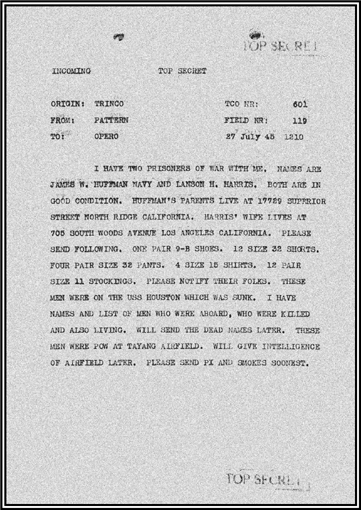
When Bartlett learned of the U.S. prisoners so close to his camp, he ordered two of his men to try to contact them, to encourage their escape and arrange a rendezvous. When Huffman and Harris made their break, it was a Free Thai Army patrol from Pattern camp that led them through the jungle to the OSS major. “Upon their arrival,” Bartlett wrote, “a runner came and informed me that they had two Americans. I sent an armed guard of four men to pick them up and bring them to camp.” At midday on July 27, the Morse transmitter at Bartlett’s field station sent the following high-pitched stutter into the ether: “I have two prisoners of war with me. Names are James W. Huffman Navy and Lanson H. Harris. Both are in good condition…. Please notify their folks…. Please send PX and smokes soonest.”
With escapees to look after, the difficult supply situation Bartlett faced couldn’t have come at a worse time. Since arriving in-country Bartlett hadn’t received a single package of food. The airlift embargo angered him, especially because he had seen with his own eyes the drops B-24s were making to a Thai army camp nearby. Not that Huffman and Harris much noticed the shortage of rations. They were glad to be put to work in the mess, taking turns directing the preparation of whatever the Thais brought in from the jungle. It was the best duty they had had in more than three years.
Bartlett interrogated them, but gingerly. “He would get us apart,” Red Huffman said. “You’d never know when he was going to ask a question. All of a sudden he’d turn around and ask you something. We gave him more information than he had ever had. We told him everything we knew. He was making sure he was getting the truth. Then he would have his radioman radio it to India.” Soon after their arrival, Huffman and Harris were joined at Pattern camp by two English prisoners and an Australian. A much larger catch was in the offing. Bartlett informed Kandy that Tayang held 1,500 prisoners, had no planes, stored 25,000 gallons of gas, housed three radio stations but no radio direction-finding equipment, and had heavy machine guns but no larger antiaircraft emplacements. The information coming from the two Americans was voluminous. “What particular information do you want me to find out?” Bartlett asked headquarters. “Would take a day to send all they have told us.”
Kandy responded the next day that it wanted the names of the Houston’s survivors, information about their condition, the location of prison camps, the total numbers of prisoners, how the Japanese guarded them, evidence of their cruelty, information about their attitudes toward war, specific conversations between POWs and guards, how the fall of Okinawa was influencing Japanese treatment of POWs, and how enemy morale might be lowered through propaganda.
One time Bartlett turned to Huffman and asked, “Would you sneak back into camp and warn them and tell them I’m coming?” It was a preposterous suggestion. Huffman refused the request in no uncertain terms. “Neither one of us would go, because we’d been prisoners for three and a half years almost,” he said. Nevertheless, Harris and Huffman and their three Allied friends seriously weighed the option of reengaging with their enemy. In a July 28 radio transmission, Bartlett reported to Ceylon: “Have told them they would be [exfiltrated] soonest. Their own words quote Let us stay here and have a crack at those GD Japs unquote. This feeling exists with all five and they all are studying our weapons.”
They did some celebrating too. After the sailors’ safe arrival at Pattern, there was a jungle feast in their honor. The main dish was monkey. Though the Americans declined the proffered plates, they had their fill of Hershey bars. Huffman broke out his two canteens and the ex-prisoners got “all hooched up” on the stout rice wine. Huffman offered Bartlett a shot of it, but it seems the OSS man preferred scotch.
The most coveted treasure that the sailors turned over to Bartlett was the roster of Houston personnel, living and dead, kept by John Reas and John Harrell. With the disclosure of this priceless record, scores of families would finally know their loved ones’ fates. On July 29 the information that Fred Hodge and so many others had tried for years to ferret out began flowing as beeps from a portable transmitter hidden deep in the Thai jungle. The bursts of secret knowledge—a roster of lost names, from “Agin, G. L.” to “Zabler, W. E.”—filled Pattern’s outgoing Morse bandwidth for nearly a week. It was not until August 5 that Major Bartlett’s radioman hand-keyed the last of the dots and dashes representing the 301 names on the list. Two days later he started sending a shorter list: the names of sixty-three of the seventy-seven Houston men who had met their end as prisoners of war. From that point on, Bartlett’s mission was to ensure that as few names as possible were added to the roster of fatalities. The resourceful commander of Pattern camp began to figure out what he could do for the rest of the prisoners at the Tayang airfield.
CHAPTER 59
All our men are bang-happy and would give their eyeteeth to begin an extensive sabotage campaign against the Japs.” So said Capt. Bud Grassi, head of the OSS base near Kanchanaburi, to Nicol Smith. He was chafing under the firm policy that blocked him from conducting overt actions of his own and forced him to rely instead on native proxies. “It’s damned hard to take when Thais come to us with explosives that they have slipped out of Jap supply dumps. I can’t help thinking how easy it would be to leave a few time pencils in these dumps, and no one would ever know what caused the explosions. We can also cut the Burma-Bangkok Railroad at innumerable places.
“Another thing the fellows are anxious to get at is rescuing the two thousand American, British, Australian and Dutch prisoners in the POW camp near Kanburi before the Japs kill them all off.”
The people who ran OSS Detachment 404 channeled the joy they felt on locating survivors of the Houston into planning their exfiltration and eventual homecoming as soon as possible. There were several possible avenues—by PBY Catalina flying boat from the southern coast of Thailand near Prachuab; by boat from the coast up to Bangkok, then up to the OSS main airfield at Pukeo; or via a single-engine Lysander flown directly from Tayang to Rangoon, then to Kandy or Calcutta. Bartlett’s men reconnoitered Tayang in case the last option was chosen. Evaluating the airfield’s security level and obstacles to approach, the major recommended a dawn or dusk landing.
“The only difficulty anticipated in the arrangement to date has been the openly expressed preference of the two rescued seamen to ‘stay here and have a crack at those GD Japs,’” Bartlett wrote. “It is probable that circumstances will compel this wish to be denied them.”
If the British were to be believed, the Royal Army was planning an invasion of Thailand in November. Accordingly, Washington had urged the OSS leadership, “Keep cautioning [your agents] against overt action before Mountbatten strikes.”
Inexorably the course was set for the war in the Pacific to end. By the middle of 1945, Okinawa had been taken, the last of the Japanese navy’s strength extinguished. American aircraft ruled the skies. Grand plans were afoot to combine all of America’s combat forces—almost everything already in the Pacific and whatever else could be brought over from liberated Europe—and throw it all against the Japanese home islands in a final strategic offensive, known as Operation Downfall. Free Thailand would contribute what it could. At Sattahip Bay, southeast of Bangkok, its small coastal fleet stood at the Allies’ disposal. There were ten torpedo boats, four large gunboats, four submarines, and fifteen seaplanes. Several of those craft could operate as far south as Singapore, or even east to the Philippines. Though the supply of oil limited their radius, more was available on a black market fed by Japanese soldiers more than willing to steal it from their depots.
But a more imposing exhibition of naval power had already struck Japan’s home islands. On the morning of July 14, as Lanson Harris and Red Huffman were slipping through the jungle toward their rendezvous with the OSS, the fast battleships South Dakota, Indiana, and Massachusetts, with the new heavy cruisers Chicago and Quincy, took station off Kamaishi, site of a great iron and steel works that adjoined the prison camp at Ohasi, where many Houston men were imprisoned, and trained their turrets inland. At 11:00 the South Dakota signaled to her sisters, “Never forget Pearl Harbor.”
At 12:10 p.m. the main batteries of Rear Adm. John F. Shafroth’s task unit thundered out, hammering the coke ovens, hearths, and foundries near the prison camps for two hours. It was the first time that American naval gunfire hit the home islands. Over the next few days the bombardment would be joined by five more U.S. fast battleships, plus a British dreadnought, HMS King George V. Planes from the Third Fleet swarmed northern Honshu and Hokkaido, striking rail yards, harbors, and ground installations.
Jess Stanbrough was working at the power plant in Ohasi when the American sixteen-inch projectiles began raining down on the nearby camp. After the Tokyo fire raids, he had smelled the incinerated pine. When the bombardment of the Kamaishi ironworks started, he heard the low rumble down the coast. The guards explained that the imperial fleet was conducting gunnery practice. Having acquired a Japanese vocabulary of about five hundred words, Stanbrough and the others weren’t fooled by the bid to save face. They had overheard mine workers conversing over morning tea: “Where were our planes?” “Well, we didn’t see any. All we saw was the Americans.” The Japanese always seemed to be talking about the bombers. Like the Allied attacks by air and from under the sea, the bombardment of Kamaishi claimed Allied lives. According to Stanbrough, “There was a lot of people that had been captured down on Wake Island and so forth in that camp that lost their lives. We had some eighteen or nineteen burn victims out of that. They brought them up to our place to try to do something…. Our medical boys—Navy guys—were over there pulling flesh off of them.”
A season of fevered diplomacy was under way as the Allies stepped up pressure on the Japanese to surrender. On July 26, at Potsdam, Germany, Harry Truman, Winston Churchill, and Josef Stalin put forward a final demand for Japan to end the war via unconditional surrender.
The prodigious land, sea and air forces of the United States, the British Empire and of China, many times reinforced by their armies and air fleets from the West, are poised to strike the final blows upon Japan. This military power is sustained and inspired by the determination of all the Allied Nations to prosecute the war against Japan until she ceases to resist…. We do not intend that the Japanese shall be enslaved as a race or destroyed as a nation, but stern justice shall be meted out to all war criminals, including those who have visited cruelties upon our prisoners.
The Japanese would invest some hope in the odd absence of reference to the Soviet Union in the Potsdam Declaration. Soon enough, however, what the Soviets were or were not doing would be of secondary significance. On August 6, a B-29 Superfortress with the name Enola Gay stenciled on her fuselage took flight from Tinian and released its epochal payload over the city of Hiroshima. Three days later another atomic device fell on Nagasaki. That same day Admiral Shafroth’s battleships closed with the Japanese mainland and let Kamaishi have it again.
CHAPTER 60
At Tayang, near Phet Buri, Lloyd Willey saw a peculiar cloud move across the sky one day. It was like nothing he had ever seen before, streaked with multiple hues—purple, red, and yellow—and moving, it seemed, with unnatural swiftness. One of the Australian prisoners with him, who had taught at Melbourne University, told him that only a godawful explosion could have produced something so exotic.
A marked change had come over the guards. The Japanese ceased their daily routine of raising their flag and gathering in ceremony to bow to the emperor. One day they just stopped doing it. Willey had premonitions of what lay ahead as he joined a work party digging a six-feet-deep moat east of the airfield. “The Japs were very touchy about that moat. They wanted every side to be perfect…. All the dirt that was piled up, they put machine guns on each corner and they told our officers that the moat was to keep the Thais out. They said it was to defend the camp, but we knew the Japs were masters of deceit.”
The Japanese willingness to kill prisoners was exhibited any number of times, perhaps most powerfully on December 14, 1944, when 150 U.S. POWs held on Palawan in the Philippines were ushered into an air raid tunnel and burned alive. Several of the doomed prisoners begged their captors to shoot them in the head, but the guards laughingly shot or bayoneted them in the stomach instead.
As fissures spread in the very core of Japan’s great Pacific empire, the fate of prisoner and emperor alike lay shrouded in doubt. The atomic bombings reverberated within the halls of the imperial command long after their thermo-atmospheric effects had drifted southwest and bruised the skies over Thailand. According to an observer, a mood of “impatience, frenzy and bewilderment” gripped the Supreme Council for the Direction of the War when it convened on the morning of August 9. A rumor arose that Tokyo would be the target of the next atomic strike. This rumor, it appears, was the product of the desperate imagination and audacity of an American fighter pilot shot down over Osaka on August 8. Captured and tortured by a Japanese officer who demanded details about the new U.S. weapons program, the pilot said that the United States had a hundred more such bombs and that Kyoto and Tokyo would be struck within days. The short period between the two atomic attacks already carried out suggested all too powerfully that America might indeed have been able to continue them at will.
Yet as intercepts of Japanese military traffic revealed, a stubborn faith in Nippon’s invincibility ruled the thinking of three of the six men who held the nation’s fate in their hands. Army Minister Gen. Korechika Anami, Chief of the Army General Staff Gen. Yoshijiro Umezu, and Chief of the Naval General Staff Adm. Soemu Toyoda insisted that any terms of surrender carry four conditions: preservation of the sovereignty of the imperial throne, self-disarmament, Japanese control of war crimes proceedings, and no Allied occupation of the home islands. The conditions, if granted, would have given cover to Japan’s militarists, who wanted to deny that they were ever actually defeated. Cooler heads feared that the aggressive demands would be seen as defiance and lead to further atomic bombings and fire raids. What conditions should be attached to the surrender papers was the subject of a clean deadlock, with three members of the War Direction Council supporting acceptance of the Potsdam Declaration with all four conditions, and three, led by Foreign Minister Shigenori Togo, favoring surrender with the sole assurance that the imperial system would be retained. The verdict breaking the impasse would be formally and finally given that night by Emperor Hirohito himself.
Japan’s diplomats had tried to divide the nascent superpowers, confronting them by brokering a separate peace with Moscow. In the middle of July, Japan’s ambassador to Russia had been informed that since Stalin and his deputies were away at Potsdam, the answer would follow on their return. On August 8, the Soviets had delivered that answer by breaking off diplomatic relations with Japan and sending their mechanized forces into Manchuria. Shortly before midnight on August 9, Emperor Hirohito joined his advisors in the air raid shelter in the basement of the imperial library. Noting the poor state of readiness of his defensive forces and the grotesque effects of the atomic blasts, he asked, “Since this is the shape of things, how can we repel the invaders? It goes without saying that it is unbearable for me to see the brave and loyal fighting men of Japan disarmed. It is equally unbearable that others who have rendered me devoted service should now be punished as instigators of war. Nevertheless, the time has come when we must bear the unbearable.”
But as the intercepts revealed, the army remained unbroken in its defiance. On August 11, Field Marshal Terauchi, the commander of the Imperial Southern Army, which included Burma, among other regions, stated, “The plans of the Southern Army have changed in no way whatever. Each Army…will go ahead to strengthen its war preparations more and more.” That same day, the chief of the Army General Staff announced, “The Imperial Army and Navy shall by no means return the sword to the scabbard.”
On August 13, the U.S. Twentieth Air Force took the war of persuasion directly to the Japanese people when B-29s rained on Japanese cities not bombs but leaflets with transcripts of the surrender negotiations. The air in Tokyo was thick with intrigue and the latent energy of rebellion. It seemed possible that either domestic opposition or a military coup might overthrow the emperor. Fear of the latter was well grounded and immediate. Any number of high-ranking army officers had serious doubts that field commanders would comply with the terms of surrender. In the hidden depths of the Army Ministry’s air raid shelter, a plot was taking shape to ensure that the rest of Japan did not either.
The field-grade officers who led the putsch pledged their allegiance not to the faltering emperor but to “the wishes of the imperial ancestors [which] constitutes a wider and truer loyalty to the Throne.” There is evidence to suggest that their ranks included not just younger officers but at least one central figure in the army’s planning and policy hierarchy. Like the twisted vision that seized the mind of Adolf Hitler as Soviet armies overran Berlin, the plotters saw the final immolation of the Japanese populace as a lamentable but just result of their failure in the war.
As the plotters tried to widen their circle, senior officers loyal to Hirohito unmasked their plan. On August 14 the plotters panicked and made their move. Lt. Gen. Takeshi Mori of the Imperial Guards Division was slain in a confrontation with one of the leaders of the revolt, Maj. Kenji Hatanaka. As Emperor Hirohito watched through the armored shutters of his palace quarters, the rebels occupied the Imperial Palace, winning the temporary cooperation of the Imperial Guards by presenting orders with the forged seal of General Mori. They tried to confiscate the phonograph recording that the emperor planned to broadcast that day, declaring the end of Japan’s resistance. But the timely intervention of officers loyal to the emperor brought the Imperial Guards back to the side of law and order and stilled the rebellion that could have changed the fate of the world.
It took as long as two days for Emperor Hirohito’s order to reach his commanders. As it descended upon them out of the blue, it induced disbelief, and doubtless led more than a few to contemplate mutiny by way of slaughter. Despite the horrors wrought by the U.S. bombing campaign, General Anami all along clung to a near-mystical belief that if the army summoned the will to continue fighting, “a road to success will somehow be revealed to us.”
In Washington, concerns mounted over the fate of the estimated 15,000 American prisoners of war in Japanese custody (among an Allied total of 168,500). The instability of the political crisis gripping Tokyo, revealed to the Allied leadership via their code-breaking operations, created a chilling spectrum of possibility. Gen. George C. Marshall, the Army chief of staff, urged that any surrender negotiations with the Japanese require that Japan “immediately forthwith and without delay” transfer all POWs to staging areas for liberation by the Allies. The Allied governments that same day declared the Japanese people “individually and collectively” responsible for any harm that might come to prisoners of war. August 1945 was suffused with wrenching uncertainty as warring nations still numb from the pain of four years of total war lurched toward a final reckoning.
CHAPTER 61
What would Japan do with its prisoners? The question was in the mind of every POW. It concerned the White House, and even the Imperial Army’s high command, who understood that their treatment of prisoners would affect Washington’s handling of the postwar transition, even as their Bushido convictions protested that the surrendered rabble were worthless and might even pose a threat as a reconstituted military force during an invasion.
On the brink of liberation, prisoners in Saigon noticed that the guards no longer cared whether they worked or not. The guards asked them what this new secret weapon was that took the flesh off people, burned them to cinders, and razed whole cities. Visibly frightened, one of them asked Lost Battalion member Garth Slate, “Will they drop one on Saigon?” Then came the long-awaited news, spreading throughout the POW diaspora. It struck so many prisoners as a hollow anticlimax. The war was over.
Thailand had a great deal to lose from any last burst of Japanese rage. Ruth, as the country’s regent and resistance leader, did not approve of anything that might put the tenuous truce at risk. He feared that the sudden appearance of C-47 transport planes at Tayang would be an aggravating incident that could be a prologue to tragedy. He declined to approve an exfiltration effort until conditions settled. Finally, approval was granted and OSS headquarters radioed Major Bartlett on August 16: “Present plan tentatively approved on highest level includes complete exfiltration all POWs in Petburi [sic] area by American C-47 aircraft. Our info indicates 1500 POWs there including 500 too weak to walk. Task is tremendous. …. POW exfiltration biggest OSS job to do and has very highest priority. Let’s do it up right. We furnish everything you help organize POWs and assist medics. Advise as soon as field ready to take sixteen sorties per day, sixteen to a plane.”
The OSS parachuted in four more men to support Major Bartlett in the effort to retrieve the men at Tayang: Capt. Roger C. L’Hereault, Lt. W. B. Macomber, bm2/c Louis Pulgencio, and phm2/c Van W. Pressley jumped from an aircraft making a food drop on the night of August 17–18. “Cover is to be maintained until code word Goldfish RPT Goldfish is given,” Kandy radioed him. “At this time you will procede [SIC] to POW area but not before code word is wired.” Bartlett and L’Hereault received a transmission from a colleague: “See you at the Mayflower.”
Although Allied recovery teams for the Repatriation of Allied Prisoners of War and Internees (or RAPWI) were busily working under the auspices of the Southeast Asia Command, the OSS struck a secret agreement with their British clandestine counterpart, Force 136, to put Major Bartlett in charge of the Phet Buri area under the code name Operation Mainland. All Americans in Thailand west of the Bangkok River would be sent to Phet Buri for evacuation. Everyone else would go to Bangkok.

When the age of atomic weapons entered its third day, Jim Gee was thirty miles from Nagasaki, in a coal-mining camp in the mountains. He didn’t notice the blast that leveled the city—by the latter half of 1945 explosions were so common around the besieged shipbuilding center that it was hard for him to tell one from another. But one day something very out of the ordinary happened. He and his fellow prisoners were called to the parade ground where just a few days before they had been exhibited to and scolded by the populace. A formal ceremony was under way. The Japanese apologized for the hardships inflicted on the prisoners and said they and the Americans were now friends. The Japanese turned over their weapons, and the camp commander ordered his people to surrender to the nearest dumbfounded American. “As soon as we found out in this camp that the war was over,” the Houston’s Ens. Charles D. Smith wrote, “we kicked the Japanese out of their jobs, took their guns away from them and isolated them over in one side of the camp out of harm’s way, so that we could go and come from the camp into the town at will.”
The role reversal induced vertigo. A prisoner who had kept an American flag hidden in his effects fastened it to a flagpole and hoisted it over the camp. They set out into the countryside to forage. For every piece of food they received from locals, an item of commensurate value was given in return. They bartered their extra clothing for eggs, greens, and vegetables. They took no revenge. Within a few days the roar of Wright radial engines filled the valley, planes appeared overhead, and suddenly the skies were wondrously full of crates swinging from parachutes. Rocking to the ground came a bountiful harvest: candy bars, powdered milk, medicines, clothes. What they did not use immediately they took to the newly familiar countryside and traded for livestock, which they slaughtered on the spot.
“Hollywood couldn’t have written a better ending,” Jim Gee said.
The serenity that fell over the prison camps from Thailand to Indochina belied the racking implosions that at last stilled Japan’s war machine. In Tokyo, some pilots were planning an unauthorized kamikaze reception for the U.S. ships gathering in the harbor. Tipped to the plot, the Imperial Army impounded their ammunition and fuel. At Atsugi Airfield, where General MacArthur was to arrive to direct the occupation, soldiers loyal to the throne subdued a navy captain who was furiously inciting a revolt, and removed the propellers from all the planes.
American aircraft littered the countryside with pamphlets printed in nine languages, instructing former prisoners: Remain where you are, disarm the Japanese, show restraint, do not punish them. The pamphlets also warned the Japanese that they were responsible for the prisoners. The prisoners seemed less interested in confiscating their captors’ weapons than in drinking their sake.
On the morning of August 29, Lt. Col. Amos D. Moscrip from OSS headquarters flew to Tayang and joined Major Bartlett on the ground. Thirty-five American prisoners were already there, and fifty-eight more arrived by truck that afternoon. Moscrip wrote:
I gave them a short talk regarding why we were there and where they were to go, how and when, and then we fell to in a huge party where generous supplies of cigarettes, gum, candy, razors, tooth brushes and paste, combs, mirrors, matches, Yank magazines, fruit juice, toddy, etc. were issued to all American POW’s. The party lasted until 0200 the next morning, 30 August, during which time my team was very busy answering a multitude of questions for those news-starved Americans. Their physical condition seemed to be fair, from a layman’s point of view, but they bore scars and marks of much suffering…. The American POW’s presented me with an American flag that two of them had made in the POW Camp over a period of 8 months from scraps of material such as they could filch. This flag was about 4 × 6 feet and had been kept secret from the Japanese at all times. I promised them that the flag would fly until every American had left Tayang. I had a flagpole erected the first thing the next morning and the flag was raised in the presence of 5 Japanese officers and about 8 Japanese enlisted men. Through an interpreter, the ranking Japanese officer stated that he was very sorry but he did not wish the American flag flown at this time over the Japanese airfield. I explained that I wasn’t interested in his wishes and after several exchanges of American and Japanese phrases via the interpreter, the Stars and Stripes whipped gaily in the breeze.
The first C-47 from Rangoon landed at Phet Buri bright and early the next morning.
The reality of freedom dawned slowly over them. Modern diagnosticians have ready labels for the psychological syndromes that beset them. But those labels didn’t exist in 1945. “While the pictures may show the men to look fairly healthy, they weren’t,” Moscrip wrote. “It will take many of them months of good care and doctor’s treatment to be able to regain their mental balance. It must also be remembered, and I think the narrative should bring out the fact, that these men were the survivors, that they were the fittest, and that many of the dead were left along the Burma-Siam Railway which they were compelled to construct. There wasn’t a single POW among all of those who were evacuated from Petburi [sic] who were not at one time or another beaten by the Japanese.” Operation Mainland’s haul from Thailand and French Indochina was 530 Americans among a total of 2,013 Allied prisoners.
Over Tokyo, Navy planes were dropping food over the prison camps, the pilots revealing their exuberance through their ailerons and rudders as they showed off their combat-honed talents in low-altitude aerobatics. At Ohasi, Red Reynolds, the chronicler of the late president’s 1938 tour on the Houston, was among the throng of prisoners marveling at an impromptu air show put on by a dozen or so U.S. dive-bombers. “They circled out and dived and wig-wagged,” he wrote in his diary. “My God, grown men looking up, waving and shouting with tears running down their cheeks. I too was a big baby, but I’m proud and not ashamed. I’ve waited three-and-a-half years for this.” As Reynolds recorded in his diary, one of the pilots zoomed in low and dropped a pack of Lucky Strikes, a book of matches, and a note reading, Cheer up, boys, only a few more days—Ens. W. F. Harrah, 2221 East Newton St., Seattle, Washington. “Boy he rates a bottle of Scotch from each man here,” Reynolds wrote.
In Washington on August 28, OSS field agent Nicol Smith appeared at a press conference, declaring: “Anyone having relatives on the crew of the Houston can be very optimistic.” That same day, American prisoners throughout southeast Asia began greeting their liberators, for out in Tokyo Bay a sight like no other greeted the residents of the capital city’s prison camps. Gliding into view came the sleek gray hulls of U.S. warships, camouflage paint schemes bright and angular. As lead elements of the U.S. Third Fleet approached, led by the battleship USS Missouri, other ships came for the prisoners. Commodore Rodger W. Simpson’s Task Group 30.6 happened to be led by the light cruiser USS San Juan, commissioned the day the Houston was lost and commanded in its early days by Capt. James Maher, the older brother of the Houston’s Arthur Maher.
Several LCVPs from the San Juan’s evacuation group, embarking medical parties, motored to the docks and tied up near Omori Camp No. 8. “The appearance of the landing craft in the channel near the prisoner of war camp caused an indescribable scene of jubilation and emotion on the part of hundreds of prisoners of war who streamed out of the camp and climbed up over the piling,” Simpson wrote. “Some began to swim out to meet the landing craft.”
Simpson was powerfully affected by conditions in the hospitals that his medics located. While he noted in his report the “almost universally helpful and outwardly polite” attitude of the Japanese, his outrage was nearly universal at the time: “With the end of the war, history started immediately to repeat, but we shall not be deceived again by the superficial friendship of this cruel race.”
Thus began an eighteen-day evacuation process that would mark an official end to the ordeal. That day an Associated Press reporter was moved to poetry in his wire dispatch: “The hand that fills in the blank pages in the book of war began to write again today. It began on a page bearing the title ‘USS Houston.’ And as it started its journey across the paper, hope, like a swiftly-flaring spark, burned brightly again in hundreds of hearts in homes scattered across America.”
Omori Camp No. 8, where Commander Maher was senior officer, was the first camp liberated. Its occupants were safely transferred to the hospital ship Benevolence in Tokyo Bay by the night of August 30. Before Maher received treatment, he requested to visit and personally thank the skipper of his brother’s old cruiser, Capt. George H. Bahm. Shortly thereafter, the Houston’s senior surviving officer found himself with an invitation from Fleet Admiral Chester Nimitz himself to board the Missouri on September 2 and watch the Japanese sign papers of surrender. When Maher was taken to the ship and went aboard, he was greeted by a Naval Academy classmate. Rather than salute him, shake his hand, or embrace, by reflex of habit Maher bowed from the waist.
Word of the surrender took a while to trickle down to the men still imprisoned in Singapore at Changi. Sixty-nine Americans were held there. For varying reasons, mostly related to their health, most of them had stayed behind when the rest of the Americans were shipped to Burma or Hintok. When the railroad was done, the paltry few survivors of F and H Forces returned to Singapore. At Changi they enjoyed a comparatively lavish lifestyle, though the work of dismantling industrial machinery as quickly as possible and shipping it back to Japan had its expected share of anxiety, pain, and crisis.
To 2nd Lt. Miles Barrett, the highest-ranking USS Houston man in Singapore, the dramatically changing fortunes had been hard on the nerves. The possibility of liberation gave the prisoners a degree of hope that made fear possible again. “In many ways these weeks have seemed the most difficult of the whole war,” Barrett confided to his diary. All along they had been scrapping for their survival. Then a ball of plutonium was crushed over Nagasaki, and six days later word arrived that Japan had accepted the Allied terms of unconditional surrender. The war over, the prisoners endured a few last tenkos, trying to hold down their excitement. Finally, on August 19, the prisoners’ representative at Changi, an Australian colonel from F Force named Dillon, decided to press his luck, insisting on the immediate delivery of Red Cross supplies and the immediate release of prisoners known to be suffering in solitary confinement at the Outram Road Jail.
For Gus Forsman, the mind-wrecking routine there had never changed. Entombed in his routine of silence, he was not allowed to lie down during the day. He could only put down his board and sleep when the guard came by in the evening and issued a one-word command to turn in: “Yasume.” Only once had the rigid routine ever deviated, about three months into his confinement, when he was allowed to take a walk outside the prison. It was a strange thing. The guards took six prisoners outside to water a garden. It had been their first contact with fresh air until that time. Forsman didn’t understand the point of it. He knew only that everything the guards did was toward the purpose of what some psychiatrists would later call menticide: the killing of the mind.
But now faraway events had remade Forsman’s world. There was light—the door to his cell opened and it flooded in, blinding him. He was ushered out and as his eyes adjusted he saw Capt. Ike Parker and Maj. Windy Rogers, considerably bonier and dirtier than he had known them before. They cringed at each other’s stench.
Escorted by guards, they were taken to a well and instructed to draw from it. Forsman, who would have paid a thousand dollars for a Dixie cup full of water just moments before, drew three or four whole buckets, drank deeply—he would have jumped in had he found the strength—and began the long process of getting himself clean. He was guided to a stack of clothing and got dressed.
As the guards marched them toward the prison gate, Rogers was seized by a flash of horrible recognition. “They’re going to shoot us in the back,” he said. “They’re going to say we were escaping. By God, let’s give them a run for their money!” The frail men started running. They tottered down the hill, trying to zigzag in order to elude the expected hail of bullets. It never came. Perhaps the guards couldn’t draw a bead on the skeletons through the convulsions of their laughter. The three Americans stopped at the bottom of the hill and stood there, marveling at their survival, wondering what was next.
A Chinaman rode by on a bicycle. Windy Rogers said something to him, and he stopped to talk to the Americans. “The war is over.” “That’s impossible,” said the prisoners. “No. They boom-boom one time. Japan finished.” He urged them to head for Changi. Joined momentarily by some other survivors of solitary confinement—bomber crewmen, worn out from the special brand of torture the Japanese reserved for “air pirates”—they set out on foot. After a march that seemed like ten miles to Forsman, they reached the compound that three years earlier had been the portal to their ordeal as guests of the Imperial Army. The guard at the gate didn’t say a word. Forsman noticed in passing that he was armed with a wooden rifle.
Up the road ahead, he saw a crowd of men coming toward them. Since July 4 rumors had been circulating among the prisoners kept at Changi Jail that ten prisoners had been executed at Outram Road, possibly including some Americans. The rumors were never sorted out, but that evening Miles Barrett, Crayton Gordon, John Wisecup, and others saw how much worse life in captivity could have been. Fourteen lost souls representing a hidden piece of the war’s horrible, slow-to-emerge truth came limping in their direction. There was a mass embrace as they got introduced all over again.
Gus Forsman would not be convinced of his liberation until those aptly named four-engine Liberator bombers were visible overhead, this time dropping more than just Juicy Fruit wrappers. Crates of C-rations, cigarettes, and candy, the bounty of a victorious nation, spilled out and spouted parachutes. The volume was impressive, but what moved Forsman most was seeing on the ground, amid the windfall, a scattering of individual items, off-brand and different from the bulk. Apparently some of the individual aircrewmen had made their own personal contributions to the cause.
On September 7 an American flag flew over Changi Prison. “The last time that I had seen that flag was when that ship went down,” said Paul Papish, “the Stars and Stripes fluttering there at the mainmast.” Prisoners broke out their own hidden stashes of goodies, reserve stocks of condensed milk and tins of sardines and rusty cans of peaches and meat and vegetables, some of it hoarded since the innocent, early days at Batavia. They rooted through their bags, traded this and that, exchanged home addresses, set their mattresses afire, and raised hell, mostly because they could. Great and optimistic promises flowed from their joy. The Americans would visit Australia, see their Aussie friends, go into business together, start a chain of motels or something. At the end of the line, the men of the Houston and the men of the Perth, soldiers of the Lost Battalion and sailors alike, were bound as one crew.
The exodus led all of them home through Calcutta. John Wisecup and Robbie Robinson were flown there in a C-47 from Singapore. The ride by “gooney bird” over the Himalayas was an adventure. In the thin, volatile air the plane pitched and yawed and soared and plummeted, wings scarcely able to hold the sky. Down the centerline of the passenger compartment a line was strung tight so that a bucket could be slid to anyone who needed relief.
Wisecup and Robinson were in the air an hour when curiosity seized them and they explored their aircraft. In a small galley area between the passenger space and the cockpit, the two Marines found a box of Butterfingers. They ripped into it, gorged for a while, then returned to their seats. They couldn’t stop themselves from expecting a Korean guard to materialize somehow and punish their thievery with a bashing. When an authority figure did approach them, she was bringing even better fare. They had never seen canned rations before. They tore into them. A few minutes later, one of the aircrew returned to them and handed them a first-aid kit. They didn’t understand why until they looked at their fingers and realized they were dripping blood, split and slashed by the sharp edges of the tins.
At Calcutta, they shambled down the ladder, still somehow afraid that the rations hidden in their clothes would spill out and betray them. They expected to be searched, the contraband confiscated. But they got away with it; they were survivors, which meant they always had. Shown to the relative opulence of the 142nd General Hospital, they unloaded the rations and slid them under their mattresses. Someone came for them, saying they were wanted in the mess hall. They went there and found awaiting them a dinner of ham, steak, and eggs.
At Calcutta, most of the exfiltrated prisoners ate like fiends. Some of them, their metabolisms still calibrated to starvation, couldn’t handle the rich fare. Given their back pay, they immediately found the chance to spend it on liberty. They went AWOL if they felt like it. They weren’t taking orders from anybody. But the trouble they spent ducking the MPs was generally wasted. The authorities avoided ordering the fragile evacuees to do anything. They asked them instead. “They learned right quick not to come out with all these orders,” said Garth Slate. “‘You do this now’ and ‘You better do this’ and ‘You’ve got to do that’ and ‘Oh, you got to do this’ went out the window.” That appears to be the extent of the psychological accommodation most of the ex-prisoners received from the military.
Some of them went outside to play baseball. John Wisecup had some work to do to get his fastball back, but at least there were no guards on hand to tell him how to do it. A well-meaning nurse rushed out to warn them that if they didn’t put their shoes on, they’d be liable to get sick, not to mention lose face with the natives. There was laughter all around.
One night Gus Forsman huddled with Crayton Gordon, just talking about everything, coming to grips with the anticlimactic reality of freedom. Forsman smoked Chesterfields until his tongue swelled, racing with his Army friend to close the circle of the story of how a great U.S. warship had gone down in battle and released its survivors into a horrible and deadly, yet sometimes unforgettably life-affirming, ordeal that led them to this place in the heart of the unlamented Greater East Asia Co-Prosperity Sphere and the once and future Asiatic Station. Injuries to the body were fast-healing. The wounds to the psyche bled freely. They would for a while. It would be more than a few decades before he would ever speak comfortably of the experience again.
CHAPTER 62
Red Huffman and Lanson Harris were flown on a British Lysander directly from Pattern camp in the Thai jungle to Rangoon. On the tarmac there, they boarded a C-47. Huffman mentioned to the pilot that in better days Harris had done a little flying. The pilot seemed to appreciate what it meant and offered him the controls. For the first time since SOC floatplanes last flew from the Houston, Harris stretched his wings. Hands on the yoke, he turned and looked back into the passenger compartment. Somebody snapped a photograph. Then the two engines roared, the plane rolled and rose, and the former residents of Serang and Bicycle Camp and the Dai Moji Maru and Changi Jail and Thanbyuzayat and 80 Kilo Camp and Tamarkan and Phet Buri and Pattern camp set out for a world of more hospitable names, from Rangoon to Karachi and from Karachi to Calcutta.
At the 142nd General Hospital, they were given physicals and medication, then shown to a truckload of khakis and told to help themselves. They got showers and were deloused and fed. They were told that as soon as their worms got cleared up, they could go home. Every morning Harris went to the lab to have his stool looked at, and each time was told he had to stick around for treatment of his parasites. One day after a few weeks of failure, Red came hurrying over to him. “He had a piece of paper, like a government check, same color, same shape,” Harris recalled. “Good for one priority passage to the USA, it said. ‘I got rid of my worms!’ Huffman announced.
“I said, ‘Goddamn it, Red, you’re not leaving me here. You go over there and crap in a box and tell them you’re Harris.’” And that’s what Huffman did.
They flew to Cairo and to Casablanca and to the Azores before beginning the final leg to Washington, DC. On that cross-oceanic flight, Huffman said to Harris, “You know the first thing I’m gonna do when I get home? I’m gonna take my girl down, and I’m gonna give her a tetanus shot.”
“A tetanus shot? What the heck for?”
“Well, I’m so rusty, I’ll probably give her lockjaw.”
In Los Angeles, Jane Harris had received a Navy Department telegram saying that her husband was safe in American hands. The news came with a demand for strict secrecy, but Jane was not about to keep the news from family. A newspaper article appeared soon thereafter, describing how two unnamed USS Houston men had escaped from a Thai prison camp. “I put two and two together with the telegram I got, and I said, well one of those has got to be Lans.”
He called her as soon as he landed in Washington. With no public transportation available thanks to the rush of postwar traveling, they settled for a few hours on the telephone. “We talked for a long time,” Jane said. “It was unbelievable to hear his voice, that was for sure.”
America’s veterans of Asia Station came home to a nation in fervid celebration. But the jubilance was the flip side of an equally widespread ignorance of the costs. It would be decades before the culture of therapy took root and debriefings and psychological counseling became standard practice for men returning home from war’s bloody funhouse. “This was all so new to everybody,” said Jane. “The U.S. had had no experience with POWs. What do you do with them? Doctors at the veterans hospital didn’t know how to cope with it.”
In Washington, Howard Charles, John Bartz, and John Wisecup were ordered to the Marine Corps headquarters building at 8th and I Streets. “They treated us like real psycho cases,” Wisecup recalled. “They didn’t put us in the hospital. What they did was put a corporal to stay with us all the time.” For the few days they were there, that corporal shadowed their every move. He explained once, “I’m told you aren’t responsible. I’m told to stay with you. You guys are Asiatic.” The Marines were offered either a hospital stay, a ninety-day leave, or a return to duty. They were interviewed not by psychiatrists but by prosecutors. War crimes tribunals were gathering. They wanted names, descriptions, affidavits, depositions.
Returning to duty briefly, Wisecup had no great expectations. He wanted two things: his promotion and his back pay. He got promoted to corporal for his six and a half years in the service, but when he asked for his private’s back pay the topkick at the headquarters told him that no Marine, private or corporal, had any business walking around with two thousand dollars in his pocket. Wisecup didn’t disagree and it appears he didn’t take the money.
He had a run-in with a mail clerk who refused to turn over his squad’s mail to him unless he was wearing an NCO insignia. Wisecup erupted and nearly punched the kid’s lights out. The incident got him a meeting with the post sergeant major—and convinced him that there was no place for him in an organization that required adherence to such Mickey Mouse rules. He told the sergeant major he was through with the Corps. “What are you going to do when you get out?” he was asked. “You don’t know how to make a living.” Wisecup told him he had all kinds of experience. He had, in fact, worked on a railroad. “I can work in the mines,” he offered. “You’ll be digging ditches,” the sergeant major responded. “Maybe so,” Wisecup told him. “But I’m going out.”
The trick was to go somewhere. The trick was to do something, keep your mind busy with movement and learning and activity and happiness, faked if necessary, just to keep it from settling in on and picking over the details of the previous four years. But the details were exactly what the U.S. government needed as they were preparing for the war crimes tribunals.
In Washington, Harris and Huffman collected their back pay and bought new uniforms. At the Navy Department of Records building, Huffman was approached by a commodore, who asked him, “Do you know where the Houston was sunk?” Huffman said he did, and the officer showed him to a huge room with a two-story-high map. Huffman climbed a moveable ladder and put a star near St. Nicholas Point. The commodore expressed surprise, saying they thought the ship had gone down two hundred or three hundred miles from there.
Their first challenge on survivor’s leave was finding their way back to the west coast. With no mass transportation available, they hired a cabbie with a seven-passenger DeSoto for ten cents a mile plus two hundred dollars for the return trip. Seventy-two hours later they were in LA. Reunited with his wife and his father, Harris told most of his whole horrible tale. After the suffering and uncertainty his folks had endured on the home front, they were entitled to it. No one else, Harris seemed to think, was. The rest of the world would never understand. “That was bad for him,” Jane Harris said. “He kept all this inside. When he came home, everybody wanted to know something. I said to him he ought to write a book. But he would tell just the funny things that happened, things that they would do to the Japs in the camps—urinating in the baths and so on.” Adventure. Hilarity. End of story.
Lanson Harris was home in Los Angeles when the FBI summoned him and asked him to look at some pictures. They wanted him to identify some guards. Accusations had been made. Charges had been leveled. “They asked me questions like, ‘Did you see this happen? Do you know if this happened? Is there anything else you can tell us that happened?’ I said, ‘No, no, no.’ I didn’t tell them anything. If they asked me a question—‘Did you do this or that?’—I’d say, well I guess we did, or I guess we didn’t. I never gave any positive answers.”
“You had a period of exuberance and then a sort of a pall comes on you,” John Wisecup said. “For four or five months, nothing could make you mad. But after that, gee whiz, I had trouble.” Back in the Burma jungle Dr. Henri Hekking, farsighted and wise, had warned his patients of the fresh ordeal that would confront them on returning home after the war. There would be consequences for those who failed to take good care of themselves. “He told us the importance of exercise, of the mental attitude of living,” Jim Gee said. The transition was strenuous. Howard Charles wrote:
I remembered the little amenities people in civilized circles took for granted, but I was not comfortable using a knife and fork, trying to remember that pants were to be zipped, that toilets were to be flushed, that car doors and doors to buildings were to be opened for females, that money was to be kept in checking accounts which one had to know how to balance. I was awkward with all those things, and it bothered me. My body was loaded with hookworms and I could not gain weight. I was fleeing from something, I knew not what, although there was no longer anything to fear or run from. I was nervous because I was nervous.
Slug Wright had trouble adjusting to the sound of a woman’s voice. “We watched these pretty-looking girls coming to work with red lipstick,” Jess Stanbrough said, “and we hadn’t seen that in about three and a half to four years…. If you hadn’t seen painted lips, it looked so strange, and we sat there and marveled at that.” After his wife picked him up to bring him home from the naval hospital in Van Nuys, she told him she wanted a divorce. Such cruelty had never been devised at Outram Road. “Why didn’t you let me know when I called you, or why didn’t you let me know when I was in the prison camp?” he asked her. “You wrote. Why didn’t you tell me then?”
“She said she just couldn’t do that because she’d heard about all these other problems that we were supposedly having. I said, ‘Don’t you know that when you’re in a bad situation, a little more trouble doesn’t hurt?’” Stanbrough got his revenge by living well. After returning to Austin and continuing his studies, he and three other men founded a firm in 1955 that became the defense contractor Tracor, a Fortune 500 company that at its peak employed eleven thousand people.
Revenge was on Howard Charles’s mind when he returned to Kansas “with the thought of finding my stepfather and dealing with him once and for all—possibly giving him a dose of his own blacksnake whip.” He found Jim Evans and took him for a drive. They cruised out to a field near Partridge, where the older man had once left the soon-to-be Marine for dead after beating him with a whip. Charles stopped the engine, fixed his stepfather with a cold stare, and said, “I’ve waited a long time.” It was then that the strength he had acquired through adversity, the seasoning by abuse that helped him fight through long years as a prisoner, enabled him to see his stepfather for the sorry, aged weakling he really was. Evans cowered, seeming to fear for his life. But Charles had said everything he needed to say with the icy stare. He resolved then and there that he would no longer go by the name his stepfather called him, Howard, that he would thereafter take the name Bob. He told his stepfather to just drive on home. Given the reprieve, Evans breathed a sigh, offered Charles a job, and hinted that he might let him inherit the farm. “Go to hell,” came the reply. This war was over. All wars were over. And Bob Charles, like America, had won.
John Bartz returned home to Duluth and confronted demoralizing disbelief within his own home. “When I first came back my mother and all of us got together, the whole group, about forty of them, relatives and all. They wanted to hear the whole story. I started, and you could see skepticism come on people. I guess it’s hard to believe that somebody would take a hose and shove it up your ass and down your throat and pour water up both ends. It’s hard to believe that. You don’t want to believe it. So I just quit.”
He quit talking, but he could never quite keep his mind from sorting it through. “I couldn’t sleep,” Bartz said. “I’d wake up at night screaming.” He found a way to fight through it. He would leave the house in the middle of the night, get in his mother’s car, and “drive it like a son of a gun.” A few times he got pulled over by the police. The local cops learned who he was pretty quickly. “Oh, you’re that Bartz kid, prisoner of war?” they would say. “Well, I’m not gonna give you a ticket, but you’d better slow down. There are other people on the road.”
Slowing down was the last thing Lanson Harris needed. He came back from the war, reenlisted, and attended flight school at Pensacola and Corpus Christi. “I was flying for five or six years, and I was feeling pretty good.” His career kept him moving. He kept going until it came time to stop. Jane Harris said, “It came time when he was in twenty years, and we had our daughter then, and she was ten. And he said, ‘Well, I’d better get out of the Navy before I kill myself.’” He got an engineering degree. Working for Northrop, he tested parachute recovery systems for the Apollo program. In the sixties, tired of government waste, he turned to a line of work he found much more rewarding: teaching junior-high wood and metal shop.
“I was absolutely lost, like a fish out of water,” Otto Schwarz recalled. “I’ll never forget. I arrived in Newark late in the evening. I had taken the five o’clock from Washington. I was all alone. Now I hadn’t been home in seven years. Washington had gotten a call through the day before to tell my parents that I’d be coming home. I stood in the railroad station absolutely alone. I didn’t know what to do, but I knew that I didn’t want to be alone.” And yet going home meant returning to the broken home he had been only too happy to leave in the adventurous blush of 1941. That adventure was over, and 1945 showed him a bleaker, less certain vista.
“I spent the next three months just drinking my way from one bar to another,” Schwarz said. “Most of my old friends from the neighborhood were still overseas. I went back to Washington twelve days early because I was broke. I had to go back and get more money. Really, really absolutely lost! We should never have been left and released like that, you know. It’s a really strange feeling because you really don’t feel like a human being anymore after coming out of those jungles.”
Wisecup retrieved his manhood quickly enough by joining the Merchant Marine and going back to sea, where he stayed for seventeen years. His postwar career took him to Japan, where he met and married a Japanese woman, his third wife. She would outlive him, but his long correspondence to friends after the war reveal a man at peace with what war had forced him to suffer. John Wisecup died in Tokyo in 2001.
The habits of a prisoner languished and rattled but never seemed to die. They drank their tea extremely hot, having learned in camp to gulp the brew fast so they could go back quickly for more. They preferred burnt-rice coffee to Maxwell House, and slept better on hard floors than plush mattresses. They prepared the meals they had fantasized about on the railroad and savored them. They met their wives or married their girlfriends, had children who would have to sate their curiosity about the Death Railway from sources other than Dad, flailed at ghosts in their sleep. There were mixed feelings about rice. Some never lost their taste for it; others, when they left the chapel after their weddings, insisted that their guests throw cornflakes. Charley Pryor craved sweets in the jungle camps but seldom ate them after his freedom. More than anything else, he craved fresh lettuce. To Don Brain, a good meal was a quart of milk and a head of lettuce held and eaten like an apple. They caught up with world developments—atomic bombs, helicopters, ballpoint pens, kidney dialysis, aerosol sprays, as well as the new faces suddenly prominent in the culture. They had never heard of this newcomer Harry Truman, but boy, had that youngster Bing Crosby become big stuff. CBS Radio was featuring a sensational new singer named Sinatra.
Jess Stanbrough did well enough in life, but the lesson he took from his POW ordeal had nothing to do with wealth. “I resolved that although I might never be rich, I’d never be poor or hungry. If you come to my house at Cape Cod…if anyone hears this, and they come visit, they’ll see a nice freezer filled up with food. They’ll ask me, ‘Well, you’re a bachelor. Why do you have all that?’ I have a nice big house on a one-acre lot and a big freezer. I’ll say, ‘Well, that’s called POW syndrome.’”
Dentists would marvel at how their tree sap fillings had held up over the years. Doctors would wonder at the dead spots on their legs where tropical ulcers had once rotted the nerves out from beneath their flesh. They cultivated deep religious faith, learned Oriental cooking, went to pieces at the first echo of taps.
In 1978, in Coldwater, Michigan, Bob Charles was immersed in his business interests, running a printing company, resolvedly avoiding Otto Schwarz’s reunions, “determined that the war would not be the biggest thing that had ever happened to me.” One day the war found him, in the person of Pack Rat McCone standing on his stoop. It didn’t take Charles more than a second to see the twinkle in the old Marine’s eye. He showed him around his plant. At once McCone was on his game, casing the facility like a warehouse in Batavia. He thought for a minute, then said, “Charlie, you’ve got thirty windows in this place. You’ve got guys running very expensive and dangerous printing presses, and they’re looking out the window. Not only that, you’re losing heat in the wintertime and losing cool in the summer. Why don’t I cover them for you?”
Ever resourceful, famously adept at odd jobs using odder tools, McCone stayed for dinner and convinced Charles to let him stick around for a while. Before McCone retired to the cot that Charles had set up on his enclosed back porch, the businessman told his wandering shipmate, “When you go down to the lumberyard, mention who you’re doing it for. Charge the company. Get what you need. By the way, you’re on my payroll.”
“Oh, no I’m not.”
“Yes you are. Either that, or you quit right now.”
“I’m not going to quit,” McCone said, “and you’re not putting me on any payroll.”
“Why?” Charles countered.
“Charlie, if you don’t know why, I can’t tell you.”
They knew each other as few other beings can know each other. And they had confronted ordeals few innocents could summon in their most fraught nightmares. In 1980, troubled by the seizure of the U.S. embassy in Tehran, Fred Quick, at the age of fifty-nine, seriously considered putting that experience to work. “If I had my way about it, I’d find forty-nine other ex-POWs and we’d go over there and relieve those folks,” he told a reporter. “Anyone who’s been through the torture I have can take what these Iranians are handing out standing on your head.” But it would be gilding the storm clouds to pretend the Death Railway was always a source of strength. One day in 1996, more than twenty years after he retired, Lanson Harris got a letter from the Long Beach Veterans Hospital calling for a physical. When he went in, and he saw some patients getting examined by the medical staff, and the doctor closed the door, it seemed to pop some kind of a psychological membrane. “I don’t know why, but all of a sudden I see these POWs…. Oh God, I was crazy. Next thing I knew the doctor had me and two guys were holding onto me. They put me in the hospital to keep me from committing suicide,” he said.
Red Huffman lives in Santee, California, outside San Diego, as this is being written, seldom venturing into the traumatic territory of memory that might have defined his life had he allowed it. Like John Wisecup and so many others, he stayed busy with challenging work. After the war he signed on for service in the Navy’s underwater demolition teams, seeing action in Korea. Like his Marine shipmate from New Orleans, he looked to the Orient to find a bride. Though his right arm is no good, his mind is sharp. Only recently, though, has he taken to sharing with his wife, Mary, the details of his war experience. They sit together and read out loud to each other what little has been written about the Houston and the ordeal of her crew. Huffman has little to do with the USS Houston Survivors Association anymore. Though it has held reunions faithfully since about 1948, Huffman has found it painful territory to tread, and if you don’t feel the need for the powerful bond of love and brotherhood available there, what’s the point? His partner in flight from Phet Buri, Lanson Harris, who is Huffman’s equal in independence of spirit, lives just up the highway from him, in Irvine. They haven’t seen each other in many a year and it seems they might never again.
The Association’s guiding light has been Otto Schwarz. Second only to the heavenly spirit of Captain Rooks in his stewardship of the Houston’s legacy, the retired chief boatswain’s mate and postal worker has organized most every significant event on behalf of the ship’s memory. Anything that has touched on the old cruiser, its history, its traditions, or its people has gone through Schwarz in Union, New Jersey. “I always had the philosophy that whenever I have the opportunity, no matter how I have the opportunity, either newspapers or television interviews or anywhere, one-to-one meeting with people, I don’t want the world to forget this. I don’t want them to forget the Houston, first of all, because it was an absolutely gallant ship with a courageous crew. I don’t want people to forget what men can do to men.”
Schwarz has run the reunions long enough, and published the Blue Bonnet newsletters regularly enough, that no gathering ever really takes place in his absence. Even when he’s not there, you sense his presence in things. He has donated his entire personal collection of artifacts to the University of Houston Libraries, whose Cruiser Houston Collection houses sixty-eight boxes of documents, artifacts, and memorabilia pertaining to the ship and grows with the passing of every survivor. With the actual survivors aging fast and traveling less, the survivors’ children, grandchildren, nieces, and nephews are taking over under the auspices of the USS Houston Next Generation Organization, under the energetic leadership of Val Roberts-Poss, daughter of survivor Valdon Roberts. The Lost Battalion Association holds its own events in Dallas every August, and the children are well in attendance there too. They’re animated by the spirit that drove their fathers, but so long as a half dozen veterans still show up at the reunions, they don’t need to look too far for a hero.
CHAPTER 63
On September 22, 1945, a field party of sixteen British and Australian troops from the War Graves Commission, accompanied by a Japanese interpreter named Takashi Nagase, a veteran of the Kempeitai’s counterintelligence branch at Kanchanaburi, left Bangkok in a caravan of atap-roofed wagons and began a three-week journey up and down the full length of the railway searching for the dead. By the time they reached Thanbyuzayat and returned to Bangkok, they had located 144 cemeteries, innumerable scattered roadside graves, and more than 10,000 bodies.
The Allied War Graves Registration determined in 1946 that the total deaths among Allied POWs in the Pacific numbered 12,399. Of the 270,000 native laborers or romusha on the line, 72,000 were counted as fatalities, although the actual number of deaths may be three times that high. More recent estimates put Allied POW deaths at 16,000 and romusha deaths at more than 200,000.
If the scale of these numbers does not approach, say, Russian losses in World War II or the number of Jewish victims murdered in the Holocaust, the horror that underlies them matches anything in human annals. When the war was over, a sweeping effort was made to gather evidence and bring to justice those responsible.
The proceedings of the International Military Tribunal for the Far East began on May 3, 1946, in Tokyo. The indictment brought fifty-five charges against twenty-eight defendants, all of them high-level generals and ministers, including Prime Minister Hideki Tojo. Absent from the indictment was the very figure who seemed to animate Japanese wartime decision making with a divine imperative, Emperor Hirohito himself. Though Pulitzer Prize–winning historian Herbert P. Bix has inferred the emperor’s personal approval behind Japan’s use of poison gas in China, the experimental use of bacteriological weapons in China in 1940, and the annihilation campaigns against Chinese communists in 1941, General MacArthur lobbied that the first grandson of Emperor Meiji be left out of the indictment in order to stabilize the delicate process of postwar reconstruction and reduce the risk that Japan might look to the Soviets for friendship after the war.
With Prime Minister Tojo left as its highest-ranking target, the indictment accused the defendants of conspiring to wage aggressive war and “murdering, maiming, and ill-treating prisoners of war [and] civilian internees…forcing them to labor under inhumane conditions.” Chief U.S. prosecutor Joseph B. Keenan said to the press: “It is high time, and indeed was so before this war began, that the promoters of aggressive, ruthless war and treaty-breakers should be stripped of the glamour of national heroes and exposed as what they really are—plain, ordinary murderers.” The earliest American articulation of the legal-moral basis of Keenan’s vigor had come from Secretary of State Daniel Webster, who said in 1842: “The law of war forbids the wounding, killing, impressments into troops of the country, or the enslaving or otherwise maltreating of prisoners of war, unless they have been guilty of some grave crime; and from the obligations of this law no civilized state can discharge itself.” These principles were codified in the Hague Convention II of 1899 in an annex entitled “Laws and Customs of War on Land,” and supplemented by the Hague Convention IV of 1907, signed by forty-one nations, ratified by twenty-five including Japan. During World War I, in 1917, the U.S. Department of State held that Hague was not contractually binding because all warring nations were not signatories to it, but that “in so far as the rules set forth in the convention are declaratory of international law, they are of course obligatory as being part of the law of nations.” This would be the legal interpretation that made Japan’s calculated refusal to ratify the Geneva Convention of 1929 a moot point.
As the Allied prosecutors argued at Tokyo, Japan had committed itself to the Geneva Convention of 1929 on January 29, 1942, when Foreign Minister Shigenori Togo responded with these words to American and British inquiries on Japan’s intentions: “Japan strictly observes the Geneva Convention of July 27, 1929, relative to the Red Cross, as a signatory of that Convention. The Imperial Government has not yet ratified the Convention relating to the treatment of prisoners of war of 27 July 1929. It is therefore not bound by the said Convention. Nevertheless it will apply mutatis mutandis [meaning ‘with suitable or necessary alterations’] the provisions of that Convention to American prisoners of war in its power.” What was a suitable or necessary alteration would be dealt with at trial.
By the time the last of 419 witnesses were heard and judgment made, the trial transcript filled 49,858 pages. The verdict came in the form of a 1,218-page opinion, which was signed by nine of the eleven justices assigned to the tribunal and rendered on November 12, 1948. It sentenced seven defendants to death, sixteen to life imprisonment, and two to shorter prison sentences. Two defendants died during the trial, and one was removed to a psychiatric hospital for treatment. Those condemned to die were dressed in U.S. Army salvage work clothing and hanged on December 23, 1948. These included Prime Minister Tojo and Lt. Gen. Heitaro Kimura, who as chief of the Burma-area Japanese Army in August 1944 approved orders to use Allied prisoners on the railway project.
According to the testimony of Tadakazu Wakamatsu, the head of transportation and communications for the General Staff, the decision to build the railway was made in the summer of 1942 by Chief of Staff Hajime Sugiyama, Minister of War Hideki Tojo, and Vice Minister of War Kimura in response to a request from the Southern Army.
United Press Tokyo war crimes trial correspondent Arnold C. Brackman wrote, “To observers in daily attendance at the tribunal, the prosecution’s evidence always appeared to sink from bad to worse. Whenever I thought we had hit rock bottom of Poe’s indescribable pit, we descended, to our shock, to a lower level of depravity.”
Gen. Ryukichi Tanaka, the former chief of the Military Affairs Bureau, testified that Tojo had ordered “all prisoners of war to engage in forced labor” at a meeting of War Ministry officials in 1942 at Ichigaya, in the very building where the Tokyo tribunal sat. There was British testimony of coolies being forced to wear weights tied to their privates to amuse their captors; Chinese patients had glass rods inserted into their vaginas; “sick coolies were used for the practice of judo and thrown over the shoulders of Japanese.”
On March 26, 1946, Prime Minister Tojo testified under cross-examination: “The Japanese idea about prisoners is very different from that in Europe and America. In Japan, it is regarded as a disgrace [to be captured]. Under Japanese criminal law, anyone who becomes a prisoner while still able to resist has committed a criminal offense, the maximum punishment for which is the death penalty.”
A document from a Japanese agency known as the Central Investigating Committee Concerning Prisoners of War detailed the chain of responsibility on the Death Railway that ran from the NCOs and junior officers who ran the work camps to the Fifth and Ninth Railway Regiments, the Railway Inspection Office, the South General Army, the Imperial General Headquarters, and the Ministry of War itself. Sir Arthur Comyns Carr, the associate prosecutor for the United Kingdom, stretched rhetoric only slightly in calling this unofficial document “the confession of the Japanese Army with regard to the Burma-Siam railway.” If it fell short of that, it certainly at a minimum revealed that Prime Minister Tojo’s high command, and perhaps even the emperor, was in the loop regarding the use of prisoners as slave labor.
Some justice had been meted out privately, by the ex-prisoners themselves, after hostilities ceased. In Saigon, some Australians caught up with a guard who had been particularly cruel on the railroad, killing several of their countrymen in cold blood. They found him in civilian clothes, his distinguishing scar visible on the back of his neck. Afterward, all they would say was, “Well, he ain’t going back to Korea. He’s not going back.”
An American survivor of the Death Railway told an interviewer:
I had a debriefing by a lieutenant colonel who was an attorney, and he wanted to know about atrocities. When I told him some of the things that we had done against the Japanese, he threatened me that if I ever told it, he would have me court-martialed. We did some terrible things to those people, and I’m not going to tell you some of the things I did. But I did some terrible things. I killed some people in prison camp. We poisoned them—not with poison but with bamboo arrows. I better shut up. Anyway, that’s the end of that. But some of the other guys did some terrible things, too, as well. They were trying to get the Japanese, and we were, too. But mine was selective, and I’m sure the others did, too. We did not go out indiscriminately to do anything bad.
What was done in the jungle stayed in the jungle. More than a few guards who probably deserved it were given railway justice and left to rot. Either the U.S. Army lawyers didn’t like what they were hearing or the Americans didn’t like what they were asking. The Tokyo proceedings featured no American witnesses to the Death Railway atrocities. That work fell to Australians and Britons, notably Lt. Col. John M. Williams, commander of the 2/2 Pioneers, alongside whom the Lost Battalion had fought on Java, Lt. Col. Albert E. Coates, the superb doctor who ran the hospital at 55 Kilo Camp and later the larger one at Nakhon Pathom, and Col. Cyril Wild, a British survivor of F Force and war crimes investigator. They etched into the trial record—and doubtless into the minds of all in attendance—the rank horror of the three-year struggle to survive in the jungle.
While the Tokyo tribunal was the main event, the Pacific counterpart to Nuremberg, a total of 2,200 trials were conducted by U.S., Australian, British, Chinese, Dutch, Filipino, and French authorities in forty-nine locations between the end of the war and April 1956. The proceedings in Manila, Shanghai, Yokohama, Guam, Kwajalein, Rabaul, and elsewhere produced more than 4,300 convictions, 984 death sentences, and 2,519 prison sentences.
The Singapore proceeding, run by the Australian Army, targeted several lower-level commanders of the railway, including Lt. Col. Yoshitada Nagatomo of Branch Three, Maj. Totare Mizutani of Branch Five, and Col. Hirateru Banno, who nominally presided over F Force’s evisceration by disease. The indictment charged Nagatomo with the executions of five Allied prisoners at Thanbyuzayat, as well as the broader accusation, leveled at him and his fourteen co-defendants, of killing and harming prisoners in the construction of the railway.
The voice of a ghost came back to haunt them. It was that of Brig. Arthur Varley, who had buried his meticulously kept diary in a grave plot at Thanbyuzayat before he left for Singapore to board the Rakuyo Maru for his fatal rendezvous with U.S. submarines in Convoy College. Per his instructions, the diary was recovered in July 1946 and entered as evidence at Singapore. Nagatomo’s own famous speech evidently came back to haunt him too. We will build the railroad if we have to build it over the white man’s body. You are merely rubble…and there will be many of you who will not see your homes again. Those words spoke for themselves. “Those words hung him,” Lloyd Willey said. At nine a.m. on September 16, 1947, at Changi Jail, Colonel Nagatomo swung from the gallows.
A regime was found liable for the acts of its officers. Individual commanders were found liable for the conduct of their underlings. It was the reverse of the U.S. experience in the 1930s Mafia prosecutions, where the bosses went free while the soldiers did time. Reflected in the three dissenting voices on the Tokyo tribunal and in legal commentary that continues to this day, there was no small degree of controversy over the standard of liability used to convict Japanese officers such as General Yamashita, the “Tiger of Malaya,” who was held culpable for the acts of his men. Save Emperor Hirohito himself, as well as any number of unnamed and unknowable individual guards, the men responsible for the ordeal of the Death Railway were dealt with by the long arm of international law.
The question of reparations and individual compensation proved equally tricky and frustrating to the ex-POWs who sought it. The War Claims Act of 1948 created a fund to pay out lump-sum compensation to ex-prisoners of war and civilian internees. From seized and liquidated Axis assets of $228 million, a prisoner was entitled, under the 1952 amendment to the act, to $1 per day if he could prove that the enemy failed to feed him as required by the 1929 Geneva Convention. An additional $1.50 per day was payable if he was subjected to “inhumane treatment.” The full $2.50 per diem stood to bring the average railway survivor a total of about three thousand dollars. If he failed to claim his piece by the statutory deadline, March 31, 1955, he received nothing. The 1951 Multilateral Peace Treaty with Japan, meanwhile, permanently blocked his right to sue for anything more.
The peace treaty repeatedly thwarted lawsuits and legislation aimed at extracting money from either the Japanese government or its corporations, which, POW advocates say, had been unjustly enriched by the slavery of Japan’s war prisoners. The absence from the Tokyo indictment of corporations such as Mitsubishi, which ran the huge prisoner-staffed shipyard at Nagasaki and sold the crossties that the army used to build the railway, was an outrage to POW groups. It led to the passage by the 107th Congress of the Justice for United States Prisoners of War Act of 2001, which tried to revive World War II–era claims against Japanese nationals that were barred by the 1951 treaty. But since the State Department considered that treaty “the cornerstone of U.S. security policy in the Pacific region,” a position that most courts found persuasive, those suits went nowhere. “A great nation does not repudiate its treaties,” said State Department legal counsel William H. Taft IV at a House hearing on the bill. At a time when a litigation-conscious U.S. Congress was granting individually tailored multimillion-dollar awards to families of victims of Islamic terror attacks, Taft seemed content to require veterans to look to that same body, not overseas private defendants, for recompense, even if in granting a $2.50 per diem to prisoners our legislature had long ago exhibited its essential disinterest in the men who lived and died to build the Death Railway.
The war over World War II continues, with some states such as California permitting lawsuits against Japanese defendants, and with some courts in Japan ruling in favor of plaintiffs with restitution claims. It was a Mitsui executive who predicted that if the zaibatsu—Japan’s great banking and industrial combines—were destroyed by war crimes tribunals or private litigation, Japan would be fertile ground for communism. Yet it was Mitsui Mining that in 2002 was ordered by the Fukuoka District Court to pay 165 million yen ($1.45 million) in restitution to fifteen Chinese nationals who worked as slaves in the prefecture’s mines during the war. Unavoidably the wheels of time move faster than the wheels of jurisprudence. By the time the appeals are exhausted, few of the survivors will be left to savor any victory. They are living to see, however, Japan finally apologize for its well-documented atrocities. In May 2005, Prime Minister Junichiro Koizumi, in Amsterdam to meet with his Dutch opposite number, Jan Peter Balkenende, said, “Humbly accepting the fact that Japan inflicted grave damage and pain on people of many countries including the Netherlands during World War II, we would like to deeply reflect on this and offer heartfelt apology.”
More than a few Houston men resolved to get justice on their own terms. When Charley Pryor was in South Korea during the Korean War, he kept an eye out for targets of opportunity unrelated to the current needs of the U.S. Marine Corps. He meant to get even with his onetime Korean guards. “If I had ever seen three or four of these guys, I’ll tell you they would have suffered unusual consequences…. I would have made a horrible example out of four or five of them that I can name right now.” But some mellowed in the knowledge that bitterness and vigilante fantasies took a price. “When you harbor something like that over a period of years, it hurts you as much or more than the people you have these feelings against,” said Roy Offerle, who buried his brother in the jungle. “There’s no use in it. Really. There was a war. They did things wrong. Maybe other people had done things wrong. But I have no animosity, really.”
Once upon a time, Gus Forsman dreamed of revenge. Returning home to Iowa, he was eager to have another assignment, but the Navy couldn’t find his records. He restlessly tolerated the bureaucratic stasis for a while before demanding and getting a discharge, whereupon he enlisted in the Army. “I wanted to volunteer to go to Japan for one thing. I planned on beating some heads over there,” he said. The Navy knew his history in Asia and wouldn’t have let that happen. When the Army discovered his status as an ex-prisoner of war, it decided to keep him from getting into a situation that both he and Uncle Sam might regret. “They figured I’d go over there on a revenge deal,” he said. He wound up quietly retiring in 1964 before getting a recall four years later to go to Vietnam with the 269th Aviation Battalion, an assault helicopter outfit. Though he had a well-rooted case of post-traumatic stress disorder when he arrived in theater, it never kept him from doing his job. He earned a promotion to first sergeant.
Sixty years after the war, revenge was the farthest thing from Forsman’s gracious mind. At the USS Houston reunion in 2005, the final year of his life, he rolled through the halls of Houston’s Doubletree Allen Center just radiating warmth and cheer, happy to talk about what he had seen, endured, and done, and not in the least held back by the wheelchair he used or the oxygen cannula he wore. The hospitality room buzzed with shared memories, small talk between big hearts. A television set ran the latest documentary of interest, people poring over a large conference table full of rare historical documents, photographs, books and manuscripts. At the previous year’s gathering, the centerpiece on that table was a large transparent case holding a six-foot scale model of the Houston. The father and son who built it had no personal connection to the ship. They hauled it down from Ohio to show off their labor of love. Like all visitors who show up with a sincere interest, they are welcomed as family. Like the state of Texas itself, the Houston veterans and the “Next Generation” of their kin adopt new friends without formality.
The last veterans of the American Civil War were passing away as the veterans of World War II sank their roots into postwar life back home, beginning a new cycle of trauma and recovery. As this book nears publication, America is not far from looking at World War II just as it does at its Civil War—that is, without living participants to learn from. Too soon, the only available sources to study will be the written and recorded ones. No voices will be left, except those that are preserved on audio recordings by relatives with enough foresight and nostalgia—a rare combination of virtues—to do this service to history.
Historian Ronald Marcello’s three-decade quest to record and preserve the stories of the Death Railway while the memories that housed them were still fresh has produced a sprawling collection of interview transcripts that resides at the University of North Texas in Denton, the home turf of the old 131st Field Artillery. To immerse oneself in these stories of witness, most of whose tellers are long dead, is to touch the sentiment that moved Stephen Crane to write his 1896 short story “The Veteran,” about the gallant death of a Civil War veteran who, long after his war, ran into a burning building to save a pet:
When the roof fell in, a great funnel of smoke swarmed toward the sky, as if the old man’s mighty spirit, released from its body—a little bottle—had swelled like the genie of fable. The smoke was tinted rose-hue from the flames, and perhaps the unutterable midnights of the universe will have no power to daunt the color of this soul.
After the war, Thailand bought the concrete bridge at Tamarkan from the Allies for $2.5 million. It has been big business for the tourist bureau ever since the movie came out, with tours and T-shirts and bumper stickers and vendors’ booths standing in commercial tribute to one of the Pacific War’s darkest episodes. The “River Kwai” today buzzes with motorboats and the kinetic pursuits of water sports enthusiasts under the steel bridge, which still stands against the glittering backdrop of a tourist bazaar that efficiently monetarizes the area’s sad past. At the annual fall festival, organizers pipe in sound effects to simulate bombing and antiaircraft fire. The kickoff of the 1990 event was marred by the discovery of a mass grave of romusha at Kanchanaburi. But the show went on. It always does. The bumper stickers and T-shirts sell briskly.
The privately funded Thailand-Burma Railway Centre does the more solemn work of remembrance. Founder and curator Rod Beattie has built a library, memorial, and gallery devoted to educating the public about the railway. Though it opened only in January 2003, it is the product of Beattie’s decade-long quest to walk the right-of-way, map it, capture its history, and teach it to others. A Buddhist shrine erected by the ex-Kempeitai interpreter Takashi Nagase in 1986 can be found near the bridge site as well. In 1976, Nagase organized a reunion of Japanese and American veterans of the railway.
Twelve hundred miles to the south, the wreck of the Houston slumbers off Panjang Island, its crew still standing watch in Sunda Strait, as her survivors like to say. The wreck, untouched by the cataclysmic tsunami of 2004, is disturbed only by the currents, which keep a churning cloud of sediment roiling around her, warding off all but the most determined intruders. In August 1973, Indonesian salvage divers recovered the ship’s bell and presented it to the American embassy in Jakarta. Today it stands in downtown Houston, in Sam Houston Park at Bagby and Lamar, atop a pink marble obelisk memorializing the reciprocal sacrifices of the cruiser and its city.
Edith Rooks and Fred Hodge got the answers they were seeking and resolved themselves, as all bereaved relatives do, to living with a hole in their hearts. But as the honors came and the encomia were delivered, the hole filled with pride. In Walla Walla, a sweeping park was named in Captain Rooks’s honor. On June 29, 1983, at Little Creek Naval Amphibious Base, in Norfolk, the Albert H. Rooks Center for Tactical Development was dedicated as the new headquarters for Commander, Surface Warfare Development Group.
Even as they are embraced by the Navy community—every officer and crewman on the submarine USS Houston (SSN-713) knows this story—they stand apart from it, for no ship’s company ever endured an ordeal quite like the Houston men did. They stand apart from the POW community too because their brotherhood was forged at sea, aboard Franklin Delano Roosevelt’s fishing yacht and the flagship of the Asiatic Fleet, where they fought the first major surface actions of the Second World War. Their closest brothers in the naval fraternity live halfway around the world. The Australians got on with their lives too—Lt. Frank Gillan as a marine engineer, H. K. Gosden as a rubber worker. The Americans have forged enduring friendships with them. Arthur Bancroft, head of the HMAS Perth Association, calls Otto Schwarz every Fourth of July to wish America a happy birthday.
They are running short on birthdays, and the world looks so different with each passing year. It is history’s nature to be forgotten. As politics trumps geography and tradition, names change, conspiring against memory and lived experience. Burma is now Myanmar. Siam is Thailand. The Dutch East Indies are Indonesia, Batavia is Jakarta, Bangkok is Krung Thep. So many small places of outsized importance can no longer be found on the face of a map. History flees us. But entertainment is an edifice that never rusts.
If we are to believe David Lean’s vision of Pierre Boulle’s novel The Bridge on the River Kwai, the prisoners took fierce pride in building the best railway they could and developed a sporting competition with the Japanese who were working alongside them. There were no tropical ulcers or kneeling prisoners taking headshots and toppling into graves they had dug for themselves. There were no cholera camps, no afflicted wretches lurching through the monsoon to drain themselves into disease-ridden pits. If you believe what you read in James Clavell’s King Rat, the British-run facility at Changi was the most notorious prison in Japanese-held Asia, not Outram Road or Kempeitai headquarters at Kanburi or 100 Kilo Camp or Hintok.
Time and again, the demands of entertainment have taken an essential aspect of historical reality and driven it so far as to outrun the truth. In King Rat, an American prisoner acquired vast personal power by breaking rules, accumulating contraband, and engaging in petty subversions that built a legend. Truth is different, more practical, and less or more interesting, depending on how much someone like John Wisecup or Pack Rat McCone intrigues you. Rules were there and opportunity was there. Survival was the product of one’s ability to balance the two. “The fact is, the ones that obeyed the rules are the ones that are still there,” said Seldon Reese of the Houston. “Now a few of us guys that did the stealing and swapping and trading, we got back home. Some of us got shot, but some of us got back home.”
Frank Fujita had seen, somehow, a glimpse of everyone’s future. On August 11, 1945, under skies droning with Wright radial engines, B-29s seeding the air with black specks whistling earthward, he pulled out his diary, put pen to paper, exuberant, and waxed Solomonic:
Well after almost 4 years our fate is to be decided within the next few hours. We become free men or dead men in two days. If we are to be free we will emerge emaciated, weary fragments of humanity into a strange world, endowed with nothing but a few measly dollars, an unsurpassed knowledge of human nature and such a morbid philosophy on life that it will serve to ostracize us from society should we put it to use. We will be easy to please and hard to fool. We will be products of 1941 coming into a world five years in advance of us, the world of Buck Rogers.
Most of us will be utterly lost, bewildered and cannot or will not fit into the new way of life and thus become the next generation of criminals, human derelicts or philosophers. Yet on the other hand a small percentage of the “horios” shall fit into society sufficiently enough to enable them to live out their span of life as the bourgeois. And yet a still smaller percentage, in years to come, will join the ranks of America’s foremost men; men of medicine, men of science and government; men to become world famous in the aesthetic arts.—OR—we shall end our “horioship” as we would have been better off to have begun it,—in death.
He was right. Among the survivors—the resurrected ghosts of Captain Rooks’s ship’s company, the wayward Texans of the Lost Battalion—there was enough variety in the endgame of destiny to fulfill the breadth of the bomb-raid prophecy. Though every day thereafter they would fight their way through a monsoon-laced jungle of memories, and though they and their loved ones would wrestle with the legacy of an ordeal that claimed some four hundred lives per mile of track set down, most of them kept the memories where they belonged, boxed up, stored for exploration only when the time was right, held down and ignored at all other times. Most of them, in spite of it all, managed to do all right.