

Part Four

Ship me somewheres east of Suez, where the best is like the worst,
Where there aren’t no Ten Commandments an’ a man can raise a thirst;
For the temple-bells are callin’, an’ it’s there that I would be—
By the old Moulmein Pagoda, looking lazy at the sea;
On the road to Mandalay,
Where the old Flotilla lay,
With our sick beneath the awnings when we went to Mandalay!
—Rudyard Kipling
“Mandalay” (1892)
CHAPTER 36
It was all about China. A world war engulfed the Pacific because Japan had struggled to subjugate its mainland neighbor. Franklin Roosevelt’s economic sanctions and oil embargo were punishment for Japan’s assault on China, Asia’s keystone in the economic world order. Japan’s earliest offensives in the southwestern Pacific grew from its need for oil to pursue its war on the continent. Now Japan aimed to strangle China by cutting its essential lines of supply from India and Burma, kept open by threadbare British and American armies.
Japan’s ability to fight in Burma was complicated by the predations of an increasingly assertive American submarine force. In the war’s early going the best supply route to Burma was by sea, from the home islands south through the South China Sea, around Singapore, through the Strait of Malacca, and up to Rangoon. Even without a submarine threat the two-thousand-mile journey would have strained the capacity of Japan’s thump-shafted merchant fleet. As the U.S. boats extended their reach, the sea lanes became a prohibitively dangerous gauntlet for the Japanese to run. By May 1942, they had lost sixty-seven ships to Rear Adm. Ralph Christie’s Fremantle-based raiders. In short order Japan’s struggle for Burma required a flow of arms and supplies far larger than its merchant marine could sustain.
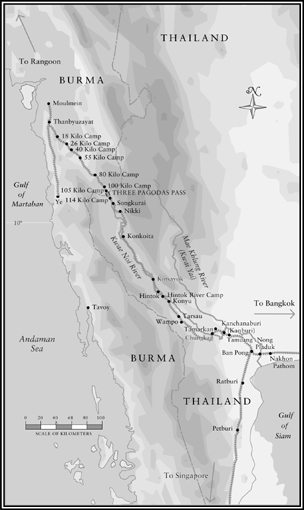
The solution to the quandary had been drawn up years earlier: a new railway link between Bangkok and Rangoon. In Burma, well-developed lines already ran from Moulmein south to Ye. In Thailand, tracks extended from Bangkok west to Ban Pong, then turned south to the Malayan border. A great gap, held firm by the mountain ridges and impassable jungle that straddled the border between Burma and Thailand, stood between the two systems. The Japanese calculated that if a link could be forged through the 258-mile-wide gap separating them, a war might be won.
A 1939 report commissioned by the Japanese Army had concluded that two regiments of railway engineers would need a full year to connect the existing rail lines. Prepared by a civilian consultant, the study attracted new interest once Burma emerged as a theater against the Allies in India. With the demands of war sapping the availability of labor and matériel, newer estimates showed the project would actually take five or six years to complete. The sudden and unexpected surplus of Allied war prisoners and local coolies, or romusha, had changed that calculus altogether. An army of slaves would compensate for Japan’s deficiencies in mechanization.
Though it had established its brutal pattern of treatment of POWs in China through the 1930s, Japan had haltingly committed itself to the principle that prisoners should not do work that was militarily useful to their captors. Japan had ratified the Hague Convention of 1907, and in 1928 it signed (but a year later refused to ratify) the more expansive 1929 Geneva Convention on the Treatment of Prisoners of War. The Imperial Army pressured the Japanese privy council not to ratify the convention because it was unlikely to bring reciprocal benefits: Bushido warriors did not become prisoners. Japan’s refusal to ratify the Geneva Convention would provide the cover it needed to deny that its prisoners of war were entitled to legal protections.
In March 1942, the commander of the Southern Field Railway Group in Saigon ordered preparations to begin for construction of the railway. On June 20 came the Army’s formal decision to proceed. Given the pressures of wartime, they needed it done fast—in twelve months. The job was assigned to the Fifth Railway Regiment in Thanbyuzayat, Burma, and the Ninth Railway Regiment in Ban Pong, Thailand. It would fall to a civilian engineer named Yoshihiko Futamatsu, who worked for Japan’s national railway, to bring to fruition the most ambitious and notorious of World War II’s civil engineering projects.
Futamatsu, promoted to major in wartime, determined that the best route for the railway was to follow the Kwae Noi River west from Ban Pong. That plan would run headlong into nearly insuperable obstacles of terrain, not to mention weather. A landscape broken by rocky ridges and snaking jungle rivers and tributaries would require exhaustive rock cutting, bridges, and viaducts along sheer cliffs. Moving north and west from the rice paddy plains of central Thailand, the terrain grew jagged and steep. As construction bogged down in the spring monsoon season, workers’ lives would be at risk from a mélange of tropical diseases and breakdowns in supply. Less difficult paths were available, but the route along the Kwae Noi had one surpassing advantage: The river, with its barge traffic, made heavy transport much easier. Large bridge trestles and heavy loads of ballast and other materials could be carried upriver from Ban Pong or cut or quarried locally. Heavy construction equipment was unavailable, but a swarm of manual laborers could more than make up the difference.
By the end of June 1942, the project’s infrastructure was taking shape. Twelve hundred British prisoners from Singapore began building base workshops and storage facilities around the town of Nong Pladuk, on the Thai end of the line. With its foundries, forges, engine shops, power stations, and an oil refinery—much of it scavenged or pillaged from Malaya, Sumatra, and Java—the town of Kanchanaburi in Thailand, often called Kanburi, became the headquarters for the entire line. Meanwhile, plans were afoot to bring prisoners to Burma to begin work from the northwest. A huge workforce of Burmese, Chinese, Tamil, Indian, and Malay natives—as many as 350,000 of them would be lured into imperial servitude—had built a chain of work camps every three or four miles along the right of way. They were joined by sixty thousand Allied prisoners of war, who rounded out the workforce and constituted its trained and disciplined core. Under their captors’ plan, they would build the railway simultaneously from either end, inland from coastal Burma and central Thailand, joining the two lines near the mountainous border with an imperial golden spike.
Such a trial had never confronted American fighting men before. Pressured to perform five years of work in twelve short months, they would be given over to the jungle and left to wrestle it toward civilization. They would contend with all its elements—its hardwoods, rocks, and vines, its predators both mammalian and bacterial, under the lash of their enemy and assault from the elements. The work would harden some and consume others. They would forget all but the most basic memories of home, picking their way through a life in captivity that would become the grist for sleepless nights ever afterward.
CHAPTER 37
How does one build a railway through an impassable jungle? How does one do it without industrial equipment, without hydraulics, steam, or mechanized tools? The task begins with an imperative: that it will be done. It will be done whether people go hungry, suffer disease, or are beaten to death with sticks. The imperative, enforced with martial ruthlessness, drives everything, but it comes with a cost. The Imperial Japanese Army was good at enforcing imperatives, if generally unmoved by the costs.
A railway begins with a survey, a right-of-way, and a cleared path. The path is staked out by engineers and cleared through forests and hills. In mountainous terrain such as the jungles of Burma, the challenge then is to tame that path, to make dangerous, jungle-draped elevations flat and level and passable by train. Long climbing stretches of earth must be leveled, ravines built up, hills knocked down, valleys filled. The railway must be squeezed through gaps between cliffs and rivers, carved as a channel through hard rock, bridged over a river system’s innumerable feeders and estuaries.
Then the path is shoveled up into a raised earth embankment, a base for a layer of broken stones, known as ballast, that allows the embankment to bear a crosshatched layer of wooden ties, or sleepers, and steel rails, and ultimately the weight of the freight trains themselves.
Like a collective embodiment of fabled John Henry in the mine, the prisoners would do with thousands of hands what should have been done by machine. In Burma, those hands were Australian, Dutch, and American. In Thailand, on the southeastern end, they were predominantly British. The British had gotten started in June 1942, just as the Japanese carrier fleet was trounced in the Battle of Midway. By the turn of 1943, as the fight for Guadalcanal was shifting in the Americans’ favor and General MacArthur was beginning the assault on New Guinea, work on the railway was in full swing. News of these victories would take months to reach the prisoners and kindle hope in their souls.
After the men in Fitzsimmons Group were marshaled at the leper’s prison at Moulmein, they were loaded into trucks and driven twenty-six kilometers into the countryside to the site of their first work camp. Since the work camps in Burma were named for their distance in kilometers from the Thanbyuzayat headquarters, this camp was known as 26 Kilo Camp. The Burma half of the railway was loosely structured around these kilo camps, each with its own Japanese commander, sited on the rail right-of-way from Thanbyuzayat (0 Kilo Camp), all the way up to Three Pagodas Pass on the Thai border, or 114 Kilo Camp. It was at 26 Kilo Camp that the story of the Americans on the River Kwai Railway began.
The 191 men of Captain Fitzsimmons’s group were loosely attached to a larger force of three thousand Australian prisoners under the leadership of Brig. Arthur L. Varley of the Australian Army. This group, who gathered at Thanbyuzayat in October, was the nucleus of the construction unit working on the Burma side of the line. The Allies would refer to it as “A Force.” In the Japanese scheme of organization, it was known as the “Number 3 Thai POW Branch” or “Branch Three.”* Its commander was Col. Yoshitida Nagatomo.
The Americans who arrived later, in January on the Dai Moji Maru, were greeted by Colonel Nagatomo and put under separate command in a unit known as Number 5 Thai POW Branch, or Branch Five, commanded by a Japanese army captain named Totare Mizutani. This group would work independently of, and have little contact with, the prisoners of Varley’s Branch Three. They began work at Alepauk, or 18 Kilo Camp. From the moment of their arrival, they leapfrogged their counterparts in Branch Three as expediency required, en route to their designated base camp at 60 Kilo Camp.
The kilo camps, built in advance by parties of romusha, were of primitive design, consisting of several long, open-sided bamboo huts roofed with interwoven palm leaves—nepa, sugo, or coconut; atap, they called it. There was no metal in their construction, no nails or other hardware. The bamboo joints were fastened with strips of bark. A door at one end opened into a dirt center aisle on either side of which was a six-foot-deep sleeping platform made from bamboo branches. There were about a hundred men per barracks.
Each man got a one-by-two-meter-long bamboo platform for personal space. They slept shoulder to shoulder, ate there, stashed their stolen possessions there. Rough-hewn though this life was, it was, at first, far more tolerable than the hell ships. A contingent of twelve to fifteen guards and Japanese Army engineers lived in their own hut across camp. The guards who oversaw the individual camps made it abundantly clear, as Colonel Nagatomo himself did, that death was the penalty for escape. The camps had no discernible perimeter. No walls were needed. The surrounding jungle was its own prison. The tall trees, dense bamboo undergrowth, and predatory animals were as confining as a concertina-topped fence with guard towers.
With the survey done and elevations calculated, the Japanese engineers stretched lines from tree to tree, marking sections of earth to be cut and others to be filled, and the prisoners got to work decapitating hills and filling ravines to lay the embankment of the railway. In the early going, cutting and filling were the principal tasks. The Japanese gave them all the work they could handle and more. The engineers set a daily quota of dirt for each prisoner to dig. At the beginning of the project it was one cubic meter per day. This turned out to be far more work than it might first have seemed. The men had not only to dig the dirt at the cutting site but also load it and carry it to a corresponding area needing a fill.
During the dry season, in the coastal foothills, the work was as easy as it would get. They shoveled and dumped, shoveled and dumped, loading sacks that were suspended from long poles and hauled to whatever depression or ravine needed filling. The poles, known as yo-ho poles for the rhythmic chants the native workers sang while working with them, were long bamboo rods from which hung a rice cloth sack large enough to hold several bucketfuls of earth. Each end of the springy pole, whose bounce seemed to make it easier to bear the loads, was carried by a prisoner. They would march several hundred yards with a fully laden yo-ho pole straining from their shoulders, spill and fill, and march back to do it again.
“You might spend a whole month making one fill in one place,” said Houston sailor Howard Brooks. “There were relatively short distances. But there might be stones close by where you start breaking up stones and putting fill in, putting stones on top for the ties you’re going to lay on it. You might do that and then you might do it in reverse another place. Then you might leave and go on down to the next camp and start the same thing over again.”
The cuts could be 150 yards long and sixty to eighty feet deep. “There was a lot of rock—a tremendous amount of rock—that you had to go through, and this was all done by hand,” Gus Forsman said. The scope of the work didn’t bow them. There was almost always immediately to hand a smaller objective, a quota enforced with the rod, to concentrate their minds.
Their tools were primitive when they had tools at all. There were no bulldozers or bucket loaders, no graders. The prisoners were all those things. They were dump trucks. They were steamrollers. They packed the railroad embankment by the percussion of their bare feet walking over it. Their shovels, made from soft metal, bent and broke when struck too vigorously into the root-infested earth, “like a pork and bean can on the end of a stick,” Howard Brooks said. “We got beat up more for bending a shovel than we did for not working at all.” They learned, in other words, to rely not on their tools but on their own hands. And as they did so, extending the railway into the mountains, every so often they would notice what appeared to be old survey markings from some earlier effort to carve out a right-of-way. Rational minds had come before them, labored briefly, and declined to proceed. Now such discretion was no longer available. When the prisoners lost track of the old markers, they set their own course into the unsurveyed jungle.
*The name was confusing insofar as most of the Americans would never work on the Thai end of the line. The Number 3 Thai POW Branch worked in Burma.
CHAPTER 38
Staying mostly at his headquarters at Thanbyuzayat, Colonel Nagatomo kept a studied distance from the backbreaking exertions of his charges up the line. Brig. Arthur Varley’s challenge was to build rapport with his counterpart and cultivate an ability to prevail upon him to treat his prisoners with as much humanity as possible. But Varley could see a hopeless situation settling in as the size of Branch Three swelled, en route to a number approaching ten thousand men later that spring—mostly Australian and Dutch, with a sampling of British and Americans in the mix. He had seen the worst of war’s foul enterprise, having received two Military Crosses for conspicuous gallantry as a young lieutenant in World War I. But nothing he had seen during that earlier conflict could have prepared him for the ruthlessness of the Japanese now. Several months before the first Americans arrived, Varley’s men had been working near Tavoy, constructing airfields for the Japanese. Eight Australians were caught trying to escape and were brought before Nagatomo. He coolly ordered them executed. Varley’s pleas went nowhere. The death sentence was inflexible. The only thing that struck Varley more than the camp commander’s cold-blooded allegiance to the Bushido code was the good-natured, downright cheerful way the Aussie “diggers” conducted themselves as they were led blindfolded to their graves. “They all spoke cheerio and good luck messages to one another and never showed any sign of fear. A truly courageous end,” he wrote in a secret diary that he kept, at considerable risk to his life, from the beginning of his time in Burma.
Confronted with Nagatomo’s murderous discipline, Varley pursued a continuous and ongoing negotiation with him and his deputies, Lieutenant Naito and Lt. Kititara Hosoda, bargaining to secure medical treatment for his weakest men and fair treatment from the guards. He monitored their treatments, provisions, and punishments, lobbied for the Japanese to make the payments they promised in exchange for work—a private got twenty-five cents a month, an NCO thirty, an officer forty—and pressed for the Japanese to allow the Red Cross to admit a ship into Moulmein, as the Geneva Convention provided.
Nagatomo remained relatively aloof in these parleys, insulating himself by communicating to Varley through a Dutch translator named Cornelius Punt, or through Lieutenant Naito, who knew some English. Varley and his medical officer, Maj. W. E. Fisher, the senior physician among all nationalities in Burma, wrote numerous letters to Nagatomo warning him of deteriorating health conditions. By the time the second group of Americans arrived in January, contagion was well established and various diseases had a firm foothold in the camps under Varley’s purview. Nagatomo seemed to consider the growing number of dysentery and malaria patients in the Thanbyuzayat hospital as malingerers. With a thousand beds, Thanbyuzayat was a large hospital. But the medical staff there had barely enough equipment to staff a small rural clinic. They had three thermometers and perhaps half a dozen two-inch rolls of bandages at any given time. They reboiled mosquito netting and old rags to use as dressings, covering them with banana leaves taped down with strips of latex. Varley, in his diary, documented his every meeting with the Japanese, every request for drugs, beds, rice bags and canvas, drums for boiling water. He also documented the futility of such efforts.
There were signs of empathy and decency in several Japanese officers at Thanbyuzayat. Lieutenant Hosoda, who stood in as Branch Three chief during Nagatomo’s occasional absences, wept at his first sight of dysentery’s effects on the prisoners. He ordered guards to bring in, under the cover of darkness, fruit and eggs to the patients. There was a second lieutenant named Suzuki, a surgeon in private practice, who, according to Dr. Fisher, examined the most serious of the sick at Thanbyuzayat “competently and sympathetically, talked intelligently about surgery and expressed the hope that the fellowship of medical practitioners need not be abolished by the exigencies of war.” There were times when Nagatomo himself, having personally seen to the execution of escapees, seemed to draw close to sympathetic cooperation with Varley. “Were there any good Japanese?” Fisher asked in his diary. “The answer is yes, but so few as only to constitute an exception proving the rule to the contrary.”
On December 7, 1942, Nagatomo traveled to Rangoon and from there on to Singapore for a conference of camp commanders. His relief was Lieutenant Naito. The Allied POW commanders were uneasy about the Japanese junior officer. Though he could fight his way through an English-language phrase, something in the glint of his eye struck them as not quite right. Six days after Nagatomo’s departure, three Dutch officers were shot and executed, supposedly, Naito said, on the personal written order of the colonel from Rangoon. On January 10, Nagatomo returned to the base camp claiming to have spent twenty thousand yen on blankets, clothes, boots, hats, toothbrushes, toilet paper, and sporting goods for the prisoners. Nothing was ever seen of it on the railway.
The men exhibited the ravages of the bacterial war quickly. After Serang, Bicycle Camp, Changi, and several months with Branch Three, Gus Forsman had dropped from 145 to 80 pounds. The nutritional deficiencies invited beriberi, which revealed itself through sudden, painful swelling that if left unchecked could assault the heart. “If you poked your finger into your leg, the hole would stay there for twenty minutes to half an hour,” said Otto Schwarz. “The soles of your feet were so swollen you couldn’t stand up from the pain.” Dry beriberi was severely painful, but it was the wet variety of the disease that killed you. “When it got to your heart, forget about it. It caused progressive swelling from outside into your core,” Schwarz noted.
Mosquitoes spread malaria, leaving men with cold, sweaty, shuddering chills. In the worst cases of cerebral malaria, or malignant tertiary malaria, the body overheated enough to warm the brain and bring delirium. The prisoner felt as though he were encased in a sphere, looking out through fishbowl glass at the blurry world, an oscillating, electric ringing in the head. “You feel like your mind is a closed circuit, not quite making contact with the outside world,” Ray Parkin wrote.
A number of Varley’s countrymen were well over fifty years old—he himself was forty-nine—and could not afford to be placed on limited duty, because limited-duty workers were not paid and men who were not paid had trouble getting enough to eat. The extent of the danger to them was apparent enough. But the Japanese seldom acknowledged the medical crisis at hand. As Varley wrote in his diary, “The J’s require absolute proof—not warnings of these dangers. Unfortunately the proof lies in the burial of a number of men who could have been saved if our warnings were heeded and necessaries supplied. It is so difficult and heartbreaking to fight for the lives of our men in all these matters and meet a brick wall on all occasions, by being told things are not available.”
The jungle’s contagions afflicted the Americans in Branch Three especially hard, because they had none of their own medics with them. When Drs. Epstein and Burroughs from the Houston and Captain Lumpkin from the Lost Battalion arrived in January and went upcountry with Branch Five, they had little contact with the other group. Treatments were seldom ever more elaborate than a damp cloth over the head. “A little quinine would have saved a lot of lives,” said Otto Schwarz. “We were very rarely given it, just once in a blue moon.” At Thanbyuzayat, Nagatomo’s headquarters camp, was a reasonably well-equipped field hospital, but it was a prohibitive distance from the work sites where the weakest prisoners fell, far up the line.
The pace of work on the line was driven by many things that the Japanese could control—rifle butts on bones, the withholding of rations and medicines—and slowed by the never-predictable patterns of sickness. Looming behind all those variables was the knowledge that in a few short months, by April or May, the monsoon season was going to multiply the difficulty of every task. There was pressure to get the embankment laid quickly so that grass and other vegetation could grow through it before the seasonal torrents picked it apart.

The disease-ripe jungle would have posed a challenge to Western medicine even under ideal sanitary conditions. Without instruments and manufactured pharmaceuticals close at hand, the best Allied doctors were helpless. In the jungle, these shortages could turn even the smallest of wounds into death sentences.
Two Lost Battalion officers, Capt. Arch Fitzsimmons and Lt. Jimmy Lattimore, having heard that a group of Dutch physicians was based farther down the line, went to the Japanese and begged them to order one of them to join Branch Three. Just one would make the difference between life and death. They offered their watches as a bribe. As it would turn out, a gifted Dutch doctor had heard of their plight and was asking for them in turn. In April, a doctor whom some of the Americans in Branch Three had met in Singapore showed up at 40 Kilo Camp to join them as their on-site medical caretaker. His name was Henri Hekking.
Howard Charles remembered seeing Hekking back at Changi, gathered with Allied officers in one of the stucco barracks, rehashing the fall of the Dutch East Indies. Born in Surabaya to Dutch parents, Hekking felt indeed that they were his islands. It was his grandmother, a committed herbalist and healer, who set him on the path of studying native medicine. When he was sixteen, his father’s work took him back to the Netherlands. Though he didn’t want to leave, Hekking went there to study medicine on a Dutch army stipend, then paid for his training with a ten-year term of service that took him back to the East Indies as a medical officer in the colonial army. There Hekking continued pursuing his grandmother’s art, first at Batavia, then at a hospital in the Celebes, and finally, before his capture, at the hospital on Timor. When the Japanese seized Timor and took him prisoner, it marked the end of his fulfillment of his promise to his oma that he would return and use his skills to help the natives of his homeland.
On his arrival at 40 Kilo Camp, Hekking introduced himself to the camp commander, Major Yamada. After exchanging niceties, the Dutchman told Yamada, “I wish to speak to you about food. The men will need meat.”
“No meat,” Yamada replied. “Later, Nippon kill water buffalo. Boom-boom. Understand-kah?”
Hekking was not bowed. “The men must have meat and citrus—fruit, any kind of fruit.”
“No fruit,” the major said.
The flat denials moved Hekking to appeal to the Japanese officer’s self-interest. He knew Yamada had a tight deadline to complete his segment of the railway. He took a new tack. “As a doctor, I must warn you that if you do not provide protein and citrus, these men will soon become sick, and if they become sick, how do you build a railroad?”
Yamada darkened. He asked: “You warn me, Captain?”
“Yes, I—” Hekking offered, before he found himself reeling backward from the blow he never saw coming. As Hekking found his balance and clutched his face, Yamada shouted, “You do not warn me, Doctor! I warn you! You will speak no more of food!” Yamada ordered a roll call, mustering the prisoners before him. Then he began a speech that was an angrier, more threatening version of the address his superior, Colonel Nagatomo, had given the prisoners at Thanbyuzayat. As Charles recalled it:
Prisoners were worthless driftwood washed ashore on the tide, he said. In Japan, one who surrendered to the enemy was worse than worthless, he was dead, for all practical purposes. He could never go home again, members of his family were disgraced, his offspring would suffer for many generations. But we were lucky: the railroad gave us the opportunity to redeem ourselves.
Yamada was just getting to the part about how his segment of the railway line would be built better and more quickly than any other when a voice began to sing. It was Freddie Quick, doing a reprise of his turn at Changi singing “God Bless America.” His voice, Charles wrote, was “a beautiful baritone, challenging [Yamada], mocking everything he stood for.”
The Japanese major’s face went crimson as he scanned the ranks for the offender, found him, and shouted for him to stop singing. Two guards seized Quick and pulled him in front of Yamada. The guards tied his hands behind his back, then, wielding bamboo poles three inches in diameter, began pounding him over the head. On demand, the bleeding Marine repeated his name, rank, and serial number, each time weaker than the last. He was made to kneel, with another pole behind his knees. The guards kept working on him, lifting and pummeling, the thick bamboo shaft whistling down and cracking him atop the head, his legs numb and starved for blood. “Stop!” Henri Hekking shouted. “You will kill that man.” The physician felt a crushing weight in his midsection—a rifle butt. The bamboo continued to fall on Quick. The guards relented only when finally he pitched forward, unconscious.
Jim Gee, Howard Charles, and some others hauled the unconscious Marine to a hut and laid him on the bamboo platform. “Is he gonna live?” someone asked. Examining the gash in his head, Hekking said, “Oh, yes. I would sew this up if I had some way to disinfect it.” He said he needed a suture, some thread, and some cloth. Jim Gee volunteered to get some water boiled and, for a cloth, offered the shirt off his back.
The Lost Battalion’s Lieutenant Lattimore, installed by Major Yamada as the food and supply officer at 40 Kilo Camp, confronted the Japanese officer one day about the inadequacy of their daily ration. The Japanese had informed Lattimore that working prisoners were to get a ration of five hundred to eight hundred grams of rice each day. In actuality, they were getting half that. The rice was “rotten and unusable, all of a grade the natives usually fed to cattle,” Howard Charles wrote. Hekking realized that the prisoners were contributing to the problem by washing their rice. He insisted they stop. The “gray rice” they were served—dirty floor sweepings with a certain proportion of bugs and other foreign garnishments—was in fact an important source of vitamins and protein. They were supposed to receive 125 grams of meat. There was none to be had—and whenever there was a windfall, say if a water buffalo was killed, the guards always took the steak. Prisoners were supposed to get 250 grams of vegetables, but this came in the form of melon, full of water and with little caloric content to fuel a working man’s metabolism. As the Lost Battalion’s talented medical officer, Capt. Hugh Lumpkin, would tell an interpreter with Branch Five, based farther down the line, “Melons were only hog feed in the States.”
Jimmy Lattimore was small of build and modest of mien, but he never had any trouble standing up for his men, no matter how many times his spectacles were sent flying. According to Howard Charles, Lattimore waved the food allocation order in front of Yamada’s face and asked if he had ever planned to honor it. When the officer scoffed, Lattimore said, “You don’t worry about a day of reckoning, because you think you’ll win the war. Is that it? There’s a day coming, buster. You’ll see.”
Assisted by two orderlies, Slug Wright from the Lost Battalion and Robert Hanley from the Houston, Hekking ran the most challenging kind of solo practice. He devised some innovative remedies out of the jungle’s natural medicine chest. Certain types of leaves healed cuts. Long, saberlike legumes held beans that when crushed and boiled produced a tonic—“bitter as gall,” according to Don Brain, but useful in reducing fevers. Hekking’s knowledge of jungle ailments and natural remedies was encyclopedic. If Pack Rat McCone was resourceful in stitching wounds with safety pins and twine, Henri Hekking took lifesaving resourcefulness to the level of mysticism, if not near divinity. He knew that palmetto mold could be used like penicillin, that pumpkin could be stored in bamboo stalks, fermented with wild yeast, and used to treat men suffering from beriberi (it got them pleasantly drunk to boot). Tea brewed from bark contained tannins that constricted the bowels and slowed diarrhea. Wild chili peppers had all sorts of beneficial internal applications.
Hekking was supposed to report to British doctors who had been trained at the finest medical schools. Leery of native ways, they called him a witch doctor. Hekking had as little regard for their practices as they did for his. Because supplies of quinine were limited, he never prescribed it preventatively. He preferred to encourage the immune system to function, and administered the medicine only to fight an actual infection. He mixed beef tallow with acetylsalicylic acid to fight athlete’s foot, distilled liquid iodine by mixing iodine crystals and sake, and ground up charcoal and mixed it with clay, a remedy that absorbed intestinal mucus. Assessing a skeletal patient squirting his insides out from dysentery, he could see beyond surface appearances and determine its underlying nature, amoebic or bacillary. When more potent medicines became available—Captain Fitzsimmons procured some sulfapyridine tablets once—Hekking would be miserly and economical, shaving the tablets down and administering the shavings directly into septic wounds. He used gasoline for alcohol, kapok for cotton, leaves for bandages, and latex for an adhesive.
Doc Hekking thought the classically trained physicians were hopelessly out of their element. “It was most distressing to him,” Howard Charles wrote, “discovering how different their approaches were to the treatment of tropical diseases…. He was light-years ahead of these doctors.” One of Branch Five’s medical officers, Captain Lumpkin, who had practiced medicine in Amarillo before mustering for war, said that any doctor who trained in the jungle with the Dutch East Indian Colonial Army knew more about tropical diseases than the collective mind of the American Medical Association.
Hekking saw his patients as whole human beings and treated the whole man. “He was the first man that I ever heard of that treated a man as a unit,” said Slug Wright. “He claimed that man had to be cured two ways: the body is only a small part of it; the mind is important as well. So he cured the mind and the body together. He was using psychosomatic medicine.” Hekking sometimes turned around a patient in decline by intentionally angering him. He found that a rush of rage could be a lifesaving stimulant, even if the patient was in no shape to act out the impulse. Hekking inspired such confidence in his patients that even his placebos had powerful effects. He saved a different kind of placebo for the enemy. When Japanese soldiers came to him for help with venereal disease, he would send them to the native black markets to get the medicine he needed. When the medication was brought to him, he would set it aside for the prisoners and inject the Japanese with water. Sometimes he gave them a salve of plain acid and told them to apply it regularly. He didn’t mind seeing them jump. He seemed fearless. Once he took a sulfapyridine tablet and made a mold from it. With the mold in hand, he was able to cast replicas using rice flour and plaster of Paris. He would trade the counterfeits to the Japanese for the quinine and other medicines his patients so urgently needed.
Hekking was the gatekeeper between the sick ward and the railway work parties. When the Japanese came around demanding workers, patients looked to him for a reprieve. Hekking would place the worst ones on the limited-duty or no-duty list. The next morning, if the Japanese couldn’t fill their quota of workers, they would go through sick bay and grab the sick for duty on the line. It fell to the doctor to protest the selection. Many times, he got the hell pounded out of him for his audacity.
Henri Hekking worked one of his miracles on Jim Gee. The Marine was one of the first Houston men to go down with a fever, collapsing while digging a grave in the jungle out by 26 Kilo Camp. Taken to a medical tent, he lay unconscious for three days. His meltdown was so severe, his loss of fluids so pronounced, that he lost fifty pounds within a week. In the midst of his delirium, Gee remembered coming to and seeing a strange man speaking a strange tongue. He didn’t know if he was in heaven or hell. He heard someone say his struggle had been long and difficult, that he had nearly lost his mind. It was Hekking, who for thirty-six hours straight had sat by his bed, patiently enduring the Marine’s rage. Hekking had brought a large sack full of roots taken from a low-growing weed known as Cephaelis ipecacuanha. Major Yamada, in a show of mercy—or perhaps just impatience with Hekking’s doggedness—had permitted him to go into the jungle, under guard, to gather the plants. He boiled them into an herbal tonic and cajoled the Marine to drink, encouraging him, touching his hand to his patient’s clammy skin. Gee struggled to sit upright and drank. Hekking got some people to carry him outside and sat him in the sun. When Gee’s strength came back, the good doctor saw to it that he was taken back to the field hospital at Thanbyuzayat.
CHAPTER 39
For Charley Pryor, working with Branch Five in the lowlands near 18 Kilo Camp, the work was hard but manageable. He found that the guards didn’t bother him much if the work got done. They had food. They even had entertainment. One of the Dutch prisoners in Branch Five was a professional magician who had once worked on Holland-to-America cruise ships. For the Americans, his sleight of hand was a welcome diversion in a countryside that seemed immune to reason. The natives saw it differently. When he set a silk handkerchief prancing and fluttering, the few romusha brave enough to watch from the perimeter disappeared in terror.
The Americans could have learned from the natives’ jungle wisdom. Clearing a right-of-way through some bamboo thickets, sweeping their picks back and forth, they were liable to disturb real estate claimed by all types of wild creatures. They found big blue-black scorpions with six-inch tails whose stingers were sharp enough to stick fast in a hickory-handled shovel. Charley Pryor said he caught a centipede that measured twenty-eight inches in length. Later he unearthed a nest of tiny snakes lying under a clump of bamboo. Curious, he put on a pair of gloves, reached down, and pulled one up, holding it by its head. He opened its mouth with a knife blade and noted two fangs deep in the cavity. When some natives saw what he was doing, they broke and ran. A safe distance away, they turned to Pryor again and began making frantic gestures. Pinching their forearms, they pointed to the sun in the west, then to the eastern horizon with a negating wave of the hand. The sun would go down, but another sunrise wouldn’t come. Talking to a British prisoner later that day, Pryor discovered the serpent he had been toying with was a krait, more poisonous than a cobra.
They would start work at sunup and fulfill their quota by midday. Little did they appreciate at first that their efficiency would work against them. “The prisoners worked in a rather foolish fashion against the advice of the officers,” Ens. Charles D. Smith wrote, “racing through their work to try to finish early so they could return to camp and have more time off for themselves.” That might have been a good strategy so long as your overseers were U.S. Navy boatswains. On the Burma-Thailand Railway, the Japanese were not in the business of granting privileges or giving breaks. They just raised the quotas to match the prisoners’ evident capacity: one and a half, two, three cubic meters a day. Because the Japanese relied on POW officers as go-betweens, they were exempt from the work details. When the enlisted men went out to the line, the officers stayed in their huts. Part of it was to be expected. They had earned the privilege not to work.
As the rail embankment stretched into the hills, the prisoners grew distant from the semblance of civilization that could be found at the Thanbyuzayat base camp. Brigadier Varley’s diary refers to tennis and soccer tournaments being played there as late as March 1943. Colonel Nagatomo presented the prizes. Concerts were permitted after working hours and on rest days. Perhaps remembering Freddie Quick’s star turn in Changi, and his defiance at 40 Kilo Camp, the Japanese required that the playlist be approved in advance, and they forbade nationalistic tunes.
Uncertain omens played at the prisoners’ hopes and fears. On February 12, prisoners at Thanbyuzayat could hear a series of distant detonations. As the guard was increased and POWs confined to huts, rumors passed that Moulmein had been bombed, though drivers traveling up from the port town disputed it. There was speculation that Allied bombers might have attacked ships off the coast. Meanwhile, as the base hospital was filling with growing numbers of no-duty sick, the epidemiological picture took a dramatic turn for the worse. Word arrived that far up the line, as far out as 80 Kilo and 85 Kilo Camps, cholera had broken out. The news chilled the spine of every thinking man. In the absence of the right treatments, the disease could kill a healthy man nearly overnight. Near the end of February, the Houston’s Dr. Epstein was sent up from base camp to continue to look after Branch Five, and soon thereafter Brigadier Varley asked that Epstein and six Australian and Dutch doctors head even farther up-country to take over the new field hospital at 30 Kilo Camp. The monsoon season was coming, and when its rains began washing down it would become impossible to move the sick all the way back to the base hospital.
As if the medical news were not bad enough, the first week of March saw, for the first time, Allied aircraft over Thanbyuzayat. On March 1, three twin-engine bombers appeared, circling the camp and the railway yards at five thousand feet. The planes dropped flares north and south of the camp, then unloaded their bombs on unknown targets to the north. The Korean guards panicked at the sight of the planes. Fixing bayonets, they confined prisoners to their huts once again and scrambled down into the slit trenches around the camp, a privilege denied to the prisoners who had dug them. The appearance of the bombers seemed to have an effect on the camp’s Japanese leadership as well. The next time a fresh group of prisoners of war arrived at the base camp, Colonel Nagatomo was there to greet them. This time, however, he read only portions of his grand stump speech. It seemed to Brigadier Varley that some of the pomp had gone out of his circumstance.
CHAPTER 40
Sinuous and halting, the emergent railway crept up the mountain, moving in contractions and dilations like a vast segmented worm. Alive with the movements of thousands of feet and hands, it grew from the earth, writhing across Burma’s gentle lowland foothills and plains and entering a land of steep, jungled rises and rocky barriers around rivers.
By the end of March 1943, the mobile track-laying parties had spiked down meter-gauge rails as far as 18 Kilo Camp. Jim Gee, fully recuperated from his bout with malaria, rejoined his fellows at 26 Kilo Camp, where the work, far less advanced, involved laying sleepers atop the finished railway embankment. Brooking no delays and urgently pressed for time, the Japanese ordered 1,850 men from Branch Five to leapfrog from 18 Kilo Camp all the way up to 85 Kilo Camp, where the railway was little more than a surveyed right-of-way through virgin jungle. Against the wishes of the doctors, the sick moved with them. As commander of Branch Five, Captain Mizutani decided to move them to the hospital at 30 Kilo Camp. He took it upon himself to decide which of the no-duty sick at 18 Kilo would make the trip on foot and which would be driven. He unsheathed his sword, walked up to each man in turn, and struck him a swift, flat blow. If the prisoner got to his feet, he was ordered to march. If he didn’t, he was borne on a stretcher and loaded onto a truck. Humping along the service road that paralleled the right-of-way, the healthy said goodbye to the lowlands and launched their forced assault on Burma’s mountains.
Hastily built by romusha who doubtless had faced unimaginable suffering, the camp at 85 Kilo was filthy. The prisoners arrived to find pit latrines adjacent to the kitchen hut. Some of them had partially fallen in. Sour, mildewed rice was strewn about in piles. No boiled water was available. Touring the camps, Brigadier Varley noted a pig’s carcass suspended from a tree near the kitchen, black with flies. Working in the field was in many ways preferable to languishing in that squalor. Still, wielding a pick under the hot Burmese sun, hacking out clumps of bamboo and their roots, was draining and dusty work. On March 30, some welcome showers cooled them, temporarily suppressing the dust. Up to then there had been only one rain in the past five months, totaling about an inch of water.
The 85 Kilo Camp was the real jungle. Here they faced dangers many and manifest. The root structures of the bamboo were alive with snakes: deadly bamboo snakes, tan in color, two to three feet in length; cobras; pythons. Without axes or hoes to root them out, Pryor used a small hand pick. “We’d get in there, and you’d hit one and sling him out there…. We were always conscious of snakes.”
The hills and rocks slowed the work, introducing new engineering challenges. High in the hills, the prisoners worked far from their sources of food and medicine, the flow of which up into the mountains was restricted like blood flowing through a calcified artery. Already inadequate supply trains had a hard time keeping up. Once a prisoner of war had dragged himself far enough into the mountains, there was no getting food to him, and no getting his half-starved carcass out. The natives who ran the canteen stores near the base camp knew better than to set up shop that far upland. The prisoners were thus forced to subsist on the rations they got from their masters, unfortified by the private market. Adding to their isolation was an administrative quirk: Captain Mizutani’s Branch Five was technically administered from Singapore, which seemed to give it a second-class status that slowed provisioning from base camp. Branch Five was going to conquer this mountain on its own.
Clearing work at 85 Kilo lasted three weeks, then the workers were moved back to 80 Kilo. The terrain there was cut through by several tributaries feeding the Zami River. Several of the cuts were so deep that something more than ordinary cutting and filling was required. Bridges would be necessary to span the gaps.
Bridges would become the signature feature of the Burma-Thailand Railway; indeed, Hollywood would define the very concept of Allied POW servitude in Asia around their construction. The largest and most famous of them would be built by British POWs in Thailand, far to the southeast of the Burma-Thailand border, the eastern limit for most Americans working on the railway. Though most of the American prisoners did not participate in the initial construction of the so-called Bridge on the River Kwai, as the long steel and concrete structure spanning the River Mae Khlung on the Thailand side of the line became known by way of the award-winning movie, their lives would become enmeshed with it, and the film a cultural shorthand by which their ordeal could be understood.
Or, as it happens, misunderstood. In David Lean’s 1957 film, the bridge—and by implication the entire railroad—was a showpiece of British pride and know-how. It was premised on the idea that the British had engineering expertise far beyond that of the Japanese. Ripe with Western chauvinism, the film depicted the British as the teachers and contractors to the unsophisticated enemy. The reality was just the opposite. The real railway was driven from end to end by Japanese ambition and know-how. Though Japan lacked the machinery to construct it by state-of-the-art means, there was no lack of design expertise—or ruthless will. Japan would do with cold dispatch what Western colonialists had deemed impracticable.
The railway had far more than just one bridge. In had 688 of them—uncelebrated, remote, anonymous structures crossing ravines and tributaries along the way, the vast majority fashioned from timber. Only seven of these bridges were built from steel. And though the largest and most difficult bridges were on the Thailand side of the line—the rivers there would swell with runoff from the coming monsoon rains, requiring monumental efforts to span them—six of the railway’s seven steel bridges were on the Burma end of the railway, between 45 and 85 Kilo Camps.
Hard timber for bridge construction was readily available in the jungle surrounding 80 Kilo Camp. The prisoners hauled the great trunks of wood from the forest, squared them with sharpened hoes, and drove them into the earth to make pilings. Charley Pryor, with Branch Five, helped drive pilings, cut timber, and clear the service road too. Back home in Littlefield, Texas, he had gotten good with an axe hacking mesquite trunks for firewood. With three others helping him—Sgt. Hugh Faulk, an Idaho lumberjack, and an Australian—they could do four days’ work in a day. The beauty of the detail outside camp was they could sleep in occasionally, because the guards never went looking for them in the jungle. When they were really feeling their oats, they would cut some buttery soft balsa wood and include it in the stacks too.
Once in a while, powerful machines were available to help them: elephants. One or two of the great beasts were on hand at 80 Kilo Camp to drag heavy logs out of the jungle, but they sometimes made more trouble than they solved. “An elephant’s a smart bugger,” said Pryor. “He tests these logs before he puts much effort into them, and if it seems heavy, well, he’d back off from it.” No amount of beating the beast over the head with an iron hook seemed to persuade him otherwise. Faced with a recalcitrant elephant, the Japanese often had no choice but to require prisoners to do the hauling instead.
The pilings, virgin teakwood, were selected for length and breadth from the rich forests surrounding the camp. Pryor and his fellows brought them down with old crosscut saws, used picks and poleaxes to trim them to fit, then dragged them, by hand or by elephas maximus, to the bridge site, where they had dug starter holes in the earth. Wherever a bridge piling was needed, a derrick (or a scaffold) would be constructed from bamboo or tree saplings secured by wire twists. The piling would be raised and lowered through the derrick, then seated into the starter hole. Then atop the scaffolding would be erected a wooden pulley mechanism, holding up a heavy weight that could be raised and lowered like a hammer to drive the piling into the earth.
Pryor called them “spider rigs.” Eight or ten men would pull on a web of ropes—“monkey lines”—fitted through a pulley atop the scaffolding. They kept rhythm by counting in Japanese—“ichi, ni, san, shi, go”—or by singing a song chosen by the engineers. For a time the engineers themselves stood atop the rickety derricks, directing the fall of the hammer. That arrangement lasted until some Australians found they could set the whole assembly swaying by deliberately falling out of sync on the count. Two engineers tumbled to their deaths that day, after which the prisoners got the job of climbing the tops of the derricks. When a piling had been driven to the proper depth in the ground, they would tear down the derrick, select a new piling site, and start all over again.
With pilings driven, trusses were next, installed from piling to piling, fastened with nails where possible but more often simply tied with vines, until the rail bed reached the opposite bank at the proper elevation. Bridges crossing the larger streams in hillier terrain sometimes required several decks of wooden pilings, one standing on top of the other. “It worked,” said Luther Prunty of the Lost Battalion. “It seemed impossible, but it worked…. It wasn’t so hard once you got the hang of it. It was just like marching…. There’s nothing that manpower can’t substitute for.”
CHAPTER 41
The first American had yet to fall when the men of Branch Three, laying rails, reached 23 Kilo Camp. Up to that point, that camp had been home only to Burmese romusha, and the condition of the camp showed it. It was evident why scores of thousands of the native slaves would die. It had to do not with their constitution or their knowledge of the region, but with their lack of discipline in maintaining proper hygiene. Wholly unprepared to survive in a disease-ridden aboriginal wasteland, though they were natives, the throng that died was unmeasurably large. Many responsible estimates approach a hundred thousand. It would become a human tragedy whose intensity and scale grew as the rail reached toward the mountains from each end. If anything put the lie to the rhetoric of a Greater Asian Co-Prosperity Sphere, it was in the atrocious mass crime that Japan perpetrated on its workforce of conscripts.
In the native-type huts, lice infestation was rampant and there was never enough boiled water to scald the floors clean. For the prisoners, there was never any choice about attending to the vital business of sanitation. Otto Schwarz said, “As we would go into a new working camp, the first thing anybody did was dig a couple of fire pits, put in the fifty-five-gallon drums, fill them with water, and get the water hot. Before you got your rice, you had to get in line and dip your mess kit or coconut shell in the hot water. Blowflies were all over everything. And that’s what carried dysentery.
“We kept our structure. We had our officers, our NCO’s—our chain of command was kept intact. We always dug big ditches and put bamboo across the tops, so we could perch and do our business…. But if you went into a native camp, they’d have families of natives there on the railroad to work, but no leaders, no bosses, and no sanitation whatever. Feces were all over the place. They crapped wherever they stood. When they died, they lay there and rotted away. Disease ran rampant in those camps.”
Faithful adherence to simple procedures—such as dipping mess kits in boiling water before eating—made all the difference. “If a passing fly chose to step into your rice ration as it was about to be eaten, there was no alternative but to throw the lot into the fire and go without,” wrote Ronald Searle, a Royal Army sapper captured at Singapore. “Although such a gesture was dramatic for a starving man, there could be no hesitation.” Survival meant continued deprivation. “There were times when most of us felt that perhaps those chums who had encountered The Curse of the Fly’s Footprint were the fortunate ones.”
Hygiene, health, and morale stood in symbiotic linkage. If the prisoners in a camp got careless with the first, the other two collapsed in turn. One sip from a tempting but bacteria-hosting wayside pool, a lack of religiosity in boiling one’s mess kit, failure to see that upstream from one’s bathing area was another pool used by the dysentery-prone—a single slip ensured that a bad life would grow far worse in a hurry. Dr. Fisher already had a surplus of patients to care for. In March he admitted 464 men from Branch Three and discharged 322. An additional sixty-five from Branch Five were there already too. With the monsoon season looming, work was slowing just as it should have been accelerating, and renewed pressure came from on high to complete the job. On April 7, Maj. Gen. Akira Sasa of the Japanese Army, the chief administrative officer of all branches in Thailand and Burma, arrived at the Branch Three headquarters to take stock of the growing crisis.
On his tour of camps up the line, General Sasa was driven by truck, with Brigadier Varley and Major Fisher riding in the back as it made the bouncing ride as far as 85 Kilo Camp. Varley appreciated that the condition of the service road made it impossible to use to transport the “heavy sick.” “They would either die from the jolting about,” he wrote, “or be so knocked about that it is far better to let them take their chances in outlying camps. Further with heavy rain it will be impassable. My previous fears voiced to Js months ago, were confirmed in my mind, i.e. that unless the rail was laid to outside camps we would not be able to maintain food supplies to these men.” Sasa had no interest in the Allied officer’s opinions. He never spoke directly with Varley and attached no value to the Branch Three commander’s concerns. He looked at the rail and the mountains, considered the requirement that the railway be finished by August, and deemed the progress insufficient.
A Japanese medical officer, Dr. Higuchi, then called a conference with Varley, Fisher, and two other officers. The Japanese commandant of 75 Kilo Camp, Lieutenant Hoshi, appeared before a muster of sick personnel on April 13 and gave a speech.
Major General Sasa has visited camp and expressed himself very satisfied with it, its order and cleanliness and conditions. But one thing he was not satisfied with was the number of sick who are far too many. There should be no sick here—all sick men were left behind. If men become sick they should not exceed twenty percent, a total of 380, this has been much exceeded. Some men who are sick I am trying to send them to Thanbyuzayat, but there is no transport and I am considering making them walk.
Hoshi repeated the rhetorical boilerplate blaming the Allies for Japan’s aggressions. “The number of sick has got to come down—this is not Sasa’s orders but from higher up. Japan is striving to build this railway by August. It must be finished by August…. If you die you are soldiers and dying is part of your job and you will be contributing to the greater glory of Japan…. You have sick only because you don’t try. If you are sick you only lie down all day and if you lie down you don’t need food. In future the sick will not get food even rice—the workers only will be fed. You will also be forced to go to work. Remember it is only four months.”
The speech was steeped in the conviction that the emperor’s divine will could command nature, defeat time and distance, and reach beyond the limitations of human endurance. The work would be done in spite of the vicious cycle that was whipping the prisoners from all sides: Survival depended on work, but disease conspired against both. The Japanese medical presence was a cruel joke. According to Ensign Smith, Higuchi’s medical training consisted of a couple of years in dental school. Dr. Fisher, with the other Allied medical personnel, shared that assessment, stating that Higuchi “knew nothing of medicine and showed no evidence of clinical experience…. He was our bane in Burma.” When the rains came, an out-of-balance equation would be tipped past the failure point. The men’s dusty-mouthed pleas for water would be fulfilled with horrifying abundance. The rains would defeat the technology of medical transport, defy medicine, and overwhelm human will with bacterial scourges that have killed men since the dawn of time. The jungle would coil and strike back at the assault of the railway and road builders. The clouds would converge over the jungle and make survival itself seem an unreachable summit.
Charley Pryor, who had had no trouble with his health when Branch Five started work at 18 Kilo Camp, caught a blowtorch of a fever after the move to 85 Kilo Camp. It laid him flat for more than two weeks. When his fever first spiked, Captain Lumpkin took him off the duty list. The fever wouldn’t break. A week went by, and another week. His temperature hit 107.5 degrees. The Dutch doctors at 85 Kilo, who hadn’t a drop of medicine to give him, puzzled over the fever’s persistence and diagnosed him with cerebral malaria complicated by jungle fever.
Burning up from within, Pryor begged for a wet blanket to be laid over him. With one draped across his body and another one over his head, he was still pushing the mercury to 105 degrees. He was so overheated that his vision blurred. He couldn’t see the jungle canopy a hundred feet above him. He couldn’t keep any water or food down. Once a robust 188 pounds, Pryor had by now withered down to no more than 75—“nothing but the skin stretched over the bones,” he said. After the eighteenth day, the fever broke. The day after the fever left him the Japanese decided to truck him back to Thanbyuzayat. It was April 16 when he was put on a truck with four or five other litter patients and driven down the pothole-laced service road. The jackhammering of the truck bed against his spine had him cursing the driver in four languages. It was a good sign.
Pryor got back to Major Fisher’s base hospital in time to witness the festivities attending the celebration of Emperor Hirohito’s forty-second birthday. The Japanese marked April 29 by producing a propaganda film showing prisoners on the railway cheerfully working in the care of their most merciful captors. They circulated written instructions concerning the production, which was preceded by several days of setup and rehearsals. No-duty prisoners were turned out of the hospital to form an audience for a concert. They carefully rehearsed enjoying it. When Colonel Nagatomo realized the players weren’t fully and properly dressed, he ordered clothing for them. Missing buttons were sewn on in a hurry. A curt order was passed to the prisoners—“You will be happy”—and then the curtain rose and the show began. Guards wheeled in tables laden with fruit and meat. All of a sudden the base hospital had new sinks, racks of real surgical equipment. “It looked like an Army field hospital in there,” Jim Gee said.
Outside, a concert platform was quickly built. Trucks drove to the hospital gate unloading patients, who were then placed on operating tables surrounded by doting Japanese medical personnel. Stocks of food and medicines until now unavailable were piled everywhere, clearly labeled for the cameras. An International Red Cross team was filmed inspecting the camp. The Japanese had long been playing that organization for fools, commandeering rations mandated by the Geneva Prisoner of War Convention, seizing shipments of medicines, and dumping loads of morale-saving mail from home into open pits. The ubiquitous Dr. Higuchi, costumed in a white gown, was trotted out to examine sick prisoners for the cameras.
There were photo opportunities aplenty, with happy, smiling prisoners all around. As Otto Schwarz recalled, they were at one point instructed to sing for the cameras. Some Australians, insurgents to the end, struck up the popular tune “Bless ’Em All,” but replaced the verb with a four-letter obscenity. The Japanese captured it on film and tape, pleased at their prisoners’ happiness.
Production of the phony showcase lasted long enough for many of the prisoners to eat like kings for just one meal. Then the Red Cross departed and the fantastic dream evaporated. When the show was over, the food and the phony field hospital disappeared. The Japanese even took back their buttons.
It would be a puzzle of life on the railway, emerging in the midst of its horror and occupying survivors’ thoughts ever after, why some men lived and others died. Conditions on the line were in a spiraling descent owing to the cumulative result of more than a year of starvation rations, the intensifying difficulty of the work in the mountains far from the logistical infrastructure that might save them, and the inevitable breakdowns in hygiene, momentary or systemic, that opened the door to disease. Charley Pryor’s recovery from malaria, or whatever it had been, suggested the depths of his constitution. Others were not so fortunate. In March, April, and May the Americans discovered that they were not immune from the terminal consequences of life on the Death Railway.
The regular relocations of working parties put undue strain on prisoners already teetering in illness. When an Australian working party from 75 Kilo was abruptly moved up the line, a thirty-man kumi under Lieutenant Hamlin was called to fill the hole at that camp. It was an onerous commute. For four days straight they marched ten kilometers every day from 85 Kilo to 75 Kilo Camp to finish an embankment. Rising before dawn and making the three-hour march, they worked all day and marched back to 85 Kilo after dark. The special duty kept them away from their huts for sixteen to twenty hours at a time. Their exertions, coinciding with an increase in the dirt-hauling quota to 2.2 cubic meters, marked the onset of a brutal period in which Lieutenant Hamlin’s kumiwas hit with a series of deaths. After continuous protests by Hamlin, the Japanese discontinued that particular work detail. But the deaths of Lawrence F. Kondzela, James H. White, and Sgt. Joe Lusk at the makeshift hospital at 80 Kilo Camp opened a breach in the hopes of even the most optimistic of the Americans.
Lusk was Charley Pryor’s closest friend, and Pryor was on the detail that buried him at a cemetery near 80 Kilo Camp. He spread rocks over the grave and marked it with a heavy cross fashioned from a teak four-by-four carved with Lusk’s name. He measured the distance and direction to each of the other graves in the cemetery there and marked it on a map. When people came for them—and he had faith that someday they would—they’d find them all.
But it was the death of another sergeant from the Houston’s Marine detachment two weeks later that irrevocably changed the alchemy of the survivors’ experience and left them with questions that linger to this day. First Sergeant Harley H. Dupler had been admitted to the Thanbyuzayat hospital with chronic bacillary dysentery. Prisoners of a less clinical mind have speculated that it was the psychological ravages inflicted by the guards that did in the Houston’s “poster Marine.” Dr. Fisher had treated him once already for dysentery, releasing him in early April. “He went to a working camp,” Fisher wrote, “and six weeks later returned, an almost unrecognizable skeleton.” The physician encouraged Dupler, saying that with a transfusion, some food, and rest he would make a rapid recovery. It was soon clear to the Australian, however, that Dupler had wounds that went deeper than the merely physical.
The story goes that Dupler had gotten bashed by a guard up the line in the jungle sometime in April, and at that point decided to stop eating. As a sergeant, he believed in the transforming power of roles. So long as he was investing himself in the rigors and rituals of the Marine Corps, as he had defiantly and famously done at Bicycle Camp, he was First Sergeant Dupler. Now, as a prisoner, he was something else, something that after seventeen years in the service he could not tolerate or reconcile himself to. As one survivor told it, Dupler embraced his illness as a last route to honor. According to Sgt. Benjamin Dunn of the Lost Battalion, Dupler said, “I’m glad I’m sick because I’m not going to work for the Japanese and help them fight my country. I won’t do it. I’ll die. I’d rather die.” Dupler was a dead man well before he landed in Dr. Fisher’s care. The Australian physician’s positive prognosis had cheered him for a day, “then he became depressed again,” Fisher wrote, “thanked his attendants, but said he wanted to die.” And that’s exactly what he did.
Lt. Ilo Hard of the Lost Battalion tried to split his rations with Dupler for a time, pressing on him half a can of Eagle brand sweetened condensed milk that he had stolen from a Batavia dock and saved for an extreme occasion just such as this. Dupler wouldn’t take it. Although he had the physical strength to take command of his own survival, his mind wouldn’t permit it. On May 14, within twelve hours of that decision, he passed away. “He had tried to be tough with the guards at work and had been beaten into submission,” Dr. Fisher said. “His spirit had been broken and life, to a man who prided himself on toughness, was no longer worthwhile.” In Dupler’s service records maintained by the Americans while on the railway, Dr. Lumpkin listed two causes of death in addition to chronic bacillary dysentery: The first was “psychopathia psychasthenia,” a neurotic state characterized by phobias, obsessions, or compulsions that one knows to be irrational. The second was “anorexia nervosa.”
Sergeant Dupler was buried on May 15 by six American pallbearers, with Dr. Epstein the only U.S. officer able to attend. Brigadier Varley’s Australians presented a wreath made from jungle leaves and red flowers.
The deaths of Sergeants Dupler and Lusk showed that physical strength had limits set by the mind. “They were some of the biggest, strongest guys,” said John Wisecup, who belonged to that class himself. “They should never have died. There’s no way to explain it—why they did this. They just lost the will to live.”
CHAPTER 42
After Sergeant Dupler died it was a short eight days before the heavens opened up and did not close. Anvil-shaped cumulus clouds had been seen over the mountain ridges now and again through April. In early May intermittent rains began. Locals called them the bamboo rains. “It is as if the Wet were a baying animal impatiently waiting over the horizon to be unleashed,” Ray Parkin wrote. “Every so often now it has sprung over the mountains, snarled at us, and been hauled back again.” Even from his headquarters at Thanbyuzayat, Brigadier Varley could sense the cataclysm soon to be produced by the collision of the Japanese will to complete the line with the onset of the monsoon and the rampant contagion he knew it would bring. “The J. will carry out schedule and do not mind if the line is dotted with crosses,” he wrote in a long diary entry on May 18, 1943. Four days later the rains came at them with their full fury.
Even the Texans had no frame of reference for the violent meteorological manifestation of the southern equatorial winter, the South Asian monsoon. The zone of turmoil produced by the collision of the southern and northern trade winds meandered on a twice-a-year frequency between the Tropic of Capricorn and the Tropic of Cancer. The stretch of hemisphere from northern Australia to southern Asia became spectacularly volatile during the season the Australians called “the Wet.” Starting in the third week of May, the rains came and didn’t stop until the entirety of the railway, from Thanbyuzayat to Ban Pong, had been soaked through and nearly submerged by the weight of a storm that had no beginning, middle, or end but simply was.
The monsoon arrived and settled over them and simply stayed there, burying them in water. It was a driving deluge that would not relent until October, pouring without letup for fifty-four days and nights. Such a period of time takes discrete shape only in retrospect, and hindsight erases the demoralizing feeling of permanence that the monsoon carried with it during its peak. Rain was not an occasion. No one talked about the coming and going of storms, about Mother Nature’s wrath. “I don’t remember any storms,” said Howard Brooks. “I just remember rain pouring down in torrents.”
The monsoon season transformed the landscape. Creeks became streams and streams became rivers, their volume and velocity increasing alarmingly fast. “Within the first day and then with ever-mounting zeal,” Rohan Rivett wrote, “it widened the muddy rivers until they began to spread prodigiously and climb their jungle-fringed banks; dominating and assertive, it intruded on every conversation and even on the privacy of your thoughts; it brought change of habit to every living thing…. Now for us there was to be a testing of moral and mental strengths such as battle danger and hot-blooded action had never brought.”
The rains were a feature of the season, a steady state, like the sun’s angle of elevation during summer, like summer heat itself. It rained all the time. The men ate, worked, rested, slept, and woke under continuous rain. They had to rise in the middle of the night to wring out their blankets. Back home, violent weather had its way with you briefly. Maybe a tornado tore up your neighborhood or took away your house. It always moved on. But the monsoon oozed overhead and settled in like tar over a pit. Thunder was rare. The most frightening sudden cracks and booms came not from lightning bolts but from great trees hitting the ground. The ground, loose and light in the dry season, could no longer hold the greatest members of its arbor. “It’s awesome to hear a huge tree three or four feet in diameter fall that way in the jungle,” said Ilo Hard. “It shakes the ground.”
Here the rains caused mudslides that buried the railway. There they washed out wooden bridges, imperiling the prisoners’ already scant supply of food. Bridges were replaced on the fly by flimsy rope-railed catwalks that the men used to haul their supplies across. “I remember on one occasion that a bridge had washed out,” Gus Forsman said, “and we strung two lines that crossed this ravine…. The train could come up to this one side of the ravine, and then we would go over there and get the supplies and go across this little catwalk deal across the ravine. Of course, the water is rushing ninety miles an hour down below you, and you’d lose your balance. Of course, if you were carrying a rice bag, it’d go over into the water—just saving yourself—and then when you got to the end, well, you’d get a bashing for letting it go. It was a really treacherous feat.”
Up at 105 Kilo Camp, the Japanese operated three vehicles captured from the English. The six-wheel-drive Studebaker, the four-wheel-drive Chevy truck, and the six-wheel-drive Reo truck had front-mounted winches, so they could hoist themselves out of most any jam. But they had limited mobility. Even with the winches, Don Brain and a number of other drivers were able to move just ten to twelve miles a day through the mud. With limited hauling capacity, corroding spark plugs, and fuel shortages, they had short range and moved only essential supplies. “Finally they gave up on this truck thing because it was just a farce,” Brain said. “They would have been better off with a bull cart.”
To get food, the prisoners had to march five or six miles on foot to the nearest spot a truck or train could reach. Their proficiency with yo-ho poles came in handy then. They’d sling a bag of rice or a box of meat and, in Jim Gee’s words, “chug-a-lug down the road.” But eventually the sodden ground was too impassable for efficient use of yo-ho pole teams, their soaked payloads too heavy. Up near the border at Three Pagodas Pass, at a far-from-alpine elevation of 925 feet, the grade was too steep at 2.9 degrees for even a single locomotive to reach the summit. The grade didn’t do any favors either for the barefooted workers hauling the supplies.
The rains depleted the kumis as men were taken back down the line to effect repairs. As they grew sick, the work parties grew smaller still, until the sick themselves were again called upon to fill the gaps. Otto Schwarz said, “You would work whatever they decided you would work—eight hours, ten hours, twelve hours or fourteen hours—then you’d drag your butt back into camp and lay down on those hard bamboo slats with the knots in them and the rain would be coming down and the thatched roof would be leaking like a sieve. Oh, God.”
They slept soaked. They kept their feet dangling off the end of the bed, unable—or, more crucially to survival, unwilling—to pull their muddy paws under the blanket. “There seemed to be no bottom to the mud in this place,” said Charley Pryor. “You just lived in perpetual wetness.”
The Japanese engineers knew all too well what the rains would do to their plans. In response they launched what became known as the “Speedo” campaign, so called because of the merciless cries of the guards, who set round-the-clock working hours, abandoned quotas, and stepped up their campaign of brutality to get the job done. Laboring from before sunrise to well after dark, the reeling prisoners redoubled their efforts. By one estimate, two men were expected to dig enough earth during the Speedo campaign to fill a whole dump truck every workday. There was a draconian unwillingness to allow a prisoner to claim no-duty status for reasons of health. “That word ‘Speedo,’” said Howard Brooks. “You went to bed at night with it ringing in your ears.” At the end of May, the Japanese ordered Branch Five to move out, and on the twenty-sixth they pulled up stakes at 80 Kilo and began climbing again.
The push farther up into the jungle to 100 Kilo Camp reflected Captain Mizutani’s fantastic indifference to the human life in his care. Mizutani told Colonel Tharp that the sick were of no use “to us or to themselves.” Accordingly, they were abandoned and left on their own at 80 Kilo Camp while the able workers marched up the line. Anyone unable to march on his own power would be left behind. Though it was a place to await death, the Japanese would call 80 Kilo Camp a “hospital.” With reduced rations and no medicine, it was less a hospital than a hospice where men too sick to work were sent to watch each other die.
The decision to establish the hospital was an act of utilitarian cruelty: With the sick segregated, it was easier to allocate food only to the fit. Though the camp was better drained than 105 Kilo, stood on higher ground, and lay adjacent to a stream that provided sanitation, its lack of food and medicine turned deadly. During its first few weeks in operation, there were no luxuries such as actual medical staff, medicines, or kitchen personnel. “The least sick of the stretcher cases had to get up and do these jobs. As a result there were many more deaths than were necessary,” wrote Ensign Smith.
With supply roads impassable, a worker’s full rice ration was cut to a hundred grams a day: half a canteen cup of rice twice daily. The no-duty sick, who needed it all the more, got half of what the workers got. Captain Mizutani seemed to consider his rations policy as an incentive to improved health. But the only way the sick survived at all was by the entrepreneurial grace of the healthy. Men stole for them, brought burnt scrapings from the kitchen and contraband sweet potatoes into the hospital. Anything extra that turned up found its way back to the hospital. The men who catered to that grim ward had strong stomachs in addition to stout hearts.
Having fought off his fever and afflicted now with a trophy-caliber tropical ulcer, which he kept dousing with steaming water and wrapping with old rags, Charley Pryor saw the pathetic state of care at 80 Kilo Camp and decided to do something about it. He started voluntary duty as its custodian and its cemetery keeper. For several weeks he worked alone, the only fit man in a camp of the dying, until Commander Epstein arrived to handle patient care, to the extent the dying could be called patients absent any care to give them. Ben Dunn of the Lost Battalion was the only patient in his truckload of souls who walked into the camp under his own power. Pryor helped him hobble onto his bamboo platform. “I looked in that hut, and I couldn’t believe that those guys were still living. It was a horrible mess. I don’t know how they managed, but Charley did a remarkable job,” Dunn said. “When a man’s lying there with beriberi or any of those other things, and he’s so sick that he’s about to die, a fly will land on his eyeball and he won’t even blink,” Dunn said. “You know he’s not going to live very long. I couldn’t believe that could happen, but I saw it.” For his steadfast work in the morguelike squalor of 80 Kilo Camp, Charley Pryor earned the nickname “Padre.”
For Lanson Harris, the dream was always the same. There was a fabulous pink marble hall, so palatial and long that it disappeared to a vanishing point in the indeterminate distance. Down its center ran a table, bejeweled and plated in silver and gold, loaded with every kind of edible thing one might dream of. “I would try to get to this table,” said Harris, “and so help me God for three and a half years I never made it. Something would always happen. I never would get to this damn table.”
Their time as sailors seemed remote and undefined. They worried about things they had taken for granted. They cursed themselves for having ever complained about Navy chow. Hunger spurred creativity. Harris had learned to watch the monkeys. What they ate a person could eat. “If they ate certain leaves, shoots, we’d collect these up, take them back to the camp, boil them up and eat them. It didn’t always taste the best. But they helped us get nutrition we were missing.” The tobacco available locally, known as “wog,” so full of nicotine it produced a powerful buzz, had off-label uses. Harris couldn’t remember who got the idea to use the wog as a fisherman’s Mickey Finn, but it saved more than a few lives.
He said, “We’d take little bits of tobacco and make a rice ball out of it. When we camped down on the river we’d get five or six guys across river and we’d throw these rice balls loaded with tobacco into the water. Other guys would be waiting a hundred yards down across the river with big bamboo clubs. The fish ate the rice balls, they got sick, regurgitated, and filled up with air. They would float up to the surface, and the floating fish would come by, and the guys with the clubs would whack them and throw them up on the beach. You’d do almost anything to eat.”
At 100 Kilo Camp one day, a fifteen-foot king cobra, fleeing the rains, had worked its way into the rafters of the hospital hut. It was spotted and turned into dinner for the guards. The jungle was “like a zoo without the cages,” said Roy Offerle.
Prisoners used most anything on hand to flavor their rice. Minnows, fish heads, even toothpaste filled the bill. John Wisecup crushed Indonesian peppercorns and mixed them with water and drank it, finding that it suppressed his appetite. At least it burned his stomach lining so bad he lost the urge to eat.
One afternoon, loud shouts roused the men at 100 Kilo Camp. A prisoner had gone down to the river to fetch a bucket of water and had sat down on a log to rest. When the log shifted and slithered beneath him, he got a little excited. Led by a Korean guard, some prisoners ran to the noise. The guard shot the great python and it rose up, head swaying waist high. He shot again and it fell dead into the underbrush. They measured its length at nineteen feet, eight inches, then carved it into twenty-inch tenderloins as thick as a man’s thigh. Everyone in the hunting party got a piece.
The rains were heavy and steady enough to form an actual stream running through the sick hut. The waters brought an unexpected windfall just as they ruined the livability. The hut’s residents learned to shape a crooked piece of wire into a hook, hang a small piece of rice on the wire, and dangle it through the bamboo decking into the stream below. There was nothing at all sporting about using one’s bunk as a fishing boat, but the occasional lungfish the men pulled from the raging gullywasher under the hut was a gift they would have been fools to refuse.
The daily routine at 100 Kilo Camp, which Charley Pryor called “one of the most unlikely campsites on the whole road,” was not for the sick or the weak. It was a life of continuous work whose ritual was enforced by the fact that only working men ate. Most of the survivors found someone to lean on, to trust unconditionally, and would help him in turn along when his own prospects sagged. The relationships sometimes paid their dividends in death: to the dead came eternal peace, while the survivors got his gear. Red Huffman and a sailor named Guy Pye helped each other along for a while. When Pye’s tropical ulcer ravaged him, he was sent to a hospital hut, where a doctor removed his leg. Huffman took possession of a few valuables that Pye had himself taken from another dead man—a silver spoon, a mess kit, and an extra canteen. Huffman did his best to keep the extra canteen full of native rice whiskey.
The conditions between 80 Kilo Camp and the Burma-Thai border near Three Pagodas Pass were the worst on the entire railway. Most of the 131 Americans who died during its construction gave up the ghost at 80, 100, or 105 Kilo Camp. What they faced there was a cumulative ordeal that drew from each of the sources of misery that had plagued them to date: cruel weather, hard work, scant rations, invisible disease, and engineers and guards indifferent to their plight. For too many of the sick, these were the last insults their besieged constitutions could take.
Brigadier Varley spent May 31 to June 4 inspecting camps with Colonel Nagatomo. The road between 100 and 108 Kilo Camps was nothing but a jungle clearing, “the worst I have ever traveled on,” Varley wrote, with ruts two feet deep, miring axles and differentials in the earth. When that happened, elephants were called in to haul the vehicles, but the great beasts lacked the tenacity of the prisoners. “Elephants working in this area are worked all day pulling trucks along until they knock up as happened in our case between 102 and 105 K., which distance we walked,” Varley wrote. In the driving rain and flowing mud, he saw a wonderland of horrors. Burmese coolies lurched along the service road. Mothers cradled children stricken with cholera. Every twenty yards along the swiftly decaying roadway there were men collapsed and buckled in pain. “These poor devils do not appear to receive any treatment and no wonder they die like flies,” he wrote. “My fears expressed so often during the past three months to [Nagatomo] that they would not be able to get food and canteen supplies through to jungle camps have been realised…. With the prevalence of cholera plus all other diseases in a force which has gradually been weakened over the past 13 months, one is alarmed and apprehensive of the future.”
According to Ensign Smith, 100 Kilo was “the worst camp we had been in. This camp was located under a mountain on marshy ground with springs bubbling up. It was necessary to build up the center sections of the huts so water would not wash completely through.” The Lost Battalion’s 1st Lt. Clyde Fillmore would write, “It got cold about five o’clock each morning and we tried to keep at least one fire going in each hut during the night. Shivering and cold the men crowded around the fire as the early morning chill drove them out of their beds…. We were now deep in the jungle, shut out from the world by heavy, grey rain clouds that hung tree-top high everywhere, and surrounded by a depressing, soggy growth of bamboo, tall trees, labyrinth of vines and lush vegetation, that fell from the sky like a green, gloomy curtain.”
Red Huffman was a fighter like John Wisecup but a bit more careful about picking his spots. Though he stayed out of the Houston’s brig and kept a clean service record, by his own admission he was no stranger to trouble on liberty. “I went along with the tides and kept my nose as clean as I could,” he said. He tackled life at 100 Kilo as he would a surly corporal in a Manila bar. Huffman remembers being at the head of the column when Branch Five reached 100 Kilo Camp. He was the last man to leave it. “Everybody died there,” he said. “That was my station.”
CHAPTER 43
As hard as they worked, as much as they achieved, it gave them no pride. Some felt downright ashamed of their contributions to the Japanese war machine, as if they had a choice. Some kept their heads down and conspired to destroy what they had built.
The moral conflict that slavery imposed on the diligent military conscience had been too much for Sergeant Dupler to handle. What bothers the survivors most about David Lean’s film about the bridge over the river near Tamarkan was the fictionalized dynamic that led Colonel Nicholson to see the bridge as an expression of British superiority. As survivors of the actual railway see it, Nicholson’s self-satisfaction bordered on collaboration. The British prisoners in particular have taken umbrage at the suggestion that the judgment and integrity of the actual officer who oversaw work on the Tamarkan bridge, Lt. Col. Philip Toosey, was colored by a desire to fulfill Japanese wishes. As the actual prisoners on the Burma-Thailand Death Railway knew, the Japanese engineers understood full well how to build a bridge. As they also knew, there were indeed ways to strike back at the Japanese captors. But on the real-life railway, and all along this concatenation of 688 bridges, the striking back took on forms much more concrete and direct than the fictional Colonel Nicholson’s hollow victory of ego.
As far as the Branch Three and Branch Five prisoners are concerned, the amount of attention that the “River Kwai” bridge commanded obscured the fact that the worst atrocities on the railway occurred further up the line from it. Of the 3,500 men who built the Tamarkan bridge, only nine died, reflecting their proximity to the base camp at Kanchanaburi and the pre-monsoon construction timeline during which most of the work was done. The atrocity was not so much this bridge as the railway that stretched 250 miles into the monsoon jungles to its northwest. And it was there that the subterfuge of prisoners bent on holding on to their dignity found its more dramatic expression, sometimes taking an unexpectedly lethal form.
“Any way you could slow the Japanese down, you tried to slow them down,” Gus Forsman said. “For a cutting, they’d want a certain slope, and if we could, we’d try to make the slope as steep as possible, knowing that when the rainy season came, you’d get a big mud slide down into it. Sometimes I don’t know whether that paid off because then we’d have to go back in and clear it out. Like I say…if you could get away with anything, you did.”
Sgt. Roy Offerle of the Lost Battalion recounted with glee the time that his Branch Five kumi, while trying to move a three- or four-story-tall derrick to drive a new bridge piling, managed to topple the thing over, shattering it to pieces. That little caper was as good as a perfectly executed bomber raid. The prisoners disconnected train hitches and mastered the illusionist’s art of appearing to work hard while actually doing no such thing at all. Through scrupulous inattention they left loose patches of dirt in vital stretches of embankment, laid rails a shade too wide, set aside weak timbers for the most crucial links in bridge trestles, let scarce and valuable tools slip under an alluvial flow of monsoon mud. With the ratio of prisoners to guards in most places on the order of thirty to one, it was not hard to get away with subtle failures. A well-tailored apology rooted in a façade of incompetence usually kept the recriminations from being too brutal.
“I know we Marines had a code among us that you’d do everything you could to slow this railroad,” said Howard Charles. Relating his treatment by the Japanese to the beatings he had gotten from his son-of-a-bitch stepfather, Charles had sworn to himself back at Bicycle Camp, “I would let them get their kicks from beating me, and I would wait, and one day…” Late one night he and Pvt. Frank H. “Pinky” King sneaked out of their hut with sabotage on their minds. Things went further than they expected, however.
It began in a hut, probably near 30 Kilo Camp, where Branch Three languished, when Pinky King crawled over to Charles’s bamboo sleeping platform in the middle of the night. King’s work detail was out at the camp supply depot, near a railroad siding where the rails and other supplies were unloaded for use at the construction site. King poked Charles, waking him. He whispered, “Follow me.” “Where?” said Charles. King shushed him. “Be quiet. Follow me.”
King led Charles outside to the tool shed and told him, “The wirecutters are right in there, right straight on that wall.” Wirecutters? King directed Charles to get the tools while he went to the benjo so he could make a noisy diversion if a guard appeared.
Implements safely in hand, they saw two guards on the camp perimeter some distance away from them. As the guards paused to converse, King and Charles made their move, crawling under the barbed wire, running, staying low until the tree cover blocked the line of sight back to camp. Then, stepping softly, the two Marines went down to the roadbed and followed the line a quarter mile back to the depot, where they came upon a flatcar parked on a rail siding. Rails came into camps piled on flatcars, which rode the tracks as far as the prisoners had laid them. The heavy rails and cross ties were stacked alongside the rail bed.
Fully loaded with rails to be put down in the morning, this flatcar was attached to a caboose. “The idea,” said Charles, “was that we’d crawl under there and cut the band on the front end of that flatcar so that when the train moved, those rails in the front would come down and hit the ground, and that would unload all of those rails up there a quarter-of-a-mile from where we had to work on them.”
Though simple, the plan was dangerous, and Charles knew it. He asked King, “Why me? Why did you pick me for this?” King didn’t have a special reason for selecting him for the job. Apparently he hadn’t thought much about it. Good Marine that he was, he grabbed the handiest volunteer. “He was a quiet guy,” Charles remembered, “but if something was to be done, and he got the idea to do it—you loved to be with him, because he never showed any signs of being afraid.” King’s tool-snatching co-conspirator didn’t have quite the same amount of ice in his veins. Returning to camp, Charles executed what for him was the scariest part of the mission, returning the wirecutters to the tool shed. He slipped back into the shed without the guards noticing, returning the tools like a thoughtful neighbor. Then they slinked back into their hut. Jim Gee noticed them crawling back into their sleeping platforms and breathed, “Where the hell have you been?”
“Out,” King said.
Charles added, “Of our minds.”
“We agreed not to place the burden of secrecy on anyone,” Charles wrote. “So we never revealed what we had done, particularly after what we learned the following day.”
The next morning, the Japanese started a locomotive, backed it into the flatcar to hitch it up, and began hauling the load of rails out toward the prisoners’ work site. The train had gotten up some speed when the metal bands the two Marines had cut gave out, letting loose the ends of the rails at the front of the car. They cascaded off the train in a rushing cacophony of metal and hit the ground. Digging into the earth, the rails were driven backward as the train rolled forward, the still fastened rear-end bands effectively aiming the rails straight back into the caboose. With a whine of steel on steel, and the crack of wooden caboose walls yielding, the rails penetrated the front of the car like lances, driving in amid the engineers and guards inside. According to Charles, five Japanese were killed by the thrusting of the rails. “I don’t know how many it hurt or mangled,” he said. “There were two or three guys who saw the results of it; I never saw it, but the word got back that we had really done some damage.” The next day Pfc. Bert “Bird Dog” Page happened to see them cleaning up the mess, hauling off several covered stretchers. There were no interrogations, no reprisals. It was all an unfortunate accident.
As in previous camps, sabotage pitted ultimate questions of right and wrong against the more ambiguous morality of risking collective punishment for solo acts. Their own self-interest required cooperation with the enemy, but as Sergeant Dupler had understood, cooperation could be viewed as a kind of hostility to one’s distant brothers in arms. The chain of causation was more than a little attenuated, but there could be no question that there was an Allied soldier fighting near Mandalay whose life would become much harder if the railway were successfully built. If you caused even a one-day delay in the railway getting finished, who was to say what the consequences might be? King, Charles, and Gee, and everyone else like them were like special forces operatives—starving, brutalized special forces operatives—working behind enemy lines, doing what they could on instinct and guts. They seized their opportunities in the theater of combat operations just as any soldier, sailor, or Marine would do.
CHAPTER 44
In May, as the Speedo period began on the Burma railway and the summer monsoon unleashed itself against the mountains, back at Singapore Japanese troops came sweeping through Changi’s barracks and hospitals, combing them for healthy candidates to send up to the Thailand end of the railway to reinforce a beleaguered unit known as “H Force.”
Not all of the USS Houston survivors on the Death Railway had gone north to work in Burma. Nineteen Americans, including John Wisecup and Robbie Robinson of the Houston and Crayton “Quaty” Gordon and Frank Ficklin of the Lost Battalion, had been left behind at Changi for health reasons. Now they joined a band of three thousand men marching to the Singapore central railway station, destined for what may well have been the most difficult phase of work on the Thailand end of the line, a half dozen work sites located from Konyu to Hintok, some 155 kilometers northwest of the Thai branch base camp at Nong Pladuk. The work sites there would acquire notoriety on par with the worst atrocities of World War II. Most who survived it would never want to talk much about it. “What we lost on that railroad made that death march look like a picnic,” Wisecup would say.
The geologic challenges found on the Thai end of the railway were formidable. At Chungkai, a camp just a few kilometers south of the big bridge at Tamarkan, a long rock ledge had to be blasted through. At the high rock plateau at Wampo, 106 to 114 kilometers from Nong Pladuk, the river cut the narrowest of valleys through the rock, leaving no room for the railway. The only way through was to set the railroad precariously against a cliff face along the river. The prisoners were forced to cut a ledge in the cliffs more than four hundred yards long. Hanging from ropes to tap the blasting charges into the rock, they built two long viaducts against cliffs along the Kwae Noi. Great timbers sixty feet long were erected to buttress the gaps. Two thousand British prisoners from Colonel Toosey’s group finished the Wampo project in seventeen days. Like a patch of tall grass concealing a colony of ants at work in its depths, the jungle was alive from Thanbyuzayat to Ban Pong with the labor of a hundred thousand men, two hundred souls every kilometer, hunkered down and slowly starving, hammering down a railway for the Japanese Army.
At Hintok, geology conspired with epidemiology to give prisoners a double dose of misery. Through one rocky hillside they blasted a narrow slash for the railway embankment. Around the Kwae Noi’s next bend they attached the railway to the curving cliff face itself, building viaducts that were held high above the swelling river by great multitiered trestles constructed from hand-hewn timber. Though cuts and fills were needed here as elsewhere, digging was hardly possible. Dynamite did the work of shovels, but no more safely. After the explosions settled, after the rock chips ceased raining down on the men on the hammer-and-tap crews who had drilled the holes for the explosives, the men emerged to clear the shattered detritus of the rocky hills by hand.
As bad as Wampo and Hintok were, the line’s cruelest earth-moving task was farther north, at Kinsayok. The embankment there was so large—thirty feet wide by thirty feet high and a quarter mile long—that it more resembled an artificial ridgeline than a railway bed. The towering trestles and viaducts and murderous cuttings through solid rock were the Thailand branch’s unique and signature challenge. It was borne mostly by British, Australian, and Dutch prisoners. But the ordeal had a handful of American witnesses and participants too. As they were herded into boxcars at Singapore, bound north to reinforce H Force, John Wisecup, Quaty Gordon, Robbie Robinson, and their Allied mates would hammer at a mountain of stone in the driving rain.
They rode with the sliding doors of their boxcars wide open. What little water they had was supplemented with water stolen from the boiler. Disembarking at Ban Pong, they went on foot into the mountains. Kicked and beaten by guards the entire way, they marched to Kanchanaburi, over the great bridge at Tamarkan. As the macadam road turned into a muddy trail, the stragglers fell out of line and were left behind to die in the jungle. Soon, assaulted by the first torrents from the mountains, they realized they were marching straight into a trial not only by fire but by water. It took more than two weeks to walk the ninety-six miles from Ban Pong to Hintok. Ronald Searle, a British sapper headed for Konyu, recalled:
The road had petered out as the undergrowth changed to forest and then into a vast cathedral of vegetation with a ceiling of unbelievable height that veiled the occasional light filtering through. The forced marches continued through the nights and memories of them have become a compression of smells and feelings; plodding along a glutinous track thick with pitfalls, faces and bodies swollen and stinging from insect bites and cuts from overhanging branches that whipped back at us. Now it felt and smelt as I had imagined the jungle would: encroaching, oppressive and rotting. We were very aware of it confining us, although we barely caught a clear sight of it at first. The frequent rainstorms became more violent and the approximate track turned into a quagmire of calf-deep black slime…. I can still recall the bizarre sucking noise made by hundreds of feet being put down and pulled out of the mud.
The news of the reinforcements struck the bedraggled slaves of H Force as a promising development. “This period of movement must mean something big. Perhaps it is the big push to get the railway through—but we can’t see how they will be able to work when the Wet Season really sets in,” Ray Parkin wrote in his journal at Hintok.
The Japanese insistence on speed required a greater number of slaves than the engineering needs of the project should have dictated. The timber trestlework for the viaducts was straight out of The American Civil Engineers’ Handbook, long edited by Mansfield Merriman, a Lehigh University engineering professor who evidently had acquired a following in industrial Japan. Designed for heavier American freight trains, the Merriman trestles were overengineered for their purpose. The prisoners paid a heavy price for this indulgence in terms of exhaustion, disease, and injury. Had the Japanese done the prudent thing and tunneled through the rock at Hintok rather than cut straight down through its deep mass along its entire length, they would have spared their slaves hundreds of tons of rock to move. But unlike tunnels, which were made from two points, cuttings could be made simultaneously at every point along a given distance—like the railway itself. Cutting was far, far faster. And deadlier.
Over a three-and-a-half-kilometer stretch of railway they made six major cuttings from the heart of the rocky earth. One of these, between the last Konyu camp and Hintok, became known as Hellfire Pass. It took little imagination to coin that nickname, for Hellfire Pass was a chilling simulation of the underworld. Working deep in a rock gorge that they blasted deeper every night, the prisoners looked up at their guards standing atop its ridges, backlit by gasoline-dipped bamboo torches stuck into the earth all around the top. A couple of bamboo-burning bonfires put great volumes of smoke into the sky while the torches lit the rocky cutting like a harvest moon on a foggy night. Fearing untimely explosions and disease, the guards came no closer to the cutting area than necessary. When they were visible, it was at a distance, walking the edges of the stony ravine wearing hooded raincoats that silhouetted them like imps standing sentry. Meanwhile, in the shifting torchlight, the skeletal shadows of prisoners danced all along the cutting’s stone face.
The hammer and tap crews tried, as much as their atrophying frames would allow, to avoid hitting a toe or breaking a buddy’s finger with their heavy hammers. “The head of the man holding the drill is only a few inches from where the hammer strikes,” wrote Ray Parkin. “If you wander, or relax those tired muscles, there can be a split skull.” The Japanese engineers, who forced out to work scores of men with useless limbs and horrible sores, took considerably less care with their explosives. Their excited cries of “Speedo, ah-hoiy-hoiy speedo, speedo!” often came too late for prisoners to avoid the blasts. “The stones and fragments came ripping through the treetops, cutting branches and lopping bamboos like scythes,” Ray Parkin wrote. For too many men, nearly including Parkin, the bombardment of shattered limestone had lethal consequences. Any break in the skin could easily metastasize into a flesh-rotting tropical ulcer.
Every morning, before dawn, the prisoner-patients of the morning shift made their way down to the mist-shrouded cutting site at Hintok Mountain Camp. “Occasionally we caught glimpses of far-away sunlit peaks of other mountains, rising out of the cloud that concealed the thousands of miles of jungle between us and freedom,” Ronald Searle wrote. The night shift worked by artificial light. Sleeping till noon, they awoke, prepared their bamboo torches and went out to work all night once again. The blasts and percussion of hammer on stone made for a constant din. “The daily blasting along this section is terrific,” Ray Parkin wrote, “like a war approaching.”
CHAPTER 45
The war was approaching. All of the prisoners knew it at some level of fact or faith, at least in its broad outlines. Rumors of its progress were whispered up and down both branches of the line, originating reliably with the stalwarts who managed to operate shortwave sets, even in the deprivation of the jungle. With the Lost Battalion’s radio whiz, Technical Sgt. Jess Stanbrough, long since shipped away to Japan, it fell to Capt. Windy Rogers of the Lost Battalion and Gus Forsman of the Houston to run the radios while keeping the lowest of profiles, even among their closest peers. “The radios were dismantled and smuggled into camps all the time, all the way along the line,” Forsman said. The prisoners fashioned components in camp, making vacuum tubes from test tubes. The origins and deployments of the equipment were closely held secrets. Still, Forsman said, “I don’t believe we were ever without a radio at one time or another in the camp.” The identity of the radio keepers was kept strictly secret too, not because friends couldn’t be trusted but because fevers couldn’t be. One never knew what a man might blurt out when racked with malarial tremors.
The war news didn’t turn broadly favorable until about January 1943, and then it spread through the camps only in the most general terms: the Allies had landed in North Africa, various Pacific island campaigns were under way. The men tried to keep a utilitarian perspective on news: “You hear it but you’re still here, so you forget about it,” said Roy Offerle of the Lost Battalion. “I lived day by day. I didn’t worry about yesterday or tomorrow. Really, to me that was the best way to keep your sanity and your wits about you—just what’s going to happen today and nothing else.”
Survival required close attention to the here and now, not to pipe dreams about great victories on distant battlefields. Near Konyu, some Australians dammed a stream and made a reservoir. Two hundred yards downstream they built a thirty-by-forty-foot system of perforated bamboo pipes held aloft on a trestle. In this way prisoners there could actually shower. Since the water was infested with cholera bacteria, they learned to shower with their mouths closed. But the path to life on the Death Railway was cleared by small victories such as this. If you kept your water boiled and your mess kits hot-dipped, if you stayed upstream of the dysentery pools and showered with your mouth closed, you might be all right.
Whether they were all right or not, the prisoners never revealed the truth when the opportunity came to send their first postcards home. The 1929 Geneva Convention provided in Article 36 that every prisoner be allowed to send a postcard to his family “within a period of not more than one week after his arrival at the camp” and that “said postcards shall be forwarded as rapidly as possible and may not be delayed in any manner.”
With Japan having declined to ratify the convention, the least of the worries occupying Colonel Nagatomo, Captain Mizutani, or anyone else in the Fifth and Ninth Railway Regiments was the timeliness of their prisoners’ personal correspondence. Reflecting their regard for the International Committee of the Red Cross, whose parcels and provisions, meant for prisoners, they were well known to have plundered, the Japanese authorities dallied in delivering the prisoners’ later mailings via the Red Cross and the Swiss Consulate General. Luther Prunty, out in the jungle one day gathering wood for the 80 Kilo Camp kitchen, turned over a log and found a whole stash of completed postcards rotting in the sodden earth.
If news was vital for the prisoners’ morale, information about them was no less vital to loved ones back home. The absence of word concerning the fate of their men kept alive an agonizing mystery and extracted a heavy psychic cost. With her husband missing along with his ship, with hard facts of the where and how so damnably few, Jane Harris, at home in Los Angeles, restored her emotional equilibrium by filling her life with denial and distraction. These provided a layer of insulation between her imagination and her subconscious. It kept them from colluding in their corrosive, whispering work.
She denied the thought that a new wife’s worst fear—sudden, unforeseen widowhood—had probably already been realized. Since she could not know for sure, she went to work to keep herself productively focused, to avoid losing her mind. But at her desk in the payroll department at Bullock’s department store, she could never for long avoid thinking of Lanson Harris or the Houston, the ship he had called home for more than a year. Until that day came, she would suffer with a monthly reminder of the misery in her life when the allotment of her husband’s salary showed up in the mail.
She quit Bullock’s after a year, took a job with some friends at a company that made window blinds, then moved to the Continental Can Company as a contometer operator. That rudimentary computer was useful for keeping the books, but it could not begin to help her figure the unknowable odds of her husband’s safe return.
Anything less than a letter or a call from Lans himself would not satisfy her. She drove down to San Diego periodically on weekends to see old friends and to visit other wives who stood on the brink of widowhood with husbands missing in action on Bataan or Corregidor. One of her friends was married to a pilot who had flown General MacArthur out of Manila. The women all had plenty of time to contemplate the permutations of fortune that might have befallen their men.
She wasn’t forced to confront her subconscious assumptions until her friends started urging her to visit the Army hospital and file a life insurance claim. “They said, ‘You might as well go over and they’ll settle with you and you’ll get your insurance started.’” But she wasn’t ready to give up on the man she had last seen more than two years before. “I said, ‘No, because he’s not dead yet.’ They said, ‘You’re crazy. You should go over there and get the money.’”
She settled into the role of widow-in-waiting, trying to be a rock of strength for her grief-stricken family. Finally it caught up with her. She clung to her job to the detriment of her health. Saddled with sudden abdominal pains, she saw her doctor and learned she needed an exploratory procedure. But the idea of taking off work and submitting to hospitalization was intolerable to her. “I’ve got to work, keep my mind going,” she said. She needed that contometer more than the managers at Continental Can did.
Had she known that she suffered from severe appendicitis, she might have beaten her fear of sitting in a silent hospital room where dark thoughts could emerge unsuppressed. Only when she was delirious with pain and on the brink of physical collapse—her doctor found that her appendix had burst—was she finally rushed into surgery. The ether and the anesthetic did what bromides from friends and family seemed never to do. They set her apart from the troubled earth. From within the gauzy shroud of medication she told the doctor, “Don’t let me come to.” She felt good. The weight was gone. They told her she had to wake up. She refused. She refused for three full weeks and stayed right there at White Memorial Hospital, clinging to sedation.
The emotional insulation of the work routine was finally pierced shortly before Christmas 1943 when the postman showed up and said, “Jane, you’ve got a funny-looking thing here.” It was a postcard from her husband.
The three-by-five piece of weathered cardstock was stamped with an alien-sounding name: Moulmein, Burma. It carried no date. “How it got through the censors, I don’t know,” she said. How it had gotten from the Japanese to the Americans was equally a mystery. She took it to the Navy Department, showed it to a chaplain, then to an administrator. They wanted her to turn it over to them. She gave them a copy but retained the original.
With her husband’s status indisputably converted from MIA to POW, Jane began going to the Red Cross, putting together little packages of toothpaste and other sundries and writing banal letters designed to clear the censors and reach this place, Moulmein, by whatever magical means the International Red Cross had devised to bridge the gap between warring enemies. But even as the news relieved some anxiety and made possible proactive courses of action, it raised other worries. The terse, preprinted multiple-choice messages on the card—“My health is (good, usual, poor). I have/have not had any illness” and so on—also seemed to worsen the anguish felt by Lanson’s grandfather. When he read the postcard he sat down and cried, because the confirmation of Lans’s survival also meant that his grandson was languishing in captivity. The older man passed away a few months later. “The only thing we could figure was that he died of grief,” Jane said.
During the war, self-help books and magazines such as House Beautiful and Good Housekeeping were catering to the needs of wives whose husbands were off to war. “You come home from the station or airport or the little gray ferry and it seems like a farewell to everything about life you love. The everybody’s-home-now feeling of a man in the house. The solid companionship of two big bath towels in the bathroom, two pairs of slippers under the bed, two people talking in the privacy of their souls,” one article read. The slicks were full of coping tips for soldiers’ and sailors’ wives. It was all so clean and sane and sound. Alleta Sullivan, a mother from Waterloo, Iowa, who lost all five of her sons in the sinking of the cruiser USS Juneau and thereby became America’s eternal symbol of wartime grief, counseled readers of The American Magazine that they should discount rumors of their loved one’s death, even though it was by just such a rumor that she found out the worst had befallen her boys. She described her work touring the country visiting shipyards and factories, exhorting the workers to greater efficiency. But there was closure and finality in the brand of grief that Mrs. Sullivan had experienced. It required people to regroup and move on. Jane Harris couldn’t do that. Her husband’s survival had been established as of a certain date. But what of the intervening time? What of the future? No doubt the well-intentioned magazine editors had a bargeload of good advice for her. Still, the chemical comfort of a White Memorial recovery room was the most peaceful of all sanctuaries.
A Portland man named Fred G. Hodge, the brother of the Houston’s communications officer, Lt. Ernest D. Hodge, invested years in tracing not only the fate of his brother, but the rest of the crew as well. His work was rooted in his supposition that, statistically speaking, there had to be many survivors. He had seen a Melbourne newspaper report of Rohan Rivett’s July 1, 1942, broadcast over the Batavia radio station referring to three-hundred-odd survivors of the Perth at Serang, Java. In that dispatch the Houston was not named, but there had to be some American survivors there too, Hodge thought. The Navy’s communiqués had already detailed the parallel fates of the two ships. It complicated things that the Navy, still deeming the Houston’s crew roster a military secret, would not release it until after the war. Still, working with a network of sleuths—including the family of chief radioman Harmon P. Alderman in Dayton, Ohio, who, using their own shortwave radio sets, received propaganda broadcasts from Java that disclosed the names of at least forty-seven of the ship’s survivors—Hodge made great progress.
Starting with just six names, Hodge would network aggressively among the community of USS Houston family members. As news about prisoners reached Washington via the International Red Cross in Switzerland, he collated it all, pursuing every conceivable link between shipmates as he found them, triangulating offhand mentions of this sailor’s “buddy” or that one’s “pal,” contacting families with sons in the same division or with similar ratings to determine whether they knew who that buddy might be. Through the good offices of his congressman, Sen. Guy Cordon (R-Ore.), he tried to get the Navy to release the ship’s roster. He was tireless, and even though he failed to determine whether his own brother had survived, the work gave him something to do with his days besides worry.
The experience filled Fred Hodge with disgust at the dilatory and opaque state of the Navy’s bureaucracy. Agents from the Office of Naval Intelligence and the FBI, concerned that he might be running some kind of perverse con game on bereaved families, investigated his activities. Hodge used the results of the investigation, which cleared him of any suspicion, to encourage recalcitrant families to cooperate with him. He saved his anger for the Navy Department’s stubborn refusal to provide a crew list. When the Navy wrote Senator Cordon that a final list of officers and crew killed in action had not been compiled, Hodge wrote to his constituency of Houston kin, “Such a statement is either a deliberate evasion or further proof that the Navy Department has returned to its Pearl Harbor status wherein one department wasn’t supposed to know what went on in another department.” Nevertheless, Fred Hodge, as champion of the Houston families’ interests a generation before the Freedom of Information Act went to its first legislative committee, did immeasurable good. As a journalist would write after the war, “It is impossible to estimate the value of Mr. Hodge’s work to home morale. There are thousands of questions in the minds of relatives who have heard nothing beyond the ‘missing in action’ announcement by the navy.” Such was a brother’s love that it could embrace the entire family of the ship and endure long past the time that he learned that Lieutenant Hodge, once spotted alive and well and in command of a life raft drifting in Sunda Strait, had never been seen again.
Edith Rooks remembered her husband’s portentous farewell in Honolulu. “One thing that has always discouraged me in counting too much on Harold’s being a prisoner,” she wrote Admiral Hart, “is that before he left me he urged me to accept the fact that the Houston would be one of the first ships to fight the Japs and that if I heard it was sunk to remember that literally he would be the last man to leave the ship.”
It galled her that she couldn’t find anyone with first-hand knowledge of the Houston and the fate of its captain. On December 7, 1942, she had received a letter from the War Department’s Office of the Provost Marshal General stating that the International Red Cross had officially confirmed through interviews with Houston officers in captivity that her husband was presumed dead. When she pressed for details about this “official” information she received a reply that epitomized bureaucratic incompetence. It urged her to hope that the Merchant Marine would soon be able to reveal more about the loss of the “SS Houston.”
Admiral Hart, in Washington, kept up a heroic correspondence that cultivated Edith’s hope even as it eased her toward acceptance of her husband’s loss. But as she learned of the Navy’s halting progress in investigating rumors concerning her husband, the uncertainty took a toll on her. Hart had shared a hopeful rumor, mentioned in a letter from Lt. Joseph Dalton, placing Captain Rooks in Formosa. He realized that he might have stoked her hopes too vigorously. On May 5 he wrote.
Probably I should not have passed to you that rumor which was contained in my last letter. I knew that it would very well amount to nothing whatever but decided that you, being the kind of person that I know you to be, should be given it for such as it might be worth. In fact I rather felt that you simply would not forgive me if I withheld it from you and you ever found out.
In this letter he went further, dispensing once and for all with the tortuous hopes that the both of them had held open for the Houston’s commanding officer.
Edith, though there is always at least a vestige of hope I suppose that we must accept the situation which is that there is not really much to cling to and that lives should be ordered on the basis that Rooks is not ever really coming back. Those words are very hard to write and if I were face to face with you I probably would not have voice enough to say them.
Yet Edith’s response to Hart’s attempt to close the door on hope just pushed her the other way on the seesaw of denial. In the same letter in which she mentioned settling her husband’s affairs, apparently convinced of the finality of his loss, she also wrote, “I must say more and more I feel the promise of Harold’s death seems based on flimsy proof.”
In May 1943, the Navy’s first prisoner list named 1,044 men held by the Japanese. The report at once kindled hope and sowed doubt. There were survivors. But only seven from the Houston were named. Family members joined all their countrymen in wondering about the survivors from the U.S. Asiatic Fleet’s flagship. But they would not get the whole story until a disastrous world war had been set right and won.
CHAPTER 46
The Pacific Ocean’s vastness was an irreducible impediment to planning, to communications, to every measure of effectiveness given to man and to machine. If the entire European combat theater was a triangle of land and sea formed by lines connecting Murmansk, Gibraltar, and Tobruk, six such triangles could fit like puzzle pieces inside that portion of the Pacific within which America and Japan fought. One story in particular brought home the gulf of distance that separated the men from their home and the inscrutable way that fate at least occasionally allowed some news through.
Grievously wounded when the Houston was sunk, Lt. (jg) Francis B. Weiler had died of his wounds on March 26, 1942, at a small Dutch hospital near Pandeglang after guiding his raft of survivors ashore. Less than one year later, a Marine courier showed up at the home of Dr. and Mrs. George Weiler, in Germantown, Pennsylvania, to give them their lost son’s U.S. Naval Academy class ring.
Entrusted by Lieutenant Weiler to a Dutch nurse just before he died, it found its way to a Dutch doctor, who surrendered it to a Japanese officer, presumably at the Pandeglang hospital. It should have remained an untraceable loss, like any of the million other workaday lootings perpetrated by victors on the vanquished. Except Lieutenant Weiler’s ring was different.
A world away, eight months later, U.S. Marines were in the fight of their lives on Guadalcanal. In the midst of a firefight, a Marine captain named Gordon Gayle was approached by a party of stretcher bearers, one of whom handed him a Naval Academy ring, saying it had been taken from a dead Japanese soldier. The Marines must have figured a Naval Academy graduate such as Captain Gayle would know what to do with the keepsake, and they were right. Looking at the ring later, Gayle saw the engraved name of Francis B. Weiler, his Annapolis classmate and the chairman of the class ring committee.
Gayle gave the ring to an artillery officer, a Captain Swisher, who was due to return to Henderson Field. Gayle asked him to get the ring to the division quartermaster so it could be returned to the States. But before Swisher could leave for the rear area, he got new orders to go to the front and spot artillery for an Army infantry unit in the thick of the fight. Swisher probably never heard the scream of the mortar round that killed him.
The ring passed next to an Army private named Charles Stimmel, a radio specialist with the 164th Infantry Regiment, the unit that Captain Swisher had gone to help. When Stimmel in turn was mortally wounded by shrapnel, on November 23, 1942, his dying request, made to his closest battlefield friend, was to return all his personal effects, which included the Naval Academy ring, to his parents in North Dakota. That is how by March 1943 the ring had made its way through the hands of nine different people, over 3,000 miles of ocean to Guadalcanal, and across another 5,500 miles to the Weiler household in a suburb north of Philadelphia.
If Fran Weiler’s ring could find its way home, there had to be hope for a prisoner of war, even one in the middle of the monsoon at Hintok Mountain Camp who had every good reason to abandon hope.
“There has got to be another way out, if we are to live,” wrote Ray Parkin, survivor of the HMAS Perth, who was gifted with an extraordinary ability to rise above his circumstances. “I am believing, more and more, in my Psychic Inductance theory. I am trying to find out how many vitamins there are in beauty. I am beginning to understand, as a purely factual statement, man shall not live by bread alone. The bush is full of ‘every word of God.’ I think, perhaps, that faith and hope are a couple of unclassified vitamins. I don’t mean faith in any dogma—but in what I see in the life of the heart of the bush.”
Though the imperturbable teak forest was itself unmoved by human struggle, it had enough heart to inspire poetry by Kipling and even bring a man on the edge of death to a naturalist’s reverie. Even as it tried to kill him, Ray Parkin was enthralled by the wilderness all around him, by the cool blue-green bamboo, by the slapping wings of Asiatic nightjars and hornbills, by the swarms of brownish butterflies, by “hooded lilies, several iris-like orchids, wild ginger, and banana (which bears no edible fruit), clumps of orchids in the branches of trees like corsages of yellow jonquils. There are waves of perfume in the bush which we sometimes walk into. Cinnamon, chocolate, and one honey-sweet like clematis. Sometimes the early morning dew on the dry bamboo leaves smells like the Australian bush—or is it just nostalgia?”
Parkin’s “unclassified vitamins” were all around him, and his obsession to catalog them was the kind of force that gave a man a reason to stay alive. “Vines are leaping with bright new green leaves a foot or so across. They are heart-shaped—some are like two hearts alongside each other. Trees are blossoming. One purple like lilac, and growing like a giant ti-tree…. There are more bird calls; monkeys call like Swannee whistles—flutelike on a slurred scale. All nature moves and has its being, and we seem to sit on it like a scab.”
John Wisecup or Charley Pryor or Red Huffman or Lanson Harris wouldn’t have waxed poetic about Death Railway flora even if it had blossomed in their hair, hauled them aloft with the winds, and winged them clear to Pearl Harbor. They found strength in other things. Most mornings, before they began a new day of labor, Wisecup, Gordon, and the rest of the men at Hintok Mountain Camp awoke to the commotion of baboons, savage and frightening, making a racket on the cliff top southwest of the camp. The men had the idea now and then to hunt one for dinner, but few such plans survived the first sight of the savage animals. They settled for less-dangerous prey. Cobras offered pinkish meat that tasted like fish or chicken. A four-foot iguana was a delicacy.
As bad as the diseases in the mountain camps were, tropical ulcers were dreaded more. Slow, decaying killers, they started with a breach in the body’s outer defenses—a small cut from a saw blade, a nick from a flying fragment of rock—and in time were gnarled caverns of necrotizing flesh. “The thing eats faster than a cancer can even think of eating,” Charley Pryor said. Swelling out and turning up at the edges, the wound unfailingly drew a cloud of blowflies seeking a chance to lay eggs. The only remedy Pryor used was boiling water. It was too hot to touch, but it felt fine on the ulcer. He spent every free minute pouring it over a rag spread over his wound.
Some put maggots into the wounds to eat away the dead flesh. In Burma, the medical staff in Branch Five tore blue cloth from mosquito netting and used it as bandaging. But natural healing was nearly impossible under the circumstances. The best treatment involved outright removal of the gangrenous tendons and muscle—Dr. Henri Hekking favored curettage with a sharpened mess-kit spoon—followed if possible by local treatment with phenol or Lysol and a sprinkling of iodoform powder. His orderly, Slug Wright of the Lost Battalion, called this “the dry method.” It used no water, no soap, no ointment, no mud. You scraped and you sealed and counted on healthy flesh to scab over and heal by itself. Progress was evident after just three or four days. A man usually didn’t survive amputation. Dr. Hekking did not lose a man to a tropical ulcer.
One day when John Wisecup was working at the Hellfire Pass cutting site, the Japanese engineers detonated a load of TNT unannounced and caught him in a crossfire of limestone chips. He expected the wound to heal, but it festered and grew. There were good medical people around, but at Hintok they had nothing to work with, not even bandages. Wisecup covered his ulcer with mud and washed it with a hot salt-and-water solution. More ulcers opened up on his feet and legs, then beriberi swelled his belly to the point that the several-mile walk out to Hellfire Pass was too much to take. He was put on light duty: digging pits. The dying buried the dead, most of their graves unmarked. Fighting through roots and mud, Wisecup and Crayton Gordon put as many as seventeen men in a single flooded hole.
In the beginning, they valued life above all else. They dragged their sick and dying on the boxcars and on up from Kanchanaburi into the jungles around Hintok to work with them until they died. “Had we known…that they’d wind up in a damn slop-hole grave, [we would have] let them die on the trail,” Quaty Gordon said. “It would have been far better not to have carried the man, to let him stop on the side of the road, and let a Jap either put a bayonet through him or a bullet through his head, and that would have been the end of it. You carried him and let him go through all the agonies of hell in that jungle. But that was clinging to life; that’s what it amounted to.”
At Hintok they died without drama or ceremony. “We’d find them laying out there outside the tents,” Wisecup said. “At first we made individual graves, and then there were so many of them that we just couldn’t keep up with it.” One rainy morning he and another man were hauling a corpse on a stretcher through the rain. Wearing khaki pants torn across the rear, the Marine was sloughing through six inches of mud, bare feet bleeding with every step over the sharp bamboo shoots growing beneath the mire. As he walked, the swaying of the stretcher caused the dead man’s feet to keep bumping into his exposed buttocks. Lice were all over Wisecup. He bit off curse after curse. The jungle was working on him. “I never will forget this. I never will forget this to the end of my days,” he said. “I stopped and turned around, grabbed hold of the stretcher, and threw the whole bunch into the jungle.”
The other man with him on that grave detail was a very religious young Dubliner. To him, it was bad enough that there was never time for last rites. It was bad enough that sometimes people delayed reporting a prisoner’s death just so they could get his ration. Sometimes they simply failed to notice a death until the stench reached an appreciable level. But the Irishman considered Wisecup’s act a sacrilege. He protested to the Marine, told him he was going to retrieve the body. Wisecup snapped at him to leave the body alone.
“John, we can’t do that, lad. No good will come of it. You can’t blaspheme the dead.”
Wisecup roared that the dead man was free at last. “Goddamnit, he’s out of the son of a bitch!” he shouted. “Leave that bastard laying over there.”
The Irishman said nothing. After a few minutes, Wisecup cooled down and went and retrieved the corpse. “I can remember that just so plain—them cold feet hitting me in the ass. I was thinking, ‘Look at him! He’s out of it! He ain’t got to put up with this shit no more!’”
CHAPTER 47
By the middle of 1943, the industrial base of the United States was at full wartime tilt. As silt, corrosion, and sea creatures were having their way with the old Houston, roiled by bottom currents off St. Nicholas Point, new ships were rolling off the line. The new light cruiser Houston was nearing completion, sliding off the ways at Newport News on June 19. The coming of that ship and so many others like her had been foretold to the Japanese slave drivers. It was the Australian doctor Weary Dunlop who did it in the spring of 1943, in the midst of the cutting project in the stony ridgelands of Hintok and Konyu.
Like every other doctor on the railway, Dunlop had been waging a war to keep the Japanese from forcing his sickest men out to work. After days of argument, which usually resulted in a sound beating for the doctor, a Japanese officer evidently tried to improve relations with Dunlop by inviting him to the screening of a propaganda film. The Australian agreed and that night was trucked up to the camp at Kinsayok and seated front and center beneath the projection screen with hundreds of Japanese on mats behind him. A sequence of propaganda pieces flickered on the screen, including a news review that depicted, as Dunlop wrote, “Nippon tearing Asia up into strips by the employment of every conceivable arm of the service.” The film highlighted the unpreparedness of the U.S. Navy and featured plenty of footage of Pearl Harbor burning.
The reaction from the Japanese audience was the predictable lusty chorus of “Banzai!” At one point they were doubtless startled to see Dunlop himself jumping to his feet, right there under their movie screen, and shouting “Banzai!” along with them.
“You think good? Nippon bomb-bomb, sink American and British ships?” someone asked him.
“Yes!” Dunlop roared. “Old ships no good—taksan [many] new ships now built—better!” he said. He could have known little about the naval forces marshaling to retake the Pacific’s far-flung realms, but his exuberant defiance would prove to be prophecy itself.
Ships were one thing; people were another. This was the first American war in three generations large enough to subsume entire families in the regular course of events. Thirty-seven sets of brothers, seventy-seven men, had served in the battleship USS Arizona. Fifty-two of them died. Off Guadalcanal the Navy lost the USS Juneau and five members of the Sullivan family, whose outsized legend would match that of the eventual flag raisers on Iwo Jima. Cdr. Al Maher’s brother James was for a time the captain of the light cruiser USS San Juan, launched the same day the Houston was sunk. The Houston’s Howard Brooks had three other brothers in the Pacific when he was working in the Burma jungle. His older brother was a Navy medic on Iwo Jima and Okinawa. Another brother was killed in Luzon. The third Brooks boy was on the destroyer escort USS Bright, struck by a kamikaze off Iwo Jima. Captain Rooks’s own younger brother was Maj. Gen. Lowell W. Rooks, of Tucson, Arizona, who served on the staff of Gen. Mark Clark and headed the planning group that had drawn up the North African offensive in 1942. An article in The Oregonian newspaper carried the headline, “Where Is the Crew of the Ghost Cruiser ‘Houston’?” It reported on Fred Hodge’s ongoing quest to determine the fate of his brother, and the rest of the crew of the Houston.
In the midst of another severe bout of malaria, Jim Gee languished in 114 Kilo Camp. Splayed out on what he was convinced would be his deathbed, “out of his mind” with the tremors, he saw his sister, Johnnie Gee, appear, looking down on him from a tree outside the sick hut. In his hallucination she had joined the service and had come looking for him. Her mouth was moving and they talked for a time. He had yet to learn of women in the military—in mid-1940, when Gee, then nineteen, had left the States, he hadn’t heard of the women’s auxiliaries—but the oddity of it would not occur to him until later. When he shook off the fever and came back to his senses, Jim Gee was the most disappointed Marine on the Burma-Thailand Railway. But the vision renewed his hope, for the clarity and immediacy of the image of his sister searching for him told him that people were out there coming for him. “This dream gave to me the strength, again, to know that, gosh, they’re really looking for us,” Gee would say. “They’re getting pretty close, and they can’t be far away because this was too realistic.”
One possibility might have struck him as a fantasy as outlandish as Johnnie floating in the trees: Less than two years after their ship’s loss, a new USS Houston was with the American fleet leading the way across the Pacific to reckon with their captors. If the new Houston was not strictly speaking a sister to Captain Rooks’s old heavy cruiser, there was certainly something of a blood relation there. Surging westward in the same task force as the new light cruiser Houston was the heavy cruiser USS New Orleans. Like the old Houston, she had felt the sting of Japanese torpedoes. In the Battle of Tassafaronga near Guadalcanal on the night of November 30, 1942, the New Orleans had taken a Long Lance torpedo that blew away her bow, forecastle, and a turret—everything forward of its number-two turret. The ship’s exposed cross-section of compartments was sealed over, and she was taken to Sydney for temporary repairs. Then CA-32 returned to Puget Sound Navy Yard in April to receive a new bow—and a new young officer. Ens. Harold R. Rooks, fresh from Harvard’s ROTC program, joined the ship on June 14, 1943. A year earlier, Secretary of the Navy Frank Knox had summoned Ensign Rooks to Washington and presented him with his father’s Medal of Honor. Now Rooks joined the New Orleans gunnery department.
Her son’s assignment doubtless filled Edith Rooks with a mix of pride and fear. When Secretary Knox wrote her in November 1943 to invite her to come to the Seattle-Tacoma shipyard to smash a champagne bottle across the stem of a new destroyer named in her husband’s honor, the last ship in the famous Fletcher class, the opportunity to reflect on the full weight of the Rooks family naval tradition must have come bearing down on her. It compelled her, on the second anniversary of the Pearl Harbor attack, to sit down and write Secretary Knox a letter:
Thank you for asking me to sponsor the USS Rooks, DD-804. It is a privilege. I am very grateful for this memorial to Captain Rooks.
Our older son Harold graduated May 27th, 1943 from Harvard [and] was commissioned Ensign U.S.N.R. the same day and in 2 weeks joined the U.S.S. New Orleans. Like his father, he is the first of his classmates to fight at the front. I hear from his superior officers the highest praise of his capability and devotion to duty.
If there were a time limit on his duty in the Battle area I feel I could bear even this.
Though her last sentence only implied what many other mothers would have beseechingly implored, it failed to mask the idea that even an iron soul such as Edith Rooks was willing to risk only so much personal grief.
But to a young Marine 7,500 miles away, suffering the rigors of malaria at a place called 114 Kilo Camp, her son had an important charge to keep. The forces the prisoners envisioned coming for them had long since gathered and set sail. Among the swarm was the USS San Jacinto, the light carrier built with the $49 million surplus from the Harris County War Bond Drive, a ship that counted among its hard-hitting air group a future president, George H. W. Bush. As Lieutenant Bush and the other aviators of VT-51 were flying strike missions against the radio installations at Chichi Jima in the first week of September 1944, the USS New Orleans moved in close to bombard that island with her guns. It was the son of the old Houston’s late captain, deep in the plotting room, who was laying the main batteries on target.
CHAPTER 48
When the war reached the American POWs, they rather wished they could have stayed hidden and been spared its fury. There were no liberating armies, no waking fulfillment of the dreams falsely spun when the troopers of the Lost Battalion first arrived at Bicycle Camp. Rather, it took the form of large bombers flown by pilots who had no earthly idea that their bombs would terminate their parabolic plunges among American captives.
Flying from bases in India in indirect support of General Stilwell’s Burma Raiders, the bombers of the Tenth Air Force ranged up and down Burma’s western coast, hitting dockyards, shipping, bridges, and railway centers. They spread a steady rain of iron on Japanese targets in Burma from before Christmas 1942 clear through 1943. Their success against shipping was partly why a railway had to be constructed in the first place. Nowhere were Japanese supply lines safe, not by land, air, or sea. But the wings of freedom were, for the prisoners, wings of death.
On June 12, 1943, the jungle’s peace yielded to a symphony of radial aircraft engines. Six planes—B-24 Liberators—approached from the southeast, circled the camp, and made their bomb runs in two waves of three. The Japanese raised no air alarm. Once more, they confined the prisoners to their huts and refused them access to the slit trenches. Though the bombers’ targets appeared to be the railway lines and workshops east of the camp, two bombs fell within the camp perimeter. There were deep percussive thuds, the closest of them sending shrapnel through the atap roofs. One of these bombs struck a well inside the camp that from the air might have looked like a gun emplacement. Twelve prisoners were killed and fifteen wounded. Losses among the Burmese camped outside the fence were doubtless heavier.
The next day Brigadier Varley was called to the Japanese headquarters and met some Japanese officers he had never seen before. One of them spoke perfect English and identified himself as a representative of the propaganda department at Rangoon. He asked Varley what he thought about the bombing and the deaths of the prisoners. Varley replied that the camp’s illegal proximity to the rail yards, a military target, was bound to bring tragedy. He said that Japanese antiaircraft fire from within the camp not only brought return fire from the bombers’ window and turret gunners but was sure to void any protection the Red Cross might have guaranteed the hospital and the prison camp.
On June 15, bugles sounded as the Liberators again appeared. Though there were just three planes on this raid, the results were far worse. Thanbyuzayat’s fourteen huts, which must have looked like a military barracks from the air, were in the crosshairs now. Though the new hospital was not hit, bombs fell inside the camp, collapsing several slit trenches and setting several roofs afire. Nineteen Australian and Dutch prisoners were killed, with about thirty wounded. Varley himself was injured in this attack, receiving shrapnel in his legs and back, bruises from head to toe, two black eyes, and punctured eardrums.
Adorning the top of the camp’s center hut was a red cross improvised from red blankets but with no white background to make it recognizable. It had faded under the elements and had been blown partly out of position by the wind. When the Japanese finally let Varley’s men construct a more visible cross out of red sand, the B-24 bombardiers still did not get the message. They put a bomb right in the center of it. According to Slug Wright, the aviators came over low enough to see them, but thought the prisoners, with their deeply tanned skin, loincloths, and panicked tendency to flee for cover in the perimeter jungle, were natives working with the enemy. The Japanese refused Brigadier Varley’s request to broadcast the hospital’s location from Rangoon.
On June 18, Colonel Nagatomo had to acknowledge that his headquarters was no longer tenable. Rail yard operations at Thanbyuzayat ceased. Nagatomo’s men broke down his headquarters and began moving it, along with all personnel and prisoners, from Thanbyuzayat up the railway line to 4, 8, and 18 Kilo Camps. They moved just in time. Over the next few weeks the Liberators came with a vengeance, hammering the Thanbyuzayat railhead, the old workshops, the camp, and the line, rolling up track like wire with their blasts.
The last five months of the railway’s construction, from June to October 1943, were the hardest for each of the nationalities out on the line. In June, on the Thailand side of the Dawna Range’s borderland ridges, through a short chain of camps around a place called Songkurai, there was a frightful cholera outbreak. The railway had no horror more lurid than what the British and Australians in F Force confronted just southeast of Three Pagodas Pass. The men were force-marched from Nong Pladuk 185 miles into the mountains, arriving seventeen days later at Songkurai No. 2 Camp, where they went to work on a major bridge. There, in the midst of cholera-laced waters, thousands of British and Australian prisoners died, as many as fifty a day at its peak. Some of the subgroups in F Force faded away nearly to a man. According to a British chaplain who gave last rites to a great many of these dead, “No medical officer or orderlies ever had to contend with such fantastic, sickening, soul-destroying conditions of human ailment.” Hundreds were cremated in a large open fire outside the camp. As the heat cooked the sinews, the pile came alive with limbs stretching and gesturing momentarily before returning to peace. “I thought at first they were trying to climb out,” the chaplain wrote.
Inspecting 105 Kilo Camp, Brigadier Varley discovered a Japanese sergeant “blitzing the sick parade,” forcing the sick to grab shovels and shuffle off to the embankment. When Varley confronted him, the sergeant said Colonel Nagatomo had ordered it. Varley responded by calling his own muster and asking Nagatomo to make an inspection in his presence.
When the colonel showed up, he was confronted with hundreds of prisoners with suppurating tropical ulcers, drawn and enfeebled by dysentery, skin clinging to bones like loose tent canvas. “Nagatomo was astonished,” Varley recorded in his diary. The Japanese commander seemed to have a change of heart. “He ordered that numbers going to work be left to [the doctors] and he asked what medicines and drugs &c were required.” That night, arrangements were made to transfer the sickest patients all the way back to 55 Kilo Camp, within reach of the camp supply train. During the first week of July, 7,824 patients moved to what became the Burma branch’s principal base hospital, Otto Schwarz among them. Flooded immediately with 1,500 patients suffering advanced pellagra, dysentery, malaria and tropical ulcers, 55 Kilo was, according to Fisher, “one of the worst, if not the worst camp dignified by the name of hospital on the whole length of the line.” The death toll for July would be the worst yet on the Burma side of the railway.
In his continuing parleys with Japanese officers, Brigadier Varley noticed more than once that they were referring to a document written in Japanese. From what Varley could tell, it was a fresh copy of the pertinent articles of the Geneva Convention. If Colonel Nagatomo came around to embracing international law, it is doubtful that his superior, General Sasa, ever did. In any case, by July 1943 it was far too late for a sudden embrace of prisoners’ rights to make any difference. The Wet had hold of them and disease was raging throughout the camps.
It was in July when Allied airpower began making its presence felt farther up the line. On July 11, Varley saw reconnaissance aircraft of “a type not seen before.” They were “twin-engined and dual body and appeared to be fast.” Every day just before noon a plane believed to have been a P-38 Lightning would range down the length of the railway at high altitude taking pictures. Jim Gee said, “He was as regular as clockwork, and he flew down and we’d get outside and we would wave to him and holler at him, and he, of course, was 32,000 feet high…That old boy will never know how much courage he gave us.”
The trick to preserving hope was to parcel it out in packages no larger than necessary to sustain yourself for three months at a time. The ninety-day interval was long enough to contain visions of significant progress in the war, yet short enough for the imagination to cycle around and revise or extend. The stoutest prisoners were optimists. When the rains abated, they imagined great Allied armies uncoiling and coming for them, suddenly free to move over dry ground. When the monsoon came back, they saw salvation in the rain-swollen rivers, newly navigable to boats carrying their liberators. “I guess they’re going to wait for the rains so they can get their boats up in these rivers,” Jim Gee told himself, knowing full well that the high hopes were but a gambit aimed at bucking up his buddies. He knew that his survival would be up to him and no one else.
CHAPTER 49
In Japan, near Nagasaki, at Fukuoka #2 Camp, the Japanese guards realized as early as February 1943 that one of their American captives was a son of Nippon. Somehow the issue didn’t come to a head until the guard who ran the tenkos at Frank Fujita’s barracks got the inkling to show off his language proficiency by reading the barracks roster.
Fujita presumed that he had gotten by up to that point because his olive skin, high cheekbones, and angular facial structure looked like the product of Filipino or Mexican heritage. But as his crewmates had warned, eventually there was no disguising the pedigree of his surname. Encountering it on the muster roll, the guard puzzled over it, then looked up, demanding: “Fu-ji-ta. Where is this Fu-ji-ta?” He approached the American artilleryman and began pawing him, running his hands over his face, inspecting the texture of his skin and hair. “Oh, this is fantastic,” the guard exclaimed. He disappeared and returned with the sergeant of the guard, abuzz about his discovery.
The next day they let Fujita off work and the camp commander brought an interpreter with him to help question the unusual captive. Why had he joined the U.S. Army? Had the Americans conscripted him against his will? They showed more pity than outrage. “A Japanese who can’t speak Japanese—how terrible,” they seemed to think. In an apparent effort toward rehabilitation, the commandant made Fujita his private servant. As he went about preparing the commandant’s meals, an English-speaking corporal was assigned to teach him Japanese.
Fujita used his position to scrape up leftovers for the sickest men in the POW barracks. Meanwhile, the Japanese continued to coax him to switch sides. In exchange for his loyalties they offered him the rank of captain and as many geishas as he could handle. “They got mad as hell when I laughed at them and told them they were doomed.” Fujita asked them why anyone would want to join a military that was busy losing a world war. That kind of talk got him well acquainted with their rifle butts.
Fujita saw trouble in learning the language of his father’s homeland. “I figured my best bet is to keep my head where it belongs—on my shoulders—and not to learn anything. So I kept playing stupid.” When the corporal assigned to tutor Fujita began to receive beatings from superiors for failing in the task, he began to threaten his understudy in turn. He would rush the American in a rage, back him up against a wall, and furiously whip his saber in front of his face, so close that Fujita could feel the breeze. Fujita was fearless and defiant, boasting to his captors how with E Battery of the Second Battalion, outside Surabaya, he had killed Japanese soldiers in battle, five of them, and had helped shoot down a Zero fighter plane. The daily threats of death inoculated him to fear and deadened the impact of physical abuse.
The Japanese must have realized this, because they responded to his bragging with renewed entreaties and protests. “You’re Japanese,” they would say. “No, I’m American,” Fujita replied. “No, the Americans are enemies.” “No. You’re the enemy,” the Texan said. The Japanese officers listened to the words coming from the mouth of the son of a Nagasaki native and shrugged. What could be done about this wayward samurai?
In time Fujita was something of a sideshow, if not a celebrity. When dignitaries visited camp, the commandant would bring him out and put him on display. “Look what we have here. A Japanese who doesn’t want to be a Japanese.” Meanwhile, the enlisted men—most of them were Koreans, eager to settle scores with Nippon on the best of days—seethed, cherishing the thought of getting Fujita alone one day, a Japanese whom they would have license to beat.
It happened on August 6, 1943, when the officers and the sergeant major were away at a meeting in Nagasaki. The guards seized their chance. Word went out to get Fujita. Two guards grabbed him and took him out to the guardhouse. A guard known as “The Jeep” pulled a large club from a rack of clubs the guards kept handy for setting prisoners straight. He bashed Fujita for all he was worth. They hit him with fists and rifle butts, from all sides, from front and back. Fujita fought to keep on his feet. “I was bound and determined those sons of bitches weren’t going to get me on the ground,” he said. Beatings could turn lethal if a prisoner fell. They beat him from the guardhouse, forcing him to stagger outside toward a fifty-foot cliff. He held his head high as the blows rained down. Somehow he avoided going over the cliff into the bay. The Koreans beat him back in the direction of the guardhouse. Finally tiring, or perhaps growing bored, they stopped, shoved him to the ground amid a throng of POWs who had gathered in witness, and disappeared. The American sergeant missed the next three days of work at the shipyards because he could not see through the swelling in his face.
Prison life in Japan was static. Prisoners worked in fixed locations, in mines or at shipyards. In contrast, the fluid nature of the Burma-Thailand railroad kept prisoners on the move. A lifetime ago, at Changi, the Australians had taken to calling themselves the “Java Rabble.” Colonel Nagatomo picked up the phrase at his welcoming lecture in Thanbyuzayat—“the rabble of a defeated army.” They witnessed the rabble gathering and moving, slogging up the line in loincloths, strung out on the march, skeletal from hunger. Proud British units—Argyll and Sutherland Highlanders, Gordon Highlanders, and First Manchesters—traveled with tough Australians, veterans of the Syrian campaign, the Texas artillerymen, and the men of the Houston, the few men who actually put up a fight for Java.
From time to time, Japanese used the road, marching toward the front in Burma. Timor ponies pulled carts full of their gear. Sometimes it was the soldiers who did the pulling. Word passed that they had eaten their ponies as their rations failed. Clyde Fillmore saw a platoon of young Japanese infantrymen, “small, illiterate, absurd little creatures” marching along to the front near 83 Kilo Camp. “Ragged, hungry and bewildered we saw them pass, part of a drama they neither desired nor understood.” They would ask for drinking water from time to time from the staff in the Japanese camp kitchen, and whenever they were refused, the imperial soldiers approached the prisoners. Sometimes the POWs shared the precious fluid. “They thanked us with bows and soft Japanese words, which we were not accustomed to,” Fillmore wrote.
At 100 Kilo Camp, Luther Prunty, suffering from tropical ulcers, tore a page from his Bible and rolled himself a nice cigar. He and a soldier named Worthington “had a testament each.” Prayers took many forms on the Death Railway: spoken, read, thought, puffed through the lungs. When faith failed, death almost always followed. Death seemed to be a by-product of collapsed moral strength, a slow decline, as if the patient were acclimating to the idea before the final surrender. Time and again at the 80 Kilo Camp hospital, Charley Pryor witnessed the slow atrophy of the will to live. One Houston sailor, in his final forty-eight hours, complained that he was having just endless trouble getting his leave arranged. He’d signed the papers but now they couldn’t find them. He needed to find them because he’d bought a bus ticket back to Arkansas and if they didn’t find them, he couldn’t go, and there was a good chance he’d get on the wrong bus anyway. He’d never get home. To top it all off, someone had swiped the dress whites he was planning to wear home. The sailor had had them pressed and laid out just so. He wanted Pryor to go to the master-at-arms and help him solve the mystery of their disappearance. It’s the kind of thing the Padre would do. No doubt the Marine sergeant told him he would.
According to Pryor, one prisoner, having seen how the Japanese sometimes excused the worst tropical ulcer patients from work, thought he’d go get himself one. He found a piece of bamboo—the stuff seemed poisonous; its scratches festered almost immediately—and began scratching a sore on himself. He worked at it over a period of days, picking at the wound with bamboo slivers, rubbing mud in it. When Pryor was working as steward, custodian, and chief gravedigger at 80 Kilo Camp, this man was among one day’s incoming litter patients. He lasted about four days.
It was usually apparent when a man was preparing himself to die. Often he would stop eating. Sometimes he would announce his despair to the world. One remedy, surprisingly effective, was tough love. Actually, it more resembled hazing. This kind of therapeutic ball busting came naturally to a guy like John Wisecup, who seemed to have a talent for getting inside people’s heads. “They’d tell you, ‘I’m finished. I’m gone.…’ So you’d slap them around or something like that. Make fun of them. That was the best way, to ridicule the guy. Curse him. Call him all kind of names. That’s the best way. Really, it’s the old Prussian system, you know…. What you’ve got to do is make a guy mad. As long as he’s feeling sorry for himself, he’s dead.” Unhealthy thoughts had to be confronted and conquered immediately. It was like scraping an ulcer, like laughing at a friend getting beaten by a guard just to prevent a necrosis from infecting the group psychology.
Paul Papish, who was laid up with dysentery and beriberi at Changi and later reunited there with the returnees from H Force, said, “It was Wisecup, I guess, who would stand back there and just berate us: ‘Go ahead and give up! Die! I’ll get your shoes!’ I told him one time that, by God, I was going to get out of there, and I was going to get well enough and strong enough to punch him right in the nose.” They learned to read the subtle signs that they were stoking somebody’s will to live. If a guy started trimming his beard again, it was a hopeful sign.
When Gus Forsman was on the brink of surrender, gripped by dysentery, wet beriberi, jaundice, and malaria, an old friend from the gun mount on a ship that seemed like a ghost from a lost time stepped up and saved his life. In another life, Elmer L. McFadden had been a gunner’s mate and first loader on the flight deck five-inch gun on which Forsman was a pointer. McFadden knew him well enough to threaten that if he died, he would go to Forsman’s hometown, Iowa Falls, and tell his family how he had lain down and given up. It angered Forsman so much that he got out of bed, went into the jungle, and traded his shorts for six duck eggs and some brown sugar. Properly fed, he recovered in a hurry.
Jim Gee helped bring Howard Charles around from dysentery by teaching him to play chess. “Look, Charlie,” he said, “your mind is like the muscle in your arm. Either you use it or it gets flabby and useless.” Gee described survival as a kind of dialectic. “There are three forces at work here,” he told Charles. “Like legs of a triangle. First food. Either we have enough or we’re dead. Second, health. That needs no explanation. Third, attitude, which is probably the best medicine. Food, health, attitude. They’re interlocked, each totally dependent on the other. We have to have all three. No food, no health. Bad attitude: the triangle collapses…. Those guys who turn in early, they’re the ones I worry about.”
Capt. Hugh Lumpkin knew how to deal with them. The Branch Five medical officer knew how to give the tough kind of love that hurt initially but saved lives. Once a demoralized soldier told him he didn’t have the strength to walk to the mess line. When Lumpkin suggested the kid have a friend do it for him, he responded, “I don’t have a friend.” Sensing a potentially fatal case of self-pity, Lumpkin said, “If you haven’t made a friend, you deserve to die.” It was enough of an emotional spark to help the kid fight his way to survival.
Sometimes no psychological tricks were needed. Straight-up Samaritanship saved lives too. Two soldiers, Jesse Webb and Lester Fassio, came to Dan Buzzo, who was sick and near death, and asked him how he liked his eggs. Buzzo knew eggs were a luxury worth four days’ wages on the line, and he said, “Don’t kid me. There are no eggs within a hundred miles.” But Webb and Fassio weren’t kidding, and their bruised bodies were the receipt for the price they had paid to bring the eggs into camp. A Korean guard had caught them and gave them the de rigueur bashing, but inexplicably let them keep the eggs. Buzzo had them sunny side up, but required his benefactors to have a bite too. “I guess that was my turning point,” Buzzo would say, “those two eggs.” According to Major Fisher, the senior Australian medical officer, “Probably no single factor in the whole of P.O.W. existence saved more lives than the humble duck egg.”
People who died did so out of despair. They died cursing God. They died in a dissociating madness, protesting their circumstances then shutting themselves down like zombies. Perth survivor Ray Parkin captured the specter of a prisoner’s death rattle with images that do not easily leave the mind:
A figure of six foot three inches emerges from between the gleaming wet tents. He is so thin that every bone in his body shows. The two bones of his forearm stick out painfully at his wrists, and the two rows of carpals and metacarpals in the backs of his hand. His fingers hang long and thin, punctuated by the knobs of articulation. Swinging at the end of stiff, bent arms, with sharp protruding elbows, they look like two small stiff faggots. His shoulders are sharp with emaciation and the studs of the acromium process, where the collarbone meets the shoulder blade, stick up like bollards on a wharf. His collar bones jut out, like bent iron bars, over a chest cage which might be that of a dressed fowl in a delicatessen. The navel sits on an odd little hemisphere low in front. On either side bony hips flare like the rim of a jug. His thighs are bones, with strings of haunches running down the back, from the shriveled knot that was once a round buttock. A knee cap sticks out in front like a piece of spiked armour. Below this, the long thin knife-like shin: it too, has strings instead of muscles. Legs not unlike those of a fowl. Long, bony feet, right-angled, are splashed past the ankles with the mud and excrement through which they walk.
This is a man. This is a man who walks naked in the rain to the latrine. Side by side with other wretches, yet alone, he crouches like a dog with a kennel in a bitter wind. He is helpless and racked with violent spasms. Dysentery reduces both body and spirit. In the rain he must crawl there and return to soiled blankets, to lie weak and helpless, without removing the mud of his beastly pilgrimage.
This comes to us all in turn. Men watch each other in silent understanding. What they see is ludicrous, but they don’t laugh.
Sacrifices were made on the railway that were every bit as dramatic as Chaplain Rentz giving up his life jacket in the Java Sea. According to Robbie Robinson, it could be “as small a thing as hiding, from yourself, let’s say, a can of condensed milk—even have the guts to hide it from yourself for that period of time until you reach it in the jungle when your buddy lay there, and you know that he was probably gone. Then you would break it out, and it would go to him—after all of the temptations that you, in possession, had. I call that a pretty good sacrifice.” They spent their scant reserves of energy hauling their buddies from one camp to the next on stretchers fashioned from yo-ho poles.
The men of the Lost Battalion were helped in captivity, as many of the Houston and Perth survivors were helped, by their parochial closeness. “It’s people you’ve known, gone to school with, you know their families. As long as you’ve been together, you know their families intimately—everything about them. Well, they just look at you different,” the Lost Battalion’s Sgt. Luther Prunty said. They could see through the distractions—the bloody leakings of amoebic dysentery or the ripeness of beriberi or a seeping tropical ulcer—and see the person they knew, a buddy in need of a meal.
Courageous and selfless though so many of them were, few ever dared try to escape. The thought was often on Charley Pryor’s mind. He realized how easy it would be. At 80 Kilo Camp he was largely free of supervision. For a while the guards came to verify the deaths claimed by Dr. Epstein, but once they got wind of the conditions there, they stopped coming altogether. Pryor realized it would be easy enough to fake his own death—to prevail upon Epstein to sign his death papers, then dig a hole, decorate it with a phony grave marker, and become a ghost. He could float away into the jungle. It was tempting, but the obstacles beyond the camp perimeter were still formidable. Pryor never rolled the dice.
Another trio of Americans had to learn the hard way. Gus Forsman, Roy Stensland, and Jimmy Lattimore made a bid to escape after tenko one night. Stensland had long ago learned to cultivate risk and exploit it through audacious, sudden action. He’d pounded a Japanese private on Batavia, had even drunk with his captors. How hard could it be to walk to freedom? The damnedest things were possible if only you tried. They thought they might make the coast and signal a submarine for assistance.
One night around ten p.m. they left the camp boundaries and set out into the nighttime jungle. They crossed hills and steep ridges, traversed cliff facings, and hacked through heavy scrub. They quickly ran out of water, but knew they couldn’t risk contact with Burmese hillmen, who stood to profit richly from their capture. Two hours into their flight they looked back toward camp and saw the watch fires burning. How far had they come? How far was there yet to go? From what they could tell, there lay ahead of them unimaginably dense and imponderably long stretches of jungle. Trying to penetrate it by night was more than they were up to. They weighed their chances and finally elected to cut their losses and return to camp before anyone knew they were missing.
CHAPTER 50
On August 1, at 100 Kilo Camp, the men in Branch Five suffered their most devastating blow to date. Hugh Lumpkin, the Lost Battalion’s twenty-nine-year-old medical officer, “had the weight of the whole camp on his shoulders, because he was about the only officer capable of controlling the Japs and the Koreans,” one of his battalionmates would write. Overworked and underfed, he got careless. He obtained some native sugar and ate it without sterilizing it. From that point on, racked with dysentery and charged with caring for 1,800 men at 100 Kilo Camp, where by this time only 97 of the 410 Americans on hand were able to work, Lumpkin struggled to deal with the maladies that surrounded him. “It was hard to find anyone with such disregard for his self and such devotion to duty as this man from Artillery,” wrote a friend. “He was on the go all day and night, every day and night; nothing was too much trouble for him. His manner towards the patients never altered, always a smile and a cheering word.”
As another railway survivor tells it, Lumpkin couldn’t shake his fear of cholera. He was terrified by the news that an outbreak had ravaged one of the British camps not too far away, killing good men by the hundreds. Fear of it overwhelmed him. “Once the dysentery took a hold of him, he was so run-down from worrying about this cholera case and trying to keep everybody alive…he went real fast,” said Roy Offerle. He refused hospitalization, asking, “What about my men?” When he did finally stay in bed it was only because he had no strength to rise. At that point he just allowed himself to die. “It was almost like a death blow to all of us,” said Dan Buzzo. “It really tore us up. He was a great man.” Ben Dunn of the Lost Battalion said it was not just fear of cholera but the disease itself that had killed Lumpkin. According to Gus Forsman, “He didn’t have it left in him because he had expended so much energy and everything toward the health of the POW’s.” After Doc Lumpkin was dead and gone even the Koreans saluted his grave.
Dr. Lumpkin’s fears were rooted in dark reality. As the Speedo campaign continued through August 1943, driving the prisoners to their limits and the railway toward completion—by the middle of the month the embankment would reach the 112 Kilo marker, with the rails laid to 83 Kilo Camp—prisoners were shuttled back and forth between the hospital camps at 80, 55, and 30 Kilo Camps, within closer reach of foods and medicines, and the work site at 108 Kilo, ever closer to the dreaded “cholera camps” on the Thailand branch of the railway.
In the jungle, a strain of bacteria known as Vibrio cholerae runs rampant where hygiene is lacking, coursing through river deltas and waterways contaminated by human waste, attaching itself to small animals living in the water. When the cholera reaches a human body, it finds a home in the small intestine, stimulating it to secrete fluid until severe dehydration sets in. In its worst form it causes profuse watery diarrhea, vomiting, and leg cramps. It seizes hold of a man in an instant and wrings him dry. Victims lose body fluids so fast that they lapse into shock. Without treatment, death can occur within hours.
Rumors of cholera’s presence was perhaps the only talisman the prisoners had against the guards. The Japanese and Koreans were terrified of it and did what they could to make the scant supply of inoculations available where conditions were threatening. The disease was rare in the Burma camps. There were several cholera deaths at 60 Kilo Camp in the end of May, and Burmese romusha suffered an outbreak at 75 Kilo at around the same time. But its most horrifying predations were in Thailand—at Hintok, Konyu, and later at a place called Songkurai.
A handful of Americans saw firsthand what the jungle had wrought upon the British prisoners in the camps around Three Pagodas Pass. Dr. Hekking asked Slug Wright to lend a hand at a cholera camp near 114 Kilo Camp, hit heavily by a fresh scourge. According to George Detre, 2,500 prisoners were said to have died there. When he saw it for the first time, “it was like a ghost town,” Detre recalled. “They walked everybody out of there that could walk, and the rest of them set the camp on fire. The guys that were laying there sick, they burned…. There was clothing waving in the wind, and we saw these partially burned barracks and canteens hanging there…. It was eerie. Believe me the Japanese cut a wide swath around the place.” Only a handful of Americans were witnesses to this horror. Slug Wright saw a British major shooting his own men infected with the disease. Word of the cholera-afflicted camp reached up and down the line. Soon it announced itself: “You could smell that camp for miles,” said Eddie Fung of the Lost Battalion.
One struggles to grasp how some of the POWs did it, survived the round-the-clock physical and psychic assault from man and from nature. Part of the reason lies in the way they framed the experience. Those who used language carefully distinguished between suffering and enduring. “Suffer is a dangerous word here just now—it can induce self-pity,” wrote Ray Parkin. “Endure is a better word, it is not so negative. Enduring can give an aim, a sense of mastery over circumstance. I have seen so much self-conscious suffering and men dying from self-pity.”
In the midst of his ordeal in Japan, Frank Fujita kept an unshakeably positive outlook. “I find beauty in everything, even in death, you know. I always find something that’s worthwhile. And even when we were starved to death—most of us down to eighty or ninety pounds or walking skeletons—then instead of me sitting around thinking how horrible a shape we were in and ‘Oh, woe is me,’ I thought this was an absolutely marvelous opportunity to study anatomy.”
“There is a lot to grumble about; a lot to be disappointed about; a lot to lose our tempers over; but there is also much to marvel at,” wrote Ray Parkin. “For instance, the loyalty of a man’s body—to watch a sore heal itself—to feel that pain is not so much a tragedy but a process. There is a fascination in trying to help it consciously, to try to break down any internal resistance to recovery by trying to quell devastating emotions like bad temper, hatred, fear, lust, envy.” There was enough of an enemy in nature. There was no need to allow a psychological fifth column to form up from within.
The Japanese had their own way of motivating. When the officers weren’t raiding the sick parade and the guards weren’t bashing with rifle butts, they encouraged the prisoners to sing to keep up their spirits. “It has become quite an institution,” Ray Parkin wrote of the bandstand brigade that worked at Kinsayok in September. The battalion bugler blew military marches on his cornet, at least until the workers were out of earshot of camp. The favorite of the Japanese was “She’ll Be Comin’ Round the Mountain,” except that the Aussies didn’t use the traditional lyrics. They substituted their own, better suited for the circumstances: “They’ll be droppin’ thousand-pounders when they come.…”
CHAPTER 51
Colonel Nagatomo had doubtless been well briefed on the progress of the two threads of the railway, rising out of the jungle in two simultaneously constructed halves that would join near the Burma-Thailand border. On September 21, 1943, forward elements of Branch Three began arriving at 85 Kilo Camp, meeting up for the first time with their countrymen in Branch Five. A few days later, with the railway’s completion evidently within view, Nagatomo told Brigadier Varley that within a month, half of the prisoners in Branch Three would be shipped to Kanchanaburi, Thailand, including all of the sick. Was the end of the project upon them? Though few had a broad enough perspective to know, it seemed that it was. And when it came to pass, the final linking of the two railway branches about thirty-four kilometers southeast of Three Pagodas Pass was a surreal anticlimax to the Americans’ frightful twelve months in the jungle.
On October 17, the two ends of the line met on the Thai side of Three Pagodas Pass. History records no moment akin to the Russians and the Americans joining hands at the Elbe River. There was no joy in the railway’s completion, no feeling of shared achievement. As the collision of the north and south trade winds expended the last of their drenching energies, as the belt of equatorial monsoon rains collapsed into the mountains and receded south toward the Tropic of Capricorn, the Burma-Thailand railway’s final stake was driven near the waterfalls at Nikki, the source of the iconic river that would become known as the River Kwai. At that point the sharp cries of “Speedo!” surrendered to the quiet of the jungle, and the kumis of Branch Three and Branch Five were disbanded, their membership dispersed.
From August through November, 226 men were buried at 100 Kilo Camp, and 225 more at 80 Kilo Camp. In the absence of a chaplain, Lieutenant Hamlin read the burial services at 100 Kilo. Funerals became anticlimactic and were usually sparsely attended by the three- or four-man gravedigging crew, a few friends, and an officer. The Houston’s bandmaster, George L. Galyean, was often on hand to blow taps on an old German flugelhorn he had scavenged at Batavia. “They had the bugle going all of the time. Somebody was dying all the time—all the time,” said Roy Offerle, whose older brother Oscar, afflicted with a bad tropical ulcer, died in his arms at 80 Kilo Camp on November 18.
The horrors of 80 Kilo Camp came to an abrupt end when the camp was abolished on December 4 and its sick moved to 105 Kilo Camp, where some Australians were said to have medical supplies. The shifts between railway camps had been so routine that the thought of a final move out of the jungle seemed fantastic. Until transportation could be arranged, the prisoners camped in the sodden deathscape between 84 and 122 Kilo Camps, working as railway maintenance crews. The guards could be heard talking about the move. The prisoners, they said, were once again bound for the “land of milk and honey” promised back in Singapore. The prisoners had long ago learned to be skeptical of the guards’ pronouncements, vague and suspect on the best of days.
While some were chosen to stay in the mountain camps and maintain the railway against erosion and bombing and the varied sabotages of a defiant jungle, most were shipped to camps in western Thailand. Boarding boxcars to ride the narrow-gauge railway themselves, the evacuees thought of their efforts at sabotage, of the soft pilings they had bolted in place and the weak spots in the embankments they had cultivated, and worried those might be the instruments of their own demise. “It was more or less like a Toonerville trolley,” said Gus Forsman. “The boxcars swayed an awful lot, and you wondered—especially when you went across a bridge or something like that—whether it would hold, or whether you were going to go crashing in.”
But Jim Gee, for one, felt blessed. As his train rumbled and squealed its way across the railway’s Thailand branch, he surveyed the starker terrain there and felt fortunate he had worked in Burma rather than Thailand. The other prisoners must have had a horrendous time of it. There were longer and deeper valleys to fill, breathtaking viaducts squeezed onto cliffside shelves along the River Kwae Noi, itself far faster, more voluminous, and treacherous than Burma’s monsoon-fed cataracts. “I think we all came to the conclusion that they had probably the rougher part of it,” Gee said. He took it all in and reflected on his experiences and arrived at a conclusion that only a humble man would make: “We were lucky.” Some of the trestles stood in three tiers, as much as ninety feet high. To the surprise of the passengers, they held. Against all expectation, the hand-made railway functioned.
On November 20, 1943, at 60 Kilo Camp, the steward of Branch Three, Col. Yoshitada Nagatomo, delivered a salute—a pathetically self-justifying one—to the men whose deaths he had presided over during the course of the railway project.
In my opinion it is a virtue since ancient times to pay homage to the souls who have died in war, even though they may be enemies. Moreover, you were under my command, and have endeavoured to work diligently in obedience to my orders, while always longing for the final repatriation to your countries once war is over and when peace is restored…. Now you have passed on to the other world, owing to unavoidable prevailing disease and epidemics and to the indiscriminate enemy bombings, I cannot see you in this world any more. Visualizing your situation, and especially that of your relatives and families, I cannot help shedding tears, sympathizing with your unfortunate circumstances. This tragedy is the result of war. However, it is owing to fate that you are in this condition, and I consider that God has called you here. However to-day I will try to console your souls and pray for you in my capacity as your commander, together with the other members of my staff by dedicating a cross and placing a wreath in your cemetery.
In the very near future your comrades will be leaving this district; consequently it may be impossible to offer prayers or place a wreath in your cemetery for some time to come. But undoubtedly some of your comrades will come here again after the war to pay homage to your memory. Please accept my deepest sympathy and sincere regards, and may you sleep peacefully and eternally. Yoshitada Nagatomo, Lieut. Col., Chief of Branch Three of Thai War Prisoners’ Camp. November 20, 1943
The next day Colonel Nagatomo had some thoughts for the living too:
We have exploited untrodden jungles. Under the burning heat of the tropical sun and the daily torrential downpour of rain we have achieved this epochal and brilliant feat in this period of time, with the inflexible and indefatigable energies of those who have wielded the pick and shovel. This achievement reflects great credit on us, and must be attributed to the fact that each of you has been zealous in doing your own respective work, grasping my mind and aims, observing my instructions of various times and many rules since the establishment of Branch Three. I extend to you my thanks for your labor with the deepest regards…. Happily let us celebrate this memorable day by having a very pleasant and cheerful time to everyone’s heart’s content. Let this occasion be chiefly one of looking to the future and reflecting on the memories of the past year.
For most any Death Railway prisoner it would have been easy to reflect on the memories of the past year and strip down one’s thinking to its vindictive, spiteful core. Of the people prone to seeing the world through such a lens, who could have been more likely than the Lost Battalion medical orderly who had seen it all, Slug Wright? As he was being shuttled by railcar to Thailand from the cholera wasteland around 114 Kilo Camp, he saw a Japanese train that had come up from Burma. When his train stopped and he was ordered to get off, Wright could hear the miserable moaning of the occupants of one of the boxcars. It was full of wounded Japanese soldiers, amputees among them. A Japanese nurse saw that Wright had a bunch of bananas and a big bamboo stalk containing about a gallon and a half of water. She approached him and asked in flawless English: “Do you have anything to eat or any water? These men haven’t had anything to eat and nothing to drink?” The woman’s nerve was extraordinary, for Wright wasn’t inclined to be helpful. “I almost said, ‘Big deal! Neither have we!’ But I didn’t. I hadn’t talked to a woman, especially a woman that could speak English…. She was a nice-looking lady and everything like that…. So I handed her the bamboo, and I gave her my damn bananas.” The woman, who seemed to be a trained opera singer, rewarded him with a rendition of “Columbia, Gem of the Ocean.” After everything Wright had been through, the beauty of the solo was staggering. “I stood there and bawled like a baby,” he said. “I didn’t dare tell my fellow POW’s what had happened, because they would be ashamed of me. But there is one time in my life that I am not ashamed of what I did. That was the enemy, but I just couldn’t do to them what they had done to me.”
CHAPTER 52
In the end, the railway of death was its builders’ route to salvation. The ghost sailors of the Houston and the Perth and the vanquished defenders of Java and Malaya rode its meter-gauge track out of the mountains toward new camps in Thailand’s central lowlands—places like Kanchanaburi and Tamarkan, Tamuan, Chungkai and Nakhon Pathom, home to a massive hospital with eight thousand beds. The most notorious engineering project of World War II was finished. At turning points such as this, there must be numbers to assess, but numbers do nothing to account for the varying traumas of individual experiences. Nonetheless:
In Branches Three and Five, there were 1,845 dead from an original strength of 11,824, for a death rate of 15.6 percent. Overall, of 61,806 Allied prisoners forced to work on the Burma-Thailand Railway, 12,399 died, including 6,904 British, 2,815 Australians, more than 2,000 Dutch, and 131 Americans. A full 45 percent of the men in F Force at Songkurai died. Of the 525-man group known as H Force, which John Wisecup joined at Hintok and Konyu, only 116 returned. The train that carried them back had about the same number of boxcars as before, but this time there was plenty of room for all.
The railway’s overall mortality rate of 20 percent is horrendous relative to that of Allied prisoners in other theaters. But it positively pales beside the numbers measuring the ordeal of the local Asian conscripts or romusha. Estimates of their deaths are conflicting but appear to approach 100,000, about one-third of the estimated 300,000 ordinary Asian civilians forced into service on the Death Railway.
The Allied survivors trickled down out of the mountains as if washed out by the last runoff of the 1943 summer monsoon. In Brigadier Varley’s A Force, about a thousand men, the “heavy sick,” went to Bangkok for hospitalization. Six thousand less severely ill found a new home at Kanchanaburi. Most of the survivors of the Burma branch were taken there in groups of two hundred and three hundred, joining thirty thousand men in a huge prison camp at Tamarkan near the River Kwae Noi, near Kanburi, where the railway’s largest steel trestle bridge stood. Some of them would go on to Saigon or Singapore for transshipment to Japan. The remaining three thousand men of A Force stayed on the railway line between 105 Kilo Camp and Konkoita, doing maintenance work, cutting firewood for locomotive fuel, and building military fortifications.
As the prisoners moved into Thailand following the railroad’s completion, the Japanese “seemed to indulge in a system of competitive bidding at the railroad station for every new group of prisoners as it arrived,” wrote Lieutenant Hamlin. The Houston men kept track of one another through an active news grapevine. They accounted for each other, keeping forbidden lists under floorboards in huts. Some of the men dared imagine that the ordeal would one day end. When that day came, careful records on each man’s whereabouts would be essential to a final reckoning of who had lived and who had died.
At Kanburi in January or February 1944, the first parcels from the International Red Cross reached the prisoners, courtesy of the Swiss consulate in Bangkok. There were shoes, cigarettes, field rations, chocolate, cheese, hardtack, powdered milk, tins of beans and beef stew. The sudden availability of provisions may have been driven by the progress the United States was making in the Pacific. The Japanese seemed increasingly aware that they would be called to account for their treatment of their prisoners.
“This camp was much better than anything we had seen before, because the Chinese and Thais did everything possible to get through information to us and also to bring in canteen supplies in the form of fruit, peanuts and meat,” wrote Ensign Smith, who came down to Kanburi from 105 Kilo Camp in April. Robbie Robinson called the Thailand camps “opportunity camps” because of their ready opportunities to make a buck or improve one’s circumstances through enterprise. Charley Pryor noted that since the country’s economy depended on agricultural exports, the diet improved markedly. Slug Wright was invited to a private dinner with Henri Hekking, who had purloined some fried fish and eggs to put over his rice. To Wright it was “like dining at the Savoy in Hollywood.” Assigned to tend gardens or herd livestock along the river, they came into daily contact with native boatmen selling fruits and eggs, medicines and supplies. Pack Rat McCone, unsurprisingly, was as resourceful as any of them. He made good money trading on the river and was in turn generous in loaning out his earnings to those in need. “He lost no telling how many dollars,” Robinson said. “But that’s the type of guy he was.”
John Wisecup was put to work in Kanburi’s sick hut taking care of tropical ulcer patients. There were scores of them. He carried them in and out of surgery and assisted with amputations, the majority of them fatal. The operating table was a stretcher laid on a stack of crates out between the sick huts. When no anesthesia was available, Wisecup applied his strength to holding patients down while the sawbones went to work. “They’d chloroform the guy. We’d stand and hold him until he went out. Then they’d scrape these leg ulcers or cut off the leg or whatever they had to do, and then we’d haul him back in.” Slug Wright witnessed at least one case of bubonic plague there.
The diseases and the amputations were the legacy of the monsoon and the railway and the jungle. All those things belonged to the past now. But one new obstacle loomed: the bridge. This particular bridge was larger than anything they had built in Burma. In the ensuing decades it would grow much larger, large enough to span oceans and continents, to outgrow the facts of its creation and emerge as a legend itself. Spanning a river swollen by the monsoon season, it was big enough to invite attack from the American bombers that were swarming over the Burma and Thai junglescape in numbers that grew daily.
Following Major Futamatsu’s design, the railway traces the River Kwae Noi for several hundred kilometers. During the monsoon season, the mountains of the Dawna Range require the river to do monumental work, draining the hills of their torrential runoff and channeling it into the Gulf of Thailand. The name “Kwai” is redolent of the misery the POWs suffered, far more so than the fictionalized movie that bears it. For starters, the bridge does not cross the River Kwae Noi. It crosses the River Mae Khlung, which joins the Kwae Noi between Kanburi and Tamarkan.*
Colonel Toosey, who arrived at the bridge site in October 1942, just as the Americans of Branch Three were seeing the first of Burma, had overseen the construction of two structures that crossed the quarter-mile-wide stretch of river. A wooden bridge was built first to enable the movement of supplies and equipment across the river for the construction of its larger concrete and steel neighbor. Known to the Japanese as the “Mekuron permanent bridge,” the concrete and steel span was large, though its structure was simple compared to the multitiered timber bridges the prisoners had built farther up in the jungle. What it lacked in complexity it made up in bulk. Eleven twenty-meter steel trusses sat on concrete abutments, plus nine five-meter wooden spans on the northern end.
Building the massive concrete piers in midstream had been a technical challenge. First, temporary cofferdams were dug into the river bottom, then filled with ballast. Prefabricated concrete rings were then dropped one by one into the cofferdams, and the earth dredged from inside by hand. The work required prisoners to don old-fashioned diving helmets and work underwater inside the cofferdams, clawing the riverbed so the pillars would sink. The steel trusses themselves were reportedly salvaged from Java. The Japanese recycled them to good effect here.
Most of the British prisoners who had built the great concrete and steel structure over the River Mae Khlung at Tamarkan were no longer present when the Americans began arriving in late 1943. Colonel Toosey was sent to Nong Pladuk in December 1943, apparently under the Japanese policy that segregated officers from enlisted men. His men were dispersed to other camps from Saigon to Singapore, making room for the newcomers washing out of the mountains.
Though their working days were not over, conditions here were much better than they had been in Burma. John Wisecup was amazed at the things prisoners had hung on to through the ordeal at Hintok. A Scotsman still had his bagpipes, a boxer his gloves. Out on burial detail, Wisecup traded odd items with Thai locals for duck eggs—watches, Ronson lighters, flints, Parker pens. Most of the survivors of the mountains were sick, awaiting transport to better hospitals. One day the Japanese raided the sick hut at Kanburi and organized a kumi of its fittest men to work the Tamarkan railroad bridge. John Wisecup joined the workers who put the finishing touches on the “Bridge on the River Kwai.” With the concrete piers finished, and with trains already using it, their work was limited to putting up braces, side stays, and sleepers. “They were in a hurry to finish it,” he said. “Boy, they were really rough on us.”
The bombers were rougher. As it happened, the Australians had been right: they were dropping thousand-pounders when they came. What none of the songsters had anticipated was that more than a few of those bombs would fall on them. Tragically, the bridge would prove most lethal not in its construction but because it attracted the full power of the United States Army Air Forces, and because the Japanese chose to locate one of the largest prisoner of war camps in central Thailand mere yards from this strategic target. When the men of the Houston were looking longingly to the skies for protection, Allied airpower had let them down. Now the airplanes fulfilled the sailors’ hopes all too thoroughly. They flowed over them like storm fronts.
Freedom was heralded by airpower, by multiengine planes the likes of which they had never seen before—B-24s, B-25s, B-29s, Mosquitos, Beaufighters, P-38s, and later shorter-ranged single-engine planes whose appearance suggested the proximity of friendly bases and renewed the POWs’ faltering hope. Tipped off by Allied intelligence agents that Bangkok’s dockyards had been expanded and that the Japanese were building a railway to link the port with Moulmein, Allied air forces escalated and extended their campaign to bomb Japanese railheads and bridges and rolling stock, destroying with impunity what prisoners had risked death to sabotage. The lifting of the monsoon opened the way for a new torrent of bombs. It was the nature of war, and the nature of the Japanese practice of exploiting their prisoners as military chattel, that victory, when it came, would not be antiseptic or painless. The success of the bombers would come at the prisoners’ expense. As the bombs fell on the bridges and their approaches, the Japanese organized kumis to repair them. More than occasionally, the bombs went astray and took a horrible toll from the prison camps. For survivors who had come this far on fatalism, there was little cause to care.
*According to a leading Australian authority on the railway, Lt. Col. Terence R. Beaton, in 1960 the River Mae Khlung was renamed the River Kwai Yai at least in part to mold life to art and accommodate the bridge’s association with the famous movie.
CHAPTER 53
The U.S. Tenth Air Force had grown from a skeleton organization in 1942 to a powerful aerial striking force operating out of bases in India. The primary mission of its B-24 Liberators, B-25 Mitchells, P-40 Warhawks, P-38 Lightnings, P-51 Mustangs, and A-36 Apaches was to keep open the supply routes to China, including a legendarily difficult airlift corridor over the Himalayas known to history as “the Hump.” Secondarily, it was charged with blocking Japan’s supplies flowing into and across Burma. As with ABDA at the outset of the war in the Dutch East Indies, it took months of political upheaval before the varied American and British air assets came under unified command. At the end of 1943, the Tenth Air Force and the RAF’s Bengal Air Command were joined as the Eastern Air Command under Maj. Gen. George E. Stratemeyer. Stratemeyer appreciated the challenge at hand. “A resourceful, able and wily enemy must be blasted from the jungles of Burma and driven from the skies in days to come,” he wrote to his men. “We must establish in Asia a record of Allied air victory of which we can be proud in the years to come. Let us write it now in the skies over Burma.”
He was referring to all of Burma, principally its strategic central region, the wedge between India and China. But he did not neglect the realm of the Death Railway. Over southern Burma and central Thailand, whose corduroy ridgelines gave false verdant beauty to the deathscape of the POW railway, it was his longest-range aircraft that carried the load. The flight from India was a challenge for even the best pilots and navigators. Burma featured some of the worst flying weather in the world. The mountains and valleys disturbed the circulation of the monsoons, leading to unpredictable weather. The Tenth’s Liberator pilots needed every bit of their plane’s famed endurance to make the three-thousand-mile round-trip to Tamarkan and back.
The Liberators of the Tenth Air Force’s Seventh Bomb Group flew their first reconnaissance missions over the railway in January 19, 1943, when Col. Conrad F. Necrason, the same pilot who had led the attack on the Nichimei Maru and the Dai Moji Maru,photographed the entire length of the line, unaware that the slaves hacking the right-of-way through the jungle were Allied prisoners. Because the bomber command gave priority to targets far closer to India, the B-24s did not make their first concentrated effort to destroy the bridges, rail junctions, and marshaling yards along the Kwae Noi until the latter part of 1944.
The September 6–7, 1944, strikes on Nong Pladuk turned out to be tragic miscues. As at Thanbyuzayat the previous June, the Japanese placed their prison barracks in harm’s way. The campaign of aerial bombardment to follow would all but destroy Nong Pladuk’s vital rail facilities. But they also commenced a terrible phase in the war in which American forces—bombers and submarines—inflicted grievous numbers of deaths on their own countrymen and allies. The B-24Js that pasted Nong Pladuk killed more than a hundred prisoners. At sea the toll was even higher. The railway survivors had heard enough war news to dread the thought of sailing between Luzon and Formosa in the South China Sea, well known as a torpedo gallery for the increasingly bold U.S. submarine wolf packs. Called “Convoy College” by the Americans for its status as a rendezvous area for Japanese merchant shipping, it was a harrowing journey. Like their counterparts in the Tenth Air Force, the submariners had no way to know that some of the ships they hunted were full of friendly POWs.
On June 24, 1944, the Japanese transport Tamahoko Maru had been torpedoed by the USS Tang (SS-306). Among the dead were 560 Allied prisoners of war, including two survivors of the USS Houston and fifteen members of the Lost Battalion. The survivors were bound for prison in Japan. Imprisoned at Camp Omori, also known as Tokyo Main Camp or Tokyo Base Camp No. 1, the Houston’s Cdr. Al Maher was joined by fellow prisoners such as Maj. Gregory “Pappy” Boyington, the legendary Marine fighter ace, and later, by Cdr. Richard H. O’Kane, the celebrated captain of the Tang, who had no way to know that it had been his own torpedoes that had killed some of Maher’s men on June 24.
Every aspect of Japanese national life was suffering under the tightening chokehold that O’Kane’s brothers in the Silent Service were applying to Japan’s oceanic lifelines. On September 6, the same day as the tragic bomber raid on Nong Pladuk, a convoy of unmarked passenger-cargo vessels laden with Allied prisoners departed Singapore and was soon beset by American submarines. In the predawn hours of September 12, the USS Pampanito (SS-383), under Lt. Cdr. Paul E. Summers, the Growler (SS-215), and the Sealion II (SS-315), stalking Japanese merchant traffic in Convoy College, located and attacked the Japan-bound convoy of seven transports and two oilers, escorted by six destroyers.
Caught on the surface at one point, the Growler made a bold head-on surface attack on a Japanese destroyer charging her. Struck by two of the Growler’s torpedoes, the Shikinami—which had helped sink the Houston in the Battle of Sunda Strait—burned so furiously that her fires blistered paint on the submarine’s conning tower as she passed by, sinking just two hundred yards away. The Pampanito torpedoed and sank the 524-foot transport Kachidoki Maru. Cdr. Eli Reich’s Sealion II put two torpedoes into the Rakuyo Maru. It took about twelve hours for the old ship to sink, for its full payload of rubber absorbed much of the force of the blasts and provided some buoyancy. As Reich took his boat deep to avoid the depth charging that followed, the convoy fled, zigzagging on a new course for Hong Kong.
The tragedy of the POWs on the doomed hell ships Rakuyo Maru and Kachidoki Maru must rank among the saddest of the Pacific war. Unknown to the subs that hunted them, they embarked thirteen hundred and nine hundred Allied prisoners, respectively. As the Rakuyo Maru took on water, her decks became a battlefield of sorts. Panicked prisoners rushed the ladders. The Japanese crewmen, holding them at bay with makeshift weapons, took all ten of the ship’s lifeboats and made good their escape. The unlucky crew remaining on the sinking ship were left to contend with their prisoners. As a tanker in the convoy erupted nearby, brightening the predawn darkness, the prisoners seized the opportunity to settle old business. They set upon the Japanese crewmen and beat many of them to death by hand in one of the uncommon instances in the Pacific war when Allied prisoners rose up en masse against their captors. The ship disappeared beneath the waves around 5:30 p.m. that afternoon.
In the water as on board the ship, the Australian and British survivors were left to their own devices once again when Japanese ships—two frigates and a merchantman—apparently responding to an SOS, reached the sinking site and organized the rescue of their countrymen in the lifeboats, leaving the Allied survivors behind. The Growler and Pampanito chased down the remaining ships that night. The Growler torpedoed and sank a Japanese frigate, the Hirado, incidentally killing a number of prisoners in the water with the explosions. The stunned survivors piled into some abandoned lifeboats and began paddling west toward the China coast, some 220 miles distant, splitting into two groups on the way. Three days into their race for shore, the men in the smaller of the two groups—four boats commanded by an HMAS Perth survivor named Vic Duncan—could see the other group of six boats hauling along nicely about six miles away. Then a sailor called out to Duncan, “Smoke on the horizon.”
It was a trio of Japanese corvettes. The men in Duncan’s group watched as the other group was surrounded by the corvettes. Then, in helpless horror, they listened as the mad-woodpecker sound of distant machine-gun fire reached them over the water. The men in Duncan’s group were approached next and asked if they were Americans; responding negatively, they were not shot but were taken prisoner and held in various camps in Japan.
What precipitated the slaughter of the other lifeboat group is beyond knowing. What is certain is that after leading A Force through the worst of the Burma railway construction, after parleying nose to nose with Colonel Nagatomo through every abomination his men were forced to endure, after keeping a secret diary that would document the story of his men’s experience in intimate detail, the commander of the doomed lifeboat flotilla, Brig. Arthur Varley, had well earned a fate other than this. After the three Imperial corvettes finished with them and moved on, none of the men on those six boats, including Varley, were ever seen again.
For the American wolf packs operating in Convoy College, September 12 appeared to be a banner day. Three days later, however, the mood changed. When the Pampanito surfaced on the afternoon of September 15, the crew was stunned to find themselves in the midst of a large debris field dotted with men clinging to wreckage. Some were ill and many were wounded; all were fouled by bunker oil and ravaged by more than three days adrift without rations or water. They were friendlies, survivors of the Rakuyo Maru. As the submarine’s crew set about pulling the men from the water, Commander Summers radioed for help, summoning the Sealion II as well as the nearby subs USS Queenfish and USS Barb.
The extent of the disaster became quickly manifest as Summers’s crew hauled aboard survivor after survivor, seventy-three in all. According to the Pampanito’s patrol report:
As men were received on board, we stripped them and removed most of the heavy coating of oil and muck. We cleared the after torpedo room and passed them below as quickly as possible. Gave all men a piece of cloth moistened with water to suck on. All of them were exhausted after four days on the raft and three years imprisonment. Many had lashed themselves to their makeshift rafts, which were slick with grease; and had nothing but lifebelts with them. All showed signs of pellagra, beri-beri, immersion, salt water sores, ringworm, malaria etc. All were very thin and showed the results of undernourishment. Some were in very bad shape…. A pitiful sight none of us will ever forget. All hands turned to with a will and the men were cared for as rapidly as possible.
The seas were whipping up, and by the time a typhoon passed through the area, making further rescue operations pointless, the four submarines had saved just 159 of the Rakuyo Maru’s 1,318 prisoner-passengers.
According to Clifford Kinvig, these Australians and Britons, taken to Saipan and then dispatched for rendezvous with their home governments, “provided the first ‘open source’ information on conditions in the railway camps.” Their astonishing reports had almost immediate international repercussions. In October 1944, the pilots of the Seventh Bomb Group began receiving briefings about the disposition of Allied prisoner of war camps along the railway. On November 17, British and Australian representatives released coordinated statements describing the atrocities of the Burma-Thailand Railway. But they were powerless to stop what was happening to their men in Japanese custody. There was nothing to be done for them but finish the war as swiftly and decisively as possible.
CHAPTER 54
The barbed-wire perimeter of the Tamarkan prison camp was just a stone’s throw from the point where one end of the great bridge touched land. A large concentration-camp–like complex that covered six or seven city blocks, Tamarkan was home to several thousand Allied prisoners. Pinky King was cleaning up the evening meal for some Japanese at their cookhouse outside the camp near the river when, from the north, he heard the drone of engines in the sky. There were aircraft, nineteen or twenty of them, big ones, coming right down the river at an altitude so high he had trouble identifying them. “Look at the mighty Japanese air force,” he said. Among the prisoners, a debate ensued as to their origin. No one had seen such a demonstration of Japanese airpower before. Doubts arose when a Japanese antiaircraft battery near the bridge opened fire on the formation. As the bombs rained down, the prisoners went wild. So did the guards. Koreans ran. Prisoners ran. “They just went wild running,” recalled King.
At the end of November, B-24s from the Seventh Group, flying from India, launched a serious effort against Tamarkan’s great railway bridge. From high altitude, they failed to bring down the steel spans. Their inefficacy was no surprise to anyone aware of their scant record against central Burma’s bridges in 1943. The big bombers’ high-volume mode of iron slinging proved to be ill suited to knocking bridge spans from their concrete piers. It took not only tremendous accuracy but also fuses timed with hairsbreadth precision—and not a little luck. Bomber commanders experimented with different angles of attack, aiming points, and aircraft formations. Against one especially heavily targeted bridge south of Mandalay, Tenth Air Force B-24s and B-25s flew 337 sorties during the year, dropping 1,219 bombs but scoring just eighteen hits. That 1.5 percent rate actually overstated the accuracy of the big B-24s: In their eighty-one sorties they accounted for just one of those hits. The skip-bombing tactics used successfully by medium bomber pilots against Japanese shipping were less useful against much narrower targets such as bridge abutments. Low-level attacks were problematic too because the bombs, with no time to orient to a vertical trajectory before they hit, seldom detonated. All manner of mechanical modifications—heavy spikes in the bombs’ noses, air brakes on the fins, and even parachutes—made little difference.
Swollen by the summer monsoon, the River Kwae Noi flowed south beneath the two east-west bridges, then turned in a sweeping bend east, tracing the southern edge of the Tamarkan prison camp, where a pier lay thick with barges full of supplies and equipment. North of them was a network of tracks and switches, beyond which three flak batteries were positioned. The prison camp was precariously situated, well within an antiaircraft shell’s burst radius of the bridge. When the bombers came over, the shrapnel from the flak landed in the camp. “When we protested the camp being located in the very center of military objectives the Japanese blandly replied that they knew it, but had not they placed the three ack-ack batteries about the camp to protect us?” Lt. Clyde Fillmore of the Lost Battalion would write. If there was any ambiguity about the threat posed by the flak batteries, it applied doubly to the bombs themselves. “You cussed the planes and everyone in them; you hated to see them come and then somehow you hated to see them leave, but you could not hold down a surge of pride that these planes were American planes and that we were carrying the war to the Nips,” Fillmore wrote. “You want to cheer them for tearing up the bridge, and you want to cuss them for trying to kill you,” said Roy Offerle. Their exuberance chafed their captors. At Tamarkan the order came down, “Prisoners will not laugh at Japanese guards during air raids.”
The big B-24s generally targeted the main bridge spans, while the smaller B-25 Mitchells, as well as Royal Air Force Beaufighters and Mosquitos, swift and light, targeted the bridge’s approaches. Later, higher up, visible by their contrails, came B-29 Superfortresses. The prisoners had never seen their like before, four-engine bombers with long tubular fuselages. From their altitude and size, they knew it was a new kind of aircraft. There were rumors that these futuristic bombers were hitting Singapore and Bangkok, and that even Tokyo itself was under assault. When fighter planes began showing up escorting the bombers, they knew friendly forces had to be close. “That little P-51 came down with the B-24s there one day—goodness!—we didn’t know what it was, but we knew whose it was,” Luther Prunty said.
And sometimes they left behind a taste of things to come. At Kanburi, right next to Tamarkan, Slug Wright was watching some bombers at work when he spotted a different sort of object falling with the payload. It hit the ground about fifty yards away from him. It was a one-gallon can with the top shorn off. He went over and picked it up, reached his finger in, and tasted the residual liquid inside—peach syrup, cold and sweet. “My friends, American airmen, flying right over, by golly, threw the damn peach can out of the damn plane after they had eaten all the damn peaches. That’s how close I was to America—tasting that peach syrup.”
Red Huffman, working to repair the damaged bridges at Tamarkan, remembered the bombers leaving a different kind of calling card. One day he was huddled in an air-raid trench when he heard the roar of engines, looked up—he could never keep himself from looking up—and saw the metal skin of an aircraft so close overhead that he could make out its rivets. When the plane had gone, he got to his feet, looked around, saw something bright and small in the dirt, and said, “I don’t believe it.” It was a Juicy Fruit gum wrapper. “I picked it up and it smelled just like chewing gum. I hadn’t smelled anything like that in three years.”
After the bombers departed, there was always work to do repairing the bridges. The Japanese engineers would buck up their wounded pride and whip together a kumi to head out and undo the damage. According to Huffman, “When the all-clear would go and the bombers went away, we’d get a work force together, go over there, find out what was wrong from the Japanese engineers, and do the job. We did wooden patches mostly. We’d lay spare tracks in. I don’t know how many times the bridges, the wooden and steel bridges, were repaired.”
One time after the all-clear sounded Huffman and some others who had emerged to undertake repairs heard muffled shouts from below the earth. They found a man buried in the rubble about ten feet under. He had kept himself alive by using a handy piece of hollow bamboo as a snorkel. “He was breathing under the ground through the bamboo coming to the surface, and hollering through it, too. That’s how we knew he was there,” Huffman said. The Japanese gunners defending the bridges had their innovations too, mounting antiaircraft guns on mobile flatcars and planting mines on bridge abutments or railway embankments and detonating them by remote control as bombers flew by. These tactics were throwbacks to the days of Richthofen’s barnstormers, but within a very short time technology would show the way to an even more destructive future.
It was a largely uncelebrated technical achievement—the Allied nations’ first smart bomb—that made it possible finally to destroy the great bridge over the River Kwae Noi. The newfangled bomb known as the VB-1 AZON was delivered to the Seventh Bomb Group’s 493rd Squadron in late 1944. It was a thousand-pounder equipped with a gyro, solenoids, and moveable fins to hold it steady in free fall, and a radio receiver and servomotor to steer it left or right. The acronym “AZON” stood for “azimuth only,” indicating the limited (though revolutionary) extent of steering control the bombardier had over the weapon in flight. There was no way to adjust its range in free fall, no way to flatten or steepen its trajectory. But it could be guided left and right by visual means, as a powerful flare burned in its tail fin. Against a long, narrow target such as a bridge, control over one dimension of the trajectory was usually enough to greatly improve the chance of a hit.
On February 5, 1945, a raid by B-24s missed the bridges but took out some of the gun positions and tracks near their approaches. Four days later Seventh Group bombers hit two sections of the wooden bridge. On February 13, another raid finally succeeded in bringing down several spans of the main concrete and steel structure over the River Kwae Noi, known as “Bridge 277” to the men who bombed it.
The end of the bridge heralded the end of the war, and the status and security of all Allied prisoners of war entered a tenuous and uncertain new phase.
At Kanburi, the new camp commandant, Captain Noguchi, and his sergeant-major, Sergeant Shimoso, were insistent disciplinarians. But the bombing seemed to unnerve even them. “You could see they were worried. They showed it,” said John Wisecup, who was there briefly before returning from Thailand to Singapore with the rest of H Force. “We started worrying too as to what they’re going to do with us. But you threw it off in the back of your mind. You’re so goddamned tired and hungry and disgusted that, I don’t know, it didn’t worry you that much. You knew that it was in the cards for them to do you in.”
Talk among prisoners was alarmingly persistent that a landing by Allied troops would force the Japanese to kill all the prisoners in their care. According to Pinky King, the guards often threatened that if they were going to die, they would take their prisoners with them. At Kanburi, Eddie Fung noticed the machine gun emplacements around the camp, ostensibly installed for antiaircraft defense. “They had been very casual about guarding us. We began hearing rumors that there might be a wholesale slaughter.” At Tamarkan, too, prisoners noticed one day that the Japanese seemed to have turned their antiaircraft guns in toward the camp.
According to documentation produced after the war, the commanding general of the Sixteenth Imperial Japanese Army instructed his troops that prisoners of war were fair game for killing. Troops were advised to kill “cautiously and circumspectly, with no policemen or civilians to witness the scene, and care must be taken to do it in a remote place and leave no evidence.” Orders traced to a Kempeitai unit and dated April 3–21, 1944, stated, “When prisoners are taken, those who are not worth utilizing shall be disposed of immediately…. Surrenderors found to be malicious after the interrogations performed on them…will be immediately killed in secret and will be disposed of so as not to excite public feeling.” A secret Imperial Japanese Navy document dated March 20, 1943, read, “Do not stop with the sinking of enemy ships and cargoes; at the same time that you carry out the complete destruction of the crews of the enemy’s ships, if possible, seize part of the crew and endeavor to secure information.”
Unbeknownst to the POWs, on August 1, 1944, a declaration had been issued by the Japanese War Ministry granting local camp commanders discretion to execute all Allied prisoners of war. Throughout their tenure on the Death Railway, the men had acclimated themselves to the risk of death as an element of daily living. Any number of offenses could get a man executed in the struggle to stay alive. Now the act of survival itself could be an offense that carried a death sentence.
The written document referencing a liquidation of the POW population was not a direct order but a clarification of some earlier policy guideline issued at the request of a prison camp commander in Formosa. According to author Linda Goetz Holmes, the war minister who wrote it did not actually have the authority to issue orders. Nonetheless, the chilling implications of the memo evoked the worst horrors of the worldwide Axis rampage. It stated, “Although the basic aim is to act under superior orders, individual disposition may be made in the following circumstances.” It allowed a commander to make a “final disposition”—that is, “to annihilate them all, and not to leave any traces”—if there was an uprising, or if he feared prisoners might escape and become a hostile fighting force. This falls short of proving an actual order to kill Allied prisoners, but in the context of what the POWs were hearing from their own camp guards, it supports the idea that the possibility of a mass slaughter was more than idle chatter.
CHAPTER 55
The spirit of the Houston—the faith of the city’s people, the fruit of their finances, and the volunteer gusto of their adult sons—was making rapid progress toward saving the vessel’s lost crewmen. The U.S. Fifth Fleet, including the new Houston and the New Orleans, embarking Lt. (jg) Hal Rooks, liberated the Mariana Islands in mid-June, taking down most of Japan’s carrier airpower in the so-called Great Marianas Turkey Shoot. Three months later the two cruisers supported the landings in the Palaus as the Marines seized Peleliu. In October they joined Adm. William F. Halsey Jr. in the Third Fleet’s audacious carrier raids on Formosa. In the counterattacks by Japanese land-based planes that followed, the new Houston joined both her lost namesake and the New Orleans in their terrible acquaintance with Japanese torpedoes.
Like the heavy cruiser USS Canberra (CA-70) the day before, the Houston was struck by an aerial torpedo and left dead in the water, in grave danger of sinking. Taken in tow by other warships, a risky proposition so close to enemy air bases, the two cruisers were towed to rear areas at a gingerly four-knot pace, on the verge of sinking the whole way. With their ships playing the unwelcome role of magnets to further attacks, Third Fleet wags called the damaged cruisers “BaitDiv,” a play on the Navy shorthand “BatDiv” for a battleship division. The joking ended on October 16, when Japanese planes hit the Houston again. With the ship staggered by a second aerial torpedo, only her crew’s determined damage-control work kept her from joining old CA-30 below the waves. Nearly two weeks later, against all odds, she reached the fleet base at Ulithi.
Though the fate of prisoners would remain an open question until surrender was secured, the war between navies was essentially over. In 1943 and 1944, American industry built 25 cruisers to Japan’s 5, 202 destroyers to Japan’s 36, and 22 fleet carriers to Japan’s 7. In merchant ship construction, the disparity was even more pronounced, with U.S. factories turning out nearly ten times Japan’s tonnage in that same two-year period. By the end of 1944 American factories had produced a total of 300,000 planes during the war. Japan had managed about one-sixth of that.
It was the gross mismatch in aircraft production that enabled John Wisecup, convalescing at Changi after his ordeal in Thailand, to pull a morsel of hope from the air and keep up his struggle of will against his captors. He was working outside splitting logs when someone told him to hit the ground. “And you know, whoosh! We look up and, Christ, here they come—about four of them. They’re not more than a hundred feet high, and they buzzed us…. I said, ‘Boy, it ain’t going to be long.’”
That feeling was becoming evident all through Japan’s faltering Pacific imperium. The first B-29 flew a reconnaissance mission over Tokyo on November 1, 1944, heralding far worse to come. Weekly, then daily, then three and four times daily, bombers of the American Twentieth Air Force ranged freely through Japanese skies, each loaded with more than seven tons of explosives, high explosive and incendiary alike. From November to the war’s end, they would drop 157,000 tons of bombs on the home islands. By optimistic estimates, the Twentieth would by the end of 1945 have built the capacity to deliver over half of that ten-month expenditure of bombs within a single month.
Duly nervous, the guards taunted prisoners with boasts of Japan’s supposed triumphs. But the falsities were easy to tease out, and thus too the desperation that underlay them. “Bombed San Francisco,” a guard would assert. Knowing the provenance of his captives, he would continue, “Bombed Amarillo,” or, “Bombed Decatur.” In the end language barriers and a poor sense of North American geography betrayed the lie. The absurdities mounted. When one of the Americans finally responded, “Oh, bullshit!” a guard said, “Bombed Bullshit!”
After a year in the Burma jungle, Otto Schwarz, Howard Charles, Robbie Robinson, and more than a hundred other Americans were shipped to Saigon, which they all expected to be a way station for an eventual shipment to Japan. There they enjoyed the relatively light, opportunity-laden work of unloading barges on the city’s vast waterfront, among many other assignments at airfields, railways, and radio stations. North of Saigon, in a resort area once popular with wealthy Frenchmen, the Japanese were digging a tunnel network similar to the defensive system they had built in Mount Suribachi on Iwo Jima. But with American B-24s on the prowl, the trains that hauled the prisoners to work sites had to move in fitful sprints, racing from tunnel to tunnel trying to avoid air attack. “There wasn’t an engine on that railroad that wasn’t filled with bullet holes,” Schwarz said.
One day down at the docks, the guard in charge of a dock party unloading a barge called a break and marched down into the barge and stood among the prisoners. He sat down on a crate and told everyone to relax. He spoke excellent English, and he had a message for his charges. “You know, you Americans think you’re smarter than the Japanese, but we watch a lot of your gangster movies, and we know just how you people operate. Now I’m going to show you what you look like to us.” He went into a little act, a comic improv portrait of an American prisoner casing the waterfront, peering hither and yon as if keeping a lookout for the guards. Then he went to a crate and opened it, removing a can of condensed milk. He looked around, removed his hat, and covered the can with it, then set it down and raced to the other end of the barge as if to make sure the coast was clear for his getaway. When he returned to pick up the covered stash of contraband, though, he found nothing underneath the hat. In the seconds he had left it alone, one of the POWs had swiped the milk, writing another ending to the guard’s little performance.
He flew into a rage, called a tenko, and summoned more guards. In the lengthy ordeal of searches that ensued, the can never turned up. Finally, the guards conceded defeat. The prisoners marched out of the dockyard back across the street to their camp. As they passed through the gate to the street, the guard was standing there, glowering stonily, still fuming at his humiliation. Then, as the Americans filed past him, spinning out from within their marching ranks came the missing can, rolling over the ground and swiveling to a stop right at his feet. Otto Schwarz said, “That was the American answer to him for telling us how we looked.”
Commander Al Maher and the rest of the prisoners at Camp Omori in Tokyo ushered in 1945 with a fireworks display to remember, and even the terror at being within the radius of the escalating B-29 strikes couldn’t keep some jubilation from leaking through. Frank Fujita, transferred to Omori in October 1943, wrote in his diary, “Most of us stayed up to see the new year in and it came in with a bang! Just as the clock struck 12:00 mid-night one B-29 dropped incendiaries that burst directly above the camp, scattering chemical incendiaries in all directions. That’s what I call a Happy New Year.” He noted that had the bomb been a high explosive model he would not likely have survived.
On February 25, the air commands on Saipan and Tinian sent against Tokyo a daylight raid comprising 170 Superfortresses, the biggest thus far. Within a few short weeks, the bombing of the imperial capital city entered the realm of phantasm. In an incendiary perfect storm on the night of March 9, Tokyo ignited like metropolitan-scale tinder. Fujita seemed to relish the spectacle of Hades arising to swallow him. He had lost the capacity for terror, chronicling the horror as one might recount a baseball box score: “The Saturday morning raid was sure a rooter—over 250,000 family units destroyed—over 50,000 casualties and over 1,000,000 people left homeless— Big raid on Nagoya last night and over 20,000 homes burned—here in Tokyo we see it all—action on all sides almost to our very walls—it’s just a matter of time until they burn us out— Come on Boys! Come on!” Before the night of March 9, fewer than 1,300 of the city’s residents had died in air raids. In that one attack, however, fatalities numbered some 100,000 people. It was a disaster that compared to the 1923 Tokyo earthquake. Huge swaths of Tokyo, as well as of Nagoya, Osaka, and Kobe, were left in cinders.
In Japan’s frozen north, at an iron ore mine in Ohasi, Jess Stanbrough, Pops Early, Red Reynolds, and Jack Feliz smelled smoke on the breeze. They had overheard a Japanese guard returning from Tokyo saying that he couldn’t find his family, couldn’t even find his neighborhood. Judging by the terrible smell in the air, the neighborhood might well have found him. “It smelled like a fireplace burning pine wood, and it just darkened,” Stanbrough said. “The sun became a dark orange, like it does when you look at it through a smoked glass filter.” Japan was choking to death on the fumes of the hemisphere-wide wildfire it had started three and a half years before. One day at Ohasi the Japanese decreed that the big motors that drove the ore-crushing machinery were to be operated without oil in their journals. They didn’t seem to grasp the consequences of their conservation effort. Anyone who had ever driven a car knew that unlubricated bearings would run only briefly before they overheated, smoked, and seized.
At Camp Omori, Commander Maher saw signs of the aftermath of Tokyo’s incineration: a clot of big logs floating down the river into Tokyo Bay. Meant for shipbuilding in a city that could no longer sustain the trade, they found alternative uses as reinforcements for bomb shelters. With their railroad work sites incinerated, the prisoners filled their days building structures to protect their captors from the attacks. Maher seemed to understand that a war as terrible as this had to end with such a grim reckoning: “We more or less accepted it philosophically.”
In Thailand, rumors flew that American secret agents were trying to incite an insurrection among the rebel paramilitaries. The war was moving into the shadows now, like a preview of asymmetric campaigns to come. And in the volatile political climate of wartime Thailand, a war of ideas was beginning, a complex mix of nationalism and communism that began to play out as the Japanese stranglehold over the country gave way. As Lloyd Willey remembered it, that war flared every Wednesday when a B-24 flew over Phet Buri, known as Cashew Mountain Camp, dropping leaflets. “I imagine they had an air gun up there,” Willey said. “You’d hear a boom and you’d just see a cloud of leaflets coming down and the Japs were running everywhere in the confusion trying to track down these leaflets and confiscate them.” Captioned in Thai characters, the illustrations told the whole story: pictures of Mount Fujiyama with American bombers flying by, or pictures of a sinking Japanese ship in a submarine’s periscope. Everywhere they rained down, POW morale rose. The prisoners could save their Bibles for praying now. They rolled their cigarettes using the leaflets instead.
Unlike Java, where natives were hostile, even murderous, the local Thai population had a deep distrust of the Japanese. As early as September 1942, curious civilians were probing the edge of the fence line at the Tamarkan camp, exploring rumors of prisoner abuse. The industrious, conscientious Thais could not tolerate the predations of the Japanese. Several courageous individuals—K. G. Gairdner, who worked for the Siam Architects Imports Co. until the Japanese interned him in Bangkok, E. P. Heath of the Borneo Company, and R. D. Hempson of the Anglo Thai Corporation—formed the core of a black market in pharmaceuticals and foodstuffs that gave thousands of prisoners a chance at life. Gairdner’s secret weapon was his wife, Millie Gairdner, who as a Thai national enjoyed the freedom to move and develop familiarity with the camps along the railway. Her web of contacts matured into a humanitarian network that brought food, medicine, and information into the camps. The move into Thailand was a huge relief in this respect. It was a return to civilization.
The former mayor of Kanchanaburi, Boonpong Sirivejjabhandu, turned his Japanese-sanctioned franchise supplying camps with canteen goods into a goodwill effort. As his fleet of river barges ferried food, medicine, and cash to camp commandants all through the River Kwae Noi’s lowlands, his store in Kanburi became a principal black-market trading post for prisoners. His political savvy kept him square with the Japanese, though the dreaded Kempeitai secret police operated constantly in the shadows, setting stings for suspected black marketeers.
Interred at Tamuan, Charley Pryor got wind of a Kempeitai entrapment operation. They were smooth operators, dressing like natives and conversing easily with locals. Pryor recognized them as Japanese, but what were they doing? Caution was the word of the day. In dealing with black marketeers, you learned to keep your exposure limited and your contacts personal. Direct contact with prisoners was terse, broken off altogether whenever a suspected Kempeitai loomed near.
“The Kempeitai spent the day seeking excuses for bashing the troops,” wrote Dr. Fisher. Their methods reached from mundane punching and kicking to assault with rods and swords to exotic and creative techniques of torture that led frequently to death. The Kempeitai would take hoses, turn them up to full pressure, and force them into the victim’s mouth. As the prisoner’s stomach bloated with water they would kick him in the abdomen. At Phet Buri, Lloyd Willey witnessed the “Kempeis” try to impress some Indian prisoners into the Imperial Army. When they refused, they were taken to the jungle, buried up to their necks in the earth, and doused over the head with sugary syrup to draw carnivorous ants.
In 1938, after its nationalist movement forced Siam’s king to abdicate, the country had become known as Thailand, or Muang Thai. The name Siam had a mythic allure that harked back to ancient empires. But it also had racial connotations—deriving from the word sajam,” meaning “the dark race”—that this proud people found pejorative. The new name, though derived from the native name from the kingdom, was far more modern. Muang Thai meant “the kingdom of the free.”
Freedom came to the country on the strength of its proud nationalists and on the wings of aircraft braving enemy airspace on moonlit nights. Pryor remembered hearing the hum of well-tuned radial engines as he lay in his hut before sleep. It was clear they were American planes, but he couldn’t fathom their mission. They never dropped any bombs, and reconnaissance flights were only ever flown in daylight. Their mission remained mysterious until Pryor got his first inkling that some kind of clandestine military operation was percolating out in the jungle. Perhaps the nighttime flights had some relation to it.
One day Pryor was startled to find that barely an hour after the bombers had come over dropping their pamphlets written in Thai, they had been translated into English and distributed within the camp. He learned from a British prisoner that a suspicious-looking Thai had approached a work party near the edge of the camp, reportedly saying to the POWs, “I am your friend. I am with your friends. Your friends are not far away. Your friends are within fifty-three kilometers.” The Thai said he wanted a prisoner of each nationality to attempt an escape with his aid. The Brit, Pryor recalled, was skeptical. He told the Thai that the Japanese would undoubtedly kill them all if such a reckless plot were discovered. The Thai said he didn’t think so. Motioning to the edge of the jungle, where a squad of heavily armed Thais appeared, he said, “If we run into Japanese, it will be bad for Japanese.”
CHAPTER 56
When the Houston and Lost Battalion men were moved into Thailand, they found themselves in the midst of a political struggle for the postwar soul of Asia. The Thai nationalist movement, well armed and broadly supported, had forced the collaborationist junta running the country to the precipice. On July 22, 1944, the militarist Pibul government, which had declared war on Britain and America, fell. The overthrow was in part occasioned by the fall of the Tojo cabinet in Japan. The Japanese were losing their grip on the Kingdom of the Free. As 1944 passed, an audacious covert American plan was under way to kindle an anti-Japanese insurgency.
The effort was the brainchild of Gen. William J. Donovan, a Columbia Law School classmate of Franklin D. Roosevelt, a former Wall Street lawyer, and the founder of the U.S. Office of Strategic Services, the organizational forerunner of the Central Intelligence Agency. In 1919, as assistant secretary of the Navy, FDR had tapped Donovan, a returning World War I hero and Medal of Honor recipient, to head the Office of Naval Intelligence. The president grew to rely on the savvy aide, employing Donovan as his own secret eyes and ears, sending him to report on events in hot spots around the world. An internationalist like FDR, Donovan believed the United States needed to engage itself with the political life of Southeast Asia. He feared that Thailand was an “intelligence blind spot” in the midst of Japan’s mainland empire. Correcting that would have any number of benefits: General Stilwell in Burma needed to know about Japanese forces heading his way through Thailand; the Tenth Air Force wanted data on targets from Burma to Bangkok to Saigon; diplomats in Washington aimed to gauge the mind of the Thai people and their willingness to take up arms against Japan. A couple of radio-equipped agents in the right places could make a difference. The capital city of Bangkok, a communications center large enough to have strategic targets worth bombing and strategic intelligence worth stealing, topped the list of espionage priorities.
The agency’s ambitions went beyond mere espionage. General Donovan’s planners were aiming to set up a network of secret guerrilla bases situated all through the Thai backcountry. They would free Thailand of Japanese oppression and, in Donovan’s vision, serve as “the opening wedge for postwar American economic and political influence in Southeast Asia.” To that end in late 1942 a cadre of 214 American field officers, working with 56 hand-picked Thai agents, began recruiting and training guerrillas. The goal was to develop a dozen battalions of Thais, each five hundred strong. The OSS was not authorized to deal with the Thai government on behalf of the United States. But because the State Department had yet to formulate an official policy with regard to the tumultuous state, Donovan’s men were turned loose to fill the void.
The OSS officers had trained at President Roosevelt’s retreat near Hagerstown, Maryland, practicing their spycraft by penetrating and observing U.S. war production centers. Slipping into factories, they mapped them as an enemy agent would. It was hard to find native Thais with such covert skills in their occupied homeland, in part because of the competition for recruits posed by British and Dutch intelligence services. The OSS focused its recruitment effort domestically, hand-selecting the best of the Thai students pursuing postgraduate studies in the United States. In January 1943 the first class of Thai agents was placed under the command of the Thai military attaché in Washington, Col. Khap Khunchon (also referred to as Kharb Kunjara). He took their oath of allegiance at the Thai Legation, holding a ceremonial Confederate sword bought at a costume shop, and heard each man pledge to overthrow the Japanese tyranny that gripped his homeland. Sent to a secret training center near Orange, Virginia, within twenty miles of the battlefields of Spotsylvania, The Wilderness, and Chancellorsville, they prepared for a very different rebellion, training to become officers in the Free Thai Army.
The presence of so many Asian nationals in the middle of Dixie’s northern frontier would have attracted unwanted notice in the absence of a good cover story. But since Orange boasted a hosiery mill of some consequence, they passed as a traveling group of Asian manufacturing representatives. The cover held up through their training, in which they learned communications, demolitions, weapons, and a type of “stream-lined ju-jitsu” used by the Shanghai police. Seeing their progress, Capt. Nicol Smith, the OSS officer in charge of their training and eventual infiltration into Asia, was impressed. “They can throw their weight in wildcats,” he said.
By June 1944 they were in the field, flying from India to Kunming, then riding ponies down to China’s southern frontier. They infiltrated on foot through French Indochina and into northern Thailand, whereupon their radio signals went dark. In deep suspense, Captain Smith listened ten times a day to the radio, hoping to hear a signal from the field.
The infiltration was dangerous business. On July 1, Smith heard from an agent code-named “Charlie” that two of the Virginia-trained agents had been compromised, caught, and killed. It was a disaster on its own terms, but no doubt the Japanese were also now alert to the insertion of agents into their midst. Finally, on October 5, after nearly four months of waiting, Smith received news of an agent’s safe landing. From deep within occupied Thailand came word that an agent code-named “Pow” had set up shop in Bangkok.
The best minds in the OSS could never have imagined the intelligence bonanza Pow would produce. He had been told that an indigenous Thai underground existed and that its leader was a “big shot.” But he had no idea who actually ran it. Arrested and taken to the police headquarters in the capital, Pow reported to Smith that the number-two man in the anti-Japanese underground was actually the head of the Thai national police. Pow’s message, Smith discovered to his delight, had been sent from within Bangkok’s police headquarters. The OSS was even more stunned to realize that the number-one man in the underground was none other than the leader of the government: the regent of Siam, Pridi Phanomyong, also known by his title, Luang Pradit Manutham. As Nicol Smith would write, “A lamp had been lighted in the capital of Siam.”
Given the OSS code name “Ruth,” Pridi was a forty-four-year-old Paris-trained attorney who had risen to fame in the summer of 1932, leading a bloodless coup that unseated the ruling monarchy. He was, in Smith’s words, “a revolutionary whom success had not turned into a conservative.” He stood for universal education and work, for the common man over the monarchic elite. He was the ideal candidate to lead a democratic rebellion. And given that his deputy was the chief of the Thai national police—Gen. Adun Adundetcharat, given the OSS code name “Betty”—the climate could not have been more favorable to start the clandestine movement that General Donovan’s group had long envisioned.
“A double life is not an easy one,” Ruth would tell Captain Smith. “By day I sit in my palace and pretend to busy myself with the affairs of His Majesty. In reality the entire time is taken up with problems of the underground—how we are going to get more guerrillas; how we are going to feed the ones we have; how we can, without causing suspicion, replace governors from provinces where we are putting in American camps.” It was the unique and defining characteristic of the Thai insurgency that it was led by sitting heads of state working as double agents against their own quisling administration.
With help from Ruth and Betty, Col. John Coughlin, the chief of Office of Strategic Services Detachment 404, which ran operations in Burma and Southeast Asia, oversaw the creation of a guerrilla network across Thailand. Near the OSS headquarters at Kandy, Ceylon, by the seaside town of Trincomalee, Capt. Nicol Smith set up a training base where volunteers brought in by his Free Thai Army advance men rehearsed small-boat tactics, weapons training, unarmed combat, junglecraft, wireless communications, mapmaking, demolitions, and intelligence gathering. By the close of January 1945, the first two American field agents had followed Pow into Bangkok. During the next few months more U.S. agents, assisted by the Free Thai Army liaisons trained in the States, parachuted into other locations with the goal of creating a rebel force ten thousand strong. A world away, deep in the jungle of a country officially committed to the wrong side of the Pacific war, Allied prisoners of war prayed for a deus ex machina to rescue them, and a rebellion awaited its spark. With the OSS network spreading through Thailand’s tropical wilderness, both were coming to fruition.
CHAPTER 57
Outside the Kanburi camp, Gus Forsman was working as a goatherd along with a one-armed Australian who helped him with the herding and milking and the hauling of the milk to the Japanese cookhouse. They took full advantage of the opportunities that came their way, bartering with natives and watering the milk after they had taken some for the hospital. Forsman learned to procure medicines from the Japanese—sulfa, iodine—putatively for the benefit of his goats, and give it to the hospital. A thought began tickling the back of his brain: Could he escape? He had no connections—all around him lay a yawning cultural divide. But with the bombings well under way, Forsman had read fear in the eyes of his Korean guards. Engaging them in conversation, he got the sense they no longer believed it was their war, that they wanted it to end. The feeling was revolutionary. It opened a world of possibility.
One day while he was out working with the goats, Forsman met a man who claimed to be a Portuguese doctor. He said he had links to the resistance in French Indochina. The doctor asked Forsman for information on the camp, the number of prisoners, the preparedness of the guards. Against his better judgment Forsman cooperated, and in turn received as his reward copies of the Bangkok newspaper, which he passed up the chain of command to the Lost Battalion officer in charge of the Americans at the camp, Capt. William “Ike” Parker whom the Navy guys called “skipper.” The Bangkok paper was an improvement on the English-language news the Japanese fed them every now and then, which was laced with uproariously funny propaganda. “We learned, from these sources, that the Japanese invented the Ford car, gave the world the telephone and begot the first electric light,” wrote Clyde Fillmore. Gus Forsman continued meeting weekly with the Portuguese, returning with the news and whatever medicine had been for sale too: sulfathiazole, Atabrine, quinine tablets.
One morning the doctor didn’t show up. In his place came a native with a mouth full of silver-capped teeth. He said he wanted to buy something. An instinct told Forsman to play dumb. It was no secret that the Kempeitai was after the biggest operators on the growing black market. Robbie Robinson and Dan Buzzo had built relationships with the captains of the small river boats, trading goodies from their ditty bags for anything the hospital might need. One day Robinson and Buzzo had come to the river ready to trade and noticed that the captains were hesitating to approach them. Sensing a dark presence, the two men dumped their entire load into the river. Buzzo had a valuable ring, which he refused to deep-six. He wrapped it in a leaf and put it in his rectum. They narrowly avoided a Kempeitai trap. When the Japanese secret police made their move and rounded them up for search, there was nothing on which to hang them. Mindful of this, Forsman cautiously told the man he had nothing to sell, and left the scene. When the Houston sailor returned to the river the next day, two Japanese soldiers were waiting for him. They put him in handcuffs and marched him back to what they called Kempeitai headquarters. There he had his second encounter with the man with the silver teeth.
In the interrogation, they had no patience for his evasions. They screamed and ranted, made him kneel by a big teakwood table, chained him to one of its thick carved legs, and broke stout bamboo canes over his back. They lashed him with electrical wires. One of them said something ominous about taking him down to the river, but they returned him to his cell instead.
The next day the Japanese took Forsman, along with his superiors, Windy Rogers and Ike Parker, to Bangkok to commence court-martial proceedings. The use of actual legal process seemed extravagant given the summary nature of justice on the railway. Some say the Japanese were fast discovering the merits of legalities, knowing that the day was coming when they would be called to account. It still wasn’t much of a trial. No evidence was presented, no questions asked. The handcuffed defendants filed into a large house, faced a panel of Japanese officers, and were given their sentence: six years in solitary confinement. Major Rogers, thinking it all a joke, said, “Six years hell. We’ll be lucky if we serve six months,” whereupon a guard hammered him to the floor. The war effort did seem to be falling in around the Japanese. But who was this Yankee to tell them what they could do with their slaves?
Locked in a civilian jail in Bangkok, Forsman recognized one of his cellmates: the Portuguese doctor he had first met at the goat farm. The Japanese beat him so regularly and severely that the sailor doubted he ever survived. Before Forsman knew it, he was being loaded into a cattle car for a train ride to Singapore. To avoid Allied bombers, the train traveled at night. When they had to leave the train in the freight yard by day, the engineers camouflaged it with palm fronds. From within the leafy concealment Forsman could look out and see enough of the wreckage to know the bombers had been doing their job.
When the train reached Singapore, Gus Forsman began an ordeal above and beyond what most of the railway prisoners had to endure. Brought to the Outram Road Jail, several miles from Changi, their residence on the first pass through the city three years earlier, he was taken to a cellblock, where he was shown a thick oak door and introduced to the new life of misery that lay behind it.
The name Outram Road is synonymous with inhumanity to those aging few who know what the name represents. It is a footnote to the larger railway ordeal, but one that seems important to relate as an object illustration of the arbitrary nature of Japanese wartime cruelty. They shipped Gus Forsman nine hundred miles for an infraction that held no meaning, posed no threat. It was an experience he never should have survived. Outram Road was reserved for the recipients of the worst punishments the Japanese garrison at Singapore meted out. Formerly the main civil prison in Singapore until the new jail at Changi was opened in the 1930s, two of its main blocks were run as a military prison reserved for those who had committed “anti-Japanese offenses.” A survivor described it as “a vast tomb” whose dominant feature was a suffocating, strictly enforced culture of silence. “There could be a sick, deadly hush throughout the entire prison, so quiet that you could hear the metallic twisting of a key in a lock echoing up the levels to the long roof,” a Scottish prisoner named Eric Lomax would write. “A warder’s boots would make a booming sound on the stone floor, and I would be afraid that the sound of a whisper would carry all the way along to him.
“This was a place in which the living were turned into ghosts, starved, diseased creatures wasted down to their skeletal outlines.”
There Gus Forsman would languish, stripped naked, washed down, and sent to live for six years in a four-foot-wide, ten-foot-deep concrete cell with only a bucket for a latrine. At the top of the fifteen-foot ceiling was a small metal grate to the outside. For a bed he was given two planks of wood laid side by side, with a wooden block for a pillow. Twice a day he received a demitasse cup of rice and a cup of tea. This ordeal was very different from the screaming fervor of the Speedo campaign on the railway—Outram Road was a regime of torture by silence. He had only himself to talk to. He asked himself questions and answered them; counted the bricks and counted the cracks in the bricks. For amusement he caught flies and pulled off their wings so they would stick around and keep him company. His only human contact was when a guard replaced his fouled “honey pot.”
He paced and he cursed, unleashing on the cold walls the full vocabulary he had acquired manning a gun on Captain Rooks’s late Asiatic Fleet flagship. He had plenty of time to ponder the existential mysteries surrounding him. For instance, there were 437 bricks in one wall of his cell, but just 435 in the other. He’d count them again—a tenko for the pavers—and get 433. He sang. He tried to remember books he had read, the sequence of their scenes. He took apart carburetors in his head. He reconstructed the agenda of the confirmation and catechism classes he had taken at the Lutheran church at his hometown in Iowa. For no obvious reason except to keep his nerve circuits alive, he would go to the corner and stand on his head until his head hurt so much he couldn’t take it.
The tea and rice diet evolved into a tyranny of repetition. The good days were days when a couple of kernels of corn came mixed in with his rice. He set them aside and cherished them like the rarest of truffles, sucking their juice and chewing them to nothing before swallowing. Through it all, Forsman could not push from his mind the absurdity of his situation. Having survived forced labor building a goddamn railroad through impassable hills and disease-ridden jungle, this son of a railroad worker was to starve to death like a stock cartoon prisoner languishing in a forgotten dungeon cell. He understood the stupidity of the risk he’d taken in trading with the locals. More compelling to him than anything his subterfuge with the outsiders might ever have gained—and the drugs he had obtained were not trivial benefits—had been his need for contact with the free world. He longed to breathe that air again, to seize hold of the hand of that aircrewman, safe on high, destroying his and his shipmates’ hard-built handiwork with payloads of empty peach tins and steerable bombs and fragrant chewing gum wrappers. But until victory came crashing down around him, he would take a breather from the real world of men and play with flies. He found that if he picked the wings just right, he could get two or three hours entertainment from a single one.
In February 1945, a photo of five Marines and a Navy corpsman planting a flagpole on a western Pacific mountaintop graced the front pages of hundreds of newspapers worldwide. After a month more of bitter fighting, Iwo Jima finally fell. In April, as troops were going ashore on Okinawa, the bombing of the Burma-Thai Railway reached its peak and Allied aircraft began to tip the balance in their race to destroy the bridges faster than the Japanese could force their slaves to repair them. With their weak air defenses and lack of appreciable aerial striking power, the Japanese garrison in Southeast Asia resembled nothing so much as the Allies in Java in February 1942.
On April 13, news began circulating that would touch the heart of every Houston sailor wherever he was and whenever he received the news. That day the joint Army-Navy casualty list was led with a prominent name: “Roosevelt, Franklin D., Commander in Chief,” who had died the previous day. In May, a world away, Germany surrendered. As fate would have it, a member of the Rooks family was involved with the negotiations with the Nazis at the highest levels. On the morning of May 12, 1945, Maj. Gen. Lowell W. Rooks, fresh from his assignment as commander of the Ninetieth Infantry Division in the Ardennes, was sent to Flensburg in his new capacity as head of General Eisenhower’s SHAEF* Control Party, the job of which was “to impose [Eisenhower’s] will on the German High Command.” On a passenger ship in Flensburg’s harbor General Rooks interviewed Admiral Doenitz and his Oberkommando der Wehrmacht braintrust. According to a U.S. Army colonel who witnessed the events, “If ever a man with a field marshal’s baton looked unhappy, Doenitz did (after he came out). Rooks must have taken almost no time to deliver his message. The Germans were marched off and put into cars to take them home to pack.”
Freedom was in the air. In June, the prison camp at Kanburi closed. Officers were segregated from the enlisted men and sent to Nakhon Pathom, forty-five miles west of Bangkok. The Japanese seemed to be concerned that prisoners in camps along the railway, lying in the likely path of invading forces, might form a fifth column against them. If the prisoners were held in a conspicuous place, it might make it difficult to hold them hostage, use them for blackmail, or carry out the “disposition” that the army command was preparing for.
The Japanese struggled to raise their battlements against the bombers. In the spring, a large number of Houston and Lost Battalion men were transferred from Kanburi and Tamarkan to the town of Phet Buri in Thailand’s south. Their job there was to construct an airstrip, as if the starving empire could do anything against the silvery fleets of bombers now crossing the skies at will. Phet Buri’s Cashew Mountain Camp was a huge concentration camp on southern Thailand’s agricultural coastal plain. About a dozen large atap-roofed barracks each accommodated about two hundred men. Red Huffman was part of the large group of prisoners there whose job was to break rocks and move earth to make a serviceable landing strip. Since boarding a cattle car at 114 Kilo Camp and leaving the cholera-infected jungle behind, Huffman had mastered the art of the cushy work detail. At Tamarkan, one of the Houston’s Chinese mess cooks, Marco Su, had gotten him a job in the guards’ cookhouse, where he showed up to find Pinky King and a number of other familiar faces already at work. When the bombing attacks forced Tamarkan to close, Huffman had been sent next to Chungkai, where he maneuvered himself into another cookhouse detail.
When he arrived at Phet Buri, he had to find a different skill set to exploit. Opportunity knocked when a Japanese soldier approached Huffman and asked him if he knew how to drive a bulldozer. The fact that he had never touched a bulldozer before didn’t keep him from answering, “Hell, yes.” The Japanese had brilliant engineers but a severe shortage of men with daily experience in practical mechanics. They had a Caterpillar tracklayer but no idea how to start it. It took Huffman only a few minutes to see that the vehicle used a separate gas engine to start the main engine. Thus did a farm boy become an airfield grader. Setting to work patching over holes in the earth caused by the removal of trees, Huffman, joined by his shipmate Lanson Harris, who as a pilot and aviation machinist’s mate was also technically adept, helped them build one fine airfield, which was referred to as Tayang.
When they weren’t working the tarmac, the two Americans were detailed to a truck depot near the camp’s perimeter. Because the guards seemed to consider the two men reliable, they were allowed to work with minimal supervision. About a half mile outside the main camp, the Japanese had gathered a dozen old vehicles in poor repair. Huffman and Harris cannibalized six of them so the other six could run. Flat tires were patched with tree gum. Though there was a guardhouse about four hundred yards from the truck depot, whenever Harris was feeling brave and the guards were occupied with their lunch, he would sneak out and explore the perimeter. “Anything to get the hell out of camp and scrounge around for something to eat,” he said. He found a grove of banana palms near the fence and took to raiding it as often as possible.
His second or third week at Tayang, Harris was in the banana grove when he noticed a trio of strangers on the other side of the fence. He wasn’t sure what to make of them. They were wearing sarongs and looked like Thai locals, but he knew that didn’t prove anything. The Japanese were known to recruit natives as collaborators, tempting their prisoners to break military law. Harris thought, Oh God, I’m going to be caught by these damn Kempeis. His alarm intensified when one of them approached him and pulled out a weapon that looked a lot like a Japanese service pistol. The man handed the weapon to him to examine. It turned out to be a German Luger. Harris was befuddled. “These guys were trying to communicate with me, but couldn’t speak the language,” he said. “I assumed he wasn’t a Kempei policeman, but I didn’t know who the hell he was.” Harris returned to camp full of questions and uncertain of the wisdom of treating the strangers as friendlies.
Harvesting bananas a few days later, Harris again encountered the trio, but this time they were accompanied by a fourth man. The man conveyed the idea to Harris that he wanted him to go with him. When or where or how was beyond Harris’s grasp. Then the man unfolded a piece of paper from his coat and showed the American a drawing of a box hanging from a parachute. “This didn’t mean a damn thing to me,” Harris said, “but he kept pointing to this picture of the parachute and pointing out in the jungle, like he wanted me to go somewhere where there was a parachute. Well, I had enough smarts to know there were no parachutes out in the damn jungle anyplace.
“When you’re associated with people under these conditions, never, never do you trust anybody. If you’re gonna do something you never say anything about it, because there are guys who would turn you in for damn near nothing, and all kinds of problems can result from this.” Still, he felt he could trust Red Huffman. “I knew Red very well. So I told him what had happened. He couldn’t figure it out and I couldn’t figure it out.
“I said, ‘Red, tell you what you do. Tomorrow morning when we go on that working party, you come with me and we’ll see if we can find those guys out in that banana grove.’” That’s what they did. And once again, the strangers were waiting for them. The mysterious Thais gave the Americans pause. They looked young, in their thirties perhaps. They also looked to have quite a drug problem. They would put a grayish powder in a little U-shaped tube, put it in their nose and inhale. “Every hour and a half they’d do it. Their eyes were blood-shot. They were higher than hell,” said Huffman. “They would get all calmed down and squared away when they’d snort.”
They were slipping Huffman and Harris handwritten notes with messages like, “Come with us and we will take you to your friends,” or “Anytime you want, run away and we will grab you by the hand.” From the strangers Harris got the idea that they were planning to infiltrate one of their men into the prison camp. They managed to get across to the American that if their man was carrying a large saw over his shoulder, that would be the signal to make their move and escape. The plan seemed deeply suspect to the Americans, but they were hard pressed to think of better alternatives. They knew the price of loose lips. Still, the plan leaked within a very small circle of prisoners.
They entrusted their secret to yeoman John C. Reas, who with another yeoman, John A. Harrell, had been faithfully keeping a forbidden register documenting the whereabouts of the Houston’s men. Such a list would be as valuable as gold when the final reckoning was made. Harris and Huffman saw that if they could get that list out of camp and give it to American authorities, their shipmates might be saved all the faster. “We brought Reas into our confidence and he agreed to give us this diary,” Harris said.
The Houston men knew the risk they were running in letting word of the plan spread. “You never tell anybody you’re gonna escape,” Huffman said. “In all the time we were there, to my knowledge, nobody had ever made a successful escape.” Any number of prisoners had gone gallantly to their deaths for attempting it. More than a few Americans at Phet Buri witnessed what the Kempeitai did with escapees. It went beyond simple execution. Lloyd Willey had seen the Japanese secret police tie up natives, jam hoses into their mouths and flood their innards with water. They shot them, poured scalding water on the tender skin behind their kneecaps, drenched them in gasoline and hit them with lit matches. Once, looking on dumbfounded with Huffman as a Kempeitai agent poured scalding water into a man’s nostrils, Willey asked, “What are they trying to do, burn him to death?” Huffman said, “Hell I don’t know, but we’re going to have to get out of here.” Yet even stout hearts such as Roy Stensland, Jimmy Lattimore, and Gus Forsman had gone under the wire, entered the jungle, then thought better of it while the opportunity for a second thought still existed. At the very moment Harris and Huffman were struggling to figure out their destiny, Gus Forsman was languishing at Outram Road, enduring solitary confinement for a far lesser offense.
One day in the second week of June, Lanson Harris and Red Huffman were working out at the truck depot installing a radiator. Harris was sitting on one fender of the truck, Huffman on the other. Harris, cut off from news and living with a three-year-old worldview, thought Hitler and Tojo probably owned the world. He considered what they were about to do and said to Huffman, “This is really stupid.” On the face of things, it was. But what were the alternatives? Huffman replied, “You know, it’s been three years. We could die in here.” The willingness to take death-defying risks often arose from having nothing to lose. Here was a chance, for the first time in years, to take charge of their fate. Huffman realized that these strangers might be offering him the only chance at life he was going to get.
From several individuals they learned that word of the escape plan had leaked beyond their immediate circle of confidants. A U.S. sailor with a lower tolerance for risk had talked about informing the Japanese. When Huffman discovered the threat, he considered terminating the plan. But then he learned that another shipmate, chief water tender Archie Terry—a dependable, “4.0” guy, Huffman said—had pledged to kill the would-be informant if he didn’t keep his mouth shut. That seemed to recalibrate the wavering sailor’s assessment of risks, and nothing was ever said to the Japanese.
Harris and Huffman were debating how to play their hand when they received an omen. The rains were frequent on the coastal fringe of the summer monsoon, but that day out of the clouds fell a driving rain of fish. Red Huffman has never been able to forget the moment when the heavens turned loose the silver-scaled torrent. “I don’t think you could see the ground, there was that many of them,” he said. “It poured down.” Outside the camp’s perimeter, kids ran around picking them up and impaling them on bamboo sticks to dry and eat. At least one rationalist found a ready explanation for the phenomenon. Dr. Epstein, the senior American officer at Phet Buri, said it must have been the product of a waterspout off the coast. In a Christian’s worldview, it might have seemed downright apocalyptic. But the Chinese had several centuries of lore that told them otherwise.
“You ever seen it rain fish?” Huffman asked Marco Su, the mess cook. Su said that the fish storm was a sign of the arrival of the dragon. In the annals of Chinese serpent-worship the species of “spiritual dragon” known as the shen lung is the god of rain and water, a common man’s deity who responds to prayers by exhaling clouds over farmers’ fields and sprinkling them with fertilizing moisture. In some versions of the legend, the dragon—half animal, half divine—rains its own scales, like those of a carp, over the fields, heralding the coming of better days.
Unexpectedly blessed with the piscine shower, the prisoners turned out and gathered as many of the fish as they could. In the camp kitchen that day, the cooks made a fine stew. Three and a half years of submitting to foreign laws of war may have predisposed the Americans to accept alternative laws of nature, and hear their messages too.
Shortly afterward the prearranged signal came from the mysterious Thais. “All of a sudden we looked up and here comes this clown walking through the camp with this big grin on,” Harris said. It was a Thai guerrilla. He was carrying a saw over his shoulder. It was their signal. Harris said to Red, “Damn it, it’s now or never.”
They chose their moment carefully, waiting until the nearest Japanese guard had retired to his hut, finished lunch, and fallen asleep. As a prostitute stood by him, fanning away flies, the Americans bolted. Harris found the small tunnel they had prepared under the fence some days before, and he scurried through; Huffman followed.
Outside the perimeter, the two USS Houston sailors ran. Sprinting through the banana grove north of camp, alive with adrenaline, they encountered four more Thais. One of them grabbed Huffman by the hand, saying, “Come, friends, come.” As they ran, the Americans saw the smoking embers of campfires outside the camp and realized that their guides had been patiently waiting for them, perhaps for days.
Thirty-nine months after a Japanese projectile struck the faceplate of the Houston’s Turret Two, forcing him to dive blindly through a hatch to escape the inferno, 880 days after he listened to a war criminal on the edge of Burma’s carnivorous jungle grandly welcome him into a life of servitude for the glory of Imperial Japan, Red Huffman sprinted through a grove of banana palms hand in hand with strangers whom he had no choice now but to trust. He prayed for the jungle to swallow him.