
CHAPTER 14
If you give me a target, I’ll get audio in it.
—OTS audio tech, 1970s
The 1970s were heady years for audio techs in the field and scientists in the lab. The demand for audio ops in every part of the world accompanied the introduction of integrated circuit technology. With the new generation of miniaturized components capable of transmitting greater distances for longer durations, audio concealments seemed limited only by the tech’s imagination. Installing audio in walls or wood blocks represented a “passive” concealment operation. The techs, however, also recognized that miniaturization and tiny electronic components offered opportunities to embed audio devices or cameras in hosts that continued functioning as they were designed. The devices were now small enough to implant into electronic concealments such as clocks, calculators, and radios. Expertise that OTS craftsmen applied to dead drops was now put to use in creating audio concealments. Watches and cigarette lighters were candidates for “active” concealments. With these concealments, the techs hid the spy gear in everyday objects an agent could carry, wear, or use for their intended purposes.
Audio devices were concealed inside furniture, books, cans of shaving cream, clothing, and in one case, a construction worker’s hard hat. Maids or visitors leaving a gift or exchanging the desk lamp for a modified duplicate, could introduce audio bugs into rooms. CIA defector Phillip Agee featured on the cover of his autobiography a photograph of the lid of his typewriter case filled with sixty “poker chip” batteries, alleging they were part of a CIA operation to bug him as he fled around the world.1
Concealments were a mainstay of the OTS laboratory. On his initial visit to the lab, a newly appointed office director commented on the variety of high-quality woods that were in the inventory.
An OTS craftsman pointed to a piece of lumber and asked, “What do you see?”
“Cabinet-grade walnut,” replied the director with pride in his knowledge of woods.
“No, sir,” corrected the concealment specialist, “that is volume in a cellulose wrapping. And we can put anything we choose underneath the wrapping as long as it doesn’t exceed the volume.”
Once the “volume” of the bug package, consisting of microphone, transmitter, switch receiver, power cells, and antenna were reduced to six cubic inches or less, relatively small blocks of wood could encase all the system’s components. The wood block became the workhorse for “quick plant” audio operations. “RF transparent” wood could be cut into almost any configuration with hand tools and then screwed, bolted, glued, or wedged into place. Small blocks could be fashioned to blend in with furniture, the molding in an office, or a picture frame by matching wood types, grains, and finishes.
For twenty years after the introduction of the SRT-3, each successive SRT model saw either the size of the transmitters decrease or improvements in performance or security.2 Transmitter models in the mid-1960s also marked the introduction of signal masking systems to defeat audio countermeasures. Without masking, a technical sweep team could inspect a facility with electronic and magnetic equipment that scanned the RF signal spectrum and detected foreign objects to locate, lock onto, and expose the secret audio transmissions. Masking reduced the vulnerability of bugs by making their signal harder to isolate and identify as clandestine transmissions.
One masking technique commonly used by both the United States and Soviets buried the transmission in the signal’s subcarrier. RF transmissions were designed to broadcast in two parts, much like stereo. The first part, a clear signal resembling white noise, was passed over as benign by someone scanning the radio spectrum. Then, just to the left or to the right on the dial—up or down the spectrum—was the subcarrier with the clandestine message. By tuning to the right frequency and tuning out the white noise, it was possible to hear the covert transmission. In principle, the use of subcarriers worked like hiding a piece of clear glass in a container of water. The glass remains invisible until the water is drained.
Other techniques for using subcarriers sent the audio signal along the existing AC power lines where it was collected and retransmitted to a listening post. Signals could be encrypted, masked, or both.
True to the nature of espionage, each technological advance was inevitably met by an effective countermeasure. In time, KGB counterintelligence teams began tuning in on the white noise in search of subcarrier transmissions. OTS responded and advanced the technology to the next level. “Concealing signals was an area I felt very strongly about,” said an OTS manager who oversaw the program. “I wanted to come up with new modulation schemes, every year I wanted at least four or five brand-new ones to hide our transmissions. For a while we got into a pattern of using certain types of subcarriers almost exclusively and, unfortunately, the Russians knew what to look for in our ‘offsets.’”
Eventually these techniques of hiding transmissions came to include a frequency-hopping technique in which short transmission bursts bounced up and down the radio spectrum in no apparent order. Without a receiver coordinated to the changes in transmissions, these frequency hops proved particularly difficult to identify and intercept since it was nearly impossible for sweep teams to anticipate the signal’s pattern.
The complexities and opportunities presented by clandestine audio seemed endless. Installing an audio bug always put the techs at personal risk of discovery and arrest when entering, leaving, or working at a target. Building reliable miniature components for covert systems that could withstand extreme environments challenged the best engineering minds. Configuring the system to operate within the available concealment space required mastery of craftsmanship and design, but no matter how sure the tradecraft and skilled the engineering, none of that mattered without access, and some targets were virtually inaccessible.
The problem of access led TSD and its partner, the Office of Research and Development (ORD), to experiment with an array of exotic audio surveillance delivery systems.3 In the early 1960s, Soviet diplomats in one Central American capital city often conferred in their embassy’s courtyard on matters they believed were too sensitive to risk discussing in their offices, which they believed were possibly bugged. The courtyard, while surrounded by a security fence, was not walled and CIA officers observed that one bench seemed to be a favored gathering place for Soviets of particular interest. Adjacent to the bench was a large shade tree. Station officers had no means to gain access to the bench inside the embassy compound so the DDP turned to TSD to devise a means to bug the conversations that occurred around the bench. The open security fence surrounding the embassy led to the idea of shooting a bullet containing the microphone and transmitter into the tree just above where the diplomats usually conferred.
For the concept of the “bullet bug” to work, TSD would need an audio device small enough to fit into a projectile, a means to clandestinely shoot the package into the tree, and components that would tolerate the velocity and impact necessary to bury a projectile far enough into the tree to escape notice.
A TSD engineer took the concept to the president and chief scientist of America’s leading hearing aid company, asking that they build a microphone small enough to fit into a .45 caliber bullet and rugged enough to function after hitting a tree. The problem of small size appeared solvable, but nothing in the company’s inventory would tolerate the shock. As the technical discussion progressed, problem after problem arose. It seemed apparent the idea had no future, until the president suddenly interjected. “Well, it’s a really good challenge, yes, let’s do it.” A team of engineers was formed to create a one-of-a-kind microphone with no manufacturing markings or signature.
After obtaining a similar commitment from a company specializing in small transmitters, TSD began testing and evaluation. Within three months, a 400 MHz transmitter, battery, and microphone small enough to fit into the projectile, somewhat larger than a .45 caliber bullet, were delivered. Battery life was limited to less than a day due to size limitations.
The antenna was a simple wire that trailed behind the projectile after it left the barrel of the gun, but presented a problem since it caused the projectile to wobble in flight and hit the target broadside. Over time, the techs found that by adjusting the antenna length the projectile would fly true, embed itself at the proper angle, and maintain the audio link to the listening post.
A vintage World War I rifle became the test weapon. Its long-rifled barrel enhanced accuracy by building up projectile speed and stabilizing the bullet and antenna before leaving the barrel. Test firings into three one-inch plywood targets clamped together were conducted at an abandoned rock quarry near Baltimore, Maryland.
Opting for safety, as they were using an old gun and unconventional ammo, the techs mounted the rifle to a table, placed sandbags around it, and attached a cord to the trigger for firing. After a few test shots, when the rifle did not fly apart, the more courageous techs fired it from a shoulder position. Repeated firings determined the correct amount of powder needed to limit the projectile penetration to no more than two inches, the maximum depth from which the microphones and transmitter could operate.
The techs found it impossible to use a standard silencer on the weapon so, to quiet the report, they jerry-rigged a fifty-gallon steel drum filled with acoustic baffles. Both ends of the drum were cut away and a center area of free space was created through which the weapon could be sighted. When fired from within the makeshift acoustic chamber, the sharp firing noise was reduced to a bass boom. Because the weapon was still too loud for operational use and they were without a technical solution, the planners envisioned a scenario in which two loud motorcycles would start at precisely the time the weapon was fired, masking the gunshot for anyone who might be within hearing distance.
From the first testing, the transmitter and battery components proved both reliable and functional. The microphones required several adjustments, in part because prior to the requirement, magnetic microphones were designed to withstand drop impacts only, a significantly lower stress than a bullet impact. Eventually, the microphones and other components proved consistently durable when the projectile traveled at approximately 500 miles per hour over distances up to 50 yards. The microphones picked up sounds of a portable radio sitting next to the plywood target and transmitted quality audio up to 250 feet.
In the next round of field tests, the “audio bullets” were fired into live trees to simulate an operational scenario. Once fired into the tree, two people seated nearby carried on a conversation at normal voice levels. Surprisingly, audio quality was poor compared to the plywood tests. Analysis showed no damage to the device, but the live tree wood proved different from plywood. Tree fibers when hit by the projectiles formed cones similar to the design of an echo-free anechoic chamber and swallowed up the audio.
Additional analysis determined that if the transmitter’s size was increased, the necessary audio amplification could be attained. This would require, however, a larger bullet, increased firing noise, and a redesign of the weapon itself. The hole in the tree would also become larger and more noticeable. In the end, the DDP judged the value of the potential information insufficient to justify TSD’s cost in time and dollars for additional development and the bullet bug was filed away.
While the project did not result in an audio “silver bullet” to bug the Soviets, technologies for high-reliability miniature microphones did emerge. Based on data obtained from the tests, TSD produced a series of very small microphones that could withstand high impact and high heat stress. This new generation of rugged microphones could endure rough handling, be installed in almost any wet or dry material, and perform at near zero failure rates regardless of where they were buried. Commercially, the research and design effort by the contractor produced shockproof microphones that enabled the size of hearing aids to shrink along with improving the microphones’ performance in varied temperature and high moisture environments.
Animals as well as technology played starring roles in the quest to prove that any target could be “hit.” When CIA operatives sought a means to penetrate the private meetings of an Asian head of state, reports reached Headquarters that during the target’s long strategy sessions with his aides, cats wandered in and out of the meeting area. Feral cats were common to the region and generally ignored. Whether the concept of an “Acoustic kitty” came from a case officer or a tech is lost to memory, but the idea launched a research project that generated unwarranted ridicule and accusations after public disclosure.4
In fact, absent from the Acoustic kitty project were both cruelty and mutated, grotesque creatures from horror movies.5 From the beginning, the techs recognized that the concept, undertaken jointly between OTS and the Office of Research and Development, fell into the high-risk category. At the time, embedding electronics inside animals or people was not a routine medical procedure.
The implant could not affect any of the natural movements of the cat nor could the cat experience any sense of irritation or the presence of the device lest it induce rubbing or clawing to dislodge components or disturb performance. The audio system components would include a power source, transmitter, microphone, and antenna.
Working with their prime audio equipment contractor, the techs produced a three-quarter-inch transmitter for embedding at the base of the cat’s skull where loose skin and flesh provided a natural pocket. Implanting the transmitter proved viable, once a device was packaged to withstand the temperature, fluids, chemistry, and humidity of the body. Microphone placement presented a more difficult problem since flesh is a poor conductor. Eventually, the ear canal became the preferred location. An antenna of very fine wire was attached to the transmitter and woven into the cat’s long fur. The cat’s size permitted only the smallest batteries, a factor that restricted the amount of hours the audio could transmit.
Research to determine the performance of the various individual components and the most effective placement areas was conducted first on dummies and then live cats. Documentation of reactions of the cats to the “foreign materials” and to nerve stimulation refined the research and eventually produced an integrated audio system suitable for dress rehearsal. Agency officials reviewed questions of humane treatment of the animals and the potential negative publicity should the activity become publicly known. After those factors were weighed against the operational value of the project’s success, the techs received authorization to go forward.
A small crowd stood behind the vet who conducted an hour-long procedure on a full-grown, anesthetized gray-and-white female cat in a clean, brightly lit animal hospital. The TSD chief audio engineer, seeing the first incision and a trace of blood, asked to sit down. No other complications arose, and after the cat awakened, she was put into a recovery area for further testing. Technically the audio system worked, generating a viable audio signal. However, control of the cat’s movements, despite earlier training, proved so inconsistent that the operational utility became questionable. Over the next few weeks, Acoustic kitty was exercised against various operational scenarios, but the results failed to improve.
Acoustic kitty demonstrated that transmitters could be embedded in animals without damage or discomfort. The experimental animals could be directed to move short distances to target locations and people in a known environment. However, outside the experimental laboratory, Acoustic kitty had a mind of its own. Eventually, deployment of Acoustic kitty in a foreign environment over which the “handler” would have no assured control was judged impractical and the project was closed.6
Exotic detours aside, OTS’s most productive audio ops followed a disciplined formula. Identify an operational requirement, select a target, survey the target, assemble the right equipment, establish a listening post, make the entry, install the device, test the system, restore any damaged area to original condition, dispose of any evidence of being there, and get out without getting caught. Audio techs improvised when it came to tools, combining an assortment of commercially available hardware store implements with specially fashioned gear made either in the lab or of their own design.
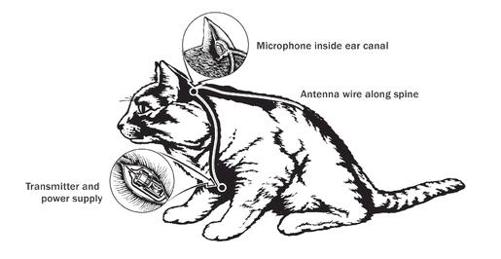
“Acoustic kitty” was TSD’s attempt to implant a clandestine listening device in a cat, mid-1960s.
In one operation, a tech used standard well-drilling equipment— configured to operate horizontally—to drill more than a hundred feet from the listening post to the target site on the opposite side of a major thoroughfare. “We bugged every room in that building, and then brought all the wire leads down to the basement,” the tech who led the operation remembered. “I surveyed in on where I wanted to enter the basement, then drilled a hole using just the azimuth and elevation data from the post to the target. I came out a foot away from target hole. The case officer said, ‘You missed.’ I said ‘Shit, a hundred and nine feet underground, in a foreign city, I think I did pretty good,’ and we figured out a way to compensate for the other twelve inches.”
Some techs excelled at solving problems with their own inventions to meet specific operational needs. Although of little use beyond covert operations, the devices were invaluable for making installations. The Nail Pusher, or Silent Hammer, was used for restoration work on baseboards and molding. Essentially the device was a hollow tube with a plunger-type mechanism to reinsert nails silently without leaving traces of a hammer mark.7
One innovation that earned its inventor a unique, if dubious, reputation among his fellow techs was a new microphone housing. Techs had long been beleaguered by the challenge of securing a mic into position within the hole drilled to reach the target’s wall. Too often after the tech carefully positioned a microphone in the hole against the pinhole, it slipped slightly away from the tiny air passage before being firmly anchored. If unnoticed at the time, the smallest misalignment produced a degraded sound. The tech’s clever solution encased the mics in a sheath of pilable latex that fit snugly into the three-eighths-inch-diameter hole leading to the pinhole. Because of the phallic appearance, techs named it the Peter Mic.
As intelligence flowed through audio’s reliable equipment, so did the audio techs’ confidence in their tradecraft skills. Among the techs, and even case officers, the thinking became, “If access could be obtained, almost any target was vulnerable.” In some respects, this was “spiral development.” Hard targets required greater tradecraft skills and, as those skills were acquired, they were applied to even harder targets.
The increased sophistication of bugs and a willingness to take on the tough operations required better equipment. For instance, drilling holes represented a core skill for audio techs. Holes for bugs were drilled down from ceilings, up from underneath floors, and horizontally in walls. When the techs could not physically get inside a room to install a bug, they drilled through a common wall. The danger of such an operation lay in the fact that the techs were literally blind to what or who was on the target side of the wall.
These drilling operations had two major security risks: noise and unintended breakthrough. Electric drills were fast, but so noisy they were not an option for use in the middle of the night or with the target room occupied. Hand-turned drills were slow and difficult with harder construction materials. To drill quietly usually meant drilling so slowly an installation could require days, especially if multiple bugs were being installed.
In a typical operation, techs preferred to start with a three-eighths-inch drill bit (the hole had to be large enough for the circumference of the microphone) until reaching the final half-inch of material in the target’s wall. At that point, depending on the size of the microphone head, drill bits of less than .050 inches were used to drill a breakthrough pinhole. The tiny hole created enough of an air passage for clear audio pickup while virtually invisible to normal observation.
With blind drilling techs never knew how close they were to the breakthrough point. Even for the best drill tech, it was a matter of guess, estimate, feel, and experience. Wrongly judged, the drill’s breakthrough would leave a noticeable hole in the target’s wall and debris on the floor. “If we don’t know the thickness of the wall, then we don’t know for sure when we are close to the other side,” explained one tech. “So if we punch through a wall with a three-eighths-inch hole, somebody is going to notice. Sometimes when we did inadvertently drill through, we joked that our audio operation became a video operation.”
Over the years, more than one tech accidentally broke through a wall, then looked into the hole only to see a curious eye peering back. During one operation, a tech drilled a larger than intended hole into a Soviet apartment. Several minutes passed, then without knocking, the Russian diplomat burst into their room and furiously began berating his “neighbors” for their carelessness in punching a hole through his wall while hanging pictures. The case officer apologized and assured the diplomat that his workers would be more careful in the future.
Targets were not the only ones displeased with tech mistakes. On a seemingly routine operation, the techs made an uneventful entry into a commercial building and began drilling the starter hole into the common wall with a Soviet trade mission. Suddenly, the drill bit broke through, creating a gaping hole in the adjoining room. With no way to repair the damage, the best that the techs could manage was to patch their side of the wall and retreat to the local chief of station’s office to report their problem.
“We have a nice hole in the wall for audio,” the head tech reported.
“Good,” the COS replied, “very, very good.”
“Well, what I mean,” explained the tech, “is that we broke through with a really nice big hole.”
The chief went ballistic. “Get out of my country and never show your face here again!” He spoke the order loudly enough that the techs heard each word and didn’t even think of putting up an argument.
“I guess that tells us something about the lack of a sense of humor some of these guys have,” whispered one of the team members.
A few weeks later, after the chief calmed down, another visiting OTS officer suggested that, given the importance of the target, another attempt was merited. The chief demanded and received assurances a similar mistake would not be made. The installation went off without a problem.
Listening to the live audio a few days later, the techs heard sounds of a work crew coming into the room. Not clear from the conversation was whether this was a sweep team or construction crew, but they were obviously looking carefully at the walls. The techs held their breath, waiting for what would happen next.
“Look at this,” one guy said.
“Damn, what’s that hole? That shouldn’t be here,” came the reply. “Well, we better get rid of it.”
With relief, the techs listened as the conscientious construction crew repaired the wall with the three-eighths-inch hole, never noticing the pinhole a few feet away. This time even the chief of station was amused.
To avoid the disasters of noise or breakthrough, techs would often drill just a few revolutions per minute. To create the pinhole, they would slowly twist a six-inch cylinder shaft that held the tiny bit with thumb and forefinger, applying little, if any, pressure, and letting the bit pull itself through the final fraction of an inch.
The problem of measuring the thickness of the remaining wall between the end of a drill bit and “breakthrough” was partially solved by one of the OTS’s cleverest tools, the Backscatter Gauge.8 While the basic technology employed was not new, its covert application was a model of ingenuity. The principle behind backscatter technology is nuclear science. A tiny radioactive source emits a steady pulse of gamma rays, bouncing them off an object while a reader contained in the unit measures the number of pulses that bounce back. A thick material will repel more gamma rays than thin material. The gauge calculates the percentage of the returning rays against the number emitted. For example, an object that bounces back 50 percent of the pulses is twice as thick as one that returns only 25 percent. A more sophisticated version of the technology later evolved into security devices used to scan baggage and individuals at airport checkpoints. In this configuration, with advanced signal processing, the returned gamma rays actually paint a picture, similar to that of an x-ray.
When OTS adapted the technology for clandestine purposes in the 1970s, backscatter was widely used in industrial applications, primarily for quality control. “It was being used in paper mills to keep the thickness or consistency of paper constant,” explained Martin Lambreth, the engineer who helped design the system. “By using the backscatter technique, the thickness could be measured continuously as it moved through production. As long as the radiation remained the same, the product was good. If it changed, they’d stop production. We wanted to use the same principle for measuring the distance from our drill bit to the surface of the wall we couldn’t see.”
With the OTS version of the technology, engineers developed a unit attached to a probe that fit into the three-eighths-inch drill hole. Techs would drill a short distance into a wall, then withdraw the drill and insert the probe to take a measurement. This drill-and-probe process continued as the electromechanical counter mounted on the unit recorded a wall’s thickness at the deepest point of the drilled hole. In time, techs became so proficient that some abandoned consulting the small mechanical readout altogether, preferring to judge depth by the clicks of the counter. The faster the clicking sounds, the thicker the wall. Since drilling sometimes occurred in near darkness, this also reduced the need for illumination and added a measure of security to nighttime jobs.
“I just listened for the clicks. I’d be on a ladder, the gauge is on the floor attached by a long cable going click-click-click,” said Martin, an experienced tech. “Then, after awhile, I’d hear click . . . click . . . click . . . and say, something’s about to happen. I better be careful from now on.” The reading, while not precise, was close enough to eliminate virtually all breakthroughs and earned praise from audio techs around the world.
A second drilling innovation adapted from industrial technology was the Grit Drill. Smooth plaster walls presented a particularly difficult problem for the audio techs. It seemed that every diplomat who happened to be an operational target also had an office or home with plastered walls. To cut through the plaster, some pressure was needed on the drill, but no matter how careful the tech tried to be, that pressure was just enough to spall the other side of the wall. Small chips of plaster from spalling were a dead give-away to anyone doing a security inspection.
OTS management dispatched an engineer, working under an alias as well as commercial cover to obscure CIA interest, on a nationwide tour to find a solution. Lugging dozens of circular samples of brick, concrete, ceramic tiles, terrazzo, and other materials neatly packaged in plastic sleeves, he began a cross-country journey in search of a better drill.
He visited more than a dozen companies, large and small. Anyone who knew anything about drilling through hard materials was fair game. Those who agreed to meet with the engineer were told that his company was looking for a drill so fine and so tough it could penetrate every one of the circular samples with a clean one-millimeter hole.
He visited precision drilling companies that cut holes in circuit boards and scientists in labs working with microwave energy. In upstate New York, he paid a call on a company that excavated concrete and was anxious to help. “I think we can do it,” said one of the mining engineers. “We would use a very small controlled explosive with great care.” The tech found the concept intriguing but the idea of using explosives, no matter how small, was not something he could likely sell to OTS.
The engineer eventually found a research company in the South that said it had a scientist with a reputation for innovative engineering. So far, the search had been futile, but he went through the requirements yet again. There was little reaction except the scientist asked that some of the material samples be left behind. Because it was the last stop on the circuit, the tech was happy to discard the weight from his luggage. Back at OTS, he reported little progress on the problem.
Nothing happened for a few weeks, and then, unexpectedly, the OTS engineer received a call from the scientist who had kept the samples. “I’ve got the solution,” offered the caller, and the engineer was on the next plane going south.
At the lab, the scientist rigged up an old thermal drill, a type used for a brief time by dentists. The drill utilized a very fine nozzle and air pressure to shoot a thin, high-velocity stream of extremely small aluminum oxide particles, essentially eroding the tooth’s enamel to create a hole rather than drilling it out. While erosion eliminated some of the discomfort of pressure during drilling, patient complaints about the taste of the particles made the technology unacceptable.
The OTS engineer pulled out samples of every possible material and the two went to work. They drilled holes in glass, concrete, plaster, stucco, and ceramic tile. No material was spared from testing and a clean hole appeared in each sample. Both engineer and scientist admired what the drill had accomplished.
“Works great, you solved the spall problem. And it’s no good to us,” the engineer told the stunned scientist.
A lengthy conversation followed as the engineer pointed out that despite the precise, clean holes, the drill would not be usable in a clandestine operation since it sent a fine spray of particles through the hole at breakthrough. If a target room was on the other side of the hole, the drill would deposit a fine coating of dust on carpet, furniture, and files that would surely alert the room’s occupant.
The scientist listened intently and asked questions about the nature of operations and the special tools that were required. “Can I keep working on this?” he asked.
The OTS engineer readily agreed. Here was a scientist with demonstrated creativity and who was clearly hooked by the challenge of clandestine requirements. Had he been a case officer, the engineer would have claimed a “recruitment.”
A few days later, an OTS secretary took a cryptic phone message from the scientist. “Tell my friend to come on down, he’ll know what it’s about.”
The following day the OTS engineer watched as the scientist attached a sleeve to the device that was inserted into the hole being drilled. The drill went into the sleeve, which was sealed around the outside of the hole. Extending from the collar was a hose that ran from a filtering system to a clear Plexiglas tube. “He blew the grit back into part of a vacuum cleaner bag, so he could filter the stuff out. Then coming out of the vacuum bag was a clear tube and in that tube was a Ping-Pong ball and a photoelectric cell on the side. That was the on/off switch,” the engineer explained. “So, when the gas came on for drilling, it created air pressure in the tube and lifted the Ping-Pong ball. While drilling he had positive gas flow and ball stayed up. As soon as the drill tip broke through, the pressure in the tube dropped, the Ping-Pong ball fell, triggering the photoelectric cell, and the damned thing turned off.”
The operational dust problem was solved along with the problem of cutting a clean pinhole through smooth plaster. OTS engineers reconfigured the device for portability and named it the Grit Drill. Helium was substituted for compressed air for its higher exit velocity. The entire Grit Drill and its accessories could be squeezed into a standard briefcase.
Once the Grit Drill kit was certified for deployment, the well-traveled engineer received orders to demonstrate the system to the overseas OTS tech bases. There, skeptical audio techs assembled for a demonstration of the “latest solution from Headquarters.” For field types, the Headquarters’ show-and-tells had a reputation for bringing more hype than practical value.
The engineer described the system, explained why it worked and demonstrated how to set it up. He then began punching tiny holes through materials the most susceptible to spalling. Each tiny hole was perfect, with no spall appearing on the target side of the sample materials. But before the demonstration was finished the chief of audio operations interrupted. “I’ve seen enough,” he declared. “I’m doing an operation tomorrow; bring that thing along because you’re going with me.” The engineer was stunned. Not only had he never been on a clandestine operation, the Grit Drill had never been used operationally.
Three days later the engineer’s anxiety had turned to excitement. The operation went smoothly with the engineer personally operating the Grit Drill during its first use in an audio installation. Now with an operational success as part of his briefing, he visited other techs in the region demonstrating the drill to interested audiences. But it was the thrill of the clandestine work that stayed with him. Like his scientist friend, he had been hooked by the excitement of clandestine operations. Back at Headquarters, after completing the show-and-tell TDY, the engineer transferred from his lab assignment to the cadre of audio tech officers.
As the audio surveillance equipment improved and inventories of transmitters, power sources, microphones, and installation tools grew, the techs themselves required additional training to configure and test equipment. The era of the “tinkerer” had ended. The days of on-the-job, trial-and-error audio training gave way to more rigorous and formal instruction aimed at greater professionalism and broader knowledge of increasingly complex equipment.
“If we weren’t doing this, we’d be robbing banks,” said Antonio J. “Tony” Mendez, one of the three OTS technical officers honored in 1997 as a CIA “Trailblazer.”9 No element of an audio operation created a more intense adrenaline rush than a surreptitious entry into a secure and guarded target. Surreptitious entry, defined as “an entry by stealth,” accompanied almost every clandestine audio installation.10 In most instances, the techs entered the premises or property of the target and then made additional entries into luggage, mail, or vehicles. Due to the risk involved, surreptitious entries were thoroughly scripted and rehearsed prior to the operation.
During World War II, the OSS created a surreptitious entry capability by enlisting former second-story men with prior experience in burglary, lock picking, and safe cracking. OSS created and issued a small “lock picking knife” containing “picks” instead of blades, that could be conveniently carried in the operative’s pocket for quick access when needed. The original OSS surreptitious-entry manual cited the purpose for their work as helping the agent solve his problem:
He wishes to obtain access to secret documents, copy or memorize their contents, and leave the premises in the same condition as he found them. To arouse suspicion that the entry had been made, would in many cases be as fatal as being caught in the act of rifling the safe. The agentshould therefore learn thoroughly the technique of surreptitious entry, so as to adapt it, as the occasion requires, to a similar job in enemy territory.11
The reasons for conducting entry operations did not change after World War II, only now the “enemy territory” became the guarded official missions of America’s Cold War adversaries scattered in countries throughout the world. While all the audio techs were trained in the basics of surreptitious entry, a handful of officers specialized in the work.12 These techs were skilled at climbing ladders, bypassing alarm systems, picking locks, cracking safes, and performing room searches as well as installing devices. These entry specialists demonstrated that, if given sufficient time and resources, virtually any lock could be opened and any alarm system bypassed, though there were always limits on time and the amount of equipment that could be deployed at the job site.13
Regardless of how easy lock picking was represented to be on television and in the movies, the techniques of manipulating locks required skill and practice. At best, picking remained more art than science. One TSD tech remembered sitting at home in a European capital in the late 1960s working through the weekend to “get the feel” for opening a new brand of foreign lock. The first successful attempt required more than twelve hours, but, once he had acquired the feel, he could open the lock in less than five minutes.
Target sites were usually well protected, and the more valuable the information inside, the more layers of protection surrounded it—locks, secured doors, gates, windows, file cabinets, vaults, safes, and even the alarm systems. A lock specialist had to be proficient in dozens of mechanisms since locks in different parts of the world varied in type and method of operation. The techs discovered that German locks were particularly difficult compared to those in South Asia.
The grab bag of different locks and security architecture the techs found in countries from Ghana to Paraguay ranged from early colonial to state-of-the-art. With narrow time windows for covert installations, the techs had to know how many minutes were required to break through locks and security barriers and then restore and rearm the security systems. Information on all of these factors was obtained in a detailed preinstallation clandestine survey of the target conducted by techs and included in the operational proposal. Only after headquarters approval of the survey could an installation operation commence.
Under the best of circumstances, the CIA would obtain advance information that a Soviet intelligence officer planned to move into a new apartment or that the Chinese government was renting an office suite for a new trade mission. If possible, local support agents were recruited to rent or even buy office space, apartments, houses, or property adjacent to target buildings.
Techs infrequently picked a lock, preferring to find other methods to gain entry. Picking took too long, the results were unpredictable, scratches from the picking on the mechanism or housing were detectable, and once a lock was picked open, it had to be picked closed at the end of the operation. Sometimes, when the location was known far enough in advance, the techs could wire the vacant property before its occupants moved in. Architectural spaces, such as the attics of row house buildings, were particularly inviting, since their design offered a contiguous common space over each unit. Once the tech gained access into the attic, he had unobstructed movement to any top-floor unit in the row. Buildings might also provide common basement areas with several outside entrances that enabled the tech team to avoid being seen coming and going through the front door. Given complete access and unlimited time to do the installation, the techs planted multiple microphones and transmitters as well as ran wires, precluding the need to pick any locks.
Depending on the relationship with security services of the host country, known collectively as “liaison,” the CIA could assign the task of performing an entry to liaison. In many countries, the internal security service already had duplicate keys to all rooms in every major hotel, and master keys for apartment houses and important commercial buildings.
The techs also made duplicate keys. By the early 1960s, master keys for every popular hotel in more than one major European city hung neatly on a rack in the techs’ shop in local stations. When possible, case officers would “beg, borrow, bribe, or steal” master or original keys. OTS had key-cutting machines at its bases and the traveling techs carried portable key-making devices that fit inside a briefcase. From the properly sized and configured blank, the techs could cut a duplicate within a few minutes.
For keys that were briefly available, OTS developed a portable key-impressioning kit. The kit consisted of a small mold with two halves filled with plastic modeling putty.14 The purloined key was placed on the putty and the two halves of the mold pressed together to capture a three-dimensional model of the key. Later, the tech could pour Wood’s Metal into the mold and create an exact copy of the key.15
The last choice was to attempt to pick an unknown lock. For this contingency, OTS issued leather lock pick kits that were small enough to fit in a jacket pocket, but provided the necessary tools for picking and raking the tumblers of many commonly found locks.16 These portable kits were most useful for opening luggage, desk drawers, and other smaller locks.
In the late 1960s, a TSD engineer developed a concept that mechanisms within key-operated locks could be measured and characterized remotely by marrying emerging ultrasonic measurement technology with an oscilloscope. Portable oscilloscopes had just been introduced and when combined with a small ultrasonic device, the techs would have a tool they could carry easily to the target, use to measure the lengths of the pins in a lock, and thereby acquire the precise data to make a key.
Once the engineer produced a prototype device that produced accurate calculations, OTS contractors refined the design for a field deployable unit. A year later, after the device proved itself by enabling several surreptitious entries into previously inaccessible targets, Cord Meyer, the Associate Deputy Director for Plans, recognized the engineer with a special award that included a $5,000 stipend. In his presentation, Meyer said he could not mention what was acquired from the entries, but added, “This is the largest stipend the DDP has ever awarded for a technical development. This gadget is right out of the James Bond movies.”
Not all entry operations involved breaking into rooms or safes. HTLINGUAL, for example, was the CIA’s controversial Cold War program that intercepted and examined U.S. mail to and from the Soviet Union.17 Covert mail intercept required skills in “flaps and seals” to open and reseal envelopes, cartons, and packages thought to contain intelligence. “Surreptitious opening” and surreptitious entry shared the common objectives: to get inside a protected area and copy or steal the contents.18 The two primary methods for opening a sealed gummed flap, such as on an envelope, were “dry openings” and “steaming.”19
From 1940 to 1973 the FBI, and later the CIA, conducted covert activities to open and photograph suspect mail in the United States. The earliest techniques of chamfering (mail opening) were taught to the FBI by a friendly Allied intelligence service during World War II. Information obtained from these programs was sanitized to protect against revealing sources and was disseminated to the intelligence agencies, the Attorney General, and the President of the United States.20
As the Cold War intensified, the CIA initiated its mail-opening project in New York to target mail from the Soviet Union. The HTLINGUAL operation was conducted by the Counterintelligence Staff and the Office of Security with TSD’s assistance. Over a twenty-year period, more than 215,000 letters to and from the Soviet Union were opened and photographed in New York.
The New York mail project originated in 1952 with a proposal to scan exteriors of all letters to the Soviet Union and record the names and addresses of the correspondents as a means of identifying U.S. contacts of Soviet intelligence. The project expanded when James Angleton, chief of the Counterintelligence Staff, advised Richard Helms, then Acting Deputy Director for Plans, of a need to open and examine a selected portion of the letters. He advised Helms that there was no capability for “searching for secret writing and/or microdots, or to determine whether items have been previously opened, and to open items sealed with the more difficult and sophisticated adhesives.”21
TSD set up a lab in New York in 1961 to test letters for secret-writing chemicals and to study Soviet censorship techniques. Because technical examination was time consuming, only a small percentage of the letters opened and photographed were actually tested. The Manhattan field office of the CIA’s Office of Security handled most of the opening and photographing. Those who opened the mail attended a one-week course called “flaps and seals” conducted by TSD at CIA Headquarters.
The basic method of opening the mail was simple. First, the glue on the envelopes was softened by steam from a kettle, and with the aid of a narrow stick, the flap was pried open and the letter removed. One of the agents who opened the mail testified “you could do it with your own teapot at home.” It took approximately five to fifteen seconds to open a letter. At one point, the CIA developed a type of “steam oven” capable of handling about one hundred letters simultaneously, but its performance was judged inadequate and the agents soon returned to the kettle-and-stick method.
The original letters, which had been opened, photographed, and possibly subjected to TSD examination, were resealed and returned the next morning to the airport for reinsertion into the mail stream. Translations and summaries of the letters’ contents were disseminated within the Agency and to the FBI.22
As the sophistication of the technology and number of audio installations expanded, OTS developed an intense, year-long training program for the audio techs designed around the lessons and mistakes from the early years. In addition to learning the ins and outs of the technology itself, novice techs were taught the basics of building walls, mixing plaster, matching paint, restoring wallpaper, and making repairs after a device was implanted. They learned how to pick locks, make key impressions, cut keys from blanks, manipulate combination locks, and do electrical and telephone wiring.
“There was every kind of reconstruction. One of our instructors was a master plasterer who, before retiring, worked in the White House and the Capitol,” recalled one tech. “We had a dedicated facility, an old food warehouse in Alexandria, Virginia, where we’d learn how to mix mortar and lay brick. It didn’t matter if you had a college degree or not. If you wanted to be a tech, you took that training.”
For a typical lesson, the master plasterer assigned trainees to build a wall, plaster it over, then knock holes in it to simulate burying audio equipment, and replaster it. Then came the tough part. Not the least impressed by the tech’s CIA affiliation, the plasterer would shine his flashlight on the gleaming wall, silently studying the work, then invite the tech to join him as he pointed out a ripple here and another there. No ripple was acceptable. “Nope, not good enough” were dreaded words. With those, the tech knocked down his wall and started over.
The course work on walls and plastering alone lasted a month, and then came paint matching, which included training with special paints that OTS formulated to be fast-drying and odorless.
Specialized soldering courses followed along with instruction about glues, adhesives, tapes, and fasteners that hold things together. The techs had to learn how to open and close all types of materials—fabrics, leather, wood, concrete, and masonry—in preparation for burying bugs in any concealment that might be in a target environment.
The techs received training to operate laser surveillance systems that, by projecting a laser through a window, could pick up audio from minute vibrations of the windowpane in the target room. Although these officers were audio specialists, overseas stations would not hesitate to ask their help in all other disciplines of OTS, so familiarization was provided in the full range of agent communication including microdot, secret writing, photography, and short-range electronic systems.
“They didn’t skimp on training at Headquarters. It was thorough and hands-on. And in the field, every new officer got a mentor—a more senior audio officer—for their first tour,” said the tech. “You didn’t do anything on your own. You traveled with somebody else and they showed you the ropes. You drank beer together, stayed in the tech hotels, and, if you wanted to succeed, you listened to the lore, no matter how long that lasted late at night.”
These field mentors also provided valuable unofficial training. Junior techs learned how to economize on space while taking the necessary tools for jobs that were never completely predictable. One tech always carried four types of tape wrapped around a No. 2 lead pencil. Individual rolls of tape added weight, required space, and contained far more tape than was ever needed on most jobs. Duct tape, double-sided tape, electrical tape, and copper foil tape were standards. Duct tape held devices in place while the epoxy dried, double-sided tape was used to stick components to walls or ceilings in temporary configurations for testing, electrical tape insulated and repaired wiring, and the copper foil with sticky backing made good practice or emergency test antennas. There was always room on the pencil to wind several loops of solder wire and utility wire as well.
Epoxy was the tech’s best friend. The strength of small amounts and its brief curing time were important to completing a permanent installation quickly. It could repair broken housings, fill cracks and holes, and hold equipment suspended at awkward angles in almost any location. Epoxy could also teach a lifelong lesson. A tech on his first job and anxious to please his mentor, was asked to quickly prepare a batch of epoxy. Without seeing a container to hold the mixture, the tech squirted the two components into his palm and stirred them together. His palm became warm, then very warm, then very hot. Yet, the tech’s professional pride and urgency to get the installation finished overrode the burning pain. He said nothing until the team returned to base and the medics treated him for a first-degree burn that permanently scarred his palm.
While techs were officially a “service” that responded to DO operational requirements, they frequently became involved in defining the requirement and developing the operational proposal for Headquarters. When operational proposals required technical detail, the writing responsibility fell to the tech. All technical operations required formal approval from both OTS, weighing in on the technical feasibility, and the operational division, which evaluated intelligence value and counterintelligence risk. Therefore, the field proposal issued under the local chief’s signature became all-important. The COS always had the final word on the proposal, but the techs established informal codes to communicate differing opinions to Headquarters without crossing the chief.
One effective method for informing Headquarters of what the tech really thought involved the length of the proposal. In drafting the cable, concise and clear language signaled the tech’s confidence in the operation, while a lengthy, excessively detailed proposal, with pros and cons, conveyed the tech’s doubts and gave Headquarters plenty of information to “pick at” and challenge. In this way, when an operation was turned down, the chief directed his displeasure at Headquarters, not the tech.
Interactions between the audio techs and station management mirrored family relationships more than commercial customer-supplier exchanges. This was because OTS had no competitors for the services that the stations needed, but, more significantly, the case officers and techs shared a commitment to the common mission. Even so, disagreements between case officer and tech were part of the everyday picture.
“A regular philosophical battle was the ‘time on target’ discussion for an operation,” explained a senior audio tech. “There’s a school that said, when you go into a target site, stay as long as you have to and be as quiet as you can. You might be inside for three hours or four days, but take as long as needed to do the operation ‘silently.’ Another school said, you get in there, minimize the noise, but do it as fast as possible and get out in a few hours. I had one of these battles with a very tough chief of station. I lost, but he heard me out. He said go in, don’t make noise, and stay as long as you need. It took five solid days to get through thirty inches of concrete drilling by hand. We smelled pretty ripe. But there wasn’t any question about the chain of command. When the ops people made the operational call and Headquarters concurred, we saluted.”23
Another tech disagreed with his case officer over his choice of cars for his cover status. “I had a 1957 Chevy, it was a wild-looking thing and the case officer was perturbed and thought it was too flamboyant,” the tech remembered. “He wanted me to get something black and spooky. I said no, my cover is commercial and this red Chevy with fins is expected of a successful businessman. Plus, you can see that the fins aren’t as big as those on some other models.” The tech’s argument prevailed.
An operation to bug a Czech intelligence officer in Europe almost never got to proposal stage. Headquarters rejected the station plan to send a tech on an after-dark walk around the target property to survey windows and doors, assess security, and observe activity in a neighborhood not frequented by Americans. The tech did not, Headquarters pointed out, have sufficient cover and plausible reason to be in that part of the city at night. The tech and case officer agonized for a couple of days then sent a brief cable, “If caught the tech will admit to being a thief. Then we will go to the local service and get him out of jail.” Headquarters reversed itself and approved the operation.
Techs, with their predilection for improvisation to get a job done found the glamorous locales often offered the least amount of operational freedom. “In Europe it seemed you had levels and levels of Agency management all wanting to review and second-guess every piece of a plan, and there was always concern about diplomatic niceties,” remembered one tech. “In Africa, we shot a little more from the hip—the case officers did, too, and I think we got a lot more done. We liked working down there and in South America. In Europe we sometimes felt smothered by a lot of tradition and scrutiny.”
A tech stationed in Central America during the Cuban missile crisis in 1962 undertook an ambitious operation to penetrate a Soviet embassy. After learning that the Soviets used a particular shop for typewriter repair, a case officer recruited the shop’s owner. The next Soviet typewriter that came in was “lent” to the tech who disassembled the machine and installed a transmitter into the platen. Once back in the embassy, it was hoped the device would pick up sensitive conversations near the machine while audio analysis of the striking keys could potentially reveal individual letters or words.
Surveillance confirmed that the Soviet diplomat picked up the typewriter and took it back into the embassy. The plan was working, and after enough time elapsed for the typewriter’s return to service, the tech sent a “turn on” signal to the device and heard . . . nothing.
The following morning, a CIA asset observing the embassy’s entrance watched a Soviet emerge carrying a typewriter high above his head. With a theatrically extravagant flourish, he heaved the offending machine into the trash. For some unknown reason the bug had been detected and the audio operation thwarted, but wariness of the Americans’ capability was raised to a new level. After the incident, Soviet case officers were not allowed to type their reports; all had to be handwritten.
Another operation made possible by miniaturization of audio devices assisted a foreign government in catching a Soviet spy. John Kennedy was President when a Northern European security service called on TSD with an unresolved problem. A Soviet diplomat, a suspected KGB officer, had begun meeting regularly with a senior government minister. While the meetings had legitimacy based the official duties of the two men, the security service suspected the minister of also spying for the Soviets. Yet, their investigations had turned up no hard evidence of espionage.
The alleged KGB officer was cagey and professional. He met the minister openly at expensive, well-known restaurants, ostensibly to discuss legitimate diplomatic matters. Several times counterintelligence officers had notice of a planned meeting and plotted with the restaurant’s manager to install monitoring equipment at the table where the Soviet would be seated, though the ploy never seemed to work. In some instances, the Soviet canceled reservations at the last moment in favor of an alternative location. In other cases, the KGB officer and the minister objected to the table offered and insisted on another.
Tom Grant had been in the country several times providing technical support to joint operations. On one of his trips, Grant’s contacts confided, “We’re certain the minister is dirty, but we can’t get the goods on the guy. We’ve failed every single time to record the meal conversation and haven’t been able to identify the covert communications being used.” Grant said he would think about the problem.
Grant was living in another part of Europe with his family. One day his wife discovered a local shop that featured Scandinavian goods, including some attractive pepper mills. “Buy every one they have in the store,” he instructed his wife. “Tell the owner we have lots of friends back home who’ll be getting these as Christmas gifts.”
None of the pepper mills ever made the trip to America. Grant went directly to the audio shop where he had several cylindrical transmitters that would fit snugly inside the pepper mills. With the help of concealment techs, he disassembled the pepper mills and created a cavity sufficient for the transmitter, microphone, and batteries. By modifying the grinding and dispensing mechanisms, a small pepper reservoir was retained and the mill still functioned, providing the bugs with an active concealment.
When shown the pepper mill bug, the local security service agreed that it might work and sought the assistance of managers at three restaurants where the KGB officer and his minister frequently met. Rather than trying to place transmitters on a specific table, the service asked the managers to remove all pepper mills from the tables on the day of the next meeting and bring one to the table after patrons were seated.
“It worked like a charm. The Soviet made his reservation, then switched restaurants but used a restaurant we had planned for,” said Grant. “When he arrived he asked for a table different than the one offered. Then the minister joined him. At that point, the headwaiter put our pepper mill right between the two of them. The guys in the surveillance van outside could hear everything.”
The suspected KGB officer and the minister ordered a meal and engaged in small talk for over an hour. At the end of the meal, they ordered coffee. The conversation had centered on official government-to-government topics, boring the counterintelligence “ears” in the van. However, as the business lunch finally wound down, the Russian paid the bill, then, as he took a final sip of coffee, leaned across the table, right over the pepper mill, and gave the minister precise directions for a dead drop.
“Well, that woke up the ‘ears,’” said Grant. “The guy with the headphones in the truck went bananas. Their service was elated. Even our case officer thanked me. I said ‘I’m happy to help but you understand I have to get back my pepper mills for the Agency and besides, one of them has to go to my wife as a souvenir—she dragged me into that shop.’”
Later the government minister was arrested as a spy and the KGB officer expelled from the country.
In every part of the world, similar imagination and creativity were required from techs and case officers for the Agency to attack the wary and protected Soviet Bloc targets. An Eastern European diplomat posted to South America in the mid-1970s seemed virtually untouchable. Surveillance determined that his embassy office was well secured and his home always occupied by family, caretakers, and service staff. However, surveillance did identify an interesting pattern in his wife’s regular Tuesday shopping excursions. As the case officer and the tech discussed the situation, the tech mentioned that concealment specialists had begun embedding a new generation of audio transmitters in desk and table lamps. The lamps functioned normally, the tech explained, and the transmitters operated without batteries by drawing power from the lamp’s electric current. Not long after, a plan emerged.
A CIA officer residing in the country began a side business selling lamps, loading his merchandise into a van every day to establish a credible pattern of activity that made him a recognized figure in the area. On the appointed Tuesday, the officer drove to the shopping district and waited for the diplomat’s wife. Arriving on schedule, she parked and went into the store. A few minutes later, the officer pulled his van into the adjacent parking place, accidentally dinging the fender of her vehicle, then waited until she returned.
Just as the target’s wife saw the damage to her car, the lamp salesman quickly approached her offering profuse apologies. He explained that he waited for fear that somebody might have seen the accident and taken down his license number. Then, building a tale of woe, he confessed that if he reported another accident to his insurance company they would surely cancel his policy. Pressing far more money than required to fix the damage into the wife’s hand, he implored her to accept the settlement and not report the incident.
The woman, sensing a good deal, accepted the money and, in a final gesture of gratitude, the lamp salesman urged her to select any lamp from the stock in his van. The diplomat’s wife chose what appeared to be the most expensive lamp and the officer carefully loaded the gift in her car, making sure to activate the audio “on” switch.
Later that night, the tech and the case officer met at the listening post and with amusement heard the diplomat’s wife relate the story of how she had “screwed over this poor American.” The audio stayed on the air for about two months until the couple decided they liked the lamp so much that it should grace their second residence in the mountains, far out of the transmitter’s range.
In another operation, two techs disguised themselves as local painters to gain entry to a diplomatic facility being readied for new occupants. Their job was to find places to install bugs. As the techs studied areas where audio might be best installed, their attention fell on two large ornately carved wooden doors piled among other materials. The doors, the techs learned, would eventually hang between two of the mission’s conference rooms. The techs reasoned that by placing mics on either side of the doors a single transmitter could pick up and relay conversations from both rooms. As an added operational bonus, the huge doors could accommodate dozens of batteries, extending the life of the operation far into the future.
The techs had only a few days to work and the presence of construction crews limited their access to the facility. The techs needed to get the doors to their shop to plant the devices. Noticing the entire construction site was a mess, with scraps of wood, fixtures, cement blocks, flooring, and other debris laying around, one of the techs said, “Let’s clean this place up. They’ll be happy that we got rid of the trash.”
The techs went to work, piling whatever construction trash they could find on the doors and carried them out like stretchers. Several stretcher loads went out and other materials were carried in. Eventually the doors went into the techs’ waiting truck and returned a couple of days later loaded with mics, batteries, and transmitters. “Everything just went fine,” remembered one of the trash haulers. “We got the audio in and no one ever suspected a thing.”
However, sound plans did not always go smoothly and some were just victims of bad luck, falling into the category of “technical success, operational failure.” In one memorable instance, the Soviet Ambassador in a European capital ordered a custom table for his home. The CIA got wind of the order and recruited the furniture maker, who agreed that the techs could put an audio device in the piece.
The operation had every earmark of success as the techs, observing from a safe house, watched the table as it was carefully carried up the steps to the Ambassador’s residence. The tech and the case officer exchanged smiles and shook hands, but before they could pour the victory toast, the deliverymen appeared again. This time they carried the table out of the residence, back down the steps and into the truck. Later that evening, as the two looked over the returned table with the furniture maker, they learned the rest of the story. The deliverymen reported that when the Soviet Ambassador saw the table he was surprised to see the top was made of Formica. He uttered two words, “not cultured,” refused delivery, and ordered the table out of his house.
At about the same time, the Agency learned of another Soviet official, a newcomer to the city, who lived in an apartment-hotel complex. The local station tracked the Soviet’s pattern of movements for a few weeks, then the chief decided to bug the official’s residence using a recently developed audio transmitter concealed in a standard three-way electrical plug. When the modified plug was inserted into a wall outlet, it drew power from the household circuit.
A week passed and Headquarters had not responded to the operational proposal. The station chief became anxious. He had an OTS technical team in the city ready to act. A detailed ops plan had been laid out. Choreographed in concert with the target’s comings and goings, the installation opportunity window fell on a specific date and time, but approvals were not in hand. “If we don’t hear by eight o’clock tonight, we’re going to go ahead and do this,” the chief told the senior tech.
The plan left little margin for error. A team of two techs would enter the apartment-hotel complex. One would take temporary control of the elevator, holding it at the floor of the Soviet’s apartment and act as outside countersurveillance. The other tech would make entry with a duplicate key and insert the modified three-way plug in an outlet under the bed. He would then exit, lock the apartment, join his colleague in the elevator, and depart the building. The entire operation would require no more than five minutes.
At eight o’clock, without a Headquarters response, the operation commenced. The techs were well into the job when, at 8:15, the communications officer brought a cable marked IMMEDIATE to the chief. The message, although apologetic about the delayed response, left no ambiguity: PROPOSED OPERATION IS NOT APPROVED.
As the techs departed the Soviet’s apartment complex, they received a signal to contact the chief immediately. He related the Headquarters disapproval direction.
“Well, it’s too late,” replied the senior tech. “In fact, we’re already listening to him. He came back home just behind us. He brushed his teeth and went to bed.”
The next morning the device captured the personal routine of the Soviet as he prepared for the day, then went off the air at noon.
The station chief was in a quandary. He had acknowledged receipt of the Headquarters order, but had not told his superiors what had already occurred. He was applying the operational maxim “What happens in the field, stays in the field.”
The chief ordered the techs to go back to the apartment and retrieve the plug. A second entry, this one without Headquarters’ knowledge or approval, was planned and executed. The tech crawled under the bed but there was no plug in the outlet. He quickly surveyed other electrical outlets in the apartment but saw no plugs.
For the chief, as well as for the techs, the situation was about as bad as it could get. Not only had they conducted two unauthorized entry operations, but a piece of the CIA’s newest clandestine audio equipment and its concealment were lost, very likely compromised to the Soviets.
The next day, the techs met at the listening post with the Russian-language transcriber sent to TDY from Headquarters to translate and process the audio take. He had set up the post in a small room in the same building as the target apartment. The post would now have to be quietly closed down and the transcriber sent home. As the tech related the saga of the lost transmitter and the pickle the chief found himself in, he noticed that one of the post’s tape recorders was connected to building power by a familiar-looking three-way plug. “Where did you get that plug?” the tech asked.
“I asked the maid for one and she got it,” the transcriber responded, a little puzzled. The maid who serviced the listening post apartment also cleaned the Soviet’s room. A couple of days earlier she had pulled the bed away from the wall to vacuum and saw the three-way plug. Concluding it was not being used, she put it in her pocket. Later, when the post’s keeper asked for a plug for his tape recorders, receiver, and other equipment, she just happened to have one handy.
The tech’s next call went to the chief who suggested that everyone meet for a three-hour, three-martini lunch. As the first round of drink arrived, the chief offered a toast: “Remember, ‘Ask and ye shall receive. Seek and you shall find.’ Look it up. Matthew 7:7.”
A legendary audio semi-success occurred when a South American dictator discovered a transmitter in a wood block attached to a piece of furniture in his office. Those in the listening post recorded the dictator’s outrage. Then, in dramatic fashion, he drew his pistol and fired several rounds into the device while denouncing the CIA and America to his staff. Satisfied his marksmanship had killed the device, he tossed the bullet-riddled trophy carelessly on top of a file cabinet.
Back at the post, the recorders continued to roll while the device kept transmitting. The bullets had shattered the block and struck a battery, but only wounded, not killed the device. Within the heart of the woodblock enough power still flowed to the undamaged transmitter that every word uttered in the office was heard for several more weeks until the remaining batteries eventually died.
Retrieving bugs could be as hazardous as installing them and just as critical to an operation’s success. Spy gear abandoned in place poses the risk of later detection by the local service or, depending on future occupants, by another foreign government. Any piece of equipment discovered, even years after the operation, could reveal technology and tradecraft to the opposition. It is one of espionage’s ironies that the very equipment used to acquire intelligence, once discovered by an adversary, becomes a valuable source of intelligence. Surveillance gear in the hands of a hostile security service could yield vital information for creating countermeasures, point to an agent, or expose concealment methods.
Lady Luck did not smile on a retrieval operation in Western Europe in the late 1970s. A long-running successful audio operation concluded when the targets moved out of their residence and the techs received orders to return to the now empty apartment and retrieve the four bugs installed in the attic. It was a typical nighttime operation that demanded stealth and sure-footedness for the techs to make their away across the building’s narrow rafters. The summer night was hot and the attic increasingly uncomfortable for the techs who, after finding the first three devices, were having difficulty locating the fourth. “My partner was swearing like crazy and I’m tiptoeing across these little rafters looking for the fourth when one the rafters breaks,” said one of the techs, remembering the incident. “The next thing I know, I’m hanging by one arm, looking down at a very expensive terrazzo floor.”
With the crash echoing in the middle of the night and the dust settling, the tech’s radio came to life. The lookout had heard the noise and anxiously asked what was happening in the house. “I said, ‘As you can probably surmise, we’ve got a little problem in here. That was me, going through the ceiling.’” Then the fourth audio bug fell to the floor.
Rather than retrace their steps over the now suspect rafters, the two techs dropped down through the hole. Fortunately, since the apartment had been vacated, they had time to clean up the mess and repair the ceiling. “Afterward, we just told everybody we had set the Guinness record for the world’s biggest pinhole,” the tech joked years later. “A six foot by six foot pinhole will give you the best audio you ever heard. God, that made a lot of noise, I can’t believe we didn’t get caught.”
A dramatic breakthrough in audio hardware occurred in the 1970s. The SRT family of transmitters, which was steadily improving, made an impressive leap forward with the “Century Series” that carried three number designators. Nothing like it had previously existed in the OTS arsenal of covert audio equipment. Known particularly for the tiny size as well as performance, the Century Series devices were microphones and transmitters made with integrated circuits jammed into packages of less than a cubic inch of space. OTS called it fractional cubic inch technology.
“To achieve the fractional cubic inch volumetric size, the whole package contained integrated circuits, very special integrated circuits,” said Kurt Beck, who worked on the project. “Our contractors used custom technology and processes. There wasn’t anything like it on the commercial market. It was a team effort. It was the contractor and the ops guys both asking, How do you get this stuff to be this small? How do you engineer the device into the size of this package?”
The volume of the new audio packages was comparable to that of six U.S. quarters stacked one on top of another. The housing around the bug’s hermetically sealed components had slots on the side that allowed techs to plug in an external power source, antenna, and microphone as needed. In less than twenty years, OTS had gone from an unreliable vacuum tube SRT-1 to a stable but power hungry SRT-3 to a family of transmitters whose reliability, size, and functionality could be adapted to virtually any covert audio requirement.
“This was not your incremental, tiny improvement—this was a quantum step,” said Linn, who built power cells for the Century Series transmitters. In terms of reliability and sophistication, it was the difference between a 1970s citizens band radio and a twenty-first-century cell phone. The James Bond gadgetry imagined in Q’s fictional laboratory had arrived in Langley. Fractional cubic inch technology brought not only the ability to build audio into smaller concealments, but also a major reduction in power required to transmit. It allowed for simultaneous transmission from two or more microphones positioned within three feet of each other. Essentially working like human ears, the listening post could “steer” audio, filtering out background noise in the room to focus in on conversations that were of particular interest.24
“It wasn’t just the electronics, but the power consumption. The power consumption was always the problem that would knock you in the head,” explained Kurt. “So if we could achieve an order-of-magnitude reduction in the power consumption, we could make a corresponding reduction in the size of the battery. That to me is the breakthrough. The low-power technology. Every 10 percent savings in power drain translated into a big lifetime improvement for the size of the battery. It didn’t make much difference if you halved the size of the transmitter, from a half a cubic inch to a fractional cubic inch, if the battery pack had to stay at ten cubic inches.”
When OTS first envisioned the fractional cubic inch package, integrated circuits were in their infancy. A little more than a decade earlier, in 1958, Jack Kilby, working at Texas Instruments, and Robert Noyce, at Fairchild Semiconductor, independently came up with the idea of the integrated circuit. Kilby beat Noyce to the patent by less than a year and later won the Nobel Prize, but Noyce, who later cofounded Intel, came up with several technical solutions, such as how to connect the tiny components on the chip, which made production practical.
“We talked to these designers and the engineers and we found out there were a lot of trade-offs you could make in all this stuff,” Kurt explained. “When we started to push on them to get the power down, ideas began to crop up. The problem was getting these analog circuits to be efficient with the power supplied. Instead of having two percent efficiency, could we get twenty-five percent efficiency?25 It makes a difference with the amount of power you need to run them. We pushed smaller and smaller. Our approach was to find the right designers. Give them some leeway. Don’t stand over their shoulder. We gave them money and said, ‘Go try it. If you have failure, do it again. Just don’t give up.’”
In the end, the circuits designed for the new Century Series were both small and energy efficient. Techs called them “flea powered.” The units drew only microamps from the batteries and signals were transmitted at the lowest possible power setting for reception by specialized antennas at the listening posts. There was almost no end to where the new devices could be hidden. Combined with new battery configurations, the Century Series could be hidden in books, wooden coat hangers, and even within the circuitry of other electronic devices, such as televisions or portable radios. Wood blocks, a longtime favorite among techs, could be made smaller as well.
Armed with new technology, techs along with the staff at Langley became more emboldened. Operations that would have been at best risky or impossible in the 1960s were now launched regularly. “Show me a target and I can get to it,” one tech was noted for saying. Within the tech culture, this was more statement of fact than bravado.
Perhaps no operation better illustrated the techs’ derring-do than one that took place in the 1970s against an implacable U.S. adversary. After years of futile negotiations to resolve an international dispute with the other nation, the President ordered his closest advisor to initiate secret talks at the highest levels of the foreign government with the objective of ending the conflict. Special assistance from the audio techs was requested for a risky and dangerous operation to acquire information on the intentions and strategy of the foreign negotiators. The techs were chosen for their unusual skills and proven courage in combat. One was an experienced mountain climber. The other, a combat-hardened former Marine, trained for the mission by climbing over slate roofs in his hometown.
Working in the early-morning hours of a moonless night, a tech, dressed in black, carrying mountain-climbing gear, crawled through a window of a safe house onto the steep slate roof of an adjoining building. A few floors below, the other tech waited anxiously with the newly designed audio equipment.When they could move unobserved, the techs skirted several roofs of adjacent houses leading to the residence of the chief of the foreign delegation and crawled silently over its slate tiles. Their targets were three chimneys positioned along the length of the roof’s ridge. As they moved from chimney to chimney, into each they dropped a small device, called a “pinger,” to measure the length of the fireplace flues that would eventually conceal an audio device. Resembling an oversized pistol, when the pinger reached the upper edge of the fireplace flue, the tech pulled the trigger. A small burst of radio wave energy—like radar—shot down the chimney and bounced back, instantly calculating the distance between the top of the chimney to the desired fireplace location for the bug. With data in hand, the techs retraced their climb and began planning the equally dangerous and risky installation.
“We returned a few weeks later, with mics and transmitters the lab had developed,” recalled one of the techs. “They were encased in an asphalt bulb, maybe two inches in diameter, so when there was fire in the fireplaces, they wouldn’t burn up.” Wires, with precise distances based on “pinger” data, let them lower the devices to the proper length in each chimney before securing them to the top.
The audio collection produced transcripts of private strategy discussions held by the target negotiators that were immediately translated and hand-carried to the President’s representative to prepare him for the next formal meeting. The techs never saw the transcripts and never expected to. That is the profession. Build the gear, put it in, make sure it works, and get out of the way. Let others use and benefit from the take. Besides, there was no reason to hang around; other stations had audio ops to be done—now.
The newly availabile fractional cubic inch transmitters encouraged planning for aggressive audio operations inside the USSR. Once the CIA had demonstrated that its officers could free themselves from surveillance in Moscow, technical audio operations followed. “In the late 1970s we were doing things in Moscow that were intentionally below the Soviet radar,” remembers a tech. “We were trying to find the balance between high-, medium-, and low-technical operational acts on the street—the capability of the agent, capability for the case officer to meet the agent, capability to dead drop certain-sized things. All of that technology we provided the agent. Now we asked, can we bring audio into the mix?”
In one of the first operations of its kind in Moscow, a plan was formed to bug one of the police shelters located throughout the city. The small shacks, also set up at strategic points in the foreign embassy district, provided shade and warmth for the police, militia, and KGB surveillance teams as well. The young officers who manned the shacks had duties other than traffic control and maintaining civil order. Their presence was a deterrent to Soviet citizens from contacting foreign officials, because any Russian wandering in the area could be stopped, asked for identification, and questioned about the reason for being there. Equally important for the KGB were the reports from officers in the shacks who relayed the comings and goings of foreign officials to the KGB from these excellent observation posts.
As the CIA increased its clandestine contacts inside the USSR through the 1970s, the chief decided to bug one of the shacks. The secret audio could potentially provide valuable intelligence from an officer “calling out” the movement of diplomats to the KGB surveillance teams and from capturing other security instructions he received.
The target shack, which was manned twenty-four hours a day, seven days a week, was classically basic. Constructed of wood and roughly twice the size of an old-fashioned phone booth, it contained a small table built into the wall, a telephone, and a heater that offered minimal comfort for two men against the cold of the Russian winter.
Over several months, CIA observers noted that the officer in the target shack was often away from his post, across the street talking with a friend. They were able to estimate the size of the small table in the booth and predict the times when the officer took a break for periodic gossip.
The operational requirements for the audio device were specific. It needed to be small enough to hide under the table in the shack, large enough to hold enough batteries for extended transmission life, and capable of being installed in less than a minute while the shack was vacant.
The techs created a woodblock audio concealment matching the faded color of the wooden table. They set spring-wound screws into one side of the wood block with enough torque from the spring to secure the block to the table’s underside. When the wood block was placed firmly underneath the tabletop’s bottom, the protruding screw heads were depressed, which released springs to turn the screws.
Because the bug required so many batteries for power, the wood block was too long to fit into the briefcase the chief normally carried. This required the techs to create a sling for cradling the device that could be worn under a topcoat. Every day, regardless of weather, the chief wore the topcoat and walked by the shelter, awaiting a time when he could enter unseen, open the coat, kneel down, pull the woodblock out of its sling, put it under the table, and activate the screws. It could all be done in less than thirty seconds.
Several weeks passed with the chief carrying the device each time he walked by the shack. The opportunity finally arose one day as the chief was walking his dog. At a distance, the chief noticed the officer leaving the shelter and crossing the street to talk with a friend, exactly as the operational plan had envisioned. The chief stopped briefly, adjusted the dog’s collar, ducked into the empty booth, planted the device, and continued walking. Later that evening, at the nearby listening post, the techs heard and recorded clear audio that was immediately forwarded to Langley for analysis of KGB surveillance codes and techniques.
Possibly more important to CIA operations than the intelligence collected from the little shack’s tapes was the act itself. The CIA had successfully implanted an audio device that clandestinely collected KGB tactical conversations. The small breach of the KGB’s internal security wall demonstrated that sound tradecraft combined with applied technology could compromise KGB communications. The little audio device became an early indicator of the possibility of future high payoff from technical collection operations inside the USSR.26
OTS officers who cataloged and analyzed foreign spy gear began to sense a peculiar pattern when it came to Soviet electronic gadgets in the late 1970s. Soviet technology seemed stalled. OTS testing repeatedly showed that the components and performance fell short of the kind of progress seen in Western spy gear.
The analysis proved correct. In a 1994 memoir, The First Directorate, the KGB’s former counterintelligence chief, Oleg Kalugin, recounted a scene in which Nikolei Yemokhonov, the deputy for scientific and technical research, was “called on the carpet” by then KGB chief and future Premier, Yuri Andropov. Andropov reprimanded Yemokhonov for lagging behind American espionage technological developments and asked about an OTS transmitter obtained by the KGB.
“Well,” replied Yemokhonov, “we don’t have devices this size.”
“What size have we got?” asked Andropov.
“Ours weighs about a kilogram,” said Yemokhonov.
The American device weighed only a few ounces: everyone in the room knew that the bulky two-pound Soviet transmitters and receivers were barely suitable for clandestine work.27
Victor Cherkashin, a senior KGB officer, offered a similar take regarding OTS audio technology in his memoir published in 2005. Cherkashin recalled that information about U.S. eavesdropping operations inside the USSR “simply astounded the KGB” when provided by American traitor Aldrich Ames. Cherkashin recounted that at the time of Ames’s initial betrayal in 1985, the CIA “was juggling several highly complex, technically advanced, ingenious operations inside the USSR without the KGB’s knowledge including eavesdropping devices disguised as tree branches near research installations.”28
On the defensive side, by the mid-1970s, the KGB had developed a significant countermeasures tool (code name MAGIC) to detect embedded audio eavesdropping devices. The KGB’s first experiment with it inside their embassy in an Asian country found more than two dozen listening devices, some more than twenty years old with corroded batteries, hidden throughout the large complex. Called the Nonlinear Junction Detector (NLJD), the device could detect a transistor or integrated circuit inside a clandestine listening device even when it was not turned on.
The Nonlinear Junction Detector worked by setting up a field of energy—radio waves—that read reflected energy. Any circuitry containing a diode present in the field was read as a disruption. Unlike metal detectors, which searched for metallic objects by means of electromagnetic induction, the NLJD was more selective in its search, noticing only the junctions of diodes found in transistors and integrated circuits.
“It was the beginning of the end for classical embedded audio devices,” said Sasha, a former member of the KGB counterintelligence, who claimed the KGB removed “hundreds and hundreds of listening devices from each continent. Europe, Canada, Great Britain, United States.” Sasha asserted that the KGB “presented this nonlinear detector to Cuba, then Warsaw Pact countries, followed by Third World, so-called friends, such as Iraq, North Korea, and Vietnam.”29
Once the NLJD technology was known, the United States countered with techniques to neutralize its effectiveness. The KGB found that bugs planted near naturally occurring junctions such as electrical sockets, rusty nails, or sections of walls containing pieces of dissimilar metals touching each other were “a nightmare for detection.30 Certain components were coveredwith a variety of hybrid coatings to mask the circuitry within. Improved shielding techniques for audio packages rendered the devices invisible to KGB countermeasures, including the NLJD.
“We worried a little bit, and put additional filters in the circuits to keep the radio frequencies out,” said Kurt. “We were always trying to shield them anyway, so the extra filtering became an incremental improvement. I don’t think we lost many of our devices to nonlinear detection.”31
Once the SRT audio systems were widely deployed, the CIA’s capacity to process the “take” from the hundreds of installations worldwide became a continuing problem. Every audio op required listening post keepers and translators. Although much of the audio contained nothing of intelligence value, someone had to listen to the tape to make that determination. The promise of good intelligence from an audio installation often exceeded the results.
“I recall, over a ten-year period, fifty percent of the audio operations were terminated every year, and probably half of those shouldn’t have gone forward in the first place,” said one senior manager. “For a few years people were getting a feather in their cap because they were involved in an audio op. A case officer felt he really could not be promoted until he had run an audio op. That was part of the case officer checklist.”
A study done by the same manager concluded that 5 percent of all audio ops produced 95 percent of all valuable information. But even that number was tricky. Some compared audio operations to diamond mining, the invaluable gems are found only after sifting tons of dirt.
For most of the last twenty-five years of the Cold War, audio dominated OTS operations. However, the emergence of computer-based information systems and cellular technologies in the 1980s and early 1990s created new target opportunities and eventually lessened the dependence on traditional audio for obtaining private conversations or communications. The target’s technology, as well as the person, became an object of recruitment.