
CHAPTER 13
A device called a transistor, which has several applications in radio where a vacuum tube ordinarily is employed, was demonstrated for the first time yesterday at Bell Telephone Laboratories at 463 West Street, where it was invented . . .
—The New York Times, July 1, 1948, last item featured in “The News of Radio”
The first new audio transmitter developed in partnership between TSS and a private contractor arrived in the late 1950s. Designed specifically for clandestine audio operations, the device was dubbed the SRT for Surveillance Radio Transmitter.1 Composed of a hybrid mix of microtubes, sometimes called “peanut tubes,” that dated to World War II, and recently introduced transistors, the SRT-1 was far from ideal, but a significant leap forward in technology.
What operations needed was a concealable, reliable transmitter for audio installations that eliminated the wiring of mic and wire jobs. While the SRT-1 was functional and no longer required wires to connect the microphones to a listening post recorder, it was also the size of a shoebox and required so much power that batteries were impractical in most situations. To make a battery-powered version, the techs tried to modify some of the circuitry, and built in a power converter to turn direct current from batteries into alternating current. However, the converters proved to be even more inefficient in terms of power consumption. The result was, in the words of one tech, “a power hog to begin with combined with an inefficient interface in the middle with a foot locker-sized thing on the back end of it. No wonder the operations guys didn’t want to use it.” With battery power impractical, techs needed to wire the device directly into the target’s power lines to operate for any extended length of time.
The greatest value of the SRT-1 was that it benchmarked many characteristics not desirable in a piece of clandestine equipment. Its dimensions were too large for easy concealment and the “in the clear” signal allowed anyone tuning across the same frequency to pick up the transmission. It offered no “remote on/off ” and broadcast continuously, draining power and making the signal relatively easy to find by hostile technical surveillance countermeasures (TSCM) sweep teams.2
However, despite the SRT-1’s shortcomings, the engineers had created a new capability for remote collection against targets some distance away from the listening post. When the first SRTs were replaced with all-transistor units in 1960, covert audio operations multiplied around the world along with the expertise of the techs.
Regardless of whether the audio operation was “hardwired” or used a radio transmitter, each installation required a carefully planned entry into the target and the right tools to the job. Secure, temporary control of the target site was also required to provide time for installation, including running and hiding wires, constructing antennas, testing the system, and restoring any damage done to the surroundings. These exacting tasks could not be rushed. Frequently the work was done at night and in semidarkness. Excessive noise by the techs or the equipment could draw attention and lead to compromise. No debris or tools could be left at the site for later discovery and wires run through public areas were in danger of discovery. The job was akin to wiring a house for cable television without the occupant or his neighbors ever noticing.
To minimize installation time, TSD developed a portable installation device with a razor’s edge that allowed the tech to slice open the wall, “bury” two wires only slightly larger than a human hair, and then close the opening. The compact “Fine-Wire Kit” could be operated with one hand. In addition to efficiency, the device provided a means to place wires in sections of open walls where no better concealment options were available.3
Given a choice, the techs preferred hiding wires behind wooden baseboards or chair-rail molding where they were less likely to be discovered and fewer restoration problems arose. For that purpose techs were issued a lightweight, aluminum “baseboard puller.” L-shaped like a small pry-bar,the baseboard puller came in two sizes, the smaller version less than a foot long. It could provide sufficient leverage to create a gap between the wooden molding on a wall large enough to slip the thin wires behind without damaging or leaving marks on either the wall or baseboard.
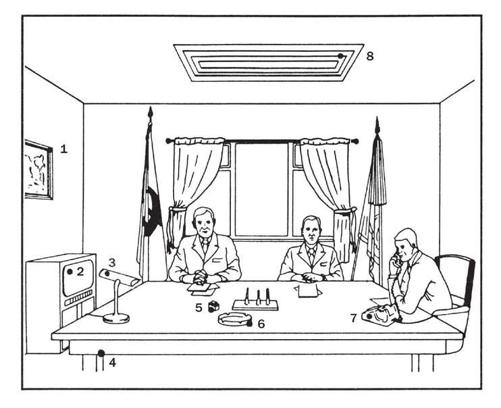
Potential locations for concealing an eavesdropping device exist in every office or conference room. 1. Picture frame. 2. Behind speaker grille of TV. 3. Table lamp. 4. Brace below table leg. 5. Cigarette lighter. 6. Ashtray. 7. Telephone. 8. Overhead light.
For audio techs, operations in the early 1960s became more numerous, complex, and increasingly audacious. Unstable Third World governments, especially in Africa where colonial governments transferred power to local authorities, added personal risk to clandestine activity. The techs, like other American visitors, were frequently viewed suspiciously and considered to be in league with the “colonialists.”
Audio operations came to the personal attention of President Eisenhower following the downing of CIA pilot Francis Gary Powers’s U-2 aircraft over Svedlovsk in the Soviet Union on May 1, 1960. Before the incident, the techs planned audio operations against the Soviet officials who would be accompanying Premier Khrushchev to the scheduled May 16 European summit meeting with President Eisenhower. The techs bugged several hotel rooms assigned to the Soviet attendees with mic and wire devices. When the summit collapsed after Khrushchev’s public denunciation of U.S. spying, the techs received word that the President himself had a “collection requirement.”
Eisenhower, the techs were told, wanted information about what the Soviet reporters from the TASS news agency knew about the cancellation and when they knew it. The President wanted specific information when he met the following morning at breakfast with his security advisors.
In fact, among the bugged targets was the room of the chief TASS correspondent. The “audio take” from conversations in the room revealed that the correspondent had telephoned Moscow after the cancellation to refile the story about the summit that he had written before departing Moscow. The audio operation left no doubt in the minds of the techs that the TASS official did not know in advance that Khrushchev would call off the summit.
Only infrequently did techs receive feedback on the value or use of the “take.” Strict standards of “need-to-know” and compartmentation were accepted as part of the profession by both engineers and tech ops officers.
About the time of the scuttled May 1960 summit, the chief of TSD stopped by the bench of one of the lab engineers. “What are you working on?” the chief asked.
“A new concealment device,” came the reply.
“What’s it for?” the chief continued.
“I’m afraid I can’t answer that,” said the tech, “I don’t know. I have a requirement from operations and I’m just making what they want.”
Another tech who served during the same time agreed. “We had an operational culture that emphasized the need not to know about what our equipment might be used for and what results were obtained, and that’s the way we did our jobs.”
Failure rates in the field of early audio installations were unacceptably high, sometimes reaching 50 percent. Two primary reasons became apparent. First, on the production end, there were no protocols for testing and certifying performance of components or the integrated systems in place. Manufacturer certification of component performance was accepted as “final” and considered sufficient. Second, differing field conditions, particularly the temperature and humidity extremes of desert, subarctic, and tropical regions played havoc with electronic components.
Testing was an ad hoc affair in TSS’s early years. Informal and unofficial systems developed. Engineers in the lab or the contracting company performed what they believed were good tests and then unofficially shipped a new device to a tech in the field. “They’d say, ‘Don’t tell anybody, but try this out,’” recalled one engineer. “‘If it works we’ll tell everybody. If it doesn’t work, just tell me.’”
Typically, field techs received individual components from headquarters such as batteries, transmitters, microphones, and recorders, then covertly assembled them into complete systems in locations that could range from a government storeroom or hotel room to the office above a target’s conference room. In many instances, the assembly at the target site was the first time all of the components of a device operated together. Too often, the techs discovered the system didn’t work.
Changes were implemented within TSD to ensure that the design and packaging of clandestine audio equipment would operate under widely varying conditions. However, field conditions were neither stable nor consistent. Engineers in the lab needed to imagine a hot, cold, rainy, dry, humid, dusty, pristine, muddy place in which their device would be plastered, glued, screwed, or bolted into position after being dropped, kicked, crushed, and adjusted by a hammer.
Kurt, by then a lead engineer, recalled the early equipment problems. “Equipment failure in the field usually pointed back to design or testing failure in the lab. We had to learn how to test our stuff. There were no manuals that said, ‘Follow these test procedures for your new, improved bug.’ Nobody else in government was building these bugs. We had to think it out for ourselves. And it took us a few years to set up test and evaluation procedures; then we could give equipment a stamp of approval. It is one thing for an engineer in the Washington lab to say ‘it works.’ But that wasn’t enough. How do we know it is going to work in Ouagadougou?”
The test protocols themselves were not without problems. On an African operation, a tech needed batteries for recorders in the listening post monitoring a bugged embassy. The tech requested and received six batteries from headquarters, each about the size of a car battery and weighing forty pounds apiece. They promised enough power to run the post for years. The tech hooked up the first battery but nothing happened. Nothing happened with the second, third, fourth, or fifth. And the sixth, too, was apparently dead. The operation had to be put on hold.
Still angry when he returned to Headquarters a week later, the tech made a beeline for the TSD warehouse determined to get to the cause of an embarrassing, time-wasting incident. Why would six batteries all fail at once? What were the odds? When confronted, the warehouse clerk was just as baffled by the batteries’ failure. The clerk described how he tested each battery and recorded that indeed they reached peak and sustained power through the stated cycle time. With their performance “certified,” the batteries were shipped to the field, the clerk unaware that he had drained all the power.
Given the uncertainty of equipment performance, it became common practice for techs to rebuild or retrofit devices in the field. Techs who knew something about electronics could look at circuit boards and see where, with just a little redesign, they could be made smaller, more reliable. Once a tech in Mexico City, discovering a circuit layout in an electronics hobbyist magazine, reconstructed a newly arrived audio transmitter in his home shop. “It was spy gear,” he boasted, “untouched by Headquarters’ hands.”
Normally reliable commercial equipment, such as the microphones used for mic and wire operations, sometimes presented unanticipated problems. Top-of-the-line carbon microphones used by the stars of the American recording industry were so sensitive that, when first installed, they captured voice audio anywhere in a room. However, when the mic remained stationery for an extended time, the carbon granules settled and compacted, like cereal settling to the bottom of the box, dramatically reducing its sensitivity. In a recording studio or concert hall, this was not a problem because the mic moved with the artist, but hidden in a wall undisturbed, the mic’s performance deteriorated over months or years.
To remedy these types of problems, TSD set up an equipment-testing division in 1964 to perform independent quality assurance evaluations of spy gear. The unit conducted independent tests and certified all of TSD’s equipment whether it was created in Agency labs, built by outside contractors, or acquired commercially. Anything a tech eventually used in the field was tested for performance in heat, cold, wet, and dry conditions along with an array of punishing tests where the device was bent, dropped, abused, and vibrated. The techs welcomed the tests, jokingly saying they needed all the equipment to be “case officer proof and agent proof.” Rough field treatment could be expected. DCI Richard Helms himself observed that case officers had to learn “not to fling these [devices] into the back seat of an automobile, but to treat them with the delicate hand they deserved.”4
By the late 1960s the techs saw audio equipment reliability jump to better than 95 percent. Standardized testing eliminated most of problems before the equipment reached the field. Nevertheless, operational realities could still trump well-designed and thoroughly tested equipment. After one tech successfully installed a wireless bug in a European city, reception from the transmitter was punctuated by intermittent static at the listening post. The breaks in transmission appeared random. The techs were stumped when even at 0200 hours, with the audio working perfectly, static would suddenly obliterate the voices, then, a few moments later, die down and the clear audio resume. Troubleshooting of the equipment did nothing to eliminate the interference. Then, looking out the window during one of the static-filled transmissions, the tech noticed motorcycles on the street. The next time static occurred, he could see another motorcycle and realized motorcycles passing between the transmitter in the target building and the receiver created static. The bug was picking up ignition interference from the motorcycles on the street.
Another lesson learned was adapting technology to covert operating requirements. Normally, trade-offs between technology and environment are relatively easy. In the 1960s, if a new stereophonic hi-fi system did not fit on the bookcase, purchasing a larger bookcase with wider shelves solved the problem. In 2008, rearranging a roomful of furniture to accommodate installation of a large plasma screen TV solves a similar problem. However, such straightforward trade-offs are rarely an option for a clandestine operation in which technology has to be covertly introduced into a setting, and then operate at peak efficiency without visible changes.
The physical environment of a target represented a constant in the operational equation. When any physical features of a facility had to be altered, it was done temporarily and only if it could be meticulously reconstructed. Scratches, dents, chips, holes, odors, debris, sawdust, mismatched paint, wet varnish, rearranged furniture, cabinet doors ajar, foot tracks on the carpet, or tools left behind—any of these things could compromise the operation.
OTS techs carried paint-matching kits and used odorless, quick-drying paints and varnishes so that neither the look nor smell of a wall restoration would leave clues behind. The number of items in the tech’s installation kit was memorized and each item counted before leaving a job. During the work tools were laid out on a cloth or rubber pad to avoid the possibility of leaving telltale oil or stains on floors and carpets and to keep all gear in a single location should an emergency bug-out (rapid departure from the site) be required.
Africa often offered the opportunity for creative solutions to problems encountered in the field. During one bugging job in a West African capital, the installation required surreptitious entry at night into the vacant building and extensive drilling for the mics and wires. The case officer and the techs faced the practical problem that sounds of drilling in an empty building at night would likely be considered unusual by neighbors. A means of masking the drill noise for an hour or more was required.
“How about bullfrogs?” the chief suggested.
The techs were confused. What possibly could bullfrogs have to do with the operation?
“I think that’ll work,” the chief continued. “The bullfrogs around here make an awful racket at night. We’ll have our staff collect several sacks of bullfrogs and when you guys go in to do the job, we’ll release them around the building. Their croaking will drown out your drills.”
A dramatic technical breakthrough for audio problems appeared in 1961 with a new generation of radio transmitters. The SRT-3 addressed almost every operational deficiency of the SRT-1 and its rarely deployed cousin, the SRT-2.5 For a clandestine transmitter, the SRT-1 had been a bulky, unstable, and power-hungry affair that comprised a hybrid stew of transistors and peanut vacuum tubes.6
Now came the model 3. About the size of a pack of cigarettes, with an all-transistor design, it transmitted on a hard-to-detect frequency above that of television station transmissions and was powerful enough to reach several hundred meters to an unobstructed line-of-sight listening post.
On a visit to Headquarters in 1961, a field tech noticed a little black box sitting on the desk of one of the audio program officers. Curious, he asked one of the women working nearby, “What’s that?” With surprise, she replied with her own question, “You’re putting in audio and don’t know about this?” The tech admitted he did not and spent the next hour learning about TSD’s new SRT-3, the first all-transistor transmitter, battery powered with a five-milliwatt output to the antenna. For the tech, it was love at first sight.
The system was not perfect, the SRT-3 had limitations, such as the amount of power consumed, the size of the battery pack for extended operation, and the fact that its unmasked signal once activated could not be remotely switched off. It transmitted a clear continuous signal until the battery died. However, the overall impact of SRT-3’s reliability and performance revolutionized the CIA’s audio surveillance program. For techs making audio installations, the SRT-3 was a thing of technological beauty and an operational joy. Housed in a plain, black metallic case, there were screws on the top to access the circuitry by sliding the top or bottom off and inputs for the mic, battery, and antenna.
Because the SRT-3’s small size, battery power, and wireless transmission, targets of opportunity—or more accurately, opportunities to plant bugs—multiplied. The techs were delighted with the SRT-3’s acceptance by the DDP stations. Never before had the CIA been able to field a battery-operated listening device small enough to be covertly planted in almost any wall, ceiling, or door and at the same time obtain reasonable performance for an extended operation.
Like drivers who must test the limits of a new car, the techs took the SRT-3 where audio devices had never been before. TSD’s new device worked best when concealed within a hollow wall or wooden floor. Implanted in the floorboards or behind the wood of a wall with a mic pressed against a nearly impossible to detect pinhole-sized air passage that opened into the target room, the SRT-3 could provide high-quality audio for the life of the battery.
Since the first SRT-3s were not hermetically sealed and were susceptible to humidity, temperature, and other environmental hazards, makeshift fixes, such as wrapping the device in plastic or duct tape, were employed with varying degrees of success. It was all too common for both the techs and case officers to become frustrated when, after a well executed entry and installation, signals could not be sustained. The only means of troubleshooting the system was to make another covert entry, extract the mic and transmitter, replace the device, and send the damaged unit to the lab for evaluation. Time after time, the problem was found to be moisture caused by dampness inside walls. “Climate controlled” buildings were rarely found in the locations TSD worked. Without an adequate field solution, the problem persisted until engineers developed hermetic sealing techniques for components of the systems at the factory.
In Asia, techs received a sobering lesson in chemistry and civil engineering. The operation was to bug the new embassy building of an Eastern Bloc country as it was being built. When reviewing the proposal, Seymour Russell, the TSD chief, expressed his “gut feeling” the operation was not going to be very successful and probably not worth doing. His senior technical ops advisor argued that TSD field techs as well as the DDP officers on the ground thought the target was both worthwhile and vulnerable to an audio attack. Russell allowed his operational inclination to outweigh his doubts and approved.
From beginning to end, it was the perfect operation. The case officer spent months recruiting construction workers who embedded dozens of audio devices into the wet cement at key positions throughout the building. Pinhole openings provided sound channels to the mics. The bugs were tested and planted without security leaks. As the embassy construction neared completion, the time came to switch on the audio. Nothing was ever heard.
New to the game of installing electronics in wet concrete, the techs had not considered that cement dries differently than clay or mud. The moisture did not evaporate from concrete. In fact, when water is added, concrete undergoes complex molecular changes called hydration, a process that produces an exothermic reaction essential in the hardening process. In other words, drying concrete gets hot. In fact, it gets very hot. Within an ordinary sidewalk a few inches thick, temperatures can reach over 100 degrees Fahrenheit during the hydration process. In a wall a foot or more thick, the heat becomes even more intense. Unknowingly, the techs had planted the devices in an oven.
“It’s unbelievable how hot that gets—the trunk of an automobile is nothing compared to what happened inside concrete,” said the tech who made the installation. “Our devices at the time couldn’t withstand the heat.” It was another step in the evolution of TSD’s spy gear. Future packaging of audio devices would give rigorous attention to the physical environment of the operation, such as heat and humidity, comparable to the attention paid to transmitter performance.
“When the battery dies, the operation dies,” became a mantra of OTS. As transistors delivered improved performance, batteries technology lagged behind, becoming the weak link in audio operations. “My wife often said I mumble in my sleep, but that I never said anything clearly,” remembered a senior TSD manager from the early years. “Except one night, apparently, I sat up and shouted, ‘Those fucking batteries!’”
The lack of small, long-life batteries constrained full operational use of the transmitters. After all, why launch an operation to bug a room if the bug transmitted for only a few days? In most cases, replacing the batteries was either impossible or added considerable risk of compromising the operation.
“Electronics and solid-state hardware rapidly moved ahead of battery chemistry,” explained an OTS chemist. “Before transistors the majority of the power going into a piece of electrical equipment was to keep the filaments hot in the tubes. That’s where power consumption was, burning volts in there. When the first transistor radios arrived, even the crummy batteries available gave acceptable life for the consumers.”
But technology acceptable to consumers was not necessarily acceptable for clandestine operations. Standard U.S. consumer batteries were too large, provided inconsistent performance, and offered life cycles either too short or too unpredictable. For an extended-life (several months or longer) audio operation, dozens of batteries were sometimes required—each one adding weight and volume to a concealment or installation.
Commercial battery options in the 1960s did not resemble those nearly half a century later. A consumer going into the local drugstore could select from only a limited number of battery types. There was the D-cell to power flashlights and the rectangular 9-volt for the transistor radio. There were also large cylindrical dry cells sold in hardware stores for special uses, such as powering camp lights.
Compared to transistors and integrated circuits, batteries possessed little sex appeal as a technology. Research in private sector companies producing batteries was directed toward lowering manufacturing costs as opposed to developing and improving the science of the battery itself. Published manufacturer ratings that estimated power output of individual batteries were often imprecise or significantly flawed. Battery makers invested little effort studying or improving long-term performance of their products because few—if any—customers cared whether a cheap battery lasted one month or six weeks. The typical consumer did not require significant improvements in performance or reduction in size. With their low prices, consumer batteries were disposable and replaceable.
The techs found ways to work with the commercially available batteries, despite their limitations. They assessed the amount of space available to conceal the bug and put the device in with whatever number of batteries could fit inside. Wiring the batteries in “parallel,” in contrast to “serial” wiring, did not alter the net voltage powering the device, but extended its operational life significantly.
“With commercial batteries we never knew for sure what their lifetime would be,” explained Kurt. “I would make my best guess and tell the case officer it would run this many hours and that’s it. Based on that, he would make the decision to do an installation or not. Sometimes, when we were lucky, the batteries ran 15 percent more than my estimate. But sometimes they ran 15 percent less and then there was a problem. If the audio was valuable and more was needed, the ops guys were faced with a decision of whether it was worth the risk to send us in again to replace the batteries. We had to learn to manage the expectations of the case officers. That became tricky when we weren’t sure how a piece of equipment would perform.”
This situation led a small cadre of TSD battery scientists to focus on mercury cell technology as offering the greatest potential for long power-life in a small package. In the mid-1960s, TSD established an extensive battery test program that produced more and better data on mercury cell performance than anywhere else in government or industry. These testing results led TSD to focus attention on a cell named the RM-1, made by the P.R. Mallory Company, and to create a specialized power sources unit for evaluating commercial batteries and developing smaller, longer-life cells for clandestine applications.7
Mallory first built its reputation during World War II with a mercury cell developed by the company’s cofounder, Samuel Ruben. Not only did the mercury cell pack more energy capacity into the volume of the battery case than other chemistries used during the war, it also operated well even when deployed in tropical temperatures. After the war, the mercury battery design fell into obscurity. It was still manufactured, but just barely, and only as a highly specialized item for a limited number of industrial devices. “The RM-1 was in the marketplace for use in medical applications and as a reference cell for testing other equipment because of its consistent, precise voltage,” explained Tom Linn, who headed the Agency’s battery program, “but they were not widely used at all.”
Still, it was considered the most viable cell available and TSD “forced” its use for extended applications. Although available in the right voltage and size for TSD’s needs, the battery was not designed for use extending over months or years. It exhibited a tendency to fail prematurely, and like virtually all commercial batteries at the time, the RM-1 hated audio operations. The constant slow and steady power drain of 1.5 volts required by the SRT-3 fostered internal crystalline growth that could eventually short out the cell.
TSD studied the failure mechanisms of the RM-1 cell and through a process of identifying failure modes, correcting each one, retesting, and further correction, the RM-1 evolved into a deployable component. Eventually a series called the “Certified Line” was produced. “That was our certification,” noted Linn. “It was certified for sure, certified for CIA’s clandestine audio operations.”
Later, when the heart pacemaker industry emerged during the 1970s, the manufacturer applied the knowledge learned in building the TSD battery. “I think it’s fair to say the first pacemaker battery—a mercury battery—was a TSD special design cell,” said Linn.
The requirements for power cells used in pacemakers and audio bugs were remarkably similar. Power must be sustained, reliable, and produced at a predictable, consistent level. Extended lifetime and small size are required since cells are not easily accessible after they are implanted, so replacing a cell is done as infrequently as possible.
The early SRT-3 battery-powered installations were configured with multiple standard D-cells linked in parallel. Eventually this would change when OTS began building cells in custom-made “cans” or containers. Not all of the specialty cans were metal containers; some of the housing materials could be molded to fit unusual concealment shapes or conform to human movement. Thin, flat, flexible, elongated, and curved shapes of metallic and nonmetallic containers for various power cell chemistries were developed and tested, all for increasing the options for concealment to enhance their operational use.8
TSD chemists also explored the possibility of using alternate substances to build what, in effect, would be a super-battery. “We did the calculations to try to find, of all the known chemical materials, what were the most energy-dense,” said OTS scientist Stan Parker, who spent a lifetime working on battery chemistries. “We got some remarkable results from the calculations. But when we looked at the toxicity of some of those materials, we said, ‘My god, I wouldn’t want to be in the room if they were going to actually try to use these. I wouldn’t want to even be in the same county.’”
It became clear that the volume of a battery could be shrunk only so much. A variety of exotic elements that yielded longer life in a more compact size were tested, but, inevitably, the laws of physics prevailed. “You can do a lot with chemistry, but then Mother Nature limits you,” concluded Parker.
TSD’s research chemists had run into one of Faraday’s Laws of Electrolysis. Paraphrased, the law states: The amount of total power in any given substance is proportional to the quantity of the substance. Even OTS scientists, as clever as they were, could find no loopholes in Faraday’s Law. When they wanted twice as much power, they needed twice as much of the substance. They could reduce the amount of the substance by half, and then get half as much power. Period.
One power source engineer explained the science to nontechnical case officers by saying, “You understand how electronics is shrinking the transmitter,” he said. “Well, when the transmitter is reduced one more magnitude, we’ll be able to disguise it as the label on this D-cell battery.”
Faced with Faraday’s Law, the designers of audio surveillance gear and covert communications became obsessed with power reduction. Instead of trying to pack more power into a smaller “can,” the engineers began looking for ways to minimize power consumption in the listening and covcom devices themselves. Less power consumption could be traded off against longer life or a smaller “can” or both. Reaching for the goal of a five-year operational life for battery-powered installations meant they needed to squeeze all the power possible out of each cell.
First among the breakthroughs was a series of switch receivers that allowed techs to turn a transmitter off and on remotely. Operationally, this enhancement ended the inefficiency of power wasted by transmitting signals from empty rooms. The remote on/off did not change the total hours batteries would power a transmitter, but it maximized the effective life by limiting transmission to those periods when conversations were held. “At three o’clock in the morning, we didn’t want that thing running, draining the battery life to send a signal that says, ‘There’s nothing going on,’” said Parker. “So, the listening post keeper could hit a button to turn on the audio in the room and listen. If something interesting was going on, if there was conversation, she’d turn on the tape recorder and continue monitoring. But if there’s silence, or she heard someone snoring, she’d turn the transmitter off.”
Remote on/off held another benefit. When a transmitter was switched off, sweep teams searching the radio spectrum for a bug would not be able to detect its presence. Equipment used by sweep teams to detect clandestine over-the-air transmitters in the 1960s looked for hidden metal objects and unauthorized radio frequency transmissions. Someone hunting for a bug could search the walls with a metal detector or modified radio receiver that automatically moved up and down the radio frequency spectrum seeking unknown or unidentified transmissions.
Because the on/off switch itself required some power to operate, it, too, became a candidate for additional power savings. One brilliant idea, the power saver circuit, came from an industrial contractor. The device was an extremely low power timer that turned the switch receiver to the on position for one second out of every twenty. If it did not receive a signal to start up the transmitter, the switch receiver obligingly went back to sleep for the next nineteen seconds. The savings in power was dramatic. Rather than running the switch receiver for twenty-four hours (1,440 minutes), the total time spent draining precious battery life could be reduced by more than 90 percent to just seventy-two minutes a day. Later, as portable, battery-powered devices began to multiply in the consumer marketplace, the same power saver circuit found a place in everyday products, such as pagers and cell phones.
The packaging of batteries presented another challenge for the techs. In some cases the battery’s gases and corrosive chemicals tended to leak. While corroded batteries in a flashlight or camera create an inconvenience for consumers, chemical reactions could prove disastrous for clandestine operations. Not only did the audio system stop working, gas or liquid seepage that discolored areas around the installation could lead to detection, compromising the operation.
“A water-based system, like the mercury cell, can give off hydrogen or hydrogen and oxygen gas. The hydrogen is the bad actor,” explained Linn. “If you get into a mode with gas escaping, leakage of the electrolyte results. This is corrosive and can change the paint color on a wall. We needed to be able to package every cell so it didn’t leak liquid or emit gas.” Balancing the laws of physics, audio engineering became a game of technological and operational horse trading, often conducted under the urgency of the “crisis de jour.”
The technical trade-offs with operational requirements were seemingly endless. How long does the device need to remain operational? If only for a few hours in a hotel room, commercial D-cells could work, but bugging a foreign embassy’s conference room for five years required a completely different technology. How large can the device be, including antenna? That answer was never the same depending on whether the antenna needed to be installed in a less-efficient horizontal position as opposed to the preferred vertical configuration to radiate the signal. What is the window of opportunity for the operation? If it must be done in the next five days, the tech ops officers had to use whatever equipment was available. Given an operational window of six months or a year, however, TSD engineers could redesign or adapt equipment and technology for a specific application.
“You’d get a call, ‘Hey, listen, we’re doing something, can you come to a meeting at three o’clock?’” remembered Parker. “So I’d say, ‘What are we going to talk about? I’ll bring the data I have on that.’ And we’d all show up, sit down, and try to figure it out. Some of the ops people were very well versed and others wouldn’t know an electron from a trumpet. They came in all flavors. But most of them you wouldn’t want any other way. The guys who didn’t have the technical knowledge sometimes had a whole lot of tradecraft knowledge they could bring to the party. One of the things I always used to say: There were enough problems to solve, so when somebody presented you with a solution, you left your pride at the door and said, Thank you.”