Access agent— A person who facilitates contact with a target individual or entry into a facility.
Accommodation address— An address with no obvious connection to an intelligence agency, used for receiving mail containing sensitive material or information.
Active concealment— A concealment device camouflaged as an everyday item that functions in accordance to its disguise to add an additional layer of security should the device attract scrutiny. Examples of an active concealment would include a ballpoint pen capable of writing, a flashlight that lights, or a can of shaving cream that dispenses cream.
Active measures— Soviet intelligence term for highly aggressive covert action and propaganda campaigns launched against the West in an attempt to influence foreign policy or create domestic unrest. Active measures, including disinformation campaigns, were aimed at Western and Third World countries, the CIA, U.S. military, and the American public.
Agent—An individual, typically a foreign national, who works clandestinely for an intelligence service.
Agent in place— An individual employed by one government while providing secrets to another.
Alias— A false identity used to protect an intelligence officer in the field; it may be as simple as a false identification and phony business cards or as elaborate as an established career substantiated with background details and legitimate documentation.
Al-Qaeda— International radical Islamic organization established by Osama bin Laden in 1988 to unite Muslims to fight the West and expel Westerners and non-Muslims from Muslim countries. Responsible for the September 11, 2001, attack on the United States and other terrorist bombings throughout the world since the early 1990s.
Audio—The capture and recording of private conversations by electronic means. Better known as “bugs,” audio devices can either be “hardwired” or transmit a signal via radio frequency, or optically using a laser or infrared light.
Bang and burn— CIA slang for personnel and operations involved with explosives, sabotage, and post-blast damage assessments.
Beacon— A device typically fastened to an object or individual that transmits a radio signal in order to track its location. The technological discipline is called beaconry.
BIGOT list— A list of names of individuals with authorized knowledge of a particularly sensitive intelligence matter.
Brush pass— A brief contact between an agent and case officer during which an exchange of physical material, such as documents, film, money, or other items, occurs.
Car toss— Similar to the brush pass, the car toss allows an agent and handler to clandestinely exchange physical material by tossing it through, or from, the open window of a car.
Case—The official record of an intelligence operation.
Case officer (also operations officer) — An intelligence officer responsible for an agent operation; responsibilities may include recruitment, instruction, as well as those of paymaster and personal advisor.
Central Intelligence Group (CIG) —The CIG, formed in 1946, was the predecessor to the Central Intelligence Agency.
Chief of station (COS) —The officer in charge at a CIA station, usually in a foreign capital.
Clear signal— A radio frequency (RF) transmission that is not masked (disguised) or encrypted.
Communicator—An intelligence officer responsible for maintaining and operating communication devices linking field stations with Headquarters.
Compartmentation— A procedure restricting knowledge of a case or operation to a small number of individuals on a “need to know” basis.
Concealment device— An object modified or fabricated to contain either a device or intelligence materials for purposes of covert storage, transport, placement within a target, or dead-dropping.
Consumer— An organization or individual who uses intelligence as part of the analysis or decision-making process. Consumers of intelligence include the military, State Department, and President.
Counterespionage— Espionage operations undertaken to detect, penetrate, and counteract foreign intelligence services.
Counterintelligence— Operations and analysis that protect information, personnel, equipment, and installations from espionage, sabotage, and terrorism.
Countersurveillance—Techniques used to detect and/or counteract hostile surveillance.
Cover— An organizational affiliation used by a person, organization, or installation to prevent identification with an intelligence service.
Covert communication (covcom) — Any technique or device used to relay data clandestinely from case officer to agent or agent to case officer.
Cryptonym— A deceptive code name assigned to an operation, individual, or case. CIA cryptonyms often included two-letter prefixes for internal identification.
Dangle— An individual or situation used as a lure to attract and identify intelligence officers of a hostile service.
DCI— Director of Central Intelligence.
DCIA— Director of the Central Intelligence Agency.
DDO— Deputy Director for Operations of CIA.
DDP— Deputy Director for Plans of CIA.
Dead drop—A method of communication between an agent and handler in which materials or devices are left unsecured in a preselected location, typically in some form of concealment. A dead drop may either be hidden from view or placed in the open in some manner that either blends in with the immediate surroundings and/or discourages close inspection by passersby.
Denied area— A term used by the CIA to describe a country or geographic region where clandestine operations are very difficult.
Diplomatic cover— An intelligence officer identified and accredited as a member of a nation’s diplomatic corps.
Directorate of Operations (DO) —The CIA component responsible for conducting HUMINT espionage operations abroad. Renamed the National Clandestine Service (NCS) in 2005.
Directorate of Science and Technology (DS&T) —The CIA component responsible for applying technology and technical expertise to intelligence requirements.
Division 19— A research and development unit under the National Defense Research Committee (NDRC) that supported OSS technical requirements during World War II.
DNI— Director of National Intelligence. The position of DNI was established in 2005 for coordinating the activities of all U.S. intelligence agencies.
Doc copy (document copy)—A device or procedure related to the clandestine copying of documents with intelligence value. Doc copy devices can include small cameras, digital scanners, or media-copying procedures.
Drum’s Bible—The 1951 report prepared by Colonel James H. (“Trapper”) Drum, head of the Agency’s Operational Aids Division, which formed the foundation for a centralized technical support organization.
Family jewels—A compilation of the most sensitive CIA operations. The phrase was first used by DCI Allen Dulles to describe his written notes on operations in the field during World War II with OSS. The term was revived in the 1970s during the U.S. Senate Church Committee investigation and applied to the compilation of CIA’s activities during the 1950s and 1960s.
First Chief Directorate— KGB organization during the Cold War responsible for foreign intelligence collection. In 1994 it was renamed the Sluzhba Vneshney Razvedki, or Russian Foreign Intelligence Service (SVR).
Flap— An incident caused by a failed operation or error; includes both diplomatic and “public relations” repercussions resulting from an arrest of a case officer or agent and can cause internal friction and conflicts with other services.
Flaps and seals—The clandestine opening, reading, and resealing of either envelopes or packages without the recipient’s knowledge.
Foreign finds— A captured clandestine device of a hostile intelligence service.
FSB (Federalnaya Sluzhba Bezopasnosti)—Federal Security Service of the Russian Federation responsible for internal security and counterintelligence.
GRU (Glavnoye Razvedyvatelnoye Upravleine or Chief Intelligence Directorate of the General Staff)—Soviet, and later Russian, military intelligence service.
Handler—The individual, usually a case officer, who controls and directs an agent.
Hard target— A person or place assiduously guarded against espionage efforts.
High-value target—An individual or installation possessing particularly important intelligence.
HUMINT (human intelligence)— Intelligence either collected or relayed by an individual.
IED (Improvised Explosive Device)—An explosive device fashioned from disparate components and most often used in terrorism or guerilla warfare.
Illegal— A term used for Soviet and Russian intelligence officers operating abroad without benefit of “diplomatic cover.” Illegals pose as legitimate residents of the target country and are protected only by a strong cover.
Intelligence requirement— Information requested by an intelligence consumer, such as the Pentagon or President.
KGB (Komitet Gosudarstvennoy Bezopasnosti or Committee for State Security)—The Cold War name for the Soviet Union’s primary security and intelligence apparatus.
L-pill— A suicide pill or tablet issued to agents who preferred death to interrogation. Although popular in spy novels and movies, L-pills were rarely used operationally.
Legend— A carefully constructed cover for an intelligence officer.
Lemon squeezer— OTS slang for a specialist in secret writing. The term is derived from one of the oldest forms of secret writing that used lemon juice, which disappears on paper when dry and then reemerges when exposed to heat.
Listening post— A secure site at which signals from an audio operation are monitored and/or recorded. The individual charged with maintaining the site is called a keeper.
Lubyanka— KGB Second Chief Directorate Headquarters, located in the center of Moscow during the Cold War.
Main enemy— Soviet designation of the United States during the Cold War.
MI5—The British intelligence service responsible for internal security. It is comparable in some ways to the FBI, but its officers do not have the power to make an arrest.
MI6—The British foreign intelligence service also known as the Secret Intelligence Service (SIS). It is similar to the CIA.
Maryland Research Laboratory (MRL)— A wartime research laboratory run by Division 19 of the National Development and Research Committee and located on the grounds on the Congressional Country Club just outside of Washington, D.C.
Mic and wire—Tech slang for an audio operation that uses hardwiring rather than radio-frequency transmission to carry the signal from the microphone to the listening post.
Microdot— An optical reduction of a photographic negative to a size that is illegible without magnification, usually 1mm or smaller in area.
Moscow rules—The distilled wisdom for conducting clandestine operations in Moscow during the Cold War.
National Development and Research Committee (NDRC)— a civilian agency created to explore new weapons for what seemed to be America’s inevitable entry into World War II.
NIACT (night action)— An indicator used in CIA messages or cables requiring an immediate response regardless of the time of receipt.
NKVD (Narodnyy Komisariat Vnutrennikh Del or The People’s Commissariat for Internal Affairs)—Forerunner of the KGB from 1934 until 1946.
Non-official cover— A CIA officer operating under a cover that has no connection to the United States government.
One-time pad (OTP)— Groups of random numbers or letters arranged in columns, used for encoding and decoding messages. Since the codes are used only once, a properly employed OTP is theoretically unbreakable.
One-way voice-link (OWVL)— A broadcast over a shortwave radio frequency containing a ciphered message to an agent.
OPC (Office of Policy Coordination)—CIA element responsible for covert action until 1952. See OSO.
Open source— Any publicly available information.
OSO (Office of Special Operations)—CIA element responsible for clandestine collection of intelligence. OSO combined with the Office of Policy Coordination in August 1952 to form the Directorate of Plans.
OSS (Office of Strategic Services)— America’s World War II intelligence organization.
OTS (Office of Technical Service)—The office in the DS&T that provides technical support to clandestine operations.
Overhead platform— Satellite or airplane capable of gathering intelligence through either interception of electronic signals or photography.
Paper mill—A counterfeiting operation specializing in creating realistic-appearing “intelligence documents” in post-World War II Europe. Paper mills were responsible for the dissemination of countless false or misleading pieces of intelligence.
Persona non grata— Latin for “unwelcome person.” Intelligence officers working under diplomatic cover who were caught in the act of espionage were declared persona non grata and ordered to leave the country.
Pocket litter— Commonly carried items, such as credit cards, driver’s licenses, receipts, and matchbooks that contribute to establishing a cover or legend.
Recruitment—The process of enlisting a potential agent to spy.
Rezidentura—The Russian intelligence station inside a foreign mission.
Roll-up—The capture of an agent or intelligence officer that shuts down an operation.
Safe house— A location used for clandestine meetings and assumed temporarily safe.
Second Chief Directorate— KGB organization responsible for internal security and counterintelligence operations.
Secret writing (SW)— Use of special inks or chemically treated “carbon papers” to produce a hidden message.
Seventh Chief Directorate— KGB organization during the Cold War responsible for surveillance.
Short-range agent communication (SRAC)— A device that allows agent and officer to communicate clandestinely over a limited distance.
Signal site— A covert means of communication using a nonalerting signal, such as a chalk mark on a lamppost, to either initiate or terminate a clandestine act.
Signals intelligence (SIGINT)— Intelligence gathered from the interception of either electronic emissions or transmissions.
Silent call—An operational signal in which the agent or intelligence officer places a call from an anonymous phone and then hangs up after a predetermined amount of time without speaking.
SIS (Secret Intelligence Service)— See MI6.
Special Operations Executive (SOE)— A British Special Forces organization charged with sabotage operations and support of underground forces during World War II.
Station— A forward-deployed operational office of the CIA.
Station chief— See Chief of station.
Surveillance detection run/route (SDR)— A planned route taken by an agent or handler prior to conducting a clandestine act in hostile territory, designed to identify or elude surveillance.
Target— A location, thing, facility, organization, or person against which an intelligence or counterintelligence operation is directed.
Technical Operations Officer (TOO)— A DS&T officer providing direct technical support to clandestine operations.
Temporary duty (TDY)— A field assignment of short duration.
Tradecraft—The techniques, technology, and methodologies used in covert intelligence operations. Tradecraft applies to both the procedures, such as surveillance detection routes, as well as the use of devices in covert audio surveillance and agent communications.
Tray rocker— OTS slang for one working in clandestine photography. The name derives from the way in which prints were developed in trays of chemicals.
TSCM—Technical Surveillance Countermeasures.
TSD—Technical Services Division (1960-1973), predecessor to OTS.
TSS—Technical Services Staff (1951-1960), predecessor to OTS.
Walk-in— A volunteer who approaches an intelligence agency for the purpose of espionage.
Wood block—An audio device concealed within a block of wood that can then be attached to a piece of furniture or an architectural detail within the targeted room.
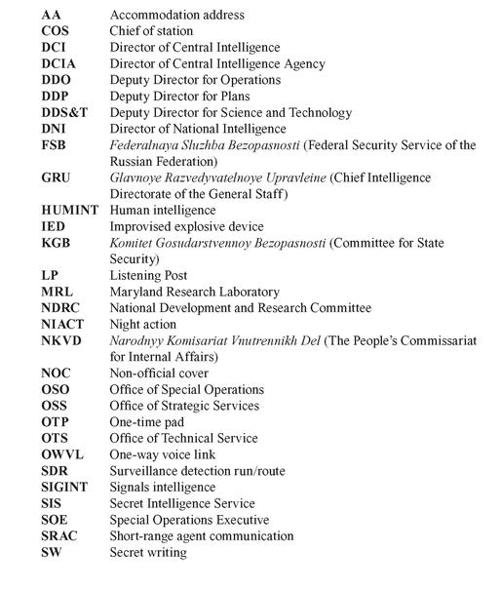
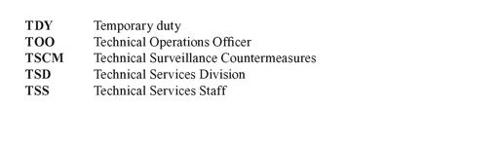
SELECTED INTELLIGENCE ACRONYMS