
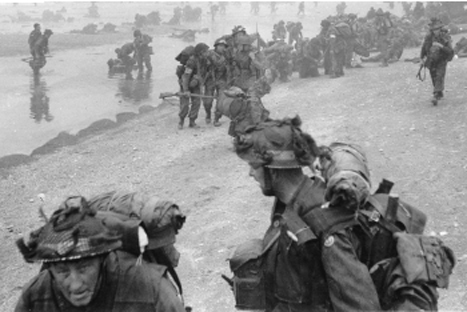
IN MEMORIAM
This book is dedicated to the memory of Colonel Eric T. Lummis, the Suffolk Regiment, veteran of D-Day, noted Regimental officer, and historian. Eric was also a respected friend to several generations of young British Army officers who had the benefit of being taught about the realities of war by this quiet, truly professional soldier, and gentleman.
COLONEL ERIC T. LUMMIS
DIED ON 11TH JUNE 1999, AGED 79.
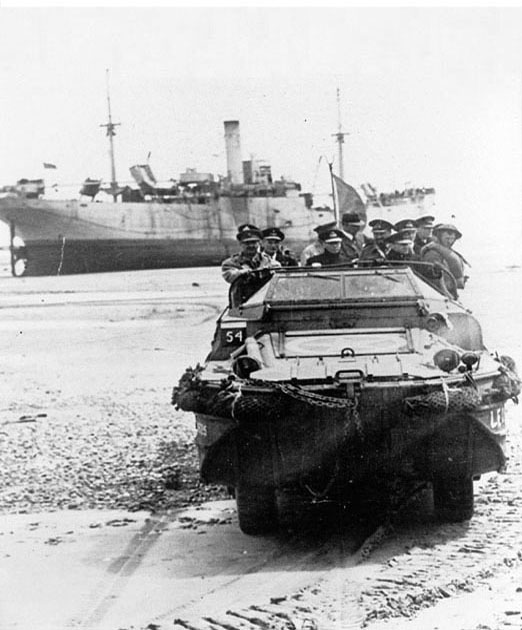
His Majesty King George VI arrives on the Normandy beaches.
Bob Lilley via Bob Oates
FOREWORD
by
LIEUTENANT-GENERAL SIR MICHAEL JACKSON CB
Former General Officer Commanding
3rd Division
This book provides a valuable tool for all students of war. The author sets the scene for the great drama of Sword Beach and the thrust for Caen, with the broad canvas of D-Day as the backdrop. The work then guides the reader through the complexities of the battles from the beachhead to William the Conqueror’s medieval capital astride the River Orne.
This work highlights the realities of command at the operational and tactical levels where decisions – even to this day – are made more frequently with incomplete intelligence, rather than the perfect situational awareness that hindsight allows us. The story of 3rd British Division in Normandy is typical of many Commonwealth infantry divisions committed to battle in the wider struggle to destroy Hitler’s European tyranny. The young men who were to bear the brunt of this bloody struggle were drawn from the shires of the United Kingdom and were committed — many men for the first time – to battle in one of the most difficult, complex, and historically significant campaigns in the history of Europe. Their courage, will, and sacrifice contributed to the shattering of German power in France and ultimately, in the course of ten months, throughout Western Europe.
The study of the Normandy campaign remains an important component in the understanding of that profoundly transformative, hugely destructive conflict, that provides historians, students, and warriors with such a rich tapestry of lessons and insights into the realities of total war. The recommended stands in this book give an excellent snap-shot of the five bloody weeks of attrition fought between the men of 3rd British Infantry Division and their ruthless and highly effective foes in the Wehrmacht and Waffen-SS. On D-Day confusion would reign on Sword Beach, where landing schedules slipped and succeeding waves of assault craft piled a jumble of men and vehicles at the water’s edge. Even so, the leading troops in Sword sector were off the beach within an hour of landing and by dark had joined up with the forces of the British 6th Airborne Division astride the Orne and pushed south to within a few miles of the city of Caen. British and Canadian forces failed to seize Caen on D-Day in part because the Germans threw the weight of their available reserves, and the only armored division to hand, into the defense of the city.
D-Day remains one of the epic assaults of history, a “mighty endeavor,” as President Franklin D. Roosevelt described it to the American people, “to preserve ... our civilization and to set free a suffering humanity.” As with his Omaha Beach edition in this series, the author has succeeded in bringing to life the realities of war, the complexities of command and control and the challenges of coalition operations against a tough resolute enemy who has not forgotten how to fight or how to die.
Tim Kilvert-Jones – formerly a principal staff officer in 3rd Division and the trainer of the divisional staff in Headquarters 3rd Division during its relocation from Germany back to Tidworth under my predecessor’s command – has analyzed the operations and tactics that defined the conduct of the battle for Caen, the pivot in the Allied strategy for the liberation of France. The author has presented incisive portraits of the leaders, soldiers, sailors and airmen on both sides of this climactic battle. The ambiguities of the struggle, the opportunities seized or missed, are all examined within a structure that allows the reader to get the very most out of a visit to this historic field of battle. I commend this work to all students, historians, and instructors in the art of war.
Lieutenant General
Sir Michael Jackson CB
INTRODUCTION
Professor Sir Michael Howard once described three general guidelines for the effective study of military history. He suggested that it should be studied firstly in depth, to get beneath the historian’s imposed pattern of seeming orderliness and to try and understand what war is really like, in effect to get an idea of the confused nature of fighting. Secondly, it should be studied in breadth so that the development of war over a long period can be understood. Thirdly, it should be studied in context to appreciate the political, social, and economic factors that exercise important influences on the military part of the equation. The Battleground Europe series has been designed to meet his demanding requirements.
The focus of the guidebook will be on one relatively short period during the momentous, but bloody events in Normandy in the mid-20th century, the assault by a joint military force from the United Kingdom on a German defended and fortified sector of the Normandy coastline from 6 June to 10 July 1944.
An appreciation of the military framework behind the operations of 1st British Corps in Sword sector on 6th June 1944 is a fundamental necessity. In order to appreciate the scale of this battlefield and the significance of the great sacrifice made by so many young men in the assault divisions of June 1944, it is essential to visualize the whole ‘canvas’ of Operation Neptune-Overlord. To that end Chapter 1 will provide sufficient explanation for the reader to fit the more personal accounts of a single division’s battles into what Winston Churchill described thus: ‘this vast operation is undoubtedly the most complicated and difficult that has ever occurred.’
The specific combat actions that are discussed in this book occurred at the tactical level. The tactical level of war is concerned with the conduct of battles and engagements; these normally unfold within a sequence of major operations. Above this level of military activity lies the operational level of conflict. This level provides the gearing between national political and military strategy and all tactical activities in a theater of operations. It is at the operational level that military resources are directed to achieve the campaign objectives, or end-state. Throughout the Northwest European Campaign, the operational commander was the American General Dwight D. Eisenhower, the Supreme Allied Commander. Eisenhower arrived in London in January 1944 to take up an appointment that would influence the very conduct of the Anglo-American effort against Germany. He was not operating in a vacuum. Eisenhower received strategic guidance from the political leaders of the western powers principally President Roosevelt of the United States and Prime Minister Winston Churchill in Britain. Military direction was then issued by either the Joint Chiefs, or via the national military strategic authorities; in Washington D.C. General George Marshall spoke for the President, while in London, Field Marshal Sir Alan Brooke (Chief of the Imperial General Staff and Chairman of the Chiefs-of-Staff Committee) spoke for Churchill.
Eisenhower was ably supported by a multi-national staff and most notably by the preliminary planning carried out under the direction of a British officer, Lieutenant General Sir Frederick E. Morgan, Chief of Staff to the as yet unnamed Supreme Allied Commander. It was Morgan’s efforts and breadth of vision that provided so much of the planning framework for the subsequent Commonwealth and American victory on D-Day.
D-Day in Perspective
D-Day was the greatest combined amphibious assault the world has yet seen. It was a staggering feat of planning and synchronized military action. On that day a total of 156,205 men, 3,000 guns, 1,500 tanks and 15,000 other assorted vehicles landed in Normandy across the assault beaches or by glider and parachute onto the fields of France. In all, eight allied divisions were put ashore. It was and still is an astonishing achievement. These forces then pressed back the remnants of the German coastal defense units, already battered by air and naval bombardment and then bloodied at close quarters on 6 June. By 2 July the Allied Expeditionary Force had deposited 1,000,000 men ashore including twenty-four divisions at a cost of 60,770 casualties (8,975 were killed). This extraordinary summary of achievement belies the very real fear, exhilaration, cost, and horror endured by those men and women touched by this climactic battle.
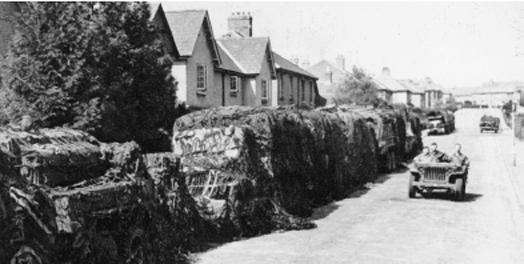
Camouflaged vehicles lining the roadway of an English south coast village in the weeks leading up to D-Day.
On 6 June 1944 disaster would only really threaten the Allies at Omaha Beach. Here the V US Corps launched its Rangers, elements of the 29th ‘Blue and Gray’ Division under command of the veteran ‘Big Red One’ (1st Division), in a frontal assault against a natural, well defended, fortress between Pointe du Hoc and St. Honorine. That the operation was to prove successful is a testament to the undaunted courage and small unit leadership of so many young men throughout the Omaha assault force. Their story can be found in the Omaha Beach book from this series. Another related title in this series is Carl Shilleto’s Pegasus Bridge/Merville Battery. The valiant glider force that captured the bridges over the Orne were dependent for their overall success and survival on a timely link-up and relief by troops coming ashore on Sword Beach. On that beach the assault battalions from 8 Infantry Brigade were to suffer localized slaughter disproportionate to the rest of the division as individual boat sections and companies beached into prepared killing areas or directly under the guns of German strongpoints.
In the past the story of the 3rd Division in Normandy has had an inappropriately mixed press. This has been largely due to the adverse criticisms written by the Australian war reporter Chester Wilmot and General Sir David Belcham in their respective books The Struggle For Europe and Victory in Normandy. A great many writers have followed their baleful influence since these works were first published in 1951 and 1981 and few have thought to challenge them until more recently. Wilmot criticized the division for a lack of drive and a loss of momentum on D-Day caused – as he put it – by being over-trained for the assault rather than focused on the exploitation to Caen. Belcham, the Brigadier General Staff (Operations) of 21 Army Group wrote ‘The record of 3rd British Division is the most disappointing of all the assaulting sections... A more dynamic formation would not have dug in at Hermanville but would have devised a plan to outflank the enemy at Periers.’ In retrospect these criticisms are largely ill-founded and misconceived. This book will guide the reader and battlefield explorer over the complex terrain and show how enemy action, Clausewitzian friction – an eternal constant in any conflict – and the environment can all play a crucial part in constraining the best devised plans of war. As Colonel Bill Friedman of the 16th Regimental Combat Team landing at Omaha Beach stated after surviving three amphibious assaults against occupied Europe and North Africa:
Once launched this kind of operation is totally out of the hands of higher level commanders... Regardless of the planning, an opposed landing is chaos incarnate. It must be dealt with as such.
Studying Sword Sector using this guide
The three recommended sequential tours of Sword sector can be completed within a day if transport is used, to move between the locations. In this guide the visitor is directed to three sites, or locations, where actions took place – these are referred to as STANDS.
STAND A is located at the seafront town of La Breche d’Hermanville where the landings are described, helping the reader to visualize and relive the events of 6 June 1944.
STAND B is situated on the German bunker system which was code-named ‘Hillman’ by the Allies. Here the attack on this strongpoint by 1 Suffolks is described in detail.
STAND C forms a vantage point on Periers Ridge to examine the only armoured German counter attack against the beaches on D Day by the elements of 21st Panzer Division.
Each tour is accompanied by a historical account; these accounts should be used as background material to the more poignant study of the ground, the memorials and the personal memories of the men who fought in Sword sector. In addition to these suggested tours, this book provides the reader with selected recommendations for visits to associated sites of general interest within the Lodgment Area. Today, there is no shortage of private museums and memorials competing, along with the more significant national and regional collections, for the visitors’ attention and revenue.
You may wish to intersperse studies of the battlefield with visits to appropriate museums in Caen, Ouistreham, Benouville and Bayeux.
D-Day and the Battle for Normandy remain amongst the most fascinating and accessible European military campaigns in the long, painful history of human conflict. Since the end of the Second World War, the region’s military history has attracted a broad range of pilgrims. The veterans and their families have been frequent, if unwitting companions to historians and soldiers studying this momentous campaign.
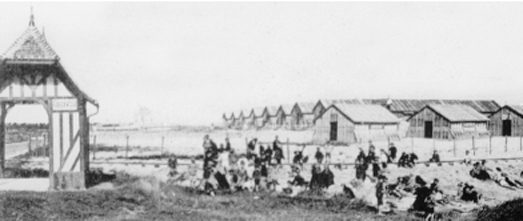
The French seaside resort of Colleville-sur-Orne. A few years on and this area would be designated ‘Queen Beach’ for the Normandy Landings.
Whether you will be playing on the beautiful beaches, or touring across the open fields beyond the dunes into the bocage, you cannot avoid the evidence of great sacrifice and terrible loss that surrounds this now beautiful, tranquil and ancient region of France. Nor should the visitor ignore the region’s broader tapestry of history and culture. The quiet villages, verdant countryside, dramatic castles, memorials and museums present physical evidence of an Anglo-Saxon, Viking, Norman, French, and English heritage. That dynamic mélange of cultures is characterized by an inscription on the Commonwealth Memorial to the Missing in Bayeux. It reads:
We, once conquered by William, have now set free the Conqueror’s Native land.
Maps
Michelin maps are an excellent and essential aid to navigation in Normandy. These maps are a useful start point and can usually be obtained from most well stocked bookshops in France and Britain and on the cross Channel ferries. In the United States they can be obtained from the Institute Geographique National (IGN) distributor at:
|
Map Link Inc. |
or |
In Europe IGN can be contacted at: |
|
Map Distributors |
ESPACE IGN |
|
|
30 South La Patera Lane |
107, rue la Boetie |
|
|
Unit#5 |
75008 Paris |
|
|
Santa Barbara |
France |
|
|
California 93117 |
E Mail: www.ign.fr |
|
|
Tel: (I) (805) 692 6777 |
||
|
Fax: (1) (805) 692 6787 |
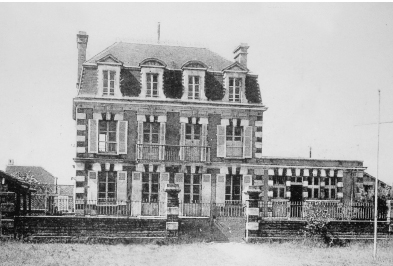
Colville-Plage pre-war. Soon to be in the thick of the fighting on 6 June 1944.
Recommended Maps
Carte Topographique. Institute Geographique National (IGN) Serie Verte Number 6: Cherbourg-Caen 1:100,000. If visits will be made to the eastern extremities of the invasion area then IGN map Number 7 will also be required. This map covers an area from Ouistreham in the west, across the Orne River and its ship canal, where Pegasus Bridge can be found, and so onto the northeast, Merville Battery and beyond.
Other useful maps include Michelin’s map Number 54 Normandie in the 1:200,000 series, which covers the whole invasion area, but at a considerably smaller scale.
The serious student or walker may also acquire appropriate maps from the IGN 1:50,000 series in order to find the more obscure routes through the region. These are, however, no longer in print.
A more useful 1: 25,000 series is now available. These maps are the IGN Serie Bleue. This series has been arranged in a wonderfully logical French manner, with all maps the same size and shape. There are a small number of maps that are exceptions to this rule including map number 1512 E, Caen; this larger than normal map covers an area that includes both Juno and Sword Beaches. The eastern boundary runs north south to the east of the river Orne and cuts through the 6th Airborne sector. The southern boundary runs between the Odon and Hill 112. A new 1:25,000 series entitled La Carte de Randonnee is also available with Caen 1612 OT covering the Jun, Sword, Pegasus Bridge and Merville Battery locations in superb clarity.
Military students are also advised to obtain copies of the excellent French military map series. These maps are available through official map acquisition processes within formation headquarters.
Copies of original Allied planning and battle maps for Neptune-Overlord are now available from the Imperial War Museum, London, for a fee.
ACKNOWLEDGEMENTS
In the research for this book I had the honour and privilege of interviewing a number of those very special veterans from 3rd Division who landed at Sword Beach. I owe my gratitude to every one of these venerable gentlemen who gave so much of their youth and souls in the name of freedom and the service of their nation. We owe them all so very much.
I owe particular thanks to the late Colonel Eric Lummis of the Suffolk Regiment, a true gentleman, warrior, and historian in his own right. He opened my eyes to the realities of a battle that has been simplified and misjudged by several senior officers and historians over time. His dedicated research into the events surrounding 3rd Division’s actions in Normandy provided an essential component in the writing of this book.
I also wish to thank Evan Davies for his constructive observations and detailed knowledge of Normandy. Kenneth Fortune, President of REEP Inc. the premier United States military studies Staff Ride Corporation for his support, and Dr. Russell Hart, senior Lecturer in the Department of History at Ohio State University. Dr. Hart gave me full access to his eminent but as yet unpublished dissertation on the battle for Normandy. I am also grateful to Richard Harris, a Normandy veteran of the Suffolk Regiment who very kindly granted me permission to quote from his privately published accounts 50 Years On and The Battle for Chateau de la Londe.
The story of 3rd Division would be incomplete without the contribution of Sir Robin Dunn. As a Battery Commander in 7th Field Regiment Royal Artillery his insights and memories of the battle are critical to any understanding of the opportunities won and lost by the ‘Iron Division’.
I must also thank in retrospect the late Colonel Hans von Luck, commander of the 125th Panzer Grenadier Regiment, 21st Panzer Division. He enlightened the author and generations of other NATO officers on a series of now legendary Normandy Staff Rides with his sophisticated analysis of his own experiences in Normandy. Hans was a professional, dedicated warrior whose insights were enriching, forthright and thoughtful.
My wife Louise and our children, Edward, Victoria and Hugo must also be thanked for their patience and tolerance of a husband and father too often confined to his study to meet his publishers’ deadline.
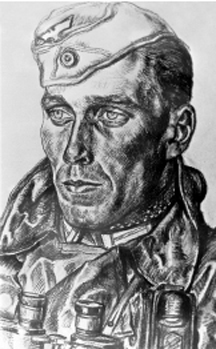
Colonel Hans Ulrich von Luck.
Any errors or lack of acknowledgement are the author’s fault alone. This book has been written in honour of the veterans who fought in Normandy and for whom there can have been few greater tests than crossing the fire-raked sands or pushing inland against the coastal defence fortifications and the 21st Panzer Division on June 6th, 1944. Those brave men were a very long way from their homes across the Channel on D-Day.
TD Kilvert-Jones
Fairfax, Virginia, USA, June 2001
We few, we happy few, we band of brothers;
For he today that sheds his blood with me
Shall be my brother; be he ne’er so vile
This day shall gentle his condition.
And gentlemen in England, now a-bed
Shall think themselves accursed they were not here,
And hold their manhoods cheap whiles any speaks
That fought with us upon Saint Crispin’s day.
SHAKESPEARE
King Henry V