
CHAPTER ONE
By the winter of 1943 the Germans were already engaged in a multifront war. On the Russian Front the finest units of the Wehrmacht and Waffen SS were being consumed at an appalling rate. In the Mediterranean the Axis powers had been defeated in North Africa, an Anglo-American expeditionary force had conquered Sicily and the mainland of Italy had now been invaded. In the skies over Germany an air war of extraordinary proportions was also consuming manpower and industrial production capacity as losses of aircraft and ground defenses climbed. In an effort to stem the devastating tide of day and night area bombing by the Allied bomber fleets, the Germans relocated fighter wings and air defense systems to protect the Fatherland at the cost of other fronts. The German air defense system (including searchlight units, gun crews, and radar centres) had absorbed 900,000 men alone. All these assets were being employed well away from what was to be the decisive ‘Second Front.’
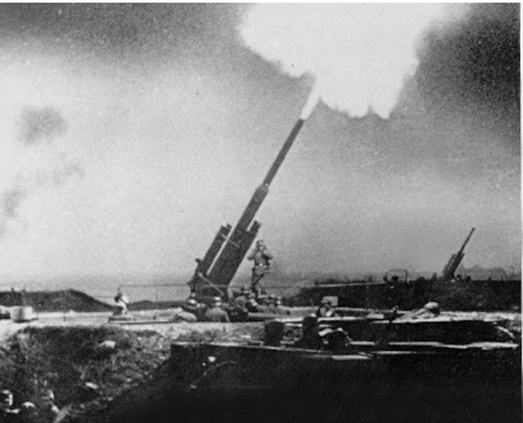
Defending the Reich from night and day bombing raids was absorbing large numbers of men, armaments and munitions.
Defending the Reich: Fortress Europe
In December 1941 Adolf Hitler ordered his national military command headquarters, the Oberkommando der Wehrmacht (OKW), to plan,
‘The construction of a new West Wall to assure protection of the Arctic, North Sea and Atlantic coasts against any landing operation of very considerable strength with the employment of the smallest number of static forces.’
On 23 March 1942, with the Third Reich at the peak of its success, he went on to issue his Führer Directive Number 40. This directive set down the detailed defensive responsibilities for the operational commanders in the West. It stated:
‘The coastline of Europe will, in the coming months, be exposed to the danger of the enemy landing in force... Even enemy landings with limited objectives can interfere seriously with our own plans if they result in the enemy gaining any kind of foothold on the coast... Enemy forces that have landed must be destroyed or thrown back into the sea by immediate counterattack.’
Ironically three days after he had signed this directive the British mounted the highly successful – though costly – raid on the port and dry dock facilities at St. Nazaire. The raid was so effective that the ‘Normandie’ dry dock (destroyed by the explosive-laden HMS Campbletown) was inoperable for the rest of the war. Within five months, on 19 August, the German defences were further probed by Operation JUBILEE, the disastrous raid at Dieppe. This operation was a frontal assault on a partly fortified harbour. The German defenders used their limited fortifications and counter-attack troops to devastating effect. After nine hours the remnants of the Anglo-Canadian force withdrew leaving behind 3,658 men out of the 5,100 troops who had landed. One thousand men had been killed and the remainder was wounded, missing, or taken prisoner. The Germans had suffered 300 casualties.
The costly experience at Dieppe was to provide diverse lessons that would be fundamental to the subsequent successful landings in North Africa, Sicily in 1943, and in Normandy one year later. Each side drew very different conclusions from the disaster. For the Germans a greater emphasis on fixed fortifications became the order of the day. For the Allies a more detailed analysis produced far reaching lessons-learned that would ultimately support NEPTUNE-OVERLORD. For the most part, the German newspaper headlines in late August 1942 illustrated the Führer’s sentiments on JUBILEE: ‘Catastrophic Defeat a Setback to Invasion... What does Stalin say about this Disaster to Churchill’s Invasion?’ For the Reich the Allied disaster provided valuable propaganda material and a reassurance that lightly held fortified defences could repel enemy amphibious assaults. The Germans certainly viewed the Anglo-Canadian operation as an amateurish undertaking. In truth, it had been.
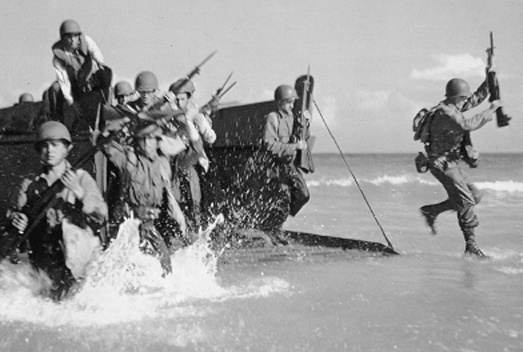
Valuable experience in amphibious landing techniques were gained through Operations TORCH (Tunisia) and HUSKY (Sicily).
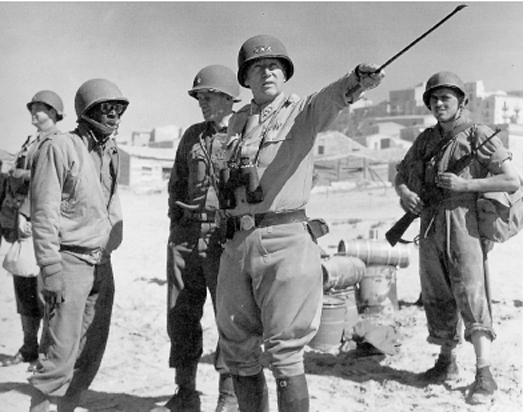
General Patton surveys the beaches following the successful landings in Sicily.
Work on the West Wall (also known as the Atlantic Wall, a component of Fortress Europe) now began in earnest amid a blaze of propaganda. The focus of effort was on the major ports (the evident target of enemy raids and any future invasion) and then on vulnerable coastal areas, such as the Pas de Calais, Hook of Holland and the Gironde estuary. The Germans had once again forgotten their own history; it was Frederick the Great of Prussia who had stated, ‘He who defends everything, defends nothing.’ In reality, what emerged was a loose necklace of powerful fortresses such as Calais and Cherbourg, interconnected by weak outposts and routine patrol activities spread over 2,400 miles of coastline. Inflexible dogma and self-delusion had replaced effective critical analysis of the threat now gathering strength across the Channel.
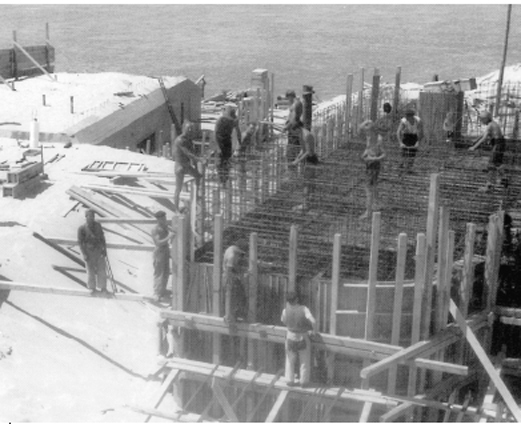
Workers of the Todt Organization constructing a massive bunker on the French coastline. Reinforcing steel rods are being put in place prior to the pouring of concrete.
The Germans were also hampered by shortages of defensive materials such as concrete, mines, adequate weapons, fighting men and labor. By 1943 the war in the East was draining the Reich’s increasingly limited resources and this was now impacting on every front. The aging Field Marshal Gerd Von Rundstedt, Commander-in-Chief West (OB West), identified the serious manpower shortfall. He reported in October 1943, that the existing West Wall could be covered but not fully defended. Yet he also recognized the utility of the Wall as a propaganda tool and, to a lesser extent, the military value of Hitler’s port-city fortress policy. That policy would actually lead to the denial or destruction of the principal French ports in the face of the Allied advance for several months after D-Day and impact on the Allied line of operations for the rest of 1944. However, Von Rundstedt went on to note that:
‘A rigid German defense (is) impossible there for any length of time, the outcome of the battle must depend on the use of a mobile and armoured reserve... the best that might be hoped for [is] that it might hold up an attack for twenty four hours, but any resolute assault [is] bound to make a breakthrough anywhere along it in a day at most. And once through all the rest could be taken from the rear...’
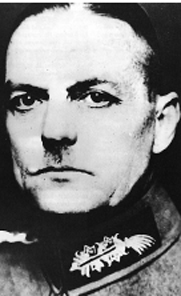
Generalfeldmarschall Gerd von Rundstedt
Führer Directive Number 51
On 3 November 1943 Hitler issued one of the half dozen of his most significant directives of the war. Führer Directive Number 51 specified the tasks required of OB West to create an effective bastion against an Anglo-American landing. The Directive stated:
‘...If the enemy here succeeds in penetrating our defences on a wide front, consequences of staggering proportions will follow within a short time. All signs point to an offensive in the Western Front no later than spring, and perhaps earlier.’
For that reason I can no longer justify the further weakening of the West in favor of other theatres of war. I have therefore decided to strengthen the defences in the West, particularly at places from which we shall launch our long-range war against England. For those are the very points at which the enemy must and will attack: there – unless all indications are misleading – will be fought the decisive invasion battle.
Hitler went on to issue specific tasks to the Army, Luftwaffe, Navy, and SS and closed with a warning:
‘All authorities will guard against wasting time and energy in useless jurisdictional squabbles, and will direct all their efforts toward strengthening our defensive and offensive power.’
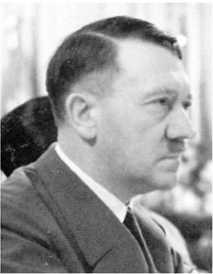
Adolf Hitler, a dictator in every sense of the word, concerned himself in almost every aspect of the total war being waged by Nazi Germany.
Fortunately for the Allies, Hitler’s subordinate component commanders and even individual arms commanders ignored this final demand. That divisive situation would be further exacerbated by his imposition of a complex, contradictory, and ineffective command structure on his forces in the West.
Field Marshal Erwin Rommel in the West: December 1943
By 5 November 1943 Hitler had promulgated his new Directive Number 51 and selected Rommel as his Inspector General of Defences in the West. By the end of that month Rommel had gathered about him a specialist joint staff to support his analysis of the West Wall. He moved from Italy to France with his own Army Group B headquarters and quickly set about a grueling programme of inspections from Denmark to the Spanish border. He focused much of his effort on the most likely areas for the impending invasion: Pas de Calais, the Somme estuary, Normandy – including the Cotentin Peninsula, Brittany, and the Netherlands.
As a result of Rommel’s highly critical report and recommendations, Hitler decided to incorporate Army Group B into OB West on 31 December. Rommel now found himself under Von Rundstedt’s command, with specific responsibility for anti-invasion plans from the Netherlands and across northern France. His command was divided into the Seventh Army West of the River Orne, and Fifteenth Army to its East, with the 88th Corps in Holland.
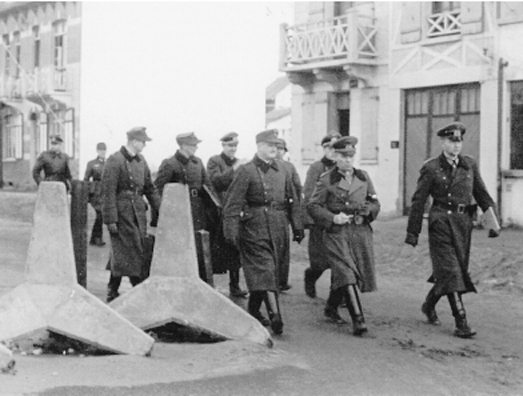
Feldmarschall Erwin Rommel applied his brilliant military mind to improving Europe’s coastal defences.
Rommel assessed that to have any hope of success ‘the enemy must be annihilated before he reaches our main battle line,’ therefore ‘we must stop him in the water.’ Rommel ordered the laying of 200 million mines along the coast to form an initial barrier. Between November 1943 and mid-May 1944 over half a million anti-invasion obstacles were put in place along with a total of 4 million mines. One month before the invasion he was able to report,
‘I am more confident than ever before. If the British give us just two more weeks, I won’t have any more doubt about it.’
The frenetic preparatory activity throughout Army Group B was a major concern to the Allies. In fact, the Allied planners were so concerned with Rommel’s beach defences that they adjusted the preferred time and conditions necessary for the amphibious assault. The seaborne invasion had been initially planned to take place under the cover of darkness, but now it would commence after first light. Better visibility would give the navy a chance to manoeuvre through the increasingly complex and lethal ‘forest’ of obstacles along the beaches.
German Intelligence Assessments and the
Impact on Defensive Strategy
During early 1944 Rommel would bemoan his lack of knowledge of Allied intentions. He wrote, ‘I know nothing for certain about the enemy.’ The Allied air forces were effectively preventing most German reconnaissance flights reaching the southern coast of Britain – now densely packed with shipping, men, and materiel. Rommel was strategically blind. His headquarters along with Fremde Heeres West (Foreign Armies West), the German military intelligence organization, focused on establishing the strength and intentions of the Anglo-American armies in Britain, was also completely misled by BODYGUARD and the deception operations protecting NEPTUNE-OVERLORD. On 20 March they could do little better than assess that the impending assault would occur ‘somewhere between the Pas de Calais and the Loire valley’.
As a result of the complex deception conducted within the BODYGUARD framework of operations, the Germans believed that the Allies had ninety operational divisions plus an additional seven airborne divisions in the UK (double the actual strength). They assessed that twenty of those divisions were poised to land in the first wave – four times the actual strength intended for the D-Day assault. The Germans believed that with so many divisions apparently prepared for the forthcoming invasion, the Anglo-American forces would be able to mount two expeditions in rapid succession, probably in the Pas de Calais and one other location. German assessments of this fictitious Allied capability and intent were further manipulated and reinforced by the information passed back to the Reich by German ‘turned’ agents in Britain, most notably agent GARBO.
The Abwehr (German Military Intelligence) staff in Spain had recruited GARBO, or rather Juan Pujol Garcia, as a potential agent for operations in Britain. By the time Pujol was deployed to southern England in 1942 he had already been ‘turned.’ As a controlled double agent he established a fictitious network of twenty-seven additional ‘sources’ located across the southern counties. GARBO then passed an intricate web of deception back to his Abwehr controller, Karl Erich Kuhlenthal, in Spain. Kuhlenthal was so impressed with the information that he retransmitted it to his headquarters in Berlin. The Abwehr informed GARBO:
‘Your activity and that of your informants gave us a perfect idea of what is taking place over there. These reports...have an incalculable
Ironically the Germans were to decorate Pujol for his services to their war effort with the Iron Cross on 17 June 1944. Within months the Director General of MI5 would also award him with an MBE for his contribution to both the Bodyguard operation and the fixing of the German Fifteenth Army in the Pas de Calais.
Blind and misled, Rommel still managed to analyze the threat and conceive of a credible defensive strategy that with hindsight and evidence from Omaha Beach appears to have had the best chance of actually defeating or disrupting the invasion. Unfortunately for the dynamic and energetic commander of Army Group B, he lacked the resources to convert theory in to reality. In mid-May 1944 Oberst Oehmichen published a German Seventh Army staff report. He illuminated the shortfalls in defensive preparations in Normandy and compared the state of the coastal defences with Fifteenth Army in the Pas de Calais. Some of his findings would have made disturbing reading for Erwin Rommel:
|
Defensive Capability |
Seventh Army Normandy |
Fifteenth Army Calais |
|
Divisional Frontage |
40-270 Kms |
40 Kms |
|
Mine Density-T mine |
440 per Km 30 in the invasion area |
|
|
Heavy Guns in Bunkers |
27 out of 47 guns |
93 out of 132 |
|
Fixed Anti-Tank Guns in Bunkers |
9 guns all in the open |
16 out of 82 under cover |
|
Resistance Nest (WN) Density |
1,300 Meters |
875 Meters |
|
Anti-Tank Gun Density |
12.25 per 10 Kms |
22 guns per 10 ms |
Any obstacle crossing or expeditionary operation is most vulnerable to counter-attack while the assaulting force is establishing its beachhead. If Rommel could hold the assault divisions on the foreshore and then launch local counter attacks using all available armoured forces, he would stand a good chance of disrupting or defeating the invasion. In Normandy, the German defences would lack any depth and as the commander of 716th Coastal Defence Division described his resistance nests, they were like ‘a string of pearls’ along the coast. In the absence of effective defences in depth, Rommel would be dependent on reserves – particularly the armoured reserves – from the interior, to crush an Allied lodgment.
Even as late as 1944 there was no doubt of German superiority in armour. The panzers would have a dramatic impact on any landing operation – if they could be positioned in hides close to the likely invasion beaches – an assessment born out by events on D-Day in Sword Sector.
The German armoured Reserves
Following his detailed analysis of the situation, Rommel now sought control of the panzer forces then under command of his higher headquarters at OB West. As a result of his experiences in North Africa, where his Afrika Korps had been under relentless enemy air attacks in the latter phase of the North Africa campaign, Rommel recognized the need to deploy his reserves well forward. This would minimize their exposure to both direct air attacks and the effects of enemy air interdiction around the landing area. Rommel was also at a fundamental disadvantage with the absence of any effective intelligence, even if he gained control of the critical armoured reserves, he would have to disperse these limited resources to cover the most likely invasion areas: from the Pas de Calais through Normandy to the Cotentin. Yet once the direction of the enemy attack had been identified he would still be able to throw the nearest panzer units into battle, if necessary piecemeal. He felt that he could afford to do this because of the qualitative advantage of the German panzers over any Allied fighting vehicle then in service. Individually, there was little doubt that German tanks were superior. They had better armour and carried more powerful weapons and were usually commanded and crewed by experienced veterans. This meant that in most engagements each individual German tank had a qualitative and often a tactical advantage over its numerically superior enemy counterparts.
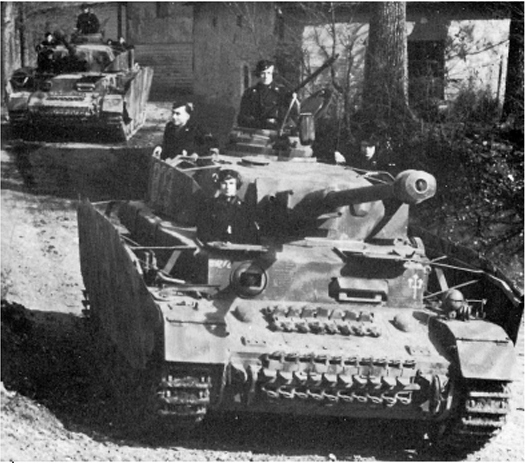
The work horse of the Panzer units – PzKpfw IVs of the 2nd Panzer Division move through a French village in 1944.
Once Rommel had codified his strategy for defeating the invasion, he sought the resources to make the concept a reality. He now demanded operational control of the panzer arm in OB West. However, a fundamental disagreement emerged between two divergent doctrinal camps. On the one hand Rommel believed in the forward deployment of the panzers and had some support from Hitler. On the other hand the veteran panzer commanders from the Eastern Front, such as General der Panzertruppen Geyr Von Schweppenburg, supported by Guderian (Inspector General of Panzers) and the aging Von Rundstedt, favored holding the panzer reserves well back from the coast until the enemy’s intentions and strength became clear; at that point a well-planned and concentrated counter attack could be launched.
Rommel therefore demanded operational control of all the armoured formations in OB West. This would then allow him site these powerful forces in forward concentration areas close to the likely invasion sites along the coastline. From their hides he would then be able to deploy them promptly and with the shortest exposure to air attack to the invasion front.
Within his concept of operations, Rommel planned to use his nearest panzer divisions as a hasty counter attack force. In June 1944 the 21st Panzer Division would be the nearest armoured formation to the Normandy coast on D-Day. Defeated and incarcerated in Tunisia, North Africa, it was reformed in Rennes, Brittany on 15 July 1943 and equipped with an assortment of captured French vehicles from the 1940 campaign. By June 1944 the Division could boast between its Panzer Regiment 22, Sturmgeschutz (Stug.) Abteilung 200, and Panzer Artillerie Regiment 155:
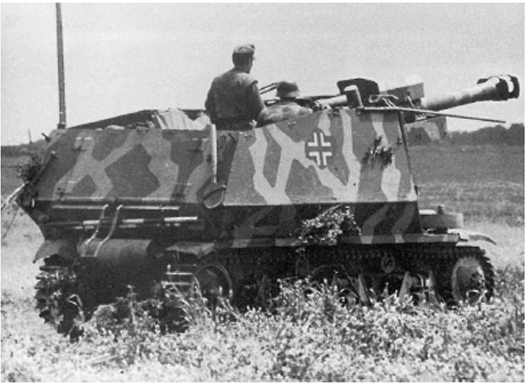
French Hotchkiss H-39 (Geschützwagen) chassis mounting a 105mm howitzer made an effective assault gun and was used to equip the reformed 21st Panzer Division.
98 PzKpfw IV (6 were old model Gs)
6 PzKpfw IIIs
23 French Somuas
43 improvised assault guns mounted on French Hotchkiss chassis
45 Lorraine conversions
This numerically powerful looking force was actually a shadow of its former self when it had fought in Rommel’s Afrika Korps. By July 1944 it would once again be shattered after a month of combat: the force would be down to 61 PzKpfw IVs and 32 Hotchkiss guns, and 45 ‘Lorraines’. On 1 August 1944 the Division would have only 42 PzKpfw IVs left.
While the initial action was being fought to both bolster the coastal defences and destroy localized penetrations, Rommel intended to bring the more distant formations to the battle area to mount further attacks on any weakly held enemy lodgments. Those more distant divisions would need to redeploy to the new front, moving on exterior lines, and probably being harried from the air by Allied fighter bombers operating well within range of the French coast from their British airfields.
This inevitably exposed journey could still prove to be shorter and less dangerous than a move from some inland concentration area designated by the cautious Von Rundstedt, or the traditional cavalry tacticians who wanted to mass their panzer arm before delivering a ‘text-book’ decisive blow. This traditional approach ignored the inherent strength of Allied air power and the ability of the Anglo-American armies to concentrate artillery and naval gunfire in devastating co-ordinated bombardments. It also fell exactly into place with General Montgomery’s assessment of how the German’s would conduct the defense. During his briefing, codenamed EXERCISE THUNDERCLAP, to all general officers of the Field Armies at St. Paul’s School, London on 7-8 April 1944, Montgomery explained that:
‘Rommel is likely to hold his mobile divisions back from the coast until he is certain where our main effort is being made. He will concentrate them quickly and strike a hard blow, his static divisions will endeavour to hold on defensively to important ground and act as pivots to counter-attacks...’
Unfortunately for Rommel, Von Schweppenburg was commanding Panzer Group West, headquartered in Paris close to Von Rundstedt’s OB West Headquarters. In 1944 Von Schweppenburg had responsibility for the training of the panzer and panzergrenadier divisions under Von Rundstedt’s command. His principal staff was composed entirely of experienced panzer and grenadier officers. From Paris, Geyr also retained an element of operational control over three of the armoured divisions in theatre. These responsibilities were now to bring him into direct contact – and on occasions, conflict – with Rommel.
German Unity of Effort and Unity of Command
Fortunately for the Allies neither German camp won the argument of control over the Panzertruppen. Hitler, ever suspicious of his army commanders, actually allowed the debate to impede any form of unified command in the West. He received a series of visitors who lobbied him in favor of one or other solutions. Guderian describes in his memoirs one such visit to gain Hitler’s support for the formation of a Front Reserve. The response to this request was a long statistical summary of fortification and mining programs conducted on the West Wall and an endorsement of the ‘Rommel Doctrine’ that the first forty-eight hours of the invasion would be critical.
Back in France, Rommel was engaged in acrimonious debates with Von Rundstedt over the location of individual divisions, such as their argument over the location of the 2nd Panzer Division astride the River Somme at Abbeville. In such an atmosphere of mistrust, Rommel alternated between bouts of defeatism to absolute confidence. His swings of emotion were noted and briefed to Hitler who finally decided to temporize. North of the River Loire, Rommel (Army Group B) was given command of 2nd, 21st and 116th Panzer Divisions. So in all, Rommel now had thirty-nine infantry and three panzer divisions under his command in June 1944. Of his vital panzer formations, 21st Panzer Division was located near Caen, the coastline that would soon become known as Sword Beach, and the Orne Bridges. 2nd Panzer Division was located in the Pas de Calais, and the 116th was concentrated near Paris.
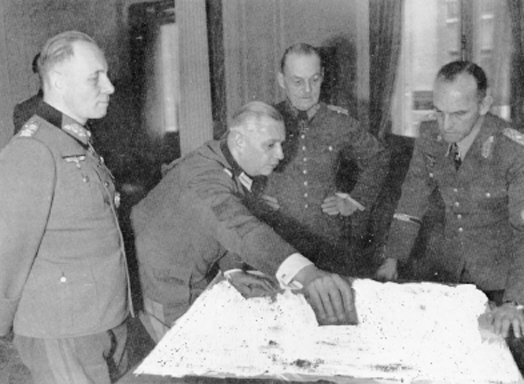
Feldmarschall Rommel (left), Feldmarschall von Rundstedt (hands on hips) and General Gause pay attention as Oberst Zimmermann makes a point on the map (sensored).
Hitler left Von Rundstedt in nominal command of Panzer Group West including Panzer Lehr, and 12th SS Hitler Jugend in accordance with OKW’s recommendation. To add to this complex command structure the 12th SS Panzer and 17th SS Panzergrenadier Divisions along with 1st SS Leibstandarte were part of the 1st SS Panzer Corps under SS General ‘Sepp’ Dietrich. These powerful, elite forces were dispersed between Brussels and Poitiers.
Ironically, in Führer Directive Number 40 of 23 March 1942, entitled Command Organisations on the Coasts, Hitler had stated:
‘The preparation and execution of defensive operations must unequivocally and unreservedly be concentrated in the hands of one man.’
It was fortunate for the Allies that Hitler did not follow through and enforce all his directives.
Inevitably, each layer of authority that Hitler imposed on his generals would add new complexities and frictions to the already hardened arteries of command in OB West. To add a final measure of delay to any flexible or responsive decision-making, Hitler demanded that none of the armoured reserves could be deployed without his personal authority. Crucial hours and days would now be lost from midnight on 6 June as the army commanders awaited decisions from their distant Commander-in-Chief. In truth, Hitler had ensured that neither of his Field Marshals in the West would have flexible command over the crucial armoured reserves at the very moment when hours rather than days would be decisive.
Germany’s Multiple Front War: the Eastern Front and Normandy
At the strategic level one must recognise and pay tribute to the Soviet contribution to the success of D-Day. In reality the Red Army was grinding the greater part of the German war machine to dust far away from Normandy. In 1943 at the Tehran conference, Stalin had promised to launch an offensive that would fix and disrupt Hitler’s ability to switch assets from Russia to France during the critical first month of the build-up in Normandy.
As June progressed, the strategic situation would deteriorate further for the Reich as Hitler became distracted by events in the East and the preparations for the expected Soviet summer offensive codenamed BAGRATION.
OPERATION BAGRATION would annihilate Germany’s Army Group Centre between 22-30 June. This Soviet offensive in western Russia had been timed to disrupt German attempts to switch reserves from the Eastern Front to meet the new threat in Normandy. With over 1.7 million men supported by over 4,000 tanks and assault guns, 6,000 aircraft and 26,000 artillery or rocket systems, the Soviet Union shattered the German frontline. Within a week the Third Reich had lost 154,000 men, either killed or taken prisoner. Materiel losses defy imagination; in one week, 2,000 tanks, 10,000 guns and 57,000 vehicles had been destroyed or captured. These losses exceed even those endured at Stalingrad. While Army Group Center was being crushed, Army Group North was being cleaved in two and forced into retreat towards East Prussia and the Baltic States.
This level of attrition puts in perspective the Allied sacrifices on D-Day. Now when the visitor to Normandy stands at La Breche or on the bunkers at Hillman and looks down over Queen White and Red, it is worth pondering the contribution of the Soviets to this particular victory.
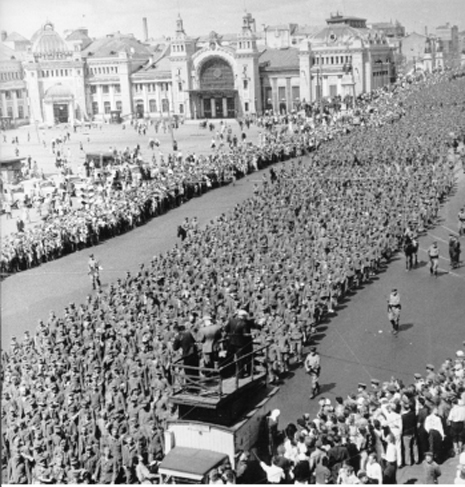
The Russian Summer offensive of 1944 smashed through German Army Group Centre. Here some 50,000 German prisoners are being marched through the streets of Moscow. After their passage the road was swilled with disinfectant.