
CHAPTER SIX
The German Situation North of Caen
Dawn on 7 June found the units of 21st Panzer Division in a state of crisis. The bloodied armoured Kampfgruppe Oppeln was experiencing difficulties in transitioning to the defensive. There was a shortage of infantry. With a sector of five kilometers to hold, there were only two companies of infantry from I/25 Grenadier Regiment and one company of 220 Armoured Engineer Regiment available. Because 200 Anti-tank Battalion (less three guns) had been detached to the remnants of 716th Coastal Defense Division and deployed in the west of the division’s sector, the tanks of 22nd Panzer Regiment had to be used as a screen to meet the next British attack.
21st Panzer Division had also lost two of its nine artillery batteries, leaving only seven batteries to cover over twelve kilometers of front. The 8th Heavy Weapons Company of 192 Regiment had pulled back from Bènouville and Blainville to a reverse slope position on the heights of Herouville near the railway bridge. At this stage there were still Germans in Beuville and Bieville. At about 0200 hours a brave German SP gun and two armoured cars slipped out of Bieville and dashed for Lebisey. They went over a necklace of seventy-five grenades placed across the road to stop enemy vehicular movement. Unfortunately the grenades failed to go off. In the Chateau de Beuville there were also sixty Germans that were cleared by Sergeant Major Lacy and gunners from the 16th Battery gun line. Rear area security was everybody’s business in Normandy.

Sherman belonging to 13/18th Hussars.
Missed Opportunities: D+1 and Beyond
The opportunity to ‘bounce’ Caen had been lost on D-Day and would be further relinquished on D+1. The Germans now exploited a narrow window of opportunity to first establish and then shore-up their front line north of Caen, with all the skill and urgency that the experience of four years of war had taught them. While many of the German units committed to this task were newly reconstituted or reinforced with young recruits, they still retained a cadre of professional, highly experienced tactical commanders who were able to improvise, seize the initiative, and turn any enemy weakness to their advantage. Here was a fearsome foe facing 1st Corps. It would now require a major Allied offensive to break through these positions, overwhelm the mobile armoured reserves and capture the city and its crossings over the Orne.
It could indeed be argued that 3rd Division had failed to make a concentrated thrust that might well have shattered the initially thin defensive crust offered by 21st Panzer Division. However, the dissipation of the 3rd Division’s combat power by the Corps and divisional commanders, as priorities changed in the heat of battle on and shortly after D-Day, explains why Rennie was unable to complete his mission in full. As the visitor drives and walks the ground around La Londe and Lebisey, it is also clear that this highly defensible terrain favoured the German defenders. As a result, the initial attempt on D-Day by a single company of infantry with limited support from a troop of tanks had been doomed by its lack of concentrated power and fire support.
On D+1 plans were hastily made for 2 Warwicks to attack Lebisey. The battalion had already cleared Blainville at first light. Brigadier Smith, Colonel Nigel Tapp and Colonel ‘Jumbo’ Herdon (commanding officer 2 Warwicks) met in Blainville to prepare a simple fire plan for the attack. This single battalion attack by 3rd Division was to be mounted in confusion and with inadequate support. The stream midway between Blainville and Lebisey wood was selected as the start line. However, a basic battle drill was ignored; the start line was not secure and pockets of Germans were still around covering the valley. Captain H C Illing commanded A Company for the attack. He remembered moving forward with his Orders Group (platoon commanders and attached subordinate commanders) for a recce and having his carrier peppered with fire.
Because of delays in getting the assault force assembled Colonel Herdon postponed the attack for an hour. Unfortunately, B and C Companies were out of radio communications when this delay was imposed and they set off on time but without the preparatory barrage – the guns had received and followed the order to delay the fireplan for one hour. As the companies advanced to within 200 metres of their objective the panzergrenadiers of 125 Regiment opened fire. The attack stalled as the forward platoons were decimated, commanders killed or wounded, including Colonel Herdon, who was killed as he went forward. The Germans brought up their tanks that enfiladed the Warwicks. Into this chaos Brigadier Smith, assuming quite incorrectly that the objective had been taken, ordered forward the anti-tank guns, FOB, and carriers, still waiting in Bieville with the Warwicks Adjutant, for the order to advance and reinforce a secure objective. The column advanced up the hill as ordered. The Germans were ready for them – and still very much in control of the situation. Some vehicles got through to the other side of the wood and went into action firing back the way they had come against the Germans now closing in for the kill. Most of the vehicles and personnel were either killed or taken prisoner. A few survivors did filter back to the battalion. This was a disaster.

An abandoned British 6 pdr anti-tank gun and German panzer grenadiers.
The Staffordshire Yeomanry had been hampered in their support role for the Warwicks attack, by the German anti-tank ditch that ran between Beauregard and Lebisey and by, as the Yeomanry War Diary for 7th June states, the ‘natural anti-tank obstacle between the main axis and the road.’ This natural barrier was the combination of the Dan stream bed (Le Dan Rau) that winds up from the Orne through Bieville, and le Vallon that intersects the Dan to the south of Bieville. Even today these deep watercourses remain obstacles except at their bridge sites. So without combined arms support the Warwicks attack was shattered against elements from Von Luck’s I/125 Panzer Grenadier Regiment supported by tanks from 22 Panzer Regiment.
Later that day, Major Dunn recalled how Brigadier Smith had arrived at Norfolk House in the early afternoon and said to Hugh Bellamy, commanding 1 Norfolk:
‘Hugh, I’ve got a bloody awful job for you; you’ve got to go through the Warwicks and get Stout [codename for the Lebisey feature].
He was unable to give a situation report on the condition of the Warwicks. At 1500 Colonel Nigel Tapp was at an Orders Group at the KSLI headquarters where after some discussion the Brigadier decided to send 1 Norfolk to capture the east side of the road. Supporting fire was to be by observation as the exact whereabouts of the Warwicks was still unknown. According to Smith’s own account, his order to Bellamy to restore the situation was a ‘nebulous commitment.’
The Norfolks duly advanced and met heavy shell and mortar fire as well as small arms fire from the now dug-in positions of the 192 Regiment grenadiers. Despite mounting casualties they reached the edge of the wood and met up with the Warwicks. Both battalions were now pinned down and eventually the Brigadier ordered them to withdraw at 2200 hours under the covering fire of all available guns. In all two field regiments, one medium regiment, and a cruiser covered this retreat.
Illing described the withdrawal as neither coherent nor highly organised though it did prove successful. Losses in both battalions were grim. The Warwicks lost a total of ten officers and one hundred and forty other ranks as well the Anti-Tank Platoon, guns, mortars and Bren Carriers. While this tragedy was unfolding Brigadier Smith had gone forward to get some inkling of the situation only to get lost and spend the night hiding in a barn. At dawn he found his way back to his headquarters at Bieville where his Brigade Major cheered him up with a bottle of champagne.
On the other flank the CO of the KOSB had been warned early to move to Mathieu (also known to the British in 1944 as Cazelle after a small part of the village). The battalion arrived at Mathieu at 1210 hours and found it unoccupied. They then advanced down the Douvres-Caen road to Le Mesnil wood where they were ordered to gigin much to the CO’s chagrin. While still digging they were subject to heavy and accurate mortar shelling that inflicted a number of casualties. The day was brought to an uncomfortable close when they came under attack from intense small arms fire with a lot of tracer. It was a wholly unexpected attack made worse by the unmistakable sound of approaching armour. Believing the situation to be hopeless and with his position apparently surrounded, the CO ordered a withdrawal. With his piper playing ‘Blue Bonnets’ the battalion collected around him and made a desperate charge through the undergrowth, expecting to be met by a hail of fire as they broke from cover. As they emerged from the wood, silence fell. It was realised that the fire had come from a recce patrol from the East Riding Yeomanry who had assumed that the battalion was a German unit! The KOSB returned to their positions somewhat embarrassed.
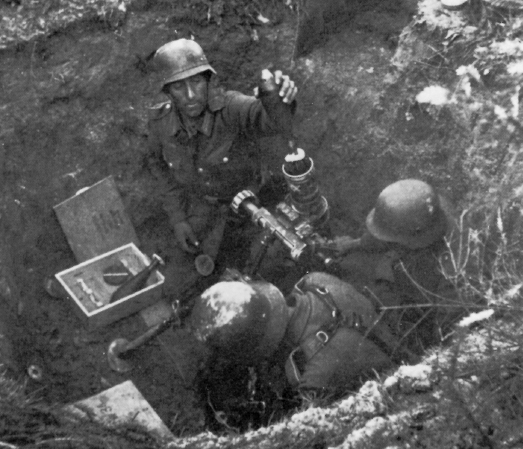
German mortar team belonging to 716 Infantry Division.
The Royal Ulster Rifles (RUR) also reached Le Mesnil wood at 1700 hours to reinforce the KOSB. D Company RUR and a squadron of the East Riding Yeomanry patrolled as far as Cambes but came under fire from German units. Casualties amounted to thirty-one men including two officers. A German version attaches more significance to this encounter. At 0300 on D+1 Standartenführer Meyer, commander of 25 SS Panzergrenadier Regiment was awaiting the arrival of his regiment at an Assembly Area on the line of Authie-St Contest-Epron. From here they were to launch a co-ordinated counter-attack at 1600 hours on 7 June with 21st Panzer Division. His troops arrived in darkness at La Folie and Couvrechef on the Caen-Douvres railway. Initial German reconnaissance indicated that the enemy did not yet occupy the villages of Carpiquet and Buron, but Villons-les-Buissons just north of Cambes had been occupied. Shortly after getting into position the SS would suffer a well-supported battalion attack against the newly arrived elements of I/25 SS Panzer Grenadier Regiment. The British attack succeeded but only after very heavy fighting and losses that prevented any further exploitation. The RUR had pushed up against the advancing elements of I/25 Panzergrenadier Regiment. The grenadiers had been supported by five tanks from 8th Company of 12 SS Panzer Regiment and by III/12 Artillery Regiment in their move towards Cambes. A violent fight had ensued, with three British tanks knocked out by German Panzerfaust. However, the German thrust was stopped in its tracks by concentrated artillery fire and fighter-bomber attacks. The commander of I/25 Grenadier Regiment was forced to disengage and hastily order his men to dig-in abandoning Cambes and any further prospect of an advance.
Back towards the beach, the Lincolns had temporarily been put under command of 8 Brigade while 1 Suffolk was transferred to 9 Brigade; they were told to clear the Chateau and the village of Lion. Orders had been issued at 1200 hours and a two-company attack mounted that ultimately cleared the chateau and the village but left the Germans in their strongpoint in Lion. Lieutenant Colonel Welby-Everard then issued new orders to the remainder of the Battalion to clear the strongpoint. H-Hour had been decided when new orders from brigade redirected the Lincolns to St Aubin d’Arquenay with one company to the Benouville bridges. This hasty move was conducted in trucks from the 90th Company RASC. As an indication of the urgency these vehicles were found to be still half full of petrol cans for the resupply of 27 Armoured Brigade. At Benouville they found Fox Troop of 92 Light Anti-Aircraft Regiment RA already in position and actively defending the bridges from determined German air attacks. Over a five-day period after D-Day the Luftwaffe mounted eight determined attacks in that period and seventeen aircraft were shot down by Fox Troop, 3rd Division.
The south Lancashires had also been very active. They had received orders to clear Plumetot and Cresserons after which they pushed on to Douvres-la-Deliverande. 5 Assault Regiment RE supported by the Beach Group had completed the Commandos work and cleared Ouistreham.
As a result of these efforts, the gap between 3rd Canadian and 3rd British Division was soon closed with the exception of the Douvres radar station that would not fall until 17th June. Having failed to reach the Orne in Caen on D-Day (thus gaining the security from depth and cohesion) it was essential to link up the individual beachheads as quickly as possible. 8 and 9 Brigades along with the Canadian troops, who were pressing south towards Carpiquet and Caen, were active in destroying the remaining German outposts still holding out in the gap on D+1.
These actions and the use of concentrated indirect fire, from the fleet and the army artillery assets, had spoilt the preparations for the German counter attack initially planned for 7 June. Edgar Feuchtinger (21st Panzer Division) and Kurt Meyer (commander of 12th SS Hitler Jugend Panzer Division’s 25th Regiment) had intended to coordinate a decisive attack that would shatter the bridgehead. Meyer had rashly stated to Feuchtinger: ‘Little fish! We’ll throw them back into the sea in the morning.’ His bravado was short lived. Feuchtinger commented afterwards:
‘We decided to drive towards Douvres, and 12 SS was to take up assembly positions during the night. Artillery fire was so great that a proper co-ordination of this attack was impossible. Meyer did make a short spurt with some fifty tanks but was driven back. He never reached the start line from which our combined attack was to begin.’
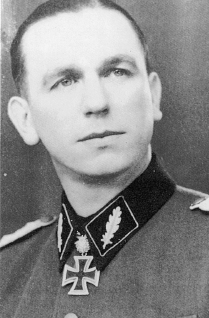
SS-Standartenführer Kurt Meyer.
The strength and intensity of Allied fire support from air, land, and sea was clearly a constant shock to the Germans and did much to shatter their attempts to fracture or destroy the expanding lodgment. Even the move up of 12th SS Hitler Jugend Panzer Division and Panzer Lehr had been disrupted to such an extent that they were condemned to be fed into the battle piecemeal without great gain and at serious loss.
Gains and Losses: 9 June (D+3)
On 9 June, 9 Brigade issued orders for a full-scale attack in four phases: Phase One was the capture of Cambes by the RUR; Phase Two, the capture of Galmanche by 1 Suffolk; Phase Three the capture of Malon; and Phase Four the capture of St Contest. The attack would be supported by the East Riding Yeomanry with a formidable amount of artillery fire from the Divisional Artillery and a cruiser off-shore.
The enemy in Cambes were the I/25 Panzergrenadiers that the RUR had fought over the previous two days. The II/25 had established themselves in Galmanche while the III/25 had dug in to its right north of Buron after being bloodied on the Canadians. The inter-divisional boundary between the 12th SS and 21st Panzer Division was effectively the railway line running north from Caen to Douvres and the sea. This line ran alongside the thick Norman wall around the Chateau at Cambes. The nearest troops of 21st Panzer Division to this boundary were at La Bijude on the Caen-Mathieu road and at Chateau de la Londe and Le Londel where 5 and 7 Companies of 192 Panzer Grenadier Regiment were dug-in. From La Bijude to Cambes was a clear field of fire.
The RUR started their attack at 1515 hours using a Start Line on the south edge of the village of Anisy west of Mathieu. The objective of the two leading companies was to seize the northern half of Cambes through which the follow-up companies would pass to take the rest of the village. There was some 1,500 metres of completely exposed ground from Anisy to Cambes. The battalion advanced steadily under cover of heavy supporting artillery fire. About 1,000 metres from the enemy, the advancing troops crested a small ridge and came into the full view of the Germans. The enemy now opened fire with machine guns and indirect fire. The CO of the East Riding Yeomanry was watching the RUR advance. He said, ‘This is where they get to ground, and the attack is held up.’
He was wrong. The battalion continued the advance in open order. A Company on the left suffered badly losing all three of the platoon commanders and a platoon sergeant. Yet the company took its objective in the final assault. D Company, under Major Montgomery, also carried its objective. The company commander was wounded twice during this action. C Company followed up on the left and supported by five AVREs engaged the enemy beyond the village. German guns in La Bijude knocked out all five of these tanks but not before they had destroyed one panzer. There then followed five hours of vicious shelling and mortaring as the RUR consolidated. The War Diary of 9 Brigade reported that the RUR success signal was fired at 1610 hours. Radio communications were not working well but the KOSB were tasked to advance into Cambes and reinforce the RUR. At 2015 hours they advanced from Le Mesnil as far as the 8-foot wall by the railway and the grounds of the Chateau. There they assisted the RUR in clearing the village and consolidating the position. As a result of this action the RUR was awarded three MCs, a DCM, and two MM but they had lost ten officers and 172 other ranks. The KOSB had three killed and thirteen wounded in total. The losses for this operation also included Lieutenant Colonel Tom Hussey, commanding 33rd Field Regiment RA, Major Brooke commanding the direct support battery, and one of the Forward Observation Officers (Captain Roose). From 2 Middlesex, Major Passy and Captain McDowell and CSM Bell were all killed.
At about the same time that the RUR were preparing for their attack, 1 Suffolk had moved forward to an Assembly Area at Le Mesnil. The CO, Lieutenant Colonel R E Goodwin, moved forward in his carrier to be co-located with Brigade HQ ready for Phase Two. He understood that the codeword for this phase had been issued. He moved off to reconnoitre the battalion’s advance to Galmache. Disaster then struck. His carrier was hit by anti-tank fire and he was severely wounded, while his Intelligence Officer and signaller were killed. Major Kit Gough, the second in command, now took over the battalion. At this point Major General Rennie came forward to assess the situation for himself and based on his analysis he gave the order to 1 Suffolk ‘Firm base where you are.’ The battalion established a defensive position around Le Mesnil Farm where Luftwaffe fighters, dropping fragmentation bombs, subsequently attacked them.

Major Kit Gough.
On the flanks the East Riding Yeomanry had been engaged to the west of Cambes and had two tanks destroyed while to the east, a further tank was lost to fire from La Londe. German reports of the day’s actions reported the break-in to Cambes, but failed to mention the severity of their losses. The reports again emphasised the weight of enemy supporting fire but noted that this apparent attempt to split the two panzer divisions along the boundary had been foiled by the flanking support fire of 22 Panzer Regiment at La Bijude.
Stabilizing the Front
With the exception of events at Chateau de La Londe, the front from Beauregard and Herouville on the Orne Canal to Cambes in the west would be stabilised for the next fortnight. The two opposing forces now dug in, laid minefields, conducted aggressive patrolling and shelled each other. Even at this stage the campaign had already degenerated from being a battle of manoeuvre to an attritional slugging match. Both opposing armies had missed opportunities for decisive action. To some extent General Crocker had considered this eventuality in his 1st Corps Operations Order. He had stated that:
‘Should the enemy forestall us at Caen and the defences prove to be strongly organised thus causing us to fail to capture it on D-Day, further direct frontal assaults which may prove costly, will not be undertaken without reference to 1 Corps. In such an event 3 Br Inf Div will contain the enemy in Caen...’
He hoped that the on-going build-up of Allied reinforcing divisions would allow for greater freedom of manoeuvre in less well-defended areas. Underlying this concept of operations was the notion the Caen was a critical pivot upon which a breakout from the western American sector of the bridgehead would swing.
The ‘exception’ to any change referred to above took place l0 June. According to German records the buildings of le Londel and la Londe to the north east of the Chateau de la Londe were occupied by the 5 and 7 Companies of 192 Panzer Grenadier Regiment with support from tanks at La Bijude. But during the night of the l0th D Company of the South Lancashires seized hold of Le Londel. Lieutenant Colonel Eddie Jones, then a platoon commander with the Battalion, described how the Company was able to walk in, occupy the position and begin to dig in. Some 600 metres away at the Chateau de la Londe the enemy were doing the same thing. The Battalion occupied the whole site which consisted of the Chateau le Londel surrounded with its solid stone wall, an accompanying farm house, out-buildings, and barns that made up a little hamlet on its own. The French families still in occupation were evacuated.

Chateau de la Londe – after the battles in late June.
It was an important position. From it one could see over the relatively flat ground over to Bieville to the east, Lebisey to the south east and to the high ground overlooking Caen to the south. A Company, in which Jones was serving, occupied a position on the right of the Battalion area, just forward of the farm buildings on the other side of the track that ran almost due south to the enemy positions in the Chateau de la Londe. Looking south he could see two or three knocked-out British 3-tonner trucks on the road from Mathieu to Caen. They must have driven straight into enemy lines earlier in the battle. A further attack on La Londe and the Chateau de la Londe was planned but was called off by the Brigade Commander because of signs of German reinforcement, though La Londe was still reported as clear. The Germans were clearly sensitive about holding this group of buildings that ran from La Bijude to Le Londel because that evening the enemy made preparations for an attack to re-secure the positions.
The noise of German tanks forming up was heard and a very heavy artillery barrage was opened up on them so that the attack was disrupted. The history of 21st Panzer Division states that at first light 5 Company of 192 Panzer Grenadiers, strengthened with some sappers of 220 Panzer Pioneer Battalion, was able to throw the British troops out of Le Londel and reoccupy their old positions. As Le Londel remained in British hands thereafter this German version lacks authority and is unsupported by a War Diary or other reference. Eddie Jones did describe how shelling and mortaring on Le Londel increased and at first light one morning, how a troop of German SP guns came up and began shelling his Platoon positions at point blank range for several minutes. They withdrew before any effective response could be organized. Fire was concentrated on the farm buildings instead of the slit trenches forward of them but nevertheless several of the Platoon were killed. The farm buildings were soon reduced to rubble.
The pattern of patrolling and improving defences by both sides continued for the next ten days. So did the shelling but there was a great difference. The weight of artillery fire by the 3rd Division’s artillery group far exceeded that of the enemy’s. German accounts draw much attention to the unceasing storm of fire they were subjected to, and the great expenditure of ammunition, which they were unable to match. In addition to supporting their own troops the 3rd Division’s artillery was also kept busy in support of 6th Airborne and 51st Division across the Orne. The regular daily rate of 100 rounds per gun could be increased to as much as 400 rounds per gun during an attack. To this weight of fire should be added the heavy mortars and machine guns of the Middlesex. The strength of this support was particularly encouraging to the troops confined to their slit trenches for much of the day. A ‘Victor’ salvo from HMS Rodney was also a great morale-booster. The History of 2 KSLI describes how it was the custom to fire ‘One minute’s worth of hate’ at Lebisey several times a day with at least five regiments of guns, the fleet, all the medium machine guns, and all the mortars in range.
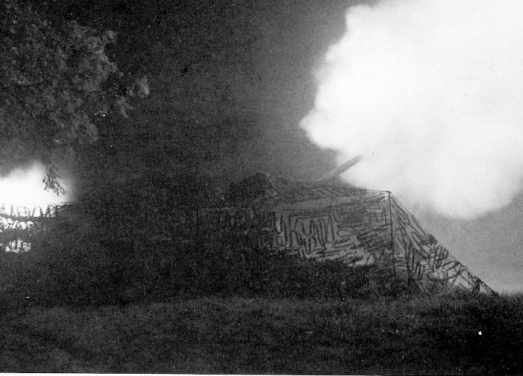
A battery of British 155mm guns firing in support of the advance in Normandy.
3rd Division learnt from a Polish deserter that this had been particularly effective on the very first attempt when it had caught the German defenders on their way to get breakfast from their field kitchen. There was a sense of grim satisfaction in the knowledge that for every shell fired at 3rd Division the enemy got at least ten back. Nevertheless, despite this disparity in the weight of shelling the Germans were still inflicting casualties. 9 Brigade suffered greatly; during the next four weeks the Lincolns reported a stream of casualties from the shelling and mortaring of their positions and as a result of the 3rd Division’s aggressive patrolling policy that was enforced throughout this period.
There were some notable patrols. Captain Gilbert commanding ‘C’ Company 2 Lincolns moved his company out from Cambes wood to carry out a raid on known enemy positions in Galmanche to obtain, if possible, a unit identification. The plan was to form a firm base halfway between the British and German positions and then to send a strong patrol from the east and another from the west. This was done and although the enemy was initially surprised the Germans fought back fiercely. There was hand to hand fighting with many casualties inflicted on both sides. Lieutenant Pacey leading one patrol was wounded in the thigh but got back; Sergeant Ward leading the other patrol when surrounded, fought his way out with bayonet and grenade, bringing back two wounded men with him. Pacey was awarded the MC, and Ward the MM.
Lieutenant Frank Matthews with 1 Suffolk led a very successful patrol that brought back valuable information about enemy positions at La Bijude. He was severely wounded but managed to get back to his own lines. His wounds were so bad that he could not be evacuated immediately to England. On the left of the Division’s line their was a similar emphasis on aggressive patrolling. The KSLI at Bieville had a thick wood known as the ‘Square Wood’ to their right front between Epron, the Lebisey ridge and Bieville and their own positions, which caused them some problems. It overlooked the deep ravine south of Bieville and was a potential base of operations for enemy use. The Battalion was ordered to send out a standing patrol each night to this very dense wood. The enemy tended to mortar it quite heavily from time to time and to send out fighting patrols to dominate the area. The enemy managed to infiltrate the position on one occasion though the patrol was withdrawn successfully; a few days later a heavy mortar attack killed four and Lieutenant Higginson was so badly wounded that he died later before he could be evacuated.
185 Brigade held the left of the line from Bieville to the canal. The Norfolks had sighted a defensive line based on the south facing spur centered on the Bellevue farm complex (‘Norfolk House’) and the former German defensive position known in the OVERLORD operations orders as Rover. A forward screen of three platoons and the carrier platoon was sited 2,000 metres forward from the canal westwards. This was nicknamed ‘Duffers Drift.’ The Norfolk regimental historian gleefully noted that:
‘The enemy, who obviously did not understand, motored down the road [from Herouville] and so fell nicely in to the trap prepared by B Company. Within a week the bag was one marine officer, thirty-five other ranks, five vehicles and two motorcycles. Then someone in the enemy lines must have put up a notice to the effect that no one came back from that particular road.’
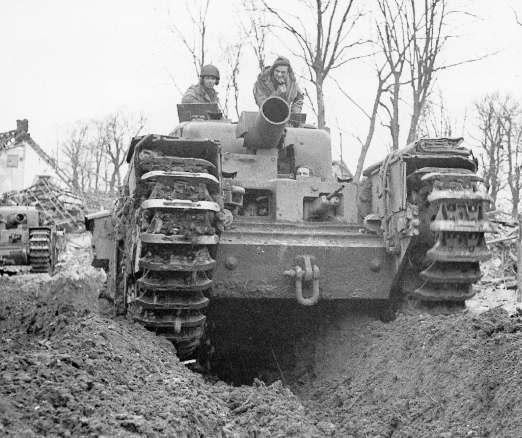
Churchill AVRE.
In addition to ‘Duffer’s Drift’ the Norfolks had their share of constant patrolling. In their case this meant on the very left of the line checking the low-lying ground up to the Orne Canal that included a factory area; they also patrolled to their front towards the Lebisey position. On one of these patrols led by Captain Fearon on the forward slopes of Lebisey Wood, he and his Sergeant, were both wounded having completed their task. Fearon was unable to move and ordered Sergeant Thorne, in considerable pain himself, to return with the information. Fearon died that same day while a prisoner. On l3 June General Rennie on one of his constant visits to forward units was on his way to Cambes. The Commander of 9th Field Ambulance, Lieutenant Colonel Wood was with him and suggested a short cut. Johnnie Beck of the 3rd Recce Regiment was in Cambes as a Contact Detachment. He recorded the General’s arrival in Cambes as from ‘the hostile end’ and the blowing up of his jeep on a British laid-mine intended to protect the position. Both the General and Colonel Wood were evacuated to England. Norman Scarfe in Assault Division wrote of the deep, sincere regret with which the Division heard of the General’s misfortune. In the meantime Brigadier Cass took temporary command of the Division while Colonel Foster of 76th Field Regiment commanded 8th Brigade.
Mention should also be made of another action that involved part of the 3rd Division. The Radar Station at Douvres-la-Delivrande (now an excellent museum) that had been attacked unsuccessfully early on in the invasion was finally taken on 17 June. Douvres was actually a Luftwaffe strongpoint designed to protect and sustain the radar station located within its perimeter. The radar had been destroyed by air attacks about three weeks before D-Day. By 17 June the fortified installation contained about 230 men including a company of Panzergrenadiers from 21st Panzer Division and stragglers from the beach defences. Though in the Canadian sector, it was a 3rd Division team that forced the surrender of its garrison that was equipped with three Pak 5cm, three Kwk 5cm, six Flak 2cm, twenty machine guns, twelve flame throwers and three heavy and one light mortar. The commander of the strongpoint, Oberstleutenant Igle, held out in his position until 17 June repelling all enemy attacks. With a reinforced and buried telephone cable running from his command post to Caen he had been able to give 716th and 21st Divisions very precise target data and situation reports right up to his defeat eleven days after D-Day.
During the first few days ashore much had been happening behind the defensive positions being held by the forward infantry battalions. For the infantry there may not have been much going on the surface but nevertheless the routine was a far from relaxing one. There was stand-to at dusk and dawn. The night was occupied with sentry duties, patrols, mine laying and improving individual positions.
Feeding was an essential component of physical and mental well being for the forward combat elements. Quartermasters and their staffs did their best to ensure rations were brought up and other supplies were being delivered. It was not all as planned. The transport bringing the large packs and other essential equipment, for example cookers and food containers, for 1 Suffolk had been lost at sea in a ship that had been sunk. Though it was June the nights were still cold and the absence of greatcoats was felt. Food had to be prepared on a platoon or individual basis and it was not possible to light fires without giving away positions. The KSLI did not get their unit transportation until D+13; they should have been landed on D+4.
Throughout this period those elements not in contact with the enemy were carrying out their duties to support the forward units. Sappers, Signals, Service Corps, Medical, Ordnance, REME, Provost and that essential morale booster the Postal Unit were all working flat out, ensuring that everything that could be done in the circumstances was being done to the best of their ability. The bridgehead was still very restricted and nowhere was completely safe from shelling and bombing even though the latter was on a relatively limited scale, thus all were at risk even if they were not in the front line.
Norman Scarfe in his work Assault Division drew attention to the question of morale in the 3rd Division during this period. He noted that great concern had been caused amongst the troops, by the inexplicable delay in the delivery of homeward mail. No mail posted by the Division in Normandy was delivered home for over a fortnight after the assault. Even more importantly, for those serving in the bridgehead, the Press and the BBC had made absolutely no mention of the role of the 3rd Division, although other divisions such as the Canadians, the 6th Airborne and the 50th (Northumbrian) were given early coverage.