
Jimmy Carter, in his last days as US president, led the worldwide condemnation of the Soviet invasion, calling it the ‘most serious threat to world peace since the Second World War’. The US shipped arms to the Mujahideen rebels, brought a halt to the ratification of the arms limitation talks (SALT II), increased military spending and, as a final gesture, announced its boycott of the coming summer Olympics in Moscow, the first to be held within the Eastern Bloc. Moscow, meanwhile, insisted that the Kabul government had invited them in and that Amin had been ‘executed by a tribunal for his crimes’. No one believed them.
Karmal promised democracy, elections and a new constitution, and replaced the Soviet-inspired red flag with a more traditional Muslim one. But despite Karmal’s promises and his attempts to stabilize matters, the country fell into a state of anarchy and civil war. As a mere pawn of Moscow, Karmal failed to secure respect. The different factions of the PDPA (the Afghan communists) killed each other as well as hacking to death anti-Soviet Afghans and members of the Islamic Mujahideen.
Moscow tried to leave the fighting to the Afghans but as more Soviet citizens were killed they found themselves increasingly drawn in. They had expected that the Mujahideen would cave in as soon as Soviet troops appeared on the scene and that they could withdraw within a matter of months. They also expected to be welcomed by the Afghan population as liberators, freeing the country from Amin’s ruthless rule. They were much mistaken on all accounts – it would be another nine years before they would withdraw.
The Soviets soon controlled all urban areas and the main lines of communication but lacked the resources and experience to subdue the Mujahideen roaming the inhospitable rural landscape. Having failed to engage their enemy the Soviets resorted to destroying their livelihoods through a comprehensive scorched-earth policy, decimating land, crops, farms, irrigation systems and livestock. The result saw over 5 million Afghan civilians streaming across the borders into Pakistan and Iran where they were accommodated in huge refugee camps.
For the young recruits into the Soviet army (pictured below) the war in Afghanistan was a frightening and brutalizing experience, fighting an enemy which considered death as an honour and a means of achieving martyrdom. The Mujahideen and much of Afghanistan’s population hated the Soviets for their godlessness; their atheism was an anathema to Afghanistan. For the Soviet Union, Afghanistan rapidly became their Vietnam, as feared; an unwinnable war in a hostile foreign land against a fanatical foe. So many young Soviet soldiers were killed they were named ‘Zinky Boys’, after the zinc-lined coffins that took them back to Russia.
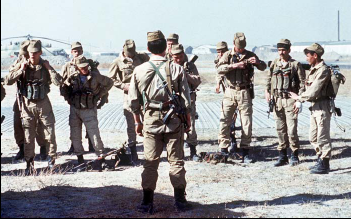
Soviet soldiers in Afghanistan, 1988
Photo by Mikhail Evstafiev
The Russian troops, driven by fear, committed awful atrocities and, unable to distinguish villager from guerrilla fighter, indiscriminately killed civilians and whole villages. Soviet equipment was poor – noisy boots that gave away their positions, heavy, cumbersome backpacks, cotton sleeping bags that soaked up the rain, inedible food rations. They scattered mines everywhere, which blighted the landscape for years. One particular type of mine resembled a toy and many Afghan children were to suffer for their curiosity. The Soviets felt they could never trust their colleagues in the Afghan army who, in increasing numbers, defected to the Mujahideen, taking food, equipment and weapons with them, together with intelligence about Soviet tactics and movements.
Much of the Soviet work in northern Afghanistan was undermined by Ahmad Shah Massoud. In 1983 Soviet forces called a temporary truce with the guerrilla leader, which served only to give Massoud time to reorganize, expand and strengthen his forces. Realizing their mistake, Karmal ordered Mohammad Najibullah, head of his secret police and future president, to hunt out Massoud and have him eliminated. The attempt failed as did several others but eventually, in 2001, two days before the 9/11 attacks, Massoud would be assassinated.
Ronald Reagan, US president from 1981, increased the shipment of guns and aid from the US, much of it sent through Pakistan and its intelligence service, the ISI (Inter-Service Intelligence). By the end of the war the US had given the Mujahideen 3 billion dollars. Much of the aid was siphoned off by the Pakistanis but the contribution still had a telling effect on the Mujahideen’s performance and how they were able to sustain the conflict and inflict increasing casualties on the demoralized Soviet forces.
US and UK military advisers helped train the Mujahideen and from 1986 the rebels started receiving assignments of the highly effective Stinger anti-aircraft missiles that could be carried on mules and fired from the shoulder. The missiles obliged the Soviet helicopters to fly too high to offer air cover for its ground troops, and provided the Mujahideen with a huge boost to their confidence. Within fifteen years, scores of US-trained Mujahideen would defect to the Taliban and use their skills against the very nation that had trained them. Iran, China, Egypt and others provided aid, as did Saudi Arabia and the son of a Saudi billionaire, named Osama bin Laden. Bin Laden financed much of the Mujahideen’s infrastructure, including the building of roads and arms depots.
The Soviet Union saw the death of three ageing leaders during its time in Afghanistan, Brezhnev died in 1982, Yuri Andropov 1984 and Konstantin Chernenko in 1985. March 1985 saw the appointment of the youngest man to hold the position of General Secretary, 54-year-old Mikhail Gorbachev, the first Soviet leader to be born after the Russian Revolution.
Gorbachev stepped up the campaign in Afghanistan, spending more and sending in greater numbers of troops. Up to 110,000 Soviet troops were present in Afghanistan at any one time and by the end of the war over 600,000 had served in the country. Gorbachev’s escalation was repaid with a number of victories but the victories came with high casualty rates and ultimately proved worthless as the Mujahideen withdrew only to re-emerge later and reclaim what the Soviets had won.
Within a year Gorbachev had replaced the ineffectual Karmal as president of Afghanistan with Mohammad Najibullah, Karmal’s former head of secret police and a one-time boxer. Najibullah, or ‘the Bull’, was a violent, brutal man who relished in the torture and execution of his opponents. Najibullah realized that his Soviet-backed regime would never defeat the Mujahideen rebels and, at the same time as calling them ‘traitors and filthy vultures’, he extended various offers of reconciliation to the Mujahideen. Not surprisingly, the Mujahideen rejected them all.
Gorbachev introduced the word glasnost, meaning openness, into the Soviet system, a move away from the traditional Soviet model of a closed society with its secret industrial cities and cloak-and-dagger governance. Before Gorbachev, critics of the war risked exile but with openness came truth and the realization of what the war in Afghanistan was really like. The huge numbers of returning soldiers told their stories and confirmed the public’s worst fears. The human cost was unacceptable to public opinion and ultimately Gorbachev had to agree, calling Afghanistan a ‘bleeding wound’.
The Soviet Union was also suffering economically and the cost of the war in Afghanistan drained precious resources that were much needed at home. It was time, the Politburo declared in February 1988, to withdraw. The last Soviet troops left the country a year later, on 15 February 1989 (pictured below). Finally, after 9 years and 50 days, and over 13,000 Soviet deaths, the ‘Soviet Vietnam’ had come to an end.
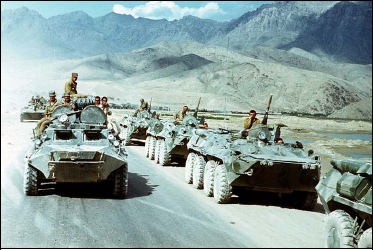
Soviet soldiers withdrawing from Afghanistan, 1988
Photo by Mikhail Evstafiev
The last Soviet soldier to leave Afghanistan was one General Boris Gromov who, having crossed Friendship Bridge into Soviet Uzbekistan, said, ‘There is not a single Soviet soldier or officer left behind me. Our nine-year war is over.’ The Soviet-Afghan War may have been over but a new one was already beginning.