
The Soviet forces may have left but the Soviet-backed president, Mohammad Najibullah, remained in power. Immediately the loose alliance of the Mujahideen, that had been forged by the invasion, fell apart, splintering into different regional, ethnic and religious groups. Afghanistan erupted into a brutal, protracted civil war that was to last until 1996 and was more intense in its violence than anything witnessed during the Soviet-Afghan war.
The US and the USSR continued to supply military aid to the Mujahideen and the Afghan government respectively. The Soviets supplied quantities of Scud missiles which the Afghan communists used to great effect, but which the Soviet Union could ill afford. The efforts of each side, the Afghan government and the Mujahideen, were distracted by internal conflict and infighting. Within the Mujahideen two men emerged as leaders of rival factions – Ahmad Shah Massoud, the ‘Lion of Panjshir’, and Gulbuddin Hekmatyar.
Pakistan saw Hekmatyar as their man in Afghanistan and wished to see him replace Najubullah at the head of the Afghan government. In March 1989, only two weeks after the Soviet withdrawal, Hekmatyar’s Mujahideen, heavily backed by the US and Pakistan, launched an attack on government forces in the city of Jalalabad. Initially government troops quickly surrendered to the Mujahideen only to be executed, which had the effect of strengthening their resolve. But the use of Soviet Scud missiles decimated Hekmatyar’s forces and by May, with Jalalabad still firmly in the government’s hands, the Mujahideen abandoned the attack. Although casualties on both sides were heavy, the main victim was the civilian population, with an estimated 15,000 dead. Ahmad Shah Massoud, meanwhile, had stayed aloof from the battle, criticizing Hekmatyar’s methods.
Massoud eventually forced Hekmatyar out of Kabul, the latter withdrawing only a short distance from where he was able to launch numerous bomb attacks on the capital.
The inter-factional war between Hekmatyar and Massoud intensified and when some of Massoud’s men fell into Hekmatyar’s hands they had their eyes yanked out and their noses cut off. Massoud responded with dignity, saying, ‘My message to Hekmatyar’s people is that without a united front we cannot succeed, we cannot achieve anything in Afghanistan.’
Internal divisions plagued the government in equal measure. In March 1990, Najibullah’s defence minister, in cahoots with Hekmatyar, staged a coup against Najibullah. Its failure gave Najibullah the opportunity to crack down on his opponents within the government.
In August 1991, Boris Yeltsin, the newly appointed president of the Russian Federation, stopped all aid, military and economic, to the Afghan government. As Afghan refugees, displaced by the Soviet invasion, returned to Afghanistan, the situation became severe. Food shortages caused widespread discontent, and soldiers, hungry and lacking weapons, began to desert.
Najibullah appealed to the West, pointing out his liberal credentials, such as his commitment to the emancipation of women, and warned that an Afghanistan under the likes of Hekmatyar would descend into repression and further chaos. His appeals were ignored. Once his most senior general, Abdul Rashid Dostum, had defected to Ahmad Shah Massoud’s side, Najibullah’s position as president became increasingly vulnerable. Further defections forced Najibullah into resigning and in April 1992 he tried to flee from Kabul to the airport, where an aeroplane was ready to fly him to India. But en route his car was stopped by troops loyal to General Dostrum. Najibullah’s driver executed an abrupt U-turn and managed to deliver Najibullah safely into the United Nations compound within the capital, where he was to remain until he suffered a gruesome death at the hands of the Taliban.
The sixteenth of April, the day Najibullah, the last Soviet-backed leader, fell, was celebrated as the Mujahideen Victory Day. But victory did not bring peace.
Following Najibullah’s flight, an interim government was established containing different factions of the Mujahideen. The Pashawar Accords of April 1992 decreed that its first interim president, Sibghatullah Mojadeddi, should stand for two months, and this would be followed by a four-month presidency under Burhanuddin Rabbani, while the government prepared for its first round of elections. Mojadeddi, having proclaimed the Islamic State of Afghanistan, duly stepped down in June 1992 after exactly two months but Rabbani, when the time came, did not. With Ahmad Shah Massoud at his side as defence minister, Rabbani failed to honour the agreement of the Pashawar Accords and was determined to hold on to power.
Hekmatyar remained a thorn in the new government’s side and Rabbani, having called Hekmatyar a ‘dangerous terrorist’, twice offered him the post of prime minister, the first time in 1992. Hekmatyar refused, opting instead to bomb Kabul (pictured below). Hekmatyar’s men freed the prisoners from the city’s jail and the scene was set for an orgy of bloodletting. The battle over Kabul lasted for four years. Through bombs and summary executions, half the city was destroyed, 25,000 of its population butchered, and women raped en masse.
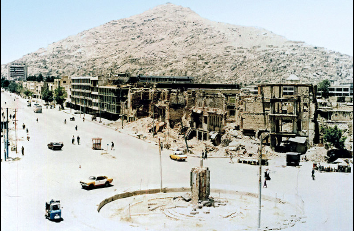
Kabul during the Afghan civil war, 1993
Photo from RAWA
Hekmatyar, backed by Pakistan, purposefully targeted civilians, wanting to undermine Rabbani’s role as president and expose his inability to protect his citizens. But his attempts to take the capital were thwarted by Massoud’s stern defence of the city.
Pakistan, frustrated by Hekmatyar’s lack of success, began backing a new arrival on the scene – the recently formed Taliban.