

1

IN 1841, A FUTURE PRESIDENT OF THE UNITED STATES BOARDED A CANAL boat just outside Louisville, Kentucky, and then watched in horror as a group of shackled slaves came into view on deck. As he soon learned, the poor souls were being transported to the Deep South—there to be sold into almost unimaginably cruel bondage in sweltering rice and cotton fields.
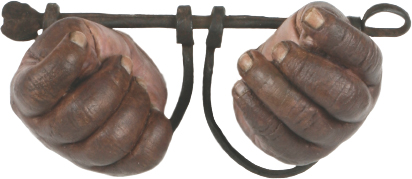
PLATE 1–1
Abraham Lincoln never got the scene out of his mind. He was on his way home to Illinois at the time after spending nearly six weeks vacationing at his best friend’s plantation. Being served there by enslaved people night and day never seemed to bother him or nag in the least at his conscience. But the sight of the shackled slaves heading south burned itself indelibly into his memory.
“They were chained six and six together,” he painfully recalled. “A small iron clevis was around the left wrist of each, and this fastened to the main chain by a shorter one at a convenient distance from the others; so that the negroes were strung together precisely like so many fish upon a trot-line. In this condition they were being separated forever from the scenes of their childhood, their friends, their fathers and mothers, and brothers and sisters, and many of them, from their wives and children, and going into perpetual slavery where the lash of the master is proverbially more ruthless and unrelenting than any other where.” Lincoln seemed particularly bewildered that the restrained slaves seemed happy, sang songs, played cards, and “cracked jokes,” immune to their fate or, more likely, bravely determined to make the best of it. He was so haunted by the scene that he admitted it still made him “miserable” thirteen years later.
But even Lincoln probably never saw shackles quite as haunting as the tiny pair in plate 1–1. This gruesome relic of slavery was designed to restrain a mere child. Experts have determined that this particular set of manacles—also called bilboes (perhaps because they were first made in Bilbao, Spain, for use by the Spanish armada)—dates to about 1800, showing that little had been done to improve them over the preceding decades, for they closely resemble similarly crude shackles recovered from the wreck of the slave shipHenrietta Marie, which sank off the coast of Florida a hundred years earlier, in 1700.
Some slave masters and ship captains might cushion such restraints with a layer of rope, but if they did, it was primarily to prevent abrasions and infections that might reduce a slave’s market value. Most slave traders of the period used restraint as a precaution, precisely as the owners of another eighteenth-century slave ship, the Dispatch, made clear in their instructions to their captain: “Keep ’em shackled and hand Bolted fearing their rising or leaping Overboard, to prevent which let always a Constant and Carfull watch be appointed to which must give the strictest Charge for the preservation of their own lives, so well as yours and on which the voyage depends.” In other words, shackles were necessary on these voyages so captives would not jump into the sea to escape their fate or revolt against their kidnappers. After all, the Africans were valuable cargo: they simply had to be secured.
Bilboes like those in plate 1–2 often linked two people together. So the modern viewer must conclude that two different children, perhaps members of the same uprooted family, might once have been restrained by these crude shackles. The more compassionate ship captains would chain their cargo only when the ships remained in tantalizing sight of their African homeland—or when they first approached an unknown port in the Americas. That was when the captives were most likely to stir in anger or fear and attempt an escape. The slave trade historian George F. Dow discovered a document in which a captain writing in the late seventeenth century admitted: “When our slaves are aboard we shackle the men two and two, while we lie in port, and in sight of their own country, for ’tis then they attempt to make their escape, and mutiny.” Still, only on the rarest occasions were restraints forced on women or children; the cruelty or fear that inspired these particular contraptions is almost incomprehensible. As the writer Corey Malcom has persuasively written, the people of any age restrained by devices like these “were barely considered human, and would never again be free.”
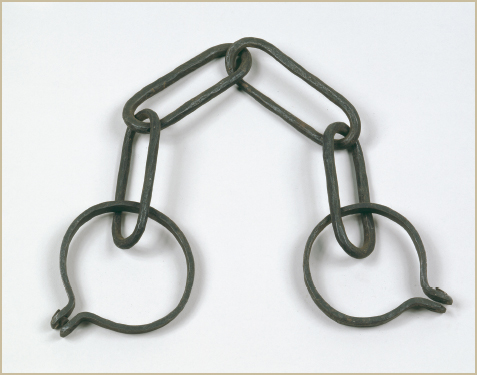
PLATE 1–2
Slave shackles, ca. 1866
Just as surviving bilboes evoke a visceral impression of bondage, surviving evidence of unshackling animates a more joyful part of slave history: the breaking of chains that came with liberation, in forms both symbolic and vividly real. Since 1921, the New-York Historical Society has also owned a set of shackles once literally cut from the ankles of a pretty seventeen-year-old Georgia slave named Mary Horn by Lieutenant Colonel William W. Badger of the 176th Regiment, New York Volunteers, who served as provost marshal of Sumter County, Georgia, during the early days of Reconstruction. Mary’s owner, an unrepentant former judge and legislator from the town of Americus, had reportedly fastened the shackles on her ankles to keep her away from her lover, George, who lived on a nearby plantation. Only when the 176th marched into the neighborhood did George demand that his fiancée’s humiliating restraints be removed.
The amazing part of this story is that these events appear to have taken place in 1866—the year after the Civil War ended, well after slaves like Mary and George had been legally freed under the terms of the Thirteenth Amendment to the Constitution. The reality was that former masters continued to hold immense power over their former “people,” inciting much violence bred by what a contemporary described as “fierce misunderstandings” and “brutal ignorance.” With Badger installed in the neighborhood, George summoned the courage to report the judge’s treatment of his beloved, protesting that the ex-master had forbidden the two to see each other, much less get married. Mary had tried running away, but George’s former owner had returned her to the judge, who then forged the shackles to restrain her. For weeks she had been forced to work in the cornfields with the painful restraints tearing at her legs.
Colonel Badger listened to George’s story and quickly issued a summons. The girl was duly brought to him, still wearing the chains, her ankles “wrapped with rags to prevent their galling the flesh.” George himself held Mary over an anvil while Colonel Badger pierced the rivets with a cold chisel and freed her—retaining the odious souvenir for himself. The colonel then performed some kind of ceremony joining George and Mary in matrimony and advised the newlywed husband to protect his wife with his life. The old judge was tried by a military court and punished, but he subsequently returned to his plantation. A year later, George reportedly killed Mary’s former master during a melee with the stubborn judge’s former slaves. In a way, justice had finally been done.