
2

ALL WE KNOW FOR CERTAIN ABOUT “CAESAR,” THE ELDERLY EX-SLAVE who gazes so poignantly across time from the justly famous pre–Civil War daguerreotype in plate 2–1, would fill no more than a long caption. Yet what the breathtaking portrait conveys about the system that kept Caesar in bondage for much of his life—yet apparently failed to deprive him of his spirit and his dignity—speaks volumes.
We have precious little reliable documentation about the subject himself—only traditional stories asserting that Caesar was the very last slave manumitted in New York State and that he endured so long in bondage that he outlived three or four generations of masters on the Nicoll family estate in Bethlehem, New York, west of Albany. According to the inscription on his marble tombstone, Caesar was born in 1737 and died in 1852—which would mean he lived to be an astounding 115 years old.
Caesar was born the property of Rensselaer Nicoll, the descendant of an extremely wealthy New York family, and grew up as the playmate of his master’s son Francis, who took him as his own possession when he married and moved to a nearby estate. When an aging Nicoll lapsed into senility, Caesar was tasked with the daily job of rocking him to sleep in an oversized cradle. After the old man’s death, Nicoll’s widow passed Caesar on to her son, who assigned him responsibility for the family stables. Caesar may even have driven the Nicoll family on their annual winter sleigh rides to New York City. One only hopes that he got to see something of the countryside during these rare sojourns. As it turned out, Caesar survived this owner, too, but when New York in 1808 enacted a law freeing all slaves under sixty-five, the old servant was already seventy and thus ineligible. Although his own children and grandchildren secured their liberty, Caesar was passed down from generation to generation like a family keepsake.
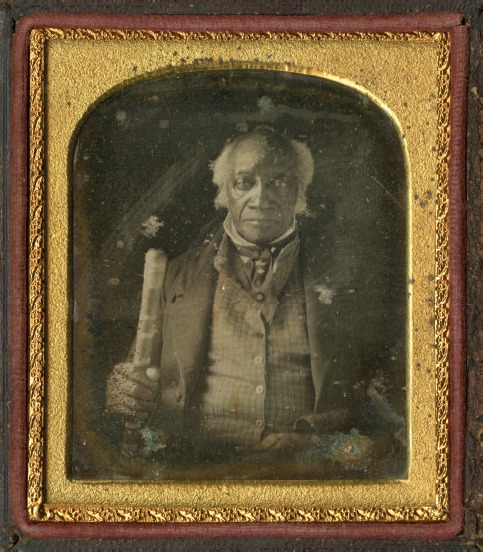
PLATE 2–1
Certainly, some of that legendary survival instinct shows vividly in this portrait: Caesar’s strong expression suggests uncompromised vigor and dignity. He cannot conceal the triumph of endurance. His fixed stare, his handsome attire, and the firm way he grips his staff all suggest that he believes—as the viewer is surely meant to appreciate—that he has earned every single year of his unimaginable life in bondage. Caesar reflects not only vitality under oppression but indomitability.
But why were such visual documents created in the first place, since they could only testify to the ubiquity and inhumanity of slavery and inevitably incite opposition to the institution? Odd as it may seem, some of the same masters who kept their human property in dehumanizing shackles—sometimes literally, as we have seen—occasionally, perplexingly, ushered them to local photographers to record their images. In many cases, we might even assume, the subjects of such mementos were house slaves beloved, in some perverse sense, by the white families they served. Caesar, needless to say, was a natural subject for such a memento. Because of his advanced age he was a curiosity—and also perhaps a highly useful living testament to the benevolence with which slaveholders insisted they treated their chattel. How else, after all, could a slave survive to 115 unless he was well cared for? Apparently, he had already inspired a portrait in another medium. In 1849, an artist named G. W. Woodward had executed a profile sketch of the living marvel as he sat dozing in a chair. Then, around 1850, his current master’s son persuaded Caesar to sit for this daguerreotype.
On other occasions, for altogether different reasons, so-called slave pictures were commissioned by abolitionists in the North to demonstrate the humanity of indefatigable African Americans who had fled or survived bondage. In some famous cases (such as a widely reproduced photograph of a slave whose scarred back was vividly lacerated by years under the whip), they were clearly meant as atrocity pictures designed to inspire popular revulsion against the institution.
Caesar was alive when New York State rather reluctantly enacted its first “manumission” law in 1799 (Pennsylvania, Connecticut, and Rhode Island had banned slavery earlier). New York’s Act for the Gradual Abolition of Slavery promised eventual freedom to slaves born after July 4, 1799, but not all at once. Males remained enslaved until the age of twenty-eight, females until the age of twenty-five—which meant Caesar and others of his older generation did not qualify for freedom: they were reclassified as “indentured servants” but remained technically in bondage. Thus only in 1827 did slavery as such disappear altogether in the Empire State. Even then, part-time residents of the state were still permitted to bring slaves to New York. Seven years later, in 1834, white rioters attacked a free black community in Manhattan, driving most of its residents out and destroying their homes. Not until 1841 were all forms of slavery banned entirely, and it is conceivable that Caesar did not actually gain his legal freedom until then.
If the ca. 1850 date attributed to Caesar’s daguerreian portrait is accurate, then the image is also embedded with a powerful historical irony. That year, Congress, led by Senators Henry Clay and Stephen A. Douglas, cobbled together a package of bills meant to take the steam out of the percolating national debate over slavery expansion. For four years thereafter, the legislation did successfully keep the slavery genie in the bottle. But included among the planks of the famous Compromise of 1850 was a toxic provision requiring citizens in all the states to return fugitive slaves to their masters. The result was particularly painful to progressive New Yorkers. Enactment of the new legislation meant the nullification of the state’s long-standing Personal Liberty laws, which had offered some hope of justice and safety to runaways. New York’s free African American community reacted to the 1850 compromise with outrage, forming committees to resist enforcement of the Fugitive Slave Act, holding mass protest rallies, and publishing disparaging editorials. One of those who came close to proposing violence to protect black fugitives was technically a fugitive slave himself: Frederick Douglass, now a well-known orator and editor and an increasingly influential voice for abolition. “If the American revolutionists had excuses for shedding but one drop of blood,” he contended, “then have the American slaves excuses for making blood flow ‘even unto the horse bridles.’”
That August, just before President Millard Fillmore approved the compromise, Douglass appeared in Cazenovia, in upstate New York, to address the two thousand delegates to the Fugitive Slave Convention, called especially in protest. In a declaration urging American slaves to flee from slavery notwithstanding the new law, Douglass held out hope to an abandoned population. “You are ever in our minds, our hearts,” he assured them. “We cannot forget you, our brethren, for we know your sufferings…because we know from experience, what it is to be an American slave. So galling was our bondage, that, to escape from it, we suffered the loss of all things, and braved every peril, and endured every hardship.…[Do] not despair of your deliverance.”
Artists and photographers observed these seismic shifts too, and slowly began integrating the African American, if not into society itself, then at least into the visual culture of mid-nineteenth-century America. Subtly at first, these images testified to the inhumanity of the slave system and the ability of African Americans, given the opportunity, to rise above what the scholar Albert Boime called the “brute” status to which so many whites had relegated them. Every time such an image suggested a subject’s humanity, Boime contends, it reemphasized the “grotesque” incongruity of slavery in a nation conceived and dedicated to the proposition that all men are created equal.
Does Caesar represent the courage of surviving fugitives—or of slaves who had simply served for so many decades that their oppressors died off, leaving them free at last by virtue of longevity alone? It is impossible to know his full story for certain. But for all its mystery his powerful image still serves in a sense to illustrate the portentous advice to slaves with which Frederick Douglass ended his August 21, 1850, open letter reflecting on that year’s compromise legislation: “Be prayerful—be brave—be hopeful. ‘Lift up your heads, for your redemption draweth nigh.’”
Final redemption for all the enslaved people who continued in hopeless bondage was what the Civil War turned out to be about.